This paper asks how sustainability expertise is constructed, distributed across shareholder and employee representatives and translated into influence through the governance channels of parity codetermined supervisory boards in German listed corporations, as European sustainability regulation and scrutiny intensify.
Thirty-six semi-structured interviews with supervisory board members in parity codetermined listed corporations are analysed abductively through an integrated resource dependence and resource-based perspective. The analysis treats the two theories as jointly explaining how externally oriented resource dependencies and internally grounded capabilities are combined within board processes, tracing how directors construct sustainability expertise, how it is allocated across shareholder and employee benches, and how it becomes consequential through formal and informal governance channels.
Sustainability expertise is constructed less as an individual credential than as a collectively developed board capability combining regulatory literacy with operational understanding. Shareholder representatives tend to supply externally oriented regulatory and capital-market knowledge, whereas employee representatives contribute firm- and workforce-grounded implementation insight and longer time horizons. Codetermination thereby broadens the board's resource base but holds these logics in productive tension. Expertise becomes influential only when channelled through committee mandates, agenda-setting authority and informal cross-bench coordination. Boards vary, however, in whether these channels confine expertise to defensible compliance or open it to strategic integration.
The study is context-specific to large German parity codetermined listed corporations with a mandatory two-tier system. Because strategic sustainability integration unfolds over longer time horizons than a single interview phase can capture, future longitudinal research could trace how the governance channels identified here shape integration over time and across corporate governance regimes.
This paper opens the boardroom black box by theorising sustainability expertise as a dynamic, collective board capability and by specifying the mechanisms through which it is constructed, reconciled across competing resource logics and mobilised into influence. It shows how codetermination, by combining distinct shareholder and employee resource bases, conditions whose expertise counts and how it is converted into influence.
Introduction
Sustainability has moved from the margins to the centre of corporate governance, reshaping how boards are expected to oversee strategy, risk and reporting (Huang et al., 2025; Aguilera et al., 2021). In Europe, reforms such as the Corporate Sustainability Reporting Directive (CSRD) and the European Sustainability Reporting Standards (ESRS), alongside national corporate governance codes, increasingly require boards to demonstrate credible sustainability monitoring and adequate competence. Yet, hard and soft law rarely specify what “sustainability expertise” at board level actually entails, how it should be distributed among directors or how it should be used in decision-making (Bano et al., 2025) [1]. These ambiguities matter particularly in large listed firms facing heightened scrutiny around sustainability reporting and assurance, board accountability and value-chain responsibilities (Iliev and Roth, 2023; Kim et al., 2023; Peters and Romi, 2015).
The German setting is analytically revealing not only because of codetermination, but because it combines a mandatory two-tier system, a stakeholder-oriented code-law tradition and dense EU-driven sustainability regulation. In large listed German firms with parity codetermination (i.e. supervisory boards with equal shareholder and employee representation in corporations with more than 2,000 employees), shareholder and employee representatives jointly oversee management and must reconcile capital-market expectations, workforce interests and societal demands under tightening regulation. Although the empirical setting is Germany, the underlying challenge is universal: as European sustainability regulation intensifies, boards across jurisdictions face uncertainty about what constitutes relevant expertise and how it should be applied in practice. Codetermination presents an analytically sharp case because it reveals how sustainability expertise is co-produced across constituencies and when it becomes influential rather than merely disclosed.
Corporate governance research has largely studied sustainability oversight from the outside in, inferring board sustainability expertise from observable proxies, such as demographics, career histories, committee memberships and interlocks and examining it through firm-level outcomes (Homroy and Slechten, 2019; Iliev and Roth, 2023; Sieweke et al., 2025; Wang et al., 2024). This work establishes that board attributes and committee design are associated with sustainability outcomes and that employee representation can strengthen stakeholder orientation and employee-related disclosure (Li et al., 2023; Lopatta et al., 2020; Scholz and Vitols, 2019). Yet it leaves the board process opaque: how directors themselves construct and legitimise sustainability expertise, how it is distributed across shareholder and employee benches and how it enters the governance channels through which issues are prioritised, framed and decided. The integrated review developed below synthesises these strands to show why this process gap matters.
This paper opens that black box by asking a single, process-oriented question: how is sustainability expertise constructed, distributed across shareholder and employee representatives and translated into influence through the governance channels of codetermined supervisory boards? An interpretive interview approach is warranted because the core uncertainty is not whether “expertise” is present, but how it is claimed, contested, recognised and converted into agenda-setting, committee work and oversight in situ. Whether the same expertise is ultimately confined to defensible compliance or extended towards strategic integration emerges as a dimension of variation within this process rather than as a separate question.
To theorise these processes, the study integrates resource dependence theory (RDT) (Pfeffer and Salancik, 1978) and the resource-based view (RBV) (Barney, 1991; Wernerfelt, 1984). This dual resource perspective conceptualises sustainability expertise not as a fixed individual credential, but as a collectively produced board capability that bridges external legitimacy demands, such as regulatory and stakeholder expectations, with internal value creation, including operational feasibility and implementation insight. Codetermination is central to this capability because it institutionalises complementary resource endowments and accountability logics, while governance channels, including committee mandates (notably audit, remuneration and sustainability/strategy), agenda-setting authority and informal cross-bench coordination, condition whether expertise becomes consequential.
Empirically, the paper draws on semi-structured expert interviews with 36 current and former supervisory board members from parity-codetermined listed firms, collectively holding 68 parity-codetermined mandates. Abductive thematic analysis traces how sustainability expertise is constructed, allocated across benches and converted into influence through formal and informal channels.
This paper makes three contributions to corporate governance research. First, it conceptualises board sustainability expertise as a dynamic, collectively developed capability rather than a proxy-based individual attribute and specifies the mechanisms through which boards construct and credentialise it. Second, by integrating RDT and RBV, it explains how externally oriented resource dependencies and internally grounded capabilities are combined and reconciled across the shareholder and employee benches that codetermination institutionalises. Third, it identifies governance channels, namely committee gateways, agenda-setting authority and informal cross-bench coordination, as the mechanism that translates expertise into influence and shows why the same expertise can be confined to defensible compliance or extended towards strategic integration. The remainder of the paper develops the regulatory context and an integrated theoretical framework, outlines the research design, presents the findings and discusses their implications for corporate governance scholarship and practice.
Regulatory and normative context in Germany
The German setting is revealing because sustainability oversight unfolds within a dense web of binding regulation and influential soft-law expectations, alongside a corporate governance architecture that institutionalises stakeholder representation. Germany's two-tier system separates the management board from the supervisory board. In large firms, the supervisory board appoints and monitors the management board, approves major strategic decisions and is expected to organise effective oversight, including sustainability-related risk, reporting and compliance.
Codetermination shapes how competence expectations are enacted in the supervisory board. Under the German Codetermination Act, companies with more than 2,000 employees must establish parity codetermined supervisory boards with equal numbers of shareholder and employee representatives; firms with 500 to 2,000 employees fall under the One-Third Participation Act; smaller firms are exempt. Codetermination, therefore, primarily characterises large, complex and often internationally active enterprises, precisely those most exposed to sustainability reporting, assurance and value-chain scrutiny and institutionalises multiple time horizons and evaluative frames within the same oversight body. While the German Corporate Governance Code (GCGC) acknowledges that supervisory boards may be composed under the codetermination statutes, its key “comply or explain” levers (e.g. nomination-related recommendations) primarily operate on the shareholder side and do not address the employee-bench election logic.
Legal competence expectations are most explicit in Section 100(5) of the German Stock Corporation Act (AktG), which requires companies of public interest to ensure that their supervisory boards include expertise in accounting and auditing. The supervisory board is also assigned a formal review responsibility for the (group) non-financial statement under Section 171 AktG; in practice, this work is typically delegated to the audit committee. Statutory committee design reinforces this channelling effect: Section 107(4) AktG requires public-interest entities to establish an audit committee and ties its composition to the expertise requirements under Section 100(5). Building on this legal foundation, the GCGC requires the supervisory board to define a concrete competence profile (explicitly including sustainability expertise) and disclose it, typically via a qualification matrix in the corporate governance statement. It also specifies how “financial” expertise is to be understood in the audit committee context: members' expertise in accounting and auditing should include sustainability reporting and its assurance; the relevant members are to be named, with details of their expertise. Together, these provisions make the audit committee the formal gateway through which sustainability reporting and assurance travel into supervisory board deliberations (Al-Shaer and Zaman, 2018; Dwekat et al., 2022).
This audit-committee logic differs from that of sustainability committees. The audit committee is legally anchored and focused on reporting, assurance, internal control and related compliance interfaces. Sustainability committees are voluntary and, where established, structure broader deliberations on transition plans, investment priorities and implementation oversight rather than the assurance interface. Beyond the audit committee, the AktG permits supervisory boards to establish further committees for preparatory work and, within limits, decision-making, providing an institutional channel for allocating sustainability work to strategy or sustainability committees. Remuneration committees are likewise optional under German law, even if widely used and recommended in soft law, so that embedding sustainability-linked incentives depends on board design choices rather than statutory necessity (Bano et al., 2025; Toukabri and Alwadai, 2024). The GCGC recommends that the chairs of key committees be independent, reinforcing the role of committee mandates and chair authority in channelling expertise into oversight.
These national provisions interact with, but are distinct from, binding European requirements. In Germany, non-financial reporting duties under the Non-Financial Reporting Directive (NFRD) continue to apply through the Commercial Code pending full CSRD transposition, which had not entered into force by late 2025. Where CSRD applies, companies report against the ESRS, whose governance disclosures (ESRS 2 GOV-1) require undertakings to describe the role of management and supervisory bodies in sustainability matters and how appropriate skills and expertise are determined and made available. The CSRD framework also strengthens the audit committee role at EU level, by requiring it to monitor the sustainability reporting process and related assurance, further formalising the committee gateway through which sustainability reporting becomes a board matter. Alongside the ESRS, the EU Taxonomy Regulation defines environmentally sustainable activities and related disclosures that have become a salient reference for investors and lenders. Because it is an environmental rather than a comprehensive taxonomy, with no comparable social taxonomy adopted, external scrutiny and perceived competence demand tilt towards environmental alignment metrics. During the interview period, this framework was politically unsettled: an end-2025 provisional agreement on an “Omnibus” simplification package would narrow CSRD scope thresholds and postpone elements of the EU due-diligence timetable, reinforcing the uncertainty boards faced over what “adequate” sustainability competence should mean in practice.
Complementary initiatives extend expectations beyond reporting into due diligence and accountability across value chains. Germany's Supply Chain Act has been in force since 2023 for large employers, requiring risk management and due diligence processes to address human rights and certain environmental risks in the supply chain. However, the reporting and enforcement regime has been politically contested: the Federal Office for Economic Affairs and Export Control announced it would stop reviewing company reports and pause related administrative offence proceedings in anticipation of legislative changes. At the EU level, the Corporate Sustainability Due Diligence Directive similarly frames sustainability oversight as a governance and implementation challenge, requiring boards to oversee risk-based due diligence systems rather than relying solely on disclosures.
Integrated resource perspective on board sustainability expertise
Three streams of corporate governance research converge on the importance of boardroom processes for sustainability oversight, yet each stops short of explaining how sustainability expertise becomes consequential in practice. The first stream has shifted attention from demographic board characteristics towards cognitive and experiential diversity, arguing that sustainability-related knowledge matters more than observable attributes alone (Edmans et al., 2023; Miller et al., 2022; Niu et al., 2025). The second has moved from documenting the existence of sustainability committees to examining their effectiveness and design, showing that independence, expertise, authority and resourcing condition whether such structures improve environmental performance and reporting credibility (Ben Hlima et al., 2024; Li et al., 2023; Mahyuddin et al., 2021; Wang et al., 2020). The third links codetermination and employee representation to stronger stakeholder orientation and employee-related disclosure under EU reporting regulation (Lopatta et al., 2020; Samani et al., 2023; Scholz and Vitols, 2019). Read together, these streams imply that expertise, structure and representation only matter through what boards actually do. But because each typically infers expertise from outward indicators and tests it against firm-level outcomes, the process through which expertise is constructed, combined and mobilised remains a black box. This section integrates these three streams into a single problem statement and develops the dual resource perspective that frame the study.
The diversity-to-expertise stream sharpens the construct but inherits a measurement problem. Studies operationalise sustainability expertise through formal roles and structures (sustainability committees, audit-committee oversight of non-financial reporting) and through directors' presumed human and social capital, inferred from career histories, prior sustainability responsibilities, awards and interlocks (Collevecchio et al., 2024; Homroy and Slechten, 2019; Iliev and Roth, 2023; Liang et al., 2022; Walls and Hoffman, 2013). These proxies enable large-sample analyses and are associated with stronger disclosure and selected environmental outcomes (Al-Shammari et al., 2023; Lu et al., 2024). Yet because expertise is reconstructed from indicators, measurement choices remain consequential, and the mechanism by which expertise becomes influential is left underspecified. The German debate on competence profiles illustrates the cost: practitioner analyses of qualification matrices show that sustainability is frequently reported as a broad, generalist competence with limited topic-level differentiation against ESRS logics and audit-committee evidence indicates uneven oversight capabilities, with environmental topics a recurrent gap (Demirtas et al., 2024; Velte, 2023; Wehrhahn, 2025; Wehrhahn and Velte, 2024). Broad expertise labels can therefore conceal substantively important variation which proxy-based designs cannot detect.
The committee-effectiveness stream points in the same direction but treats the channelling of expertise as a structural property rather than an enacted process. Evidence that committee “quality” rather than mere existence, drives outcomes implies that the same formal structure can produce different results depending on how it is used (Ben Hlima et al., 2024; Li et al., 2023). A smaller qualitative literature opens this process by examining how experience, education and network ties shape director participation and influence, but it tends to treat these as discrete attributes and leaves underexplored how they are combined and recognised as sustainability expertise in board practice (Alawadi et al., 2024a, b; Bhardwaj et al., 2025; Klarner et al., 2020; Perrault, 2015; Veltrop et al., 2017). What remains missing across both is an account of the work through which a board stabilises what counts as expertise and converts it into agenda-setting and decisions.
Codetermination adds a distinctive layer that this study foregrounds because it institutionalises within a single oversight body the very differences that condition knowledge integration. Quantitative work associates employee representation with more substantive sustainability commitments and stakeholder orientation, while also noting tensions between financial and socio-environmental priorities (Al Amosh, 2025; Duran and Pull, 2014; Gorton and Schmid, 2004; Joecks et al., 2019; Kirsch, 2022). The codetermination literature suggests three differences between representative groups that are analytically central. First, the groups draw on different knowledge bases: shareholder representatives typically import capital-market and cross-mandate knowledge and external benchmarks, whereas employee representatives hold firm-specific, operational and workforce-grounded knowledge, with union-based members adding cross-firm and sector intelligence (Hillman et al., 2000; Samani et al., 2023). Second, they face different incentives: shareholder representatives are oriented towards market-facing credibility and return expectations, while employee representatives answer to an electoral logic, and, for union-based members, a degree of financial independence from the firm, both of which shape what they advocate. Third, they bring different time horizons, with employee representatives accompanying employment biographies and site survival over the long run and shareholder representatives more closely tied to reporting cycles. These differences also structure the internal dynamics of codetermined boards, where the shareholder-side chair holds a casting vote and privileged access to management and where cross-bench pre-coordination conditions which claims travel into decisions (Scholz and Vitols, 2019; Veltrop et al., 2017). The codetermination literature thus tells us that the two benches are differently endowed and differently motivated, but not how their distinct resources are integrated or held in tension, as sustainability expertise in board work.
To explain that integration, the study draws together RDT and RBV, not as parallel lenses but as two halves of a single account of how boards combine externally oriented dependencies with internally grounded capabilities. RDT views organisations as dependent on actors controlling critical resources, including capital, regulatory approval and legitimacy and casts boards as instruments for managing these dependencies (Hillman et al., 2000; Pfeffer and Salancik, 1978). In the sustainability domain, expertise equips directors to interpret European requirements, anticipate investor and stakeholder scrutiny and engage credibly with auditors, regulators, rating agencies and organised labour, shaping the firm's legitimacy and access to finance (Al-Shaer and Zaman, 2018; Auzepy et al., 2023; Flammer, 2021; Tsang et al., 2024). RBV, in contrast, foregrounds internal resources and capabilities as the basis of durable advantage, casting directors as repositories of human and social capital whose knowledge can support measurement systems, data infrastructures and strategic competencies in decarbonisation, circularity or supply-chain transformation (Barney, 1991; Walls and Hoffman, 2013; Wernerfelt, 1984). Taken separately, each is incomplete: RDT can portray boards as mere responders to external pressure, while RBV can understate how legal and political constraints define what counts as valuable expertise in a heavily regulated domain (Peters and Romi, 2015).
Integrating the two clarifies why sustainability expertise is best understood as a collectively produced board capability that sits at the junction of external dependence and internal capability and specifies the mechanisms through which it operates. Three mechanisms organise the analysis. Construction concerns how boards define and credentialise expertise: under externally imposed but under-specified competence expectations (RDT), boards perform internal threshold work and collective sense-making to stabilise what counts as expertise (RBV). Integration concerns how the two resource bases are combined: codetermination institutionalises the externally oriented, legitimacy-facing resources typically carried by shareholder representatives alongside the internally oriented, implementation-grounded resources typically carried by employee representatives, so that the dual logic is not merely theorised but embodied in the board's composition. Because the two logics can be complementary in the resources they supply yet competing in the claims they privilege, integration is an act of reconciliation rather than addition, and the relationship can tip into tension when reporting credibility, capital allocation and workforce impacts collide. Mobilisation concerns how integrated expertise becomes consequential: a resource has no effect until it is recognised as authoritative and coupled with positions and entitlements through which it can be converted into influence (Power and Gendron, 2015).
Governance channels are the mechanism that accomplishes mobilisation, translating expertise into influence and mediating the compliance and proactive logics that run through sustainability oversight. Sustainability work travels through committee gateways (notably audit, remuneration and, where established, sustainability or strategy committees), through agenda-setting and chair authority and through informal cross-bench coordination and access to internal experts (Klarner et al., 2020; Veltrop et al., 2017). These channels determine whether the same underlying expertise is confined to defensible compliance, when it enters mainly as an appended reporting item or extended towards strategic integration, when it shapes plenary prioritisation, incentives and investment. The compliance-versus-proactive distinction is therefore not a separate outcome to be explained but a property of how expertise is mobilised: it is reconciled or left unreconciled, within these channels. This integrated perspective leads to a single overarching research question: how is sustainability expertise constructed, distributed across shareholder and employee representatives and translated into influence through the governance channels of codetermined supervisory boards?
Methodology
Germany is analytically significant because it combines strong yet partly under-specified competence expectations with embedded stakeholder representation and because large listed corporations have been among the earliest and most intensively affected by EU-driven sustainability reporting and value-chain governance debates. Regulation raises the salience of sustainability expertise, but ambiguity over what counts as “expertise” leaves room for interpretation and contestation within boards. Parity codetermination, in turn, makes the composition and deployment of that expertise consequential because sustainability oversight is produced through joint deliberation across shareholder and employee benches. This combination creates a setting in which sustainability expertise can remain a compliance-oriented reporting competence or become a broader capability shaping strategy, risk oversight and organisational transformation.
This study adopts an interpretive qualitative design to examine how sustainability expertise is defined, legitimised and enacted within parity codetermined German supervisory boards. The interpretive paradigm foregrounds how actors construct meaning in the context and how such meanings become consequential in governance practice (Ahrens and Chapman, 2006; Parker, 2012). Accordingly, sustainability expertise is treated not as a measurable individual attribute but as a relational and situational accomplishment that gains authority through interaction, institutional expectations and organisational routines (Alvesson and Kärreman, 2007; Power and Gendron, 2015). Because directors draw on multiple, partly overlapping knowledge claims in board work, the analysis also attends to adjacent expertise bases (e.g. industry/sector, functional and regulatory knowledge) through which sustainability expertise is distinguished and made credible. This stance aligns with the dual resource perspective, which conceptualises sustainability expertise both as a legitimacy resource vis-à-vis external audiences and as an internal capability.
The empirical setting comprises supervisory boards subject to parity codetermination under the German Codetermination Act. These boards institutionalise the joint oversight of management by shareholder and employee representatives and operate under increasing sustainability-related regulatory demands. The setting is, therefore, theoretically revealing because competence expectations are salient yet loosely specified, creating scope for boards to negotiate what sustainability expertise means and how it should be organised in practice.
Access to supervisory board members is restricted, and relevant experience is concentrated among a small population. Purposive sampling, therefore, targeted individuals with direct responsibility for, or sustained exposure to, board-level sustainability oversight (Patton, 2015). German-headquartered listed corporations with more than 2,000 employees were identified using LSEG Workspace and matched to directors via BoardEx. This sampling frame aligns with parity codetermination and focuses on firms for which sustainability reporting and assurance, as well as supply-chain due diligence, are practically salient governance issues. Banks were retained to preserve sectoral variation, as they face similar codetermination and disclosure requirements, while many of their directors hold cross-industry executive experience.
Participants were approached through professional networks, direct email and LinkedIn. Additional access to employee representatives was facilitated by the Hans–Böckler–Stiftung, which trains and supports employee-side supervisory board members. Snowball sampling complemented this strategy and helped secure representation from both benches across industries and ownership structures. To limit self-selection and “sustainability enthusiast” bias, recruitment sought heterogeneity in sector, firm size, board role and stakeholder constituency.
In total, 36 semi-structured expert interviews were conducted with current and former supervisory board members, evenly split between shareholder and employee representatives (Table 1). The sample was female-majority, comprising 23 women and 13 men. The interviewees span a wide range of industries and career stages; most are in the 50–69 age bracket, with some participants younger and others older. The sample includes both German and non-German nationals. Educational backgrounds range from vocational and apprenticeship routes to Master's degrees and PhDs, reflecting heterogeneity in professional trajectories in supervisory board roles. In aggregate, interviewees held 68 parity-codetermined mandates; 31 participants reported at least one mandate in a parity-codetermined DAX company, with additional exposure to MDAX and SDAX firms. Interviews lasted between 30 and 95 minutes (averaging approximately one hour) and were conducted predominantly via secure video conference, with a smaller number held in person.
The sampling frame carries industry and size biases that bound the findings. Because the frame combined an LSEG Workspace screen for listed corporations with more than 2,000 employees and BoardEx director matching, the sample skews towards DAX-listed corporations: 31 of 36 participants held at least one DAX mandate, with thinner MDAX and SDAX coverage. Sectorally, manufacturing- and industrials-adjacent fields (chemicals, automobiles, telecommunications, engineering) are well represented, while service-intensive and consumer-facing sectors are sparser, as Table 1 shows. Both biases matter analytically. Size bias may overstate the salience of formal competence infrastructure (qualification matrices, dedicated committees, structured learning), which is most developed at large, heavily scrutinised firms and may be weaker in smaller codetermined corporations. Industry bias may foreground environmentally intensive value chains, where ecological expertise is especially sector-specific and underweight settings where sustainability oversight is dominated by social or data-driven concerns. Retaining banks for sectoral contrast and deliberately seeking heterogeneity in role, gender and constituency partially offsets these tendencies, but the study claims analytical transferability rather than statistical representativeness (Parker and Northcott, 2016).
Data were generated through semi-structured expert interviews, well-suited to eliciting practice-based accounts from elite participants while retaining comparability across cases (Misoch, 2019). In qualitative accounting research, interviews are treated as sites of meaning production rather than neutral retrieval; accordingly, the approach combined a flexible guide with probing for examples, episodes and justificatory logics (Ahrens and Chapman, 2006; Beattie, 2014). The “expert” status of interviewees relates to their privileged access to board processes and their capacity to reflect on how competence is defined, displayed and contested in situ.
The interview guideline was developed iteratively from the dual resource framework, the research question, the German corporate governance architecture and sustainability-related regulatory provisions, alongside prior research on board capital and sustainability oversight. Table 2 summarises the guide and illustrates how the question blocks align with the study's analytical interests. The main sections first elicited how interviewees define sustainability expertise, how boards identify, acquire and (where possible) verify it, and how it is distributed across directors and representative benches; this directly informed the analysis of how expertise is defined and credentialised and how resources are allocated and combined. To capture how sustainability expertise is differentiated from and combined with other board-relevant knowledge, the guide also invited participants to describe the industry/sector, functional and regulatory expertise they regarded as salient to sustainability oversight, and how these expertise claims were mobilised in deliberations. The guide then examined cross-bench interaction by asking where collaboration produces synergies or conflicts and whose voices carry weight in sustainability discussions, before tracing the translation of influence through concrete incidents in which sustainability expertise shaped discussions or decisions, and through questions on the effectiveness of formal structures, such as committees, reporting lines and governance routines. Finally, the interviews probed constraints and barriers, including return pressure, internal politics, codetermination dynamics and regulatory and cultural factors that foster or hinder sustainability competence in supervisory boards. Sequencing and depth followed participants' mandates and reasoning and follow-up questions were used to clarify terms, test internal consistency and obtain concrete illustrations of committee work, agenda-setting and interactions with management and advisors (Ahrens and Chapman, 2006; Beattie, 2014).
Interviews were conducted over a three-month period in 2025, in person or via secure video conference. A pilot interview with a former supervisory board member and editor of a specialist supervisory board magazine informed refinements to wording, ordering and timing. All interviews were recorded with consent and transcribed verbatim. With one exception, interviews were conducted in German. Quotations were translated into English in a two-step process: first, a literal translation to preserve meaning and then stylistic refinement, following guidance on handling non-English interview material in qualitative accounting research (Feldermann and Hiebl, 2019; Hoque et al., 2017).
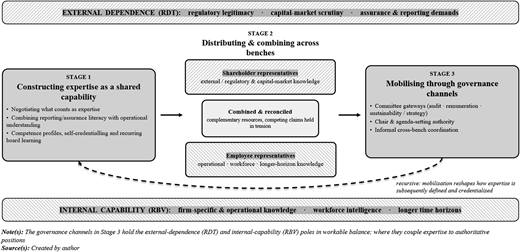
Analysis followed an abductive iterative logic, moving between empirical material and the sensitising concepts of the dual resource perspective (Alvesson and Kärreman, 2007; Power and Gendron, 2015; Timmermans and Tavory, 2012). Transcripts were imported into MAXQDA. Initial coding captured how participants defined and evaluated sustainability expertise and related expertise claims invoked as reference points in board work (notably industry/sector and regulatory/reporting knowledge); how they described the contributions and interaction of shareholder and employee representatives; and how they linked expertise to board structures, deliberation and regulatory demands. Subsequent coding related categories across cases to develop patterned accounts of how expertise is constructed, how it is combined across benches, and how it becomes consequential through committee mandates, chair authority, agenda-setting routines and informal channels. Apparent surprises, such as narrow framings of sustainability expertise as reporting competence or counter-stereotypical accounts of expertise sources across benches, were used to revisit assumptions, refine categories and sharpen boundary conditions (Timmermans and Tavory, 2012). Table 3 presents the resulting data structure in Gioia-style form, tracing how exemplar quotations were abstracted into first-order concepts, second-order themes and three aggregate dimensions. The aggregate dimensions correspond to the construction, distribution and mobilisation of sustainability expertise and map directly onto the integrated resource perspective: the construction and distribution dimensions capture how RBV-grounded internal capability and RDT-oriented external dependence are combined across the benches, while the mobilisation dimension captures the governance channels through which expertise is converted into influence. These dimensions are the building blocks of the process model in Figure 1, so that every analytical claim advanced in the findings and discussion can be traced back to specific coded evidence rather than to isolated illustrative quotations.
The abductive logic shaped the analysis in a specific way and was disciplined against cherry-picking. Theory entered as a sensitising device rather than a template for confirmation: the dual resource concepts directed attention to external-dependence and internal-capability claims, but the coding categories were built up from the transcripts and revised whenever the material resisted them. Three safeguards guarded against selecting confirming evidence. First, all 36 transcripts were coded in full and compared constantly across both benches and across sectors, so that themes had to hold beyond favourable cases. Second, surprises and disconfirming instances were actively pursued, not set aside: narrow framings of expertise as mere reporting competence, counter-stereotypical accounts of where environmental or social knowledge sat and the minority view that codetermination constrains the competence mix were retained, reported and used to sharpen boundary conditions. Third, the theoretical integration was held to the same standard: rather than invoking whichever lens fit a given quotation, the analysis required RDT and RBV to account jointly for the same episodes and acknowledged where each is limited, which reduced the temptation to read a perfect theory-data match into the material.
Credibility was strengthened through systematic comparison across shareholder and employee constituencies and across sectors. Reflexive notes were written after interviews to document emerging interpretations, interview dynamics and potential researcher assumptions, supporting interpretive transparency (Ahrens and Chapman, 2006; Parker, 2012). In keeping with interpretive traditions, reliability is understood as traceability and interpretive consistency rather than replicability; claims are grounded in documented coding decisions and the abductive steps through which themes were developed (Krippendorff, 2019).
Ethical procedures reflected the sensitivity of elite governance contexts. Participants received information about the study purpose, confidentiality and data handling, provided oral consent prior to recording and were offered the option to review their transcript. Audio files, transcripts and coding outputs were stored on encrypted drives accessible only to the research team.
Findings
The findings are organised as a single process that answers the overarching research question in three connected stages: how boards construct sustainability expertise as a shared capability; how that capability is distributed and combined across the shareholder and employee benches; and how it is mobilised into influence through governance channels. The three stages correspond to the aggregate dimensions in Table 3 and to the process model in Figure 1, and they are presented sequentially only for clarity; in practice they are recursive, with mobilisation feeding back into how expertise is subsequently defined and credentialised. Throughout, whether expertise is confined to defensible compliance or extended towards strategic integration appears as variation within the process rather than as a separate outcome.
Constructing sustainability expertise as a shared capability
The first stage shows how board members (BMs) define and legitimise sustainability expertise in practice and how boards build a shared expertise base under tightening, yet only partly specified European sustainability corporate governance expectations.
Interviewees commonly anchor sustainability expertise in regulatory and assurance literacy. In this sense, expertise means being able to oversee sustainability reporting and related assurance, judge the plausibility of management's disclosures and materiality assessments and anticipate how external reviewers (auditors, regulators and investors) will scrutinise them. Participants note that this framing is reinforced by board rules and best-practice expectations and, in practice, often concentrates on committee work rather than being evenly distributed across the full supervisory board.
At the same time, most interviewees resist equating sustainability expertise solely with reporting competence. They describe it as the capacity to understand how sustainability issues affect long-term strategy, risk and value creation, including the firm's “licence to operate”, as BM03 highlighted. This broader view includes recognising goal conflicts between return pressure and transition-related investment and organisational change. Interviewees overwhelmingly discuss environmental and social sustainability in this context; governance is typically viewed as an inherent part of supervisory board work rather than as a distinct sustainability specialism. Social topics are portrayed as relatively familiar terrain in the German social market economy, whereas environmental issues are seen as more recent, technically demanding and strongly contingent on sectoral value chains. BM05 remarked that “there is still a great deal of room for improvement, and believe me, I am one of the [sustainability] committee spokespersons”. Several interviewees stress that ecological questions are highly sector-specific and thus unequally distributed across members. Employee representatives often present social sustainability as their “natural” competence and explicitly acknowledge that they do not possess the same depth of environmental expertise. As BM20 put it, “our core competence on the employee side really lies in what is understood by the S in ESG”.
Across interviews, a recurring distinction emerges between industry-specific expertise and regulatory expertise. The former involves understanding how sustainability trends manifest in each sector and how deriving firm-specific implications through the “principle of internal differentiation”, as BM18 described. The latter involves navigating reporting and assurance regimes. In practice, sustainability expertise is located at the intersection of these dimensions rather than as a uniform skill set.
How this heterogeneous construct is translated into credentials and corporate governance practices is equally fluid. Formally, sustainability expertise is usually identified through the board's (soft-law) competence profile, often disclosed as a qualification matrix in the annual report. Members self-assess their competencies, including sustainability and mark areas in which they consider themselves qualified. External verification of these self-assessments is rare; challenges tend to come, if at all, from the chair rather than from auditors or regulators. Some companies do little more than this and treat sustainability expertise as a “compliance-only item”, as BM33 observed. Others strengthen and document it more actively by encouraging structured learning or certificates and by prioritising prior responsibility for sustainability-related transformation, sustainability reporting/assurance or related compliance when nominating shareholder representatives.
Because competence expectations remain generic, even as European reporting standards increase pressure to demonstrate topic-specific capacities, boards invest in developing shared internal understandings of what sustainability expertise entails. Interviewees describe protracted discussions about what constitutes sustainability expertise and when a member may legitimately be presented as an “expert” in the competence matrix. BM06 recounted a process lasting around three months and involving the legal department, management board and, finally, the supervisory board itself “clustering” its members to clarify their self-understanding:
We realised that this is really a question of definition. We first had to work out what we actually mean by sustainability expertise so that not everyone simply claims, “I have great expertise when it comes to, say, sustainability for aquatic organisms”. The key question was whether I truly have this expertise because I have conducted research in the field, or whether it is merely because I have a general understanding that you should not, to put it bluntly, pour chemicals into the water. – BM06, Employee Representative and Vice Chairman of a supervisory board in the chemicals industry
Such debates are simultaneously about thresholds and collective sense-making. Boards rely on recurring learning formats, including plenary workshops, committee deep dives, strategy off-sites and site visits, to build and update a baseline of sustainability literacy. There are no formal examinations; instead, expertise is inferred from how directors work in committees, the questions they ask and their ability to connect sustainability topics to financial and strategic considerations. Taken together, these practices illustrate a key qualitative insight: sustainability expertise appears less as a fixed attribute of individual directors and more as a dynamic board-level capability that is co-constructed, credentialled and developed through ongoing self-assessment, internal negotiation and learning.
In practice, interviewees describe this capability as doing double duty. It serves as an external credibility resource, enabling boards to demonstrate defensible oversight under intensified reporting and assurance scrutiny, while simultaneously functioning as an internal judgment capacity that helps boards assess feasibility, anticipate implementation challenges and connect environmental and social sustainability to strategy, risk and long-term value creation.
Distributing and combining expertise across the shareholder and employee benches
Interviewees emphasise that parity representation masks systematic differences in backgrounds and knowledge bases. On the employee side, they distinguish between company-based representatives, rooted in specific sites and organisational units and union-based representatives, who enter the board from outside and carry cross-company, intra-sectoral expertise. As BM03 put it, there is “a huge difference between people coming from the workforce and those coming from the union”, with union representatives portrayed as more professional and “often very, very good” people. A third category of senior managers appears less frequently and is perceived as closer to company-based employee representatives, so it is not treated separately here. Across all camps, legal liability for sustainability decisions is collective; however, interviewees describe clear differences in how each subgroup acquires sustainability expertise, the knowledge bases they rely on, and the time horizons they bring to sustainability debates.
Shareholder representatives typically arrive with long careers as senior executives, industry experts, investors or professional non-executive directors. Many have held responsibility for finance, strategy, legal affairs or mergers and acquisitions across multiple mandates. Sustainability expertise is usually acquired through prior executive roles in climate strategies, decarbonisation programmes, compliance or non-financial reporting or through consultancy and academia. Their knowledge base is strongly shaped by regulatory frameworks and capital market expectations, with EU Taxonomy, CSRD and rating criteria featuring prominently. Shareholder representatives like BM12 frame themselves as importing “best practice” from other mandates or sectors and as particularly attuned to how investors, analysts and proxy advisors evaluate the firm's sustainability performance. Interviewees often describe them as bringing external expectations and benchmarks into board discussions.
Company-based employee representatives follow a different trajectory. Elected by the workforce, they are typically long-tenured staff members; skilled workers, engineers, plant managers or works council leaders, with deep operational understanding of the firm and its sites. They often state that they were not elected for their sustainability expertise but for their ability to represent employees' interests. As BM36 explained: “Let me be very clear: employees do not vote based on sustainability competence. […] To be honest, they vote based on familiarity and trust”. Sustainability knowledge is built alongside their primary workplace roles, supported by formal training, especially from union foundations on climate policy, supply chain due diligence or occupational health and safety. Their specific contribution lies in first-hand insights into production processes, working conditions and employment effects across the value chain. BM05 stressed that “especially on social issues, we have our ear to the ground – I always tell the management that we can ‘hear the grass growing’ because we are part of the workforce. This is where we can make a strong contribution, precisely because we enjoy trust and hold elected mandates”. Interviewees thus portray company-based representatives as grounding sustainability debates in operational realities and implementation risks.
Union-based employee representatives again draw on a distinct knowledge base. Often full-time trade union officials or sector-level negotiators sitting on several supervisory boards, they are well-versed in employment law, collective bargaining and national or European policy processes. Their sustainability expertise is shaped by cross-company and cross-sector experience, including patterns of restructuring, just transition debates and regulatory developments across entire industries. As BM02 noted, they bring in “new legal requirements that are already in the air”. Interviewees describe them as adept at rephrasing firm-specific proposals in terms of legal standards, sectoral norms, precedent-setting implications and as effective brokers of compromises across companies and sites. Some note that, because a large share of their remuneration is passed on to the union, they enjoy financial independence from the company, which they see as reinforcing their capacity to advocate for sensible environmental and social standards.
Despite these differences, boundaries between groups are increasingly blurred: all three now include individuals with backgrounds in compliance and risk, and at least some form of formal sustainability training. Sustainability expertise is thus not the preserve of a single subgroup but is built through different acquisition channels that combine regulatory, sectoral and operational knowledge in complementary ways.
These subgroups nonetheless exhibit divergent emphases in sustainability debates. Employee representatives, especially company-based members, are consistently described and describe themselves, as primarily focused on the social dimension. They emphasise employment, skills, workplace safety, fair workload and investment in sites, framed in terms of the long-term viability of “this company, these jobs” and, as BM25 put it, the need “to underline that it is, of course, also about safeguarding sites and about Germany as a business location”. Union-based representatives extend this focus beyond the individual firm to sectoral standards, supply-chain conditions and just transition. Environmental issues are present but typically articulated through their implications for employment, health and regional development.
Shareholder representatives tend to frame sustainability in terms of financial materiality. As BM02 explained, if one adopts a financial focus, “everything the company does should ultimately benefit the shareholders”. Their accounts, therefore, concentrate on climate risks, compliance with CSRD and taxonomy requirements, governance structures and the expectations of investors and rating agencies. They emphasise decarbonisation pathways, scenario analysis and the integration of sustainability factors into risk management and capital allocation, attaching particular importance to governance topics such as internal control systems, executive remuneration and transparency. This orientation is described as more outside-in, comparative and top-down, positioning the firm against peers and benchmarks.
These lenses are accompanied by different temporal orientations. Employee representatives portray themselves as thinking in medium- and long-term horizons tied to employment biographies and the survival of sites and regions. “We always have a longer-term view, because we accompany employees over their entire working life, from training to retirement”, as BM32 elaborated. Shareholder representatives are associated with shorter-term or more flexible horizons driven by reporting cycles and return expectations, even where they stress long-term value creation. Interviewees agree that these divergent priorities and horizons generate tensions, particularly when sustainability investments compete with dividends, when climate-related restructuring threatens locations or when reporting obligations increase administrative burdens. In such situations, employee representatives emphasise employment security, reskilling and socially responsible transformation, while shareholder representatives stress efficiency, capital discipline and regulatory credibility.
Most interviewees, however, characterise interaction between subgroups as largely constructive and complementary. They describe disagreements “not [as] conflicts, but conflicts of interests” (BM03) and note that crises, such as liquidity problems or safety incidents, tend to align perspectives quickly. Combining a strong focus on environmental and governance requirements, capital market expectations and a grounded view of social consequences is seen as broadening the board's field of vision and connecting strategic decisions with operational realities. Synergies become visible when climate targets generate cost savings or productivity gains or when shareholder and employee representatives jointly advocate for credible sustainability-aligned executive remuneration. As BM31 remarked, once climate initiatives also generate visible efficiency gains, “everyone stops seeing them as a burden and starts to read them as common business sense”. Interviewees thus portray codetermination less as a barrier to sustainability than as a setting in which the pace, cost and distributional effects of sustainability measures are negotiated across competing time horizons.
Conflict nonetheless runs through all three stages, even where interviewees decline the label. In construction, it takes the form of contested credentialing: self-assessments in the competence matrix are “levelled” by nomination committees against members' CVs, and interviewees concede that members sometimes tick expertise they do not hold. In distribution, conflict crystallises where sustainability costs money or jobs, and along the fault line between social and ecological objectives when, as BM30 put it, “social justice and climate justice are played off against each other” as fossil-related jobs disappear. It also runs within benches and, most often, between board and management over slowing commitments under margin pressure. In mobilisation, open deadlock is rare because it is pre-empted. Disagreements are settled in bench pre-meetings, so that “lively conversations within the employee representative group” reach plenary as one position (BM19), The chair's casting vote means that the employee bench “knows that it needs the consent of the shareholder side” (BM35) and “has in mind that it would lose a contested vote” (BM23), so that its mere threat can close a conflict without it being fought out and employee representatives may instead slow a process: “The employer says: you are blocking; we say: we want to slow it down and do it properly” (BM23). Deadlock is thus displaced into pre-coordination, chair authority and delay, not absence.
Mobilising expertise into influence through governance channels
Across the interviews, sustainability expertise translates into influence primarily through perceived subject-matter authority and roles in committees that structure sustainability oversight, notably the audit committee (sustainability reporting and assurance), the remuneration committee (sustainability-linked incentives) and, where established, dedicated sustainability or strategy committees with an explicit sustainability remit. Contributions to sustainability debates are distributed across shareholder and employee representatives; however, members recognised as particularly knowledgeable, or who chair the audit, remuneration or a sustainability/strategy committee, are seen as especially influential. The chair of the supervisory board, always a shareholder representative with a casting vote and close links to the management board, retains a structurally privileged position in interpreting and prioritising sustainability issues. As BM30 observed, social issues are “often less clearly quantifiable than environmental metrics such as CO2-emissions or governance indicators like board independence, and this makes integration into strategic decisions and reporting more difficult”. Consequently, topics that can be readily quantified and standardised tend to carry more weight than less comparable social aspects, which can lead in practice to the S in ESG being treated as secondary, despite its rhetorical prominence.
Formal structures channel much of this influence. The audit committee is the primary gateway through which sustainability information enters the board, primarily via non-financial reporting and assurance. Sustainability is often treated as an additional item on the agenda, otherwise dominated by financial considerations, reinforcing a compliance-oriented frame. The remuneration committee embeds sustainability in executive incentives, increasing the strategic salience of selected metrics. Some boards have established dedicated sustainability committees or expanded existing strategy and innovation committees to encompass sustainability. As BM08 explained, “the sustainability committee is more about strategy and the audit committee more about reporting”, highlighting that the reporting side continues to carry greater weight due to legal scrutiny and potential sanctions. These bodies can deepen discussion and create space for specialist expertise, but interviewees stress that they only matter if their work visibly shapes plenary decisions and key performance indicators. This mirrors archival evidence that committee quality (notably independence and sustainability expertise and broader effectiveness attributes) is what links sustainability committees to environmental outcomes and reporting credibility (Ben Hlima et al., 2024; Li et al., 2023; Wang et al., 2020). Sustainability is also integrated into annual strategy retreats, and in one case was strengthened by relocating the sustainability unit under the finance function, improving authority and data quality.
Alongside these formal channels, interviewees emphasise informal influence. Board members draw on direct exchanges with managers holding operative responsibility and, on the employee side, on dense workplace networks. BM32 explained that they “regularly invite in-house experts […] to preparatory meetings, depending on the topic”, allowing issues to be explored in greater depth than formal agendas permit. Such practices are central to how expertise is enacted: they show how members use positional resources and social capital to place sustainability concerns on the agenda and frame them as risk, opportunity or feasibility.
Influence also travels bottom-up, and these signals shape both what boards know and how competence is judged. Formally, sustainability functions report directly to the board, boards increasingly demand employee-survey results broken down by site and country, and grievance mechanisms established under supply-chain due diligence carry complaints upward. BM31 described them as “extremely effective, because complaints can be lodged and then become an issue at entirely different levels”. Works councils consulted on the materiality assessment may, as BM26 noted, submit a statement to the supervisory board, and in some firms, they prepare the employee bench before plenary. Informally, company-based employee representatives relay observations that management has not raised and that can correct its account, as when employee representatives questioned whether a falling accident rate reflected safer work or altered reporting (BM05). As BM30 explained, employee-side knowledge “is contributed bottom-up, through experience from the plants”, which gives board debate “a certain groundedness”. Such signals also substitute for expertise, since with direct access to in-house resources “you do not need to build that expertise in the supervisory board” (BM27), but their reach depends on management sharing rather than withholding information.
Codetermination sets the structural frame within which these influence channels operate. A minority of interviewees perceive parity representation as constraining, arguing that shareholder representatives can shape the expertise profile of “their” half of the board, while employee elections follow their own logic and may not prioritise sustainability skills. BM11 stressed that candidate lists for employee elections are often highly political and driven by power, so that sustainability expertise “does not rank high on this list”, even if codetermination is otherwise strongly socially oriented. For these interviewees, codetermination reduces scope to optimise the overall competence mix.
The majority, however, view codetermination as supportive of sustainability, particularly the social dimension. They emphasise that parity ensures employment, working conditions and the distributive effects of climate change and restructuring are systematically raised and negotiated, rather than treated as residual. This extends time horizons beyond short-term returns and can contribute to more considered decisions, even if they take longer. BM19 summarised it by noting that “codetermination does not, in my view, make decision-making any easier. But once a decision has been reached and accepted, it tends to last longer; the answers and solutions are more sustainable, in the broad sense of the word”. Union-based representatives add that, because much of their remuneration is reinvested in the union, they are less exposed to short-term monetary incentives, which they interpret as reinforcing a longer-term stance on environmental and social issues.
Shareholder-side interviewees add nuance. While some criticise the constraints codetermination places on board composition, several underline its value in increasing cognitive diversity and in preventing management proposals from being assessed solely through a capital-market lens. One supervisory board chairman emphasised that employee representatives “represent the citizen much more than the board member” and thereby “bring the civic side into the discussion”, whereas shareholder representatives can become “professionally deformed, so that their being a citizen has somewhat disappeared” (BM28). They also caution against treating sustainability as a niche concern of a few designated experts, whether on the shareholder or employee bench, given that legal liability remains collective.
Interviewees situate these dynamics in a changing regulatory and political environment. Denser regulation, such as CSRD and due diligence laws, raises the baseline for sustainability oversight and pushes boards away from purely symbolic engagement by forcing sustainability onto the agenda. At the same time, the volume and complexity of sustainability rules, combined with political backlash in some jurisdictions, can make companies more cautious about high-profile sustainability positioning. BM11 captures this ambivalence by stating, “I consider ESG reporting very important, but at the moment it feels as if the tail is wagging the dog”.
Overall, codetermination and regulation are not seen as deterministically pro- or anti-sustainability. Rather, they create conditions in which the same sustainability expertise can be channelled into substantive strategic integration or confined to compliance-driven discussions, depending on how boards design committees, use informal channels and navigate competing pressures.
Discussion
This study examined how sustainability expertise is constructed, distributed across the shareholder and employee benches and mobilised into influence on codetermined supervisory boards in large German firms. Based on 36 interviews, the analysis shows that sustainability expertise is less a fixed individual attribute than a collectively produced capability that is negotiated, practised, and updated over time. Read through an integrated resource dependence and resource-based perspective, the findings show boards co-producing expertise at the intersection of externally oriented legitimacy demands and internally embedded implementation insight, while governance channels determining whether that expertise becomes consequential (Barney, 1991; Pfeffer and Salancik, 1978; Wernerfelt, 1984). The discussion develops these claims along the three process stages and then draws out their integrated theoretical implications.
Constructing expertise: threshold work and the measurement critique
A central implication is that sustainability expertise is constructed through board-specific threshold work rather than anchored in stable professional credentials. Interviewees' accounts suggest a process closer to how boards commonly treat industry or sector expertise, which is contextual, experience-based and collectively validated in practice, rather than to legally defined financial expertise requirements, where minimum numbers and explicit competence expectations create clearer, auditable thresholds. In the German setting, financial expertise is explicitly mandated and operationalised via audit committee design and disclosure, whereas sustainability expertise is largely channelled through soft-law competence profiles and self-assessment. This flexibility allows boards to adapt to sectoral and regulatory variation, but it also amplifies the comparability problem already noted in competence-matrix research: boards' self-ascriptions can conceal substantive differences in topic depth and assurance literacy (Demirtas et al., 2024). The findings, therefore, sharpen a measurement critique in the sustainability expertise literature. Studies that code expertise primarily from CV-based indicators (e.g. prior roles, committee seats, interlocks) risk conflating reporting/assurance literacy with operational and transition-relevant knowledge, and, crucially, miss the collective work through which boards stabilise what counts as expertise in situ (Homroy and Slechten, 2019; Iliev and Roth, 2023). The interview evidence also aligns with concerns that oversight capabilities in the audit committee ecosystem remain uneven and that sustainability-related competence gaps matter for how reporting and assurance are governed (Wehrhahn, 2025; Wehrhahn and Velte, 2024).
Distributing sustainability expertise across benches
The study extends codetermination research by specifying how shareholder and employee representatives contribute distinct sustainability-relevant resources and how these are combined in practice. Consistent with prior work linking employee representation to stakeholder orientation and employee-related disclosure under EU reporting regimes, employee representatives contributed firm- and workforce-grounded implementation insight and longer time horizons (Lopatta et al., 2020; Samani et al., 2023; Scholz and Vitols, 2019), while also highlighting tensions between financial and socio-environmental objectives (Duran and Pull, 2014; Gorton and Schmid, 2004; Joecks et al., 2019; Kirsch, 2022). Shareholder representatives, in contrast, were described as importing externally oriented regulatory and capital-market knowledge, which are often framed around climate metrics, taxonomy alignment and investor scrutiny. The prominence of climate-related expertise on the shareholder side is not simply a “preference” effect; it is reinforced by the structure of European sustainability evaluation, where environmental metrics are comparatively standardised and strongly capital-market salient, while equivalent standardisation for social classification is weaker. This helps explain when environmental topics are more readily translated into board competence claims and monitoring routines, and why “S” issues, despite being prominent in codetermination, are more difficult to stabilise as comparable board expertise and corporate governance metrics. The dual resource perspective clarifies the resulting pattern: codetermination broadens the board's resource base by combining external legitimacy resources with internal implementation capability, but it does not automatically balance competence across sustainability domains when external scrutiny and measurement infrastructures privilege particular knowledge forms (Barney, 1991; Pfeffer and Salancik, 1978).
Mobilising expertise: governance channels as the translation mechanisms
The findings further clarify that expertise matters through enactment. Influence was attributed primarily to subject-matter authority coupled with positions embedded in corporate governance channels rather than to constituency membership per se. Audit committees remain the primary gateway through which sustainability enters board work, predominantly via sustainability reporting and assurance, echoing research on sustainability assurance and committee credibility effects (Al-Shaer and Zaman, 2018; Peters and Romi, 2015). Where sustainability is appended to financially dominant audit agendas, the prevailing frame is one of defensible compliance. However, when boards mobilise dedicated sustainability/strategy committee mandates, connect sustainability metrics to remuneration and utilise preparatory meetings and internal experts, the scope for strategic integration widens. Yet these mechanisms only matter if committee outputs shape plenary prioritisation and investment discussions, consistent with qualitative insights that board influence is produced through agenda-setting, framing and routinised channels rather than through “having” expertise alone (Power and Gendron, 2015; Klarner et al., 2020). This provides a process explanation for why similar outward structures (e.g. a sustainability committee) can coincide with different substantive outcomes across firms.
The same channels also reveal how the compliance and proactive logics are reconciled, addressing a tension the findings surface but do not resolve at the level of individual conviction. Reconciliation occurs structurally rather than attitudinally: a proactive sustainability claim advances when it is coupled to a compliance-legitimated gateway, so that it inherits that gateway's standing, for instance when a transition metric is tied to executive remuneration, or when a strategic sustainability question is routed through the audit committee's assurance authority rather than raised in plenary alone. Where no such coupling is available, the proactive claim stalls and expertise defaults to compliance, even where the underlying competence is present. Informal cross-bench coordination performs a complementary reconciling function, pre-aligning a shared frame before plenary so that the two benches' competing logics enter the formal agenda as an agreed item rather than as open conflict. The compliance-versus-proactive distinction is therefore best read not as a property of boards' ambition but as an outcome of whether their channels couple expertise to authoritative positions.
The relationship between compliance orientation and strategic relevance is, moreover, reversible rather than a ladder that boards climb. Compliance is the entry point that forces sustainability onto the agenda. Yet the same demands can crowd out strategy: reporting absorbs audit-committee capacity for little perceived benefit, boards engage with sustainability as an outcome of regulation, not of a strategic decision and a self-reinforcing loop in which a compliance-only strategy justifies minimal investment in expertise, so that sustainability is never recognised as a success factor. Movement towards strategic relevance occurs where boards bridge the two logics, by asking what strategic conclusions follow from the first sustainability report or by interlocking the audit committee's reporting view with an investment-and-sustainability committee's investment logic through mutual attendance and shared minutes. Movement can also reverse: when political backlash withdraws the capital-market support that rewarded proactive positioning or boards pre-emptively downplay their own exposure on the topic. Theoretically, compliance orientation mobilises expertise as a resource-dependence legitimacy resource and strategic relevance as a resource-based capability. The two are coupled in three ways. Compliance supplies the gateway through which capability claims gain standing. External demands can consume the internal capacity that capability-building requires. Relevance derived only from external pressure recedes with it, whereas relevance anchored in the business model and in the employee bench's longer horizons persists.
Integrating the dual resource perspective
The study's central theoretical contribution is to show that resource dependence and resource-based logics are not merely complementary but jointly constitutive of board sustainability expertise, and to specify the mechanisms that bind them. Construction, distribution and mobilisation are the points at which the two logics meet. In construction, externally imposed but under-specified competence expectations (an RDT pressure) are met by internal threshold work and collective learning that build a capability (an RBV process), so that expertise is simultaneously a legitimacy resource and an internal capacity. In distribution, codetermination does more than add two knowledge bases: it institutionalises the two logics in different benches, with shareholder representatives carrying externally oriented, capital-market-facing resources and employee representatives the internally grounded, implementation-facing ones. This is why the relationship is one of reconciliation rather than aggregation; the benches supply complementary resources but can privilege competing claims when reporting credibility, capital allocation and workforce impacts collide. In mobilisation, governance channels arbitrate the resulting tension and decide which logic prevails in each decision. The integration thus explains a pattern neither lens captures alone: boards facing similar external pressures and holding similar internal capabilities still diverge because converting expertise into influence depends on how channels reconcile the two logics. Sustainability expertise becomes consequential not when a board possesses it, but when its channels hold external dependence and internal capability in workable balance.
Taken together, the study refines a dual resource perspective on board sustainability expertise in ways that travel beyond Germany. Codetermined supervisory boards do not simply aggregate externally oriented legitimacy resources and internally embedded implementation insights; they actively construct sustainability expertise through contested thresholds, ongoing collective learning and the mobilisation of formal and informal corporate governance channels. Under tightening yet partly under-specified European competence expectations, boards can blend regulatory literacy with sectoral and operational knowledge in ways that broaden sustainability oversight into strategic corporate governance or narrow it to defensible compliance.
Figure 1 presents the process model that synthesises these findings, organised around the overarching research question and constitutes the core empirical contribution of the paper. The model traces three recursive stages. Boards first construct sustainability expertise as a shared capability by negotiating what it encompasses, combining reporting and assurance literacy with sector- and firm-specific operational understanding and reinforcing it through competence profiles and recurring learning. This capability is then distributed across the benches, with shareholder representatives contributing externally oriented, resource-dependence-facing regulatory and capital-market knowledge and employee representatives contributing internally grounded, resource-based implementation insight, workforce intelligence and longer horizons. Finally, governance channels, committee gateways, chair and agenda-setting authority and informal coordination, mobilise the combined capability, reconciling the two logics and determining whether the same expertise is confined to defensible compliance or extended towards strategic integration. The figure positions each stage between the external-dependence and internal-capability poles that the channels hold in balance, making the dual resource integration visible as the spine of the model.
Conclusion
This paper asked how sustainability expertise is constructed, distributed across shareholder and employee representatives and translated into influence through the governance channels of codetermined supervisory boards. Drawing on 36 expert interviews with members of parity codetermined supervisory boards in large German listed firms and theorising abductively through an integrated resource dependence and resource-based perspective, the study shows that sustainability expertise is not primarily an individual credential but a collectively developed capability. It combines regulatory and assurance literacy with sector- and firm-specific operational understanding, becoming consequential only when coupled with committee mandates, agenda-setting routines and informal cross-bench coordination (Barney, 1991; Pfeffer and Salancik, 1978; Power and Gendron, 2015).
For an international audience, the German case is analytically sharp because it highlights how expertise is co-produced across constituencies under European sustainability regulations and heightened scrutiny. Codetermination broadens the board's knowledge base by institutionalising complementary resource endowments: shareholder representatives tend to contribute externally oriented regulatory and capital-market knowledge, while employee representatives contribute implementation realism, workforce intelligence and longer time horizons, with union-based members adding cross-firm and cross-sector insight (Samani et al., 2023; Scholz and Vitols, 2019). At the same time, the distribution of sustainability expertise is uneven across sustainability domains; social competence is strong and routinised in codetermination, whereas environmental expertise is more variable and, on the shareholder side, more tightly coupled to the metrics and classifications that dominate external evaluation.
The findings also have policy and practice implications for European corporate governance reforms that rely on board competence disclosure. Competence matrices remain largely self-reported and too coarse to distinguish reporting/assurance literacy from the sectoral and operational knowledge required for substantive oversight (Demirtas et al., 2024). This limitation becomes more pronounced in the context of regulatory volatility. If European initiatives aimed at simplifying or narrowing sustainability reporting obligations reduce external enforcement pressure for some firms while leaving stakeholder scrutiny and assurance expectations uneven, boards may face weaker incentives to invest in topic-specific competence profiles and structured learning, even as the underlying transition and due diligence challenges persist. A practical implication is that boards and regulators may need a more robust approach than generic self-declarations, combining clearer expectations for topic-specific competence with ongoing board-level learning processes rather than relying on either a purely credential-based model or purely self-assessed matrices.
Beyond regulatory design, the findings carry concrete implications for board practice. Because expertise becomes consequential only when channelled, nomination committees and chairs gain little from recruiting isolated sustainability experts and more from composing benches that deliberately pair externally oriented regulatory and capital-market knowledge with internally grounded operational and workforce knowledge and from treating cross-bench complementarity as a design variable rather than an accident of codetermination. Chairs and committee leads can mobilise existing expertise by coupling sustainability questions to authoritative gateways, for example by tying transition metrics to remuneration or routing strategic sustainability matters through the audit committee's assurance standing and by institutionalising the preparatory and cross-bench coordination through which claims reach plenary as agreed agenda items. Finally, because the data capture a single, volatile regulatory moment, boards that sustain structured collective learning are better placed to retain topic-specific competence even when external enforcement pressure fluctuates.
This study is subject to limitations. It is context-specific to parity codetermined listed corporations within the German two-tier system, and the evidence is based on interview accounts shaped by retrospective sense-making and constraints on elite access (Parker and Northcott, 2016). The analysis focuses on how expertise is constructed and enacted rather than directly observing board meetings or linking expertise configurations to organisational outcomes.
These limitations nonetheless support a clear research agenda along four lines. First, comparative studies across governance regimes could test whether the collective construction of sustainability expertise observed here is distinctive to codetermination or general to boards operating under under-specified competence expectations. Second, mixed-method designs could link interview-based process evidence to CV-coded measures and disclosed competence matrices, examining when disclosure tracks substantive capability rather than symbolic alignment (Demirtas et al., 2024; Gow et al., 2018). Third, further work could examine how audit committee ecosystems, including internal audit and external assurance interfaces, shape the translation of sustainability expertise into assurance quality and monitoring intensity (Al-Shaer and Zaman, 2018; Wehrhahn, 2025). Fourth, given the political contestation surrounding European sustainability regulation, research could examine how regulatory uncertainty affects boards' incentives to invest in topic-specific expertise and whether shifts in reporting scope and timing alter the balance between compliance-oriented and strategically integrated sustainable corporate governance. Underpinning several of these directions, and because the present design captures a single regulatory moment, the question of when sustainability expertise drives proactive strategic integration rather than defensible compliance warrants dedicated longitudinal study. This could be done by tracing how the governance channels identified here shape integration across several reporting and investment cycles and complementing emerging work on sustainability integration that has so far largely bypassed the board level (Johnstone and Skoog, 2025; Zoni and Bustamante, 2025).
Overall, the paper shifts attention from whether boards can signal sustainability competence to how sustainability expertise is collectively constructed, contested and converted into influence through corporate governance channels. This process focus helps explain why European boards facing broadly similar regulatory expectations nonetheless vary markedly in whether sustainability oversight remains compliance-centred or becomes strategically integrated, and why that balance is reversible. Compliance opens the gateway through which sustainability expertise gains standing, yet can absorb the capacity integration requires, and integration resting on external pressure alone recedes with it.
I would like to thank Lee Parker and Chandana Alawattage for their thoughtful and constructive feedback on earlier versions of this manuscript. I am also grateful to Patrick Velte for his ongoing guidance and support throughout the development of this article.
Note
Here, hard law denotes legally binding rules (e.g. EU/national statutes and mandatory reporting or due diligence requirements) that are enforceable by regulators and courts. Soft law denotes formally non-binding standards (e.g. corporate governance codes and “comply or explain” recommendations) that nonetheless shape board practice via disclosure expectations, market pressure, reputational risk and regulatory scrutiny.