The purpose of this paper is to discuss the development and assessment of learning support environments for academic writing that utilize ICT, such as e-learning and online tutoring, in Japanese higher education. First, the authors introduce the design of an e-learning writing program for the Japanese language and assess whether the program is an effective learning support tool for undergraduates. Second, the authors analyze and assess online tutoring support for academic writing and clarify the merits and disadvantages of online and offline tutoring at writing centers, then suggest instructional strategies by analyzing the writing tutoring process.
The authors adopted e-learning goals to assess its effectiveness. The authors asked the participants questions they could answer from five-point scales, conducted a paired t-test, and included a free description-type questionnaire. Then, to assess online tutoring, the 12 students took pre- and post-test questionnaires, after which the authors conducted a Wilcoxon signed rank test. In addition, the authors carried out a Kruskal–Wallis rank sum test in order to confirm differences in satisfaction level and the effectiveness of face-to-face tutoring and online tutoring.
By analyzing the pre- and post-test results, the t-test confirmed that the students found the e-learning system to be effective for nurturing academic literacy. This means the system is appropriate as a support tool for nurturing academic writing, especially writing knowledge and rules, and university must provide a comprehensive learning support environment including e-learning. Next, the authors found no statistically significant difference between face-to-face and online tutoring, although some problems with the writing process remained. So online tutoring has opportunity to promote autonomous learning. The research results make it clear that because of writing centers’ potential and their effectiveness in utilizing ICT tools.
Research findings about academic writing are to improve the tutoring process and writing strategies, such as the use of ICT for academic writing support like e-learning, online tutoring, do not exist. To provide learning opportunity to learners and promote autonomous learning, e-learning and online tutoring are important. For the reasons noted above, it is necessary to provide an alternative writing support environment to students in Japan. Therefore, the authors report on and assess the development of learning support environments for e-learning programs and online tutoring for academic writing at the undergraduate level in Japan.
1. Introduction
In recent years, pioneering universities in Japan have opened writing centers to promote the development of undergraduate students’ writing skills. Most Japanese undergraduates must submit a written thesis in order to graduate from university. Although writing skills are necessary for graduation, they are difficult to nurture. Consequently, higher education curricula in Japan include educational writing programs. Most freshmen enroll in a first-year seminar program that aims to cultivate their academic skills through lessons, presentations, writing and debates. In addition to including writing programs in courses, Japanese universities have begun managing writing centers as a learning support tool for undergraduates; since writing requires high cognitive literacy, its promotion takes time. Moreover, the enrollment rate of undergraduate students in Japan is increasing despite the fact that the population of people aged 18 years or below has declined in recent years. Therefore, a disparity may exist between students’ motivations and their academic abilities. Universities should provide learning support to undergraduates to maintain the quality of learning outcomes. So it needs to serve student learning support to improve student retention (Chuah and Lim, 2018). To this end, some pioneering universities have established writing centers. Previous research has found that participation in writing centers has an effect on undergraduates’ future writing skills (Sadoshima et al., 2015).
The National Institution for Academic Degrees and Quality Enhancement of Higher Education (2016) in Japan has defined learning support as the complete support services available for students to effectively earn their diplomas. The purpose of learning support is to nurture autonomous learners using the learning programs, learning advice, learning materials and opportunities provided by universities to not only promote the quality of learning but also ensure that students earn their diplomas, including student support, advice desks and student guidance. Learning support comprises developmental studies, learning assistance, learning resources and integrated student development (Kerstiens, 1995). Writing centers are also a part of learning support. Research by the Ministry of Education, Culture, Sports, Science and Technology of Japan found that, in 2015, 72 universities (i.e. 9.4 percent of the total) in the country provided learning support for academic writing, including setting up writing centers; this was 30 more universities than in 2011. This implies that the importance of learning support for academic writing is now recognized in Japanese higher education, as many universities provide academic writing programs, support through writing centers and learning resources. Although research on academic writing support is prevalent in Japan, most of it focuses on tutor training, as improving the quality of tutoring is a priority for writing centers. However, research findings to improve the tutoring process and writing strategies for academic writing, such as the use of ICT for academic writing support like e-learning, online tutoring and analysis of the history of tutoring systems, do not exist. Analyzing tutoring history clarifies trends in tutoring contents, enabling tutor training to focus on making tutors more effective based on learners’ issues. However, problems remain, such as the fact that the average tutoring session is 30 or 30 min long, which is insufficient to nurture undergraduates’ writing skills. To promote self-regulated learning, writing centers in the USA provide e-learning systems and online tutoring systems. North American writing centers create resources that adapt to local students’ learning needs. They provide e-learning resources, such as the Purdue Online Writing Lab’s website, to nurture a self-regulated learning style for academic writing (Tzu-Shan, 2013). In addition to that, Wong (2018) shows it is important to utilize ICT tools to teaching innovations. However, most Japanese writing centers do not provide e-learning resources. For the reasons noted above, Japanese universities need to design and develop the contents and style of e-learning for academic writing.
Furthermore, large universities have different campuses, and writing centers are typically set up only on the main campus, making them difficult to access. Although online writing tutoring is not as popular as other writing support methods in the USA, it should be researched, because it is helpful for students on distant campuses and those facing commuting problems. Also, North America’s writing centers are usually located on large campuses, so they utilize online tutoring. Turner (2006) suggests combining online and face-to-face tutoring as a good way to improve writing skills. Therefore, a learning environment to promote self-regulated learning and nurture academic writing skills needs to provide both online and face-to-face tutoring, and then e-learning. Japanese writing centers’ studies have been sharing their research outcomes little by little, but it is clear that e-learning for academic writing and online tutoring has not yet fully been investigated.
Hence, it is necessary to provide an alternative writing support environment to students in Japan through methods like e-learning and online tutoring that utilize ICT. Therefore, this study reports and assesses the development of learning support environments for e-learning programs and online tutoring for academic writing at the undergraduate level in Japan.
2. Objectives
The purpose of this study is to discuss the development and assessment of learning support environments for academic writing that utilize ICT, such as e-learning and online tutoring, in Japanese higher education. First, it introduces the design of an e-learning writing program for the Japanese language and assesses whether the program is an effective learning support tool for undergraduates. Second, it analyzes and assesses online tutoring support for academic writing and clarifies the advantages and disadvantages of online and offline tutoring at writing centers; last, it suggests instructional strategies by analyzing the writing tutoring process.
3. Design and assessment of e-learning for academic writing
3.1 E-learning design process
The authors designed an e-learning program based on the IDEAL instructional model for subjective learning. This model consists of the following steps: “identify problems and opportunities,” “define goals,” “explore possible strategies,” “anticipate outcomes and act” and “look back and learn” (Bransford and Stein, 1984).
Following the IDEAL model, e-learning as a part of “IDE” was designed then students use e-learning in the “AL” part. Therefore, first, writing problems were identified and goals defined, after which possible e-learning strategies were explored. The following methods were used to identify students’ problems: analyzing students’ usage history of writing centers, comparing freshmen’s reports in first-year seminars before and after they used a writing center and assessing instructors’ needs for nurturing Japanese writing skills. Problems based on the analyses were defined, and students were provided with the environment to study through e-learning.
The first research step involved analyzing students’ usage history of writing centers. The writing center used for this study as a data source has an e-portfolio and online reservation system for tutoring. Tutoring cases at the writing center, focusing on consultation record data collected in 2012, 2013 and 2016 (Iwasaki et al., 2013; Tada et al., 2017), were analyzed. Data from 2012 and 2013 included 629 cases in total, and that from 2016, 1,356 cases. For 2012 and 2013, the types of reports and tutorial content were analyzed, and the tutorial content was divided into different categories. The frequency of usage per month, students’ grades and types of reports were also analyzed to understand students’ problems.
The second research step involved comparing freshmen’s reports before and after they had used the writing center and analyzing the outcomes and the tutor’s counseling sheets from the first-year seminars (Iwasaki and Mibuchi, 2013). Students’ performances against report requirements were checked using mixed method approaches, including quantitative and qualitative methods. First, it was ensured that items were written collectively, following the submission issue; next, McNemar’s statistical test for quantitative methods was adopted. Then, to identify students’ improvement, their writing expression and structure and report contents were analyzed.
Based on the outcomes of both research projects, the e-learning contents for nurturing Japanese writing skills were discussed and confirmed by the Japanese writing faculty, the writing center’s staff, two faculty members who teach academic skills classes and teaching assistants.
3.2 Basic units of the e-learning program
The first research step revealed that tutorial contents could be divided into eight categories: understanding the thesis question, preparing to write, writing expression, writing structure, citations and searching for information, research methods, report layout and other (such as the utilization of computer software).
In the second research step, it was observed that students encountered problems related to writing expression, particularly in the areas “Change from spoken to written language” and “Correspondence between subject and predicate.” In the report contents, difficulties were observed in “Supplement for the meaning of sentences to be understood.” In terms of writing structure, it was found that students faced difficulty in improving the structure of their reports in the absence of specific advice from their tutors. In addition, students encountered problems in writing expression and sentence structures, suggesting that 40-min tutorials are insufficient.
In light of these results, the authors developed five categories of 29 lessons for Japanese writing. Based on the first research project, five units were categorized as follows: (1) “Composition of a report: how to write a report,” (2) “How to organize your thoughts,” (3) “How to express your thoughts (Let’s write a report: sentence structure),” (4) “How to express your thoughts (Let’s write a report: writing expressions),” and (5) “Let’s review the report before submitting it.”
Because many students faced problems in report preparation and time management, Unit 1, “Composition of a report: how to write a report,” was developed. Having identified a problem with citations and gathering information, Unit 2, “How to organize your thoughts,” was added. Given that creating and improving the structure of a report can also be difficult, Unit 3, “How to express your thoughts (Let’s write a report: sentence structure),” was introduced. As many students also struggled with writing expressions, a concrete writing example to deepen their understanding was provided in Unit 4, “How to express your thoughts (Let’s write a report: writing expressions).” Finally, as the majority of students did not review their writing before visiting the writing center, the issue of reviewing one’s own report was addressed in Unit 5, “Let’s review the report before submitting it.” In addition, since most of the students were social science and humanities majors, some content specifically for students majoring in science and engineering was added; each piece of content comprised a video of approximately 5–10 min.
The material in the Japanese writing program covers the entire writing process. The composition of the teaching materials is described below, and an e-learning sample table is provided (Table I).
These e-learning techniques can be utilized as an independent learning method to promote academic writing and solve students’ writing problems, a support tool for writing centers to improve students’ papers and allow them to learn deeply following discussions with writing tutors and flipped classroom learning resources. However, as it takes time to produce a series of e-learning courses, as a part of this study, multiple courses based on 29 individual lessons have been developed. Students can choose between courses such as “Writing a logical report for one hour,” “Academic writing for first-year experiences,” “Academic writing for a liberal arts graduate thesis” and “Scientific writing.”
3.3 Analysis and discussion of e-learning for academic writing
This study was conducted during the second semester of the 2017 school year. A questionnaire survey on academic writing was distributed among students enrolled in a “Learning Methods” class; 66 students participated in the e-learning lesson “Writing a logical report for one hour.” The questionnaire items discussed topics such as the effectiveness of and problems with e-learning, students’ learning situation and the user interface. E-learning courses set goals, so e-learning goals were adopted to assess their effectiveness. The participants were asked questions they could answer on five-point scales, a paired t-test was conducted, and a free description-type questionnaire was included.
The results of the analysis of the questionnaire are presented in Table II. The t-test confirmed that the students found the e-learning system effective.
The questionnaire item “What problems did you find in your report?” provided a free description form in which the students responded as follows: “I found that there is a difference between subject and predicate” and “Although I had planned to be careful, I got the e-learning quiz on spoken and written language wrong, so I have to review my report again.” Thus, the students identified writing expression problems in their reports. Other responses included “I knew the importance of expressing the conclusion clearly,” “I learned the importance of revealing the main point of the report” and “I realized that it is necessary to create an outline while considering the number of words.” These responses also indicated that the students had identified the points that needed improving with respect to sentence composition.
The students highlighted the benefits of e-learning as follows: “I thought it was good to use e-learning materials to write a graduation thesis” and “I can utilize the writing tips, such as colloquial expression and end-of-sentence handling, to improve my report.” These opinions on the use of e-learning teaching materials indicated that the students had gained knowledge and learning opportunities. In addition to these responses, “I noticed my mistakes by taking e-learning quizzes” and “Reviewing materials is a good way for me to acquire knowledge about academic writing” highlighted the effects of e-learning.
However, students also indicated some problems related to quiz assessment in the free description items; one student remarked, “I do not immediately receive a score on the free description questions in quizzes, so I cannot quickly view the results.” To improve the system, it is necessary to cooperate with the IT center. However, it is difficult to score free description questions automatically. Therefore, students must visit the writing center to check their answers with the writing tutors.
4. Assessment of online tutoring for academic writing
4.1 Overview of online tutoring
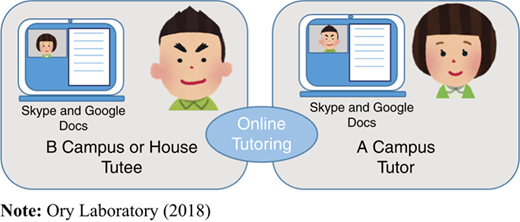
There are two types of tutoring: asynchronous and synchronous. Synchronous tutoring consists of text-based online tutoring utilizing a chat system, online video or phone-based support via Skype, and other systems such as television conference-based online tutoring sharing a whiteboard. Asynchronous systems include online tutoring by e-mail, online tutoring by e-Portfolio and online tutoring by learning the management system (Ryan and Zimmerelli, 2016). Online writing tutoring in Japan is not well-known, compared to writing support in USA, as mentioned earlier; however, Japanese universities are starting to develop writing centers. However, online tutoring has merits for students on distant campuses and students facing social communication problems; it is, therefore, important to share research findings on online tutoring. Hence, X university is trialing online tutoring – all of its four campuses have writing centers, but only the center at the main campus provides full-time support from Monday to Friday; those at the other campuses are open only two days a week or less. To provide the same support as the main campus at other campuses, online tutoring is required (Figure 1).
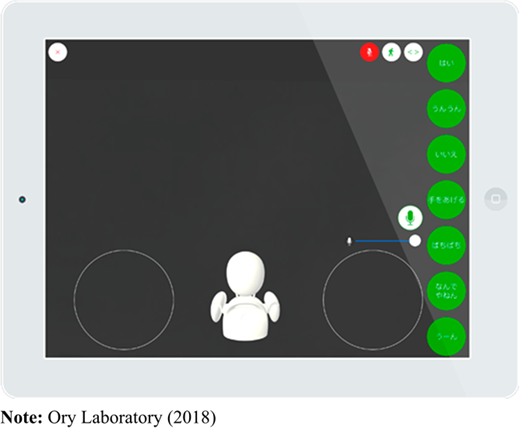
For this study, the authors used online video or phone-based support via Skype and telepresence support with a robot because undergraduates can easily access Skype. They can communicate with their tutors using Skype and share reports using Google Docs. In addition, due to rapid advances in ICT and robotics, research on writing support using robots and AI will become necessary in the future. Therefore, the authors conducted an online writing support activity using the telepresence robot OriHime in a trial developed by Ory Laboratory. A telepresence robot sets up a video conference with remote control to help transmit, or convey, a physical action to a remote party. OriHime is equipped with a camera, a microphone and a speaker, and operates as an agent with the operator’s control. There is no AI or automatic control functions in OriHime. Using an iPad application, the operator can check the situation of his/her interlocutor using OriHime’s camera and speak with the other party. It is also possible to move OriHime’s head and arm. OriHime can perform six actions: “Yes,” “No,” “Head Down,” “Applause,” “Question: Why, What?” and “Um.” In addition, the operator can move the robot’s head. The OriHime operation screen on the staff side is shown in Figure 2.
The OriHime operator controls the robot and can communicate with people in the robot’s location via the internet (Ory Laboratory, 2017). In a study by Hashimoto et al. (2011), an independently developed telepresence robot was placed in a classroom to act as a faculty member. This allows provision of learning support for learners at remote campuses that are difficult for tutors to visit. In addition, telepresence robots can solve the problem of deciding where to look when using Skype (Uno et al., 2014).
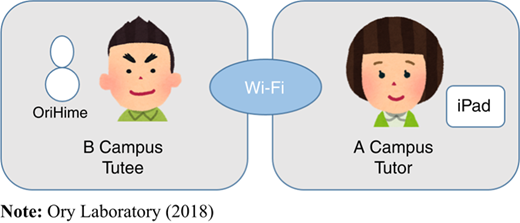
Tutors at A campus, the main campus that comprises ten faculties, provided online writing support to students at different campuses using OriHime. In addition to online tutoring using Skype, the authors worked on writing support using OriHime for students of B campus presented in Section 2. OriHime was set up in the remote B campus, while the tutor remained at A campus. Figure 3 shows an image of the usage.
Students at B campus set up OriHime and consulted with it. The tutor operated the iPad, talked to the students individually through OriHime, and provided writing support.
4.2 Online tutoring research method
The subjects in this study were 12 undergraduate students in their junior year at X university enrolled in seminar classes. They were assigned to write a pre-graduation thesis of 10,000 characters. The students used two of the following three tutoring options from October to December 2017: face-to-face, Skype and OriHime. The questionnaire survey on academic writing was distributed among students enrolled in the “Junior Seminar” class. The 12 students took pre- and post-test questionnaires, after which a Wilcoxon signed rank test was conducted. In addition, a Kruskal–Wallis rank sum test was carried out in order to confirm differences in satisfaction level and the effectiveness of face-to-face tutoring and online tutoring. The questionnaire items concerned the effectiveness of and problems with writing and the difference between online and face-to-face writing support, using a five-point Likert scale and free description. Individual interviews were held, with each requiring 40 min to 1 h to address the tutee’s writing process in detail. As a method of analysis, the interview survey results were analyzed with reference to Saiki (2008), and open coding was performed on the data. Afterward, while considering the relationship between the labels, the consistency of the data and labels was examined.
4.3 Analysis and discussion of online tutoring
Table III shows significant differences in 14 items that tutors discuss in sessions, such as, “I can explain the basic format of a report/thesis.” On the other hand, there are no significant differences in the three items that tutors do not discuss in tutoring sessions, such as “I can explain how to write conclusions and future tasks.” Table IV shows that there are no significant differences in the 11 items regarding the difference between face-to-face tutoring and online tutoring, such as “I want to take [F/S/O] writing support.” The authors’ use of (F/S/O) meant face-to-face, Skype and OriHime, so each tutee answered three questions, namely “I want to take Skype writing support,” “I want to take OriHime writing support” and “I want to take face-to-face writing support.” Then, the results using the Kruskal–Wallis rank sum test were compared.
The interview data analysis revealed that students identified merits of online tutoring, such as, “It is easy to understand the advice points by sharing a monitor” and “It can quickly write changes.” However, “It is difficult to know how to respond when there is silence” and “The tutor used paper to show the composition of sentences by way of an illustration; this way is easier to understand than online tutoring, because the tutor does not use paper in online tutoring” were identified as problems. Tutors must pay closer attention in online tutoring than in face-to-face tutoring, in which the meaning of the tutor’s action is made clear through conversations, especially when there is silence. Also, the online tutoring environment needs to be improved – not just cameras, sounds and file sharing, but tutors need to have whiteboards and online applications available, so that they can also communicate in their own handwriting.
There was no statistically significant difference between face-to-face and online tutoring; both were found effective for nurturing academic literacy. This indicates that Japanese writing centers need to start online tutoring to provide useful learning environments to learners. However, there are some problems regarding the writing process, like tutors’ attitude and the online tutoring environment. It is, therefore, important that writing centers train tutors in instruction strategies.
In the interviews, students using OriHime stated, “The tool does not matter if the learner understands the tutor’s opinion regarding the writing questions;” in other words, if students can focus on the task, the tool does not matter. Another student said, “Orihime is easier to talk to, and I found that students think so because there is no tension in a conversation with OriHime.” However, if the student cannot focus on a task, it is not easy to discuss such problems with OriHime.
On the other hand, some students did not like online tutoring using OriHime because they could not fully understand the tutor’s ideas. In the interview, they remarked, “Since I do not understand the idea of the other party, I cannot judge whether I am reading the sentences correctly,” “I cannot understand the reaction from the robot” and “I wanted to see the facial expression of the other person, but I only heard their voice.” This study speculates that the success of online tutoring utilizing OriHime may be influenced by the kind of writing consultation that is desired, such as consultations about writing composition, confirmation of a written expression, the form of learning that should be promoted or the learner’s communication style. The system must be further investigated for a full-fledged evaluation and to understand its practical feasibility.
5. Conclusion and future tasks
This study reports on the design and assessment of learning support for academic writing utilizing ICT in Japanese writing centers. To construct learning support for effective academic writing, it examined the possibilities of e-learning and online tutoring in Japanese higher education. First, an e-learning system comprising 5 categories and 29 lessons was developed following the IDEAL model by analyzing a writing center’s consultation history and a comparison of improvements as noted by university students; after this, the e-learning system was assessed. By analyzing the pre- and post-test results, the t-test confirmed that the students found the e-learning system effective for nurturing academic literacy. However, it was not easy to automatically mark reports and free-form sentences in this e-learning system. This means the system is appropriate as a support tool for nurturing academic writing, especially writing knowledge and rules, and universities must provide a comprehensive learning support environment that includes curricula, e-learning and tutoring. In this study, it was not possible to carry out e-learning log analysis and analyze post-learning reports. The authors plan to work on this in future research.
No statistically significant difference was found between face-to-face and online tutoring, although some issues with the writing process remained. There were also some problems related to the content for which counseling was being sought. It was ok if the content for which advice was needed was clear, but if it was not clear, the tutor further advised the student in writing, either on paper or on a whiteboard. Therefore, it is necessary to prepare appropriate online writing support environments. With respect to online tutoring using a robot, preferences differed depending on the individual student’s communication style: some students said they do not have to look at people’s faces to be able to talk to them easily. However, as the survey was limited to 12 junior students majoring in social science, future research will need to advance the analysis by increasing the number of subjects and including other grade levels and majors. Considering this is a preliminary study, these results make it clear that because of writing centers’ potential and effectiveness in utilizing ICT tools, Japanese writing centers need to promote ICT learning environments for academic writing.