This study examines how cognitive and affective factors drive Vietnamese transnational education (TNE) students' intention to use ChatGPT for English academic writing, and investigates how information verification and responsible use enhance English writing proficiency (EWP).
Survey data from 501 TNE students across three major Vietnamese cities were analysed using confirmatory factor analysis and structural equation modelling. The conceptual model integrates the technology acceptance model, the pupils’ attitudes toward technology short questionnaire (PATT-SQ) model and Mitcham’s philosophical framework. Insights from an expert survey of six lecturers supported the interpretation and practical implications.
Cognitive factors (perceived usefulness, perceived ease of use and perceived risk) significantly influence ChatGPT usage intention, whereas affective factors do not. Perceived risk negatively impacts intention, reflecting student awareness of potential drawbacks. The results further reveal a strong behavioural pathway in which frequent use intention promotes information verification, which fosters responsible use and ultimately improves EWP. This demonstrates that learning outcomes depend on critical, ethical engagement rather than usage frequency alone.
Higher education institutions (HEI) should embed AI literacy, verification practices and ethical guidelines into curricula to optimise ChatGPT utility and mitigate dependency. Limitations include a cross-sectional design, lack of contextual factors and a localised sample, which future longitudinal and comparative studies should address.
This study offers one of the first empirical examinations linking ChatGPT adoption, verification behaviours, responsible use and measurable EWP gains among Vietnamese TNE students. By integrating cognitive, affective, behavioural and ethical dimensions, it extends traditional technology adoption models to the context of generative AI-assisted academic writing.
1. Introduction
Transnational education (TNE) programmes in Vietnam have expanded significantly through locally delivered degree programmes offered in partnership with foreign universities, such as Greenwich Vietnam, Swinburne Vietnam and RMIT University Vietnam. These programmes aim to align domestic higher education with international standards and enhance graduate employability. Annually, approximately 35,000 students enrol in TNE programmes and gain access to international degrees and English-medium instruction (Reimers et al., 2022). This expansion has created a large cohort of students who are required to study and write in English, although many enter these programmes with limited English proficiency. As a result, students increasingly seek immediate language-support tools for academic writing (Liyanage, 2018). Among these tools, ChatGPT has become prominent because it can support English academic writing, provide interactive feedback and improve learning efficiency. For example, a survey at Vietnam National University Ho Chi Minh City reported that approximately 90% of students used ChatGPT for multiple purposes, including language learning (Giang, 2024).
Many TNE programmes in Vietnam rely on blended or technology-mediated delivery, aligning them closely with open and distance learning (ODL) principles such as openness, flexible access and learner autonomy (Bedenlier, 2015). In this context, ChatGPT intersects with ODL by offering on-demand language and writing support outside classroom hours and enabling iterative drafting, instant feedback and self-directed revision. Recent research further supports the relevance of examining technology-supported language learning in distance and digitally-mediated education. Sun et al. (2026) show that digital language-learning tools are valuable in distance education because they provide flexible access, interactivity and personalised, self-paced learning support. Extending this discussion from mobile language-learning applications to generative AI, the present study examines ChatGPT as a writing-support tool for students who must complete academic tasks in English-medium transnational education.
However, ChatGPT-supported learning should not be viewed as automatically beneficial. Alongside its advantages, ChatGPT use raises ethical and cognitive concerns, including overdependence, reduced critical thinking and possible weakening of students’ own academic voice (Al-Sofi, 2024; Yao et al., 2025). This concern is consistent with Rafiq and Ahmad’s (2025) study, which shows that AI use in ODL can support creativity, problem-solving and learning, but may also hinder students’ creativity when learners rely excessively on technology. These concerns are particularly important in academic writing contexts, where the instant availability of generated text may encourage overuse if students do not critically evaluate, verify and revise ChatGPT outputs.
Despite growing research on ChatGPT and generative AI in higher education, several gaps remain. First, most studies focus on general student populations or broad learning behaviours, leaving limited understanding of how ChatGPT is adopted and used by students in TNE programmes, where English-medium academic writing is a central requirement. Second, existing literature often treats ethical concerns as peripheral issues rather than as measurable behavioural mechanisms that may influence learning outcomes. Third, limited empirical attention has been given to the pathway through which frequent ChatGPT use may lead to information verification, responsible use and English writing proficiency gains. Addressing these gaps, this study examines Vietnamese TNE students’ intention to use ChatGPT for English academic writing by analysing the cognitive and affective factors shaping its adoption, the role of information verification and responsible use and the resulting influence on English writing proficiency. The following research questions guide the study:
What cognitive and affective factors predict students’ intention to use ChatGPT for English academic writing in TNE programmes?
How does students’ information verification intention influence their responsible use of ChatGPT during academic writing tasks?
How does responsible ChatGPT use influence students’ English writing proficiency?
Based on empirical findings and expert insights, how can higher education institution (HEIs) design pedagogical strategies and policies that foster responsible human–ChatGPT interaction in TNE programmes?
The remainder of this paper reviews the theoretical foundations and prior studies on ChatGPT use in academic writing and develops the research framework. It then describes the methodology, presents the empirical findings and discusses their theoretical and practical implications for academic integrity, learner autonomy and the sustainable integration of ChatGPT in TNE and digitally-mediated learning environments. The paper concludes by summarising the study’s contributions, acknowledging its limitations and outlining directions for future research.
2. Theoretical background and determinants of ChatGPT use in academic writing
2.1 Review of attitudes toward technology
Attitudes are generally understood as predispositions to evaluate an object favourably or unfavourably and are commonly conceptualised as comprising cognitive, affective and behavioural components (Ben-Ze'ev, 2001; Clore and Schnall, 2018). In educational technology research, these dimensions help explain why students accept, resist or use a technology in particular ways. In the context of generative AI-supported learning, ChatGPT represents a specific and prominent tool because of its ability to support idea generation, drafting, revision, language practice and interactive feedback in academic writing (García-Carreño, 2025; Maheshwari, 2023).
Empirical studies suggest that students’ use of ChatGPT is often shaped by perceived usefulness, reduced effort and access to immediate feedback (Maheshwari, 2023). This pattern is relevant in Vietnam, where many students face challenges in English academic writing and seek accessible tools to manage linguistic, structural and argumentative demands (Chu et al., 2024). However, ChatGPT use also raises concerns about overdependence, reduced critical thinking and unresolved ethical implications for long-term learning effectiveness (Chu et al., 2024; Yao et al., 2025). These concerns indicate that students’ engagement with ChatGPT should be examined not only as adoption intention, but also as how they evaluate, verify and responsibly integrate generated content into their own academic work.
Unlike earlier educational technologies that mainly provided corrective or evaluative support, ChatGPT offers generative and dialogic assistance for higher-order writing processes such as brainstorming, drafting and revision (García-Carreño, 2025). Its conversational format may be useful for non-native English speakers because it allows students to request explanations, examples and revisions iteratively. Nevertheless, this flexibility can blur the boundary between assistance and dependency if students treat ChatGPT outputs as ready-made academic content. Although prior studies have examined students’ attitudes toward ChatGPT, much of this literature remains focused on general adoption, perceived benefits or broad academic integrity concerns. Less attention has been given to how these attitudes operate in English-medium TNE contexts, where students face simultaneous pressures related to academic writing, language proficiency and institutional expectations. This study addresses this gap by positioning students’ attitudes as antecedents of a broader pathway linking frequent ChatGPT use, information verification, responsible use and English writing proficiency gains.
2.2 The technology acceptance model and the pupils' attitudes toward technology model
The technology acceptance model (TAM) provides a strong theoretical foundation for examining students’ acceptance of new technologies. It explains technology adoption primarily through perceived usefulness and perceived ease of use (Davis, 1989). TAM has been widely applied in educational contexts because of its ability to predict learners’ intention to use digital tools and platforms. For example, it has been used to explain students’ intention to use social media platforms for learning during the COVID-19 pandemic (Alismaiel et al., 2022). In this study, TAM is useful for examining whether Vietnamese TNE students intend to use ChatGPT frequently when they perceive it as helpful and easy to use for English academic writing.
However, TAM alone does not fully capture the affective dimensions of students’ technology engagement. The pupils’ attitudes toward technology short questionnaire (PATT-SQ) complements TAM by incorporating affective responses such as interest, boredom and emotional reactions toward technology (Ardies et al., 2013; Svenningsson et al., 2018). These factors are relevant because students’ engagement with ChatGPT may be shaped not only by cognitive evaluation, but also by how they feel when interacting with the tool. Combining TAM and PATT-SQ therefore enables a more comprehensive assessment of cognitive and affective predictors of students’ intention to use ChatGPT.
The limitation of using TAM alone is that it often treats intention to use as the primary outcome of technology acceptance. This is insufficient for ChatGPT-supported academic writing, where the concern is not only whether students intend to use the tool, but whether they use it critically and responsibly. Similarly, affective models explain students’ emotional orientation toward technology, but not whether such emotions translate into verification behaviour or responsible academic practice. By combining TAM and PATT-SQ, this study contributes a more comprehensive account of how cognitive and affective attitudes shape frequent ChatGPT use in English academic writing.
2.3 Mitcham's philosophical framework of technology
Mitcham’s (1994) philosophical framework conceptualises technology through four interrelated dimensions: object, knowledge, activity and volition. Technology is therefore not only a physical or digital tool, but also a form of knowledge, a set of human activities and an expression of intention shaped by human values and purposes. Within this framework, volition is important because it connects users’ understanding of a technology with their intention to use it. Students’ willingness to engage with ChatGPT is therefore shaped not only by the tool’s technical affordances, but also by how they understand its value, risks and appropriate role in learning.
This framework is useful for examining ChatGPT-supported academic writing because it moves the analysis beyond simple tool adoption. At the object level, ChatGPT can be viewed as a generative AI tool that provides writing-related support. At the knowledge level, it offers explanations, suggestions and language resources that may shape students’ academic writing. At the activity level, students decide how to prompt, evaluate, revise and integrate ChatGPT-generated content. At the volitional level, their cognitive and affective attitudes influence whether they use ChatGPT frequently and responsibly. Mitcham’s framework therefore provides a philosophical basis for linking technology attitudes, adoption intention and responsible academic practice.
A further gap is that philosophical discussions of educational technology are often used conceptually but are less frequently operationalised in empirical models of student behaviour. This is important for ChatGPT because the tool does not merely deliver information; it produces text that students may adopt, modify or question. This study therefore uses Mitcham’s framework to connect students’ attitudes and intention with concrete academic practices, including information verification and responsible integration of ChatGPT-generated content.
2.4 Theoretical integration of TAM, PATT-SQ and Mitcham’s framework
TAM has been widely used to investigate learners’ intentions to use ChatGPT and other digital learning technologies. Nevertheless, its focus on perceived usefulness and ease of use may not fully capture affective factors, perceived risk, perceived importance or students’ readiness to use ChatGPT for English academic writing (Ayanwale and Ndlovu, 2024; Pham et al., 2025; Yao et al., 2025). To address this limitation, the present study integrates PATT-SQ to examine affective dimensions such as interest, boredom and emotional responses (Ardies et al., 2013). Prior research suggests that interest may encourage students’ intention to use ChatGPT, while boredom and negative emotions may reduce engagement (Acosta-Enriquez et al., 2024). In the Vietnamese TNE context, these affective dimensions are relevant because students’ willingness to use ChatGPT may depend not only on its academic value, but also on their emotional experience of using it for English academic writing.
Mitcham’s framework strengthens this integrated model by explaining how cognitive and affective attitudes can develop into technological volition and responsible activity. In this study, TAM represents students’ cognitive evaluation of ChatGPT, including perceptions of usefulness, ease of use, importance, risk and writing self-efficacy. The PATT-SQ captures the affective dimension of students’ interaction with ChatGPT. These dimensions contribute to students’ intention to use ChatGPT frequently, while the behavioural pathway examines whether frequent use intention leads to information verification, responsible ChatGPT use and English writing proficiency gains.
The responsible use dimension is conceptually linked to critical AI literacy. Lim et al. (2025) argue that critical AI literacy goes beyond functional knowledge of how to operate AI tools; it requires learners to understand AI’s affordances and limitations, question its outputs, consider ethical and social implications and make reflective decisions about its use. In this study, information verification and responsible ChatGPT use are positioned as behavioural manifestations of critical AI literacy in academic writing. This framing is relevant in TNE and ODL-oriented contexts, where students are expected to exercise learner autonomy while maintaining academic integrity.
Recent research also supports the need to examine guided and responsible use of generative AI in ODL environments. Suwardika et al. (2026) show that ChatGPT can support students’ digital literacy when embedded within structured learning activities and bounded by ethical guidance. Building on this perspective, the present study does not treat ChatGPT use as automatically beneficial. Instead, it examines whether intention to frequent use is accompanied by verification and responsible use practices that can support measurable English writing proficiency gains.
The integration of TAM, PATT-SQ and Mitcham’s framework addresses an important theoretical gap. Existing studies often examine adoption factors, emotional responses or ethical concerns separately, but provide limited explanation of how these dimensions operate together in a pathway from ChatGPT adoption to writing outcomes. This study contributes an integrated model in which cognitive and affective attitudes explain frequent use intention, while information verification and responsible use explain how ChatGPT engagement may translate into English writing proficiency gains.
2.5 Conceptual model and research hypotheses
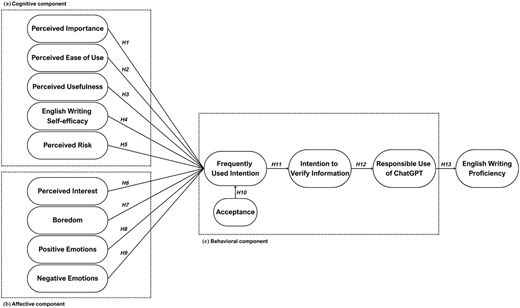
Figure 1 presents the proposed research model, which integrates 14 constructs derived from TAM (Davis, 1989), the PATT-SQ model (Svenningsson et al., 2018) and Mitcham’s philosophical framework of technology (Ankiewicz, 2018). The model follows a sequential logic. Cognitive and affective attitudes are expected to shape students’ intention to use ChatGPT frequently for English academic writing. This frequent use intention then leads to behavioural responses, including information verification and responsible use, which are expected to contribute to English writing proficiency gains. The framework therefore moves beyond technology adoption alone by treating responsible ChatGPT use as a measurable behavioural mechanism rather than a general ethical concern.
2.5.1 Frequent use intention (FUI)
Behavioural intention is central to TAM, which explains technology acceptance through users’ intention to adopt and continue using a system (Davis et al., 1989). In this study, frequent use intention (FUI) refers to students’ intention to use ChatGPT regularly for English academic writing. This construct is important because writing in English is a cognitively demanding task for many L2 learners (Yao et al., 2025), especially in TNE contexts where students must meet academic requirements in English-medium programmes. Students are more likely to form an intention to use ChatGPT frequently when they perceive the tool as useful, accessible and relevant to their writing needs. However, intention to frequent use alone does not necessarily indicate meaningful learning. For this reason, FUI is treated as the starting point of a behavioural pathway that must be followed by information verification and responsible use.
2.5.2 Cognitive predictors of FUI
The cognitive domain captures students’ rational evaluation of ChatGPT as a writing-support tool. Perceived usefulness (PU) and Perceived importance (PIM) reflect the extent to which students believe that ChatGPT can support their English academic writing performance and learning needs (Venkatesh and Davis, 2000). Prior studies have shown that perceived usefulness and related evaluative beliefs can significantly influence students’ intention to use ChatGPT and other educational technologies (Acosta-Enriquez et al., 2024). Perceived ease of use (PEU), defined as the belief that using a system requires minimal effort (Davis, 1989), is also expected to strengthen FUI because students are more likely to use ChatGPT regularly when interaction with the tool is simple and cognitively manageable.
English writing self-efficacy (EWS) is included as another cognitive predictor. Rooted in self-efficacy theory, EWS refers to students’ belief in their ability to organise and perform writing-related tasks successfully (Bandura, 1978). Students with stronger confidence in English academic writing may be more willing to use ChatGPT strategically to support drafting, revision and language refinement. Finally, perceived risk (PR) captures students’ perception of uncertainty and potential adverse outcomes associated with using ChatGPT, including misinformation, privacy concerns and possible academic integrity issues (Dowling and Staelin, 1994). Because PR can reduce users’ readiness to adopt new technologies (Schierz et al., 2010), PR is expected to negatively predict FUI. These cognitive predictors capture students’ practical judgements about whether ChatGPT is useful, manageable and sufficiently safe for repeated academic writing use. Therefore, the following hypotheses are proposed:
PIM positively predicts students’ intention to frequently use ChatGPT in English academic writing.
PEU positively predicts students’ intention to frequently use ChatGPT in English academic writing.
PU positively predicts students’ intention to frequently use ChatGPT in English academic writing.
EWS positively predicts students’ intention to frequently use ChatGPT in English academic writing.
PR negatively predicts students’ intention to frequently use ChatGPT in English academic writing.
2.5.3 Affective predictors of FUI
The affective domain captures students’ emotional responses to using ChatGPT for academic writing. Grounded in the PATT-SQ model, this domain examines whether interest, boredom and emotional reactions influence students’ intention to use ChatGPT frequently (Svenningsson et al., 2018). Perceived interest (PI), understood as an emotion arising from engagement with specific content or activities (Silvia, 2005), is expected to positively influence FUI because students who find ChatGPT engaging may be more willing to integrate it into their writing routines. By contrast, boredom (BOR) and negative emotions (NE) may reduce FUI by creating disengagement, discomfort or resistance toward repeated interaction with the tool (Ben-Ze'ev, 2001). Positive emotions (PE), which refer to favourable emotional reactions triggered by perceived benefits or enjoyable interaction (Shiota et al., 2021), are expected to encourage students’ intention to use ChatGPT frequently for English academic writing. Including these affective predictors allows the model to test whether ChatGPT use is driven only by instrumental evaluation or also by emotional engagement. Therefore, the following hypotheses are proposed:
PI positively predicts students’ intention to frequently use ChatGPT in English academic writing.
BOR negatively predicts students’ intention to frequently use ChatGPT in English academic writing.
PE positively predicts students’ intention to frequently use ChatGPT in English academic writing.
NE negatively predicts students’ intention to frequently use ChatGPT in English academic writing.
2.5.4 Behavioural predictors and outcomes
The behavioural domain extends the model from adoption intention to responsible academic practice. In this study, acceptance (ACP) is conceptualised not as a final outcome, but as students’ cognitive–evaluative readiness to integrate ChatGPT into their learning routines. Students who accept ChatGPT as a legitimate academic support tool are expected to form stronger intentions to use it frequently (Acosta-Enriquez et al., 2024). However, frequent use intention may expose students to both the benefits and limitations of ChatGPT outputs. Therefore, FUI is expected to increase students’ intention to verify information (IVI), as repeated engagement with ChatGPT may make students more aware of possible inaccuracies, incomplete explanations or unsupported claims.
IVI is positioned as a direct antecedent of responsible use of ChatGPT (RUC). Verification is important because responsible academic use requires students to evaluate, cross-check and revise ChatGPT-generated content before incorporating it into their own writing. This logic is consistent with critical AI literacy, which emphasises that learners should not passively accept AI-generated outputs but should question their reliability, limitations and ethical implications (Lim et al., 2025). Finally, RUC is expected to improve English writing proficiency (EWP). Students who use ChatGPT responsibly are more likely to treat it as a learning support rather than a substitute for their own thinking, allowing them to improve grammar, structure, coherence and argumentation through critical revision and integration (Mohammed and Khalid, 2025). This behavioural sequence reflects the central argument of the study: the educational value of ChatGPT depends not only on frequency of use, but on whether students verify and responsibly integrate its outputs into their academic writing. Therefore, the following hypotheses are proposed:
ACP positively predicts students’ intention to frequently use ChatGPT in English academic writing.
FUI positively predicts students’ intention to verify information received from ChatGPT before using it for English academic writing.
IVI positively predicts students’ responsible use of ChatGPT in English academic writing.
RUC positively predicts students’ English writing proficiency gains.
3. Methodology
This study adopted a quantitative survey design supplemented by an expert survey. Quantitative data were collected from 501 undergraduate students at Greenwich Vietnam and Swinburne Vietnam (see Table 1). Participants were recruited through convenience sampling from three major TNE hubs in Vietnam: Da Nang (n = 201), Hanoi (n = 150) and Ho Chi Minh City (n = 150). All participants had prior experience using ChatGPT and were enrolled in business administration, information technology or graphic design programmes. After providing informed consent, participants completed an anonymous online questionnaire. The questionnaire was adapted from validated instruments in prior studies and modified to fit the context of ChatGPT use for English academic writing in TNE programmes. A forward-backward translation procedure was conducted, followed by a pilot test with 50 students to ensure linguistic clarity and cultural appropriateness. Respondents rated their perceptions and behaviours regarding ChatGPT use on a five-point Likert scale ranging from 1 = strongly disagree to 5 = strongly agree. To protect participant anonymity, the study did not collect sensitive or directly identifying personal information.
In addition, an expert survey was conducted with six lecturers to support the interpretation of the quantitative findings and strengthen the practical implications of the study. The lecturers were selected based on three criteria: (a) possession of a master’s or doctoral qualification, (b) substantial teaching experience in English academic writing within TNE programmes and (c) direct observation of students’ use of ChatGPT in academic tasks. The structured expert survey, adapted from Nguyen (2023), included open-ended questions on the benefits, potential issues, practical solutions and recommended guidelines for students’ use of ChatGPT. The responses were used as contextual evidence to support the discussion of institutional policies, pedagogical strategies and responsible ChatGPT use in the Vietnamese TNE context.
Quantitative data were analysed using Cronbach’s alpha to assess the internal consistency and reliability of the measurement scales. Confirmatory factor analysis was then conducted to validate the measurement model by assessing factorial structure, convergent validity, discriminant validity and overall model fit. Subsequently, structural equation modelling (SEM) was employed to test the hypothesised relationships within the proposed theoretical framework, including direct and indirect effects through path analysis.
4. Results
4.1 Reliability and validity
Confirmatory factor analysis (CFA) was conducted to assess the reliability and validity of the measurement model. Standardised factor loadings ranged from 0.584 to 0.885 (see Table 2), exceeding the minimum acceptable threshold of 0.50. These indicators were therefore retained because their associated constructs demonstrated satisfactory composite reliability and average variance extracted. Given the sample size (n = 501) and the theoretical relevance of the retained indicators, this decision is consistent with prior methodological recommendations (Hair et al., 2022). Cronbach’s alpha (CA) values ranged from 0.749 to 0.956, while composite reliability (CR) values ranged from 0.833 to 0.960. Both sets of values exceeded the recommended threshold of 0.70, confirming the internal consistency of the measurement scales. In addition, average variance extracted (AVE) values ranged from 0.500 to 0.744, meeting or exceeding the 0.50 criterion and confirming satisfactory convergent validity across all constructs.
Discriminant validity was assessed using the heterotrait–monotrait ratio of correlations (HTMT). As shown in Table 3, all HTMT values were below the conservative threshold of 0.850, indicating adequate discriminant validity across constructs. Two construct pairs were close to the upper threshold: FUI–PEU (0.850) and RUC–IVI (0.826). These values suggest conceptual proximity between perceived ease of use and frequent use intention, and between information verification and responsible ChatGPT use. However, as all values remained within the acceptable range, the results indicate that the constructs were sufficiently distinct for subsequent structural model assessment.
4.2 Structural model assessment and hypothesis testing
Structural equation modelling (SEM) was employed to test the hypothesised relationships within the proposed theoretical framework. SEM enabled the simultaneous estimation of direct and indirect effects among the latent variables through path analysis. Of the thirteen hypotheses proposed, seven were supported (see Table 4). The significant path coefficients ranged from −0.107 to 0.729, indicating meaningful predictive relationships within the model.
Among the predictors of FUI, PU (β = 0.307, p < 0.001) and PEU (β = 0.325, p < 0.001) showed the strongest positive effects, confirming the central role of perceived usefulness and perceived ease of use in students’ intention to use ChatGPT frequently for English academic writing. PR had a significant negative effect on FUI (β = −0.107, p < 0.050), indicating that perceived risk reduced students’ intention to use ChatGPT frequently. By contrast, the paths from PIM, EWS, PI, BOR, PE and NE to FUI were not statistically significant or did not support the expected direction. Therefore, H1, H4, H6, H7, H8 and H9 were not supported.
The behavioural pathway was fully supported. ACP positively predicted FUI (β = 0.302, p < 0.001), and FUI positively predicted IVI (β = 0.510, p < 0.001). The strongest relationship was observed between IVI and RUC (β = 0.729, p < 0.001), indicating that information verification is a key antecedent of responsible ChatGPT use. Finally, RUC had a significant positive effect on EWP (β = 0.525, p < 0.001), showing that responsible ChatGPT use contributes to English writing proficiency gains. These findings support the proposed behavioural sequence from frequent use intention, to information verification, responsible use and writing proficiency.
Table 5 reports the indirect effects. Two significant indirect pathways were identified: from ACP to EWP and from FUI to EWP. The indirect effect from FUI to EWP was particularly strong (β = 0.195, p < 0.001), indicating that the effect of frequent ChatGPT use on English writing proficiency operates through information verification and responsible use. These results suggest that English writing proficiency gains are shaped by a mediated behavioural pathway rather than by frequent use intention alone.
5. Discussion
In the cognitive domain, PIM showed no significant effect on FUI; therefore, H1 was not supported. This finding contradicts Acosta-Enriquez et al. (2024) but aligns with Reid et al. (2018), suggesting that recognising the general importance of a tool is not sufficient to drive intention to use frequently. In the Vietnamese TNE context, students appear to use ChatGPT for English academic writing mainly when it is perceived as practically useful and easy to use, rather than because they regard it as important in a broad sense.
The results showed that PEU and PU were strong predictors of FUI, supporting H2 and H3. This indicates that TNE students are more likely to use ChatGPT frequently when they perceive it as easy to use and beneficial for writing tasks, which is consistent with prior studies (Acosta-Enriquez et al., 2024). This finding supports the central logic of TAM, in which perceived usefulness and perceived ease of use are key drivers of technology acceptance. From an ODL perspective, accessible and user-friendly technologies can also support self-directed learning in digitally-mediated environments where immediate instructor support may be limited (Anandan et al., 2025; Nikolopoulou, 2023). The expert survey further supports this interpretation, as all six lecturers acknowledged ChatGPT’s usefulness in writing-related tasks. One lecturer in graphic design noted that ChatGPT “helps save time looking for ideas and materials,” reinforcing the usefulness and ease-of-use dimensions underlying students’ repeated use.
EWS had no significant effect on FUI; therefore, H4 was not supported. One possible interpretation is that students with stronger confidence in English academic writing may feel less dependent on external writing support. By contrast, PR had a significant negative effect on FUI, supporting H5. This suggests that perceived risks related to misinformation, information security and academic integrity may reduce students’ intention to use ChatGPT frequently. This finding is consistent with Howlader et al. (2025), who found that perceived risk can reduce users’ intention to adopt AI-based technologies. Together, these cognitive findings show that students’ ChatGPT use is shaped not only by perceived benefits, but also by concerns about possible academic and informational risks.
The results also showed that affective factors did not significantly influence FUI; therefore, H6–H9 were not supported. This finding contrasts with Ajlouni et al. (2023), who reported stronger relationships between affective factors and students’ intention to use ChatGPT. In the present study, TNE students’ intention to use ChatGPT appears to be driven more by cognitive evaluation than by emotional responses. This may reflect the instrumental nature of English academic writing in TNE programmes, where usefulness, ease of use and risk may matter more than interest, boredom or emotional reactions. This finding refines the role of PATT-SQ in the model by suggesting that affective responses may be less influential in task-oriented academic writing contexts.
Regarding the behavioural pathway, ACP had a significant positive effect on FUI, supporting H10. This result is consistent with Cho and Seo (2024), who found that acceptance influences students’ intention to use AI-based technologies. H11 was also supported, as FUI significantly predicted IVI. This suggests that frequent ChatGPT use may increase students’ awareness of the need to check information before incorporating it into academic writing. Rather than indicating passive dependence, frequent use intention can create opportunities for active engagement when students recognise that ChatGPT outputs may be incomplete, inaccurate or unsupported.
The results for H12 revealed a strong positive relationship between IVI and RUC, indicating that information verification is a key antecedent of responsible ChatGPT use. This finding aligns with Sun (2022), who found that concerns about misinformation can encourage proactive verification. It also resonates with Lim et al.’s (2025) discussion of critical AI literacy, which positions learners as informed actors who can question AI-generated outputs rather than passively accepting them. In this study, the transition from FUI to IVI and then to RUC suggests that responsible ChatGPT use is not simply compliance with academic integrity rules, but a behavioural expression of critical judgement.
RUC significantly contributed to EWP, supporting H13. This result suggests that students can improve their English academic writing when they engage with ChatGPT responsibly. The finding aligns with previous research showing that ChatGPT can support academic vocabulary, motivation, grammatical structure and concept formation (Lai and Trinh, 2025). However, the present study extends this discussion by showing that writing proficiency gains are not associated with ChatGPT use in general, but with responsible use mediated by information verification. This supports the central argument of the manuscript: ChatGPT’s educational value depends less on frequency of use and more on the quality of students’ interaction with the tool.
Path analysis further revealed significant indirect behavioural pathways from ACP to EWP and from FUI to EWP through IVI and RUC. These findings identify a sequential mechanism in which acceptance promotes frequent use intention, such intention encourages information verification, verification strengthens responsible use and responsible use contributes to writing proficiency gains. From the perspective of Mitcham’s philosophy of technology, this pathway reflects the movement from volition to activity: students move from intention to the concrete practices of evaluating, revising and ethically integrating ChatGPT-generated content. The findings therefore show that ChatGPT does not produce learning gains automatically; its value depends on reflective and responsible engagement.
These findings are also consistent with recent scholarship on AI-supported learning in ODL. Suwardika et al. (2026) found that an AI-supported flipped design-thinking model using ChatGPT enhanced students’ digital literacy when the tool was embedded within structured learning activities and bounded by ethical guidance. Similarly, the present study suggests that ChatGPT contributes to English academic writing development when students are guided to verify information, critically revise generated content and use the tool within clear academic integrity boundaries. This interpretation also reinforces Lim et al.’s (2025) human-centred view of critical AI literacy.
Overall, the findings suggest that Vietnamese TNE students’ engagement with ChatGPT is driven mainly by cognitive factors, particularly perceived usefulness, perceived ease of use and perceived risk, rather than by affective factors. More importantly, improvements in English academic writing proficiency depend on a mediated behavioural pathway involving intention to use ChatGPT frequently, information verification and responsible use. This finding advances the authors’ central position that frequent ChatGPT use alone is insufficient for meaningful learning. Instead, responsible interaction is the mechanism through which ChatGPT can support writing development in TNE and ODL-oriented learning environments.
These findings have practical implications for HEIs, particularly those offering TNE programmes in which English academic writing is a formal requirement. Since PEU and PU significantly influenced FUI, institutions should provide structured training that helps students use ChatGPT effectively for brainstorming, drafting, revising and language refinement. However, training should also teach students how to evaluate ChatGPT outputs, identify unsupported claims, verify information against credible sources and revise generated text in ways that preserve their own academic voice. Lecturer training is also important, as instructors need to guide students’ use of ChatGPT rather than simply discourage or prohibit it.
The strong relationship between IVI and RUC also suggests that HEIs should embed information verification into AI literacy workshops, writing courses and academic integrity policies. Students should be guided to cross-check ChatGPT-generated content, cite sources appropriately and distinguish between using ChatGPT as learning support and as a substitute for their own thinking. Consistent with Suwardika et al. (2026), ChatGPT should be incorporated as guided scaffolding rather than as an autonomous problem-solver, supported through explicit prompts, verification routines, staged writing tasks, lecturer feedback and transparent academic integrity rules.
Beyond institutional training, the findings also point to the need for clear policy frameworks. To reduce perceived risk and prevent misuse, institutions should define acceptable and unacceptable uses of ChatGPT in academic writing. Students may also be required to include an AI-use declaration explaining how ChatGPT was used and how generated content was verified and revised. Expert insights further suggest that phased assessment can help monitor students’ writing development and reduce the risk that their original ideas are replaced by generated content. In this sense, ChatGPT should be positioned as a “thought partner” rather than a replacement writer.
In terms of theoretical implications, this study extends the literature on ChatGPT-supported academic writing by linking cognitive, affective, behavioural and ethical dimensions within a single model. By integrating TAM, PATT-SQ and Mitcham’s philosophy of technology, the study provides a multidimensional lens for understanding how TNE students move from attitudes toward ChatGPT to responsible academic practice. Constructs such as IVI and RUC foreground critical AI literacy as a central condition for ethical and effective ChatGPT use. Future research could adopt longitudinal designs and test the model across different disciplines, institutions and educational systems.
6. Conclusion
This study examined the factors influencing Vietnamese TNE students’ intention to use ChatGPT and their responsible use of the tool for English academic writing. The findings show that students’ intention to use ChatGPT frequently is shaped mainly by perceived usefulness, perceived ease of use and perceived risk, while affective factors do not significantly influence frequent use intention. More importantly, the results reveal a mediated behavioural pathway in which frequent ChatGPT use promotes information verification, information verification strengthens responsible use, and responsible use contributes to English writing proficiency gains.
These findings support the central argument of the study: ChatGPT should not be understood merely as a convenient writing tool, nor should its educational value be assumed from frequency of use alone. Rather, ChatGPT becomes educationally meaningful when students verify, critically revise and responsibly integrate generated content into their own academic writing. From an ODL perspective, this pathway suggests that ChatGPT-supported learning can strengthen learner autonomy when students take responsibility for evaluating and refining generated outputs instead of passively accepting them. In this sense, information verification and responsible use are essential conditions for sustaining ethical and effective ChatGPT-supported learning in digitally-mediated environments.
The study contributes to the literature by integrating cognitive, affective, behavioural and ethical dimensions within a single framework. By combining TAM, PATT-SQ and Mitcham’s philosophy of technology, the study extends technology adoption research beyond intention to use and shows how ChatGPT adoption can be connected to responsible academic practice and measurable writing outcomes. Practically, the findings suggest that HEIs should design policies and pedagogies that encourage students to use ChatGPT as a supportive learning partner while maintaining academic integrity. Such support should include AI literacy training, information verification practices, transparent AI-use guidelines and lecturer guidance on responsible ChatGPT use in academic writing.
Despite these contributions, the study has several limitations. First, although it examines cognitive, affective and behavioural factors, it does not fully account for contextual influences such as institutional policy, teaching quality and curriculum design. Second, the cross-sectional design limits the ability to assess the long-term effects of ChatGPT use on students’ writing development and responsible usage. Third, the sample scope could be expanded to include students from more diverse disciplines, institutions and programme types, as well as comparisons between local and international students. Future research could therefore examine whether the proposed relationships remain stable over time and across different educational contexts, and whether institutional-level support further shapes responsible ChatGPT use and academic integrity.