


The paper aims to clarify the mediating effect of spirituality on the relationship between principal leadership and pre-service teacher efficacy in open and distance learning (ODL) environments. The issue of leadership weaknesses in school management remains a pertinent area of exploration.
This study employed a quantitative methodology, collecting data from 300 pre-service teachers engaged in ODL settings in Penang. The data were analysed using partial least squares-structural equation modelling (PLS-SEM) with Smart PLS software version 3.3.3 to evaluate the hypotheses.
The results show that principal leadership has a positive and significant influence on spirituality. Additionally, the findings indicate that the three dimensions of spirituality meaningful work, a sense of community and alignment with organisational values also significantly influence principal leadership. Furthermore, the results show that spirituality has a positive and significant influence on teacher efficacy.
The field of research, education and leadership in private preschools can benefit from the findings of this study. However, the study is limited by its focus on private preschools within Penang, restricting the generalisability of the findings to other contexts. Additionally, relying solely on a quantitative research method may not capture the full range of administrative styles adopted by leaders in these settings.
This research highlights the importance of leadership in early childhood education, offering insights for private preschool management and the Ministry of Education. It examines the relationship between principals’ leadership styles, self-efficacy and spirituality, which influence teacher effectiveness. The study underscores the need for strong support in teacher training and professional development, particularly for pre-service teachers in ODL programmes. Continuous qualification upgrades are essential for ODL teachers to balance learning and teaching. Effective leadership significantly impacts preschool teachers, who must manage teaching, administration and student needs, emphasising the role of leadership in fostering quality education.
This study highlights the social implications of transformational leadership in early childhood education, emphasising its impact on teacher effectiveness and spirituality. Using Bandura’s social cognitive theory, it explores how leadership styles shape self-perceptions and behaviours within a social environment. The findings suggest that principals play a crucial role in fostering a supportive culture, aligning with Goetz et al. (2021). By prioritizing social sensitivity, preschool leaders can enhance teacher guidance and minimize conflicts. Additionally, the study contributes to Malaysian preschool literature, revealing that teachers’ work experience indirectly influences their perceptions of leadership effectiveness and spiritual orientation.
This study provides valuable insights and reference sources for early childhood education administration and leadership, particularly within the context of ODL. It highlights the importance of spirituality as a mediator in enhancing teacher efficacy in supportive leadership environments.
1. Introduction
Leadership is crucial in shaping and enhancing teacher involvement in schools. A principal’s leadership style can significantly impact teachers’ spirituality and self-efficacy in working together to achieve the organisation’s mission and vision. The role of a principal, particularly in private preschools, requires a blend of leadership, management, communication and decision-making skills. It demands a strong commitment to student success and a willingness to embrace various tasks and challenges. Each day principals face challenges in enhancing student achievement, even at the preschool level. They encounter some of the most challenging issues, including managing student behaviour and resolving conflicts with teachers and other staff members.
The issue of leadership extends beyond the principal; it encompasses the principal’s role in ensuring that school management is conducted excellently and effectively. An organisation requires a leadership style that can influence its employees to ensure that objectives are met. A principal’s ineffective leadership style can hinder teachers’ actions impact their emotions and confidence, ultimately affecting their performance as they carry out their duties. Ineffective leadership, characterized by poor accountability, leads to lower teacher self-efficacy, which in turn reduces their engagement and overall teaching effectiveness (Gonzalez and Pelayo, 2022). Leadership aims to improve employee performance and overall organisational effectiveness.
Saka (2018) noted that a proactive leadership style is essential for ensuring that followers define their purpose and objectives, helping them achieve higher performance levels. Additionally, leadership is linked to teacher efficacy and educators’ ability to navigate online learning environments despite infrastructural challenges. The study highlights that teachers with high self-efficacy can positively influence student engagement and motivation in online learning or ODL platforms (Kundu et al., 2020). The ODL mode was introduced to enable Malaysian teachers to pursue professional development while continuing their work, contributing to the nation’s progress. It was designed to enhance and expand Malaysia’s human resource capacity. In the early childhood education programme, ODL is delivered through a blended approach, combining face-to-face and online learning.
As mentioned by Ooi and Othman (2023), learning offers in-service teachers the opportunity to work while studying, making it the preferred mode for educators seeking the required qualifications. In the context of Malaysia, pre-service teachers refer to those who are still in the process of continuing their studies to obtain formal certification. Therefore, new approaches and technologies in online and distance education have enhanced the role of ODL universities in expanding access to higher education.
Therefore, principals need to understand the teaching process to enable teachers, including pre-service teachers in ODL programmes, to implement it effectively. Thus, preschool principals play a vital role in ensuring that the teaching process runs smoothly and that teachers are prepared to carry out their responsibilities, ensuring that the preschool’s mission and goals are achieved. A significant issue arises when private preschool teachers face challenges in classroom management and inadequate student control strategies, negatively impacting the teaching and learning process. The education field is fraught with difficulties, leading to teachers who lack confidence and struggle to overcome problems or obstacles (Hariyanti et al., 2019).
According to Haldorai et al. (2020), fostering workplace spirituality, which consists of positive environmental characteristics, the development of good values and respect for employees’ abilities and contributions, can help address these challenges by enhancing teachers’ self-satisfaction, creativity and teamwork spirit, which also will improve their confidence and effectiveness in managing the classroom.
In addition to the environment, the principal’s confidence and trust in teachers also affect organisational effectiveness. Teachers are the most significant agents in the learning process, facilitating the delivery of knowledge and skills to students. A high-performing teacher can assist every educational organisation in implementing the government’s critical objective of becoming a developed country by 2020.
Therefore, elements of spirituality and self-efficacy are crucial in forming an organisation. This leadership refers to the style practised by principals in leading their preschool teachers, including those in pre-service ODL programmes. Moreover, this leadership style is also seen to directly and indirectly impact the development of teachers’ self-efficacy in achieving desired preschool goals. Thus, this study will focus on the mediating effect of spirituality on the relationship between principal leadership and teacher efficacy within a preschool context.
1.1 Purpose of the study
This paper aims to determine the mediating effect of spirituality on the relationship between principal leadership and pre-service teacher efficacy in ODL environments. However, the objectives of this research are as follows:
Determine the influence of principal leadership on pre-service teacher efficacy in ODL.
Determine the influence of principal leadership on spirituality in preschool:
Identify the relationship between principal leadership and meaningful work.
Identify the relationship between principal leadership and a sense of community.
Identify the relationship between principal leadership and alignment with organisational values.
Determine the influence of spirituality on pre-service teacher efficacy in ODL.
Determine the relationship between principal leadership and pre-service teacher efficacy, with spirituality as a mediator in ODL.
2. Theoretical framework
A component of leadership in the school setting referred to as leadership, highlights interpersonal relationships as a key leadership function, emphasising both influence and being influenced. To enhance the professional development of teachers in the school, the role of the leader or principal is crucial. Therefore, past studies for each variable in this study will be discussed in more detail below.
2.1 Workplace spirituality
Spirituality in the workplace refers to an environment that has a clear purpose, a sense of self and a shared sense of responsibility. When viewed from the origin of the word, “spiritually”, it comes from the Latin “spiritus” which means the principle that vitalises an organism. Alternatively, it can also derive from the Latin “sapientia” (Sophia in Greek), meaning “wisdom”, which refers to the intelligence of wisdom (Mhatre and Mehta, 2023). Workplace spirituality is generally related to the meaning of life, connectedness, compatibility and life values at the workplace. It also reflects the expression and experience of spirituality of employees at the workplace, facilitated by various organisational aspects such as culture and values of honesty, organisational climate, leadership and organisational practices (Astakoni et al., 2022).
According to Fairos and Mydin (2022), workplace spirituality helps early childhood educators develop a sense of meaning in life and psychological well-being by receiving support from their colleagues. Additionally, the dimensions of spirituality, such as meaningful work, a sense of connection with others, alignment with values and organisational support, can also directly and indirectly influence a teacher’s well-being. According to Miri et al. (2023), ensuring that the workplace possesses positive characteristics is crucial, as it can impact a teacher’s growth and job performance. Furthermore, preschool teachers who incorporate the concept of workplace spirituality can create a classroom environment that embraces diversity, fosters greater acceptance and provides stronger support.
At the individual level, it refers to the meaningful work carried out by employees, including pre-service teachers participating in ODL programmes. The second level, the community, emphasises the group concept in performing tasks. Employees are expected to be aligned with the organisation’s values and goals when they desire to work for a company whose mission is to uphold high standards of ethics and integrity, contribute to the welfare of the workforce and society and be good corporate citizens.
The interaction between employees and the organisation needs to align with the organisation’s values and goals, emphasising the purpose of employees and pre-service teachers carrying out their responsibilities based on these objectives. As stated by Mousa and Alas (2016), spirituality in the workplace enables employees to engage with the responsibilities and jobs assigned to them. Based on Ahmed et al. (2022), there are three main levels of workplace spirituality, which refer to meaningful work, a sense of community and alignment of values. This demonstrates that individuals prioritise their work and strive for optimal performance, showing dedication to their profession. By bringing their heart and soul to work, employees and pre-service teachers from ODL backgrounds can contribute more effectively to their organisation and achieve greater job satisfaction. Ultimately, this emphasis on personal investment in work can lead to increased productivity and overall success for both individuals and the workplace.
Next, the second dimension refers to a sense of community. According to Norrahman (2023), the relationship between employees is so close that they often try to bring their own families into the workplace community, particularly in the management of early childhood education. Additionally, Murray and Holmes (2021) noted that the last dimension of alignment with organisational values is also related to individuals within the organisation who strive to adapt to the organisation’s values and possess values of integrity and unity, aligning with the organisation’s vision, mission and goals. This value is achieved through the vision and personal actions of individuals, who create a sense of being called and become part of the workplace community. This statement is supported by Ahmed et al. (2022), who focus on integrating these values into the workplace, thereby indirectly increasing employee morale and motivation, which in turn influences their feelings and work. In conclusion, spirituality in the workplace, especially in the context of pre-service teachers engaged in ODL, highlights the importance of creating an environment that fosters meaningful work, a sense of community and alignment with organisational values, ultimately contributing to enhanced teacher efficacy and a more fulfilling work experience.
2.2 Principals’ leadership
A preschool principal refers to an individual who leads the administration and management of a preschool. They are responsible for managing and supervising teachers to ensure that the quality of education is maintained efficiently. The study by Amzat et al. (2023) examines how different principal leadership styles influence teacher commitment in Islamic schools in Malaysia, with teacher well-being acting as a mediator. This study highlights that fostering a positive school environment through supportive leadership can strengthen teacher commitment and school performance.
Furthermore, Wang et al. (2019) conducted a study on the characteristics of leaders and the organisational environment and discovered that leadership has a positive impact on creating an efficient, visionary and mission-oriented organisational environment. Leung (2018) stated that the leadership characteristics of these principals influence teachers in carrying out their tasks and implementing changes during teaching sessions. Based on Hadebe’s (2023) study, the role of secondary school administrators in supporting ODL student teachers during their teaching practice in the post graduate diploma in education programme highlights the importance of school leadership in providing necessary support services, including prevention, intervention, transition and follow-up assistance. However, despite the support provided by school leadership and management, challenges still exist for ODL student students’ teachers in secondary schools.
Moreover, this leadership is applied so that teachers and school members can uphold the values associated with the responsibilities entrusted to them. However, the leadership described in this study will be based on the leadership style in the preschool context.
2.3 Pre-service teacher’s efficacy
Self-efficacy refers to an individual’s assessment of their ability to organise and implement the necessary steps to achieve a specific objective effectively. This important element plays a significant role in a person’s success. The concept of efficacy expectations states that individuals’ confidence in achieving certain objectives is directly related to their likelihood of success (Bandura, 1977). According to Greene’s research (2020), the cultivation of teacher self-efficacy depends on the professional perspective of individual educators, which, in turn, is informed by their unique personal experiences. Each of these elements is significant for a person’s self-efficacy growth. A person’s self-efficacy influences similar experiences and serves as a source of self-efficacy, including mastery experiences, vicarious experiences, verbal or social persuasion and physiological and emotional states.
The concept of teacher self-efficacy relates to teachers’ unwavering belief in their ability to inspire and assist students in achieving academic success and developing exemplary behaviours (Bandura, 1993). A person’s self-efficacy influences similar experiences and serves as a source of self-efficacy, including mastery experiences, vicarious experiences, verbal or social persuasion and physiological and emotional states. One of the domains engaged in the subject of education is teacher self-efficacy. Based on Mohamed Riyath and Muhammed Rijah (2022), motivation and encouragement from leadership can further enhance educators’ self-efficacy when they are working in an organisation. Thoma (2023) highlights how public school leaders promote collective teacher efficacy through spiritual leadership, which aligns with the idea that principal leadership can also influence teacher efficacy.
It is essential to recognise that collective teacher efficacy is a crucial factor in determining student achievement (Grant and Ray, 2019). Rathnasekara et al. (2023) stated that self-efficacy beliefs are recognised as a highly dependable factor in enhancing the utilisation of e-learning, ultimately fostering employees’ competency development and improving their behavioural engagement in ODL or online learning.
3. Hypotheses development
3.1 Relationship between principal leadership and pre-service teacher efficacy
A recent study by Wong and Thien (2020) discovered a substantial relationship between pre-service teacher self-efficacy in areas such as instructional tactics, classroom management and student engagement and the characteristics of individual charisma and consideration. Furthermore, according to Ross and Gray (2006), leadership has a positive impact on teachers’ self-efficacy, which in turn contributes to their dedication to their profession and organisational principles. This research underscores the significance of cultivating teacher self-efficacy through effective leadership and supportive measures. The leadership style exhibited by the principal can indirectly impact the effectiveness of teachers regarding their trust and confidence in carrying out assigned tasks while managing the teaching process at school. These findings strongly suggest a significant relationship between principal leadership and pre-service teacher efficacy.
Thus, based on objective 1, the following hypothesis was formulated:
Principal leadership has a positive significant influence on pre-service teacher efficacy.
3.2 Relationship between principal leadership and spirituality
The importance of spirituality in fostering values, ethics, and trust in leaders has been established. According to a study by Gocen and Ozgan (2020), the spirituality of teachers is not static; rather, it develops over time and is shaped by experiences, particularly in terms of how they are treated and the type of leadership demonstrated by their principals. In addition, based on objective 2, the following hypothesis was formulated:
Principal leadership has a positive significant influence on spirituality.
3.3 Relationship between principal leadership and meaningful work
Research findings indicate a correlation between transformational leadership and the increased well-being of followers, thereby imbuing their lives with purpose and significance (Krishnan, 2012). This vision must instill a sense of purpose and the belief that one’s contribution can make a meaningful difference. By fostering a culture of calling in the organisation, individuals are more likely to experience a sense of satisfaction and strive to achieve their goals. Ultimately, this can lead to a more engaged and productive workforce. In addition, based on objective 2(a) the following hypothesis was formulated:
Principal leadership has a positive significant influence on meaningful work.
3.4 Relationship between principal leadership and sense of community
According to Nauman (2018), work also represents a sense of community sensitivity for the majority of workers. This indicates a profound connection between the dimensions of the sense of community within the workplace context. In addition, this spirituality factor refers to elements of interrelatedness and interdependence among employees, as well as a sense of comfort with the world and collaborative problem-solving (Pandey et al., 2016). Furthermore, the leadership style highlighted by the principal will help foster a more positive and mutually supportive working community. Based on objective 2 (b), the following hypothesis was formulated:
Principal leadership has a positive significant influence on the sense of community.
3.5 Relationship between principal leadership and alignment with organisational values
The relationship of alignment with the organisational is dependent on individuals in the organisation who strive to apply those values and have integrity and unity in line with the vision, mission and objectives of the organisation (Kumar, 2018). Additionally, the relationship between principal and teacher leadership can have a profound impact on achieving set goals. Kumar (2018) suggests that the transfer of values occurs through the actions and personal vision shown by individuals, which creates a sense of belonging and encourages active participation among members in the workplace. Thus, based on objective 2 (c), the following hypothesis was formulated:
Principal leadership has a positive significant influence on alignment with organisational values.
3.6 Relationship between spirituality and pre-service teacher efficacy
According to Grant and Ray (2019), research reveals that incorporating spirituality and self-efficacy into one’s teaching approach can significantly improve relationships with parents, students and colleagues. These findings suggest that by acknowledging the impact of these qualities on classroom effectiveness, teachers can make more informed decisions about how best to serve their students. Integrating spirituality in the workplace can have a profound impact on pre-service teachers’ self-efficacy beliefs, as shown by Greene’s (2020) research. Therefore, practising spirituality in the workplace can be a catalyst for positive transformation and success in the educational environment. The following hypothesis was formulated based on objective 3:
Spirituality has a positive significant influence on pre-service teacher efficacy.
3.7 Spirituality mediates the relationship between principal leadership and pre-service teacher efficacy
According to Haldorai et al. (2020), spirituality has become an intermediary that influences the behaviour of leaders in shaping organisations. Thus, the following hypothesis was formulated based on objective 4:
Spirituality mediates the relationship between principal leadership and pre-service teacher efficacy.
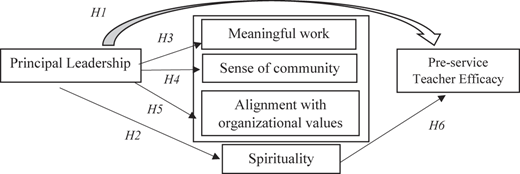
The conceptual framework, as shown in Figure 1, examines how principal leadership influences pre-service teacher efficacy, both directly and indirectly, through spirituality as a mediator. Spirituality is conceptualized into three dimensions: meaningful work, sense of community and alignment with organisational values. The study explores the direct effect of principal leadership on pre-service teacher efficacy, the impact of principal leadership on spirituality and the role of spirituality in enhancing teacher efficacy. Furthermore, it investigates whether spirituality mediates the relationship between principal leadership and pre-service teacher efficacy in ODL.
4. Methods
4.1 Measures
Principal leadership: To measure the leadership in the preschool context among the principals, the Khalid (1997) instrument was used and adapted in this research. It comprises 34 items on a five-point scale, ranging from 5 (strongly agree) to 1 (strongly disagree).
Teacher efficacy: Teacher efficacy was measured using 12 items adapted from the Teacher Sense of Efficacy Scale (Tschannen-Moran and Hoy, 2001). Items are rated on a five-point scale ranging from 5 (strongly agree) to 1 (strongly disagree).
Spirituality: To measure the three dimensions (meaningful work, sense of community and alignment with organisational values. The questionnaire was adapted from Milliman et al. (2003). There are 20 items on a five-point scale ranging from “strongly agree” to “1” (strongly disagree).
5. Results
5.1 Descriptive analysis
The majority of respondents who participated in the research were aged between 21 and 30 years, consisting of 253 respondents (84.3%), followed by respondents aged between 31 and 40 years consisting of 44 respondents (44.0%), followed by those below 20 years old consist of three respondents (1.0%). The majority of preschool teachers hold a diploma, with 189 respondents (63.0%), followed by Malaysian Higher School Certificate (STPM), which is held by 66 respondents (22.0%). The bachelor’s level of education was recorded as the third highest among respondents, with 35 respondents (11.7%), followed by Malaysian Certificate of Education (SPM), which consisted of 6 respondents (2.0%) and masters, which consisted of four respondents (1.3%).
Next, the majority of respondents’ experience serving in preschool is within 11–15 years for 107 people (35.7%), followed by 1–5 years for 80 respondents (26.7%), then 16–20 years for 61 respondents (20.3%), followed by 6–10 years and more than 20 years of experiences consists of the same percentage with 26 respondents for each (8.7%), as shown in Table 1.
Respondents demographic profile (N = 300)
| Attribute | Value | Frequency | Percentage |
|---|---|---|---|
| Age | Below 20 years old | 3 | 1.0 |
| 21–30 years old | 253 | 84.3 | |
| 31–40 years old | 44 | 44.0 | |
| Education level | SPM | 6 | 2.0 |
| STPM | 66 | 22 | |
| Diploma | 189 | 63.0 | |
| Bachelor | 35 | 11.7 | |
| Master | 4 | 1.3 | |
| Years of experience | 1–5 years | 80 | 26.7 |
| 6–10 years | 26 | 8.7 | |
| 11–15 years | 107 | 35.7 | |
| 16–20 years | 61 | 20.3 | |
| More than 20 years | 26 | 8.7 |
Source(s): Author’s own work
5.2 Common method bias
This research has been confirmed to have no issues of common method bias and collinearity, as the values of variance inflation factor (VIF) for the construct are below 3.3. The VIFs must have a value that is equal to or below 3.30 in order to guarantee that the structural model is free of common method bias and collinearity problems (Kock, 2015).
5.3 Results of the measurement model assessment
In this study, convergent and discriminant validity were employed to assess the construct validity. The measurement of model assessment indicates that all item loadings for each variable exceed 0.7. Additionally, based on the results, all constructs exhibit a composite reliability value of more than 0.7, with values of approximately 0.90. According to Hair et al. (2010), the value composite reliability values must be greater than 0.70. In addition, the values of average variance extracted (AVE) are more than 0.5; this result shows that the values are acceptable. According to Fornell and Larcker (1981), AVE values greater than 0.5 and composite reliability values of at least 0.7 are acceptable.
Discriminant validity was assessed as the next analysis. In the present study, the Fornell–Larcker test will be used. When the correlation between the variable latent and other variable latents in the model is low, this discriminant validity can be accepted (Kock, 2015). According to Hair et al. (2014), when using the Fornell–Larcker analysis, the AVE value between two constructs must be higher. This analysis refers to the square root of AVE’s value with the correlation of latent variables. Table 2 shows the discriminant validity using Fornell and Larcker analysis. Based on the results, it indicated that there is no discriminant validity in this study.
5.4 Results of structural assessment model
The significance level of path coefficients was determined using the bootstrapping approach with 5,000 samples. The path coefficient, t-value, p-value and 95% confidence interval are presented in Table 3. The statistical findings show that all hypotheses H2, H3, H4, H5 and H6 were significant except H1, which was not supported.
Direct effect
| Path | Beta | t-value | p-value | Decision |
|---|---|---|---|---|
| H1: PL → TE | 0.113 | 1.1300 | 0.25 | Not supported |
| H2: PL → S | 0.820 | 27.940 | 0.00 | Supported |
| H3: PL → MW | 0.940 | 98.811 | 0.00 | Supported |
| H4: PL → SOC | 0.902 | 58.957 | 0.00 | Supported |
| H5: PL → OV | 0.920 | 52.895 | 0.00 | Supported |
| H6 S → TE | 0.674 | 7.439 | 0.00 | Supported |
Note(s): PL – Principal leadership, S – Spirituality, MW – Meaningful work, SOC – Sense of community, OV – Alignment with organisational values and TE – Teacher efficacy
Source(s): Author’s own work
5.4.1 Results on the influence of principal leadership on pre-service teacher efficacy in ODL
This result indicates that principal leadership has a significant and positive influence on spirituality (β = 0.820, p < 0.001). In addition, the principal leadership also has a significant influence on the three dimensions of spirituality, namely meaningful work (β = 0.940, p < 0.001), sense of community (β = 0.902, p < 0.001) and alignment with organisational values (β = 0.920, p < 0.001).
5.4.2 Results on the influence of spirituality on pre-service teacher efficacy in ODL
Furthermore, the results indicate that spirituality has a significant and positive influence on teacher efficacy (β = 0.674, p < 0.001). The results suggest that it helps teachers overcome challenges such as self-discipline and a lack of face-to-face interaction by fostering a strong sense of purpose and focus on their inner strength.
5.4.3 Results of the relationship between principal leadership and pre-service teacher efficacy, with spirituality as a mediator in ODL
Next, this study examines the indirect effect of the spirituality relationship on principal leadership and teacher efficacy. Based on the bootstrapping method, indirect effects can be analysed to see the relationship between variables. According to the results, shows that spirituality mediates the relationship between principal leadership and pre-service teacher efficacy. Table 4 shows that the H7 hypotheses were supported.
Indirect effect
| Path | Beta | t-value | p-value | Decision |
|---|---|---|---|---|
| H1:PL → S → TE | 0.553 | 7.809 | 0.25 | Supported |
Note(s): PL – Principal leadership, S – Spirituality and TE – Teacher efficacy
Source(s): Author’s own work
Additionally, the explanatory power of this model is demonstrated in Table 5, which enables us to view the model’s predictions and understand the variables that contribute most to the model. The R2 value is used to evaluate the structural model. The results indicate R-squares of spirituality (R2 = 0.67) and teacher efficacy (R2 = 0.59). Chin (1998) explained the values of R2 are 0.67 (large), 0.33 (moderate) and 0.19 (weak). Therefore, both values are in the range of large. Based on Table 6, the results of the F-square are shown. The value of f2 has three values : 0.02 (small), 0.15 (medium) and 0.35 (large) (Chin, 1998). However, the results show that principal leadership has a medium effect on the variable of self-efficacy (f2 = 0.010) and has a large effect on the mediator variable of spirituality (f2 = 2.060). Next, the spirituality variable has a significant effect on self-efficacy (f2 = 0.363).
6. Discussion
This study examines the influence of principal leadership on pre-service teacher efficacy in ODL and the role of spirituality as a mediating factor. The findings indicate that principal leadership does not have a direct, significant influence on pre-service teacher efficacy. This aligns with previous studies, such as Francisco (2019), which suggest that while teachers may rate their efficacy as high, their relationship with leadership does not necessarily contribute to that efficacy. Other factors, such as self-motivation, peer collaboration and institutional support, may play a more critical role in shaping teacher efficacy in ODL settings (Saether, 2019).
Additionally, this study also found a strong relationship between principal leadership and spirituality in preschool settings. Specifically based on the three dimensions where the principals who demonstrate strong leadership create environments where teachers find greater meaning in their work. Leadership that fosters a supportive and collaborative environment enhances teachers’ sense of community. Findings suggest that principal leadership is positively associated with alignment with organisational values. Leaders who embody and communicate a strong vision help teachers integrate their personal and professional beliefs with institutional goals (Pio and Lengkong, 2020).
The results support the hypothesis that spirituality has a significant influence on pre-service teacher efficacy. This is consistent with Greene (2020), who found that teachers who experience a high level of workplace spirituality exhibit greater confidence in their teaching abilities. When institutions nurture a sense of purpose, belonging and alignment with values, pre-service teachers in ODL programmes can develop stronger self-efficacy. Although principal leadership does not directly impact pre-service teacher efficacy, the presence of spirituality as a mediator creates a significant positive effect. This finding aligns with the person–organisation (PO) fit theory (Palframan and Lancaster, 2019), which suggests that when an organisation meets the needs of its personnel, elements of spirituality become embedded in professional experiences. Overall, these findings suggest that while principal leadership alone may not directly impact teacher efficacy in ODL settings, fostering a strong sense of spirituality through leadership strategies can lead to more effective and motivated educators. Future research should explore additional mediating factors, such as institutional culture and peer collaboration, to provide a more comprehensive understanding of teacher efficacy development.
7. Implication
7.1 Social implication
The social implications of this study emphasise how the findings contribute to social dynamics in early childhood education. It examines how these findings relate to existing theories and models used in the study. The results can help identify aspects of transformational leadership that influence the effectiveness and spirituality of teachers. This knowledge can assist in minimising conflicts between principals and teachers by utilising Bandura’s social cognitive theory, which highlights how individuals’ self-perceptions and behaviours are shaped by their social environment.
According to the study’s conceptual framework, the principal’s leadership style has a significant influence on the spiritual dimension in preschool settings. Goetz et al. (2021) assert that organisational culture plays a vital role in shaping individual characteristics. By prioritising social sensitivity, preschool principals can effectively mediate and guide their teachers within the school organisation. This highlights the significance of effective leadership in creating a supportive and nurturing environment for preschool children. Moreover, this research enhances the significance of literature in the Malaysian preschool context. The findings suggest that teachers’ work experience has an indirect impact on their assessment of the principal’s leadership style as well as their perceptions of effectiveness and spiritual orientation.
7.2 Practical implication
This research provides valuable insights for private preschool management and the Ministry of Education on enhancing the educational leadership skills of early childhood teachers, including pre-service teachers in ODL programmes. Furthermore, it explains the relationship between the principal’s leadership style, self-efficacy and spirituality, all of which play an important role in enabling teachers to achieve their objectives. This study thus acts as a call to action to foster the growth and development of young learners in the preschool environment. Additionally, this research emphasises the significance of support in enhancing teacher training and professional development. To increase the efficacy of pre-service ODL teachers, it is crucial for them to upgrade their qualifications while working, ensuring continuous learning without compromising their teaching responsibilities. It has been proven that the quality of leadership has a great influence on the actions of preschool teachers. This is because these educators bear the heavy responsibility of not only delivering lessons effectively but also managing administrative tasks, meeting the needs of students and juggling various other tasks.
8. Conclusion and recommendation
This paper has analysed the influence of spirituality on the relationship between principal leadership and teacher efficacy in the preschool context. The results indicate that it is essential to identify the type of leadership exhibited by principals that influence the self-efficacy of both in-service and pre-service teachers, especially those in ODL programmes. Furthermore, this study contributes to the understanding of the roles of principal leadership, teacher self-efficacy and spirituality, particularly in the preschool stage. Therefore, it is crucial to determine the effect of spirituality on the relationship between principal leadership and teacher efficacy in the preschool context.
8.1 Limitations and future research recommendations
The field of research, education and leadership in private preschools can benefit from the findings of this study. However, the study is limited by its focus on private preschools in Penang, which restricts the generalisability of the findings to other contexts. Additionally, relying solely on a quantitative research method may not capture the full range of administrative styles adopted by leaders in these settings. To obtain more comprehensive results, future research should integrate both quantitative and qualitative methods to explore the administrative styles that leaders in private preschools adopt. Future studies could also focus on different categories within private kindergartens, such as urban and rural settings and expand research to other educational contexts. Therefore, these findings are specific to Penang and should be interpreted accordingly.

