Hong Kong and mainland China share similar cultures, but there are linguistic, cultural and economic differences between these two “sibling cultures”. Hong Kong universities have received a significant increase in the number of Mainland Chinese students due to government initiatives aimed at transforming Hong Kong into a regional education hub. This study seeks to investigate the role of competence in second language (L2) communication and acculturation strategies in the cross-cultural adaptation of these sojourning students.
Aligned with the hypothesized model, this study gathered data from 208 Mainland Chinese students in Hong Kong, collecting demographic details and employing validated measurement tools. It assessed academic, sociocultural and psychological adaptation, acculturation and proficiency in second language (L2) communication. Path analysis utilizing Mplus software and structural equation modeling were applied for analysis.
The results from the structural equation modelling suggest that having a strong ability to communicate in a second language and identifying with people from the same country as oneself can greatly influence how well one adapts to a new culture. Additionally, identifying with people from the host country can contribute to socio-cultural adaptation. The main objective of this research is to contribute to the existing literature on cross-cultural adaptation and communication and provide valuable insights that can be used to inform curriculum design and educational policies and practices.
This study introduces a distinctive approach by integrating second language willingness to communicate (L2 WTC), acculturation and adaptation within an interactive and responsive model. It pioneers the examination of the interplay between acculturation strategies, L2 WTC and adaptation. Additionally, the research distinguishes itself by employing structural equation modeling to explore the intricate variables associated with cross-cultural adaptation among Mainland Chinese students in a unique social context where non-local students predominantly share a common ethnicity and cultural background with the local population.
Introduction
In recent years, the Hong Kong government has actively pursued the vision of establishing the territory as a regional education hub, with the recruitment of “non-local students” identified as a key component (Cheng et al., 2011). This initiative, driven by the desire to diversify the student base and enhance Hong Kong’s soft power in education (Mok and Bodycott, 2014), has led universities in Hong Kong to proactively seek students globally as part of an internationalization strategy (Oleksiyenko, 2014). The term “non-local student” encompasses both foreign students from outside the administrative region and those from Mainland China (Bodycott and Lai, 2012), with students from the Mainland constituting the majority. The proposal to increase the intake of non-local undergraduates by the 2024–2025 academic year reflects the government’s commitment to attracting global talent without affecting the opportunities available to local students, as non-local students will be paying full tuition fees. This change aims to support Hong Kong’s transformation into a regional education hub by attracting approximately 6,000 new non-local undergraduates.
Despite the rising number of Mainland Chinese students in Hong Kong’s universities, challenges persist due to the “Mainland–Hong Kong conflicts,” rooted in significant political, economic, sociocultural and linguistic differences between the two regions. These disparities, coupled with Hong Kong’s unique colonial history and development trajectory, have contributed to a complex relationship marked by mutual discrimination and anti-mainlandization sentiments (Lau, 1998; Siu, 1996; Yu and Zhang, 2016; Xu, 2015).
Previous research has primarily focused on the push–pull factors influencing Mainland students' decision to study in Hong Kong, highlighting both the opportunities and challenges they face, including language barriers, academic pressures and social discrimination (Bodycott, 2009; Zeng, 2006). Moreover, studies in non-Western settings have begun to explore the unique adaptation challenges faced by students in culturally proximate but politically distinct environments (e.g. Malay et al., 2023; Yu and Wright, 2017, 2024; Zhu et al., 2023), revealing the need for context-specific frameworks to understand the adaptation processes of different student groups, including Southeast Asian and Mainland Chinese students in Hong Kong (Cao and Meng, 2022).
This study aims to identify the strategies employed by non-local students from diverse cultural backgrounds to successfully adapt and communicate within the context of Hong Kong. Theoretical frameworks guiding this research include second language (L2) communication (Clément et al., 2003), acculturation strategies (Ward and Rana-Deuba, 1999) and cross-cultural adaptation (Berry, 1999; Zhou et al., 2008; Yu, 2009; Yu and Wright, 2024), with a focused exploration of the core research questions regarding how these students navigate their unique challenges.
Theoretical frameworks and research gaps
L2 acquisition is crucial for enhancing intercultural communication, serving as a fundamental element in the study of intercultural interaction, acculturation and adaptation (Clément et al., 2003). The Willingness to Communicate (WTC) model is pivotal, offering a nuanced measure of language utility within intercultural contexts by focusing on an individual’s propensity to initiate communication voluntarily, influenced by their confidence, communication anxiety and perceived competence (Clément et al., 2003). Acculturation, defined as the adoption of values, norms and beliefs of a dominant group by a minority group, is intertwined with L2 acquisition, affecting and being affected by the process (Jiang et al., 2009). Challenges in international students’ adaptation often stem from L2 competence and cultural differences (Andrade, 2006). Despite this, limited research has explored the interrelationships between acculturation, L2 WTC and adaptation. This study proposes an innovative model linking these elements, building on previous work (e.g. Gallagher, 2012; Yu, 2009, 2010, 2021; Yu and Downing, 2012; Yu and Shen, 2012; Yu and Watkins, 2008; Yu and Wright, 2024) but uniquely incorporating L2 WTC, acculturation and adaptation strategies to examine their impact on successful university adaptation and intercultural communication outcomes across diverse cultural backgrounds.
Three facets of cross-cultural adaptation
Adaptation is the process of adjusting to environmental conditions (Castro, 2003). In cross-cultural psychology, adaptation often refers to the “fit” between an acculturating individual and the mainstream cultural environment, as part of acculturation research (Berry and Sam, 1997), highlighting it as an ongoing process. Literature identifies two primary outcomes of cross-cultural adaptation: psychological and socio-cultural (Ward and Kennedy, 1993). Psychological adaptation, within a stress and coping framework, pertains to well-being and satisfaction in a new cultural context. Socio-cultural adaptation, within a social learning paradigm, involves the ability to integrate into or negotiate the host culture’s interactive aspects (Ward and Kennedy, 1993). O’Reilly et al. (2010) observed that international students experiencing psychological distress also faced socio-cultural difficulties, suggesting a link between mental stress, life satisfaction and socio-cultural adaptation.
The capacity to overcome academic challenges significantly impacts international students' intellectual and socio-personal growth (Pascarella and Terenzini, 2005; Yorke and Longden, 2007). Academic performance is largely influenced by students' ability to adapt to new socio-cultural practices within academic settings (Lebcir et al., 2008). Despite the overlooked aspect of academic adaptation in cross-cultural adaptation literature, its importance is underscored in studies on international students (e.g. Yu, 2009, 2010; Snow, 2006). Research indicates that academic success significantly influences socio-cultural adaptation and psychological well-being (Li and Kaye, 1998). Zhou and Todman (2008) found a relationship between psychological and socio-cultural adaptation and academic issues among Chinese postgraduate students in the UK. Furthermore, academic adaptation is identified as a core issue and a major predictor of socio-cultural adaptation (Zeng, 2006; Yu, 2021).
The role of competence in L2 communication in cross-cultural adaptation
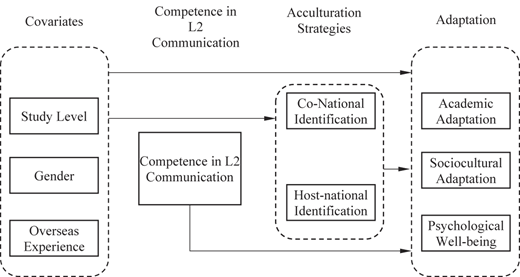
The relationship between L2 competence and adaptation is complex and multifaceted. Extensive research consistently demonstrates that second language competence plays a pivotal role in cross-cultural adaptation. For example, congruence between motives and goals for learning an L2 can facilitate adaptation to a foreign culture (Rubenfeld et al., 2007). Wilczewski and Alon (2023) conducted a systematic review of literature from 1994 to 2021 to explore language and communication in international students’ cross-cultural adaptation within higher education institutions, and they found higher L2 competence was found to be associated with better academic and sociocultural adaptation and increased social satisfaction. In a study conducted with international students in an Australian university (Yu and Shen, 2012), it was suggested that linguistic confidence in L2 is a primary predictor of both socio-cultural and academic adaptation. Moreover, Yu et al. (2020) reported that bilingual competences significantly predicted sociocultural adaptation together with academic efficacy, social support, contact with locals and psychological adaptation. In addition, Dekeyser and Criado (2012) emphasized that developing skills and practicing L2 competence play a crucial role, potentially influencing psychological adaptation. These findings underscore the critical importance of language skills in facilitating successful adaptation to new cultural contexts. Thus, we hypothesize that L2 competence positively predicted three facets of cross-cultural adaptation (see Figure 1).
The role of acculturation strategies and cross-cultural adaptation
Current acculturation theory states that acculturation occurs in two dimensions, namely, maintenance of original cultural identity and maintenance of relations with other groups (Kim, 2007). If evaluative responses to the two dimensions are dichotomized, then four acculturation attitudes or strategies are proposed as follows: integration, assimilation, separation and marginalization (Berry, 1997; Berry and Sam, 1997).
In the social context model (Clément, 1980; Clément and Kruidenier, 1985), frequent and pleasant contact with the L2 group enhances linguistic confidence at varied levels, which in turn is associated with increased communication competence in the L2, increased identification with the L2 group and increased psychological adaptation (Noels and Clément, 1996; Noels et al., 1996).
While Berry’s model focuses on acculturation strategies in culturally distant contexts, our framework extends this by demonstrating how co-national identification and L2 competence modulate these strategies in sibling cultures like Mainland–Hong Kong dyads, where cultural proximity reshapes adaptation pathways.
The success of a cross-cultural adaptation depends on the individual’s degree of identification with his/her host and home cultures (Berry, 2003). Ward and Rana-Deuba (1999) found that strong co-national identification results in an enhanced psychological well-being, whereas strong host national identification is associated with excellent socio-cultural adaptation. Based on the 2D model of acculturation, Berry (2003) posited that people who have high levels of home and host identification (categorized as integration strategy) experience low acculturative stress, whereas people who have low identification with both home and host cultures (categorized as marginalization strategy) experience high acculturative stress. Therefore, we hypothesize that co-national identification predicts psychological adaptation while host-national identification predicts socio-cultural adaptation (see Figure 1).
Individual-related factors and cross-cultural adaptation
Recent reviews have consistently emphasized the necessity of conducting additional research to explore individual-level factors that have received insufficient attention thus far, such as individual characteristics and perceptions (Brunsting et al., 2018; Cao and Meng, 2022). It is notable that international students, with varying characteristics, may employ a range of acculturation strategies, ultimately influencing their adaptation across the three dimensions. In the present study, we propose three individual factors, namely study level, gender and overseas experience as predicators of adaptation.
Study level. Previous research on international student adaptation often conflates undergraduate and graduate experiences (Brunsting et al., 2018), though life-stage differences shape adjustment processes (Brunsting et al., 2018). Recent studies highlight divergent outcomes: graduate students report lower acculturative stress (Li et al., 2013), greater social integration (Han et al., 2017) and more emotion-oriented coping strategies than undergraduates (Kim and Ra, 2015). While both groups encounter similar cross-cultural challenges, life-stage factors – such as developmental priorities and academic demands – influence their adaptation approaches. These distinctions underscore the need for disaggregated analyses to better address each cohort’s unique needs in institutional support frameworks.
Gender. Gender is a key factor in cross-cultural adaptation (Berry, 2002), yet research shows inconsistent effects on international students’ adaptation. Zhang and Goodson (2011) found women face more challenges and higher acculturative stress, while Ying and Han (2006) noted that Taiwan female students are more willing to embrace American culture and build cross-cultural connections. Lee et al. (2009) reported higher adaptation levels among Korean female students, but Zhu et al. (2023) found no significant gender differences in academic adaptation in China. These findings highlight the need to explore potential gender differences in acculturation strategies and processes.
Overseas experience. Previous cross-cultural experiences significantly influence international students' adaptation. Students with prior abroad exposure exhibit enhanced psychological adjustment and reduced acculturative stress (Akhtar and Kröner-Herwig, 2015; Gebregergis et al., 2019). Cao et al. (2017) found that such students develop stronger intergroup communication skills and better overall adaptation outcomes. While most studies focus on the duration of stay in the host country (de Araujo, 2011), this research examines prior overseas experience as a predictive factor for acculturation strategies and adaptation success.
Method
Sample
The sample for the current study comprised 208 Mainland-origin Chinese students studying in Hong Kong. Among them, 164 (78.8%) were female (coded as 0); 1 (0.5%) was a part-time student; 92 (44.2%) had no (coded as 0), 90 (43.3%) had less than one year (coded as 1) and 26 (12.5%) had more than one year (coded as 2) of overseas experience; 70 (33.7%) were aged between 15 and 20 (coded as 17.5), 106 (51.0%) between 21 and 25 (coded as 23), 25 (12.0%) between 26 and 30 (coded as 28), 5 (2.4%) between 31 and 35 (coded as 33) and 2 (1%) more than 35 years (coded as 38); 99 (47.6%) were undergraduates (coded as 0) and others are postgraduates (52.4%; coded as 1).
Measures
Measurement instruments were developed and validated in the pilot study (Yu, 2021). A pilot study (n = 198) confirmed the instrument clarity and cultural relevance; Cronbach’s α > 0.8 for all scales. All the instruments were translated into Chinese, which went through back-translation by two experienced researchers in this field who are highly proficient in both Chinese and English. Students’ language competence was measured at the first time point, and their acculturation and cross-cultural adaptations were measured at the second time point (1 year after the first time point). Gender, study level and overseas experience were measured using a single item respectively.
Academic adaptation. Students were asked about their agreement on the statements related to academic adaptation. There were 12 items, with five response categories: “Strongly Disagree” (coded as 1), “Disagree” (2), “Neutral” (3), “Agree” (4) and “Strongly Agree” (5). Example items were “I understand the classes I take at host university,” “My study is progressing well” and “My teaching staff’s advice is helpful.” The factor loadings of the items ranged between 0.43 and 0.79, with Cronbach’s Alpha of 0.90.
Sociocultural adaptation (self-report competence). Students were asked to report their competence regarding statements related to sociocultural adaptation of their life and study in Hong Kong. There were 23 items, with five response categories, from “Not at all competent” (coded as 1) to “Extremely competent” (5). Example items were “Building and maintaining relationships,” “Managing my academic responsibilities” and “Interacting at social events.” The factor loadings of the items ranged between 0.35 and 0.81, with Cronbach’s alpha of 0.94.
Psychological adaptation (well-being). Students were asked about the frequency of their feelings during the past week. There were 10 items, with three response categories: “Hardly ever” (coded as 1), “Some of the time” (2) and “Most of the time” (3). Example items were “I feel depressed,” “I am happy” and “My sleep is restless.” Negative wording items were recoded so that a greater total score on this scale stands for better well-being. The factor loadings of the items ranged between 0.43 and 0.79, with Cronbach’s Alpha of 0.84.
Acculturation. Students were asked to report the extent to which their lifestyle is similar to “Mainlanders” (Co-national identification) and “Hong Kongers” (Host-national identification). There were 21 items, with five response categories: “Not at all similar” (coded as 1), “A little similar” (2), “Moderately similar” (3), “Much similar” (4) and “Very similar” (5). Example items were “Clothing,” “Pace of life” and “General knowledge.” The factor loadings of the items ranged between 0.51 and 0.82, with Cronbach’s Alpha of 0.95.
Competence in L2 Communication. Students were asked to report how competent they are in communication in English in varied situations. There were 12 items, with five response categories: “Not at all similar” (coded as 1), “A little similar” (2), “Moderately similar” (3), “Much similar” (4) and “Very similar” (5). Example items were “Speak in public to a group (about 30 people) of strangers,” “Talk with an acquaintance” and “Talk in a large meeting (about 10 people) of friends.” The factor loadings of the items ranged between 0.70 and 0.90, with Cronbach’s alpha of 0.96.
Data analysis
The skewness of the three adaptation variables was between −0.54 and −0.28 (within the range of −1 and 1) and the kurtosis was between −0.66 and 1.07 (within the range of −2 and 2), indicating normal distribution. Parallel analysis revealed more than one underlying factor for the six latent variables, suggesting no evidence of common method bias. Path analysis was conducted to test the hypothesized model using Mplus software (Muthén and Muthén, 2018). Of note, it is ideal to employ structural equation modeling (SEM). However, an SEM based on a sample size of 208 (<300) may yield biased results (Kline, 2015), especially some latent variables of the current study have more than 20 indicators. Hence, a mean raw score was calculated for each latent variable and used as observed score in the path analysis. Criteria for small, medium and larger effect size of the path coefficient are 0.10, 0.30 and 0.50, respectively, and those for R-squared are 0.01, 0.09 and 0.25, respectively. Preliminary analysis showed that the effects of age on all the dependent variables were non-significant and its correlation with study level was 0.60; hence, it was excluded from the analysis.
Results
Descriptive statistics
Table 1 presents the mean, standard deviation and correlations of the variables in this study. The three types of adaptations were positively associated with each other (r ranging between 0.25 and 0.54). Co-national and Host-national identification and perceived Communication competence were also positively associated with the three types of adaptation, with the r ranging between 0.17 and 0.34. However, overseas experience and gender were not significantly associated with any types of adaptations. While postgraduate students showed a low level of sociocultural adaptation, the study-level differences in academic adaptation and psychological adaptation were non-significant.
Results of path analysis
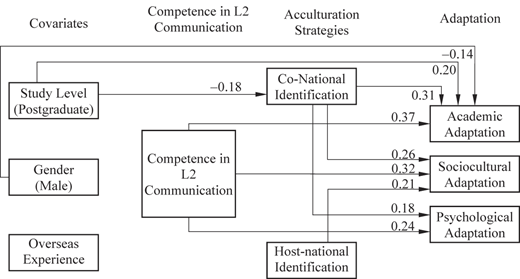
As all the paths in the hypothesized model were tested, the degree of freedom (d.f.) was zero and fit indexes could not be calculated. Hence, non-significant small (standardized path coefficient less than 0.05) effects were fixed at zero to obtain the fit indexes. Results show that the hypothesized model fit the data well, with the chi-square values for the final model (1.96, d.f. = 8, p = 0.98) being nonsignificant at α = 0.05, CFI (1.00) and TLI (1.00) above 0.95, SRMR (0.02) less than 0.08 and RMSEA (0.00) less than 0.06. The final model accounted for 0.24, 0.28 and 0.12 of the variance (R2) in academic adaptation, sociocultural adaptation and psychological adaptation respectively.
Figure 2 shows the results of the path analysis (based on the original model specification). Specifically, Co-national identification was positively associated with academic adaptation, sociocultural adaptation and psychological adaptation, with the standardized path coefficient (β) of 0.31, 0.26 and 0.18, respectively. Host-national identification was positively associated with sociocultural adaptation (β = 0.21) but was not significantly associated with academic adaptation or psychological adaptation. Also, perceived communication competence reported one year ago was a significant predictor of academic adaptation (β = 0.37), sociocultural adaptation (β = 0.32) and psychological adaptation (β = 0.24). Of note, study level showed a positive direct association with academic adaptation (β = 0.20), and indirect negative association via Co-national identification (β = −0.06 = −0.18 × 0.31); however, the total association between study level and academic adaptation was non-significant (p = 0.07). Finally, significant gender difference was found in academic adaptation, favoring female students (β = −0.14).
Discussion and implication
The present study examined Chinese students’ adaptation experiences in Hong Kong. Guided by the hypothesized model, we conducted a path analysis to explore the relationships between perceived competence in second language (L2) communication and acculturation strategies and cross-cultural adaptation. These findings highlighted some important predictors of Chinese students’ cross-culture adaptation in a society where most international students share broadly similar ethnicity and cultural heritage with locals (see also Yu, 2009).
Background variables and academic adaptation
International students encounter distinct challenges as they adapt to their roles as students within a new educational institution and academic environment, in addition to general obstacles related to sojourners’ intercultural adjustment (Zhou and Todman, 2009). Recently, academic adaptation as an independent and important component of students’ general cross-cultural adaptation has gained attention in scholarship (Malay et al., 2023; Yu and Wright, 2016). Three group differences were identified in this study.
Gender differences in academic adaptation than male students
Gender emerged as a significant factor influencing academic adaptation, with notable contrasts between this study’s findings and prior literature. While earlier research often reported greater adaptation challenges among female international students compared to males (Zhang and Goodson, 2011), our results revealed that female Mainland Chinese students in Hong Kong exhibited higher levels of academic adaptation than their male counterparts-a trend aligning with broader observations of young women’s academic outperformance globally (Kindlon, 2006). This pattern may reflect culturally specific dynamics: Confucian values emphasizing diligence and family expectations in Mainland China often place heightened academic pressure on women, potentially fostering resilience and goal-oriented behaviors (Lee et al., 2009; Brandon, 2022). Additionally, female students’ stronger peer-support networks and self-regulated learning strategies, observed in East Asian educational contexts (Zhu et al., 2023), may further enhance their adaptability. However, the interplay of socio-cultural factors (e.g. gendered societal roles, familial pressures) warrants deeper exploration. Future studies could employ mixed-method designs to disentangle how cultural norms, motivational drivers and institutional environments collectively shape these gender disparities, particularly in “sibling culture” contexts like Hong Kong.
Differences in academic adaptation and acculturation strategies between postgraduates and undergraduates
The study findings indicate that postgraduate students demonstrated a higher level of academic adaptation compared to undergraduates, consistent with previous research that identifies study level as a positive predictor of adaptation (Cao and Meng, 2022). However, the exact reason for this disparity remains unclear, as Mainland Chinese students enrolling in Hong Kong universities generally demonstrate high academic achievement regardless of their study level. We also observed that postgraduate students displayed a relatively lower degree of acculturation towards their fellow co-national peers compared to undergraduate students. Previous literature highlights the value of co-national bonds for international students’ adaptation, particularly during the early sojourn stages when feelings of homesickness and loneliness are prominent (e.g. Cao et al., 2017). However, over time, co-national integration becomes less central, which may lead students to perceive a need to limit contact with their fellow co-nationals (Schartner, 2015). This potential aversion to co-national contact could explain why postgraduate students demonstrate a lower level of acculturation to their co-national peers compared to undergraduates. In contrast, undergraduates might be more inclined to develop meaningful relationships with their co-nationals. Moreover, it is argued that postgraduate students display notable distinctions, such as differing attitudes towards academic expectations and university services (Arambewela and Hall, 2013), as well as a comparatively shorter timeframe for sociocultural and academic adjustments when compared to their undergraduate peers. Therefore, the temporary nature of postgraduate students' stays in a host country, coupled with their eventual return to their home country upon completing their study abroad, may influence their motivation to actively establish broader international connections during their stay in the host nation.
Mediating role of acculturation strategies between the study level and academic adaptation
Different acculturation strategies (i.e. integration, assimilation, separation and marginalization) have been linked to distinct adaptation outcomes for international students. Those who adopt integration strategies tend to experience lower levels of depression, while those who adopt assimilation strategies often achieve better sociocultural adaptation compared to those who adopt other acculturation strategies (Ward and Rana-Deuba, 1999). With regards to academic adaption in the present study, a mediating role between study level and academic adaptation was observed among Mainland students. Specifically, the extent to which these students achieved academic adaptation was influenced by their study level, which was further mediated by their process of acculturation with co-nationals. Schartner (2015) conducted a study focusing on international students in the UK, investigating three patterns of social connections involving co-nationals, host-nationals and other international students. The study provided valuable insights into the distinct roles of social ties in the cross-cultural adaptation process. Notably, a remarkable finding emerged regarding the intricacies of co-national contact. It was observed that co-national contact reached its peak approximately 2–3 months into the sojourn, but subsequently experienced a substantial decline and plateaued over time. The findings revealed certain drawbacks associated with co-national contact, such as impeding English language development and personal growth. Consequently, these dynamics had implications for their academic adaptation. The explanation for these findings may lie in the significant differences observed in the adaptation experiences of international postgraduate students compared to four-year undergraduate students, primarily attributed to the shorter duration of postgraduate studies, which limits their opportunities to adjust to the new academic and cultural environment (Arambewela and Hall, 2013).
Positive predicting roles of competence in L2 communication and three facets of cross-cultural adaptation
The data obtained from the sampled students strongly indicate that perceived competence in second language (L2) communication plays a crucial role in predicting all three dimensions of cross-cultural adaptation. This finding is consistent with previous studies that consistently highlight language competence as a frequently reported and positively correlated predictor for all aspects of cross-cultural adaptation (Andrade, 2006; Yu and Downing, 2012). Extensive literature documents the positive impact of foreign language proficiency on various facets of international students' adaptation experiences, including their willingness to engage in intercultural interactions (Cao et al., 2017), academic performance (Li et al., 2009) and psychological and sociocultural adaptation (Yu et al., 2019). Therefore, it comes as no surprise that perceived competence in L2 communication exhibits a significant correlation with students' cross-cultural adaptation, regardless of individual characteristics such as study level, gender and overseas experiences, as observed in this study.
Co-national identification predicts three facets of cross-cultural adaptation
The study identifies that interaction with co-nationals positively predicates the process of three facets of cross-cultural adaptation. Co-national ties play a significant role in providing support and buffering acculturative stress during the sojourn experience (Schartner, 2015). Previous research emphasizes the importance of forming social networks with fellow co-nationals, particularly for international students from East Asian countries due to their collectivistic culture (Lee et al., 2009). Interaction with co-nationals can help reduce culture shock and facilitate their adaptation. A recent study on Chinese international students in Belgium further supports this argument, revealing that integration with co-nationals is the most common adaptation strategy for these students (Cao et al., 2017). In our study context, Hong represents a unique blend of Eastern and Western societies, and previous research has highlighted the impacts of factors such as individuals’ personality, cultural distance between Chinese and host cultures and host-nationals’ perceptions of Chinese minority groups on the adoption of acculturation strategies (Cao et al., 2017). Future comparative studies can provide valuable insights into the variations in acculturation strategies adoption among different Chinese acculturating groups and international students from diverse backgrounds, contributing to a better understanding of their influence on adaptation outcomes. Furthermore, the study findings indicate that gender and overseas experience had no noticeable effects on co-national identification. However, it was observed that the effects were moderated by the level of study, suggesting that the impact of gender and overseas experience on co-national identification may vary depending on the students' study level.
Host-national identification predicts socio-cultural adaptation
The study findings highlight that host-national identification plays a significant role in predicting sociocultural adaptation. Increased interaction with host-nationals has been suggested by Ward and Kennedy (1993) and Zhang and Goodson (2011) as a means to mitigate challenges related to social adaptation. This finding aligns with previous evidence that interaction with local students is beneficial for international students' sociocultural adaptation (Zhou and Todman, 2009). However, no association was found between host-national identification and either academic adaptation or psychological adaptation in our study. Specifically focusing on Mainland Chinese international students, it was observed that an accommodating approach was more conducive to sociocultural adaptation. Previous studies conducted on Chinese and other Asian international students have challenged the significance of host-national ties, consistently illustrating a significant lack of interaction between these students and local individuals (e.g. Lehto et al., 2014; Yu et al., 2019). These findings support the notion that Chinese international students face significant challenges in establishing communication and developing intercultural friendships, particularly with individuals from the local community (Cao et al., 2017; Schartner, 2015), despite sharing an ethnic and cultural background, such as Chinese international students in Hong Kong (Yu et al., 2019). We hope that future studies will further explore the relationship between adaptation and the adoption of acculturation strategies, shedding more light on this complex dynamic.
Implications for university practice, policy recommendation and future research
Implication for university practices
The findings hold significant practical value for institutions hosting culturally proximate international students. Universities should prioritize L2 communication training through immersive language courses and peer-led conversational practice to bolster academic confidence. Simultaneously, structured acculturation initiatives – such as mixed-cultural mentorship programs and community-engagement projects – can bridge sociopolitical divides between Mainland Chinese students and Hong Kong peers. Tailored interventions, such as academic resilience workshops for male undergraduates and condensed orientation programs for time-constrained postgraduates, could further address adaptation disparities. These strategies align with Hong Kong’s vision as a global education hub, ensuring policies not only attract non-local students but also sustainably support their multidimensional adaptation, fostering long-term academic success and intercultural cohesion.
First, universities should expand L2 support through immersive courses and discipline-specific workshops to enhance classroom engagement and reduce language anxiety. Second, institutions must design acculturation programs that combine mentorship with community-driven projects (e.g. cross-cultural dialogues on shared histories and sociopolitical identities) to address latent tensions while promoting mutual respect. Third, adaptation disparities tied to gender and study level necessitate targeted interventions, such as resilience-building workshops for male undergraduates and modular orientations for postgraduates balancing academic and professional timelines. Finally, collaboration with policymakers is critical to align institutional practices with Hong Kong’s broader goals, ensuring that recruitment drives are matched by robust support systems addressing academic, psychological and sociocultural needs. By embedding these strategies into curricula, student services and intercultural programming, universities can cultivate inclusive environments that empower students to thrive across all dimensions of adaptation.
Policy recommendations for international student integration
To translate findings into policy, governments and institutions should collaborate to establish national language support programs (e.g. subsidized Cantonese-English bilingual courses) and intercultural competency accreditation for universities. Additionally, targeted funding for gender-specific mental health initiatives and flexible visa policies for postgraduates would address adaptation disparities. Such measures align with Hong Kong’s vision as a global education hub, ensuring policies foster both academic excellence and socio-cultural cohesion. Moreover, universities should establish cross-border funding schemes for peer mentorship programs targeting female undergraduates, as data show their heightened sociocultural adaptation challenges.
Implications for future research
Future research should compare adaptation strategies across cultural groups in Hong Kong (e.g. Mainland Chinese vs. Southeast Asian students) to disentangle how linguistic, historical and political nuances shape divergent pathways, informing tailored institutional support. While findings may extend to culturally proximate regions (e.g. Singapore–Malaysia), validation in non-Confucian contexts is needed.
Limitations
This study has several limitations. First, the sample size, while reflecting the gender distribution of Mainland Chinese students in Hong Kong (78.8% female), may constrain statistical power and limit generalizability to underrepresented subgroups, such as male students. Future research should employ mixed-method designs – for example, pairing large-scale surveys with targeted interviews – to deepen insights into gender-specific adaptation processes. Longitudinal studies tracking students across academic terms could also elucidate dynamic adaptation pathways and causal relationships. Second, the exclusive focus on Mainland Chinese students, though deliberate, precludes comparative analysis with other cultural groups in Hong Kong (e.g. Southeast Asian or Western peers). Expanding this scope would test the universality of our framework and reveal how sociopolitical nuances shape adaptation differently across populations. Third, while measurement instruments demonstrated strong reliability in the pilot study and underwent rigorous translation validation, reliance on self-reported data introduces risks of social desirability bias (e.g. inflated L2 competence ratings). Future studies could integrate triangulated methods, such as behavioral assessments (e.g. language proficiency tests), observational studies of classroom interactions or peer evaluations, to complement self-reports. For instance, tracking digital communication patterns or academic performance metrics could provide objective adaptation indicators. Despite these limitations, the findings provide critical insights into adaptation within Hong Kong’s unique sociopolitical landscape, informing policies to support culturally proximate yet distinct student populations.
Conclusion
The significant increase in the number of international students in Hong Kong has solidified its status as a prominent regional hub for international education. Using structural equation modelling, the study makes a significant contribution to the literature by understanding complex working mechanisms of variables in Chinese international students’ cross-cultural adaption within a context of Hong Kong, where students found both similar and strange culturally. It is clear from this study that enhanced competence in second language (L2) communication as well as encouragement to culturally identify with both the home and host nations are beneficial to adapt better. Furthermore, the level of study was positively correlated with academic adaptation and female students reported a higher level of academic adaptation. Further research might address temporal aspects of acculturation strategy choices on adaptation and compare the differences between Mainland Chinese students to other international peers in Hong Kong’s universities.
This study contributes theoretically by synthesizing L2 communication, acculturation strategies and tripartite adaptation into an integrative framework, addressing gaps in prior literature that often isolates these dimensions. By examining Mainland Chinese students in Hong Kong – a unique “sibling culture” context – we demonstrate that even shared ethnicity does not negate adaptation challenges, underscoring the criticality of linguistic and sociopolitical nuances. Our findings reveal co-national identification as a universal predictor across adaptation facets, while host-national ties uniquely drive sociocultural adaptation, refining Berry’s acculturation model. Furthermore, the moderating effects of study level and gender on academic adaptation provide new insights into how life-stage and sociocultural expectations shape cross-cultural outcomes, advancing tailored theoretical and practical approaches for diverse student populations.
This paper forms part of a special section on “Enhancing Global Competence in Asian Higher Education: Technological Integration, Interdisciplinary Collaboration, and Cross-Cultural Adaptation”, guest edited by Dr Robin Jung-Cheng Chen.
Availability of data and materials
The datasets generated and/or analyzed during the current study are available from the corresponding author upon reasonable request.
Consent to participants
Informed consent was sought and approved by the participants.