

The impact of COVID-19 on education, work and governance in China and Asia
Background of the special issue
The world was shocked by the sudden outbreak of coronavirus disease 2019 (COVID-19) pandemic in 2020. As the world faces an unprecedented global health crisis after the outbreak of the COVID-19 pandemic, many countries across the global village have encountered tremendous political, health, financial, economic and educational challenges. The COVID-19 pandemic which emerged in Wuhan, the People's Republic of China brought panic to the world in terms of its ramifications and spread. At the beginning, major world leaders in the West had not realized how severe of the COVID-19 pandemic, hence many governments in Europe and North America did not take such a health crisis very seriously by introducing health preventive measures effective enough in combating this global disease. Tougher public health measures have begun to be adopted by leaders in the Western societies only when the crisis has gone beyond national control. In contrast, most of the leaders in East Asia have adopted relatively stringent public health policies to manage the COVID-19 because of their previous painstaking experiences when handling the widespread of SARS in the 2003.
Figure 1 below clearly shows the steady growth of infected cases up to 112 million by February 23, 2021, with deaths accumulated to 2.47 million globally. Across the globe, the top five countries being severely hit by the COVID-19 pandemic are ranked in the figure below. The USA ranks number 1 in the world, followed by India, Brazil, Russia and the UK. Although vaccines have been introduced and started for use in these countries, public health experts warn governments and peoples across the world to remain alert of the unstable and bounce back of the pandemic. This unprecedented public health crisis has indeed challenged our conventional wisdom in managing economic, social, political and cultural developments. Treating the abnormal as normal is becoming increasingly important to turn our life back to normal, no matter how we define it living with the diverse experiences related to current COVID-19 pandemic.
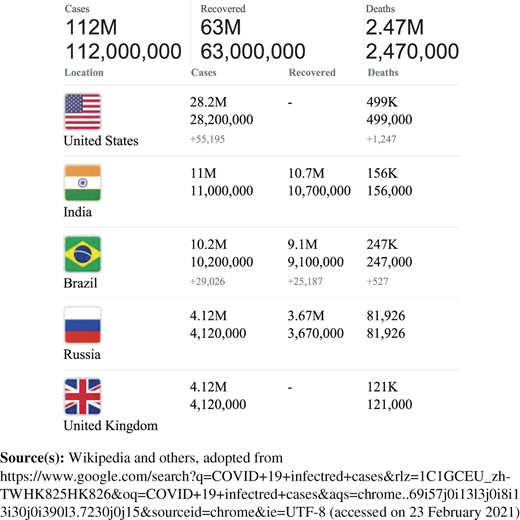
Infected cases and deaths of COVID-19 pandemic globally (as of February 2021)
Infected cases and deaths of COVID-19 pandemic globally (as of February 2021)
The present special issue entitled The Impact of COVID-19 on Education, Work and Governance in China and Asia is set out against the sudden outbreak of the COVID-19 to critically examine how China and Asian countries have responded to the global health crisis by adopting new measures to manage work, education and city governance, especially crisis management measures amidst the health crisis. After the call for paper of this special issue, the Editor of the issue has received overwhelmingly positive responses. The Journal Office has received many interesting articles and papers engaging the international readers to codevelop new insights and comparative perspectives in analyzing the impact of COVID-19 pandemic on the multiple aspects of human and social life being disrupted by the sudden outbreak of the health crisis. The Special Issue Editor, in consultation with the Journal Editorial Team, has selected 12 articles for this special issue. The Editor is thankful for all colleagues who have submitted their pieces for the special issue. Because of limited space, we have only published the selected papers in this issue. Other interesting papers closely related to the COVID-19 pandemic issues will be published in regular issues of the journal if they go through the established review process.
About the issue
The collection of articles in this special issue shows the complexity of issues confronting Asian societies when they are disrupted by the sudden outbreak of the COVID-19 pandemic. Comparing the infected cases in Asia with their counterparts in Europe, North America, South America and Africa, we have realized that the infected cases and deaths generated from the COVID-19 pandemic are comparatively less than their overseas counterparts. Some commentators would believe the previous adverse impact of SARS erupted in 2003 had indeed provided a highly relevant public health learning lessons for many Asian peoples/countries when they have to manage the emergency of the COVID-19 pandemic. As Mok recently argued when commenting on the future international student mobility in the post-COVID-19 era:
Based upon cultures which tend to emphasise social responsibility over individualism, the more effective response to the pandemic in East Asia has meant the higher education picture in the region looks even more robust and stable. In view of the crisis management capability against the COVID-19 pandemic context, how Chinese and Asian students plan for their studying abroad in future would become an important question when examining the future of international higher education. Though USA and UK institutions can probably rely on their reputations, Australia might struggle longer to recover, and would higher education institutions in East Asia like Singapore and Hong Kong become more popular for Chinese students as destinations for overseas learning particularly when these two city-states have highly ranked universities globally. Some of the challenges higher education systems in the traditional popular international study destinations in the West are currently facing, and their responses to them, will become institutionalised. Major challenges for institutions with strong intentions to get back international students should adopt policies and measures supporting medically, physically, psychologically or financially vulnerable students when studying abroad. (Mok, 2021, p. 12)
The contributors in this special issue offer highly relevant insights when reflecting upon responses adopted by the governments in Asia, universities and faculty members, and other stakeholders in the wider society when managing the crisis of the COVID-19 pandemic. This special issue provides international and comparative perspectives for policymakers, senior university leaders and major employers of companies how individuals no matter they are students, faculty members or employees assess the impacts of the COVID-19 pandemic on their work, education experiences, teaching and learning and city management and broader governance issues. One common theme across the selected articles in this issue is: obviously the COVID-19 pandemic has significantly transformed the way that we manage work, education and city governance. No matter how we assess the impacts of the present global health crisis, no one can deny the fact that the magnitude of the impacts is deep and long-lasting (An and Tang, 2020). What we have experienced before the outbreak of the COVID-19 crisis would not come back as expected, how countries across different parts of the globe could come together with humble minds to collaborate together with earnest efforts and shared vision in promoting global common good would determine the fate of our collective futures. If some of the world leaders still adopt the Cold War perspectives in analyzing international relations, playing up geo-politics for national interests, it would be difficult to copromote a better world with a shared vision for human betterment. We hope the analysis offered by this issue will humble ourselves, providing the drive and energy forging for global and regional collaborations to cocreating a better world in the post-COVID-19 era. Most important of all, we hope scholars will keep researching the impacts of the COVID-19 pandemic on other aspects that the current special issue has not covered (see, for example, Bone and Cinotto, 2020). One interesting but challenging area is how the COVID-19 pandemic has shaped world politics and international relations in the post-COVID era, especially when Asian economies seem to enjoy a relatively quick economic recovery. Whether and how the Regional Comprehensive Economic Partnership deal signed on November 15, 2020 would have affected the intra- and inter-regional collaborations remain a very important area for future research.

