

Guest editorial
Article Type: Guest editorial From: Asian Education and Development Studies, Volume 5, Issue 2.
In my 2009 review of 1,312 studies on corruption in 23 Asian countries, I found that most of these studies focused on China(14.23 per cent), followed by Japan (11.38 per cent), the Philippines (10.92 per cent), India (10.53 per cent), and Indonesia(9.23 per cent). Conversely, very little research has been done on these five Asian countries: Brunei Darussalam (0.15 per cent); Bhutan (0.38 per cent); Macao (0.46 per cent); Laos (0.61 per cent); and Nepal and Sri Lanka (0.69 per cent) each (Quah, 2009, p. 18).
Furthermore, of the 25 Asian countries included in Transparency International’s 2014 Corruption Perceptions Index (CPI), Table I shows that only seven countries (28 per cent) have attained scores above 50. This means that the remaining 18 countries (72 per cent) have scores ranging from eight for North Korea to 39 for Mongolia.
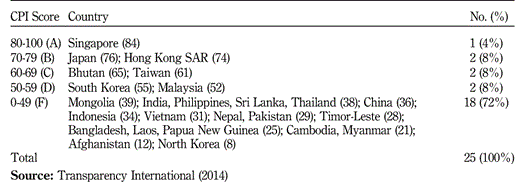
The purpose of this special issue is to rectify the research gap on corruption in those Asian countries where corruption is a problem. More specifically, this issue includes papers on corruption in these six countries: Brunei Darussalam, Cambodia,Myanmar, Pakistan, Papua New Guinea, and Vietnam. While Brunei Darussalam is excluded in the 2014 CPI, the CPI scores for the other five countries are low: Cambodia and Myanmar (21), Papua New Guinea (25), Pakistan (29), and Vietnam (31). Brunei Darussalam was ranked 38th among the 177 countries included in the CPI in 2013 with a score of 60 (Transparency International, 2013).
This special issue of the Asian Education and Development Studies (AEDS) consists of the Guest Editorial and seven papers. Following this Guest Editorial are the six country studies analysing in turn the anti-corruption efforts in Brunei Darussalam by David S. Jones, Cambodia by Sophal Ear, Myanmar by Jon S.T. Quah,Pakistan by Feisal Khan, Papua New Guinea by Grant Walton, and Vietnam by Robert Gregory. The anti-corruption measures in these six countries are compared and evaluated by Jon S.T. Quah in the final paper.
To facilitate comparison, the authors invited by the Guest Editor were requested to adopt this common framework for analysing the anti-corruption measures in the six countries: brief review of literature; policy context; perceived extent of corruption;causes of corruption, anti-corruption measures; and evaluation of anti-corruption measures.
I would like to thank all the contributors to this AEDS special issue for accepting my invitation to write the country papers. I am also grateful to them for their cooperation and patience in revising their papers according to the feedback provided by the peer-reviewers and myself. The quality of the papers in this AEDS special issue has been enhanced considerably by the constructive feedback provided by the peer-reviewers. I would like to take this opportunity to thank the 12 peer-reviewers listed below for their kind assistance in reviewing the papers. Needless to say, they are not responsible for the views expressed by the authors in their papers:
1. Naved Ahmad, PhD, Associate Professor, Institute of Business Administration, Karachi, Pakistan.
2. M. Shahid Alam, PhD, Professor of Economics, Northeastern University, Boston, MA, USA.
3. Gerald E. Caiden, PhD, Emeritus Professor of Public Administration, Sol Price School of Public Policy, University of Southern California, Los Angeles, CA, USA.
4. Antonio G. David, JD, Associate, Corporate Department, Ropes & Gray LLP, Boston, MA, USA.
5. Sinclair Dinnen, PhD, Associate Professor and Deputy Director (Research), State Society and Governance in Melanesia Programme,Australian National University, Canberra, ACT, Australia.
6. Leslie Holmes, PhD, Professor of Political Science, University of Melbourne, Melbourne, VIC, Australia.
7. Michael Johnston, PhD, Emeritus Professor of Political Science, Colgate University, Hamilton, NY, USA.
8. Peter Larmour, PhD, Adjunct Professor of Public Administration, Australian National University, Canberra, ACT, Australia.
9. Patrick K.C. Low, PhD, former Associate Professor of Business Administration, Universiti Brunei Darussalam, Bandar seri begawan,Brunei Darussalam.
10. Mohammad Habibur Rahman, PhD, Associate Professor, Mohammed Bin Rashid School of Government, Dubai, United Arab Emirates.
11. Anh Tran, PhD, Associate Professor, School of Public and Environmental Affairs, Indiana University, Bloomington, IN, USA.
12. Socheata Vong, PhD, Democracy, Human Rights, and Governance Specialist, USAID Cambodia, Phnom Penh, Cambodia.
Finally, I wish to express my appreciation to Professor Sonny Lo, the Managing Editor of AEDS, for inviting me to guest-edit this special issue on "Combating Corruption in Six Asian countries." I would also like to thank Zhou Minxing for his assistance in facilitating the preparation of this special issue.
Dr Jon S.T. Quah
Anti-Corruption Consultant, Singapore
References
Quah, J.S.T. (2009), "Combating corruption in the Asia-Pacific countries: what do we know and what needs to be done?", in Wescott, C., Bowornwathana, B. and Jones, L.R. (Eds), The Many Faces of Public Management Reform in the Asia-Pacific Region, Emerald Group Publishing, Bingley, pp. 15-43
Transparency International (2013), "Corruption Perceptions Index 2013", Berlin, available at: www.transparency.org/cpi2013/results (accessed 28 September 2015)
Transparency International (2014), "Corruption Perceptions Index 2014: results", Berlin, available at: www.transparency.org/cpi2014/results (accessed 28 September 2015)

