This study investigates the influence of integrating artificial intelligence on the academic productivity of management students in Morocco. It explores how significant factors contribute to academic outcomes, including the quality of AI chatbots, task–technology fit, social influence, perceived usefulness and actual usage.
The study employs a quantitative research design that utilizes the SEM-PLS methodology to analyze data collected from a sample of 392 management students. This model evaluates the interrelationships among the quality of AI chatbots, user engagement and academic productivity.
The results show that AI tools, particularly chatbots like ChatGPT, significantly boost academic performance by enhancing learning efficiency, providing personalized support and streamlining both academic and administrative tasks. Perceived usefulness, satisfaction and chatbot usage are critical determinants of academic productivity. Additionally, task–technology fit and social influence play essential roles in technology adoption, reinforcing the need for alignment between AI tools and academic requirements.
The findings stress the importance for higher education institutions to incorporate AI chatbots strategically by ensuring their design aligns with student needs and promotes engagement. A structured approach to AI adoption, emphasizing usability and peer influence, can enhance learning outcomes and academic development.
This study enriches the dialogue on AI’s role in higher education by providing empirical insights into the factors that facilitate effective AI adoption. It underscores the significance of aligning technology with academic needs to improve student learning and productivity.
1. Introduction
Integrating AI into higher education holds strong implications for considerably boosting learning output in management studies, especially in Morocco. AI implementation systems combine learning environments with assessment forms to raise instructional integrity, and in Morocco, the positive effects of the use of AI among higher education students are built on satisfaction and perceived ease of use (Boubker, 2024). AI technologies, such as ChatGPT and Natural Language Processing tools, augment the efficiency of academic writing and research (Dergaa et al., 2023).
Feedback systems supported by AI lead to more traditional assessment methods and improve the integrity of education (Qadhi et al., 2024). Further, learning efficiency is augmented, personalized educational support is offered, and AI enables monitoring of student learning; thus, student outcomes are improved toward academic success (Wang et al., 2023). In management education, AI tools can raise academic practices and pedagogical approaches. AI chatbots can automate such tasks as identifying at-risk students, course recommendations, academic advising, student empowerment initiatives, and improving the educational experience (Bilquise and Shaalan, 2022). Essentially, AI chatbots can manage student activities, aiding each student working through such tools in growing independently and productively with their self-paced learning.
Moreover, research indicates that academic resilience influences how students manage their coursework and utilize AI chatbots (Ali et al., 2023). Addressing AI-related challenges necessitates a transformative approach to academic integrity that empowers learners while fostering practical academic writing skills without fear of sanctions (Khoo and Kang, 2022).
Incorporating AI into higher education offers great potential to substantially boost the academic productivity of management students, particularly in Morocco (Douali et al., 2022). The study highlights the beneficial effects of AI use among higher education students in Morocco, attributed mainly to their satisfaction with the technology and their opinions on its user-friendliness (Moukhliss et al., 2024).
Building on these advancements, specific AI-driven tools significantly contribute to the academic and professional development of management students. For instance, AI facilitates the rapid analysis of complex business cases, improves financial modeling accuracy, and strengthens decision-making processes through pattern recognition and forecasting (Olubusola et al., 2024). AI-powered simulations and data visualization tools also replicate real-world challenges, providing students with practical management experience and clearer insights into abstract concepts.
Moreover, personalized learning platforms adapt educational content to students' individual needs, enhancing focus and retention. AI scheduling assistants help students manage time more effectively, while language translation tools break down communication barriers for international learners. In research, AI streamlines literature reviews and insight synthesis, increasing scholarly productivity (Kamalov et al., 2023).
Chatbots, in particular, represent a transformative shift in management education. Their implementation has been shown to improve student engagement, motivation, and academic outcomes, especially in team-based projects and technical subjects such as Python programming (Vanichvasin, 2021). Their ability to personalize learning experiences and support independent study makes them a critical asset in modern higher education. These tools not only improve educational delivery but also play an active role in academic advising, risk detection, and self-regulated learning pathways (Bilquise and Shaalan, 2022; Farah et al., 2024).
Kim and Cho (2023) emphasize a considerable deficiency in comprehending the interactions between AI and the cognitive processes employed by students. Although students predominantly utilize AI for self-directed purposes, the impact of technology on shaping human behaviors and identities is often neglected (Kim et al., 2022). Post-humanist theories offer valuable insights, such as Actor-Network Theory (ANT). Substantially, ANT advocates for an equitable perspective on human and non-human agencies, recognizing both as distinct agents in their own right. According to this theory, students and AI engage in a reciprocal relationship throughout their learning activities, indicating that their interaction should be mutually engaging and supportive (Latour, 2007).
The remainder of this paper is systematically organized as follows: Section 2 examines the utilization of AI chatbots in management education. Section 3 presents the development of the study's conceptual model, which investigates the interplay between AI chatbots' quality and academic productivity. Section 4 delineates the essential components of the employed research strategy, whereas Section 5 is devoted to presenting and discussing the study's findings. Lastly, Section 6 provides a conclusion to the paper.
2. Academic productivity in IA era: a conceptual research model
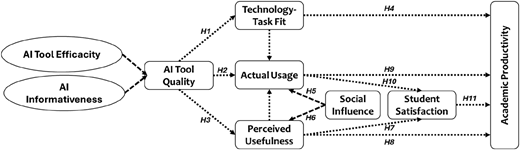
Scholars have argued that using Generative Artificial Intelligence (GenAI) in language teaching and learning is practical, particularly since November 2022, when GenAI gained significant popularity with the introduction of OpenAI's ChatGPT (Law, 2024). From his detailed systematic literature review, Law (2024) explains that more empirical studies are needed to test AI-based chatbots' effectiveness and further risks. Additionally, he points out the importance of ethical issues, the design of specific language skills-focused interventions, and stakeholder participation for the proper and effective use of AI tools. In line with these imperatives, we propose the development of the model illustrated in Figure 1:
2.1 AI chatbots' quality
Introducing artificial intelligence chatbots into academic writing benefits both students and educators. These tools show substantial promise for enhancing the effectiveness of academic writing and increasing research productivity (Dergaa et al., 2023). Faculty members employ AI chatbots for grammar correction, reference formatting, and plagiarism checks to streamline their work (Rabbianty et al., 2023). Learners, in turn, can focus more on evaluation and feedback, which can lead to improved academic performance (Bancoro, 2024).
However, generative AI-based chatbots also raise concerns related to reliability and intellectual ownership. They challenge traditional notions of authorship and the accuracy of shared information. A critical issue arises around how literate users should evaluate the credibility of AI-generated content (Simms, 2025). Academic publishers are increasingly addressing the impact of these tools on integrity and are calling for transparency in their use (Perkins et al., 2024; Tang et al., 2023). Likewise, universities must consider the ethical dilemmas these tools pose if they aim to uphold academic standards (Miao et al., 2023).
The quality of AI chatbots significantly influences student engagement and behavioral change in academic settings (Polyportis, 2024). Providing actionable insights to AI developers can foster improved engagement, emphasizing the importance of user-centered design and continuous improvement. Usability, ease of use, and trust in these tools also shape user attitudes and intentions to adopt AI technologies.
Evidence indicates that the quality of chatbots is a significant factor affecting student performance in higher education (Chen et al., 2023). The key elements through which these factors influence learning outcomes include technology attributes, task-technology fit, and compatibility with existing systems (Chen et al., 2023). Another study confirmed that chatbots enable users to complete tasks efficiently, enhancing productivity (Emon, 2023). Additionally, the quality of chatbots, encompassing both information quality and service quality, dramatically contributes to user benefits and satisfaction (Gupta and Yang, 2024). Their quickness, ease of use, and accuracy in delivering information are considered exceptional, impacting students' acceptance and utilization of the technology (Rahman et al., 2023).
Chatbots have evident power in diverse industries and can enhance productivity (Charfeddine et al., 2024). The education environment has explored Chatbots as digital co-educators to support students in conceptual understanding and comprehension (Habiba and Partho, 2024). Studies have exposed their possible use for fostering personalized learning, improving writing performance, and consequently enhancing the student's academic experience (Liling and Aklani, 2023). This highlights the importance of promoting their ethical and responsible use in educational contexts (Habiba and Partho, 2024).
In essence, the impact of chatbots on technology-task fit, actual usage, and academic productivity is multifaceted. Their quality, efficiency, and perceived usefulness are central to their successful adoption. As such, we propose the following hypotheses:
The quality of AI chatbots allows for a better Technology Task Fit.
The quality of AI chatbots increases their Actual Usage.
The quality of AI chatbots increases their perceived usefulness.
2.2 Technology task fit
The integration of AI in higher education has been strongly linked to the concept of Technology Task Fit (TTF), which reflects how well a technological tool supports the academic tasks it is intended to assist. A positive TTF has been shown to significantly improve academic productivity, particularly when AI tools like chatbots and learning platforms align with students' learning objectives and institutional goals (Morales-García et al., 2024). TTF, therefore, is considered a vital enabler of educational performance through AI deployment (Al-Rahmi et al., 2020; Jannah et al., 2023). Based on these considerations, we posit the following hypothesis:
Technology task fit enhances students' academic productivity.
2.3 Social influence
The Social Influence (SI) significantly shapes students' acceptance of AI technologies. Group interactions and social pressure can improve Perceived Usefulness (PU) and Ease of Use (PEU) of AI tools (Saqr et al., 2024; Soodan et al., 2024). Peer endorsement and collaborative learning environments foster positive attitudes toward adoption (Alshurideh et al., 2023; Bhattarai and Maharjan, 2020). Literature confirms that social circles—peers, instructors, institutions—encourage AI engagement and perceived benefits (Ayyash et al., 2020; Osman et al., 2024). Thus the following hypotheses:
Social influence positively impacts students' actual usage.
Social influence positively impacts the PU of AI chatbots by students.
2.4 Perceived usefulness
PU, a key factor in technology adoption, refers to students' beliefs about how AI tools improve task performance (Schei et al., 2024). System quality, trust, and marketing of AI benefits influence student satisfaction and sustained use (Emon, 2023; Jyothsna et al., 2024). Research shows that PU contributes to motivation, satisfaction, and academic performance (Zhang et al., 2024).
PU positively reinforces students' satisfaction with using and adopting AI chatbots.
PU positively contributes to improving students' academic productivity.
2.5 Actual usage
The actual use of AI chatbots in academic tasks (e.g. grammar checking, research support, and plagiarism detection) drives student productivity and learning quality (Lainjo and Tmouche, 2024; Rabbianty et al., 2023). AI tools such as GPT have improved classroom personalization and experiential learning (Alkan, 2024; Seo et al., 2021). Usage patterns depend on prior experience and perceived usefulness (Ali et al., 2023), reinforcing that hands-on engagement is vital for academic success (Rasheed et al., 2023). Therefore, we propose the following hypotheses:
The actual usage of AI chatbots has a positive relationship with students' academic productivity.
The actual usage has a positive impact on student satisfaction.
2.6 Satisfaction
Student satisfaction with AI chatbots is critical for improving performance. It depends on ease of use, personalized feedback, and content quality (Almufarreh, 2024; Olubusola et al., 2024). Satisfied students are more engaged and likely to succeed academically (Akanni, 2022). Emotional well-being, trust in AI, and teaching quality all influence this satisfaction (Kesavaraj and Felisiya, 2024). Thus, we suggest the following hypothesis:
Students' satisfaction with AI chatbots is positively linked to academic productivity.
3. Research design
In this section, we shall expound upon our research strategy by thoroughly examining the methodological components of our inquiry.
3.1 Methodology
In this study, we adopted a hypothetico-deductive approach, formulating hypotheses from theoretical and empirical foundations for quantitative testing. This aligns with our model and the study's quantitative nature. Data were collected using a questionnaire, a common tool in SEM-based research. Structural Equation Modeling (SEM) assesses relationships between observed and latent variables. The questionnaire included Likert-scale items, allowing respondents to express agreement levels, generating data suited for SEM analysis (Sulistiyantoro and Mildawani, 2024). This method ensures structured, quantifiable responses and supports large-sample data collection, essential for SEM-PLS analysis (Alami and El Idrissi, 2022). Overall, this approach provides both methodological rigor and analytical clarity in exploring complex variable relationships.
3.2 Field exploration
All participants in this research are in their fourth and final year at the National Business School and Trade of Tangier, Morocco. Morocco's higher education ministry initiative aims to integrate AI technologies into the academic environment, thereby impacting the decision to focus on this specific sample.
There has been a notable surge in AI usage across in Morocco, with undergraduate, graduate, and doctoral scholars increasingly leveraging these technologies, particularly chatbots, for their routine academic activities. The institution's focus on management sciences, which encompasses finance, logistics, and human resources, renders it an optimal setting to investigate the implications of AI integration.
As AI emerges as a pivotal element in Morocco's educational framework, assessing the preliminary impacts of this transition on students' academic efficiency is imperative. Gaining insights into students' perceptions of AI's ability to enhance their competencies will provide a significant understanding of the prospective benefits of this technological advancement. Furthermore, this knowledge will assist the business school in incorporating these technologies into its curricula, enriching the student experience and maximizing their engagement with these tools.
3.3 Variable definition
3.4 Data collection and analysis
The present study adopted a quantitative methodology, surveying 426 students enrolled in management sciences programs at the business school, primarily within the final two years of their academic curriculum. The survey was conducted during the winter semester of 2023/2024 at the National School of Business and Trade in Tangier from December 4th to December 8th, 2023. Responses were received from 92% of the initial sample, resulting in 392 completed and returned questionnaires after excluding 34 due to conformity issues. This sample size of 392 students is considered adequate for hypothesis testing using PLS-SEM, satisfying the 95% confidence level requirements with a 5% margin of error, as Adam (2020) indicated. Furthermore, this sample size adheres to the ten-times rule concerning the SEM-PLS explanatory power (Hair and Alamer, 2022).
We utilized SEM with Partial Least Squares as our primary estimation method to empirically evaluate our conceptual research model. Originally developed to model multiple causal relationships, these structural equations were subsequently applied to assess the validity of latent constructs. The gathered data was analyzed using the PLS algorithm integrated into the SmartPLS software (version 4) (Ringle et al., 2023). To ensure the reliability of our constructs, internal validity, along with convergent and discriminant validity, was assessed to confirm the robustness of our model.
3.5 Demographic description
The sample comprised 392 individuals, predominantly females (70.15%), while male students accounted for only 177 individuals. This observation highlights a significant gender imbalance, with most of the participants being female.
Regarding academic background, many respondents, representing 73.21% of the sample, are in their fourth year. These 287 individuals are distributed across various specializations, with Finance being the most prevalent, followed by Audit, Logistics, and Human Resources Management. The 105 finance students left, comprising 26.79% of the sample, are in their fifth year.
Concerning AI utilization and experience, all the students reported possessing experience with AI, reflecting complete penetration and familiarity with AI chatbots among the participants. Consequently, the sample demonstrates a high level of internet engagement, with nearly half of the respondents (49.23%) dedicating over four hours online daily. In comparison, 30.36% utilize the internet for 2–4 h daily. As presented in Table 1, a minor segment of the sample (10.20%) uses the internet for 1–2 h daily, while an identical proportion reports less than one hour of daily usage.
4. Empirical analysis
This section will comprehensively analyze our study's empirical results, emphasizing validating the research model, evaluating the key constructs, and interpreting the findings to corroborate the hypothesized relationships.
4.1 Outer model assessment
The assessment of convergent validity shows a robust measurement model, highlighting strong reliability and validity across all constructs. Item loadings exceed the recommended threshold of 0.7, indicating significant relationships between observed variables and their respective constructs. Although a few items, such as INF4 (0.711), display slightly lower loadings, they remain within acceptable limits, affirming the model's adequacy. Reliability is validated through Cronbach's alpha and rho_A values, both surpassing 0.7, indicating strong internal consistency. Composite Reliability values also exceed the 0.7 threshold, further reinforcing the reliability of the constructs. Convergent validity is established through AVE, with all constructs achieving values above 0.5, indicating that their underlying constructs explain over 50% of the variance in observed variables. Constructs such as PU and Satisfaction demonstrate reliability and validity across all metrics. While a few items show slightly lower values, they do not compromise the model's overall robustness as illustrated in Table 2. In conclusion, the PLS-SEM results confirm the reliability and convergent validity of the measurement model, ensuring well-defined constructs capable of supporting subsequent structural model analysis.
Evaluating the model's discriminant validity and explanatory power provides a thorough analysis, highlighting strengths and areas for improvement. The Fornell–Larcker results (Table 3) affirm discriminant validity, as the diagonal values surpass inter-construct correlations. However, the HTMT ratios reported in Table 3 raise potential concerns, particularly between constructs such as Perceived Usefulness and TTF, where the ratios approach or slightly exceed the recommended threshold. Complementing this, the cross-loadings analysis (Table 4) further supports construct reliability, while also suggesting areas where measurement overlap may need closer examination. This indicates that while the constructs are distinct, some overlap in their conceptualization or measurement may require further investigation.
The cross-loadings test largely support the validity of the constructs, as items load more strongly on their intended constructs than on others.
4.2 Inner model assessment
As illustrated in Table 5, the model fit indices provide additional insight, revealing a moderate alignment with the data. The Chi-square and NFI values suggest room for improvement, particularly in the estimated model. In contrast, the saturated model reflects better alignment, as indicated by lower d_ULS and SUMMER values. These findings point to potential modifications in the structural paths or the measurement model to enhance overall model fit and reliability.
Table 6 shows that the model demonstrates significant explanatory power for Academic Productivity and Satisfaction, underscoring their central role in our theoretical framework. In contrast, Actual Usage shows more limited explanatory power, suggesting that the model's current predictors do not fully capture its variance. This result suggests that the current predictors do not fully capture the variance in Actual Usage, highlighting an opportunity to incorporate additional constructs or refine existing ones. Despite these disparities, the Q2 values affirm that all constructs possess predictive relevance, with TTF showing exceptionally high relevance, further validating its importance in the model.
The model explains significant variance in Academic Productivity and Satisfaction, while the explanatory power for Actual Usage is relatively low.
4.3 Model estimation
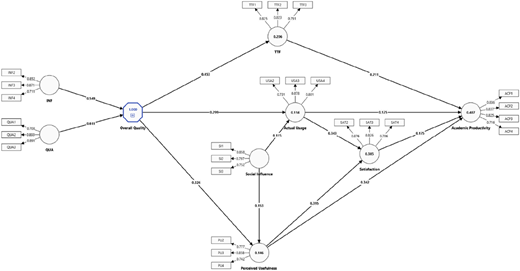
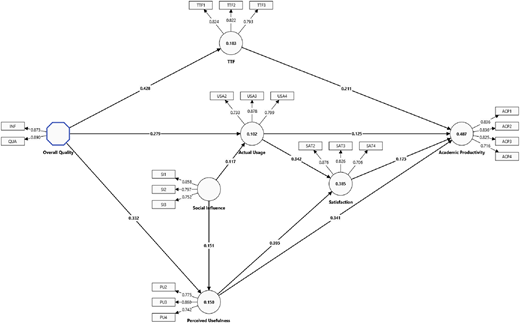
We established a first-step modulization using the SEM-PLS approach to estimate our model. Figure 2 represents the first-order estimation, where the analysis focuses on the direct relationships between observable indicators and their respective constructs. Figure 3 illustrates the second-order estimation, where the model incorporates higher-order constructs, synthesizing the relationships between first-order latent variables to capture more abstract, overarching dimensions within the structural model, especially for the overall AI tool quality variable.
4.4 IPMA analysis
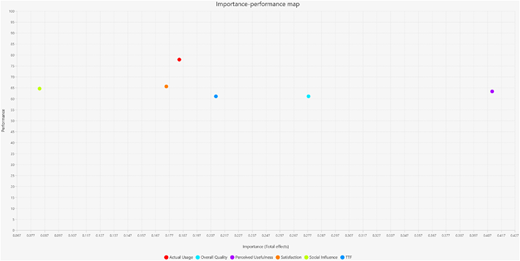
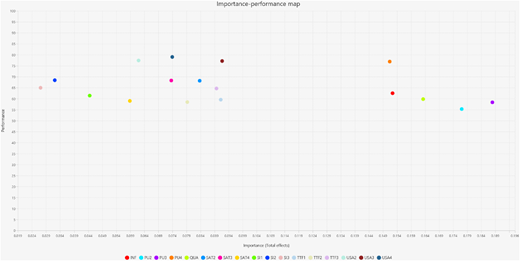
The IPMA analysis comprehensively evaluates the key variables influencing academic productivity, as illustrated in Figure 4. The high importance-performance score of Actual Usage underscores its critical role in enhancing productivity, while the comparatively lower scores for Overall Quality and Task-Technology Fit suggest significant room for improvement in these areas. The tool's effectiveness can be substantially increased by focusing on these areas. The Perceived Usefulness (63.332) is slightly higher than the overall quality, implying that users recognize the tool's utility despite its average quality. Satisfaction (65.601) reflects a moderate level of user contentment and the enhancement of this could directly correlate with increased productivity. Social Influence (64.620) also plays a notable role, suggesting that positive reviews and recommendations can further amplify usage and productivity. In summary, improving the tool's overall quality, perceived usefulness, satisfaction, and task-technology fit is paramount for maximizing academic productivity.
The MV performance data reveals various dimensions of the tool's effectiveness and user engagement. The Actual Usage scores (USA2: 77.423, USA3: 77.168, USA4: 79.018) are consistently high, indicating that the tool is frequently utilized, reflecting its importance in academic productivity. Information quality (INF: 62.499) is relatively moderate, suggesting room for improvement in the content provided by the tool. The perceived usefulness scores (PU2: 55.293, PU3: 58.355, PU4: 76.913) show a range, with PU4 standing out, indicating that certain aspects of the tool are perceived as highly useful. Overall quality (QUA: 59.815) is average, pointing to potential enhancements that could be made. Satisfaction scores (SAT2: 68.176, SAT3: 68.304, SAT4: 58.992) vary, with SAT2 and SAT3 being higher, suggesting that while some features meet user expectations, others might need improvement. Social Influence scores (SI1: 61.416, SI2: 68.431, SI3: 64.987) indicate that recommendations and peer influence play a significant role in tool adoption and usage. The Task-Technology Fit scores (TTF1: 59.566, TTF2: 58.482, TTF3: 64.668) suggest that the tool is generally suitable for its intended tasks, though there is still room for optimization. These findings, as summarized in Figure 5, highlight the need to enhance information quality, overall quality, and task-technology fit to boost user satisfaction and perceived usefulness, ultimately maximizing academic productivity.
5. Results discussion
Our study investigates the intricate relationship between AI chatbot features, students' perceptions, and academic productivity among management students. The analysis identifies key factors shaping the adoption and effectiveness of AI chatbots in academic settings, all of which are summarized in Table 7. The primary takeaway of this paper is the finding that academic productivity is the most significantly impacted outcome, demonstrating the largest effect size and strongest explanatory power in the model. While other variables contribute to this outcome, none exert the same level of practical influence. This central result should inform both future research and practical implementation strategies.
Academic Productivity stands out as the most important consequence of students' interaction with AI chatbots. The results emphasize that Actual Use of AI chatbots is a significant driver of both Academic Productivity and Satisfaction. This means students had active, consistent exchanges with AI chatbots to derive academic advantages; hence, it is more than mere access. Given its large effect on ACP, promoting tools that support and motivate consistent, purposeful use should be a top institutional priority (see Table 8).
Also, our findings acknowledge overall quality as a critical antecedent to Actual Use, Perceived Usefulness, and Fit-to-Task Technology. This suggests that users will probably accept and benefit from AI chatbots when viewed in terms of reliability, efficiency, and high quality. These results resonate with previous research underlining the primacy of quality in the technology adoption process (Chen et al., 2023; Gupta and Yang, 2024). Quality tools drive adoption and increase the perceived utility and fit to academic tasks; hence, these concepts are not disconnected.
According to our results, Perceived Usefulness predicted increased academic productivity and satisfaction. Besides usability, for these tools to significantly impact productivity and satisfaction, students need to recognize AI chatbots' intrinsic value in their learning (Al-Qaysi et al., 2025). User perceptions are a core concern during the adoption of new technology. Additionally, satisfaction with AI chatbots could be a decent predictor of academic productivity, considering students' experiences concerning ease of use and aiming for the right outcomes in management fields (Schei et al., 2024). A closer examination of the effect sizes (f2) reveals that the path from PU to SAT had a medium effect, indicating a meaningful and practical impact. In contrast, the effect of PU on ACP was small, suggesting that while statistically significant, its practical contribution is more modest. This fact implies that other factors may play a more dominant role in shaping students' perceptions of how well the AI chatbots perform.
The work further demonstrates that TTF significantly positively affects academic productivity. This finding underscores the necessity of aligning AI chatbots with the specific demands of educational tasks to ensure their effectiveness (Jannah et al., 2023; Yang et al., 2022). Therefore, developing and refining AI chatbots should prioritize optimizing them based on tasks to enhance overall student experience and productivity. While perceived quality is a key determinant, the fit of tool functions with requirements remains an independent and important consideration. The analysis of effect sizes further illuminates this relationship, showing that the path from Overall Quality to TTF has a medium effect (f2 = 0.224), indicating that a high-quality tool is substantively important for achieving task-technology fit. Conversely, the direct effect of TTF on ACP is small, suggesting that while TTF is a significant predictor, its practical impact on academic productivity is less pronounced than other factors. One possible explanation is that some students may exhibit high levels of productivity regardless of the tool's task alignment, due to intrinsic motivation or personal study habits. Additionally, the role of instructor support, often overlooked, may act as a key determinant in shaping students' academic outcomes, further moderating the influence of TTF.
Finally, Social Influence positively and significantly affects both Actual Use and Perceived Usefulness. This highlights the great importance of the social context in technology acceptance and adoption (Ayyash et al., 2020; Saqr et al., 2024). However, SI's effect sizes on both AU and PU are small, indicating that while statistically relevant, SI is not a strong practical driver of chatbot adoption or perceived value in this context. Over time, students appear to rely more on their own experiences and perceptions than on peer influence when evaluating the usefulness or deciding to use AI chatbots.
Ultimately, the study's primary practical implication is that enhancing academic productivity via AI chatbot use should be the central focus for both educators and developers. While improvements in quality, usability, and social promotion are supportive, it is the frequency and purposefulness of actual use that most directly drives productivity gains. Future research should leverage this finding to explore how to design chatbot experiences that foster deeper, outcome-oriented engagement in academic environments.
6. Conclusion
In conclusion, this study illuminates the complex interplay between an AI Chatbot's characteristics, user perceptions, and academic productivity, with actionable implications for integrating Chatbots into higher education. To implement AI chatbots effectively, four features must be prominent: accessibility, meaningful engagement, good design quality, and alignment with academic tasks and user needs.
Actual use is key in the academic productivity equation, emphasizing the importance of user training, incentives, and intuitive tools that motivate continuous interaction. Engagement must be highly encouraged within educational settings to ensure the proper use of Chatbots and implement meaningful use throughout.
The perceived usefulness and technology-task-fit importance of Chatbots are to make them valuable and fit different academic tasks and student needs. Rigorous testing, evaluation, and iterative improvements are essential for creating user-friendly, reliable, and practical tools in various learning contexts. Positive social influence can enhance the willingness of potential adopters and positively impact attitudes toward these technologies in the academic environment.
More concretely, these insights provide educational institutions with possible steps that could entail designing flexible tools, engaging the academic community in their promotion, and aligning Chatbots with educational objectives. Such measures could aid in the effective promotion of student productivity and satisfaction. Given that this study has identified specific determinants of academic productivity following the UTAUT model, we can affirm the relevance of this theory. Nevertheless, it is somewhat antiquated, yet it still contributes to the contemporary landscape of AI adoption.
The present study also identifies several promising areas for future research. The potential conceptual overlap between perceived usefulness and task-technology fit warrants further investigation and refinement of these definitions. Additionally, future studies should employ longitudinal designs and a more diverse cross-section of students to examine the long-term effects of AI chatbot use across different fields and cultural backgrounds.
Ultimately, the continued integration of AI chatbots will be driven by their ability to meet the evolving requirements of students. Fostering meaningful engagement and ensuring user satisfaction are fundamental to optimizing the effectiveness of these tools in enhancing academic productivity and advancing educational progress. While our quantitative methodology was well-suited to the research objectives, we acknowledge its limitations, including the sample's gender imbalance and specific cultural context, which may affect the generalizability of the findings. Nonetheless, these results provide a strong foundation for future inquiry and remain highly relevant within the study's defined scope.