Skip to article sections
Purpose

This study aims to investigate the association between behavioral intention in adopting digital accounting technology (BIDAT) and three key factors: performance expectancy (PE), effort expectancy (EE) and social influence (SI). This study also investigates the moderating role of technology type and economic level on the associations.

Design/methodology/approach

A compilation of 47 research articles, collectively investigating 132 associations involving PE, EE, SI and BIDAT, underwent analysis through the meta-analysis methodology. In addition to the overarching meta-analysis, an extensive subgroup analysis was conducted to assess the influence of technology type and economic level as moderators.

Findings

This meta-analysis confirms significant associations between BIDAT and its predictors: PE, EE and SI. While technology type lacks a moderating effect, the economic level significantly moderates PE’s relationship with BIDAT, underscoring the universality of predictors and the influence of economic factors.

Practical implications

The study’s implications are significant for practitioners and policymakers. The findings show that practitioners must adopt different accounting technology implementation strategies based on the economic context, such as focusing on productivity in developed countries and competitiveness in developing countries. Policymakers should implement contextual regulations, such as incentives and performance reporting standards. These findings also support a technology-neutral approach with a consistent adoption framework for various accounting solutions.

Originality/value

This study pioneers digital accounting technology adoption through meta-analysis, offering novel insights into adoption dynamics. By synthesizing existing research, it enriches understanding of contextual influences, such as technology type and economic level, thereby advancing theoretical discourse in the field.

In the digital era, behavioral intention in adopting digital accounting technology (BIDAT) has become one of the critical aspects of technology adoption process among users or organization that plan to adopt the technology. Cavalcanti et al. (2022) defined behavioral intention as “the strength of one’s intention to perform a specific behavior”. Prior studies has provided empirical evidence supporting behavioral intention as a reliable predictor of technology use, which in turn directly influences the actual action (Escobar-Rodríguez and Carvajal-Trujillo, 2013; Alamin et al., 2020; Alzahrani, 2022).

Recent literature have explored and highlighted the importance of performance expectancy (PE) (Uddin et al., 2019; Mukred et al., 2019; Matar et al., 2020; Jain et al., 2022), effort expectancy (EE) (Rahi et al., 2019; Amron et al., 2021; Chang et al., 2022), and social influence (SI) (Cokins et al., 2020; Najib et al., 2021; Pieters et al., 2022) as the determinants of BIDAT. However, conflicting results regarding the strength and direction of these relationships have emerged (Queiroz et al., 2020; Al-Okaily et al., 2020; Faizal et al., 2022; Chitakala and Phiri, 2022; Nawi et al., 2022; Khan et al., 2022) complicating efforts to draw clear, generalizable conclusions. At the same time, recognizing and understanding the factors that encourage or hinder digital accounting technology adoption is critical for organizations and individuals, as it allows them to take advantage of the benefits of the technology while facing potential challenges.

Individual studies have examined these factors, however there are still gaps in synthesizing their overall impact in different settings. Alnasrallah and Saleem (2022) and Jadil et al. (2021) suggest that BIDAT moderating factors are still unclear and require further research. Afsay et al. (2023) indicate that technology type and economic level are two determinants that could also affect adoption behaviors, but digital accounting solutions have not fully addressed these factors. Prior meta-analyses by Jennions et al. (2013) and Wu and Lederer (2009) have explored technology acceptance broadly but have not specifically addressed digital accounting technology adoption. Moreover, the moderating roles of technology type and economic level remain underexplored. To fill in the gaps, this study aims to provide robust conclusions by conducting a meta-analysis of existing research on BIDAT, focusing on these moderating factors.

The paper strengthens theoretical frameworks and identifies factors affecting BIDAT, therefore advancing the body of knowledge on digital accounting technology adoption. PE, EE, and SI are significantly associated with BIDAT. Economic level moderates the PE–BIDAT relationship, while technology type has no moderating effect. These findings offer useful guidance for practitioners and policymakers in diverse economic contexts. Practical implications are presented in the final section.

The paper comprises five sections: Section 2 reviews the literature and develops hypotheses; Section 3 outlines the methodology; Section 4 presents and discusses the findings; and Section 5 concludes the study.

The adoption of digital accounting technology reflects the diversity of institutional contexts worldwide, ranging from Western markets with strict regulations to developing economies in Asia and Africa (Gong et al., 2020). The adoption of Sarbanes Oxley and General Data Protection in Northern America and Europe has resulted in a compliance culture (Sullivan, 2019). In contrast, Asia-Pacific economies, exemplified by China’s Golden Tax System, appear to be much more focused on new technology (Li et al., 2020). The increasing interconnectedness of global markets has also driven international standardization through International Financial Reporting Standards, which has significantly impacted the global trend of adopting accounting technology (El-Helaly et al., 2020). This standardization mainly influences international businesses, while local small and medium enterprises (SMEs) must adapt to the specific needs of each region (Donbesuur et al., 2020; Ma et al., 2021). Moreover, the COVID-19 pandemic brought a noticeable global acceleration of the digital transformation, which transcended traditional geographical barriers for technology diffusion.

Empirical studies on the determinants of behavioral intention examine the relationship between PE, EE, SI and BIDAT, using the Technology Acceptance Model (TAM) and the Unified Theory of Acceptance and Use of Technology (UTAUT) as frameworks. TAM, a well-known framework in information systems and technology adoption developed by Davis (1989), suggests that perceived usefulness and simplicity influence users’ behavioral intention to adopt technology (Le and Cao, 2020). Perceived usefulness, like PE, is based on the notion that technology improves productivity, and perceived ease of use, like EE, evaluates the simplicity and effort required (Gokmenoglu and Kaakeh, 2022). Furthermore, based on consumers’ rational decision-making, TAM incorporates external aspects such as SI, where consumers are more likely to accept technology that is valuable and user-friendly (Ibrahim et al., 2018). UTAUT, also a well-known framework in information systems and technology adoption developed by Venkatesh et al. (2003), suggests that PE, EE and SI are significant factors shaping behavioral intention (Queiroz and Wamba, 2019; Mukred et al., 2019; Rahi et al., 2019). Both TAM and UTAUT advocate moderation, acknowledging external variables’ impact on the relationship between behavioral intention and technology adoption. TAM asserts that perceived usefulness and ease of use directly influence technology adoption intention, with moderating effects from factors like technology type and economic level (Greener, 2022). Similarly, UTAUT integrates moderators such as gender, age, and experience, extendable to include technology type and economic level (Mannheim et al., 2023). These models recognize diverse contexts, such as technological types and economic levels, moderating key determinants’ influence on behavioral intention in technology adoption.

PE is a critical factor influencing the decision to adopt digital accounting technology. It comprises the user’s impression of how technology adds to their capacity to conduct accounting duties efficiently and effectively in digital accounting (Sheel and Nath, 2020). This view is frequently divided under related constructs like perceived utility, which reflects the user’s conviction in the technology’s ability to improve job performance and allow efficient task execution (Cavalcanti et al., 2022).

However, research on the association between PE and behavioral intention yields contradictory results. While some studies suggest a positive relationship between higher perceived PE and greater intention to adopt the technology (Queiroz and Wamba, 2019; Matar et al., 2020), other studies have found contradictory results (Queiroz et al., 2020; Chitakala and Phiri, 2022). However, reasoning implies that persons who are confident of the efficacy of digital accounting technology in improving their work performance are more willing to adopt such technology.

Recognizing the critical role of PE is an essential component of the theoretical framework for comprehending the adoption of digital accounting technology. PE impacts an individual’s behavioral intention to accept technology by altering the user’s impression of the technology’s utility and efficiency (Cokins et al., 2020; Najib et al., 2021). Users’ inclination to adopt digital accounting technology increases when they perceive higher levels of PE linked with the technology. The hypothesis derived from the given explanation is:

H1.

The better the performance expectancy, the higher behavioral intention in adopting digital accounting technology.

EE is the perceived ease of use of a particular technological system (Cao et al., 2021). It incorporates the user’s belief in the simplicity and convenience of using technology for accounting tasks in adopting digital accounting technology. EE can be further subdivided into words like perceived ease of use. It is a reflection of the user’s view of the level of effort required to interact with technology.

Previous studies on the correlation between EE and BIDAT produced inconsistent results. According to several studies, as EE increases, so does the possibility of users adopting a behavioral intention to use the technology (Uddin et al., 2019; Mukred et al., 2019; Chang et al., 2022). Other research suggests that EE does not have a substantial impact on BIDAT (Al-Okaily et al., 2020; Cokins et al., 2020; Jain et al., 2022; Faizal et al., 2022). However, when individuals perceive a digital accounting system to be user-friendly, intuitive, and requiring less cognitive effort, they are more inclined to adopt a positive behavioral intention towards it. Given the above debate, the hypothesis that has been developed is as follows:

H2.

The better the effort expectancy, the higher behavioral intention in adopting digital accounting technology.

The impact of others’ views, opinions, and actions on an individual’s decision-making process is referred to as SI (Wang and Chou, 2014). It influences people’s inclinations to adopt new technologies, such as digital accounting systems. SI is a subjective norm, representing perceived social pressure to engage in a specific action.

Prior research, however, has shown contradictory findings on the role of SI on behavioral intention. While some studies have found that individuals are more likely to adopt digital accounting technology when their social environment influences them (Rahi et al., 2019; Cokins et al., 2020), others have found no significant association (Chang et al., 2022; Nawi et al., 2022; Jain et al., 2022; Khan et al., 2022). A logical analysis reveals that SI is closely linked to behavioral intention despite these differences. Individuals frequently seek validation and social acceptability in their decision-making processes, particularly when adopting novel technologies. Given the above debate, the hypothesis that has been developed is as follows:

H3.

The better the social influence, the higher behavioral intention in adopting digital accounting technology.

According to contingency theory, the efficacy of organizational systems or processes is determined by the fit between the qualities of the technology and the unique settings in which it is used (Araral, 2020). Sophisticated digital accounting technology, including blockchain, ERP, cloud computing, financial technology (fintech), and accounting software (Ardolino et al., 2018; Ivanov et al., 2019; Teng et al., 2022; Karakose et al., 2022) are considered contingencies that interact with individual views and social influences in this study on adopting digital accounting technology. According to contingency theory, the impact of elements such as PE, EE, and SI on behavioral intention varies depending on how well these factors coincide with the unique features and capabilities of the chosen technology type.

Each technology type has distinct qualities and functions. ERP systems streamline business processes comprehensively (Zain et al., 2023), cloud computing provides scalable and on-demand computing resources (Chanthinok and Sangboon, 2021), fintech introduces innovative financial solutions (Bergmann et al., 2023), and accounting software provides tailored tools for financial management (Vysochan et al., 2021). Understanding these different forms of technology is critical because they reflect different approaches to digital accounting. For example, blockchain stresses transparency and security, whereas ERP prioritizes integration and efficiency. Accounting software tailors solutions for specific financial duties, while cloud computing provides flexibility and accessibility. Fintech delivers unique financial features.

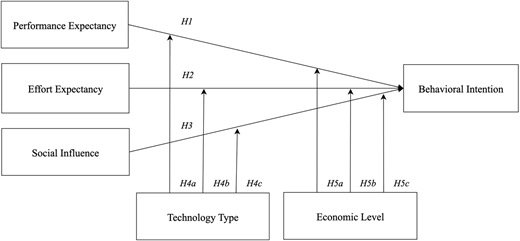
Technology type is a moderator by influencing the condition under which associations between key determinants (PE, EE, and SI) and behavioral intention operate (see Figure 1). The hypothesis derived from the given explanation is:

H4a.

Technology type moderates the association between performance expectancy and behavioral intention in adopting digital accounting technology.

H4b.

Technology type moderates the association between effort expectancy and behavioral intention in adopting digital accounting technology.

H4c.

Technology type moderates the association between social influence and behavioral intention in adopting digital accounting technology.

An examination of the literature on BIDAT revealed that certain studies, such as Cao et al. (2021), were situated in developed economies like the United Kingdom, while others exemplified by Najib et al. (2021), were conducted in developing economies such as Indonesia. Mokodompit et al. (2025) and Blut et al. (2022) also found that the economic level influences adoption processes, with developed countries show more robust results. Developed in line with this empirical evidence, the following hypotheses are developed:

H5a.

The economic level moderates the association between performance expectancy and behavioral intention in adopting digital accounting technology.

H5b.

The economic level moderates the association between effort expectancy and behavioral intention in adopting digital accounting technology.

H5c.

The economic level moderates the association between social influence and behavioral intention in adopting digital accounting technology.

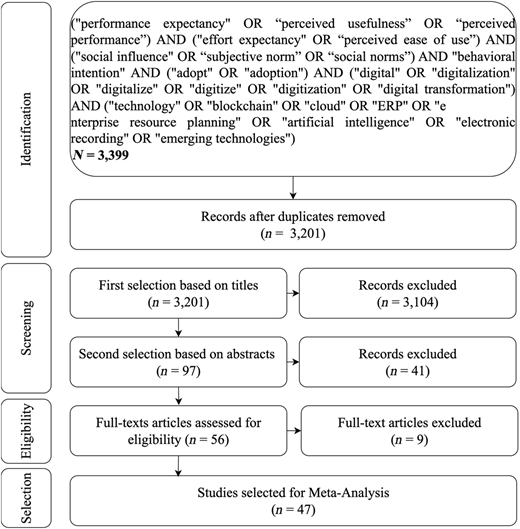
A search was conducted in accordance with the parameters specified in the Preferred Reporting Items for Systematic Reviews and Meta-Analysis (PRISMA) developed by Liberati et al. (2009). It spanned the period from 2012 to 2022 and encompassed three databases-Scopus, Dimension, and Google Scholar. Utilizing a meticulous Boolean search strategy that involved the operators AND and OR, the search queries underwent systematic refinement to ensure a comprehensive exploration, as depicted in Figure 2. Acknowledging the potential limitations of relying solely on computerized database, which may lead to the omission of up to 50% of published studies (Cooper et al., 2019), we adopted a comprehensive approach.

To facilitate the organization and analysis of the collected data, we employed a specific systematic method to compile the articles into a consolidated file. This file presented pertinent information, including journal titles, publication years, volume and issue numbers, author details, and article titles.

A total of 3,399 articles were initially identified, and upon removing duplicates, a count of 3,201 records remained (refer to Figure 2 for an overview of the study selection process).

The present study utilized a judgment sampling approach to select reviews suitable for inclusion in the meta-analysis. The inclusion criteria set forth specific prerequisites for the research subjects: (1) articles must be full-text, and published in English; (2) they need to employ performance expectancy or perceived usefulness, effort expectancy or perceived ease of use, and social influence or subjective norm as independent variables; (3) they need to employ behavioral intention in adopting digital accounting technology as the dependent variable; and (4) they must provide quantitative empirical data, preferably in the form of correlation coefficients.

The initial phase of the study encompassed a title search. Among the 3,201 articles reviewed, a total of 3,104 were excluded based on preliminary assessment. Subsequently, the 97 abstracts underwent individual screening. Abstracts demonstrating potential adherence to the inclusion criteria were retained, leading to procuring corresponding full-text articles. Abstracts failing to meet the criteria were dismissed from further consideration. Within the pool of 97 articles, 41 were subsequently excluded, leaving 56 articles for a comprehensive full-text review.

Nine of these 56 articles were excluded because they did not fulfill the eligibility criteria. The exclusion occurred due to their failure to incorporate correlation coefficients or any other statistical information that could be converted into correlation coefficients. Therefore, 47 articles were considered appropriate for inclusion in the meta-analysis (Appendix A).

Information was extracted from the sources in accordance with a predetermined checklist. The extracted data encompassed several key elements, including the identity of the researcher, publication type and year, overall sample size, type of digital accounting technology, unit of analysis, study aims, objectives, hypotheses, participant information, details of both dependent and independent variables, analysis, and results.

Meta-analysis allows the accumulation of results from several studies (Rana et al., 2015; Sutrisno and Dularif, 2020). This study adopted the meta-analysis techniques advocated by Hunter and Schmidt (2004). These methodologies encompass: (1) calculation of effect sizes pertaining to the association between PE, EE, SI and BIDAT, (2) identification and examination of outliers, (3) assessment of homogeneity among effect sizes, and (4) evaluation for potential publication bias.

Statistical analysis of 47 studies was carried out using the OpenMEE software as described by Wallace et al. (2017). The correlation coefficient between each study’s dependent and independent variables measures the effect size (ES) (Pathak et al., 2017). In studies lacking a correlation coefficient, other statistical measures such as t, F, p, or others are initially converted to r-pearson estimation (Borenstein et al., 2009; Card, 2015). Furthermore, Fisher’s Z transformation is used to convert ES to z (Card, 2015).

The transformed ES is used to compute the overall effect within the random-effect model (REM) using the Dersimonian and Laird (1986) approach to ensure the summary effect of PE, EE, and SI on BIDAT at 95% confidence intervals (CI). The correlation between the independent and dependent variables is significant if the p-value is < 0.05 (Retnawati et al., 2018). The results of the summary effect obtained must be transformed back into the correlation coefficient (r) to interpret the final results because the summary effect calculation process still uses the Fisher transformation value (Borenstein et al., 2009). The conversion results were classified into three categories based on classification, namely low (0 ≤ ES ≤ 0.2), medium (0.2 ≤ ES ≤ 0.8), and high (ES ≥ 0.8) (Cohen, 1977).

Subsequently, outlier analysis was conducted, marking a pivotal phase in any meta-analysis investigation due to the potential distortion outliers can introduce to the results (Davis and Rothstein, 2006). A forest plot was employed for outlier analysis, visually presenting ES and CI of individual studies incorporated in the meta-analysis. This graphical representation enables researchers to pinpoint potential outliers and evaluate their impact on the overall findings. Studies significantly deviating outside the confidence intervals or displaying markedly different ES may be deemed potential outliers. In instances where no outlier detected, the transformed ES is also employed to test heterogeneity in the random effect model. Heterogeneity is assessed through the inconsistency index test (I2) (Higgins and Thompson, 2002). Higgins and Thompson (2002) classified I2 values, designating 25%, 50%, and above 75% as indicating low, medium, and high degrees of heterogeneity, respectively. As for moderator estimation, a subgroup analysis was performed to examine the possible moderating effect of technology type and economic level on each of the three causal paths in the research model.

The robustness of the meta-analysis findings and the potential for publication bias were evaluated using Fail-Safe Numbers (Nfs) (Jennions et al., 2013). According to Jennions et al. (2013), meta-analysis results are significant despite publication bias if the Nfs exceeds “5(n) + 10,” where n is the number of studies included in the analysis. Elevated Nfs values serve as indicators of results robustness, underscoring diminished vulnerability to the influence of publication bias.

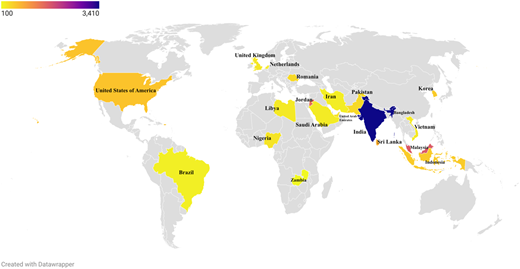
In research investigating BIDAT, a crucial aspect involves the integration of multiple independent variables and a myriad of findings. Studies encompassing various findings are treated as distinct research contributions (Nurkholis et al., 2020). In this meta-analysis, 132 correlation coefficients were derived from a compilation of 47 studies. Notably, a few studies did not provide complete sets of all three correlations. Table 1 illustrates that 45 studies reported PE-BI correlations, 43 studies reported EE-BI correlations, and 44 studies reported SI-BI correlations out of the total 47 studies included in the analysis. Moreover, the path coefficients for PE-BI vary from 0.000 to 0.680, for EE-BI from −0.630 to 0.760, and for SI-BI from 0.001 to 0.616. Furthermore, most empirical research on BIDAT has shown that 89% of the PE-BI linkage, 51% of the EE-BI linkage, and 70% of SI-BI linkage are statistically significant. Moreover, out of 24 countries, India exhibited the largest sample size, encompassing 3,410 respondents, accounting for 27% of the total. Following closely were Malaysia with 1,716 respondents (13%) and Jordan with 1,468 respondents (11%) (See Figure 3).

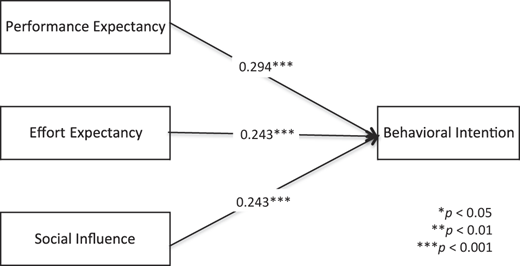
In Table 2, the computed weighted mean ES, estimated significance levels, and 95% CI are displayed. Figure 4 shows that the meta-analysis validate the presence of all associations outlined in the research model. Notably, PE (H1: ES = 0.294; p < 0.001) emerged as the primary precursor to BIDAT, followed by EE (H2: ES = 0.243; p < 0.001) and SI (H3: ES = 0.243; p < 0.001). Therefore, H1, H2 and H3 are accepted. Regarding estimate precision, certain mean ES demonstrated greater accuracy than others. For instance, the 95% CI for SI (0.187–0.299) was found to be small, indicating more accurate estimation of the average ES in the SI-BI connection (Borenstein et al., 2009).

In meta-analytic research, outlier examination is crucial due to potential distortion (Davis and Rothstein, 2006). Visual examination of forest plots (Figures B1- B3, Appendix B) showed some studies with seemingly deviating ES and CIs. Sensitivity analysis conducted after excluding these outliers showed slightly lower ES and reduced heterogeneity across all paths (Table 3), while maintaining statistical significance and confirming the robustness of the results. In line with Borenstein et al. (2009), all studies were retained to preserve contextual diversity.

For each of the three investigated causal pathways, the results of statistical calculations I2 in Table 2 indicate heterogeneity in the research data using the random effect model. This is evidenced by I2 values well exceeding 50% in PE (Q = 538.499; I2 = 91.829; p < 0.001), EE (Q = 534.063; I2 = 92.323; p < 0.001), and SI (Q = 396.797; I2 = 89.163; p < 0.001). Despite the minimal sampling variance, additional analysis using subgroup was conducted to identify factors significantly influencing this association.

As seen in Table 4 and Table 5, results revealed only one notable moderating effect (highlighted in bold). The examination of Table 3 disclosed no significant Q-statistic for the moderating impact of technology type on the association between PE (Q = 2.291; p = 0.682), EE (Q = 3.523; p = 0.474), SI (Q = 0.260; p = 0.992), and BIDAT. Thus, H4a, H4b, and H4c are rejected. While technology type did not significantly moderate the three causal pathways, Table 3 showed that the ES in the ERP subgroup was greater than that of the other technology type subgroup in certain associations, such as PE and BI (ES = 0.400, p < 0.001), and SI and BI (ES = 0.269, p < 0.001). Conversely, in the association between EE and BI, the cloud computing subgroup exhibited a higher ES than the other technology types (ES = 0.309, p < 0.001).

The results presented in Table 5 reveal a statistically significant Q-statistic regarding the moderating influence of the economic level on the association between PE and BIDAT (Q = 4.489; p < 0.05). This observation indicates that the economic level serves as a moderator only for the association between PE and BIDAT. Therefore, H5a is accepted, while H5b and H5c are rejected. Specifically, this connection exhibits greater strength in studies within developed economies (ES = 0.483; p < 0.001) compared to those within developing economies (ES = 0.269; p < 0.001). Figures C1 and C2 in Appendix C provide a summary of the subgroup analysis results.

Table 2 presents the results of the Nfs statistic aimed at assessing the susceptibility of the data to publication bias. The Nfs values for PE-BI (15,046) surpass the threshold of 235 ((5(45))+10), while both EE-BI (8,062) and SI-BI (9,530) exceed the threshold of 225 ((5(43))+10) and 230 ((5(44))+10), respectively. The substantial Nfs values suggest result robustness, making it improbable for numerous non-significant unpublished studies to remain undisclosed and unreported (Rosenthal, 1991). Consequently, the findings affirm that undisclosed or unpublished studies do not pose a significant risk to the credibility of conclusions regarding the association between PE, EE, SI and BIDAT.

The results of the meta-analysis confirm all of the direct associations proposed in the study model. In particular, the study showed that higher PE significantly impact BIDAT. This means that individuals are more likely to use digital accounting technology when they think it will help them with their accounting tasks. This observation consistent with the findings of Uddin et al. (2019), who underscored the substantial influence of PE. Additionally, the study revealed that higher EE significantly impact BIDAT, implying that the ease of employing digital accounting technology for accounting activities positively influences its adoption. Chang et al. (2022) corroborated this notion, emphasizing EE as a pivotal determinant of BIDAT. Similarly, the study identified SI as a factor reinforcing BIDAT. Consequently, individuals are more likely to embrace digital accounting technology services if they perceive support from their relatives or friends. This finding resonates with the research of Najib et al. (2021), who underscored the significance of SI in fostering a high BIDAT. These results not only validate established theoretical frameworks such as TAM and UTAUT but also offer nuanced insights into the specific context of BIDAT.

Furthermore, the findings of moderation effect reveal that the economic level influences the association between PE and BIDAT. The effect is stronger in developed countries where people are more sensitive to perceived benefits. This aligns with Blut et al. (2022), who found stronger associations in developed countries. Meanwhile, there was no significant moderating effect of technology type on the association between PE, EE, SI, and BIDAT. This suggests that regardless of the specific digital accounting technology, the influence of PE, EE, and SI on BIDAT remains consistent across different technologies. This contradicts Jennions et al. (2013), which suggests that unique contexts, such as technology type, can significantly impact the adoption process. In contrast, the findings highlight the broader applicability of TAM and UTAUT across various technologies.

However, a more thorough examination through subgroup analysis revealed intriguing nuances. In comparison to other technology-type subgroups, the ERP subgroup had a greater ES in PE-BI and SI-BI associations. This implies that the perceived performance of the technology and the social context surrounding its adoption might exert a stronger influence on consumers adopting ERP systems. Conversely, the cloud computing subgroup demonstrated a larger ES than other technology types in the association between EE and BI. This implies that when users engage with cloud computing solutions in the context of digital accounting technology, their behavioral intentions may be more influenced by perceived ease of use, as compared to when users adopt other types of technologies.

Furthermore, accounting software consistently showed the smallest ES across all interactions, indicating a significantly lesser influence on user BIDAT. One probable reason for this finding is the familiarity and prevalence of accounting software in today’s business environment. Users may perceive accounting software as a standard and integral tool due to its longstanding presence and widespread adoption, potentially reducing the perceived impact of PE, EE, and SI on their BIDAT. Users’ baseline expectations and accounting software’s maturity limit the impact of further modifications and reduce susceptibility to SI compared to emerging technologies.

This meta-analysis examines how technology type and economic level moderate the relationship between PE, EE, SI, and BIDAT. The results show statistically significant direct correlations in the model. Interestingly, economic level moderates the PE-BIDAT relationship, while technology type shows no moderating effect.

Based on the research results, practitioners in developed countries should focus on measurable productivity gains when implementing digital accounting technology. This can be done by doing a detailed cost-benefit analysis. Meanwhile, practitioners in developing countries need to focus on how this technology enhances competitiveness and aligns with international standards. Moreover, the results show the technology type does not moderate adoption; this indicates that practitioners can implement a consistent framework across various technologies, focusing on gradual implementation and standardized training approaches. These strategies are realistic and can be applied in various economic contexts.

The results also show that policymakers need to align their regulatory strategies with the economy. It is suggested that policymakers in developed countries need to focus on developing performance benchmarking systems and incentive programs to promote proven accounting efficiency. On the other hand, policymakers in developing countries can implement gradual compliance requirements to help with the transition to digital accounting technology. They can also set up support systems like tax breaks or grants to make the initial cost of adopting new technology easier, and they can create programs to help organizations understand and use digital accounting solutions. Furthermore, since the technology type does not moderate adoption, it suggests that policymakers can focus on technology-neutral policies that prioritize outcomes over specific technological solutions.

This meta-analysis has limitations. The use of quantitative studies limits qualitative aspects that could be valuable. Incorporating qualitative methodologies into future research, such as case studies or interviews, may uncover contextual factors and nuanced perspectives that quantitative approaches alone may fail to detect. Moreover, future research should examine factors such as trust and perceived risk, as well as contextual elements such as cultural differences and industry-specific obstacles. Exploring cultural dimensions, such as individualism versus collectivism, may offer deeper insights on technology adoption. Addressing these gaps will deepen insights and guide future research in this field.

The authors thank the editorial team and anonymous reviewers for their valuable comments and suggestions.

The supplementary material for this article can be found online.
Afsay
,
A.
,
Tahriri
,
A.
and
Rezaee
,
Z.
(
2023
), “
A meta-analysis of factors affecting acceptance of information technology in auditing
”,
International Journal of Accounting Information System
, Vol. 
49
, pp. 
1
-
27
, doi: .
Al-Okaily
,
M.
,
Lutfi
,
A.
,
Alsaad
,
A.
,
Taamneh
,
A.
and
Alsyouf
,
A.
(
2020
), “
The determinants of digital payment systems’ acceptance under cultural orientation differences: the case of uncertainty avoidance
”,
Technology in Society
, Vol. 
63
, 101367, doi: .
Alamin
,
A.A.
,
Wilkin
,
C.L.
,
Yeoh
,
W.
and
Warren
,
M.
(
2020
), “
The impact of self-efficacy on accountants’ behavioral intention to adopt and use accounting information systems
”,
Journal of Information Systems
, Vol. 
34
No. 
3
, pp. 
31
-
46
, doi: .
Alnasrallah
,
W.
and
Saleem
,
F.
(
2022
), “
Determinants of the digitalization of accounting in an emerging market: the roles of organizational support and job relevance
”,
Sustainability
, Vol. 
14
No. 
11
, pp. 
1
-
16
, doi: .
Alzahrani
,
A.
(
2022
), “
An analysis of the technology acceptance model (TAM) in understanding faculty’s behavioral intention to use Internet of Things IOT
”,
International Journal of Educational Research and Innovation
, Vol. 
19
, pp.
153
-
169
, doi: .
Amron
,
M.T.
,
Ibrahim
,
R.
and
Bakar
,
N.A.A.
(
2021
), “
Cloud computing acceptance among public sector employees
”,
Telkomnika (Telecommunication Computing Electronics and Control)
, Vol. 
19
No. 
1
, pp. 
124
-
133
, doi: .
Araral
,
E.
(
2020
), “
Why do cities adopt smart technologies? Contingency theory and evidence from the United States
”,
Cities
, Vol. 
106
, pp. 
1
-
15
, doi: .
Ardolino
,
M.
,
Rapaccini
,
M.
,
Saccani
,
N.
,
Gaiardelli
,
P.
,
Crespi
,
G.
and
Ruggeri
,
C.
(
2018
), “
The role of digital technologies for the service transformation of industrial companies
”,
International Journal of Production Research
, Vol. 
56
No. 
6
, pp. 
2116
-
2132
, doi: .
Bergmann
,
M.
,
Maçada
,
A.C.G.
,
de Oliveira Santini
,
F.
and
Rasul
,
T.
(
2023
), “
Continuance intention in financial technology: a framework and meta-analysis
”,
International Journal of Bank Marketing
, Vol. 
41
No. 
4
, pp. 
749
-
786
, doi: .
Blut
,
M.
,
Chong
,
A.Y.L.
,
Tsiga
,
Z.
and
Venkatesh
,
V.
(
2022
), “
Meta-analysis of the unified theory of acceptance and use of technology (UTAUT): challenging its validity and charting a research agenda in the red ocean
”,
Journal of the Association for Information Systems
, Vol. 
11
, pp.
1
-
139
.
Borenstein
,
M.
,
Hedges
,
L.V.
,
Higgins
,
J.P.T.
and
Rothstein
,
H.R.
(
2009
),
Introduction to Meta-Analysis
, (Second) ,
John Wiley & Sons
,
Hoboken
.
Cao
,
G.
,
Duan
,
Y.
,
Edwards
,
J.S.
and
Dwivedi
,
Y.K.
(
2021
), “
Understanding managers’ attitudes and behavioral intentions towards using artificial intelligence for organizational decision-making
”,
Technovation
, Vol. 
106
, pp. 
1
-
15
, doi: .
Card
,
N.A.
(
2015
),
Applied Meta-Analysis for Social Science Research
,
Guildford Publications
,
New York
.
Cavalcanti
,
D.R.
,
Oliveira
,
T.
and
de Oliveira Santini
,
F.
(
2022
), “
Drivers of digital transformation adoption: a weight and meta-analysis
”,
Heliyon
, Vol. 
8
No. 
2
, pp. 
1
-
17
, doi: .
Chang
,
M.
,
Walimuni
,
A.C.S.M.
,
Kim
,
M.C.
and
Lim
,
H.S.
(
2022
), “
Acceptance of tourism blockchain based on UTAUT and connectivism theory
”,
Technology in Society
, Vol. 
71
, 1020237, doi: .
Chanthinok
,
K.
and
Sangboon
,
K.
(
2021
), “
The development of digital accounting system on cloud computing
”,
Journal of Computer Science
, Vol. 
17
No. 
10
, pp. 
889
-
904
, doi: .
Chitakala
,
C.
and
Phiri
,
J.
(
2022
), “
Factors that affect SMEs in the adoption of e-tax payment systems in Zambia, the case of Kamwala trading area-based on UTAUT model
”,
Open Journal of Business and Management
, Vol. 
10
No. 
06
, pp. 
3395
-
3408
, doi: .
Cohen
,
J.
(
1977
),
Statistical Power Analysis for the Behavioral Sciences
,
Academic Press
,
New York
.
Cokins
,
G.
,
Oncioiu
,
I.
,
Turkes
,
M.C.
,
Topor
,
D.I.
,
Capusneanu
,
S.
,
Pastiu
,
C.A.
,
Deliu
,
D.
and
Solovastru
,
A.N.
(
2020
), “
Intention to use accounting platforms in Romania: a quantitative study on sustainability and social influence
”,
Sustainability
, Vol. 
12
No. 
15
, pp. 
1
-
17
, doi: .
Cooper
,
H.
,
Hedges
,
L.V.
and
Valentine
,
J.C.
(
2019
),
The Handbook of Research Synthesis
,
Russell Sage Foundation
,
New York
.
Davis
,
F.D.
(
1989
), “
Perceived usefulness, perceived ease of use, and user acceptance of information technology
”,
MIS Quarterly: Management Information Systems
, Vol. 
13
No. 
3
, pp. 
319
-
339
, doi: .
Davis
,
A.L.
and
Rothstein
,
H.R.
(
2006
), “
The effects of the perceived behavioral integrity of managers on employee attitudes: a meta-analysis
”,
Journal of Business Ethics
, Vol. 
67
No. 
4
, pp. 
407
-
419
, doi: .
Dersimonian
,
R.
and
Laird
,
N.
(
1986
), “
Meta-analysis in clinical trials*
”,
Controlled Clinical Trials
, Vol. 
7
No. 
3
, pp. 
177
-
188
, doi: .
Donbesuur
,
F.
,
Ampong
,
G.O.A.
,
Owusu-Yirenkyi
,
D.
and
Chu
,
I.
(
2020
), “
Technological innovation, organizational innovation and international performance of SMEs: the moderating role of domestic institutional environment
”,
Technological Forecasting and Social Change
, Vol. 
161
, pp. 
1
-
11
, doi: .
El-Helaly
,
M.
,
Ntim
,
C.G.
and
Soliman
,
M.
(
2020
), “
The role of national culture in international financial reporting standards adoption
”,
Research in International Business and Finance
, Vol. 
54
, pp. 
1
-
19
, doi: .
Escobar-Rodríguez
,
T.
and
Carvajal-Trujillo
,
E.
(
2013
), “
Online drivers of consumer purchase of website airline tickets
”,
Journal of Air Transport Management
, Vol. 
32
, pp. 
58
-
64
, doi: .
Faizal
,
S.M.
,
Jaffar
,
N.
and
Mohd nor
,
A.S.
(
2022
), “
Integrate the adoption and readiness of digital technologies amongst accounting professionals towards the fourth industrial revolution
”,
Cogent Business and Management
, Vol. 
9
No. 
1
, pp.
1
-
14
, doi: .
Gokmenoglu
,
K.
and
Kaakeh
,
M.
(
2022
), “
An empirical investigation of the extended technology acceptance model to explain mobile banking adoption
”,
Eastern Journal of European Studies
, Vol. 
13
No. 
2
, pp. 
204
-
225
, doi: .
Gong
,
Y.
,
Yang
,
J.
and
Shi
,
X.
(
2020
), “
Towards a comprehensive understanding of digital transformation in government: analysis of flexibility and enterprise architecture
”,
Government Information Quarterly
, Vol. 
37
No. 
3
, pp. 
1
-
13
, doi: .
Greener
,
S.
(
2022
), “
Digging for acceptance theory
”,
Interactive Learning Environments
, Vol. 
30
No. 
4
, pp. 
587
-
588
, doi: .
Higgins
,
J.P.T.
and
Thompson
,
S.G.
(
2002
), “
Quantifying heterogeneity in a meta-analysis
”,
Statistics in Medicine
, Vol. 
21
No. 
11
, pp. 
1539
-
1558
, doi: .
Hunter
,
J.
and
Schmidt
,
F.
(
2004
),
Methods of Meta-Analysis Correcting Error and Bias in Research Findings
, (2nd ed.) ,
Sage Publications
,
Thousand Oaks
.
Ibrahim
,
A.M.
,
Hassan
,
M.S.
and
Gusau
,
A.L.
(
2018
), “
Factors influencing acceptance and use of ICT innovations by agribusinesses
”,
Journal of Global Information Management
, Vol. 
26
No. 
4
, pp. 
113
-
134
, doi: .
Ivanov
,
D.
,
Dolgui
,
A.
and
Sokolov
,
B.
(
2019
), “
The impact of digital technology and Industry 4.0 on the ripple effect and supply chain risk analytics
”,
International Journal of Production Research
, Vol. 
57
No. 
3
, pp. 
829
-
846
, doi: .
Jadil
,
Y.
,
Rana
,
N.P.
and
Dwivedi
,
Y.K.
(
2021
), “
A meta-analysis of the UTAUT model in the mobile banking literature: the moderating role of sample size and culture
”,
Journal of Business Research
, Vol. 
132
, pp. 
354
-
372
, doi: .
Jain
,
G.
,
Kamble
,
S.S.
,
Ndubisi
,
N.O.
,
Shrivastava
,
A.
,
Belhadi
,
A.
and
Venkatesh
,
M.
(
2022
), “
Antecedents of blockchain-enabled e-commerce platforms (BEEP) adoption by customers – a study of second-hand small and medium apparel retailers
”,
Journal of Business Research
, Vol. 
149
, pp. 
576
-
588
, doi: .
Jennions
,
M.D.
,
Lortie
,
C.J.
,
Rosenberg
,
M.S.
and
Rothstei
,
H.R.
(
2013
), “Chapter 4: publication and related bias”, in
Koricheva
,
J.
,
Gurevitch
,
J.
and
Mengersen
,
K.
(Eds),
Handbook of Meta-Analysis in Ecology and Evolution
,
Princeton University Press
,
Princeton, London
.
Karakose
,
T.
,
Kocabas
,
I.
,
Yirei
,
R.
,
Papadakis
,
S.
,
Ozdemir
,
T.Y.
and
Demirkol
,
M.
(
2022
), “
The development and evolution of digital leadership: a bibliometric mapping approach-based study
”,
Sustainability
, Vol. 
14
No. 
23
, 16171, doi: .
Khan
,
M.S.
,
Rabbani
,
M.R.
,
Hawaldar
,
I.T.
and
Bashar
,
A.
(
2022
), “
Determinants of behavioral intentions to use Islamic financial technology: an empirical assessment
”,
Risks
, Vol. 
10
No. 
6
, pp. 
1
-
13
, doi: .
Le
,
O.T.T.
and
Cao
,
Q.M.
(
2020
), “
Examining the technology acceptance model using cloud-based accounting software of Vietnamese enterprises
”,
Management Science Letters
, Vol. 
10
No. 
12
, pp. 
2781
-
2788
, doi: .
Li
,
J.
,
Wang
,
X.
and
Wu
,
Y.
(
2020
), “
Can government improve tax compliance by adopting advanced information technology? Evidence from the Golden Tax Project III in China
”,
Economic Modelling
, Vol. 
93
, pp. 
384
-
397
, doi: .
Liberati
,
A.
,
Altman
,
D.G.
,
Tetzlaff
,
J.
,
Mulrow
,
C.
,
Gotzsche
,
P.C.
,
Ioannidis
,
J.P.A.
,
Clarke
,
M.
,
Devereaux
,
P.J.
,
Kleijnen
,
J.
and
Moher
,
D.
(
2009
), “
The PRISMA statement for reporting systematic reviews and meta-analyses of studies that evaluate health care interventions: explanation and elaboration
”,
Journal of Clinical Epidemiology
, Vol. 
62
No. 
10
, pp. 
e1
-
e34
, doi: .
Ma
,
D.
,
Fisher
,
R.
and
Nesbit
,
T.
(
2021
), “
Cloud-based client accounting and small and medium accounting practices: adoption and impact
”,
International Journal of Accounting Information Systems
, Vol. 
41
, pp. 
1
-
19
, doi: .
Mannheim
,
I.
,
Varlamova
,
M.
,
van Zaalen
,
Y.
and
Wouters
,
E.
(
2023
), “
The role of ageism in the acceptance and use of digital technology
”,
Journal of Applied Gerontology
, Vol. 
42
No. 
6
, pp. 
1283
-
1294
, doi: .
Matar
,
N.A.
,
Al Malahmeh
,
T.
,
Al-Adaileh
,
M.
and
Al Jaghoub
,
S.
(
2020
), “
Factors affecting behavioral intentions towards cloud computing in the workplace
”,
International Journal of Emerging Technologies in Learning
, Vol. 
15
No. 
16
, pp.
31
-
48
, doi: .
Mokodompit
,
M.P.
,
Subroto
,
B.
,
Sutrisno
,
T.
and
Subekti
,
I.
(
2025
), “
Isomorphic pressures and XBRL adoption: a meta-analysis with economic level as a moderator
”,
Cogent Business and Management
, Vol. 
12
No. 
1
, pp. 
1
-
20
, doi: .
Mukred
,
M.
,
Yusof
,
Z.M.
and
Alotaibi
,
F.M.
(
2019
), “
Ensuring the productivity of higher learning institutions through electronic records management system (ERMS)
”,
IEEE Access
, Vol. 
7
, pp. 
97343
-
97364
, doi: .
Najib
,
M.
,
Ermawati
,
W.J.
,
Fahma
,
F.
,
Endri
,
E.
and
Suhartanto
,
D.
(
2021
), “
Fintech in the small food business and its relation with open innovation
”,
Journal of Open Innovation: Technology, Market, and Complexity
, Vol. 
7
No. 
1
, pp. 
1
-
17
, doi: .
Nawi
,
N.C.
,
Al Mamun
,
A.
,
Md Nasir
,
N.A.
and
Rahman
,
M.K.
(
2022
), “
Analyzing customer acceptance of the internet of things (IoT) in the retail industry
”,
Journal of Ambient Intelligence and Humanized Computing
, Vol. 
14
No. 
5
, pp. 
5225
-
5237
, doi: .
Nurkholis
,
N.
,
Dularif
,
M.
and
Rustiarini
,
N.W.
(
2020
), “
Tax evasion and service-trust paradigm: a meta-analysis
”,
Cogent Business and Management
, Vol. 
7
No. 
1
, pp. 
1
-
20
, doi: .
Pathak
,
M.
,
Dwivedi
,
S.N.
,
Dewo
,
S.V.
and
Thakur
,
B.
(
2017
), “
Which is the preferred measure of heterogeneity in meta-analysis and why? A revisit
”,
Biostatistics and Biometrics Open Access Journal
, Vol. 
1
No. 
1
, pp. 
1
-
7
, doi: .
Pieters
,
J.J.
,
Kokkinou
,
A.
and
van Kollenburg
,
T.
(
2022
), “
Understanding blockchain technology adoption by non-experts: an application of the unified theory of acceptance and use of technology (UTAUT)
”,
Operations Research Forum
, Vol. 
3
No. 
1
, pp. 
1
-
19
, doi: .
Queiroz
,
M.M.
and
Wamba
,
S.F.
(
2019
), “
Blockchain adoption challenges in supply chain: an empirical investigation of the main drivers in India and the USA
”,
International Journal of Information Management
, Vol. 
46
, pp. 
70
-
82
, doi: .
Queiroz
,
M.M.
,
Wamba
,
S.F.
,
De Bourmont
,
M.
and
Telles
,
R.
(
2020
), “
Blockchain adoption in operations and supply chain management: empirical evidence from an emerging economy
”,
International Journal of Production Research
, Vol. 
59
No. 
20
, pp. 
6087
-
6103
, doi: .
Rahi
,
S.
,
Ghani
,
M.A.
and
Ngah
,
A.H.
(
2019
), “
Integration of unified theory of acceptance and use of technology in internet banking adoption setting: evidence from Pakistan
”,
Technology in Society
, Vol. 
5
, pp.
1
-
10
, doi: .
Rana
,
N.P.
,
Dwivedi
,
Y.K.
and
Williams
,
M.D.
(
2015
), “
A meta-analysis of existing research on citizen adoption of e-government
”,
Information Systems Frontiers
, Vol. 
17
No. 
3
, pp. 
547
-
563
, doi: .
Retnawati
,
H.
,
Djidu
,
H.
,
Kartianom
,
K.
and
Alpino
,
E.
(
2018
),
Introduction to Meta Analysis
,
Parama Publishing
,
Indonesia
.
Rosenthal
,
R.
(
1991
),
Meta-Analytic Procedures for Social Research
,
Russell Sage Foundation
,
New York
.
Sheel
,
A.
and
Nath
,
V.
(
2020
), “
Antecedents of blockchain technology adoption intentions in the supply chain
”,
International Journal of Business Innovation and Research
, Vol. 
12
No. 
4
, pp. 
324
-
346
, doi: .
Sullivan
,
C.
(
2019
), “
EU GDPR or APEC CBPR? A comparative analysis of the approach of the EU and APEC to cross border data transfers and protection of personal data in the IoT era
”,
Computer Law and Security Review
, Vol. 
35
No. 
4
, pp. 
380
-
397
, doi: .
Sutrisno
,
T.
and
Dularif
,
M.
(
2020
), “
National culture as a moderator between social norms, religiosity, and tax evasion: meta-analysis study
”,
Cogent Business and Management
, Vol. 
7
No. 
1
, pp.
1
-
20
, doi: .
Teng
,
X.
,
Wu
,
Z.
and
Yang
,
F.
(
2022
), “
Research on the relationship between digital transformation and performance of SMEs
”,
Sustainability
, Vol. 
14
No. 
10
, pp. 
1
-
17
, doi: .
Uddin
,
M.A.
,
Alam
,
M.S.
,
Khan
,
T.U.Z.
and
Akter
,
A.
(
2019
), “
A study of the adoption and implementation of enterprise resource planning (ERP): identification of moderators and mediator
”,
Journal of Open Innovation: Technology, Market, and Complexity
, Vol. 
6
No. 
1
, pp.
1
-
18
, doi: .
Venkatesh
,
V.
,
Smith
,
R.H.
,
Morris
,
M.G.
,
Davis
,
G.B.
 
Davis
,
F.D.
and
Walton
,
S.M.
(
2003
), “
User acceptance of information technology: toward a unified view
”,
MIS Quarterly
, Vol. 
27
No. 
3
, pp. 
425
-
478
, doi: .
Vysochan
,
O.
,
Vysochan
,
O.
,
Yasinska
,
A.
and
Hyk
,
V.
(
2021
), “
Selection of accounting software for small and medium enterprises using the fuzzy topsis method
”,
TEM Journal
, Vol. 
10
No. 
3
, pp. 
1348
-
1356
, doi: .
Wallace
,
B.C.
,
Lajeunnesse
,
M.J.
,
Dietz
,
G.
,
Dahabreh
,
I.J.
,
Trikalinos
,
T.A.
,
Schmid
,
C.H.
and
Gurevitch
,
J.
(
2017
), “
OpenMEE: intuitive, open-source software for meta-analysis in ecology and evolutionary biology
”,
Methods in Ecology and Evolution
, Vol. 
8
No. 
8
, pp.
941
-
947
, doi: .
Wang
,
E.S.T.
and
Chou
,
N.P.Y.
(
2014
), “
Consumer characteristics, social influence, and system factors on online group-buying repurchasing intetention
”,
Journal of Electronic Commerce Research
, Vol. 
15
No. 
2
, pp. 
119
-
132
.
Wu
,
J.
and
Lederer
,
A.
(
2009
), “
A meta-analysis of the role of environment-based voluntariness in information technology acceptance
”,
MIS Quarterly
, Vol. 
33
No. 
2
, pp. 
419
-
432
, doi: .
Zain
,
M.R.M.
,
Urus
,
S.T.
,
Trinh
,
T.
,
Amirul
,
S.M.
and
Mat
,
T.Z.T.
(
2023
), “
ERP post-implementation phase: deployment of the unified theory of acceptance and use of technology (UTAUT) model on user acceptance
”,
Asia-Pacific Management Accounting Journal
, Vol. 
18
No. 
1
, pp. 
85
-
129
, doi: .
Marikyan
,
D.
,
Papagiannidis
,
S.
and
Stewart
,
G.
(
2023
), “
Technology acceptance research: meta-analysis
”,
Journal of Information Science
, pp. 
1
-
22
, doi: .
Omotunde
,
C.
,
Iyanu Omotunde
,
O.
,
Iyanu
,
O.
,
Christopher
,
O.
and
OluwatobiI
,
O.
(
2017
), “
Factors influencing administrative staffs toward the adoption of cloud computing
”,
Library Philosophy and Practice (e-Journal)
, p.
1615
, available at: https://digitalcommons.uni.edu/libphilprac/1615/
Rosenthal
,
R.
(
1979
), “
The file drawer problem and tolerance for null results
”,
Psychological Bulletin
, Vol. 
86
No. 
3
, pp. 
638
-
641
, doi: .
Published in Asian Journal of Accounting Research. Published by Emerald Publishing Limited. This article is published under the Creative Commons Attribution (CC BY 4.0) licence. Anyone may reproduce, distribute, translate and create derivative works of this article (for both commercial and non-commercial purposes), subject to full attribution to the original publication and authors. The full terms of this licence may be seen at Link to the terms of the CC BY 4.0 licence.

Supplementary data

Data & Figures

Figure 1
A flowchart shows 3 constructs predicting behavioral intention, with technology type and economic level linking them.The flowchart starts on the left with three rectangles arranged vertically, and labeled from top to bottom as “Performance Expectancy,” “Effort Expectancy,” and “Social Influence.” Each of these has a right-pointing arrow directed toward a rectangle on the far right labeled “Behavioral Intention.” These arrows are labeled as follows: from “Performance Expectancy” to “Behavioral Intention” is “H 1,” from “Effort Expectancy” to “Behavioral Intention” is “H 2,” and from “Social Influence” to “Behavioral Intention” is “H 3.” Two horizontally aligned rectangles, labeled “Technology Type” and “Economic Level,” are positioned at the bottom center, directly beneath the middle space between the left and right rectangles. Three upward arrows labeled “H 4 a,” “H 4 b,” and “H 4 c” emerge from “Technology Type” and point to the arrows “H 1,” “H 2,” and “H 3,” respectively. Similarly, three upward arrows labeled “H 5 a,” “H 5 b,” and “H 5 c” emerge from “Economic Level” and point to the arrows “H 1,” “H 2,” and “H 3,” respectively.

Research model. Source(s): Authors’ own work

Figure 1
A flowchart shows 3 constructs predicting behavioral intention, with technology type and economic level linking them.The flowchart starts on the left with three rectangles arranged vertically, and labeled from top to bottom as “Performance Expectancy,” “Effort Expectancy,” and “Social Influence.” Each of these has a right-pointing arrow directed toward a rectangle on the far right labeled “Behavioral Intention.” These arrows are labeled as follows: from “Performance Expectancy” to “Behavioral Intention” is “H 1,” from “Effort Expectancy” to “Behavioral Intention” is “H 2,” and from “Social Influence” to “Behavioral Intention” is “H 3.” Two horizontally aligned rectangles, labeled “Technology Type” and “Economic Level,” are positioned at the bottom center, directly beneath the middle space between the left and right rectangles. Three upward arrows labeled “H 4 a,” “H 4 b,” and “H 4 c” emerge from “Technology Type” and point to the arrows “H 1,” “H 2,” and “H 3,” respectively. Similarly, three upward arrows labeled “H 5 a,” “H 5 b,” and “H 5 c” emerge from “Economic Level” and point to the arrows “H 1,” “H 2,” and “H 3,” respectively.

Research model. Source(s): Authors’ own work

Close Figure 1
Figure 2
A flowchart shows article screening through title, abstract, and full-text review.The flowchart shows four vertical text boxes arranged in a vertical sequence along the left side. From top to bottom, these are labeled: “Identification,” “Screening,” “Eligibility,” and “Inclusion.” Under “Identification,” a single large vertical rectangle contains a long text block describing the search strategy. It reads: “(performance expectancy* OR ‘perceived usefulness’ OR ‘perceived performance’) AND (‘effort expectancy*’ OR ‘perceived ease of use’) AND (‘social influence’ OR ‘subjective norm’ OR ‘social norms’) AND ‘behavioral intention’ AND (‘adoption’ OR ‘acceptance’) AND (‘digital’ OR ‘digitization’ OR ‘digitalization’ OR ‘digital transformation’) AND (‘technology’ OR ‘blockchain’ OR ‘cloud’ OR ‘E R P’ OR ‘enterprise resource planning’ OR ‘artificial intelligence’ OR ‘electronic recording’ OR ‘emerging technologies’) N equals 3,399” A downward arrow from this box leads to a rounded rectangle labeled: “Records after duplicates removed (n equals 3,010)” In the “Screening” section, a downward arrow from the “Records after duplicates removed” in “Identification” section leads to the next box labeled: “First selection based on titles (n equals 3,201)” A rightward arrow from this box leads to another box labeled: “Records excluded (n equals 3,104)” A downward arrow from the “First selection based on titles” box leads to: “Second selection based on abstracts (n equals 97)” A rightward arrow from this leads to: “Records excluded (n equals 41)” In the “Eligibility” section, a downward arrow from “Second selection based on abstracts” in the “Screening” section leads to the next box labeled: “Full-text articles assessed for eligibility (n equals 56)” A rightward arrow leads to: “Full-text articles excluded (n equals 9)” In the “Selection” section, a downward arrow from “Full-text articles assessed for eligibility” in the “Eligibility” section leads to the next box labeled: “Studies selected for Meta-Analysis (n equals 47)”

Search terms and study selection process. Source(s): Authors’ own work

Figure 2
A flowchart shows article screening through title, abstract, and full-text review.The flowchart shows four vertical text boxes arranged in a vertical sequence along the left side. From top to bottom, these are labeled: “Identification,” “Screening,” “Eligibility,” and “Inclusion.” Under “Identification,” a single large vertical rectangle contains a long text block describing the search strategy. It reads: “(performance expectancy* OR ‘perceived usefulness’ OR ‘perceived performance’) AND (‘effort expectancy*’ OR ‘perceived ease of use’) AND (‘social influence’ OR ‘subjective norm’ OR ‘social norms’) AND ‘behavioral intention’ AND (‘adoption’ OR ‘acceptance’) AND (‘digital’ OR ‘digitization’ OR ‘digitalization’ OR ‘digital transformation’) AND (‘technology’ OR ‘blockchain’ OR ‘cloud’ OR ‘E R P’ OR ‘enterprise resource planning’ OR ‘artificial intelligence’ OR ‘electronic recording’ OR ‘emerging technologies’) N equals 3,399” A downward arrow from this box leads to a rounded rectangle labeled: “Records after duplicates removed (n equals 3,010)” In the “Screening” section, a downward arrow from the “Records after duplicates removed” in “Identification” section leads to the next box labeled: “First selection based on titles (n equals 3,201)” A rightward arrow from this box leads to another box labeled: “Records excluded (n equals 3,104)” A downward arrow from the “First selection based on titles” box leads to: “Second selection based on abstracts (n equals 97)” A rightward arrow from this leads to: “Records excluded (n equals 41)” In the “Eligibility” section, a downward arrow from “Second selection based on abstracts” in the “Screening” section leads to the next box labeled: “Full-text articles assessed for eligibility (n equals 56)” A rightward arrow leads to: “Full-text articles excluded (n equals 9)” In the “Selection” section, a downward arrow from “Full-text articles assessed for eligibility” in the “Eligibility” section leads to the next box labeled: “Studies selected for Meta-Analysis (n equals 47)”

Search terms and study selection process. Source(s): Authors’ own work

Close Figure 2
Figure 3
A world map shows the respondent distribution by country.The world map is titled “Respondents’ Distribution by Country.” It uses a color gradient scale from yellow to dark blue, ranging from 100 to 3,410, shown at the top left with yellow labeled as 100 and dark blue labeled as 3,410. Various countries are shaded in different colors based on this scale. The countries labeled, and their corresponding colors, as shown on the map, are: Dark blue: India and Bangladesh. Orange: United States of America, Indonesia, Korea, and Sri Lanka. Yellow: Pakistan, Brazil, Iran, Saudi Arabia, Libya, Nigeria, Zambia, United Kingdom, Netherlands, Romania, United Arab Emirates, and Vietnam. Pink: Malaysia and Jordan.

Respondents’ distribution by country. Source(s): Authors’ own work

Figure 3
A world map shows the respondent distribution by country.The world map is titled “Respondents’ Distribution by Country.” It uses a color gradient scale from yellow to dark blue, ranging from 100 to 3,410, shown at the top left with yellow labeled as 100 and dark blue labeled as 3,410. Various countries are shaded in different colors based on this scale. The countries labeled, and their corresponding colors, as shown on the map, are: Dark blue: India and Bangladesh. Orange: United States of America, Indonesia, Korea, and Sri Lanka. Yellow: Pakistan, Brazil, Iran, Saudi Arabia, Libya, Nigeria, Zambia, United Kingdom, Netherlands, Romania, United Arab Emirates, and Vietnam. Pink: Malaysia and Jordan.

Respondents’ distribution by country. Source(s): Authors’ own work

Close Figure 3
Figure 4
A path diagram with factors performance expectancy, effort expectancy, and social influence points to behavioral intention.The path diagram starts with three vertically arranged rectangles on the left labeled from top to bottom as “Performance Expectancy,” “Effort Expectancy,” and “Social Influence.” All three rectangles have rightward arrows pointing to a rectangle on the right labeled “Behavioral Intention.” The arrow from “Performance Expectancy” to “Behavioral Intention” is labeled “0.294 triple asterisk.” The arrow from “Effort Expectancy” to “Behavioral Intention” is labeled “0.243 triple asterisk.” The arrow from “Social Influence” to “Behavioral Intention” is also labeled “0.243 triple asterisk.” In the bottom right corner of the image, a legend reads: “asterisk p less than 0.05, double asterisk p less than 0.01, triple asterisk p less than 0.001”

The meta-analytic outcomes. Source(s): Authors’ own work

Figure 4
A path diagram with factors performance expectancy, effort expectancy, and social influence points to behavioral intention.The path diagram starts with three vertically arranged rectangles on the left labeled from top to bottom as “Performance Expectancy,” “Effort Expectancy,” and “Social Influence.” All three rectangles have rightward arrows pointing to a rectangle on the right labeled “Behavioral Intention.” The arrow from “Performance Expectancy” to “Behavioral Intention” is labeled “0.294 triple asterisk.” The arrow from “Effort Expectancy” to “Behavioral Intention” is labeled “0.243 triple asterisk.” The arrow from “Social Influence” to “Behavioral Intention” is also labeled “0.243 triple asterisk.” In the bottom right corner of the image, a legend reads: “asterisk p less than 0.05, double asterisk p less than 0.01, triple asterisk p less than 0.001”

The meta-analytic outcomes. Source(s): Authors’ own work

Close Figure 4
Table 1

The finding composition

PathknRange of PearsonSample sizeTSSSNS
FromToAve.FromToAve.No.%No.%
PE-BI47450.0000.6800.2753795927412,3504089%511%
EE-BI4743−0.6300.7600.2063795927011,6122251%2149%
SI-BI47440.0010.6160.2283795927612,1413170%1330%
Total 132           

Note(s): k – no. of studies; n – no. of occurrences; Ave. – average values; TSS – Total sample size; S – Significance; NS – Non-significance; PE – Performance expectancy; EE – Effort expectancy; SI – Social influence; BI – Behavioral intention

Source(s): Authors’ own work
Table 2

Meta-Analysis of the related associations and results of heterogeneity and publication bias

PathnTSSES95% CISEp-valueHeterogeneity and publication bias
Lower boundUpper boundtauˆ2QDFp-valueI2Nfs
PE-BI4512,3500.2940.2310.3580.032<0.0010.042538.49944<0.00191.8315,046
EE-BI4311,6120.2430.1750.3110.035<0.0010.045534.06342<0.00192.328,062
SI-BI4412,1410.2430.1870.2990.029<0.0010.030396.79743<0.00189.169,530

Note(s): n – no. of occurrences; TSS – Total sample size; ES – Effect size; CI – Confidence interval; SE – Standard error; tauˆ2 - between-study variance; DF – degree of freedom; I2- ratio of the true heterogeneity; Nfs – fail safe number; PE – Performance expectancy; EE – Effort expectancy; SI – Social influence; BI – Behavioral intention

Source(s): Authors’ own work
Table 3

Results of sensitivity analysis

SensitivityHeterogeneity
PathnTSSES95% CISEp-valueI2
Lower boundUpper bound
PE-BI4011,2820.2440.1900.2980.027<0.00187.40
EE-BI3710,5650.1770.1240.2300.027<0.00185.99
SI-BI3911,1990.1910.1470.2360.023<0.00180.81
Source(s): Authors’ own work
Table 4

The moderation effect of technology type

SubgroupsPE-BIEE-BISI-BI
Accounting software
No. of occurrences775
Total sample size1,7961,7961,356
ES0.2390.1110.215
p-value<0.0010.005<0.001
Blockchain
No. of occurrences868
Total sample size2,7892,0512,789
ES0.3060.2430.238
p-value<0.001<0.001<0.001
Cloud computing
No. of occurrences101010
Total sample size1,9281,9281,928
ES0.3070.3090.248
p-value<0.001<0.001<0.001
ERP
No. of occurrences778
Total sample size1,3461,3461,463
ES0.4000.2780.269
p-value<0.001<0.001<0.001
Fintech
No. of occurrences131313
Total sample size4,4914,4914,605
ES0.2490.2810.240
p-value<0.001<0.001<0.001
Heterogeneity
Q-statistic2.2913.5230.260
p (heterogeneity)0.6820.4740.992
Source(s): Authors’ own work
Table 5

The moderation effect of the economic level

SubgroupsPE-BIEE-BISI-BI
Developed
No. of occurrences544
Total sample size1,6611,2671,392
ES0.4830.4090.330
p-value<0.0010.0110.031
Developing
No. of occurrences403940
Total sample size10,68910,34510,749
ES0.2690.2300.234
p-value<0.001<0.001<0.001
Heterogeneity
Q-statistic4.4891.5550.777
p (heterogeneity)0.0340.2120.378
Source(s): Authors’ own work

Supplements

Supplementary data

References

Afsay
,
A.
,
Tahriri
,
A.
and
Rezaee
,
Z.
(
2023
), “
A meta-analysis of factors affecting acceptance of information technology in auditing
”,
International Journal of Accounting Information System
, Vol. 
49
, pp. 
1
-
27
, doi: .
Al-Okaily
,
M.
,
Lutfi
,
A.
,
Alsaad
,
A.
,
Taamneh
,
A.
and
Alsyouf
,
A.
(
2020
), “
The determinants of digital payment systems’ acceptance under cultural orientation differences: the case of uncertainty avoidance
”,
Technology in Society
, Vol. 
63
, 101367, doi: .
Alamin
,
A.A.
,
Wilkin
,
C.L.
,
Yeoh
,
W.
and
Warren
,
M.
(
2020
), “
The impact of self-efficacy on accountants’ behavioral intention to adopt and use accounting information systems
”,
Journal of Information Systems
, Vol. 
34
No. 
3
, pp. 
31
-
46
, doi: .
Alnasrallah
,
W.
and
Saleem
,
F.
(
2022
), “
Determinants of the digitalization of accounting in an emerging market: the roles of organizational support and job relevance
”,
Sustainability
, Vol. 
14
No. 
11
, pp. 
1
-
16
, doi: .
Alzahrani
,
A.
(
2022
), “
An analysis of the technology acceptance model (TAM) in understanding faculty’s behavioral intention to use Internet of Things IOT
”,
International Journal of Educational Research and Innovation
, Vol. 
19
, pp.
153
-
169
, doi: .
Amron
,
M.T.
,
Ibrahim
,
R.
and
Bakar
,
N.A.A.
(
2021
), “
Cloud computing acceptance among public sector employees
”,
Telkomnika (Telecommunication Computing Electronics and Control)
, Vol. 
19
No. 
1
, pp. 
124
-
133
, doi: .
Araral
,
E.
(
2020
), “
Why do cities adopt smart technologies? Contingency theory and evidence from the United States
”,
Cities
, Vol. 
106
, pp. 
1
-
15
, doi: .
Ardolino
,
M.
,
Rapaccini
,
M.
,
Saccani
,
N.
,
Gaiardelli
,
P.
,
Crespi
,
G.
and
Ruggeri
,
C.
(
2018
), “
The role of digital technologies for the service transformation of industrial companies
”,
International Journal of Production Research
, Vol. 
56
No. 
6
, pp. 
2116
-
2132
, doi: .
Bergmann
,
M.
,
Maçada
,
A.C.G.
,
de Oliveira Santini
,
F.
and
Rasul
,
T.
(
2023
), “
Continuance intention in financial technology: a framework and meta-analysis
”,
International Journal of Bank Marketing
, Vol. 
41
No. 
4
, pp. 
749
-
786
, doi: .
Blut
,
M.
,
Chong
,
A.Y.L.
,
Tsiga
,
Z.
and
Venkatesh
,
V.
(
2022
), “
Meta-analysis of the unified theory of acceptance and use of technology (UTAUT): challenging its validity and charting a research agenda in the red ocean
”,
Journal of the Association for Information Systems
, Vol. 
11
, pp.
1
-
139
.
Borenstein
,
M.
,
Hedges
,
L.V.
,
Higgins
,
J.P.T.
and
Rothstein
,
H.R.
(
2009
),
Introduction to Meta-Analysis
, (Second) ,
John Wiley & Sons
,
Hoboken
.
Cao
,
G.
,
Duan
,
Y.
,
Edwards
,
J.S.
and
Dwivedi
,
Y.K.
(
2021
), “
Understanding managers’ attitudes and behavioral intentions towards using artificial intelligence for organizational decision-making
”,
Technovation
, Vol. 
106
, pp. 
1
-
15
, doi: .
Card
,
N.A.
(
2015
),
Applied Meta-Analysis for Social Science Research
,
Guildford Publications
,
New York
.
Cavalcanti
,
D.R.
,
Oliveira
,
T.
and
de Oliveira Santini
,
F.
(
2022
), “
Drivers of digital transformation adoption: a weight and meta-analysis
”,
Heliyon
, Vol. 
8
No. 
2
, pp. 
1
-
17
, doi: .
Chang
,
M.
,
Walimuni
,
A.C.S.M.
,
Kim
,
M.C.
and
Lim
,
H.S.
(
2022
), “
Acceptance of tourism blockchain based on UTAUT and connectivism theory
”,
Technology in Society
, Vol. 
71
, 1020237, doi: .
Chanthinok
,
K.
and
Sangboon
,
K.
(
2021
), “
The development of digital accounting system on cloud computing
”,
Journal of Computer Science
, Vol. 
17
No. 
10
, pp. 
889
-
904
, doi: .
Chitakala
,
C.
and
Phiri
,
J.
(
2022
), “
Factors that affect SMEs in the adoption of e-tax payment systems in Zambia, the case of Kamwala trading area-based on UTAUT model
”,
Open Journal of Business and Management
, Vol. 
10
No. 
06
, pp. 
3395
-
3408
, doi: .
Cohen
,
J.
(
1977
),
Statistical Power Analysis for the Behavioral Sciences
,
Academic Press
,
New York
.
Cokins
,
G.
,
Oncioiu
,
I.
,
Turkes
,
M.C.
,
Topor
,
D.I.
,
Capusneanu
,
S.
,
Pastiu
,
C.A.
,
Deliu
,
D.
and
Solovastru
,
A.N.
(
2020
), “
Intention to use accounting platforms in Romania: a quantitative study on sustainability and social influence
”,
Sustainability
, Vol. 
12
No. 
15
, pp. 
1
-
17
, doi: .
Cooper
,
H.
,
Hedges
,
L.V.
and
Valentine
,
J.C.
(
2019
),
The Handbook of Research Synthesis
,
Russell Sage Foundation
,
New York
.
Davis
,
F.D.
(
1989
), “
Perceived usefulness, perceived ease of use, and user acceptance of information technology
”,
MIS Quarterly: Management Information Systems
, Vol. 
13
No. 
3
, pp. 
319
-
339
, doi: .
Davis
,
A.L.
and
Rothstein
,
H.R.
(
2006
), “
The effects of the perceived behavioral integrity of managers on employee attitudes: a meta-analysis
”,
Journal of Business Ethics
, Vol. 
67
No. 
4
, pp. 
407
-
419
, doi: .
Dersimonian
,
R.
and
Laird
,
N.
(
1986
), “
Meta-analysis in clinical trials*
”,
Controlled Clinical Trials
, Vol. 
7
No. 
3
, pp. 
177
-
188
, doi: .
Donbesuur
,
F.
,
Ampong
,
G.O.A.
,
Owusu-Yirenkyi
,
D.
and
Chu
,
I.
(
2020
), “
Technological innovation, organizational innovation and international performance of SMEs: the moderating role of domestic institutional environment
”,
Technological Forecasting and Social Change
, Vol. 
161
, pp. 
1
-
11
, doi: .
El-Helaly
,
M.
,
Ntim
,
C.G.
and
Soliman
,
M.
(
2020
), “
The role of national culture in international financial reporting standards adoption
”,
Research in International Business and Finance
, Vol. 
54
, pp. 
1
-
19
, doi: .
Escobar-Rodríguez
,
T.
and
Carvajal-Trujillo
,
E.
(
2013
), “
Online drivers of consumer purchase of website airline tickets
”,
Journal of Air Transport Management
, Vol. 
32
, pp. 
58
-
64
, doi: .
Faizal
,
S.M.
,
Jaffar
,
N.
and
Mohd nor
,
A.S.
(
2022
), “
Integrate the adoption and readiness of digital technologies amongst accounting professionals towards the fourth industrial revolution
”,
Cogent Business and Management
, Vol. 
9
No. 
1
, pp.
1
-
14
, doi: .
Gokmenoglu
,
K.
and
Kaakeh
,
M.
(
2022
), “
An empirical investigation of the extended technology acceptance model to explain mobile banking adoption
”,
Eastern Journal of European Studies
, Vol. 
13
No. 
2
, pp. 
204
-
225
, doi: .
Gong
,
Y.
,
Yang
,
J.
and
Shi
,
X.
(
2020
), “
Towards a comprehensive understanding of digital transformation in government: analysis of flexibility and enterprise architecture
”,
Government Information Quarterly
, Vol. 
37
No. 
3
, pp. 
1
-
13
, doi: .
Greener
,
S.
(
2022
), “
Digging for acceptance theory
”,
Interactive Learning Environments
, Vol. 
30
No. 
4
, pp. 
587
-
588
, doi: .
Higgins
,
J.P.T.
and
Thompson
,
S.G.
(
2002
), “
Quantifying heterogeneity in a meta-analysis
”,
Statistics in Medicine
, Vol. 
21
No. 
11
, pp. 
1539
-
1558
, doi: .
Hunter
,
J.
and
Schmidt
,
F.
(
2004
),
Methods of Meta-Analysis Correcting Error and Bias in Research Findings
, (2nd ed.) ,
Sage Publications
,
Thousand Oaks
.
Ibrahim
,
A.M.
,
Hassan
,
M.S.
and
Gusau
,
A.L.
(
2018
), “
Factors influencing acceptance and use of ICT innovations by agribusinesses
”,
Journal of Global Information Management
, Vol. 
26
No. 
4
, pp. 
113
-
134
, doi: .
Ivanov
,
D.
,
Dolgui
,
A.
and
Sokolov
,
B.
(
2019
), “
The impact of digital technology and Industry 4.0 on the ripple effect and supply chain risk analytics
”,
International Journal of Production Research
, Vol. 
57
No. 
3
, pp. 
829
-
846
, doi: .
Jadil
,
Y.
,
Rana
,
N.P.
and
Dwivedi
,
Y.K.
(
2021
), “
A meta-analysis of the UTAUT model in the mobile banking literature: the moderating role of sample size and culture
”,
Journal of Business Research
, Vol. 
132
, pp. 
354
-
372
, doi: .
Jain
,
G.
,
Kamble
,
S.S.
,
Ndubisi
,
N.O.
,
Shrivastava
,
A.
,
Belhadi
,
A.
and
Venkatesh
,
M.
(
2022
), “
Antecedents of blockchain-enabled e-commerce platforms (BEEP) adoption by customers – a study of second-hand small and medium apparel retailers
”,
Journal of Business Research
, Vol. 
149
, pp. 
576
-
588
, doi: .
Jennions
,
M.D.
,
Lortie
,
C.J.
,
Rosenberg
,
M.S.
and
Rothstei
,
H.R.
(
2013
), “Chapter 4: publication and related bias”, in
Koricheva
,
J.
,
Gurevitch
,
J.
and
Mengersen
,
K.
(Eds),
Handbook of Meta-Analysis in Ecology and Evolution
,
Princeton University Press
,
Princeton, London
.
Karakose
,
T.
,
Kocabas
,
I.
,
Yirei
,
R.
,
Papadakis
,
S.
,
Ozdemir
,
T.Y.
and
Demirkol
,
M.
(
2022
), “
The development and evolution of digital leadership: a bibliometric mapping approach-based study
”,
Sustainability
, Vol. 
14
No. 
23
, 16171, doi: .
Khan
,
M.S.
,
Rabbani
,
M.R.
,
Hawaldar
,
I.T.
and
Bashar
,
A.
(
2022
), “
Determinants of behavioral intentions to use Islamic financial technology: an empirical assessment
”,
Risks
, Vol. 
10
No. 
6
, pp. 
1
-
13
, doi: .
Le
,
O.T.T.
and
Cao
,
Q.M.
(
2020
), “
Examining the technology acceptance model using cloud-based accounting software of Vietnamese enterprises
”,
Management Science Letters
, Vol. 
10
No. 
12
, pp. 
2781
-
2788
, doi: .
Li
,
J.
,
Wang
,
X.
and
Wu
,
Y.
(
2020
), “
Can government improve tax compliance by adopting advanced information technology? Evidence from the Golden Tax Project III in China
”,
Economic Modelling
, Vol. 
93
, pp. 
384
-
397
, doi: .
Liberati
,
A.
,
Altman
,
D.G.
,
Tetzlaff
,
J.
,
Mulrow
,
C.
,
Gotzsche
,
P.C.
,
Ioannidis
,
J.P.A.
,
Clarke
,
M.
,
Devereaux
,
P.J.
,
Kleijnen
,
J.
and
Moher
,
D.
(
2009
), “
The PRISMA statement for reporting systematic reviews and meta-analyses of studies that evaluate health care interventions: explanation and elaboration
”,
Journal of Clinical Epidemiology
, Vol. 
62
No. 
10
, pp. 
e1
-
e34
, doi: .
Ma
,
D.
,
Fisher
,
R.
and
Nesbit
,
T.
(
2021
), “
Cloud-based client accounting and small and medium accounting practices: adoption and impact
”,
International Journal of Accounting Information Systems
, Vol. 
41
, pp. 
1
-
19
, doi: .
Mannheim
,
I.
,
Varlamova
,
M.
,
van Zaalen
,
Y.
and
Wouters
,
E.
(
2023
), “
The role of ageism in the acceptance and use of digital technology
”,
Journal of Applied Gerontology
, Vol. 
42
No. 
6
, pp. 
1283
-
1294
, doi: .
Matar
,
N.A.
,
Al Malahmeh
,
T.
,
Al-Adaileh
,
M.
and
Al Jaghoub
,
S.
(
2020
), “
Factors affecting behavioral intentions towards cloud computing in the workplace
”,
International Journal of Emerging Technologies in Learning
, Vol. 
15
No. 
16
, pp.
31
-
48
, doi: .
Mokodompit
,
M.P.
,
Subroto
,
B.
,
Sutrisno
,
T.
and
Subekti
,
I.
(
2025
), “
Isomorphic pressures and XBRL adoption: a meta-analysis with economic level as a moderator
”,
Cogent Business and Management
, Vol. 
12
No. 
1
, pp. 
1
-
20
, doi: .
Mukred
,
M.
,
Yusof
,
Z.M.
and
Alotaibi
,
F.M.
(
2019
), “
Ensuring the productivity of higher learning institutions through electronic records management system (ERMS)
”,
IEEE Access
, Vol. 
7
, pp. 
97343
-
97364
, doi: .
Najib
,
M.
,
Ermawati
,
W.J.
,
Fahma
,
F.
,
Endri
,
E.
and
Suhartanto
,
D.
(
2021
), “
Fintech in the small food business and its relation with open innovation
”,
Journal of Open Innovation: Technology, Market, and Complexity
, Vol. 
7
No. 
1
, pp. 
1
-
17
, doi: .
Nawi
,
N.C.
,
Al Mamun
,
A.
,
Md Nasir
,
N.A.
and
Rahman
,
M.K.
(
2022
), “
Analyzing customer acceptance of the internet of things (IoT) in the retail industry
”,
Journal of Ambient Intelligence and Humanized Computing
, Vol. 
14
No. 
5
, pp. 
5225
-
5237
, doi: .
Nurkholis
,
N.
,
Dularif
,
M.
and
Rustiarini
,
N.W.
(
2020
), “
Tax evasion and service-trust paradigm: a meta-analysis
”,
Cogent Business and Management
, Vol. 
7
No. 
1
, pp. 
1
-
20
, doi: .
Pathak
,
M.
,
Dwivedi
,
S.N.
,
Dewo
,
S.V.
and
Thakur
,
B.
(
2017
), “
Which is the preferred measure of heterogeneity in meta-analysis and why? A revisit
”,
Biostatistics and Biometrics Open Access Journal
, Vol. 
1
No. 
1
, pp. 
1
-
7
, doi: .
Pieters
,
J.J.
,
Kokkinou
,
A.
and
van Kollenburg
,
T.
(
2022
), “
Understanding blockchain technology adoption by non-experts: an application of the unified theory of acceptance and use of technology (UTAUT)
”,
Operations Research Forum
, Vol. 
3
No. 
1
, pp. 
1
-
19
, doi: .
Queiroz
,
M.M.
and
Wamba
,
S.F.
(
2019
), “
Blockchain adoption challenges in supply chain: an empirical investigation of the main drivers in India and the USA
”,
International Journal of Information Management
, Vol. 
46
, pp. 
70
-
82
, doi: .
Queiroz
,
M.M.
,
Wamba
,
S.F.
,
De Bourmont
,
M.
and
Telles
,
R.
(
2020
), “
Blockchain adoption in operations and supply chain management: empirical evidence from an emerging economy
”,
International Journal of Production Research
, Vol. 
59
No. 
20
, pp. 
6087
-
6103
, doi: .
Rahi
,
S.
,
Ghani
,
M.A.
and
Ngah
,
A.H.
(
2019
), “
Integration of unified theory of acceptance and use of technology in internet banking adoption setting: evidence from Pakistan
”,
Technology in Society
, Vol. 
5
, pp.
1
-
10
, doi: .
Rana
,
N.P.
,
Dwivedi
,
Y.K.
and
Williams
,
M.D.
(
2015
), “
A meta-analysis of existing research on citizen adoption of e-government
”,
Information Systems Frontiers
, Vol. 
17
No. 
3
, pp. 
547
-
563
, doi: .
Retnawati
,
H.
,
Djidu
,
H.
,
Kartianom
,
K.
and
Alpino
,
E.
(
2018
),
Introduction to Meta Analysis
,
Parama Publishing
,
Indonesia
.
Rosenthal
,
R.
(
1991
),
Meta-Analytic Procedures for Social Research
,
Russell Sage Foundation
,
New York
.
Sheel
,
A.
and
Nath
,
V.
(
2020
), “
Antecedents of blockchain technology adoption intentions in the supply chain
”,
International Journal of Business Innovation and Research
, Vol. 
12
No. 
4
, pp. 
324
-
346
, doi: .
Sullivan
,
C.
(
2019
), “
EU GDPR or APEC CBPR? A comparative analysis of the approach of the EU and APEC to cross border data transfers and protection of personal data in the IoT era
”,
Computer Law and Security Review
, Vol. 
35
No. 
4
, pp. 
380
-
397
, doi: .
Sutrisno
,
T.
and
Dularif
,
M.
(
2020
), “
National culture as a moderator between social norms, religiosity, and tax evasion: meta-analysis study
”,
Cogent Business and Management
, Vol. 
7
No. 
1
, pp.
1
-
20
, doi: .
Teng
,
X.
,
Wu
,
Z.
and
Yang
,
F.
(
2022
), “
Research on the relationship between digital transformation and performance of SMEs
”,
Sustainability
, Vol. 
14
No. 
10
, pp. 
1
-
17
, doi: .
Uddin
,
M.A.
,
Alam
,
M.S.
,
Khan
,
T.U.Z.
and
Akter
,
A.
(
2019
), “
A study of the adoption and implementation of enterprise resource planning (ERP): identification of moderators and mediator
”,
Journal of Open Innovation: Technology, Market, and Complexity
, Vol. 
6
No. 
1
, pp.
1
-
18
, doi: .
Venkatesh
,
V.
,
Smith
,
R.H.
,
Morris
,
M.G.
,
Davis
,
G.B.
 
Davis
,
F.D.
and
Walton
,
S.M.
(
2003
), “
User acceptance of information technology: toward a unified view
”,
MIS Quarterly
, Vol. 
27
No. 
3
, pp. 
425
-
478
, doi: .
Vysochan
,
O.
,
Vysochan
,
O.
,
Yasinska
,
A.
and
Hyk
,
V.
(
2021
), “
Selection of accounting software for small and medium enterprises using the fuzzy topsis method
”,
TEM Journal
, Vol. 
10
No. 
3
, pp. 
1348
-
1356
, doi: .
Wallace
,
B.C.
,
Lajeunnesse
,
M.J.
,
Dietz
,
G.
,
Dahabreh
,
I.J.
,
Trikalinos
,
T.A.
,
Schmid
,
C.H.
and
Gurevitch
,
J.
(
2017
), “
OpenMEE: intuitive, open-source software for meta-analysis in ecology and evolutionary biology
”,
Methods in Ecology and Evolution
, Vol. 
8
No. 
8
, pp.
941
-
947
, doi: .
Wang
,
E.S.T.
and
Chou
,
N.P.Y.
(
2014
), “
Consumer characteristics, social influence, and system factors on online group-buying repurchasing intetention
”,
Journal of Electronic Commerce Research
, Vol. 
15
No. 
2
, pp. 
119
-
132
.
Wu
,
J.
and
Lederer
,
A.
(
2009
), “
A meta-analysis of the role of environment-based voluntariness in information technology acceptance
”,
MIS Quarterly
, Vol. 
33
No. 
2
, pp. 
419
-
432
, doi: .
Zain
,
M.R.M.
,
Urus
,
S.T.
,
Trinh
,
T.
,
Amirul
,
S.M.
and
Mat
,
T.Z.T.
(
2023
), “
ERP post-implementation phase: deployment of the unified theory of acceptance and use of technology (UTAUT) model on user acceptance
”,
Asia-Pacific Management Accounting Journal
, Vol. 
18
No. 
1
, pp. 
85
-
129
, doi: .
Marikyan
,
D.
,
Papagiannidis
,
S.
and
Stewart
,
G.
(
2023
), “
Technology acceptance research: meta-analysis
”,
Journal of Information Science
, pp. 
1
-
22
, doi: .
Omotunde
,
C.
,
Iyanu Omotunde
,
O.
,
Iyanu
,
O.
,
Christopher
,
O.
and
OluwatobiI
,
O.
(
2017
), “
Factors influencing administrative staffs toward the adoption of cloud computing
”,
Library Philosophy and Practice (e-Journal)
, p.
1615
, available at: https://digitalcommons.uni.edu/libphilprac/1615/
Rosenthal
,
R.
(
1979
), “
The file drawer problem and tolerance for null results
”,
Psychological Bulletin
, Vol. 
86
No. 
3
, pp. 
638
-
641
, doi: .

Languages

or Create an Account

Close subscription notice
Close access options