This study aims to examine how digitalization, globalization, natural resources rent (NRR), public investment and institutional quality shape gross domestic product per capita in 15 African landlocked countries (LLDCs) from 1996 to 2023 and whether institutions condition the growth returns to digitalization and globalization.
Using a balanced panel dataset, the analysis employs dynamic fixed effects with a lagged dependent variable and internal lag instruments (panel instrumental variable/two-stage least squares), complemented by including Driscoll–Kraay and panel-corrected standard errors for robustness. Both level and semi-log specifications are estimated, incorporating lagged regressors and interaction terms to explicitly capture complementarities between institutional quality and structural drivers.
The results reveal that income is highly persistent (lagged dependent variable 0.65 in semi-log). Digitalization and institutional quality exert consistently positive and significant effects on economic growth. While globalization's standalone impact is modest, its effect is substantially strengthened in the presence of stronger institutions. Lagged public investment supports growth, whereas NRR and the labor force exhibit weak, inconsistent effects. The results support a complementarities narrative in which institutional capacity is a prerequisite for translating digital adoption and external integration into higher living standards in landlocked contexts.
Focusing exclusively on African LLDCs, this study is among the first to jointly assess digitalization and globalization through the lens of institutional moderation. By establishing that institutional quality conditions the effectiveness of digital and global openness strategies and highlighting the conditional role of investment and the limited contribution of resource rents, the findings offer policy-relevant evidence on reform sequencing for structurally disadvantaged economies.
1. Introduction
Digitalization has altered the economics of distance in Africa. For landlocked economies, where geography raises transport costs, fragments the market, reduces foreign direct investment, and constrains growth (Kashiha et al., 2016; Paudel, 2014), the diffusion of mobile telephony, fixed lines, and Internet use offers new possibilities for production, coordination, and market access that are less constrained by physical borders. Macro evidence for Africa links greater information and communication technology (ICT) penetration to stronger economic performance (Abdulqadir and Asongu, 2022), and a widely used way to measure “digitalization” at the country level is to reduce mobile, fixed line, and Internet indicators into a principal-components (PCA) index that captures their common variation (David and Grobler, 2020). Beyond direct effects, digitalization operates as a general-purpose technology (Bresnahan and Trajtenberg, 1995), lowering search and transaction costs, enabling e-logistics and digital payments, and complementing other growth drivers such as trade integration (Adeleye et al., 2021; Diouf et al., 2024).
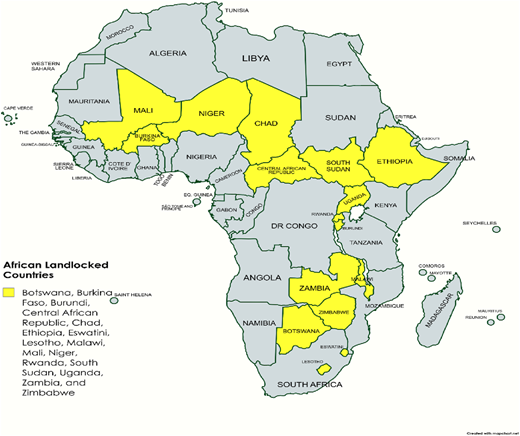
These digital channels are particularly critical for landlocked countries (LLDCs) (Figure 1), where internal remoteness, bureaucratic clearance, and border delays magnify the gains from technologies that compress transaction times and improve market connectivity (MacKellar et al., 2000; Paudel, 2014). Yet being landlocked does not automatically constrain growth; rather, outcomes depend on opportunities, the degree of openness and institutional capacity. For example, resource-rich landlocked economies such as Chad and Botswana have managed to achieve higher exports and growth despite costly transport costs, whereas resource-scarce counterparts remain heavily dependent on neighbors (Raballand, 2003).
As globalization is increasingly enabled by ICT, it captures the overall exposure to trade, investment, and information flows. For landlocked economies negotiating corridor politics, customs reforms, and services liberalization, the KOF globalization indices serve not just as summary measures but as practical tools to gauge how external integration interacts with domestic capabilities (Bataka, 2019; Gold, 2011; Wang et al., 2023). Recent sub-Saharan African (SSA) evidence shows that ICT adoption strengthens the trade-growth link (Adeleye et al., 2021), globalization's benefits are larger with effective governance (Agyei and Idan, 2022; Glennice Fosah et al., 2023), and infrastructure gains are amplified where institutional quality is stronger (Ogbaro et al., 2023). Accordingly, these findings highlight that digitalization and globalization can ease structural disadvantages, but their growth returns are conditional on the quality of institutions (Gold and Tregenna, 2024; Iddrisu and Chen, 2024).
Despite these insights, most related studies (Abdulqadir and Asongu, 2022; Adeleye et al., 2021; Akinlo and Okunlola, 2021; Bataka, 2019; David and Grobler, 2020; Iddrisu and Chen, 2024) focus on SSA broadly rather than exclusively on LLDCs. Such studies typically pool heterogeneous country groups with markedly different factor endowments, degree of economic diversification, technological readiness and exposure to transit constraints. As a result, the unique structural conditions of African LLDCs, such as high trade costs, dependence on transit corridors, limited market access, and vulnerability to external shocks, are masked in broader SSA samples. To fill this literature gap, our study examines the nexus between digitalization, globalization, natural resources, labor, investment and institutions in the 15 landlocked African economies. Disparate from the existing studies, this research focuses solely on these economies, employing interaction-based, cross-section-dependence-robust dynamic methods that allow country-specific adjustment dynamics and long-run responses, including explicit endowment controls (resource rents, labor force participation, and investment). This approach absorbs common shocks through cross-sectional time effects and reports marginal effects across the observed institutional distribution. Thereby, the analysis mitigates heterogeneity bias inherent in pooled SSA panels and provides a structurally coherent sample. In so doing, we extend African panel evidence showing that openness and digital infrastructure payoffs are conditioned by institutional quality, an aspect largely overlooked in prior LLDC research (Akinlo and Okunlola, 2021; Ogbaro et al., 2023) and we capture the multidimensional nature of globalization using KOF indices.
Using data from the World Development Indicators (WDI), the World Governance Indicators (WGI), and the KOF Swiss Economic Institute, covering the period 1996–2023, this study makes three contributions. First, it provides the first LLDC-focused analysis that jointly models the interaction effects between digitalization × institutions and globalization × institutions, allowing for a nuanced assessment of conditional growth effects. In line with established practice, digitalization is measured through PCA of mobile phones, fixed lines, and Internet use, following David and Grobler (2020) approach, while six WGI institutions' dimensions are summarized as a moderator through PCA; these are measurement choices rather than contributions per se. Second, the empirical strategy employs dynamic instrumental variable (IV) regression with ordinary least squares (OLS) and semi-log/lagged specifications, which are robust for small-N, moderate-T LLDC panels with potential endogeneity and unobserved common factors. Third, the estimation strategy is complemented by Driscoll-Kraay and panel-corrected standard errors (PCSE) for robustness, improving upon previous studies (Gold and Tregenna, 2024; Ogbaro et al., 2023) by jointly incorporating the two interaction terms and providing cross-sectional dependence-robust dynamic inference within an LLDC setting.
Specifically, the research addresses three central questions (regulatory quality (RQ)): (1). How does digitalization affect economic growth in landlocked African countries, and how does its effect vary with institutional quality? (2). How do institutional moderators influence globalization-growth relationships? (3). What roles do natural resources, labor, and gross fixed capital formation (public investment) play once lagged and interaction effects are considered?
To provide a comprehensive understanding of these dynamics, the paper proceeds as follows: Section 2 reviews the theoretical and empirical literature, highlighting the gaps our study addresses. Section 3 outlines the methodology; Section 4 presents and discusses the econometric results; Section 5 concludes with policy recommendations, offering actionable insights to enhance economic performance despite the unique structural challenges of geographical disadvantage of landlockedness.
2. Literature review
2.1 Theoretical review
This study is primarily grounded in the growth-with-institutions perspective, which posits that the returns to technology adoption and globalization are contingent on institutional quality (Acemoglu and Robinson, 2013; North, 1990). Within this framework, digitalization and openness to trade are considered high-return levers, whose effectiveness depends on governance structures, RQ, and bureaucratic capacity. Classical trade theory (Ricardo, 1891) and subsequent extensions in trade and technology literature (Bhagwati and Srinivasan, 1978; Krueger, 1978) provide a basis for understanding how specialization and technology, particularly telecommunications, enhance productivity and income (Gold, 2011). Digitalization, framed as a general-purpose technology (Bresnahan and Trajtenberg, 1995), reduces transaction costs (Bakare and Gold, 2011), facilitates knowledge diffusion, and improves labor and capital efficiency. From a Schumpeterian finance perspective, digital networks further deepen credit markets and improve payments, indirectly supporting growth. The absorptive capacity framework (Cohen and Levinthal, 1990) further reinforces that institutional quality is a critical moderator, enabling credible rules, contract enforcement, and bureaucratic capability to determine effectively how digital technologies and openness translate into productivity gains. Recent African growth debates echo this logic, highlighting that weak institutional settings often blunt the benefits of ICT expansion and trade reforms (Diouf et al., 2024; Ogbaro et al., 2023).
Globalization theory (Dreher, 2006) also distinguishes between de jure (policy-driven) and de facto (realized) integration, while the second-best theory (Lipsey and Lancaster, 1956) emphasized that institutional strength shapes whether external openness yields sustained benefits or exposes economies to volatility. Neoclassical and Solow-Swan growth models justify the inclusion of capital formation and labor force as conventional growth drivers, while the resource-based view (Sachs and Warner, 2001) explains how natural resources rents introduce volatility and the “resource curse” (Adekunle et al., 2023) dynamics unless mitigated by effective governance. Overall, this theoretical synthesis frames the study by examining the interaction between digitalization, globalization, and institutional quality, with institutions moderating the growth effects of technology and trade, while traditional growth inputs and resource endowments are controlled for. This focus provides a coherent lens for understanding economic growth in African LLDCs and aligns directly with the study's empirical strategy and objectives.
2.2 Empirical review
Empirical studies focusing exclusively on landlocked African countries remain limited, with much of the evidence drawn from broader sub-Saharan Africa (SSA) or Africa as a whole. The most directly relevant work is by Gold and Tregenna (2024), who analyze 16 landlocked African economies (1996–2021) using pooled mean group and system generalized method of moments (GMM). They find that openness robustly promotes growth, while telecommunications and institutional quality exhibit mixed direct effects when estimated without interactions, highlighting the importance of conditional (moderating) channels.
Furthermore, recent SSA studies provide strong evidence that efficient digital infrastructure, including broadband networks and information technology, can reduce these challenges by reducing transaction costs, improving resource allocation efficiency, stimulating demand, and promoting investment across sectors (Abdulqadir and Asongu, 2022). Ogbaro et al. (2023), using Cross-Sectional (CS)-ARDL with common correlated effects (CCE) augmentation, demonstrated that infrastructure, particularly ICT components, delivers stronger long-run effects in the presence of higher institutional quality.
Adeleye et al. (2021) show that mobile and fixed telephony strengthen the trade-growth link across 53 African countries, while David and Grobler (2020) justify that PCA-derived Africa-wide ICT indices positively correlate with growth and human development, validating the PCA as a robust measure of digitalization in macro panels. Most recently, Awad and Albaity (2024) find that income growth often drives ICT adoption in 42 African countries (2000–2019), cautioning on causality, while Iddrisu and Chen (2024) suggest that digitalization's net growth effect can operate partly through financial development. Diouf et al. (2024) further confirm sizable macro payoffs from expanding Internet access, though usage and quality gaps persist, particularly in landlocked economies. Earlier contributions also stress the offsetting role of ICT against geographic disadvantages (Bhattarai, 2019). Raballand (2003) note that inadequate internal infrastructure and high transportation costs hinder trade performance, suggesting that digital infrastructure can partially offset these constraints (Bakare and Gold, 2011). Collectively, these studies underscore the critical role of digitalization in facilitating production, enhancing market efficiency, and promoting integration in SSA.
The empirical findings on globalization are more mixed, with results often depending on institutional capacity and openness measures. Akinlo and Okunlola (2021) show that unconditional openness effects, initially weak or negative, turn positive once interacted with institutions across pooled, fixed effects (FE), and GMM estimators. Agyei and Idan (2022) similarly find that government effectiveness (GE) strengthens trade outcomes, and Ngouhouo et al. (2021) confirm the central role of institutions in shaping openness using 36 SSA countries (1996–2017). More recently, Glennice Fosah et al. (2023), using dynamic common correlated effects/system generalized method of moments (DCCE/SGMM) for 35 SSA countries (1995–2018), demonstrate that accounting for cross-sectional dependence alters inference, even when broader development indicators beyond gross domestic product (GDP) growth are considered, reinforcing the importance of institutional and neighborhood effects. Similarly, Zahonogo (2016) indicates that greater participation in global trade enhances the adoption of technology and innovation from advanced economies, boosting growth in more open countries. Several earlier SSA studies distinguish between de jure (policy/institutional) and de facto (realized) globalization, with the former more robustly linked to growth (Bataka, 2019). At the same time, classic studies of MacKellar et al. (2000) and Paudel and Cooray (2018) confirm that landlockedness reduces trade diversification and increases reliance on primary products. Overall, the literature supports the view that globalization benefits are conditional and shaped by governance and integration capacity.
Institutional quality consistently emerges as a moderator of both ICT and openness effects. Ogbaro et al. (2023) emphasize “institutions as absorptive capacity”, while Agyei and Idan (2022) demonstrate that stronger governance mitigates the adverse effects of resource rents. Chomen (2022) finds weak direct correlations between institutions and growth, except in specifications excluding control variables, where measures of corruption control and executive constraint are positively related to growth. Similarly, broader empirical results confirm that landlocked African economies are plagued by weak institutional structures that impede trade and hinder economic growth (MacKellar et al., 2000; Paudel, 2014; Paudel and Cooray, 2018). While Basnet (2017) concludes that institutional structure, particularly political stability and reduced corruption, significantly impacts growth. The inclusion of control variables in prior studies varies, depending on the intended objectives. For instance, investment and labor (human capital proxies), while natural resource rents (NRR) are rarely modeled explicitly, despite their importance in volatility and exposure to external shocks (Agyei and Idan, 2022; Akinlo and Okunlola, 2021). Where resource rents are considered, their effects are often conditional, with adverse growth impacts mitigated by stronger institutions. As many SSA studies indicate positive effects for oil or coal rents but negative for forest rents, governance and infrastructure consistently appear to counteract “resource curse” dynamics (Adekunle et al., 2023; Amare et al., 2024; Henri, 2019).
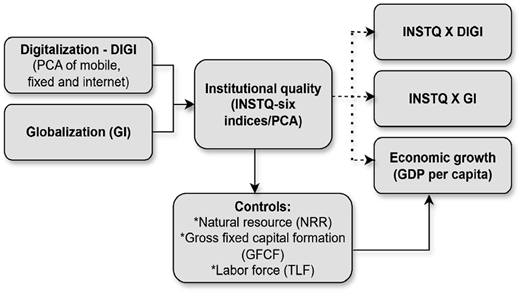
Distinctively, no previous study jointly estimates a PCA-based digitalization index (mobile, fixed, Internet) while simultaneously modeling globalization, and interacting both digitalization and institutions, as well as globalization and institutions, within a dynamic IV/two-stage least squares (2SLS) framework that explicitly addresses endogeneity and consistently includes key controls such as natural resources, gross fixed capital formation and labor. This study addresses this gap, offering a comprehensive empirical design that explicitly models these interdependencies while controlling for endogeneity and cross-sectional dependencies, thereby providing a rigorous foundation for assessing growth drivers in landlocked African economies. The study's conceptual framework (Figure 2) illustrates this contribution, highlighting a cross-sectionally dependent and institutionally moderated model.
3. Methodology
3.1 Data and variable description
The panel data utilized for the 15 African LLDCs, as depicted in Figure 1, covers the period from 1996 to 2023. The starting year is selected because institutional quality data from the WGI became available in 1996, while 2023 marks the latest year with complete secondary data accessibility. The selected countries shared geographical constraints that uniquely shaped trade, investment, and digital infrastructure dynamics. The final sample includes Botswana, Burkin Faso, Burundi, Central African Republic, Chad, Eswatini, Ethiopia, Lesotho, Malawi, Mali, Niger, Rwanda, Uganda, Zambia, and Zimbabwe. However, South Sudan is omitted because comparable data are unavailable, and it only attained landlocked status in 2011 following independence. Data are sourced from the WDI for macroeconomic and socio-economic variables, the WGI for institutional quality dimensions, and the KOF Swiss Economic Institute for globalization indices. Detailed measurements and descriptions for each variable are provided in Table 1.
3.2 Model specification and estimation strategy
The empirical analysis estimates the conditional effects of digitalization, globalization and control variables on economic growth and incorporates the institutional quality as a moderating factor. It further investigates the dynamic interactions between institutions and digitalization, as well as institutions and globalization, to account for potential conditional effects in landlocked African countries.
The baseline model specifies real GDP per capita (KGDPPC) as a function of digitalization, globalization, institutional quality, natural resources rents, gross fixed capital formation, and the labor force:
Where i and t denote country and year indices, respectively; are intercept and slope coefficients; and serves as the idiosyncratic error term.
Given the potential endogeneity of regressors such as digitalization, institutions and globalization, the study applies IV/2SLS regression using internal lags as instruments. This approach is widely used in small-N, moderate-T growth panels that are vulnerable to simultaneity and dynamic panel bias (Arellano and Bond, 1991). However, a limitation is that lagged instruments may be weak in short panels, potentially biasing estimates and inference.
To refine interpretation and capture complementarities, the analysis extends the baseline into a semi-log specification with lagged regressors, where variables such as digitalization and PGFCF enter one-period lags to reflect delayed growth effects. Interaction terms, INST × DIGI and INST × globalization index (GI) are introduced to test whether institutions condition the income effects of digitalization and globalization.
Hence, Equation (2) introduces interaction terms to capture the conditional effects of institutions on digitalization and globalization.
For robustness, dynamic semi-log forms are estimated with lagged dependent variables and year dummies:
To assess the conditional effects of institutions, we introduce interaction terms between institutional quality and digitalization (INST x DIGI) as well as institutions and globalization (INST x GI). These interactions allow for the effect of digitalization and globalization on GDP per capita to vary with the institutional environment, providing insights into potential complementarities or diminishing returns.
Here, captures growth persistence; lagged labor () and lagged investment () allow for delayed effects; and controls for year-specific shocks.
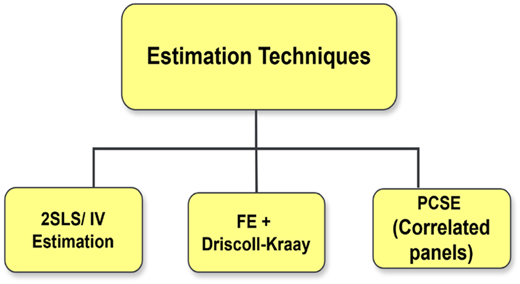
Diagnostic checks confirmed departures from the classical assumptions: the Modified Wald test indicated heteroskedasticity, while the Wooldridge test detected autocorrelation. To ensure robustness, the study therefore employs Driscoll-Kraay standard errors (Driscoll and Kraay, 1998), which are robust to heteroskedasticity, serial correlation and cross-sectional dependence, and PCSE (Beck and Katz, 1995), which provides efficient inference under panel heteroskedasticity and contemporaneous correlation. While these estimators strengthen inference, they do not eliminate potential finite-sample bias, and PCSE estimates may be sensitive to unbalanced panels or strong cross-sectional dependencies. Taken together, this multi-pronged estimation strategy, IV/2SLS for endogeneity, semi-log models with interaction for dynamic effects, and Driscoll-Kraay and PCSE for robustness (see Figure 3 for the empirical flowchart), provides consistent and reliable evidence on how digitalization, globalization, institutions and resources shape growth trajectories in African LLDCs.
4. Results and discussion
4.1 Descriptive statistics
As presented in Table 2, the dependent variable, GDP per capita (KGDPPC) averages 1,163 (SD 1,438) with a wide range of 245$-7,236$, indicating large income gaps. NRR average 10.19% but vary from 0.66% to 40.49%, revealing uneven resource dependence. Gross fixed capital formation (PGFCF) averages 20.42$ with a 2.00–59.72 range, showing differences in investment levels. Total labor force averages about 6.79 million, spanning roughly 0.29–52.89 million, underscoring stark differences in market size. The GI has a mean of 43.74 and ranges from 23.42 to 58.30, pointing to moderate but varied global integration. Institutional quality (INST_Rnk) and digitalization (DIGI) range between −1.75 and 2.65 and −1.36 to 2.89, respectively, capturing substantial dispersion in governance and digital adoption.
4.2 Correlation and multicollinearity diagnostics
The correlation matrix reported in Table 3 supports theoretical expectations. GDP per capita is positively associated with digitalization (0.611), globalization (0.461), institutional quality (0.408), and gross fixed capital formation (0.248), while it is negatively related to natural resources rents (−0.435) and labor (−0.238). Among these, digitalization exhibits the strongest positive link with economic performance, underscoring its central role in driving growth in African LLDCs. Although some correlations, particularly between digitalization and globalization, are moderately high, they remain below the critical threshold. To ensure these correlations are not distorted, a variance inflation factor (VIF) test is subsequently conducted using the logged specification.
Hence, as reported in Table 4, the mean VIF of 1.61 is well below the conventional threshold of 10 (Gold and Rasiah, 2022), indicating the absence of multicollinearity.
4.3 Panel diagnostic tests
To ensure the reliability of the regression results, diagnostic checks (Table 5) confirmed departures from classical panel assumptions (Mills, 2014). The modified Wald test indicated heteroskedasticity, while the Wooldridge test rejected the null of no autocorrelation. Such outcomes are not unexpected in landlocked African economies, which are structurally exposed to volatility from resource rents, trade corridor frictions, and external shocks. Although the IV/2SLS method addresses some of these concerns, nonetheless, the study also employs robust estimators, such as Driscoll-Kraay and PCSE (see Table 8), which correct for heteroskedasticity, autocorrelation, and cross-sectional dependence.
4.4 Baseline estimates (IV/OLS)
Table 6 reports the dynamic fixed-effects estimates for GDP per capita, and six WDI disaggregated institutional quality: rule of law (ROL), political stability (PSAV), control of corruption, RQ, voice and accountability, and GE in African LLDCs, using lagged regressors as instruments. The lagged dependent variable is highly significant (0.59–0.61; p < 0.001), indicating moderate income persistence and partial adjustment toward country-specific steady states. This translates into a long-run multiplier of about 2.5, in line with SSA panel studies and convergence predictions in Solow-type frameworks.
Digitalization (DIGI) enters with a large, positive and robust coefficient (66–80; p < 0.001), consistent with its role as a general-purpose technology that reduces transaction costs and reallocates resources towards more efficient uses. This aligns with macro evidence that ICT penetration fosters growth (Abdulqadir and Asongu, 2022; David and Grobler, 2020) and complements findings that digital connectivity enhances the gains from external integration (Adeleye et al., 2021). The effect is particularly plausible in landlocked contexts, where digital tools offset high trade costs and help leapfrog other traditional development barriers. Institutional quality is also positive and significant (2.36–4.12), supporting the “institutions as fundamentals” view that stronger property rights and state capacity raise steady-state income differences (Agyei and Idan, 2022; Akinlo and Okunlola, 2021).
By contrast, globalization (GI) is generally negative, statistically significant in some specifications (e.g. with ROL or GE) but imprecise in others. This pattern is consistent with globalization theory (Dreher, 2006) and “second-best” settings (Lipsey and Lancaster, 1956) typical of LLDCs, where institutional capacity is weak and trade costs are high (Bhagwati and Srinivasan, 1978). In such settings, external integration can magnify misallocation and rent-seeking, transmit terms-of-trade and capital-flow volatility, and cause Dutch disease pressures, resulting in adverse net growth effects until governance thresholds are met. This aligns with SSA evidence showing negative direct openness effects but positive GI x institutions and dimension-specific moderation by institutional quality (Agyei and Idan, 2022; Akinlo and Okunlola, 2021). In addition, aggregate GI indices can obscure divergent de jure and de facto components (Bataka, 2019), helping to explain why unconditional GI effects appear negative while the interaction with institutions turns positive under stronger governance. Moreover, the control variables, NRR, public investment (LNPGFCF), and labor force (LNTLF), are small and insignificant. Resource rents' null effect fits the resource curse hypothesis (Henri, 2019; Sachs and Warner, 2001); public investment effects may be obscured by lags and GDP share scaling; and labor force size adds little beyond demographic and human capital measures. WGIs entered individually provide little extra signal, consistent with collinearity, since the composite aggregates the six dimensions. Overall, the baseline results confirm RQ1 and RQ2, revealing a coherent pattern: digitalization and institutional quality consistently raise income levels, globalization yields mixed effects without complementary institutions, and traditional inputs such as investment, labor, and resource rents exert only limited direct influence.
4.5 Extended models - semi-log interaction estimate
Table 7 presents extended semi-log specifications with lagged regressors and institutional interactions, which sharpen the estimates and increase persistence. In this model, the lagged dependent (LNGDP per capita as DV) variable is 0.645 (p < 0.001), implying a long-run multiplier of about 2.8. In the baseline semi-log model, lagged digitalization remains strongly positive (0.022, p < 0.001), institution quality is also significant (0.057, p < 0.001), consistent with delayed capital deepening, while natural resources rents and labor remain negligible.
Introducing the digitalization × institutions interaction amplifies the main effects of digitalization (0.030, p < 0.001) but yields a negative interaction (−0.011, p < 0.001). Since lower rank values denote weaker institutions, the marginal payoff to digitalization rises with stronger institutions. This aligns with theories of general-purpose technologies, where regulatory capacity and contract enforcement reduce adoption frictions and magnify productivity gains. Conversely, the negative interaction may also suggest a threshold effect; beyond a certain point, excessive institutional rigidity could dampen digitalization's full growth potential, whether through regulatory lag, bureaucracy, or digital governance inefficiencies. Importantly, however, both institutional quality and digitalization retain strong and positive individual effects across all models, showcasing the case for dual reforms and expanding digital infrastructure while simultaneously streamlining institutional frameworks. The results echo SSA evidence that infrastructure payoffs are higher under better governance (Ogbaro et al., 2023) and that ICT complements openness (Adeleye et al., 2021; Iddrisu and Chen, 2024).
In landlocked contexts, where trade costs are elevated, this complementarity is especially compelling. With globalization × institutions interaction, globalization remains marginally significant and positive (0.003, p < 0.10), potentially due to weak trade logistics, landlocked barriers, or low participation in global value chains. Although the institutions coefficient strengthens (0.158, p < 0.01), and the interaction is negative (−0.002, p < 0.10), again, implying that globalization yields higher returns where institutions are stronger. This pattern is consistent with SSA findings that openness enhances growth under supportive governance (Agyei and Idan, 2022; Akinlo and Okunlola, 2021), and with KOF-based evidence that de jure openness is generally beneficial while de facto effects are mixed (Bataka, 2019). Two supplementary results need to be emphasized. First, lagged public investment (LNPGFCF) is robustly positive, suggesting capital formation as predicted by augmented Solow logic contributes to long-run growth, with implied semi-elasticities of about 0.8–1.1% per GDP point invested. Second, resource rents (NRR) remain insignificant, consistent with the resource curse view that windfalls require institutional strength to avoid volatility, misallocation and guard against Dutch disease (Adekunle et al., 2023; Amare et al., 2024).
In summary, the semi-log dynamic estimates with interactions provide clear evidence that institutional quality (INST_RnK) conditions the returns to both digitalization and globalization in landlocked African economies. This directly addresses RQ2 by showing that capable institutions are essential to unlock the productivity gains of digital technologies and trade integration. The result is theoretically grounded in models of technology adoption and trade under frictions, empirically aligned with SSA evidence on openness-institutions and infrastructure-institutions complementarities (Agyei and Idan, 2022; Akinlo and Okunlola, 2021; Ogbaro et al., 2023), and economically intuitive in environments where state capacity and RQ are essential for translating reforms and technologies into broad-based income gains.
4.6 Robustness checks - Driscoll-Kraay and panel-corrected standard errors (PCSE)
Given the evidence of heteroskedasticity, serial correlation in the diagnostic tests, reliance solely on IV/2SLS estimates may yield biased standard errors and misleading inferences. To ensure robustness, the analysis in Table 8 incorporates Driscoll-Kraay and PCSE, both of which provide consistent estimates in the presence of heteroskedasticity, serial correlation and cross-sectional dependence. These estimators are particularly suited to small-N, moderate-T panels typical of African landlocked economies, where shocks often spill across units.
The results broadly confirm earlier findings in the IV/2SLS estimates, where NRR remain negative and significant (p < 0.05), reinforcing the resource curse hypothesis that dependence suppresses growth through volatility, Dutch disease, and governance stresses (Amare et al., 2024; Sachs and Warner, 2001). Public investment (LNPGFCF) loses significance across all specifications, consistent with evidence that inefficient capital spending or absorptive capacity constraint weakens the growth impact of investment on African economies (Calderón and Servén, 2010), whereas globalization (GI) and labor (LNTLF) exhibit positive and precisely estimated effects. The growth payoff to investment is not robust once interactions are included. The positive effect of GI is consistent with SSA evidence that openness/globalization, particularly de jure components, supports growth and with landlocked Africa (Bataka, 2019; Gold and Rasiah, 2022; Gold and Tregenna, 2024), particularly in the presence of strong institutions, openness is growth-enhancing on average. As well, the labor findings echo studies on Africa's demographic dividend potential when coupled with job creation and skills upgrading (Bloom et al., 2003).
Digitalization (DIGI) also shows a positive association with growth, especially under PCSE with interactions. This supports SSA findings on ICT/digitalization that associate penetration indices with higher growth and development, and positive net effects even when conditioning on financial-sector channels (Asongu and Le Roux, 2017; David and Grobler, 2020; Iddrisu and Chen, 2024). Turning to moderation, the INSTGI term is insignificant under the Driscoll-Kraay and only weakly positive under the PCSE, which is weaker than the commonly reported positive openness × institutions complementarity in the SSA panels (Agyei and Idan, 2022; Akinlo and Okunlola, 2021). This difference may reflect our focus on a multidimensional GI rather than trade shares and specific constraints faced by landlocked economies (Bataka, 2019; Gold and Tregenna, 2024). Contrarily, INSTDIGI is negative and significant in PCSE specification (−0.024; p < 0.05). The institutions' results point to the need for the government to be flexible and efficient to enhance growth (Acemoglu et al., 2005; North, 1990).
Lastly, the robustness checks strengthen confidence in the baseline results across all specifications: digitalization and institutional quality emerge as the most consistent growth drivers in African LLDCs (RQ1 and RQ2), while globalization becomes positive only when supported by strong institutions (RQ2). NRR continue to dampen growth, public investment (PGFCF) shows limited or delayed effects, and labor expansion contributes positively, directly addressing RQ3. Overall, this study establishes that technology and openness can accelerate growth in LLDCs, but only when anchored in strong institutions and prudent resource management.
5. Conclusion and policy recommendations
This study makes a novel contribution to the growth literature by explicitly examining how digital infrastructure and institutional quality interact to influence economic performance in 15 African landlocked developing countries (LLDCs) between 1996 and 2023. By constructing PCA-based composite indices for digitalization and institutional quality, and applying IV regressions with robustness checks, the analysis captures both direct and interaction effects in the context characterized by small-N, moderate-T, and exposure to external shocks.
The results highlight three major insights that directly address the research questions outlined in the introduction. First, digitalization and globalization consistently exert a significant positive influence on economic growth, demonstrating that technology-driven trade facilitation and connectivity are critical for enhancing productive capacities. Second, institutional quality exhibits a nuanced influence as GE positively correlates with growth, while other institutional measures show weaker or conditional effects, particularly when interacting with digital infrastructure. The interaction effects indicate that combining robust digital infrastructure with effective institutions significantly accelerates growth, supporting theoretical perspectives on the complementarity between governance and technology. Third, domestic investment and labor force contribute modestly, confirming that traditional growth drivers remain relevant, while natural resources rents are growth-dampening in the absence of strong institutions, they are consistent with resource curse dynamics.
These findings yield several actionable policy priorities. The LLDC governments should adopt targeted trade facilitation strategies, including streamlining customs procedures, reducing bureaucratic barriers, and leveraging digital trade platforms to speed cross-border transactions. Expanding digital infrastructure, broadband coverage, secure networks, and Internet access should be complemented with ICT skills development and digital literacy programs for businesses and workers. Rwanda provides a practical example, having invested heavily in e-government and broadband platforms to integrate markets and deliver services more efficiently. Institutional reforms, such as enforcing anti-corruption measures and improving regulatory efficiency, are essential to create a supportive environment for private sector growth. Botswana illustrates this pathway, where stronger governance and prudent resource management have enhanced stability and long-term development prospects despite landlockedness. Policies to mobilize domestic investment through public-private partnerships, targeted investment incentives, and improved access to finance will complement infrastructure and innovation. Human capital development (labor force), through vocational training and skill-upgrading initiatives, will strengthen the workforce to adopt technology-intensive practices and production. Additionally, LLDCs should pursue regional integration initiatives to facilitate intraregional trade, harmonize standards, and promote knowledge exchange, thus magnifying the benefits of openness and infrastructure improvement, to overcome the structural disadvantages of landlocked geography.
This study has limitations, as key sectors such as electricity provision and foreign direct investment were not explored. Moreover, the analysis does not account for external shocks or global macroeconomic volatility, which could influence growth outcomes. Future research should incorporate these dimensions to provide a more comprehensive understanding of the growth dynamics of African LLDCs and offer stronger policy guidance.
Open access publication of this article was funded under the SANLiC transformative agreement for South African institutions.