


The purpose of this paper is to find a doubly nonlinear parabolic equation of fast diffusion in a bounded domain.
For positive and bounded initial data, the authors study the initial zero-boundary value problem.
The findings of this study showed the complete extinction of a continuous weak solution at a finite time.
The extinction time is studied earlier but for the Laplacian case. The authors presented the finite extinction time for the case of p-Laplacian.
1. Introduction
Let be a bounded domain with smooth boundary . For any positive , let be the space-time cylinder, and let be the parabolic boundary defined by . Throughout this paper, we fix and , where is the Sobolev critical exponent. We consider the following doubly nonlinear parabolic equation
Here the unknown function is a nonnegative real-valued function defined for , and the initial data is assumed to be in the Sobolev space , positive and bounded in and, is the p-Laplacian.
First of all, we will recall some fundamental results for the Eqn (1.1).
In the case , the Eqn (1.1) becomes the so-called porous medium equation or the plasma equation with the Sobolev critical exponent . The global existence and continuity of a weak solution of (1.1) in the case is proved in [1–3]. In particular, the extinction at a finite time of a continuous weak solution is shown in [4, 5]. The positivity of the unique weak solution is demonstrated in [6] and the decay estimation has presented in [6, 7]. The asymptotic behavior at the extinction time is also studied (see [8, 9]). The regularity results for the porous medium equations and the p-Laplace equations are also established and are the fundamental theory for the degenerate and singular parabolic equations (see [10, 11]). Here we will consider a doubly nonlinear equation (1.1) with the p-Laplacian, the porous medium operator and the Sobolev critical exponent and study the positivity, boundedness and finite time extinction of a weak solution of Eqn (1.1). The Hölder regularity of a weak solution to Eqn (1.1) in homogeneous case accomplished in [12]. On the other hand, in the nonhomogeneous case that is not equal to p, the regularity of a weak solution is remained to be settled.
A doubly nonlinear parabolic equation, like the one considered above, has been studied before, and the global existence of a weak solution is proved in [13, 14] and, for a positive, bounded initial data in the Sobolev space , the boundedness, the expansion of positivity and regularity of a weak solution to Eqn (1.1) are accomplished in [15] in the Sobolev critical case that . The finite time extinction is also shown in [13]. These results are the starting point of our study in the paper and thus, we will recall these results later.
Now we will explain in details what we mean by complete extinction for solutions of problem in Eqn (1.1). Our aim here is to show that there exists a positive time T such that u is positive in and . This T is called the complete extinction time for Eqn (1.1). From the preceding results, the expansion of positivity and a finite time extinction, obtained in [13, 15], we find that a nonnegative weak solution of Eqn (1.1) is positive in for some and u vanishes in for some . Here we notice the possibility that a gap may appear and thus, the solution may have positive portion together with zero one in . The proof of the finite time complete extinction is nothing but to show the equality , that is the main issue in this paper. Our main assertion is the following:
(Finite time complete extinction). Let and . Suppose that is a convex bounded domain. Let be positive, bounded and in . Let u be a nonnegative, continuous weak solution of (1.1). Then there exists a positive such that T is the complete extinction time for (1.1), that is, u is positive in and u vanishes in .
Under the interior positivity and finite time extinction, explained above, our main task is to devise an appropriate comparison function, rely on the comparison theorem and verify that above. We follow the construction of comparison function in [6], where the Laplace operator being is studied in any dimensional space domain. Here we shall treat the doubly nonlinear operator, the p-Laplacian coupled with the porous medium operator with the Sobolev critical exponent in three dimensional space domain. We shall compute the p-Laplacain under polar coordinates in the three space dimension, since the higher dimension case seems to be technically difficult. So far, there is no generalized method to evaluate the p-Laplacian in higher dimensional case since this operator is nonlinear and we cannot apply the cylindrical coordinates and the mathematical induction to generalize the case for higher dimension. The convexity of domain is used for the comparison argument to be worked well for our demand (see the proof of Theorem 4.1). Here we also need to assume the continuity of a weak solution to Eqn (1.1), because the regularity for (1.1) is now unknown to be valid in the nonhomogeneous case that is not equal to p, stated as before. In the forthcoming work, we shall study how to remove the assumption of regularity.
The structure of this paper is as follows. In Section 2, we prepare some notations, algebraic inequalities and the definition of weak solution for future use. In Section 3, we gather the fundamental properties of a weak solution of Eqn (1.1) such as the global existence of a weak solution, nonnegativity and boundedness, the so-called expansion of positivity and a finite time extinction of a weak solution. The final Section 4 is devoted to the main theorem and its proof. The proof relies on an appropriate choice of comparison function. Here the computation of the p-Laplace operator is done under the polar-coordinates in three dimensional space domain.
We prove our main theorem for the case of critical Sobolev exponent as we have used the Talenti's function which is a unique solution of the stationary equation on all of space corresponding to Eqn (1.1) (see [16, 17]) to make bound the extinction time.This special function is legitimate for the case of critical Sobolev exponent. Using the usual energy estimates finite extinction time for the subcritical and critical case can be achieved (see [18]). For the supercritical case finite extinction time cannot work well.
2. Preliminaries
We exhibit in this section some notation, analytic tools, definition and statement of some basic theorems including the comparison theorem used later.
2.1 Notation
Following the standard text books [19, 20], we set the following notation. Let be a bounded domain in with smooth boundary and for a positive let be the cylindrical domain. Let us define the parabolic boundary of by
Now, we will present some function spaces, defined on space-time region. For is a function space of measurable real-valued functions on a space-time region with a finite norm
where
when , we write for brevity. For the Sobolev space consists of measurable real-valued functions that are weakly differentiable and their weak derivatives are p-th integrable on , with the norm
where denotes the gradient of v in a distribution sense, and let be the closure of with respect to the norm . Also let denote a function space of measurable real-valued functions on space-time region with a finite norm
Let denote an open ball with radius centered at some .
The algebraic inequality is often used later on.
(Algebraic inequalities, [10]). For every there exist positive constants and such that for any
2.2 Weak solution
Here we are going to define a weak solution which is the most basic prerequisite element to conduct the ongoing research of our Eqn (1.1).
Let . A measurable function u defined on is called a weak supersolution (subsolution) to (1.1) if the following (D1)–(D3) are satisfied:
(D1)
(D2)For every nonnegative ,
(D3)
A measurable function u defined on is called a weak solution to Eqn (1.1) if it is simultaneously a weak sub and supersolution, that is,
for every
3. Fundamental facts and results
In this section, let and , the Sobolev exponent.
3.1 Existence of a weak solution
We first state the global existence of a weak solution of Eqn (1.1). For the proof see [14, Theorem 1.1].
(Existence of a weak solution).
For any , there exists a global weak solution of Eqn (1.1).
3.2 Nonnegativity and boundedness
We notice that a weak solution to Eqn (1.1) is nonnegative and bounded provided that the initial value does so. See [15, Propositions 3.4 and 3.5] for the proof.
(Nonnegativity and boundedness). Suppose that , nonnegative and bounded in . Then
3.3 Comparison theorem
We here state the comparison theorem being available for Eqn (1.1), that is used in the proof of our main theorem later. The proof is given in Appendix. We say that on in the trace sense, if
3.4 Expansion of positivity
In this section, we state some positivity results of a nonnegative weak solution to the doubly nonlinear Eqn (1.1), that we will use later to prove our main theorem. We recall that the so-called expansion of positivity holds true for a nonnegative weak solution of Eqn (1.1). This positivity result is proved in [15]. Here we recall them without the proof. The regularity of the solution can be realized upto the positivity region and after that region we do not know about the regularity of the solution of Eqn (1.1).
The following is the expansion of positivity in a compact subdomain. For the proof see [15, Theorem 4.7].
Let , the Sobolev critical exponent. Let u be a nonnegative weak supersolution of (1.1). Let be a subdomain contained compactly in . Let and . Assume that
If a nonnegative weak supersolution u is positive in at some time , its positivity may expand in a future time interval starting from , that is without any waiting time. See the proof in [15, Corollary 4.8].
Let , the Sobolev critical exponent. Let u be a nonnegative weak supersolution of (1.1). Let be a subdomain contained compactly in . Suppose that almost everywhere in for some . Then there exist positive numbers and such that
Once the interior positivity holds true, the positivity around the boundary can follow from the usual comparison function. See the proof in [15, Proposition 4.9].
(Positivity of the solution near the boundary). If in then every nonnegative weak supersolution u to Eqn (1.1) is positive near the boundary.
3.5 Extinction of solutions
In this section, we will state the definition of finite extinction time and a proposition which ensures the existence of finite extinction time of a solution to Eqn (1.1). Firstly, the extinction time is defined as follows:
(Extinction time). Let u be a nonnegative weak solution to Eqn (1.1) in . We call a positive number an extinction time of u if
The following proposition presents the finite time extinction of the solution of (1.1).
Let , the Sobolev critical exponent. Suppose the initial data in Then there exists such that in
For the proof see Appendix. Here we use the special function peculiar to the Sobolev critical case .
Let , the Sobolev critical exponent. Let u be a nonnegative weak solution to (1.1) in . Then there exists an extinction time for u which is bounded as
4. Main theorem
Our main result in this paper is the following theorem.
Suppose that . Let and , the Sobolev critical exponent. Let be a convex bounded domain with smooth boundary. Suppose that the initial data belong to , positive and bounded in . Let u be a continuous weak solution of Eqn (1.1) in with the initial and boundary data . Then there exists a positive number such that and .
Proof. By Theorem 3.4 and Proposition 3.8, we have the existence of finite positive such that and . We notice that the solution u may have a positive portion and a zero one in . Therefore, our aim is to show that . The uniqueness of a weak solution to (1.1) holds true by the comparison principle, Theorem 3.3. Thus, we may assume the following: for any , there exists a space point such that u(x0; t0) > 0. Indeed, if , then the function u being extended to zero in is also a weak solution of Eqn (1.1). That contradicts the choice of (see Figures 1 and 2).
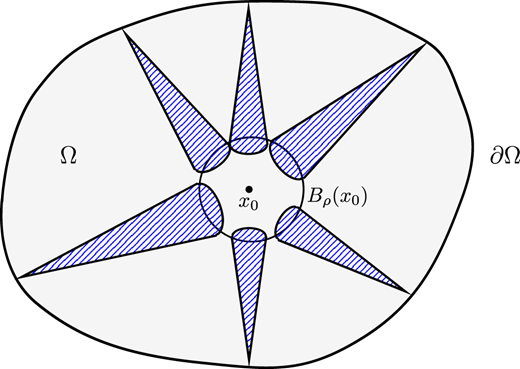
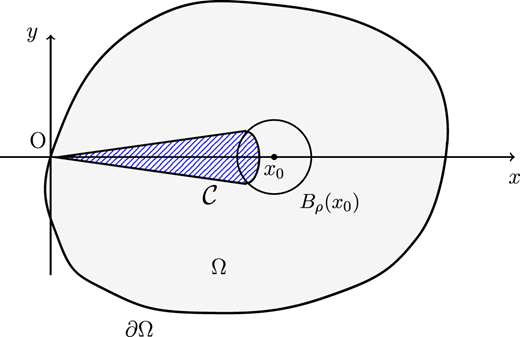
For any , let such that . Since u is continuous, there exists a ball with center and radius and a positive number such that in . To proceed our argument, we will work under the polar coordinates around any boundary point of . Let be any point on . By a translation, let be transformed to the origin. We use the polar coordinates around the origin, where Eqn (1.1) is invariant under a parallel transformation and a rotation and thus, if necessary, by the rotation around the origin, we may assume that the first component axis is the line passing through two points, the origin and and the other component axes are orthogonal to the above first axis and each other. Then, we make some conic space region with vertex at the origin and small angles around the first axis such that the final arc like part of the cone is in . This conic space region is denoted by and, let It is verified by the convexity of the domain that if the angles around the first axis are small, and thus, for a small positive .
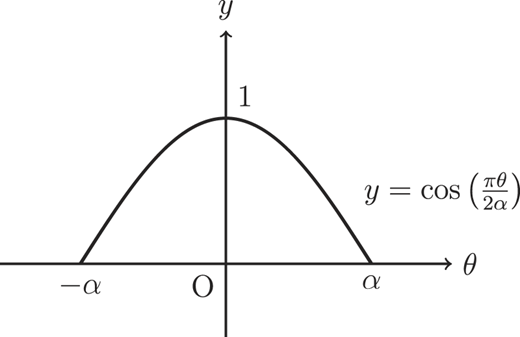
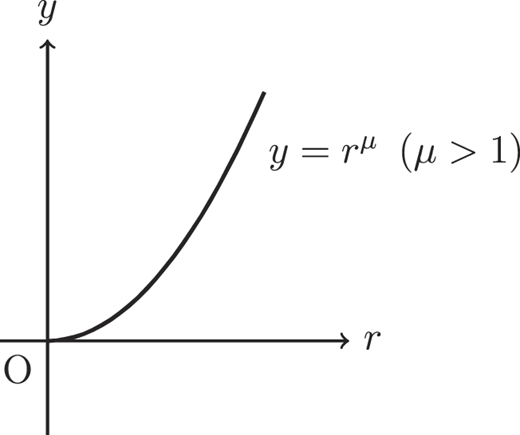
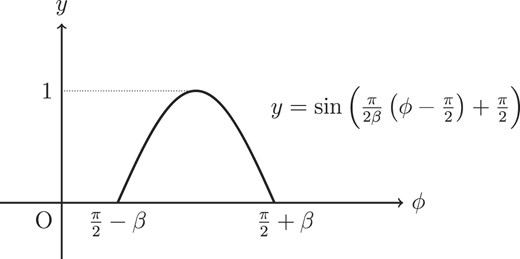
Let the comparison function in the three dimension be defined as
in the time-space region given by the variables in the range
where the positive parameters are determined according to the demand, later. As before, we choose and so small that . Again, that is possible by the hypothesis that the domain is convex (see Figures 3–5).
For brevity, we use the abbreviation hereafter
There holds
We know that
where
The drift term is computed as
and thus,
if we choose as which is verified by a large positive depending on a small , and the lower positive bound of such that for .
and thus, letting , we have
Here the reasoning is as follows: since , the parameter m can be so small that the quantity in the bracket is positive. Thus, in . The boundary condition of w is verified as follows: On the lateral boundary, because at
and at ,
On the arc like boundary of if the parameter m is so small that , where On the initial boundary . Therefore, w is the subsolution of L in and thus, by Theorem 3.3. Hence, the solution u is positive in This is true for any with vertex on the boundary and thus, u is positive in , because of the convexity of the domain. Hence the proof is complete. □
The author would like to thank the supervisor Prof. Masashi Misawa for his continuous guidance to prepare this paper. Also thanks to Dr Kenta Nakamura for several stimulating discussions. This work is supported by the Grant-in-Aid for Scientific Research (C) No.18K03375 at Japan Society for the Promotion of Science.
References
Appendix Proofs of Theorem 3.3 and of Proposition 3.9
Here we are going to provide a detailed proof of Theorem 3.3, and Propositions 3.8 and 3.9, since their results are actually used in the proof of the main theorem.
At first we will depict the proof of Theorem 3.3.
Proof of Theorem 3.3. Following [15], we prove our assertion. For a small let us define the Lipschitz function by
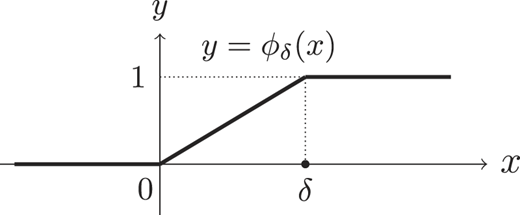
Note that and . Let and be the Lipschitz cut off function on time such that
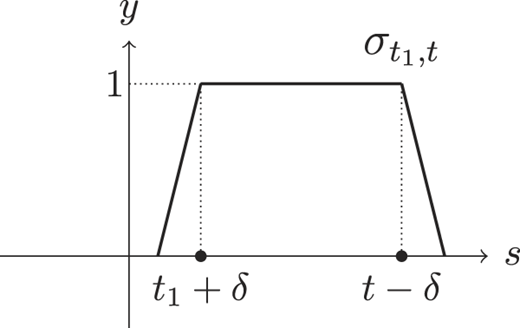
Choose an admissible test function to have
and
Note that
and thus,
Since and belong to , by the Lebesgue dominated convergence theorem, we can take the limit as in (A.5) and then obtain, as ,
and thus, in , for nonnegative , which is equivalent to that in . Hence the proof is complete. □
Proposition 3.8 is given by Proposition 3.9. Therefore, we are now going to exhibit the proof of the Proposition 3.9.
Proof of Proposition 3.9. The proof is similar to [13]. We consider the solution of the corresponding elliptic equation of (1.1) for the sake of construction of a suitable comparison function and this function is called Talenti function [17] which is defined as
In [16], Sciunzi showed that solution of this equation is necessarily of the form
with a parameter . Now what remains to show that a solution of Eqn (1.1) should be extinct at a finite time.
To proceed further, we assume by a translation that the origin . Let be a nonnegative weak solution to Eqn (1.1). Next, let be a nonnegative separable solution of
Then satisfies
where is a separation constant. Applying integration by parts to the first separable function, we see that the separation constant . Let us set to obtain
solves the first equation in (A.8), where is the initial data. Thus the vanishing time of is given by
Let be . Then
We choose the initial data for the ODE in (A.8) as
and therefore, we find that
According to Theorem 3.3, we have
and thus, the vanishing time of is estimated as
where (A.10) is used. The proof is complete. □

