This study is a part of a larger project aimed at reviewing clinical, care and managerial practices for people with intellectual disability or autism spectrum disorders (ID/ASD) and challenging behavior resulting in violence or aggression. The purpose of this study is to conduct a state-of-the-art review of interventions aimed at preventing and managing aggression in individuals with ID/ASD in formal care settings.
A systematic literature search was conducted on January 24th, 2024, focusing on three main concepts: “intellectual disabilities/autism spectrum disorders,” “aggressive behaviour” and “specialized services.” Four reference databases were searched. Two independent reviewers selected studies and conducted data extraction. References were categorized by major themes, with data extraction and narrative synthesis performed for each theme.
This paper found that the number of publications on this theme has gradually diminished over the past 30 years. The number of publications on psychosocial interventions increased, while those pertaining to pharmacological approaches decreased. In the former, studies on staff training have increasingly supplanted interventions directly targeting individuals with ID/ASD. Small, uncontrolled studies reported some efficacy for aggression management interventions, while controlled trials generally found no significant effects. Several authors emphasized the primary role of environmental factors in controlling aggression among individuals with ID/ASD.
The selection of literature in a unique pool without creating a separate search equation for each subsection of the study. It may cause the omission of important publications in the field. It does not allow for a complete picture of evaluated interventions for the prevention and management of violent behaviors in individuals with IA/ASD. However, it allows us to trace the evolution of discussions on the topic. In addition, a formal evaluation of the methodological quality of the included studies was not conducted.
This review may inform researchers and practitioners about the current state of matters in clinical intervention for aggressive behavior in adults with ID/ASD.
To the best of the authors’ knowledge, this is the first review taking a historical perspective in analyzing the development of approaches for dealing with aggressive behavior in adults with ID/ASD in formal settings. This perspective enables considering past unproductive paths and inspires the development of new approaches.
Introduction
While aggressive behavior is not rare in adults with an intellectual disability or autism spectrum disorders (ID/ASD), its severe forms (e.g. physical violence and objects destruction) are observed only in a small fraction (about 5%) of this population (Crocker et al., 2006). In these cases, care demands skills and efforts beyond the informal carers’ capacities (McConkey, 2024). Thus, people with ID/ASD who display severe aggressive behavior may be placed in formal care settings (Modi et al., 2015). These include settings outside family home, such as long-term care hospital units, long-term care facilities and group homes. These facilities are designed to provide secure, structured environments, tailored care and interventions supposed to prevent violent outbursts (Dubé, 2016). Nevertheless, approximately 40% of service users exhibit aggressive behaviors even in formal settings (Tenneij and Koot, 2008). Around 20% of them display aggression on a monthly basis, while another 20% experience weekly or even daily outbursts (Saloviita, 2002). Moderate (15%) and severe aggression (15%) account for a significant proportion of these incidents (Smith et al., 2022). Outwardly directed aggression accounts for about 73% of all incidents. Staff members are most often (70%) the victims of aggression, followed by peer-service users (10%) and visitors (5%). Aggression may also be directed at objects or self [30% (Tenneij and Koot, 2008)]. The consequences of these actions affect not only the immediate victims but also witnesses, the authors of aggression themselves and the institution as a whole.
Service users who are exposed to aggressive outbursts, whether directly targeted or inadvertently present, may feel unsafe or threatened (Tenneij and Koot, 2008). Staff members exposed to or witnessing aggression experience psychological distress and physical injuries, which can erode their coping capacity, lead to burnout, reduce job satisfaction and negatively impact health and relationships outside of work (Newman et al., 2021). Authors of aggression also face consequences: from psychological trauma or physical injuries resulting from restrictive measures to legal consequences (Alexander et al., 2015; Haines-Delmont et al., 2022; Sanders, 2009; Sequeira and Halstead, 2001; Wheeler et al., 2009). Additionally, cycles of aggression and restrictive interventions observed by other service users can deteriorate the therapeutic environment on the ward (Luiselli et al., 2009). At the institutional level, aggression reduces the overall quality of care because of higher staff turnover, which often leads to hiring less experienced staff with greater training needs (Hatton et al., 2001). Financial costs also rise, driven by increased staffing needs, higher rates of absenteeism because of illness or injury and the need to address both physical and psychological trauma (Newman et al., 2021). Given the importance of the problem, several countries have developed guidelines for managing challenging behavior, including aggression, intended for implementation in formal care settings (National Institute for Health and Care Excellence, 2015a, 2015b, 2019).
Clinical interventions to mitigate or reduce aggression in adults with ID/ASD have been proposed by recent guidelines. Procedures include thorough analysis of service users’ preferences and needs and analysis of the individual, carer and environmental factors that may trigger aggressive behaviors. In complex or resistant cases, functional assessment by a multidisciplinary team is recommended (Community living British Columbia, 2016; National Institute for Health and Care Excellence, 2015a, 2015b, 2019; The Ontario Association for Behavioural Analysis, 2019). Based on this assessment, clinical team members develop a behavior support plan for each service user to establish intervention goals and monitor progress (Community living British Columbia, 2016; National Institute for Health and Care Excellence, 2015a). Anger management interventions based on cognitive behavioral principles and tailored sensory interventions may be included in the plan. Antipsychotics are recommended only if psychological intervention shows no effect or if the risks posed by aggressive behavior are very severe and only in combination with psychosocial intervention (National Institute for Health and Care Excellence, 2015a, 2019; The Ontario Association for Behavioral Analysis, 2019). Prescription of antipsychotics should follow strict rules, such as mandatory description of type, frequency and severity of aggressive behavior and its triggers, consent of service-user or their legal representatives, review of medication effectiveness, side-effect monitoring and discontinuing medication if there is no response within six months of starting treatment (National Institute for Health and Care Excellence, 2015a). Rapid tranquilization is acceptable as an emergency measure only (National Institute for Health and Care Excellence, 2015b). However, aggressive behavior persists even in countries that have adopted these guidelines (Smith et al., 2022), and recent reviews on the efficacy of clinical intervention may offer insight into the reasons why.
Recent reviews underscore the limited overall efficacy of clinical interventions for aggression in this population. For example, a Cochrane review on antipsychotics for aggressive behavior in individuals with ID found no positive impact on behavior but highlighted the low quality of trials and underreporting of medication side effects (Brylewski and Duggan, 2004). In individuals with ASD, another Cochrane review found that pharmacological intervention were effective for irritability but not for anger (Iffland et al., 2023). Non-Cochrane reviews also stressed the small number of available controlled studies, their questionable methodological quality and the heterogeneity in outcome measures (Dinca et al., 2005; Im, 2021; Matson and Neal, 2009). A Cochrane review of behavioral and cognitive-behavioral interventions for aggression in individuals with ID/ASD also indicated that trials are limited in number and that existing evidence primarily focuses on service users living in family settings. Dialectical behavior therapy for anger and mindfulness training for caregivers showed some efficacy, while positive behavioral support did not (Prior et al., 2023). In contrast, a non-Cochrane review reported the effectiveness of non-pharmacological interventions for challenging behavior, particularly combining mindfulness with behavioral techniques (Bruinsma et al., 2020).
To summarize, while numerous trials have examined the efficacy of clinical interventions for managing aggressive behavior in individuals with ID/ASD, the evidence remains limited, making clinical decision-making complex. Given these limitations, shifting focus from intervention efficacy to conducting a state-of-the-art review that examines the evolution of research perspectives on this issue could illuminate potential paths forward. This type of review can clarify unproductive approaches, identify overlooked opportunities and stimulate the development of novel solutions for complex clinical challenges. For instance, state-of-the-art reviews have contributed to advances in understanding mental health comorbidities in individuals with ID (Dosen, 1993) and service trajectories in the UK (Russell, 1984). More recently, these reviews elucidated such questions as an application of extended reality technologies for ASD (Bennewith et al., 2024) and challenges associated with pain assessment in this population (Nicolardi et al., 2023).
Thus, this review aims to answer critical questions: “Where are we now?”, “How did we arrive here?” and “What future directions should we take?” concerning prevention and management for aggression in individuals with ID/ASD. In addition, this review seeks to identify and synthesize evidence on interventions that directly target aggressive behavior among service users, with particular attention to approaches that show promise in terms of effectiveness.
Methods
This study is part of a larger project aimed at describing existing clinical and organizational practices for individuals with ID/ASD who exhibit aggressive behavior in formal care settings. Specifically, this component of the study focuses on the evolution of clinical practices designed to directly address or prevent aggressive behavior through targeted interventions. The analysis, synthesis and results presentation were carried out as a state-of-the-art literature review (Barry et al., 2022) to provide an overview of the progression of knowledge over time and suggest directions for future research. The literature search and data extraction were carried out in accordance with recent guidelines for systematic scoping reviews (Levac et al., 2010; Peters et al., 2020). The literature search was structured based on the Population, Concept and Context (PCC) framework by Pollock et al. (2023), focusing on ID/ASD (P), aggressive behavior (C) and specialized services (C) (Supplementary Materials 1 presents the search equation). The literature search was conducted on January 24th, 2024, using the PsycINFO, EMBASE, Medline, CINAHL and EBM Reviews databases. No additional searches were performed in the reference lists of retained articles; similarly, no authors were contacted. The first 100 entries in both English and French from Google Scholar were also screened and included in the main results pool. A grey literature search was conducted using the same core concepts, targeting clinical guidelines and Cochrane systematic reviews. Details of repositories, search queries and results from the grey literature search are provided in Supplementary Materials 2.
Inclusion criteria were: study samples limited to adults (according to the local jurisdiction, or, if not specified, 18 years old and more); studies addressing aggression or aggressive behavior; specialized care settings; quantitative design; and research conducted in countries within the Organization for Economic Co-operation and Development (OECD) to ensure comparability of economic and legislative environments. Exclusion criteria included: studies published before 1994 (corresponding to the clarification of the ASD diagnosis in the DSM-IV); studies focused on self-harm or other forms of challenging behavior (e.g. stereotypies); research conducted in primary care settings or addressing primary care interventions; and publication types such as book chapters, conference abstracts, opinion papers and case studies with fewer than five participants, to enhance generalizability and reduce the risk of bias associated with small sample sizes. Studies with inextricable information and studies in languages other than English or French (the languages spoken and understood by the authors) were also excluded. Titles and abstracts were screened against the primary inclusion and exclusion criteria by two independent reviewers. Disagreements were resolved by a third party (YB or AL). Following this, references were pre-screened and categorized based on the intervention goal (e.g. addressing aggressive behavior in service users vs improving overall care), the primary target of the intervention (e.g. service users vs caregiving staff) and the level at which the intervention was implemented (e.g. ward, hospital or broader health-care system). The main study protocol is registered on the Open Science Network platform (Link tohttps://osf.io/4n6gm).
This paper presents the results of a review of interventions directly targeting aggressive behaviors among service users. Articles selected for this theme were analyzed in three steps. First, the main themes were extracted by study design, types of intervention and target of intervention. Second, data related to each theme were extracted independently by two reviewers and documented using a pre-established extraction sheet. Finally, a narrative synthesis of results was the conducted for each theme.
Results
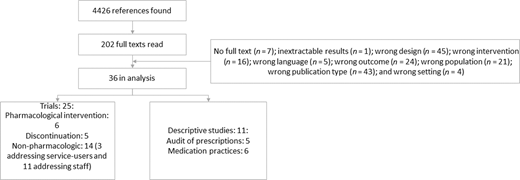
Of 4,426 initial references, 202 were selected for full-text reading. Reasons for exclusion were as follows: full text not found (n = 7); inextractable results (n = 1); wrong design (n = 45); wrong intervention (n = 16); wrong language (n = 5); wrong outcome (n = 24); wrong population (n = 21); wrong publication type (n = 43); and wrong setting (n = 4), as per the previously mentioned inclusion and exclusion criteria (Figure 1).
Studies reporting “irritability” or “externalized challenging behaviour” instead of “aggression” or “violence” were included. Notably, a substantial number of potentially relevant studies were excluded for assessing challenging behavior overall rather than aggressive behavior specifically (“wrong outcome,” n = 9). Case studies with fewer than five participants (“wrong design,” n = 5) and studies with mixed samples (adults and children/adolescents, “wrong population,” n = 6) were excluded for the sake of generalizability of results. One potentially relevant study was excluded for presenting preliminary results from an ongoing trial (“wrong design”.) Two of the selected articles on non-pharmacological interventions reported results from the same trial; therefore, their findings were merged. A description of included studies by intervention group is provided in Supplementary Tables 1–5. Study data are available from the corresponding author upon request. A total of 36 full texts were retained.
Two main topics were covered in the selected studies: pharmacologic trials (n = 25; non-pharmacologic interventions, n = 13; pharmacologic interventions, n = 6; discontinuation trials, n = 5) and descriptive studies (n = 11; audit reports, n = 5; descriptions of prescription practices for aggressive behavior, n = 6).
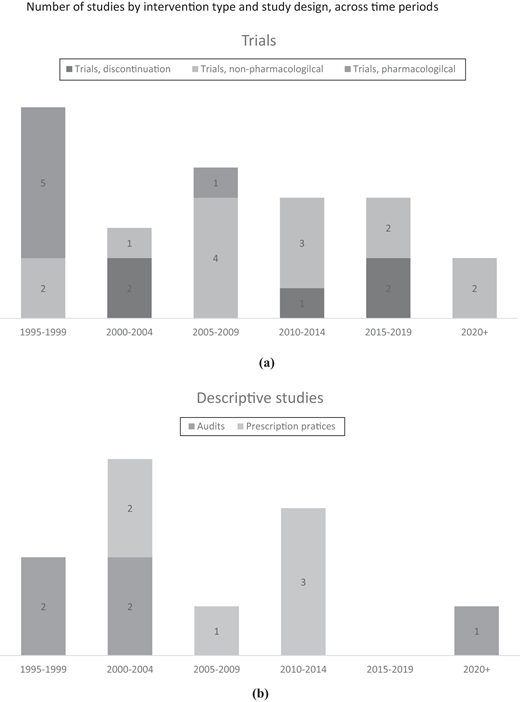
Several temporal trends were observed in both the number of published trial results and descriptive studies [Figures 2(a) and 2(b)]. First, there has been a declining trend in the number of published papers on interventions for ID/ASD targeting aggressive behavior over the years [Figure 2(a)]. Second, studies on non-pharmacologic interventions and antipsychotic discontinuation trials have gradually replaced clinical trials of pharmacologic treatments. Finally, the overall number of descriptive studies gradually declined after peaking in 2000–2004.
This sequence of topics in academic publications may not necessarily reflect the evolution of therapeutic practices. However, it may indicate the establishment of a consensus and the consolidation of clinical practices in the field.
An overview of studies is presented below for each theme study populations, measures of aggressive behavior and intervention effects are presented in Supplementary Tables 1–5.
Trials: Pharmacological interventions
Clinical trials of pharmacological interventions (1995–2008): We found six clinical trials of pharmacological interventions. Three trials assessed the effects of antidepressants (Davanzo et al., 1998; King and Davanzo, 1996; Verhoeven and Tuinier, 1996), and three assessed the effects of antipsychotics (Boachie and McGinnity, 1997; Cohen et al., 1998; Tyrer et al., 2008). With the exception of Tyrer et al. (2008), all included studies are non-controlled trials conducted in the late 1990s (1995–1999). These trials share the same methodological limits: non-controlled design, lack of description of participant selection, no reported retention rate, no description of inclusion and exclusion criteria, no description of environments and psychosocial co-interventions and no use of validated tools to assess outcomes. Nevertheless, the studies report positive effects on one or more indicators of aggressive behavior, including its frequency (Cohen et al., 1998; Davanzo et al., 1998; King and Davanzo, 1996), severity (Davanzo et al., 1998; King and Davanzo, 1996) or the number of participants exhibiting such behavior (Boachie and McGinnity, 1997; Verhoeven and Tuinier, 1996).
The study by Tyrer et al. (2008), published in The Lancet, holds a distinctive place in the literature because of its high methodological quality. This randomized, multicenter, controlled trial compared the efficacy of a typical antipsychotic (haloperidol) and an atypical antipsychotic (risperidone) to that of a placebo, using validated outcome measures. A reduction of aggression was observed across all groups. However, the most substantial decrease was noted in the placebo group. In the absence of a significant difference between treatment and placebo conditions, the authors advise against the use of antipsychotics for the management of aggression in patients with ID/ASD.
Discontinuation of antipsychotics (1995–2019): Given the growing body of evidence pointing to the limited efficacy of pharmacological treatments, it is reasonable to expect a corresponding increase in clinical trials focused on antipsychotic discontinuation. As such, we identified one descriptive study (Bisconer et al., 1995) and five clinical trials (de Kuijper et al., 2014; de Kuijper and Hoekstra, 2018; Gerrard et al., 2019; Hanzel et al., 2000; Stevenson et al., 2004) addressing this theme. Three of these studies focused on the discontinuation of antipsychotics overall (de Kuijper et al., 2014; de Kuijper and Hoekstra, 2018; Gerrard et al., 2019), one on the effect of barbiturate discontinuation on antipsychotic doses (Hanzel et al., 2000) and one on the discontinuation of thioridazine specifically, a first-generation anti-psychotic (Stevenson et al., 2004).
Only one study reported a weak rate of discontinuation: those on thioridazine (Stevenson et al., 2004), where only 7.5% of participants were completely discontinued. Others stated a relatively high rate of discontinuation: around 35% (Bisconer et al., 1995; de Kuijper et al., 2014; de Kuijper and Hoekstra, 2018). Meanwhile, discontinuation was not a linear process: many patients changed their status back and forth between “discontinued” and “non-discontinued” during the trials (de Kuijper et al., 2014; de Kuijper and Hoekstra, 2018; Stevenson et al., 2004). Aggressive behavior decreased (de Kuijper et al., 2014; de Kuijper and Hoekstra, 2018; Hanzel et al., 2000; Stevenson et al., 2004) or showed no changes (Bisconer et al., 1995) following successful complete discontinuation. Incomplete discontinuation was accompanied by stabilization (de Kuijper and Hoekstra, 2018) or increase (de Kuijper et al., 2014) in aggressive behavior. Aggressive behavior was reduced to a lesser extent in participants with stronger antipsychotic side effects (Stevenson et al., 2004). An increase in aggressive behavior often followed an unsuccessful discontinuation attempt (Stevenson et al., 2004).
The non-intended value of this research is the thorough documentation of antipsychotic side effects (de Kuijper and Hoekstra, 2018), which include urinary problems in 80% of participants, dyskinesia in 45%, temperature dysregulation in 38%, dysphagia in 36%, defecation disorders in 33%, akathisia in 30% and parkinsonism in 24%. Muscle spasms, abdominal pain, heartburn and anxiety were also reported (de Kuijper et al., 2014; de Kuijper and Hoekstra, 2018). Being a woman, having a lower level of intellectual disability, not having a co-occurring autism diagnosis, not having been recently hospitalized and taking only one antipsychotic were all associated with higher odds of successful discontinuation (de Kuijper and Hoekstra, 2018; Stevenson et al., 2004).
Trials: non-pharmacological interventions
Intervention for service users aimed at preventing aggressive behavior (2005–2017): We found three studies reporting the effect of non-pharmacological interventions: one on dialectical behavioral therapy (Brown et al., 2013), one on extracranial stimulation (Childs, 2005) and one trial on the use of massages, multisensory environments and their combination, against a control group (Chan and Chien, 2017). Uncontrolled trials showed positive results for interventions: in the nine-participant trial of extracranial stimulation, the frequency of crisis intervention was reduced by more than twice (Childs, 2005). Similar results were obtained in a four-year open trial of adapted dialectical behavior therapy delivered to 40 participants (Brown et al., 2013). A controlled trial showed no effect of massages, multisensory environments and their combination on aggression in individuals with ID (Chan and Chien, 2017).
Trials: interventions for staff aimed at preventing aggression in service users
Individualized management plan (1995–1999): The first report on the efficacy of individualized management plans dates to 1995. In that study, a committee was created to review medication use and restraint practices (Bisconer et al., 1995). The review committee was composed of clinicians, administrators and community representatives (e.g. parents or service user advocates). Its goal was to assess each individual plan for managing challenging behavior and to adapt it as needed to better align with service users’ needs. Over a six-year period, the intervention let to a reduction in antipsychotic use and associated side effect burden. A quarter of service users discontinued the medication completely. While there was no decrease in the proportion of service users subjected to physical restraint (around 20%), its frequency of use diminished from 8.5 to 1.3 incidents per month, and its duration reduced from 1.8 h to 1 h. There was a non-significant decrease in incidents of physical (−3%) and an important decrease in incidents of verbal (−33%) aggression (Bisconer et al., 1995). However, the efficacy of individual plans was not consistently replicated in subsequent studies. A 1999 publication reports no changes in the proportion of service users with a goal related to problem behavior in individual management plans; however, the content of individual plans was not revealed (Stancliffe et al., 1999). A 2005 study (Thomas et al., 2005) reports an almost twofold reduction in cases of physical aggression overall and in aggression causing injuries. In this study, individual care plans were a part of a larger intervention, including staff training to recognize, prevent and de-escalate incidents of aggression; organizational, environmental and clinical risk assessments; risk management, care program approach and care coordination; as well as use of advance directives.
Active support training (2008–2010): The “Active Support” intervention consists of two parts: active listening to a person’s preferences regarding daily activities (the type of activities preferred, ways of proceeding) and active assistance from staff so that the person can undertake the preferred activities in their own way. It is assumed that the intervention indirectly reduces problem behaviors, including aggression, by structuring the routines of people with ID/ASD and by allowing them to occupy their time with meaningful activities. Two studies have tested the effect of the training (Koritsas et al., 2008; Stancliffe et al., 2010). The intervention was administrated to staff as a three-day classroom training with the distribution of training materials (Koritsas et al., 2008; Stancliffe et al., 2010) along with either two hours (Stancliffe et al., 2010) or two days (Koritsas et al., 2008) of observation and coaching in the workplace. No difference in the score on the Inventory for Client and Agency Planning (Bruininks et al., 1986) at post-training was observed in the study with the shorter coaching period (Stancliffe et al., 2010). In the study with the longer coaching period, an increase in score on the Disruptive behavior subscale of the Developmental Behavior Checklist for Adults (Mohr et al., 2011) at post-training but a decrease at the six-month follow-up (Koritsas et al., 2008) were reported.
Positive behavior support (2024): A controlled non-randomized study showed no overall efficacy of positive behavior support training provided to direct care staff (Bruinsma et al., 2024). The training consisted of eight bi-weekly sessions of 3 h each, supplemented by homework and five supervision sessions. A post-hoc analysis showed better outcomes in individuals with more advanced ID (severe or profound) and higher baseline score on the irritability scale of the Aberrant Behavior Checklist [ABC, (Aman and Singh, 1986)]. These findings suggest that the intervention may be particularly effective, or successfully adapted, for specific subgroups of individuals with ID/ASD who display aggressive behavior.
Physical intervention training (2000–2022): Two articles published 20 years apart report on the outcomes of staff training in physical intervention during crisis situations (Baker and Bissmire, 2000; Haines-Delmont et al., 2022). Both interventions viewed physical intervention during a crisis as a last resort measure. However, the primary objective of the training in the first study was to improve staff readiness for responding to incidents of aggression, whereas the more recent study focused on preparing staff for the prevention and positive management of possible outburst (Baker and Bissmire, 2000). The earlier study found that the intervention resulted in an increase in reported physical interventions and a decrease in crisis interventions where the specific type of intervention (e.g. physical restraint) was not documented. The average number of incidents remained unchanged. The more recent study reported on the “No Force First” program (Haines-Delmont et al., 2022), which showed a reduction in episodes of aggression toward staff (from 1,300 to 1,000) and toward other patients (from 404 to 283) at post-intervention.
Other psychosocial interventions (2009–2017): This group of studies includes interventions not previously described. The outcomes of a trial evaluating the specialized behavioral team model (2009–2011) were reported in two publications (Hassiotis et al., 2011; Hassiotis et al., 2009). The team consisted of behavior specialists trained in behavior analysis and intervention in the field of intellectual disability. The specialists coordinated intervention plans for each individual and their support staff. The intervention led to a reduction in irritability scores of the ABC at both the six-month (Hassiotis et al., 2009) and two-year (Hassiotis et al., 2011) follow-ups, compared to usual care. Another intervention, nidotherapy (Tyrer et al., 2017), aims to decrease aggression in patients with ID by modifying their environment. The four components of nidotherapy are: understanding the person and their environment, analyzing the environment, creating a new environmental pathway and monitoring the pathway. These components were presented to staff over a six-month period. Nidotherapy was shown to be effective to control clients’ aggressive behavior. However, its positive effect started to manifest seven months after the implementation of the intervention.
Descriptive studies
Prescribing practices for aggressive behavior (2001–2013): Despite the methodological limitations of clinical trials, pharmacological treatments remain a common practice. Five studies describing these practices were found. They addressed continuous (Kwok et al., 2010; Okorie and Connaughton, 2011; Stolker et al., 2002),“pro re nada” (PRN) or “as needed” (Delafon et al., 2013) prescriptions; and determinants of antipsychotic prescription (Tsakanikos et al., 2007) or polypharmacy (Okorie and Connaughton, 2011; Stolker et al., 2001). These studies collectively report a high rate of neuroleptics prescription in general and of antipsychotics in particular, as well as frequent instances of polypharmacy and high-dose antipsychotic prescription (more than 100% of daily recommended doses) (Delafon et al., 2013; Kwok et al., 2010; Stolker et al., 2001, 2002; Tsakanikos et al., 2007). Determinants of prescription were aggressive/bizarre behavior and comorbid ASD or mental health issues (Kwok et al., 2010; Stolker et al., 2001, 2002; Tsakanikos et al., 2007). Disruptive behaviors were more likely to be associated with the prescription of antipsychotics than psychotic symptoms per se (Delafon et al., 2013; Okorie and Connaughton, 2011; Stolker et al., 2002). PRN medication was more frequently prescribed than administrated (Delafon et al., 2013). Despite the medication, a substantial proportion of patients, between 23% (Delafon et al., 2013) and 60% (Tsakanikos et al., 2007), remained physically aggressive. Side effects of medication were not systematically reported.
Audits of prescribing practices (1996–2021): Despite evidence showing that antipsychotics are not effective in preventing or managing aggressive behavior – and despite recommendation from a randomized clinical trial against their use – these medications continue to be widely prescribed in formal care settings. In response, results of several audits of prescribing practices have been published. The studies retained for this review (Bisconer et al., 1996; Dalvi et al., 2003; Elhusein et al., 2021; Marshall, 2004) applied different quality criteria to evaluate prescribing patterns. These included locally developed guidelines (Kalachnik et al., 1995; Marshall, 2004), the Royal College of Psychiatrists Consensus Statement (Royal College of Psychiatrists, 1993) and the NICE quality standards (National Institute for Health and Care Excellence, 2019). These guidelines shared a common emphasis on the need for transparency in prescribing practices. This included thorough description of the index behavior, obtaining informed consent from service users, monitoring of side effects and conducting regular medication reviews. These guidelines also underscore that polypharmacy and prescribing doses above recommended levels should be avoided and that medication should only be administered in addition to psychosocial interventions (Kalachnik et al., 1995; National Institute for Health and Care Excellence, 2019; Royal College of Psychiatrists, 1993).
Results of the audits showed an insufficient description of the target behavior in service-users’ documentation (Bisconer et al., 1996; Marshall, 2004). Medication was rarely part of an integrated management plan (Bisconer et al., 1996; Elhusein et al., 2021). Evidence of the evaluation of service users’ capacity to provide informed consent to medication was scarce (Elhusein et al., 2021). Prescriptions often lacked a documented rationale for medication use or polypharmacy (Dalvi et al., 2003; Elhusein et al., 2021). Objective evaluation of treatment response (Elhusein et al., 2021; Marshall, 2004), including side-effect monitoring (Dalvi et al., 2003; Marshall, 2004), were also infrequently recorded. Second opinions, particularly for high-dose antipsychotic prescriptions (Dalvi et al., 2003), or participation in medication reduction programs were rarely sought (Bisconer et al., 1996). Multidisciplinary reviews (Bisconer et al., 1996) and the provision of written information on possible side effects were uncommon (Bisconer et al., 1996).
Despite being prescribed antipsychotics, an important part of service users continued to manifest aggressive behaviors (Bisconer et al., 1996; Dalvi et al., 2003; Marshall, 2004). Post-audit recommendations included conducting regular audits and implementing new reports to make reporting less time- and effort-consuming (Marshall, 2004). In addition, it was recommended to mark the files of service users with high doses of antipsychotics with red indicators to ensure vital signs were monitored weekly. Monitoring checklists may also be helpful (Dalvi et al., 2003). Additionally, strengthening the regulation of neuroleptic prescribing and investing in the recruitment of case managers to monitor the quality of care and advocate for service users’ rights within health care and social services were recommended (Bisconer et al., 1996).
Discussion
This review aimed to examine approaches to preventing and managing aggression in individuals with ID/ASD. Its goal was to answer three key questions: “Where are we now?”, “How did we get there?” and “What are the next steps?"
"Where are we now?"
We found that medication and restraint use in formal care settings can be significantly reduced without a corresponding increase in the frequency or severity of aggressive behavior. While reduction is feasible, complete discontinuation may present challenges. First, it may provoke increased aggressive behavior and the re-emergence of side effects. Second, service users and providers may not be fully prepared for complete antipsychotic discontinuation (de Kuijper et al., 2022; de Kuijper and Hoekstra, 2017; Kleijwegt et al., 2019). Qualitative studies reveal fear of losing control among both groups, and a discontinuation trial showed limited willingness to stop antipsychotic medication without strong support. The statistically significant placebo effect observed in a controlled trial of antipsychotics (Tyrer et al., 2008) corroborates the hypothesis that service users place strong belief in the efficacy of medication. As such, “top-down” forced discontinuation would likely face resistance. Thus, successful discontinuation initiatives may require changes in overall attitudes surrounding medication, such as the training of dedicated staff and informal carers along with supporting the active involvement of service users to ensure commitment in discontinuation of medication.
At the same time, some literature classifies unnecessary sedation as abuse (Codina et al., 2024) and acknowledge that aggression often arises in routine care situations involving service users and staff (Embregts et al., 2009). Marshall (2004) stress that the continued use of antipsychotics in formal care settings is driven by the need for rapid control of aggressive behavior, limited institutional resources, a shortage of family placement options and a lack of suitably trained managers to implement targeted organizational and environmental changes (Marshall, 2004). Thus, organizational issues – such as underqualification, dissatisfaction and understaffing (Felce et al., 1993; Hatton et al., 2001) – appear to play a significant role in the ubiquitous use of antipsychotics (Codina et al., 2024; de Kuijper and Hoekstra, 2017; Embregts et al., 2009). Thus, antipsychotic use may be partially improved with the resolution of organizational challenges.
Similarly, use of physical restraints and proper delivery of psychosocial interventions refer to organizational limits, practices and culture (de Kuijper and Hoekstra, 2017). For example, efforts implement policies to reduce the use of restraint may face obstacles because of varying interpretations by staff and service users. Older publications report that staff often viewed restraints as a routine practice (Saloviita, 2002), while some service-users perceived being restrained as a successful act of defiance against hospital authority, recognized by their peers (Luiselli et al., 2009). However, more recent publications describe restraint as a “despair measure” from the staff’s perspective (Williams, 2010) and a traumatizing experience for service users (Haines-Delmont et al., 2022). Thus, the efficacy of such interventions may depend on the alignment between the institution’s underlying values and attitudes and the intended goals of the intervention.
"How did we get there?"
First, the number of studies on aggressive behaviors is surprisingly small, even when “irritability” and “externalized challenging behaviour” are included. Given the extensive literature on behavioral interventions aimed at reducing challenging behaviors overall, this finding may suggest that this type of challenging behaviors is most difficult to correct. Second, small, uncontrolled trials reported some success in the effectiveness of interventions; however, rigorously controlled, randomized trials with blinded outcome assessments yielded negative results. Additionally, we found that pre–post studies using historical data for the pre-intervention assessment often reported positive effects. It is possible that the mere presence of researchers in facilities may alter staff behavior, leading to a reduction in aggressive behaviors in service users, a phenomenon known as “The Hawthorne Effect” (McCarney et al., 2007). Therefore, the apparent intervention effect might stem from external oversight, not the intervention itself. Finally, we found that psychosocial interventions, especially those that do not target aggressive behavior directly, present a more promising avenue.
"What are the next steps?"
In general, we found that organizational practices consistently emerge in discussion of the effectiveness of individual interventions, whether in relation to preparedness for antipsychotic discontinuation, fidelity in implementing psychosocial interventions, attitudes toward restraint or formal care routines. Therefore, an ecological approach seems to be the future direction for preventing and managing incidents of aggressive behavior (Lemieux et al., 2025; Olivier-Pijpers et al., 2019). In brief, this approach involves engaging broader environments in the rehabilitation process. Ideally, staff is well trained and satisfied with working conditions; direct management is supportive; decision-making is transparent and involves staff, informal carers and service-users; upper management implements adequate procedures; facilities are sufficiently funded; and the community cares about adults with ID/ASD and proving safe, ethical and dignified care. Several initiatives of this type were described. For example, the “Stopping over-medication of people with a learning disability [intellectual disability], autism or both,” known as the STOMP project, of England’s National Health Service, unites researchers and clinicians to respond to the unnecessary antipsychotic medication of adults with ID/ASD (Biswas et al., 2021; Deb et al., 2023). In addition, an institution-wide intervention for improving the fidelity of behavioral interventions significantly reduced the frequency and severity of aggressive behaviors in service users (Brady, 2022); a realistic review of complex interventions shows the effectiveness of a humanistic, individualized and tailored approach (Royston et al., 2023); and recovery-promoting physical environments may also be a factor to consider (Bodryzlova et al., 2024).
Implications for research and practice. Research might contribute to the creation of a robust evidence base on the influence of managerial, organizational and systemic factors in the management and prevention of incidents of aggressive behavior in adults with ID/ASD. This evidence should inform practice and guide action across all levels that impact behavior in this complex population, including frontline staff, direct and upper management, health-care systems and the broader community.
Limitations. The main limitation of this review is the selection of literature in a unique pool without creating a separate search equation for each subsection of the study. It may cause the omission of important publications in the field. It does not allow for a complete picture of evaluated interventions for the prevention and management of aggressive behaviors in individuals with ID/ASD. However, it allows us to trace the evolution of discussions on the theme. In addition, a formal evaluation of the methodological quality of the included studies was not conducted. However, most common methodological limits are discussed throughout the text.
Conclusion
This review analyzes the effectiveness of measures aimed at preventing and managing aggressive behavior in formal care settings. It has found a transition in research interests from pharmacological to psychosocial interventions for people with ID/ASD who display aggressive behavior and from interventions directly addressed to service users to environmental interventions, including those relating to staff training. Further research would be relevant to clarify the effect of environmental changes on aggression in individuals with ID/ASD in formal care settings.
Funding: Social Sciences and Humanities Research Council of Canada: 872-2022-1016.
References
Supplementary material
The supplementary material for this article can be found online.