Social network structures significantly impact business opportunity recognition, but existing evidence reveals that not all social network structures work in favor. This study aims to examine the effects of international entrepreneurs’ network centrality and constraints on opportunity recognition in a host country. Also, it analyzes the contextual mechanism of the home country’s cultural tightness and looseness on the relationships between network structures and opportunity recognition.
This study adopts a quantitative research approach, using survey data from 220 international entrepreneurs in China to test the hypotheses through multiple regression analysis.
This research finds that international entrepreneurs’ network centrality (not the network constraints) in the host country positively contributes to opportunity recognition. Furthermore, this study suggests that international entrepreneurs’ home country cultural tightness negatively moderates the relationship between network centrality and opportunity recognition.
This study contributes a novel integrative framework to international entrepreneurship by linking entrepreneurs’ social network structures (centrality and constraint) with their home country cultural tightness. Unlike prior studies that view networks or culture in isolation, this paper demonstrates the cross-level contingency effect between individual embeddedness and societal norms. It responds to recent calls for contextualized models in international opportunity recognition (Pidduck et al., 2024; Wang et al., 2019).
Introduction
International entrepreneurship (IE) lies at the intersection of entrepreneurship and international business, integrating theory and concepts from both domains (Schwens et al., 2018; Zahra, 2020). Individuals who demonstrate risk-taking behavior and exploit business opportunities cross-borders are referred to as international entrepreneurs (Kulchina, 2017). IE effectively allows international entrepreneurs to exploit and explore valuable resources abroad (Reuber et al., 2018). It enables individuals to proactively pursue growth and innovation opportunities in foreign markets that create value for their business ventures (Schwens et al., 2018). However, IE also exposes international entrepreneurs to uncertainty, the liability of foreignness, the risks involved in the pursuit of opportunities, adaptation to business routines and external processes in new environments (Zahra, 2020). The liabilities of foreignness usually are the costs of doing business abroad that result in a competitive disadvantage (Zaheer, 1995).
The IE literature revealed that recognizing opportunities cross-borders lead to competitive advantage (Reuber et al., 2018). Entrepreneurs’ social ties and social network structures (e.g. network centrality and constraints) can influence opportunity recognition (Oviatt and McDougall, 2005; Park and Chu, 2018; Scalera et al., 2018; Verbeke and Ciravegna, 2018). Network centrality refers to the extent to which an entrepreneur occupies a central position in a social network, as measured by the number of direct ties with other actors (Burt, 2004). Network constraint is defined as the degree to which an entrepreneur’s network contacts are connected to each other, resulting in redundant information and limited structural holes (Burt, 1992, 2004). These constructs can be highly associated with entrepreneurs’ opportunity recognition, conceptualized as the cognitive and social process through which entrepreneurs identify potentially valuable business ideas by scanning their environment, drawing on prior knowledge and leveraging social capital (Singh et al., 1999), because high centrality provides greater access to diverse and timely information, social support and resources necessary for recognizing and acting on business opportunities whereas high network constraint reduces access to novel information and brokerage advantages, limiting an entrepreneur’s ability to identify new opportunities (Batjargal et al., 2013; Kim et al., 2018).
Despite the progress made to understand IE, research on how international entrepreneurs recognize and pursue business opportunities has overlooked the cultural context in which opportunities and international entrepreneurs are embedded (Jones and Casulli, 2014). Although entrepreneurs’ social network structures contribute to the pursuit of opportunities, the cultural context’s influence on opportunity recognition has been relatively under-explored (Autio, 2005). This is surprising given that prior research in IE highlighted the significance of culture with reference to social network structure. For example, Xiao and Tsui (2007) found that the benefits of social network structures cannot be materialized without considering the cultural context in which the networks are embedded and exploited.
In addition, the cultural context affects the formation, functionality and utilization of social network structures (Godart and Galunic, 2019; Ma et al., 2011; Vasudeva et al., 2013). Wang et al. (2019) demonstrate that the effects of network centrality and constraints on entrepreneurial outcomes are different because of their functionality. However, previous research studies downplay this argument because they focused on managerial tie strength (Ma et al., 2011) based on a single culture assumption (Stam, 2010). Focusing on the significant role of culture, in this study, we consider tight versus loose cultures as a contextual variable. (Gelfand et al., 2006, 2011) theorized that societal cultures can also be differentiated along the axis of tight versus loose cultures.
While the interplay between culture and networks has gained traction, past research has largely considered cultural value frameworks (e.g. Hofstede, GLOBE), which are often static and broad (Reuber et al., 2018; Zahra et al., 2014). This paper adopts a more dynamic lens – cultural tightness-looseness (Gelfand et al., 2011) – to understand how societal norms from entrepreneurs’ home countries shape the functionality of their social networks in foreign contexts.
Furthermore, despite growing interest in social capital and diaspora entrepreneurship, few studies offer a cross-level theoretical model integrating cultural cognition and structural social networks (Pidduck et al., 2023; Xuan and Yankai, 2024). This study addresses this gap and answers calls for context-sensitive entrepreneurship research in emerging markets. By examining how cultural tightness from the entrepreneur’s home country moderates the effects of social network centrality and constraints on opportunity recognition in China, this paper advances a contextually embedded theory of international entrepreneurship.
Accordingly, cultural tightness refers to the strength of social norms and the degree of sanctioning in a society. In other words, societies with a tight culture are those where norms and social rules are more rigid and deviance from norms are less tolerated. On the other hand, societies with loose culture have more flexible norms, and it is more tolerated to deviate from these norms in society. Tight versus loose culture contexts in which business ventures are embedded have been associated with various business outcomes (Gelfand et al., 2011). For example, business ventures in loose cultures (e.g. USA) tend to leverage market mechanisms of information asymmetry, whereas in tight cultures (e.g. China) ventures are usually inclined to cultivate social mechanisms of mutual trust, relationship and high commitment (Yang et al., 2011).
Particularly concerning the entrepreneurship context, Pidduck et al. (2023) argue that the tightness-looseness cultural framework can even have advantages over the value-based frameworks such as Hofstede or GLOBE, as value-based frameworks are relatively more static and may fail to capture some entrepreneurship-related variables, such as entrepreneurial mindsets (a vital mechanism in spurring opportunity recognition) reflected in a fast-changing environment. Thus, they suggest that cultural tightness/looseness may at least partially address such limitations by being more fluid in nature. Yet, despite its value for entrepreneurship research, how cultural tightness/looseness from entrepreneurs’ home country may impact entrepreneurs remains under-investigated (Pidduck et al., 2024).
Moreover, despite a plethora of studies reflecting on IE, the existing literature has so far ignored exploring alternative mechanisms because they overemphasized economic and financial explanations (Batjargal et al., 2013; Haveman et al., 2017; Ma et al., 2011; Yang et al., 2011). Doing business in emerging economies (e.g. China) is difficult because international business ventures deal with several challenges (property rights, corporate governance and financial regulations) due to underdeveloped institutions and cultural tightness (Batjargal, 2007; Bruton et al., 2018). Owing to the tightness of Chinese culture, the acceptability and adaptability to a new entering venture are limited. Prior research suggests that doing business through networks of social relations is an effective way to understand the new culture, seek legitimacy and manage international ventures in transition economies (Batjargal, 2006; Batjargal et al., 2013). International entrepreneurs usually face the liability of foreignness, cultural friction and business process complexities because of underdeveloped institutions, particularly in emerging economies (Schwens et al., 2018). However, research insights and commentaries from emerging economies about the IE literature did not explain the cultural context clearly because the research primarily stems from Western culture (Bruton et al., 2018; Yang et al., 2011).
This study aims to address those gaps by examining the effects of international entrepreneurs’ network structures on opportunity recognition in a host country context. We take a novel approach by exploring a country with tight culture (i.e. China) and suggesting that tightness/ looseness of entrepreneurs’ home country culture may impact the relationship between their social network structures (position and constraints)s and opportunity recognition in the host country. Drawing on social network theory (Burt, 2004) and the tightness–looseness cultural framework (Gelfand et al., 2011), we theorize that international entrepreneurs’ network structures, specifically network centrality and network constraint, play a critical role in business opportunity recognition. We further argue that the cultural tightness of an entrepreneur’s home country moderates these relationships by influencing how networks are interpreted, formed and used abroad.
This study makes four compelling contributions. First, we extend the IE research by studying the influence of social network structures on business opportunity recognition. Examining international entrepreneurs’ network structures and business opportunities adds a missing piece to the IE research. Second, it explores the effect of cultural context–cultural tightness-looseness–on international business ventures (Wang et al., 2019). Focusing on international entrepreneurs’ network structures in a host country and examining a contingency of cultural tightness-looseness that diminishes/elevates the effect of network structures on business opportunity recognition extends the IE research boundary. Third, this study echoes the understanding that the effectiveness of entrepreneurs’ network structures depends on the cultural context in which the networks are embedded and exploited. Therefore, we stretch the social network theory into a cultural context and contribute to the view that the effect of network structures is contingent on the culture in which the network is embedded. Finally, fourth, broadening the focus of academic research from dominant Western (e.g. North American and European) perspectives to emerging economies broadens and contributes to a better understanding of the IE research (Batjargal, 2007; Bruton et al., 2008, 2018).
Examining small and medium-sized firm (SME) foreign business ventures in the Chinese context is important for two reasons. First, examining the specific context of transition economies can make a significant contribution to international entrepreneurship literature because entrepreneurship is considered a context-dependent social process through which individuals create wealth by bringing together unique packages of resources to exploit marketplace opportunities (Bruton et al., 2018; Ferreira et al., 2014; Puffer et al., 2010). Despite being one of the leading economies with a growing entrepreneurial sector, we have a limited understanding of how international entrepreneurs in China recognize business opportunities (Puffer et al., 2010). Second, international entrepreneurship in China is different from North America and Europe (Brzozowski et al., 2017; Kulchina, 2016; Sequeira et al., 2009) because institutions (e.g. government) and social values play a significant role in entrepreneurial processes (Gunawan, 2024). Therefore, it can add to the missing piece in the existing international entrepreneurship literature.
Theory and hypotheses
International entrepreneurship in China
China is one of the largest recipients of foreign direct investment in the world. As a result of continuous reforms and an open-door policy, international entrepreneurship in China has been growing and roughly half a million foreign-funded small and medium enterprises have registered (National Bureau of Statistics of China, 2018). The extant literature has suggested that network ties and business development in China are complicated and unique because of cultural values, language barriers and bureaucratic structure (Batjargal, 2007). Entrepreneurship in general and international entrepreneurship specifically in China is different from North America and Europe because the Chinese social and administrative institutions play a significant role in most aspects of the entrepreneurial process (Bruton et al., 2018). Research has revealed that the government in China, relatively, influences the entrepreneurial process in many ways, e.g. land access, business approval, business license, encouragement to use products deemed desirable by society and gifts of money to firms that meet the broader societal goals (Haveman et al., 2017). Hence, social relations (guanxi) are critical to succeeding in international entrepreneurship in China (Ngoma, 2016). Guanxi is a cultural phenomenon in Chinese society referring to personal relationships at individual and organizational levels (Park and Luo, 2001). It is considered a source of social capital and a strategic tool that helps facilitate business operations, open dialogues, acquire information and build trust (Luo et al., 2012). Therefore, network structures are critical for entrepreneurial opportunity recognition (Vissa and Chacar, 2009).
Social network and business opportunity recognition
There are two theories (discovery theory and creation theory) that explain entrepreneurial actions to form and exploit opportunities (Alvarez and Barney, 2007). Thus, entrepreneurs adopt different cognitive frameworks, effectuation and causation, to discover and create opportunities (Sarasvathy, 2001). Effectuation (also referred to as discovery theory) is used when pursuing opportunities using resources at their immediate disposal (who they are and what they know). With this cognitive framework, entrepreneurs remain flexible to take advantage of environmental contingencies in discovering opportunities (Maine et al., 2015). However, causation is a goal-driven and deliberate model of cognitive approach (Sarasvathy, 2001). In a causation model, entrepreneurs create and recognize opportunities by making choices based on their existing knowledge and engaging in an iterative learning process (Sarasvathy, 2001). In this research, we adopt the causation approach (also referred to as creation theory) of international entrepreneurs to recognize or create opportunities in a host country.
According to creation theory, opportunities are not assumed to be objective phenomena formed by exogenous shocks to an industry or market. They are created by the actions, reactions and enactment of entrepreneurs exploring ways to create (Alvarez and Barney, 2007). Under the preview of opportunity recognition literature, extant research demonstrates how entrepreneurs can efficiently recognize new opportunities by matching the needs of different markets (Maine et al., 2015) and networking with other players with preferential information to create new partnerships and organizational forms (Soh, 2003). Thus, opportunity recognition is a function of idiosyncratic information, knowledge and social capital possessed by individual entrepreneurs (Maine et al., 2015).
The relationship between entrepreneurs’ social networks and business opportunity recognition has remained an exciting topic of entrepreneurship research (Burt and Burzynska, 2017; Domurath and Patzelt, 2016). International enterprise managers and owners develop social networks with host individuals and institutions to reduce the liability of being an outsider or a foreigner (Dahl and Sorenson, 2012). In a broader sense, business enterprises can excel not only by localizing their business and social activities but also by developing knowledge networks with locals (Emami et al., 2023; Scalera et al., 2018). Furthermore, social networks are particularly important for small and medium-sized enterprises (SME) because firms generally face resource and knowledge constraints needed for business development (Li and Zhang, 2007). Therefore, new SMEs use social networks to minimize transaction and information-acquisition costs. (Cumming et al., 2014; Olaore et al., 2020) have alluded that SMEs in China make a significant investment in social network development to gain access to resources. It has already been noted that entrepreneurial networks are typically critical in transitioning economies because institutions and business practices are relatively less developed (Batjargal et al., 2013). Therefore, international entrepreneurs’ social network structures in a host country facilitate recognizing opportunities such as critical resources and information in the local market (Li and Zhang, 2007). Therefore, international entrepreneurs’ social network structures in a host country facilitate recognizing opportunities such as critical resources and information in the local market (Zhang and Pezeshkan, 2016).
Entrepreneurs occupying central positions in their social network cherish several benefits. Network degree centrality is the number of direct ties an individual has in the network (Burt, 2004). Entrepreneurs’ direct ties can be with friends, colleagues, business partners, associates and local suppliers. Many direct ties provide access to valuable resources and reduce the dependency on a single source (De Carolis et al., 2009; Soomro et al., 2025). International entrepreneurs actively use inter-organizational and social networks to leverage resources, which are opportunities for business. These opportunities can be in the form of information, knowledge, funding possibilities and partnership prospects (Batjargal et al., 2013). An international entrepreneur that occupies a central position in social networks enhances his/her embeddedness in a host country (e.g. local people, entrepreneurs and public administrators), which is likely to increase opportunities availability. Therefore, well-connected international entrepreneurs with direct relationships in the host country can recognize more business opportunities and capitalize on their social network effectively. An international entrepreneur that occupies a central position in social networks enhances his/her embeddedness in a host country (e.g. local people, entrepreneurs and public administrators), which likely to increase opportunities availability. Therefore, well-connected international entrepreneurs with direct relationships in the host country can recognize more business opportunities and capitalize on their social network effectively. Thus, we posit:
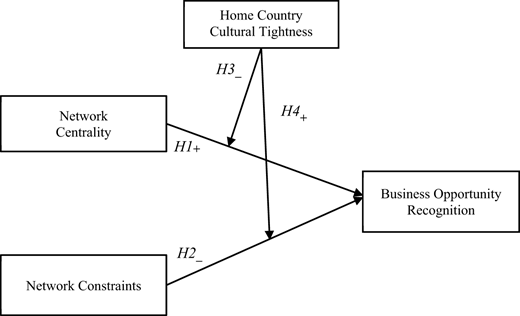
International entrepreneurs’ social network centrality in a host country is positively related to business opportunity recognition.
The network constraints are conceptualized as “the extent to which a network is directly or indirectly connected in a single contact” (Batjargal, 2010; Burt, 2004). For example, an individual faces more network structural constraints if other members in his/her networks associate with each other. So, higher connections of individuals in a network will not have brokerage benefits. Therefore, social network constraints provide redundant information that consumes personal and social resources without new or unique information. Compared with other network structural characteristics (e.g. network structural holes, betweenness and closeness), network constraints are less dynamic and transitory (Burt, 2004). An entrepreneur with abundant structural constraints receives less new information–related to new ways of doing business, potential partners, products and services and government policies–from the social network connections. International entrepreneurs with many network constraints consume substantial resources to filter valuable information and increase operational costs. When individuals in a social network are closely connected, opportunities for novel resources and information are limited (Batjargal, 2010; Burt, 2004; Kim et al., 2018).
Additionally, Granovetter’s seminal work on “The Strength of Weak Ties” (1983) demonstrates that weak ties play a critical role in providing access to new information and diverse opportunities, which are crucial for entrepreneurs’ opportunity recognition, that are not available through strong ties alone. According to this framework, when entrepreneurs benefit from expansive networks rather than relying on a single contact or only strong ties, they may enhance their opportunity recognition capabilities (Granovetter, 1983). Considering the aforementioned arguments, we propose that the effect of international entrepreneurs’ network structural constraints limits business opportunity recognition:
International entrepreneurs’ social network constraint is negatively related to business opportunity recognition.
Although the literature on social networks in entrepreneurship is rich (Burt, 2004; Batjargal et al., 2013), studies that integrate cultural frameworks as contingent mechanisms remain scarce. Some research (Ma et al., 2011; Wang et al., 2019) has hinted at contextual variation, yet a formalized bridge between network structure and cultural tightness is overlooked. By explicitly modeling cultural tightness as a moderator, this paper theorizes how deeply ingrained normative systems in entrepreneurs’ home countries affect their capacity to benefit from centrality or suffer from constraint in foreign social structures. This theoretical integration responds to calls by international entrepreneurship scholars (Xuan and Yankai, 2024; Pidduck et al., 2024) to contextualize entrepreneurial cognition and network effects through sociocultural lenses.
Furthermore, we respond to critiques that much of the IE literature is rooted in Western logic (Bruton et al., 2018). By focusing on China as a host country and incorporating entrepreneurs from multiple tight/loose home cultures, this study introduces a rare comparative framework, reflecting diverse institutional and cultural logics. It also complements work by Pidduck et al. (2023, 2024) on how tight home cultures constrain entrepreneurial flexibility and opportunity navigation abroad.
Cultural aspects of the entrepreneurs’ home country may act as a boundary condition impacting the relationship between entrepreneurs’ social networks and their opportunity recognition. One of the critical contentions in the literature is that individuals mostly define and understand their relationship with others depending on the culture they belong to (Triandis et al., 1988). In tight cultures (e.g. China), people define a social network as “family, friends, and other individuals concerned with their welfare” (Triandis et al., 1988). The social network in tight culture possesses high trust, cooperation and reciprocity (Ma et al., 2011). Also, Chinese business enterprises put a heavy weight on personal relationships (e.g. guanxi) in doing business (Dimitratos et al., 2016). Individuals in tight cultures understand and act upon implicit expectations of their social networks. Therefore, international entrepreneurs who adopt the host country’s cultural values and embed them into societal norms are more likely to recognize business opportunities through social network connections. However, when international entrepreneurs stick with their tight networks with individuals of similar cultures, that may engender proximity and cooperation with other entrepreneurs in the host country. Thus, international entrepreneurs might miss informational advantages that stem from social network connections in the new environment. Therefore, we suggest that international entrepreneurs’ home country’s cultural tightness impends their ability to capitalize on the benefit of network degree centrality.
Moreover, in tight cultures, social network centrality would be based on strong ties and hierarchical relationships. When international entrepreneurs rely on their ties and central network positions in their home-based networks, they may also need to adhere to well-structured norms and maintain stable and predictable relationships. While this centrality in their tight cultured home networks may mean access to reliable information and support within established norms, that may also impede opportunity recognition due to limited exposure to diverse perspectives and alternative opportunities (Burt, 1992, 2004).
Finally, prior research suggested that doing business in China is challenging because of tight social values and complex business processes (Batjargal, 2007; Bruton et al., 2018). International entrepreneurs interpret social values and business practices according to the cultural values they were brought up in. It might be challenging for them to mingle with the host country’s society if they are not flexible and adaptive to the host country’s social and business values (Pidduck et al., 2023). A society’s cultural tightness impacts the cognitive style of individuals in that society such that in loose cultures individuals adopt an innovator cognitive style, whereas in tight societies they prefer a more adaptor cognitive style (Chua et al., 2015). Accordingly, individuals with an innovator cognitive style are more open to change and to challenging the existing norms. Conversely, individuals with adaptor cognitive styles often accept the already established norms and practices rather than trying to change them. Entrepreneurs from tight cultures may face challenges in adapting their network centrality to the host culture that differs significantly from their home cultural norms. Central positions in their tightly structured networks may reduce the entrepreneur’s ability to flexibly adjust to diverse cultural contexts and seize opportunities that require innovation or deviation from established norms.
Along similar lines, previous research implies that some international enterprises are more capable than others of identifying, recognizing and exploiting the opportunities in a host country’s institutional environment (Xuan and Yankai, 2024; Zahra et al., 2014). Network degree centrality is likely to enhance an entrepreneur’s embeddedness in a local entrepreneurial network (Puffer et al., 2010). International entrepreneurs can better exploit their network centrality when they familiarize themselves with the social and business values of the host country. Home country cultural tightness restrains individuals from adopting new initiatives and business practices in a host country that contribute to recognizing business opportunities. Therefore, we propose that the home country’s cultural tightness will hamper the effect of network centrality on opportunity recognition:
The home country’s cultural tightness of international entrepreneurs will weaken the positive relationship between social network centrality and business opportunity recognition.
In network structures where international entrepreneurs do not hold a brokerage position, these entrepreneurs might leverage their social support advantage, especially in highly interconnected networks like those in Chinese society, where information circulates widely (Batjargal et al., 2013). Although these entrepreneurs may not gain early-stage information advantages in the host country, the emphasis on mutual trust and long-term cooperation in tight cultures (e.g. China) (Triandis et al., 1988) allows them to benefit from strong social support. Consequently, their high interconnectedness with similar individuals can diminish the disadvantages of network constraints.
Moreover, individuals from tight cultures are accustomed to operating within well-defined structures and regulations (Gelfand et al., 2006). This disciplined approach can benefit international entrepreneurs in foreign environments where they can steadily build credibility and navigate the business landscape even with limited initial contacts. In tight cultures, where trust is a profound element, they can be perceived as reliable and credible partners. This positive reputation can help them gain trust and resources from their local networks, even if their initial ties are limited. Through these close social networks, international entrepreneurs can also reach more sources of information and identify business opportunities more easily.
Finally, as mentioned in H2, network constraints may also limit the benefit from the strength of weak ties (Granovetter, 1983). However, entrepreneurs from tight cultures may be more skilled at making the most of concentrated, strong ties. These ties, often based on deep trust and loyalty in tight cultures, can be highly influential and can provide access to broader networks indirectly, thus compensating for the lack of multiple weak ties. Their few strong relationships may act as a gateway to broader networks that may provide critical introductions, increasing their reach and helping them navigate local business environments to better recognize opportunities. All in all, we argue that international entrepreneurs’ home country’s cultural tightness will reduce the negative effect of network constraints on business opportunity recognition. Thus, we propose the following:
The home country’s cultural tightness of international entrepreneurs will weaken the negative relation between social network constraint and business opportunity recognition.
We demonstrate the research framework in Figure 1.
Method
Data and sample
To test our hypotheses, we collected primary data from SME foreign business ventures in China. A venture owned directly or indirectly by one or several non-Chinese individuals in China is considered a foreign business venture. Additionally, in the case of a partnership venture, we included those business ventures in our sample that have non-Chinese nationals as the main shareholder (60% or more) and hold a top management position in the firm. We sampled foreign business ventures that have continuously operated in China for at least two years, as business ventures surviving the initial two years are considered to have the potential to achieve performance targets (Kalnins and Chung, 2006).
A survey questionnaire was used to collect data because prior research suggested that, in the absence of archival data, survey data is acceptable and has similar validity as the objective data (Dess and Robinson, 1984; Peng and Luo, 2000). We approached and randomly selected foreign business ventures from the China Chamber of International Commerce’s directory in Shanghai (Link to ccoic.cn/ecmsLink to the cited article). The chamber of commerce maintains and updates, every year, a directory of foreign entrepreneurs in China. An invitation email was sent to 492 international entrepreneurs randomly selected from the entrepreneurs’ directory of international chambers of commerce. The email explained the research purpose and our commitment to sharing the research findings with the respondents. We assured respondents of the confidentiality of their responses and provided an option to respond anonymously. We collected data in two phases, T1 and T2, with a time lag of six months to reduce the potential risk of common method variance (CMV) (Podsakoff et al., 2003).
An online questionnaire link was emailed to 348 international entrepreneurs who agreed to participate in this study. Two reminder emails were sent to international entrepreneurs with a time lag of one month. We received 273 responses which resulted in a response rate of 55% at T1. The final usable sample after T2 was 220 international entrepreneurs. The international entrepreneurs were from different countries (e.g. Germany 23, Poland 18, UK 17, French 11, USA 16, Canada 18, India 32, Pakistan 37, Bangladesh 22, Malaysia 14 and South Korea 12). Most of the respondents were male (93%), and 53% of them have graduate-level education. The average age of the respondents in the final sample was 36 years, and 60% of them have 5–9 years of entrepreneurial experience. The number of international entrepreneurs staying in China was 7.55 years on average. And 52% of the business ventures in the sample have the age 3–7 years with an average size of 7.95 employees. Furthermore, 85% of business ventures in the sample were related to trading firms, and 15% were related to logistics.
Measures
We used established, validated measurement scales from previous studies to measure the constructs used in our study. Their reliability and validity have been tested and confirmed by many researchers over time.
Business opportunity recognition. We used the six-item scale from (Singh et al., 1999) to measure business opportunity recognition. The measurement has been widely used in existing research (Nicolaou et al., 2009; Ozgen and Baron, 2007), therefore, we do not suspect issues of the measurement validity and reliability. The international entrepreneur responded to the survey questionnaire at T2. The sample item is “while doing about day-to-day business activities, I see potential new ideas (e.g. new products, new markets and new ways of conducting business).” It measures six factors that constitute IE (Owner or CEO) opportunity recognitive such as entrepreneurial alertness, cognition, prior knowledge, social capital, systematic research and environment conditional. Existing research synthesizes the entrepreneurship literature and found that these six factors formulate entrepreneurs’ opportunity recognition (Mary George et al., 2016). Cronbach’s alpha was 0.94. The questionnaire items for opportunity recognition are presented in Table 1.
International entrepreneur’s social network. Following prior research, we used the name generating method to build international entrepreneurs’ egocentric networks (Burt, 2004; Marsden, 1990). We asked international entrepreneurs, the owner or CEO of a business venture, to report the most important entrepreneurial network in China from whom they obtained business advice (e.g. information and suggestion) and business support (e.g. finances and supplies). We also requested the respondents to indicate the presence of ties among their social networks (alters). The international entrepreneurs reported their entrepreneurial network at time T1. The measure has been widely suggested and used by previous studies (Ma et al., 2011; Soda et al., 2004).
Social network centrality. Based upon prior research on conceptualization, we operationalized the network centrality as the direct relationship of a focal international entrepreneur with others (alters) in the network (Batjargal et al., 2013; Burt, 2004). Business advice (e.g. information and suggestion) and support (e.g. financial and supplies) are critical for international entrepreneurs’ venture success. The centrality of direct relationships of an international entrepreneur provides him/her power to acquire valuable resources faster and accumulate or disseminate information quickly.
Social network constraints. Drawing on conceptualization, we operationalized the network constraint as the extent of connections among the alters that connected to the focal (Burt, 1992). We used (Burt, 1992) measurement of network constraint:
where is the proportion of total relational strength that directly allocates to , is the proportion of total relational strength that devotes to and is the proportion of total relational strength that contact devotes to contact . Drawing on (Batjargal, 2010) conceptualization, we calculated the network constraints score. We use R programming to calculate the network degree centrality and constraint.
International entrepreneurs’ home country cultural tightness. We used the objective score of country cultural tightness-looseness from Gelfand et al. (2011) to measure the home country’s cultural tightness. The score assesses the degree to which social norms are clearly defined, pervasive and imposed within a country. A higher score means the country’s culture is tight and social norms are strictly followed. Gelfand et al. (2011) did not have the cultural tightness-looseness score for Bangladesh; therefore, we used the score of India as a proxy for Bangladesh’s cultural tightness because both countries share geographical borders, similar historical background, political system, social values and cultural norms. Similarly, owing to the unavailability of the cultural tightness-looseness score of Canada, we used the score of the USA as a proxy for Canada for similar reasons.
Control variables
We controlled several variables that may account for international entrepreneurs’ opportunity recognition. First, following previous research and considering variables that may impact our findings (Batjargal et al., 2013), we controlled demographic variables. Demographic variables are measured as, for example, age in years, gender in dichotomous (1 for male and 0 for female) and education from 1 to 4 (1 for a college graduate, 2 bachelor’s degree, 3 for a master’s degree and 4 for a doctoral degree). We control for entrepreneurship experience (in years) because it influences individual’s behavior, their way to make decisions, opportunity spotting (Batjargal et al., 2013; Xiao and Tsui, 2007). It is crucial to control the international entrepreneur’s length of stay in China because it is possible that the longer time in the country, the better business and social understanding they might have, which can ultimately influence their ability to recognize business opportunities (Sequeira et al., 2009).
Furthermore, we control firm-level variables, including business venture size and business venture age. Prior researchers suggested that mature and large business ventures are likely to recognize more business opportunities compared to new and small ventures (Domurath and Patzelt, 2016; Li and Zhang, 2007). Business venture age was coded 1 for 3–7 years, 2 for 8–12 years, 3 for 13–17 years and 4 for above 18 years. Firm size was measured as the firm’s number of employees.
Results
Table 2 shows the descriptive statistics, correlations and reliability coefficients (Cronbach’s alpha) of the main constructs used in this study. Network degree centrality (r = 0.38, p < 0.05), network constraints (r = −0.36, p < 0.05) and host country cultural tightness (r = −0.29, p < 0.05) are correlated with business opportunity recognition. The network degree centrality was correlated with (r = −0.35, p < 0.05) network constraints and the host country’s cultural tightness (r = −0.47, p < 0.05). Furthermore, network constraint was significantly correlated with the host country’s cultural tightness (r = 0.40, p < 0.05).
Table 3 presents the regression analysis results. We used hierarchical multiple regression to analyze the study variables and test the hypothesis. We entered the control variable in Model 1, the explanatory variables in Model 2 and the moderation variable in Model 3. The interaction term between the network degree centrality and home country cultural tightness was entered in Model 4. In Model 5, we added the interaction term between the network constraints and the home country’s cultural tightness. Variables were mean-centered before examining the interaction effects. The multicollinearity assumption were tested using variance inflation factor (VIF). The VIF values for all the relations were less than 1.
H1 states that network degree centrality is positively related to business opportunity recognition. Model 2 presents that international entrepreneurs’ network degree centrality was significantly related to business opportunity recognition (β = 0.12, p < 0.05), which supports H1. It means that a one-unit increase in network degree centrality leads to a 12% increase in business opportunity recognition. Furthermore, it highlights that international entrepreneurs’ central position in the social network significantly contributes to their business opportunity recognition. On the other hand, Model 3 shows that network constraints are negatively related to business opportunity recognition (β = −2.27, p < 0.05), which supports H2. It demonstrates that highly interconnected international entrepreneurs may recognize fewer opportunities because of redundant information and novel resources.
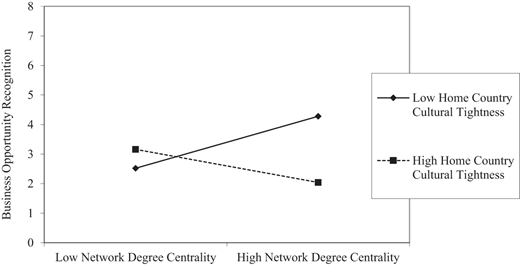
H3 states that home country cultural tightness negatively moderates the relationship between network degree centrality and business opportunity recognition. Results in Model 4 indicate that home country cultural tightness significantly moderates the relationship between the network degree centrality and business venture performance (β = −0.02, p < 0.05). It means that one degree increases in home country cultural tightness decreases 2% the relationship between network degree centrality and business opportunity recognition. In other words, international entrepreneurs’ home country cultural tightness diminishes the effect of network degree centrality on business opportunity recognition. This result supports H3. The value of the home country’s cultural tightness was set at one standard deviation above and below the mean (Aiken and West, 1991). The relationship between network degree centrality and business opportunity recognition is weakened when the home country’s cultural tightness is high.
H4 argues that the home country’s cultural tightness negatively moderates the relationship between network structural constraints and business opportunity recognition. Model 5 shows that the interaction term of network structural constraints and the host country’s cultural tightness is not significantly related to the business opportunity recognition (β = −0.22, p > 0.05). It means that home country cultural tightness does not buffer the effect of network constraints on business opportunity recognition. It can also be implied that international entrepreneurs’ home country cultural tightness approach restricts them from finding new opportunities and ways to grow the business in host country. Therefore, international entrepreneurs tightly connected to homogeneous others may not benefit from the brokerage in their social networks. The result did not support H4. Regression results are presented in Table 3. Figure 2 shows the interaction graph between network degree centrality and the home country’s cultural tightness.
Discussion
International entrepreneurship literature has intensively studied and called for examining social network dynamics in exploiting business opportunities (Brzozowski et al., 2017; Patel and Conklin, 2009). However, it has so far not fully explored how and when network ties lead to business opportunities. This study explores how international entrepreneurs’ cultural tightness influences the relationship between network structures and business opportunity recognition. The research findings have profound theoretical contributions and practical implications for future research on international entrepreneurship and social networks.
Theoretical implications
This paper advances the literature by proposing a contextually embedded theory of international opportunity recognition that connects structural network advantages with home–cultural logics. Prior studies have examined social capital benefits in isolation (Batjargal, 2007), but our findings reveal that network benefits are not universally transferable; their efficacy depends on the cultural cognitive scripts embedded in entrepreneurs’ upbringing. This underscores the need to re-theorize network advantage in global entrepreneurship as a culturally bounded phenomenon.
First of all, this study extends the international entrepreneurship literature by revealing that international entrepreneurs’ network centrality positively affects business opportunity recognition. Our research results extend the idea of the existing research (Ma et al., 2011) that cultural contexts make different aspects of social networks more salient to recognize opportunities. It strengthens the assertion that understanding the contingent mechanism of cultural context is crucial for network analysis (Xuan and Yankai, 2024). Therefore, the findings of this study are aligned with the argument that the functioning feature of social network structures is dependent on cultural context. In general, our results are consistent with the observations of scholars who found that network centrality in a tight culture brings several advantages by facilitating trust and reciprocity (Ma et al., 2011; Xiao and Tsui, 2007).
Second, this study contributes to the international entrepreneurship literature by examining cultural tightness as a boundary condition on the relationships between network structures and business opportunity recognition. The research findings argue that the effect of social network structures is contingent on the cultural tightness in which the social networks are embedded. It suggests that the entrepreneurs’ network structures, especially network centrality, might be less likely to contribute to opportunity recognition in tight cultures (e.g. China). Our research opens a new avenue for future research on international entrepreneurship in China. The findings strengthen a line of inquiry beyond the governance focus (Kulchina, 2017) of foreign business ventures established outside of the native country borders. Thus, international entrepreneurs will benefit their firms more when positioning them in social networks according to the host country’s cultural values and norms (tightness/looseness).
Third, exploring how network centrality and constraints contribute to business opportunity recognition will broaden the social network theory. The research finding extends the understanding that the effect of different social network structures on business opportunity recognition might not be similar. This suggests that the cultural embeddedness of actors is essential for interpreting the functional utility of their network positions. Thus, we stretch the idea that culture plays a significant role in the functionality of social network structure. This study addresses the contention in international entrepreneurship literature of how entrepreneurs’ social network structures lead to opportunity recognition in a host country.
Fourth, analyzing the effect of international entrepreneurs’ social network structures (e.g. network centrality and constraints) on venture opportunity recognition in emerging economies (e.g. China) provides an alternative perspective to broaden the international entrepreneurship literature and stretches the social network theory. It extends social network theory by emphasizing that better alignment of social network structures and cultural understanding of a host country contributes to international entrepreneurs’ business opportunities. Therefore, social network positions matter the most when they are aligned with the cultural values (tightness/looseness) of society where individuals are embedded.
Implication for policy and practice
From a practical perspective, the research findings provide several broader implications for international entrepreneurship literature. First, international entrepreneurs’ social network structures do not have a similar influence on business opportunity recognition. It extends recent research work that has emphasized the need to understand the effect of social networks on international entrepreneurs’ business opportunity recognition (Chen and Tan, 2009; Ma et al., 2011; Patel and Conklin, 2009). Second, it stretches the growing body of research that emphasizes managing and facilitating transnational, international and international entrepreneurship because many countries encourage foreign investment that could boost economic activities (Chandra and Coviello, 2010; Schwens et al., 2018).
This study underscores the importance of international entrepreneurs to intentionally design their social networks, rather than expanding them through convenience or cultural familiarity. Entrepreneurs should cultivate structurally diverse networks that span across industries, social groups and cultural communities within the host country, as diverse networks reduce informational redundancy and increase access to non-overlapping knowledge and opportunities (Burt, 2004). In particular, entrepreneurs should assess their network constraints and take deliberate steps to reduce over-embeddedness in tightly knit or homogeneous groups, which may limit their exposure to novel information (Batjargal, 2010; Kim et al., 2018). Also, building weak ties that offer access to non-redundant information and distinct social circles across cultural and institutional boundaries can enhance flexibility, opportunity recognition and adaptability in rapidly changing or uncertain foreign markets (Granovetter, 1983).
Entrepreneurs from culturally tight societies must often overcome ingrained relational norms such as preferences for strong ties, hierarchy and long-term predictability when operating in looser, more flexible host cultures. These norms, while effective in the home context, may limit the ability to form weak ties or engage in exploratory social behaviors that are often rewarded in less structured environments (Gelfand et al., 2011). Furthermore, cultivating a mindset of cultural ambidexterity, being able to function within both tight and loose cultural logics, can enhance entrepreneurs’ capacity to form effective ties in diverse settings. By shifting from a depth-oriented to a breadth-oriented networking approach, tight-culture entrepreneurs can better position themselves to recognize and act on new opportunities abroad.
To summarize, international entrepreneurs who contemplate business operations in different countries should alter their business strategies according to the host country’s cultural context. Furthermore, international entrepreneurs can amplify the advantage of their networks’ positioning by adapting to the cultural values of the host country. Better understanding and adaptability to the host country’s cultural context will accelerate business opportunity recognition.
At the macro level, the research findings are important to policymakers in China. The findings revealed that cultural looseness can positively facilitate the influence of social network positions on opportunity recognition. To boost international entrepreneurship in China, cultural awareness between local and international entrepreneurs should be promoted as early as the business creation or execution stage by policymakers and educators. To settle the longstanding debate on why certain international ventures fail while others succeed (Zhang et al., 2021), the current findings suggest that alignment between social network structures and cultural context is critical. Proponents of international entrepreneurship should emphasize boosting cultural flexibility and openness while discovering business opportunities and operating in different cultural contexts (George and Zahra, 2002).
Structured networking platforms, mentoring programs and cultural acclimatization workshops embedded within incubator programs can foster meaningful cross-cultural connections and reduce the liability of foreignness. Policymakers and incubators can play an enabling role by creating ecosystem-level conditions that support the formation of central and diverse entrepreneurial networks. By identifying key actors within the host-country ecosystem, such as suppliers, regulators and experienced business owners and facilitating early introductions, policymakers can help international entrepreneurs achieve central positions more quickly (Puffer et al., 2010).
Limitations and future research opportunities
From a practical perspective, the research findings provide several broader implications for international entrepreneurship research. First, owing to the complexities in data collection and the nature of the study, the use of ego-centered networks does not allow us to have complete information on the full network of international entrepreneurs. Therefore, we are unable to know how and to what extent the international entrepreneurs’ position in the full network would influence their business opportunity recognition. Future research could investigate full networks or other network structures (e.g. network transitivity, closeness and strength) and business venture performance outcomes to gain a deeper understanding of the network structures’ effects. In particular, future studies could examine how full-network positions interact with host-country cultural values to amplify or diminish opportunity recognition, thereby building directly on our finding that centrality is more valuable under certain cultural conditions.
Second, we use objective scores of cultural tightness from existing research (Gelfand et al., 2011). Although we carefully sampled the foreign entrepreneurs and used control variables, future studies could incorporate the foreign entrepreneurs’ understanding or perception of the host country’s culture. It is likely that the subjective understanding of cultural looseness or tightness might influence the ways international entrepreneurs develop social networks and recognize business opportunities (Chua et al., 2015; Greve and Salaff, 2003). Future work is needed to examine the formation of network ties based on cultural context using a large sample size to rule out the potential alternative explanations. Furthermore, we did not differentiate international entrepreneurs’ cognitive approach to discover or create opportunities in the host country. Future research could examine how and to what extent social network structures influence opportunity discovery and creation in certain institutional contexts. Moreover, future research could test whether individual-level factors, such as cultural intelligence, moderate the relationship between cultural tightness and opportunity recognition. This could help explain why some entrepreneurs succeed despite tight cultural constraints in their home or host countries.
Third, the issue of the CMV problem can be raised due to collecting subjective data from a single source. However, considering that data were collected in two phases with a time lag of six months, it is unlikely that common method bias would have infiltrated our results. Also, not all the constructs used in this study to test hypotheses were subjective response data. For instance, the measurements of network structures (degree centrality and constraints) were indext-based, derived from participant responses. Thus, we are reasonably confident that our results are not subject to CMV. Future research should use multisource subjective and objective data for more comprehensive results. Combining survey and digital trace data (e.g. from LinkedIn or professional networks) could enhance the validity of network structure measures and reveal how entrepreneurs’ networks evolve over time.
Fourth, this study emphasized opportunity recognition which loosely translates into business performance. Future research should focus on the performance outcomes of international ventures. It will provide a better understanding of to what extent international entrepreneurs’ network structures and host/home country cultural context influence the venture performance. Additionally, longitudinal venture performance will help to establish causal relationship between international entrepreneurs’ network structures and venture performance. Finally, we did not control entrepreneurship alertness (Valliere, 2013). It is an entrepreneur cognitive ability that allows him/her to impute meaning to environmental change that would not be imputed by others. Although we controlled for related factors such as entrepreneurial experience and the years of stay in a host country that could influence opportunities recognition, controlling for entrepreneurial alertness could have strengthened the generalizability of the research findings. Future research could control factors related to entrepreneurs’ cognitive factors (entrepreneurial alertness, regulator focus) and behavioral attributes (risk taking, self-monitoring and socializing) to enhance the robustness of research findings.
Conclusion
This study provides a step forward to better understand international entrepreneurship and how social network structures facilitate business opportunity recognition. By integrating the dynamic cultural tightness-looseness dimension as a moderator, this paper delivers a novel, empirically tested framework that responds directly to emerging debates about the cultural embeddedness of entrepreneurial behavior (Pidduck et al., 2024; Chua et al., 2015). The new insights into the social network perspective scratch the international entrepreneurship literature. The research finding supports the view that not all network structures contribute to business opportunity recognition in a host country. Not all social network structures help to overcome the liability of foreignness (Schwens et al., 2018; Zaheer, 1995).
To leverage the benefits of network structures in tight cultures (e.g. China), entrepreneurs need to centrally locate them in the social network structures. On the other hand, social network constraints hamper business opportunity recognition. Additionally, the effect of network structures of international entrepreneurs is contingent on their cultural tightness/looseness. Given the pervasiveness of international entrepreneurship and the paucity of scholarly research on this topic, our research findings lay a foundation for further research to examine international entrepreneurs’ social network structure and business opportunity recognition.
Informed consent statement
Participation in the study was voluntary, and respondents provided consent to be a part of the study. All participants were informed that they could skip any question they wished or quit the survey at any time.