


This paper aims to assess the direct effects of antecedents of initial trust, the mediating effect of trust and the moderating effect of demographic variables on non-adopters’ behavioral intention to use mobile banking.
The study tested the models of theory of reasoned action and theory of planned behavior to evaluate potential antecedents of trust (diffusion of trust, infrastructure quality, perceived costs, privacy and security) moderators (demographic variables) and mediators (initial trust) that will influence behavioral intention to use mobile banking. The Hayes’ Process Macro developed by Andrew F. Hayes (2013) was used as a statistical analysis in SPSS to estimates the path coefficients using multiple regression. The tool provides insights on the direct and indirect effect of the independent variable on the dependent variable through the existence of moderating variables and mediation variables.
The results show that the non-adopters of mobile banking asserted that the antecedents of initial trust played a significant influence on behavioral intention to use online banking services.
There is a dearth of literature addressing mobile banking in the Philippines. The first initial trust formation in internet banking using computer workstations and laptops in the Philippines was conducted by Chiu et al. (2016). This research fills in the gap by expanding and formulating a deeper understanding of the antecedents of initial trust that influence consumer behavioral intention that might be responsible for the slow diffusion of mobile banking services in the country. The results from this study will help financial institutions create a beneficial connection with consumers while alleviating the fears of non-adopters and enhancing their understanding of the benefits of mobile banking.
1. Introduction
The Philippines financial system is undergoing a period of technological innovations. The changes include a significant increase in the number of alternative formal channels for delivering financial services. The most recent are the use of mobile banking. Since the telecommunication industry was liberalized from 65 years of private monopoly ownership in 1992, there is a rapid growth in cellular mobile telephone services in the country. By the year 2000, the mobile phone subscriptions surpassed fixed telephone lines with a ratio of 8.3:3.9 per 100 subscriptions (ITU, 2016). At the end of 2012, it indicates that every Filipino owned a mobile phone regardless of economic status with 101.9 million subscribers exceeding the total population of the country of 97.1 million. The deficiencies of fixed telephone lines in underserved and unserved areas facilitated the adoption of mobile devices and short message services (SMS). Therefore, financial institutions are attracted to reach larger population by utilizing mobile phones to bring financial services to undertake banking transactions such as account balance inquiries, monitor checking account transactions, pay utility bills, pay loans, fund transfer, receive and send remittances and payroll services. It is important distribution channels through which bank customers can be migrated from brick-and-mortar branches to minimize banks’ operating expenses (Peevers et al., 2008).
Despite the rapid rollout of mobile services and popularity of mobile money in the country, adoption of mobile banking has been slow. Based on the study of Ramanathan et al. (2014) on digital banking penetration across 13 Asian markets, they found that the Philippines had the lowest digital banking penetration which shows only 9 per cent of the respondents used a smartphone to transact banking services. However, despite the Philippines earned the title of “texting capital of the world” or the “SMS-intensive country in the world” (GSMA, 2014), the use of mobile phones in online banking services is still in its infancy stage, and the mobile money services provided by telecommunication industry retains its position as the leading mobile financial channel for the Filipino. There is a dearth of literature addressing mobile banking, prior researches focused on microfinance services (Jimenez and Roman, 2005), ease of use of internet banking (Lim, 2013), mobile money (Alampay and Bala, 2010; Boor et al., 2014; Mendes et al., 2007) and internet banking (Chiu et al., 2016).
This research fills in the gap by expanding and formulating a deeper understanding of the antecedents of initial trust that influence consumer behavioral intention that might be responsible for the slow diffusion of mobile banking services in the country. This study focuses on analyzing the direct effects of antecedents of trust, the mediating effect of initial trust and the moderating effect of demographic variables on non-adopters’ behavioral intention to use mobile banking. The results from this study will help financial institutions create a beneficial connection with consumers while alleviating the fears of non-adopters. It will also enhance their marketing efforts on the benefits of mobile banking by knowing the different factors that influence trust toward the use of mobile banking. This paper has been structured as follows: Section 2 provides a literature review of the mobile banking and barriers to adoption in the Philippines. Section 3 outlines theoretical framework, conceptual model and hypothesis development. Section 4 highlights the research methodology. The results and discussion are presented in Section 5. Lastly, Section 6 discusses the key conclusion, significant business implications, research limitations and future research directions.
2. Literature review
Mobile phones have increasingly become a significant tool that an individual use for banking, budgeting, payments and shopping. Given the rapid growth in the area of mobile finance, mobile banking has been a major contributor to the evolution of banking system. The purpose of mobile banking is to increase bank’s profitability (DeYoung et al., 2007; Hernando and Nieto, 2007) by reaching a wider geographical area (Cruz et al., 2010) and decreasing bank’s operating costs such as handling fees, transaction costs, manpower and overhead expenses (Nsouli and Schaechter, 2002; Polatoglu and Ekin, 2001). Convenience and efficiency of mobile banking within the overall service delivery process provide consumer value by decreasing time, effort and costs (Laukkanen and Lauronen, 2005). Table I presents the different mobile banking services provided by the local banks in the Philippines which aim to give freedom to carry out most of the physical banking activities.
Summary of commercial and universal bank’s mobile banking services as of February 2017
| No. Institutions | Internet banking name | 1 | 2 | 3 | 4 | 5 | 6 | 7 | 8 | 9 | 10 | 11 | 12 | 13 | 14 | |
|---|---|---|---|---|---|---|---|---|---|---|---|---|---|---|---|---|
| Access and manage account | Local fund transfer | Bills payment | E-shop | Credit card | Check account status | Check book request | Alert notification/ Service requirement | Prepaid mobile load | Loans services | Remittance services | Security reminder | Third-party seal | Mobileapp | |||
| 1 | Asia united bank corporation | AUB mobile banking | Yes | Yes | Yes | No | Yes | Yes | Yes | Yes | No | Yes | Yes | Yes | Yes | Yes |
| 2 | Bank of the Philippine Islands | BPI mobile | Yes | Yes | Yes | No | Yes | Yes | Yes | Yes | Yes | Yes | Yes | Yes | Yes | Yes |
| 3 | BDO Unibank, Inc. | BDO mobile banking | Yes | Yes | Yes | No | Yes | Yes | Yes | Yes | Yes | Yes | Yes | Yes | Yes | Yes |
| 4 | China banking corporation | China bank mobile banking | Yes | Yes | Yes | No | Yes | Yes | No | Yes | Yes | Yes | No | Yes | Yes | Yes |
| 5 | East west banking corporation | Mobile access | Yes | Yes | Yes | No | Yes | Yes | No | Yes | No | Yes | No | Yes | Yes | No |
| 6 | Metropolitan bank & trust company | Metrobank direct | Yes | Yes | Yes | No | Yes | Yes | Yes | Yes | Yes | No | No | Yes | Yes | Yes |
| 7 | Philippine National Bank | ebanking | Yes | Yes | Yes | No | No | Yes | Yes | Yes | Yes | Yes | Yes | Yes | Yes | Yes |
| 8 | Philippine Trust Company | Powered by bancnet | Yes | Yes | Yes | No | No | Yes | Yes | No | Yes | No | No | Yes | Yes | No |
| 9 | Rizal commercial banking corporation | RCBC online banking & touch Q | Yes | Yes | Yes | Yes | Yes | Yes | Yes | Yes | Yes | Yes | Yes | Yes | Yes | Yes |
| 10 | Security bank corporation | Security Bank Mobile | Yes | Yes | Yes | No | Yes | Yes | Yes | Yes | Yes | No | No | Yes | Yes | Yes |
| 11 | Union bank of the Philippines | UnionBankUMobile | Yes | Yes | Yes | No | Yes | Yes | Yes | Yes | Yes | Yes | No | Yes | Yes | Yes |
| 12 | United coconut planters bank | UCPB Connect & mobile banking | Yes | Yes | Yes | No | No | Yes | Yes | Yes | Yes | No | Yes | Yes | No | Yes |
| 13 | Al-Amanah Islamic investment bank of the Philippines | NONE | – | – | – | – | – | – | – | – | – | – | – | – | – | – |
| 14 | Development Bank of the Philippines | DBP mobile banking – powered by Bancnet | Yes | Yes | Yes | No | No | No | No | No | Yes | No | No | Yes | Yes | No |
| 15 | Land bank of the Philippines | iAccess | Yes | Yes | Yes | No | Yes | Yes | Yes | Yes | No | No | Yes | Yes | Yes | Yes |
| 16 | Bank of Commerce | bCommerce | Yes | Yes | Yes | No | No | Yes | Yes | Yes | No | No | No | Yes | Yes | No |
| 17 | BDO Private Bank, Inc. | BDO online banking | Yes | Yes | Yes | No | Yes | Yes | Yes | Yes | Yes | Yes | Yes | Yes | Yes | Yes |
| 18 | Philippine bank of communications | Powered by bancnet | Yes | Yes | Yes | No | No | Yes | Yes | No | Yes | No | No | Yes | No | No |
| 19 | Philippine veterans bank | Powered by bancnet | Yes | Yes | Yes | No | No | Yes | Yes | No | Yes | No | No | Yes | No | No |
| 20 | Robinsons bank corp. | Personal banking | Yes | Yes | Yes | No | No | Yes | Yes | Yes | Yes | Yes | No | Yes | Yes | Yes |
Based on Digital Report end of 2016 on Southeast Asia (We Are Social and Hootsuite, 2017), it shows that Philippines are advancing in digital connectivity:
Philippine population having mobile subscriptions is 128 per cent.
Population using the internet is 58 per cent.
Population using mobile phones is 88 per cent.
Population using smartphones is 61 per cent.
Active mobile internet users constitute to 51 per cent.
Lastly, 30 per cent are mobile banking users.
Despite that there are 148.71 mobile-cellular telephone subscriptions per 100 Filipinos in the country (ITU, 2016), as well as banks expansion and innovations through online banking, the use of mobile banking in the Philippines has not reached a level of growth. The Philippines, an archipelago of over 7,000 islands, access to financial services in remote areas and islands are mostly operated in cash or over-the-counter exchanges, who are alienated with the newest advances in technology. Some do not see the value such as small business owners, farmers and fishermen, others are illiterate in using the internet and many are poor. This population was reluctant to risk everything from financial loss by using new financial innovations. Based on the following research studies on Philippine internet environment (Akamai Technologies, 2016; Bangko Sentral ng Pilipinas (BSP), 2015; Lee and Jaramillo, 2013; ITU and UNESCO, 2015; Alegado and Yap, 2016; Huddleston, 2015; House of Representative, 2015, 2016; Avendano, 2013; Felipe, 2014; Symantec, 2016), there are four barriers to diffusion of online banking, namely, infrastructures, costs, privacy and security, that this study adopted to test their real effect on behavioral intention of customers to adopt mobile banking services in the Philippines which are crucial factors for individual participation in modern technological.
2.1 Infrastructure
Internet speed is a major source of daily frustration of internet users in the country. Many cities in the rural areas require massive investment to move up to a more advanced internet connection. Based on Akamai Q4 report (2016), the global average internet speed is 5.6 Mbps. However, the country has an average speed of 3.5 to 4.5 Mbps which is below the global standard. It also shows that Philippine ranked 108th out of 146 countries studied. The country has been consistently ranked at the bottom when it comes to internet speed among Asia-Pacific countries, whereas other neighboring states continue to improve its internet infrastructures. For example, Singapore average speed leapfrog from 16.5 to 20.2 Mbps, Thailand jumped from 10.8 to 13.3 Mbps, Vietnam from 5.0 to 8.3 Mbps, Malaysia from 6.4 to 8.2 Mbps and Indonesia from 4.5 to 6.7 Mbps. The country is still lagging behind among ASEAN countries when it comes to broadband adoption from per cent above 4, 10 and 15 Mbps. With this kind of speed and data limits, users should expect buffering time and hang time if they are going to download, upload and transact online.
There is a significant correlation between internet speed, website download speed, internet usage and user satisfaction (Hoffman and Novak, 1996). An effective and efficient technology-based self-service system such as online banking is dependent on the quality of technological infrastructure such as accessibility, availability, connectivity, navigability, reliability and speed (Al-Somali et al., 2009; Gerrard et al., 2006; Jayawardhena and Foley, 2000; Lee and Turban, 2001; Waite and Harrison, 2004). Critical components such as speed of internet influence frequent connection breakdown, browsing speed, ease of navigation, website transition, waiting time and transaction flow (Poon, 2007). Connection speed was an important attribute linked to the efficiency of mobile fund transfer service and linked to convenience using the mobile brokerage (Laukkanen and Lauronen, 2005).
The importance of quality internet connection influences online‐banking acceptance or adoption in Finland (Pikkarainen et al., 2004), Malaysia (Poon, 2007), Saudi Arabia (Almogbil, 2005), Singapore (Gerrard and Cunningham, 2003) and Thailand (Rotchanakitumnuai and Speece, 2003). In the case of Singapore, Sheshadri and Rani (2014) stated that the Singaporean government plays a major driver for the diffusion of information and communication technology. Based on Sayar and Wolfe (2007, p. 125) research of Turkish internet banking users, speed seekers view download speed, transaction speed, user-friendliness of the site and privacy influence users’ bank selection. Peltier and Youssef (2015) found that speed of internet connection affects consumers’ use of e-commerce in Luxembourg. They investigate the link between demand for internet and e-activities. They found that firms are more likely to undertake e-commerce when the connection speed is higher than 3.75 Mbps and the faster the internet speed, the larger the number of online practices or e-applications adopted. In the case of mobile internet connection, the demand for internet speed is constantly increasing due to the rapid development of mobile devices such as 3G, 4G, 4G+ and mobile applications. Increasing mobile innovations and applications leads to higher internet cost.
2.2 Perceived costs
Affordability of internet connection is a significant factor in influencing internet usage (Hoffman et al., 1999; Venkatesh and Brown, 2001). Perceived costs refer to the person’s believes that using the online banking will cost money (Luarn and Lin, 2005). One-time investment for a mobile device is a necessity in the present world. However, perceived cost has a significantly negative effect on the decision to use mobile commerce (Wu and Wang, 2005) and 3G mobile phones (Kuo and Yen, 2009). Based on the study of Petrazzini and Mugo (1999), the cost and pricing of internet service are broken down into setup costs and operating expenses which is much higher in developing countries than in developed countries. There are also specific regulations or government mandates which influence access and cost of internet. The costs vary depending on the number of Internet Service Providers in the country. Another major consideration is the monthly internet access expenditure which has a bigger slice of a person’s monthly expenses. Based on the study of Martin (2003) on digitally divided society, lower socioeconomic groups would be less likely to use the internet and pay a monthly internet service subscription fees.
United Nations Broadband Commission report (ITU and UNESCO, 2015) shows that only 26.9 of every 100 Filipino homes have access to the broadband internet at 39.7 per cent of individuals using the internet. It also indicates that for every 100 capita, 28 Filipino have a mobile broadband subscription in which the country ranked 103 out of 195 countries studied. Internet access in the Philippines is about US$18 a megabit per second more than three times the global average internet costs of US$5 (Alegado and Yap, 2016; Huddleston, 2015). In comparison with monthly internet broadband subscription costs in Singapore, the Philippines is rated two to three times higher. For example, in Singapore, 100 Mbps costs US$28, 200 costs US$30 and 500 costs US$43, whereas in the Philippines, 100 Mbps costs US$70, 200 costs US$90 and 500 costs US$150 a month (House of Representative, 2015, 2016). Kim et al. (2007) stated that customers would compare the fee structure of the mobile internet, mobile phone calls and stationary internet access. For an average Filipino family with an average annual income of US$4,700-5,000 and an average annual expenditure of US$3,860, giving them a savings amounting to US$840, it will be very difficult for them to afford the internet service.
The cost associated with internet access fees and subscription charges is a significant barrier to the adoption of internet banking (Poon, 2007; Sohail and Shanmugham, 2003; Zhengh and Zhong, 2005). Perceived costs discourage non-users from using the internet banking services because they feel that it would entail more costs than the relative advantage (Kuisma et al., 2007; Sathye, 1999). It also has a negative influence on the behavioral intention to use mobile banking in Australia (Wessels and Drennan, 2010), Brazil (Cruz et al., 2010) and Taiwan (Luarn and Lin, 2005; Yu, 2012). It is, therefore, hypothesized that financial considerations, including the cost of a web‐enabled mobile phone and subscription fees, will influence consumer intentions to use mobile banking.
2.3 Online privacy
Privacy and security are associated with financial risks (Cheng et al., 2006). Both factors are major concerns of trust (Bidarra et al., 2013; Susanto et al., 2012; Susanto et al., 2016; Wang and Shan, 2013) and are considered obstacles to the adoption of mobile commerce (Gao and Bai, 2014). In the banking context, privacy refers to the ability of the bank to authenticate and protect consumers’ personal information from unauthorized access which is free from invasion, interception and theft (Cheung and Lee, 2001; Mukherjee and Nath, 2003; Lee, 2009; Lee and Turban, 2001; Littler and Melanthiou, 2006; McKnight et al., 2002). It follows legal and ethical practices such as Federal legislation that prevents corporation and government manipulation of personal information (Agranoff, 1991; Casaló et al., 2007). Feakin et al. (2015) developed a “cyber engagement scale” with indicators of governance, crime, military, business and social for government and industry to measure countries cyber maturity. “Maturity is demonstrated by the presence, effective implementation, and operation of cyber-related structures” (Feakin et al., 2015, p. 5). They found that the Philippines continues to suffer from passive government engagement, weak enforcement, lack of awareness of cyber military issues and lack of strategic public policy and engagement with the industries and private sectors on the development of the digital economy.
With these weaknesses, the country has experienced sophisticated cyber-attacks from virus-infected e-mails, malware, website attacks, money laundering and fraudulent activities. Based on the report of Department of Justice (DOJ), “87 per cent of Filipino internet users were identified as victims of crimes and malicious activities committed online” (Avendano, 2013). According to Philippine National Police, internet fraud tops the list of cybercrime from 2010 to 2013 (Felipe, 2014). Major incidents of cybercrime in the Philippines include the “I Love You” virus in 2000, hacking into government websites in 2004, the “Heartbleed Bug” in 2014, hacking into Commission on Election (Comelec) website in 2016 and the Bangladesh Central Bank cyberheist in 2016.
2.4 Online security
Based on the three decades of research on consumer adoption and utilization of electronic banking by Hoehle et al. (2012), there are 63 studies out of 247 peer-reviewed articles stating that security was a major factor influencing consumers’ intentions to use the electronic banking system. The perspective of security is that online financial transaction is dangerous (Goudarzi et al., 2013). Consumer awareness of security practices such as authentication, biometrics, callback modems, encryption, digital certificates, firewalls, filtering routers, password protection, PC hardware security and smart cards would increase customer confidence in using online banking services (Yousafzai et al., 2003). Grandinetti (1996) defined security as protection of data from unauthorized individuals, whereas Casaló et al. (2007) defined security as the technical guarantee that legal and ethical practices are met. Aladwani (2001) and Jun and Cai (2001) found that IT managers and customers were more concerned with the security of online banking due to the absence of personal interaction than they were with traditional banking. Laukkanen (2007) finds that safety is one of the key factors in determining consumer value perception of internet banking and mobile banking. The study of Susanto et al. (2016) confirms that security significantly influence trust on smartphone banking services.
The Internet Security Threat Report by Symantec (2016) shows that retail industry was the most heavily exposed to phishing attacks in 2015. Under the retail industry, the finance sector was the most targeted by spear-phishing attacks with 34.9 per cent of all spear-phishing e-mail directed to a very small group of people in an organization in the Finance industry, which is 15 per cent higher than 2014. The ratio 1 out of 2,200 users is a victim of e-mail phishing, and the ration 1 out of 310 is a victim of Malware in an e-mail. The industry also ranked second regarding data breached with 120 million identities exposed in 2015. Common cybercrimes, phishing and pharming, occur when falsified bank website asks consumers to provide their personal identification number, password and transaction number; the unauthorized person uses this confidential information later to operate fraudulent financial activities. If bank consumers perceive that mobile banking is secured and has privacy protection, then it may lead to positive perception in determining attitudes toward the use of mobile services (Lin, 2011).
3. Theoretical framework
3.1 Theory of reasoned action and theory of planned behavior
According to theory of reasoned action (TRA), behavioral intention is the cognitive representation of individual readiness to perform a given behavior shaped by person’s attitude and affected by the subjective norm (Fishbein and Ajzen, 1975). Attitude is a beneficial factor in which behavior is either positive or negative. Subjective norm is how a person’s perceptions are influenced by society. Sheppard et al. (1988) pointed that specificity, actions, timing, context and target are the key to distinguishing the attitude, intention and behavior. Ajzen (1991) introduced the theory of planned behavior (TPB) as the extension of the TRA that further explains adoption behavior. It focuses on behavioral intention being a function of attitude, subjective norms and perceived behavioral control (Fishbein and Ajzen, 1975; Taylor and Todd, 1995). In his first attempt, he found out that attitude and subjective norm could not fully determine behavioral intention. So he expanded the model by adding perceived behavioral control in determining human behavior.
Ajzen (1991) explained that the TPB describes how an individual is likely to perform a behavior that leads to the determinant of the individual’s actual behavior. There are three variables that influence individual behavioral intention: attitude toward the behavior that refers to an individual’s beliefs that an individual participation will help to achieve desired goals (e.g. trust, practicality, sense of being in a community, convenience, monetary benefits and environmental concern). Subjective norms refer to the person who influences the decision and participation (e.g. family and friends). And perceived behavioral control reflects the person’s perception of ease or difficulty of performing a given behavior with the presence of control factors (e.g. self-efficacy, perceived privacy protection and technology facilitating condition). TPB assists individuals in making decisions rationally and systematically by the information available to them. Table II presented some of the studies that applied either the TRA or TPB on internet banking (Suh and Han, 2002; Yousafzai et al., 2009) and mobile banking (Gu et al., 2009; Zhou, 2012; Maroofi et al., 2013), whereas some scholars such as Alsajjan and Dennis (2010) combined these models in predicting attitudinal intention to use internet banking.
List of studies on trust and initial trust as MeV to behavioral intention
| Author/s | Respondents | Measurement | Theories | Consequences |
|---|---|---|---|---|
| Suh and Han (2002) | 845 – IB users – South Korea | SEM | TRA, TAM | Trust had a significant positive impact on behavioral intention on IB |
| Gu et al. (2009) | 910 – MB users – South Korea | SEM | TAM, TRA | Trust is crucial in increasing behavioral intention to use MB |
| Liu et al. (2009) | 438 – MB users – China | SEM | TAM | Intention is directly affected by trust in MB |
| Yousafzai et al. (2009) | 441 – IB users – Scotland | SEM | TPB | Trust has a direct effect on intentions to use IB |
| Alsajjan and Dennis (2010) | Undergraduate – 232 UK and 386 Saudi Arabia | SEM | TAM, TRA, TPB | Results confirm that intentions toward IB adoption are attitudinal |
| Dimitriadis and Kyrezis (2010) | 762 – bank customers – Greece | SEM | TAM | Trust has a strong mediating role of trusting intention on the intention to use IB |
| Kim and Kang (2012) | 247 – IB users – South Korea | Path analysis | TAM | Trust is a significant factor affecting the intention to use MB |
| Susanto et al. (2012) | n = 251 – bank customers – Indonesia | Partial least squares regression | Initial Trust Formation | Initial trust has a partial mediating role between the antecedents and usage intention of IB |
| Zhou (2012) | 200 – mobile consumers – China | FA and SEM | TRA | Trust has a significant effect on flow experience and usage intention of MB |
| Akhlaq and Ahmed (2013) | 109 – IB users – Pakistan | SEM | Self-Determination theory Deci and Ryan’s and TAM | Intrinsic motivation is responsible for building user’s trust in the intention to use IB |
| Maroofi et al. (2013) | n = 210 – bank customer – Iran | SEM | TRA | Initial trust positively affects usage intention of MB |
| Oliveira et al. (2014) | n = 284 – public university – Portugal | SEM | TTF and UTAUT | Initial trust has total effect on the behavioral intention on MB |
| Afshan and Sharif (2016) | n = 198 – higher education students – Pakistan | FA and SEM | TTF and UTAUT | There is significant association of initial trust with the intention to adopt MB |
| Chaouali et al. (2016) | 245 – undergraduate –Tunisia | PLS | UTAUT | Trust in the IB services has a positive impact on customers’ intention to adopt IB |
Note:
Structural equation modelling (SEM); Factor analysis (FA); Task-technology fit (TTF); unified theory of acceptance and usage of technology (UTAUT)
McKnight et al. (1998, 2002, p. 301) define behavioral intentions in terms of consumer projection, anticipation, intention and willingness as a trust construct to perform three specific behaviors:
follow the advice of the web vendor;
share personal information with the vendor; and
purchase goods or services from the vendor.
They stated that these three behavioral intentions are the outcomes of trust which would become trust-related behaviors. Trust increases over time, as it accumulates through stages and influences behavioral intention to actual use (Pavlou, 2003).
3.2 Initial trust
Given trust as the central determinant of relationships, an individual perceives the other party is trustworthy. It is a volitional vulnerability that influences an individual to such interaction to commit to the relationship (Holmes, 1991; Mayer et al., 1995). Before an individual commits in interaction and relationship, the level of trust starts at zero (Lewicki et al., 2006). McKnight et al. (1998) argue that consumers go through stages of trust in deciding whether or not to explore or to transact with an online business. Initial trust is the introductory stage, where there is presence of fear and unfamiliarity when customer lacks first-hand knowledge, credible information and experience (McKnight and Chervany, 2001/2002, 2006; McKnight et al., 1998; McKnight et al., 2002; McKnight et al., 2003/2004).
McKnight et al. (2003/2004) further proposed a model of initial trust formation that consumers go through in deciding whether or not to explore or transact with an online business. They argue that an early stage of consumer trust is divided into two sub-stages (2003-2004, pp. 2-3):
Introductory stage or stage of unfamiliarity is a stage in which a consumer has not yet experienced the website and has only second-hand or non-experiential information about the site through browsing, searches, advertisement and from others’ feedback. A consumer must choose whether or not to explore a site he/she may have heard. So when the consumer decides to use the site, he/she already enters the next stage.
Exploratory stage is the stage when the consumer first visits the site and then decides whether or not to transact, provide personal information or rely on the web business.
Potential users make initial judgments about the online service or technology that could determine whether or not they will use the mobile banking in the future. Initial trust has the willingness to depend on factors that make an individual accept the risk and uncertainty of transacting business (Lowry et al., 2008; Hampton-Sosa and Koufaris, 2005). Thus, banks need to gain sufficient trust at this first stage to overcome consumers’ perceptions of risk and to persuade customers to transact with them which is particularly critical to the success of online banking. Table II presented that multiple studies have found that initial trust serves as a mediating variable (MeV) between antecedents and behavioral intention.
3.3 Disposition to trust
The initial trust-building model by McKnight and his group of researchers shows that disposition to trust as the origin of individual’s trust comes from the psychological trait of a person. The person’s actions are “molded certain childhood derived attributes that become more or less stable over time” (McKnight and Chervany, 2001/2002, p. 41). They considered it as cross-situation and cross-personal because of the presence of propensity to rely on web business in the absence of specific knowledge and experience. Disposition to trust is most influential when the relationship between the trustor and trustee is new which is similar with initial trust when trustor is unfamiliar with the trustee (McKnight et al., 1998; Rotter, 1980). Gefen (2000) and Chen and Barnes (2007) found that people’s disposition to trust affected their initial trust in e-commerce vendor. Moreover, this stage fades when the consumer gains experience and forms gradual trust (McKnight and Chervany, 2001/2002; Gefen, 2000).
There are two divisions of disposition to trust (McKnight and Chervany, 2006): faith in humanity and trusting stance. First, faith in humanity means that a person assumes that others care enough to help other people. Those with high faith in humanity tend to be less judgmental, critical or more tolerant of others’ mistakes. Moreover, second, the trusting stance is a personal choice or strategy that a person assumes about the other people that derive from the calculative-based trust. A person subjectively calculates the possible benefits gained and is willing to take the risk to perform unless negative experience takes place to force him/her to change his/her mind. Consequently, individual with a high disposition to trust are more inclined to interact in a more positive manner with an unfamiliar website until the website, or online vendor proves to be untrustworthy (Wu et al., 2010). Disposition to trust was significant predictors of initial trust in internet banking (Grabner-Kraüter and Faullant, 2008; Kim and Prabhakar, 2004; Kim et al., 2009) and mobile banking (Zhou, 2011).
3.4 Demographic profile as moderating variables
Some scholars in online banking prove that demographic profiles are statistically significant toward the adoption of new technology-based services. Gender and age are the most studied demographic characteristics in the online banking context. For example, when compared to women, men are task-oriented and more receptive to technological innovations such as mobile banking services (Cruz et al., 2010; Laforet and Li, 2005; Laukkanen and Pasanen, 2008; Laukkanen, 2016; Suoranta and Mattila, 2004). As an individual’s age increases, the adoption probability decreases. Older customers have a lower propensity, negative attitude and are more resistant to change toward using mobile banking services (Cruz et al., 2010; Fall et al., 2015; Laforet and Li, 2005; Laukkanen et al., 2007; Laukkanen, 2016). Based on the study of Joshua and Koshy (2011), younger generations are the typical users of online banking.
Marital status, level of education and household income have been pointed to have a positive impact on the adoption of online banking services. Some authors argue that marital status was significantly associated with the adoption of mobile communications (Munnukka, 2007) and mobile banking (Iddris, 2013). Individuals with a higher level of educations have access to technology and the internet are more comfortable in using self-service technologies given that they have greater internet literacy and self-efficacy (Karjaluoto et al., 2002; Mattila et al., 2003; Meuter et al., 2005). Income and wealth influence the use of internet (Porter and Donthu, 2006) and online banking system (Mann and Sahni, 2012).
4. Conceptual framework and hypothesis formulation
This study intends to investigate the perceived impact of mediation and moderating variables (MoV) to behavioral intention to use mobile banking services. Based on the above review of literature and their prior research results, we proposed a conceptual model (Figure 1) to explain non-adopters’ behavioral intention to use mobile banking by synthesizing both positive and negative factors through the adoption of TRA and TPB.
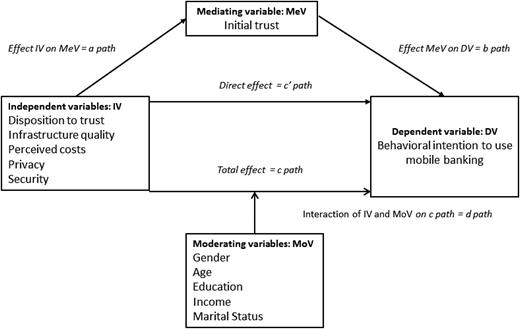
Based on previous studies, this research tested a model of behavioral intention to evaluate potential moderators and mediators of the relationship as presented in Figure 1 assuming that the factors influence the intention to adopt mobile banking:
Disposition to trust (Grabner-Kraüter and Faullant, 2008; Kim and Prabhakar, 2004; Kim et al., 2009; Zhou, 2011): We can infer that disposition to trust would have a significant effect on consumers’ initial trust toward the intention to use mobile banking. Thus, we propose that:
Disposition to trust significantly influences behavioral intention to use mobile banking.
Disposition to trust significantly influences customer’s initial trust.
Customer’s initial trust significantly influences behavioral intention in disposition to trust path.
The relationship between the disposition to trust and behavioral intention to use mobile banking is fully mediated by initial trust.
Infrastructure quality (Almogbil, 2005; Gerrard and Cunningham, 2003; Pikkarainen et al., 2004; Poon, 2007; Rotchanakitumnuai and Speece, 2003): We hypothesized that slow internet connection speed in the Philippines may make banking customers uncertain about whether or not to adopt mobile banking:
Infrastructure quality significantly influences behavioral intention to use mobile banking.
Infrastructure quality significantly influences customer’s initial trust.
Customer’s initial trust significantly influences behavioral intention in infrastructure quality path.
The relationship between infrastructure quality and behavioral intention to use mobile banking is fully mediated by initial trust.
Perceived costs (Cruz et al., 2010; Kuisma et al., 2007; Luarn and Lin, 2005; Poon, 2007; Sathye, 1999; Sohail and Shanmugham, 2003; Wessels and Drennan, 2010; Yu, 2012; Zhengh and Zhong, 2005): It is therefore hypothesized that financial considerations, including the cost of a web‐enabled mobile phone and subscription fees, will influence consumer intentions to use mobile banking:
Perceived costs significantly influence behavioral intention to use mobile banking.
Perceived costs significantly influence customer’s initial trust.
Customer’s initial trust significantly influences behavioral intention in perceived costs path.
The relationship between perceived costs and behavioral intention to use mobile banking is fully mediated by initial trust.
Privacy (Cheung and Lee, 2001; Mukherjee and Nath, 2003; Lee, 2009; Lee and Turban, 2001; Littler and Melanthiou, 2006; McKnight et al., 2002): If bank consumers perceive that mobile banking is secured and has privacy protection, then it may lead to positive perception in determining attitudes toward the use of mobile services (Lin, 2011). So the following hypothesis is formulated:
Privacy significantly influences behavioral intention to use mobile banking.
Privacy significantly influences customer’s initial trust.
Customer’s initial trust significantly influences behavioral intention in privacy path.
The relationship between privacy and behavioral intention to use mobile banking is fully mediated by initial trust.
Security (Casaló et al., 2007; Goudarzi et al., 2013; Laukkanen, 2007; Lin, 2011; Yousafzai et al., 2003; Susanto et al., 2016): These studies confirmed that security significantly influences trust; thus, the following hypotheses are proposed for investigation:
Security significantly influences behavioral intention to use mobile banking.
Security significantly influences customer’s initial trust.
Customer’s initial trust significantly influences behavioral intention in security path.
The relationship between security and behavioral intention to use mobile banking is fully mediated by initial trust.
Demographics profile: It includes gender (Cruz et al., 2010; Laforet and Li, 2005; Laukkanen and Pasanen, 2008; Laukkanen, 2016; Suoranta and Mattila, 2004), age (Cruz et al., 2010; Fall et al., 2015; Laforet and Li, 2005; Laukkanen et al., 2007; Laukkanen, 2016), education (Karjaluoto et al., 2002; Mattila et al., 2003; Meuter et al., 2005), income (Mann and Sahni, 2012; Porter and Donthu, 2006) and marital status (Iddris, 2013; Munnukka, 2007); we can hypothesize that demographic variables may moderate the effects of disposition to trust, infrastructure quality, perceived costs, privacy and security on behavioral intention to adopt mobile banking as well as the effects of initial trust on individual behavior of using mobile banking.
The relationship between the disposition to trust and behavioral intention to use mobile banking is fully moderated by demographic profile (gender, age, education, income and marital status).
The relationship between infrastructure quality and behavioral intention to use mobile banking is fully moderated by demographic profile (gender, age, education, income and marital status).
The relationship between perceived costs and behavioral intention to use mobile banking is fully moderated by demographic profile (gender, age, education, income and marital status).
The relationship between privacy and behavioral intention to use mobile banking is fully moderated by demographic profile (gender, age, education, income and marital status).
The relationship between security and behavioral intention to use mobile banking is fully moderated by demographic profile (gender, age, education, income and marital status).
The conceptual framework is patterned on the proposed model of Baron and Kenny (1986) on assessing the presence and effect of MeV and MoV on the strength and direction of the relation between an independent variable (IV) and a dependent variable (DV). The difference between moderator-predictor relation and mediator-predictor relation is that the variables of the former are at the same level in relations to their role as exogenous to certain criterion effects which mean moderator variables also function as an IV. While the later relations show that the predictor is commonly the antecedent to the mediator where the mediator can shift roles from effects to causes.
4.1 Mediation analysis
Based on the proposed model of Baron and Kenny (1986) for assessing the presence of a mediating effect, there are several path-analytic regressions were conducted to describe the entire structure of cause and effect linkages of all paths. It determined the magnitude of direct and indirect influences that each variable has on the other variables. Figure 2 shows Baron and Kenny (1986) mediational effect using the four steps process interpreted using multiple regression analysis:
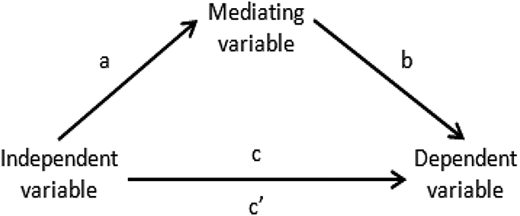
Step 1. Path c: IV as predictor and the DV as the outcome variable – this step establishes that there is a significant effect that may be mediated.
Step 2. Path a: This confirms the significance of the relationship between the IV and the MeV – mediator is outcome variable.
Step 3. Path b: It shows that the MeV affects the outcome variable (DV). This study assumed that there are significant relationships from Steps 1 to 3, and we can make an assumption that Step 4 or mediation effect is possible.
Step 4. Path c’: MeV and IV are used simultaneously to predict the DV where MeV completely mediates the IV–DV relationship.
4.2 Moderation analysis
Baron and Kenny (1986, p. 1174) define a moderator “as a qualitative (e.g. race, sex, class) or quantitative (e.g. level of reward) variable that affects the direction and/or strength of the relation between an independent or predictor variable and a dependent or criterion variable”. Moderation analysis indicate when or under what conditions a particular association can be expected. Based on the proposed moderation analysis model of Baron and Kenny (1986), there are three causal paths that influence the outcome or the DV as presented in Figure 3. It shows that the slope and intercept of the regression of DV on IV depends on the specific value of MoV:
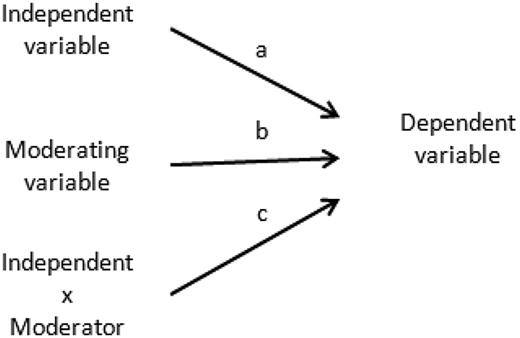
the impact of IV as predictor: Path a;
the impact of the MoV: Path b; and
the interaction of predictor (IV) and moderating (MoV): Path c.
5. Research methodology
The data were collected from both qualitative and quantitative method. The questionnaire was the main data-gathering instrument used in this study and supplemented by informal interviews. Selected factors found in the questionnaires were based on previously reviewed studies. To provide more reliable and valid results, a pre-testing of the questionnaires was done with customers from the twenty local banks. As the result of the pre-test, several items were refined. There were changes made in the formulation of proper wording and meaning to be adopted. Some initial items were found to be unclear for the respondents, and these items were eliminated. After the pre-test, the original questionnaire were refined. In all, 46 questions regarding non-adopters of mobile banking were developed. All variables were measured on a five-point Likert scale which ranges from strongly disagree (1) to strongly agree (5).
5.1 Sampling method
The samples were taken from Manila City and Makati City as the financial districts of the Philippines. These cities are the main areas in the country where internet penetration are higher, and internet connectivity is developed. The self-administered method was used to gather data from various bank customers from July 2016 until October 2016. All respondents are clients who have bank accounts in the local banks in the country. The researchers’ implicit assumption is that these clients who are non-adopters of mobile banking can be potential adopters of online services in the future.
Based on the study of Green (1991) on how many subjects does it take to do a regression analysis, the general rule of thumb is no less than 50 respondents for a correlation or regression analysis with the number increasing based on the number of IVs or predictors of DVs. Green (1991) suggests N > 50 + 8p (where p is the number of IVs) in considering the multiple R2 values or N > 104 + p in considering the beta weights for testing the multiple correlation or regressions. The calculations of the sample size are presented in Table III.
Sampling model and size
| Green (1991) Model | Non-adopter(s) |
|---|---|
| (based on multiple R2) N > 50 + 8p | N > 50 + 8(11) = 138 |
| (based on beta weights) N > 104 + p | N > 104 + 11 = 115 |
A total of 500 questionnaires beyond the minimum sampling size based on Green (1991) model were sent to non-adopter respondents. Also, 314 surveys were returned at the end of data collection process. Table IV provides the profile of the non-adopter respondents and their internet and mobile use. The qualitative method explains the perception of non-adopters of mobile banking and identifies some factors that affect initial trust and behavioral intention to use mobile banking as shown in Table V. This method helps identify possible factors not captured by previous studies.
Profile of respondents
| Profile | Frequency | Percentage |
|---|---|---|
| Gender | ||
| Male | 124 | 39.49 |
| Female | 190 | 60.51 |
| Age | ||
| Below 20 | 41 | 13.06 |
| 20-25 | 151 | 48.09 |
| 26-30 | 37 | 11.78 |
| 31-35 | 44 | 14.01 |
| 36-40 | 34 | 10.83 |
| Above 40 | 7 | 2.23 |
| Educational level | ||
| High school | 57 | 18.15 |
| Bachelor degree | 218 | 69.43 |
| Master degree | 28 | 8.92 |
| Doctoral degree | 11 | 3.5 |
| Your income per month in US$ | ||
| Below 200 | 78 | 24.84 |
| 200-400 | 75 | 23.89 |
| 401-600 | 77 | 24.52 |
| 601-800 | 41 | 13.06 |
| 801-1,000 | 30 | 9.55 |
| above 1,000 | 13 | 4.14 |
| Marital status | ||
| Single | 235 | 74.84 |
| Married | 79 | 25.16 |
| How many mobile phones you have? | ||
| 1 | 146 | 46.50 |
| 2 | 142 | 45.22 |
| 3 | 22 | 7.01 |
| 4 | 4 | 1.27 |
| How long have you been using the mobile phone? | ||
| Less than a year | 17 | 5.41 |
| 1-3 years | 54 | 17.20 |
| 4-6 years | 67 | 21.34 |
| 7-9 years | 48 | 15.29 |
| 10 years or more | 128 | 40.76 |
| On average, how many hours per week do you use the internet on your mobile phone? | ||
| Less than 1 h | 9 | 2.87 |
| 1 to 5 h | 61 | 19.43 |
| 6 to 10 h | 108 | 34.39 |
| 11 to 20 h | 71 | 22.61 |
| 21 to 40 h | 43 | 13.69 |
| Over 40 h | 22 | 7.01 |
Note:
US$1 = PHP50
Summary of perception of respondents toward mobile banking
| Factors | Non-adopters’ opinion toward mobile banking |
|---|---|
| Infrastructure quality | The Philippines has one of the slowest internet connections speed in the world same as a data plan Mobile signal is different in every location and places I am already paying the highest monthly fee just to get a better connection, but, still, I faced mobile data connection disruption The higher frequency of application usage and mobile browsing requires more data, faster browsing speeds and better quality service |
| Perceived costs | Mobile data plans were costly and only affordable for affluent With the proliferation of smartphones, along with higher mobile app and browsing usage and the 4G network overhauls, mobile operators must prepare for significant increases in big data streams at affordable prices Mobile networks are more focus on social media rather than giving more data network for surfing Monthly internet data connection costs a lot just to use mobile banking. ATMs are accessible everywhere Data allowances advertise by mobile operators are overestimated, resulting in frustrated subscribers who experience overage charges |
| Privacy | I am afraid to use the mobile banking because my money online will be stolen without the bank’s knowledge I don’t want to share my personal information online. I want face to face contact with banks’ personnel The only thing that goes between you and your money online is your username and password while so I do not think it is safe The banks may not have strict laws regarding data protection |
| Security | There is a lot of cyber crimes in the country Money transfer online is not secured, even rich countries, they cannot control hackers I am afraid to share my information may be unauthorized personnel from the bank share it to third parties without bank’s knowledge A number of thefts and pickpockets incident happen in the country, and my mobile phone might steal from me |
6. Results and discussion
In this research, the impact of key IVs that could influence initial customer trust in mobile banking and behavioral intention was tested. Some of the key findings from the data analysis are highlighted below.
6.1 Validity and reliability
Reliability analysis was carried using internal consistency measure of Cronbach’s alpha. Results show all variables have a high-reliability range from 0.702 to 0.877 which exceeded the minimum acceptable value of alpha = 0.7 as presented in Table VI. Nunnally (1978) stated that the closer the value of alpha to 1, the higher the internal consistency and reliability of the instrument. Also, Ferketich (1991) stated that corrected item-total correlations should range between 0.30 and 0.70 for a good scale. Therefore, no item was deleted from the variables because it ranges from 0.416 to 0.775, which is within the acceptable value.
Cronbach’s alpha
| Variables | No. of items | Cronbach’s alpha |
|---|---|---|
| Disposition of trust | 6 | 0.756 |
| Quality of infrastructure | 6 | 0.789 |
| Perceived costs | 6 | 0.702 |
| Perceived privacy | 6 | 0.784 |
| Perceived security | 6 | 0.823 |
| Initial trust | 5 | 0.802 |
| Behavioral intention | 9 | 0.877 |
Detecting multicollinearity using variance inflation factors (VIF), a VIF measures the extent to which multicollinearity has increased the variance of an estimated coefficient. The general rule of the thumb is that VIF value exceeding 4.00 corresponds to tolerance value of 0.25 (i.e. 1/0.25 = 4) which warrants further investigation (Rogerson, 2001) and a VIF value of 10.00 corresponds to the tolerance value of 0.10 (i.e. 1/0.10 = 10); these are signs of serious multicollinearity requiring correction (Hair et al., 1995). Based on the test of multicollinearity diagnostics using linear regression analysis in SPSS, Table VII presented that multicollinearity does not exist among IVs, MeV, MoV and DV because of the VIF value ranging from 1.173 with a tolerance value of 0.853 to VIF value of 1.759 with a tolerance value of 0.568.
Test of multicollinearity
| Variables | No. of questions | Tolerance | VIF | ||
|---|---|---|---|---|---|
| Lowest | Highest | Lowest | Highest | ||
| Disposition to trust | 6 | 0.734 | 0.628 | 1.363 | 1.592 |
| Infrastructure quality | 6 | 0.853 | 0.575 | 1.173 | 1.738 |
| Perceived costs | 6 | 0.789 | 0.710 | 1.268 | 1.409 |
| Privacy | 6 | 0.755 | 0.670 | 1.325 | 1.492 |
| Security | 6 | 0.758 | 0.580 | 1.320 | 1.725 |
| Initial trust | 5 | 0.753 | 0.568 | 1.328 | 1.759 |
Note:
Dependent variable: behavioral intention
6.2 Relationships test between the variable
The correlation test was carried out to determine the strength and relationships among the independent, moderating, mediating and DV. As shown in Table VIII, all IVs positively influence initial trust and behavioral intention to use mobile banking. There is a very strong positive correlation between privacy and behavioral intention (r = 0.821, p = < 0.01). Disposition to trust (r = 0.712 p = < 0.01) and security (r = 0.787, p = < 0.01) shows strong positive correlation with behavioral intentions, whereas perceived costs (r = 0.463, p = < 0.01) and infrastructure quality (r = 0.495, p = < 0.01) show moderate correlation with the DV. The results verified a very high significant correlation between initial trust as the MeV and three IVs which included the disposition of trust, privacy and security with a coefficient value range of (r = 0.749, p = < 0.01) (r = 0.773, p = < 0.01) and (r = 0.740, p = < 0.01). Initial trust (r = 0.768, p = < 0.01) as the MeV has a high positive correlation with the DV.
Correlation test of IV, MoV, MeV and DV
| G | A | E | I | MS | DT | PC | IQ | PP | PS | IT | BI | |
|---|---|---|---|---|---|---|---|---|---|---|---|---|
| Gender (G) | 1 | −0.157** | −0.109 | −0.082 | −0.031 | −0.058 | −0.062 | 0.036 | 0.009 | 0.035 | 0.043 | 0.006 |
| – | 0.005 | 0.055 | 0.147 | 0.582 | 0.305 | 0.274 | 0.521 | 0.875 | 0.533 | 0.446 | 0.915 | |
| Age (A) | −0.157** | 1 | 0.628** | 0.398** | 0.561** | 0.080 | 0.046 | −0.023 | 0.099 | 0.080 | 0.122* | 0.016 |
| 0.005 | – | 0.000 | 0.000 | 0.000 | 0.157 | 0.416 | 0.686 | 0.080 | 0.156 | 0.030 | 0.780 | |
| Education (E) | −.109 | 0.628** | 1 | 0.225** | 0.392** | 0.011 | −0.003 | −0.031 | 0.048 | 0.041 | 0.064 | 0.000 |
| 0.055 | 0.000 | – | 0.000 | 0.000 | 0.820 | 0.960 | 0.584 | 0.396 | 0.466 | 0.257 | 0.994 | |
| Income (I) | −0.082 | 0.398** | 0.225** | 1 | 0.587** | 0.057 | 0.069 | 0.039 | 0.045 | 0.085 | 0.039 | 0.064 |
| 0.147 | 0.000 | 0.000 | – | 0.000 | 0.311 | 0.224 | 0.486 | 0.423 | 0.134 | 0.488 | 0.262 | |
| 314 | 314 | 314 | 314 | 314 | 314 | 314 | 314 | 314 | 314 | 314 | 314 | |
| Marital status (MS) | −0.031 | 0.561** | 0.392** | 0.587** | 1 | 0.006 | 0.091 | 0.016 | 0.082 | 0.119* | 0.054 | 0.027 |
| 0.582 | 0.000 | 0.000 | 0.000 | – | 0.909 | 0.108 | 0.781 | 0.148 | 0.035 | 0.344 | 0.636 | |
| Disposition to trust (DT) | −0.044 | 0.097 | 0.028 | 0.044 | 0.015 | 1 | 0.576** | 0.391** | 0.691** | 0.600** | 0.712** | 0.749** |
| 0.434 | 0.085 | 0.623 | 0.437 | 0.795 | – | 0.000 | 0.000 | 0.000 | 0.000 | 0.000 | 0.000 | |
| Perceived costs (PC) | −0.048 | 0.054 | 0.020 | 0.054 | 0.090 | 0.576** | 1 | 0.345** | 0.558** | 0.462** | 0.463** | 0.521** |
| 0.398 | 0.341 | 0.720 | 0.336 | 0.110 | 0.000 | – | 0.000 | 0.000 | 0.000 | 0.000 | 0.000 | |
| Infrastructure quality (IQ) | 0.033 | −0.016 | −0.028 | 0.048 | 0.039 | 0.391** | 0.345** | 1 | 0.584** | 0.639** | 0.495** | 0.443** |
| 0.558 | 0.77 | 0.617 | 0.398 | 0.493 | 0.000 | 0.000 | 0.000 | 0.000 | 0.000 | 0.000 | ||
| Perceived privacy (PP) | 0.006 | 0.084 | 0.053 | 0.031 | 0.063 | 0.691** | 0.558** | 0.584** | 1 | 0.828** | 0.821** | 0.773** |
| 0.909 | 0.136 | 0.349 | 0.580 | 0.262 | 0.000 | 0.000 | 0.000 | – | 0.000 | 0.000 | 0.000 | |
| Perceived security (PS) | 0.038 | 0.071 | 0.044 | 0.068 | 0.106 | 0.600** | 0.462** | 0.639** | 0.828** | 1 | 0.787** | 0.740** |
| 0.506 | 0.208 | 0.432 | 0.226 | 0.061 | 0.000 | 0.000 | 0.000 | 0.000 | – | 0.000 | 0.000 | |
| Initial trust (IT) | 0.032 | 0.094 | 0.063 | 0.043 | 0.048 | 0.712** | 0.463** | 0.495** | 0.821** | 0.787** | 1 | 0.768** |
| 0.578 | 0.095 | 0.262 | 0.451 | 0.395 | 0.000 | 0.000 | 0.000 | 0.000 | 0.000 | – | 0.000 | |
| Behavioral intention (BI) | 0.004 | 0.040 | 0.016 | 0.069 | 0.051 | 0.749** | 0.521** | 0.443** | 0.773** | 0.740** | 0.768** | 1 |
| 0.942 | 0.483 | 0.782 | 0.221 | 0.369 | 0.000 | 0.000 | 0.000 | 0.000 | 0.000 | 0.000 | – |
Notes:
N = 314; * Correlation is significant at the 0.05 level (two-tailed); ** Correlation is significant at the 0.01 level (-tailed)
In relation to respondents’ demographic variables, the correlation matrix indicates that gender, age, education, income and marital status are statistically insignificant. The correlation coefficients of the demographic variables are close to zero which suggests no linear association between IVs, mediation variable and DV. According to Baron and Kenny (1986, p. 1174), it is desirable that the moderator variable is uncorrelated with both the IV and the DV to provide a clear interpretable interaction. Further analysis of the MoV and MeV are presented in the next section using Hayes’ Process Macro.
6.3 Mediation and moderation analysis
The Hayes’ Process Macro developed by Hayes (2013) was used as a statistical moderation and mediation analysis in SPSS to estimates the path coefficients using multiple regression for the continuous outcome (Preacher and Hayes, 2008). It provided insights on the boundary conditions pertaining to the direct and indirect effect of the IV on the DV through the existence of MoV and mediation variables.
6.3.1 Mediation analysis.
Mediation was tested using “Model 4” in Process Macro (Hayes, 2013) as shown in Table IX. Initial trust as mediator was entered into the Process Macro as covariates; 5,000 bias-corrected bootstrap samples and 95 per cent confidence intervals were used in the model (Preacher and Hayes, 2008). The overall models were significant:
Summary of mediation analysis using Hayes’ process macro
| Coefficient | SE | t | p | LLCI | ULCI | |
|---|---|---|---|---|---|---|
| Path c | ||||||
| Disposition of trust | 1.224 | 0.061 | 19.952 | 0.000* | 1.104 | 1.345 |
| Infrastructure quality | 0.533 | 0.061 | 8.723 | 0.000* | 0.413 | 0.653 |
| Perceived costs | 0.872 | 0.081 | 10.775 | 0.000* | 0.713 | 1.031 |
| Privacy | 1.194 | 0.056 | 21.492 | 0.000* | 1.085 | 1.303 |
| Security | 1.020 | 0.054 | 19.424 | 0.000* | 0.917 | 1.124 |
| Path a | ||||||
| Disposition of trust | 0.672 | 0.0375 | 17.903 | 0.000* | 0.598 | 0.746 |
| Infrastructure quality | 0.344 | 0.0342 | 10.063 | 0.000* | 0.277 | 0.411 |
| Perceived costs | 0.447 | 0.0485 | 9.216 | 0.000* | 0.352 | 0.543 |
| Privacy | 0.733 | 0.0288 | 25.406 | 0.000* | 0.676 | 0.789 |
| Security | 0.627 | 0.0278 | 22.554 | 0.000* | 0.572 | 0.681 |
| Path b | ||||||
| MeV in disposition of trust path | 0.826 | 0.0800 | 10.323 | 0.000* | 0.668 | 0.983 |
| MeV in infrastructure quality path | 1.260 | 0.0719 | 17.515 | 0.000* | 1.118 | 1.401 |
| MeV in perceived costs path | 1.132 | 0.0679 | 17.126 | 0.000* | 1.029 | 1.296 |
| MeV in privacy path | 0.712 | 0.1015 | 7.008 | 0.000* | 0.512 | 0.911 |
| MeV in security path | 0.846 | 0.0957 | 8.829 | 0.000* | 0.340 | 0.640 |
| Path c’ | ||||||
| Disposition of trust | 0.669 | 0.076 | 8.863 | 0.000* | 0.521 | 0.818 |
| Infrastructure quality | 0.100 | 0.050 | 1.995 | 0.047** | 0.001 | 0.198 |
| Perceived costs | 0.352 | 0.066 | 5.373 | 0.000* | 0.223 | 0.481 |
| Privacy | 0.673 | 0.091 | 7.426 | 0.000* | 0.495 | 0.851 |
| Security | 0.490 | 0.076 | 6.421 | 0.000* | 0.339 | 0.640 |
Notes:
*p < 0.01; **p < 0.05
Disposition to trust: The overall model was significant [F(2, 311) = 319.68, p < 0.001, R2 = 0.67].
Infrastructure quality: The overall model was significant [F(2, 311) = 228.71, p < 0.001, R2 = 0.60].
Perceived costs: The overall model was significant [F(2, 311) = 259.07, p < 0.001, R2 = 0.62].
Privacy: The overall model was significant [F(2, 311) = 291.13, p < 0.001, R2 = 0.65].
Security: The overall model was significant [F(2, 311) = 274.16, p < 0.001, R2 = 0.64].
In Path c, the regression shows that all IVs were statistically significant with the behavioral intention to use mobile banking, ignoring the initial trust as the mediator. It confirmed a positive relationship between IV and DV with p < 0.01. Hence, H1c, H2c, H3c, H4c and H5c were supported. In Path a, the regression analysis confirmed a positive association between all the IV and initial trust as the MeV, without the presence of behavioral intention. Hence, H1a, H2a, H3a, H4a and H5a were supported. In Path b, the results showed that initial trust as the mediator was positively associated with behavioral intention. Lastly in Path c’, the IVs were significant predictors for both the DV and MV, and both a-path and b-path were significant. Direct effects of IV, namely, disposition to trust (β = 0.669, t (314) = 7.5826, p = < 0.01), infrastructure quality (β = 0.100, t (314) = 1.995, p = < 0.05), perceived costs (β = 0.352, t (314) = 5.373, p = < 0.01), privacy (β = 0.673, t (314) = 7.426, p = < 0.01) and security (β = 0.490, t (314) = 6.421, p = < 0.01) were positively associated with behavioral intention to use mobile banking with the present of initial trust as MeV. Hence, H1c’, H2c’, H3c’, H4c’ and H5c’ were supported.
A measure of the indirect effect of IV on DV was presented in Table X after the regression models. According to Preacher and Hayes (2004), the indirect effect of IV on DV in this situation was defined as the product of Path a and Path b or ab. In most situations, ab = c – c’, where the total effect of IV and DV known as Path c can be decomposed into a direct component of Path c’ and an indirect component of Path ab (Sobel, 1982). The significance of the indirect effect can be determined by examining the lower and upper bounds of the 95 per cent confidence intervals. Indirect effect was statistically significant because zero does not occur between the lower limit confidence interval (LLCI) and the upper limit confidence interval (ULCI). Therefore, we can conclude that the indirect effect for initial trust as mediator is significant.
Indirect effect of X on Y
| Indirect effect | Effect | Boot se | Boot LLCI | Boot ULCI | z | p |
|---|---|---|---|---|---|---|
| Disposition of trust | 0.555 | 0.086 | 0.402 | 0.733 | 8.932 | 0.000* |
| Infrastructure quality | 0.433 | 0.055 | 0.324 | 0.548 | 8.715 | 0.000* |
| Perceived cost | 0.520 | 0.069 | 0.389 | 0.661 | 8.105 | 0.000* |
| Privacy | 0.521 | 0.089 | 0.340 | 0.691 | 6.751 | 0.000* |
| Security | 0.530 | 0.082 | 0.339 | 0.640 | 8.214 | 0.000* |
Note:
*p < 0.01
In the case of the effect size for the indirect effect with a 95 per cent confidence interval which did not include zero were all significantly greater than zero. The p-values are drawn from the unit normal distribution under the assumption of a two-tailed z-test of the hypothesis that the mediated effect equals zero in the population; ± 1.96 was the critical value of the test ratio which contained the central 95 per cent of the unit normal distribution (Preacher and Leonardelli, 2010). Because the calculated values of z for the Sobel test (normal theory test) = z-score were all above 1.96, it meant that initial trust mediates the relationship between IV and DV.
6.3.2 Moderation analysis.
Simple moderation was examined using “Model 1” in Process (Hayes, 2013) as shown in Table XI. Gender, age, education, income and marital status were entered into the Process Macro as covariates. 5,000 bias-corrected bootstrap samples and 95 per cent confidence intervals were used in the model (Preacher and Hayes, 2008). To test the Path d hypothesis – H1d, H2d, H3d, H4d and H5d, that behavioral intentions are a function of various antecedents of initial trust, and more specifically whether demographic variables moderates the relationship of both variables – a hierarchical multiple regression analysis was conducted.
Moderated regression results for the effect of MoV on behavioral intention = Path d
| Overall model | Interaction between IV × MoV | ||||||
|---|---|---|---|---|---|---|---|
| Coefficient | SE | T | p | LLCI | ULCI | ||
| Disposition of trust | |||||||
| Gender | R2 = 0.57 F(3,310) = 141.31, p < 0.01 | −0.180 | 0.125 | −1.445 | 0.149 | −0.426 | 0.065 |
| Age | R2 = 0.56 F(3,310) = 122.28, p < 0.01 | 0.017 | 0.059 | 0.294 | 0.769 | −0.098 | 0.133 |
| Education | R2 = 0.56 F(3,310) = 120.21, p < 0.01 | 0.045 | 0.178 | 0.251 | 0.802 | −0.305 | 0.394 |
| Income | R2 = 0.56 F(3,310) = 122.70, p < 0.01 | 0.058 | 0.095 | 0.606 | 0.545 | −0.130 | 0.245 |
| Marital status | R2 = 0.56 F(3,310) = 123.10, p < 0.01 | 0.005 | 0.052 | 0.101 | 0.920 | −0.096 | 0.107 |
| Infrastructure quality | |||||||
| Gender | R2 = 0.27 F(3,310) = 28.11, p < 0.01 | −0.042 | 0.137 | −0.307 | 0.759 | −0.311 | 0.227 |
| Age | R2 = 0.28 F(3,310) = 28.75, p < 0.01 | −0.073 | 0.050 | −0.1.437 | 0.152 | −0.172 | 0.027 |
| Education | R2 = 0.28 F(3,310) = 28.49, p < 0.01 | −0.074 | 0.169 | −0.4385 | 0.661 | −0.406 | 0.258 |
| Income | R2 = 0.27 F(3,310) = 27.59, p < 0.01 | 0.004 | 0.122 | 0.031 | 0.975 | −0.235 | 0.243 |
| Marital status | R2 = 0.27 F(3,310) = 27.05, p < 0.01 | 0.038 | 0.050 | 0.757 | 0.450 | −0.061 | 0.136 |
| Perceived costs | |||||||
| Gender | R2 = 0.20 F(3,310) = 20.92, p < 0.01 | −0.129 | 0.192 | −0.674 | 0.505 | −0.508 | 0.251 |
| Age | R2 = 0.20 F(3,310) = 21.21, p < 0.01 | −0.100 | 0.067 | −1.496 | 0.136 | −0.232 | 0.032 |
| Education | R2 = 0.20 F(3,310) = 20.93, p < 0.01 | −0.379 | 0.228 | −1.59 | 0.098 | −0.828 | 0.070 |
| Income | R2 = 0.20 F(3,310) = 24.00, p < 0.01 | −0.075 | 0.120 | −0.626 | 0.532 | −0.311 | 0.161 |
| Marital status | R2 = 0.20 F(3,310) = 24.87, p < 0.01 | −0.034 | 0.070 | −0.494 | 0.622 | −0.172 | 0.103 |
| Privacy | |||||||
| Gender | R2 = 0.60 F(3,310) = 117.16, p < 0.01 | −0.063 | 0.129 | −0.490 | 0.625 | −0.317 | 0.191 |
| Age | R2 = 0.60 F(3,310) = 118.59, p < 0.01 | 0.031 | 0.051 | 0.608 | 0.544 | −0.070 | 0.132 |
| Education | R2 = 0.60 F(3,310) = 117.10, p < 0.01 | 0.107 | 0.150 | 0.715 | 0.475 | −0.187 | 0.401 |
| Income | R2 = 0.60 F(3,310) = 116.80, p < 0.01 | 0.013 | 0.099 | 0.134 | 0.894 | −0.182 | 0.208 |
| Marital status | R2 = 0.60 F(3,310) = 131.94, p < 0.01 | 0.054 | 0.045 | 1.202 | 0.230 | −0.035 | 0.143 |
| Security | |||||||
| Gender | R2 = 0.55 F(3,310) = 71.24, p < 0.01 | 0.089 | 0.154 | 0.578 | 0.564 | −0.214 | 0.392 |
| Age | R2 = 0.54 F(3,310) = 64.36, p < 0.01 | −0.021 | 0.067 | −0.202 | 0.749 | −0.153 | 0.110 |
| Education | R2 = 0.55 F(3,310) = 63.53, p < 0.01 | 0.031 | 0.166 | 0.186 | 0.853 | −0.296 | 0.358 |
| Income | R2 = 0.55 F(3,310) = 63.75, p < 0.01 | −0.006 | 0.104 | −0.057 | 0.954 | −0.210 | 0.198 |
| Marital status | R2 = 0.55 F(3,310) = 82.64, p < 0.01 | 0.060 | 0.056 | 1.079 | 0.281 | −0.050 | 0.170 |
Notes:
*p < 0.01; **p < 0.05
Table XI shows the first step which is the overall model; two variables were included: antecedents of initial trust (disposition to trust, infrastructure quality, perceived costs, privacy and security) and demographic variables (gender, age, education, income and marital status). These variables accounted for a significant amount of variance in behavioral intention to use mobile banking. However, the second step which shows the interaction between behavioral intention and IVs moderated by demographic variables were not significant. It shows that the interaction between antecedents of initial trust and demographic variables accounted for an insignificant amount of variance in behavioral intention to use mobile banking, meaning that demographic variables do not strengthen the direct effect of antecedents of initial trust on behavioral intention. The results show that zero value lies between the negative LLCI and the positive ULCI. Therefore, moderation in not occurring. Based on these results, Path d hypothesis – H1d, H2d, H3d, H4d and H5d – were not supported. These findings are inconsistent with the findings from some similar past studies (Cruz et al., 2010; Fall et al., 2015; Iddris, 2013; Joshua and Koshy, 2011; Karjaluoto et al., 2002; Laforet and Li, 2005; Laukkanen and Pasanen, 2008; Laukkanen, 2016; Mattila et al., 2003; Mann and Sahni, 2012; Meuter et al., 2005; Munnukka, 2007; Suoranta and Mattila, 2004).
6.4 Summary of empirical results
The results of this research have provided evidence that the conceptualization of mediation analysis (antecedents, initial trust and behavioral intention) acts as the starting point of interpretation and can be guided by theories or previous research thus providing a more realistic representation of the antecedents of initial trust that influence the adoption of mobile banking in developing countries. In short, they are valid measures of the underlying construct of initial trust and behavioral intention. Nevertheless, any conceptual framework can be subjected to further improvement and we encourage scholars and practitioners to work on improving it further (Table XII).
Research objectives and hypothesis
| Path/s | Results |
|---|---|
| c path – Total effect – to determine which antecedents greatly influence non-adopters’ initial trust | |
| H1c. Disposition to trust significantly influences behavioral intention to use mobile banking | Significant |
| H2c. Infrastructure quality significantly influences behavioral intention to use mobile banking | Significant |
| H3c. Perceived costs significantly influence behavioral intention to use mobile banking | Significant |
| H4c. Privacy significantly influences behavioral intention to use mobile banking | Significant |
| H5c. Security significantly influences behavioral intention to use mobile banking | Significant |
| a path – to determine the effect of IV on MeV | |
| H1a. Disposition to trust significantly influences customer’s initial trust | Significant |
| H2a. Infrastructure quality significantly influences customer’s initial trust | Significant |
| H3a. Perceived costs significantly influence customer’s initial trust | Significant |
| H4a. Privacy significantly influences customer’s initial trust | Significant |
| H5a. Security significantly influences customer’s initial trust | Significant |
| b path – to determine the effect of MeV on DV | |
| H1b. Customer’s initial trust significantly influences behavioral intention in disposition to trust path | Significant |
| H2b. Customer’s initial trust significantly influences behavioral intention in infrastructure quality path | Significant |
| H3b. Customer’s initial trust significantly influences behavioral intention in perceived costs path | Significant |
| H4b. Customer’s initial trust significantly influences behavioral intention in privacy path | Significant |
| H5b. Customer’s initial trust significantly influences behavioral intention in security path | Significant |
| c’ path – Direct effect – to determine the mediating effects of initial trust between antecedents and non-adopters’ behavioral intention | |
| H1c’. The relationship between the disposition to trust and behavioral intention to use mobile banking is fully mediated by initial trust | Significant |
| H2c’. The relationship between infrastructure quality and behavioral intention to use mobile banking is fully mediated by initial trust | Significant |
| H3c’. The relationship between perceived costs and behavioral intention to use mobile banking is fully mediated by initial trust | Significant |
| H4c’. The relationship between privacy and behavioral intention to use mobile banking is fully mediated by initial trust | Significant |
| H5c’. The relationship between security and behavioral intention to use mobile banking is fully mediated by initial trust | Significant |
| d path – Moderating effect on c path – to determine the moderating effects of demographic variables between antecedents and non-adopters’ behavioral intention | |
| H1d. The relationship between the disposition to trust and behavioral intention to use mobile banking is fully moderated by demographic profile (gender, age, education, income and marital status) | Insignificant |
| H2d. The relationship between infrastructure quality and behavioral intention to use mobile banking is fully moderated by demographic profile (gender, age, education, income and marital status) | Insignificant |
| H3d. The relationship between perceived costs and behavioral intention to use mobile banking is fully moderated by demographic profile (gender, age, education, income and marital status) | Insignificant |
| H4d. The relationship between privacy and behavioral intention to use mobile banking is fully moderated by demographic profile (gender, age, education, income and marital status) | Insignificant |
| H5d. The relationship between security and behavioral intention to use mobile banking is fully moderated by demographic profile (gender, age, education, income and marital status) | Insignificant |
7. Conclusion and implications
7.1 Contributions to research and practice
Wireless financial services continue to become ingrained in society due to the rapid development of mobile devices. It enhances the development of the banking system in each country. However, diffusion of new mobile banking services cannot fully achieve expected benefits if it is not used by all banking consumers. Results show that this study supported the study of Chiu et al. (2016) on the issues that influence initial trust on behavioral intention to use internet banking in the Philippines. The responses of non-adopters asserted that initial trust played a significant impact on behavioral intention whether to use mobile banking services. Disposition to trust (Kim et al., 2009; Zhou, 2011), infrastructure quality (Almogbil, 2005; Gerrard and Cunningham, 2003; Pikkarainen et al., 2004; Poon, 2007; Rotchanakitumnuai and Speece, 2003), perceived costs (Cruz et al., 2010; Luarn and Lin, 2005; Wu and Wang, 2005; Wessels and Drennan, 2010; Yu, 2012;), privacy (Bidarra et al., 2013; Casaló et al., 2007; Wang and Shan, 2013) and security (Bidarra et al., 2013; Laukkanen, 2007; Ouyang, 2012; Susanto et al., 2016) are widely recognized as the main obstacles to the adoption of mobile banking in the Philippines.
The banks have little and no control over the development of internet connectivity and speed in the country. It is limited due to deficiencies in the regulatory framework, broadband infrastructure development and the limitations of existing telecom infrastructure, especially in remote areas. Banks should work with the government or telecom companies to address rural population access, build regulatory capacities, strengthen regulatory frameworks and public-private partnerships for regional connectivity. Any incremental efforts to lower prices or provide better rates of internet subscription would have a tremendous impact on affordability and hence access. Banks can concentrate on other factors that are under their control such as improving online privacy and security practices such as safeguarding customer data and information such as security compliance, third-party seals, certification, guarantees and regulations. It is more than preventing unauthorized access to their customers’ data and funds. Winning customers trust, both in the retail and commercial space, is the key to boosting banks’ bottom lines.
The study also proves that customers’ demographic variables as MoV such as gender, age, education, household income and marital status have insignificant impact on the antecedents of initial trust and willingness to use mobile banking. Even demographic variables did not yield a result that was anticipated; we encourage the financial institution to identify relevant customer needs through customer segmentation. Understanding the preferences of urban households, young and educated professionals, affluent groups of customers, overseas workers and entrepreneurs while alleviating the fears and lack of understanding of non-adopters could increase the growth mobile banking adoption and retention. Particularly, the individual with entrepreneurial characteristics and inclination are risk-taker and proactive to acquire new ideas that involve innovation at the inception stage of the introduction of mobile banking services into the market. Financial institutions need to focus on how they can market the entrepreneurial nature of mobile banking as a useful technological innovation for the growth of their businesses.
The financial institutions must devote more resources to encourage people to learn mobile banking benefits and usages. Therefore, banks should equip their customers with awareness, knowledge and trialability at the beginning of their relationship with the consumer. Effective marketing services depend on trust building formation before the customer experience the online services. Maintaining customer confidence at all times is crucial in building customer relationships.
7.2 Limitation and future research
The present study makes a modest attempt to identify various factors that influence non-adopters’ initial trust as a means of adopting mobile banking in the developing country particularly in urban cities. Also, the popularity and growth of mobile phones for many low-income individuals in developing countries use as cost-effective ways of financial management, and entrepreneurial activities require more attention to academic scholars. Future studies are expected to validate and expand the model of this study.
Previous studies were done in different countries such as developed and developing using a variety of factors. This study investigates only a few factors that are strongly believed to have an influenced to mobile banking adoption in developing countries like the Philippines. Hence, other elements can be included in future research. It would be interesting to empirically assess the relative effect of the various motivational factors of customers and environmental factors as antecedents of initial trust to different groups. Future studies would benefit from observing actual interactions of financial institutions and non-adopters to develop concrete marketing strategies. Researchers can also test the validity of factors in every stage of trust over time or how customers’ trust will develop over time.
This study does not measure cultural dimensions such as difference among developed, developing and under-developed countries which cannot claim with confidence a link between culture and factors that influence initial trust of non-adopters. Further research to test the validity of these proposed mechanisms are required to understand individual differences across diversified demographic characteristics, different cultural background and psychological disposition that may influence their initial trust. Further studies to answer research questions such as how banks can tailor their mobile banking and services to each region or culture effectively can bring about a new theory of online trust in global environments.

