This study examines whether generative AI chatbot features are associated with user autonomy and competence and whether these psychological states are, in turn, associated with GenAI misuse intention, conceptualized here as an empowerment backfire mechanism.
Drawing primarily on the Self-Determination Theory, this study develops an empowerment-based model of GenAI chatbot misuse and examines the Neutralization Theory as an alternative account of moral rationalization. Data from 736 GenAI users were analyzed using structural equation modeling (SEM).
Results show that GenAI capability and accessibility were positively associated with autonomy and competence, which were positively associated with GenAI misuse intention. Situational anxiety moderated only the competence–GenAI misuse intention relationship. By contrast, neutralization mechanisms showed mixed associations, suggesting that empowerment-related perceptions may play a more central role than conventional rationalization in explaining ethically questionable GenAI use.
Although the cross-sectional design limits causal inference, the findings highlight the unintended ethical consequences of empowerment-related psychological states in AI-enabled service settings.
This study introduces the empowerment backfire mechanism, showing that GenAI capability and accessibility may increase misuse intention through autonomy and competence.
1. Introduction
Generative AI chatbots, such as ChatGPT, are AI-enabled conversational systems that use natural language interaction to generate new content and support task completion in real time. Built on generative AI and machine learning algorithms, these systems analyze and synthesize information from diverse sources to produce new content (Sengar et al., 2025). Their accessibility and convenience further enhance their appeal, as users can obtain immediate responses and iteratively refine outputs through repeated prompts (Lim et al., 2023). However, the same features that make generative AI chatbots useful and empowering may also produce unintended ethical risks. Prior research has also suggested that AI chatbot attributes such as intelligence, human-likeness and empathy can shape users’ perceptions and subsequent responses, indicating that chatbot use involves psychological effects beyond mere task efficiency (Zhao and Aw, 2025). Because their generated outputs are not always verified, users may be tempted to rely on them in ways that blur the boundaries of appropriate use and responsibility in task-related settings.
This contradiction points to a deeper theoretical issue. Prior research has suggested that chatbot design features do not always generate uniformly positive outcomes, as human-like design cues may elicit less favorable responses under certain conditions (Hai and Katsumata, 2025). In generative AI chatbot use, users may simultaneously strengthen autonomy and competence while also creating conditions under which users become more willing to engage in ethically questionable behavior. In this study, this paradox is conceptualized as an empowerment backfire mechanism, in which the psychological states generated by technological empowerment may produce unintended behavioral consequences. Specifically, GenAI capability and accessibility may enhance users’ perceived autonomy and competence, thereby increasing their sense of control, confidence and task efficacy. Yet these empowerment-related psychological states may also encourage users to rely on AI-generated outputs in morally ambiguous ways, increasing their GenAI misuse intention. Thus, rather than assuming that empowerment is uniformly beneficial, this study argues that GenAI-enabled empowerment may carry a dark side when it strengthens users’ perceived capacity to act without sufficiently reinforcing ethical restraint.
To explain this empowerment backfire mechanism, the present study draws primarily on Self-Determination Theory (SDT) and incorporates Neutralization Theory as a supplementary perspective. SDT explains how GenAI capability and accessibility may be associated with greater autonomy and competence (Xia et al., 2022). However, unlike prior research that tends to associate autonomy and competence with positive motivational outcomes, this study examines whether these empowerment-related perceptions may also be positively associated with ethically questionable usage intentions. Neutralization Theory, by contrast, helps explain whether users rely on rationalization-related mechanisms to justify violations of social norms (Sharma, 2020). Given that neutralization mechanisms may operate differently across contexts, this study positions them as a secondary pathway rather than the dominant theoretical explanation. The study further examines whether situational anxiety conditions these relationships. This theoretical positioning suggests that ethically questionable GenAI use may be associated not only with rationalization but also, and more fundamentally, with empowerment-related perceptions.
Compared with studies focused mainly on chatbot technology development (Feng et al., 2024), this study examines the psychological dynamics of generative AI chatbot interactions. It contributes to the marketing literature by theorizing an empowerment backfire mechanism in which GenAI capability and accessibility are positively associated with autonomy and competence, which are in turn positively associated with GenAI misuse intention. It further extends customer misbehavior research to AI-mediated task contexts, where accountability is ambiguous and user agency is shared with algorithmic systems. By centering the SDT, this study suggests that GenAI misuse intention is more consistently associated with empowerment-related perceptions than with neutralization mechanisms. Thus, ethically questionable generative AI chatbot use may be associated with empowerment-related perceptions even when denial of responsibility or necessity-based justification is weak.
2. Literature review
2.1 Technological features of chatbots
Chatbots are AI-enabled systems that use natural language processing to generate real-time responses based on user inputs (Olujimi and Ade-Ibijola, 2023). While early chatbots were mainly task-oriented and rule-based, contemporary systems are increasingly data-driven and adaptive (Huang et al., 2022), capable of generating and revising novel outputs. This study conceptualizes GenAI capability and accessibility as two salient technological features and focuses specifically on generative AI chatbots rather than narrowly task-oriented systems.
GenAI capability refers to the ability of chatbots to generate new content and adapt outputs to user goals (Feuerriegel et al., 2024). Accessibility refers to the extent to which chatbot functions and outputs are readily available, comprehensible and easy to use for task accomplishment. Prior research highlights flexibility, open access and reduced barriers as central aspects of accessibility (Han and Lee, 2022), while chatbots can improve access through on-demand information and understandable outputs (Grassini et al., 2025; Khamaj, 2025). Together, these features shape how users interact with and apply chatbot outputs.
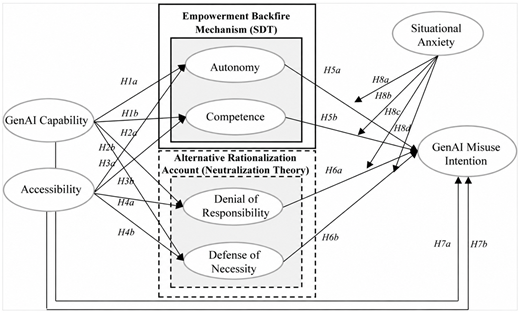
Beyond their functional role, GenAI capability and accessibility are theoretically relevant because they can reshape both reliance and responsibility in human–AI interaction. As systems become more capable and accessible, users may rely more readily on AI-generated outputs (Chen et al., 2023), while the boundary between user agency and system contribution becomes less distinct, complicating accountability for how those outputs are evaluated, disclosed and used (Novelli et al., 2024; Schoenherr and Thomson, 2024). This is particularly important for responsible AI use because users retain discretion over whether to verify AI-generated content, disclose AI assistance and present AI-supported work as their own contribution. Accordingly, AI reliance and accountability are not treated as separate explanatory mechanisms, but as the ethical context in which technological empowerment may become consequential: greater perceived capability and accessibility expand users’ capacity to act while preserving their responsibility for how AI-generated outputs are verified, disclosed and applied. Table 1 summarizes the relevant evidence and highlights the unresolved mechanisms motivating the present study. However, whether GenAI capability and accessibility are associated with autonomy, competence, neutralization mechanisms and GenAI misuse intention remains underexamined, motivating H1a–H4b and H7a–H7b.
2.2 Empowerment backfire in chatbot use: a self-determination perspective
Prior research suggests that chatbot features may produce mixed outcomes rather than uniformly positive effects. Empathic chatbots, for example, have been described as a double-edged sword because the same feature can enhance satisfaction while undermining customer experience under time pressure (Juquelier et al., 2025). In GenAI chatbot use, such mixed outcomes suggest that empowering features may improve user experience but also create unintended ethical risks. This study conceptualizes this paradox as an empowerment backfire mechanism, in which chatbot features are associated with greater autonomy and competence, which may in turn be associated with a greater likelihood of ethically questionable use. More specifically, the empowerment backfire mechanism refers to a theoretically grounded pattern in which GenAI capability and accessibility are positively associated with autonomy and competence, which are in turn positively associated with GenAI misuse intention. Accordingly, this study draws primarily on the SDT to explain the empowerment backfire mechanism, while the Neutralization Theory is examined as an alternative account of moral rationalization.
SDT identifies autonomy, competence and relatedness as core psychological needs and links self-determined behavior to autonomy and satisfaction (Deci and Ryan, 1985; Ryan and Deci, 2020). This study focuses on autonomy and competence because task-oriented GenAI use prioritizes control and effectiveness over social relatedness. Autonomy concerns self-directed regulation and choice, whereas competence concerns perceived effectiveness and control in ongoing engagement (Deci and Ryan, 2002). Prior research associates autonomy with positive outcomes (Ketonen et al., 2018) and competence with improved task performance through digital technologies (Elfeky et al., 2023). However, this study examines whether these empowering states may also produce unintended ethical consequences. Over-reliance on AI outputs, for example, may weaken independent judgment and ethical reflection (Zhai et al., 2024).
The Neutralization Theory explains how individuals rationalize norm-violating behavior by reducing the moral tension associated with questionable conduct (Sykes and Matza, 1957). Among its various techniques, this study focuses on denial of responsibility and defense of necessity. Denial of responsibility attributes questionable conduct to external circumstances, whereas defense of necessity frames such conduct as necessary or unavoidable under particular conditions (Minor, 1981; Silic et al., 2017). These mechanisms may be relevant in GenAI chatbot use because responsibility for AI-assisted outcomes can be distributed ambiguously across users, technological systems and developers (Schoenherr and Thomson, 2024). Users may therefore attribute questionable outcomes partly to the system or regard inappropriate use as necessary for completing tasks under situational constraints. Prior studies have applied neutralization mechanisms to technology-related misconduct and shown that rationalization can facilitate norm-violating behavior in digital environments (Sharma, 2020; Zhang and Leidner, 2018; Hohensinn et al., 2024). Recent evidence also suggests that interaction with AI agents can alter moral judgment and facilitate moral disengagement in ethically sensitive situations (Zhu et al., 2025). Accordingly, whether autonomy, competence and neutralization mechanisms are associated with GenAI misuse intention in GenAI chatbot use remains underexamined, motivating H5a–H6b.
2.3 Situational anxiety
Situational anxiety is a context-specific negative emotion involving cognitive, physiological and behavioral symptoms (Hong et al., 2019). Based on the Trait-State Theory, it differs from trait anxiety because it is temporary, situation-bound and diminishes once the perceived threat subsides (Khng, 2017). Prior research suggests that situational anxiety often emerges in unfamiliar or threatening contexts, shaping individuals’ emotional and behavioral responses (Kuo et al., 2016). It has also been shown to undermine performance and efficiency in work, learning and healthcare settings (Good et al., 2025; Lewis et al., 2023). Whether situational anxiety moderates the associations between these psychological mechanisms and GenAI misuse intention in GenAI chatbot use remains underexamined, motivating H8a–H8d.
2.4 GenAI misuse intention
In this study, GenAI misuse intention captures users’ willingness to engage in inappropriate, insufficiently verified, rule-violating or ethically questionable GenAI chatbot use in task-related situations. It represents a broad domain of morally ambiguous, norm-deviating use, encompassing non-disclosure, over-reliance, misrepresentation and rule violation rather than treating them as separate outcomes. Although such behaviors are not always illegal, they are often regarded as inappropriate and unethical (Wirtz and McColl-Kennedy, 2010). Such intentions are more likely to emerge when individuals feel less responsible, especially in non-ownership or access-based contexts (Bardhi and Eckhardt, 2012). Recent research further suggests that customer misbehavior may also arise in AI-enabled service environments, where altered service norms and reduced interpersonal oversight can create new opportunities for inappropriate conduct (Zhao et al., 2025). Accordingly, this study applies GenAI misuse intention to the GenAI chatbot context, capturing users’ likelihood of engaging in inappropriate, insufficiently verified, rule-violating or ethically questionable forms of use when limited oversight and ambiguous accountability weaken ethical restraint.
3. Research framework and hypothesis development
This study proposes an empowerment backfire mechanism linking GenAI capability and accessibility to GenAI misuse intention through autonomy and competence. SDT provides the primary explanation, with Neutralization Theory as an alternative account. As depicted in Figure 1, the contribution lies in this theoretical configuration rather than in any individual construct or relationship.
Throughout the model, GenAI capability and accessibility refer to users’ perceptions of chatbot characteristics, whereas autonomy, competence, neutralization, situational anxiety and GenAI misuse intention refer to users’ psychological states, rationalizations and intentions.
3.1 GenAI capability, accessibility and self-determination
GenAI capability refers to users’ perception of a generative AI chatbot’s capability to understand instructions, generate task-relevant content and support iterative human–machine interaction (Feuerriegel et al., 2024). Unlike traditional tools that execute predefined functions, GenAI chatbots can follow users’ creative goals and allow iterative refinement. Such perceived capability may enhance autonomy because users can initiate prompts, revise instructions and steer the interaction process according to their intentions, thereby strengthening perceived control over task execution (Laato et al., 2022). At the same time, by synthesizing complex information and producing high-quality outputs, GenAI capability may strengthen competence, as users are more likely to feel capable of performing tasks effectively and mastering their task environment (Deci and Ryan, 1985).
Accessibility refers to users’ perception of how readily a generative AI chatbot and its outputs can be accessed and used to accomplish task requirements. Higher accessibility can reduce perceived barriers and facilitate users’ effective engagement with chatbot systems, thereby supporting smoother and more inclusive interactions (Han and Lee, 2022). From a self-determination perspective, when a chatbot is more accessible, users may perceive greater freedom in navigating and directing the system, which may foster autonomy (Ryan and Deci, 2020). Likewise, a responsive and accessible interface may reinforce competence by enabling users to interact with the system more effectively, control their task environment and achieve desired outcomes more easily. Consequently, this study proposes the following hypotheses:
Users’ perceived GenAI capability is positively associated with their autonomy.
Users’ perceived GenAI capability is positively associated with their competence.
Users’ perceived accessibility is positively associated with their autonomy.
Users’ perceived accessibility is positively associated with their competence.
3.2 GenAI capability, accessibility and neutralization mechanisms
Neutralization mechanisms allow individuals to justify questionable behavior and reduce internal moral conflict (Sykes and Matza, 1957). In GenAI chatbot use, greater capability may weaken such rationalizations because users actively formulate prompts, refine instructions, evaluate content and decide how outputs are used. This involvement makes it more difficult to shift responsibility to the system, potentially reducing denial of responsibility. Greater capability may also reduce constraints and the need for improper shortcuts, making defense of necessity less convincing. Thus, when technological support is effective and users remain actively involved in producing outcomes, external or necessity-based justifications may become less plausible (Sharma, 2020).
Accessibility refers to the extent to which chatbot outputs are readily accessible and useable in users’ decision making (Yamagishi et al., 2026). When a system is highly accessible, users perceive fewer barriers to appropriate task completion. Under such conditions, it becomes more difficult to attribute misconduct to system difficulty or limited support, thereby reducing denial of responsibility. Similarly, when information and assistance are readily available, users may be less likely to justify improper behavior as necessary, because accessible resources reduce the pressure to rely on inappropriate shortcuts. Consequently, this study proposes the following hypotheses:
Users’ perceived GenAI capability is negatively associated with their denial of responsibility.
Users’ perceived GenAI capability is negatively associated with their defense of necessity.
Users’ perceived accessibility is negatively associated with their denial of responsibility.
Users’ perceived accessibility is negatively associated with their defense of necessity.
3.3 Self-determination and GenAI misuse intention
Self-determination in chatbot use is reflected in users’ perceived ability to regulate their actions and make decisions autonomously, which often fosters confidence and positive engagement with AI technologies (Xia et al., 2022). However, such empowerment may also have unintended consequences. In this context, GenAI misuse intention reflects the broad tendency toward norm-deviating GenAI chatbot use defined earlier in the text. Prior research suggests that greater psychological proximity can weaken the strictness of moral evaluation (Paramita et al., 2020). In chatbot use, autonomy may strengthen users’ control over interaction, whereas competence may increase their confidence in using the system effectively. Under morally ambiguous conditions, autonomy may increase users’ perceived discretion over how chatbot outputs are used, while competence may make questionable use appear more feasible and controllable. As a result, users may become more likely to treat the chatbot as an instrumental extension of their own agency, which may reduce moral restraint and increase GenAI misuse intention. Therefore, the following hypotheses are proposed:
Users’ autonomy is positively associated with their GenAI misuse intention.
Users’ competence is positively associated with their GenAI misuse intention.
3.4 Neutralization and GenAI misuse intention
Neutralization refers to a psychological mechanism through which individuals rationalize antisocial behavior and reduce internal moral conflict. Here, GenAI misuse intention reflects the broad form of norm-deviating GenAI chatbot use defined previously. Prior research suggests that neutralization techniques, such as denial of responsibility and defense of necessity, are more likely to emerge in individualized contexts characterized by limited human interaction and weak traceability (Chu, 2021). Improper behavioral intentions are also more likely to arise in unsupervised settings where individuals feel detached from human oversight or ownership (Sun et al., 2024). Applied to chatbot use, interactions with generative AI are often private and involve limited supervision. Under such conditions, users facing moral ambiguity may rely on neutralization mechanisms to justify questionable use. By denying responsibility for AI-assisted outputs or framing improper behavior as necessary, users may cognitively reframe morally ambiguous behavior in ways that increase their willingness to engage in ethically questionable use. Therefore, the following hypotheses are proposed:
Users’ denial of responsibility is positively associated with their GenAI misuse intention.
Users’ defense of necessity is positively associated with their GenAI misuse intention.
3.5 Direct effects of GenAI capability and accessibility on GenAI misuse intention
Beyond these psychological pathways, GenAI capability and accessibility may also be directly associated with GenAI misuse intention. More capable and accessible chatbots reduce the effort required to generate, revise and apply AI outputs, thereby making questionable use easier to enact. Moreover, increased reliance on AI-generated outputs may blur the boundary between user agency and system contribution, creating ambiguity in accountability (Chen et al., 2023; Novelli et al., 2024). Therefore, the following hypotheses are proposed:
Users’ perceived GenAI capability is positively associated with their GenAI misuse intention.
Users’ perceived accessibility is positively associated with their GenAI misuse intention.
3.6 The moderating role of situational anxiety
Situational anxiety is a temporary state of tension and unease triggered by specific events or perceived threats (Cheng and McCarthy, 2018) and can produce defensive or reactive responses (Mogg and Bradley, 2016). In chatbot use, it may condition the associations of autonomy, competence, denial of responsibility and defense of necessity with GenAI misuse intention. Under high anxiety, users may rely more heavily on perceived control and capability as coping resources, strengthening the associations of autonomy and competence with GenAI misuse intention (Xia et al., 2022). Anxiety may likewise increase reliance on neutralization when users rationalize questionable conduct under pressure (Ainsworth et al., 2024). Accordingly, this study tests situational anxiety as a moderator of these psychological mechanism–outcome relationships. It does not predict moderated mediation or conditional indirect effects. The following hypotheses are proposed:
The positive association between users’ autonomy and GenAI misuse intention is stronger at higher levels of situational anxiety.
The positive association between users’ competence and GenAI misuse intention is stronger at higher levels of situational anxiety.
The positive association between users’ denial of responsibility and GenAI misuse intention is stronger at higher levels of situational anxiety.
The positive association between users’ defense of necessity and GenAI misuse intention is stronger at higher levels of situational anxiety.
4. Methodology
4.1 Design
This study employed a cross-sectional self-report survey design to examine the associations among GenAI chatbot features, psychological mechanisms, situational anxiety and GenAI misuse intention.
4.2 Participants
Participants were required to have prior experience using generative AI chatbots, such as ChatGPT or similar systems capable of generating task-related outputs. Respondents were recruited through Facebook and Dcard, particularly from Chinese-language communities related to AI and GenAI chatbot use. The survey was not restricted to a specific country or region; therefore, the sample represents users recruited from Chinese-language online communities rather than a nationally representative population.
4.3 Procedure
The questionnaire was developed using Survey Cake and distributed through online communities. To contextualize GenAI misuse intention, respondents were presented with GenAI-use situations involving reliance on chatbot-generated content, insufficient disclosure of AI assistance, use of chatbot outputs in tasks expected to reflect individual effort and presentation of AI-assisted work that may obscure the user’s actual contribution. This anchored GenAI misuse intention in morally ambiguous, task-related GenAI use rather than unethical behavior in general. Data were collected in two recruitment waves: June 7–21, 2025, yielding 412 responses, and June 24–July 22, 2025, yielding 345 responses. Both waves used the same questionnaire and measurement procedure during different recruitment periods. All variables were measured concurrently within the same survey response; therefore, the study remained cross-sectional. Before the main analyses, the responses were screened for data quality. A total of 21 responses that did not meet the response-quality criteria were excluded, resulting in a final sample of 736 valid responses.
4.4 Measures
All constructs were measured using a 5-point Likert scale ranging from 1 (“strongly disagree”) to 5 (“strongly agree”). Measurement items were adapted from prior literature, with the complete items and sources presented in Appendix 1.
4.5 Data analysis approach
Data analysis proceeded in three stages. First, AMOS 23 was used to assess construct reliability and validity and to estimate the structural model. Second, direct effects and specific indirect effects were estimated using SEM, with indirect effects tested using 5,000 bootstrap resamples. Third, SPSS 23 hierarchical regression was used to test the moderating effects of situational anxiety. Mediation and moderation were examined separately; conditional indirect effects were not estimated because moderated mediation was not hypothesized.
5. Results
5.1 Sample profile
Appendix 2 shows that 58.3% of respondents were female, 48.9% were aged 20–29, 53.5% had university-level education and 38.9% were students.
5.2 Measurement and structural model analysis
This study followed a two-step SEM approach. First, construct reliability and validity were assessed. As shown in Table 2, all CR values (0.776–0.929) exceeded 0.70 and all AVE values (0.609–0.767) exceeded 0.50, supporting reliability and convergent validity (Fornell and Larcker, 1981; Hair et al., 2006). Discriminant validity was established because the square roots of AVE exceeded the corresponding inter-construct correlations. Second, the structural model allowed residuals of autonomy, competence, denial of responsibility and defense of necessity to covary, reflecting shared unexplained variance in the user–chatbot context. The model showed acceptable fit (χ2/df = 2.568, GFI = 0.929, CFI = 0.964, RMSEA = 0.046), as shown in Table 3. As summarized in Table 4, H1a–H1b, H2b, H3a–H3b, H4a–H4b, H5a–H5b and H7a–H7b were supported, whereas H2a and H6a–H6b were not supported. Among the moderation hypotheses, only H8b was supported, whereas H8a, H8c and H8d were not supported. Specific indirect effects through autonomy and competence were significant, whereas those through denial of responsibility and defense of necessity were not; both total indirect effects were significant.
6. Discussion
The empirical results provide partial rather than full support for the proposed model, with the strongest support for the empowerment pathway. GenAI capability and accessibility were positively associated with users’ autonomy and competence, while autonomy (H5a: β = 0.150, p = 0.002) and competence (H5b: β = 0.195, p < 0.001) were positively associated with GenAI misuse intention. GenAI capability (H7a: β = 0.131, p = 0.016) and accessibility (H7b: β = 0.115, p = 0.044) also showed significant direct associations. More importantly, autonomy and competence significantly mediated the associations of both GenAI capability and accessibility with GenAI misuse intention. For GenAI capability, the indirect effects through autonomy (0.069) and competence (0.081) were significant; for accessibility, those through autonomy (0.056) and competence (0.130) were also significant. Neither denial of responsibility nor defense of necessity produced a significant indirect effect. These positive indirect effects provide the primary empirical support for the proposed empowerment backfire mechanism, indicating that empowerment-related psychological states may be associated with willingness to misuse GenAI.
In contrast, the neutralization findings reveal a dissociation between empowerment and rationalization. GenAI capability was negatively associated with defense of necessity (H2b: β = −0.171, p < 0.001) but not denial of responsibility (H2a: β = −0.048, p = 0.339), whereas accessibility was negatively associated with both denial of responsibility (H4a: β = −0.112, p = 0.026) and defense of necessity (H4b: β = −0.240, p < 0.001). Neither denial of responsibility (H6a: β = 0.031, p = 0.527) nor defense of necessity (H6b: β = −0.075, p = 0.138) was significantly associated with GenAI misuse intention, and neither mediated the predictor–outcome associations. Thus, neutralization does not support a parallel rationalization mechanism, suggesting that questionable GenAI use may emerge through empowerment without strong moral justification. This contrast makes empowerment the more consistent explanatory mechanism in this context.
Finally, situational anxiety functioned as a selective rather than general boundary condition. H8a, H8c and H8d were not supported, whereas the competence–situational anxiety interaction was significant (H8b: β = 0.103, p = 0.012). The positive association between competence and GenAI misuse intention was stronger at higher levels of situational anxiety, while no comparable moderation was observed for autonomy, denial of responsibility or defense of necessity. Thus, situational anxiety should not be interpreted as a general moderator, nor does this interaction indicate moderated mediation. Overall, the findings strongly support the empowerment pathway but provide limited support for neutralization and anxiety-related mechanisms.
7. Conclusion
The ethical risk of GenAI chatbots may not arise from their failure, but from their effectiveness. The results show that GenAI capability and accessibility are positively associated with autonomy and competence, and that both psychological states are further associated with greater GenAI misuse intention. In contrast, denial of responsibility and defense of necessity do not significantly explain GenAI misuse intention, suggesting that empowerment rather than rationalization is the more consistent pathway. By conceptualizing this pattern as an empowerment backfire mechanism, this study shows that features designed to increase users’ control and capability may also be associated with a greater likelihood of ethically questionable use. Situational anxiety further qualifies this mechanism by interacting significantly only with competence.
7.1 Research implications
The central theoretical contribution of this study lies in the empowerment backfire mechanism rather than in any individual construct. By linking GenAI capability and accessibility to GenAI misuse intention through autonomy and competence, the study shows how empowerment-related psychological states may be associated with unintended ethical consequences in AI-mediated contexts. This extends SDT beyond its conventional positive framing by identifying a less examined consequence of autonomy and competence. The Neutralization Theory provides an alternative account, but its weaker explanatory role further highlights empowerment as the more consistent mechanism. Situational anxiety additionally identifies a selective boundary condition for the competence pathway.
7.2 Practical recommendations
The findings suggest that platform developers and organizations may complement improvements in GenAI capability and accessibility with responsible-use safeguards. Although these features enhance user effectiveness, autonomy and competence were positively associated with GenAI misuse intention in morally ambiguous task contexts. This pattern suggests that capable, self-directed users may perceive inappropriate use as easier and controllable. Accordingly, safeguards may be embedded in AI–user interactions through output traceability, disclosure reminders, explainability cues, source-verification prompts and task-sensitive guidance when users generate, revise, export or submit AI-assisted outputs. Because situational anxiety moderated only the Competence–GenAI misuse intention relationship, accountability cues, review checkpoints and self-reflective prompts may be relevant for competent users under situational pressure. These measures may make ethical boundaries, attribution of contribution and responsible-use expectations more salient. Because the study measures intention rather than actual behavior, these recommendations should be viewed as precautionary design and management considerations rather than demonstrated interventions for reducing misconduct.
7.3 Research limitations
The findings have four limitations. First, the cross-sectional self-report design supports associations rather than causal claims. Because constructs were reported by respondents, common method variance may affect observed associations, while the sensitive nature of GenAI misuse intention may introduce social desirability bias. Accordingly, findings should be interpreted as self-reported associations rather than evidence of misconduct. Longitudinal or experimental studies could examine temporal ordering. Second, participants were recruited from Chinese-language online communities rather than a nationally representative sampling frame. Accordingly, generalization should be limited to this context; future research should replicate the model across cultural and national settings. Third, GenAI misuse intention was examined in morally ambiguous GenAI chatbot-use situations; future research could distinguish academic, workplace and professional contexts where accountability and ethical consequences may differ. Fourth, this study focused on situational anxiety as a potential boundary condition; future studies could examine ethical orientation, moral identity or prior AI experience as conditions shaping the association between technological empowerment and inappropriate use.