This study investigates why AI literacy differentially moderates the effects of transparency and personalization on perceived autonomy in AI-based tourism recommendation services. Integrating self-determination theory and the stimulus–organism–response model, it examines the asymmetric moderating role of AI literacy across two pathways linking AI service attributes to behavioral outcomes through perceived autonomy.
Data were collected from 322 South Korean users who had used AI travel planning tools within the preceding three months. CB-SEM with AMOS 23.0 was employed for structural path analysis, and bootstrapping with 2,000 resamples tested mediation effects. Interaction terms were mean-centered to address multicollinearity in moderation analysis.
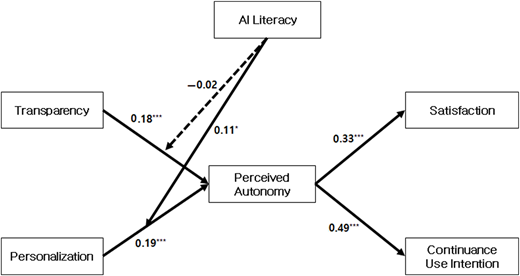
Transparency and personalization positively influence perceived autonomy, which more strongly affects continuance use intention (ß = 0.49) than satisfaction (ß = 0.33). AI literacy strengthens the personalization–autonomy link (ß = 0.11, p < 0.05) but not the transparency–autonomy link (ß = −0.02, n.s.), revealing asymmetric moderation. AI literacy also exerts the strongest direct effect on perceived autonomy (ß = 0.36), surpassing both service design attributes.
The cross-sectional design limits causal inference; future research should employ longitudinal or experimental approaches. The Korean-only sample restricts cultural generalizability. Only autonomy among SDT’s three basic needs was examined; future models should integrate competence and relatedness.
AI platforms may benefit from designing differentiated autonomy-support strategies based on user AI literacy levels. Transparency features should be universally accessible, while personalization features may be more effective when adapted to varying literacy levels. These findings suggest that investments in AI literacy education – such as onboarding tutorials and algorithmic explainers – may strengthen personalization effectiveness, though causal validation through experimental or longitudinal designs is needed before treating these as confirmed prescriptions.
As AI increasingly mediates consumer decision-making, ensuring that users maintain genuine psychological autonomy becomes a societal concern. This study demonstrates that AI literacy empowers users to convert personalized recommendations into autonomous choices, suggesting that public AI literacy education initiatives can help prevent algorithmic dependence and support informed, self-determined consumer behavior.
This study provides initial empirical evidence for asymmetric moderation by AI literacy across distinct AI service attributes – transparency and personalization – suggesting that transparency operates at an intuitively accessible informational level while personalization requires evaluative processing facilitated by AI literacy. These findings offer a theoretically grounded basis for further investigation with parallel operationalizations across diverse AI service contexts.
1. Introduction
A traveler types “solo healing trip, 2 nights 3 days” into an AI travel planner. Within seconds, the algorithm synthesizes past search history, review patterns, and real-time weather data to suggest an optimized itinerary. The recommendation is remarkably precise. Yet a fundamental question emerges: “Is this trip my choice, or the algorithm's?” This tension between technological convenience and human autonomy encapsulates the essential dilemma of tourism in the AI era.
Unlike previous waves of digitalization that enhanced existing decision-making processes, AI-driven systems fundamentally restructure how travelers make choices by pre-curating options and replacing exploratory search with algorithmic curation (Gretzel et al., 2020; Tussyadiah, 2020). This shift is rapid: the Asia-Pacific AI tourism market is growing at a 33.2% CAGR, the highest globally, with industry reports indicating majority adoption among digitally active travelers in high-penetration markets such as South Korea (MarketsandMarkets, 2024). Yet academic research remains anchored in technology acceptance frameworks that ask whether users adopt AI, rather than what AI does to the psychological experience of choosing. As AI increasingly mediates travel decisions, whether these choices remain genuinely self-determined – or merely algorithmically curated – becomes a pressing concern. South Korea is a particularly appropriate context: a digitally mature travel market (28.69 million outbound trips in 2024, 59% booked via mobile; KOSIS, 2025), AI recommendation features standard across major platforms (Naver Travel, Kakao Maps, Interpark Tours), and leading OECD rankings in digital adoption (OECD, 2023) implying sufficient AI literacy variance to detect differential moderation effects. Despite this rapid adoption, existing research has predominantly examined functional outcomes such as acceptance and satisfaction; whether AI-mediated choices remain psychologically self-determined has received limited attention. Self-Determination Theory identifies autonomy as a core need driving intrinsic motivation (Deci and Ryan, 2000), and the S–O–R model (Mehrabian and Russell, 1974) links environmental stimuli to behavioral outcomes through internal states – yet their integration to explain how AI service attributes shape perceived autonomy remains underdeveloped. Three interrelated gaps motivate this study. Theoretically, existing research has not explained why transparency and personalization may influence perceived autonomy through different psychological mechanisms, nor integrated SDT and S–O–R to position autonomy as a core organism variable in AI tourism. Methodologically, prior studies have examined AI literacy as a dependent variable or single-path moderator, without testing differential moderation across distinct stimulus types within a unified model. Empirically, no quantitative study has tested asymmetric moderation by AI literacy across parallel service attribute pathways in AI tourism recommendation services. Transparency provides comprehensible rationale for recommendations (Shin, 2021), while personalization reflects users' preferences in service output (Baek and Morimoto, 2012). Their processing demands differ fundamentally: transparency offers readily interpretable information, whereas personalization requires evaluating whether outputs align with one's self-concept – a process that may depend on understanding how AI operates. AI literacy (Laupichler et al., 2022) may therefore differentially moderate the two pathways. However, existing research has focused on conceptualizing AI literacy as a competency to be developed (Long and Magerko, 2020; Laupichler et al., 2022) rather than examining how it conditions responses to distinct AI attributes, and SDT/S–O–R applications in AI tourism have centered on acceptance outcomes. No study has empirically tested whether AI literacy produces asymmetric moderation across transparency and personalization. Accordingly, this study integrates SDT and the S–O–R model to investigate how transparency and personalization influence satisfaction and continuance use intention through perceived autonomy, and examines the differential moderating role of AI literacy across these pathways – identifying specific boundary conditions under which AI service attributes operate differently, with implications for both theory and literacy-adaptive system design.
2. Theoretical background and hypothesis development
2.1 AI tourism recommendation services and user experience
AI-based tourism recommendation services have recently emerged as one of the most rapidly diffusing digital technologies in the tourism industry, going beyond simple information provision to fundamentally transform the structure of travel decision-making. In South Korea, these services span general-purpose platforms with travel modules (Naver Travel, Kakao Maps), dedicated OTAs (Interpark Tours, Yanolja), and AI itinerary generators – all sharing an architecture that analyzes search histories and preference signals to generate recommendations, making transparency and personalization directly salient to users. Whereas traditional tourism decision-making relied on users' active search processes – such as information search, comparison, and review exploration – the current paradigm has shifted toward algorithm-driven systems that pre-structure and suggest available options. In other words, rather than actively exploring “what to choose” from the outset, users increasingly make decisions by evaluating “which option to select” from a set of pre-curated alternatives.
With generative AI, conversational planners and recommendation engines now integrate the full planning process, and consumers increasingly begin from algorithmic pre-selection rather than open-ended search. These advances introduce tensions beyond convenience: recommendations built on past behavioral data may reinforce existing preferences – the filter bubble effect (Pariser, 2011) – and opaque recommendation processes may diminish users' sense of control over decision-making (Burrell, 2016).Recent studies conceptualize AI recommendation environments as algorithmic experiences, in which users' cognitive interpretations and emotional responses to algorithms determine adoption and continuance (Shin et al., 2020). This is especially relevant in tourism – an experience good whose quality cannot be evaluated before consumption (Nelson, 1970) – where users may value psychological control and agency over mere informational accuracy. Accordingly, these services are not merely information technologies but structural mechanisms that reshape decision-making. Two design attributes are central: transparency – the comprehensibility of an AI system's decision criteria – operates at the informational level, answering “why was this recommended?”, whereas personalization – the reflection of individual preferences in outputs – operates at the evaluative level, prompting “does this genuinely reflect who I am?” This distinction implies fundamentally different cognitive demands, explaining when and why AI literacy may moderate the two pathways differently.
2.2 Integration of self-determination theory and the S–O–R model
Self-Determination Theory proposes three basic psychological needs – autonomy, competence, and relatedness (Deci and Ryan, 2000). However, this study focuses specifically on autonomy. This choice does not reflect a reduction of variables, but rather a process of theoretical specification grounded in the research context.
AI-based tourism recommendation services inherently structure users' choice architecture, present alternatives, and reconfigure the decision-making process in advance. In this context, the key psychological mechanism lies in whether users perceive their choices as externally imposed or as self-determined – that is, their perception of autonomy. From this perspective, autonomy is not merely one of several psychological variables, but functions as a core meta-mechanism that shapes user experience in AI-driven recommendation environments.
In contrast, competence and relatedness are less directly activated in this context. Competence in SDT denotes a situational sense of task effectiveness triggered by performance feedback – not by recommendation exposure – and is conceptually distinct from AI literacy as a stable individual difference; modeling both would create construct overlap at the moderator level. Relatedness concerns social bonding, whereas AI recommendation services are dyadic (user–algorithm) rather than social interactions; it may matter in peer-recommendation or group-planning contexts but is not theoretically activated here. This study therefore adopts a context-driven specification centered on autonomy as the SDT dimension with greatest explanatory relevance. Furthermore, recent research on algorithms and AI has emphasized perceived control, self-determination, and agency as central to user experience (Shin, 2021) – concepts closely aligned with autonomy in Self-Determination Theory. In sum, this study does not merely apply Self-Determination Theory, but rather refines and reinterprets it by positioning autonomy as the central explanatory axis within the specific context of AI tourism recommendation services, thereby offering a more precise understanding of technology–user interaction.
The Stimulus–Organism–Response model (Mehrabian and Russell, 1974) provides the causal architecture by positing that environmental stimuli influence internal psychological states, which subsequently drive behavioral responses. This study positions transparency and personalization as stimuli, perceived autonomy as the organism variable, and satisfaction and continuance use intention as responses, thereby achieving a complementary integration in which Self-Determination Theory provides the theoretical rationale for the organism variable and the Stimulus–Organism–Response model provides the sequential causal structure.
2.3 Transparency and perceived autonomy
Algorithmic transparency refers to the degree to which an AI system's decision criteria and processes are provided to users in a comprehensible form (Shin, 2021; Shin and Park, 2019). Transparency presents the rationale behind recommendations explicitly, enabling users to understand “why these options were suggested,” thereby facilitating information-based decision-making.
From the perspective of Self-Determination Theory, understanding the rationale for one's actions is a core condition for autonomy fulfillment (Deci and Ryan, 2000). When users are able to recognize the reasons behind their choices, those actions shift from being externally controlled to self-determined. In this regard, transparency goes beyond simple information provision; it transforms external stimuli into forms that can be internalized.
Within the Stimulus–Organism–Response framework, transparency operates as a stimulus that enhances users' cognitive sense of control and comprehensibility, thereby activating perceived autonomy as an organism state. Accordingly, transparency converts users from passive recipients of algorithmic outputs into active interpreters and decision-makers, which is expected to increase perceived autonomy.
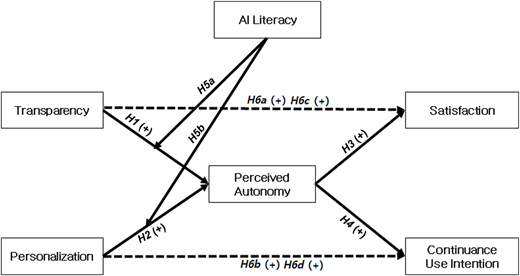
Transparency positively influences perceived autonomy.
2.4 Personalization and perceived autonomy
Personalization refers to the extent to which a service tailors information to individual users' preferences, behavioral patterns, and contextual factors (Srinivasan et al., 2002; Baek and Morimoto, 2012). Personalized recommendations enable users to perceive that their unique needs and characteristics are reflected in the service, creating not merely information relevance but identity congruence with the self-concept.
From the perspective of Self-Determination Theory, autonomy is strengthened when individuals perceive that their actions align with their own values and preferences (Deci and Ryan, 2000). Personalized recommendations lead users to perceive choices as originating from their own preferences rather than being externally imposed, thereby reinforcing a sense of self-determination. Tourism consumption, in particular, is an inherently self-expressive domain in which individuals seek to express their identity through travel choices. When personalized recommendations are perceived as reflecting one's preferences and identity, the experience of autonomous choice is enhanced.
Consequently, personalization functions as a mechanism that transforms external recommendations into “my choice,” and is expected to increase perceived autonomy.
Personalization positively influences perceived autonomy.
2.5 Perceived autonomy and behavioral responses
According to Self-Determination Theory, the fulfillment of autonomy generates positive affect and satisfaction, functioning as intrinsic motivation that sustains behavior (Sheldon et al., 2001). When users integrate AI recommendations into their own judgment processes rather than passively accepting them, satisfaction with the service experience increases. This indicates that perceived autonomy is not merely a cognitive variable but a key factor that shapes the quality of user experience.
Meanwhile, information systems continuance research has identified users' positive experiences and expectation confirmation as major determinants of continuance use intention (Bhattacherjee, 2001). However, recent studies suggest that the degree to which users internalize a service into their own decision-making process – beyond mere satisfaction – constitutes a critical factor in sustaining continued use. From the perspective of Self-Determination Theory, autonomy fulfillment converts extrinsic motivation into intrinsic motivation, rendering behavior self-sustaining. In AI recommendation contexts, when users experience autonomy, the service transcends a mere information tool and is perceived as an instrument supporting their own decision-making, which is expected to strengthen long-term continuance use intention.
Perceived autonomy positively influences satisfaction.
Perceived autonomy positively influences continuance use intention.
2.6 Moderating effect of AI literacy
AI literacy refers to users' ability to understand the operating principles of AI, interpret algorithmic outputs, and critically evaluate them (Laupichler et al., 2022; Long and Magerko, 2020). This capability represents an important individual difference factor that shapes user experience differently even within the same AI environment.
From an SDT perspective, autonomy varies with how individuals interpret their environment: identical autonomy-supportive conditions yield different experiences depending on users' capacity to leverage them. Higher-literacy users can interpret transparency information precisely and convert personalized recommendations into autonomous choices; lower-literacy users may fail to comprehend the same information – consistent with Burrell's (2016) account of opacity from technical illiteracy – and thus fail to translate it into perceived autonomy. Drawing on this reasoning, two moderating hypotheses are proposed. For transparency, because the cognitive demands of processing transparency information are relatively low and accessible regardless of AI knowledge, the incremental benefit of AI literacy for converting transparency into perceived autonomy is expected to be limited. Accordingly, H5a is stated as a non-directional hypothesis, acknowledging the theoretical possibility of moderation while remaining agnostic about its magnitude given the accessibility-floor argument.
AI literacy moderates the relationship between transparency and perceived autonomy.
For personalization, because evaluating whether algorithmic recommendations genuinely reflect one's self-concept requires understanding how AI systems learn from behavioral data, users with higher AI literacy are better equipped to make this evaluative judgment. Accordingly, H5b specifies a positive moderation direction.
AI literacy positively moderates the relationship between personalization and perceived autonomy, such that the positive effect of personalization on perceived autonomy is stronger for users with higher AI literacy.
2.7 Mediating effect of perceived autonomy
According to the Stimulus–Organism–Response model (Mehrabian and Russell, 1974), environmental stimuli influence behavioral responses not directly but through the mediation of internal psychological states. In this study, perceived autonomy is positioned as the core organism variable, and satisfaction and continuance use intention as behavioral responses.
Self-Determination Theory posits that autonomy fulfillment generates positive affect and satisfaction, and this experience functions as intrinsic motivation that sustains behavior (Sheldon et al., 2001). Additionally, Bhattacherjee's (2001) expectation-confirmation model identifies positive experience and expectation confirmation as key factors in forming continuance use intention.
Taken together, service design attributes such as transparency and personalization are expected to influence behavioral responses not directly, but indirectly through the psychological mechanism of perceived autonomy. That is, perceived autonomy functions as the key mediating variable connecting stimuli and behavioral outcomes.
Perceived autonomy mediates the relationship between transparency and satisfaction.
Perceived autonomy mediates the relationship between transparency and continuance use intention.
Perceived autonomy mediates the relationship between personalization and satisfaction.
Perceived autonomy mediates the relationship between personalization and continuance use intention.
3. Research methodology
3.1 Research model
This study conceptualizes AI tourism recommendation services as autonomy-based decision-making infrastructure and integrates Self-Determination Theory with the Stimulus–Organism–Response model to delineate the psychological mechanisms between service design attributes and user behavior, as illustrated in Figure 1.
3.2 Data collection
An online survey targeted adults aged 19 and above who had used an AI travel planner within the preceding three months. Participants were recruited through open recruitment via publicly accessible online communities – Naver Cafe communities and KakaoTalk open chatrooms specializing in voluntary survey exchange – to obtain a demographically diverse sample. To ensure that only eligible respondents completed the survey, pre-screening criteria were applied at the outset. Eligibility required: (1) age of 19 or older; (2) experience using online or mobile tourism services within the past year; (3) actual use of AI-based recommendation services or algorithmic recommendation features; and (4) awareness that received recommendations were based on personalization or AI technology. Response quality was monitored through reverse-coded item consistency checks. The perceived autonomy and continuance use intention scales included reverse-coded items (A4, A6, A7, and CU3); responses showing inconsistent patterns between regular and reverse-coded items within the same construct were identified as potentially inattentive and excluded from the final dataset. Data were collected over 14 days (March 16–30, 2026), yielding 322 valid responses.
3.3 Measurement instruments
All items were measured on 7-point Likert scales (1 = strongly disagree; 7 = strongly agree) using validated scales contextually adapted to the AI tourism recommendation setting; full items appear in Appendix. Transparency was measured with 3 items from Shin (2021), personalization with 5 items adapted from Baek and Morimoto (2012) and Srinivasan et al. (2002), perceived autonomy with 7 items from the Basic Psychological Needs Scale (Deci and Ryan, 2000), some reverse-coded; satisfaction with 3 items from Shin (2021), and continuance use intention with 3 items from Bhattacherjee (2001), one reverse-coded. AI literacy was measured with 3 items from Laupichler et al. (2022), representing functional recognition (AIL1), procedural understanding (AIL2), and critical evaluation (AIL3) – dimensions consistent with Long and Magerko's (2020) conceptualization of AI literacy.
3.4 Analytical procedures
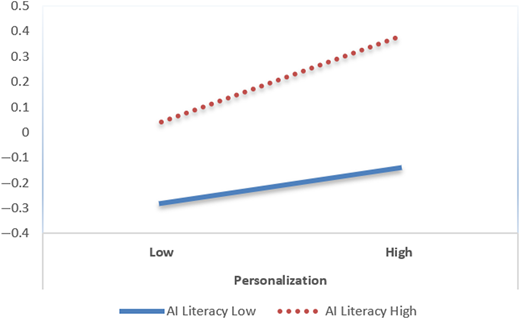
Exploratory factor analysis (EFA) assessed measurement validity, with Cronbach's α evaluating internal consistency. Descriptive statistics examined normality, and Pearson correlations identified variable relationships. Confirmatory factor analysis (CFA) then assessed convergent and discriminant validity, followed by path analysis estimating structural relationships and mediating effects. AI literacy was treated as a continuous moderating variable throughout; interaction terms were constructed from mean-centered scores (Aiken and West, 1991), and a multi-group approach was not adopted, as continuous moderation preserves moderator variance and avoids power loss from dichotomization (MacCallum et al., 2002). Simple slope analysis interpreted the significant personalization interaction at ±1 SD of AI literacy. Variance inflation factors were all below 3.0 (range: 1.31–2.47), confirming the absence of multicollinearity (Hair et al., 1998).
3.5 Sample characteristics
A total of 322 valid responses were analyzed; sample characteristics are presented in Table 1. The sample was balanced by gender (50.9% female) and region (50.3% metropolitan), with respondents in their 20s forming the largest age group (28.9%). Nearly half held a bachelor's degree (49.4%), office workers were the largest occupational group (39.4%), and mobile travel applications were the dominant booking channel (59.0%). Most respondents traveled 3–4 times in the past year (45.7%), and 42.9% reported independent decision-making authority for tourism bookings.
4. Research results
4.1 Validity and reliability of measurement scales
An exploratory factor analysis (maximum likelihood, Varimax rotation) assessed measurement validity; one personalization item fell below the 0.50 loading threshold (Hair et al., 1998) and was removed before re-estimation. As shown in Table 2, the KMO measure (0.928) and a significant Bartlett's test confirmed suitability for factor analysis, and six factors with eigenvalues above 1.0 emerged with all retained loadings above 0.50. Cronbach's α ranged from 0.79 to 0.85 across constructs, exceeding the 0.70 threshold (Nunnally, 1978), indicating satisfactory validity and reliability.
4.2 Descriptive statistics and correlation analysis
Descriptive statistics for the main variables are presented in Table 3. Skewness (−0.51 to −0.18) and kurtosis (−0.35 to 0.47) values confirmed normality, and all inter-variable correlations were positive and significant (0.38–0.63), remaining below the 0.85 multicollinearity threshold (Kline, 2005).
4.3 Measurement model assessment
The results of the confirmatory factor analysis (CFA) indicated that the measurement model demonstrated an acceptable level of fit χ2(71) = 306.40 (p < 0.001), χ2/df = 4.31, IFI = 0.954, CFI = 0.954, TLI = 0.948, RMR = 0.035, RMSEA = 0.073 (90% CI [0.065, 0.082]), and SRMR = 0.051. These indices collectively indicate satisfactory model fit (Hu and Bentler, 1999; Bentler, 1990). The factor loadings, average variance extracted (AVE), and construct reliability (CR) for the measurement model are presented in Table 4. Convergent validity is considered acceptable when standardized factor loadings and AVE values exceed 0.50, and CR values exceed 0.70 (Anderson and Gerbing, 1988). In this study, standardized factor loadings ranged from 0.58 to 0.87, AVE values ranged from 0.45 to 0.63, and CR values ranged from 0.80 to 0.85. Most constructs met the recommended thresholds. Although the AVE of perceived autonomy (0.45) fell slightly below 0.50, three indicators support retention: CR (0.85) exceeds 0.70, all loadings exceed 0.60, and √AVE (0.67) exceeds all inter-construct correlations (max 0.64), confirming discriminant validity (Fornell and Larcker, 1981; Hair et al., 2010). This is acknowledged as a limitation warranting expanded autonomy scales in future research.
Discriminant validity was assessed via the Fornell-Larcker criterion; as presented in Table 5, the square roots of AVE exceeded all corresponding correlations. Regarding the potential overlap between personalization and perceived autonomy, the two constructs differ in locus of attribution – system behavior versus user psychological state – and √AVE (0.67) exceeds their correlation (0.53), though this conceptual adjacency is acknowledged as a limitation.
To diagnose common method bias, a single-factor model comparison test was conducted (Podsakoff et al., 2003). The single-factor model – with all items loading on one latent factor – exhibited poor fit: χ2(230) = 1400.65 (p < 0.001), IFI = 0.666, CFI = 0.663, RMR = 0.063, and a chi-square difference test confirmed the multi-factor model's superiority. Common method variance is therefore not severe enough to distort the findings.
4.4 Structural model and hypothesis testing
Path analysis estimated the structural relationships, with predictors and moderator mean-centered. The model fit indices indicated an acceptable level of fit: χ2(6) = 83.65 (p < 0.001), χ2/df = 13.94, IFI = 0.912, CFI = 0.910, TLI = 0.903, RMR = 0.078, RMSEA = 0.071 (90% CI [0.058, 0.085]), and SRMR = 0.061. While the χ2/df ratio reflects sensitivity to large sample sizes, the remaining indices collectively support acceptable model fit (Hu and Bentler, 1999). The estimated path coefficients are presented in Table 6 and Figure 2. Transparency (β = 0.18, p < 0.001), personalization (β = 0.19, p < 0.001), and AI literacy (β = 0.36, p < 0.001) were found to have significant positive effects on perceived autonomy. In turn, perceived autonomy had significant positive effects on both satisfaction (β = 0.33, p < 0.001) and continuance use intention (β = 0.49, p < 0.001). Regarding the moderating effects, the interaction term between personalization and AI literacy showed a significant positive effect on perceived autonomy (β = 0.11, p < 0.05). In contrast, the interaction between transparency and AI literacy was not significant (β = −0.02, n.s.), indicating that AI literacy selectively moderates the effect of personalization, but not transparency, on perceived autonomy. Regarding practical magnitude, AI literacy's direct effect on perceived autonomy (β = 0.36) was approximately twice that of either service attribute (transparency: β = 0.18; personalization: β = 0.19) – a model-relative comparison rather than a claim of broad dominance. The interaction effect (β = 0.11) is modest, consistent with typical interaction effect sizes in field studies using moderated regression (Champoux and Peters, 1987), and represents a context-specific boundary condition rather than a large-scale amplification.
Given the significant moderating effect of AI literacy on the relationship between personalization and perceived autonomy, a simple slope analysis was conducted (see Figure 3). The results indicate that when AI literacy is low, the increase in perceived autonomy associated with higher levels of personalization is relatively modest. In contrast, when AI literacy is high, the positive relationship between personalization and perceived autonomy becomes substantially stronger, suggesting that the effect of personalization on perceived autonomy is amplified among users with higher levels of AI literacy.
4.5 Mediation effect analysis
To examine the mediating effect of perceived autonomy, a bootstrapping procedure with 2,000 resamples was conducted, and the results are presented in Table 7. The indirect effects of transparency on satisfaction (β = 0.06, 95% CI [0.02, 0.11]) and continuance use intention (β = 0.09, 95% CI [0.04, 0.15]) through perceived autonomy were found to be significant, as the confidence intervals excluded zero. Similarly, the indirect effects of personalization on satisfaction (β = 0.06, 95% CI [0.02, 0.11]) and continuance use intention (β = 0.09, 95% CI [0.04, 0.16]) via perceived autonomy were also significant. All confidence intervals were derived from bootstrapping with 2,000 resamples and are bias-corrected. Accordingly, hypotheses 6a through 6d were supported.
5. Discussion and implications
5.1 Discussion
The findings confirm that both transparency and personalization significantly enhance perceived autonomy, which in turn positively influences satisfaction and continuance use intention. All mediation paths are significant, validating the sequential Stimulus–Organism–Response structure and demonstrating that AI service attributes influence consumer behavioral outcomes not directly but through the psychological mechanism of perceived autonomy.
The most notable finding is the asymmetric moderation pattern: AI literacy strengthens the personalization–autonomy path but not the transparency–autonomy path. Transparency offers rationale that consumers process intuitively regardless of AI understanding, whereas personalization demands a higher-order self-referential judgment – “does this genuinely reflect who I am?” – that requires understanding how AI systems learn from behavioral data, a capacity AI literacy directly supports. An important interpretive caveat merits acknowledgment. As reflected in Appendix, the transparency items are framed normatively – capturing beliefs about what algorithmic systems should do – whereas the personalization items are service-specific and experiential. The two predictors are therefore not measured at the same conceptual level, and the asymmetric moderation result may partly reflect this measurement asymmetry. That said, the transparency items specifically reference algorithmic criteria and outputs, grounding respondents' beliefs in AI-relevant knowledge, and transparency's significant direct effect on perceived autonomy (β = 0.18) indicates the construct captured a psychologically meaningful evaluation. This possibility is acknowledged as a limitation, and future research should employ service-specific transparency measures to test whether the asymmetric pattern holds under parallel operationalizations. The non-significant transparency moderation itself warrants interpretation. Transparency information is, by design, meant to be comprehensible regardless of technical background: when a system states why a recommendation was generated, the rationale is already pre-processed into accessible form. This “accessibility floor” effect means AI literacy adds little incremental processing value – consistent with explainable AI research showing well-designed explanations enhance trust across user groups (Shin, 2021). Future research should examine whether this null moderation holds across different transparency forms and populations.
Additionally, AI literacy exhibits a direct effect on perceived autonomy (β = 0.36) stronger than either transparency (β = 0.18) or personalization (β = 0.19), indicating that consumers' capacity to understand AI is a more powerful source of perceived autonomy than the service design attributes themselves. This finding carries important implications for the personalization paradox in digital marketing: as algorithmic personalization becomes increasingly precise, it is not the quality of personalization but the consumer's ability to critically evaluate it that ultimately determines whether personalized services enhance or erode autonomous choice.
Perceived autonomy influences continuance use intention (β = 0.49) more strongly than satisfaction (β = 0.33). Although direct comparative interpretation requires caution given their parallel positioning as dependent variables, this pattern suggests that in AI-mediated consumption environments, long-term behavioral persistence depends less on how satisfied consumers feel and more on the degree to which they internalize the service as an instrument of their own decision-making. This is consistent with the proposition in Self-Determination Theory that intrinsic motivation, once formed through need satisfaction, becomes self-sustaining – and extends this proposition to algorithmic service contexts where the boundary between consumer choice and algorithmic curation is increasingly blurred.
5.2 Theoretical implications
First, this study provides initial empirical evidence that AI literacy produces asymmetric moderation effects across conceptually distinct marketing stimuli. XAI research has argued that transparency disclosures reduce uncertainty and increase trust (Shin, 2021; Shin and Park, 2019) but has not tested whether AI literacy conditions their effectiveness; personalization paradox research (Baek and Morimoto, 2012; Aguirre et al., 2015) has focused on situational moderators, leaving consumer capabilities unexamined as boundary conditions. The finding that AI literacy strengthens the personalization–autonomy link but not the transparency–autonomy link advances both literatures: it suggests transparency operates independently of user capability, and identifies AI literacy as a consumer resource that converts potentially intrusive personalization into perceived autonomous choice. This challenges the implicit assumption of uniform moderation in prior research (Shin, 2021), though replication with parallel operationalizations – particularly service-specific transparency measures – is needed before generalization. A more precise statement of the contribution is that AI literacy appears to matter more for interpreting personalization than for understanding transparency, pending confirmatory evidence from conceptually parallel designs.
Second, this study introduces perceived autonomy as a process-level mediator that bridges marketing stimuli and consumer behavioral outcomes in AI-mediated service contexts. While consumer behavior research has extensively examined outcome-based mediators such as satisfaction, perceived value, and trust, the present findings suggest that a basic psychological need – autonomy – may function as a more fundamental explanatory mechanism. The stronger effect of perceived autonomy on continuance use intention (β = 0.49) compared to satisfaction (β = 0.33) – interpreted with the caution noted in Section 5.1 – suggests that in algorithmically mediated environments, long-term engagement may depend less on momentary satisfaction and more on whether the service preserves consumers' sense of self-determined choice. This shifts the theoretical question from “does AI satisfy consumers?” to “does AI let consumers remain decision-makers?” – a reframing with significant implications for how AI-driven marketing strategies are conceptualized and evaluated.
Third, AI literacy's relatively stronger direct effect on perceived autonomy – already interpreted in Section 4.4 – positions consumer capability as a theoretically significant source of autonomous experience in AI-mediated contexts. This has important theoretical implications for the personalization paradox in digital marketing: as AI-driven personalization becomes increasingly sophisticated, the consumer's ability to understand and critically evaluate algorithmic processes – rather than the quality of personalization itself – may become the primary determinant of whether personalized services enhance or diminish autonomous choice. This positions AI literacy not merely as a moderating variable but as a strategic consumer resource that shapes the fundamental nature of human–algorithm interaction.
Fourth, by integrating Self-Determination Theory with the Stimulus–Organism–Response framework, this study deepens the S–O–R model's organism variable from emotion- and attitude-level constructs to a basic psychological need level. Positioning perceived autonomy – a fundamental and persistent motivational state – as the organism variable demonstrates that consumer behavior in AI-mediated environments is shaped by intrinsic motivation rather than transient affective responses, providing a more stable and theoretically grounded foundation for understanding post-adoption behavior in algorithmic service contexts.
5.3 Practitioner implications: three design principles
The findings yield three actionable design principles for AI-driven marketing platforms.
Principle 1: Support, Don't Replace. AI platforms should prioritize transparent choice architectures over recommendation accuracy. This involves presenting recommendation rationale alongside results, enabling consumers to modify recommendation criteria and priorities, and providing hybrid modes combining AI suggestions with self-directed exploration. The goal is to position AI as a decision-support tool rather than a decision-replacement agent. Given that transparency enhances perceived autonomy regardless of AI literacy level, transparency features represent a universally effective design strategy that does not require user segmentation.
Principle 2: Guarantee Recommendation Sovereignty. Consumers' perception that they retain ultimate decision authority is critical for long-term engagement. Platforms should provide recommendation rejection feedback, opt-out options, and criterion customization features. The finding that perceived autonomy influences continuance intention more strongly than satisfaction implies that marketers who sacrifice consumer autonomy for short-term conversion gains risk undermining long-term retention. To prevent autonomy depletion as AI accuracy increases, platforms should maintain consumer-directed exploration modes that preserve autonomous search capabilities.
Principle 3: Design Literacy-Adaptive Personalization. The asymmetric moderation by AI literacy demonstrates that identical personalization features produce different effects across consumer segments. For consumers with high AI literacy, advanced features such as algorithm learning feedback, preference dashboards, and criterion weighting tools may be effective in converting personalization into perceived autonomy, whereas intuitive explanations and progressive disclosure interfaces may better serve consumers with low AI literacy – though these specific feature-level recommendations extend beyond the constructs directly tested and warrant validation. Given AI literacy's strong direct effect (β = 0.36), investments in AI literacy education – onboarding tutorials, algorithmic explainers – may strengthen personalization effectiveness, though this correlational inference requires experimental or longitudinal validation before serving as a confirmed prescription.
5.4 Limitations and future research directions
Despite its contributions, this study has several limitations that suggest directions for future research.
First, self-reported measures may introduce social desirability and recall biases; future research should incorporate platform log data, click-stream analytics, and behavioral metrics for more objective verification of autonomy perceptions and continuance behavior. In addition, while reverse-coded item consistency checks were employed to screen for inattentive responses, formal standalone attention-check items were not embedded in the survey. Future research should incorporate explicit attention-check items alongside reverse-coding procedures to provide more comprehensive response quality assurance.
Second, the cross-sectional design limits causal inference; longitudinal tracking of autonomy perception changes over extended AI service usage periods, or experimental designs manipulating transparency and personalization levels, would strengthen causal claims.
Third, the Korean-only sample constrains external validity. Although South Korea is a suitable context given its high AI adoption, cultural dimensions such as individualism-collectivism, uncertainty avoidance, and attitudes toward algorithmic authority may moderate the examined relationships in ways a single-country sample cannot assess. Cross-national replication, particularly contrasting high- and low-AI-adoption Asia-Pacific markets, would strengthen generalizability. Fourth, only autonomy among Self-Determination Theory's three basic needs was examined; future research incorporating competence and relatedness – particularly in social AI contexts such as peer recommendation networks or AI-mediated group travel planning – would provide a comprehensive understanding of psychological need fulfillment in AI-mediated consumption.
Fifth, although a CFA-based single-factor comparison test was employed to assess common method bias, future research should consider additional techniques such as the marker variable approach or the heterotrait-monotrait (HTMT) ratio of correlations (Henseler et al., 2015) to further strengthen the robustness of common method variance diagnostics.
Sixth, recruitment through open online communities and survey-exchange chatrooms may have yielded respondents more digitally engaged than the broader population – particularly relevant given AI literacy's moderating role, as observed effects may attenuate in more representative samples. Respondents also were not asked which type of AI tool they primarily used; the studied service thus encompasses heterogeneous systems (chat-based planners, OTA recommenders, map modules) in which transparency and personalization may operate differently. Future research should recruit representative samples and specify tool type. Seventh, transparency and personalization were not measured at the same conceptual level in the current study: the transparency items are framed normatively, capturing general beliefs about algorithmic explainability, while the personalization items are service-specific and experiential. Future research should align the measurement levels of these two constructs by employing service-specific, experiential transparency measures to enable more refined re-examination of whether AI literacy's asymmetric moderating effects reflect true theoretical differences or are partly attributable to measurement-level asymmetry.
Despite these limitations, this study provides empirical evidence that perceived autonomy functions as a core behavioral mechanism in AI-mediated service contexts, and identifies AI literacy as an asymmetric boundary condition that differentially shapes how distinct marketing stimuli influence consumer self-determination – a contribution that opens new avenues for both theoretical and practical advances in AI-driven marketing research.
Ethics statement
This study was approved by the Institutional Review Board of Pusan National University (IRB No. PNU 2026-03-017, approved February 17, 2026). Participation was voluntary, and informed consent was obtained from all respondents.
AI disclosure
During the preparation of this work, the author used Claude in order to improve English readability, language editing, and grammar refinement. After using this tool, the author reviewed and edited the content as needed and take full responsibility for the content of the publication.
The author gratefully acknowledges the constructive comments of the editor and the anonymous reviewers, which substantially improved this manuscript.
Appendix Measurement items
All constructs were measured using a 7-point Likert scale ranging from 1 (“strongly disagree”) to 7 (“strongly agree”). All measurement items were adapted and modified to fit the context of AI tourism recommendation services.
A1. Transparency
T1: I think that the evaluation and the criteria of algorithms used should be publicly released and understandable to people.
T2: Any outputs produced by an algorithmic system should be explainable to the people affected by those outputs.
T3: Algorithms should let people know how well internal states of algorithms can be understood from knowledge of its external outputs.
A2. Personalization
PP1: This AI tourism recommendation service provides me with relevant information tailored to my needs.
PP2: This AI tourism recommendation service makes me feel that I am a unique customer.
PP3: I believe that this AI tourism recommendation service is customized to my needs.
PP4: This AI tourism recommendation service makes travel recommendations that match my needs.
PP5: I feel that this AI tourism recommendation service is designed specifically for me.
A3. Perceived autonomy (AI-based recommendation context)
(R indicates reverse-coded items)
A1: When using the AI recommendation service, I feel free to make my own decisions.
A2: I feel that I can express my own preferences when interacting with the AI system.
A3: I feel that the choices I make through the AI recommendation reflect my true preferences.
A4 (R): I feel that the AI system pushes me to follow its suggestions rather than my own judgment.
A5: The AI recommendation system considers my preferences and needs.
A6 (R): I feel that I have limited control over the recommendations provided by the AI system.
A7 (R): I feel that the AI system restricts my ability to choose freely.
A4. Satisfaction
S1: Largely, I am fairly pleased with algorithm services.
S2: Overall, the algorithm services fulfill my initial expectations.
S3: Generally, I am happy with the contents of algorithm services.
Note. The term “algorithm services” in the satisfaction items reflects the exact wording used in the administered survey. As clarified in the survey introduction provided to all participants, this term refers specifically to the AI-based tourism recommendation service examined in this study.
A5. Continuance Use Intention
(R indicates reverse-coded items)
CU1: I intend to continue using this service rather than discontinue its use.
CU2: My intentions are to continue using this service than use any alternative means.
CU3 (R): If I could, I would like to discontinue my use of this service.
A6. AI Literacy
AIL1: I can recognize the use of artificial intelligence (AI) in everyday products and services.
AIL2: I understand how AI algorithms learn from data.
AIL3: I can critically evaluate AI-generated recommendations and outputs.