


Studio is the centre of architectural education but has been criticized for reinforcing problematic hierarchies and power structures in the academy, hence reinforcing similar challenges in the profession of architecture. This paper studies an innovative graduate architectural studio framed from a critical pedagogy perspective which aimed to shift specific studio norms about work and processes of social relations concerning collaboration, co-design, the value of time and evaluation systems.
Reflections from student studio participants were collected through semi-structured interviews two years after the completion of the studio. The collected reflections were qualitatively analysed to uncover which non-normative elements of the studio were most salient to the first years of professional practice.
Upon reflection, participants revealed the fact that uniquely deep collaboration, the experience with a “real” project entailing physical construction and a stakeholder/client, respect for work–life balance and fairness of evaluation structures were of greatest value to them from their perspective as practitioners.
This paper sheds light on the specific value to practicing architects of student experiences in innovative studios which present non-normative modes of practice. This builds toward a greater understanding of how innovative architectural pedagogies may also lead to a shift in norms of practice.
Introduction
Critical pedagogy and architecture studio
Studio instruction has formed the backbone of architectural education since architectural instruction shifted toward the academy from an apprenticeship system (Martin, 1983). The centrality of studio has been expressed as architecture's the “signature pedagogy”, shaping how aspiring practitioners think, perform and act with integrity within the profession (Shulman, 2005). Studio instruction is based predominantly on project-based work which is prompted, coached, critiqued and evaluated by a seasoned designer; typically students work alone, but in parallel with other students proposing different solutions to the same design brief (Schön, 1985). Given its centrality in architectural education, careful examination is warranted of the construction of studio pedagogy, and the logics of studio-based knowledge, systems and practices (Crysler, 1995). Critical pedagogy scrutinizes hierarchy and power in education and engages students and instructors in questioning both means and ends of knowledge production. Critical pedagogy in architecture specifically critiques the relationship of the academy to the social, political and economic forces unique to the profession, arguing that hegemonic structures from practice are recreated in and perpetuated by architecture schools (Crysler, 1995; Dutton, 1991). Dutton argues that studio reproduces society's asymmetrical power relationships by selecting what knowledge is emphasized, and by structuring academic relationships hierarchically or competitively.
Critiques of instructor and student roles in architecture studio
Studio-based architectural training develops students' design expertise through sequenced, structured design experiences; roles for instructor and student are distinct from non-studio teaching, and uniquely problematic. Donald Schön's theory of reflective practice underpins much of studio education (Schön, 1983). Schön describes how architectural learning occurs through coached reflection, whereby students learn first by emulation of an instructor and then by self-evaluation, aided by regular instructor feedback (Schön, 1985, 2008). Interactions are central to the learning in studio, as students and instructors both draw on explicit and implicit knowledge to generate new understandings with each design project (Cennamo and Brandt, 2012). Knowledge, is not “transmitted” in the traditional sense of normative non-studio education (Biggs and Tang, 2007), but constructed by the student. However, critics maintain that while studio actively engages students, its overall organization is one of domination. Studio hierarchy positions the student as an “empty vessel” to be filled with expertise by a more talented instructor (Dutton, 1991; Crysler, 1995). Webster argues that studio critique by jury is a mechanism to coerce conformance with professional norms, rather than a support for student learning (Webster, 2006, 2007). Belluigi's review finds that while the role of studio teacher is construed in the literature on studio teaching as master of an underling apprentice, Schön's reflective practitioner (itself reliant on a master-apprentice hierarchy) or atelier coach, there are also examples subverting this hierarchy, where the instructor plays the role of critical friend, student-centred assistant or analyst (Belluigi, 2016). Belluigi notes that constructions of students follow from the way instructors are framed; just as an instructor as “master” thus frames a student as “apprentice”, an instructor as “assistant” might therefore frame a student as “leader.” Hierarchy in general, and the construction of stratified roles in particular are acknowledged in a critical studio pedagogy.
Architectural studio norms, and rejections thereof
Architectural education comprises more than accumulation of knowledge and building of skills. Dana Cuff argues that architectural education also aims to acculturate students into professional norms and values (Cuff, 1991). Some norms are taught explicitly, as in professional practice courses, but most are communicated through implicit messages and structures; Thomas Dutton describes this as the “hidden curriculum” of architectural education (Dutton, 1987). Others argue that architectural education perpetuates an obsolete status quo resistant to contemporary social demands for equity, justice and climate protection (Roaf and Bairstow, 2008).
However, establishing and maintaining norms is not exclusively negative. Schulman asserts that this aspect of professional pedagogy can prepare students to practice as professionals with integrity (Shulman, 2005). Importantly, norms are not static. Architecture's ethical norms have been found to have shifted in the last decades as concerns about environmental and social responsibility have grown more intense (Gillon et al., 2024). The architectural academy can contribute to this ethical turn. Presumptions about the nature of the work of architecture are inherent to studio pedagogy; an instructor chooses only whether to write these out explicitly or leave them implicit within that studio's “hidden curriculum.”
Studio curricula which explicitly resist norms of instructor-student hierarchy and inter-student competition hint at a turn in architecture's signature pedagogy. Salama observes that many alternative approaches to studio tackle perceived problems in the architectural profession, and emphasize the social implications and real-world issues implicit in acts of design (Salama, 2015). Salama writes that the teaching techniques and tools associated with alternative models of studio education offer different processes for students to experience; many emphasize analysis and synthesis in the design process (Salama, 2015). However, studios broaching problems of the profession do not automatically also confront norms within the studio.
While a full review of all non-normative studio pedagogy eclipses the scope of this inquiry, examples abound of studio pedagogies which emphasize deep collaboration, design-build and participatory design with stakeholders; all reject prevailing norms of competition and hierarchy. (These examples are in addition to alternative studio teaching models which emerged during the COVID-19 pandemic which emphasized adaptations to remote or hybrid learning modalities.) Some innovative studio pedagogies have attempted to radically increase collaboration within the studio (Munasinghe, 2019; Qureshi, 2020); one approach included role-play of clients, critics, designers (Austerlitz and Sachs, 2006). Other studios emphasize collaboration with community partners (Dhadphale and Wicks, 2022; Jabeen et al., 2021; Leal et al., 2022; Song, 2024). Design build studios rely on collaborative efforts in design and construction (Gutai and Palaiologou, 2021; Hinson, 2007; Mohareb and Maassarani, 2018). However, while instructors tend to value collaboration among their students, and some research shows that collaboration correlates with rapid design progression (Safin et al., 2021), it does not necessarily follow that students have all needed skills to do so effectively (Karimi and Farivarsadri, 2024), particularly across disciplines (Leathem et al., 2019). Collaboration within the design studio is a skill which cannot automatically be presumed, but must be taught (Park, 2020). Cuff observes that collaborative studios which resist problematic norms, specifically the celebration of heroic solo design activity, what Cuff calls “charrette culture” (Cuff, 1991). These specific examples suggest opportunities for students to encounter democratic, people-oriented norms while in school.
Architectural pedagogy's relationship to practice
The experience of normative and alternative studio pedagogies has implications beyond the bounds of studio. As Cuff writes, “While practice's problems (as they are theorized) help to shape academic training, the reverse influence also holds true: approaches to academic problems help to shape those in practice. The emphasis on the individual designer, the downplaying of budget considerations, the charrette ethos – all are internalized by the student and carried into professional life.” (Cuff, 1991). As such, Cuff emphasizes that schools are modest “instigators of change” confronting contradictions within architecture practice. That said, Cuff maintains that the design problems encountered in school differ from those of practice along several key dimensions: how strongly design is valued, who participates in design, the level of uncertainty in projects, the predictability of the product and the number of stakeholders involved. Similarly to Cuff, Schön writes that the nature of student problem solving frames future design work, “Indeed, an entire design project may sometimes function as preparation for the execution of future projects.” (Schön, 1992). Studio pedagogy construction shapes future practice at the level of the individual and, potentially the profession.
Research motivation
The studio discussed in this paper was developed to provide an alternative model of studio which revealed and challenged the hidden curriculum of architecture. Through the follow-up research presented herein, we examine which, if any, norms and values from the studio persisted across the leap from the academy to professional practice. Two years after the conclusion of the studio, we conducted and qualitatively analysed interviews with studio participants. This paper asks the question: When reflecting upon a studio wherein the parameters of work and processes of social relations were co-designed, which non-normative elements were most salient to the first years of professional architectural practice?
Through this analysis we explore which alternative academic studio practices most influences one's later perceptions as a professional. This allows us to speculate upon Cuff and Schön's broader assertions that the adoption of new studio norms allows for cultivation of new modes of professional practice.
Methods
This study methodology was critical and constructivist, gathering qualitative data through semi-structured interviews; the invited sample was the spring 2022 “Fence+” elective graduate architecture studio at the authors' university. Students eligible to enrol in elective studios had already completed core required design studios; the Fence + studio was aligned with the Ecological Practices Graduate Research Group. All twelve former students from the studio were invited; five elected to be interviewed. In fall 2024 interviews lasting 30–60 min were conducted online, recorded and auto transcribed. (Transcripts were reviewed and edited for accuracy).
An interview protocol was designed based on the research question and themes drawn from a literature review of critical pedagogy, collaboration and alternative studio practices. Questions of design praxiology (Cross, 2007) specifically probed practices codified in the co-developed studio culture policy (described below), and elicited reflections upon participants' professional work. Questions invited reflection upon the studio generally, and the studio culture policy specifically using the think-aloud method (Taylor et al., 2016). This study was conducted per the ethical requirements of the University at Buffalo's Institutional Review Board. The research protocol was reviewed and approved September 10, 2024.
Reflections were thematically analysed using qualitative analysis software (nVivo) to explore relationships between participants' experiences of studio and professional norms and practices. The authors initially coded terms and concepts in student responses by hand on paper, using descriptive phrases. For example, a paragraph from Darren's transcript read, “You're trying to …... you're trying to do these big projects that are the real projects. And they're just hard to get these things done, frustratingly. But you know I see that in my work, and also you know how that transpired, and I have no resentment towards anybody, because I understand all that tape that comes up when you're just trying to do something, especially when you're doing an underserved community. It feels like there's just so much more for no reason. But it's been that way for a while, unfortunately.” The authors marked up this paragraph with the phrases “real projects”, “frustration”, “similarity to professional work”, “red tape”, “understanding the challenges”.
After this initial round of coding, the authors met to compare notes, and similar codes were grouped into broad themes of Professional Work, Studio Policy, Evaluation, Real, Group/Team, Process, Studio as a Course, Community Engagement, Work-Life, Personal Characteristics and Communication. and the authors then re-coded the transcripts to elicit dimensions within initial thematic categories. An example theme, along with description and sub-themes is shown in Table 1. Both authors participated in coding, and results were discussed frequently to correlate emerging code structures.
A typical theme and sub-themes developed following initial transcript coding
| Theme + dimensions | Description |
|---|---|
| Professional work | Related to things which happen in architectural practice |
| Asking for flexibility | |
| Being not technically an architect | |
| Being open to different settings | |
| Building trust | |
| Changing expectations | |
| Collaborating with others | |
| Comparing to studio | |
| Contributing ideas | |
| Designing things | |
| Experiencing challenge | |
| Having a bad job | |
| Learning more about buildings | |
| Managing people | |
| Managing time or money | |
| Missing studio | |
| Teaching architecture | |
| Working in a local firm | |
| Working on a project team | |
| Working toward licensure | |
| Working while in school | |
| Working with clients |
Fence + studio pedagogy
The authors co-taught the Fence + studio over a 16-week semester, meeting twelve hours weekly in three sessions. One author taught a seminar taken by a third of the studio the preceding term, which aimed to provide critical underpinnings for practices of deep collaboration, co-production of knowledge and anti-oppressive design. The studio worked with a non-profit partner, Buffalo Go Green, to design the edge of a new urban farm in Buffalo, NY's Bailey–Green neighbourhood. The studio's title Fence+, emphasized the charge to design a generous, engaging and functional boundary for the property; a “Fence+” is more than a “fence”. The studio scope was to co-design, fabricate and install a 150 ft long Fence + on the community partner's site, as shown in Figure 1. Funding was provided through a Foundation for Food and Agriculture Research grant [1]; the studio solicited additional support through in-kind donations.
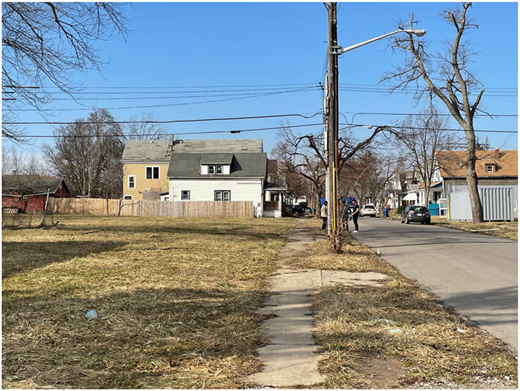
Community partner's site, composed of five adjacent vacant lots. Source: Photo by author
Community partner's site, composed of five adjacent vacant lots. Source: Photo by author
Studio culture policy development
The Fence + studio critiqued the institutionally-approved Studio Culture Policy from 2005, and collaboratively wrote a new, Fence + Studio Culture Policy to codify values of student agency over their time, space and experiences. (See Appendix for text of the policy.) A signed copy was posted in the studio, and reviewed with visitors (e.g. critics, consultants) to underscore intended practices. The policy structured processes of decision making, practices for conducting work and methods of communication. It emphasized consensus decision-making, full participation, non-hierarchical structure and overall student agency.
Pedagogical intentions and strategies: dismantle engrained studio hierarchies
The Fence + studio pedagogy revealed architectural practice's embedded power differentials by bringing critical attention to norms and values of the studio's process and discourse, and empowering students to manifest these. At the time of this writing, he authors had collectively taught in architecture programs for 17 years. In our individual and shared experiences, studio teaching has some challenges; student-student collaboration seems to incentivize production over process; community engagement is at odds with solo, self-driven studio projects; the spectre of grading and assessment lurks behind every conversation between faculty and students. Generally speaking, students work in ways and at levels which are to the detriment of their own health and well-being. While the culture of these has improved since the time the authors attended architecture school, the norms of hierarchy, competition, solo “heroic” overwork tenaciously persist in the studio. Shaped by readings in critical pedagogy by Dutton and Crysler, we developed the intellectual frame for the studio around four specific reactionary intentions (Dutton, 1987; Crysler, 1995). Dutton's curriculum restructured key studio elements: it redistributed studio power more democratically, with careful attention to grading through “an equal combination of self-evaluation, peer evaluation, and my [instructor's] evaluation”; it emphasized group work to build student–student relationships and de-emphasize the teacher–student hierarchy of solo crits; it encouraged students' consensus decision-making, and empowered students to choose a design focus based on their interests and values (Dutton, 1987). Inspired by this precedent, the Fence + studio set forth four aims:
- (1)
Collaborate deeply within studio
The studio aspired to significant, authentic collaboration among students wherein students would bring their backgrounds, experiences and values into the studio as in Austerlitz and Sachs (2006), Dutton (1987), and structured assignments to prompt design co-authorship and deemphasize individual ownership of design ideas. After brief individual “warm-up” assignments, students worked in partnerships which later coalesced into small groups; partners and groups migrated often. Work was shared and discussed at milestones to encourage idea exchange. When commencing design development, the studio co-wrote a statement synthesizing driving ideas; thereafter small groups handled specific aspects, soliciting other groups to inform further decisions. Groups reshuffled as needed. During fabrication, students each took leadership of elements of fabrication, coordinating the labour of others to procure, move and process materials. Work was coordinated in full group conversations, as in Dutton's model (Dutton, 1987).
- (2)
Co-design with community partner
The studio aimed to work co-equally and empathetically alongside our community partner as in Dhadphale and Wicks (2022) to refute the notion of architecture produced by the solo creative genius. We structured a close relationship through site visits, regular studio visits and presence at all milestone reviews.
- (3)
Democratize evaluative structures
The studio resisted established professor - student hierarchies to effect more democratic studio practices of guidance and evaluation. Reviews were structured as co-design opportunities rather than critique; students, professors, partners and guests sat at a table with a screen; students stayed seated to present, prioritizing equitable, “eye-level” conversations and refuting normative critic – student hierarchies (Webster, 2007). Acknowledging shortcomings of the established norms around grading, the studio used peer- and self-evaluation methods with extensive written comments at both formative and summative reviews. This aligns with so-called the notion of “ungrading,” a critique of our systems of grading and a questioning of the way in which our teaching has come to be shaped by systems of standardized and quantitative grades (Stommel, 2024).
- (4)
Recognize the value of students' time
The studio valued students' time so as to push back on the “charrette culture” of academic architecture where work completion edges other classes, as well as sleeping, eating and showering (Cuff, 1991). The studio recognized that students have other classes, jobs and personal commitments by emphasizing flexible deadlines, and online accommodation or schedule modifications for illness or personal circumstances. Full-studio collaboration meant students contributed to different tasks, and work could be shifted to balance works load or meet fabrication deadlines.
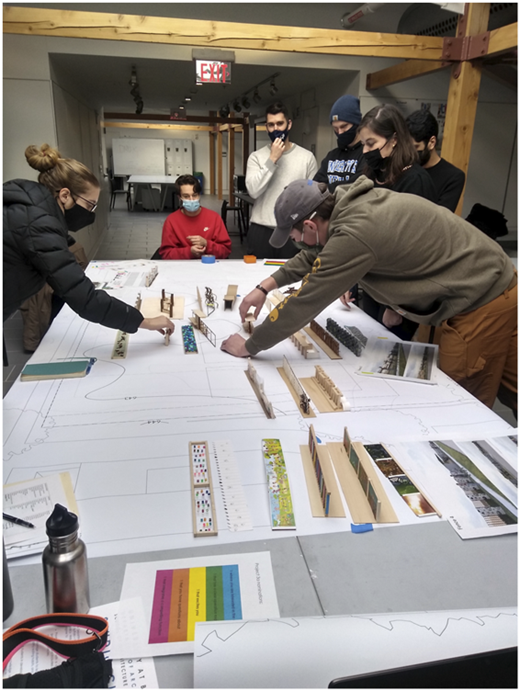
These aims, developed from the seminar to the studio brief, to the co-authored studio culture policy, underlay all of the work conducted in the studio. Within this collaborative and democratic framework, the architectural production of sketches, scale models, detailed drawings and a full-scale construction were completed within the semester. Examples of the student design and fabrication work can be seen in Figures 2–5.
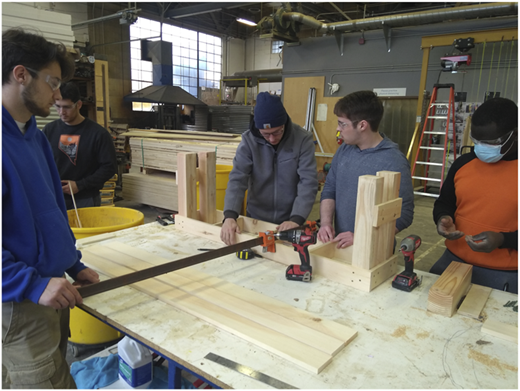
Students working in the shop together to construct wooden benches for Fence+. Source: Photo by author
Students working in the shop together to construct wooden benches for Fence+. Source: Photo by author
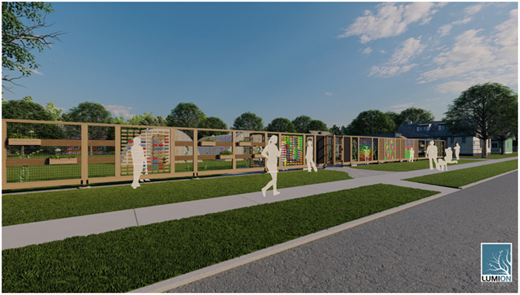
Rendering of Fence + installed on site. Source: Rendering produced by Fence + students, and used with permission by author
Rendering of Fence + installed on site. Source: Rendering produced by Fence + students, and used with permission by author
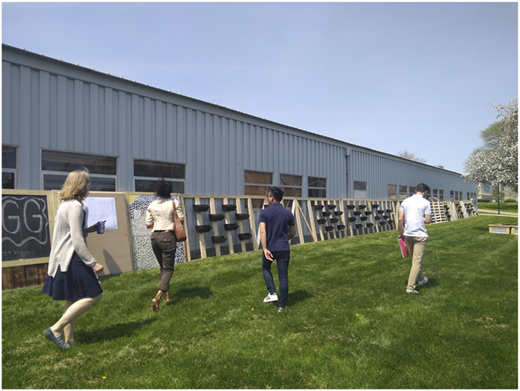
Fence + panels displayed against a building on campus for Final Review. Source: Photo by author
Fence + panels displayed against a building on campus for Final Review. Source: Photo by author
Results
This section describes the results of our interviews which probed the research question on salience of non-normative studio parameters to initial professional practice. Several themes emerged from an analysis of the interview transcripts: work on something “real”, unique collaboration, respect for work–life balance and fairness of evaluation. Each theme is described briefly below with illustrative quotes from interviewees and considered further in the Discussion.
Notions of “real”
Working on something “real” was particularly pertinent. Nearly every subject mentioned a desire for a “real” project as a motivation to select the studio or distinguished this studio from previously taken ones based on this characteristic. Responses about “real” clustered along two dimensions: that of “real” physical construction, and involvement of a “real” stakeholder or client. In this section, responses hew closely to the language used in interviewee responses; the notion of “real” is discussed further along these two dimensions in the discussion.
When describing motivations for studio selection, students mentioned the promise of designing something which was physically constructed on a site, to be seen, used and appreciated; this is not “just” a paper drawing. Harrison [2] said simply, “I really like the design-build aspect,” and Audrey that, “I also wanted to build something and see it up and somewhere.” Comparing it to previous studios, Seth observed, “I think what I feel was different, was the practicality of it and the implementation of the fence, because we actually built the fence.” Darren said, “I want to build. Still, I don't want to just sit here and design stuff forever …. Making the final thing. You know, that's what was so enticing to me.” Comparing this to other studios, he noted, “Most of the time, you're going to design this building, and you have no worries about it because you don't have to worry about anything. You're just designing it.”
Within the theme of “real” was also the dimension of working with a stakeholder or client. On this Abigail said, “Seeing the Fence + studio and knowing that we'd be working with a community partner, I really wanted to get in there and work with the community … So that's what stuck out to me where I wanted to do more of that community engagement. So that's what drew me.” Audrey noted, “I really felt that also important was collaboration with [community partner], and the fact that she was coming to studio so often and giving feedback, and also that grounded and made the project real. We could have designed anything super not practical for this specific use, but the fact that there [were] more stakeholders, I think that was also very important because that made the project. We had an actual client, almost, and actual objectives to meet.”
Participants felt that a “real” project was important to them for their professional work. In emphasizing this, Darren noted about his job searching, “I can't really show off most of my stuff [in my portfolio], because it just doesn't feel like they're real projects.”
Unique collaboration
The experience of collaboration in this studio came across as powerful. Responses indicated that collaboration was different in this studio, as compared to previous academic work due to a uniquely “all hands on deck” approach. Audrey noted, “The most outstanding, I think, was collaboration. It was actually harder than I thought, but it was very interesting to approach the studio differently than like a competition kind of thing.” She pointed out the distinction from other academic experiences, but alignment with professional ones: “It was the collaboration between the students …. I think the dynamic within the studio was very different [than other studios].” Harrison said, “Since this was a team effort, you know, we were all pushing at an equal pace and it's not just on one person. If someone's falling behind on something, we're all falling behind.” He went on, “So, I felt like that was definitely like the biggest team-building studio out of any I've taken.”
Additionally, students reflected positively on the new experience of dissipation of design idea “ownership” over time. Audrey said, “In many studios where I had to collaborate, even in small groups of peers, I can think back on the end project, and I can recognize whose idea was the primary thing that we took and then developed and improved as a group, and we ended up with a project … But with this studio I have no idea who had the idea of any of the parts of it …. It wasn't just one genius idea that we all agreed that it was the best and did it.” Seth observed that collaboration extended to the research processes, “Everything was more like working together with, or collaborating with the other members of the team in producing, or in the research.”
Students noted how collaboration meant sharing work as well as ideas. Harrison noted, “It brought to the table a lot of different people of different experiences. So that really helped us cover all the fields, and then, even selecting who did what and if anyone needed help – like to jump in and help each other out – that really worked the best. You know, someone may be more experienced in something than someone else and could either take the lead on it or help out in the situation.” This was particularly true during construction. Abigail noted: “... [I'm] remembering near the end of the academic semester having the final. It was just crunch time, where, even though everyone had their own part to play, we all came together and helped out where needed. So, I remember making planter boxes with [another student]. We were doing that, and then Darren came over to help us. So, it was just [all] hands on deck.”
Students made connections between experiencing collaboration in this studio and in their offices. Harrison said, “This studio is definitely the most similar to actual work in an office … Not that we had specific ranks, but, you know, a certain person to go to for the certain jobs. Let's just say that we divvied up. And it's pretty much the same sort of idea, and at least [in] my office.” Audrey expressed a similar idea, “I could clearly see [it] playing out in the office, how the collaboration actually worked. It was me and another person as interns, and we had to finish something by a deadline. And it was a lot of this helping out and doing something to finish what we had to do.” Seth noted of a colleague in his office, “I used to go to her every single time I had questions, but we don't work together on the same project. But we do ask each other questions anytime.” Darren, already in practice while in the studio, observed that what stood out to him was, “Really collaborating with the students, and then also having that collaboration with people like on the ground in our clientele. Essentially, I think [this] really drove home a lot of the things I was already doing at work. Where I work now we're all working towards the same goal.”
Every interviewee noted how the studio's practice of weekly fresh food sharing helped facilitate socializing, informal conversations and trust-building, which in turn eased collaboration. This seemed particularly beneficial to quiet, introverted or new students. Audrey observed of this practice, “You got to socialize in different ways with [your] peers.” Thinking of her subsequent office work, she added, “Actually, when I was working at the office and it was Friday sometimes, and I [would] be hungry and I was like, ‘Oh, I wish there was like a Fresh Fruit Friday here.’”
Respect for work–life balance
Also noteworthy to interviewees was the studio's attention to work-life balance, specifically the valuing of time and maintenance of flexibility. Participants found their time to be valued when workload expectations workload were clear and reasonable. Abigail said “There [have] been a lot of times [in other courses] … where we will get loads and loads of homework or assignments that we have to work on within a very limited timeframe. So having the opportunity to have a realistic amount of work … within Fence+ was more than we could have ever asked for. I think that was just new to us, and we very much enjoyed it.” Darren's description of previous studio's experiences was, “That's where you build a horrible culture of overwork and stressing out and trying to do stuff that's just not possible.”
Flexibility was also noted by participants. Abigail had to be absent for a personal emergency during the term and recalled that, upon her return, “[The instructors] sort of were just like, ‘Okay, slowly, get back into the rhythm. Take on what you can, and then we'll work from there.’” Abigail noted how this experience set an expectation for flexibility, saying, “Then once I graduated, I worked with a firm for a short little while, and they were not like that whatsoever, and [it was] miserable, dreary.” That said, requesting flexibility is not easy. She observed, “I definitely have grown more into receiving and accepting the flexibility. Still have those battles every once in a while. But I have come to learn more about not being so timid or nervous, or feeling the guilt of asking if I need it, if my supervisors and bosses don't offer it to me.”
Fairness of evaluation
Interviewees voiced the importance of evaluation methods, and of their efforts being seen by others. Audrey noted, “It wasn't like, ‘Okay [I'm] going to paint these things, and if this is perfect, [I'm] going to get an A.’ It was more like this is an overall project that if we all put our effort and work on this, we're going to all collectively have good grades, or this is going to be a success overall.” Abigail said, “It's not just the professors looking at what I'm doing, it's all the classmates. So, however many pairs of eyes are on me, that gives them the motivation to really start working, putting in the effort, making sure that everything's all distributed equally, and everyone's doing what they're supposed to do.” While nearly all participants brought up the studio's peer evaluations, when asked none could recall any feedback they had thus received.
In addition to grading, participants found the democratic nature of reviews significant. Darren observed, “It was a conversation. Which, you know, that's all architecture is. It's just a constant conversation between you, the client, the world, the site, your coworkers and everything like that. And it was much more of a useful critique.” Audrey, who later taught first-year studio, carried the idea of “eye-level reviews” into her teaching. She recalled, “I think very interesting from that policy was this eye level review thing. I had the chance to do it once with a group of freshmen students. And I think that doing that in that studio helped me … I think it was very effective.”
Discussion
Interviewees frequently used terms like “real [3]” in the context of this studio, but careful reading reveals a subtle shift in the meaning with the person's position and expertise. Before taking the studio, interviewees considered the scope of the Fence + project to be “real,” and recalled that the “real” felt underrepresented elsewhere in the curriculum. Dimensions within this are discussed at greater length below. While in the studio, wherein “real” issues of one's labour and time were valued, students valued “real” methods of evaluation and efforts to balance life inside and outside of studio. Interviewees affinity for “real” projects persisted to their time in practice, wherein the “reality” collaboration brought many comparisons to Fence + studio experiences.
Working on a “real” project
While superficially counterintuitive, “reality” is radical in many architecture studio projects today. Interviewees returned frequently to the notion of the Fence + project as “real”; many selected the studio for its reality, citing this as a positive differentiator from previous studio experiences, but one that prefigured their professional work. The realistic issues noted by participants in this studio included construction with full-scale materials, working within limitations of cost or time, facing challenges directly, and working with the needs of others. Salama maintains that an emphasis on realistic issues is one key way studios challenge convention (Salama, 2015), while Cuff's comparisons between architectural academy and practice gives possible dimension to “reality” in the studio context (Cuff, 1991). See Table 2 for a summary of Cuff's comparison between design problems in architectural practice, the academy and the authors' interpretation of each dimension for the Fence + studio.
Characteristics of the architectural problems for projects in the profession and the academy, with comparison to the Fence + project
| Characteristic | Architectural office | Academy | Fence + project |
|---|---|---|---|
| Design | Design in the balance
| Design as a master value
| Design as a leading value
|
| Participants | Countless voices
| Solo or duet
| Many voices
|
| Dynamics | Professional uncertainty
| Clear problems
| Managed uncertainty
|
| Product | Surprise endings
| Uncertain solutions
| Surprise design
|
| Process | Perpetual discovery
| Curtailed process
| Closed-ended, circular
|
| Stakes | A matter of consequence
| Singular stakes
| Significant to several
|
Students appear to confer designations of “real” on aspects aligned with several of Cuff's characteristics of practice. In the academy, Design is “a master value” to Cuff, wherein students are not burdened by economic or political considerations; practice must balance design and business (Cuff, 1991). When interviewees noted the “reality” of material cost estimates and budget constraints, they align “reality” with Cuff's practice characteristic of Design. Additionally, Cuff defines academic Participants as individuals guided by a master designer, whereas in practice many have input and influence. The interviewee who noted “the fact that there were more stakeholders … was also very important” describes a practice-based Participant characteristic. Cuff sees clarity and focus in the Dynamics of academic design problems, avoiding the ambiguity and complexity in practice. Contrasting it with Fence+, one subject said of previous studios, “You don't have to worry about anything. You're just designing.” The Fence + studio attended to aesthetic quality, but also budget, schedule, politics, structure and durability, thereby compelling students to wade into Schön's “swampy low ground” of important, messy problems from practice (Schön, 1992), Rittel and Webber's “wicked problems” (Rittel and Webber, 1973) or Cross's “ill-formed problems” (Cross, 2007). As one interviewee described a built professional project, “It's so much more than you could imagine, because to any non-architect, non-engineer, a building's a building to them, you know?” Complex and ambiguous work for students contrasted with previous studios but aligned later with practice. In Cuff's view, the Product of design in practice is a (potentially novel) building proposal, but in academia is a formal or visual proposition, often rule-breaking or brief-challenging. As a design-build studio a physical proposal was given for Fence+, further aligning it with practice, and leading one interviewee to remark, “It was the implementation aspect that was quite different from all the other projects.” However, due to an unforeseen land acquisition challenge, the Fence + structure was fabricated but not installed during the studio. Outwardly this curveball impedes student engagement in a “real” project; while the Fence+ was fabricated and exhibited, it was not installed onsite as planned. However, the studio frequently discussed the emerging issue of land tenure with the partner, and students appeared to understand the consequent shift from site installation to prototype exhibition as a further indication “reality”; one said of the situation “That's the most real-world we've ever seen in any [studio].” The Fence + studio Process fell between where Cuff saw the academy and practice; an iterative cycle of design was constrained by the academic calendar. Last, by inspection, Fence + aligned with the Stakes of practice, wherein having a community partner extended the consequences beyond the studio.
The axes of “real”
While several of Cuff's characteristics of practice are observed to describe interviewee notions of reality, arguably two axial dimensions of relationship to “real” construction and presence of a “real” client have greater salience to the subjects of this study. These two dimensions are roughly analogous to two notions of “real” projects in architecture pedagogy: “design-build”, which emphasizes learning through the manual labour of real construction, and “live build,” which underscores learning through the soft skills of working with real clients (Brown and Russell, 2022). Notions of “reality” as expressed exist on the continua from “real” to “un-real” along these two dimensions. To interviewees, “real” construction studios had projects physically made at full scale, a real site and some level of permanence; they were enclosed, photographable, responded to gravity and physical forces and adhered to code. Projects with “real” clients had stakes for occupants, users or owners outside the studio, involved another's budget and financial interests and brought benefit to the broader community. While dimensions of reality emerged in all interviews, “real client” was emphasized by some interviewees and “real construction” more by others. These two dimensions together describe four models of reality-based studios. Figure 6 illustrates four quadrants delineated by these notions of “real”; each quadrant is described further below, citing illustrative projects from the architecture educational context.
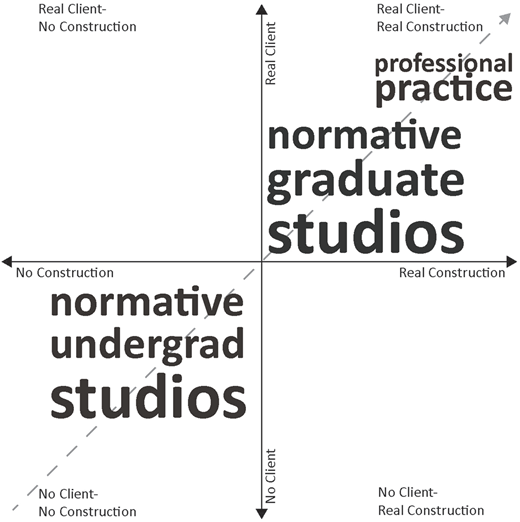
Client and construction dimensions of “real” and the four resultant models of reality-based projects. Source: Authors' own work
Client and construction dimensions of “real” and the four resultant models of reality-based projects. Source: Authors' own work
Real client – real construction: This type of project is designed and built for a stakeholder. Projects in this quadrant range considerably in construction complexity; some are fully enclosed, functioning houses, constructed in studios programs such as University of Kansas's Studio 804 (Rockhill, 2023), Tulane's Rural Studio (Dean, 2002) or University of Virginia's EcoMod (Quale, 2008). Other projects in this quadrant may be simpler structures, such as the Fence + described herein, or the shelters for refugees constructed at Beirut Arab University (Mohareb and Maassarani, 2018). This quadrant also describes many projects typical of architectural practice.
Real client – no construction: This type of project includes extensive stakeholder engagement followed by a design proposal absent any physical making. Studios may provide reports or graphics to a client to be used for fundraising, community engagement or policy advocacy; arguably work is leveraged toward future construction, though none occurs within the studio. While “real client – no construction” resembles unbuilt work of practicing firms, student-produced academic work is not routinely stamped by a licensed professional. Examples of projects in this category include those of university-affiliated community design centres, such as Lawrence Technological University's Detroit Studio (Kim, 2024).
No client – real construction: This type of project includes physical construction absent the input from the eventual owner/user. As with “real client – real construction”, projects in this category range from full buildings, such as the houses constructed for the Solar Decathlon competitions see (Bohm, 2018 for one example of many), to installations, prototypes or follies, often constructed on campus, such as the furniture and office prototype constructed at Florida A&M (Chamel, 2016), and the pavilions constructed at Loughborough University (Gutai and Palaiologou, 2021).
No client – no construction: This type of project is arguably typical of architectural studio, wherein a design is developed without a stakeholder external to the studio, and developed through drawings, renderings and scale models. Both dimensions range within this category. Some studios may suggest characteristics or preferences of hypothetical clients or be informed by client proxies; some studios emphasize construction pragmatics through large-scale detail development, extensive drawing sets, specifications, cost estimates or other evidence of constructability.
Fence + interviewees overall desired less experience in the “no client – no construction” quadrant and more of the “real client – real construction” quadrant; they understood projects ultimately to be most “real” regarding construction and client in practice and craved more of these experiences earlier. Some of this may be driven by an interest in finding professional work, and perceiving “real” projects as a more certain path toward this; one interviewee expressed a desire to have a portfolio with a “real” studio projects for job interviews. However, this may also be driven by values and concerns which lie outside the narrow focus of the simplifying assumptions of “no client – no construction” studios.
Broadly speaking, many architectural curricula, including that of the authors' home institution, progress from the “no client – no construction” projects toward greater reality in both dimensions; more complex projects are assigned to more experienced students. However, this trajectory is not inherent to emerging design expertise, and has notable exceptions wherein first-year students engage in “no client – real construction” projects (Gutai and Palaiologou, 2021; Stonorov, 2018). Additional pedagogies which break this perceived progression and offer “real” opportunities earlier on would provide students more chances to grapple with and build expertise in “real,” situated problems of architectural practice.
Taking into account life outside of studio
Interviewees valued bringing the “reality” of their outside lives into studio and reconciling this with their project labour; they frequently noted the studio's attempt to codify balance between studio work and life outside it. In particular, instructors agreed to assign “realistic amount of work over the course of a week,” and to define temporal expectations for deliverables (e.g. an eight-hour drawing, or a four-hour construction task) while taking into account non-studio commitments. Students shared detailed schedules of academic, work, and family commitments, and then constructed collaborative work shifts to accommodate these. During construction specifically, expectations were defined by hours spent in shop, rather than on a task completion. Students who finished their work early helped others with incomplete tasks.
A related provision existed already in the school-wide studio culture policy developed in 2005, which asks faculty to “Encourage students to lead balanced lives. This includes regular sleep and exercise, healthy eating habits, and breaks for non-architecture related endeavours.” Despite this being posted widely, interviewees claimed no awareness of it and recalled unbalanced experiences in previous studios. The co-authoring of the Fence + studio policy on work-life balance, the specificity its language and its consideration in project organization were critical to adoption.
Studio practices framed student time as limited, and student labour as valuable; arguably two characteristics of fair labour practices in general. More specifically, these practices attempted to refute what Cuff termed “charrette culture” in architecture, which entails not only long hours (as many professions require) but working as long as needed to complete a project by a deadline. One interviewee's experience of the studio's flexibility and shared responsibilities gave her the wherewithal and confidence years afterward to leave a job which did not offer similar qualities. This suggests that the inverse of Cuff's assertion may hold. Cuff asserts that the academic charette ethos is carried into professional life; here a balanced ethos in school carried forward into practice.
Methods of evaluation matter
Thoughtful evaluation of one's efforts matters to both students and professionals. While co-developing Fence + evaluation processes, students were keen for grades to reflect effort and time invested, as well as the quality of work products. Ultimately the grading scheme reflected engagement and collaborative participation, gauged by both instructors and peers as well by assessing satisfaction of project criteria. Interestingly, when reflecting on grading, several interviewees described it as reflecting effort and not quality, seemingly ignoring the balance between the two after the intervening years. Perhaps from their perspective as practitioners, the relationship between time and reward aligns more closely with professional correlation of time and remuneration; wherein a presumed threshold of professional quality is implicit, with little to no incentive to exceed.
While this makes some sense when viewed through the lens of the business of architecture, the perceived diametric relationship in grading systems of effort versus quality perhaps reveals a broader conflation of values in architectural education. Specifically, when studio products, described by Cuff as “formal and technical responses based primarily on visual appearances “are evaluated in isolation of the process of production, it suggests that these products are the intended outcome of the studio endeavour. Grades thus should be allocated solely on quality. However, if evaluating the incorporation of situated and generalized understanding evidenced by design drawings and models, these products are seen as indices of learning, with the development of expertise as the intended studio outcome. Evaluating drawings is more straightforward and can be carried out by graders external to the studio; assessing learning suggests the involvement of a studio critic with knowledge of the student's progression. As Dutton emphasized, it is important to balance this input with those from each student in the studio, as “the granting of the grades is clearly one of the most formidable weapons in the professor's arsenal” (Dutton, 1987, p. 19). Democratizing grade allocation, and accounting for labour and effort in addition to product helps to redistribute authority in the studio. This provides a precedent for students moving into practice wherein both ends and means are valued.
A different kind of collaboration
While novel as students, the intense collaboration of Fence + felt familiar once in practice. Cuff describes that architectural academy and practice differ in their Participants; in school no one but the student is affected by a design's results, whereas in practice design has consequences for people well removed from the architect's office (Cuff, 1991). The stakes of the Fence + work were understood as shared by the full studio; as one interviewee said, “If someone's falling behind on something, we're all falling behind.” Others described their work in practice similarly; if a project fell behind the firm as a whole was behind and would adjust to respond.
As described in the previous section, the value of collaboration may be misunderstood if studio objectives are articulated as production rather than learning goals. Studios structured to reward learning explicitly may also see value in shared work, as a study of collaborative design suggests that students working together progress more rapidly through design than solo actors (Safin et al., 2021). However, one identified consequence of collaboration was an ambiguity around authorship of ideas, as Audrey described when she couldn't discern who originated a specific element of the project. This would be problematic on its own if coupled to a grading approach evaluating products at face values; a system of self-, peer- and instructor-evaluation of process is incumbent in a collaborative project.
Face-to-face social connections among students were essential to collaboration. Specifically, each interviewee brought up, unprompted, the studio's weekly tradition of coordinated food sharing. In Dutton's words, this allows the humanity of the “whole student” a place in the studio, not simply the student-as-designer (Dutton, 1991). Social connections were an important to relationship building, which in turn facilitated trust for deeper collaborative work.
Study limitations
While this study sheds some helpful light on the salience of alternative studio practices to emerging professionals, further study on this topic is certainly merited to mitigate limitations. While all interviewees had graduated, power differential had shifted from the hierarchy explicit in a graded studio, the authors acknowledge that some power differential may still have been perceived by participants, affecting their willingness to provide critical or negative feedback. This was anticipated in structuring interview questions as open-ended and reflective, and not evaluative, but the same hierarchy, which was central to this investigation, may still have influenced student responses. While the interviewees' comments were not exclusively laudatory, there was a generally positive tone to their responses. This is a limitation inherent in interviews conducted by the studio instructors central to the nature of the studio pedagogy. While this may delimit the ability to assess the quality of the studio, it should not greatly inhibit the ability to investigation the nature of the impact of the studio on students' subsequent experiences.
This evaluation drew on responses from five of twelve participants in one studio; as such while illustrative of key issues it is difficult to generalize broadly. It is possible that participating subjects had more positive studio and professional experiences, and were hence more open to reflection through interview.
Interviews were carried out more than two years after the studio's completion; results may have differed had participants been interviewed immediately after the studio, or after accruing more substantial professional experience.
Conclusion
The architectural academy is both shaped by and shapes architectural practice; bringing a critical eye to the signature pedagogy of architectural education is essential to effecting change. In the Fence + studio we set out to democratize the prevailing hierarchy of studio by establishing four new studio norms relative to collaboration, co-design, evaluative structures and the valuation of students' time. After leaving school and beginning practice, participants in the studio recognized the uniqueness of this experience, and the importance of such an experience to their roles as emerging practitioners. Of particular salience were deep collaboration, the experience with a “real” project, respect for work-life balance and fairness of evaluation. Broadly speaking, participants valued the ways it prepared them for agency within professional practice. This points toward the potential for new studio practices to cultivate incremental, bottom-up change to norms of architectural practice. Further research is needed to better understand better the mechanisms and potential impacts of such changes.
Disclosure statement
The study materials for the project referenced above were reviewed and approved by the University at Buffalo Institutional Review Board by Non-Committee Review. The UBIRB has determined on 9/10/2024 that the research is Exempt according to 45 CFR Part 46.104.
The authors are indebted to the efforts of all students of the Fence+ studio, but respects their privacy by allowing them to remain anonymous. Furthermore, the tireless engagement with our students by our community partner, Allison DeHonney of Buffalo Go Green is acknowledged with warm gratitude. This work was only possible following an extended collaboration with a large network of academic and community partners: Emmanuel Frimpong Boamah (University at Buffalo), Fernando Burga (University of Minnesota), Yeeli Mui (Johns Hopkins University), Samina Raja (University at Buffalo), Michelle Horwitz and Darryl Lindsey (Appetite for Change), Queen Frye and Diane Picard (Massachusetts Avenue Project), and Rebekah Williams (Food for the Spirit). The authors are also grateful to the anonymous reviewers of this article, whose comments strengthened and refined the work.
Appendix
Fence + Studio Culture Policy Statement
The Department of Architecture in the School of Architecture and Planning at the University at Buffalo acts in accordance with the NAAB studio policy requirement. Therefore, all studio faculty and/or departmental administrators agree to:
Provide students with a syllabus that complies with the University at Buffalo syllabus guidelines, and includes a studio description, objectives, evaluation methods and grading policies, with the understanding that these may change.
Grading and Evaluations are to be agreed upon as assignments change.
Detailed timeline of deliverables; amount of time needed to complete certain assignments, taking into consideration time commitments outside of class.
Facilitate students to lead balanced lives by assigning realistic amounts of work over the course of a week.
Correlate work between other architecture courses and studio.
Larger push for integrating knowledge and information acquired in other architecture courses in studio, when possible.
Be respectful of other student's personal belongings and materials by not taking or stealing anything without permission.
Professor to represent complaints of the studio.
Reinforce fostering a constructive atmosphere in design reviews, more equal dialogue and eye-level conversations.
Encourage socialization between studios of all years.
Reward effort vs “quality”; the real learning comes from doing your work in class. The effort a student puts forth should determine the class grade. If students put little to no effort into the overall project, their grade should reflect that.
Peer review grading for all students who work directly with one another. Reviews will not determine final grading but will play a large part in the professors' decision.
Fabulous Fresh Fruity Fridays Forever (NO NUTS) (variable: various vegetables).
Approved by the students of ARC 606 EP| University at Buffalo Department of Architecture 02/2022.
Notes
The studio was one activity of a five-year FFAR research grant “Growing Food Policy from the Ground Up”, a collaboration among University at Buffalo, Johns Hopkins, University of Minnesota, Urban Fruits and Veggies, Appetite for Change, Massachusetts Avenue Project and Food for the Spirit.
All names are pseudonyms.
Interviewees also used related terms like “reality,” “realistic,” and “real-world,” as well as synonyms like “actual,” and “grounded.”

