The purpose of this study is to explore the impact of sustainability (environmental, social and governance or ESG) practices on the financial performance (FP) of the Nordic financial industry.
The study covers a sample selection of observations for a total of 152 firm-years for 39 financial companies within the Nordic region (Sweden, Denmark, Finland and Norway) for the business years including 2015–2019. Data regarding ESG and FP indicators were extracted from the Thomson Reuters Eikon database in July 2020. This is a quantitative study using regression and a generalized method of moments.
Using static and dynamic estimators, the authors found both positive and negative impacts of sustainability practice on FP. The authors identified a negative relationship between ESG practices and FP (return on invested capital, return on equity and earnings per share). The authors identified a positive relationship between governance and return on assets.
A key contribution to the accounting literature is the finding that there is a risk for financial firms in adopting sustainability practices, as they follow a logic that contradicts the purely economic rationale. On the other hand, the positive relationship between governance and FP helps not only companies but also regulators and researchers to understand the positive impact of a good governance structure.
1. Introduction
In the past decade, environmental, social and governance (ESG) practices have become vital not only for policymakers but also for the public and company investors (Garcia et al., 2017). A trusting relationship with stakeholders is a key to a competitive advantage for companies. ESG practices such as resource management and risk management influence managements’ decision-making. Companies applying ESG measures have been found to gain long-term improvements in efficiency, customer loyalty, corporate reputation, access to capital, cost savings and innovation capacity (Arrive et al., 2019; Ferrero-Ferrero et al., 2016; Graafland and Smid, 2013). Ensuring the trust of different stakeholder groups beyond the stockholders is critical. ESG information has become extensively reported, and the area has inspired much research, but the empirical findings are mixed and research and practice in a nascent stage (Semenova and Hassel, 2016). Interesting research gaps concerning ESG relationships remain unresolved. The relationship between ESG and effects on financial performance (FP) is still controversial, a matter for further inquiry (Nasrallah and El Khoury, 2021).
This article explores this relationship by looking into the three dimensions of ESG reporting concerning firm FP, both as a group and separately (Aras and Crowther, 2008; Aras et al., 2010). Many studies show that the three ESG dimensions are interconnected and that combining them strengthens management practice and enhances firm performance (Tarmuji et al., 2016; Alareeni and Hamdan, 2020). Many of the existing studies focus on only one of the three ESG dimensions and its relationship with FP (Edwards, 1998; Stanwick and Stanwick, 2000; Barnett and Salomon, 2006; López-Gamero et al., 2010; Sanda et al., 2010; Perrini et al., 2011; Yusof et al., 2016). ESG and FP are commonly thought to be incompatible, and it is problematic to recognize both traditional shareholders’ needs and wants and those of other types of stakeholders (Dyllick and Hockerts, 2002; Spangenberg, 2004). The dichotomization between the shareholder perspective outlined by FP and that outlined by ESG reveals a conflict impacting on managements’ decision-making (Xie et al., 2019). The current study investigates the tension between financial firms wishing to please their shareholders in accordance with agency theory (Jensen and Meckling, 1976) and pleasing a broad group of stakeholders in accordance with stakeholder theory (Freeman, 1984). This investigation contributes to a theoretical discussion on the relationships between ESG practice and FP. Scholars call for further contextual knowledge, for instance regarding the industry and geographical aspects. Our study focuses on the financial industry as follows: a sector playing a critical role for nations’ and companies’ economic growth, as well as for social well-being (Anwar et al., 2011). Trust in the financial sector has declined and the systematic risk increased after the financial crisis of 2007–2008 (Laeven et al., 2010; Lin et al., 2018). The crisis directed attention toward ESG practice, extending beyond the mere financial targets (Crespi and Migliavacca, 2020; Galbreath, 2013; Ehrenhard and Fiorito, 2018). ESG practice became a critical measure for financial institutions in the battle to decrease systematic risks (Al-Qudah et al., 2021; Buallay, 2019).
This study’s focus on the Nordic financial industry contributes geographically contextualized knowledge (Friede et al., 2015). European countries are considered as leading countries in advocating sustainable development (Buallay, 2019 and Johansson et al., 2021). Within Europe, the Nordic financial institutions have outstanding economic performance and tight interconnection and they are subjected to similar risks, as well as shared policies and institutions (Aggarwal, 2013; Berg et al., 1993). The Nordic region has low cultural barriers for entering the countries within it. Given the rising concerns about ESG practices and FP globally, this paper investigates the context of the Nordic financial industries association between ESG and FP. In particular, the study poses the following research question:
How does sustainability practice affect FP within the Nordic financial industry?
The remainder of the paper is organized as follows. In the next chapter, we begin with the theoretical explanatory approach relating the concepts between sustainability practice with ESG and the firm’s FP. The discussion helps to deduct our hypothesis. Further, in this chapter, we focus on the theoretical underpinning of our discussion which implies the tension between stakeholders and shareholders theories. The third chapter focuses on data and methodological underpinning to develop this paper. The chapter discusses the sample selection process, main variables and the regression models in detail. The descriptive statistics, correlation matrix and regression results are discussed in the chapter four. Finally, we conclude the fifth chapter by discussing the results along with our contribution and recommendation for further studies.
2. Theoretical framework and hypothesis development
2.1 Sustainability practice and environmental, social and governance information
We define ESG as a sustainability practice where measures and reports provide a basis for decision-making based on a broad range of non-financial information (Bassen and Kovacs, 2008; Tarmuji et al., 2016; Yoon et al., 2018 and La Torre et al., 2018). Examples of ESG information include the environmental dimension (pollution, biodiversity loss, greenhouse gas emissions, waste management, renewable energy, energy efficiency); the social dimension (quality of life, well-being, diversity; equality, employee relations and human capital management); and the governance dimension (internal control, routines, board, diversity, independence, information transparency and risk management) (Al-Qudah et al., 2021; Sultana et al., 2018; Xie et al., 2019). FP consists of the firm’s financial achievement for a specific period of time measured by such factors as capital adequacy, efficiency, leverage, liquidity, profitability and solvency (Fatihudin and Mochklas, 2018).
2.2 Sustainability practice and financial performance
Although there are many positive examples of the relationship between ESG and FP, researchers often claim that the results are ambiguous and inconclusive (Revelli and Viviani, 2015; Rowley and Berman, 2000; Van Beurden and Gössling, 2008), showing positive relationships, negative relationships or no relationship (Alareeni and Hamdan, 2020; Orlitzky et al., 2003).
A review by Friede et al. (2015) including 2000 studies showed that most studies found positive relationships between ESG and FP. ESG has been suggested to be a strategic measure that enables firms to increase profits (Albuquerque et al., 2012) and is also seen as an indicator of responsibility, corporate reputation and consumer trust (Alsayegh et al., 2020; Brown et al., 2009; Buallay, 2019; Steyn, 2014). The adoption of sustainable practices helps firms gain a competitive advantage over their peers in the industry (Lourenço et al., 2012), increasing productivity and intensity while also decreasing systematic risk exposure (Albuquerque et al., 2019). ESG practices have been found to reduce firms’ downside risk (Hoepner et al., 2019) and high (or low) ESG scores provide an indication of low (high) business risk (Buallay, 2019). ESG practices are associated with decreased financial and operating costs and lower costs of debt (Eliwa et al., 2019). Shareholders tend to interpret ESG performance as a signal of future stock performance and risk mitigation (Broadstock et al., 2020). Nevertheless, other studies indicate a negative relationship, suggesting that ESG does not contribute to risk management (Duque-Grisales and Aguilera-Caracuel, 2019; Lee et al., 2009).
Previous studies of the relationships between individual ESG dimensions and FP also reveal divergent findings. Some studies identify a positive relationship between environmental practice (EP) and FP, pointing to the need to pay attention to environmental stakeholders (Salama, 2005; Friede et al., 2015). Failure to consider environmental stakeholders can result in conflicts that increase costs and decrease FP (Fauzi et al., 2007 and Arvidsson, 2014). In contrast, other studies show that improved EP leads to increased costs and a decrease in marginal net benefits (Horváthová, 2010). Findings between contexts also differ. Effects are found to differ between countries and regulatory systems (Di Vita, 2009). Scholars also emphasize the need to look further into different organizational contexts (Theyel, 2000). Findings on the relationship between social practice (SP) and FP are also mixed. Many studies show positive effects between SP and FP (Simpson and Kohers, 2002; Chien and Peng, 2012; Servaes and Tamayo, 2013). SP has the potential to be profitable, representing a sustained competitive advantage generating resources for the firm (McWilliams and Siegel, 2000). Socially responsible investments have also been found to increase FP (Shahzad and Sharfman, 2017). Nevertheless, there are also studies showing negative effects, for instance suggesting that firm investment in SP diverts funds that could be used for productive investment (Smith and Sims, 1985; Peng and Yang, 2014). There are also studies reporting no relationship between SP and FP (Fauzi et al., 2007; Weston and Nnadi, 2021).
Finally, prior studies on the relationship between governance practice (GP) and FP are also mixed and inconclusive (Setia-Atmaja, 2009). The concentration of ownership, in general, is associated with poorer FP (Shan and McIver, 2011). Nonetheless, other studies point to positive relationships (Xu and Wang, 1999; Nasrallah and El Khoury, 2021), for instance between ownership concentration and FP. Good internal GPs enable coping with economic and financial shocks (Nasrallah and El Khoury, 2021). In addition, higher insider ownership can lower agency costs and thus results in better firm performance (Xu and Wang, 1999; Shan, 2019). There are also divergent findings regarding specific GP aspects. First, some studies found larger board size to be related to lower FP (Cheng, 2008; Bebeji et al., 2015) while others found that large board size makes it easy to obtain information, also supporting FP (Dalton et al., 1999; Badu and Appiah, 2017; Puni and Anlesinya, 2020). Second, some studies also found that the independence of directors, board and audit committee members decreases the financial cost of debt (Anderson et al., 2004). As such, board independence promotes board effectiveness that may help to alleviate and reduce agency problems by monitoring and controlling management’s opportunistic behavior (Haniffa and Hudaib, 2006; Kyere and Ausloos, 2020). In contrast, other studies did not find a significant relationship between board independence and FP (return on equity [ROE] and return on assets [ROA]) (Fooladi and Nikzad Chaleshtori, 2011). In conclusion, previous studies are scattered in different directions when looking into ESG practice and FP; both when looking into the ESG as a whole and when looking at the separate ESG dimensions (Rowley and Berman, 2000; Van Beurden and Gössling, 2008; Hoepner and McMillan, 2009; Revelli and Viviani, 2015; Friede et al., 2015). Given these ambiguous and inconclusive results, our non-directional hypothesis states that as follows:
There is a significant relationship between ESG and FP.
2.3 Stakeholder theory and agency theory
To explore the relationship between ESG and FP, we apply agency theory and stakeholder theory, two possibly complementing and contradicting theoretical perspectives.
Based on agency theory, firms have a binding fiduciary duty to put shareholder needs and expectations first, to build increased wealth as an incentive for the shareholders (Ifeani et al., 2016; Jensen and Meckling, 1976). From a shareholder perspective, firms should invest in projects that maximize financial revenue and minimize financial costs. Other purposes would minimize firm effectiveness. Firms strive to maximize shareholder value primarily on a short-term perspective (Shleifer and Vishny, 1997). On the other hand, based on a stakeholder perspective, companies need to fulfill expectations beyond mere shareholder interest, satisfying many stakeholders, such as employees, customers, suppliers, financiers, communities, government bodies, political groups, trade associations and trade unions (Freeman, 1984; Ifeani et al., 2016). In this, firms benefit from social and environmental responsibility, where stakeholder relationships are key in the expression of such responsibility (Barnett and Salomon, 2012; Sisaye, 2021). Stakeholders have different expectations of firm performance and firms need to please the different stakeholders to ensure long-term survival and success. Core groups of stakeholders have expectations of sustainability practice, i.e. ESG practice as expressed through ESG reporting. Firms are being pressurized to meet demands for different types of performance by their multi-faceted stakeholders along with regulatory enforcement (Bodhanwala and Bodhanwala, 2018).
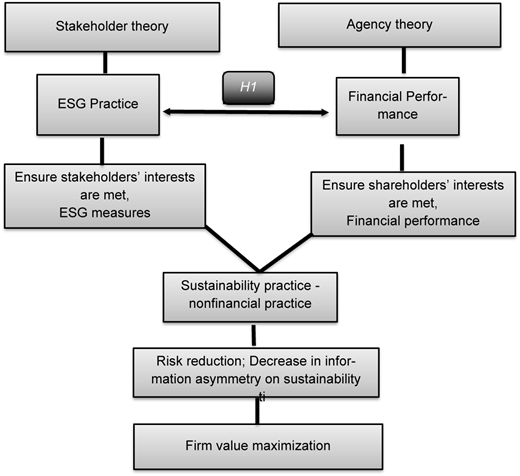
How does sustainability practice affect firm FP? Based on the discussion above and inspired by Ng and Rezaee (2015), Figure 1 conceptualizes the tension between agency theory and stakeholder theory. Both theories describe how businesses should work through maximizing the welfare of stakeholders and maximizing the value of the shareholders, respectively. Agency theory explains shareholders’ value maximization, outlined through FP measures such as return on invested capital (ROIC) or ROE. Stakeholder theory enables us to explore ESG practice, where firms ensure stakeholders’ interests. The framework outlines the non-directional relationship between ESG practice and FP, indicated by our hypothesis.
3. Data and methodology
3.1 Sample selection
Studies point to a need to further contextualize findings on ESG and FP and examine different industries and geographical locations. Financial firms (e.g. banking, investment holding, real estate rental, property and casualty insurance, financial and commodity markets, multi-line insurance, corporate financial services and consumer lending) are under increasing pressure from governments, regulators and other stakeholders to contribute to the climate goal (Brounen and Marcato, 2018). Financial firms channel resources from savers to investors, helping companies to fund new investments and households to streamline consumption over time (Calmfors et al., 2020). These firms have a high impact on society, and therefore, on sustainable development (Beck et al., 2010) and may have a catalytic role in influencing sustainability practice and behavior in industries and companies invested in (Douglas et al., 2004). The demand for sustainable practices in the financial industry is critical as they are key actors for the functioning of the economy (Beck et al., 2010). The Nobel Prize-winning economist Joseph Stiglitz stresses that sustainability practice will have a huge impact on the worldwide economy and that incorporating such practices into financial firms’ business models is needed more than ever (Festl-Pell, 2016).
Financial firms have a responsibility to manage financial resources in a planned and reliable way and FP is critical for their shareholders (Wakaisuka-Isingoma et al., 2016). Meanwhile, good sustainability practices are likewise crucial for financial institutions as they are expected to enhance the institution’s trustworthiness, ensuring reliable management and prudent allocation of a firm’s resources (Tsifora and Eleftheriadou, 2007). Hence, the dichotomy between sustainability practice and FP is an intricate dilemma for firms operating in the financial industry. As such, balancing between shareholders’ interests and the interest of broader groups of stakeholders is expected to be critical in the management control and risk management of financial firms.
The data for this study comes from financial firms from Sweden, Norway, Denmark and Finland. The Nordic countries, following similar financial processes, have developed closely integrated financial systems and extensive supervisory cooperation (Gjedrem, 2000; Spendzharova and Emre Bayram, 2016). For example, in the banking sector, the European Banking Authority and single supervisory mechanism play central roles in implementing and monitoring the adopted set of harmonized rules (Ferran and Babis, 2013). Icelandic financial investors are not included in the current article due to the relatively limited market size. From a practitioner point of view, a large number of financial institutions in the Nordic region tends to integrate ESG dimensions into their business model (Said by Aleksi Lehtonenin, Head of Nordea Business Banking Finland, Nordea, 2020). Much has been written about Nordic sustainability in the media and by professionals in recent years while empirical findings lag behind. So out of curiosity, the authors aim to investigate sustainability practice in the Nordic financial industry. We selected the years 2015–2019 to capture the recent updates in the Nordic financial industry. Similar time perspectives are commonly applied in other studies (Ameer and Othman, 2012; Velte, 2017; Bodhanwala and Bodhanwala, 2018).
3.2 Data extraction
Data on Nordic financial firms (banks; investment holding companies; real estate rental, development and operations; property and casualty insurance; financial and commodity market operators and service providers; multi-line insurance and brokers; corporate financial services; and consumer lending companies) was extracted from the Thomson Reuters Eikon database. The database is comprehensive enough to include all the major finance companies in the Nordic region (Uyar et al., 2020; Velte, 2017).
The aim of this empirical study is to explore the relationship between sustainability practice and firms’ FP in Nordic financial companies. ESG scores have widely been used as a proxy to measure sustainability practice (Cheng, 2014; De and Clayman, 2014; Luo, 2015; Velte, 2017). ESG data, as well as data on FP such as ROIC, ROE and ROA, were extracted from the database in July 2020. To test the relationship for ESG as both an integrated measure and individual measures, we extracted both gross data of ESG scores and individual data for each one of the E, S and G components. To control for the relationships between ESG and FP by involving systematic risk (Beta [β]), unsystematic risk (Total debt/Total assets) and firm leverage (Total debt/Total equity), such data were also extracted from the database, intentionally keeping both leverages. The calculation of total debt/total assets helped to show the degree to which a firm has used its debt to finance assets and total debt/total equity helped to show the ratio of liabilities to shareholder equity and how much leverage a firm has used.
A total of 258 financial firms in the Nordic financial industry were identified in the Thomson Reuters Eikon database. Only 39 firms disclosed a complete set of ESG scores for the years 2015–2019. The final sample includes 152 firm-years of observations for 39 companies. To ensure that we captured potential impact-by-time lags between ESG and FP in the models, we included a one-year time lag (t + 1) between ESG scores and FP indicators (Scholtens, 2008; Velte, 2017).
3.3 Variables and model choice
The study uses several variables to proxy the firm’s FP. For the empirical analysis, we deliberately selected accounting-based measures rather than market-based measures, as the accounting data is audited, and therefore, more reliable (Velte, 2017). All the accounting-based measures, such as ROA, ROIC, ROE and earnings per share (EPS), are considered part of FP (Velte, 2017; Bodhanwala and Bodhanwala, 2018; Pan et al., 2014). To capture the relationship, some control and moderator variables were added to ensure homogeneity among the variables. This helped us to outline the models on the relationship between ESG and FP (Bodhanwala and Bodhanwala, 2018). The statistical analysis used static and dynamic models; data were analyzed with STATA statistical software. Table 1 describes the dependent, independent and control variables in detail.
The study performs statistical estimation using fixed-effect (FE) panel regression along with dynamic estimation generalized method of moments (GMM) with a variety of control variables (Coles et al., 2012; Park et al., 2021). For this, we apply the one-step system GMM estimation (Arellano and Bover, 1995; Blundell and Bond, 1998). GMM estimation is used to increase accuracy and cross-check findings and it is also preferable when dealing with smaller sample sizes (cf. Bond, 2002; Levine et al., 2000; Rahman et al., 2019; Ullah et al., 2018). GMM is argued to be a valid estimator for dynamic panel data to capture cause-and-effect relationships between underlying phenomena that are dynamic over time, enabling dealing with time series and random walk (Blundell and Bond, 1998). Furthermore, one-step GMM estimation is relatively better than first-difference GMM as it addresses the cross-section dependence and heteroscedasticity (Rahman et al., 2019). More specifically, the approach enabled handling the endogeneity problem in regression analyzes that may cause inconsistent estimates and incorrect inferences (Ullah et al., 2018). GMM estimation uses a high number of instruments and connects the regression in the levels with regressions in the first differences. Here, the instruments in the level estimation are efficient predictors for the endogenous variables. The use of both static and dynamic estimations ensured the robustness of the findings. FE regression was applied because the Hausman test (Prob > χ2 = 0.0067) was significant. In line with this argumentation, estimation following FE and one-step system GMM formulas was performed.
For the regression, we estimated the relationships in two regression models, as our independent variables share measures with each other. For example, ESG is the average value of E, S and G; therefore, their multicollinearity could influence the result (though we got tolerable variance of inflation factors (VIF) mean values, see details in Section 4.2), as they do not have discriminant validity. Finally, following two-regression estimations would help to better capture the relationship statistically. The regression models are as follows:
Financial performance (ROIC, ROE, ROA, EPS) = α + β1 ESG + β2 Beta (systematic risk) + β3 unsystematic risk + β4 Firm leverage + β5 Firm size + β6 Moder_ESG_Fsize + ε.
Financial performance (ROIC, ROE, ROA, EPS) = α + β1 Environmental Score + β2 Social score + β3 Governance Score + β4 Beta (systematic risk) + β5 unsystematic risk + β6 Firm leverage + β7 Firm size + β8 Moder_ENV_Fsize + β9Moder_SOC_Fsize + β10 Moder_GOV_Fsize + ε.
Here, α is the constant and ε is the error term.
However, to be consistent with the above models, the following one-step system GMM model was introduced.
FP (ROIC, ROE, ROA, EPS)it = αi + γ ϑi,t−1 + β1 ESG it + β2 Beta (systematic risk)it + β3 unsystematic riskit + β4 Firm leverageit + β5 Firm sizeit + β6 Moder_ESG_Fsizeit + εit.
FP (ROIC, ROE, ROA, EPS)it = αi + γ ϑi,t−1 + β1 Environmental Score it + β2 Social score it + β3 Governance Score it + β4 Beta (systematic risk) it + β5 unsystematic risk it + β6 Firm leverage it + β7 Firm size it + β8 Moder_ENV_Fsize it + β9Moder_SOC_Fsize it + β10 Moder_GOV_Fsize it + εit.
Here,
αi is the constant term;
γ ϑi,t−1 represents the lag value of dependent variables;
Zit are the independent variables; and
εit is the error term.
3.4 Empirical model details
We extracted dependent, independent and control variables from the Thomson Reuters Eikon database for the years 2015–2019 with the definitions stated in Table 1. As the aim of the study was to identify relationships between sustainability practice and FP, the study used a FE regression model along with a one-step system GMM to ensure the robustness of findings generated (Coles et al., 2012; Rahman et al., 2019; Ullah et al., 2018; Watsham and Parramore, 1997). The FE method has frequently been used as an estimator for performing regression analysis, where it is needed for predicting values from one dependent variable to one or more independent variables (including control variables) (López, 2007; Lourenço et al., 2012). It represents data dispersion to the dependent variables based on the value of independent variables with consideration of control variables. To get the best result from the regression estimator, data needs to pass the tests of normality, autocorrelation and multicollinearity. As we run the regression, we are concerned with the normality of dependent variables (Table 2 descriptive statistic) because independent variables are robust in regression analysis (Hair et al., 1998). To normalize the data, we transformed it by square root. Still, the normality was not in a satisfactory range; the kurtosis of one of the dependent variables had much higher values than normal. A detailed statistical investigation found that data concerning one firm was creating the noise. To focus on the average performer, we removed data from SimCorp A/S Denmark from the analysis to make the data normal (Table 2 descriptive statistic). Missing values in the data series were replaced with series mean (Hair et al., 1998). Finally, the analysis contains 152 firm-years of observations.
In line with GMM estimation, lags of the dependent variables as explanatory variables were used to capture dynamic panel data estimation. These lagged values are used as instruments to control for endogenous relationships in the models (Ullah et al., 2018). These instruments are often called “internal instruments” as they are used from the existing econometric model (Roodman, 2009).
4. Data analysis and results
4.1 Descriptive statistics
Table 2 provides a detailed descriptive statistic for all dependent, independent and control variables. This study used accounting and financial measures to define the performance of financial industry in Nordic countries. We used ROIC, ROE and ROA as a proxy to measure FP. Systematic risk, unsystematic risk, leverage and firm size are widely used in the literature as control variables (Bodhanwala and Bodhanwala, 2018; Velte, 2017). Previous studies by Atan et al. (2018), Velte (2017) and Makni et al. (2009) have argued that firm size plays an important role in a firm’s performance, so we added size as a control variable. The size was calculated by taking the log value of total assets. Leverage was calculated by the ratio of total debt to total equity. Both Leverage and Unsystematic risk were added as control variables as they could have an influence on FP (Atan et al., 2018; Esteban-Sanchez et al., 2017). In addition, we used the β factor as a control variable to determine its impact on a firm’s performance through the regression models (Makni et al., 2009). Finally, we applied some moderating variables as control variables, such as the interaction between ESG and firm size and interaction between E, S and G with firm size, to capture the complex relationship. A prolific impact between ESG/E, S, G and firm size had been identified in previous studies; therefore, it is used for moderating the two dimensions (Drempetic et al., 2019; Velte, 2017).
4.2 Correlation results
Table 3 represents the Pearson correlation matrix at 0.01 and 0.05 significance levels for dependent, independent and control variables. There was slight moderate collinearity among ESG scores. This relationship is what we expected, as data are interdependent. We found some surprising negative correlation among ESG, E, S and G with our dependent variables. Pointing to some of the moderate correlations, we ran the VIF to check the intensity of multicollinearity. The test identified tolerable multicollinearity with a mean VIF of 7.74 among independent variables. Further investigation showed that ESG has moderate multicollinearity with E, S and G because ESG is a shared measure with its three dimensions. Running the regression in two models eliminated this issue. We further confirmed this through a VIF test and found mean VIF 1.52 and 2.02 for the first and the second model, respectively, as per equations to make a robust estimation of the regression. Finally, after meeting the assumptions, the FE panel regression was performed.
4.3 Regression results and discussion
Tables 4a and 4b provide the regression and GMM results for the dependent, independent and control variables. The results of both static and dynamic estimations are reported in the tables.
The first model shows that there is a significant negative relationship between ESG practice and all FP except from the ROA. These relationships are confirmed through both static and dynamic models. Actually, ROA has an indifferent (non-significant) relationship. Overall, this implies that there is a negative relationship between ESG and FP in the Nordic financial industry. The second model investigates the impact of the individual E, S and G dimensions. The model found a significant negative relationship between the environmental score with ROIC and the social score with EPS, which supports our previous findings based on the first model. Further, the second model found only a positive relationship between governance and ROA.
The results support our hypothesis that ESG practice has a significant impact on FP (both positive and negative). Examining the control variables in the regression models yields an interesting outcome. Firms’ leverage had a significant positive relationship on FP ROIC and ROE while significant negative relationships with ROA and EPS.
5. Conclusions and discussion
Sustainability practice is becoming a widespread phenomenon around the world and growing interest focuses on the relationship between ESG and firms’ FP (Alsayegh et al., 2020; Bodhanwala and Bodhanwala, 2018; Pan et al., 2014; Velte, 2017;). There is a growing consensus that the financial system must not only be strong and stable but also sustainable (Miralles-Quirós et al., 2019a). Financial firms have expanded their social responsibilities activities with the aim of strengthening the credibility and trust that their stakeholders have in them (Miralles-Quirós et al., 2019b). The financial industry can have a major impact on the transformation to a sustainable society through their power to influence markets and companies; individual financial companies also have the potential to facilitate the transition beyond their own organizations (Al-Qudah et al., 2021). Many people in the Nordic region expected the financial scandals and reputational concerns to be a trigger for firms in the financial sector to pay attention to sustainability practices. Requirements from stakeholders were expected to drive financial firms, a business that is highly focused on performance, toward sustainability practices. Therefore, this article began by addressing the debate over whether embracing sustainability practices would improve, reduce or have no impact on profitability. Using the Thomson Reuters Eikon database, we identified companies in the Nordic region that consistently ranked high on sustainability measures for the years 2015–2019, using ESG as a proxy for sustainability. We believe this study is the first one to look at the Nordic financial industry, specifically providing knowledge on the multi-dimensional nature of sustainability practice. The multi-dimensional nature is explored by the use of both the total ESG measure and the three individual dimensions of ESG when testing the potential relationships between sustainability practice and firm FP.
In this study, data analysis with FE and GMM models resulted in robust and consistent findings. There were both negative and positive relationships between sustainability practice and firm performance. First, our findings indicate a negative relationship between total ESG and FP (ROIC, ROE and EPS). This supports the German study by Velte (2017) and the Japanese study by Lo and Liao (2021), etc. (Brammer et al., 2006). Nonetheless, our findings also contradict other studies (Ameer and Othman, 2012; Artiach et al., 2010). One possible explanation for the negative relationship is that sustainability practices require a long-run investment that inversely affects FP (Ameer and Othman, 2012; Bodhanwala and Bodhanwala, 2018; López, 2007). Furthermore, legislation in Sweden and other Nordic countries on sustainability reporting was established in 2017, during the studied period. This may have caused firms to invest in ESG, also causing high costs at the time. It takes time for norms and regulations to internalize in firms and become the new normal.
From a shareholder perspective, financial firms need to reward their shareholders for remaining in the industry. Expectations on FP as ROIC may, therefore, affect the firm’s management accounting practices. Based on the rational financial perspective, there is a risk that the financial firms would choose not to adopt sustainability practice, as it follows a logic that contradicts the purely economic rationale. Nevertheless, long-term maximation of values may require firms to consider multiple perspectives and multiple stakeholders’ interests (Jensen, 2002; Fatemi and Fooladi, 2013). Short-term investments in ESG may be required from a long-term perspective, where financial firms need to please stakeholders other than the shareholders to establish trust among customers and key stakeholders, ensuring a firm’s operations and success. A trade-off may be needed in the future to please both shareholders and other stakeholders, i.e. a trade-off between the requisites of agency theory and stakeholder theory for the greater good while still ensuring positive FP.
Second, our findings indicate a positive relationship between the governance dimension (G) and ROA. Sustainability practice appears to be critical from a purely financial perspective when looking into governance dimensions. The positive relationship may indicate that solid governance ensures higher profitability from firms’ use of their assets. This is not surprising, as asset management is the driver of financial firms and the financial industry. Control over assets is critical and ensures a prudent allocation of resources, helping the financial firms to enhance ROA. Proper governance has a positive impact on the financial firms’ customers as well, providing benefits for shareholders. Furthermore, governance was identified as a weak link in the recent corporate scandals and much focus turned to governance afterward (Ehrenhard and Fiorito, 2018). Such practices are the core of the agency problem as follows: dealing with the issue of information asymmetry and transparency when assessing responsibilities and reliabilities. Governance may enable firms to mitigate business risks and shareholders to assess those risks. GPs may ensure a trustworthy, reliable and responsible firm for various types of stakeholders. Furthermore, good corporate governance, together with accountability, transparency and justice, fulfills stakeholders’ demands and aligns with stakeholder theory.
Third, the result of bringing ESG moderating variables (ESG interaction with firm size) into the first models showed that firm size together with ESG had a positive association with ROIC and ROE but a negative relationship with EPS. This may be explained by the tendency of large firms to have long experience and plenty of professionals dealing with ESG dimensions in management control practices (Derbali, 2021). On the other hand, a negative relationship between ESG and EPS may imply that the distribution of profit may not achieve the overall ESG goal. There was no association for interaction at the individual level for the second model. Therefore, a weak form of moderation can be said to exist.
One explanation for the positive relationship between sustainability practice and governance and the negative relationship between the total ESG and performance may be the different time periods for the establishment of norms and legislation. The positive relationship with governance may relate to the establishment of the Swedish corporate governance code (Swedish Corporate Governance Code, 2020) in 2005, which targets all firms traded on regulated markets in Sweden. These regulations also apply to other Nordic companies operating in Sweden. In contrast, the negative relationship between total ESG and firm performance may be explained by less mature norms on social and environmental sustainability and high investment costs for achieving the legal requirement from a short-term perspective.
This study contributes to the ongoing debate on the financial industry and the role of this industry on the natural environment and society. The findings may help future researchers and policymakers to understand the phenomena and undertake efforts to promote sustainability. From a practice perspective, a critical understanding of the importance of qualitative ESG dimensions on FP may help management in financial companies navigate between the two targets of ESG and FP to facilitate transformation (Eccles and Serafeim, 2013). The study also makes four contributions to the literature. First, it enhances knowledge about a new contextual setting, the Nordic financial industry. Second, readers learn about the multi-dimensional setting of ESG measures. Third, the article theoretically discusses findings on sustainability practice and performance in connection with the contradictory and complementary theoretical frameworks of agency theory and stakeholder theory. Fourth, it links its findings to the maturity and immaturity in sustainability norms and regulations.
Our study is not without limitations, and we, therefore, suggest a number of studies for the future. Future studies would benefit from extending the scope beyond the Nordic financial industry into other national and industrial settings, providing comparative studies. Which will help to minimize our limitation as we have a quite small sample size due to focusing only on the financial industry in the Nordic region. These studies could integrate the perspective of sustainability norms and legislation into their analyzes, looking at the phenomenon from a perspective of harmonization of sustainability practice. For this, different periods in time might be used, including longer-term perspectives. In addition, further studies could provide analyzes from an institutional theoretical perspective, digging deeper into the work processes and procedures in financial firms to look at, for instance, the embeddedness of norms and legislation in sustainability practice or investments made and return on investments gained. Finally, future studies could combine quantitative and qualitative methods to gain a deeper understanding of how to integrate ESG dimensions in investors’ decision-making processes, dealing with the often-competing institutional logics of ESG and FP.
Authors would like to thank Professor Arne Fagerström from University of Gävle Sweden, Professor James Sallis from Uppsala University Sweden, Assistant professor Md. Mozaffar Hosain from Jagannnath University Bangladesh, Associate Professor Catherine Lions from Umeå University Sweden, Senior Lecturer Fredrik Hartwig from University of Gävle, Associate Professor Mohammad Ashraful Ferdous Chowdhury from Shahjalal University of Science and Technology, Bangladesh and two anonymous reviewers from accounting research journal for their guidelines, comments and suggestions.
Funding: The study has conducted during the period while the first author has received the grant from the project called “Hållbart värdeskapande genom cirkulära affärsmodeller” which is an European Union (EU) project and financed by Swedish Tillväxtverket.