The construction industry faces a persistent labor shortage that undermines productivity and project performance. As traditional metrics like schedule, budget, and quality depend heavily on workforce capabilities, addressing talent gaps is critical. This study aims to identify the distinguishing skillsets of top-performing specialty field leaders (FLs) in the United States and explore how performance evaluation can support workforce development and retention strategies.
Supervisor-rated performance data were collected for 80 specialty FLs across 22 performance indicators grouped into four competency areas. Principal Component Analysis was used to create a composite performance index, which provided a systematic cutoff for classifying FLs as top or average performers. Independent t-tests were then conducted to assess statistically significant differences between the two groups across each performance factor.
Top-performing FLs significantly outperformed their peers in 17 of 22 competencies across all four areas: technical skills, leadership and communication, adaptability and overall job performance. These findings highlight critical performance drivers for targeted workforce development in specialty contracting.
Construction firms can use the findings to implement structured performance evaluation tools and individualized training plans that enhance workforce capabilities and project delivery. The composite index provides a scalable method for benchmarking performance and addressing skill gaps among field leaders.
This study introduces a composite performance index tailored to specialty FLs and applies it to distinguish high performers. It advances construction workforce literature by linking field-level performance with broader labor challenges, providing a framework for training, succession planning and retention.
Introduction
The construction industry relies on people as a vital resource throughout the entire project lifecycle. However, it is currently experiencing a shortage of skilled individuals, posing a significant challenge to the productivity of the industry. Factors such as the retirement of experienced workers and the impact of the COVID-19 pandemic have contributed to this labor crisis. Many of the skilled baby boomers are exiting the industry due to age, leaving a void that younger workers are not entering in sufficient numbers (Albattah et al., 2015). In 2020 alone, a significant percentage of older workers left their jobs, further compounding workforce instability (Davis, 2021).
Companies engaged in specialty contracting and skilled trades are particularly impacted by this shortage and are encountering significant difficulties hiring skilled workers, especially for supervisory positions (Associated General Contractors of Americ a [AGC], 2018). In a 2018 survey, 80% of construction firms reported difficulty recruiting qualified field leaders (AGC, 2018). More recently, the AGC's 2024 Workforce Survey found that 94% of construction firms struggled to fill hourly craft positions, with 72% specifically citing shortages in sheet metal specialty trade. Likewise, Elbashbishy and El-adaway (2024) identified persistent labor shortages in trades such as plumbing, electrical, HVAC (part of SMACNA) and masonry, highlighting the ongoing workforce challenges in these sectors. Projections suggest that supervisory roles in construction will grow by 8% over the next eight years, outpacing average industry growth (U.S. Bureau of Labor Statistics [BLS], 2022). These trends raise concerns about how the sector will meet future project demands without stronger workforce development strategies.
A labor shortage occurs when there is a deficiency of sufficiently trained, skilled and competent individuals for specific job positions (Institute of Management and Administration [IOMA], 2005). Employers report that many job applicants lack the necessary skills for open positions (AGC, 2022). Although some firms have initiated in-house training initiatives (AGC, 2022), the effectiveness of these efforts depends on understanding performance measures that matter most to project success. Given the limited pool of new workers, improving productivity will also depend on investing in and developing the existing workforce. This includes identifying core competencies, upskilling lower-performing staff and creating targeted strategies to retain and grow talent (Maali et al., 2022).
Field leaders, including foremen, site supervisors and crew leads, play a central role in directing daily site operations and ensuring alignment with project objectives. Despite their importance, little research has evaluated their performance or examined the skillsets that differentiate top performers. While several studies have examined leadership competencies in construction, these tend to focus on project managers (Dainty et al., 2005; Hanna et al., 2016; Rezk et al., 2018), with fewer addressing field-level roles. Poveda and Fayek (2009) proposed a comprehensive evaluation model for foremen, but the limited sample size and reliance on self-assessment constrain its generalizability.
This study addresses these limitations by focusing on field leaders in the Sheet Metal and Air Conditioning Trades (SMACNA), a segment of the construction industry where workforce shortages are documented (AGC, 2024) and reliable supervisor-rated performance data were available, limited research has examined leadership performance or workforce development. Using data from 80 specialty field leaders, the study developed a composite performance index (CPI) based on 22 performance skills to provide a structured means of evaluating field leader performance. This CPI enables a comparison of top- and average-performing field leaders and offers insights into the skillsets that correlate with stronger on-site leadership. In addition, the study aims to identify the essential competencies that drive performance in specialty contracting, with practical implications for assessing, supporting and developing field leaders.
Literature review
Workforce shortage in the construction
A persistent challenge in the construction industry is the recruitment of workers with the specific skillsets needed for successful project execution. Research has consistently identified a shortage of skilled workers as a key contributor to this talent gap (IOMA, 2005; Elbashbishy and El-adaway, 2024). Previous studies have established that in certain trades, like plumbing and electrical, firms are unable to hire because candidates do not meet the required skills levels (Elbashbishy and El-adaway, 2024). The aging workforce is a significant factor, with many experienced and skilled professionals nearing retirement. For instance, in relation to workforce shortages, Albattah et al. (2015)'s study on the age distribution of workers showed that the construction sector is losing a significant number of experienced and skilled manpower. The demand for labor is outpacing supply, as there are not enough skilled and competent personnel to take over the aging workforce, especially in positions involving site supervision (Bettisworth, 2018). This shortage of skilled workers has significant implications for construction projects, including project delays, increased risks, cost overruns, quality control issues and reduced productivity (Karimi et al., 2018, Bettisworth, 2018, Olsen et al., 2012). Furthermore, the impending retirement and exit of construction professionals from the industry indicate that these conditions are expected to worsen. The Bureau of Labor Statistics (BLS, 2022) predicts over 41,000 annual job openings due to these departures in on-site activities, highlighting the growing need for qualified individuals. While young graduates, who represent a potential talent pool, may possess the education needed to fill these roles, they often lack the expertise, practical experience and training necessary to meet industry standards and expectations, particularly in specialty trade contracting firms (Chini et al., 1999). As Ling and Tan (2015) highlighted, site supervisors with more job experience are better equipped to navigate challenges, fulfill client expectations, and optimize project results. Additionally, certain personality characteristics and behaviors have been associated with soft skills that influence the successful execution of project objectives. Effective construction project management requires these soft skills, including teamwork, leadership, communication, dispute resolution, motivation and trust building (Zuo et al., 2018; PMI, 2013).
Field leaders' competencies and influence on projects
Field leaders, such as site supervisors, are vital to project and organizational’ success. Diamant and Debo (1988) likened their role to the conductor of a symphony orchestra, responsible for coordinating labor, materials, equipment, and other resources to deliver construction projects within specified timeline and allocated budget. Their position as the driving force of timeliness and quality workmanship suggests that their quality, skills and experience can impact project success (Cline, 2014). Although leadership is a critical skill for field leaders, other essential competencies are required for them to excel in their supervisory roles and efficiently manage construction projects. In addition to leadership skills, Cline (2014) underlined the importance of job performance, communication skills, initiative, decision-making and the ability to collaborate with other project team members. A deficiency in these competencies can impede project and organizational objectives. Gunderson and Gloeckner (2011) highlighted the significance of a thorough understanding of estimating, scheduling, and cost control for site superintendents to effectively lead field operations. In their work, Soemardi and Pribadi (2018) demonstrated that initiative is a critical skill that empowers site supervisors to enhance work effectiveness, create a positive work environment and develop the capabilities of their subordinates.
The skills required for field supervision were categorized into two distinct competencies, namely technical and behavioral skills by Koch and Benhart (2010).
Field leaders require a range of technical skills, including planning, work sequencing, estimating, organization, knowledge of efficient construction methods, construction resource management and a safety-first approach (Gunderson et al., 2007; Koch and Benhart, 2010; Ling and Tan, 2015; Soemardi and Pribadi, 2018). In addition to these technical skills, field leaders should possess behavioral competencies, such as leadership, communication, mentoring and negotiation skills, which are important for effective interaction with project team members and construction crews. Since field leaders are the top-of-the-line supervisors on construction sites, their abilities to motivate and influence the crew members to perform work affects their success on the construction project (Maloney and McFillen, 1987).
Competency measurement in construction
Performance measurement in construction is a complex process that cannot be adequately assessed with a single factor (Gebretekle and Fayek, 2023). Recognizing this complexity, prior studies have explored various methods for evaluating the competency of construction personnel.
For project managers, Iqbal et al. (2023) investigated competency by assessing their technical and contextual knowledge using a Likert scale during project execution. Their study revealed that both the project manager's competence and the team's intellectual and emotional intelligence positively influence project success in terms of cost and time management.
Beyond project managers, Siriwardana and Ruwanpura (2012) developed a Worker Performance Index (WPI) tool to rank crew members based on their performance levels and expected supervisory requirements. This index considered factors such as motivation, technical skills, management and supervisor's assessments, encompassing 17 sub-factors like safety records, leadership potential, worker attitude and morale, quality of work, oral communication skills, motivation level, technical experience and craft certification/multi-skilling. This evaluation method facilitated the ranking and understanding of the cross-section of workers based on their current skills, personal traits and motivational levels.
Similarly, Rezk et al. (2018) developed a competency assessment framework for project managers. Their model, designed to identify training needs, defined 55 key competencies categorized into project management knowledge, leadership, cognitive and other relevant areas. Additionally, they developed weighted questions to make the assessment objective. Their work identified key competencies like scope management, project controls, risk and issues management, mentorship, innovation, communication, problem-solving, influence, accountability, initiative, adaptability, etc. Their study highlighted an assessment framework that provides insights into individual and organizational training needs.
Focusing on foremen, Poveda and Fayek (2009) employed fuzzy logic to develop a performance evaluation model based on 77 factors. These factors were grouped into six categories: safety, planning and scheduling, administration, quality assurance and control (QA/QC), leadership and supervision, and lastly employee relations categories. Their study utilized a 7-point linguistic scale descriptor (“extremely low”, “quiet low”, “slightly low”, “neither low nor high”, “slightly high” “quite high” and “extremely high”), rather than numeric evaluations due to the subjective nature of performance assessment. Their study provided a technique to evaluate the performance of foremen and identified the factors that affect their daily performance. This provides insights organizations can use to develop plans to improve the performance of their foremen over time.
Based on these prior studies, the competencies relevant to field leadership can be viewed as a combination of measurable skills, knowledge and personal attributes that influence on-site performance and project outcomes. These competencies are represented through four main areas: technical skills, leadership and communication, adaptability and overall job performance. Prior literature highlights specific and measurable performance skills within these areas that can inform how field leaders are assessed and developed. Table 1 summarizes these competency domains, their associated skills and supporting references from literature.
Knowledge gap
Research on competencies in construction has concentrated on project management roles, leading to the development of performance evaluation frameworks (Dainty et al., 2005; Hanna et al., 2016; Rezk et al., 2018). In contrast, fewer studies have addressed field-level leadership, especially within specialty contracting, despite its critical influence on productivity, safety and crew coordination. Among the limited work available, Poveda and Fayek (2009) provided a holistic performance evaluation of foremen, incorporating self-assessments, supervisor and peer ratings, and crew feedback. However, only 17 foremen participated in the self-assessment portion, which limits the extent to which those findings can be broadly applied. With limited research on field leadership in specialty trades, this points to the need to investigate methods for evaluating field leader performance.
Research Question and hypothesis statements
This study addresses the gap by introducing a CPI developed from 22 supervisor-rated performance skills. The CPI serves as a structured, statistically grounded method for distinguishing top and average performers and identifying the skillsets most associated with strong field leadership. This study centers on specialty field leaders in the sheet metal and air conditioning trades and responds directly to both the labor shortage challenge and the lack of tools for evaluating and developing field-level leadership in construction.
Research Question (RQ): Do top-performing Specialty Field Leaders (FLs) differ from average performers in their competencies, as measured by performance scores?
There is no significant difference in the skill levels between top-performing and average-performing Specialty Field Leaders (FLs).
There is a significant difference in the skill levels between top-performing and average-performing Specialty Field Leaders (FLs).
Methodology
This study examined the performance skills of field leaders (FLs) employed by contractors affiliated with the Sheet Metal and Air Conditioning Contractors' National Association (SMACNA).
Data collection
Specialty Field Leaders (FLs) in this study are construction personnel tasked with leading and managing on-site operations. They work in conjunction with project managers to ensure the timely allocation of necessary resources-tools, information and materials for construction activities on-site. Typical roles such as foremen, site supervisors, or similar positions. Supervisors in the sample were experienced personnel with direct oversight of FLs and the ability to evaluate their performance.
Data was collected using a combination of purposive and snowball sampling. In the first phase, national and regional SMACNA contractors were contacted directly. SMACNA firms were purposively selected as the initial population because their affiliation with the trade association typically reflects more structured organizational practices and clearly defined supervisory hierarchies. This increased the likelihood of reaching supervisors who had direct oversight responsibilities and could provide informed and reliable assessments of FL performance. After this initial recruitment, the second phase utilized snowball sampling to expand participation. Participating contractors were encouraged to share the survey invitation with peers in their professional networks, leveraging established professional networks to expand data collection.
A total of 80 direct supervisors provided ratings of FLs across 22 performance skills grouped into four competency areas: Technical Skills, Leadership and Communication, Adaptability, and Overall Job Performance.
Survey instrument
The survey instrument was developed from a literature review of construction leadership competencies (Gunderson et al., 2007; Farooqui et al., 2010; Rios et al., 2020). The review helped identify broader competency areas associated with effective field leadership in specialty contracting. In this study, competencies represent the broader capability areas, such as technical proficiency, leadership, adaptability and job effectiveness) that describe what field leaders must be able to do. Skills are defined as specific, observable, and measurable indicators within each competency domain that are used to gauge the level of capability demonstrated. Performance refers to how these skills are demonstrated on the job, as reflected in supervisors' ratings of each skill.
Supervisors evaluated FLs across 22 performance indicators grouped into four competency areas (Table 2). Each category included multiple questions assessed on a 1-to-10 rating scale. This scale was chosen to maximize granularity in supervisor rating and to provide a sufficient range to capture subtle performance differences among participants. The four competency areas were:
Technical Skills: This category assessed the specialty FLs' proficiency in identifying and mitigating design errors, adhering to safety policies, planning and managing project schedules, demonstrating estimating expertise and possessing overall job knowledge.
Leadership and Communication Skills: This category assessed specialty FLs' ability to take initiative, influence others, communicate effectively and collaborate with the owner's representative and other project stakeholders.
Ability to Change and Adapt: This criterion gauged specialty FLs' openness and disposition to embrace changes, including new technologies, skills and processes.
Overall Job Performance: This category comprehensively evaluated specialty FLs' overall effectiveness in achieving project goals, including meeting project deadlines, consistently achieving profitable outcomes and maintaining high-quality work standards.
Method of analysis
This section details the statistical techniques employed to examine the collected data on the performance skills of specialty field leaders (FLs). Descriptive statistics were done to summarize the key characteristics of the data. Table 3 presents descriptive statistics, including the range (minimum, maximum), mean, and standard deviation, which provide insights into the central tendency and dispersion of the data collected from supervisor assessments of specialty FLs' performance skills.
A central objective of this research was to distinguish top-performing specialty FLs from average performers based on their supervisor-rated performance skills. To achieve this, a composite index representing the overall performance of each specialty FL needed to be developed. The analysis process in generating this composite index involved two key steps: assessing internal consistency and conducting factor reduction of the 22 performance skills for all specialty FLs using Principal Component Analysis (PCA).
Internal consistency of the supervisor ratings was evaluated using Cronbach's alpha coefficient (Cronbach, 1951). This analysis determines the extent to which the 22 individual performance skills are interrelated and contributes to measuring a single, underlying index of overall performance. A high Cronbach's alpha value indicates strong internal consistency, signifying that the factors are highly correlated and effectively capture the same underlying concept. The suitability of the data for principal component analysis (PCA) was then determined (Tabachnick and Fidell, 2019). PCA is a statistical technique used to reduce a large set of variables into a smaller set of underlying factors, or principal components. These principal components explain a significant proportion of the variance in the original data. Two statistical tests were conducted to assess suitability for PCA. First, the Kaiser–Meyer–Olkin (KMO) Measure of Sampling Adequacy assessed the proportion of variance in the performance skills that can be explained by common underlying factors. A high KMO value indicates that a significant amount of variance is explained by common factors, making PCA an appropriate technique. Second, Bartlett's test of Sphericity determined whether the variables have a sufficient level of correlation to proceed with PCA. A statistically significant result (low p-value) indicates that the variables are sufficiently correlated for PCA. These tests provided insights into the appropriateness of using PCA to condense the 22 performance skills into a single, composite index.
PCA was chosen as the primary method for analyzing the supervisor-rated performance skills for several reasons. First, PCA is adept at identifying the underlying dimensions that explain the relationships between multiple variables. In this case, it helps uncover the key factors that contribute most significantly to successful performance as a specialty FL (Fellows and Liu, 2021). Second, PCA allows for quantifying the importance of each identified factor. By examining the amount of variance explained by each principal component, the factors with the most substantial influence on the overall performance of specialty FLs can be determined (Shlens, 2014). Finally, with 22 individual performance measures, a direct analysis of all these variables could be cumbersome and difficult to interpret. PCA's ability to condense this data into a smaller set of key factors simplifies the analysis and facilitates a clearer understanding of the performance characteristics that differentiate top specialty FLs from average performers (Kim, 2008). This focus on the most essential factors will ultimately be used to create a composite index that effectively captures overall specialty FLs' performance. Applying PCA reduced the 22 performance measures into a smaller set of principal components. These principal components were then used to create a CPI representing overall specialty FLs' performance. This composite index will serve as the basis for classifying specialty FLs into two distinct groups: top performers (high-fliers) and average performers.
Lastly, Independent t-tests were conducted to compare the performance levels of top-performing and average-performing specialty field leaders for each performance factor. The tests analyzed the mean scores for each factor and were conducted at 99 and 95% confidence levels. This statistical analysis was employed to identify the distinctive skills exhibited by the top-performing specialty FLs. Percentage differences of statistically significant results were conducted to evaluate the magnitude of the observed differences and to facilitate result interpretation.
Results
Descriptive statistics
Descriptive statistics summarize the data collected on the performance skills of specialty field leaders (FLs). Table 3 focuses on supervisor-rated performance, providing means, standard deviations, minimums and maximums for each of the 22 factors, offering insights into average specialty FL performance levels and the range of observed performance across each factor.
Principal Component Analysis findings and development of the composite performance index
This section details the findings related to the suitability of the performance skills for PCA and the development of a CPI using PCA.
Before conducting PCA, the eligibility of the data for determining principal component(s) from the 22 performance skills was assessed using two statistical tests: KMO Measure of Sampling Adequacy and Bartlett's test of Sphericity. The KMO’s measure of sampling adequacy yielded a substantial correlation value of 0.879, exceeding the recommended threshold of 0.5 (Kaiser and Rice, 1974). This result suggests a strong relationship among the performance skills, indicating the suitability of the data for PCA. Bartlett's test of sphericity produced a highly significant result with a p-value <0.01, further confirming the data's appropriateness for PCA and the factorability of the 22 performance skills. Combined, these tests indicated that the data met the minimum requirements for PCA. Internal consistency of the data was assessed using Cronbach's Alpha, resulting in a high value of 0.994. This value signifies a high level of internal consistency, supporting the effectiveness of utilizing the data to develop a CPI.
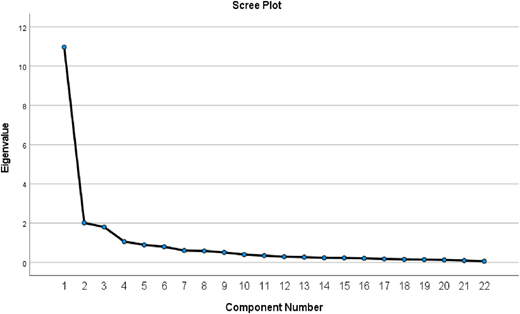
The factorization using PCA identified four components with eigenvalues greater than 1 (refer to Table 4), explaining a cumulative variance of 72.031%. Where there is more than one component with an eigenvalue greater than 1, scree plots can be visually inspected such that the component that appears before the steepest point of break is assumed to be meaningful and is retained (Park et al., 2002). The scree plot, as shown in Figure 1, was visually examined to determine which of the four components to retain. The scree plot indicated an inflection point after the first component, suggesting that this component (the first) captured the most significant portion of the variance in the data. This resulted in retaining the component with an eigenvalue of 10.965 (variance of 49.841%). The retained component served as the CPI. This CPI served as the basis for grouping the specialty FLs into two performance groups: top performers and average performers.
Categorization of participating specialty field leaders
Eighty (80) specialty FLs evaluated from their supervisor ratings were used for the PCA analysis and factorization of the performance skills. The resulting CPI scores, derived from the factorization of the 22 performance skills, served as the basis for categorizing these 80 specialty FLs into two groups: top performers and average performers. The CPI scores ranged from 2.04 to −4.95. Specialty FLs who had negative scores were automatically classified as average performers, constituting 81% of the participants. To identify the top performers among those with positive CPI scores, a method based on the greatest spread within these positive CPI scores was employed (Coutinho et al., 2020). This approach essentially looked for specialty FLs whose positive CPI scores stood out significantly from the rest, indicating exceptional performance levels. Using this method, 19% of the total population were classified as top performers. Table 5 provides the minimum and maximum CPI scores for both groups of participants.
Differences between the performance skills of both groups
Among the 22 performance skills, the analysis showed that high-performing specialty FLs consistently outscored average performers in all categories, except for in “Ability to train their replacement/duplicate themselves”.
At a 99% confidence interval (p-value <0.01) and a 95% (p-value <0.05) confidence interval, results from the independent t-test revealed statistically significant differences in the mean scores of top performers when compared with those of average performers in the four performance categories (17 out of the 22 performance competencies), as indicated in Table 6. This analysis showed important variations in performance across the categories, with the largest difference observed in the Ability to identify design errors and the Ability to work with the project team, amounting to an 18% disparity. On the other hand, the smallest difference was observed in the category of Overall satisfaction, with a 7% variance between the two groups. These findings led to the rejection of the Null Hypothesis (H0) and the acceptance of the Alternative Hypothesis (H1), indicating significant differences in the competencies between these two groups of specialty FLs.
Discussion
Distinguishing skillsets of top-performing field leaders
The analysis shows that top-performing specialty FLs exhibit a more comprehensive and balanced skillset than their average-performing counterparts, outperforming them across all four performance dimensions: technical skills, leadership and communication, adaptability and overall job outcomes.
Technical skills and job performance outcomes
Clear differences emerged between top and average performers in both technical competencies and job performance. Top-performing FLs consistently scored higher in almost every subcategory in this area as shown in Table 6. This aligns with prior research (Koch and Benhart, 2010), which emphasizes the importance of supervisors having a broad set of capabilities, including quality, safety and schedule oversight.
A particular advantage among top performers was their 18% greater proficiency in detecting design errors, an especially valuable skill in the sheet metal and HVAC trades, where practical oversights, such as duct runs with slight misalignments or unsealed gaps in critical joints can lead to costly rework and system inefficiencies. These findings also highlight that top performers displayed a strong understanding of construction practices, enabling them to work efficiently and control costs while adhering to schedules and achieving profitability. This is further supported by Sears et al. (2008), who emphasize the critical role of effective daily operations planning in construction project profitability. This suggests that it is not enough for specialty FLs to solely possess constructability knowledge; they must also demonstrate well-rounded proficiency in construction practices to effectively utilize resources and optimize productivity on the job site.
Leadership and communication skills
Top-performing FLs in the sheet metal and air conditioning trades also excelled in five of the eight leadership and communication skill areas, particularly those related to relationship-building. Specialty FLs in these trades play a pivotal role in coordinating daily operations on mechanical systems such as ductwork and HVAC equipment installation. These systems often require precise sequencing and close coordination with various stakeholders and other trades, including electricians, pipefitters, etc. As such, strong communication is essential, not only for assigning tasks, but for resolving interdependencies and ensuring that installations are completed correctly and on schedule. Strong communication goes beyond simply assigning tasks; it fosters collaboration and teamwork, which are essential for successful project execution. Unforeseen circumstances are not unusual in the construction industry, and site supervisors can leverage established interpersonal relationships to address matters with project team members on time, thereby preventing any negative impact on the project. This implies that top-performing FLs possess strong interpersonal relationship skills, which can facilitate open and clear communication strategies (Atout, 2014) and contribute to the decision-making process necessary for achieving project goals.
The ability to influence considered a vital leadership skill (Kumar 2009), stood out as a key differentiator, with top performers demonstrating a 12% higher ability. In practice, this might involve convincing crews to adopt safer practices or align behind shifting project priorities. Ferris et al. (2005) classified influencing ability as a political skill in construction, emphasizing the importance of understanding others and using that expertise to influence them in a manner that aligns with personal or organizational goals, without relying on formal authority. As a leader of a construction crew, a specialty FL ought to be adept at leveraging relationships to motivate and inspire crew members toward achieving anticipated project outcomes.
Similarly, the ability to take initiative as a problem-solving skill was more prevalent among top performers (8% higher). This ability enables them to anticipate risks, develop contingency plans and make preemptive adjustments, thereby improving project efficiency and goal attainment.
Adaptability
Adaptability emerged as a critical skill among top-performing FLs, who outperformed their peers by 13% in this area. Sheet metal and air conditioning projects often operate under evolving conditions, including design revisions, supply chain disruptions or labor fluctuations. Leaders who can adjust to shifting circumstances are better equipped to manage uncertainty while keeping crews focused and productive. Dainty et al. (2005) emphasize that adaptability and resilience are key leadership traits in construction, enabling supervisors to navigate through uncertainties and complexities with agility and resilience.
More than just problem-solving, adaptability also involves receptiveness to innovation. High-performing FLs in this study demonstrated a greater willingness to adopt new tools and technologies, which could be prefabrication software, automated duct layout tools, or energy efficiency standards. Embracing innovative approaches and being receptive to change allows specialty FLs to leverage advancements in construction practices and explore opportunities for improvement (Abankwa et al., 2021). By demonstrating flexibility and adaptability, specialty FLs can effectively lead their teams in navigating through dynamic and evolving construction environments. They are better prepared to tackle unforeseen challenges and capitalize on emerging opportunities to drive improvements in field performance and enhance overall project outcomes.
Performance evaluation as a strategy to guide workforce development
This study used structured supervisor ratings to distinguish top- and average-performing specialty field leaders (FLs) and developed a CPI based on 22 performance skills. While it did not evaluate formal performance evaluation systems, the CPI offers a practical approach for identifying performance differences and guiding workforce strategies. The findings illustrate how structured assessments at the field level can support broader workforce development goals in the construction industry by highlighting key performance distinctions.
The industry continues to face a persistent labor shortage that affects project outcomes and productivity (Karimi et al., 2018). Previous research points to skill gaps among available workers (Olsen et al., 2012), but addressing these gaps requires reliable methods to assess and understand them. The CPI provides a replicable framework for benchmarking field leader performance across technical, leadership, communication and adaptability competencies. This approach allows firms to identify specific strengths and weaknesses among their workforce, enabling targeted development strategies rather than one-size-fits-all training.
For specialty field leaders who may have limited access to formal upskilling pathways, structured evaluations rooted in job performance offer a scalable means of tailoring support. This aligns with research emphasizing that performance assessment is an essential foundation for improving workforce competencies and allocating training resources effectively (Neyestani, 2014; Kassa et al., 2025).
In addition to improving the current workforce capacity, structured assessments like the CPI can support long-term talent planning. Specialty contracting firms can better anticipate succession needs and better prepare for leadership succession, an urgent need as experienced workers retire and labor availability remains uncertain (Munro, 2017; Ali et al., 2019; Bano et al., 2022), by identifying high-performing individuals who demonstrate the capabilities to assume leadership roles in the future. Integrating a systematic performance assessment tool such as the CPI into broader human resource practices could enable companies to plan strategically, improve retention and enhance overall workforce capacity.
Conclusion
The construction industry should adopt proactive strategies to address labor shortages and sustain long-term productivity. A key aspect of this effort is addressing skill gaps among both the current workforce and future talent. This study focused on 80 specialty field leaders (FLs) in the sheet metal and air conditioning trades, using supervisor-rated data to examine the distinguishing performance skills of high performers. Among the 22 factors assessed, top-performing FLs showed higher ratings in 17 areas, including technical, leadership, communication, adaptability and job outcome categories. These findings enhance our understanding of the competencies linked to effective site-level leadership.
The CPI developed in this study provides a valuable tool for construction and specialty contracting firms to classify and assess the performance of their site supervisors/field leaders. Employers can incorporate targeted and personalized approaches to training and development, rather than a one-size-fits-all strategy, into their talent development plans to address the gaps identified and enhance the competence of their construction workforce. By leveraging the knowledge gained from this study, construction companies can make informed decisions regarding skill development initiatives and allocate resources effectively. Tailoring support to individual needs not only improves performance and productivity but may also contribute to stronger retention by supporting career growth.
Investing in ongoing training and workforce development remains essential as the industry works to respond to growing demands with a limited pool of skilled labor. This study demonstrates how structured assessment tools like the CPI can support firms in identifying high-potential individuals and improving overall workforce capacity.
Contributions of the study
This study contributes to both research and practice in the construction field. From a research perspective, it extends existing work on performance evaluation and skill development by focusing on the underexplored context of specialty field leadership. In addition, the study develops a CPI that consolidates multiple performance skills into a single and structured measure, providing organizations with a replicable tool for assessing and improving field leadership performance. This index provides a basis for comparing performance levels and identifying key competencies associated with strong field leadership.
In practice, the findings offer a practical framework that firms can use to evaluate and strengthen their field leadership teams. The CPI can help organizations identify skill gaps and design targeted training programs that align with the specific competencies required for field leadership success.
Limitations and recommendations for future research
This study acknowledges some limitations that should be considered when interpreting the findings. One limitation is the relatively small number of participants who were specialty field leaders. The findings may not fully capture the experiences and skill sets of specialty field leaders in other trades or industries. Future research should aim to include a larger and more diverse sample of specialty field leaders to enhance the generalizability of the findings. The participants in this study were primarily sheet metal and air conditioning contractors within larger regional companies in the United States. It is important to recognize that different specialty contractors may have unique characteristics and requirements. Therefore, future research should strive to include participants from a wider range of specialty trades to obtain a more comprehensive understanding of the skills and performance skills specific to each trade.
The authors acknowledge the support of the Sheet Metal and Air Conditioning Contractors’ National Association (SMACNA) and the New Horizons Foundation (NHF) during data collection.