This research aims to analyse the influence of multidimensional factors on customer purchasing intentions of compressed stabilised earth blocks (CSEBs), providing relevant authorities with systematic insights to promote CSEBs.
A cross-sectional field survey with 222 respondents, preceded by a pilot survey with 30 respondents, was conducted in the Eastern and Northern provinces of Sri Lanka. Descriptive statistics, correlation analysis and multiple linear regression were used to analyse the significance of personal, social, psychological and cultural factors on customer purchase intentions of CSEBs.
Beyond the direct influence of product pricing, factors of lifestyle, social norms/values, perception and social differences significantly shape customer purchasing intentions within the personal, social, psychological and cultural dimensions, respectively. Correlation and multiple linear regression analyses further indicated that personal, social and psychological dimensions substantially influence customer purchasing intentions of CSEBs, while the cultural dimension had negligible influence.
By identifying key factors shaping customer purchasing intentions, this research lays the groundwork for initiatives aimed at promoting CSEBs. These insights can also inform marketing strategies, educational/awareness programmes and regulatory measures to promote CSEBs effectively.
This research addresses a critical gap in behavioural research on sustainable building materials, focusing on the influence of personal, social, psychological and cultural factors on the customer purchasing intentions of CSEBs. The findings enrich the existing knowledge base and offer novel insights for evidence-based decision-making to promote CSEBs and future behavioural research.
Introduction
High carbon emissions stand as the primary cause behind global warming (Ansari et al., 2023). Extensive industrial energy usage, particularly within the construction industry, is the primary reason for these high emission levels (Jayawardana et al., 2021). The construction industry accounts for roughly 40% of global energy usage, making it the largest single industry for energy consumption (Ansari et al., 2023; Yang et al., 2014).
Within the construction industry, building construction is the most prominent field, with buildings consuming energy across their entire lifecycle—from construction to demolition (Ibn-Mohammed et al., 2013). The total energy consumption by buildings consists of two components: embodied and operational energy (Jayawardana et al., 2021). Embodied energy refers to the energy consumed in the production, transportation, and extraction of natural resources. In contrast, operational energy refers to the energy required during the operational stage of a building’s life cycle (Ibn-Mohammed et al., 2013).
Similarly, the carbon emissions throughout a building’s lifecycle can be categorised into embodied and operational carbon (Gurupatham et al., 2021). In comparison, operational carbon emissions are the most significant component (Jayawardana et al., 2019). However, with the consistent implementation of energy-efficient approaches in building construction, the impact of operational carbon emissions has been significantly reduced, shifting considerable relative importance to embodied carbon emissions (Kumanayake et al., 2018). Furthermore, the literature states that 70% of the global raw material extraction is finally included within the buildings, highlighting the significant embodied energy potential (Jayawardana et al., 2019). Therefore, sustainable construction practices are essential to lower buildings’ embodied and operational carbon emissions (Jayawardane et al., 2024).
In a building, the building envelope is crucial for both embodied and operational carbon emissions. Walls constitute a significant portion of the building envelope compared to other components (Jayawardana et al., 2021). Therefore, walls encompass a substantial volume of materials, resulting in a high fraction of embodied energy and related embodied carbon emissions. Additionally, the influence of walls on the operational energy efficiency of the building is noteworthy, primarily due to significant energy losses and gains during the operational phase (Udawattha and Halwatura, 2017; Yang et al., 2014). Consequently, walling materials play a crucial role in operational energy usage and related operational carbon emissions. Therefore, evidence-based selection of sustainable walling materials is essential to reduce the impact of these carbon emissions (Kumanayake et al., 2018).
In recent years, Sri Lanka has implemented various initiatives to promote more sustainable buildings, with the use of sustainable materials being a fundamental approach (Kumanayake et al., 2018). Under this approach, utilising locally available natural materials for construction offers a cost-effective and efficient solution, helping to reduce carbon emissions and the overall environmental impact of buildings. In this context, Compressed Stabilised Earth Blocks (CSEBs) have emerged as a promising sustainable alternative (Uzoegbo, 2020).
In tropical countries like Sri Lanka, Cement Sand Blocks (CSBs) and Burnt Clay Bricks (BCBs) are commonly used as walling materials (Udawattha and Halwatura, 2017). However, the extensive use of these materials results in significant environmental impacts (Hanafi, 2021). Beyond high carbon emissions, these conventional materials contribute to high natural resource depletion, elevated energy consumption, environmental pollution, and substantial construction waste generation (Gurupatham et al., 2021).
Compared to BCBs and CSBs, CSEBs provide numerous advantages. These advantages include Earth’s availability in large quantities locally, cost-effectiveness, eco-friendliness, energy-efficient behaviour, adequate strength, high thermal insulation capacity, low thermal conductivity, fire-resistant behaviour, and simplicity in the manufacturing process (Priji et al., 2020; Uzoegbo, 2020).
Moreover, global research highlights that life cycle emissions, particularly carbon emissions of CSEBs, are significantly lower than those of conventional materials like BCBs and CSBs (Uzoegbo, 2020). This finding is reinforced by Gurupatham et al. (2021) in the Sri Lankan context through a comprehensive cradle-to-grave life cycle assessment of a single-storey house with a 50-year design life. This research found that life cycle emissions for the modelled house were 242,429.33 kgCO2e when using BCBs, 257,698.39 kgCO2e with CSBs, and only 230,167.83 kgCO2e using CSEBs. Emissions could be reduced even further to 185,535.12 kgCO2e by using unplastered CSEB walls, which also provide an aesthetically pleasing wire-cut finish. Additionally, studies by Ansari et al. (2023) and Jayawardana et al. (2021) also assert that CSEBs are the most sustainable walling material currently available in the Sri Lankan context.
Knowledge gap, research aims and significance
Despite the enhanced sustainability offered by CSEBs, the widespread adoption of the material is limited in Sri Lanka compared to conventional building materials (Gurupatham et al., 2021). This limitation can be attributed to the lack of awareness regarding the benefits and improved sustainability associated with CSEBs. Moreover, the reluctance to transition from familiar building materials to this relatively new material also plays a significant role. Therefore, raising awareness about the enhanced sustainability of CSEBs and influencing customers to choose CSEBs over conventional building materials are essential to fostering sustainable construction practices.
To achieve this sustainable transition, an in-depth understanding of the multidimensional factors influencing the customer purchasing intentions of CSEBs is essential (Qazzafi, 2020; Chathuranga et al., 2024). However, behavioural research analysing the influence of multidimensional factors on customer purchasing intentions of sustainable materials, such as CSEBs, remains underexplored. This gap presents a significant barrier to promoting sustainable materials in developing countries like Sri Lanka, where sustainable construction practices are not yet widely adopted (Chathuranga et al., 2024). Therefore, there is an urgent need to analyse the relationship between these factors and the customer purchasing intentions of CSEBs. Such insights are essential for building the knowledge base required to develop strategic initiatives for promoting sustainable materials in the Sri Lankan context.
The following objectives have been defined for this research:
To identify the multidimensional factors influencing customer purchasing intentions of CSEBs
To analyse the influence of these factors on the customer purchasing intentions of CSEBs
To offer systematic insights that support evidence-based decision-making for promoting CSEBs
Customer behaviour
Customer behaviour refers to the actions taken by individuals when selecting, acquiring, and utilising products and services to fulfil their needs and desires (Yolanda and Herwinda, 2017). Numerous factors and attributes shape an individual’s decision to purchase a product (Ramya and Ali, 2016). Therefore, promoting a product within a community necessitates a thorough understanding of customer purchasing behaviour (Pandey et al., 2021). Customer purchasing behaviour primarily encompasses two critical components: (1) factors influencing customer purchasing behaviour and (2) the customer purchasing decision process (Ramya and Ali, 2016; Rani, 2014).
Literature indicates a significant positive correlation between customer purchasing intentions and actual purchasing behaviours (Chan, 2001). Customer purchasing intention, driven by purchasing influential factors, plays a crucial role in shaping customers’ purchasing behaviour (Alalei and Jan, 2023). Thus, this research mainly focuses on customer purchasing intentions regarding CSEBs, which ultimately govern their purchasing behaviour.
Factors influencing customer purchasing intentions
A direct correlation exists between the customer’s net income level, product pricing, and the customer’s intention to purchase products (Qazzafi, 2020). This relationship has been extensively studied, indicating that product pricing plays a pivotal role in shaping customer purchasing intentions and behaviours (Ramya and Ali, 2016). However, there is a significant need to explore the influence of additional factors beyond product pricing that are often neglected (Yolanda and Herwinda, 2017). Thus, the primary focus of this research is to analyse the influence of these underexplored factors on customer purchasing intentions of CSEBs.
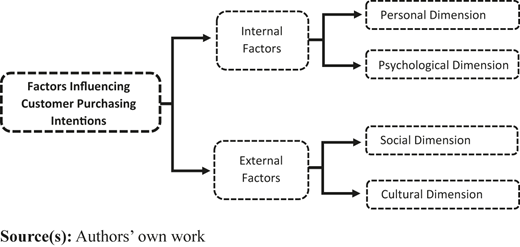
Various internal and external factors influence customer purchasing intentions. Based on the published literature, these factors can be categorised into four key dimensions: personal, social, psychological, and cultural, as shown in Figure 1 (Rani, 2014; Yolanda and Herwinda, 2017; Ramya and Ali, 2016; Pandey et al., 2021). Numerous studies have explored the impact of these dimensions on customer purchasing intentions, underscoring their significance. This research also focuses on these four primary dimensions, which are evident in shaping customer purchasing intentions. Consequently, the multidimensional factors identified and the hypotheses developed in this research are based on this framework, following the four-dimensional structure outlined in the subsequent sections.
Customer purchasing decision process
The customer purchasing decision process is complex and unfolds in five stages (Qazzafi, 2019; Yolanda and Herwinda, 2017; Rani, 2014). Understanding this process is crucial for comprehending how customers make purchasing decisions.
Need Identification: Customers recognise a disparity between their current situation and an ideal state, leading to recognising needs.
Information Retrieval: Customers actively receive information about products or services from various sources such as family, friends, advertisements, mass media, and social media platforms.
Alternative Evaluation: Customers critically assess and compare alternative options or brands based on the information gathered during the previous phase.
Decision to Purchase: The focus shifts to customers’ intentions to purchase a product after acquiring knowledge about it and conducting a comprehensive evaluation.
Post-Purchase Evaluation: The final stage involves customers evaluating the purchased product to ascertain if it meets their expectations and aligns with their needs.
Effectively guiding customers through the five stages of the purchasing decision process is essential when promoting a product (Qazzafi, 2019). In order to guide customers effectively, it is critical to analyse the influence of multidimensional factors on customer purchasing intentions thoroughly. In this regard, the authors systematically reviewed the existing literature and identified 24 multidimensional factors that may influence customer purchasing intentions for CSEBs, categorised across four dimensions: personal, social, psychological, and cultural (see Table 1). The methodology used for this systematic literature review, including the PRISMA (Preferred Reporting Items for Systematic Reviews and Meta-Analyses) flow diagram, is outlined in the “Materials and methods” section.
Customer purchasing intention influential and measuring factors
Source(s): Authors’ own work
Theoretical framework and hypothesis
Customer purchasing intention (CPI)
This research aims to analyse the relationship between customer purchasing influential factors and the customer purchasing intention of CSEBs. To achieve this aim, a method to measure the customer purchasing intentions of CSEBs is needed. Thus, another new dimension was introduced, Customer Purchasing Intention (CPI), which measures the customer purchasing intentions of CSEBs based on their attributes. Under the CPI dimension, six factors were used to measure customer purchasing intentions (Table 1).
Research hypothesis
As previously mentioned, the customer purchasing intentions for products are influenced by four primary dimensions: personal, social, psychological, and cultural (Rani, 2014; Yolanda and Herwinda, 2017; Ramya and Ali, 2016; Pandey et al., 2021). To analyse the specific influence and extent of each of these dimensions on customer purchasing intentions for CSEBs, the following four hypotheses were developed and analysed in this research.
Personal dimension significantly influences the customer purchasing intentions of CSEBs.
Social dimension significantly influences the customer purchasing intentions of CSEBs.
Psychological dimension significantly influences the customer purchasing intentions of CSEBs.
Cultural dimension significantly influences the customer purchasing intentions of CSEBs.
Materials and methods
This section presents a comprehensive overview of the research methodology employed in this research, detailing each stage of the process and providing a clear roadmap of the research design and approach.
Systematic literature review: process overview
This research aims to analyse the relationship between customer purchasing influential factors and the customer purchasing intention of CSEBs. To achieve this, the authors systematically reviewed the published literature to identify the influential factors, along with the factors used to measure customer purchasing intentions of CSEBs (Table 1).
The first step in the literature search involved developing a search query, which was formulated as a combination of the following key terms: Purchasing Intention, Purchasing Behaviour, Customer Behaviour, Purchasing Decision, Customer Purchasing Influence, Sustainable Materials, and Green Materials.
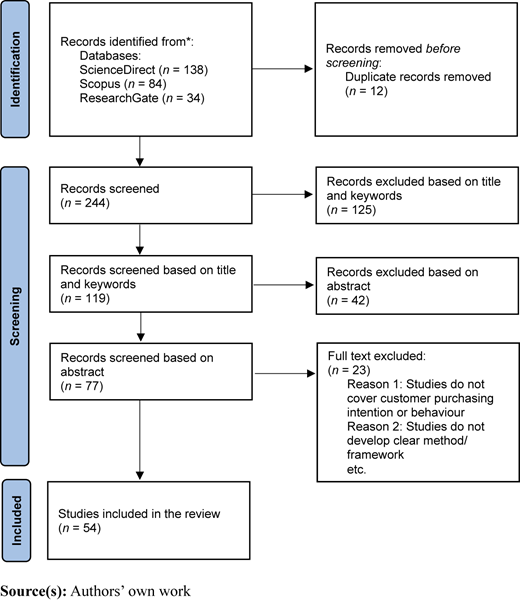
The reports identified through the literature search using the developed search query were filtered, as illustrated in Figure 2. Reports published in journals, conferences, and book chapters from 2010 to 2023 in “ScienceDirect,” “Scopus,” or “ResearchGate” were included in the research. Out of a total of 256 articles, 54 were finally selected as relevant to the present research to guide the research methodology and to identify the customer purchasing influencing and measuring factors.
Research setting and sampling method
The research conducted in the Northern and Eastern provinces of Sri Lanka, explicitly covering the districts of Batticaloa and Mullaitivu. This area was chosen due to the relative popularity of earthen construction compared to other regions in the country and the researcher’s familiarity with the context, aiming to provide more relevant results for the Sri Lankan context.
This research employed the convenience sampling method to identify respondents. This method was chosen for its straightforward approach, facilitating data collection within a convenient timeframe and a manageable budget. It focused on individuals who were readily available and willing to participate, offering a practical approach (Etikan et al., 2016).
Survey design and data collection
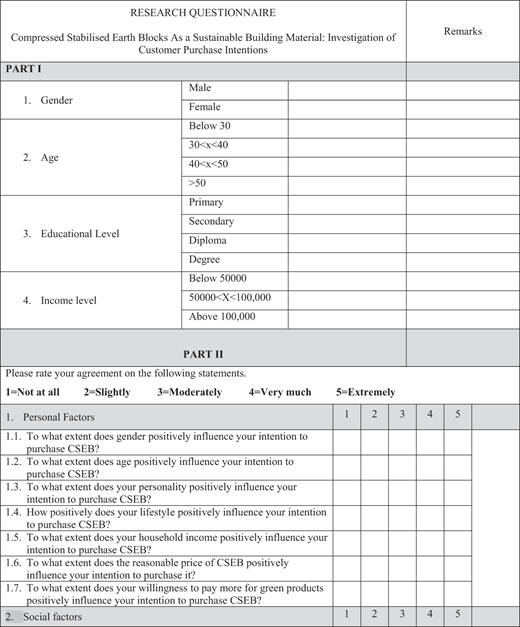
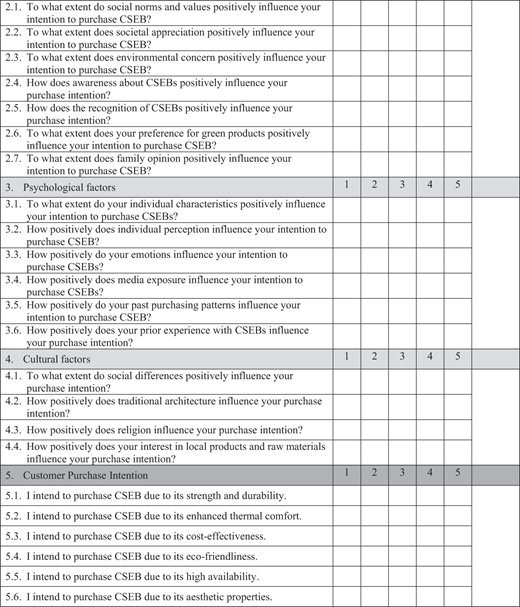
This research utilises a cross-sectional field survey with one-to-one discussions. The questionnaire consisted of 30 questions, with 24 questions measuring the influence of identified factors on customer purchasing intention across four dimensions: personal, social, psychological, and cultural, using a 5-point Likert scale (1 = Not at all to 5 = Extremely). The remaining six questions were under the CPI dimension, measuring respondents’ purchasing intention based on CSEB’s attributes using the same Likert scale.
Additionally, the field survey collected detailed demographic information, including gender, age category, educational level, and income level, to interpret the findings and understand the diverse backgrounds of respondents.
Prior to the final survey, the drafted questionnaire was refined in consultation with four Sri Lankan construction industry practitioners, including a project manager, a construction manager, and two residents with prior experience in purchasing and using CSEB. This ensured comprehensive coverage of all aspects related to customers’ purchasing intentions of CSEBs. Subsequently, pilot and final surveys were conducted among the general public respondents.
The pilot survey aimed to ensure the questionnaire’s feasibility, understandability, reliability, and internal consistency. A widely accepted sample size of 30 respondents (from 30 families) was surveyed to achieve these aims in a manageable and cost-effective manner. The pilot survey gathered data on survey time per person, understandability, and whether the questionnaire was internally consistent and reliable.
After refining the questionnaire based on suggestions from the pilot survey, the final survey was conducted with 222 respondents (from 222 families). This sample size was selected with a 90% confidence level and a 5% margin of error, ensuring it accurately represented the population. This sample size ensures robust and reliable results within the research objectives and resource limitations, making the findings representative and impactful.
Data analysis methods
Initially, a reliability assessment of the survey questionnaire was conducted using Cronbach’s alpha, a widely recognised measure of internal consistency and reliability, with a general threshold of 0.7 (Hair, 2019). This method ensures that the surveyed factors consistently measure each dimension of the research.
Descriptive statistics were then used to provide a detailed overview of the respondents’ demographics and a thorough understanding of the collected data. This step was crucial to contextualise the responses and assess the distribution and central tendencies of factors identified within the research dimensions (Chathuranga et al., 2024).
A correlation analysis analysed the strength and direction of relationships between the four independent dimensions: personal, social, psychological, and cultural and the dependent CPI dimension. This analysis was essential for identifying preliminary associations that informed the subsequent regression analysis (Hair, 2019).
Finally, multiple linear regression analysis was conducted to validate the formulated hypotheses. Also, this method is particularly effective for identifying the individual contribution of each independent dimension to the CPI dimension, providing a clearer understanding of each dimension’s influence while validating and expanding the findings from the correlation analysis (Pantano, 2011).
This combination of statistical methods ensures that the research outcomes are both robust and reliable, providing valuable insights into the factors influencing customer purchasing intentions and their relationship to the purchasing intention of CSEBs.
Analysis and results
Internal consistency and reliability
The calculated Cronbach’s alpha value for each dimension are as follows: CPI (0.706), personal (0.738), social (0.707), psychological (0.635), and cultural (0.692). These values are around the general threshold value of 0.7, indicating that the factors used under each dimension are reliable and internally consistent (Hair, 2019).
Demographic data
Pilot survey sample
Among the surveyed 30 respondents, 60% of respondents were males, and 40% were females. Regarding age distribution, 36.6% of respondents were over 50 years old, followed by 33.3% in the 40–50 age group, 20.0% in the 30–40 age group, and 10.1% under 30. Regarding educational attainment, the majority had secondary education (83.3%), while a smaller percentage had only primary education (16.7%). Regarding income levels, most respondents earned less than 50,000 LKR per month (1 USD ≈ 360 LKR), accounting for 90.0%, while a minority reported incomes between 50,000 and 100,000 LKR per month (10.0%).
Final survey sample
Among the surveyed 222 respondents, the majority were male (67.1%), while females comprised 32.9%. Regarding age distribution, respondents over 50 were about 33.3%, followed by the 40–50 age group at 30.6%, the 30–40 age group at 26.2%, and those under 30 at 9.9%. Educational attainment was predominantly secondary education (89.2%), with a smaller percentage having only primary education (10.8%). Regarding income levels, the majority fell into the less than 50,000 LKR (I USD ≈ 360 LKR) per month range (94.6%), while a minority reported incomes between 50,000 and 100,000 LKR per month (5.4%). This demographic profile outlines the survey sample used to represent the population and draw conclusions.
Mean Likert scale ratings
Analysis of the respondents’ mean Likert Scale (LS) ratings reveals several vital conclusions. The mean LS rating of 4.24 for the CPI dimension indicates a significant positive intention to purchase CSEBs. The personal, social, and psychological dimensions have mean LS ratings of 4.10, 3.80, and 3.83, respectively, suggesting a substantial influence on customer purchasing intentions. Although the cultural dimension has a lower mean LS rating of 3.53, it still exceeds the moderate (3.0) value. This suggests that cultural factors have a lesser influence on customer purchasing intentions compared to the other dimensions.
Deep insights into the customer purchasing influential dimensions
Based on the mean LS ratings provided, dominant factors influencing customer purchasing intentions in each dimension have been identified and ranked accordingly (Table 2). The analysis revealed that “lifestyle”, “social norms/values”, “perception”, and “social differences” were the dominant influential factors in the personal, social, psychological, and cultural dimensions, respectively.
Ranking of factors influencing customer purchasing intentions
| Dimension | Factor | Mean LS rating (SD) | Rank |
|---|---|---|---|
| Personal | Lifestyle | 4.32 (0.836) | 1 |
| Price Concern | 4.27 (0.861) | 2 | |
| Household income | 4.21 (0.863) | 3 | |
| Age | 4.12 (0.925) | 4 | |
| Personality | 4.05 (0.735) | 5 | |
| Gender | 3.92 (1.090) | 6 | |
| Willingness to pay more for green | 3.79 (1.103) | 7 | |
| Social | Social norms and values | 4.25 (0.922) | 1 |
| Environmental concern | 4.05 (0.914) | 2 | |
| Recognition of the product | 3.95 (1.052) | 3 | |
| Family opinion | 3.92 (0.745) | 4 | |
| Awareness of the product | 3.83 (1.163) | 5 | |
| Societal appreciation/influence | 3.77 (1.124) | 6 | |
| Green product preference | 3.57 (1.415) | 7 | |
| Psychological | Perception | 4.03 (0.887) | 1 |
| Emotions | 4.00 (0.874) | 2 | |
| Media exposure | 3.95 (0.820) | 3 | |
| Individual characteristics | 3.85 (0.646) | 4 | |
| Prior experience | 3.77 (1.198) | 5 | |
| Purchasing patterns | 3.38 (0.980) | 6 | |
| Cultural | Social differences | 3.66 (0.937) | 1 |
| Local product/raw materials preference | 3.59 (1.058) | 2 | |
| Religion | 3.48 (1.062) | 3 | |
| Traditional architecture | 3.40 (1.062) | 4 |
Source(s): Authors’ own work
Correlation analysis
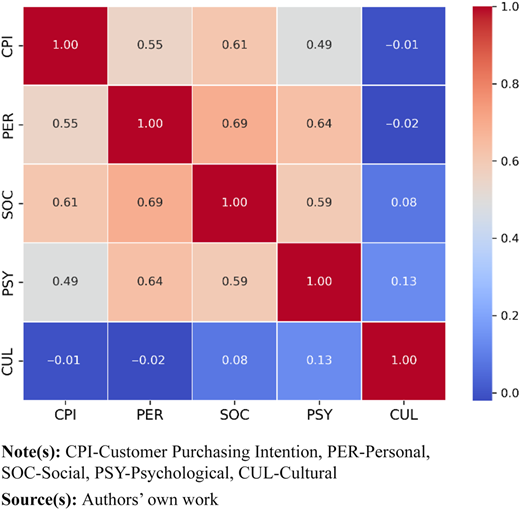
This research employs the widely used Pearson correlation coefficient and a 95% significance criterion. Significant correlation coefficients between the social (0.61), personal (0.55), and psychological (0.49) dimensions with the CPI dimension indicate their positive influence on the purchasing intention of CSEBs. In contrast, the cultural dimension shows a weak, insignificant negative correlation (−0.01) with the CPI dimension, suggesting its negligible influence on customer purchasing intentions of CSEBs. Additionally, the correlation diagram (Figure 3) comprehensively illustrates the cross-correlations among all dimensions of interest.
Multiple linear regression analysis
Multiple linear regression was used to validate the developed hypothesis and analyse the influence of the independent dimensions (personal, social, psychological, and cultural) on the CPI dimension. The results revealed a compelling model summary, with an R-squared value of 0.417, indicating that 41.7% of the total variation in CPI dimension is attributed to these independent dimensions. Further refinement of the model using the adjusted R-squared value yielded a value of 0.406, showing that independent dimensions collectively explain 40.6% of the variance in the CPI dimension.
Additionally, an ANOVA test was conducted to assess the significance of the multiple linear regression model, which utilises the four independent dimensions to predict the dependent dimension of CPI. The obtained F-statistic of 38.817 indicates that the relationship between independent dimensions and the CPI dimension is statistically significant (Hair, 2019). It further validates the credibility and robustness of the developed multiple regression model (Pantano, 2011).
The results of the multiple linear regression analysis are stated in Table 3. Furthermore, the validation of the research hypothesis based on the multiple regression analysis is summarised in Table 4.
Multiple linear regression results
| Model | Unstandardized coefficients | Standardized coefficients | t-value | Sig | ||
|---|---|---|---|---|---|---|
| B | Std. Error | Beta | ||||
| Independent Dimensions | (Constant) | 2.390 | 0.193 | 12.392 | 0.000 | |
| Personal | 0.126 | 0.057 | 0.175 | 2.219 | 0.028 | |
| Social | 0.265 | 0.048 | 0.413 | 5.495 | 0.000 | |
| Psychological | 0.105 | 0.054 | 0.139 | 1.962 | 0.045 | |
| Cultural | −0.030 | 0.029 | −0.055 | −1.030 | 0.304 | |
| Dependent Dimension = CPI | ||||||
Source(s): Authors’ own work
Based on the regression coefficients related to personal, social, and psychological dimensions, it is evident those dimensions significantly influence customer purchasing intentions by supporting the first three hypotheses (H1, H2, H3). This fact is further supported by the highly significant correlations from the correlation test. However, neither correlation nor multiple linear regression analyses support the last hypothesis (H4). Accordingly, the cultural dimension does not significantly influence the customer purchasing intentions of CSEBs.
Discussion and conclusions
The use of sustainable building materials is a widely recognised approach to reduce high energy consumption and related carbon emissions. CSEBs have emerged as a promising alternative in this sustainable transition. However, the widespread adoption of CSEBs in developing countries like Sri Lanka remains limited compared to conventional building materials. Thus, this research aims to provide systematic insights to relevant authorities that support evidence-based decision-making for promoting CSEBs within the Sri Lankan construction industry.
Promoting sustainable materials like CSEBs requires a thorough understanding of the multidimensional factors influencing customer purchasing intentions. According to the literature, a direct correlation exists between the customer’s net income level, product pricing, and customer purchase intention (Ramya and Ali, 2016). Also, personal, social, psychological, and cultural dimensions significantly shape customer purchasing intentions (Yolanda and Herwinda, 2017). Accordingly, this research aims to analyse the relationship between influential factors within these four independent dimensions and the customer purchasing intention of CSEBs, which is relatively underexplored.
To achieve the research objectives, 222 respondents from the Northern and Eastern provinces of Sri Lanka, specifically from the districts of Batticaloa and Mullaitivu, were surveyed using a structured questionnaire. These regions were selected due to the relative popularity of earthen construction, which aligns with the research objectives, as well as the researcher’s familiarity with the local context. Although the findings are specific to these regions, they may provide valuable insights that could inform sustainable construction practices in other parts of Sri Lanka with similar socio-economic conditions.
Mean Likert scale rating analysis
The analysis revealed that the Customer Purchasing Intention (CPI) dimension has a high mean LS rating of 4.24, reflecting a strong positive intention to purchase CSEBs. Similarly, the mean LS ratings of the personal, social, and psychological dimensions, which are 4.10, 3.80, and 3.83, respectively, are around 4.0, suggesting their substantial influence on customer purchasing intentions of CSEBs. However, the mean LS rating of the cultural dimension was 3.53, which still surpasses the moderate value (3.00), indicating a comparatively lower but notable influence on customer purchasing intentions.
The study further analysed the four independent dimensions to identify the most dominant influential factors based on respondent perspectives. The influential factors were ranked based on the mean LS ratings (Table 2), revealing that “lifestyle”, “social norms/values”, “perception”, and “social differences” are the dominant influential factors within the personal, social, psychological, and cultural dimensions, respectively.
“Lifestyle” was identified as the dominant personal factor influencing customer purchase intentions of CSEB, which is consistent with previous findings (Qazzafi, 2020). This indicates that customers’ choices reflect their values and preferences aligned with sustainable living practices, highlighting a robust correlation between lifestyle choices and adopting sustainable building materials. The dominant influence of the social factor “social norms/values” on purchasing intentions emphasises the importance customers place on public perception and community values when selecting sustainable materials (Pandey et al., 2021). Additionally, the analysis revealed that customer “perception” of CSEBs plays a crucial role within the psychological dimension, indicating that a positive perception significantly enhances purchasing intentions (Akdogan et al., 2021). This highlights the importance of developing a positive image of CSEBs within the market. Finally, “social differences” were found to be a crucial factor in influencing the purchase decision of CSEB under the cultural dimension, as identified through the ranking of factors based on mean LS ratings (Akdogen et al., 2021). At this stage, this finding suggests that cultural diversity and social dynamics significantly impact consumer preferences and adoption of sustainable building materials.
When considering the personal dimension, the second and third-ranked factors are “price concern” and “household income”. That means that with a good household income and a reasonable price for CSEBs, people’s intentions are significantly influenced to purchase CSEBs (Koistinen et al., 2013). Therefore, relevant authorities, including product manufacturers, should focus on developing CSEBs at a lower cost to control market prices, making CSEBs more competitive than conventional materials. This finding also aligns with existing literature, which highlights the direct correlation between a customer’s net income, product pricing, and purchasing intentions (Pandey et al., 2021). Moreover, factors such as “age,” “personality,” and “gender” under the personal dimension also play a crucial role in influencing customer purchasing intentions for CSEBs.
“Environmental concern” and the “societal appreciation” factors also significantly influence customer purchase intention under the social dimension. The present research identifies that customers are highly mindful of social norms and values when purchasing sustainable building materials, a point further reinforced by the significant ranking of the “societal appreciation” factor. Additionally, the high ranking of the “environmental concern” factor indicates that customers are concerned about the sustainability of the products when they purchase (Zahid et al., 2018). Furthermore, “recognition and awareness of the product” also play a crucial role in shaping customer purchasing intentions. Therefore, it is evident that if relevant authorities effectively communicate the enhanced sustainability and environmental benefits of CSEBs, their promotion could be more effective (Tariq, 2014).
According to the cultural dimension, people highly prefer “local products”. This is a positive opportunity to promote CSEBs, as they can be produced locally. Furthermore, “emotions” and “media exposure” significantly influence the CSEB purchase intentions under the psychological dimension (Wang and Hazen, 2016). By highlighting the environmental issues associated with conventional building materials and the benefits of locally produced CSEBs, customers’ emotions can be effectively influenced to opt for sustainable materials like CSEBs. To achieve this, “media exposure” can be utilised effectively, as identified in the research.
The “willingness to pay more for green” under personal and “green product preference” under social dimensions, which were ranked last, convey that people may not yet fully appreciate the numerous benefits achievable through sustainable building materials. This underscores the urgent need for widespread educational initiatives and programmes to raise awareness about these benefits, ensuring that the general public, not just the informed community, becomes more engaged with sustainable building options (Wang and Hazen, 2016).
Correlation and multiple linear regression analysis
The correlation and multiple linear regression tests were used to analyse the underlying patterns between the four independent dimensions and the dependent dimension of CPI. In the respective order, social, personal, and psychological dimensions exhibit a solid positive correlation with the CPI dimension, with Pearson correlation coefficients of 0.61, 0.55, and 0.49 with high significance (p < 0.05) showing the positive influence of these dimensions in shaping the customer purchasing intentions of CSEBs. However, the cultural dimension demonstrates a weak, insignificant negative correlation (−0.01) with the CPI dimension, suggesting the marginal influence of cultural factors on customer purchase intentions of CSEBs. Consequently, the correlation analysis supports hypotheses H1, H2, and H3, while hypothesis H4 receives marginal support.
The multiple linear regression test was employed to statistically validate the hypothesis and further analyse the extent of influence between the independent and dependent dimensions. The multiple regression model yields an adjusted R-squared value of 0.406, showing that personal, social, psychological, and cultural dimensions collectively explain 40.6% of the variance in the CPI dimension. In the linear regression model, social, personal, psychological, and cultural dimensions got standardised Beta coefficients of 0.413, 0.175, 0.139, and −0.055, respectively.
The social dimension showed the highest sensitivity (Beta = 0.413), confirming that social factors have the strongest influence on customer purchasing intentions, supporting hypothesis H2. The personal dimension showed moderate sensitivity (Beta = 0.175), supporting hypothesis H1, indicating that personal factors also play a significant role in shaping purchasing intentions but with a weaker influence than the social dimension. The psychological dimension (Beta = 0.139) showed comparably lower sensitivity, which still supports hypothesis H3. Lastly, the cultural dimension (Beta = −0.055) showed minimal sensitivity, revealing that cultural factors have a negligible influence on purchasing intentions, which unsupported hypothesis H4. Thus, the regression analysis validates the first three hypotheses (H1, H2, and H3) with high significance (p < 0.05) and rejects the last (H4) hypothesis (Table 4).
Accordingly, the social, personal, and psychological dimensions influence the customer purchasing intentions of CSEBs, aligning with the previous research (Yolanda and Herwinda, 2017; Pandey et al., 2021). However, the cultural dimension exhibits a negligible influence, which contrasts with earlier research findings, suggesting the need for further investigation of this behaviour.
Factors within the cultural dimension of this research include “social differences”, “preference for local products/raw materials”, “religion”, and “traditional architecture”. While certain market products are notably influenced by social differences, religious beliefs and traditional architecture (Khan and Sharma, 2020; Pantano, 2011), building materials such as CSEBs tend to transcend these cultural preferences. The selection of sustainable building materials often prioritises factors like sustainability, cost-effectiveness, and durability over cultural considerations. As a result, the minimal influence observed in the cultural dimension on the purchase intention of CSEBs may be attributed to the dominance of these factors in sustainable building material selection.
Notably, the negligible influence of the cultural dimension is an important consideration as it may enhance the generalisability of the research findings. If cultural dimension had a significant influence, the results could be more regionally specific, limiting their applicability to other areas. However, given the minimal influence of cultural dimension, the research conclusions regarding the influence of social, personal, and psychological dimensions on customer purchasing intentions can be more confidently extended to a broader Sri Lankan context, which often exhibits similar characteristics across the country.
Research implications
The findings offer a comprehensive understanding of the dimensions and multidimensional factors influencing customer purchasing intentions regarding CSEBs. These evidence-based insights help mitigate uncertainties in decision-making by relevant authorities when promoting sustainable materials like CSEBs in Sri Lanka. Additionally, the results provide clear guidance for sustainable building material developers, emphasising critical design and production factors that significantly influence customer purchasing intention. Equipped with this knowledge, authorities and material developers can craft both immediate and long-term initiatives to promote CSEBs and encourage broader adoption across Sri Lanka. These insights could also inform the development of targeted marketing campaigns, educational/awareness programmes, and regulatory measures to increase CSEB usage, ultimately steering the Sri Lankan construction industry towards more sustainable practices.
Strengths and limitations of the research
As the first research to analyse the multidimensional factors influencing customer purchase intentions for sustainable materials like CSEBs in the Sri Lankan context, this research provides critical insights that enhance the existing knowledge base. The research rigorously validates findings through a pilot survey that refined survey instruments and utilised robust statistical analyses, including correlation and multiple linear regression tests, to analyse the data. Moreover, the authors carefully selected sample sizes for both the pilot and final surveys, balancing the constraints of time, cost, and labour resources to ensure credible results and offer actionable insights for policy and practice in sustainable construction.
However, the research focus on the Eastern and Northern provinces of Sri Lanka could potentially limit the generalisability of findings nationwide. Furthermore, convenience sampling could lead to sampling biases, affecting the generalisability of the results by potentially excluding certain groups and introducing variability that does not reflect the overall population.
Recommendations and future studies
Given that the research findings reveal a minimal impact of cultural dimension on the purchase intention of CSEBs, it is recommended that future research further explore this scenario by surveying various regions of Sri Lanka to understand the influence of cultural dimension on CSEBs purchase intentions. Moreover, longitudinal studies must conducted to monitor changes in customer purchasing intentions over time and capture evolving trends in sustainable material choices. A thorough sensitivity analysis is also advised to assess the responsiveness of each dimension, which is crucial for advancing strategies to promote CSEB adoption.
To improve the robustness of future studies, diverse sampling methods beyond convenience sampling should be employed to ensure representation of various demographic groups and geographic regions. Engaging policymakers and stakeholders is crucial to translating research insights into effective policies and practices that promote the widespread adoption of sustainable materials like CSEBs.
Furthermore, comparative studies across different regions of Sri Lanka would provide valuable insights into regional variations in sustainable material choices. These insights can inform targeted strategies to overcome barriers and promote CSEB adoption on a national scale.
Declaration of interest statement: The authors report that there are no competing interests to declare.
Data availability statement: The data supporting these research findings are available upon request from the corresponding author.
Supplementary files: A sample of the questionnaire used for data collection is provided as a supplementary file ( Appendix).
References
Appendix