This study aims to enhance our understanding of employee emotional competence (EEC) in the context of service failure and recovery. Accordingly, the present study investigates the relationship between perceived EEC and customer emotional attachment (CEA) through the mediating role of service recovery satisfaction (RES). Furthermore, the study examines the moderating impact of service failure severity (SFS) on the relationship between perceived EEC and RES.
A self-administered online survey was carried out to collect data. Using a convenience sampling technique, 195 US consumers were recruited from Prolific Academic. To test the hypotheses, this study employed partial least squares structural equation modeling (PLS-SEM).
According to the analysis, perceived EEC impacts CEA directly and indirectly via RES. Additionally, the study finds that consumers reported feeling more emotionally connected to the restaurant when they were satisfied with service recovery. Finally, the study identified that the connection between perceived EEC and RES increases with service failure severity.
This study emphasizes enhancing EEC through organization-wide training to increase customer satisfaction and emotional attachment to the service organization. Furthermore, it underscores the need for comprehensive employee training to categorize service failure severity and formulate appropriate recovery strategies.
The authors believe this is the first RES study to examine perceived EEC’s effect on CEA. By combining the affect infusion and cognitive appraisal theories to examine recovery satisfaction, this study contributes to the existing body of research on service recovery by shedding light on the relationship between perceived EEC and CEA. Furthermore, the study offers preliminary findings indicating an increase in the impact of perceived EEC on RES during high failure severity (SFS).
1. Introduction
Service failure and recovery have garnered substantial research attention in recent decades (Koc, 2019). There is a surging body of research underscoring that good service recovery can exert a positive influence on a myriad of service outcomes, including repatronage intentions, loyalty, word of mouth and customer satisfaction (e.g. Ali et al., 2023; de Mesquita et al., 2023). Strong emotions are prevalent among consumers in service encounters (Song et al., 2022) and significantly influence customers' value judgments (de Mesquita et al., 2023). For instance, the emotional content of service failures and customers` affective reactions to service breakdowns can determine their switching, negative word of mouth and post-recovery satisfaction levels (Zhu et al., 2021). Thus, while redressing service failure, promoting strong emotional attachments is vital for achieving profitable, devoted and customer repurchasing (Grisaffe and Nguyen, 2011; Oliver, 1999).
Within this context, employee emotional competence (EEC), the ability to identify, interpret and manage customers` emotions accurately, plays a vital role in service recovery circumstances (Delcourt et al., 2012; 2016; Matute et al., 2018; Fernandes et al., 2018; Huang et al., 2020). EEC “involved in creating and maintaining an appropriate climate for service” helps “reduce some of the emotional problems inherent in high levels of interpersonal interactions” (Bardzil and Slaski, 2003, p. 98). Prior literature demonstrates that the emotional regulation and well-being of individuals depend on the emotional support of other individuals (Moussa and Touzani, 2013). Therefore, emotionally competent employees are more likely to regulate customer emotions and manifest emotional attachment after a service failure incident. However, despite the significance of perceived EEC in addressing customer emotions, the literature provides a minimal understanding of how consumers’ perceptions of EEC influence their emotional attachment after service failure. For instance, prior scholars suggest a strong emotional attachment may prevent consumers from switching service providers (Brocato et al., 2015), while emotional attachment has received limited attention in customer–service provider relationships (Moussa and Touzani, 2017).
Given the potential significance of emotional attachment in service failure and recovery context, the present study considers affect infusion and cognitive appraisal theories to examine the effect of perceived EEC on CEA through the mediating role of recovery satisfaction. The affect infusion theory posits that people’s affective states impact their evaluative judgments (Forgas, 1995). Hence, a positive affective state induced by emotionally competent employees can positively influence the service recovery evaluations of consumers (e.g. Umar and Saleem, 2022). Since cognitive appraisal theory emphasizes that cognition drives emotions (Bagozzi et al., 1999; Watson and Spence, 2007), it is likely that positive evaluation of service recovery results in positive emotions such as consumer emotional attachment (CEA). Given this background, the present study proposes that service recovery satisfaction is an underlying mechanism between perceived EEC and CEA such that perceived EEC affects recovery satisfaction (affect infusion theory), which, in turn, affects CEA (cognitive appraisal theory).
Though most of prevailing studies have considered service failure as constant, severity of service failures can vary from minute failures to even more severe scenarios (Weun et al., 2004). Therefore, understanding the impact of failure severity on customer experience could give service providers insight into customers' emotions and determine appropriate solutions (Cho et al., 2017; La and Choi, 2019). In the literature, there is converging evidence that service failure severity moderates the impact of service recovery strategies on recovery satisfaction (e.g. Mafael et al., 2022; Smith et al., 1999; Weun et al., 2004; El-Manstrly et al., 2021). Previous research, however, has not explicitly examined the tenet of whether the EEC and recovery satisfaction relationship varies under varying levels of service failure severity. Thus, the present study examines the moderating role of service failure severity on the relationship between perceived EEC and CEA in the restaurant industry.
The restaurant sector is one of the most important sectors of the overall tourism industry since consumer spending in the restaurant sector goes hand in hand with hotel and tourism stays (Meyer-Waarden and Sabadie, 2023). Besides, it is also considered a highly competitive sector where firms try to make intense efforts to minimize customer switching behavior (So et al., 2013). In the long run, customers establish an emotional connection with restaurants (Nyamekye et al., 2023). Therefore, after a service failure, for most consumers, service recovery is not centered only on product replacement but on reestablishing an emotional connection with service providers (Ringberg et al., 2007). Hence, the present study considered the restaurant sector as the context of this research.
Given the above background, the present study contributes to the hospitality literature in numerous ways. First, this is among the pioneer studies to explicitly examine the influence of perceived EEC on the emotional attachment of restaurant consumers after service failure and recovery encounters. This investigation endorses the notion that restaurant managers and waiters need to recognize emotional attachment as an essential element in establishing relationships with customers (Ha and Jang, 2009). Second, the present study extends research on perceived EEC by providing an understanding of how perceived EEC leads to emotional attachment through the mediating role of recovery satisfaction. Third, this study examines the moderating effect of service failure severity on the relationships between perceived EEC and recovery satisfaction. Given this contribution, this study highlights the significance of perceived EEC by explaining that employee emotional competence is more effective in severe failures. From a managerial viewpoint, the study offers valuable insights to service providers on using EEC to stimulate CEA and recovery satisfaction. Furthermore, service failures are rife; managers need to understand that various types of service failures based on the severity of the failure can influence consumer behavior and attitude.
2. Literature review
2.1 Theoretical background
This study used affect infusion theory (Forgas, 1995) and cognitive appraisal theory (Bagozzi et al., 1999) as theoretical lenses to design its theoretical framework. According to the affect infusion theory, consumer evaluative judgment is influenced by individual affective states. In this study, we considered the effect infusion theory to explain the effect of perceived EEC on service recovery satisfaction. Accordingly, we argue that perceived EEC induces a positive affective state in consumers, which propels their evaluative judgments, such as satisfaction with service recovery. Cognitive appraisal theory describes the cognitive process through which customers evaluation of a situation elicits specific emotions (Smith and Lazarus, 1993). The present study uses cognitive appraisal theory as a theoretical lens to explain the relationship between recovery satisfaction and CEA. We argue that recovery satisfaction is a positive assessment of a service failure situation that activates positive emotions in consumers, such as CEA. Given the above discussion, we considered that service recovery satisfaction is an underlying mechanism such that perceived EEC affects recovery satisfaction (affect infusion theory), which, in turn, affects CEA (cognitive appraisal theory). Furthermore, the present study considered affect infusion theory to explain service failure severity as a moderator between perceived EEC and recovery satisfaction. Since theory suggests customers affective states influence their service evaluation, it can be argued that severe service failure elicits severe negative emotions, therefore making employees emotional becomes more serious and leads to better service recovery. On the contrary, mild service failure is likely to elicit mild negative emotion; therefore, the effect of employee emotional competence might be less evident as compared to severe service failures.
2.2 Employee emotional competence
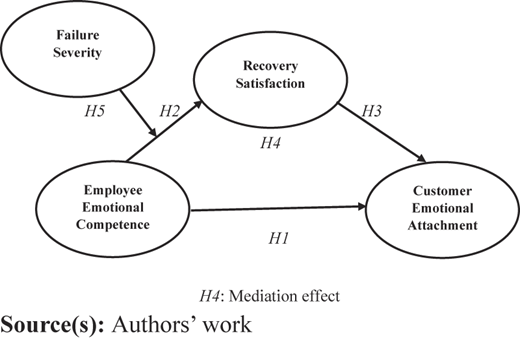
EEC is defined as an “employee demonstrated ability to perceive, understand, and regulate customer emotions in a service encounter to create and maintain an appropriate climate for service” (Delcourt et al., 2016, p. 77). Several scholars have noted that in adverse service encounters, customers expect employees to handle their emotional needs with intelligence, tact, care and skills (Delcourt et al., 2012, 2016; Matute et al., 2018; Fernandes et al., 2018; Song et al., 2022). Also, services marketing and hospitality scholars have documented that while recovering from service failure, front-line employees’ emotional interventions help in managing customer emotions (Kidwell et al., 2020; Liu and Gursoy, 2022). For instance, a growing body of empirical evidence shows that emotionally competent employees can better handle customers` emotional needs, stating that consumers' perceptions vis-à-vis EEC can influence their service recovery evaluations (e.g. Delcourt et al., 2017; Umar and Saleem, 2022). In general, researchers concluded that while redressing failure, service providers should focus on customers' emotional needs due to service failure (Matute et al., 2018), which may result in unfavorable outcomes (Xu et al., 2019). Accordingly, the present study considers EEC to examine its effect on customers' emotional attachment through recovery satisfaction. In addition, this study considers the moderating role of service failure severity in EEC and recovery satisfaction links. Next, we turn to the literature on CEA, recovery satisfaction and service failure severity and establish a theoretical framework using the theoretical foundation of affect infusion and cognitive appraisal theories (see Figure 1).
2.3 Employee emotional competence and customer emotional attachment
Emotional attachment is “a psychological state of mind in which a strong cognitive and affective bond connects a brand to an individual in such a way that the brand is an extension of the self” (Park et al., 2007, p. 7). Psychological literature essentially uses emotional attachment to explain closed relationships among people (Hazan and Shaver, 1994). Emotional attachment has received significant attention in marketing and customer behavior (Malar et al., 2011; Park et al., 2010; Vlachos et al., 2010; Moussa and Touzani, 2017). Accordingly, services marketing studies have empirically and theoretically evidenced that customers develop emotional attachments toward service providers such as banks and retailers (e.g. Vlachos et al., 2010; Moussa and Touzani, 2017). Vlachos et al. (2010) established that when customers feel trust in employees, they develop an emotional attachment toward the firm. Hyun and Kim (2014) noted that employee rapport-building behavior positively influences customers’ emotional attachment. Positive service experiences like staff emotional support result in CEA to grocery retailers and hair salons (Moussa and Touzani, 2017). This aligns with Brocato et al. (2015) observation that social bonds with staff significantly impact CEA to service providers. Considering the attributes of EEC, encompassing the abilities to perceive, understand and regulate customer emotions, it is theoretically plausible to expect a substantial and positive correlation between EEC and CEA. Thus, we hypothesize the following relationship.
There is a positive relationship between perceptions of EEC and CEA.
2.4 Employee emotional competence and recovery satisfaction
Recovery satisfaction has been extensively researched in the hospitality industry. From the consumer’s perspective, service recovery transcends a mere cost–benefit analysis, encompassing the infusion of specific emotional elements to assist customers in navigating challenging service failure situations. Consequently, consumer evaluations of service recovery are shaped by a dual influence: the nature of actions taken (e.g. tangible compensations) and how these actions are executed (e.g. the quality of customer–employee interactions) (Levesque and McDougall, 2000). In accordance with this assertion, Fernandes et al. (2018) posit that service providers who surpass the scope of their professional duties to aid customers and exhibit elevated emotional competence can establish enduring positive impressions and achieve customer satisfaction, even in the presence of service delivery errors. Customers become emotionally engaged in service failure and recovery scenarios (Smith et al., 1999). Given that employees with heightened emotional competence are proficient in offering personalized emotional assistance (Garbas et al., 2023), it is posited that emotionally competent employees are better equipped to attend to customers' emotional requirements arising from service failures (Fernandes et al., 2018). For instance, two consecutive studies demonstrate that employee emotional competence has a significant positive effect on service recovery satisfaction (Fernandes et al., 2018; Umar and Saleem, 2022). Thus, we can assume that perceived EEC has a significant positive effect on the recovery satisfaction of restaurant consumers. Previous scholars used the theory of affect infusion as a theoretical lens to explain the relationship between perceived EEC and customer satisfaction (Delcourt et al., 2012). Affect infusion theory posits that individuals' affective states influence their judgments (Forgas, 1995). Therefore, it can be argued that customers’ positive affective state induced by emotionally competent employees makes them less critical and more satisfied (Delcourt et al., 2012). Thus, we have hypothesized that.
There is a positive relationship between perceptions of EEC and recovery satisfaction.
2.5 Recovery satisfaction and customer emotional attachment
Prior literature provides evidence that recovery satisfaction leads to many favorable emotional outcomes, such as customer attachment to the organization (Moussa and Touzani, 2017), customers’ liking, warm feelings and affection for the firm (Ali et al., 2023). Besides, customer affective commitment (having positive feelings for the organization) underpins emotional attachment (Lai, 2015). In their influential article on branding, Thomson et al. (2005, p. 79) argued that “an individual who is emotionally attached to a brand is likely to be satisfied with it.” Consistent with their contention, they did find a strong correlation between satisfaction and emotional attachment. Also, Moussa and Touzani (2017) documented that customers develop an emotional attachment to a service provider that is responsive to and meets their needs. A service failure can trigger negative emotions; however, successful recovery can improve customers' attachment to the organization (Ali et al., 2023). Cognitive appraisal theory offers promising avenues for the examination of emotions in the field of marketing (Bagozzi et al., 1999). For instance, cognitive appraisal theory asserts that emotions are elicited by a preliminary cognitive evaluation of the encountered events (Cai et al., 2018). Thus, drawing upon cognitive appraisal theory, one may anticipate that consumers positive evaluation of service recovery (i.e. satisfaction from recovery efforts) can lead to positive emotions (i.e. CEA) (Bagozzi et al., 1999; Watson and Spence, 2007). Building on empirical studies and cognitive appraisal theory, we hypothesize:
There is a positive relationship between recovery satisfaction and CEA.
2.6 Mediating role of service recovery satisfaction
Recovery satisfaction is a pivotal mediator in the interplay between recovery efforts and their outcomes (Smith et al., 1999). For example, multiple studies have identified recovery satisfaction as a mediating factor between employee-related efforts, such as interaction justice, and favorable recovery outcomes, including overall satisfaction (Chang and Chang, 2010) and customer service loyalty (Kamath et al., 2020). Extending the discourse, research suggests that a customer’s emotional attachment to a firm can be expressed as loyalty, satisfaction, commitment, retention and more (Prentice, 2016). Within the scope of this investigation, which delves into the role of emotionally competent employees, prior scholars underscore that post-recovery satisfaction mediates the intricate relationships between EEC and favorable outcomes such as word of mouth and repurchase intention (Fernandes et al., 2018).
The affect infusion theory posits that affect leads to judgment (Forgas, 1995). Following affect infusion theory, customers' affective state resulting from perceived EEC affects their service recovery appraisal and satisfaction. According to cognitive appraisal theory, favorable judgments of events produce positive emotions (Bagozzi et al., 1999; Watson and Spence, 2007); hence, recovery satisfaction may increase a customer’s emotional attachment. To sum up, it can be posited that positive affective states in consumers, induced by perceived EEC, contribute to recovery satisfaction (i.e. affect infusion theory); subsequently, the engendered recovery satisfaction nurtures CEA (i.e. cognitive appraisal theory). Given these empirical and theoretical explanations, we hypothesized that.
Recovery satisfaction will mediate the relationship between EEC and CEA.
2.7 Moderating role of service failure severity
Service failure severity is defined as the perceived intensity of a service failure (Wang et al., 2011, p. 351). The magnitude of failure severity is considered more critical in service failure and recovery (La and Choi, 2019). For instance, multiple studies noted that the relationship between service recovery strategies and satisfaction is moderated by service failure severity (El-Manstrly et al., 2021; Mafael et al., 2022; Smith et al., 1999; Weun et al., 2004). Previous studies demonstrated that certain moderating variables influence the effect of perceived EEC on positive recovery outcomes. For instance, the relationship between EEC and post-recovery satisfaction is stronger for high-contact personalized services than for standardized services (Fernandes et al., 2018). Similarly, the effect of perceived EEC on recovery satisfaction is significantly weaker for process failure than outcome failure (Umar and Saleem, 2022). Cho et al. (2017) suggest that negative emotions elicited by a service failure and subsequent dissatisfaction depend on the severity of the failure. Previous studies claim that the effect of recovery efforts on positive customer emotions is stronger for minor failures than for significant failures (Fan and Niu, 2016). Based on affect infusion theory, it can be argued that severe failure evokes severe negative emotions in consumers. Given the higher emotional stake of the consumer for sever service failures (e.g. food safety issues, severe hygiene issues), employee emotional competence is more effective and leads to a better service recovery. On the other hand, in mild failures, consumers emotional state is not that high; therefore, the effect of perceived EEC on recovery satisfaction will be lower in mild failures than in severe failures.
Thus, we have hypothesized that.
The positive relationship between perceived EEC and recovery satisfaction will be stronger for high failure severity than for low failure severity.
3. Methodology
The study considered a survey-based research design to examine the proposed theoretical framework. The survey questionnaire was managed in the following manner: First, the concepts of service failure and recovery in a restaurant setting were explained to the participants, and we asked them to recall and describe their most recent service failure and recovery experience at a restaurant. Subsequently, participants were asked to respond to the survey questions by referring to recalled and described experiences. Hospitality scholars classify restaurants into several categories, including casual dining, fine dining, fast food, etc. (Lee et al., 2020). The scope of the present study includes overall restaurant consumers in the United States as the population of inquiry and examines the positive emotional outcomes of service recovery. Prior scholars suggest that US consumers have a higher dining out frequency (Kim and Ham, 2016). A web-based cross-sectional survey was designed using Lime Survey, and considering a convenience sampling technique, data were collected from US consumers who frequently visit restaurants through Prolific Academics. A total of 195 complete responses were received as a result of the data collection. A recommended sample size for PLS-SEM is five to ten observations per variable (Hair et al., 2018). Accordingly, in this study, cases per variable are more than 35, exceeding the minimum criteria (de Oliveira et al., 2020). Thus, we considered the sample size satisfactory for further analyses.
3.1 Measures
The present study considered pre-validated scales from existing literature. For instance, we used a five-item scale to measure perceiving customer emotions, three three-item scales to measure understanding customer emotions, and a five-item scale to measure regulating customer emotions (Delcourt et al., 2016). For recovery satisfaction, a three-item scale was adapted from Fernandes et al. (2018). In addition, CEA was measured using a six-item scale adapted from (Park et al., 2010) and (Malar et al., 2011). Finally, service failure severity was measured with four items adapted from Tsarenko and Tojib (2012). This study used a seven-point Likert scale to measure all variables, ranging from 1 (strongly agree) to 7 (strongly disagree). This did not find any significant influence for any of the control variables.
4. Results
The sample of the present study includes male consumers 52.6% and 46.9% were female. 11.2% of respondents were under the age of 25, 40.8% were between the ages of 25 and 39, 42.3% were between the ages of 40 and 64, and 4.6% were beyond the age of 64. Similarly, 35.7% of consumers had a college degree and 51.5% of consumers had an annual income of more than 60,000 USD. Overall, 65.8% of consumers dine out one or more times per week. We considered Harman’s single-factor method to check common method bias, and the study reported no common method bias. Our theoretical framework includes a higher-order construct of employee emotional competence, a mediating variable of recovery satisfaction and a moderating variable of failure severity. Therefore, we considered PLS-SEM since it is appropriate for complex models (Hair et al., 2014) with formative constructs and a small sample size (Ramayah et al., 2018). Accordingly, we perform a measurement model to validate the construct, a higher-order model to validate the dimensions of perceived EEC, and a structural model to validate the hypotheses.
4.1 Measurement model
This study considered a measurement model to assess reliability and validity (Hair et al., 2014). Composite reliability is used to assess internal consistency and individual items' reliability. The measurement model demonstrated that the composite reliability for all constructs was greater than the threshold of 0.70 (see Table 1). Validity was measured through convergent validity as well as discriminant validity. Convergent validity was examined through average variance extracted (AVE) (Hair et al., 2019) and as shown in Table 1, this study reported AVE for all variables greater than the cut-off value of 0.05. Hence, convergent validity was considered appropriate. In addition, this study considered the heterotrait-monotrait ratio (HTMT) criterion (Henseler et al., 2015) to examine discriminant validity. As shown in Table 2, all values are less than 0.90, thus validating the discriminant validity as per (HTMT) criterion.
4.2 Higher-order model
To specify perceived EEC as a higher-order latent variable determined by three dimensions of PCE, UCE and RCE, we employed a higher-order model. Accordingly, a variance inflation factor (VIF) for each dimension was determined. VIF values were observed from 1.854 to 2.013, which are quite lower than the threshold value of 5 (Hair et al., 2014). Therefore, the potential multicollinearity issue among the dimensions was not expected. As shown in Table 3 the outer loading of all three dimensions was found statistically significant, thereby suggesting that all dimensions qualify the lower-order constructs of the higher-order latent variable of perceived EEC. Although the outer weight for PCE is not significant, its outer loading is significant; hence, it was maintained (Sarstedt et al., 2019). Thus, the condition of higher-order construct validation is verified.
4.3 Structural model
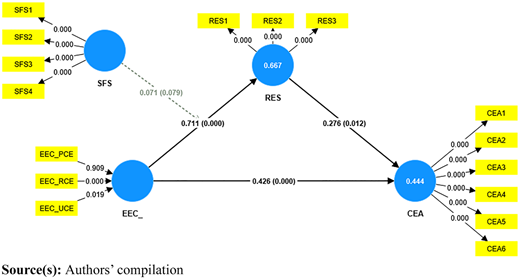
This study employed a structural model to examine the hypothesized relationships. The impact of perceived EEC on CEA was supported with beta = 0.426, p = 0.000 (H1). The effect of perceived EEC on recovery satisfaction was supported with beta = 0.792, p = 0.000 (H2). The effect of recovery satisfaction on CEA (H3) was also supported with beta = 0.276, p = 0.012 (see Table 4). To examine the mediating role of recovery satisfaction, we considered Preacher and Hayes (2008) approach using a bootstrapping procedure with subsamples of 5,000 repetitions to examine confidence intervals and t-values. Table 5 shows that the mediating role of recovery satisfaction between EEC and CEA (H4) was also supported since the confidence intervals did not include zero (Preacher and Hayes, 2008). As direct and indirect hypotheses both were significant, it can be argued that recovery satisfaction partially mediates the EEC–CEA link.
Service failure severity was considered as a moderator in the relationship between EEC and recovery satisfaction. Table 6 presents the results of the full model (with all study variables) with the moderating effect of service failure severity. The moderating effect was performed by multiplying EEC (predictor) and service failure severity (moderator) to create an interaction to understand the impact they jointly have on the dependent outcome (Henseler and Fassott, 2010). This way, we considered the bootstrapping procedure with 5,000 repetitions to examine the effect of the predictor on the criterion variable, the effect of the moderator on the criterion variable and the effect of interaction on the criterion variable. Results revealed that the coefficient of interaction is one-tailed significant (beta = 0.07, p = 0.079 and t = 1.76). Thus, it could be concluded that service failure severity exhibits a positive, marginal moderating effect on the relationship between EEC and recovery satisfaction, thus supporting H5 (see Figure 2). This implies that higher levels of service failure severity are related to a higher impact of EEC on recovery satisfaction, and vice versa. In other words, the higher the level of service failure severity, the higher the impact of EEC on recovery satisfaction, and the lower the level of service failure severity, the lower the impact of EEC on recovery satisfaction. By implication, this demonstrates that EEC is highly important for recovery satisfaction in cases where service failure severity is high. However, it should be noted that the moderating effect is marginal, as our finding is acceptable only at one significant tail, but it is very important because of the sensitivity of the study’s context—the service setting (restaurant).
5. Discussion
Our data analysis shows several interesting results. First, this study found that consumers perceiving higher emotional competence in service employees also have higher service recovery satisfaction. These findings align with prior studies indicating that perceived EEC is an essential skill for delivering exceptionally personalized service (e.g. Huang et al., 2020) and that emotional service recoveries significantly enhance customer satisfaction (Delcourt et al., 2012; 2016; Matute et al., 2018). Thus, it is noteworthy that perceived EEC directly contributes to the satisfaction derived from service recovery (Fernandes et al., 2018).
CEA has emerged as a noteworthy component within the context of customer evaluation, satisfaction and loyalty to services (e.g. Park et al., 2010; Vlachos et al., 2010; Brocato et al., 2015; Moussa and Touzani, 2017). According to psychology literature, individuals have a psychological predisposition to establish affectionate bonds (Hazan and Shaver, 1994). Consistent with our argument, this study found that in the context of service failures, consumers perceiving higher levels of EEC tend to demonstrate greater emotional attachment to the service provider. These findings align with previous research, which indicated that customers' emotional attachment is fostered by trust in employees and their ability to build rapport (Vlachos et al., 2010; Hyun and Kim, 2014; Moussa and Touzani, 2017).
Employing cognitive appraisal theory, which emphasizes an interplay between cognition and emotion (Bagozzi et al., 1999; Watson and Spence, 2007), we contend satisfaction with service recovery drives emotional attachment. This study did find that consumers who have higher satisfaction with service recovery tend to exhibit greater emotional attachment to the service provider. These findings support the notion that highly satisfied customers show greater emotional attachment to the firm (Moussa and Touzani, 2017; Kumar et al., 2019). Also, these findings are congruent with previous research that suggests ensuring satisfactory service helps establishing an emotional bond with the service provider (Brocato et al., 2015; Xiaofei et al., 2021; Ali et al., 2023).
Prior research has noted service recovery satisfaction as an underlying mechanism in several types of loyalty outcomes such as customer service loyalty (Chang and Chang, 2010; Kamath et al., 2020), repurchase intention (Ali et al., 2023), to mention a few. Using affect infusion and cognitive appraisal theories, we hypothesized that service recovery satisfaction plays an underlying mediation role in the link between perceived EEC and CEA. The study documents a significant indirect effect of perceived EEC on CEA via service recovery satisfaction. This finding suggests that achieving customer recovery satisfaction serves as a pathway through which perceived EEC can exert its influence on fostering customer emotional bonds with the restaurant.
Preceding research has emphasized that service failure severity has determinantal effects on the customers' emotions, satisfaction, and future behaviors (Cho et al., 2017). For instance, the severity of service failure plays a crucial role in shaping customers' perceptions of the failure (El-Manstrly et al., 2021) and negatively affects both service organizations and consumers alike (Koc, 2019). As expected, the results indicated that as the severity of service failure escalates, the connection between perceived EEC and recovery satisfaction strengthens. These findings highlight the greater significance of EEC in the restaurant industry. Despite the notion that the seriousness of service failures poses greater challenges for recovery (Ma et al., 2020), as severe failures have adverse effects on satisfaction, trust and subsequently repurchase behavior (Alnawas et al., 2023; de Mesquita et al., 2023), this finding suggests that EEC is more effective in severe failures. One of the possible explanations for this finding is that consumers put in more cognitive efforts to understand and register the emotional competence of service employees in severe failures. On the contrary, in lower failure-severity situations, consumers do not put much cognitive effort into the emotional competence of service employees.
5.1 Theoretical and managerial implications
This study contributes to the literature in several ways. This is the first research that contributes to service failure research by considering CEA as a noteworthy outcome of service recovery strategies (e.g. Kumar et al., 2019; Xiaofei et al., 2021; Ali et al., 2023). The study document perceived EEC as a way to cultivate an emotional connection with customers. These results align with previous studies that have documented that the attachment system drives individuals to seek supportive figures for emotional regulation and protection (e.g. Moussa and Touzani, 2013; Moussa and Touzani, 2017). In other words, in the face of service failure, emotionally competent employees, who can perceive, understand and regulate customer emotions (Delcourt et al., 2016), can foster CEA with restaurants. Second, the study adds to the evidence in the literature that in the context of service failure, a positive affective state induced by emotionally competent employees makes customers less discerning and more content. This is in line with affect infusion theory: individuals' affective states influence their judgments (Forgas, 1995). Third, we extend the cognitive appraisal theory, which posits that an individual’s cognition drives emotions (e.g. Bagozzi et al., 1999; Watson and Spence, 2007), to service recovery encounters by demonstrating that service recovery satisfaction fosters CEA in a restaurant.
Fourth, this research contributes to service failure research by considering recovery satisfaction as an underlying mechanism of perceived EEC and CEA. The study found that consumer positive affective states induced by perceived EEC affect their judgment (i.e. recovery satisfaction), and consumer cognition (i.e. recovery satisfaction) in turn affects their emotion (i.e. CEA with restaurant). In doing so the study contributes to the literature customer recovery satisfaction that has documented its mediation between recovery strategies and behavioral intention (e.g. Chang and Chang, 2010; Ali et al., 2023; Kamath et al., 2020). These findings again support cognitive appraisal and affect infusion theories.
The fifth contribution is study document moderating effect of service failure severity in the relationship between perceived EEC and recovery satisfaction in restaurant context. This contributes further evidence to the existing literature, emphasizing the importance for restaurant operators to categorize service failures into either trivial or critical incidents (Cho et al., 2017).
To sum up, this study contributes to several key theoretical understandings within the service failure and recovery literature. The study reinforces the affect infusion theory by demonstrating that employees' emotional competence influences customer satisfaction during recovery, which highlights the role of affect in improving recovery outcomes. The study also extends cognitive appraisal theory by illustrating recovery satisfaction as a crucial appraisal process, serving as an underlying mechanism between perceived employee emotional competence and CEA. Accordingly, it enriches our understanding of the emotion-driven evaluation of customers. The study also shows that the severity of the service failure has a moderating effect. This shows that service organizations need to adjust their recovery strategy based on the severity of the service failure, which makes theoretical applications more useful in real life.
Similar to earlier studies (e.g. Delcourt et al., 2016), this study also advocates implementation of organization-wide training programs aimed at enhancing employees' emotional competence skills. Emotionally competent employees alleviate the negative consequences of service failure (Alnawas et al., 2023). Furthermore, emotional service recovery contributes to customer satisfaction, subsequently nurturing CEA to the service organization (e.g. Kumar et al., 2019; Xiaofei et al., 2021; Ali et al., 2023). The implication here is that in the event of service failure, emotionally competent employees in a restaurant can not only satisfy customers but also form an emotional bond with them. Another important implication is that managers must understand that the satisfaction that comes from employees' ability to perceive, understand and manage customer emotions is essential for building long-term relationships, such as emotional attachment. Hence, it is imperative for managers to ensure that employees thoroughly comprehend the pivotal role of emotional competence in securing recovery satisfaction and subsequent emotional attachment to the restaurant.
This study also shows that, in restaurant service failure, the impact of perceived EEC on recovery satisfaction strengthens as perceived service failure severity escalates. The implication is that consumer emotional stakes are higher for severe service failures; therefore, employee’s emotional competence improves service recovery. On the other hand, in minor failures, consumers' emotional state is lower; therefore, perceived EEC has a lower effect on recovery satisfaction. Thus, like previous researchers (e.g. Tsarenko and Tojib, 2012; Cho et al., 2017), we also underscore the necessity for employees to undergo comprehensive training in categorizing the severity of service failures and corresponding recovery strategies. Recently, Alnawas et al. (2023) have suggested that employees’ secure interpersonal attachment style mitigates the adverse influence of service failure severity on the brand. Hence, managers, in addition to prioritizing employees' emotional competence, must also consider the severity of service failures. In other words, managers should prioritize emotional competence for severe service failures, such as food safety and hygiene issues, as it improves post-recovery satisfaction.
6. Limitations and future research
This study acknowledges several limitations. This study is done among restaurant consumers; thus, findings are limited to restaurants, not to the services in general. Given that employee emotional competence could potentially be applicable in other service settings, particularly in health and personal care due to their more personalized nature, future studies may consider extending the scope of this research to explore this model among services in various categories. The limitation of a restricted sample size may also restrict the generalizability of the research; therefore, future research should aim to expand the sample to enhance the applicability of the findings. To enhance the validity of our study, future research could incorporate control variables, such as failure type, restaurant type and demographic factors (Fernandes et al., 2018). In this study, we have utilized the critical incident analysis method, which possesses certain drawbacks that depend on users recalling events accurately and truthfully. Besides, professional creative writers may help in creating scenarios incorporating EEC. Nevertheless, experiments employing videos that depict employees' emotional competence in service failure situations provide a promising avenue (e.g. Delcourt et al., 2017) for validating this study. Furthermore, field experiments, owing to their naturalistic settings, present a significant opportunity for studying the influence of EEC on real consumers (Matute et al., 2018). The study found that service failure severity has a slightly positive moderating effect on the connection between EEC and recovery satisfaction in the context of a restaurant service failure. Future researchers could verify these results in various other service settings such as hotels, airlines, banking and retail.
Funding: This research is funded by the Tampere University of Applied Sciences Foundation the grant number is 20230320.