Skip to article sections
Purpose

The growing interest in sensory and experiential marketing, along with extensive research in recent decades, highlights the need to summarize the existing literature. One of the least explored aspects is that, since experience is a complex construct to assess or measure, specific instruments must be developed to accurately capture it.

Design/methodology/approach

A total of 60 relevant articles, published between 2001 and 2023, were collected from academic databases such as WOS and Scopus, among others, and analyzed.

Findings

Our research concludes that sensory experiences are critical factors in understanding consumer decision-making.

Originality/value

The analysis was conducted using bibliometric indicators, such as authorship and year of publication, as well as the dimensions and types of scales or measurement instruments used.

The way we understand consumption has changed dramatically over the past few decades. It all began with a pivotal shift in the early 1980s, when Holbrook and Hirschman (1982) challenged the dominant utilitarian view of consumer behavior. Instead of seeing consumption merely as a rational process of acquiring functional benefits, they revealed its deeper, more human dimension: one driven by emotions, fantasies, and sensory pleasures. This marked the beginning of a new era, one in which the experience itself became central to understanding how and why people consume.

As this experiential view gained traction, scholars in the late 1990s began to expand the conversation. Pine and Gilmore (1998) introduced the concept of the “experience economy,” arguing that in a saturated marketplace, businesses could no longer rely solely on price or quality to differentiate themselves. Instead, they needed to create memorable, emotionally rich experiences. Schmitt (1999) further contributed to this evolving paradigm by framing the consumer experience as a complex interplay of rational and emotional interactions between consumers and brands.

In today’s hypercompetitive global market, this idea has only grown in relevance. Traditional marketing tactics are no longer enough. Consumers are no longer passive buyers because they seek out experiences that stimulate their senses and emotions (Le et al., 2019; Österle et al., 2018). Companies, in turn, are rethinking their strategies, shifting from product-centric to experience-oriented approaches that connect with consumers on a deeper, more personal level (López Rodríguez, 2016).

From this transformation, experiential marketing emerged as a powerful response to consumer hedonism. At its core lies the interaction between the consumer (the subject) and a product, service, event, person, or idea (the object), all shaped by the surrounding environment. Unlike traditional models, this approach is inherently subjective: every consumer experience it differently. What makes experiential marketing particularly compelling is its ability to engage consumers at multiple levels: rational, emotional, sensory, physical, and even spiritual (Homburg et al., 2017; Bustamante and Rubio, 2017).

This shift also paved the way for a more holistic understanding of consumption that goes beyond functionality. Consumers increasingly seek meaningful experiences that resonate with their identity and emotions. As Gentile et al. (2007) suggested, a richer framework is needed, one that includes sensory, affective, cognitive, physical, and social dimensions. This comprehensive perspective provided fertile ground for the development of experiential marketing as a strategy to create value through immersive, emotionally engaging environments.

Within this broader context, sensory marketing has gained prominence as a key component of experiential strategies. It focuses on the deliberate use of the five senses (sight, hearing, smell, taste, and touch) to craft brand experiences that align with the consumer’s identity, lifestyle, and preferences (Zha et al., 2025). Far from being superficial, sensory stimuli activate neural pathways that generate emotional responses and shape lasting memories (De Garcillán López-Rúa, 2015).

As the literature shows, sensory marketing does more than complement experience: it defines it. By stimulating the senses, brands create distinctive perceptions that deepen emotional connections and influence consumers’ evaluations of their experiences (Krishna, 2012; Hultén, 2011). Moreover, sensory cues help shape coherent brand identities by establishing consistent associations across all consumer touchpoints (Shahid et al., 2022).

This convergence of experiential and sensory marketing has become a focal point in recent academic discourse. Scholars are increasingly interested in how these two approaches intersect to create powerful, multidimensional brand experiences. For instance, Wang (2025) proposed a comprehensive experiential sensory marketing model that integrates perceptual theory and emerging technologies. His findings revealed a strong positive correlation between sensory marketing strategies and customer loyalty in retail settings: for every 1% improvement in experiential sensory marketing, loyalty rose by 0.647%.

The hospitality industry, in particular, offers fertile ground for these concepts. Fong et al. (2023) conducted a critical synthesis revealing how sensory cues enhance consumer experiences with hospitality brands, ultimately fostering loyalty. Meanwhile, researchers like Petit et al. (2019) have turned their attention to the digital world, demonstrating how sensory elements can also create immersive experiences in online environments. Their work shows that even in virtual settings, sensory strategies remain powerful tools for enhancing engagement and shaping perceptions.

In light of this growing body of work, this paper aims to analyze the main factors addressed in the academic literature on sensory and experiential marketing. To achieve this objective, a bibliometric analysis was conducted, a quantitative exploration of the literature drawn from various academic databases and platforms. This approach allows us to identify both the most extensively studied aspects of the field and those that present opportunities for future research.

Based on the preceding discussion, this study seeks to address the following research questions:

RQ1.

What key thematic and methodological trends have characterized research on sensory and experiential marketing over the past 2 decades?

RQ2.

What instruments have been most frequently employed to assess sensory experiences within the sensory and experiential marketing research domain?

RQ3.

What measurement scales have been commonly used to quantify or evaluate sensory experiences in this body of research?

The remainder of the paper is structured as follows: Section 2 presents a literature review of the most relevant topics for our study. Section 3 outlines the methodology used. Section 4 presents the results of the performance analysis, identifying the key factors that shaped the research landscape. Finally, Section 5 offers our conclusions and suggests future lines of inquiry for further exploration.

The connection between the senses and emotions has long intrigued researchers, but recent advances in neuroscience have brought new clarity to this relationship. Far from being a passive gateway to the brain, sensory perception plays an active, foundational role in shaping emotional experiences. Each of our five senses (vision, hearing, touch, taste, and smell) serves as a vital conduit, translating the external world into neural signals that the brain interprets and reacts to emotionally.

Among the brain structures responsible for this interpretation, the limbic system and particularly the amygdala, emerges as central. It evaluates the emotional weight of incoming sensory information. As McDonald (2020) notes, the basolateral amygdala receives and processes this information, acting as a kind of emotional filter that assigns meaning to what we see, hear, and feel.

This process, however, is far from linear. Once stimuli are registered, regions such as the insular cortex come into play, synthesizing sensory data into a coherent, subjective emotional experience (Craig, 2009). Functional neuroimaging studies support this pathway: for example, activation in the somatosensory cortex has been linked to the perception of emotions communicated through facial expressions and vocal tones (Dricu and Frühholz, 2020). Such findings make it increasingly clear that sensory input does not simply precede emotion, but actively constructs it.

In fact, interdisciplinary evidence shows that deliberately stimulating the five senses can both enhance positive emotion and dampen negative emotional responses. As Rodriguez and Kross (2023) argue, sensory engagement offers an efficient, low-effort path to emotion regulation. Conversely, disruptions in the neural circuits responsible for processing sensory data can negatively affect higher-order functions like emotional self-regulation (Harricharan et al., 2021). This perspective has broad implications: by targeting the sensory-emotional link, new therapies may be developed for emotional disorders rooted in sensory dysregulation. From a neuroscientific standpoint, then, emotions are not random or disconnected from the world around us, but are systematically constructed, grounded in the way our brains interpret sensory input.

In this changing psychological and marketing landscape, experience has emerged as a central currency. Today’s consumers seek not only satisfaction, but also emotional experiences that go beyond the functional value of a product or service (Walls et al., 2011). This new consumer mindset has led companies to increasingly adopt experiential marketing strategies designed to create deeper, more memorable connections between consumers and brands.

Yet, despite its growing relevance, the academic literature on experiential marketing remains relatively limited, especially in terms of understanding its full impact on customer perceptions (Geuens and De Pelsmacker, 2017). To design more effective strategies, companies must understand how emotions and cognitive responses evolve throughout the customer journey, from the first interaction to post-purchase reflection.

As recent research shows, consumers are no longer content with merely acquiring goods. Instead, they assess the overall experience surrounding a brand: its ambiance, its narrative and its emotional resonance (Hagiu and Altman, 2017; Itani et al., 2019; Melero et al., 2016). This evolution opens the door to designing experience-based marketing approaches that foster engagement before, during, and after consumption (De Keyser et al., 2015). Experiences, in this sense, become powerful emotional triggers that influence behavior, deepen loyalty, and shape brand perception.

Closely intertwined with the experiential paradigm is sensory marketing, which focuses on stimulating the senses to enhance brand experiences (Biswas, 2019). Marketers may craft multisensory environments that engage all five senses, or they may target one or two strategically chosen senses to provoke specific emotional responses. However, achieving the right balance is essential: while single-sense strategies may lack emotional richness, overstimulation can overwhelm the consumer (Rodas-Areiza and Montoya-Restrepo, 2018; Doucé and Adams, 2020).

Recent studies have moved beyond simply acknowledging the influence of sensory stimuli. Scholars are now building empirical models that clarify causal relationships. In these models, sensory stimuli (such as lighting, sound, scent, texture, or visual aesthetics) serve as independent variables that influence mediators like emotional activation, perceived quality, or hedonic pleasure (Rahman et al., 2023; Krishna, 2012; Hultén, 2011). Multisensory congruence has also been shown to amplify emotional responses. Spence et al. (2014) found that when multiple stimuli align harmoniously (e.g. soft music paired with warm lighting), the positive emotional impact is heightened or Biswas and Szocs (2019) considered examining so-called sensory compensation effects and found that certain stimuli from one sensory modality can compensate/satisfy desire related to another sensory modality at the point of sale. These effects are no longer limited to the physical world, but we are also seeing major advances in the digital world on sensory perception (Batat, 2024).

Visual and tactile elements, in particular, play a powerful role in influencing consumer decisions (Affonso and Janiszewski, 2023; Jarvis et al., 2024). Research by Vilnai-Yavetz and Rafaeli (2006) revealed that store design and texture can drive purchase intentions, mediated by perceived value and brand identification. This positions design as a strategic variable with both emotional and behavioral consequences.

To explore the scope of sensory marketing further, it’s useful to break down the five senses and their applications:

  1. Visual Marketing: Sight dominates human perception, and around 83% of information is processed visually (De Garcillán López-Rúa, 2015). Visual strategies rely on colour, lighting and design to shape brand image and influence behaviour (Hultén et al., 2009; Spence and Di Stefano, 2024; Campo et al., 2025) or as is often the case in the food sector (Simmonds and Spence, 2017).

  2. Scent Marketing: Smell is uniquely linked to memory and emotion. With humans able to distinguish over 10,000 scents, a familiar aroma can instantly evoke emotional memories (Hultén et al., 2009; Muñoz-Querales et al., 2020).

  3. Gustatory Marketing: Taste rarely acts alone; it is preceded by visual, tactile, and olfactory filters (Biswas et al., 2021). It requires a conscious, voluntary action, which makes its activation particularly significant (De Garcillán López-Rúa, 2015).

  4. Auditory Marketing: Music and sound can regulate mood and evoke specific emotions, helping shape the consumer experience at both conscious and subconscious levels (Muñoz-Querales et al., 2020; Jang and Lee, 2019).

  5. Tactile Marketing: Touch adds depth to brand interaction, engaging through textures, temperature, and weight. It, too, requires voluntary engagement but can be encouraged visually (Hultén et al., 2009; De Garcillán López-Rúa, 2015).

In addition to sensory inputs themselves, various moderating factors shape the impact of these stimuli. These include consumer typology (hedonic vs. utilitarian), cultural background, and brand familiarity (Akdim et al., 2022). This layered approach allows marketers to go beyond generalizations like “scent enhances experience” and instead specify the conditions under which such effects are most potent; for example, identifying when a scent will evoke loyalty or increase willingness to buy.

To gain a comprehensive view of the scientific literature on sensory and experiential marketing, a structured search was carried out across several leading academic databases: Web of Science (WOS), Scopus, Emerald, ScienceDirect, and Wiley Online Library. In order to broaden the scope and capture a wider linguistic and regional range of publications, complementary platforms such as ResearchGate, Dialnet, and Google Scholar were also consulted, particularly to include relevant studies in Spanish that are often underrepresented in indexed sources.

The search strategy involved the use of carefully selected keywords in both English and Spanish. While English remains the dominant language for academic publication globally, Spanish was included due to its growing relevance in scientific discourse and its widespread use in marketing and consumer research contexts. Although Table 1 presents unified search terms, the specific syntax and application of these queries were adapted to the parameters and functionalities of each database. For instance, the use of Boolean operators, truncation symbols, wildcards, and field-specific filters (e.g. title, abstract, keywords) was adjusted in accordance with the search protocols of different academic databases. These adaptations ensured consistency in the conceptual scope of the search strategy while accounting for the technical differences across databases.

The final set of search terms (see Table 1) was determined through a structured and iterative process among the authors, based on preliminary literature reviews and alignment with the study’s research objectives. Both English and Spanish terms were used to ensure linguistic inclusivity and to capture regionally diverse contributions.

During this process, additional terms such as sensorial marketing, brand engagement, customer immersion, and experiential branding were considered but ultimately excluded. These terms were either too broad, overlapped conceptually with included keywords, or were less frequently used in empirical literature directly related to sensory marketing. The final selection reflects a deliberate balance between breadth and specificity to ensure thematic focus and analytical rigor.

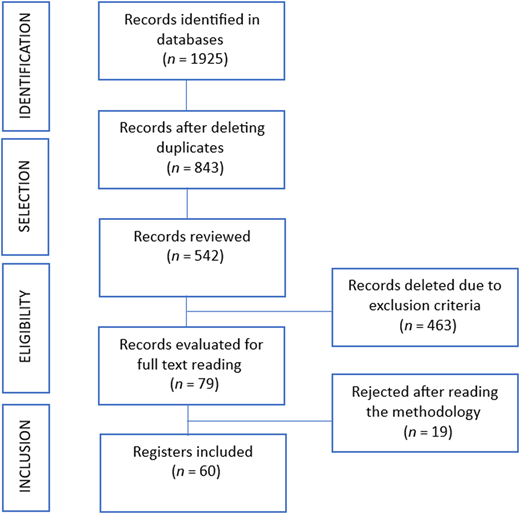
The initial search yielded a total of 1,925 publications that included the selected keywords in their titles or as part of their keyword lists. A second round of advanced filtering was conducted to remove duplicates in the databases, resulting in a final set of 843 unique articles. Subsequently, screening was performed by reading the abstracts, yielding 542 potentially eligible records, of which 463 were eliminated due to exclusion criteria. The full text of the 79 articles that met the eligibility criteria was then read, of which 19 were excluded after reading the methodology because they did not include field work that allowed the impact on consumers to be assessed through measurement instruments or scales, or because they approached the subject of emotions and sensory experience exclusively from psychological or socioemotional aspects. In the end, 60 articles published between 2001 and 2023 were selected.

To ensure that the final sample of studies aligned with the objectives of the research, we applied a set of well-defined inclusion and exclusion criteria:

Inclusion criteria:

  1. Peer-reviewed journal articles.

  2. Availability of full-text versions.

  3. Complete reference listings.

  4. Publications written in English or Spanish.

Exclusion criteria:

  1. Systematic literature reviews or previous bibliometric analyses.

  2. Articles published before the year 2000.

  3. Purely theoretical analyses.

  4. Studies addressing the five senses from non-marketing perspectives (e.g. biomedical or artistic contexts).

  5. Theses, books, and book chapters.

To structure the selection process transparently and systematically, we adopted and adapted the PRISMA framework (Preferred Reporting Items for Systematic Reviews and Meta-Analyses) (Güzel et al., 2025; Page et al., 2021). Although traditionally used in health sciences, PRISMA has proven useful for structuring robust review processes across disciplines, and was here tailored to a bibliometric review context. The aim was to ensure methodological rigor and replicability in analyzing trends, gaps, and measurement approaches within the field.

The PRISMA flow diagram guided the process through four key stages: identification, screening, eligibility assessment, and final inclusion. To adapt this protocol to the specificities of bibliometric research, several important modifications were made:

  1. Review objective: While PRISMA typically assesses the effectiveness of interventions, here it served to synthesize the evolution of research output on sensory and experiential marketing, focusing especially on measurement instruments and conceptual frameworks.

  2. Expanded data sources: The search extended beyond core databases (Scopus and Web of Science) to include additional academic platforms such as Dialnet and Google Scholar, capturing research in Spanish and emerging perspectives not always visible in high-impact journals.

  3. Tailored exclusion criteria: Unlike reviews in medicine or engineering, this study deliberately excluded theoretical and review articles in order to focus on empirical work presenting concrete measurement tools or models. A publication window between 2001 and 2023 was selected to highlight contemporary contributions in a fast-evolving field.

  4. Data extraction and categorization: Instead of clinical metrics, the extracted information included bibliometric variables (journal, country, language, quartile, etc.) and content variables (sensory dimensions studied, measurement instruments, scales, emotional or behavioral outcomes assessed).

Through this methodological adaptation, the study preserves the principles of transparency, reproducibility, and academic rigor that PRISMA promotes, while ensuring its suitability for the objectives of bibliometric analysis. Figure 1 presents the flowchart summarizing the full article selection process.

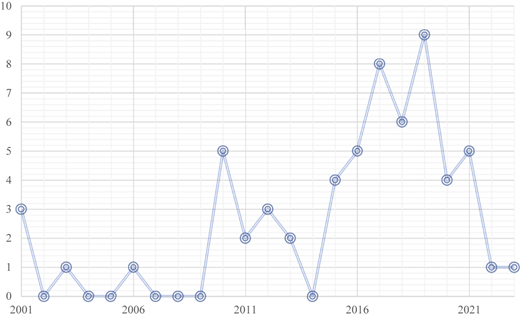
Figure 2 illustrates the distribution of publications by year. A clear upward trend in studies on experiential and sensory marketing can be observed beginning in 2016 and reaching a peak in 2019. This pattern reflects the growing academic and professional interest in marketing innovation. However, a significant decline in publications occurred in 2020, likely attributable to the challenges posed by the COVID-19 pandemic. Approximately 25% of the analysed publications were released during the COVID-19 period (2020–2022), a time that significantly influenced both consumer experiences and academic approaches to sensory marketing. Many of these studies adapted their focus and methodology to address pandemic-specific constraints, such as reduced physical interaction, increased reliance on digital environments, and shifting consumer priorities. As a result, some findings may reflect temporary conditions or adjustments specific to that exceptional context. Moreover, mobility restrictions and limitations on interpersonal interaction imposed by health authorities not only disrupted economic activity but also posed substantial barriers to the execution of empirical research projects (Maison et al., 2021; Rinaldi and Bottani, 2023).

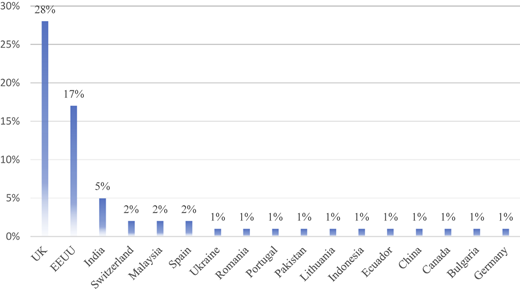
In terms of geographical origin, the United Kingdom leads with 28% of the total publications, followed by the United States with 17%. In Latin America, only one contribution was identified, originating from Ecuador (see Figure 3), which highlights the underrepresentation of this region in the field.

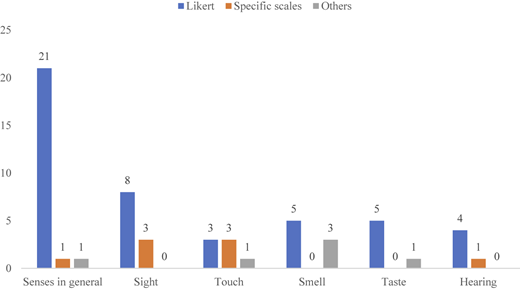
Regarding the thematic focus of the reviewed articles, 38.33% address sensory marketing from a general perspective, while the remaining 61.67% concentrate on the analysis of a specific sense. Vision emerges as the most studied individual sense, appearing in 18.33% of the publications (see Table 2). As for the methodological tools employed, the Likert scale predominates, being used in 76.67% of the studies. In some cases (13.33%), the Likert format serves as a foundation for constructing more specific instruments aimed at capturing the involvement of the senses (either globally or individually). Less frequently (10.00%), alternative techniques such as software applications, augmented reality tools, or devices for monitoring physiological responses, facial expressions, or brain activity are employed (see Figure 4).

Among the 60 articles analysed, 23 address sensory marketing in general terms, without specifying any particular sensory modality. The remaining 37 articles focus on individual senses: 11 on sight, 8 on smell, 7 on touch, 6 on taste, and 5 on hearing. This study places particular emphasis on the latter group in order to identify which senses have received the most scholarly attention and to explore the methodological approaches employed to investigate them.

Table 2 presents the bibliographic references of the articles addressing sensory marketing from a general perspective or through the integration of multiple senses. It also includes the measurement instruments and scales employed, as well as the specific dimensions analysed in each study.

The 23 articles analysed in this category predominantly utilise a five-point Likert scale to assess the relationship between sensory stimuli and consumer behaviour, purchase intentions, or brand preferences. Seventeen of these studies adopt a comprehensive approach, evaluating the influence of all five senses across various contexts. These include tourism and entertainment experiences (Agapito et al., 2012; Tasci and Milman, 2019), purchase intentions for different product categories (Ahmed and Ding, 2019; Altschwager et al., 2017; Beig and Nika, 2022; Hsiao et al., 2021; Palma Perez et al., 2018; Pelletier and Collier, 2018), dining experiences (Leri and Theodoridis, 2021; Nadiri and Nazan Gunay, 2013), brand perception and value (Beig and Nika, 2022; Guerra Serrano and Gomes-Franco e Silva, 2017; Haase and Wiedmann, 2018; Wiedmann et al., 2018), and broader aspects of consumer behaviour (Chang and Horng, 2010; Shobeiri et al., 2016).

A total of 6 studies in the final sample focus on specific combinations of senses. For example, sight and touch (Balaji et al., 2011); sight and hearing (Shaed et al., 2015); touch and taste (Perumal et al., 2021); sight, hearing, and smell (Fürst et al., 2021); sight, taste, and smell (De Wijk et al., 2012); and sight, hearing, touch, and smell (Labenz et al., 2018). Across these combinations, sight consistently emerges as a dominant sense, underscoring its central role in marketing strategies.

Table 3 summarises the literature focusing on visual marketing, detailing the measurement instruments used and the specific dimensions explored in each study.

All the reviewed articles employ the Likert scale to assess visual perception and its influence on consumer decisions, particularly regarding purchase and consumption behaviours. In three instances, the Likert scale served as a foundation for the development of specialised instruments to measure emotional and perceptual responses. Notable examples include the VISUALSCAPE scale (Bagdare and Roy, 2016), which evaluates the impact of visual experiences on purchasing behaviour; the Centrality of Visual Product Aesthetics (CVPA) scale (Bloch et al., 2003), which assesses the significance of product design through the dimensions of value, insight, and intensity of response; and the Experiential Value Scale (EVS) (Mathwick et al., 2001), which predicts variations in purchase preferences based on visual appeal.

A significant portion of the literature examines the impact of colour on different aspects of consumer experience. Some studies analyse how colour influences purchase intentions (Hussain, 2017; Lee and O'Mahony, 2005), while others investigate the dominance of vision over other senses in food and beverage consumption (Reinoso Carvalho et al., 2017). Additional research explores colour as a strategic marketing tool, highlighting how colour saturation can alter perceptions of product size (Hagtvedt and Brasel, 2017) or how visual merchandising can stimulate impulse buying (Bashar and Ahmad, 2012; Jalees et al., 2016).

Table 4 presents the bibliographic references related to olfactory marketing, along with the instruments and dimensions assessed in each case.

Five of the reviewed articles apply the five-point Likert scale to measure the impact of scent on purchase intentions and consumer responses (Anggie and Haryanto, 2011; Chebat and Michon, 2003; Gómez Gallo and Hernández Zelaya, 2020; Herrmann et al., 2013). In the study by Dörtyol (2021), the Likert scale is used as a base to develop the Need-to-Smell (NTS) scale, which measures impulse buying through scent along the dimensions of expectancy, desire, satisfaction, confidence, and avoidance. A more experimental approach is found in Beyts et al. (2017), where the Likert scale (focusing on pleasure) is complemented by autonomic measurements of physiological responses, such as heart rate, temperature and muscle activity, captured via facial electromyography.

Other studies employ alternative qualitative and technological tools. For instance, Cerulo (2018) uses blind perfume testing in a shopping mall to investigate how scent activates cognitive mechanisms and meaning according to social class. Castellanos et al. (2010) adopt Linguistic Inquiry and Word Count (LIWC) software to analyse participant narratives triggered by scent-related memories. After exposure to various environmental odours, participants were asked to recount childhood memories, illustrating the evocative power of smell (Muñoz-Querales et al., 2020) and its role in forging lasting brand associations (Hultén et al., 2009).

Table 5 compiles the bibliographic references of studies focused on haptic or tactile marketing, including their methodologies and analytical dimensions.

Three articles employ the 5-point Likert scale to examine the influence of touch on purchase intentions (AL-Fakhri and Alabdullah, 2021; Jha et al., 2020; Liu et al., 2017). Additionally, three articles use the scale as a basis to construct the Need for Touch (NFT) scale (Peck and Wiggins, 2006; Ringler et al., 2019; Ştir and Zaiţ, 2019), which measures consumers’ tactile sensitivity and its impact on attitudes and behaviours. These articles pay particular attention to virtual touch experiences, especially in relation to online shopping and purchase decisions.

Heller et al. (2019) introduce an innovative approach by incorporating augmented reality (AR) to compare the effects of tactile versus voice controls on consumers’ willingness to pay. Their findings suggest that simulating tactile attributes through AR can positively influence consumer responses, demonstrating the potential of immersive technology in enhancing the sensory dimension of digital retail environments.

Table 6 presents the articles that investigate gustatory or taste-based marketing, together with the corresponding instruments and dimensions.

Five studies use the 5-point Likert scale to evaluate the role of taste in food tourism and culinary experiences (Di-Clemente et al., 2019, 2020), as well as its influence on brand preference and perceived food and beverage quality (Chung et al., 2006; Ghose and Lowengart, 2001; Jang and Lee, 2019). González Viejo et al. (2019) complement the Likert data with physiological and neurological indicators, such as facial expression monitoring, heart rate, temperature, and brain activity (via EEG), to gain a more comprehensive understanding of consumers’ multisensory reactions to taste stimuli.

Finally, Table 7 provides an overview of the literature related to auditory or sound marketing, including the instruments used and the analytical dimensions covered.

Four studies rely on the 5-point Likert scale to assess emotional responses to auditory stimuli and their effects on consumer behaviour (Biswas et al., 2019; Ringler et al., 2017), brand loyalty and preference (Wu et al., 2010), and advertising effectiveness (Lewis et al., 2012).

Hollebeek et al. (2016) extend this approach by developing the Music Engagement Scale (MES), which is grounded in Likert scale responses. This tool measures the role of music in shaping consumer engagement with brands, with particular emphasis on social identity and emotional connection.

This study provides a comprehensive research framework that can serve as a foundation for the development of new marketing strategies. Over the past 2 decades, there has been a notable increase in interest surrounding sensory and experiential marketing, reflecting a shift towards consumer-centred innovation. In this paradigm, emotions and hedonic experiences rooted in the stimulation of the senses play a central role in shaping consumer behaviour, brand preference, loyalty, and purchase intention. Several contributions of this work deserve to be highlighted. First, the literature review identifies and categorises key trends in the scientific production of sensory and experiential marketing, with particular emphasis on the evolution and application of measurement instruments. The primary academic contribution lies in mapping the development of these tools and revealing which sensory dimensions and emotional constructs have received the most empirical attention. This not only consolidates prior knowledge but also uncovers significant research gaps: for example, the under-representation of certain senses such as taste and sound, and the scarcity of validated, context-specific measurement scales.

From a managerial perspective, this study offers practical insights for professionals seeking to design impactful multisensory experiences. By identifying which sensory modalities have been most effectively operationalised, marketing practitioners can make more informed strategic decisions. For example, the prominence of visual and olfactory stimuli in empirical studies reinforces their utility in shaping consumer perceptions and preferences.

At a broader societal level, this research contributes to the development of more human-centred environments. Sensory design principles, when empirically grounded, can enhance the atmosphere of spaces such as schools, hospitals, and other public institutions, fostering emotional well-being and sensory engagement. In parallel, given the persuasive nature of sensory marketing, the findings of this study also call for a deeper ethical reflection on its application and highlight the need for transparency in sensory-based marketing strategies.

In terms of measurement tools, the extensive use of Likert-scale questionnaires stands out particularly the traditional five-point version, although some studies have experimented with expanded scales to enhance sensitivity and accuracy. This widespread reliance is largely due to the Likert scale’s ease of use, low cost, and scalability for large sample sizes. However, it is essential to recognise the limitations of this approach, especially given that emotions and sensory experiences are inherently subjective constructs that may be susceptible to response biases (Sörensen, 2008).

To a lesser extent, the literature also reflects the use of alternative measurement tools, including physiological and facial expression analysis, which offer the advantage of greater objectivity but entail higher costs and technical requirements. Moreover, neuroscientific methods such as electroencephalograms (EEGs) are beginning to emerge as promising techniques for accessing emotional and sensory responses that traditional surveys may fail to capture (Esch et al., 2012; Zurawicki, 2010). As Zurawicki (2010) notes, “When marketing researchers understand more about how the human brain works, they understand more about how the consumer’s brain works,” thereby enabling a more effective mapping of the decision-making process.

In conclusion, the findings of this study reaffirm that emotions and sensory experiences are critical to understanding consumer behaviour. Therefore, continued research is needed particularly employing diverse, interdisciplinary methods to develop more robust, multidimensional tools for capturing these complex constructs.

These findings provide a clear response to the research questions posed in this study, offering a thematic and methodological overview of sensory and experiential marketing over the past 2 decades, an identification of the most frequently used instruments for assessing sensory experiences, and a critical evaluation of the measurement scales employed across the literature. This integrated perspective not only enhances theoretical understanding but also lays a foundation for more rigorous and nuanced future research in the field.

The main limitation of this review lies in the scarcity of relevant publications in Spanish, especially those originating from Latin America. This highlights a clear gap in the empirical literature and points to an opportunity for Spanish-speaking researchers and marketers to explore this area more deeply. Latin America thus represents a promising niche for future research in sensory and experiential marketing.

Another limitation stems from the temporal context of some of the analysed studies. The COVID-19 pandemic may have introduced both methodological constraints and thematic shifts in the field, as many researchers were compelled to modify their designs to comply with health and safety restrictions. These adaptations could influence the generalisability of the findings, particularly in relation to sensory interactions that are typically dependent on in-person experiences.

Furthermore, while general discussions of multisensory experiences dominate the literature, studies focused on individual sensory modalities remain relatively scarce. This gap presents a fertile ground for future research that adopts a more segmented approach and examines visual, haptic, olfactory, gustatory and auditory marketing individually. Such research could yield deeper insights into how each sensory modality contributes to consumer perception, memory, and decision-making.

Future research could investigate how the COVID-19 pandemic reshaped sensory and experiential marketing practices, particularly with the rise of digital sensory strategies and contactless experiences. Understanding the long-term impact of these transformations may offer valuable insights into how brands can craft immersive and engaging sensory experiences in post-pandemic contexts.
Affonso
,
F.M.
and
Janiszewski
,
C.
(
2023
), “
Marketing by design: the influence of perceptual structure on brand performance
”,
Journal of Marketing
, Vol. 
87
No. 
5
, pp. 
736
-
754
, doi: .
Agapito
,
D.
,
do Valle
,
P.
and
Costa Mendes
,
J.
(
2012
), “
Sensory marketing and tourist experiences
”,
Spatial and Organizational Dynamics
, Vol. 
10
, pp. 
7
-
19
.
Ahmed
,
S.
and
Ding
,
H.
(
2019
), “
Shopping cues: conceptualization, scale development, and validation
”,
International Journal of Market Research
, Vol. 
62
No. 
1
, pp. 
95
-
112
, doi: .
Akdim
,
K.
,
Casaló
,
L.
and
Flavián
,
C.
(
2022
), “
The role of utilitarian and hedonic aspects in the continuance intention to use social mobile apps
”,
Journal of Retailing and Consumer Services
, Vol. 
66
, 102888, doi: .
AL-Fakhri
,
I.
and
Alabdullah
,
T.
(
2021
), “
The evolution of a robust and reliable brand experience scale in the Malaysian context: an empirical evidence
”,
Business Ethics and Leadership
, Vol. 
5
No. 
4
, pp. 
59
-
67
, doi: .
Altschwager
,
T.
,
Conduit
,
J.
,
Bouzdine-Chameeva
,
T.
and
Goodman
,
S.
(
2017
), “
Branded marketing events: engaging Australian and French wine consumers
”,
Journal of Service Theory and Practice
, Vol. 
27
No. 
2
, pp. 
1
-
47
, doi: .
Anggie
,
C.
and
Haryanto
,
J.
(
2011
), “
Analysis of the effect of olfactory, approach behavior, and experiential marketing toward purchase intention. Gadjah Mada international
”,
Journal of Business
, Vol. 
13
No. 
1
, pp. 
85
-
101
, doi: .
Bagdare
,
S.
and
Roy
,
S.
(
2016
), “
VISUALSCAPE: a scale to measure visual experience in retailing services
”,
Marketing Quarterly
, Vol. 
37
No. 
4
, pp. 
272
-
287
, doi: .
Balaji
,
M.
,
Raghavan
,
S.
and
Jha
,
S.
(
2011
), “
Role of tactile and visual inputs in product evaluation: a multi-sensory perspective
”,
Asia Pacific Journal of Marketing and Logistics
, Vol. 
23
No. 
4
, pp. 
513
-
530
, doi: .
Bashar
,
A.
and
Ahmad
,
I.
(
2012
), “
Visual merchandising and consumer impulse buying behavior
”,
Eurasiona Journal of Business and Management
, Vol. 
2
No. 
1
, pp. 
24
-
35
.
Batat
,
W.
(
2024
), “
Phygital customer experience in the metaverse: a study of consumer sensory perception of sight, touch, sound, scent, and taste
”,
Journal of Retailing and Consumer Services
, Vol. 
23
No. 
4
, pp. 
513
-
530
, doi: .
Beig
,
F.
and
Nika
,
F.
(
2022
), “
Impact of brand experience on brand equity of online shopping portals: a study of select e-commerce sites in the state of Jammu and Kashmir
”,
Global Business Review
, Vol. 
23
No. 
1
, pp. 
156
-
175
, doi: .
Beyts
,
C.
,
Chaya
,
C.
,
Dehrmann
,
F.
,
James
,
S.
,
Smart
,
K.
and
Hort
,
J.
(
2017
), “
A comparison of self-reported emotional and implicit responses to aromas in beer
”,
Food Quality and Preference
, Vol. 
59
, pp. 
68
-
80
, doi: .
Biswas
,
D.
(
2019
), “
Sensory aspects of retailing: theoretical and practical implications
”,
Journal of Retailing
, Vol. 
95
No. 
4
, pp. 
111
-
115
, doi: .
Biswas
,
D.
and
Szocs
,
C.
(
2019
), “
The smell of healthy choices: cross modal sensory compensation effects of ambient scent on food purchases
”,
Journal of Marketing Research
, Vol. 
56
No. 
1
, pp. 
123
-
141
, doi: .
Biswas
,
D.
,
Lund
,
K.
and
Szocs
,
C.
(
2019
), “
Sounds like a healthy retail atmospheric strategy: effects of ambient music and background noise on food sales
”,
Journal of the Academy of Marketing Science
, Vol. 
47
No. 
1
, pp. 
37
-
55
, doi: .
Biswas
,
D.
,
Labrecque
,
L.I.
and
Lehmann
,
D.R.
(
2021
), “
Effects of sequential sensory cues on food taste perception: cross-modal interplay between visual and olfactory stimuli
”,
Journal of Consumer Psychology
, Vol. 
31
No. 
4
, pp. 
746
-
764
, doi: .
Bloch
,
P.
,
Brunel
,
F.
and
Arnold
,
T.
(
2003
), “
Individual differences in the centrality of visual product aesthetics: concept and measurement
”,
Journal of Consumer Research
, Vol. 
29
No. 
4
, pp. 
551
-
565
, doi: .
Bustamante
,
J.C.
and
Rubio
,
N.
(
2017
), “
Measuring customer experience in physical retail environments
”,
Journal of Service Management
, Vol. 
28
No. 
5
, pp. 
884
-
913
, doi: .
Campo
,
R.
,
Porcheddu
,
D.
and
Mai
,
L.T.
(
2025
), “
Sensory expectations of beverages generated by colours: a cross-cultural comparison among young consumers
”,
British Food Journal
, Vol. 
127
No. 
2
, pp. 
738
-
757
, doi: .
Castellanos
,
K.
,
Hudson
,
J.
,
Haviland-Jones
,
J.
and
Wilson
,
P.
(
2010
), “
Does exposure to ambient odors influence the emotional content of memories?
”,
The American Journal of Psychology
, Vol. 
123
No. 
3
, pp. 
269
-
279
, doi: .
Cerulo
,
K.
(
2018
), “
Scents and sensibility: olfaction, sense-making, and meaning attribution
”,
American Sociological Review
, Vol. 
83
No. 
2
, pp. 
361
-
389
, doi: .
Chang
,
T.
and
Horng
,
S.
(
2010
), “
Conceptualizing and measuring experience quality: the customer’s perspective
”,
Service Industries Journal
, Vol. 
30
No. 
14
, pp. 
2401
-
2419
, doi: .
Chebat
,
J.
and
Michon
,
R.
(
2003
), “
Impact of ambient odors on mall shoppers’ emotions, cognition, and spending: a test of competitive causal theorie
”,
Journal of Business Research
, Vol. 
56
No. 
7
, pp. 
529
-
539
, doi: .
Chung
,
J.
,
Yu
,
J.
and
Pysarchik
,
D.
(
2006
), “
Cue utilization to assess food product quality: a comparison of consumers and retailers in India
”,
The International Review of Retail, Distribution and Consumer Research
, Vol. 
16
No. 
2
, pp. 
199
-
214
, doi: .
Craig
,
A.D.
(
2009
), “
How do you feel—now? The anterior insula and human awareness
”,
Nature Reviews Neuroscience
, Vol. 
10
No. 
1
, pp. 
59
-
70
, doi: .
De Garcillán López-Rúa
,
M.
(
2015
), “
Persuasión a través del marketing sensorial y experiencial
”,
Opción
, Vol. 
31
No. 
2
, pp. 
463
-
478
.
De Keyser
,
A.
,
Lemon
,
K.N.
,
Klaus
,
P.
and
Keiningham
,
T.L.
(
2015
), “
A framework for understanding and managing the customer experience
”,
Marketing Science Institute. Working Paper Series, Vol. 85 No. 1, pp. 15-121
.
De Wijk
,
R.
,
Kooijman
,
V.
,
Verhoeven
,
R.
,
Holthuysen
,
N.
and
De Graaf
,
C.
(
2012
), “
Autonomic nervous system responses on and facial expressions to the sight, smell, and taste of liked and disliked foods
”,
Food Quality and Preference
, Vol. 
26
No. 
2
, pp. 
196
-
203
, doi: .
Di-Clemente
,
E.
,
Hernández-Mogollón
,
J.
and
Campón-Cerro
,
A.
(
2019
), “
Food-based experiences as antecedents of destination loyalty
”,
British Food Journal
, Vol. 
121
No. 
7
, pp. 
1495
-
1507
, doi: .
Di-Clemente
,
E.
,
Hernández‐Mogollón
,
J.
and
López‐Guzmán
,
T.
(
2020
), “
Culinary tourism as an effective strategy for a profitable cooperation between agriculture and tourism
”,
Social Science Research
, Vol. 
9
No. 
25
, pp. 
1
-
15
, doi: .
Dörtyol
,
İ.
(
2021
), “
Do consumers need to smell? Scale development and validation
”,
Journal of Sensory Studies
, Vol. 
36
No. 
4
, pp. 
1
-
13
, doi: .
Doucé
,
L.
and
Adams
,
C.
(
2020
), “
Sensory overload in a shopping environment: not every sensory modality leads to too much stimulation
”,
Journal of Retailing and Consumer Services
, Vol. 
57
, pp. 
1
-
14
, doi: .
Dricu
,
M.
and
Frühholz
,
S.
(
2020
), “
A neurocognitive model of perceptual decision-making on emotional signals
”,
Human Brain Mapping
, Vol. 
41
No. 
6
, pp. 
1532
-
1556
, doi: .
Esch
,
F.R.
,
Möll
,
T.
,
Weber
,
B.
,
Elger
,
C.E.
and
Neuhaus
,
C.
(
2012
), “
Brands on the brain: do consumers use declarative information or experienced emotions to evaluate brands?
”,
Journal of Consumer Psychology
, Vol. 
22
No. 
1
, pp. 
75
-
85
, doi: .
Fong
,
L.H.N.
,
Lei
,
S.S.I.
,
Chow
,
C.W.C.
and
Lam
,
L.W.
(
2023
), “
Sensory marketing in hospitality: a critical synthesis and reflection
”,
International Journal of Contemporary Hospitality Management
, Vol. 
35
No. 
8
, pp. 
2916
-
2928
, doi: .
Fürst
,
A.
,
Pečornik
,
N.
and
Binder
,
C.
(
2021
), “
All or nothing in sensory marketing: must all or only some sensory attributes Be congruent with a product's primary function?
”,
Journal of Retailing
, Vol. 
97
No. 
3
, pp. 
439
-
458
, doi: .
Gentile
,
C.
,
Spiller
,
N.
and
Noci
,
G.
(
2007
), “
How to sustain the customer experience: an overview of experience components that co-create value with the customer
”,
European Management Journal
, Vol. 
25
No. 
5
, pp. 
395
-
410
, doi: .
Geuens
,
M.
and
De Pelsmacker
,
P.
(
2017
), “
Planning and conducting experimental advertising research and questionnaire design
”,
Journal of Advertising
, Vol. 
46
No. 
1
, pp. 
83
-
100
, doi: .
Ghose
,
S.
and
Lowengart
,
O.
(
2001
), “
Taste tests: impacts of consumer perceptions and preferences on brand positioning strategies
”,
Journal of Targeting, Measurement and Analysis for Marketing
, Vol. 
10
No. 
1
, pp. 
26
-
41
, doi: .
Gómez Gallo
,
S.
and
Hernández Zelaya
,
S.
(
2020
), “
El olfato en el marketing sensorial: estudio de caso de Zara Home
”,
Revista Digital de Marketing Aplicado
, Vol. 
24
No. 
2
, pp. 
201
-
216
, doi: .
González Viejo
,
C.
,
Fuentes
,
S.
,
Howell
,
F.
,
Torrico
,
D.
and
Dunshea
,
F.
(
2019
), “
Integration of non-invasive biometrics with sensory analysis techniques to assess acceptability of beer by consumers
”,
Physiology and Behavior
, Vol. 
200
No. 
1
, pp. 
139
-
147
, doi: .
Guerra Serrano
,
A.
and
Gomes-Franco e Silva
,
F.
(
2017
), “
El uso del neuromarketing y del marketing sensorial en los eventos: un estudio de caso
”,
REDMARKA. Revista Digital de Marketing Aplicado
, Vol. 
18
No. 
1
, pp. 
21
-
47
, doi: .
Güzel
,
O.
,
Vizuete-Luciano
,
E.
and
Merigó-Lindahl
,
J.M.
(
2025
), “
A systematic literature review of the pay-what-you-want pricing under PRISMA protocol
”,
European Research on Management and Business Economics
, Vol. 
31
No. 
1
, 100266, doi: .
Haase
,
J.
and
Wiedmann
,
K.
(
2018
), “
The sensory perception item set (SPI): an exploratory effort to develop a holistic scale for sensory marketing
”,
Psychology and Marketing
, Vol. 
35
No. 
10
, pp. 
727
-
739
, doi: .
Hagiu
,
A.
and
Altman
,
E.J.
(
2017
), “
Finding the platform in your product. Four strategies that can reveal hidden value
”,
Harvard Business Review
, Vol. 
95
No. 
4
, pp. 
94
-
100
.
Hagtvedt
,
H.
and
Brasel
,
S.
(
2017
), “
Color saturation increases perceived product size
”,
Journal of Consumer Research
, Vol. 
44
No. 
2
, pp. 
396
-
413
, doi: .
Harricharan
,
S.
,
McKinnon
,
M.C.
and
Lanius
,
R.A.
(
2021
), “
How processing of sensory information from the internal and external worlds shapes the perception of and engagement with the world in the aftermath of trauma: implications for PTSD
”,
Frontiers in Neuroscience
, Vol. 
15
, 625490, doi: .
Heller
,
J.
,
Chylinski
,
M.
,
de Ruyter
,
K.
,
Mahr
,
D.
and
Keeling
,
D.
(
2019
), “
Touching the untouchable: exploring multi-sensory augmented reality in the context of online retailing
”,
Journal of Retailing
, Vol. 
95
No. 
4
, pp. 
219
-
234
, doi: .
Herrmann
,
A.
,
Zidansek
,
M.
,
Sprott
,
D.
and
Spangenberg
,
E.
(
2013
), “
The power of simplicity: processing fluency and the effects of olfactory cues on retail sales
”,
Journal of Retailing
, Vol. 
89
No. 
1
, pp. 
30
-
43
, doi: .
Holbrook
,
M.B.
and
Hirschman
,
E.C.
(
1982
), “
The experiential aspects of consumption: consumer fantasies, feelings, and fun
”,
Journal of Consumer Research
, Vol. 
9
No. 
2
, pp. 
132
-
140
, doi: .
Hollebeek
,
L.
,
Malthouse
,
E.
and
Block
,
M.P.
(
2016
), “
Sounds of music: exploring consumers' musical engagement
”,
Journal of Consumer Marketing
, Vol. 
33
No. 
6
, pp. 
417
-
427
, doi: .
Homburg
,
C.
,
Jozić
,
D.
and
Kuehnl
,
C.
(
2017
), “
Customer experience management: toward implementing an evolving marketing concept
”,
Journal of the Academy of Marketing Science
, Vol. 
45
No. 
3
, pp. 
377
-
401
, doi: .
Hsiao
,
C.
,
Tang
,
K.
and
Su
,
Y.
(
2021
), “
An empirical exploration of sports sponsorship: activation of experiential marketing, sponsorship satisfaction, brand equity, and purchase intention
”,
Frontiers in Psychology
, Vol. 
12
, pp. 
1
-
13
, doi: .
Hultén
,
B.
(
2011
), “
Sensory marketing: the multi-sensory brand-experience concept
”,
European Business Review
, Vol. 
23
No. 
3
, pp. 
256
-
273
, doi: .
Hultén
,
B.
,
Broweus
,
N.
and
van Dijk
,
M.
(
2009
),
Sensory Marketing
,
Palgrave Macmillan
.
Hussain
,
J.
(
2017
), “
Impact of visual merchandising on consumer buying behaviour. A case study of big bazaar
”,
PARISHEELAN International Multidisciplinary Refereed Quaterly Reasearch Journal
, Vol. 
13
No. 
2
, pp. 
35
-
41
.
Itani
,
O.S.
,
Kassar
,
A.N.
and
Loureiro
,
S.M.C.
(
2019
), “
Value get, value give: the relationships among perceived value, relationship quality, customer engagement, and value consciousness
”,
International Journal of Hospitality Management
, Vol. 
80
, pp. 
78
-
90
, doi: .
Jalees
,
T.
,
Kazmi
,
S.
and
Zaman
,
S.
(
2016
), “
The effect of visual merchandising, sensational seeking and collectivism on impulsive buying behavior
”,
Journal of Systems Science and Information
, Vol. 
4
No. 
4
, pp. 
321
-
333
, doi: .
Jang
,
H.
and
Lee
,
S.
(
2019
), “
Applying effective sensory marketing to sustainable coffee shop business management
”,
Sustainability
, Vol. 
11
No. 
22
, p.
6430
, doi: .
Jarvis
,
N.
,
Legendre
,
T.S.
and
Lee
,
R.H.
(
2024
), “
Feasibility of adopting imperfect produce in on-site foodservice: expert opinions and consumer sensory discrimination
”,
British Food Journal
, Vol. 
126
No. 
8
, pp. 
3221
-
3241
, doi: .
Jha
,
S.
,
Balaji
,
M.
,
Peck
,
J.
,
Oakley
,
J.
and
Deitz
,
G.
(
2020
), “
The effects of environmental haptic cues on consumer perceptions of retailer warmth and competence
”,
Journal of Retailing
, Vol. 
96
No. 
4
, pp. 
590
-
605
, doi: .
Krishna
,
A.
(
2012
), “
An integrative review of sensory marketing: engaging the senses to affect perception, judgment and behavior
”,
Journal of Consumer Psychology
, Vol. 
22
No. 
3
, pp. 
332
-
351
, doi: .
Labenz
,
F.
,
Wiedmann
,
K.
,
Bettels
,
J.
and
Haase
,
J.
(
2018
), “
Sensory stimuli in print advertisement – analyzing the effects on selected performance indicators
”,
Journal of International Business Research and Marketing
, Vol. 
3
No. 
2
, pp. 
7
-
15
, doi: .
Le
,
D.
,
Scott
,
N.
and
Lohmann
,
G.
(
2019
), “
Applying experiential marketing in selling tourism dreams
”,
Journal of Travel and Tourism Marketing
, Vol. 
36
No. 
2
, pp. 
220
-
235
, doi: .
Lee
,
H.
and
O'Mahony
,
M.
(
2005
), “
Sensory evaluation and marketing: measurement of a consumer concept
”,
Food Quality and Preference
, Vol. 
16
No. 
3
, pp. 
227
-
235
, doi: .
Leri
,
I.
and
Theodoridis
,
P.
(
2021
), “
How do personality traits affect visitor’s experience, emotional stimulation and behaviour? The case of wine tourism
”,
Tourism Review
, Vol. 
76
No. 
5
, pp. 
1013
-
1049
, doi: .
Lewis
,
C.
,
Fretwell
,
C.
and
Ryan
,
J.
(
2012
), “
An empirical study of emotional response to sounds in advertising
”,
American Journal of Management
, Vol. 
12
No. 
1
, pp. 
80
-
91
.
Liu
,
W.
,
Batra
,
R.
and
Wang
,
H.
(
2017
), “
Product touch and consumers’ online and offline buying: the role of mental representation
”,
Journal of Retailing
, Vol. 
93
No. 
3
, pp. 
369
-
381
, doi: .
López Rodríguez
,
C.E.
(
2016
), “
El gerente competitivo y su rol en las mipymes: una perspectiva desde el marketing
”,
Equidad y Desarrollo
, Vol. 
25
, pp. 
209
-
224
, doi: .
Maison
,
D.
,
Jaworska
,
D.
,
Adamczyk
,
D.
and
Affeltowicz
,
D.
(
2021
), “
The challenges arising from the COVID-19 pandemic and the way people deal with them. A qualitative longitudinal study
”,
PLoS One
, Vol. 
16
No. 
10
, e0258133, doi: .
Mathwick
,
C.
,
Malhotra
,
N.
and
Rigdon
,
E.
(
2001
), “
Experiential value: conceptualization, measurement and application in the catalog and internet shopping environment
”,
Journal of Retailing
, Vol. 
77
No. 
1
, pp. 
39
-
56
, doi: .
McDonald
,
A.J.
(
2020
), “
Chapter 1 – functional neuroanatomy of the basolateral amygdala: neurons, neurotransmitters, and circuits
”,
Handbook of Behavioral Neuroscience
, Vol. 
26
, pp. 
1
-
38
, doi: .
Melero
,
I.
,
Sese
,
F.J.
and
Verhoef
,
P.C.
(
2016
), “
Recasting the customer experience in today’s omni-channel environment
”,
Universia Business Review
, Vol. 
50
, pp. 
18
-
37
.
Muñoz-Querales
,
E.
,
Lechuga-Cardozo
,
J.
and
Pulido-Rojano
,
A.
(
2020
), “
Percepción de los decisores de centros comerciales sobre aplicación de acciones de marketing
”,
Revista de Ciencias Sociales
, Vol. 
26
No. 
2
, pp. 
148
-
162
.
Nadiri
,
H.
and
Nazan Gunay
,
G.
(
2013
), “
An empirical study to diagnose the outcomes of customers' experiences in trendy coffee shops
”,
Journal of Business Economics and Management
, Vol. 
14
No. 
1
, pp. 
22
-
53
, doi: .
Österle
,
B.
,
Kuhn
,
M.M.
and
Henseler
,
J.
(
2018
), “
Brand worlds: introducing experiential marketing to B2B branding
”,
Industrial Marketing Management
, Vol. 
72
, pp. 
71
-
98
, doi: .
Page
,
M.J.
,
McKenzie
,
J.E.
,
Bossuyt
,
P.M.
,
Boutron
,
I.
,
Hoffmann
,
T.C.
,
Mulrow
,
C.D.
,
...
and
Moher
,
D.
(
2021
), “
The PRISMA 2020 statement: an updated guideline for reporting systematic reviews
”,
The BMJ
, Vol. 
372
, pp. 
1
-
9
, doi: .
Palma Pérez
,
X.
,
Arteaga Flores
,
R.
,
Ponce Andrade
,
J.
,
Loor Chávez
,
T.
,
Calderón Bailón
,
J.
and
Mejía Vásquez
,
P.
(
2018
), “
El marketing sensorial y su influencia en el comportamiento de compra de los consumidores de la ciudad de Manta, Ecuador
”,
Dominio de las Ciencias
, Vol. 
4
No. 
4
, pp. 
145
-
158
, doi: .
Peck
,
J.
and
Wiggins
,
J.
(
2006
), “
It just feels good: customers’ affective response to touch and its influence on persuasion
”,
Journal of Marketing
, Vol. 
70
No. 
4
, pp. 
56
-
69
, doi: .
Pelletier
,
M.
and
Collier
,
J.
(
2018
), “
Experiential purchase quality: exploring the dimensions and outcomes of highly memorable experiential purchases
”,
Journal of Service Research
, Vol. 
21
No. 
1
, pp. 
459
-
473
, doi: .
Perumal
,
S.
,
Ali
,
J.
and
Shaarih
,
H.
(
2021
), “
Exploring nexus among sensory marketing and repurchase intention: application of S-O-R model
”,
Management Science Letters
, Vol. 
11
, pp. 
1527
-
1536
, doi: .
Petit
,
O.
,
Velasco
,
C.
and
Spence
,
C.
(
2019
), “
Digital sensory marketing: integrating new technologies into multisensory online experience
”,
Journal of Interactive Marketing
, Vol. 
45
No. 
1
, pp. 
42
-
61
, doi: .
Pine
,
B.J.
and
Gilmore
,
J.H.
(
1998
), “
Welcome to the experience economy
”,
Harvard Business Review
, Vol. 
76
No. 
4
, pp. 
97
-
105
.
Rahman
,
F.B.A.
,
Hanafiah
,
M.H.
,
Zahari
,
M.S.M.
and
Jipiu
,
L.B.
(
2023
), “
Social commerce adoption: a study on consumer’s online purchase behaviour of perishable pastry products
”,
British Food Journal
, Vol. 
125
No. 
1
, pp. 
318
-
344
, doi: .
Reinoso Carvalho
,
F.
,
Moors
,
P.
,
Wagemans
,
J.
and
Spence
,
C.
(
2017
), “
The influence of color on the consumer's experience of beer
”,
Frontiers in Psychology
, Vol. 
8
, pp. 
1
-
9
, doi: .
Rinaldi
,
M.
and
Bottani
,
E.
(
2023
), “
How did COVID-19 affect logistics and supply chain processes? Immediate, short and medium-term evidence from some industrial fields of Italy
”,
International Journal of Production Economics
, Vol. 
262
, 108915, doi: .
Ringler
,
C.
,
Sirianni
,
N.
and
Christenson
,
B.
(
2017
), “
The power of consequential product sounds
”,
Journal of Retailing
, Vol. 
97
No. 
2
, pp. 
288
-
300
, doi: .
Ringler
,
C.
,
Sirianni
,
N.
,
Gustafsson
,
A.
and
Peck
,
J.
(
2019
), “
Look but don't touch! the impact of active interpersonal haptic blocking on compensatory touch and purchase behavior
”,
Journal of Retailing
, Vol. 
95
No. 
4
, pp. 
186
-
203
, doi: .
Rodas-Areiza
,
J.
and
Montoya-Restrepo
,
L.
(
2018
), “
Methodological proposal for the analysis and measurement of sensory marketing integrated to the consumer experience
”,
DYNA
, Vol. 
85
No. 
207
, pp. 
54
-
59
, doi: .
Rodriguez
,
M.
and
Kross
,
E.
(
2023
), “
Sensory emotion regulation
”,
Trends in Cognitive Sciences
, Vol. 
27
No. 
4
, pp. 
212
-
225
, doi: .
Schmitt
,
B.
(
1999
), “
Experiential marketing
”,
Journal of Marketing Management
, Vol. 
15
Nos
1-3
, pp. 
53
-
67
, doi: .
Shaed
,
M.
,
Chik
,
C.
,
Aini
,
N.
and
Nongchik
,
N.
(
2015
), “
The influence of sound and vision in sensory marketing towards customer purchasing behaviour in institutional foodservice
”,
Journal of Tourism, Hospitality and Culinary Arts
, Vol. 
7
No. 
2
, pp. 
35
-
51
.
Shahid
,
S.
,
Paul
,
J.
and
Ansari
,
S.
(
2022
), “
The role of sensory marketing and brand experience in building emotional attachment and brand loyalty in luxury retail stores
”,
Psychology and Marketing
, Vol. 
39
No. 
1
, pp. 
1398
-
1412
, doi: .
Shobeiri
,
S.
,
Rajaobelina
,
L.
,
Durif
,
F.
and
Boivin
,
C.
(
2016
), “
Experiential motivations of socially responsible consumption
”,
International Journal of Market Research
, Vol. 
58
No. 
1
, pp. 
284
-
297
, doi: .
Simmonds
,
G.
and
Spence
,
C.
(
2017
), “
Thinking inside the box: how seeing products on, or through, the packaging influences consumer perceptions and purchase behaviour
”,
Food Quality and Preference
, Vol. 
62
, pp. 
340
-
351
, doi: .
Sörensen
,
J.
(
2008
), “
Measuring emotions in a consumer decision-making context – approaching or avoiding
”,
Aalborg University, Department of Business Studies, Working Paper Series, 20, pp. 1-43
.
Spence
,
C.
and
Di Stefano
,
N.
(
2024
), “
Sensory translation between audition and vision
”,
Psychonomic Bulletin and Review
, Vol. 
31
No. 
2
, pp. 
599
-
626
, doi: .
Spence
,
C.
,
Puccinelli
,
N.M.
,
Grewal
,
D.
and
Roggeveen
,
A.L.
(
2014
), “
Store atmospherics: a multisensory perspective
”,
Psychology and Marketing
, Vol. 
31
No. 
7
, pp. 
472
-
488
, doi: .
Ştir
,
M.
and
Zaiţ
,
A.
(
2019
), “
Potential impact of virtual touching on endowment and feelings of ownership. A literature review of concepts and scales
”,
Review of Economic and Business Studies
, Vol. 
12
No. 
2
, pp. 
145
-
162
, doi: .
Tasci
,
A.
and
Milman
,
A.
(
2019
), “
Exploring experiential consumption dimensions in the theme park context
”,
Current Issues in Tourism
, Vol. 
22
No. 
7
, pp. 
853
-
876
, doi: .
Vilnai-Yavetz
,
I.
and
Rafaeli
,
A.
(
2006
), “
Aesthetics and professionalism of virtual servicescapes
”,
Journal of Service Research
, Vol. 
8
No. 
3
, pp. 
245
-
259
, doi: .
Walls
,
R.A.
,
Okumus
,
F.
,
Wang
,
Y.
and
Kwun
,
D.J.W.
(
2011
), “
An epistemological view of consumer experiences
”,
International Journal of Hospitality Management
, Vol. 
30
No. 
1
, pp. 
10
-
21
, doi: .
Wang
,
X.
(
2025
), “
A study of the relationship between sensory marketing strategies and customer loyalty in experiential retail environments
”,
Journal of Combinatorial Mathematics and Combinatorial Computing
, Vol. 
127a
, pp. 
381
-
394
, doi: .
Wiedmann
,
K.
,
Labenz
,
F.
,
Haase
,
J.
and
Hennigs
,
N.
(
2018
), “
The power of experiential marketing: exploring the causal relationships among multisensory marketing, brand experience, customer perceived value and brand strength
”,
Journal of Brand Management
, Vol. 
25
No. 
2
, pp. 
101
-
118
, doi: .
Wu
,
W.
,
Fu
,
C.
,
Huang
,
H.
and
Wang
,
H.
(
2010
), “
Effects of sound stimuli applied in branding: an empirical study of its antecedents and consequence
”,
Asian Journal of Business and Accounting
, Vol. 
3
No. 
1
, pp. 
27
-
54
.
Zha
,
D.M.
,
Foroudi
,
P.
and
Jin
,
Z.Q.
(
2025
), “
Examining the impact of sensory brand experience on brand loyalty
”,
Corporate Reputation Review
, Vol. 
28
No. 
1
, pp. 
14
-
42
, doi: .
Zurawicki
,
L.
(
2010
),
Neuromarketing: Exploring the Brain of the Consumer
,
Springer-Verlag
.
Published by Emerald Publishing Limited. This article is published under the Creative Commons Attribution (CC BY 4.0) license. Anyone may reproduce, distribute, translate and create derivative works of this article (for both commercial and non-commercial purposes), subject to full attribution to the original publication and authors. The full terms of this license may be seen at Link to the terms of the CC BY 4.0 licence.

Data & Figures

Figure 1
A PRISMA flowchart shows records from identification to inclusion.The flowchart shows four vertical text boxes representing four stages, arranged in a vertical series on the left. From top to bottom, these are labeled: “IDENTIFICATION,” “SELECTION,” “ELIGIBILITY,” and “INCLUSION.” In the “IDENTIFICATION” stage, a text box reads “Records identified in databases (n equals 1925).” A line extends downward from this text box and leads to the “SELECTION” stage with a text box labeled “Records after deleting duplicates (n equals 843).” A line extends downward and connects to another text box in the same stage labeled “Records reviewed (n equals 542).” A line extends downward from “Records reviewed (n equals 542)” and connects to the “ELIGIBILITY” stage with a text box labeled “Records evaluated for full text reading (n equals 79).” A line extends right to a text box labeled “Records deleted due to exclusion criteria (n equals 463)” in the same stage. A final line extends downward from “Records evaluated for full text reading (n equals 79)” to the “INCLUSION” stage with a text box reading “Registers included (n equals 60).” A line extends right to a text box that reads “Rejected after reading the methodology (n equals 19)” in the same stage.

PRISMA data collection process. Source(s): Authors’ work

Figure 1
A PRISMA flowchart shows records from identification to inclusion.The flowchart shows four vertical text boxes representing four stages, arranged in a vertical series on the left. From top to bottom, these are labeled: “IDENTIFICATION,” “SELECTION,” “ELIGIBILITY,” and “INCLUSION.” In the “IDENTIFICATION” stage, a text box reads “Records identified in databases (n equals 1925).” A line extends downward from this text box and leads to the “SELECTION” stage with a text box labeled “Records after deleting duplicates (n equals 843).” A line extends downward and connects to another text box in the same stage labeled “Records reviewed (n equals 542).” A line extends downward from “Records reviewed (n equals 542)” and connects to the “ELIGIBILITY” stage with a text box labeled “Records evaluated for full text reading (n equals 79).” A line extends right to a text box labeled “Records deleted due to exclusion criteria (n equals 463)” in the same stage. A final line extends downward from “Records evaluated for full text reading (n equals 79)” to the “INCLUSION” stage with a text box reading “Registers included (n equals 60).” A line extends right to a text box that reads “Rejected after reading the methodology (n equals 19)” in the same stage.

PRISMA data collection process. Source(s): Authors’ work

Close modal
Figure 2
A line chart shows the distribution of articles from 2001 to 2021.The horizontal axis is marked with years and ranges from 2001 to 2021 in increments of 5-year intervals. The vertical axis ranges from 0 to 10 in increments of 1 unit. A single line with circular markers represents the distribution of articles by year of publication. The line begins at (2001, 3), drops to (2002, 0), rises to (2003, 1), drops to (2004, 0), remains constant through (2005, 0), rises to (2006, 1), drops again to 0 through 2009, rises sharply to (2010, 5), drops to (2011, 2), rises to (2012, 3), drops to (2013, 2), falls to (2014, 0), then climbs steadily from (2015, 4) to (2017, 8), dips to (2018, 6), peaks at (2019, 9), drops to (2020, 4), rises to (2021, 5), then sharply falls to (2021, 1). Note: All numerical data values are approximated.

Distribution of articles by year of publication. Source(s): Authors’ work

Figure 2
A line chart shows the distribution of articles from 2001 to 2021.The horizontal axis is marked with years and ranges from 2001 to 2021 in increments of 5-year intervals. The vertical axis ranges from 0 to 10 in increments of 1 unit. A single line with circular markers represents the distribution of articles by year of publication. The line begins at (2001, 3), drops to (2002, 0), rises to (2003, 1), drops to (2004, 0), remains constant through (2005, 0), rises to (2006, 1), drops again to 0 through 2009, rises sharply to (2010, 5), drops to (2011, 2), rises to (2012, 3), drops to (2013, 2), falls to (2014, 0), then climbs steadily from (2015, 4) to (2017, 8), dips to (2018, 6), peaks at (2019, 9), drops to (2020, 4), rises to (2021, 5), then sharply falls to (2021, 1). Note: All numerical data values are approximated.

Distribution of articles by year of publication. Source(s): Authors’ work

Close modal
Figure 3
A vertical bar chart illustrates the distribution of publications by country.The horizontal axis is labeled with country names from left to right as follows: “U K,” “E E U U,” “India,” “Switzerland,” “Malaysia,” “Spain,” “Ukraine,” “Romania,” “Portugal,” “Pakistan,” “Lithuania,” “Indonesia,” “Ecuador,” “China,” “Canada,” “Bulgaria,” and “Germany.” The vertical axis ranges from 0 percent to 30 percent in increments of 5 percent. The graph shows seventeen vertical bars. The data for the bars are as follows: U K: 28 percent E E U U: 17 percent India: 5 percent Switzerland: 2 percent Malaysia: 2 percent Spain: 2 percent Ukraine: 1 percent Romania: 1 percent Portugal: 1 percent Pakistan: 1 percent Lithuania: 1 percent Indonesia: 1 percent Ecuador: 1 percent China: 1 percent Canada: 1 percent Bulgaria: 1 percent Germany: 1 percent.

Distribution of publications by country. Source(s): Authors’ work

Figure 3
A vertical bar chart illustrates the distribution of publications by country.The horizontal axis is labeled with country names from left to right as follows: “U K,” “E E U U,” “India,” “Switzerland,” “Malaysia,” “Spain,” “Ukraine,” “Romania,” “Portugal,” “Pakistan,” “Lithuania,” “Indonesia,” “Ecuador,” “China,” “Canada,” “Bulgaria,” and “Germany.” The vertical axis ranges from 0 percent to 30 percent in increments of 5 percent. The graph shows seventeen vertical bars. The data for the bars are as follows: U K: 28 percent E E U U: 17 percent India: 5 percent Switzerland: 2 percent Malaysia: 2 percent Spain: 2 percent Ukraine: 1 percent Romania: 1 percent Portugal: 1 percent Pakistan: 1 percent Lithuania: 1 percent Indonesia: 1 percent Ecuador: 1 percent China: 1 percent Canada: 1 percent Bulgaria: 1 percent Germany: 1 percent.

Distribution of publications by country. Source(s): Authors’ work

Close modal
Figure 4
A vertical bar chart shows use of Likert, specific scales, and others across six sensory modalities, with counts labeled.The vertical axis ranges from 0 to 25 in increments of 5 units. The horizontal axis is labeled with six sensory modalities from left to right as follows: “Senses in general,” “Sight,” “Touch,” “Smell,” “Taste,” and “Hearing.” Each modality has three vertical bars. A legend at the top indicates that the first bar represents “Likert,” the second bar represents “Specific scales,” and the third bar represents “Others.” The data for each modality from left to right is as follows: Senses in general: Likert: 21, Specific scales: 1, Others: 1 Sight: Likert: 8, Specific scales: 3, Others: 0 Touch: Likert: 3, Specific scales: 3, Others: 1 Smell: Likert: 5, Specific scales: 0, Others: 3 Taste: Likert: 5, Specific scales: 0, Others: 1 Hearing: Likert: 4, Specific scales: 1, Others: 0.

Distribution of measurement instruments/scales by sensory modality. Source(s): Authors’ work

Figure 4
A vertical bar chart shows use of Likert, specific scales, and others across six sensory modalities, with counts labeled.The vertical axis ranges from 0 to 25 in increments of 5 units. The horizontal axis is labeled with six sensory modalities from left to right as follows: “Senses in general,” “Sight,” “Touch,” “Smell,” “Taste,” and “Hearing.” Each modality has three vertical bars. A legend at the top indicates that the first bar represents “Likert,” the second bar represents “Specific scales,” and the third bar represents “Others.” The data for each modality from left to right is as follows: Senses in general: Likert: 21, Specific scales: 1, Others: 1 Sight: Likert: 8, Specific scales: 3, Others: 0 Touch: Likert: 3, Specific scales: 3, Others: 1 Smell: Likert: 5, Specific scales: 0, Others: 3 Taste: Likert: 5, Specific scales: 0, Others: 1 Hearing: Likert: 4, Specific scales: 1, Others: 0.

Distribution of measurement instruments/scales by sensory modality. Source(s): Authors’ work

Close modal
Table 1

Search criteria

Topics in EnglishTopics in Spanish
experiential marketing AND sensory marketingmarketing experiencial Y marketing sensorial
emotional marketingmarketing emocional
emotional marketing measurement OR scalesmedición del marketing emocional O escalas
emotional marketing AND consumer behaviormarketing emocional Y comportamiento del consumidor
sense marketing measurement OR scalesmedición de marketing de los sentidos O escalas
sensory marketing AND consumer behaviormarketing sensorial Y comportamiento del consumidor
visual marketing AND consumer behaviormarketing visual Y comportamiento del consumidor
visual marketing measurement OR scalesmedición de marketing visual O escalas
sound OR auditory marketingmarketing sonoro O auditivo
sound OR auditory marketing AND consumer behaviormarketing sonoro O auditivo Y comportamiento del consumidor
sound OR auditory marketing measurement OR scalesmedición de marketing sonoro O auditivo O escalas
taste marketing AND consumer behaviormarketing gustativo Y comportamiento del consumidor
taste marketing measurement OR scalesmedición del marketing gustativo O escalas
smell marketing AND consumer behaviormarketing olfativo Y comportamiento del consumidor
smell marketing measurement OR scalesmedición del marketing olfativo O escalas
touch OR haptic marketing AND consumer behaviormarketing táctil O háptico Y comportamiento del consumidor
touch OR haptic marketing measurement OR scalesmedición del marketing táctil O háptico O escalas
Source(s): Authors’ work
Table 2

Articles analysed on senses

AutorsYearTitleMeasurement scaleDimensions
1Agapito, D., do Valle, P., da Costa Mendes, J2012Sensory Marketing and Tourist ExperiencesLikertSight, smell, touch, taste and hearing/tourist experience
2Ahmed, S., Ding, H2019Shopping cues: Conceptualization, scale development, and validationLikertSenses/intention to buy
3Altschwager, T., Conduit, J., Bouzdine-Chameeva, T., Goodman, S2017Branded marketing events: engaging Australian and French wine consumersLikertSensory, cognitive and relational experiences
4Balaji, M., Raghavan, S, Jha, S2011Role of tactile and visual inputs in product evaluation: a multi-sensory perspectiveLikertSight and touch/purchase intention
5Beig, F., Nika, F2022Impact of brand experience on brand equity of online shopping portals: A study of select e-commerce sites in the state of Jammu and KashmirLikertSensory experience/product purchase intent/brand equity
6Chang, T., Horng, S2010Conceptualizing and measuring experience quality: the customer’s perspectiveLikertEnvironment, services, inappropriate behaviours of other consumers, other customers, own customers
7De Wijk, R., Kooijman, V., Verhoeven, R., Holthuysen, N., de Graaf, C2012Autonomic nervous system responses on and facial expressions to the sight, smell, and taste of liked and disliked foodsLikertSensory experience/emotions
8Fürst, A., Pečornik, N., Binder, C2021All or Nothing in Sensory Marketing: Must All or Only Some Sensory Attributes Be Congruent with a Product’s Primary Function?LikertSensory attributes at product and environmental level through the senses of sight, smell and hearing
9Guerra Serrano, A., Gomes-Franco e Silva, F2017The use of neuromarketing and sensory marketing at events: a case studyLikertSight, smell, touch, taste and hearing/brand perception
10Haase, J., Wiedmann, K2018The sensory perception item set (SPI): An exploratory effort to develop a holistic scale for sensory marketingLikertVisual, acoustic, haptic, olfactory and taste perception (sensory perception item set (SPI)
11Hsiao, C., Tang, K., Su, Y2021An Empirical Exploration of Sports Sponsorship: Activation of Experiential Marketing, Sponsorship Satisfaction, Brand Equity, and Purchase IntentionLikertSensory experience/product purchase intent/brand equity
12Labenz, F., Wiedmann, K., Bettels, J., Haase, J2018Sensory stimuli in print advertisement – Analyzing the effects on selected performance indicatorsLikertSight, hearing, touch, smell/brand perception and consumer behaviour
13Lee, H., Smith, S2015A visitor experience scale: Historic sites and museumsLikertEntertainment, cultural identity seeking, education, relationship building and escapism
14Leri, I., Theodoridis, P2020How do personality traits affect visitor’s experience, emotional stimulation and behaviour? The case of wine tourismLikertThe Big Five model scale: Neuroticism Extroversion Openness Agreeableness Conscientiousness
15Nadiri, H., Nazan Gunay, G2013An empirical study to diagnose the outcomes of customers’ experiences in trendy coffee shopsLikertSenses/impact on experience
16Palma Pérez, X. et al.2018El marketing sensorial y su influencia en el comportamiento de compra de los consumidores de la ciudad de Manta, EcuadorLikertSight, smell, touch, taste and hearing/purchasing behaviour
17Pelletier, M., Collier, J2018Experiential purchase quality: exploring the dimensions and outcomes of highly memorable experiential purchasesLikertSensory experience/nostalgia, price awareness and repurchase intention
18Perumal, S., Ali, J., Shaarih, H2021Exploring nexus among sensory marketing and repurchase intention: Application of S-O-R ModelLikertTact, taste and Re intention to buy
19Shaed, M., Chik, C., Aini, N., Nongchik, N2015The influence of sound and vision in sensory marketing towards customer purchasing behaviour in institutional foodserviceLikertSight and hearing/buying behaviour
20Shobeiri, S., Rajaobelina, L., Durif, F., Boivin, C2016Experiential motivations of socially responsible consumptionLikertEmotional, cognitive, sensory, relational and behavioural
21Singhal, S., Khare, K2015Does sense react for marketing – Sensory MarketingLikertSight, smell, touch, taste and hearing/purchase decision
22Tasci, A. y Milman, A2019Exploring experiential consumption dimensions in the theme park contextLikertSenses, feelings, thinking, acting and relating
23Wiedmann, K., Labenz, F., Haase, J., Hennigs, N2018The power of experiential marketing: exploring the causal relationships among multisensory marketing, brand experience, customer perceived value and brand strengthLikertVisual, acoustic, haptic, olfactory, taste, sensory, affective, behavioural, intellectual
Source(s): Authors’ work
Table 3

Articles analysed on Visual Marketing

AuthorsYearTitleMeasurement scaleDimensions
1Bagdare, S., Roy, S2016VISUALSCAPE: A Scale to Measure Visual Experience in RetailingLikertVisual experience/VISUALSCAPE scale
2Bashar, A., Ahmad, I2012Visual merchandising and consumer impulse buying behaviorLikertVisual merchandising/impulse buying
3Bassi, F2010Experiential goods and customer satisfaction: An application to filmsLikertCustomer satisfaction and full consumer experience of a product (films)
4Bloch, P., Brunel, F., Arnold, T2003Individual Differences in the Centrality of Visual Product Aesthetics: Concept and MeasurementLikertCVPA scale (centrality of visual product aesthetics)/value, insight and intensity of response/relationship with products
5Hagtvedt, H. Brasel, S2017Color saturation increases perceived product sizeLikertColour saturation/increased perception of the size of products
6Hussain, J2017Impact of Visual Merchandising on ConsumerBuying Behaviour. A Case Study of Big BazaarLikertColour, window design, lighting, lighting, accessories/consumer buying behaviour
7Jalees, T., Kazmi, S., Zaman, S2016The Effect of Visual Merchandising, Sensational Seeking and Collectivism on Impulsive Buying BehaviorLikertVisual merchandising/impulse buying
8Lee, H., O'Mahony, M2005Sensory evaluation and marketing: measurement of a consumer conceptLikertVisual impression/assessment of product qualities
9Mathwick, C., Malhotra, N., Rigdon, E2001Experiential value: conceptualization, measurement and application in the catalog and Internet shopping environmentLikertExperiential Value Scale (EVS)/prediction of differences in purchase preferences/visual appeal
10Nwachukwu, D., Affen, M2023Visual Marketing Strategies and Customers Engagement in restaurant Businesses in Port HarcourtLikertVisual marketing/customer engagement
11Reinoso Carvalho, F., Moors, P., Wagemans, J., Spence, C2017The influence of color on the consumer’s experience of beerLikertVisual appearance (colour) signals/taste properties of food and beverages
Source(s): Authors’ work
Table 4

Articles analysed on Scent Marketing

AuthorsYearTitleMeasurement scaleDimensions
1Anggie, C., Haryanto, J2011Analysis of the effect of olfactory, approach behavior, and experiential marketing toward purchase intentionLikertConsumer behaviour/purchase intention
2Beyts; C., Chaya, C., Dehrmann, F., James, S., Smart, K., Hort, J2017A comparison of self-reported emotional and implicit responses to aromas in beerLikert/Autonomous measuresAromas/pleasure-pleasure/physiological and facial expressions
3Castellanos, K., Hudson, J., Haviland-Jones, J., Wilson, P2010Does exposure to ambient odors influence the emotional content of memories?Linguistic Inquiry and Word CountEmotive/evocative memory
4Cerulo, K2018Scents and Sensibility: Olfaction, Sense-Making, and Meaning AttributionBlind odour testsConstruction of meaning/social class
5Chebat, J., Michon, R2003Impact of ambient odors on mall shoppers’ emotions, cognition, and spending: A test of competitive causal theorieLikertScent/perception of the environment
6Dörtyol, İ2021Do consumers need to smell? Scale development and valida-tionLikertNeed-to-Smell (NTS) scale
Aroma/expectation, desire, satisfaction, confidence, avoidance/impulse purchase
7Gómez Gallo, S., Hernández Zelaya, S2020Smell in sensory marketing: Zara Home case studyLikertPurchase intent/consumer loyalty/brand evocation
8Herrmann, A., Zidansek, M., Sprott, D., Spangenberg, E2013The Power of Simplicity: Processing Fluency and the Effects of Olfactory Cues on Retail SalesLikertConsumer responses
Source(s): Authors’ work
Table 5

Articles analysed on Tactile Marketing

AuthorsYearTitleMeasurement scaleDimensions
1AL-Fakhri, I., Alabdullah, T2021The Evolution of a Robust and Reliable Brand Experience Scale in the Malaysian Context: An Empirical EvidenceLikertAffective, sensory, behavioural, intellectual/purchase intention
2Heller, J., Chylinski, M., de Ruyter, K., Mahr, D., Keeling, D2019Touching the Untouchable: Exploring Multi-Sensory Augmented Reality in the Context of Online RetailingLikertTouch vs. voice controls/consumers’ willingness to pay
3Jha,. S., Balaji, M, Peck, J., Oakley, J., Deitz, G2020The Effects of Environmental Haptic Cues on Consumer Perceptions of Retailer Warmth and CompetenceLikertPurchasing behaviour
4Liu, W., Batra, R., Wang, H2017Product Touch and Consumers’ Online and Offline Buying: The Role of Mental RepresentationLikertMental representations/purchase intentions/willingness to pay for a product
5Peck, J., Wiggins, J2006It just feels good: Customers’ affective response to touch and its influence on persuasionLikertNeed for Touch (NFT) scale virtual touch/intention/purchase decision
6Ringler, C., Sirianni, N., Gustafsson, A., Peck, J2019Look but Don’t Touch! The Impact of Active Interpersonal Haptic Blocking on Compensatory Touch and Purchase BehaviorLikertNeed for Touch (NFT) scale virtual touch/intention/purchase decision
7Ştir, M., Zaiţ, A2019Potential Impact of Virtual Touching on Endowment and Feelings of OwnershipLikertNeed for Touch (NFT) scale virtual touch/intention/purchase decision
Source(s): Authors’ work
Table 6

Articles analysed on Taste Marketing

AuthorsYearTitleMeasurement scaleDimensions
1Chung, J., Yu, J., Pysarchik, D2006Cue utilization to assess food product quality: A comparison of consumers and retailers in IndiaLikertIntrinsic cues (taste and freshness) vs. extrinsic cues (price, packaging, branding)/general perceptions of food product quality
2Di-Clemente, E., Hernández-Mogollón, J., Campón-Cerro, A2019Food-based experiences as antecedents of destination loyaltyLikertMemorability, quality of life, attachment to place
3Di-Clemente, E., Hernández-Mogollón, J., López-Guzmán, T2020Culinary Tourism as An Effective Strategy for a Profitable Cooperation between Agriculture and TourismLikertGastronomic tourism/culinary experiences
4Ghose, S., Lowengart, O2001Taste tests: Impacts of consumer perceptions and preferences on brand positioning strategiesLikertBrand preference
5González Viejo, C., Fuentes, S., Howell, F., Torrico, D., Dunshea, F2019Integration of non-invasive biometrics with sensory analysis techniques to assess acceptability of beer by consumersLikert/Autonomic measures and brain imagingCarbonation in the mouth, taste, overall taste
6Jang, H., Lee, S2019Applying Effective Sensory Marketing to Sustainable Coffee Shop Business ManagementLikertDominance, arousal, hedonic motivation
Source(s): Authors’ work
Table 7

Analysed articles on Sound Marketing

AuthorsYearTitleMeasurement scaleDimensions
1Biswas, D., Lund, K., Szocs, C2019Sounds like a healthy retail atmospheric strategy: Effects of ambient music and background noise on food salesLikertAmbient music volume (and background noise)/food choices
2Hollebeek, L., Malthouse, E., Block, M2016Sounds of music: exploring consumers’ musical engagementLikertMusical Engagement (ME) scale
Music/social identity, affect/consumption
3Lewis, C., Fretwell, C., Ryan, J2012An Empirical Study of Emotional Response to Sounds in AdvertisingLikertEmotional response/advertisements
4Ringler, C., Sirianni, N., Christenson, B2017The Power of Consequential Product SoundsLikertPerception/consumer behaviour/purchase intention
5Wu, W., Fu, C., Huang, H., Wang, H2010Effects of Sound Stimuli Applied in Branding: An Empirical Study of Its Antecedents and ConsequencesLikertSound stimuli/brand loyalty and preference
Source(s): Authors’ work

Contents

Supplements

References

Affonso
,
F.M.
and
Janiszewski
,
C.
(
2023
), “
Marketing by design: the influence of perceptual structure on brand performance
”,
Journal of Marketing
, Vol. 
87
No. 
5
, pp. 
736
-
754
, doi: .
Agapito
,
D.
,
do Valle
,
P.
and
Costa Mendes
,
J.
(
2012
), “
Sensory marketing and tourist experiences
”,
Spatial and Organizational Dynamics
, Vol. 
10
, pp. 
7
-
19
.
Ahmed
,
S.
and
Ding
,
H.
(
2019
), “
Shopping cues: conceptualization, scale development, and validation
”,
International Journal of Market Research
, Vol. 
62
No. 
1
, pp. 
95
-
112
, doi: .
Akdim
,
K.
,
Casaló
,
L.
and
Flavián
,
C.
(
2022
), “
The role of utilitarian and hedonic aspects in the continuance intention to use social mobile apps
”,
Journal of Retailing and Consumer Services
, Vol. 
66
, 102888, doi: .
AL-Fakhri
,
I.
and
Alabdullah
,
T.
(
2021
), “
The evolution of a robust and reliable brand experience scale in the Malaysian context: an empirical evidence
”,
Business Ethics and Leadership
, Vol. 
5
No. 
4
, pp. 
59
-
67
, doi: .
Altschwager
,
T.
,
Conduit
,
J.
,
Bouzdine-Chameeva
,
T.
and
Goodman
,
S.
(
2017
), “
Branded marketing events: engaging Australian and French wine consumers
”,
Journal of Service Theory and Practice
, Vol. 
27
No. 
2
, pp. 
1
-
47
, doi: .
Anggie
,
C.
and
Haryanto
,
J.
(
2011
), “
Analysis of the effect of olfactory, approach behavior, and experiential marketing toward purchase intention. Gadjah Mada international
”,
Journal of Business
, Vol. 
13
No. 
1
, pp. 
85
-
101
, doi: .
Bagdare
,
S.
and
Roy
,
S.
(
2016
), “
VISUALSCAPE: a scale to measure visual experience in retailing services
”,
Marketing Quarterly
, Vol. 
37
No. 
4
, pp. 
272
-
287
, doi: .
Balaji
,
M.
,
Raghavan
,
S.
and
Jha
,
S.
(
2011
), “
Role of tactile and visual inputs in product evaluation: a multi-sensory perspective
”,
Asia Pacific Journal of Marketing and Logistics
, Vol. 
23
No. 
4
, pp. 
513
-
530
, doi: .
Bashar
,
A.
and
Ahmad
,
I.
(
2012
), “
Visual merchandising and consumer impulse buying behavior
”,
Eurasiona Journal of Business and Management
, Vol. 
2
No. 
1
, pp. 
24
-
35
.
Batat
,
W.
(
2024
), “
Phygital customer experience in the metaverse: a study of consumer sensory perception of sight, touch, sound, scent, and taste
”,
Journal of Retailing and Consumer Services
, Vol. 
23
No. 
4
, pp. 
513
-
530
, doi: .
Beig
,
F.
and
Nika
,
F.
(
2022
), “
Impact of brand experience on brand equity of online shopping portals: a study of select e-commerce sites in the state of Jammu and Kashmir
”,
Global Business Review
, Vol. 
23
No. 
1
, pp. 
156
-
175
, doi: .
Beyts
,
C.
,
Chaya
,
C.
,
Dehrmann
,
F.
,
James
,
S.
,
Smart
,
K.
and
Hort
,
J.
(
2017
), “
A comparison of self-reported emotional and implicit responses to aromas in beer
”,
Food Quality and Preference
, Vol. 
59
, pp. 
68
-
80
, doi: .
Biswas
,
D.
(
2019
), “
Sensory aspects of retailing: theoretical and practical implications
”,
Journal of Retailing
, Vol. 
95
No. 
4
, pp. 
111
-
115
, doi: .
Biswas
,
D.
and
Szocs
,
C.
(
2019
), “
The smell of healthy choices: cross modal sensory compensation effects of ambient scent on food purchases
”,
Journal of Marketing Research
, Vol. 
56
No. 
1
, pp. 
123
-
141
, doi: .
Biswas
,
D.
,
Lund
,
K.
and
Szocs
,
C.
(
2019
), “
Sounds like a healthy retail atmospheric strategy: effects of ambient music and background noise on food sales
”,
Journal of the Academy of Marketing Science
, Vol. 
47
No. 
1
, pp. 
37
-
55
, doi: .
Biswas
,
D.
,
Labrecque
,
L.I.
and
Lehmann
,
D.R.
(
2021
), “
Effects of sequential sensory cues on food taste perception: cross-modal interplay between visual and olfactory stimuli
”,
Journal of Consumer Psychology
, Vol. 
31
No. 
4
, pp. 
746
-
764
, doi: .
Bloch
,
P.
,
Brunel
,
F.
and
Arnold
,
T.
(
2003
), “
Individual differences in the centrality of visual product aesthetics: concept and measurement
”,
Journal of Consumer Research
, Vol. 
29
No. 
4
, pp. 
551
-
565
, doi: .
Bustamante
,
J.C.
and
Rubio
,
N.
(
2017
), “
Measuring customer experience in physical retail environments
”,
Journal of Service Management
, Vol. 
28
No. 
5
, pp. 
884
-
913
, doi: .
Campo
,
R.
,
Porcheddu
,
D.
and
Mai
,
L.T.
(
2025
), “
Sensory expectations of beverages generated by colours: a cross-cultural comparison among young consumers
”,
British Food Journal
, Vol. 
127
No. 
2
, pp. 
738
-
757
, doi: .
Castellanos
,
K.
,
Hudson
,
J.
,
Haviland-Jones
,
J.
and
Wilson
,
P.
(
2010
), “
Does exposure to ambient odors influence the emotional content of memories?
”,
The American Journal of Psychology
, Vol. 
123
No. 
3
, pp. 
269
-
279
, doi: .
Cerulo
,
K.
(
2018
), “
Scents and sensibility: olfaction, sense-making, and meaning attribution
”,
American Sociological Review
, Vol. 
83
No. 
2
, pp. 
361
-
389
, doi: .
Chang
,
T.
and
Horng
,
S.
(
2010
), “
Conceptualizing and measuring experience quality: the customer’s perspective
”,
Service Industries Journal
, Vol. 
30
No. 
14
, pp. 
2401
-
2419
, doi: .
Chebat
,
J.
and
Michon
,
R.
(
2003
), “
Impact of ambient odors on mall shoppers’ emotions, cognition, and spending: a test of competitive causal theorie
”,
Journal of Business Research
, Vol. 
56
No. 
7
, pp. 
529
-
539
, doi: .
Chung
,
J.
,
Yu
,
J.
and
Pysarchik
,
D.
(
2006
), “
Cue utilization to assess food product quality: a comparison of consumers and retailers in India
”,
The International Review of Retail, Distribution and Consumer Research
, Vol. 
16
No. 
2
, pp. 
199
-
214
, doi: .
Craig
,
A.D.
(
2009
), “
How do you feel—now? The anterior insula and human awareness
”,
Nature Reviews Neuroscience
, Vol. 
10
No. 
1
, pp. 
59
-
70
, doi: .
De Garcillán López-Rúa
,
M.
(
2015
), “
Persuasión a través del marketing sensorial y experiencial
”,
Opción
, Vol. 
31
No. 
2
, pp. 
463
-
478
.
De Keyser
,
A.
,
Lemon
,
K.N.
,
Klaus
,
P.
and
Keiningham
,
T.L.
(
2015
), “
A framework for understanding and managing the customer experience
”,
Marketing Science Institute. Working Paper Series, Vol. 85 No. 1, pp. 15-121
.
De Wijk
,
R.
,
Kooijman
,
V.
,
Verhoeven
,
R.
,
Holthuysen
,
N.
and
De Graaf
,
C.
(
2012
), “
Autonomic nervous system responses on and facial expressions to the sight, smell, and taste of liked and disliked foods
”,
Food Quality and Preference
, Vol. 
26
No. 
2
, pp. 
196
-
203
, doi: .
Di-Clemente
,
E.
,
Hernández-Mogollón
,
J.
and
Campón-Cerro
,
A.
(
2019
), “
Food-based experiences as antecedents of destination loyalty
”,
British Food Journal
, Vol. 
121
No. 
7
, pp. 
1495
-
1507
, doi: .
Di-Clemente
,
E.
,
Hernández‐Mogollón
,
J.
and
López‐Guzmán
,
T.
(
2020
), “
Culinary tourism as an effective strategy for a profitable cooperation between agriculture and tourism
”,
Social Science Research
, Vol. 
9
No. 
25
, pp. 
1
-
15
, doi: .
Dörtyol
,
İ.
(
2021
), “
Do consumers need to smell? Scale development and validation
”,
Journal of Sensory Studies
, Vol. 
36
No. 
4
, pp. 
1
-
13
, doi: .
Doucé
,
L.
and
Adams
,
C.
(
2020
), “
Sensory overload in a shopping environment: not every sensory modality leads to too much stimulation
”,
Journal of Retailing and Consumer Services
, Vol. 
57
, pp. 
1
-
14
, doi: .
Dricu
,
M.
and
Frühholz
,
S.
(
2020
), “
A neurocognitive model of perceptual decision-making on emotional signals
”,
Human Brain Mapping
, Vol. 
41
No. 
6
, pp. 
1532
-
1556
, doi: .
Esch
,
F.R.
,
Möll
,
T.
,
Weber
,
B.
,
Elger
,
C.E.
and
Neuhaus
,
C.
(
2012
), “
Brands on the brain: do consumers use declarative information or experienced emotions to evaluate brands?
”,
Journal of Consumer Psychology
, Vol. 
22
No. 
1
, pp. 
75
-
85
, doi: .
Fong
,
L.H.N.
,
Lei
,
S.S.I.
,
Chow
,
C.W.C.
and
Lam
,
L.W.
(
2023
), “
Sensory marketing in hospitality: a critical synthesis and reflection
”,
International Journal of Contemporary Hospitality Management
, Vol. 
35
No. 
8
, pp. 
2916
-
2928
, doi: .
Fürst
,
A.
,
Pečornik
,
N.
and
Binder
,
C.
(
2021
), “
All or nothing in sensory marketing: must all or only some sensory attributes Be congruent with a product's primary function?
”,
Journal of Retailing
, Vol. 
97
No. 
3
, pp. 
439
-
458
, doi: .
Gentile
,
C.
,
Spiller
,
N.
and
Noci
,
G.
(
2007
), “
How to sustain the customer experience: an overview of experience components that co-create value with the customer
”,
European Management Journal
, Vol. 
25
No. 
5
, pp. 
395
-
410
, doi: .
Geuens
,
M.
and
De Pelsmacker
,
P.
(
2017
), “
Planning and conducting experimental advertising research and questionnaire design
”,
Journal of Advertising
, Vol. 
46
No. 
1
, pp. 
83
-
100
, doi: .
Ghose
,
S.
and
Lowengart
,
O.
(
2001
), “
Taste tests: impacts of consumer perceptions and preferences on brand positioning strategies
”,
Journal of Targeting, Measurement and Analysis for Marketing
, Vol. 
10
No. 
1
, pp. 
26
-
41
, doi: .
Gómez Gallo
,
S.
and
Hernández Zelaya
,
S.
(
2020
), “
El olfato en el marketing sensorial: estudio de caso de Zara Home
”,
Revista Digital de Marketing Aplicado
, Vol. 
24
No. 
2
, pp. 
201
-
216
, doi: .
González Viejo
,
C.
,
Fuentes
,
S.
,
Howell
,
F.
,
Torrico
,
D.
and
Dunshea
,
F.
(
2019
), “
Integration of non-invasive biometrics with sensory analysis techniques to assess acceptability of beer by consumers
”,
Physiology and Behavior
, Vol. 
200
No. 
1
, pp. 
139
-
147
, doi: .
Guerra Serrano
,
A.
and
Gomes-Franco e Silva
,
F.
(
2017
), “
El uso del neuromarketing y del marketing sensorial en los eventos: un estudio de caso
”,
REDMARKA. Revista Digital de Marketing Aplicado
, Vol. 
18
No. 
1
, pp. 
21
-
47
, doi: .
Güzel
,
O.
,
Vizuete-Luciano
,
E.
and
Merigó-Lindahl
,
J.M.
(
2025
), “
A systematic literature review of the pay-what-you-want pricing under PRISMA protocol
”,
European Research on Management and Business Economics
, Vol. 
31
No. 
1
, 100266, doi: .
Haase
,
J.
and
Wiedmann
,
K.
(
2018
), “
The sensory perception item set (SPI): an exploratory effort to develop a holistic scale for sensory marketing
”,
Psychology and Marketing
, Vol. 
35
No. 
10
, pp. 
727
-
739
, doi: .
Hagiu
,
A.
and
Altman
,
E.J.
(
2017
), “
Finding the platform in your product. Four strategies that can reveal hidden value
”,
Harvard Business Review
, Vol. 
95
No. 
4
, pp. 
94
-
100
.
Hagtvedt
,
H.
and
Brasel
,
S.
(
2017
), “
Color saturation increases perceived product size
”,
Journal of Consumer Research
, Vol. 
44
No. 
2
, pp. 
396
-
413
, doi: .
Harricharan
,
S.
,
McKinnon
,
M.C.
and
Lanius
,
R.A.
(
2021
), “
How processing of sensory information from the internal and external worlds shapes the perception of and engagement with the world in the aftermath of trauma: implications for PTSD
”,
Frontiers in Neuroscience
, Vol. 
15
, 625490, doi: .
Heller
,
J.
,
Chylinski
,
M.
,
de Ruyter
,
K.
,
Mahr
,
D.
and
Keeling
,
D.
(
2019
), “
Touching the untouchable: exploring multi-sensory augmented reality in the context of online retailing
”,
Journal of Retailing
, Vol. 
95
No. 
4
, pp. 
219
-
234
, doi: .
Herrmann
,
A.
,
Zidansek
,
M.
,
Sprott
,
D.
and
Spangenberg
,
E.
(
2013
), “
The power of simplicity: processing fluency and the effects of olfactory cues on retail sales
”,
Journal of Retailing
, Vol. 
89
No. 
1
, pp. 
30
-
43
, doi: .
Holbrook
,
M.B.
and
Hirschman
,
E.C.
(
1982
), “
The experiential aspects of consumption: consumer fantasies, feelings, and fun
”,
Journal of Consumer Research
, Vol. 
9
No. 
2
, pp. 
132
-
140
, doi: .
Hollebeek
,
L.
,
Malthouse
,
E.
and
Block
,
M.P.
(
2016
), “
Sounds of music: exploring consumers' musical engagement
”,
Journal of Consumer Marketing
, Vol. 
33
No. 
6
, pp. 
417
-
427
, doi: .
Homburg
,
C.
,
Jozić
,
D.
and
Kuehnl
,
C.
(
2017
), “
Customer experience management: toward implementing an evolving marketing concept
”,
Journal of the Academy of Marketing Science
, Vol. 
45
No. 
3
, pp. 
377
-
401
, doi: .
Hsiao
,
C.
,
Tang
,
K.
and
Su
,
Y.
(
2021
), “
An empirical exploration of sports sponsorship: activation of experiential marketing, sponsorship satisfaction, brand equity, and purchase intention
”,
Frontiers in Psychology
, Vol. 
12
, pp. 
1
-
13
, doi: .
Hultén
,
B.
(
2011
), “
Sensory marketing: the multi-sensory brand-experience concept
”,
European Business Review
, Vol. 
23
No. 
3
, pp. 
256
-
273
, doi: .
Hultén
,
B.
,
Broweus
,
N.
and
van Dijk
,
M.
(
2009
),
Sensory Marketing
,
Palgrave Macmillan
.
Hussain
,
J.
(
2017
), “
Impact of visual merchandising on consumer buying behaviour. A case study of big bazaar
”,
PARISHEELAN International Multidisciplinary Refereed Quaterly Reasearch Journal
, Vol. 
13
No. 
2
, pp. 
35
-
41
.
Itani
,
O.S.
,
Kassar
,
A.N.
and
Loureiro
,
S.M.C.
(
2019
), “
Value get, value give: the relationships among perceived value, relationship quality, customer engagement, and value consciousness
”,
International Journal of Hospitality Management
, Vol. 
80
, pp. 
78
-
90
, doi: .
Jalees
,
T.
,
Kazmi
,
S.
and
Zaman
,
S.
(
2016
), “
The effect of visual merchandising, sensational seeking and collectivism on impulsive buying behavior
”,
Journal of Systems Science and Information
, Vol. 
4
No. 
4
, pp. 
321
-
333
, doi: .
Jang
,
H.
and
Lee
,
S.
(
2019
), “
Applying effective sensory marketing to sustainable coffee shop business management
”,
Sustainability
, Vol. 
11
No. 
22
, p.
6430
, doi: .
Jarvis
,
N.
,
Legendre
,
T.S.
and
Lee
,
R.H.
(
2024
), “
Feasibility of adopting imperfect produce in on-site foodservice: expert opinions and consumer sensory discrimination
”,
British Food Journal
, Vol. 
126
No. 
8
, pp. 
3221
-
3241
, doi: .
Jha
,
S.
,
Balaji
,
M.
,
Peck
,
J.
,
Oakley
,
J.
and
Deitz
,
G.
(
2020
), “
The effects of environmental haptic cues on consumer perceptions of retailer warmth and competence
”,
Journal of Retailing
, Vol. 
96
No. 
4
, pp. 
590
-
605
, doi: .
Krishna
,
A.
(
2012
), “
An integrative review of sensory marketing: engaging the senses to affect perception, judgment and behavior
”,
Journal of Consumer Psychology
, Vol. 
22
No. 
3
, pp. 
332
-
351
, doi: .
Labenz
,
F.
,
Wiedmann
,
K.
,
Bettels
,
J.
and
Haase
,
J.
(
2018
), “
Sensory stimuli in print advertisement – analyzing the effects on selected performance indicators
”,
Journal of International Business Research and Marketing
, Vol. 
3
No. 
2
, pp. 
7
-
15
, doi: .
Le
,
D.
,
Scott
,
N.
and
Lohmann
,
G.
(
2019
), “
Applying experiential marketing in selling tourism dreams
”,
Journal of Travel and Tourism Marketing
, Vol. 
36
No. 
2
, pp. 
220
-
235
, doi: .
Lee
,
H.
and
O'Mahony
,
M.
(
2005
), “
Sensory evaluation and marketing: measurement of a consumer concept
”,
Food Quality and Preference
, Vol. 
16
No. 
3
, pp. 
227
-
235
, doi: .
Leri
,
I.
and
Theodoridis
,
P.
(
2021
), “
How do personality traits affect visitor’s experience, emotional stimulation and behaviour? The case of wine tourism
”,
Tourism Review
, Vol. 
76
No. 
5
, pp. 
1013
-
1049
, doi: .
Lewis
,
C.
,
Fretwell
,
C.
and
Ryan
,
J.
(
2012
), “
An empirical study of emotional response to sounds in advertising
”,
American Journal of Management
, Vol. 
12
No. 
1
, pp. 
80
-
91
.
Liu
,
W.
,
Batra
,
R.
and
Wang
,
H.
(
2017
), “
Product touch and consumers’ online and offline buying: the role of mental representation
”,
Journal of Retailing
, Vol. 
93
No. 
3
, pp. 
369
-
381
, doi: .
López Rodríguez
,
C.E.
(
2016
), “
El gerente competitivo y su rol en las mipymes: una perspectiva desde el marketing
”,
Equidad y Desarrollo
, Vol. 
25
, pp. 
209
-
224
, doi: .
Maison
,
D.
,
Jaworska
,
D.
,
Adamczyk
,
D.
and
Affeltowicz
,
D.
(
2021
), “
The challenges arising from the COVID-19 pandemic and the way people deal with them. A qualitative longitudinal study
”,
PLoS One
, Vol. 
16
No. 
10
, e0258133, doi: .
Mathwick
,
C.
,
Malhotra
,
N.
and
Rigdon
,
E.
(
2001
), “
Experiential value: conceptualization, measurement and application in the catalog and internet shopping environment
”,
Journal of Retailing
, Vol. 
77
No. 
1
, pp. 
39
-
56
, doi: .
McDonald
,
A.J.
(
2020
), “
Chapter 1 – functional neuroanatomy of the basolateral amygdala: neurons, neurotransmitters, and circuits
”,
Handbook of Behavioral Neuroscience
, Vol. 
26
, pp. 
1
-
38
, doi: .
Melero
,
I.
,
Sese
,
F.J.
and
Verhoef
,
P.C.
(
2016
), “
Recasting the customer experience in today’s omni-channel environment
”,
Universia Business Review
, Vol. 
50
, pp. 
18
-
37
.
Muñoz-Querales
,
E.
,
Lechuga-Cardozo
,
J.
and
Pulido-Rojano
,
A.
(
2020
), “
Percepción de los decisores de centros comerciales sobre aplicación de acciones de marketing
”,
Revista de Ciencias Sociales
, Vol. 
26
No. 
2
, pp. 
148
-
162
.
Nadiri
,
H.
and
Nazan Gunay
,
G.
(
2013
), “
An empirical study to diagnose the outcomes of customers' experiences in trendy coffee shops
”,
Journal of Business Economics and Management
, Vol. 
14
No. 
1
, pp. 
22
-
53
, doi: .
Österle
,
B.
,
Kuhn
,
M.M.
and
Henseler
,
J.
(
2018
), “
Brand worlds: introducing experiential marketing to B2B branding
”,
Industrial Marketing Management
, Vol. 
72
, pp. 
71
-
98
, doi: .
Page
,
M.J.
,
McKenzie
,
J.E.
,
Bossuyt
,
P.M.
,
Boutron
,
I.
,
Hoffmann
,
T.C.
,
Mulrow
,
C.D.
,
...
and
Moher
,
D.
(
2021
), “
The PRISMA 2020 statement: an updated guideline for reporting systematic reviews
”,
The BMJ
, Vol. 
372
, pp. 
1
-
9
, doi: .
Palma Pérez
,
X.
,
Arteaga Flores
,
R.
,
Ponce Andrade
,
J.
,
Loor Chávez
,
T.
,
Calderón Bailón
,
J.
and
Mejía Vásquez
,
P.
(
2018
), “
El marketing sensorial y su influencia en el comportamiento de compra de los consumidores de la ciudad de Manta, Ecuador
”,
Dominio de las Ciencias
, Vol. 
4
No. 
4
, pp. 
145
-
158
, doi: .
Peck
,
J.
and
Wiggins
,
J.
(
2006
), “
It just feels good: customers’ affective response to touch and its influence on persuasion
”,
Journal of Marketing
, Vol. 
70
No. 
4
, pp. 
56
-
69
, doi: .
Pelletier
,
M.
and
Collier
,
J.
(
2018
), “
Experiential purchase quality: exploring the dimensions and outcomes of highly memorable experiential purchases
”,
Journal of Service Research
, Vol. 
21
No. 
1
, pp. 
459
-
473
, doi: .
Perumal
,
S.
,
Ali
,
J.
and
Shaarih
,
H.
(
2021
), “
Exploring nexus among sensory marketing and repurchase intention: application of S-O-R model
”,
Management Science Letters
, Vol. 
11
, pp. 
1527
-
1536
, doi: .
Petit
,
O.
,
Velasco
,
C.
and
Spence
,
C.
(
2019
), “
Digital sensory marketing: integrating new technologies into multisensory online experience
”,
Journal of Interactive Marketing
, Vol. 
45
No. 
1
, pp. 
42
-
61
, doi: .
Pine
,
B.J.
and
Gilmore
,
J.H.
(
1998
), “
Welcome to the experience economy
”,
Harvard Business Review
, Vol. 
76
No. 
4
, pp. 
97
-
105
.
Rahman
,
F.B.A.
,
Hanafiah
,
M.H.
,
Zahari
,
M.S.M.
and
Jipiu
,
L.B.
(
2023
), “
Social commerce adoption: a study on consumer’s online purchase behaviour of perishable pastry products
”,
British Food Journal
, Vol. 
125
No. 
1
, pp. 
318
-
344
, doi: .
Reinoso Carvalho
,
F.
,
Moors
,
P.
,
Wagemans
,
J.
and
Spence
,
C.
(
2017
), “
The influence of color on the consumer's experience of beer
”,
Frontiers in Psychology
, Vol. 
8
, pp. 
1
-
9
, doi: .
Rinaldi
,
M.
and
Bottani
,
E.
(
2023
), “
How did COVID-19 affect logistics and supply chain processes? Immediate, short and medium-term evidence from some industrial fields of Italy
”,
International Journal of Production Economics
, Vol. 
262
, 108915, doi: .
Ringler
,
C.
,
Sirianni
,
N.
and
Christenson
,
B.
(
2017
), “
The power of consequential product sounds
”,
Journal of Retailing
, Vol. 
97
No. 
2
, pp. 
288
-
300
, doi: .
Ringler
,
C.
,
Sirianni
,
N.
,
Gustafsson
,
A.
and
Peck
,
J.
(
2019
), “
Look but don't touch! the impact of active interpersonal haptic blocking on compensatory touch and purchase behavior
”,
Journal of Retailing
, Vol. 
95
No. 
4
, pp. 
186
-
203
, doi: .
Rodas-Areiza
,
J.
and
Montoya-Restrepo
,
L.
(
2018
), “
Methodological proposal for the analysis and measurement of sensory marketing integrated to the consumer experience
”,
DYNA
, Vol. 
85
No. 
207
, pp. 
54
-
59
, doi: .
Rodriguez
,
M.
and
Kross
,
E.
(
2023
), “
Sensory emotion regulation
”,
Trends in Cognitive Sciences
, Vol. 
27
No. 
4
, pp. 
212
-
225
, doi: .
Schmitt
,
B.
(
1999
), “
Experiential marketing
”,
Journal of Marketing Management
, Vol. 
15
Nos
1-3
, pp. 
53
-
67
, doi: .
Shaed
,
M.
,
Chik
,
C.
,
Aini
,
N.
and
Nongchik
,
N.
(
2015
), “
The influence of sound and vision in sensory marketing towards customer purchasing behaviour in institutional foodservice
”,
Journal of Tourism, Hospitality and Culinary Arts
, Vol. 
7
No. 
2
, pp. 
35
-
51
.
Shahid
,
S.
,
Paul
,
J.
and
Ansari
,
S.
(
2022
), “
The role of sensory marketing and brand experience in building emotional attachment and brand loyalty in luxury retail stores
”,
Psychology and Marketing
, Vol. 
39
No. 
1
, pp. 
1398
-
1412
, doi: .
Shobeiri
,
S.
,
Rajaobelina
,
L.
,
Durif
,
F.
and
Boivin
,
C.
(
2016
), “
Experiential motivations of socially responsible consumption
”,
International Journal of Market Research
, Vol. 
58
No. 
1
, pp. 
284
-
297
, doi: .
Simmonds
,
G.
and
Spence
,
C.
(
2017
), “
Thinking inside the box: how seeing products on, or through, the packaging influences consumer perceptions and purchase behaviour
”,
Food Quality and Preference
, Vol. 
62
, pp. 
340
-
351
, doi: .
Sörensen
,
J.
(
2008
), “
Measuring emotions in a consumer decision-making context – approaching or avoiding
”,
Aalborg University, Department of Business Studies, Working Paper Series, 20, pp. 1-43
.
Spence
,
C.
and
Di Stefano
,
N.
(
2024
), “
Sensory translation between audition and vision
”,
Psychonomic Bulletin and Review
, Vol. 
31
No. 
2
, pp. 
599
-
626
, doi: .
Spence
,
C.
,
Puccinelli
,
N.M.
,
Grewal
,
D.
and
Roggeveen
,
A.L.
(
2014
), “
Store atmospherics: a multisensory perspective
”,
Psychology and Marketing
, Vol. 
31
No. 
7
, pp. 
472
-
488
, doi: .
Ştir
,
M.
and
Zaiţ
,
A.
(
2019
), “
Potential impact of virtual touching on endowment and feelings of ownership. A literature review of concepts and scales
”,
Review of Economic and Business Studies
, Vol. 
12
No. 
2
, pp. 
145
-
162
, doi: .
Tasci
,
A.
and
Milman
,
A.
(
2019
), “
Exploring experiential consumption dimensions in the theme park context
”,
Current Issues in Tourism
, Vol. 
22
No. 
7
, pp. 
853
-
876
, doi: .
Vilnai-Yavetz
,
I.
and
Rafaeli
,
A.
(
2006
), “
Aesthetics and professionalism of virtual servicescapes
”,
Journal of Service Research
, Vol. 
8
No. 
3
, pp. 
245
-
259
, doi: .
Walls
,
R.A.
,
Okumus
,
F.
,
Wang
,
Y.
and
Kwun
,
D.J.W.
(
2011
), “
An epistemological view of consumer experiences
”,
International Journal of Hospitality Management
, Vol. 
30
No. 
1
, pp. 
10
-
21
, doi: .
Wang
,
X.
(
2025
), “
A study of the relationship between sensory marketing strategies and customer loyalty in experiential retail environments
”,
Journal of Combinatorial Mathematics and Combinatorial Computing
, Vol. 
127a
, pp. 
381
-
394
, doi: .
Wiedmann
,
K.
,
Labenz
,
F.
,
Haase
,
J.
and
Hennigs
,
N.
(
2018
), “
The power of experiential marketing: exploring the causal relationships among multisensory marketing, brand experience, customer perceived value and brand strength
”,
Journal of Brand Management
, Vol. 
25
No. 
2
, pp. 
101
-
118
, doi: .
Wu
,
W.
,
Fu
,
C.
,
Huang
,
H.
and
Wang
,
H.
(
2010
), “
Effects of sound stimuli applied in branding: an empirical study of its antecedents and consequence
”,
Asian Journal of Business and Accounting
, Vol. 
3
No. 
1
, pp. 
27
-
54
.
Zha
,
D.M.
,
Foroudi
,
P.
and
Jin
,
Z.Q.
(
2025
), “
Examining the impact of sensory brand experience on brand loyalty
”,
Corporate Reputation Review
, Vol. 
28
No. 
1
, pp. 
14
-
42
, doi: .
Zurawicki
,
L.
(
2010
),
Neuromarketing: Exploring the Brain of the Consumer
,
Springer-Verlag
.

Languages

or Create an Account

Close Modal
Close Modal