This study investigates what affects consumers' purchase intention of agricultural products in live streaming e-commerce in China.
A conceptual model is developed using signaling theory and stimulus-organism-response theory. It is tested and validated through structural equation modeling of 352 surveys of Chinese consumers.
The study reveals that product quality and service quality positively affect perceived value and negatively affect perceived risk. It finds that perceived risk negatively affects consumers' trust and hosts' characteristics positively affect consumers' trust. Furthermore, the study discovers that perceived value and consumers' trust have a positive influence on consumers' purchase intention. It shows that there are two covariant relationships between product quality and service quality, service quality and hosts' characteristics.
This study contributes to fresh food research with the development of a validated model for better understanding consumers' behaviors in live streaming commerce. The findings help develop live streaming commerce through formulating appropriate strategies.
1. Introduction
Live streaming e-commerce is about showcasing products interactively to consumers in live broadcasting to guide them to purchase presented products (Wongkitrungrueng and Assarut, 2020). It provides retailers with new means to sell products online, leading to more retailers of agricultural products entering e-markets (Chen and Zhang, 2023). The characteristics of agricultural products, such as perishability, time-sensitivity, low standardization (Cui et al., 2023), similarity of live streaming content and availability of similar products offline (Wang et al., 2020) further intensify the competition. As a result, how to improve consumers' purchase intention is becoming critical.
Live streaming e-commerce of agricultural products (LSEAP) in China is being developed rapidly (Chen and Zhang, 2023; Xing et al., 2024). This is due to the strict regulation and the secure online payment system that have been developed and the capacity of live streaming e-commerce to allow consumers to observe agricultural products intuitively before purchasing, for enhancing information transparency and shortening the distance between consumers and products (Meng et al., 2021). The proportion of consumers who are willing to purchase agricultural products via live streaming, however, remains relatively low. Better understanding what affects consumers' purchase intention in LEASP is, therefore, of great significance.
There are some studies on exploring consumers' purchase intention in live streaming e-commerce (Lu and Chen, 2021; Zheng et al., 2022). These studies examine how live streaming-related cues and consumer engagement shape consumers' purchase intention in various contexts. The findings of such studies, however, might not be applicable in LSEAP. Product quality, which is critical to consumers and difficult to distinguish in LSEAP (Okpala and Korzeniowska, 2020), has not been considered. How information asymmetry affects consumers' behaviors is still unclear. This study addresses these gaps with the research question as follows: What affects consumers' purchasing intention in LSEAP in China?
This study investigates what affects consumers' purchase intention in LSEAP. A conceptual model is developed within the background of the signaling theory and the stimulus-organism-response (SOR) theory. Such a model is then tested and validated using structural equation modeling (SEM) based on the survey data from 352 Chinese consumers. Overall, this study provides an empirically grounded account of consumers' purchase intention in LSEAP and offers insights for both research and practice.
In what follows, Section 2 conducts a comprehensive review of the relevant literature. Section 3 proposes a conceptual model. Section 4 describes the research method. Sections 5 analyzes the data and discusses the results. Section 6 articulates the contribution of this study and its implications. Finally, Section 7 concludes this study with limitations and future research.
2. Literature review
Customers' purchase intention is driven by trust and inhibited by perceived risk in online environments characterized by spatial separation (Kim et al., 2008). In such a situation, consumers often face information asymmetry (Mavlanova et al., 2016) as they cannot directly inspect products before purchasing, leading to skepticism and uncertainty regarding product quality and information reliability (Doanh et al., 2026). This creates specific challenges for the sales of agricultural products online.
Agricultural products are typical “experience goods” with high heterogeneity and perishability (Grunert, 2005; Cui et al., 2023). Factors such as origin, production methods and safety standards, which are difficult to verify visually play a crucial role in consumers' purchase intention (Liu et al., 2023). When consumers are unable to assess product quality directly, they must rely on external cues such as labels, certifications, or third-party reviews (Chang et al., 2021). The reliance on static information, however, often fails to convey sufficient intrinsic quality cues (e.g. freshness) and credence qualities (e.g. safety), resulting in high information asymmetry.
Live streaming e-commerce has been developed to address such limitations above with the creation of a real-time shopping environment with a wealth of information available to assist consumers in the purchasing process (Wongkitrungrueng and Assarut, 2020). Compared with traditional e-commerce, live streaming e-commerce is more timely, authentic and interactive (Meng et al., 2021).
The increasing popularity of live streaming e-commerce leads to numerous studies exploring what affects consumers' purchase intention. Such studies are often approached from the perspectives of hosts, technologies and relationships in various situations.
Host-based studies focus on exploring how hosts' characteristics affect consumers' purchase intention. Hou et al. (2020) show that hosts' social status, humor appeal and sex appeal influence consumers' purchase intention. Meng et al. (2021) find that the performance of hosts stimulates consumers' emotion, thus enhancing their purchase intention. Guo et al. (2022) discover that hosts' beauty, expertise, humor and passion are positively related to hedonic value, thus influencing consumers' purchase intention. Xu et al. (2022a, b) point out that hosts' professionalism increases consumers' purchase intention through trust. Yan et al. (2023) state that hosts as the celebrity significantly impact consumers' purchase intention. Li et al. (2024) demonstrate that social presence created by hosts plays a crucial role in reducing psychological distance and enhancing consumers' purchase intention. Song et al. (2024) reveal that hosts' helpful and empathetic behaviors can significantly enhance consumers' purchase intention.
Technology-oriented studies concentrate on investigating how technology use affects consumers' purchase intention. Sun et al. (2019) discover that visibility, meta-voicing and guidance influence consumers' purchase intention. Li et al. (2021) reveal that technical and social factors foster emotional attachment, thus influencing consumers' purchase intention. Chen et al. (2022) state that real-time communication, product interactivity, perceived authenticity, perceived enjoyment and search convenience influence consumers' purchase intention. Zeng et al. (2022) point out that screen quality, the number of bullet screens and popularity have a positive impact on consumers' purchase intention. Xu et al. (2022a, b) reveal that the affordance of live streaming increases consumers' purchase intention through increasing perceived information transparency. Xing et al. (2024) confirm that platform usability and perceived usefulness strengthen consumers' intention to purchase fresh agricultural products online.
Relationship-aligned studies examine how social interaction, social presence and engagement affect consumers' purchase intention. Zhang et al. (2021) show that information quality and interaction quality are positively related to relationships, therefore affecting consumers' purchase intention. Addo et al. (2021) suggest that consumer engagement is positively associated with purchase intention. Zheng et al. (2022) reveal that engagement behaviors (visits, likes and comments) have significant positive effects on purchase intention. Chen et al. (2022) find that perceived expertise, perceived similarity, perceived likeability and perceived familiarity promote the formation of relationships, thus influencing consumers' purchase intention. Yu and Zheng (2022) show that consumers' perceived value has a significant positive effect on consumer engagement, which in turn increases consumers' purchase intention. Liao et al. (2023) point out that hosts' interaction orientation has a positive effect on consumers' interaction, thus affecting consumers' willingness to purchase. Yang et al. (2023) reveal that social interaction-oriented content has a positive spillover effect and negative distraction effect on consumers' purchase behavior.
Despite the growing evidence as above on what affects consumers' purchase intention with the identification of various critical factors in live streaming e-commerce, existing studies rarely integrate such critical factors into a unified behavioral framework, particularly in the context of LSEAP. There is a lack of studies on what affects consumers' purchase intention in LSEAP. Given the uniqueness of LSEAP, a better understanding consumers' purchase intention in LSEAP is becoming critical.
This study draws on the signaling theory and the SOR theory to better understand the consumer behavior in LSEAP. The use of the signaling theory helps address the challenge of information asymmetry in LSEAP, suggesting that consumers rely on observable cues to infer unobservable product attributes and seller reliability (Mavlanova et al., 2016). The adoption of the SOR theory facilitates explaining how information cues in LSEAP shape consumers' purchase intention (Cui et al., 2019; Sultan et al., 2021). Given the rich and interactive nature of LSEAP (Wongkitrungrueng and Assarut, 2020), integrating these two theories provides a coherent lens for better understanding what affects consumers' purchase intention in LSEAP.
3. Research model
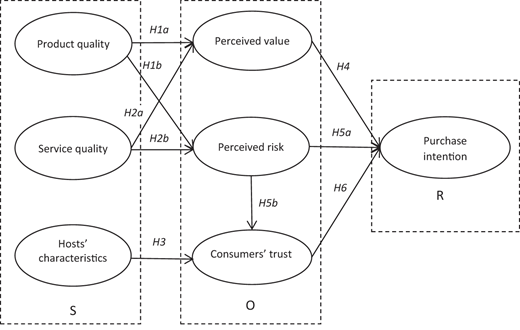
This study explores what affects consumers' purchase intention in LSEAP. It integrates the signaling theory and the SOR theory for understanding the impact of information transmission through live streaming on consumers' purchase intention. With the integration of these two theories, a conceptual model shown as in Figure 1 is developed as follows.
3.1 Product quality
Product quality is about the characteristics of products that can meet consumers' needs (Okpala and Korzeniowska, 2020). Agricultural product quality is related to intrinsic quality cues (e.g. freshness, appearance) and credence qualities (e.g. safety). It also involves consumers' anticipated consumption experience based on available information cues (Grunert, 2005; Sun and Yu, 2025). The availability of product-related information allows consumers to better evaluate these quality-related attributes, such as the planting and production process that affects food safety (Lin, 2022), as well as the freshness and tastefulness reflected through the streamer's display and tasting, thereby helping them form a more comprehensive evaluation of product quality. Live streaming commerce provides real-time demonstration and interaction, which helps consumers form clearer expectations about product quality and consumption outcomes before purchase, representing a critical advantage in selling agricultural products online.
Product quality affects perceived value (Konuk, 2019). Consumers evaluate product quality based on the information given (Lin, 2022). In live streaming, consumers rely on visuals to assess intrinsic cues and host explanations to infer credence qualities and to form quality expectations about the consumption outcome. If consumers believe that the quality of products is worth the price through the information they receive, the purchase is then cost-effective, leading to higher perceived value. This leads to the hypothesis as follows:
Product quality positively influences perceived value.
Product quality impacts perceived risk (Marakanon and Panjakajornsak, 2017; Tzavlopoulos et al., 2019). Due to the heterogeneity of agricultural products, consumers rely on quality cues to reduce uncertainty (Grunert, 2005). It is worthwhile noting that some aspects of the consumption outcome can only be confirmed after delivery and consumption. This means that quality uncertainty may still be present even when products are demonstrated in live streaming. When consumers perceive product quality to be high and consistent with the information presented, the uncertainty about receiving an unsatisfactory product is reduced. This reduces the perceived risk. Thus, this study proposes the following hypothesis:
Product quality negatively influences perceived risk.
3.2 Service quality
Service quality is about how well the service fulfills consumers' needs and expectations (Li et al., 2021; Ma, 2021a, b). Consumers continuously evaluate service performance throughout the purchasing process due to the perishable nature and quality variability of agricultural products. Before making purchase decisions, consumers are concerned about whether product information is presented in a clear and understandable manner that accounts for their needs (Zhang et al., 2021). Consumers want the products they purchase to be delivered on time and in good condition and are consistent with the description provided by the host (Liu and Fan, 2025). When after-sales issues arise, consumers want to know whether such issues can be handled in a timely and appropriate manner (Liu and Fan, 2025). This study considers the accuracy of product information, the reliability of logistics services and the timeliness of after-sales services in assessing service quality.
Improving service quality can increase perceived value (Seo and Um, 2023). When service quality exceeds expectations, it would increase consumers' satisfaction, therefore resulting in higher perceived value (Jeong and Kim, 2020). This leads to the following hypothesis:
Service quality positively influences perceived value.
Improving service quality can decrease perceived risk. In LSEAP, consumers are more concerned about loss and breakage during logistics transportation and the time required. Furthermore, they worry about the inconsistency between actual quality and product description. Such risks can be reduced with the provision of quality services (Tzavlopoulos et al., 2019). The availability of delivery information, for example, can reduce the perceived risk. This leads to the following hypothesis:
Service quality negatively influences perceived risk.
3.3 Hosts' characteristics
Hosts provide consumers with recommendations through sharing their experience in live streaming for promoting consumers' purchase intention (Luo et al., 2021; Ma, 2021a, b). Their involvement, interactivity, innovativeness and popularity affect consumers' purchase intention. Involvement is related to hosts' professionalism measured by their knowledge and familiarity with products. Interactivity is linked to the interaction between hosts and consumers (Chen et al., 2020). Innovativeness is about the uniqueness of hosts' show in promoting the product, which can capture consumers' attention and stimulate their interest in the product by innovative broadcasting and promotion approaches. Popularity is concerned about the influence of hosts on consumers, especially on the followers (Zhang et al., 2024).
Hosts' characteristics affect consumers' trust. Hosts can build brand reputation and increase consumers' trust (Luo et al., 2021; Ju et al., 2025). The hosts with high involvement can enhance consumers' confidence in the product, thereby influencing their purchase intention (Luo et al., 2021). Interactive and innovative hosts can attract more consumers and provide more targeted product information and recommendations, thus gaining consumers' trust. Followers of well-known hosts, such as celebrity hosts, are more likely to trust them and the products they recommend (Wei and Xi, 2024). This leads to the following hypothesis:
Hosts' characteristics positively influence consumers' trust.
3.4 Perceived value
Perceived value reflects consumers' perspective of the benefits received and the sacrifices made (Jeong and Kim, 2020). It is reflected in the enjoyment customers get and the judgement about whether the time, effort and money they spend on shopping are worthwhile.
Perceived value influences consumers' purchase intention (Chen and Lin, 2018). Consumers compare the value of different products (Chen and Chang, 2012). The higher the perceived value, the more the consumer believes that the product can satisfy their needs, leading to stronger purchase intention. This leads to the hypothesis as follows:
Perceived value positively influences consumers' purchase intention.
3.5 Perceived risk
Perceived risk is the uncertainty that consumers have in buying specific products (Cui et al., 2019; Rosillo-Díaz et al., 2020). In LSEAP, this uncertainty is particularly salient because consumers must make decisions based largely on mediated information rather than direct inspection (Meng et al., 2021). As a result, consumers may perceive risk not only in terms of whether the product arrives in an acceptable condition, but also in whether the delivery process is timely and whether the actual product quality matches what is presented in the live streaming.
Perceived risk has a negative influence on consumers' purchase intention (Chen and Chang, 2013). When there is a higher risk, consumers would delay or cancel the purchase. An increase in perceived risk leads to a decrease in consumers' purchase intention (Chen and Chang, 2012). The following hypothesis is then proposed:
Perceived risk negatively influences consumers' purchase intention.
Perceived risk affects consumers' trust. It often acts as a primary barrier to trust in LSEAP as perceived risk stems from multiple uncertainties, including food safety concerns (Lobb et al., 2007) as well as product deterioration or loss, long delivery time and poor product quality. These uncertainties weaken consumers' confidence in the reliability of the product and the transaction process, thereby inhibiting trust formation. When perceived risk is high, it inhibits the formation of trust. As a result, risk-related emotions would negatively affect consumers' confidence and reduce consumers' trust (Chen and Chang, 2012). This leads to the following hypothesis:
Perceived risk negatively influences consumer trust.
3.6 Consumers' trust
Consumers' trust is the psychological state of consumers' identification and confidence in the product (Yu et al., 2021). It reflects consumers' beliefs that the information about the products is true and the comments in the live streaming show are reliable and accurate (Duong et al., 2025). If consumers perceive the product information and consumer reviews presented during live streaming as truthful and credible, they are more likely to develop trust in the product. Furthermore, trust also means that consumers believe that live streaming platforms are reliable and trustworthy (Zhang et al., 2025a, b). A lack of trust in platform reliability may lead to skepticism toward purchasing through the platform. Accordingly, consumers' trust is formed through their trust in product information, viewers' reviews and the reliability of the platform.
Consumers' trust affects consumers' purchase intention (Yu et al., 2021). Consumers have low purchase intention when they do not trust the retailer or the product. Hosts can present agricultural products from multiple perspectives, such as production processes, product origins and quality attributes, enabling consumers to better understand product quality and service reliability, thereby enhancing consumers' trust. The higher the consumers' trust level, the higher the purchase intention. The following hypothesis is therefore proposed:
Consumers' trust positively influences consumers' purchase intention.
4. Research methodology
A survey-based quantitative design was adopted to test the hypothesized relationships in the proposed model (Deng et al., 2023). China was selected as the empirical setting because live streaming e-commerce is being developed rapidly in China and has become an important channel for agricultural product sales online (Meng et al., 2021).
The development of the measurement model followed the construct validation paradigm of Creswell and Creswell (2017). Measurement items were developed from prior literature and adapted to the LSEAP context. Content validity was supported through a pilot process and expert review. Table 1 reports the constructs, items and sources. All items were measured using a 5-point Likert scale ranging from strongly disagree (1) to strongly agree (5).
The questionnaire was administered in Chinese. Translation equivalence was ensured through a translation and back-translation procedure. Data were collected via a professional Chinese survey company between March 14 and April 29, 2022. A total of 423 responses were obtained. After screening for missing values and outliers, 352 valid responses were retained for analysis.
Common method bias was assessed using Harman's one-factor test (Duan and Deng, 2021). The first unrotated factor explained 47.64% of the variance, which was below the 50% threshold (Podsakoff et al., 2003). Inter-construct correlations were also below 0.90, suggesting that common method bias was unlikely to be a serious concern (Tehseen et al., 2017).
Data analysis was conducted using SEM to validate the measurement model and test the hypothesized relationships (Byrne, 2001). Confirmatory factor analysis (CFA) was performed in AMOS version 26 using the maximum likelihood estimation method. CFA proceeded in three steps. First, the model was standardized to examine multivariate normality and estimation suitability. Second, an iterative refinement process was applied to improve the measurement model based on item performance and theoretically justified diagnostics. Third, the goodness of fit (GOF) of the final model was evaluated to assess the extent to which the data supported the proposed model.
5. Data analysis results
This study used SEM to validate the measurement model and test individual hypotheses. SEM was used because of its advantages of using latent variables to express unobserved constructs while considering the measurement error and multiple correlations between constructs (Byrne, 2001).
Table 2 presents an overview of the demographic characteristics of the respondents to the survey. It shows that 60.2% of the respondents were female and 39.8% were male. In the LSEAP context, female consumers account for a relatively larger share, as women often take primary responsibility for cooking and household food purchases in many families. More than half of the respondents were aged between 21 and 30, which is consistent with younger consumers' higher acceptance and more frequent use of LSEAP. The respondents were well educated since most respondents were young people, with 77.0% holding a college or bachelor's degree. Accordingly, the largest proportion of participants reported a monthly income of RMB 2,001–6,000 (40.9%). An analysis of such characteristics reveals that the overall profile of the respondents are consistent with the characteristics of the current Chinese consumers who purchase agricultural products through live streaming. This shows that the samples used for the survey are representative of the whole population of the study.
To test the validity and reliability of the theoretical model, CFA was conducted using AMOS version 29 with the maximum likelihood estimator (Byrne, 2001). First, the measurement model was standardized and inspected to ensure that the estimation procedure was appropriate for the data. Standardized factor loadings were then examined to confirm that each item loaded meaningfully on its intended construct. As shown in Table 3, all retained items exhibited acceptable loadings, ranging from 0.68 to 0.87, supporting the adequacy of the item–construct representation.
Second, an iterative refinement process was undertaken to obtain the most appropriate set of measurement items for each construct. Convergent validity was assessed during this process using composite reliability and average variance extracted (AVE) (Hair et al., 2010). As shown in Table 4, CR values range from 0.76 to 0.90 and AVE values range from 0.54 to 0.74, indicating satisfactory convergent validity.
Construct reliability was evaluated. Cronbach's alpha coefficients were calculated to assess internal consistency, with values above 0.70 considered acceptable (Nunnally and Bernstein, 1994). As shown in Table 5, Cronbach's alpha values range from 0.80 to 0.92, suggesting good reliability across constructs.
The discriminant validity of constructs was explored by comparing the square root of the AVE of each construct with the correlation between the construct and other constructs (Fornell and Larcker, 1981). Table 6 shows the results. The square root of AVE of seven constructs is between 0.73 and 0.85, which is higher than the correlation between this construct and other constructs. This shows that all seven constructs have high discriminant validity.
The model's overall fitness with the data was examined using six common model-fit indices (Byrne, 2001). As shown in Table 7, the proposed model is unsatisfactory with respect to its overall fitness. This means that the theoretical model needs to be further modified.
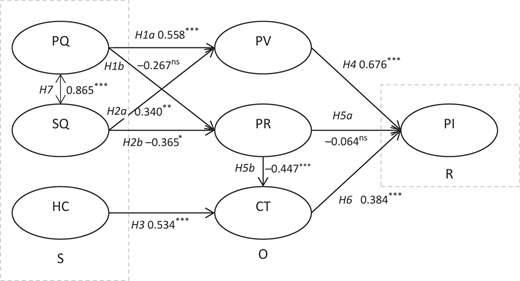
The theoretical model was revised based on the modification indices (MI) and the practical situation. Statistically, the MI between PQ and SQ is 184.409, indicating that adding a co-variant relationship between them can significantly reduce the Chi-square value, therefore improving the overall model fitness.
The perishability and timeliness of agricultural products require higher service quality (Abbas et al., 2023). To keep agricultural products fresh, unspoiled and well-tasted, live streaming retailers need to provide fast and reliable services. To ensure that the product is consistent with its description, retailers must take measures to ensure the product quality. This shows that PQ and SQ can form a virtuous cycle. It is, therefore, reasonable to add a co-variation between PQ and SQ. Figure 2 shows the modified model with an additional hypothesis as follows:
There is a co-variation relationship between product quality and service quality.
The overall fitness of the initial modified model was assessed, shown as in Table 8. Although most fitness indices meet the recommended thresholds, the RMSEA value remains suboptimal even after accounting for the covariance between SQ and PQ. Consequently, this study further explored the potential for additional covariance relationships within the model to improve the fitness of the model with the data.
An inspection of the modification indices reveals a substantial value of 128.519 between HC and SQ. This suggests that adding a covariance path between these two constructs would significantly reduce the Chi-square value and improve the overall model fitness. As a result, H8 was added to the model as follows:
There is a co-variation relationship between service quality and hosts' characteristics.
In live streaming commerce for agricultural products, a strong inter-dependency exists between service quality and hosts' characteristics. Although service quality in terms of logistics efficiency and after-sales support is typically provided by merchants or platforms (Li et al., 2021), consumers often view the host as the guarantor of this service experience. Drawing on signaling theory, consumers rely on observable host attributes, such as professionalism and credibility, to infer unobservable product and service standards. A highly professional host serves as a credible signal indicating that they have vetted the supply chain, which creates an expectation of reliable logistics and product authenticity (Wongkitrungrueng and Assarut, 2020). Conversely, service failures like damaged packaging or delayed delivery are often attributed to the host's lack of screening, thereby diminishing their perceived competence and reputation (Liu and Fan, 2025). This shows that higher service quality and positive hosts' characteristics tend to occur in tandem, reinforcing each other.
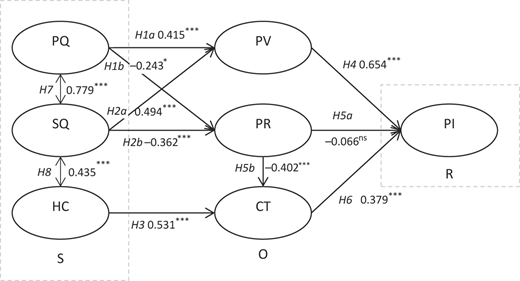
The modified model was assessed with respect to its overall fitness. Table 9 presents a summary of the overall fitness assessment results. This means that the modified model fits very well with the data. This shows that the modified model can be further analyzed to test the hypotheses, leading to the development of the structural model in Figure 3.
The study finds that product quality and service quality have a significant positive impact on consumers' perceived value. Thus, H1a (path coefficient PC = 0.415, p < 0.001) and H2a (PC = 0.494, p < 0.001) are supported. This means that improving product quality and service quality can help to increase perceived value. Furthermore, the study reveals that product quality has a greater impact on perceived value based on the path coefficient.
The study reveals that product quality and service quality are negatively associated with perceived risk and the impact of service quality is more significant. This finding is consistent with the findings of previous studies in which quality has a significant negative effect on perceived risk. Thus, H1b (PC = −0.243, p < 0.05) and H2b (PC = −0.362, p < 0.001) are supported. This means that product quality risk can be mitigated by better services. If retailers can provide satisfactory services, they can reduce perceived risk.
The study shows that there is a significant positive impact of hosts' characteristics on trust. This finding is consistent with previous studies in which hosts can build trust (Luo et al., 2021). Thus, H3 is supported (PC = 0.531, p < 0.001). This suggests that hosts with stronger involvement and professionalism, more effective interaction and higher perceived influence are better able to convey credible information and reduce consumers' uncertainty in live streaming, thereby strengthening consumers' trust (Luo et al., 2021).
The study discovers that perceived value has a significant positive impact on consumers' purchase intention. This finding is well-aligned with the results of previous studies (Chen and Chang, 2012; Chen and Lin, 2018). Thus, H4 (PC = 0.654, p < 0.001) is supported. The path coefficient reveals that perceived value has the greatest direct impact on consumers' purchase intention.
The study demonstrates that perceived risk has no significant effect on consumers' purchase intention. This means that H5a (PC = −0.066, p > 0.05) is not supported. However, the hypothesis that perceived risk has a significant negative impact on consumers' trust is supported. This finding is consistent with the finding of previous studies in which perceived risk has a significant negative effect on trust (Chen and Chang, 2013). Hence, H5b is supported (PC = −0.402, p < 0.001).
This study finds that the direct path from perceived risk to purchase intention is not statistically significant. It shows that perceived risk primarily shapes consumers' confidence in the live streaming purchase process, thus negatively affecting consumers' trust. This is largely due to the presence of effective governance in China's live streaming e-commerce platforms with the development of adequate mechanisms such as platform rules, transaction guarantees, logistics traceability and dispute-resolution procedures. Such effective governance helps reduce the uncertainty related to purchasing agricultural products via live streaming throughout the transaction process, thus mitigating consumers' perceived risk.
The study states that consumers' trust has a significant positive impact on consumers' purchase intention. This finding is consistent with those of previous studies (Hossain et al., 2022). Thus, H6 (PC = 0.379, p < 0.001) is supported. In LSEAP, consumers often rely on the host and the live streaming information to judge whether the product and transaction are credible, especially when food safety and quality cannot be fully verified prior to delivery (Lobb et al., 2007). When consumers trust the host and perceive the information provided during the livestream as reliable, they are more willing to base their decisions on these cues, thereby strengthening their purchase intention. This means that conveying a credible image is particularly important to attract more consumers.
The study supports that product quality and service quality have a significant co-variation relationship. Thus, H7 (PC = 0.779, p < 0.001) is supported. This means that product quality and service quality are inseparable in LSEAP. Consumers' demands for quality agricultural products urge retailers to provide better information on product quality and their commitments to service quality. With the continuous improvement of living conditions, consumers' requirements for quality products and services are increasing, therefore improving product and service quality is becoming critical.
Furthermore, the study also confirms a significant co-variation relationship between service quality and hosts' characteristics, supporting H8 (PC = 0.435, p < 0.001). This positive correlation suggests that perceived quality is closely tied to the host's attributes in agricultural product live streaming. Consumers tend to associate professional and credible hosts with reliable quality services, viewing the host as a signal of backend fulfillment capabilities. Conversely, robust service delivery validates the host's recommendations and reinforces their reputation. This indicates a synergistic effect where high host competence and superior service quality mutually reinforce each other in shaping consumer perceptions.
6. Contributions and implications
The study has made several theoretical contributions. First, this study has developed an integrated model within the background of signaling theory and stimulus-organism-response theory to investigate what affects consumers' intention to purchase agricultural products in live streaming commerce. This leads to a better understanding of the behavior of consumers in LSEAP.
Second, this study extends the application of signaling theory and stimulus-organism-response theory in examining how signals in live streaming can promote cognitive changes in consumers, address information asymmetry and stimulate purchase intention. This enriches the use of these theories in understanding information transmission in live streaming commerce and provides empirical findings on how to improve the effectiveness of such transmission for enhancing consumer purchasing intention.
Third, this study examines the effect of product quality on purchase intention in live streaming commerce. With the improvement of life quality and health awareness, Chinese consumers pay more attention to the quality of agricultural products. Existing studies focus more on the impact of hosts, technology and relationship on consumers' purchase intention. Different from previous studies, this study also considers the impact of product quality on consumers' purchase intention.
Fourth, this study investigates the influence of service quality on consumers' purchase intention. Some studies have examined the impact of electronic service quality on consumers' purchase intention in e-commerce. There is, however, little research exploring the impact of service quality on consumers' purchase intention. This study addresses this gap with a specific focus on service quality.
The findings of this study have several implications. First, the findings suggest that suppliers and retailers should adopt a synergistic approach to leverage the co-variation between agricultural product quality and live streaming service quality. Since the findings demonstrate that these two factors are mutually reinforcing, managers must treat logistics capabilities as an extension of product quality control rather than viewing them in isolation. Regarding product quality, suppliers must invest in advanced quality control technologies, such as cold-chain monitoring, to ensure that the intrinsic attributes of freshness, safety and tastiness are maintained throughout the supply chain. Regarding service quality, managers should recognize that logistics efficiency functions as a necessary safeguard for product quality. To prevent damage during transportation and ensure orders are fulfilled as promised, suppliers need to upgrade their logistics infrastructure. Furthermore, given the significant co-variation, suppliers must align their service standards with their product claims. Offering premium agricultural products requires reliable after-sales services and timely delivery.
Second, multi-channel network (MCN) agencies and operations managers should integrate service knowledge training into the professional development of hosts. In the practical landscape of LSEAP, many agricultural suppliers lack professional broadcasting skills. Consequently, they heavily rely on MCN agencies, which are third-party organizations that manage and support livestream hosts and provide services such as talent recruitment, training and operational support, to contract professional hosts or receive incubation support to bridge this gap. Given the co-variation between host characteristics and service quality, MCN agencies bear the responsibility of ensuring that host performance aligns with backend service capabilities. Operational teams should train hosts to master accurate information regarding product specifications, logistics status and after-sales policies to prevent exaggerated or false descriptions. By ensuring that host professionalism and high-quality service standards are strategically aligned and mutually reinforcing, managers can build a consistent and reliable brand image.
Third, platforms must actively manage the quality live streaming environment as perceived risk negatively affects trust, while trust drives purchase intention. Platforms should implement rigorous verification mechanisms for product authenticity and host qualifications to mitigate perceived risk. Furthermore, recommendation algorithms should be optimized to favor merchants with high composite scores in products, services and host reputation, thereby creating a transparent, low-risk shopping environment.
7. Conclusion
The increasing popularity of LSEAP in China requires a better understanding of what influences consumers' purchase intention. This study investigates the critical factors affecting the purchase intention of consumers in purchasing agricultural products on live streaming e-commerce. The findings are useful for various stakeholders to participate in the live streaming market of agricultural products through formulating appropriate strategies.
This study has two limitations, which suggest opportunities for future research. First, the respondents in this study are mainly young consumers. With the rapid development of digital technologies and the increasing aging of the population, it is more forward-looking to study the purchase intention of middle-aged and senior consumers. Second, this study comprehensively considers the influencing factors of consumers' purchase intention in LSEAP. Given the fast-paced nature of live streaming, where consumers often rely on heuristics, this study adopts parsimonious measures to capture the holistic perceptions of consumers' trust and product quality, rather than dissecting their complex multidimensional structures. It is difficult to fully explain the mechanism of consumers' purchase intention by only using the current model as consumers' behavior is complex. Future research can adopt more theories and incorporate more factors to better explain consumers' purchase intention in LSEAP.