


Organizations are increasingly investing in corporate wellness programs to improve the overall health of their workforce. Among these, workplace diet-related interventions may play a key role in promoting employees’ well-being and positively influencing organizational performance, such as by increasing productivity and reducing absenteeism. However, little is known about the specific diet-related interventions implemented by HR managers as part of their corporate wellness programs and how they combine with employees’ well-being and organizational performance.
This study addresses this research gap through a mixed-method approach. It involves interviews with a sustainable food provider and the HR managers of one of its client firms, followed by a fuzzy-set qualitative comparative analysis of 20 questionnaires completed by the firm’s employees. The study aims to identify the potential configurational initial variables that can generate the best outcomes for employees’ well-being and organizational performance.
The analysis reveals that the successful pathway to achieving both outcomes includes a balanced diet, service quality and reduced time needed for lunch breaks, while the reduction of lunch management stress scores low. Some empirical evidence suggests the positive evaluation of diet-related interventions from employees’ perspectives, especially in terms of increased productivity. These findings theoretically contribute to organizational support theory and offer practical insights for management.
This article investigates diet-related interventions in the workplace that are so far under-investigated in the managerial and organizational discussion by offering a twofold perspective of HR managers on the one hand and employees on the other.
1. Introduction
Organizations increasingly invest in employees’ health and well-being (Ton, 2014) through corporate wellness (CW) programs, which are initiatives targeting the improvement of employees’ “wellness” (Till, 2019) from physiological, mental, and social perspectives (Wolfe et al., 1994). These initiatives involve an “intensification of the links between wellness and economic interest” (Dale and Burrell, 2014, p. 3). They are praised for their positive outcome on workers and organizations, such as improvements in employee health, reduced healthcare costs, and enhancements in performance and productivity (Kelly and Snow, 2019). Within this framework, CW programs align with the organizational support theory (OST) (Eisenberger et al., 1986; Eisenberger and Stinglhamber, 2011). OST suggests that employees develop perceptions regarding the extent to which their organization values their contributions and cares about their well-being. In this context, CW programs can strengthen employees’ engagement when they perceive that their organization is committed to promoting their well-being (Munoz et al., 2023).
Among corporate wellness initiatives, workplace diet-related interventions have gained increasing attention due to their impact on employees’ health and workplace productivity (Gubler et al., 2018). Research in Human Resource Management (HRM) emphasizes their potential benefits, noting that “providing nourishing food to workers, even for a fee, can improve quality of life and work, and have positive “trickle down” effects for the family as well” (Wanjek, 2005, p. 13). However, several workplace factors such as stressful working hours and time constraints can negatively influence employees’ dietary choices, increasing the risk of poor nutrition and obesity (Quintiliani et al., 2010). Interestingly, participation rates in diet and nutrition initiatives are higher than in other CW interventions, such as smoking cessation programs (Mulaney et al., 2021). Workplace diet-related interventions, which can take many forms, show particular potential in preventing and reducing diseases linked to poor diet (Geaney et al., 2016). Given that dietary behavior is influenced by multiple societal and psychological factors (Rutter, 2012), effective interventions require complex and comprehensive approaches. The workplace, where most adults spend approximately 60% of their daily lives (Morgan et al., 2011), provides an ideal setting for implementing and evaluating such complex programs.
Despite the growing research interest in CW programs, diet-related workplace interventions remain under-investigated, especially in the managerial and organizational discourse (Gubler et al., 2018). While prior literature has examined general employee well-being and productivity, there is limited empirical research on how diet and nutrition programs affect workplace performance, particularly in high income countries (Drewnowski, 2020). Additionally, little is known about how HR managers design and implement these interventions as part of broader wellness strategies and how employees perceive their impact.
In this paper, we aim to address this research gap by investigating the role of diet-related interventions within CW programs from a twofold perspective - that of human resource managers on the one hand and employees on the other. Specifically, we seek to answer the following research question: “How do diet-related interventions combine with employees’ well-being and workplace performance?” To address this question, we adopt a mixed-method approach, combining qualitative insights from interviews with a sustainable food provider and HR managers of its client firm, with quantitative analysis using fuzzy-set Qualitative Comparative Analysis (fsQCA) on survey data from employees. This methodology allows us to identify the optimal configuration of initial variables that may maximize employees’ well-being and workplace performance.
Our investigation makes a twofold contribution. First, it contributes to the Organizational Support Theory (Eisenberger et al., 1986) by examining diet-related interventions as a form of organizational support in the workplace. Second, by focusing on diet-related interventions within corporate wellness programs, this study sheds some light on an under-investigated topic in managerial and organizational debate (Gubler et al., 2018), offering practical implications for HR managers designing wellness initiatives.
The remainder of the paper is structured as follows. First, we review the relevant literature on organizational support theory and corporate wellness programs, with a particular focus on diet-related interventions. Next, we present the methodology, followed by our findings. Finally, we discuss our key theoretical contributions, managerial implications, and propose avenues for future research.
2. Theoretical background
2.1 Organizational support theory
Organizational Support Theory (OST) (Eisenberger et al., 1986) has gained increasing attention in organizational behavior research for its insights into the psychological processes underlying the employee–organization relationship - from the employees’ perspective. In particular, employees tend to attribute human-kind characteristics to organizations, perceiving favorable or unfavorable treatment as a signal of organizational support or disfavor (Rhoades and Eisenberger, 2002).
A key construct of OST is Perceived Organizational Support (POS), which refers to employees’ beliefs about the extent to which the organization values their contributions and cares about their well-being (Eisenberger et al., 1986). POS plays a crucial role in reassuring employees that they will receive support from their organization when needed, particularly in stressful or challenging situations. This perception of support creates a sense of security and stimulates a positive relationship between the employee and the organization.
The reciprocity norm (Gouldner, 1960) applied to organizations suggests that when employees and the employers engage in reciprocal exchanges, it leads to mutually beneficial outcomes. Eisenberger and Stinglhamber (2011) posit that high levels of POS trigger a series of psychological processes that benefit both employees and the organization. Employees who perceive strong organizational support tend to develop a sense of obligation to contribute to the organization’s goals, thereby increasing their efforts to help the organization reach its objectives. This sense of reciprocity often manifests in higher organizational commitment, greater job satisfaction, and improved job performance.
Moreover, OST explores both the antecedents and consequences of POS, providing a comprehensive framework for understanding its role in organizational dynamics. Extant studies (Rhoades and Eisenberger, 2002) have identified several key antecedents of POS, including fair treatment, supervisor support, and favorable organizational rewards and job conditions. These factors contribute to the development of POS and, consequently, influence employee attitudes and behaviors. The consequences of POS are equally significant and wide-ranging. Research has shown that employees with high POS are more likely to engage in organizational citizenship behaviors, demonstrate greater job involvement, and exhibit lower levels of withdrawal behaviors, such as absenteeism and turnover intentions (Rhoades and Eisenberger, 2002).
A recent study by Payne et al. (2018) shows that POS for health is associated with various relational aspects of workplace culture, including leadership support, coworker support, and employee engagement. Organizations aiming to build solid relationships with their employees should, therefore, invest in fostering POS. One potential strategy for achieving this is the implementation of effective CW programs, which can enhance employees’ perception of organizational support and contribute to a more engaged and committed workforce.
2.2 Corporate wellness programs
Corporate wellness (CW) programs have emerged as a significant approach for organizations to enhance Perceived Organizational Support and improve employee outcomes. The growing importance of these programs is reflected in the substantial growth of the CW industry, which is now a well-established sector valued at approximately $43 billion globally (Dodd, 2017). Such a considerable investment underscores the increasing recognition of employee well-being as an important factor in organizational success.
CW programs are defined as a “combination of educational, organizational, and environmental activities designed to motivate and promote healthy lifestyles among company employees and their families” (Martínez-Lemos, 2015, p. 201). These programs can be conceptualized as a tangible manifestation of organizational support, directly influencing employees’ perceptions of how much the organization values their well-being.
The implementation of CW programs aligns closely with the principles of Organizational Support Theory. By investing in employees’ health and well-being, organizations demonstrate a commitment to employee welfare that extends beyond the basic employment contract. This display of organizational care and support can significantly enhance POS, thereby triggering the reciprocity mechanism previously described. As employees perceive their organization’s investment in their well-being, they are more likely to reciprocate with increased commitment and performance (Eisenberger and Stinghlhamber, 2011).
CW programs have been shown to yield positive effects for both employees and organizations. Gubler et al. (2018) found that CW programs and related health improvement enhance employees’ productivity through two primary mechanisms, i.e. job motivation and capability. Their study revealed that employees with pre-existing health issues who improved their health through wellness programs exhibited a 10% productivity increase. This finding aligns with the concept of reciprocity, as these employees are more likely to feel grateful and work harder to reciprocate (Dabos and Rousseau, 2004; Hekman et al., 2009).
The connection between CW programs and Organizational Support Theory (OST) is further strengthened by Guest’s (2017) model, which identifies the antecedents of employees’ well-being. According to this model, factors such as “investing in employees,” “providing engaging work,” “positive social and physical environment,” “voice,” and “organizational support” contribute to both “individual and organizational performance.” CW programs can be seen as a concrete manifestation of these antecedents.
Moreover, Grawitch et al. (2006) developed the so-called “PATH model framework” to synthesize previous research on workplace health and integrate various research streams. This model identifies five categories of organizational “healthy workplace practices,” which can be linked to CW programs, and the “health and safety” category is among them. These practices affect employee well-being (which include Physical Health, Mental Health, Stress Motivation, Commitment, Job Satisfaction, and Morale) and organizational improvements (which include several variables, among which Performance/Productivity, Absenteeism and Turnover).
While CW programs offer substantial benefits, it is also important to consider their potential drawbacks and paradoxes. In fact, it should be noted that some scholars have raised criticisms towards CW programs as they may lead to an “intensification of the links between wellness and economic interest” (Dale and Burrell, 2014, p. 3), thereby overemphasizing economic performance objectives (Harvey, 2018) and employer’s control over employees (Hull and Pasquale, 2018). Moreover, as noted by Kavaratzis et al. (2023), some paradoxes may also emerge in balancing well-being with other workplace gains, such as job performance and satisfaction. These critiques highlight the importance of implementing CW programs in a manner that prioritizes employees well-being, rather than solely focusing on organizational outcomes.
2.2.1 Research context: diet-related interventions within corporate wellness programs
Diet and nutrition are recognized for being relevant not only for the well-being of the body but also for mood and mental well-being (Muscaritoli, 2021). However, employees may not follow appropriate dietary patterns due to time constraints, work pressure, stress, and the offer of unhealthy food. This represents an issue as malnourished employees are less productive, generate greater labor turnover, early retirement, and raise healthcare costs (Koopman, 2002). Naska et al. (2017) show that “out-of-home’ eaters” employees eating solely at work and not both at work and at restaurants do not report the increase in total energy intake that is typically associated with eating out (Lachat et al., 2012). Taking care of employees’ eating habits within the workplace may thus really make a difference.
In the Italian context, where food plays a central role in daily life and eating well is deeply embedded in the culture, over 70% of workers take a lunch break every day. Of these, 41% report having lunch in their workplace (e.g. homemade meals, canteens, or vending machines), while 59% eat outside (e.g. in restaurants or cafes nearby) (Caraher et al., 2017). While the demand for healthy food is a clear trend among European employees (Caraher et al., 2020), Italian workers appear particularly demanding and attentive (Corvo et al., 2020). They require quality food, often seek specific food properties (e.g. organic and sustainable options), and request more vegetables in their meals (Caraher et al., 2020). However, healthy eating is also influenced by socio-economic factors (Huang et al., 2024). Introducing healthy eating initiatives at the corporate level could help address socio-economic differences among employees. In recent years, companies have experimented with innovative food solutions aimed at promoting healthy nutrition. For example, with the Covid-19 pandemic crisis, companies in Italy have introduced the “distributed canteen,” enabling employees to access multiple local partner restaurants via an app that also provides nutritional information (Mariani, 2024).
Several are the initiatives that organizations are experimenting with reference to diet and nutrition within CW programs. For instance, they offer healthier food and drink options at cafeterias (Haddon, 2018), recognizing the workplace’s role in providing nutritious foods and preventing malnutrition and food-related diseases like diabetes (Wanjel, 2005). Mulaney et al. (2021) found that employees’ participation in diet/nutrition initiatives is the highest among all the implemented CW initiatives. This high participation rate suggests that employees value these programs. HRM praises nutritional and diet programs as “providing nourishing food to workers, even for a fee, can improve quality of life and work, and have positive “trickle down” effects for the family as well” (Wanjek, 2005, p. 13). Moreover, research from an HRM perspective highlights that investing in employees’ well-being generates a positive environment that makes the employees more engaged and committed to the organization (Saks, 2022).
Several studies address the topic of diet and nutrition from health and medical perspectives (e.g. Allan et al., 2017; Drewnowski, 2020; Melián-Fleitas et al., 2021; Schliemann and Woodside, 2019). For instance, Sorensen (2004) highlights that workplace interventions focus primarily on encouraging physical activity and improving diet, mainly by increasing fruit and vegetable consumption. In contrast, diet and nutrition are underexplored from a managerial and organizational perspective (Gubler et al., 2018). Organizational studies tend to focus more broadly on employees’ well-being (that includes happiness, health, and relationships) (Van De Voorde et al., 2012) and its impact on employees’ retention and performance (Page and Vella-Brodrick, 2009).
Drewnowski (2020) proposes a model that illustrates the relationship between certain health conditions and workplace productivity. The identified health conditions include mental health, musculoskeletal disorders, communicable diseases, noncommunicable diseases, and diets and lifestyle. The latter includes diet, nutrition, physical activity, sedentariness, smoking, and alcohol use. Gubler et al. (2018) further consider interventions on nutrition and diet as part of a broader CW program, showing their potential to impact employee productivity and firm profitability significantly. However, much remains to be understood about diet and nutrition and how they can be linked to employees’ well-being and organizational performance. The literature lacks empirical studies investigating how diet and nutrition programs influence employees’ reciprocity (Gubler et al., 2018) and how they affect individual well-being and organizational performance (Guest, 2017). We here address these gaps through the case studies of PlanEat and BeSharp.
3. Methodology
In light of our research question, fsQCA is particularly well-suited for this study. This configurational method is effective for examining complex social phenomena where an outcome may be affected by multiple conditions that can be either necessary or sufficient (Fiss, 2011), as in our case. Our aim is to identify potential configurational -initial- variables that maximize unique coverage solutions, using employees’ well-being and organizational performance as outcomes.
We performed the fsQCA using FSQCA 3.0 software based on Drass and Ragin’s (1992) theoretical background, employing a combination of intermediate and complex solutions (which coincided in our case), including all counterfactuals related to core and complementary characteristics (Greckhamer, 2015). To ensure robust and reliable results, we set a consistency threshold of 0.90 for necessary conditions and 0.80 for sufficient conditions. We conducted the analysis separately based on Schneider and Wagemann (2010). From the analysis of necessary conditions, no initial variables were required for the two outcomes. We proceeded with a Truth Table analysis to distinguish the configurations of conditions subsets of the outcomes from all the initial variables (SQ, BD, RS, and RTL).
3.1 Research design
Our research design comprises three main steps: (1) a comprehensive review of the literature on corporate wellness (CW) and employees’ well-being; (2) three in-depth interviews to collect qualitative data (one with the communication manager of PlanEat as the sustainable food provider, and two with the HR managers of beSharp as the firm adopting the food service) to identify novel variables or characteristics to be analyzed through fsQCA; and 3) quantitative data collection through the administration of a questionnaire (see Appendix 2) to beSharp’s employees, followed by data analysis using fsQCA.
3.1.1 Selection of initial variables
To select the initial variables, we relied on the literature review and the interviews.
The review (step 1) yielded the following outcome variables:
Improved health in terms of psycho-physical well-being (first outcome, PW), reflecting the employer’s concern for employees’ psychological, physical, and social well-being (Grant et al., 2007).
Increased productivity (second outcome, IP), highlighting that CW programs enhance employees’ productivity by improving their health and consequently strengthening their work capability (Gubler et al., 2018).
The interviews (step 2) yielded the following variables:
Adoption of a balanced diet also outside the office (BD): it means that employees learn how to eat healthy in the workplace and then adopt these habits also in their private lives, with positive health effects. In our interviewee’s words: “improving eating habits in the office and offering the possibility of ordering PlanEat also for dinner can help employees to regulate themselves even outside the office”.
Reduction of lunch break time (RTL): by ordering from PlanEat, the employees have lunch already prepared and they do not need to eat out, therefore they can have more time to relax after lunch. From our interviewee’s point of view: “going out for lunch often requires more time and it is more stressful as you need to order, wait and so on, whereas if you have food in the office, you can have more time to relax after lunch.”.
Reduction of lunch management stress (RS): it means that employees are less stressed in meal management as they do not need to think about cooking or choosing where to eat once they have planned their meals with PlanEat. From our interviewee’s point of view: “using PlanEat is convenient for the employee, who only has to book the meal online and can then also order groceries for the evening and keep them in the company fridge.”
Quality of the service (SQ): PlanEat offers high-quality and locally sourced food, and a convenient and intuitive service. As stated by our interviewee: “PlanEat is a great added value both for the quality of the product and for the advantage given by the possibility of being able to take food home”.
3.1.2 In-depth interviews and quantitative data collection
Step (2) of our data collection consisted of three in-depth interviews conducted in April and May; the first one involved PlanEat’s Sales Director, and the other two beSharp’s HR managers, C.V. and A.E. (see Table 1 for data collection details).
Data collection: steps 2) and 3)
| Type of data | Interviewee’s role | Details | |
|---|---|---|---|
| Primary data | In-depth interview | Sales Director PlanEat.eco (Alimentiamoci Srl Benefit company) | April 2024–1 h |
| In-depth interview | HR manager beSharp A. E | May 2024–1.30 h | |
| In-depth interview | HR managers beSharp C.V | May 2024–1.30 h | |
| Survey | beSharp’s employees | N. 20 completed surveys | |
| Secondary data | Company’s Resume | N. 23 pages | |
| Company’s data from the Orbis database and the firm’s website | / | ||
Source(s): Authors’ own work
PlanEat.eco (Alimentiamoci Srl Benefit Corporation) is an innovative start-up founded in 2019 in Milan that operates in the food sector and develops, produces, and markets environmentally friendly products and services while creating value for the local area. PlanEat’s core activity involves a platform providing local, low impact food in portions, allowing clients to plan meals in a simple and fast way, and receive ingredients at home in compostable containers. Recently, the firm has expanded into B2B services, offering healthy and sustainable lunch solutions for corporate employees. Thus, this firm represents an interesting case to analyze how companies can enhance employees’ well-being through diet-related interventions.
The innovative service is well-explained by the sales and communication manager:
We have created a platform for companies that offers a healthy, innovative, anti-waste lunch break, with the aim to start a change to protect people, work and the planet. A fully customizable service, new on the market, flexible and tailor-made so that every collaboration can be designed ad hoc. We provide a report on the impact that each customer has on the planet.
Recently, the firm has also introduced reusable containers that are washed after usage and can be reused multiple times. At the end of their lifespan, PlanEat melts them to create new containers, so that package waste is definitely eliminated. Another recent innovation consists of software that connects restaurants and food providers to company employees: people can pre-order the desired lunch meal and choose among a wider selection of dishes. The food provider can prepare just the right amount of food necessary to satisfy all the ordered dishes and avoid food waste. It can also handle deliveries in a more sustainable way, optimizing delivery times and guaranteeing fair rider management.
One of PlanEat’s client firms is beSharp, an IT company founded in 2011 in Pavia, employing 60 people and operating in the B2B sector. The mission of beSharp, as we read from its website, involves “supporting companies to adopt revolutionary technological models, creating innovative projects that help them achieve their most ambitious goals”. The firm has introduced a welfare package that includes diet-related interventions aimed at improving their employees’ eating habits. Specifically, it offers employees the option to order meals from PlanEat by planning the weekly meals in advance and store the ordered items in compostable packaging in a dedicated fridge in the kitchen. This initiative represents an interesting case of implementing healthy eating programs in the workplace.
The interview with beSharp’s HR managers was divided into two main parts (see Appendix 1 for the full interview scheme). The first part focused on the corporate wellness programs implemented by the firm, particularly diet and nutrition initiatives, to understand how it addresses the nutritional needs of its employees (e.g. canteens, meal vouchers, nutritional consultancy, and events to promote correct nutrition). The second part explored the company’s connection with PlanEat, specifically examining the expected effects of its adoption on employees’ well-being and organizational outcomes.
Several welfare services are offered by beSharp, and PlanEat is one of them as it concerns healthy nutrition in the workplace. As reported by our interviewees:
We have a welfare package which includes for example economic contributions for travel, summer camps, purchase of books, psychological sessions, and PlanEat is included in these welfare services.
In step (3), we asked beSharp’s HR managers to internally disseminate our survey. Appendix 2 provides an overview of all the questions included in the survey. After two rounds of distribution, we received 20 completed questionnaires, corresponding to a 33.3% response rate.
We then employed the fsQCA. This method is particularly suited for exploratory investigations as it offers a “configurational way of thinking and theorizing about the complexity inherent in causation among management and organizational phenomena” (Misangyi et al., 2017, p. 259). FsQCA focuses on the combined effects of causal conditions as it assumes causation to be complex, intertwined, and holistic, and it aims to identify and explain causal connections (i.e. configurations) between a set of phenomena based on asymmetric linkages (Ragin, 2009). FsQCA enables the simultaneous exploration of all possible interactions and outcomes in a set of variables that characterize the investigated phenomena (Fiss, 2011; Woodside and Baxter, 2013). These features make fsQCA particularly suited for theory development (Fiss, 2011).
In our fuzzy-set analysis, we used four initial variables, (1) the adoption of a balanced diet (BD), (2) service quality (SQ), (3) the reduction of the time needed for the lunch break (RTL), and (4) the reduction of lunch management stress (RLS). Our outcome variables were (1) improved health in terms of psycho-physical well-being (PW) and (2) increased productivity (IP).
3.2 Fuzzy-set calibration
As Ragin (2009) and Woodside (2010) describe, before conducting the fuzzy-set analysis (Necessary condition test and Truth table), it is important to transform the original variables into fuzzy-set variables through a process called fuzzification.
Specifically, to simplify the analysis without losing model significance, we transformed our original Likert scale degrees into a final scale of seven categories: 0.95 (corresponds to 7, fully present/developed/implemented); 0.82 (corresponds to 6, highly present/developed/implemented); 0.67 (corresponds to 5, medium-highly present/developed/implemented;) 0.5 (corresponds to 4, the point of maximum ambiguity, in which we viewed it as equally probable to represent a low or high development of that condition); 0.39 (corresponds to 3, medium-low presence/development/implementation); 0.17 (corresponds to 2, low presence/development/implementation); and 0.05 (corresponds to 1, not present/developed/implemented).
For the two outcome variables, we employed fuzzy logic assuming three degrees of the outcome: high, medium, and low. Therefore, using the same “direct calibration method” as for the initial variables, we assigned the following values: projects with high outcomes received a 0.95, projects with medium outcomes received a 0.5, and projects with low outcomes received a 0.05. Table 2 provides the initial values and fuzzy-set scales for each enabling characteristic and the two outcomes.
Initial values and fuzzy-set calibration characteristics and outcomes
Original Likert value | Fuzzy value | Initial characteristics | |||
|---|---|---|---|---|---|
| BD | RS | SQ | RTL | ||
| 1 | 0.05 | Not following at all balanced diet | Very low impact of PlanEat in reducing the lunch management stress | Very low quality of service | Very low importance of reduction of time for lunch |
| 2 | 0.17 | Rarely following a balanced diet | Low impact of PlanEat in reducing the lunch management stress | Low quality of service | Low importance of reduction of time for lunch |
| 3 | 0.39 | Occasionally following a balanced diet | Moderated impact of PlanEat in reducing the lunch management stress | Average quality of service | Moderated importance of reduction of time for lunch |
| 4 | 0.5 | Often following a balanced diet | More than moderated impact of PlanEat in reducing the lunch management stress | Above average quality of service | More than moderated importance of reduction of time for lunch |
| 5 | 0.67 | Very often following a balanced diet | Quite high impact of PlanEat in reducing the lunch management stress | High quality of service | Quite high importance of reduction of time for lunch |
| 6 | 0.82 | Almost always following a balanced diet | High impact of PlanEat in reducing the lunch management stress | Very high quality of service | High importance of reduction of time for lunch |
| 7 | 0.95 | Always following a balanced diet | Very high impact of PlanEat in reducing the lunch management stress | Excellent quality of service | Very high importance of reduction of time for lunch |
| Original Likert value | Fuzzy value | Outcomes | |
|---|---|---|---|
| Improved health in terms of psycho-physical well-being (PW) | Increased productivity (IP) | ||
| 1–3 | 0.05 | Low | Low |
| 4 | 0.5 | Medium | Medium |
| 5–7 | 0.95 | High | High |
Source(s): Authors’ own work
Moreover, we defined the threshold value for each initial variable and the outcomes. In particular, the threshold for the initial variables (DB, RS, SQ, and RTL) was set at 4 in the original Likert scale or 0.5 in the fuzzy scale (the maximum value of likelihood). On the other hand, the outcomes (IP, and PW) were set at 4 in the original Likert scale or 0.5 in the fuzzy scale.
4. Findings
Using standard analysis to derive intermediate and complex solutions (Ragin, 2009), we observed whether each initial characteristic’s condition contributed to the outcomes when the characteristic was either present or absent. We only selected the configurations with a raw consistency greater than 0.8 to improve our model’s robustness (Ragin, 2009).
Therefore, as reported in Table 3, for improved psycho-physical well-being, we obtained a unique final complex solution.
Truth table outcome1 (Improve psycho-physical well-being)
| Out 1 = Improve psycho-physical well-being frequency cutoff: 1 Consistency cutoff: 0.928161 | Solution 1 |
|---|---|
| BD | ■ |
| SQ | ■ |
| RS | ⊗ |
| RTL | ■ |
| Raw unique coverage | 0.54 |
| Unique coverage | 0.54 |
| Consistency | 0.86 |
| Solution coverage | 0.54 |
| Solution consistency | 0.86 |
Note(s): ■ = present
⊗ = absent
– = indifferent
Source(s): Authors’ own work
The final complex and also the intermediate solution are the same, and the solution is:
This configuration suggests that improved well-being is associated with the presence of a balanced diet, high service quality, and reduced lunch time, combined with the absence of stress reduction. This solution demonstrates a coverage of 0.54 and a consistency of 0.86, explaining a substantial portion of the outcome while maintaining high consistency.
For the second outcome, increased productivity, the analysis yielded two solution paths (see Table 4).
Truth table outcome2 (Increased productivity)
| Out 2 = increased productivity frequency cutoff: 1 consistency cutoff: 0.928161 | Solution 1 | Solution 2 |
|---|---|---|
| BD | ■ | ■ |
| SQ | – | ■ |
| RS | ■ | ■ |
| RTL | ⊗ | – |
| Raw unique coverage | 0.32 | 0.51 |
| Unique coverage | 0.04 | 0.23 |
| Consistency | 0.91 | 0.91 |
| Solution coverage | 0.55 | |
| Solution consistency | 0.90 | |
Note(s): ■ = present
⊗ = absent
– = indifferent
Source(s): Authors’ own work
The final complex solutions and also the intermediate solutions are the same, and the final solution is:
This analysis shows two potential solutions. The second solution is the most important, with a unique coverage of 0.23 of our sample. However, the final solution presented above, which includes the set of the two solutions, covers about 56% of the dataset.
Some interesting findings emerge also from the qualitative questions of the administered survey (Q12a and Q16). In particular, some empirical evidence which is insightful for our research suggests the positive evaluation of diet-related interventions from employees’ perspective, especially in terms of increased productivity. As highlighted by our survey’s respondents:
“A healthy diet generates a better psychophysical well-being, and consequently better work and relational performance”.
“Eating well affects my general well-being and also my work”.
5. Discussion
Our findings suggest that the potential configurational initial variables that could generate the best outcomes in terms of both employees’ well-being and organizational performance are a balanced diet (BD), service quality (SQ), and reduction of the time needed for the lunch break (RTL), while the reduction of lunch management stress (RS) scores low or is absent.
The emergence of balanced diet (BD) and service quality (SQ) as pivotal factors across both outcomes underscores the potential importance of nutritional interventions and quality food service in corporate wellness (CW) strategies. These interventions align with the “Healthy Workplace Practices” within the PATH model framework proposed by Grawitch et al. (2006), which identifies workplace health practices as central to fostering employee well-being and organizational improvements. This finding is consistent with previous studies highlighting the role of nutrition in cognitive function and overall well-being (Gómez-Pinilla, 2008), reinforcing the notion that diet-related workplace interventions contribute to psychological and physical health. Furthermore, our findings add to the limited body of literature exploring diet and nutrition from a managerial and organizational perspective (Gubler et al., 2018), particularly in high-income countries where such initiatives remain underexplored (Drewnowski, 2020).
The prominence of RTL (Reduction of the time needed for the lunch break) as another key initial variable in both configurations suggests that employees perceive efficiency in meal consumption as beneficial to their work experience. Employees who order meals through PlanEat save time otherwise spent commuting or waiting in line at restaurants, allowing for more relaxation during breaks. This efficiency may enhance job satisfaction and overall well-being, reflecting broader discussions in HRM literature on the importance of workplace policies that facilitate work-life integration (Guest, 2017). Employees may interpret such interventions as a form of organizational support, reinforcing their commitment and productivity. .
Interestingly, the initial variable “reduction of lunch management stress” (RS) scores low or is absent in the path leading to both outcomes. A possible explanation is that employees do not perceive meal management as a particularly stressful task, or that it is a less salient factor compared to diet quality, service quality, and time efficiency. This contrasts with prior research suggesting that workplace food choices can be a source of stress, particularly in environments where employees face time constraints and limited healthy options (Hull and Pasquale, 2018). This aspect certainly deserves further investigation in different workplace settings to determine whether the perceived lack of stress associated with meal management is context-dependent or reflective of broader workplace trends.
Our findings provide some empirical support for the Organizational Support Theory. Specifically, evidence suggests that the introduction of diet-related interventions increases perceived organizational support (POS) by triggering psychological processes in employees (Eisenberger and Stinglhamber, 2011) that foster a sense of well-being. This, in turn, enhances their productivity and alignment with the organization’s goals. Moreover, leadership support in improving health (Payne et al., 2018) emerges here as a form of commitment from HR managers, demonstrating their care for employees’ nutritional habits, further reinforcing POS.
Overall, our study highlights the importance of integrating diet-related initiatives into corporate wellness programs as a strategic approach to enhancing employee well-being and workplace performance. While previous research has established the general benefits of CW programs (Kelly and Snow, 2019), our findings provide specific insights into the potential configurational initial variables regarding diet-related initiatives that can generate the best outcomes for employees’ well-being and organizational performance.
6. Conclusion
This study aimed to investigate how diet-related interventions combine with employees’ well-being and workplace performance. Through a mixed-method study and the adoption of the fsQCA methodology to evaluate 20 surveys, we find that the successful pathway for both outcomes includes a balanced diet (BD), service quality (SQ), and reduced time needed for the lunch break (RTL). In contrast, the reduction of lunch management stress (RS) scores low (or absent).
Theoretically, we contribute to Organizational Support Theory (OST) (Eisenberger et al., 1986) in the context of diet-related interventions by offering insights into how introducing healthy diet initiatives in the workplace strengthens the reciprocity bond between organizations and employees. Our findings suggest that employees who perceive high organizational support tend to reciprocate with greater commitment and improved work performance.
We also shed light on the broad topics of diet and nutrition, an area that remains under-investigated in the managerial and organizational discourse (Gubler et al., 2018). From a managerial perspective, our findings suggest that firms should invest more in diet and nutrition as part of their corporate wellness programs through healthy eating initiatives in the workplace by partnering with providers that offer high-quality meals that ensure a balanced diet.
This study has some limitations. The primary limitation is the small sample size. We are aware that fsQCA can be ideally applied to small to medium sample sizes (Woodside, 2010; Woodside and Baxter, 2013) that require familiarity with exploratory investigations (Trueb, 2013). This exploratory study paves the way for quantitative research aimed at developing and testing a model on a larger sample of firms implementing healthy eating initiatives in the workplace. Such studies would enable the collection of sufficient data to generalize the emerging findings through statistical testing, potentially extending the analysis across different countries and industries. Finally, we believe it would be highly valuable to conduct a longitudinal study including both quantitative methods (e.g. surveys) and qualitative approaches (e.g. ethnographic research) to explore how the implementation of diet-related interventions impacts employees’ well-being and organizational performance over time from the perspectives of both employees and HR managers.
We would like to thank PlanEat and beSharp for actively contributing to our research project. Project funded under the National Recovery and Resilience Plan (NRRP), Mission 4 Component 2 Investment 1.3 - Call for tender No. 341 of 15 March 2022 of Italian Ministry of University and Research funded by the European Union – NextGenerationEU; Award Number: Project code PE00000003, Concession Decree No. 1550 of 11 October 2022 adopted by the Italian Ministry of University and Research, CUP F13C22001210007, Project title “ON Foods - Research and innovation network on food and nutrition Sustainability, Safety and Security – Working ON Foods”.
Corrigendum: It has come to the attention of the publisher that the article, Re, B., Zardini, A., Sanguineti, F. and Previtali, P. (2025), “Healthy eating initiatives in the workplace: a configurational approach”, British Food Journal, Vol. ahead-of-print No. ahead-of-print. https://doi.org/10.1108/BFJ-10-2024-1080, included the incorrect funding CUP number. This funding information should read, We would like to thank PlanEat and beSharp for actively contributing to our research project. Project funded under the National Recovery and Resilience Plan (NRRP), Mission 4 Component 2 Investment 1.3 - Call for tender No. 341 of 15 March 2022 of Italian Ministry of University and Research funded by the European Union – NextGenerationEU; Award Number: Project code PE00000003, Concession Decree No. 1550 of 11 October 2022 adopted by the Italian Ministry of University and Research, CUP F13C22001210007, Project title “ON Foods - Research and innovation network on food and nutrition Sustainability, Safety and Security – Working ON Foods”.
The publisher asks that funding be entered correctly at submission and confirmed at article proofing stage.
References
Appendix 1 Interviews with beSharp’s HR managers
Can you give us a general overview of how the company deals with the health and well-being of employees?
Do you have corporate wellness programs in place?
Why do you use them?
Focus on the “diet and nutrition” aspect: describe if and how the company takes care of the nutrition of its employees (examples: canteens, meal vouchers, nutritional consultancy, events promoting correct nutrition).
[If you have an internal canteen: do you offer differentiated menus? (gluten free, reduced salt/cholesterol, vegetarian/vegan)]
[If you offer meal vouchers, how do you choose participating bars/restaurants? (examples: proximity to the office or also varied offer/healthy foods?)]
PlanEat: why did you decide to adopt the service? Is the adoption of Planeat part of a broader corporate wellness program for employees? What are the expected benefits in terms of individual well-being (e.g. improved physical health, decreased weight, increased productivity) for your employees? Describe in detail.
Tell us about PlanEat’s nutritional consultancy service. Why did you adopt him? What are the expected benefits deriving from this service for your employees?
What is the expected impact of the adoption of Planeat and the nutritional consultancy service at an organizational level? How do you measure this impact? Do you have monitoring/feedback tools? Describe in detail.
Appendix 2 Questionnaire administered in Italian
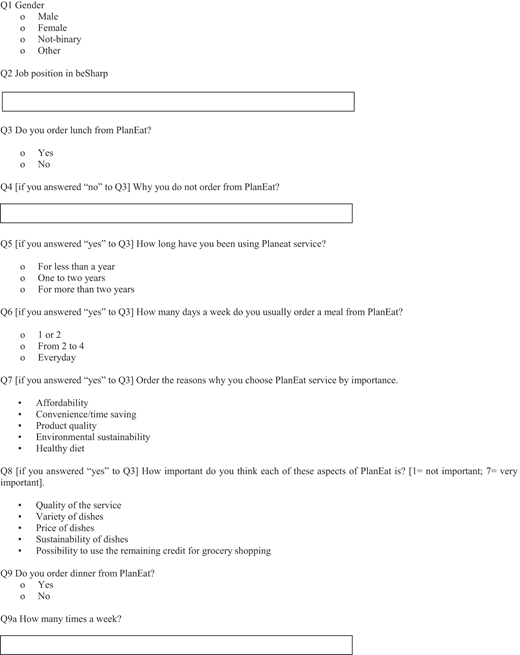
 The questionnaire depicts twenty questions. From top to bottom, the questions are as follows: The first question reads, “Q 1 Gender” and is followed by the following four options: “Male”, “Female”, “Non-binary”, and “Other”. The second question reads, “Q 2 Job position in beSharp”, and is followed by a blank space for written response. The third question reads, “Q 3 Do you order lunch from PlanEat?” and is followed by the following two options: “Yes” and “No”. The fourth question reads, “Q 4 (If you answered ‘no’ to Q 3) Why do you not order from PlanEat?”, and is followed by a blank space for written response. The fifth question reads, “Q 5 (If you answered ‘yes’ to Q 3) How long have you been using PlanEat service?” and is followed by the following three options: “For less than a year”, “One to two years”, and “For more than two years”. The sixth question reads, “Q 6 (If you answered ‘yes’ to Q 3) How many days a week do you usually order a meal from PlanEat?” and is followed by the following three options: “1 or 2”, “From 2 to 4”, and “Everyday”. The seventh question reads, “Q 7 (If you answered ‘yes’ to Q 3) Order the reasons why you choose PlanEat service by importance.” and is followed by the following five option options: “Affordability”, “Convenience or time saving”, “Product quality”, “Environmental sustainability”, and “Healthy diet”. The eighth question reads, “Q 8 (If you answered ‘yes’ to Q 3) How important do you think each of these aspects of PlanEat is? (1 equals not important; 7 equals very important).” and is followed by the following five options: “Quality of the service”, “Variety of dishes”, “Price of dishes”, “Sustainability of dishes”, and “Possibility to use the remaining credit for grocery shopping”. The ninth question reads, “Q 9 Do you order dinner from PlanEat?” and is followed by the following two options: “Yes” and “No”. The tenth question reads, “Q 9 a How many times a week?” and is followed by a blank space for written response. The eleventh question reads, “Q 10 (If you answered ‘yes’ to Q 3) How important do you think PlanEat service is in relation to (1 equals not important; 7 equals very important).” and is followed by the following five options: “Weight loss”, “Improvement of psychological and physical well-being”, “General improvement in health”, “Adoption of a balanced diet also outside the office”, “Increase in concentration”, and “Environmental sustainability”. The twelfth question reads, “Q 11 (If you answered ‘yes’ to Q 3) How much do you agree with the following statements regarding the impact of PlanEat for beSharp? (1 equals completely disagree; 7 equals completely agree).” and is followed by the following five options: “Increase in productivity”, “Reduction of absenteeism”, “Reduction of the time needed for the lunch break”, “Increased socialization during lunch break”, and “Reduction of lunch time management stress”. The thirteenth question reads, “Q 12 (If you answered ‘yes’ to Q 3) Since using PlanEat service, are you more careful about following a balanced diet compared to when you managed your meal yourself?” and is followed by the following two options: “Yes” and “No”. The fourteenth reads, “Q 12 a Why?” and is followed by a blank space for written response. The fifteenth question reads, “Q 13 If it were available, would you take advantage of PlanEat’s nutritional consultancy service?” and is followed by the following two options: “Yes” and “No”. The sixteenth question reads, “Q 14 [if you answered ‘yes’ to Q 13] How important do you think the nutritional consultancy service is for the following statements?” and is followed by the following five options: “Improved health in terms of weight loss”, “Improved health in terms of psycho-physical well-being”, “Improvement of lifestyle”, “Improved eating habits even outside the office”, and “Increase in concentration”. The seventeenth question reads, “Q 15 Would you like the company to organize meetings on healthy eating?” and is followed by the following two options: “Yes” and “No”. The eighteenth question reads, “Q 16 [if you answered ‘yes’ to Q 15] Why do you think meetings on healthy eating could be useful?” and is followed by a blank space for written response. The nineteenth question reads, “Q 17 [if you answered ‘yes’ to Q 15] Why do you think meetings on healthy eating could be useful?” and is followed by the following five options: “Excellent”, “Good”, “Discrete”, “Sufficient,” and “Poor”. The twentieth question reads, “Q 18 Do you have suggestions or proposals to improve the service?” and is followed by a blank space for written response.The questionnaire depicts twenty questions. From top to bottom, the questions are as follows: The first question reads, “Q 1 Gender” and is followed by the following four options: “Male”, “Female”, “Non-binary”, and “Other”. The second question reads, “Q 2 Job position in beSharp”, and is followed by a blank space for written response. The third question reads, “Q 3 Do you order lunch from PlanEat?” and is followed by the following two options: “Yes” and “No”. The fourth question reads, “Q 4 (If you answered ‘no’ to Q 3) Why do you not order from PlanEat?”, and is followed by a blank space for written response. The fifth question reads, “Q 5 (If you answered ‘yes’ to Q 3) How long have you been using PlanEat service?” and is followed by the following three options: “For less than a year”, “One to two years”, and “For more than two years”. The sixth question reads, “Q 6 (If you answered ‘yes’ to Q 3) How many days a week do you usually order a meal from PlanEat?” and is followed by the following three options: “1 or 2”, “From 2 to 4”, and “Everyday”. The seventh question reads, “Q 7 (If you answered ‘yes’ to Q 3) Order the reasons why you choose PlanEat service by importance.” and is followed by the following five option options: “Affordability”, “Convenience or time saving”, “Product quality”, “Environmental sustainability”, and “Healthy diet”. The eighth question reads, “Q 8 (If you answered ‘yes’ to Q 3) How important do you think each of these aspects of PlanEat is? (1 equals not important; 7 equals very important).” and is followed by the following five options: “Quality of the service”, “Variety of dishes”, “Price of dishes”, “Sustainability of dishes”, and “Possibility to use the remaining credit for grocery shopping”. The ninth question reads, “Q 9 Do you order dinner from PlanEat?” and is followed by the following two options: “Yes” and “No”. The tenth question reads, “Q 9 a How many times a week?” and is followed by a blank space for written response. The eleventh question reads, “Q 10 (If you answered ‘yes’ to Q 3) How important do you think PlanEat service is in relation to (1 equals not important; 7 equals very important).” and is followed by the following five options: “Weight loss”, “Improvement of psychological and physical well-being”, “General improvement in health”, “Adoption of a balanced diet also outside the office”, “Increase in concentration”, and “Environmental sustainability”. The twelfth question reads, “Q 11 (If you answered ‘yes’ to Q 3) How much do you agree with the following statements regarding the impact of PlanEat for beSharp? (1 equals completely disagree; 7 equals completely agree).” and is followed by the following five options: “Increase in productivity”, “Reduction of absenteeism”, “Reduction of the time needed for the lunch break”, “Increased socialization during lunch break”, and “Reduction of lunch time management stress”. The thirteenth question reads, “Q 12 (If you answered ‘yes’ to Q 3) Since using PlanEat service, are you more careful about following a balanced diet compared to when you managed your meal yourself?” and is followed by the following two options: “Yes” and “No”. The fourteenth reads, “Q 12 a Why?” and is followed by a blank space for written response. The fifteenth question reads, “Q 13 If it were available, would you take advantage of PlanEat’s nutritional consultancy service?” and is followed by the following two options: “Yes” and “No”. The sixteenth question reads, “Q 14 [if you answered ‘yes’ to Q 13] How important do you think the nutritional consultancy service is for the following statements?” and is followed by the following five options: “Improved health in terms of weight loss”, “Improved health in terms of psycho-physical well-being”, “Improvement of lifestyle”, “Improved eating habits even outside the office”, and “Increase in concentration”. The seventeenth question reads, “Q 15 Would you like the company to organize meetings on healthy eating?” and is followed by the following two options: “Yes” and “No”. The eighteenth question reads, “Q 16 [if you answered ‘yes’ to Q 15] Why do you think meetings on healthy eating could be useful?” and is followed by a blank space for written response. The nineteenth question reads, “Q 17 [if you answered ‘yes’ to Q 15] Why do you think meetings on healthy eating could be useful?” and is followed by the following five options: “Excellent”, “Good”, “Discrete”, “Sufficient,” and “Poor”. The twentieth question reads, “Q 18 Do you have suggestions or proposals to improve the service?” and is followed by a blank space for written response.
