


This study investigates heterogeneity in household leftover food management behaviour, offering insights into consumer motivations, abilities and opportunities.
Data were collected from 1,004 Australian households through an online survey. A confirmatory factor analysis (CFA) was conducted to identify the best-fitting model for the collected data. Based on the items selected for the CFA model, a latent class analysis (LCA) was performed to classify households into distinct subgroups. Finally, a multinomial logistic regression was conducted to examine the influence of sociodemographic variables on household latent class membership.
The analysis identified four distinct consumer segments. Efficient savers demonstrate strong skills in meal planning, food storage and repurposing leftovers. Unplanned eaters are characterised by limited skills in handling leftovers and low motivation to reduce leftover waste. Aspirational savers exhibit a desire to manage leftovers effectively but face occasional challenges, while time-savvy planners balance efficient food management with busy lifestyles. Sociodemographic factors, such as age, gender, employment and household composition, significantly influence class membership.
The findings emphasise the importance of targeted interventions, such as consumer education on meal planning, portion control, optimal food storage and leftover utilisation, to address specific behaviours within each segment.
This study contributes to the literature by revealing the underlying heterogeneity within consumer groups that influences leftover food management. Gaining deeper insights into consumer behaviours related to food leftovers can empower policymakers and relevant government agencies to design targeted interventions to mitigate food waste.
1. Introduction
Food waste is a significant global and national issue, with wide-ranging environmental, economic, and social impacts (Roodhuyzen et al., 2017). Worldwide, approximately one-third of all food produced for human consumption, about 1.3 billion tons annually, is lost or wasted (Food and Agriculture Organisation, 2011). In wealthier nations, food waste is primarily concentrated at the consumer level (Principato et al., 2021), where households contribute significantly (>60%) to the problem (Forbes et al., 2024). In Australia, for instance, household food waste comprises nearly 34% of the total food waste, leading to the waste of billions of dollars worth of edible food annually (FIAL, 2021). Food waste exacerbates food insecurity, with millions lacking adequate nutrition while substantial amounts of edible food go unused. Therefore, reducing food waste at the household level is critical to achieving broader sustainability and food equity goals, calling for more public awareness, policy changes, and practical interventions at both the national and local levels.
In Australia, about one-third of household food waste consists of leftovers, food that is cooked but not served or served but not eaten (Fight Food Waste CRC, 2020). Limited research has explored the distinct consumer segments in leftover food management behaviour, particularly in terms of latent (unobserved) psychological and sociodemographic factors that drive these behaviours. While existing studies have primarily focused on consumer attitudes and general practices or observable patterns in consuming leftovers at the household level (Ananda et al., 2025; Nikravech et al., 2023), little is known about the underlying heterogeneity within consumer groups and the nuanced motivations, abilities, opportunities and constraints that influence leftover food management. Addressing this gap can provide a deeper understanding of how different segments approach food waste, enabling more targeted interventions to promote sustainable consumption and reduce leftover food waste across diverse consumer profiles.
This study aims to analyse the heterogeneity in household leftover [1] food management behaviour. Latent class analysis (LCA) was used for this purpose, as it allows the segmentation of consumers based on non-observable traits inferred from observable variables. LCA is highly effective for segmentation because it can identify unobserved heterogeneity within a population (Nylund et al., 2007). This technique divides a population into mutually exclusive, exhaustive latent classes based on individuals’ responses to observed variables, allowing for more precise and meaningful groupings (Lanza and Rhoades, 2013; Vermunt, 2003a). LCA is especially beneficial for segmentation in research involving complex behaviours (Andersen et al., 2003), such as consumer behaviour, where motivations and actions may not be directly observable.
While algorithmic clustering methods like k-means are more common, model-based approaches like LCA have been less frequently applied in studying consumer behaviour towards food (Bello and Abdulai, 2017; Grymshi et al., 2022) despite their benefits. The LCA approach was chosen for the study because it can reveal underlying patterns in data that other methods might overlook (Vermunt and Magidson, 2004). It identifies subgroups within a population based on similar responses to measured variables, providing deeper insights into behaviours or characteristics that are not directly visible (Vermunt, 2003b). LCA outperforms other segmentation techniques, relying on a probabilistic framework for statistical inference, making its results generalisable to the entire population (Rhead et al., 2018). Additionally, LCA reduces subjectivity when selecting the number of latent classes, as it relies on statistical criteria (e.g. Bayesian Information Criterion) to determine the best fit (Grymshi et al., 2022). While clustering methods like k-means are well-suited to continuous data, LCA works more effectively with categorical or ordinal data (Vermunt and Magidson, 2004), making it advantageous in the present study3- 5.
This paper enhances understanding of the diverse ways households manage leftover food, a critical step in crafting effective strategies to reduce food waste. Gaining deeper insights into consumer behaviours related to food leftovers can empower policymakers and relevant government agencies to design targeted interventions to mitigate food waste. By exploring the variations in leftover food management among Australian households, this study contributes to the ongoing dialogue on food waste reduction and supports the achievement of the United Nations’ Sustainable Development Goal 12.3.
The subsequent sections of this paper are divided as follows: Section 2 reviews the literature; Section 3 discusses the methodology, data collection and data analysis techniques used; Section 4 presents the main findings of the latent class analysis; Section 5 discusses the policy implications; and Section 6 concludes the paper with future research directions.
2. Literature review
Food leftovers play a significant role in household food waste (Silvennoinen et al., 2014; Zainal and Hassan, 2019). These comprise food prepared for one meal but not consumed during that meal (Andrews et al., 2018). Leftovers encompass excess cooked portions (Cappellini, 2009; Porpino et al., 2015) and surplus ingredients (Evans, 2011, 2012). Managing leftovers is recognised as a critical behaviour for reducing household food waste (Ananda et al., 2021; Vásquez Neyra et al., 2022). Previous studies have shown that consumers’ motivation is crucial in managing leftover food (Aloysius et al., 2025; Nguyen et al., 2023). Consumers are often driven to minimise meal waste, influenced by their negative feelings about wasting food and their awareness of its consequences (van Geffen et al., 2020). Many people experience guilt when they waste food and frequently regard it as shameful (Nunkoo et al., 2021). These feelings of guilt can enhance consumers’ satisfaction when they successfully manage leftovers (Ang et al., 2021). Individuals with a higher optimistic bias are nearly three times more likely to discard leftover food, as they may underestimate their own contribution to food waste (Eves et al., 2025). Awareness of personal food waste levels, along with its economic and environmental costs, can encourage individuals to adopt better leftover management practices, such as meal planning, proper storage, and repurposing leftovers to reduce waste (Nunkoo et al., 2021; Ramos et al., 2024).
Consumers often refrain from reusing leftovers or choose to discard them away due to concerns about perceived reductions in quality and freshness (Porpino et al., 2015). Changes in visual traits, such as appearance and colour, may lead consumers to think the food is spoiling, prompting disposal (Andrews et al., 2018). Furthermore, leftovers can be seen as unappealing because they are regarded as “used” or “second-hand” (Andrews et al., 2018). When social norms influence consumers’ negative attitudes, beliefs, and perceptions regarding leftover food, they are more inclined to reject including leftovers in meals and dispose of them, even when they are still edible (Aloysius et al., 2023).
Skills such as meal planning, efficient cooking, managing food inventory, understanding expiration dates, and proper food storage are also crucial in minimising leftover food waste (Aloysius et al., 2023). People with greater knowledge of proper food preservation techniques and leftover-based recipes tend to generate less food waste (Vásquez Neyra et al., 2022). Effective fridge and freezer management provides a simple and universal method for households to learn food preservation, extending shelf life and supporting leftover reuse to reduce waste (Xu et al., 2024). Moreover, lifestyle factors, time availability, and access to information and technology impact how people manage leftover food at home (Aloysius et al., 2025; Farr-Wharton et al., 2014).
3. Methods
3.1 Data collection
Data were collected from an online survey of Australian households. Before implementing the study, human research ethics approval was obtained from the CQ University Human Research Ethics Committee (HREC ethics approval number: 0000024071).
3.1.1 Survey questionnaire
The study adopted a questionnaire presented in the previous research by Aloysius et al. (2025). The survey questionnaire comprised of questions/items focused on consumers’ habits related to leftover food management (LFM) and disposal practices at home, self-reported motivations (MOT) for managing food leftovers at home, consumer abilities (ABI) and opportunities (OPP) in LFM. All the items were rated on a 7-point scale ranging from “never” to “every time”. The final section of the questionnaire gathered socio-demographic information about households.
3.1.2 Sample selection
Latent class models have been identified to perform well with large samples (Sinha et al., 2021), giving accurate fit statistics for sample sizes greater than 500 (Finch and Bronk, 2011). The present study targeted a representative sample of 1,000 Australian households.
Survey participants were recruited through the market research firm Dynata, with target households identified via their internal social research panels. The online survey was conducted between December 4 and December 19, 2023. The questionnaire was programmed using Qualtrics and the survey link was shared with Dynata’s internal panels, allowing respondents to participate through a mobile app or affiliated partners, such as FlyBuys. Eligibility criteria required participants to be at least 18 years old and have some level of responsibility for household food management activities, including meal planning and food storage. Individuals who had not cooked in their households within the past seven days were excluded. Quotas based on age distribution across Australian states and territories were applied to ensure the sample was nationally representative. After excluding invalid or incomplete responses, the final dataset consisted of 1,004 completed surveys.
3.2 Data analysis
The data analysis process involved testing for multivariate normality, performing confirmatory factor analysis, and utilising latent class analysis, each of which is described below.
3.2.1 Multivariate normality testing
Mardia’s test (Mardia, 1970) was performed to assess the “Multivariate Normality” of the cleaned data set. The test results indicated that the data did not follow a normal distribution. Therefore, the fictional models were estimated using a “robust maximum likelihood estimator” (MLM) (Brown, 2006).
3.2.2 Confirmatory factor analysis (CFA)
A confirmatory factor analysis (CFA) was conducted to evaluate the factor loadings and model fit indices, ensuring the “reliability” and “validity” of the items in the online questionnaire. The latent constructs Motivation (MOT), Opportunity (OPP), Ability (ABI), and Leftover Food Management (LFM) were assessed using 36 observed variables (items), with model fit indices estimated through the “robust maximum likelihood” (MLM) method. The analysis was carried out using the lavaan package in R software (Rosseel, 2012).
The factor loadings ranged from −0.074 to 0.862, with all items showing statistical significance (p < 0.05). However, the initial model fit indices revealed suboptimal results: a CFI value of 0.704, a TLI value of 0.683, an RMSEA value of 0.092, and an SRMR value of 0.129, indicating poor model fit. Consequently, 11 items with standardised factor loadings below 0.5 were excluded from the model.
After removing these items, the CFA was repeated, and the revised model demonstrated improved fit indices: a CFI value of 0.920, a TLI value of 0.910, an RMSEA value of 0.061, and an SRMR value of 0.052. These values align with established thresholds for an acceptable model fit (Hu and Bentler, 1999; Xia and Yang, 2019), indicating that the modified model achieved a good fit.
The “Cronbach α” and “Composite Reliability” (CR) were used to test the construct reliability, and the convergent validity was tested using the “Average Variance Extraction” (AVE) index. Cronbach α and CR values for all the latent constructs were acceptable (Bland and Altman, 1997; Fornell and Larcker, 1981) except for the OPP construct (less than 0.70). All latent variables included in the model had sufficient convergent validity, with AVE scores close to 0.5 (Hair et al., 2013). The square root of each AVE exceeded the corresponding inter-construct correlations, confirming acceptable “discriminant validity” (Hair et al., 2011). The items included in the modified measurement model, along with their corresponding factor loadings, and reliability indicators, are presented in Appendix “1“ and “ 2“.
3.2.3 Latent class analysis (LCA)
A latent class analysis (LCA) was performed using the items (manifest variables) selected for the modified CFA model. In the LCA, the observed variables are statistically independent (local independence) within each latent class.
The latent class model is written as follows (Lanza and Rhoades, 2013),
P(Y = y) is the probability of obtaining response pattern y, where C is the number of latent classes, and Pc denotes the proportion of persons belonging to each latent class (class membership probability). These are the unconditional probabilities that should sum up to one. represents the probability of selecting response rj to item j, given membership in latent class c. The ρ parameters represent a matrix of item–response probabilities conditional on latent class membership.
Models with two through five classes were estimated using the poLCA package in R software (Linzer and Lewis, 2011). The estimates for these latent class models are presented in Table 1. The optimal number of latent classes is determined based on the “Akaike information criterion” (AIC) (Akaike, 1974) and the “Bayesian information criterion” (BIC) (Schwarz, 1978). These information criteria are based on the maximum likelihood values of the fitted model, where a lower value suggests a more optimal model fit (Sinha et al., 2021). Using simulations, Nylund et al. (2007) concluded that BIC outperforms AIC, particularly when dealing with large sample sizes.
Fit indices of latent class analysis
| No. of classes | Log-likelihood | Residual degrees of freedom | AICa | BICb |
|---|---|---|---|---|
| 2 | −38658.73 | 703 | 77919.47 | 79397.91 |
| 3 | −37464.96 | 552 | 75833.92 | 78054.03 |
| 4 | −36862.47 | 401 | 74930.93 | 77892.72* |
| 5 | −36404.4 | 250 | 74316.79 | 78020.25 |
Note(s): aAIC, Akaike Information Criterion; bBIC, Bayesian Information Criterion; * represents the optimal class model chosen by BIC criteria
Source(s): Authors’ own work
3.2.4 Post-hoc analysis
After LCA, Chi-Square (χ2) tests were performed for socio-demographic variables: gender, age, household composition, employment and income, to test whether the distribution of these socio-demographic variables differs significantly across the identified latent classes. The results of the χ2 tests are summarised in Appendix “3”. All the other socio-demographic variables have shown significant differences between classes except for income level.
After identifying the classes and significant covariates, a multinomial logistic regression was performed using the nnet package in R software (Venables and Ripley, 2002) to understand how the selected socio-demographic variables predict the households’ latent class membership.
The log odds for the probability that household i in class k (Pik) is given by (Meloun and Militký, 2011),
where β is a regression coefficient associated with the mth predictor variable (X) and the kth latent class.
4. Results
4.1 Latent class analysis model
Inspection of the BIC values suggests that the four-class model is the optimal solution, with a monotonically decreasing fit when more classes are added (Figure 1). Further increases in model complexity (more classes beyond 4) yield an increase in BIC.
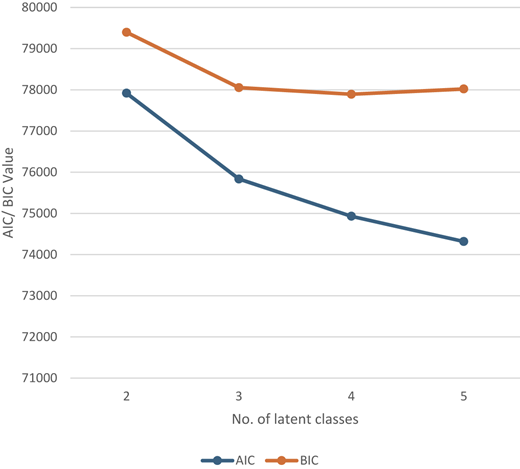
Elbow plot for model fitting indices. Source: Authors’ own work
Elbow plot for model fitting indices. Source: Authors’ own work
Figure A1 presents the item probabilities for four latent classes, which represent the conditional likelihood of observing each response (1–7) within each class.
The results allow us to define the following groups of households according to their responses to motivations, opportunities, and abilities related to leftover food management behaviour at home.
4.2 Class descriptions
4.2.1 Class 1: Efficient Savers
This group efficiently manages food leftovers, consistently choosing “Every time” for handling leftovers and “Never” for opportunity constraints. They plan meals, track food stock, check date labels, and use shopping lists. They cook precise portions and store leftovers properly to maintain freshness. They always use the oldest food first and follow their meal plans closely. They do not watch cooking shows or seek leftover-based recipes online. Household tasks are stress-free, and they never tire of cooking planned meals, leading to minimal leftovers. They strive to avoid unnecessary waste and feel guilty about discarding food. When disposing of leftovers, they are aware of the quantities wasted. They are confident that reducing the disposal of food leftovers can save the environment, money and time.
4.2.2 Class 2: Unplanned Eaters
These households take a neutral stance on leftover food management, often choosing middle-ground options for motivations, opportunities, and abilities. They frequently encounter unexpected changes in meal plans, leading to leftovers. Half the time, they do not plan meals, check stock, or use a shopping list before shopping, making it harder to cook precise portions. While interested in cooking shows and social media recipes for leftovers, half of the time, they are reluctant to store leftover food in a way that preserves the quality. They sometimes fail to use the oldest food first, do not store leftovers in low temperatures, and do not store leftovers in separate containers in an ordered manner. They feel less guilt about discarding leftovers and are unaware of how much edible food they waste. Their views on the benefits of reducing leftover waste, such as saving money, time, and the environment, remain neutral.
4.2.3 Class 3: Aspirational Savers
This group comprises households who desire to manage food leftovers at home. Usually, they know what food they have in stock, pay attention to date labels, and store them correctly to keep them fresh for as long as possible. They always use a shopping list. Frequently, they plan their meals and are precise in cooking the right quantities. Their meals during the week occasionally diverge from what they had planned; however, they usually use up the oldest food first when preparing meals. They rarely get stressed in taking care of housework. Usually, they aim to have no unnecessary leftovers and always feel guilty about throwing away food 0leftovers. Most of the time, they know the quantities of food leftovers they dispose of. They agree that reducing the disposal of food leftovers can save the environment, money and time.
4.2.4 Class 4: Time-Savvy Planners
Households in this group show similar leftover management behaviour to “Aspirational Savers”, but in contrast, they experience a busy lifestyle. They face unexpected situations where meals during the week diverge from what they had planned. They are sometimes under time pressure and need more time to prepare the intended meal from the ingredients bought. They frequently feel stressed. Despite having limited time in household food management, these households watch television programmes dedicated to cooking and access social media platforms to learn new recipes from leftovers. They usually plan their meals, know what they have in stock, check date labels, and store leftovers in optimal conditions.
4.3 Multinomial logistic regression model
Table 2 presents the multinomial logistic regression analysis results, with the reference latent class “Efficient Savers”.
Multinomial logistic regression results for four latent classes
| Predictor | Unplanned eaters vs efficient savers | Aspirational savers vs efficient savers | Time-savvy planners vs efficient savers |
|---|---|---|---|
| Gender (female) | −0.3517* (0.1969) | ||
| Age_25–44 | −0.8181** (0.3674) | ||
| Age_45–64 | −1.7517**** (0.3704) | −0.1655**** (0.4083) | −1.4388**** (0.4059) |
| Age_>65 | −2.1616**** (0.6089) | −2.4971*** (0.8538) | |
| Households with children | 0.65849** (0.3039) | ||
| Self-employed | −1.1786*** (0.4327) | −0.7429* (0.3861) | −0.8207* (0.4575) |
| Unemployed | −0.6569*** (0.2377) | −0.1356*** (0.2291) | −1.2919*** (0.2979) |
Note(s): Standard errors are in parentheses. *p < 0.1, **p < 0.05, ***p < 0.01, ****p < 0.001
Only characteristics that were successfully retained in the models, with a p-value <0.1, are presented
Source(s): Authors’ own work
The coefficients from a multinomial logistic regression are in log odds and are relative to the baseline level - “Efficient Savers”. Females and older age groups are less likely to be categorised as “Unplanned Eaters,” with the log-odds decreasing progressively with age. Employment status also plays a role, as self-employed and unemployed individuals show lower odds of being “Unplanned Eaters” than full-time workers. Similarly, the likelihood of being an “Aspirational Save” decreases significantly with age and for self-employed individuals. For “Time-Savvy Planners,” older age groups reduce the odds while having children in the household and employment increase the likelihood.
5. Discussion and policy implications
The latent class analysis results provide novel insights into the heterogeneity of leftover management among households. The study identified four latent classes of households based on consumers’ motivation, abilities, and opportunities and reported leftover management behaviours.
The results revealed that aiming to have no unnecessary leftovers, feeling guilty about throwing away food leftovers, and awareness of food leftovers that are being wasted increases the probability of being in the “Efficient Savers” class. This is in line with the findings of Nikravech et al. (2023), where consumers with strong intentions to reduce food waste and negative emotions towards food waste were associated with more leftovers-conscious clusters, “Leftover lovers” and “Leftovers recyclers”. Consumers’ guilt over food waste motivates them to ensure they serve their families appropriate portion sizes (Nunkoo et al., 2021). Ramos et al. (2024) found that more frequent food waste measurements gradually reduce household food waste. Moreover, the results showed that consumers’ skills in meal planning, food storage, and cooking in the right quantities, as well as knowledge of food stocks and expiry dates, increase the probability of being in the “Efficient Savers” class. The “Self-sufficient Savers” cluster identified by Ananda et al. (2025) showed similar findings, characterised by efficient food-storing behaviours and precision cooking.
Time constraints and busy lifestyles increase the likelihood of consumers falling into the “Unplanned Eaters' category. However, strong motivation to reduce leftover food waste and improved skills in managing leftovers can increase the likelihood of busy individuals belonging to the “Time-Savvy Planners' category. The findings of Ribbers et al. (2024) support this, highlighting that moral motivations play a key role in reducing household food waste.
The coefficient of the gender of the consumers (−0.352) indicates that being female decreases the log odds of belonging to the “Unplanned Eaters” class compared to the “Efficient Savers” class. Research shows that women waste less food than men at home and are more likely to store leftovers properly (Quested et al., 2013; Visschers et al., 2016). They have greater knowledge of handling leftovers (Wang et al., 2021), likely due to their higher involvement in food-related tasks and nutrition awareness (Wardle et al., 2004). Women often serve as the primary household cooks, controlling portion sizes and food management (Gojard and Véron, 2018). Eating leftovers is seen as an act of care and prioritisation of family needs (Andrews et al., 2018). For many women, especially mothers, consuming leftovers represents a sacrifice for their family’s well-being, strengthening familial bonds (Cappellini, 2009).
The consumer age coefficient indicates that the log-odds of being an “Unplanned Eater” (compared to an “Efficient Saver”) decreased for older age groups when compared to the baseline group of younger consumers (aged 18–24). Specifically, for consumers aged 45–64, the log odds of being classified as an “Unplanned Eater” decrease by 1.751 relative to those in the 18–24 age group. For those aged 65 years and above, the log odds decrease by an even greater amount, 2.161, compared to the 18–24 age group. This suggests that being a young adult increases the likelihood of belonging to the “Unplanned Eaters” class. This is in line with the findings of Ananda et al. (2025) which indicate that older households are less likely to belong to the high meal waste cluster, “Naïve Discarders”. Moreover, the log-odds of being an “Aspirational Saver” and “Time-Savvy Planner” decrease for older age groups compared to younger consumers. For consumers aged 65 years and above, the log odds of being classified as a “Time-Savvy Planner” decrease by 2.497 relative to those in the 18–24 age group. This may be because, at an older age, consumers are less likely to have a busy lifestyle or face time constraints in their day-to-day lives.
Research shows that younger individuals tend to waste more food than older generations (Bravi et al., 2020; Quested et al., 2013; Visschers et al., 2016). This is linked to a lack of skills in grocery shopping, cooking with leftovers, and proper food storage (Karunasena et al., 2021). Younger consumers are less likely to incorporate leftovers into meals or save them for future use (Roe et al., 2020). Additionally, age significantly impacts knowledge and risk perception regarding leftover handling (Wang et al., 2021). Younger consumers have fewer competencies in household food management due to limited experience in reusing leftovers compared to older adults (Bravi et al., 2020). Conversely, older individuals, especially those living alone, tend to store leftovers for shorter periods (Thaivalappil et al., 2019), likely because they are more precise in cooking appropriate quantities, thereby reducing leftover meals.
The coefficient of the household composition (0.658) indicates that being in a household with children rather than living alone increases the log odds of belonging to the “Time-Savvy Planner” class compared to the “Efficient Savers” class. This suggests that having children in the household decreases the likelihood of belonging to the “Efficient Savers' group; however, it does not imply that having children makes someone less capable of managing leftovers. They may still be effective at managing leftovers under time pressure. This further explains why Ananda et al. (2025) noted that households with infants and toddlers are less likely to belong to the high meal waste cluster, “Naïve Discarders”.
In the present study, having children in the household was not a significant factor for belonging to the “Unplanned Eaters' group; however, several past studies have identified young children as a major influence on food waste (Kansal et al., 2022; Karunasena et al., 2021). Nguyen et al. (2023) noted that motivations to reduce and sort household food waste are constrained, particularly due to responsibilities and time constraints faced by families with children. Selective eating behaviours and preferences in children can lead parents to over-prepare or over-provide meals (Kansal et al., 2022). Additionally, children may reject food made with leftover ingredients due to the altered appearance of such meals (Evans, 2011). Older children may contribute to food waste by making last-minute decisions to eat outside the home, leaving prepared meals uneaten (Visschers et al., 2016). To maintain a “good provider” identity, parents may encourage waste by tolerating picky eating habits (Gojard and Véron, 2018), driven by a moral obligation to serve proper meals (Revilla and Salet, 2018), resulting in over-purchasing and meal over-preparation (Graham-Rowe et al., 2014).
The coefficient of the employment of the consumers indicates that the log-odds of being an “Unplanned Eater” (compared to an “Efficient Saver”) decrease for self-employed and unemployed consumers when compared to the consumers working full-time. Specifically: for self-employed consumers, the log-odds of being classified as an “Unplanned Eater” decrease by 1.178 relative to those working full-time. Previous general food waste studies note that consumers who are not in the labour force and job seekers generate less food waste than employed consumers (Grasso et al., 2019; Secondi et al., 2015). Being employed reduces the probability of eating everything prepared (Mattar et al., 2018), increasing the likelihood of wasting more food (Cecere et al., 2014).
Moreover, in the present study, for unemployed consumers, the log-odds of being classified as a “Time-Savvy Planner” (compared to an “Efficient Saver”) decrease by 1.292 relative to those working full-time. This suggests that being a full-time worker increases the likelihood of belonging to the “Unplanned Eaters” or “Time-Savvy Planner” classes rather than being an “Efficient Saver”. This could be because full-time employees have less time to plan meals or less focus on acquiring awareness of food waste (Qi and Roe, 2016).
5.1 Intervention opportunities
Choosing the right interventions for household food behaviour is crucial for motivating households to minimize leftover food waste. The “Efficient Savers” group, already adept at managing leftovers, would benefit from interventions that focus on sustaining motivation, expanding skills, and enhancing their impact. Positive behaviours can be reinforced through tracking apps or reward-based systems that celebrate waste reduction. Short, engaging cooking content can introduce quick, creative ways to use leftovers without disrupting routines. AI-driven meal planners and precision tools, such as portioning devices and food scales, can optimise meal planning and minimise waste. Additionally, promoting food donation apps and sustainability programs can help them extend their impact within their communities.
For the “Unplanned Eaters” group, low-effort, practical interventions are necessary to make leftover food management easier, more visible, and more rewarding. Personalised waste tracking through apps or journaling can help them recognise the amount of food they discard. Beginner friendly meal planning tools can suggest recipes based on available ingredients, while storage tips, like fridge organisation and clear containers, can improve leftover visibility. Quick, engaging cooking videos with effortless leftover recipes can make reuse more appealing. Simple storage practices, such as resealable bags and stackable containers, alongside fridge reminders, can help maintain food quality. Linking actions to tangible benefits such as saving time, money, and environmental resources can boost motivation.
The “Aspirational Savers” group, with strong habits but occasional meal plan deviations, needs interventions that enhance flexibility and optimise leftover use. Adaptive meal planning tools can adjust plans based on unforeseen changes, ensuring efficient ingredient use. Promoting creative leftover utilisation through quick, low-effort meal ideas, cooking videos, and infographics can increase food reuse. Smart storage solutions, such as efficient labelling and transparent containers, can improve visibility and reuse ease. Interactive tracking tools can estimate savings, and reward systems can sustain engagement.
For “Time-Savvy Planners”, behavioural interventions should focus on convenience, stress reduction, and time-efficient food management. Flexible meal planners can adapt to time constraints, while quick leftover utilisation ideas can focus on meal assembly rather than full cooking. Smart storage solutions, like clear labelling and accessible containers, can make leftover access easier. Short, engaging cooking videos can support their busy lifestyles, and pre-planned meal templates or rotational schedules can reduce decision-making stress.
Policy initiatives should focus on consumer education in key areas such as meal planning, portion control, and food storage, with particular emphasis on young males and full-time employees, who often play a significant role in leftover food waste behaviours. Multi-component interventions, such as combining nudges with knowledge enhancement, have been shown to reduce food waste (Liechti et al., 2024). Digital resources or workshops teaching skills like estimating portions, sorting leftovers, and creative reuse can empower households. Smartphone apps could calculate ingredient quantities for specific servings, create shopping lists, and offer reminders for food supplies. Additionally, these platforms could provide guidance on repurposing leftovers and offer strategies for food preservation. Governments and sustainability organisations should collaborate to launch campaigns focusing on fridge and freezer management, storage conditions, and safe reuse of leftovers, addressing food safety concerns and encouraging households to incorporate leftovers into meals with confidence, thereby reducing food waste.
5.2 Limitations and future research needs
This study relies on self-reported behaviours regarding leftover management, which may only sometimes align with actual practices. Additionally, these responses may be affected by a tendency to answer in socially desirable ways. Therefore, the results could be affected by social desirability or response bias, which can distort the identification of latent classes and reduce accuracy in describing behaviour patterns. Moreover, LCA assumes that individuals within each class are homogeneous and that the data fit specific statistical assumptions, such as local independence. Violations of these assumptions can bias results and reduce the validity of the analysis.
Future research should focus on developing tailored interventions that address the specific barriers and motivators of different consumer segments to enhance leftover food waste reduction strategies. For “Efficient Savers”, studies should explore strategies to sustain long-term behaviour change and prevent intervention fatigue, assess the scalability of AI-driven meal planners and precision cooking tools, and identify ways to encourage community-level engagement. Research on “Unplanned Eaters” should investigate psychological barriers to leftover management, evaluate the real-world effectiveness of nudging strategies, and assess the impact of real-time waste tracking. For “Aspirational Savers”, further examination is needed to understand meal plan deviations and explore how creative leftover utilisation can be made more appealing through personalised recipe recommendations. Given that “Time-Savvy Planners” often face time constraints, research should explore strategies to balance convenience with sustainability without adding stress. More broadly, future studies should examine demographic-specific interventions, the role of technology in shaping food waste behaviours, and the integration of retail and household interventions to create a cohesive food waste reduction framework. Addressing these research gaps will support the development of practical, scalable, and sustainable strategies that align with consumer needs and lifestyles.
6. Conclusions
The study explored the heterogeneity of food leftover management behaviours at the household level through a latent class analysis approach. Data were collected through an online survey, capturing motivations, abilities, and opportunities influencing leftover management among Australian households. LCA identified four unique classes: “Efficient Savers”, “Unplanned Eaters”, “Aspirational Savers”, and “Time-Savvy Planners”, each characterised by varying motivations, skills, and lifestyle factors. The findings indicate that a focus on minimising unnecessary leftovers, guilt over food waste, and awareness of wasted leftovers increase the likelihood of being an “Efficient Saver”. Skills in meal planning, proper food storage, cooking appropriate quantities, and monitoring food stocks and expiry dates also contribute to this category.
Conversely, time constraints and busy lifestyles make consumers more likely to be “Unplanned Eaters”. However, strong motivation to reduce food waste and enhanced leftover management skills can shift busy individuals into the “Time-Savvy Planners” group. The MNL analysis helped determine the statistically significant socio-demographic differences between the latent classes. The likelihood of having an unplanned leftover food management behaviour decreases among females, older age groups, and those who are self-employed or unemployed compared to full-time workers. Findings provide insights for policymakers to design tailored strategies that promote sustainable food practices.
This work has been supported by an Australian Government Research Training Programme Scholarship and the End Food Waste Cooperative Research Centre whose activities are funded by the Australian Government’s Cooperative Research Centre Program.
Notes
In this study, leftovers are defined as “food cooked or purchased for one meal that becomes surplus or remains uneaten,” including a) prepared but unserved food, b) food served but uneaten, c) leftover ingredients, d) takeout leftovers, and e) leftover food from online orders.
References
Appendix 1
Measurement model constructs and reliability indicators
| Items | Factor loadings | Cronbach α | Composite reliability | |
|---|---|---|---|---|
| Leftover Food Management (LFM) | 0.83 | 0.79 | ||
| LFM_1 | Use up the oldest food first | 0.727 | ||
| LFM_4 | Move the oldest food items to the front or top | 0.645 | ||
| LFM_5 | Use storage containers to keep leftovers | 0.667 | ||
| LFM_6 | Put leftovers in the fridge/freezer | 0.660 | ||
| LFM_7 | Keep the temperature in the fridge below 4°C and freezer below −18 C | 0.741 | ||
| Motivation (MOT) | 0.86 | 0.84 | ||
| MOT_1 | I aim to have no unnecessary leftovers | 0.614 | ||
| MOT_2 | I feel guilty about throwing away food leftovers | 0.672 | ||
| MOT_3 | I am aware of the food leftovers that I waste | 0.627 | ||
| MOT_7 | If I reduce the amount of leftovers I dispose of, I am saving the planet | 0.752 | ||
| MOT_8 | If I reduce the amount of leftovers I dispose of, I am saving money | 0.784 | ||
| MOT_9 | If I reduce the amount of leftovers I dispose of, I am saving time | 0.748 | ||
| Opportunity (OPP) | 0.51 | 0.63 | ||
| OPP_1 | I am too tired to prepare the meal for which I bought the ingredientsR | 0.742 | ||
| OPP_2 | Unexpected circumstances occur, in which I had food leftoverR | 0.717 | ||
| OPP_3 | I am under time pressure in my day-to-day lifeR | 0.792 | ||
| OPP_4 | The meals during the week get diverged from what I had plannedR | 0.714 | ||
| OPP_5 | I feel under stress in taking care of workR | 0.814 | ||
| OPP_8 | I use television programmes dedicated to cooking, to learn leftover recipes | −0.463 | ||
| OPP_10 | I use websites and social media channels, to learn leftover recipes | −0.419 | ||
| Ability (ABI) | 0.88 | 0.87 | ||
| ABI_1 | I plan before going to the shop | 0.647 | ||
| ABI_2 | I use a shopping list | 0.572 | ||
| ABI_3 | I am precise in cooking the right quantities | 0.709 | ||
| ABI_4 | I know what food I have in stock | 0.823 | ||
| ABI_5 | My shelves and/or fridges are organised | 0.794 | ||
| ABI_6 | I pay attention to the expiry dates | 0.691 | ||
| ABI_7 | Storing my food leftovers in the right way | 0.779 |
Note(s): R Reverse coded
All the factor loadings are significant at the 1% level (p < 0.001)
Appendix 2
Appendix 3
Socio-demographic characteristics of the latent classes
| Class 1 | Class 2 | Class 3 | Class 4 | ||
|---|---|---|---|---|---|
| Class name | Efficient savers | Unplanned eaters | Aspirational savers | Time-savvy planners | p |
| Class size | 276 | 256 | 307 | 165 | |
| Gender | |||||
| Male | 141 | 127 | 162 | 61 | ** |
| Female | 135 | 129 | 145 | 104 | |
| Age | |||||
| 18–24 years | 12 | 41 | 16 | 25 | *** |
| 25–44 years | 73 | 127 | 88 | 88 | |
| 45–64 years | 120 | 69 | 126 | 45 | |
| >65 years | 71 | 19 | 77 | 7 | |
| Household composition | |||||
| Single person household | 71 | 55 | 70 | 26 | *** |
| Families with children | 61 | 100 | 68 | 83 | |
| Families with only adults | 144 | 101 | 169 | 56 | |
| Employment | |||||
| Full-time | 72 | 124 | 87 | 82 | *** |
| Part-time | 38 | 49 | 58 | 47 | |
| Self-employed | 23 | 9 | 13 | 8 | |
| Unemployed | 86 | 61 | 88 | 23 | |
| Retired | 57 | 13 | 61 | 5 | |
| Income | |||||
| <$A 1000 per week | 76 | 68 | 80 | 27 | ns |
| $A 1000 – $A 1999 per week | 82 | 61 | 98 | 51 | |
| $A 2000 – $A 2999 per week | 38 | 46 | 53 | 34 | |
| $A 3000 – $A 3999 per week | 32 | 30 | 30 | 19 | |
| >$A 4000 per week | 20 | 30 | 21 | 18 | |
| Do not want to say | 28 | 21 | 25 | 16 | |
Note(s): **p < 0.01; ***p < 0.001; nsp>0.1
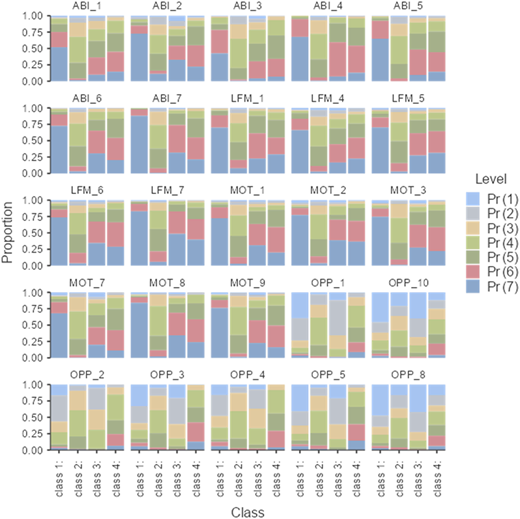
Item response probabilities for four latent classes. Note: The likelihood of respondents choosing each response category (1 – Never, 2 – Rarely, 3 -Occasionally, 4 – Sometimes, 5 – Frequently, 6 – Usually, 7 – Every time) for each manifest variable.
Item response probabilities for four latent classes. Note: The likelihood of respondents choosing each response category (1 – Never, 2 – Rarely, 3 -Occasionally, 4 – Sometimes, 5 – Frequently, 6 – Usually, 7 – Every time) for each manifest variable.

