


Monitoring sustainability in the food system is vital, yet the firms operating between production and consumption in the value chain are often overlooked; they constitute a “missing middle”. We investigate sustainability indicator quantity, scope and target connection among food sector firms and assess how these are influenced by firm characteristics, including size, sector and multinational affiliation.
We construct and use a panel data set of quantity, scope and target connection of reported sustainability indicators from 92 firms active in the Swedish food and beverage industry, wholesale and retail sector, from 2017 to 2021. We categorize sustainability indicators into topics and dimensions and employ random-effects Tobit estimation and censored quantile regression to explore heterogeneity among firms.
The findings reveal firm heterogeneity in sustainability indicator reporting. While almost 90% report emissions, “maintaining natural capital” and “economic enablers” are underreported sustainability dimensions. Net turnover and multinational affiliation are positively related to sustainability indicator reporting, while belonging to the wholesale sector is negatively related to reporting sustainability indicators for high and low quantiles. The share of target-connected sustainability indicators increases from 30% to 50% over the period.
Using sustainability reports as a source of data for sustainability efforts implies some limitations since all monitored indicators may not be disclosed in sustainability reports nor does monitoring indicators mean that sustainability objectives are met. We consider the act of monitoring, targeting and reporting on indicators as a key step for achieving such objectives, and the quantity, scope and alignment of indicators with specific targets are highlighted to ensure that the report is informative and effective and the data are trustworthy.
Our study can be useful for firms themselves, wishing to benchmark against similar firms and plan future monitoring and reporting efforts. For researchers and policymakers, our study can work as a transparent source of information on the contents sustainability reporting, a solid base for future research and policy impact evaluations.
Food system sustainability is a topic of broad social relevance, affecting all levels of society from producers to consumers. This research provide insights into the sustainability efforts of an under-researched segment of the food system, and on how monitoring tools such as indicators can and should be used to speed up the progress toward sustainability. Further, we provide a basis for effective impact evaluation of legislation, which is important to tailor effective policy for a future sustainable food system.
This is one of the first studies to collect a unique and detailed catalogue covering actual sustainability indicators used by the “missing middle” firms and illustrate their capacity to capture relevant dimensions, topics and targets. We highlight the heterogeneity in sustainability indicator reporting among firms and thereby provide a pre-Corporate Sustainability Reporting Directive benchmark which is useful for efficient policy evaluation on the path towards sustainable food systems.
1. Introduction
Achieving sustainable food systems – a key to achieving sustainable development – requires efficient monitoring tools to track progress (Fanzo et al., 2021; United Nations, 2015; 2021). Quantitative sustainability indicators, defined as measurable aspects of environmental, economic or social systems, constitute such tools to analyse complex dynamics and monitor progress towards food system sustainability (Arulnathan et al., 2020; Hebinck et al., 2021). While diversity in food system actors’ perceptions of sustainability challenges and solutions has previously been identified (Béné et al., 2019; Röös et al., 2022), it remains unknown whether the diversity also prevails in the uptake and use of monitoring tools like sustainability indicators. Since monitoring sustainability indicators constitute an important basis for sustainable action, in the spirit of “what gets measured gets done”, these questions require attention from research. To answer this need, this study investigates the heterogeneity in the use of sustainability indicators among food system firms, using data from Sweden. We ask:
What quantity, scope and target connections characterize the indicators monitored and reported in the food and beverage industry, wholesale and retail firms active in the Swedish market?
How are the quantity, scope and target connections of the indicators influenced by firm size, sector and multinational affiliation?
Firms active in the food industry and retail sectors have incentives to monitor sustainability indicators and provide sustainability-related information through sustainability reports (Buallay, 2021; Christensen et al., 2021). To enhance comparability in sustainability reporting across Europe, a first set of European Sustainability Reporting Standards (ESRS) was released in 2023 within the framework of the Corporate Sustainability Reporting Directive (CSRD) (Directive (EU) 2022/2464; Regulation (EU) 2023/2772), changing the current setting for sustainability reporting [1]. So far, much research about sustainability reporting focuses on the consequences of such mandatory reporting regimes (Gerwing et al., 2022; Krueger et al., 2024), and the levels of information disclosure expected (Fiandrino et al., 2019; Rustam et al., 2019; Zamil et al., 2021). Several studies use rating systems to evaluate sustainability performance based on reporting (e.g. Brunella et al., 2024; Sun et al., 2024), even though such systems have spurred critique (e.g. Kotsantonis and Serafeim, 2019; Crona et al., 2021). Limited attention has so far been directed to the deeper contents of sustainability reports, including how firms track their own progress toward sustainability objectives by monitoring sustainability indicators. As differences in sustainability indicator use remain under-explored, so does the extent to which such differences are driven by heterogeneity in firms’ characteristics. This paper thereby provides novel insights by outlining a detailed characterization of sustainability indicator monitoring and reporting, through the lens of quantity, scope and target connection, and analysing how heterogeneity in sustainability indicator reporting relates to economic and industrial aspects.
The “missing middle” in food system sustainability research refers to firms between agricultural production and food consumption in the value chain, including food processors, wholesalers and retailers, which are often overlooked (Béné, 2020; Veldhuizen et al., 2020; Tezzo et al., 2021). However, these firms are highly affected by, and substantially contribute to, sustainable development of the food system and therefore deserve more attention from research (Garnett, 2011; Baker and Friel, 2016; Alabi and Ngwenyama, 2023). This paper thereby contributes to closing a research gap by focusing on firms in the food and beverage industry, wholesale and retail sectors.
To achieve our aims, we collect a unique and detailed indicator catalogue of quantitative sustainability indicators reported by a total of 92 food sector firms active in the Swedish market between 2017 and 2021, using their sustainability reports. To answer our first research question, we categorize sustainability indicators according to topics and dimensions from recent theoretical conceptualizations and practical applications and are thus able to construct and describe a panel data set covering actual sustainability indicators coupled with firm characteristics. To answer the second research question, we use a random effects Tobit estimation and a censored quantile regression (CQR) model to explore connections between sustainability indicator monitoring - and firm characteristics. Finally, we discuss the implications of our results for the implementation of CSRD and ESRS; food system sustainability; and the integration of sustainability monitoring, reporting and performance.
With this paper, we advance the scientific discussion about how sustainability indicators are used by food system firms, and the potential for sustainability indicator monitoring to function as a tool in a sustainable food system transformation. Results are informative for public policy and private reporting initiatives, aiming to tailor efficient measures for enhanced sustainability monitoring and reporting, and to achieve sustainable food systems.
2. Conceptual foundations and hypotheses development
2.1 Quantity, scope and target connection of sustainability indicators
The uptake and use of quantitative sustainability indicators in food system firms’ sustainability reporting can be explored by investigating how many sustainability indicators are reported (quantity), how broadly they capture relevant sustainability issues (scope) and to what extent they are aligned to internal sustainability targets of the firm (target-connection). We describe the scope of sustainability indicators by categorizing them into dimensions and topics. Dimensions refer to the broad conceptual pillars capturing overarching areas of sustainability. We identify them building on Hebinck et al. (2021), who developed a compass to sustainable food systems, guided around societal goals: (1) Healthy, adequate and safe diets, (2) A clean and healthy planet and (3) Just, ethical and equitable food systems. In line with Hansson et al. (2024), we include (4) Maintaining natural capital, as the necessary basis for sustainable food systems and divide economic aspects into (5) Economic enablers and (6) Governance, emphasizing the function of the economy and the need to internalize external effects. A topic refers to a sub-domain of a dimension, i.e. specific and measurable contents of each dimension. We use the “likely material” topics of the Global Reporting Initiative (GRI) standard for agriculture, aquaculture and fishing sectors, which cover 26 aspects relevant to the entire supply chain of food products (Figure 1). The GRI and similar reporting standards are widely used by firms in the food sector, and we use the GRI here due to the sector-specific guidance tailored for food-related issues. We include quantifiable topics relating to policy commitments and compliance with laws and regulations from the general disclosures of the GRI framework.
 The horizontal axis ranges from 0 percent to 100 percent in increments of 10 percent. The vertical axis lists multiple indicator topics grouped under six main categories labeled along the left side from top to bottom as follows: “Governance”, “Economic enablers”, “Maintaining natural capital”, “A clean and healthy planet”, “Just, ethical and equitable food system”, and “Healthy, adequate and safe diets”. The graph displays individual horizontal bars for each topic. Under Governance, the topics and their approximate percentages are as follows: Compliance laws and regulations: 33 percent. Policy commitments: 54 percent. Anti-corruption: 33 percent. Public policy: 25 percent. Sustainable sales: 59 percent. Under Economic enablers, the indicators are: Anti-competitive behavior: 4 percent. Economic inclusion: 41 percent. Living income and living wage: 10 percent. Under Maintaining natural capital, the indicators are: Soil health: 5 percent. Climate adaption and resilience: 10 percent. Natural ecosystems conversion: 29 percent. Biodiversity: 35 percent. Under A clean and healthy planet, the indicators are: Pesticides use: 23 percent. Water and effluents: 62 percent. Waste: 73 percent. Emissions: 89 percent. Under Just, ethical and equitable food system, the indicators are: Employment practices: 75 percent. Occupational health and safety: 75 percent. Freedom of association and collective bargaining: 9 percent. Child labor: 10 percent. Forced compulsory labor: 5 percent. Non-discrimination equal opportunity: 78 percent. Rights of indigenous peoples: 9 percent. Land and resource rights: 7 percent. Local communities: 27 percent. Animal health and welfare: 26 percent. Under Healthy, sustainable and safe diets, the indicators are: Supply chain traceability: 39 percent. Healthy diets: 35 percent. Food safety: 34 percent. Food security: 29 percent. Note: All numerical data values are approximated.
Share of firms reporting sustainability indicators within each topic and dimension
The horizontal axis ranges from 0 percent to 100 percent in increments of 10 percent. The vertical axis lists multiple indicator topics grouped under six main categories labeled along the left side from top to bottom as follows: “Governance”, “Economic enablers”, “Maintaining natural capital”, “A clean and healthy planet”, “Just, ethical and equitable food system”, and “Healthy, adequate and safe diets”. The graph displays individual horizontal bars for each topic. Under Governance, the topics and their approximate percentages are as follows: Compliance laws and regulations: 33 percent. Policy commitments: 54 percent. Anti-corruption: 33 percent. Public policy: 25 percent. Sustainable sales: 59 percent. Under Economic enablers, the indicators are: Anti-competitive behavior: 4 percent. Economic inclusion: 41 percent. Living income and living wage: 10 percent. Under Maintaining natural capital, the indicators are: Soil health: 5 percent. Climate adaption and resilience: 10 percent. Natural ecosystems conversion: 29 percent. Biodiversity: 35 percent. Under A clean and healthy planet, the indicators are: Pesticides use: 23 percent. Water and effluents: 62 percent. Waste: 73 percent. Emissions: 89 percent. Under Just, ethical and equitable food system, the indicators are: Employment practices: 75 percent. Occupational health and safety: 75 percent. Freedom of association and collective bargaining: 9 percent. Child labor: 10 percent. Forced compulsory labor: 5 percent. Non-discrimination equal opportunity: 78 percent. Rights of indigenous peoples: 9 percent. Land and resource rights: 7 percent. Local communities: 27 percent. Animal health and welfare: 26 percent. Under Healthy, sustainable and safe diets, the indicators are: Supply chain traceability: 39 percent. Healthy diets: 35 percent. Food safety: 34 percent. Food security: 29 percent. Note: All numerical data values are approximated.Share of firms reporting sustainability indicators within each topic and dimension
We evaluate the usefulness of sustainability indicators by examining their connection to internal sustainability targets. Linking sustainability indicators and targets provides information on the firms’ progress toward sustainability, since such a connection is needed to operationalize the indicators and use them to improve sustainability performance (Gil et al., 2019; Hebinck et al., 2021). Target connection is therefore recognized as a core principle for sustainability assessment (Pintér et al., 2012). Along the quantity of total sustainability indicators, topics and dimensions, we use the number and share of target connected indicators as outcome variables.
2.2 Influences on firm use of sustainability indicators
Institutional theory highlights how firms secure legitimacy by complying with institutional rules and norms (Govindan, 2018). Within a supply chain, isomorphic pressures lead to homogeneity in sustainability activities (Glover et al., 2014; Ioannou and Serafeim, 2019). This suggests that limited variation is expected among firms with similar sectoral or multinational characteristics. Stakeholder theory emphasizes the impact of a firm’s externalities on groups such as competitors, suppliers, shareholders and customers. Firms are incentivized to reduce negative impacts on these groups and increase positive ones (Freeman and McVea, 2005; Sarkis et al., 2011; Govindan, 2018). In this view, societal interest, consumer demand and regulatory pressure encourage firms to measure and report more on sustainability issues over time, especially firms with extensive stakeholder interactions, proximity to consumers or public visibility.
New legislation based on EU CSRD has a more direct influence on the monitoring contents of reports in comparison to previous legislation as it promotes sustainability reporting according to ESRS as a way to streamline reporting practices (European Union, 2022; Christensen et al., 2021). Even though the scope and ambition of the CSRD has been significantly limited under the omnibus simplification package, reports under this framework are now being published, and it remains to be seen how ESRS will affect sustainability monitoring in the food sector more broadly, and in the long run. Many firms in the food sector use private frameworks such as GRI for sustainability reporting, which require the inclusion of some key performance indicators (Iazzi et al., 2021). However, during our study period 2017–2021, firms had considerable freedom to choose which specific sustainability indicators to monitor and report, even under mandatory reporting regimes (Beske et al., 2020; Machado et al., 2021).
Firm size also shapes reporting practices. Larger firms tend to adopt corporate codes of conduct, ISO certification and social reporting more frequently (Graafland et al., 2003), partly because their scale reduces relative organizational costs (Baumann-Pauly et al., 2013). Smaller firms, however, may respond more swiftly to stakeholder pressure (Darnall et al., 2010) but often lack the supply chain information advantages of larger firms (Shore, 2014). In the food sector, multinational corporations commonly engage in sustainability reporting, and many use established frameworks and corresponding indicators (Shnayder et al., 2015; Global Corporate Sustainability Report 2024, 2024). Yet, whether such reporting drives substantive positive change remains debated, as integrating monitoring with tangible progress towards sustainability objectives is still a challenge both in theory and in practice (Higgins and Coffey, 2016; Morioka and de Carvalho, 2016; Kotsantonis and Serafeim, 2019).
Based on the above, we formulate two testable hypotheses to describe and explore heterogeneity in quantity, scope, and target connection of sustainability indicators used in food system firms’ sustainability reports, in relation to firm size, sector and multinational affiliation:
Firms with (a) high turnover, (b) more employees, (c) multinational affiliations are likely to monitor and report (a) many sustainability indicators, (b) wide indicator scope and (c) target-connected indicators.
Firms in retail and wholesale, monitor and report (a) more sustainability indicators, (b) a wider indicator scope and (c) more target-connected indicators, than firms in the food and beverage industry.
3. Methods
3.1 Data collection and categorization
A list of 547 organizational numbers of firms with employees ≥50, active in the Swedish market of food industry and retail, was obtained from Statistics Sweden to identify a target population [2]. The selection of ≥50 employees was based on the need to limit data collection time and given the lower probability of smaller firms publishing a sustainability report, we considered the risk of missing substantial information by excluding these firms to be relatively low. There was at least one sustainability report from 92 of these firms during the period 2017–2021. In total, we collected 340 sustainability reports. The sustainability reports were retrieved from the firms’ yearly financial statements, via the firm's website, or by e-mail. Sustainability indicators were manually collected, and financial data were retrieved from official statistics compiled at allabolag.se [3]. To measure an indicator, it needs to be quantitative and have units (Veleva and Ellenbecker, 2001). Accordingly, we did not include qualitative descriptions or indicators without units in our study. In total, 6,586 quantitative sustainability indicators were identified from the reports. The total count includes multiple but occasionally conceptually similar or synonymous indicators such as energy use, energy consumption, energy costs, etc. with different units and languages (sustainability reports were written in both Swedish and English). Including 5 years in our data collection, some indicators that are identical or nearly identical appear more than once. We refer to this dataset as the “Raw Sustainability Indicator Catalogue”. Each sustainability indicator was linked to an internal sustainability target, if such a target was explicitly stated in the report. Some targets were generally defined and could be linked to several sustainability indicators, while others were specifically monitored by one single indicator. Targets without indicators were not considered. Multinational affiliation was defined and distinguished between firms operating, owning or being owned by companies exclusively in Sweden, in the Nordic countries, outside of the Nordics and outside Europe.
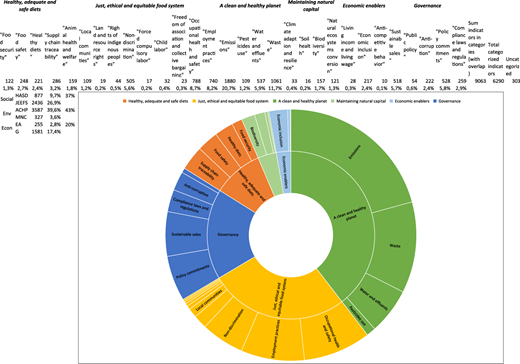
Next, we constructed the panel dataset containing the outcome variables indicator quantity, indicator dimensions, indicator topics, quantity of target connected indicators and share of target connected indicators. To categorize the sustainability indicators under dimensions from Hansson et al. (2024) and topics from Global Reporting Initiative (2022) and to construct the outcome variables indicator dimensions and indicator topics, we first used Chat GPT-3.5 to generate a list of words related to specific indicators of the GRI standard (Figure 2, Supplementary material 1). The generated list contained 20 words, in both Swedish and English, as the sustainability reports were in both languages. The lists where then manually scrutinized for relevance to our categorization exercise. Words wrongly translated and compound words already captured (such as climate adaptation when climate was already included) were deleted. When available, the GRI-topic specific disclosures were used for cross-validation, and new words were added iteratively (see Supplementary Material 1 for all dimensions and topics, and to follow the whole process of generating, replacing and including words in the categorization). In Stata, collected indicators were matched to words in the lists, and a topic variable was created by counting all indicators containing the listed words. Due to the diversity in firms’ definitions of indicators, almost identical words and phrases appear in the raw indicator catalogue and therefore the most short, broad and flexible form was preferred when defining the search strings [4]. Topic categories were defined to be distinguishable, but sustainability indicators are not necessarily isolated to a single topic; hence some overlap in categorization occurred. This is not considered a problem for the analysis, since the use of broad sustainability indicators capable of capturing information on several topics can be considered an efficient approach to sustainability monitoring. Additionally, many reported indicators related to health, nutrition and sales of certified products, but corresponding topics were missing in the GRI guidelines. Therefore, two additional topics were added: “healthy diets” and “sustainable sales”. After categorization, a total of 303 indicators remained uncategorized. These related to general production aspects such as volumes or unspecified input purchases, administrative figures such as facilities or marketing, and unspecified indicators such as “social conditions”. Once sustainability indicators had been categorized under topics, the topics were in turn categorized under the dimensions according to Hebinck et al. (2021) and Hansson et al. (2024): (1) Healthy, adequate and safe diets, (2) A clean and healthy planet and (3) Just, ethical and equitable food systems, (4) Maintaining natural capital (5) Economic enablers and (6) Governance (Figure 1, Supplementary Material 1). The resulting outcome variables reflect indicator scope by summing up the number of topics and dimensions in which each observed firm reported sustainability indicators in each of the considered years. Figure 1 shows all topics and dimensions. Appendix 1 shows descriptive statistics of all outcome variables and regressors used in the analysis.
 The horizontal axis ranges from 2017 to 2021 in increments of 1 year. The left vertical axis ranges from 0 to 25 in increments of 5 units. The right vertical axis ranges from 0 percent to 60 percent in increments of 10 percent. The graph displays a shaded area and three lines that represent devlopments in indicator quantities, topics and dimensions. A legend on the right identifies the elements as “Target connection of indicators”, “Indicator quantity”, “Indicator topics”, and “Indicator dimensions”. The shaded area labeled “Target connection of indicators” starts at (2017, 12), increases to (2018, 13), rises to (2019, 15), increases further to (2020, 17), and ends at (2021, 20). The line labeled “Indicator quantity” starts at (2017, 20), decreases slightly to (2018, 19.5), declines to (2020, 18.5), rises, and terminates at (2021, 20). The line labeled “Indicator topics” starts at (2017, 9.3), remains almost constant near (2018, 9.2), increases slightly to (2019, 9.3), peaks at (2020, 9.7), declines, and ends at (2021, 9.2). The line labeled “Indicator dimensions” starts at (2017, 4.0), increases slightly to (2018, 4.2), remains around (2019, 4.2), decreases slightly to (2020, 4.1), and ends at (2021, 4.0). Note: All numerical data values are approximated.
Yearly development of indicator quantity, scope and target connection for reporting years
The horizontal axis ranges from 2017 to 2021 in increments of 1 year. The left vertical axis ranges from 0 to 25 in increments of 5 units. The right vertical axis ranges from 0 percent to 60 percent in increments of 10 percent. The graph displays a shaded area and three lines that represent devlopments in indicator quantities, topics and dimensions. A legend on the right identifies the elements as “Target connection of indicators”, “Indicator quantity”, “Indicator topics”, and “Indicator dimensions”. The shaded area labeled “Target connection of indicators” starts at (2017, 12), increases to (2018, 13), rises to (2019, 15), increases further to (2020, 17), and ends at (2021, 20). The line labeled “Indicator quantity” starts at (2017, 20), decreases slightly to (2018, 19.5), declines to (2020, 18.5), rises, and terminates at (2021, 20). The line labeled “Indicator topics” starts at (2017, 9.3), remains almost constant near (2018, 9.2), increases slightly to (2019, 9.3), peaks at (2020, 9.7), declines, and ends at (2021, 9.2). The line labeled “Indicator dimensions” starts at (2017, 4.0), increases slightly to (2018, 4.2), remains around (2019, 4.2), decreases slightly to (2020, 4.1), and ends at (2021, 4.0). Note: All numerical data values are approximated.Yearly development of indicator quantity, scope and target connection for reporting years
3.2 Empirical specifications
Our outcome variables are censored, since some firms do not have a published sustainability report for all years. This implies that our outcome variables; quantity, scope and target connection of sustainability indicators; for some firms in certain years are zero due to the lack of data. To account for the censored nature of the outcome variables and the panel structure of the data, we employed the random-effects Tobit model for panel data (Chib and Hamilton, 2002; Li and Zheng, 2008; Wooldridge, 2010; Liu et al., 2023). The unobserved, latent outcome variable is determined by the explanatory variables represented by , where is the parameter of interest, the unobserved, time-constant individual effect (the random effect) represented by and an idiosyncratic error term .
The observed outcome is a corner solution response, meaning it equals the latent variable if the is above the censoring point (in our case 0) and equals the censoring point otherwise. Hence
where is the censored outcome variables of interest (i.e. indicator quantity, indicator dimensions, indicator topics, target connections), where and represents individual firms and period. We express the linear model with the panel-level random effects as:
where is defined above, is a vector of the time-variant regressors (e.g. number of employees and net turnover of the firm), is a vector of the time-invariant regressors (e.g. firm sector and level of multinational affiliation). is the exogenous and identically distributed (i.i.d.), random effect that captures firm-specific heterogeneity. is the idiosyncratic error term, assumed to be both normally distributed and independent of . We use Mundlak’s approach to ensure that these assumptions are satisfied (Mundlak, 1978) and estimate the maximum likelihood with integration over (Chib and Hamilton, 2002; Wooldridge, 2010; Liu et al., 2023). The results show average effects of the regressors on the latent outcome variable.
In addition to estimating the average effects, we use a censored quantile regression (CQR) approach by (Chernozhukov et al., 2015, 2019; Lee et al., 2023) to model the heterogeneous effects of the regressors across the conditional distribution of the latent outcome . This approach does not specify a normal distribution and thereby allows the effect and magnitude of regressors, and the distribution of the error term, to vary across quantiles of the outcome variables. Quantile regression has been used to study similar cases in the context of agri-food economics (e.g. Khanal et al., 2018; Mishra et al., 2015) and corporate sustainability (e.g. Garsaa and Paulet, 2022; Muhammad and Migliori, 2023), one motivation being that this approach is efficient when the dependent variable has a highly non-normal distribution, such as our censored case (Cameron and Trivedi, 2010).
In summary, censored quantile regression models explore how covariates affect the -th conditional quantile of a latent outcome , as specified above. Assuming conditional independence between the censoring mechanism and the latent given , we can identify the parameters for quantile levels below the censoring-tail where sufficient uncensored observations exist (Portnoy, 2003; Chernozhukov et al., 2019). We let denote the -th conditional quantile of given regressors and which are defined as above, and T are year-dummies capturing time-specific effects, to account for our panel structure.
denotes a set of coefficients in the -quantile function of based on variables. We observe the censored outcome as specified in Eq. 2. CQR estimates by solving an optimization problem analogous to quantile regression, using a loss function adapted for censoring that redistributes mass below the censoring point (Portnoy, 2003; Chernozhukov et al., 2015; Lee et al., 2023).
We implement the estimator in Stata 17 using the cqiv command for 25th, 50th and 75th quantiles and obtain estimates for each of our outcome variables (indicator quantity, indicator dimensions, indicator topics, target connections) to identify whether firm characteristics influence sustainability indicator reporting differently for lower-, median- and higher-reporting firms. Robust standard errors were obtained by 100 resamples using the non-parametric bootstrap method. Additionally, a Poisson regression was estimated as a robustness check (Supplementary Material 2) (Wooldridge, 2010).
4. Results
4.1 Distribution of sustainability indicators
Figure 1 shows the share of firms reporting indicators within each topic and dimension. Almost 90% report emissions indicators and almost 75% report waste indicators, but less than 5% report soil health or climate adaptation and resilience indicators. Some 36% report biodiversity indicators, but the majority (84%) of indicators within this topic refer to the use or sale of organic products. We include such proxy variables in Figure 1 since organic production is highly associated with biodiversity claims, but highlight this by also showing the share of firms (17%) that monitor biodiversity in other ways [5]. In the social dimensions, about 75% of firms report indicators related to employment practices, occupational health and safety, as well as non-discrimination and equal opportunities. Less than 10% report indicators related to forced and compulsory labour, land and resource rights, rights of indigenous peoples, freedom of association and child labour. Within economic enablers and governance dimensions, results highlight that almost two-thirds report sustainable sales, a topic not found in the GRI standards. Sustainable sales contain sales data that the firms identify as relevant to include in their sustainability report, thus sales of any product with a sustainability claim, either from the manufacturer or from the firm itself. Only 4% of firms report anti-competitive behaviour-indicators; this is the topic with the fewest indicators reported (Figure 1). An uneven distribution of reported topics and dimensions is also reflected in the frequency of categorized indicators where only 3.2% of categorized sustainability indicators monitor the dimension “maintaining natural capital” and merely 2.8% monitor the dimension “economic enablers” ( Appendix 2).
4.2 Yearly developments of sustainability indicator quantity, scope and target connection
Figure 2 shows the developments of the quantity, scope and target connection of sustainability indicators between 2017 and 2021. The number of sustainability reports available for analysis increased over the years, from 44 in 2017 to 90 in 2021. The figure shows the results conditional on having a sustainability report published in a given year, hence excluding the 0 observations in the sample.
The left y-axis of Figure 2 counts the number of indicators in the average sustainability report, which is quite stable around 20 over the years. It also counts indicator scope, that is, the number of topics and dimensions reported, which on average is stable just below 10 (of 30 topics) and just below 5 (of 6 dimensions) throughout the years (Figure 2).
The right y-axis of Figure 2 shows the share of target-connected sustainability indicators in percent, which is the extent to which the indicators monitor aspects that are connected to internal sustainability targets. The share of target-connected indicators is steadily increasing over the years, from 30% in 2017 to almost 50% in 2021 (Figure 2).
4.3 Empirical estimation results
4.3.1 Firm characteristics' average relation to sustainability indicators
We identify a positive and statistically significant correlation at the 10% level between the number of employees and sustainability indicator quantity and scope (Table 1, columns 1, 2 and 3). Target connection (Table 1, columns 4 and 5) shows no significant relation with the number of employees. On average, 1% change in the number of employees is associated with a 0.3% change in the number of sustainability indicators reported by the firm. There is a highly significant and positive correlation between net turnover and all outcome variables, implying that firms with a high turnover are more likely to report sustainability indicators, with a wider scope and more target connected. Coefficients for the sectors (beverage industry, wholesale and retail) illustrate comparison to the base sector: food industry. At the 10% significance level, we identify a negative relation between wholesale sector affiliation and the outcomes. For multinational affiliation, the results show statistically significant relations for sustainability indicator quantity, topics and target connection at both the European level and the global level. This implies that in comparison to firms operating only in Sweden, firms active on the European and global market are more likely to report more sustainability indicators, with a wider scope and more connected to internal targets.
| Variables | Indicator quantity | Indicator dimensions | Indicator topics | Target connected indicators | Share of target connection |
|---|---|---|---|---|---|
| Log employed | 0.335* | 0.189* | 0.247* | 0.209 | 0.037 |
| (0.175) | (0.110) | (0.147) | (0.196) | (0.045) | |
| Log net turnover | 0.490*** | 0.253** | 0.385*** | 0.604*** | 0.096* |
| (0.174) | (0.109) | (0.145) | (0.192) | (0.044) | |
| Sector | |||||
| Beverage industry | −0.053 | −0.132 | −0.165 | 0.152 | 0.016 |
| (0.518) | (0.324) | (0.432) | (0.570) | (0.124) | |
| Wholesale | −0.575* | −0.356 | −0.484* | −0.666* | −0.150* |
| (0.347) | (0.217) | (0.290) | (0.389) | (0.085) | |
| Retail | −0.982 | −0.422 | −0.768 | −1.083 | −0.246 |
| (0.623) | (0.389) | (0.519) | (0.686) | (0.150) | |
| Multinational affiliation | |||||
| Nordics | 0.047 | 0.143 | 0.120 | −0.032 | 0.057 |
| (0.485) | (0.304) | (0.406) | (0.543) | (0.118) | |
| Europe | 1.217*** | 0.731*** | 0.994*** | 1.150*** | 0.219** |
| (0.370) | (0.232) | (0.309) | (0.412) | (0.090) | |
| Global | 1.052*** | 0.604** | 0.844** | 0.836* | 0.174* |
| (0.395) | (0.247) | (0.329) | (0.440) | (0.096) | |
| Constant | −7.050*** | −3.556*** | −5.354*** | −9.044*** | −1.473*** |
| (1.874) | (1.176) | (1.565) | (2.070) | (0.465) | |
| Sigma_u | 1.114*** | 0.712*** | 0.954*** | 1.264*** | 0.266*** |
| (0.117) | (0.075) | (0.100) | (0.140) | (0.031) | |
| Sigma_e | 1.405*** | 0.893*** | 1.178*** | 1.466*** | 0.352*** |
| (0.064) | (0.041) | (0.054) | (0.075) | (0.018) | |
| Rho | 0.399 | 0.389 | 0.396 | 0.427 | 0.364 |
| (0.054) | (0.055) | (0.055) | (0.059) | (0.060) | |
| LR test of sigma_u = 0 | 87.05 | 81.56 | 84.71 | 81.28 | 60.45 |
| Observations | 460 | 460 | 460 | 460 | 460 |
Note(s): Standard errors in parentheses ***p < 0.01, **p < 0.05, *p < 0.1
Variables are log-transformed to de-emphasize outliers (Metcalf and Casey, 2016). For the censored outcome-variables, the inverse hyperbolic sine (asinh) is used, which is an approximation frequently interpreted as a logarithmic transformation (Bellemare and Wichman, 2020)
Sigma_e, which measures the overall variance component of the model, is significant across all specifications. The significant LR test for sigma_u implies that the null hypothesis of no panel-level effect is not to be accepted, thus suggesting that the random panel Tobit used is appropriate
4.3.2 Heterogeneity in sustainability indicator reporting
Table 2 shows the results from the censored quantile regression analysis for quantiles 25, 50 and 75. For the firms situated on the lower spectrum in terms of all outcomes (25th quantile, Table 2, columns I-V), sustainability indicator quantity is positively correlated with the number of employees (Table 2). Further, a 1% change in net turnover is associated with a between 0.2 and 0.7% increase in sustainability indicator quantity, scope and target connection. No significant correlation is identified between firm size and target connection for this quantile. At the 5% significance level, we can identify a negative association between belonging to the wholesale sector and the number of reported indicators and topics, implying that these firms report fewer sustainability indicators and with a narrower scope than the base sector food industry. The retail sector also reports less indicators, narrower scope and less target connected indicators than food industry for this quantile. A positive correlation can be identified for firms operating at the European and global level with sustainability indicator quantity and scope. For target connection, a negative correlation can be identified for firms operating in the Nordic countries, as compared to firms operating only in Sweden.
Firm characteristics relating to reporting sustainability indicatorsa
| 25th quantile | |||||
|---|---|---|---|---|---|
| Indicator quantity | Indicator dimensions | Indicator topics | Target connection | Share target connection | |
| Log employed | 0.323** (0.015, 0.693) | 0.155 (−0.050, 0.436) | 0.233 (−0.077, 0.619) | 0.155 (−0.267, 0.912) | 0.015 (−0.052, 0.106) |
| Log net turnover | 0.493*** (0.143, 0.860) | 0.282** (0.069, 0.537) | 0.418** (0.103, 0.800) | 0.607** (0.062, 1.008) | 0.078 (−0.014, 0.130) |
| Beverage industry | 0.227 (−0.603, 0.880) | 0.067 (−0.368, 0.403) | −0.038 (−0.498, 0.375) | 0.166 (−1.168, 1.290) | 0.032 (−0.189, 0.199) |
| Wholesale | −0.521** (−1.139, −0.040) | −0.315 (−0.563, 0.080) | −0.455** (−0.899, −0.084) | −0.358 (−1.203, 0.485) | −0.087 (−0.232, 0.046) |
| Retail | −1.437*** (−2.926, −0.557) | −0.589 (−1.678, 0.206) | −1.256** (−3.136, −0.243) | −1.110 ** (−2.888, −0.256) | −0.114 (−0.298, 0.251) |
| Nordics | 0.255 (−0.419, 0.825) | 0.137 (−0.639, 0.703) | −0.068 (−1.038, 1.182) | −1.536* (−4.975, 0.100) | −0.241** (−0.863, −0.008) |
| European | 1.315*** (0.708, 1.846) | 0.740*** (0.182, 1.039) | 0.981*** (0.450, 1.385) | 0.915 (−0.378, 1.737) | 0.153 (−0.062, 0.299) |
| Global | 0.736** (−0.090, 1.330) | 0.418* (−0.056, 0.871) | 0.558* (−0.011 1.080) | 0.272 (−0.634, 1.161) | 0.086 (−0.151, 0.270) |
| 2018 | 0.663* (−0.042, 1.607) | 0.455 (−0.393, 1.214) | 0.532 (−0.442, 1.581) | 0.105 (−1.114, 1.483) | 0.060 (−0.124, 0.243) |
| 2019 | 1.211*** (0.482, 1.935) | 0.896*** (0.157, 1.476) | 1.131** (0.180, 1.940) | 0.669*** (0.290, 1.186) | 0.120*** (0.043, 0.282) |
| 2020 | 1.451*** (0.672, 2.280) | 1.100*** (0.450, 1.624) | 1.382*** (0.457, 2.115) | 1.258*** (0.693, 1.794) | 0.207*** (0.082, 0.323) |
| 2021 | 1.900*** (1.139, 2.723) | 1.265*** (0.614, 1.716) | 1.528*** (0.675, 2.089) | 1.814*** (1.203, 2.228) | 0.354*** (0.196, 0.439) |
| Cons | −8.652*** (−12.34, −5.504) | −4.888*** (−7.636, −2.901) | −7.067*** (−11.29,−3.979) | −9.792*** (−14.042, −4.975) | −1.301** (−1.924, −0.195) |
| Observations | 460 | 460 | 460 | 460 | 460 |
| 50th quantile | |||||
|---|---|---|---|---|---|
| Indicator quantity | Indicator dimensions | Indicator topics | Target connection | Share target connection | |
| Log employed | 0.091 (−0.297, 0.313) | −0.037 (−0.219, 0.113) | −0.054 (−0.307, 0.186) | 0.067 (−0.194, 0.449) | 0.006 (−0.052, 0.080) |
| Log net turnover | 0.559*** (0.402, 0.909) | 0.299*** (0.115, 0.494) | 0.505*** (0.268, 0.825) | 0.591*** (0.168, 0.850) | 0.078* (−0.002, 0.157) |
| Beverage industry | 0.144 (−0.616, 0.985) | −0.105 (−0.491, 0.282) | −0.116 (−0.717, 0.517) | 0.324 (−0.763, 1.307) | 0.081 (−0.098, 0.236) |
| Wholesale | −0.248 (−0.616, 0.126) | −0.188 (−0.467, 0.124) | −0.278 (−0.621, 0.143) | −0.437* (−0.951, 0.061) | −0.122* (−0.242, 0.009) |
| Retail | −0.529 (−1.426, 0.149) | 0.006 (−0.347, 0.308) | −0.330 (−0.925, 0.205) | −0.714 (−1.597, 0.325) | −0.084 (−0.263, 0.099) |
| Nordics | −0.081 (−1.043, 0.545) | 0.125 (−0.311, 0.679) | 0.052 (−0.836, 0.999) | −0.895 (−2.795, 1.225) | −0.077 (−0.412, 0.326) |
| European | 1.237*** (0.624, 1.656) | 0.546** (0.117, 0.911) | 0.924*** (0.625, 1.489) | 0.838*** (0.217, 1.306) | 0.132** (0.027, 0.222) |
| Global | 0.891* (−0.107, 1.432) | 0.449* (−0.032, 0.878) | 0.715** (0.038, 1.327) | 0.661** (0.119, 1.050) | 0.127** (0.023, 0.239) |
| 2018 | 0.645** (0.166, 1.409) | 0.456 ( −0.226, 0.971) | 0.597 (−0.200, 1.336) | 0.379 (−0.346, 0.960) | 0.055 (−0.058, 0.151) |
| 2019 | 1.005*** (0.664, 1.701) | 0.734** (0.103, 1.183) | 0.911*** (0.245, 1.381) | 1.002*** (0.319, 1.756) | 0.150** (0.003, 0.285) |
| 2020 | 1.282*** (0.964, 1.926) | 0.883*** (0.255, 1.327) | 1.122*** (0.245, 1.382) | 1.593*** (0.808, 2.063) | 0.258*** (0.092, 0.401) |
| 2021 | 1.634*** (1.185, 2.338) | 0.975*** (0.364, 1.477) | 1.280*** (0.636, 1.894) | 2.028*** (1.373, 2.295) | 0.364*** (0.218, 0.443) |
| Cons | −7.377*** (−10.663, −6.015) | −3.259*** (−5.343, −0.974) | −5.880*** (−9.095, −3.780) | −8.613*** (−11.092, −3.999) | −1.124*** (−1.976, −0.305) |
| 460 | 460 | 460 | 460 | 460 | |
| 75th quantile | |||||
|---|---|---|---|---|---|
| Indicator quantity | Indicator dimensions | Indicator topics | Target connection | Share target connection | |
| Log employed | 0.125 (−0.163, 0.397) | −0.015 (−0.097, 0.071) | −0.025 (−0.152, 0.131) | 0.107 (−0.271, 0.516) | 0.002 (−0.067, 0.172) |
| Log net turnover | 0.273* (−0.048, 0.575) | 0.113** (0.013, 0.179) | 0.257*** (0.079, 0.354) | 0.447* (−0.006, 0.911) | 0.073 (−0.100, 0.153) |
| Beverage industry | 0.130 (−0.562, 0.799) | −0.117 (−0.454, 0.093) | −0.031 (−0.358, 0.209) | 0.556 (−0.141, 1.187) | 0.055 (−0.100, 0.247) |
| Wholesale | −0.271** (−0.701, −0.018) | −0.113 (−0.254, −0.040) | −0.218*** (−0.385, −0.069) | −0.390** (−1.001, −0.121) | −0.154 (−0.360, 0.123) |
| Retail | −0.253 (−0.751, 0.267) | 0.087 (−0.047, 0.195) | −0.113 (−0.300, 0.112) | −0.279 (−0.707, 0.359) | −0.107 (−0.255, 0.168) |
| Nordics | −0.272* (−0.785, 0.055) | −0.118 −0.335, 0.074) | −0.173** (−0.306, −0.031) | −0.070 (−0.714, 1.108) | 0.051 (−0.119, 0.327) |
| European | 0.452* (−0.005, 0.582) | 0.156** (0.012, 0.295) | 0.262*** (0.062, 0.452) | 0.734*** (0.476, 1.180) | 0.143*** (0.062, 0.268) |
| Global | 0.833** (0.163, 1.208) | 0.287*** (0.124, 0.411) | 0.487*** (0.250, 0.742) | 1.086*** (0.661, 1.646) | 0.214*** (0.128, 0.470) |
| 2018 | 0.174 (−0.321, 0.656) | 0.117 (−0.097, 0.351) | 0.047 (−0.247, 0.324) | 0.560* (−0.051, 1.591) | 0.056 (−0.051, 0.155) |
| 2019 | 0.315*** (0.119, 0.834) | 0.203* (−0.018, 0.354) | 0.206** (0.003, 0.372) | 1.162*** (0.843, 1.952) | 0.177** (0.016, 0.322) |
| 2020 | 0.511** (0.057, 0.280) | 0.221 (−0.087, 0.399) | 0.261* (−0.001, 0.425) | 1.464*** (1.017, 2.213) | 0.285*** (0.092, 0.416) |
| 2021 | 0.803*** (0.442, 1.280) | 0.322*** (0.067, 0.485) | 0.418*** (0.165, 0.632) | 1.905*** (1.462, 2.773) | 0.461*** (0.300, 0.680) |
| Cons | −1.698 (−4.623, 1.825) | 0.408 (−0.264, 1.646) | −0.915 (−1.624, 0.878) | −6.073*** (−10.675, −2.177) | −0.885 (−1.660, 0.545) |
| 460 | 460 | 460 | 460 | 460 | |
Note(s): Mean values of the bootstrapped coefficients are reported, upper and lower bound of 95% confidence interval in parenthesis. ***p < 0.01, **p < 0.05, *p < 0.1
Variables are log-transformed to de-emphasize outliers (Metcalf and Casey, 2016). For the censored outcome-variables, the inverse hyperbolic sine (asinh) is used, which is an approximation frequently interpreted as a logarithmic transformation (Bellemare and Wichman, 2020)
For firms in the median (50th) quantile (Table 2, columns VI-X), the positive correlation between net turnover and sustainability indicator quantity and scope, identified for the 25th quantile, remains. A negative association between belonging to the wholesale sector and reporting target connected indicators is identified at the 10% level, but the results for the retail sector are no-longer statistically significant. Furthermore, the positive correlation between the outcomes and operating at the European and global level persists and extends also to include target connection. This implies that for the median firm, being owned by companies, owning companies or having operations in other countries than Sweden and the Nordic countries positively relate to the tendency to report sustainability indicators.
The firms on the upper spectrum of all outcomes (75th quantile, Table 2, columns XI-XV) also show a positive correlation between net turnover and sustainability indicator quantity, scope and target connection. These firms also tend to report fewer sustainability indicators, with a narrower scope and with less target connection if they belong to the wholesale sector, in comparison to the food industry sector. A positive relationship also persists between operating on European and global markets and reporting more indicators with a wider scope that are connected to internal targets.
The quantile regression analysis hence reveals a clearer negative relationship between specific sectors and sustainability indicator reporting, in particular for low and high quantiles; a relationship that was not revealed as clearly by the Tobit means regression.
5. Discussion and conclusions
The aim of this research was to investigate the uptake and use of sustainability indicators by firms in the “missing middle” of the food value chain, i.e. in food and beverage industry, wholesale and retail sectors, and to analyse how sustainability indicator reporting differs depending on firm size, sector and multinational affiliations. Drawing on institutional and stakeholder theory, we developed hypotheses and manually collected sustainability indicators from 92 firms over five years. Indicators were categorized into dimensions and topics according to recent theoretical conceptualizations (primarily Hansson et al., 2024) and practical applications (GRI standards). Further, we used a random Tobit model and Censored quantile regression to statistically analyse the panel data and identify heterogeneity. By this detailed overview of the “missing middle” firms’ sustainability indicator reporting in terms of quantity, scope and target connection, we provide novel insights regarding their contribution to food system sustainability. Below we provide a summary of key results, as well as implications of our findings for policy and practice. We conclude by a reflection on the integration of sustainability monitoring, reporting and performance, as well as some suggestions for future research.
5.1 Uptake and use of sustainability indicators
Our results show that food system firms frequently included quantitative sustainability indicators in their sustainability reports, on average 20 indicators per report. Their scope is relatively broad, spanning on average 4 of 6 dimensions and 10 of 30 topics. By 2021, 50% of all reported sustainability indicators were related to internal targets. However, clear gaps remain. Economic enabler indicators such as anti-competitive behaviour and living income, and indicators relating to “maintaining natural capital” such as soil health, climate adaptation and resilience are underreported. One explanation is that sustainability reporting is kept separate to corporate financial reporting, where financial performance indicators are disclosed (Pizzi et al., 2020). However, our findings highlight opportunities to integrate financial performance indicators, in particular relating to profitability, resource use, long-term viability and autonomy, into sustainability reporting. Further, the low reporting of “maintaining natural capital” indicators such as productive soils and resilient ecosystems suggests that relatively little attention is given to elements that underpin long-term food system functioning. The integration of financial and sustainability accounts could emphasize the notion of natural capital as non-substitutable (Ayres et al., 2001) and strengthen sustainability indicator monitoring as a tool for a sustainable food system transformation.
5.2 Firm characteristics influence
We find strong support for Hypothesis 1 (H1): higher net turnover in the Swedish market and affiliations in the European and global markets are characteristics which are positively associated with reporting many sustainability indicators, with a wide scope, that are target-connected. In contrast, the relationship between the number of employees and reporting sustainability indicators is inconsistent. A potential explanation is that firms with high turnover and multinational affiliations have relatively lower costs and easier access to the necessary information in the supply chain to report on sustainability indicators (Baumann-Pauly et al., 2013; Shore, 2014). This is supported by the tendency of multinational companies to include a whole company group in their sustainability reports, to which the Swedish subsidiary refers, avoiding the need to collect own data. Such tendency raises additional questions regarding the representativeness of sustainability reports that should be addressed in future research.
5.3 Sectoral heterogeneity
Contrary to Hypothesis 2 (H2), we cannot conclude that wholesale and retail sectors report more sustainability indicators, with a wider scope or more target connected. Instead, the relationship has a tendency towards being negative in comparison to the food industry, in particular for wholesale firms in lower and upper quantiles. This could suggest that customer relations of wholesalers are more business-to-business oriented, where sustainability reporting is less targeted at end-consumers or external stakeholders. Food industry firms in our sample tend to be both large and multinational, likely giving them both incentives and resources to monitor and report a wider range of sustainability indicators.
The above summary of results suggests that firms do differ in their uptake and use of sustainability indicators depending on their characteristics. Large, multinational firms in the food industry are shown to adhere to societal interest, consumer demand and regulatory pressure of sustainability reporting, and the effect extends to the uptake and use of quantitative sustainability indicators. Such an effect, whether institutional or stakeholder based, is not as strong in the wholesale or retail sector.
5.4 Regulatory implications (CSRD and ESRS)
Our results have implications for the regulatory context of the EU CSRD and the ESRS standards. As our results show, 90% of the firms in our sample already monitored emissions. Hence, the CSRD requirement to justify the omission of climate-related disclosures is likely to have minimal additional effect (European Commission, 2023, Article 56). The widespread use of biodiversity proxies suggests that greater alignment in indicator design, especially in how proxies and sector-specific calculations are handled, could help streamline sustainability reporting. Potential topic requirements should focus on currently underreported sustainability dimensions to ensure comprehensive and meaningful disclosures.
Previous research shows that sustainability-reporting legislation can influence firms that are not directly subject to it (Shawn et al., 2025). This supports an expectation of firms with established structures for sustainability reporting with quantitative indicators to continue to report in a similar manner, regardless of whether they fall under CSRD. However, because ESRS standards intended to streamline sustainability reporting will formally apply to only a small share of firms, the heterogeneity in sustainability indicator use that is identified in this study is likely to persist. Future developments in sustainability reporting, related to the CSRD or other events, could be evaluated against our baseline. Such assessments could benefit from including the reporting behaviour of smaller firms as well.
5.5 Food system sustainability implications
Our results reveal heterogeneity in the use of sustainability indicators among firms in the middle of the food value chain – a segment often overlooked in the food system sustainability debates, which tend to focus on agriculture production and food consumption. Yet, the firms in food and beverage industry, wholesale and retail influence sustainability in the whole food system and are therefore crucial to include in any public or private effort aiming towards sustainable food systems. Our findings are useful for policymakers seeking to understand and influence how firms use sustainability indicators as a tool for a sustainable food system transformation. They are also relevant for firms, providing a sector specific overview of sustainability indicator uptake and use, which can serve as a benchmark for internal assessment, comparison and innovation.
5.6 Integration of sustainability monitoring, reporting and performance
We acknowledge both strengths and limitations of sustainability reports as a data source. First, sustainability reports serve as the official records of firms’ sustainability indicators monitoring, but they do not necessarily disclose all sustainability indicators that are tracked internally. Firms have freedom in determining which sustainability indicators are material to report. Second, not all monitored sustainability indicators are measured directly. Proxy indicators are common, as illustrated by the biodiversity-case, and some models rely on sector-level estimates with varying accuracy (Schmidt et al., 2022). Third, reporting on a sustainability indicator does not by itself imply progress towards sustainability objectives (see, e.g. Stacchezzini et al., 2016; Crona et al., 2021; Ali et al., 2023). Nevertheless, we consider the monitoring, targeting and reporting on sustainability indicators an essential step towards achieving such objectives. The quantity and scope of sustainability indicators, and the degree to which they are aligned with explicit targets, provide important insights on the informative and strategic value of a sustainability report. Our results show a notable increase in the share of indicators linked to targets, from 30% in 2017 to 50% in 2021, suggesting a growing relevance of monitoring and reporting efforts in terms of progress towards sustainability goals. This trend represents a necessary condition for monitoring efforts to translate into action that improves sustainability performance and supports broader food system transformation. Future research should critically examine whether this trend persists and evaluate the effectiveness of monitoring sustainability targets, particularly their potential to drive positive change.
The authors would like to express our warmest gratitude to the food and agricultural economics research group of the department of economics at the Swedish University of Agricultural Sciences who contributed with valuable comments for this paper; in particular to Shaibu Mellon Bedi for spending time explaining the CQR command and to Eleanor Johansson for helping with the Stata lists. The work is part of Mistra Food Futures (DIA, 2018/24 #8); a research program funded by Mistra (The Swedish foundation for strategic environmental research). Funding is gratefully acknowledged.
Appendix 1
Descriptive statisticsa
| Variable of interest | Definition | Obs | Mean | SD | Min | Max |
|---|---|---|---|---|---|---|
| Outcome variables | ||||||
| Indicator quantity | Number of quantitative indicators | 460 | 14.46 | 17.04 | 0 | 116 |
| Indicator dimensions | Number of dimensions measured with quantitative indicators | 460 | 3.06 | 2.26 | 0 | 6 |
| Indicator topics | Number of topics measured with quantitative indicators | 460 | 6.89 | 5.99 | 0 | 30 |
| Target connection 1 | Number of indicators with a corresponding internal target | 460 | 6.31 | 9.31 | 0 | 52 |
| Target connection 2 | Percent of indicators with a corresponding internal target | 460 | 29.04 | 31.30 | 0 | 1 |
| Regressors | ||||||
| Net turnover | Net turnover in thousand SEK | 460 | 4,64 | 1.40 | 5.73 | 1.28e+08 |
| No. of employees | Average number of (fulltime) employees | 460 | 677.73 | 1681.6 | 11 | 12,772 |
| Sector | ||||||
| Food industry | 1 if food industry, 0 otherwise | 460 | 0.53 | 0 | 1 | |
| Beverage industry | 1 if beverage industry, 0 otherwise | 460 | 0.09 | 0 | 1 | |
| Wholesale | 1 if wholesale, 0 otherwise | 460 | 0.29 | 0 | 1 | |
| Retail | 1 if retail, 0 otherwise | 460 | 0.09 | 0 | 1 | |
| Multinational affiliation | ||||||
| Sweden | 1 if only in Sweden, 0 otherwise | 460 | 0.27 | 0 | 1 | |
| Nordics | 1 if Sweden and other Nordic countries, 0 otherwise | 460 | 0.13 | 0 | 1 | |
| Europe | 1 if Sweden, Nordics and other European countries, 0 otherwise | 460 | 0.29 | 0 | 1 | |
| Global | 1 if Sweden, Europe and countries outside Europe, 0 otherwise | 460 | 0.30 | 0 | 1 | |
Zeroes in the outcome variables are due to the censored character of the data, i.e. there are not sustainability reports available for all firms in all years. The 460 observations include the (120) censored values
Appendix 2
 |
Notes
The omnibus simplification package launched in February 2025 implies significant reduction in the ambitions of CSRD legislation including removing 80% of the companies from the scope of CSRD, postponing all applications and making all sector specific standards voluntary (European Commission, 2025)
According to their main activity (SCB, SNI 1 2007), industry codes included are: C10, C11, C46.170, G46.210, G46.310–40, G46.360–90, G47.111–12, G47.210–30, G47.241–42, G47.250, G47.299.
Coop Sverige AB is the central organization of 26 consumer associations owned by KF. Some of them publish individual sustainability reports, their indicators are identical and therefore only accounted for once. Economic parameters for all consumer organizations with an available financial statement are included. This may involve some double counting due to organizational changes during the period of study, but the effects are considered marginal.
For example, the word diversity returns gender diversity, genetic diversity, etc. and “ecolog” returns ecologic, ecological and ecology. When a distinction was needed, both words were included specifically.
The bar for biodiversity in Figure 1 shows that proxies of organic sales or production is common, despite recent research highlighting the need for multi-level data such as location, usage and operations for comprehensive biodiversity disclosures (Wassénius et al., 2024).
The supplementary material for this article can be found online.

