This article aims to examine how adopting instant messaging influences knowledge creation, content quality, and interruption, as well as how these factors mediate the relationship between instant messaging adoption and team performance.
An online questionnaire distributed to 500 companies yielded 198 useable responses that were analyzed using partial least squares structural equation modeling (PLS-SEM).
Adopting instant messaging significantly enhances knowledge creation and content quality and, counterintuitively, reduces interruption. Knowledge creation, content quality, and interruption each partially mediate the relationship between instant messaging adoption and team performance.
Challenging the notion that instant messaging fragments attention, this study demonstrates that instant messaging streamlines communication by channeling queries into exchanges that reduce unnecessary interruptions. Such streamlining enables teams to redirect focus toward strategic discussions by leveraging instant messaging's capacity to enhance knowledge creation and content quality while keeping interruptions at bay.
This article reveals that instant messaging adoption enhances knowledge creation and content quality and, contrary to expectations, reduces overall interruptions. This finding challenges the belief that real-time messaging inevitably fragments attention and further uncovers a paradox in which residual interruptions, though fewer, still undermine collaboration outcomes.
1. Introduction
In the digital era, instant messengers have become central to managerial communication. Statista (2024) reports that 80 to 90% of companies use instant messaging as a primary internal and external communication platform. This trend shows no sign of slowing, as active instant messaging accounts are projected to exceed nine billion by 2025 (Radicati, 2020), including two billion on WhatsApp (Statista, 2025). This global phenomenon also extends to developing countries like Malaysia, where 80% of organizations have adopted WhatsApp for stakeholder engagement (Suruhanjaya Komunikasi dan Multimedia Malaysia, 2021). Cost-effectiveness and a vast user base drive this uptake as instant messaging bridges geographic distances through real-time interaction and information sharing with minimal resources (Attalla et al., 2020). From an operations management standpoint, such real-time communication helps streamline workflows and reduce coordination bottlenecks, as teams can quickly address issues and synchronize activities across production and service processes (Abdelhay et al., 2024; Darics, 2020). Given the widespread recognition of WhatsApp for both formal and informal communication, which underscores its role not only in customer relationship management (Kumar et al., 2022) and managing supply chain networks (Martins et al., 2020) but also in organizational practice at the workplace (Astudillo Rodas, 2024; Omar et al., 2020), this article focuses exclusively on that platform as a timely and relevant case-in-point of instant messaging in the workplace.
Early work by Garrett and Danziger (2008) identified near-synchronous messaging and presence awareness as transformative for stakeholder engagement. Subsequent research highlights how such features reshape knowledge creation (Ou and Davison, 2011; Reyes Ch et al., 2020). More recent studies show that WhatsApp facilitates multimedia collaboration, interactive feedback, and rapid decision-making, and thus, enhancing organizational knowledge processes and conferring competitive advantage (Attalla et al., 2020; Tarofder et al., 2023; Yuan and Wu, 2020; Zhou et al., 2021). Moreover, instant messaging has been linked to improved team coordination and faster information flow, which are known to improve process efficiency and overall performance (Abdelhay et al., 2024; Darics, 2020).
Despite these benefits, interruption emerges as a critical drawback. Abudaqa et al. (2019) characterize instant messaging as an email extension that generates frequent disruptions. Müller and Antoni (2020) argue that messaging immediacy creates urgency, prompting immediate responses that can lead to burnout and degrade work quality. Ou and Davison (2011) and Palmer and O'Neill (2003) similarly link real-time messaging to workflow disruptions. Sugiyantoro et al. (2022) therefore call for rigorous empirical investigation into how these interruptions influence team performance. In this vein, this article endeavors to answer three research questions (RQs):
What strategies can managers implement to harness instant messaging's potential benefits while mitigating its potential drawbacks?
Answering these questions yields both theoretical and practical contributions. Theoretically, integrating media synchronicity, social presence, and adaptive structuration perspectives advances theory on organizational communication in an era where instant messaging is prevalent at the workplace while empirical validation of a mediation model clarifies how interruptions, knowledge creation, and content quality jointly shape the influence of instant messaging on team performance. Practically, guidelines that emerge from the study will enable managers to leverage instant messaging for knowledge creation and high-quality content while mitigating interruptions, and by extension, improve team performance and overall operational effectiveness at the workplace. Therefore, the insights herein on instant messaging adoption and its impact on knowledge creation, interruption, and team performance make a valuable addition to Benchmarking: An International Journal, extending the discourse around digital transformation (Malik et al., 2025), information communication technology (Kumar and Gawali, 2025), as well as operational (Sahu et al., 2025) and workforce (Muduli and Choudhury, 2025) excellence.
2. Theoretical foundation
This article draws on three complementary theoretical lenses—media synchronicity theory, social presence theory, and adaptive structuration theory—to frame how instant messaging adoption influences team performance through interruption, knowledge creation, and content quality. Media synchronicity theory (Dennis et al., 1998) clarifies how real-time coordination and media capabilities drive informational and task outcomes. Social presence theory (Short et al., 1976) explains how cues of immediacy and interpersonal salience shape engagement and potential disruptions. Adaptive structuration theory (Giddens, 1984) encapsulates how teams appropriate messaging features within organizational norms, yielding both positive and negative performance effects. These perspectives collectively provide a cohesive foundation for the proposed mediation model, wherein the three lenses form a single explanatory chain in which platform capabilities shape perceived presence, perceived presence sets response norms, and local appropriation fixes those norms into day-to-day practice, which is why the model predicts joint effects on knowledge creation, content quality, and interruption and links them to team performance. To embed benchmarking into this chain, we treat it as a comparative-measurement logic wherein insights emerging from a study guided by these theories can be operationalized into auditable indicators and targets (e.g. response latency, decision cycle time, handoff-acknowledgment share, thread-closure rate), enabling within- and between-team comparison and disciplined learning (Kumar et al., 2020). Under media synchronicity (Dennis et al., 1998), these indicators capture throughput effects of real-time capabilities; under social presence (Short et al., 1976), they discipline response-time expectations; under adaptive structuration (Giddens, 1984), they document how appropriations become stable routines. This benchmarking logic matters on necessity grounds (without targets, high-synchronicity use drifts into costly over-notification), on importance (with targets, immediacy converts into repeatable performance gains), on relevance (it ties our mediators to measurement-based improvement), and on urgency (as messaging volumes rise, the costs of unmanaged norms compound). Accordingly, we specify the model so that its constructs can map to a scorecard that can support internal and external comparison, foreshadowing the practical guidelines developed later. Importantly, this integrated view justifies the need for all three theories because no single lens can account for both the information processing gains and the attention costs of instant messaging. Each theory is detailed further in the following sub-sections.
2.1 Media synchronicity theory
Media synchronicity theory has attracted attention from various scholars (Dominguez-Péry et al., 2021; Tan and Yan, 2020; Wang, 2022) as a lens for organizational communication performance. This theory argues that collaboration succeeds when media features (e.g. fast transmission, support for multiple simultaneous messages, timely feedback) align with the demands of idea generation and decision making (Dennis et al., 1998). Those capabilities determine the degree of synchronicity, or the extent to which participants work on a common activity at the same time, wherein high synchronicity accelerates knowledge exchange but may overload participants when coordination demands exceed cognitive capacity (Wang, 2022).
Empirical evidence supports these dynamics. Li et al. (2020) show that greater synchronicity improves team effectiveness in business processes. Lam (2016) and Wang (2022) find that rapid feedback and high transmission velocity improve group performance. Yet, instant messaging platforms, which combine rich media features and real-time interaction, have not receive adequate scrutiny at the workplace, especially in terms of its impact on team performance (Astudillo Rodas, 2024; Omar et al., 2020). WhatsApp, for example, offers instant feedback, file sharing, and parallel message handling, but its impact on positive outcomes, such as knowledge creation and content quality, and negative outcomes, such as interruptions, remains unclear. To address this gap, this article uses media synchronicity theory to guide the formulation of hypotheses that assess how instantaneous, media-rich features of instant messaging influence these outcomes. Specifically, hypotheses operationalize feedback speed, file-sharing capability, and parallel messaging in relation to knowledge creation, content quality, and interruption. This approach tests both sides of the synchronicity argument: that rich, real-time features will enhance knowledge creation and content quality while increasing interruptions when cognitive demands exceed users' processing limits at the workplace.
2.2 Social presence theory
Social presence theory defines social presence as the salience of interpersonal relationships in mediated interaction (Short et al., 1976). Dennis and Valacich (1999) demonstrate that the absence of verbal and nonverbal cues diminishes perceived presence. Tseng et al. (2019) characterize social presence in computer-mediated communication as the perception of a communicator's authenticity while Lowenthal (2010) highlights intimacy and immediacy, originally theorized by Argyle and Dean (1965) and Wiener and Mehrabian (1968), as its core dimensions.
Recent research confirms social presence as central to online engagement across contexts such as education (Ming et al., 2021) and information sharing (Fan et al., 2019; Park and Ko, 2022; Song et al., 2019). Comparative studies reveal that email offers lower social presence than face-to-face interaction (Miranda and Saunders, 2003) while generic computer-mediated channels often fail to convey presence (Park and Ko, 2022). In contrast, instant messaging platforms deliver status indicators, read receipts, and multimedia support (Basch et al., 2020; Koponen and Rytsy, 2020; Zhu, 2019), enhancing both immediacy and intimacy. These features foster trust and cohesion by signaling availability and enabling rapid socio-emotional exchange (Basille et al., 2025). Hence, this article applies social presence theory to propose that higher perceived presence in instant messaging drives knowledge creation and content quality while also influencing interruption. Hypotheses operationalize the key features of instant messaging—status visibility, read receipts, and multimedia sharing—to assess their effects on these mediating variables. The resulting model, combined with predictions from media synchronicity theory and adaptive structuration theory, forms the basis for the conceptual framework.
2.3 Adaptive structuration theory
Adaptive structuration theory extends Giddens' (1984) structuration framework to the study of group communication technologies by scrutinizing how technology structures—rules and resources—interact with human agency to shape organizational outcomes (Sun and Lee, 2022; Turner et al., 2019). This theory suggests that technology adoption does not occur in isolation but through ongoing negotiation between users and organizational norms (Giddens, 1984). Hence, as teams appropriate messaging features, such as group channels or priority flags, those norms guide whether instant messaging amplifies collaboration or generates interruptions.
Adaptive structuration theory emphasizes the duality of structure: technology both constrains and enables user actions while user actions reproduce or modify that technology's role in workflow (Giddens, 1984). Prior research validates adaptive structuration theory in traditional groupware contexts (Sewpersadh, 2025), yet empirical tests in mobile messaging remain scarce. This article applies adaptive structuration theory to hypothesize how appropriation patterns the use of instant messaging influence knowledge creation, content quality, and interruptions at the workplace, thereby extending the theory's theoretical generalizability and predictive capability. Specifically, norms that prioritize rapid responses may boost real-time idea exchange but also elevate cognitive load. Conversely, conventions that reserve messaging for task-related dialogue should enhance content quality while limiting disruptions. Leveraging adaptive structuration theory thus deepens understanding of how instant messaging adoption translates into performance outcomes over time. More importantly, integrating this lens with media synchronicity theory and social presence theory provides a comprehensive foundation for the mediation model that is developed and tested in the subsequent sections.
3. Conceptual model and hypothesis development
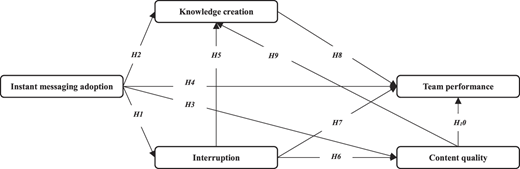
Instant messaging originated in 1971 when Murray Turoff developed a real-time system for the U.S. Emergency Preparedness Office and gained mass adoption after American Online embedded it in its browser in 1988 (Larson, 2024). Cunningham (2003) characterizes instant messaging as an embedded, single-line person-to-person communication feature, while Lee (2006) defines it as an Internet-based application enabling near-real-time interaction. These milestones laid the foundation for instant messaging's evolution into a ubiquitous tool for real-time collaboration in organizational settings. Building on this evolution, the conceptual framework in Figure 1 integrates theoretical insights and empirical evidence to explain how instant messaging adoption influences team performance through interruption, knowledge creation, and content quality.
3.1 Impact of instant messaging
Early research presents conflicting effects of instant messaging on workflow. Li and Gupta (2009) find that constant messaging fragments attention and impairs productivity, whereas Garrett and Danziger (2007) and Ou and Davison (2010) demonstrate that notification controls and interactive features can limit disruptions and improve communication quality. Ou et al. (2011) add that interactive messaging fosters trust among team members and supports strategic knowledge management. Sector-specific studies echo this duality. Chang and Ian (2014) advocate for strategic messaging use in textiles but warn that unclear policies risk unchecked interruptions. Healthcare research (Attalla et al., 2020; Benedictis et al., 2019; Villar Meza et al., 2021) documents rapid WhatsApp adoption for stakeholder updates. The COVID-19 pandemic accelerated these trends: Mitchell (2023) and Paerata (2023) observe surges in remote coordination driven by messaging's affordability, connectivity, and flexibility. In contrast, Hurbean et al. (2022) and Sun and Lee (2022) link unregulated messaging to frequent interruptions, information overload, and user fatigue, indicating a need for self-regulation strategies. These mixed findings highlight interruptions as a critical outcome of instant messaging. Accordingly, this article proposes:
Adoption of instant messaging increases interruptions among team members.
Despite concerns about interruptions, messaging tools such as WhatsApp offer capabilities that strengthen collaborative knowledge creation. Mols and Pridmore (2021) show that WhatsApp helps individuals manage professional and personal boundaries while sharing richer multimedia content, thereby enriching the knowledge-generation process. Availability indicators and status updates further expand the interaction space, ensuring timely contributions. Agrawal (2021) finds that immediate feedback loops between staff and clients improve customer relationship management, reinforcing Ou and Davison's (2010) conclusion that interactivity builds communication quality and trust. Hashim et al. (2022) report that screen sharing and status updates enhance employee engagement in the public sector, while Jung et al. (2021) reveal that graphical emoticons strengthen perceived belonging and influence behaviors such as purchase intention. Media synchronicity theory attributes these adoption drivers to parallelism and rapid transmission (Tarofder et al., 2023) and the sentiment analysis by Ke et al. (2024) links messaging use to gains in knowledge creation and content quality, framing messaging platforms as strategic knowledge-management assets. Wang (2022) identifies core features (e.g. real-time information exchange, end-to-end encryption, group and individual messaging, expressive symbols, read receipts, status updates) that transform team collaboration while Martinez-Comeche and Ruthven (2020) add that these platforms create an open, immediate environment for generating practical knowledge. As a result, this article proposes:
Adoption of instant messaging increases knowledge creation among team members.
Effective teamwork relies on high-quality content that adheres to the seven C's of clarity, correctness, conciseness, concentration, completeness, consideration and courtesy (Tang and Bradshaw, 2020). Instant messaging platforms enhance these attributes by offering rich-media options, for example, emojis for tone, images for clarity and voice notes for nuance (Abudaqa et al., 2019; Adomako et al., 2021; Yuan and Wu, 2020). Real-time drafting and editing further ensure messages remain precise and relevant (Tang and Bradshaw, 2020). These capabilities collectively elevate the thoroughness and appropriateness of team communications. Accordingly, this article proposes:
Adoption of instant messaging improves content quality for team members.
Instant messaging has also transformed workplace communication by enabling instantaneous information sharing and reducing coordination delays. Research shows that messaging streamlines workflows (Hurbean et al., 2022), fosters team cohesion through real-time feedback and availability cues (Ke et al., 2024), and supports remote collaboration by bridging spatial divides (Ruiller et al., 2019; Tang and Bradshaw, 2020). Indeed, many organizations now embed messaging within collaboration platforms to synchronize tasks and accelerate decision making (Paerata, 2023; Tarofder et al., 2023). These efficiencies translate into clearer task alignment, faster problem solving, and higher collective productivity. Consequently, this article proposes:
Adoption of instant messaging improves team performance.
3.2 Impact of interruption
Disruptions triggered by instant messaging pose significant challenges in complex task environments. Deng et al. (2019) identify interruption as a primary obstacle to sustained focus and Wang et al. (2022) show that unsolicited messages, often accompanied by images or voice notes, demand immediate responses that fragment attention and derail workflows. Martinez-Comeche and Ruthven (2020) attribute irritation to core platform features (e.g. live status indicators, pop-up notifications, parallel message streams) and note that despite controls on timing and frequency, these features extend interruptions across time zones and geographic boundaries.
At the same time, research reveals that not all messaging interruptions undermine performance. Hurbean et al. (2025) report that only 1.6% of interruption variance is explained by messaging adoption. Park and Ko (2022) distinguish between harmful disruptions and welcomed, supportive messages. Liu et al. (2022) find that interruptions can relieve monotony and strengthen morale while Choi et al. (2023) add that brief breaks can reduce errors, enhance accuracy, and accelerate knowledge creation. Yet, Hurbean et al. (2025) also document a statistically significant link between messaging use and interruptions and Kalliomäki-Levanto and Ukkonen (2022) detail downstream effects such as stress, errors, and poorer performance. Puranik et al. (2020) connect interruptions to negative emotions such as frustration and Feldman and Greenway (2021) show that some disruptions can evoke positive emotions like excitement and hope when they signal achievements. This contradictory evidence and lack of empirical clarity on interruption's dual effects motivate the following hypotheses on its adverse impacts:
Interruption has a negative effect on knowledge creation.
Interruption has a negative effect on content quality.
Interruption has a negative effect on team performance.
3.3 Impact of knowledge creation
Knowledge creation drives organizational performance by generating actionable insights that support strategic decision making (Bereznoy et al., 2021). Barua (2021) identifies two core processes—action and interaction—that underpin clear, specific knowledge development. Zhu et al. (2020) emphasize that informal networks and rich encoding (e.g. animations, graphs) refine content and support deeper understanding. Instant messaging platforms meet these demands: they enable rapid exchange of multimedia (e.g. graphics, music, video) (Zhou et al., 2021) and foster flexible collaboration, supporting efficient knowledge development (Ajjan et al., 2014). Rehearsability and amendability built into these platforms ensure that knowledge artifacts remain accurate and polished, strengthening team productivity (Tarofder et al., 2023). Hence, this article proposes:
Knowledge creation has a positive effect on team performance.
3.4 Impact of content quality
High-quality content serves as the backbone of effective knowledge exchange and collaboration. Research shows that generating and sharing clear, complete, and well-structured information reduces cognitive load, enabling team members to integrate and build on ideas more efficiently (Levinthal and Myatt, 1994; Ou et al., 2011). Nonaka (1994) argues that intensive communication drives knowledge creation, but only when messages maintain precision and relevance. Soo et al. (2002) find that informal networks facilitate knowledge sharing provided content quality remains uncompromised. Hence, when content quality is high, teams develop a shared understanding more quickly, which accelerates problem solving and consensus building. This shared understanding not only deepens the knowledge-creation process but also supports faster decision making, reduces rework, and strengthens performance outcomes. In light of these theoretical and empirical insights, this article proposes:
Content quality has a positive effect on knowledge creation.
Content quality has a positive effect on team performance.
3.5 Mediating role of knowledge creation, content quality, and interruption
In addition to direct effects, this article examines how knowledge creation, content quality, and interruption mediate the impact of instant messaging adoption on team performance. Each mediator draws on established theory and empirical findings. Media synchronicity theory (Dennis et al., 1998) holds that high synchronicity improves mutual understanding and content quality while fostering knowledge creation through seamless multimedia exchange (Rishani et al., 2025), but also generates interruptions when processing demands exceed capacity (Hurbean et al., 2025). Social presence theory (Short et al., 1976) argues that heightened interpersonal connection builds trust and sustains a knowledge-creation culture via cues such as status updates and read receipts (Ma and Zhang, 2023). Adaptive structuration theory (Giddens, 1984) emphasizes how teams appropriate messaging features within organizational norms, reshaping communication and knowledge-sharing practices over time (Corvello, 2025).
Team performance emerges from coordinated efforts and active participation in interrelated tasks (Quigley et al., 2018). Rapid, effective knowledge exchange and high-quality content accelerate problem solving foster shared understanding and drive collective productivity (Mardani et al., 2018; Tseng et al., 2019). Instant messaging facilitates these functions but also introduces interruptions. The interplay of these mediators explains how instant messaging adoption shapes team performance.
3.5.1 Knowledge creation as a mediator
Knowledge creation underpins improved group outcomes: Menguc et al. (2013) demonstrate that instantaneous knowledge exchange raises sales-team effectiveness while Adomako et al. (2021) show that tactical and strategic knowledge generated via cross-functional messaging platforms enhances performance. Kao and Wu (2016) add that knowledge creation fully mediates the link between entrepreneurial orientation and organizational performance. These studies, in turn, imply that instant messaging's impact on team performance may depends on its capacity to foster rich, timely knowledge flows. Hence, this article proposes:
Knowledge creation positively mediates the relationship between instant messaging adoption and team performance.
3.5.2 Content quality as a mediator
Organizations depend on content that is accurate, flexible, interactive, reliable, and up-to-date to support decision making and coordination (Zhu et al., 2020). Lo and Lie (2008) identify four core dimensions of rich content (i.e. completeness, factual accuracy, relevance, timeliness) and demonstrate that these attributes underpin effective communication and drive organizational performance. When messages lack these qualities, comprehension falters and task execution suffers. Zhou et al. (2021) argue that only media with sufficient capabilities, such as social platforms, can deliver content that meets these standards. Instant messaging platforms offer multimedia support, real-time feedback, and status indicators, all of which enable users to craft and share high-quality content (Cao et al., 2021). Hence, by facilitating swift revision and rich information exchange, instant messaging adoption should enhance team performance through improved content quality. Therefore, this article proposes:
Content quality positively mediates the relationship between instant messaging adoption and team performance.
3.5.3 Interruption as a mediator
Instant messaging's core promise is seamless, real-time connectivity: it enables effective communication (Abudaqa et al., 2019), enriches content sharing (Cao et al., 2021), shortens decision-making time (Kao and Wu, 2016), and strengthens team performance (Mitchell, 2023). Yet, these very features also introduce frequent, informal notifications that fragment attention. Cao et al. (2021) warn that the informality and immediacy of messaging disrupt employees' focus while Wang et al. (2022) empirically link messaging adoption to significantly higher rates of work interruption, which, in turn, degrade communication quality and reduce overall performance. Consequently, this implies that interruptions impose cognitive switching costs and diminish the coherence and completeness of shared information. Thus, this article proposes:
Instant messaging adoption increases interruptions, which, in turn, reduce content quality.
Interruptions diminish content quality, thereby negatively affecting team performance.
4. Methodology
4.1 Approach
Grounded in positivism (Lim, 2023), this article employs empirical data and quantitative methods to uncover how instant messaging adoption affects team performance. A deductive approach generated hypotheses from media synchronicity theory (Dennis et al., 1998), social presence theory (Short et al., 1976), and adaptive structuration theory (Giddens, 1984). A single-method quantitative design using a structured survey enabled rigorous hypothesis testing and supported generalizability of findings (Lim, 2025), advancing understanding of messaging's influence on teams. Focusing on individual employees as the unit of analysis, a cross-sectional survey captured perceptions at the point of data collection, providing a snapshot of organizational communication practices.
4.2 Instrumentation
Following Brown et al. (2020), this article developed a structured questionnaire by defining conceptual and operational definitions, selecting appropriate measurement scales, evaluating reliability and validity, and conducting a pilot study. The instrument comprised three sections: demographic attributes, perceptions of key constructs, and open-ended suggestions. Nominal scales captured demographic data; seven-point Likert scales measured perceptions of instant messaging adoption, interruption, knowledge creation, content quality, and team performance. Three open-ended items solicited respondents' recommendations. All measurement items were adapted from prior empirical studies (Table 1).
To ensure validity, this article employed Moore and Benbasat's (1991) card-sorting technique, which suits constructs drawn from multiple sources. To establish content validity (Lim, 2024), a pretest with two industry professionals and one academic researcher sorted items into their intended constructs, achieving a 93% hit ratio initially. After revising item wording per their feedback, a second round yielded a 98% hit ratio, confirming strong item-construct reliability. To establish face validity (Lim, 2024), a pilot study with 32 postgraduate students at a Malaysian university evaluated the item statements and their internal consistency: all constructs exceeded the Cronbach's alpha threshold of 0.70 except three items within interruption and team performance. These items were refined before final data collection.
4.3 Sampling
To identify organizations that use WhatsApp for internal official communication, a stratified random sampling approach was applied to the 2,954 industry-diverse organizations listed in the Malaysia Digital Economy Corporation (MDEC) database, which maintains the most comprehensive listing of digitally engaged organizations in Malaysia, where the authors were located (Tarofder et al., 2023). A total of 2,184 organizations met the criterion and received invitation emails, with 864 consented to participate.
Using Soper's (2025) a-prior sample size calculator, the minimum sample size for structural equation modeling of a model with five latent variables (i.e. instant messaging adoption, knowledge creation, content quality, interruption, and team performance) measured with 23 items at an anticipated (medium) effect size of 0.30 and desired statistical power level of 0.80 and probability level of 0.05 is 150.
An online questionnaire was chosen for its ability to span geographic distances, cost effectiveness, efficiency, and potential to garner better response rates. Ethical guidelines outlined by Sekaran and Bougie (2016) were strictly observed; no incentives were offered and participation in the study was voluntary. From the 864 consenting organizations, 500 were randomly selected for survey distribution. Three reminder emails over six months yielded 198 complete and useable responses (e.g. no excessive missing or straight-line responses) for all constructs in this study (i.e. instant messaging adoption, knowledge creation, content quality, interruption, team performance), exceeding the minimum sample size required.
To assess nonresponse bias, independent-samples t-tests compared early versus late respondents and an analysis of variance scrutinized for potential industry differences, with neither tests revealed significant differences. These results confirm that the final sample of 198 organizational representatives provides an adequate sample for hypothesis testing via structural equation modeling.
4.4 Analysis
Partial least squares structural equation modeling was selected to estimate the proposed relationships and test the hypotheses because it excels in handling complex causal models and does not require strict data normality (Dash and Paul, 2021). Unlike covariance-based structural equation modeling, this variance-based approach derives latent constructs from weighted indicators and accommodates reflective measurement models efficiently (Hair et al., 2017). Six conditions particularly favor its use: assessing models with multiple constructs and paths (Sarstedt and Cheah, 2019), combining reflective and formative measures (Hair et al., 2019a), comparing groups (Hair et al., 2019b), operating with small samples (Sarstedt et al., 2014), working without normality assumptions (Memon et al., 2021), and testing mediating effects (Manley et al., 2021). SmartPLS v.4 provided an intuitive interface, advanced bootstrapping routines, robust handling of non-normal data, and support for complex model structures, making it an ideal tool for this study's analysis (Cheah et al., 2024).
5. Results
5.1 Profile of respondents
Of the 198 respondents, 110 (55.6%) were male and 88 (44.4%) were female. The age distribution was broadly represented: 26 (13.1%) were 20–25 years old, 30 (15.2%) were 26–30, 42 (21.2%) were 31–35, 45 (22.7%) were 36–40, 35 (17.7%) were 41–45, and 20 (10.1%) were older than 45. In terms of education, 16 (8.1%) held a diploma, 93 (47.0%) a bachelor's degree, 72 (36.4%) a master's degree, and 17 (8.6%) a doctorate. Work experience spanned the range: 53 (26.8%) had less than one year, 48 (24.2%) had one to three years, 46 (23.2%) had four to six years, and 51 (25.8%) had more than six years. Respondents' positions were similarly varied, with 71 (35.9%) in top management, 76 (38.4%) in middle management, and 51 (25.8%) as first-line managers. This distribution confirms a diverse sample across gender, age, education, experience and organizational level.
5.2 Measurement model
Measurement model assessment comprised five key criteria: indicator reliability, internal consistency reliability, convergent validity, discriminant validity, and multicollinearity (Table 1 and Table 2). Indicator reliability was confirmed through factor loadings, with all items exceeding the minimum threshold of 0.708 (Lim, 2025). Internal consistency reliability was evaluated using Cronbach's alpha and composite reliability, whereby all alpha values surpassed the minimum 0.80 benchmark yet remained below the maximum 0.95 threshold, avoiding redundancy concerns (Ursachi et al., 2015), while composite reliability values exceeded the minimum 0.70 benchmark (Lim, 2025), confirming strong consistency across items. Convergent validity was established via average variance extracted (AVE), with values ranging from 0.634 to 0.849, well above the minimum 0.50 threshold (Alarcón et al., 2015). Discriminant validity employed the heterotrait–monotrait ratio of correlations (HTMT), with all HTMT values fell below the maximum 0.85 cutoff, demonstrating that constructs are empirically distinct (Henseler et al., 2015). Multicollinearity was assessed using variance inflation factors (VIF), wherein all VIF values ranged from 1.571 to 3.485, staying below the critical maximum threshold of 5 and thus indicating no multicollinearity issues (Lim, 2025).
5.3 Structural model
Partial least squares structural equation modeling tested all direct and indirect effects (Table 3) in a single model (Hair et al., 2019a, b).
5.3.1 Direct (main) effects of instant messaging adoption
Interruption. Instant messaging adoption reduces interruptions (β = −0.300, p < 0.001). This contrasts with Abudaqa et al. (2019), Ou and Davison (2011), and Tang and Bradshaw (2020), who link messaging immediacy to workflow disruptions. As a result, H1 is not supported.
Knowledge creation. Instant messaging adoption boosts knowledge creation (β = 0.587, p < 0.001). This is consistent with Adomako et al. (2021) and Jarrahi et al. (2020) on messaging's role in real-time data exchange. As such, H2 is supported.
Content quality. Instant messaging adoption enhances content quality (β = 0.689, p < 0.001). This finding echoes Tang and Bradshaw (2020) and Yuan and Wu (2020) regarding rich-media features supporting completeness, clarity, and conciseness. Based on this, H3 is supported.
Team performance. Instant messaging adoption, on its own, does not improve team performance (β = 0.115, p > 0.05), indicating that there is more to the results from Colazo (2021) and Zhu (2019) on messaging's link to productivity. Consequently, H4 is not supported.
5.3.2 Direct (main) effects of interruption
Knowledge creation. Interruption reduces knowledge creation (β = −0.095, p < 0.05), corroborating Ou and Davison (2011) on interruption's impact on information sharing and trust. Considering this, H5 is supported.
Content quality. Interruption diminishes content quality (β = −0.139, p < 0.01), supporting Choi et al. (2023) and Liu et al. (2022) on cognitive switching costs that degrade message coherence. Given this, H6 is supported.
Team performance. Interruption, on its own, does not significantly lower team performance (β = −0.057, p > 0.05). Hence, H7 is not supported.
5.3.3 Direct (main) effects of knowledge creation and content quality
Knowledge creation → Team performance. Knowledge creation significantly boosts team performance (β = 0.252, p < 0.01), reflecting Menguc et al. (2013) and Kao and Wu (2016). In light of this, H8 is supported.
Content quality → Knowledge creation. Although prior studies suggest content quality drives knowledge building (Levinthal and Myatt, 1994; Ou et al., 2011), this path was not significant (β = 0.116, p = 0.096 > 0.05). In this regard, H9 is not supported.
Content quality → Team performance. Content quality exerts a positive effect on team performance (β = 0.341, p < 0.001), aligning with Zhu et al. (2020) on rich content enhancing decision making. In view of this, H10 is supported.
5.3.4 Indirect (mediation) effects of knowledge creation, content quality, and interruption
A bootstrap procedure with 5,000 resamples evaluated indirect effects. Knowledge creation (β = 0.148, p < 0.01) and content quality (β = 0.235, p < 0.01) mediated the relationship between instant messaging adoption and team performance, supporting H11 and H12. These complementary mediations extend Tarofder et al. (2023) by indicating that instant messaging adoption enhances performance by accelerating knowledge flows and improving message richness. However, unexpectedly, interruptions positively mediated the relationship between instant messaging and content quality (β = 0.042, p < 0.05), contrary to H13. This positive pathway suggests that brief disruptions create opportunities for reflection, prompting users to revisit and refine their messages, consistent with Choi et al. (2023), who suggest that interruptions can sometimes yield positive outcomes. Nevertheless, content quality negatively mediated the effect of interruptions on performance negatively (β = −0.047, p = 0.020), signaling that, over time, frequent disruptions erode message accuracy and coherence, which undermines team outcomes. This is in line with Hurbean et al. (2025), who reported a similar double-edged effect of messaging-induced interruptions. Therefore, H14 is supported.
6. Discussion
This study clarifies how adopting instant messaging (re)shapes team performance in the workplace through three mediators underpinned by media synchronicity theory (Dennis et al., 1998), social presence theory (Short et al., 1976), and adaptive structuration theory (Giddens, 1984)—namely, knowledge creation, content quality and interruption. Estimating all direct and indirect paths in one model reconciles earlier mixed findings—some report pure collaboration gains from instant messaging (Jarrahi et al., 2020; Ou and Davison, 2011) while others warn of its disruptive potential (Hurbean et al., 2022; Li and Gupta, 2009). Specifically, the results indicate that adopting instant messaging coincides with fewer interruptions (contrasting with Choi et al., 2023) and simultaneous improvements in knowledge creation and content quality (extending Adomako et al., 2021; Jarrahi et al., 2020; Rishani et al., 2025; Zhang and Yang, 2025). Yet, the remaining interruptions continue to undermine these benefits by impeding knowledge creation, diminishing content quality, and reducing team performance (extending Choi et al., 2023). These results, in turn, imply that teams can leverage instant messaging to streamline collaboration and elevate knowledge creation and content quality only if they also adopt clear interruption-management protocols to prevent the remaining disruptions from eroding performance. Noteworthily, the paradox of interruption—where instant messaging adoption appears to reduce overall interruptions even as the residual interruptions continue to undermine knowledge creation, content quality, and team performance—witnessed herein constitutes a key contribution of this study, extending Tarofder et al. (2023), which focused on instant messaging adoption determinants without examining the distinct impact of interruption. What follows next is a theory-by-theory unpacking of these patterns, showing how each lens explains both the gains and the caveats of instant messaging at the workplace.
6.1 Theoretical contributions
Evidence that instant messaging adoption enhances knowledge creation and content quality affirm media synchronicity theory's claim that matching high-synchronicity media capabilities, such as parallel messaging and rapid transmission, to team tasks improves communication effectiveness (Dennis et al., 1998). Earlier work demonstrated synchronous exchanges accelerate information flows (Adomako et al., 2021; Jarrahi et al., 2020; Rishani et al., 2025; Zhang and Yang, 2025), and our findings extend those results by showing these same features directly foster clear, complete, and resource-rich content. Yet, media synchronicity theory also cautions that excessive synchronicity can overwhelm cognitive capacity (Dennis et al., 1998; Ou and Davison, 2011; Rishani et al., 2025; Zhang and Yang, 2025), which aligns with our finding that residual interruptions continue to undermine performance and thus, underscores the need to balance rapid, parallel messaging with strategies to prevent cognitive overload.
Linking these outcomes to social presence theory (Short et al., 1976), the study reveals that stronger cues of presence (e.g. immediate responses, read receipts, status indicators) heighten engagement and trust among team members (Basille et al., 2025). Those heightened social signals translate into deeper collaborative exchanges, which, in turn, produce higher-quality content. Unexpectedly, brief interruptions also sometimes improved content quality by jolting users to refine their messages, echoing the positive interruption effects described by Choi et al. (2023) and Feldman and Greenway (2021). Yet, sustained disruptions ultimately erode clarity and coherence, underscoring the delicate balance social presence theory describes between intimacy and intrusion (Short et al., 1976).
Adaptive structuration theory explains how teams shape these dynamics through local norms and technology appropriation (Giddens, 1984). Rather than treating messaging tools as deterministic, this lens highlights how user-defined policies, such as channel tagging or response-time settings, govern whether high-synchronicity features yield knowledge-creation gains or costly interruptions (Turner et al., 2019). Our results confirm that when teams adapt instant messaging into the messaging structures in their workflow, they capture knowledge and content benefits; when structures are absent or misaligned, interruptions prevail.
The mediation results underscore that team performance gains derive more from cognitive and social processes (e.g. knowledge creation, content quality) than from direct messaging effects. This insight advances prior studies that examined only a single mediator (e.g. Tang and Bradshaw, 2020) by demonstrating a multifaceted model. Addressing calls for systematic study of messaging-induced interruptions (Abudaqa et al., 2019; Sugiyantoro et al., 2022), the evidence reveals their double-edged role: brief jolts can sharpen focus, but chronic disruptions undermine content quality and team outcomes.
Overall, these findings fill a critical gap by integrating three theoretical perspectives into a single empirical model to offer a coherent explanation for both the enabling and constraining effects of adopting instant messaging platforms, such as WhatsApp, for real-time internal communication, collaborative knowledge creation, and content sharing in modern organizations. The subsequent section translates these theoretical contributions to actionable recommendations for managerial practice.
6.2 Managerial implications
Effective adoption of instant messaging demands active management rather than passive rollout. Managers must shape how these tools are used to capture their collaborative benefits while guarding against the very disruptions they can introduce.
First and foremost, managers must recognize that real-time multimedia features of instant messaging can boost knowledge creation and content quality only if they are supported by clear interruption-management practices. Defining response-time protocols, such as specifying hours for immediate replies and others as “focus” zones, allows teams to benefit from rapid exchanges without fragmenting attention. Assigning dedicated channels for urgent queries and separate ones for informational updates should also help employees prioritize messages effectively and prevents the residual interruptions that our study shows still erode performance.
Furthermore, equipping staff with guidelines for using rich-media features will further improve communication quality. Training should cover best practices for deploying emojis to convey tone, diagrams or images for clarity, and voice notes for clear feedback. Integrating these guidelines into onboarding and periodic communication workshops ensures that team members share precise and resource-rich content, thereby reducing the need for follow-up clarifications and accelerating decision making.
Moreover, given that technology outcomes depend on how people appropriate tools within local norms, managers should create a living messaging charter that codifies naming conventions, channel hierarchies, and status-update etiquette. Such a charter might require that read-receipt settings be enabled only in priority channels or that status messages reflect actual availability. Inviting teams to co-design these norms fosters ownership over their workflows and balances collaboration with the need for uninterrupted focus.
To position for measurable performance improvement, formalize instant messaging as a digital work system, specify where work conversations happen, how urgency is signaled, and who maintains channel hygiene, then attach a clear metric, a target, and a brief weekly team review. To illustrate, batch notifications during focus windows should lower interruption load, measured as minutes of unsolicited alerts per person per day, and compress response latency at the kth (e.g. 90th) percentile. Expected response tags such as “need today” and “need this week” should shorten decision cycle time, measured from the first problem statement to the recorded decision, and lift on time task completion, measured as the share of tasks finished by the committed date. Priority spaces for urgent issues should raise first contact resolution rate and shorten exception resolution time, measured from the first flag to closure. End-of-thread summaries should raise a simple content quality score based on completeness and clarity checks and cut rework on the next handoff. Acknowledge required handoff tags should increase the share of handoffs acknowledged within the set window and reduce queue time at handoffs. Teams can also track throughput per person, measured as tasks closed per person per week, to confirm that faster communication converts into more finished work. Set a small number of quarterly targets, monitor with weekly charts, review outliers in a meeting, and refine the routines until the targets are reached.
Last but not least, leadership must model disciplined messaging behavior if interruption-management protocols are to take root. When managers respond promptly during designated windows, use multimedia judiciously, and respect boundaries for after-hours communication, they demonstrate that the organization values both efficient collaboration and deep, focused work. This top-down example reinforces the practices our findings identify as essential for sustaining enhanced knowledge creation, high-quality content and improved team performance.
6.3 Reflections for benchmarking
In the spirit of benchmarking, understood as disciplined, comparative measurement that enables transparent targets, learning, and continuous improvement (Kumar et al., 2020), organizations should treat instant messaging as an operational process that can be measured and compared within and across units and firms by constructing a scorecard that links usage patterns to coordination outcomes, where response latency (e.g. median time from first message to first substantive reply) and decision cycle time (e.g. from problem statement to recorded decision), for instance, provide comparable, auditable indicators of workflow efficiency and team performance.
Internal benchmarking should begin with a baseline month and clear sampling rules. Select work designated messaging spaces only, for example, each unit's Microsoft Teams channels or company managed WhatsApp Business groups. Include messages posted on business days (e.g. Monday to Friday) work hours (e.g. 9 am to 6 pm). Exclude social or cross organization chats. Compute per team medians and kth (e.g. 90th) percentiles for response latency and decision cycle time. Track these weekly with control charts to distinguish real shifts from noise. Identify high performers, then roll out repeatable routines across teams, such as agreed response windows and quiet hours, separate spaces for urgent and informational messages, short message templates with end-of-thread summaries, and a handoff tag that requires acknowledgment within a set time. Run a pilot and remeasure against the baseline, normalize for workload and case mix, and report a simple scorecard for managers. For telemetry, follow one of two paths. Path one uses WhatsApp by moving operational conversations to the WhatsApp Business Platform with company managed numbers and a webhook integration that records message events and timestamps with user consent, which enables calculation of the two benchmark metrics without inspecting message content (Meta, 2025). Path two uses Microsoft Teams, which provides admin level usage and activity reports (Microsoft, 2025b), Microsoft 365 Usage Analytics in Power BI (Microsoft, 2024), Adoption Score measures for communication and meetings (Microsoft, 2023), Service Health email notifications for incident tracking (Microsoft, 2025a), and Message Center weekly digests for planned changes, with an option to anonymize user-level data when required (Microsoft, 2025c).
External benchmarking is most feasible through industry associations that agree on metric definitions and sharing formats. In practice, a member firm raises the topic during an association meeting, the association secures support from other members, and an independent study is commissioned, often with academic partners, to ensure neutral measurement, privacy preserving protocols, and consistent analysis, and deliverables can include, for example, anonymized percentile distributions for core indicators such as response latency, decision cycle time, the share of handoffs acknowledged within a set window, and the share of threads closed with a brief summary. Firms can subsequently then locate their position, identify gaps, and prioritize trials of simple routines with the highest expected payoff. Notably, evidence from benchmarking consortia shows how network coordination and shared methods improve effectiveness (Dimitrijevska-Markoski and Nukpezah, 2022) while recent work on academia–industry collaboration explains why association-led, academia-supported studies are workable in practice (Mascarenhas et al., 2024).
7. Conclusions, limitations, and future directions
To this end, this study demonstrates that instant messaging adoption when managed through clear interruption management protocols and steered by media synchronicity, social presence, and adaptive structuration perspectives can markedly improve collaborative knowledge creation, elevate content quality and, through these mediating pathways, improve team performance at the workplace.
Despite its contributions, this study has several limitations that point to clear directions for future research. First, reliance on self-reported survey measures introduces potential response bias. Subsequent work should therefore triangulate survey findings with behavioral data from messaging logs or observational studies to validate reported interruption and use patterns. In practical terms, future work can compute server-side measures such as response latency, decision cycle time, handoff acknowledgment within a set window, and thread closure rate from privacy-preserving metadata, then compare those indicators with self-reports to assess bias and calibrate survey instruments. Second, focusing exclusively on Malaysian organizations constrains cross-cultural generalizability. The single-country scope should be addressed through multi-country and multi-industry designs that apply harmonized constructs and common operational indicators, thereby allowing direct comparison of effect sizes across contexts. In other words, replicating this model in different national and industry contexts should therefore reveal how cultural norms shape media synchronicity, social presence, and structuration processes. Third, the single-method quantitative design limits insight into how teams enact interruption-management protocols in practice. Future research should therefore adopt mixed-methods approaches by combining qualitative interviews, focus groups or diary studies to capture the evolving negotiation of messaging norms and the lived experience of real-time collaboration. The cross-sectional snapshot also limits causal inference and the study of lagged effects, so longitudinal panels, repeated-measures field studies, and staggered rollouts with pre- and post-measurement would better identify temporal dynamics and strengthen causal claims.
Notwithstanding these limitations and ensuing directions, future research could also explore the influence of individual personality traits, leadership styles, and organizational policies on instant messaging adoption. In addition, comparative studies across different instant messaging platforms would offer a wider perspective on their effectiveness in diverse organizational contexts and thus further refining our understanding of this dynamic communication tool. Hence, by addressing these issues and pursuing these directions, scholars can broaden and deepen our understanding of instant messaging's role in team performance at the workplace.
Ethics approval
This study was approved by the Management and Science University Ethics Committee (approval no. EA-L 1–01-GSM-2024-06-0,009) where the lead author was previously affiliated.
Informed consent obtained for research
All participants provided written informed consent prior to enrolment in the study by using consent form.