


Research on circular start-ups is expanding; however, the understanding of key ecosystem-level concepts remains fragmented, and the role of circular start-ups (CSUs) in value co-creation within circular ecosystems has not been explained adequately. This study reviews existing research to (1) clarify how circular start-ups are defined, (2) map the current state of literature on CSUs, and (3) explore how these start-ups contribute to value co-creation in circular ecosystems.
This study employs a systematic literature review (SLR) methodology, guided by thematic and lexical analyses. A total of 75 high-quality articles were selected from the Scopus and Web of Science databases, using indexing criteria from the Association of Business Schools and the Australian Business Deans Council. The review followed established protocols to ensure analytical rigor and transparency.
Based on our synthesis, we defined circular start-ups. Circular start-ups serve as key players in the transition to a circular economy, working both independently and with other ecosystem actors. Value co-creation is the central mechanism through which circular start-ups enable systemic circular transitions.
This SLR represents an initial attempt to clarify the emerging phenomenon of CSUs. It contributes to the literature by providing a clear definition and conceptual framework for CSUs, along with a future-oriented research agenda. By exploring this niche area, the study enhances scholarly understanding and creates new research opportunities at the intersection of entrepreneurship and the circular economy.
1. Introduction
Start-ups have emerged as key players in the transition to a circular economy. These firms design their business models with the aim of closing loops (Cerchione et al., 2025; De Angelis, 2024; Henry et al., 2023; Kasana et al., 2024). CSUs play a vital role in the transition to a circular economy (Lit et al., 2024; Klofsten et al., 2024; Roshan et al., 2024, von Kolpinski et al., 2023), introducing innovative solutions and often adopting more ambitious circular strategies compared to large organizations (De Angelis, 2024; Henry et al., 2024). For example, CSUs have used disruptive technologies to reduce costs, increase productivity, and lower energy consumption (Datta et al., 2025; Kaivonen et al., 2026; Sehnem et al., 2022).
CSUs are essential to their surrounding ecosystems as they support larger incumbents or Small and Medium Enterprises (SMEs) (Ferreira et al., 2024; Ghisellini et al., 2024; Hockerts and Wüstenhagen, 2010; Klofsten et al., 2024; Tuladhar et al., 2024). They provide circular materials or components (Ghisellini et al., 2024), innovative circular solutions (Mohapatra et al., 2024; Sehnem et al., 2022), and niche technical expertise (Roshan et al., 2024). Through their interactions, they co-create value with other stakeholders in their ecosystem (Hoogendoorn et al., 2020; Re and Magnani, 2022). However, these firms face barriers such as technology dependence, poor credibility, limited resources, collaboration challenges, lack of knowledge, and inadequate institutional support (see, e.g. Brändström et al., 2024; Geissdoerfer et al., 2023; Lit et al., 2024; Saharan et al., 2024; von Kolpinski et al., 2023). They must also navigate and manage complex value chains (Antikainen and Valkokari, 2016; Ranjbari et al., 2025). Collaboration is essential for these firms to overcome such challenges (Pedersen et al., 2023; Tuladhar et al., 2024).
Despite their promise, research on CSUs remains scattered (De Angelis, 2024; Han et al., 2023; Kasana et al., 2024; Maaβen and Urbano, 2024), while the value-creation potential of CSUs has been marginalized. The proliferation of concepts has hindered theoretical unity, and the field lacks a cohesive framework through which to synthesize existing knowledge. Additionally, CSUs remain under-theorized, with no widely agreed-upon conceptual foundation (Das et al., 2022; Ghisellini et al., 2024). Similar to incumbent firms in circular transitions (Frishammar and Parida, 2019; Magnusson and Werner, 2023), CSUs are an emerging phenomenon marked by limited cohesion and an incomplete understanding of their roles and dynamics. In addition, multiple definitions of CSUs exist that each highlight different aspects, leading to terminological inconsistency and making it difficult to compare findings across studies.
Against this backdrop, we conduct a systematic literature review (SLR) to provide a comprehensive analysis of CSUs. Accordingly, we address the following research questions: (1) How are CSUs defined in the business and management literature? (2) What are the core concepts and relationship structures of CSUs within circular ecosystems? and (3) What role do CSUs play in value co-creation within circular ecosystems? By answering these questions, the article makes three contributions. First, we consolidate existing definitions and propose a new definition of CSUs within circular ecosystems. Second, we map the CSU literature within the context of circular ecosystem discussions. Third, we develop an integrated understanding of the value co-creation dynamics for CSUs within circular ecosystems.
To achieve this, we review 75 articles published in business and management journals. Following guidelines proposed by Tranfield et al. (2003) and Marzi et al. (2025), we utilize the SLR approach to analyze research on circular start-ups, supported by descriptive and thematic analyses. To do so, we follow the PRISMA flow chart, (Moher et al., 2015) which enables us to map current knowledge and emerging themes about CSUs and thereby propose future research directions.
2. Method
2.1 Review design
We conducted a systematic literature review (SLR) in the field of business and management to address our research questions. The review followed guidelines proposed by Tranfield et al. (2003) and Marzi et al. (2025). The goal was to generate new insights for both researchers and practitioners, similar to previous reviews on entrepreneurial ecosystems (Cao and Shi, 2021), entrepreneurs' actions and venture success (Müller et al., 2023). This SLR method allows for the structured organization of existing concepts, theoretical foundations, and methodological choices (Kunisch et al., 2023). It also helps identify research gaps and develop a future research agenda that benefits practice (Snyder, 2023). We used the PRISMA procedure to identify, screen, and select the most relevant articles for further analysis.
2.2 Identification of relevant literature
Building on previous SLRs (Reyes-Gómez et al., 2025; Risitano et al., 2025; Saura et al., 2023), we applied PRISMA (Moher et al., 2015) to guide our identification of relevant studies. Based on the research questions and scope, we developed the following search string: [“born circular firm*” OR “born sustainable firm*” OR “circular-born firm*” OR “young-born circular firm*” OR “sustainable start-up*” OR “circular start-up*” OR “green start-up*” OR “born green” OR “sustainable entrepreneur*” OR “circular entrepreneur*” OR “green entrepreneur*”]. To ensure transparency, at least one of these terms had to appear in the title, abstract, or keywords in order for the article to be included. We searched Scopus and Web of Science on December 31, 2025, due to their broad journal coverage (Mariani et al., 2023). The above keywords were selected to ensure we would capture the various labels used for firms and entrepreneurs linked to the circular economy and to sustainability (Cerchione et al., 2025). We searched the TOPIC field in Scopus and WoS using this string, following relevant review guidelines. This first search produced 5,495 documents, as shown in Figure 1.
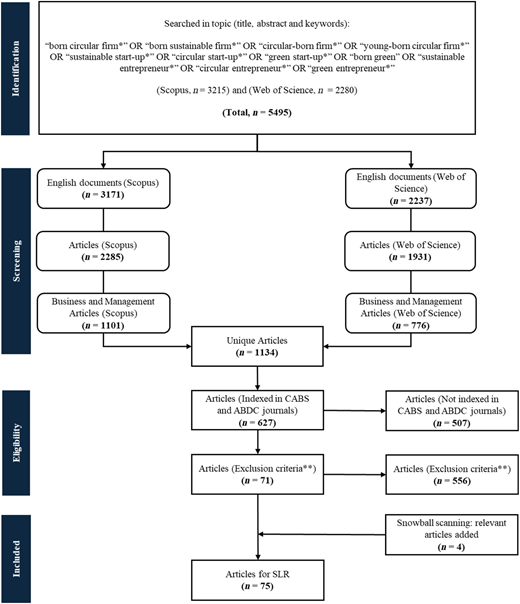
PRISMA flowchart. Note. CABS = Chartered Association of Business Schools, ABDC = Australian Business Deans Council. Source: Author's own creation
PRISMA flowchart. Note. CABS = Chartered Association of Business Schools, ABDC = Australian Business Deans Council. Source: Author's own creation
2.3 Screening, eligibility, and inclusion
During screening, we applied the following inclusion criteria. We limited the sample to documents published in English and to peer-reviewed journal articles, excluding book chapters, book reviews, conference papers, theses, and reports. We also restricted the subject areas to business, management, and accounting to keep the review focused and manageable while minimizing the omission of relevant work (Marinković et al., 2022). After removing duplicates, the sample was reduced to 1,134 articles. Following Kunisch et al. (2023), we then applied explicit quality criteria to assess methodological rigor, theoretical contribution, and empirical robustness.
Next, we applied the eligibility criteria. Journal quality was assessed using the Chartered Association of Business Schools and Australian Business Deans Council rankings, following Feliciano-Cestero et al. (2023). This step reduced the sample to 627 articles. We then screened titles, abstracts, and keywords for relevance to the research questions and the topical focus on CSUs. This excluded 556 articles in which CSUs were not a substantive focus, leaving 71 articles for full-text assessment. Applying the content-based inclusion criteria presented in Table 1 resulted in 71 retained articles. Snowball scanning identified 4 additional relevant articles, producing a final sample of 75. Studies were excluded at the screening stage when CSU-related terms appeared only incidentally and were not examined in the study's aims, framing, or findings.
Inclusion and exclusion criteria
| Criterion | Inclusion | Exclusion |
|---|---|---|
| Research field | Business, Management, and Accounting | All others |
| Document type | Peer-reviewed Articles | Conference papers, working papers, reports, and book chapters |
| Language | English | Any other language |
| Relevance | Limited to start-ups circular business model in their core businesses Address the role of start-ups in the transition toward circular economy | Other firms including incumbent Not directly relevant to the research question |
The final inclusion and exclusion criteria were content-based, as shown in Table 1, and required that articles address CSUs directly or examine the role of start-ups in the transition toward a circular economy. Two authors independently coded the articles and compared decisions to resolve disagreements, which improved consistency and reduced bias. Only articles meeting the predefined criteria were retained. Figure 1 summarizes the selection process from identification to final inclusion.
2.4 Data analysis
We analyzed the full text of the 75 articles in two phases. First, we conducted an initial mapping using content analysis, following Tranfield et al. (2003). For each study, we extracted the research question(s), conceptual framing, theories or models, and the roles attributed to start ups in the transition to a circular economy. This phase provided an overview of how CSU research has developed, and the results are reported in Web Appendix 1.
Second, we conducted two qualitative analyses aligned with the research questions. Drawing on prior systematic reviews on the circular economy (Centobelli et al., 2020; Suchek et al., 2021) and established coding procedures (Gaur and Kumar, 2018), we developed a coding scheme through an iterative process. Two authors independently coded the full sample to enhance rigor and reliability (Debellis et al., 2021). We began with open coding on a subset of articles to generate initial codes, consolidated overlapping codes into a codebook with definitions and decision rules, and then applied the codebook to all 75 articles. Multiple codes were allowed per article, and the codebook was refined when disagreements indicated unclear boundaries.
For Research Question 1, concerning how CSUs are defined, we used content analysis consistent with Cristofaro (2019). We reviewed each article for explicit definitions and conceptual descriptions of CSUs and coded definitional elements and conceptual boundaries. The results are presented in Table 2. For Research Question 2, we used LexiPortal for concept mapping (Leximancer, 2018), consistent with prior review research on concept mapping applications (Rehman et al., 2026). The concept map visualized co-occurring concepts across the corpus and supported theme development by validating relationships among concepts, refining theme boundaries, and highlighting weakly connected or underexplored areas.
Definitions of circular start-ups
| No | Reference | Definition |
|---|---|---|
| 1 | Kasana et al. (2024) | “A circular start-up defined as a start-up company that adopts one or more circular strategies-reduce, reuse, recycle and recover-into its business operations.” (p. 2547) |
| 2 | Re and Magnani (2022) | “Circular firms tend to develop collaborative value co-creating processes with different actors to narrow, slow, and close the resource loops.” (p. 189) |
| 3 | Rok and Kulik (2021) | “A start-up as a temporary organization which seeks to apply a repeatable, scalable and innovative business model.” (p. 341) |
| 4 | Todeschini et al. (2017) | “Born sustainable startups are originally conceived to develop a new business model leveraging sustainability at its core.” (p. 765) |
| 5 | Diacono and Baldacchino (2024) | “Entrepreneurial activity that is aligned with CE principles. This includes the identification, exploration, and exploitation of circular opportunities, which are defined as profitable opportunities that aim to drive growth decoupled from the use of scarce natural resources.” (p. 166) |
| 6 | Knoppen and Knight (2022) | “Born sustainable firms are those which were established with explicit strategic intent to operate in a sustainable manner from the outset.” (p. 1790) |
| 7 | Mondal et al. (2023) | “Green entrepreneurship refers to environment-friendly start-ups that aim at creating and implementing solutions to environmental problems and contribute to society and economic growth.” (p. 2) |
| 8 | Zucchella and Urban (2019) | “Firms that have been founded originally adhering to circular economy principles.” (p. 91) |
| 9 | Henry et al. (2024) | “An independent and innovative entrepreneurial activity that is embedded in a circular business model.” (p. 1124) |
| 10 | Han et al. (2023) | “As organizations that seek conscious growth motivated by circularity and realize societal and environmental impact through the balanced pursuit of commercial and impact scaling activities.” (p. 372) |
| 11 | This study | “circular start-up - a new firm that adopts circular economy principles to identify, explore and exploit entrepreneurial opportunities with the intention to foster resource efficiency and effectiveness, and minimize waste generation by cycling, extending, intensifying and dematerializing material and energy resource flows.” |
For Research Question 3, concerning CSU roles, we conducted reflexive thematic analysis following Braun and Clarke (2019). This involved familiarization with the data, generating initial codes, clustering codes into candidate themes, reviewing and refining themes, defining and naming themes, and writing up the results. Themes were formed by grouping codes that reflected the same underlying mechanism or CSU role in circular transitions, and each theme was kept distinct through clear inclusion and exclusion rules during full sample coding. After the first coding round, the two coders compared outputs, discussed discrepancies, and resolved disagreements to reach agreement on the final codes and themes. We followed quality control practices for systematic reviews (Kunisch et al., 2023), consistent with recent management reviews (Ancillai et al., 2023; Evers et al., 2023). This process produced a consistent coding structure for interpreting how literature defines CSUs and characterizes their roles in circular ecosystems and value co-creation.
3. Results
3.1 Definitional comprehensiveness of CSUs
The definition of CSUs remains ambiguous. Researchers employ diverse terminology to describe the concept and related phenomena, such as “born circular firms,” “circular start-ups,” “young-born circular firms,” “sustainable start-ups,” “born green firms,” “circular entrepreneurs” and “circular new ventures.” This diversity in terminology illustrates the range of perspectives through which researchers approach the study of these firms. Furthermore, the findings suggest that circular CSUs play a significant role not only individually but also within the broader ecosystem, collaborating with other firms to co-create value based on circular economy principles. These firms place circularity at the core of their operations for environmental sustainability. Table 2 shows the various definitions used by researchers.
The definitions identified from the literature review (Table 2) provide various perspectives and challenges on what constitutes CSUs. For instance, while some definitions emphasize the adoption of specific circularity strategies such as reduce, reuse, recycle, and recover, others focus on less specific, collaborative approaches to value co-creation under the broad umbrella of the circular economy. For example, the definition by Awan et al. (2023) emphasizes practical actions aimed at minimizing resource use and waste, providing clarity on operational approaches to circularity. Re and Magnani (2022) focus on the collaborative nature of circular firms, highlighting their engagement with various actors to develop value co-creating processes that narrow, slow, and close resource loops. This definition underscores the systemic and collaborative approach required for effective circularity, emphasizing the importance of stakeholder engagement and collective action.
Rok and Kulik (2021) highlight the temporal dimension and firms' search for repeatable, scalable, and innovative business models. Todeschini et al. (2017) emphasize sustainability as a foundational element of circular business models, while Diacono and Baldacchino (2024) focus on circular opportunities that drive growth without depleting natural resources. Knoppen and Knight (2022) stress the strategic intent of firms to operate sustainably from inception, aligning closely with circular economy principles. These definitions are based on conventional start-up ideas, such as developing scalable, repeatable, and innovative business models.
Nonetheless, there is also some consensus in definitions regarding the orientation of such firms to address sustainability challenges based on circular economy principles. Based on this analysis of the literature, a CSU can be defined as a new firm that adopts circular economy principles to identify, explore, and exploit entrepreneurial opportunities with the intention of fostering resource efficiency and effectiveness, and minimizing waste generation by cycling, extending, intensifying, and dematerializing material and energy resource flows. This definition emphasizes: (1) the newness of the firm, (2) the adoption of circularity as a guiding principle, (3) the intention to foster resource efficiency and effectiveness, and the aim of (4) turning sustainability challenges into entrepreneurial opportunities.
Henry et al. (2020) analyzed 128 CSUs and proposed five CSU archetypes: design-based, waste-based, platform-based, service-based, and nature-based. Several studies suggest that CSUs can make major contributions to the transition toward the circular economy, and thus attribute different roles to them in this transition. These roles can generally be described as follows: (1) developing innovative business models that challenge incumbent firms, (2) reinforcing the dominant linear economy, and (3) serving as a source of radical innovations for incumbent firms.
3.2 Concept mapping of CSU roles in the circular ecosystem literature
Entrepreneurs play a pivotal role in advancing the transition toward a circular economy (Alpsahin Cullen, 2023; Demirel et al., 2019; Henry et al., 2023; Rovanto and Finne, 2023). They extend product life and create new forms of value through remanufacturing, renovation, and recovery, while exploiting opportunities created by circular economy transitions (Sehnem et al., 2022; De Chiara, 2025; Diacono and Baldacchino, 2024). In early sustainability transitions, CSUs are especially active in introducing radical and disruptive innovations and can diffuse sustainable innovations through institutional work (Allal-Chérif et al., 2023; Hockerts and Wüstenhagen, 2010; Sreenivasan and Suresh, 2023; Weissbrod and Bocken, 2017; Hall et al., 2019).
The growing emphasis on sustainability has shifted entrepreneurship from profit-centred models toward environmental entrepreneurship (Hoogendoorn et al., 2020; Hoogendoorn et al., 2020). Within this logic, CSUs are positioned as frontrunners in circular economy transitions because they embed economic and environmental goals into their core business models (Hoogendoorn et al., 2020; Rok and Kulik, 2021). Their agility allows them to develop circular business models, optimize product lifecycles and supply chains, and pursue models such as product life extension and resource value extension to reduce waste disposal (Sulaiman and Khezri, 2025; Mehrotra and Jaladi, 2022).
From a resource-based view, CSU advantage depends on how entrepreneurs mobilize and recombine resources to generate and diffuse knowledge that advances circularity (Barney, 1991; Penrose, 1958; Baraldi et al., 2019; Chien et al., 2025). Klein et al. (2023) identify four resource mobilization patterns for circularity: resource seeking, material bricolage, value-based bricolage, and ideational bricolage.
Knowledge is a critical CSU resource. From a knowledge-based view, CSU's ability to access, combine, and leverage diverse knowledge sources is central to innovation and long-term success (Grant, 1996). Opportunity-oriented entrepreneurs are more successful in attracting external finance and knowledge, which supports radical innovation (Abdesselam et al., 2024). Abdesselam et al. (2024) further show that eco-innovative CSUs are more successful in attracting finance and external knowledge, while green product innovation is particularly important for entrepreneurial firms relative to incumbents (Shrivastava and Tamvada, 2019).
Beyond introducing new technologies and business models, CSUs provide knowledge and networking services to larger firms, supporting the diffusion of circular practices across industries (Audretsch and Fiedler, 2024; Kanda et al., 2025; Todeschini et al., 2017). They also invest in green technologies and show a higher probability of growth, underlining the strategic importance of circular innovation (Demirel and Danisman, 2019; Leoncini et al., 2019).
The concept map in Figure 2 shows CSU research clustered around circular business models and linked to circular economy initiatives, innovation, knowledge, and sustainable entrepreneurial value (Cullen and De Angelis, 2021; Henry et al., 2020). It positions CSUs as ecosystem actors that use strategies to overcome barriers and generate social and environmental impact (Berghuis et al., 2023). Future research should therefore develop a more integrated understanding of value co-creation from a circular ecosystem perspective.
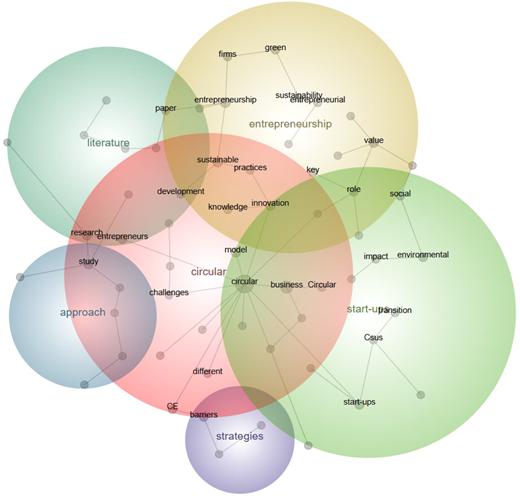
The clusters in Figure 2 connect through three theoretical lenses and research streams. The first links entrepreneurship and sustainability to venture-level value creation and explains why CSUs pursue economic and environmental goals simultaneously (Hoogendoorn et al., 2020; Rok and Kulik, 2021). The second focuses on circular business models, innovation, and knowledge, where CSU resources and knowledge access shape circular innovation and competitive advantage (Barney, 1991; Grant, 1996; Chien et al., 2025). The third emphasizes ecosystem roles, strategies, and barriers, showing how CSUs coordinate with partners and diffuse circular practices beyond firm boundaries (Moore, 1993; Hall et al., 2019; Ciccullo et al., 2023; Re and Magnani, 2022, 2023). These clusters also reflect different research logics, with quantitative studies estimating drivers and outcomes of CSU innovation, qualitative studies explaining coordination and transition processes, and conceptual studies developing constructs and role typologies (Henry et al., 2020; Cullen and De Angelis, 2021).
Achieving circular economy objectives requires an ecosystem approach in which multiple stakeholders collaborate toward shared sustainability goals (Klofsten et al., 2024). Ecosystems explain how interdependent actors interact and collaborate to create value (Moore, 1993). Within them, entrepreneurs play orchestrating roles in coordinating circular supply chain actors, including upcycling and downcycling activities (Ciccullo et al., 2023; Prosman and Cagliano, 2022). Through collaboration with diverse actors, CSUs navigate systemic challenges and co-create circular value across interconnected networks (Re and Magnani, 2022, 2023). Close stakeholder collaboration across supply chains facilitates sustainable practices (Le et al., 2024; Ranjbari et al., 2025). CSUs can trigger meso- and macro-level change through innovative strategic relationships formed at the micro level (Ribeiro-Soriano and Piñeiro-Chousa, 2021). They access underutilized or surplus resources from incumbents, while incumbents benefit from improved environmental performance (Tuladhar et al., 2024).
3.3 Value co-creation of start-ups in the circular ecosystem
From an ecosystem perspective, CSUs collaborate and compete with other new ventures and incumbents to co-create value through circularity. Value co-creation helps explain how CSUs contribute and shape circular ecosystems. Circular economy systems rely on coordinated interactions among heterogeneous actors that jointly generate economic, environmental, and social value through resource integration, shared learning, and collaborative innovation (Geissdoerfer et al., 2026). Many CSUs are born circular and embed circularity into their business models from inception (Kanda et al., 2024). As a result, value creation extends beyond firm-level performance and emerges through multi-actor coordination and institutional alignment (Kanda et al., 2021).
Value co-creation occurs through reciprocal product and service exchange. In circular ecosystems this exchange is visible in closed-loop flows, service-based offerings, and product-as-a-service models that require ongoing interaction among firms, users, suppliers, and intermediaries (Bocken et al., 2014). It supports collective problem solving around product longevity, reverse logistics, material recovery, and regenerative design (Aryee et al., 2025).
Start-ups contribute to co-creation through flexibility, experimentation, and their ability to reconfigure value propositions around sustainability goals (Schaltegger et al., 2016). CSUs collaborate with suppliers to develop circular offerings and engage customers in product design, usage optimization, and take-back systems (Kanda et al., 2024). These interactions generate relational value by building trust, reducing uncertainty, and supporting iterative innovation (Kanda et al., 2021). Co-creation outcomes often depend on the breadth and intensity of engagement, especially in start-up supplier and start-up customer relationships, yet only some dyadic pathways scale to ecosystem-level sustainability benefits.
Co-creation also enables circular business model innovation. Circular business models often require changes in ownership structures, revenue models, and product life-cycle responsibilities that start-ups cannot implement alone (Urbinati et al., 2017). Business model experimentation occurs across networks that share risks and capabilities. Product-service systems require coordination among manufacturers, logistics providers, and maintenance partners, and remanufacturing depends on return flows shaped by user participation and regulatory frameworks (Bocken et al., 2014). Start-ups can orchestrate these configurations by proposing novel value propositions and aligning partner incentives around shared sustainability goals (Kanda et al., 2025).
Co-creation is more effective when actors share commitments to sustainability, transparency, and long-term environmental stewardship (Dziubaniuk and Aarikka-Stenroos, 2025). Ethical value co-creation strengthens relational embeddedness and supports knowledge sharing beyond transactional collaboration, which is important for start-ups seeking resources, technical expertise, and legitimacy (Schaltegger et al., 2016). Normative congruence can also reduce opportunistic behavior in systems marked by interdependence and information asymmetry, indicating that co-creation is shaped by moral economies that influence collaboration structures (Dziubaniuk and Aarikka-Stenroos, 2025).
Institutional conditions shape the scope and effectiveness of co-creation. Regulatory incentives, standardization frameworks, and public procurement policies can enable or constrain start-ups’ ability to mobilize ecosystem partners (Aryee et al., 2025). Misalignment across local, national, and sectoral regulations can create friction in implementing circular solutions. Institutional work by start-ups and partners, including lobbying, standard setting, and awareness building, can modify governance structures and increase co-creation potential (Schaltegger et al., 2016). This work indicates that start-ups can also shape institutional environments to support circular practices (Re and Magnani, 2022).
Co-creation outcomes extend beyond firm performance. CSUs engaged in intensive co-creation aim to increase material efficiency, reduce waste, and extend product life cycles, while social outcomes can include community engagement, local employment, and consumer empowerment (Bocken et al., 2014). These outcomes interact, since environmental gains can depend on social acceptance of reuse practices and economic viability can depend on regulatory recognition of circular value (Urbinati et al., 2017). This interdependence supports a systemic view of value creation in circular ecosystems.
Barriers to effective co-creation persist. Resource asymmetries can limit start-up bargaining power and constrain knowledge flows, while technical complexity and market uncertainty can reduce partner commitment. Misaligned incentives, such as volume-based supplier revenue models, can conflict with circular principles that emphasize durability and reduced throughput (Urbinati et al., 2017). Co-creation can therefore generate coordination costs that disproportionately burden start-ups (Schaltegger et al., 2016). Governance mechanisms, including shared metrics, collaborative platforms, and intermediaries, help sustain co-creation over time (Kanda et al., 2021).
In summary, value co-creation explains how start-ups contribute to circular ecosystems through collaborative innovation, business model experimentation, institutional engagement, and resource integration. Co-creation depends on supportive institutions, aligned incentives, and effective governance. Stronger theory and evidence are needed to explain when CSU activity enables systemic circular transitions rather than isolated improvements.
4. Future research agenda
An ecosystem perspective is vital for studying CSUs, but current literature still provides limited cumulative insights into how internal processes, team dynamics, and external conditions collectively influence CSU development over time. Previous research stresses the importance of employee engagement and motivation, capability development, and the acquisition of micro-competences (Dragan et al., 2024; Chowdhury et al., 2022; Alpsahin Cullen, 2023; von Kolpinski et al., 2023). It indicates that ecosystem cooperation can offer resources and legitimacy (Berghuis et al., 2023). Future research should explicitly link these levels by exploring how internal business processes and team dynamics interact with external ecosystem factors throughout various venture stages. Longitudinal research designs are useful to study how CSUs reconfigure their circular business models as they grow, and mixed methods approaches can combine process data with performance metrics to explain different pathways of growth.
Future research, as presented in Table 3, should clarify the core concepts that define CSUs and how these align with societal needs. Existing studies discuss variations in circular strategy implementation among start-ups and highlight capabilities necessary for closing resource loops (Das et al., 2022; Coppola et al., 2023). Evidence regarding market acceptance and creation remains limited and context-dependent, even though CSUs can influence how products are purchased and used (Droege et al., 2023). Therefore, research should examine how CSU definitions and typologies differ across sectors and regions, and how these differences relate to strategy selection, market development, and resilience. Configurational methods, such as fsQCA, could assist in identifying combinations of capabilities and contextual factors that lead to market acceptance, creation, or resilience, rather than assuming a single optimal pathway.
Future research agenda
| Research area | Future research questions |
|---|---|
| Comprehensive perspective | 1. How do internal business processes affect the growth and sustainability of circular start-ups? |
| 2. What role do team dynamics play in start-up operations? | |
| 3. How do external influences impact the success of circular start-ups? | |
| 4. How do circular start-ups reconfigure their business models over time, and which longitudinal designs best capture this evolution? | |
| 5. How can mixed-methods designs combine process data and performance measures to explain growth paths in circular start-ups?? | |
| Fundamental concepts | 1. What core concepts define circular start-ups? |
| 2. How do these concepts align with societal needs? | |
| 3. What factors influence market acceptance and market creation for circular start-ups? | |
| 4. What are the key resilience factors? | |
| 5. How do definitions and typologies of circular start-ups vary across sectors and regions, and what comparative methods best surface these differences? | |
| 6. How can configurational methods, such as fsQCA, identify combinations of capabilities and conditions that lead to market creation or resilience? | |
| Customer engagement | 1. How can strategic customers be leveraged as partners for circular start-ups? |
| 2. What is the quality and sustainability of customer relationships? | |
| 3. How do customer relationships contribute to independent growth and resilience? | |
| 4. How do circular start-ups and customers co-develop circular offerings over time, and what longitudinal or diary-based methods capture engagement dynamics? | |
| 5. How can experiments or field trials test which customer incentives and messages increase adoption, retention, and circular behaviors? | |
| Innovative policy strategies | 1. What policy interventions support circular start-ups effectively? |
| 2. How can existing policies be evaluated for their impact on start-up success? | |
| 3. What best practices exist for fostering conducive environments for growth? | |
| 4. How can policies disrupt unsustainable incumbents? | |
| 5. How do policy mixes, rather than single instruments, influence circular start-up scaling, and what quasi-experimental designs can estimate causal effects? | |
| 6. How do intermediaries, incubators, and ecosystem orchestrators translate policy into venture-level outcomes, and what multi-level research designs best examine this link? |
Customer engagement remains crucial, but current research has yet to clarify how engagement dynamics lead to long-term adoption and venture resilience. Future studies should explore how CSUs develop customer-centric strategies and how circular value co-creation with customers occurs in practice (Re and Magnani, 2022, 2023). Additionally, there is a need for more empirical testing of which incentives and messages effectively promote the adoption of eco-innovations (Ball and Kittler, 2019). Future research should also track customer relationships over time, including how CSUs and customers collaboratively develop circular offerings, using longitudinal or diary-based methods to capture engagement trends. Experiments and field trials can then evaluate which incentives, messages, and engagement strategies enhance adoption, retention, and circular behaviors.
Finally, innovative policy strategies are essential for fostering circular entrepreneurship, yet current evidence remains thin on which interventions work best, for whom, and under which conditions. Research should identify which policy interventions support CSUs effectively and evaluate how existing policies shape venture outcomes, including whether policies can shift advantage away from unsustainable incumbents (Ferreira et al., 2024). Studies should move beyond single-instrument views to assess policy mixes and their interaction with entrepreneurial ecosystems (Berghuis et al., 2023). Quasi-experimental designs can help estimate the causal effects of policy changes on the creation, survival, and growth of CSUs. Multi-level research designs are also needed to explain how intermediaries, incubators, and ecosystem orchestrators translate policy into venture-level outcomes, and which mechanisms make that translation effective.
5. Discussion and implications
Transition toward a circular economy requires an ecosystem approach in which multiple actors collaborate to achieve shared circular objectives (Klofsten et al., 2024). Scholars have highlighted the pivotal role of start-ups as key drivers of this transition (Baraldi et al., 2019; Hoogendoorn et al., 2020; Närvänen et al., 2021; Ribeiro-Soriano and Piñeiro-Chousa, 2021). For instance, CSUs can access underutilized or surplus resources from incumbent firms, while incumbents benefit from collaborating with start-ups to improve their environmental performance without engaging in extensive experimentation themselves (Tuladhar et al., 2024). The literature suggests that CSUs exploit emerging business opportunities (Diacono and Baldacchino, 2024), leverage digital infrastructure to scale low-carbon circular practices (Chien et al., 2025), develop innovative circular business models (Bouncken et al., 2021), and facilitate the diffusion of sustainable innovations through institutional work (Hall et al., 2019).
Across the reviewed studies, a consistent insight is that CSU contributions to circular transitions operate through a small set of ecosystem-level mechanisms. CSUs create circular value by designing and iterating circular business models, by mobilising and recombining resources and knowledge with partners, and by engaging in institutional work that lowers adoption barriers and legitimises circular practices (Bouncken et al., 2021; Tuladhar et al., 2024; Chien et al., 2025; Hall et al., 2019). These mechanisms are interconnected. Business model innovation influences which partners and resources CSUs need, collaboration supplies knowledge and legitimacy that enable scaling, and institutional work helps stabilise rules and norms supporting diffusion beyond niche contexts (Kanda et al., 2021; Hoogendoorn et al., 2020). This synthesis clarifies why CSU impact depends on ecosystem conditions, not only on venture-level capabilities, and it highlights coordination and alignment as central levers for creating circular value.
Our study highlights the structure of the literature on CSUs and provides insights into the major research topics in this field. The results of the systematic review showed that value creation emerges at the ecosystem level through multi-actor coordination and institutional alignment (Kanda et al., 2021). Our findings confirm that there is no common understanding of CSUs in the circular ecosystem context. Thus, with inspiration from Gartner (1985) and the reviewed literature, we propose a set of five factors as characteristic of the circular new venture creation process. These are the: (1) organization, (2) environment, (3) individual(s), (4) venturing process and (5) ecosystem. Based on the review, we offer a more functional definition of CSUs that helps to close existing conceptual gaps (Table 2). In the following section, we summarize the implications and contributions of this study.
5.1 Theoretical contribution
This review enhances understanding of how circular startups contribute to circular economy transitions by clarifying constructs and synthesizing information. It summarizes how the literature defines CSUs by identifying definitional elements and conceptual boundaries across studies, then organizing these into a coherent foundation for circular entrepreneurship research (De Chiara, 2025; Cullen and De Angelis, 2021; Henry et al., 2020; Cerchione et al., 2025). It links CSUs definitions to common business model and strategy patterns in the literature, supporting more consistent theorizing and comparison across different contexts (De Angelis, 2024; Ranjbari et al., 2025; Antikainen and Valkokari, 2016; Bocken et al., 2014). By situating CSUs within circular and entrepreneurial ecosystems, the review clarifies that CSU phenomena cannot be explained solely at the firm level because ecosystem structure, legitimacy, and coordination influence what CSUs can do and the outcomes they can achieve (Klofsten et al., 2024; Berghuis et al., 2023; Aryee et al., 2025).
The review advances theory by integrating fragmented findings into an ecosystem-level explanation of CSU value co-creation. Across the reviewed studies, CSUs' contributions cluster around a small set of mechanisms, including circular business model innovation and experimentation, resource and knowledge mobilization, collaboration and orchestration with ecosystem actors, and institutional work that supports diffusion and legitimacy (Das et al., 2022; Weissbrod and Bocken, 2017; Klein et al., 2023; Abdesselam et al., 2024; Tuladhar et al., 2024; Hall et al., 2019; Närvänen et al., 2021). These mechanisms depend on how CSUs engage external actors in value co-creation, including customers and partners, and how actor engagement evolves as ventures scale (Re and Magnani, 2023; Payne et al., 2008; Storbacka et al., 2016; Grönroos, 2011). Taken together, this synthesis shifts the theoretical focus from isolated venture attributes to multi-actor processes and boundary conditions that determine when CSU-driven circular innovations scale beyond niche settings (Han et al., 2023; Ciccullo et al., 2023).
5.2 Managerial implications
Our review reveals that the development of CSUs is shaped by the interaction between individual mindsets, organizational arrangements, process design, environmental conditions, and ecosystem dynamics. Accordingly, our study offers several practical implications for circular entrepreneurs, managers, support organizations, and policymakers. First, founders and managers of CSUs should consider environmental problems as sources of entrepreneurial opportunities (Al Halbusi et al., 2025; Belz and Binder, 2017; Dean and McMullen, 2007), as firms with green technologies have a higher possibility of growth (Leoncini et al., 2019). Furthermore, firms must pay close attention to the mindset and capability development (Coppola et al., 2023) of key individuals within the venture (Dragan et al., 2024). While strong sustainability values and a commitment to circular principles are essential, excessive emphasis on environmental and social objectives at the expense of market orientation may constrain growth and reduce investment attractiveness.
Second, CSUs must actively emphasize value co-creation within their ecosystems (Ferreira et al., 2024; Sulaiman and Khezri, 2025). Given their limited resources, legitimacy, and capabilities, CSUs rarely create and capture value independently; instead, collaboration with partners and other ecosystem actors is critical for innovation and scaling. Finally, support organizations and policymakers must foster favorable institutional and market conditions for CSUs. External factors such as consumer preferences for sustainable products, and government policies supporting circular economy initiatives play a decisive role in shaping the operating environment. As CSUs often compete by means of established linear offerings, targeted policy support is necessary to enhance competitiveness and create a level playing field.
6. Limitations
Although we sought to provide a rigorous and systematic review, this study has several limitations that suggest avenues for future research from methodological and conceptual perspectives. First, the data collection was limited to peer-reviewed journal articles indexed in the Scopus and WoS databases, which aligns with established standards for systematic reviews. Nevertheless, this approach may have excluded relevant and impactful contributions on CSUs published in other outlets. Future research could broaden the scope by including conference proceedings, white papers, reports, and book chapters, as well as studies indexed in additional databases, such as Google Scholar or EBSCO, in order to capture emerging trends and alternative perspectives in the circular start-up literature.
Second, our SLR focuses exclusively on CSUs. Future studies could extend this by including other types of firms, such as incumbents, to develop a more comprehensive understanding of how organizations transition toward the circular economy through both cooperative and competitive strategies. Third, scholars have begun to discuss theoretical enrichment through value co-creation as a positive outcome within CSUs (Re and Magnani, 2022, 2023). Future research could utilize a cooperation perspective to understand how such value co-creation mechanisms shape CSUs' role in CE transitions. Future research may also apply alternative methodological approaches, such as bibliometric, meta-analytic, or configurational review methods, to achieve a finer-grained understanding of the existing literature on CSUs and circular economy transitions.
The supplementary material for this article can be found online.

