This study aims to investigate the dynamics of knowledge hiding (KH) within group settings, focusing on both the experiences of those who hide knowledge and the perceptions of their group members.
An exploratory study was conducted with 49 undergraduate business students who participated in group-based problem-solving tasks. Some participants were assigned the role of “knowledge hiders.” Data were gathered through observations, pre- and posttask surveys and in-depth interviews. The analysis included quantitative and qualitative approaches, with thematic analysis applied to the qualitative data.
This study identified complex emotional responses among knowledge hiders, including guilt and cognitive conflict, moderated by social context. Hiders used various strategies, including evasive hiding, playing dumb and misdirection. Interestingly, targets often misinterpreted KH behaviors, attributing them to disinterest or discomfort rather than intentional withholding.
The controlled setting and short-term interactions may limit generalizability to organizational contexts. Future research should explore the long-term consequences of KH and its occurrence in diverse environments.
Organizations may benefit from addressing the underlying causes of KH, such as communication issues and weak social connections, rather than solely focusing on eliminating KH behaviors. Understanding the subtle nature of KH could lead to more effective interventions in fostering open knowledge-sharing cultures.
The dual perspective – examining both the hiders’ and targets’ experiences – adds a novel dimension to the KH literature. The findings challenge the assumption that KH always leads to negative outcomes, like mistrust or group conflict, and emphasize how KH is often misperceived in group interactions.
1. Introduction
It is known that knowledge is a critical strategic resource for organizational functioning and sustainable organizational performance (Zack et al., 2009; Bollinger and Smith, 2001; Shahzad et al., 2020). Organizations often emphasize knowledge sharing (KS) as it fosters employee development and enhances overall success (Siachou et al., 2021; Venz and Nesher Shoshan, 2022). However, despite the well-documented benefits of KS, recent research has drawn attention to the growing issue of knowledge hiding (KH), where individuals deliberately withhold or conceal information requested by others (Connelly et al., 2012).
KH is not an uncommon behavior. Studies suggest that up to 76% of employees in the USA and 46% in China report engaging in KH (Connelly et al., 2012; Peng, 2012). Although KH has been associated with reduced creativity and task performance (Singh, 2019; Syed et al., 2021), some studies suggest that it may also serve protective functions for both individuals and organizations (Xiao and Cooke, 2019). For instance, employees might hide knowledge to protect confidential information (Xiong et al., 2021) or for personal job security (Anand and Hassan, 2019; Serenko and Bontis, 2016).
Despite the prevalence and importance of KH, capturing and analyzing it in real-time interactions remains difficult (Connelly and Zweig, 2015; Khoreva and Wechtler, 2020). Current research heavily relies on retrospective self-report questionnaires (Anand et al., 2022; Siachou et al., 2021), which provide valuable insights but fall short of capturing the complex, real-time behavioral and emotional dynamics of KH. This suggests the need for alternative methodologies, such as experimental or qualitative approaches, which could provide richer insights into how KH functions (Khalid et al., 2020; Strik et al., 2021).
Furthermore, most research focuses on the motivations and behaviors of knowledge hiders (Batistič and Poell, 2022; Han et al., 2022), with limited attention given to the targets – those on the receiving end of KH. Although some studies have started to explore how targets respond to KH (Connelly and Zweig, 2015; Xiao, 2024), these investigations remain scarce. Understanding both perspectives (i.e. the hider and the target) is crucial, as the consequences of KH may not always align with traditional assumptions. For instance, targets may rationalize or accept KH as a necessary part of organizational life rather than always viewing it as harmful (Connelly and Zweig, 2015).
Given the interpersonal nature of KH (Anand et al., 2022), this study aims to fill the existing research gaps by investigating how KH unfolds in real-time interactions and how both hiders and targets experience and interpret KH. Specifically, the study addresses two key research questions:
How do individuals experience and manage KH?
How do the targets of KH perceive and interpret the act as it occurs?
To answer these questions, we conducted an exploratory study involving 49 undergraduate business students in Almaty, Kazakhstan. Participants were placed in groups and assigned collaborative tasks, with one individual designated as a “knowledge hider.” This setup enabled the observation of real-time KH behaviors and group dynamics. Through observational data, posttask surveys and in-depth interviews, we analyzed both the experiences of knowledge hiders (RQ1) and the interpretations of their targets (RQ2).
This paper is organized as follows. Section 2 reviews relevant literature on KH. Section 3 outlines the research design, including the methodology and participant details. Section 4 presents the results, focusing on hiders – their emotional, cognitive and strategic dimensions of KH – and then on targets, exploring how they perceive and interpret KH behaviors. Section 5 discusses the implications of the findings and proposes future research directions, whereas Section 6 concludes the study with key insights and limitations.
2. Background
KH is defined as the deliberate withholding or concealment of knowledge when requested by others (Connelly et al., 2012). As an organizational phenomenon, KH has been linked to various outcomes. On an individual level, engaging in KH leads to diminished creativity (Feng et al., 2022), reduced task performance (El-Kassar et al., 2022) and increased interpersonal deviance, fostering a more toxic work environment (Arain et al., 2022). At the organizational level, it can impair team creativity and collaboration, hindering group dynamics and overall performance (Černe et al., 2014; Fong et al., 2018). However, not all outcomes of KH are negative. For example, Khoreva and Wechtler (2020) found that certain forms of KH can enhance personal well-being. Similarly, Offergelt et al. (2019) argued that when employees justify their decision not to share knowledge, it may increase feelings of empowerment by allowing individuals to retain control over their knowledge.
In addition to examining its outcomes, recent research has identified key antecedents of KH, ranging from individual to broader organizational-level factors. Individual-level factors are crucial in KH, with traits such as narcissism (Soral et al., 2022) and prosocial motivation (Hernaus and Černe, 2022) associated with a greater tendency to hide knowledge. Leadership dynamics, including leader–member exchange quality (He et al., 2022) and leadership style (Hao et al., 2022; Koay and Lim, 2022), significantly influence KH behaviors.
Despite insights into antecedents and outcomes, there remains a limited understanding of how KH unfolds in real time. Most studies focus on before or after the KH event, examining what leads individuals to hide knowledge or the consequences of their actions. The moment-by-moment decisions, emotional responses and strategies hiders use during the act remain largely unexplored. For instance, Connelly and Zweig (2015) identified that individuals often anticipate harm to their relationships and fear retaliation when engaging in KH. Yet, their work focuses on anticipatory emotions rather than actual experiences during the act. Similarly, Burmeister et al. (2019) and Islam et al. (2022) explored the emotional consequences of KH – such as guilt and shame – through vignettes and surveys, yet emphasizing only postevent reflections.
A crucial element of this real-time understanding is how individuals choose and adapt their strategies when engaging in KH. Previous research has established three main strategies for engaging in KH: evasive hiding, playing dumb and rationalized hiding (Connelly et al., 2012; Černe et al., 2014; Serenko and Bontis, 2016). Evasive hiding involves avoiding knowledge requests by offering incomplete or misleading details, delaying responses or failing to follow up. Playing dumb involves feigning ignorance or lack of expertise, whereas rationalized hiding refers to offering seemingly valid reasons – such as company policies or confidentiality requirements – to justify KH. However, recent studies suggest that KH strategies may be more varied than initially understood. For example, bullying hiding has emerged as a more aggressive tactic, where individuals actively undermine or intimidate the knowledge requester (Yuan et al., 2021). These findings raise the possibility that additional, unexplored strategies may exist.
In addition, a commonly held assumption in the literature is that when knowledge is hidden, the relationship between the hider and the target will automatically deteriorate, leading to mistrust, reduced collaboration and potential retaliation (Peng, 2012; Serenko and Bontis, 2016; Černe et al., 2014; Ford and Staples, 2010). Connelly and Zweig (2015) challenged this assumption, showing that KH targets do not always perceive the behavior as harmful. Despite these findings, no study has yet simultaneously examined both hiders’ actions and targets’ real-time perceptions of KH as it unfolds. Most research focuses on hiders’ intent or targets’ reflections after the fact, taking for granted that KH always damages relationships. This situation suggests the need for research exploring how hiders’ strategies and targets’ interpretations evolve in real time to understand the complex dynamics of KH better.
3. Methodology
3.1 Research design
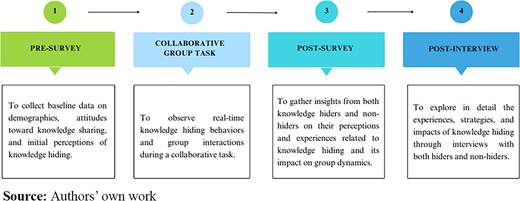
The study used an exploratory design to investigate the dynamics of KH in group settings, focusing on the experiences of both knowledge hiders and their targets. The sequence of activities is outlined in Figure 1.
The study involved 49 undergraduate students from a business school in Almaty, Kazakhstan. Access to the participants was facilitated through the past affiliation of one of the coauthors with the university. In total, 41 students participated in group tasks, with 30 acting as regular members and 11 assigned as “knowledge hiders.” The average participant age was between 20 and 23 years, with most having minimal work experience.
An online presurvey was administered to all participants, collecting baseline data on demographics, attitudes toward KS and KH, social identity and motivations such as expected rewards and future associations. KH perceptions were measured using items from Connelly et al. (2012), whereas perceived social identity was evaluated using Kwon and Wen (2010) measure of participants’ sense of belonging. Expected rewards and associations were assessed using items adapted from Bock et al. (2005). All survey items used a five-point Likert scale.
Participants were then divided into small groups to solve a business puzzle involving categorizing startups based on business models, target markets or revenue strategies. Each participant received an information card with partial details about relevant companies and was instructed to share insights verbally without revealing the card contents directly. One participant per group was secretly designated as the “knowledge hider,” given complete information but instructed to hide the solution while participating in discussions. Observers were assigned to each group to monitor interactions, noting nonverbal cues that might indicate emotional and cognitive discomfort of knowledge hiders.
After the task, all participants completed online posttask surveys. The regular participants reflected on group dynamics and potential KH behaviors, using items adapted from Connelly et al. (2012) to assess indicators of KH. On the contrary, knowledge hiders completed a separate survey focusing on their internal experiences, including emotions such as guilt and perceived advantages from hiding knowledge. These reflections addressed how hiders manage the act of hiding and their strategies (RQ1).
Finally, semistructured interviews were conducted with 14 participants, including both knowledge hiders and regular participants. The interviews with the hiders explored their emotional responses, cognitive conflicts and strategic behaviors during the task (RQ1). For the regular participants, the interviews focused on their interpretations of KH, assessing how they recognized or responded to KH behaviors (RQ2). Examples of interview questions for hiders include, “How did you feel while hiding knowledge?” and “What strategies did you use to avoid suspicion?” Regular participants were asked questions like, “Did you notice any signs of KH during the task?” and “How did hidden knowledge affect your group’s performance?”
3.2 Data analysis
Following established methodologies for exploratory qualitative research (e.g. Yin, 2009; Gioia et al., 2013), we used a multistage inductive data analysis process to comprehensively examine the dynamics of KH in group settings. By triangulating data from multiple sources – observations during the group task, posttask surveys and interviews – we ensured depth and accuracy in our findings. Table 1 provides a detailed overview of the data integration process at each research stage, outlining the data collection methods, analysis techniques and how the insights from each phase informed the subsequent stages.
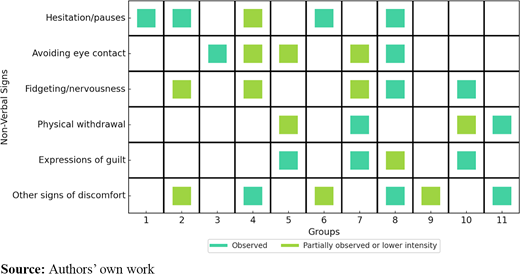
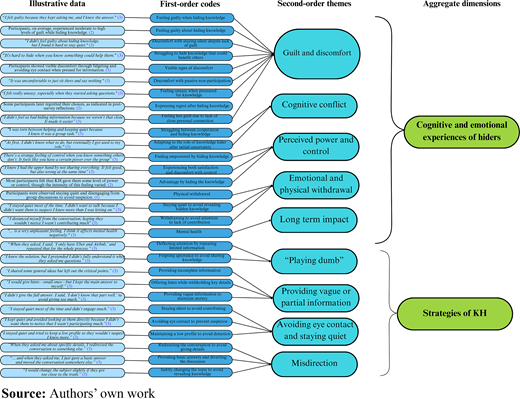
Our data analysis proceeded in three main steps. We began by closely reading all collected data, i.e. the observational notes, pre- and postsurvey responses and interview transcripts. Using open coding, we identified and labeled key statements and behaviors that were significant to participants’ experiences of KH. For example, knowledge hiders expressed sentiments like “I felt guilty because they kept asking me, and I knew the answer,” which we coded as “feeling guilty when hiding knowledge.” Observations of nonverbal cues such as fidgeting or avoiding eye contact were coded as “visible signs of discomfort” (see Figure 2 for the distribution of nonverbal signs and their intensity among hiders).
We then examined the first-order codes to identify patterns and relationships among them. By grouping similar codes, we developed broader conceptual themes that reflected underlying processes or experiences. For instance, codes related to guilt and internal conflict were integrated into the second-order theme of “Guilt and discomfort.” Similarly, strategies used by hiders, such as “playing dumb” or “providing vague information,” were grouped under “Strategies of knowledge hiding.” This step involved iterative comparison and discussion among the research team to refine themes and ensure they accurately represented the data.
In the final stage, we aggregated the second-order themes into overarching theoretical dimensions that encapsulated the essence of participants’ experiences. Themes like “Guilt and discomfort” and “Cognitive conflict” were combined into the aggregate dimension of “Cognitive and emotional experiences of hiders.” The theme “Strategies of knowledge hiding” formed its aggregate dimension, highlighting the strategical aspects of how participants managed KH. The full structure of these codes, themes and aggregate dimensions related to knowledge hiders is illustrated in Figure 3.
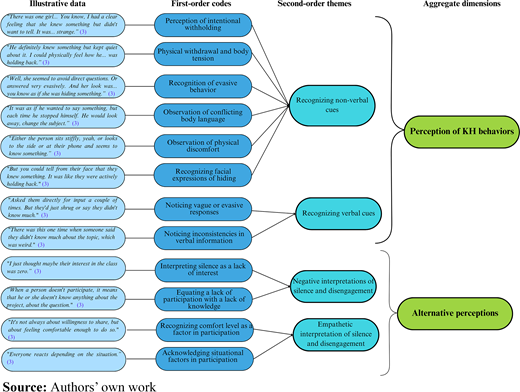
For the KH targets, we applied the same analytical process. First-order codes from their observations – such as “He definitely knew something but kept quiet about it. I could physically feel how he […] was holding back” (coded as “perception of intentional withholding”) and “It was as if he wanted to say something, but each time he stopped himself. He would look away, change the subject” (coded as “Observation of conflicting body language”) – were grouped into the second-order theme “Recognizing nonverbal cues.” This led to the aggregate dimension “Perception of KH behaviors,” as presented in Figure 4, which summarizes how targets interpreted KH during group interactions.
Throughout the analysis, we remained open to emerging patterns, allowing the data to guide the development of themes and dimensions – a hallmark of exploratory qualitative research. By systematically moving from specific observations to broader theoretical insights, we were able to construct a nuanced understanding of KH from both the hiders’ and targets’ perspectives.
4. Results
This section presents the results in three key areas. Subsection 4.1 outlines the presurvey results, providing baseline insights into participants’ demographics, social identity and attitudes toward KH. Subsection 4.2 explores the experiences and strategies used by knowledge hiders during the group task, examining their emotional and cognitive responses. Finally, subsection 4.3 discusses the perceptions and interpretations of KH from the perspective of the targets, highlighting how KH behaviors were observed and understood.
4.1 Presurvey results
Table 2 compares the descriptive statistics between the overall sample, hiders and nonhiders, with corresponding t-values and p-values. Across the sample, social identity scores average 3.39 (±0.86), indicating a moderate sense of belonging and engagement among participants. Similarly, expected rewards and associations show moderate levels (3.58 ± 0.96 and 3.48 ± 0.72, respectively), reflecting a reasonably positive outlook on external incentives and potential future collaborations within the class. Interestingly, KH scores are lower overall (2.09 ± 0.73), suggesting that participants generally do not frequently engage in KH. This low level of reported KH may reflect the classroom environment, where students often feel obligated to share information and collaborate, particularly when grades and public feedback are involved.
When comparing hiders and nonhiders, we found no statistically significant differences across the key variables of social identity, expected rewards and associations and KH (all p-values > 0.05). Even though hiders reported slightly lower scores on social identity (3.27 ± 0.99) and expected rewards (3.14 ± 1.07) compared to nonhiders (3.43 ± 0.83 and 3.73 ± 0.88, respectively), these differences are not statistically significant.
Overall, the setting studied (i.e. a classroom environment) seems to foster a cooperative and collaborative dynamic, and the assigned roles as hiders introduce only minor variations in perceptions of social identity, rewards and KS.
4.2 Experiences and strategies of knowledge hiders
Figure 2 illustrates the different levels of nonverbal signs exhibited by hiders across the groups. The variation in signs such as hesitation/pauses, fidgeting and physical withdrawal reflects how hiders managed the tension of hiding knowledge.
By examining the combination and intensity of these signs across the groups, we grouped them into three categories:
High emotional and physical discomfort: Hiders in groups 7, 8 and 10 exhibited significant signs of discomfort, including avoiding eye contact and physically withdrawing from the group. The addition of frequent fidgeting and visible expressions of guilt suggests that the discomfort in these groups was both emotional and physical.
Moderate physical discomfort: In groups 4, 5 and 11, hiders showed moderate discomfort through subtle physical withdrawal and nervous gestures, such as playing with objects or adjusting their posture. These behaviors suggest that while hiders in these groups were uncomfortable, their distress was more physical than emotional.
Mild cognitive discomfort: Hiders in groups 1, 2, 3, 6 and 9 often delayed their responses, indicating internal conflict, but did not exhibit strong signs of emotional or physical withdrawal. The addition of small nervous behaviors like fidgeting with objects or shifting in their seats suggests that the discomfort in these groups was more cognitive, focused on uncertainty about how to respond, rather than overt anxiety or distress.
Figure 3 expands on these findings by organizing the data into a structured format, capturing the hiders’ observable behaviors, cognitive and emotional experiences and the strategies they employed during the KH process. This finding, derived from observations during the game, postgame surveys and interviews, allows us to explore the why behind the participants’ actions.
4.2.1 Cognitive and emotional experiences of hiders.
Participants experienced a range of feelings, including guilt, internal conflict and mental strain, alongside strategic perceptions of power and control.
4.2.1.1 Guilt and discomfort.
Many participants experienced significant guilt and discomfort while hiding knowledge. Participants in Group 4 and Group 7 showed visible signs of discomfort, which aligned with their high self-reported guilt scores of 5/5 in postgame surveys. Group 4 hider reflected, “I felt guilty because they kept asking me, and I knew the answer,” and “It was uncomfortable to just sit there and say nothing.” Similarly, a Group 7 hider stated, “It’s hard to hide when you know something could help them.”
However, not all participants expressed guilt. The hider in Group 2 offered a different perspective, stating, “I didn’t feel guilty about hiding knowledge, but I found it hard to stay quiet.” Social distance also played a critical role in shaping how the participants experienced guilt and discomfort. For example, the hider in Group 4 reflected that “If this person were someone I really knew, I would feel bad. But if it’s someone I don’t know well, I would be okay with it.” The hider did not display visible signs of guilt during the experiment, and the interview confirmed that weaker social ties made withholding information more manageable.
4.2.1.2 Cognitive conflict.
Some participants struggled between their role of hiding knowledge and their natural inclination to cooperate with their group. In Group 10, the participant exhibited fidgeting and physical withdrawal, later reflecting, “I was torn between helping and keeping quiet because I knew it was a group task.” In contrast, the hider in Group 4 displayed mild hesitation during the experiment but expressed deeper internal discomfort in the interview: “It felt like I was betraying my team” (Group 4). In addition, the hider in Group 1 felt conflicted about participating without revealing too much. This internal struggle was captured in her statement, “At first, I didn’t know what to do, but eventually I got used to my role.” (Group 1).
4.2.1.3 Perceived power and control.
While guilt and conflict were common themes, some participants experienced a sense of control and power from hiding knowledge. One participant shared, “There’s a strange feeling of control when you know something others don’t. It feels like you have a certain power over the group” (Group 10). Similarly, a participant from Group 8 stated, “I knew I had the upper hand by not sharing everything. It felt good, but also wrong at the same time.”
4.2.1.4 Emotional and physical withdrawal.
Another common response to the discomfort of KH was emotional and physical withdrawal. Participants in Groups 7 and 10 distanced themselves from the conversation or contributed minimally, as observed during the experiment. One participant noted, “I stayed quiet most of the time. I didn’t want to talk because I didn’t want them to suspect I knew more than I was letting on” (Group 7). In the observations, this behavior was reflected in physical withdrawal, where participants leaned back or sat apart from the group, avoiding direct engagement.
4.2.1.5 Psychological toll.
Beyond the immediate feelings of guilt and conflict, some participants reported experiencing a longer-term psychological toll from the KH task. While this aspect was not always visible during the experiment, the interviews revealed the underlying mental strain. For example, the hider in Group 10 expressed, “You know the truth, but the fact that you can’t reveal it because something holds you back is a very unpleasant feeling. I think it affects mental health negatively” (Group 10).
4.2.2 Strategies used by knowledge hiders.
During the game, participants employed several strategies to navigate the tension between concealing information and maintaining their roles within the group. These strategies, ranging from feigning ignorance to misdirection, allowed the participants to participate in the task without raising suspicion.
4.2.2.1 “Playing dumb”.
Several participants pretended not to know or understand key information, which helped them avoid contributing without appearing overtly deceptive. The hider in Group 4 adopted this approach, stating, “I didn’t look at their cards or focus on what they were doing. When they asked, I said, ‘I only have Uber and Airbnb,’ and repeated that for the whole process.” Similarly, the hider in Group 10 admitted, “I knew the solution, but I pretended I didn’t fully understand it when they asked me questions.” This strategy helped participants maintain a passive role in the group, as they were not expected to contribute when unfamiliar with the key details.
4.2.2.2 Providing vague or partial information.
Another common strategy was to offer vague or incomplete answers, allowing participants to appear cooperative without fully disclosing the information they had. The hider in Group 1 admitted, “I shared some general ideas but left out the critical points.” Similarly, the hider in Group 10 used vague responses, saying, “I would give hints—small ones—but I kept the main answer to myself.” The hider in Group 4 echoed this approach, sharing, “I didn’t give the full answer. I said, ‘I don’t know that part well,’ to avoid giving too much.”
4.2.2.3 Avoiding eye contact and staying quiet.
Silence and physical withdrawal were also key strategies used by participants to avoid drawing attention or suspicion. The hider in Group 1 noted, “I stayed quiet most of the time and didn’t engage much.” The hider in Group 4 adopted a similar approach, stating, “I kept quiet and avoided looking at them directly because I didn’t want them to notice that I wasn’t participating much.” This strategy allowed participants to manage the tension of withholding knowledge by remaining on the periphery of the group discussions.
4.2.2.4 Misdirection.
Some participants actively steered conversations away from critical topics to prevent their peers from uncovering the knowledge they were hiding. The hider in Group 1 shared, “When they asked me about specific details, I redirected the conversation to something else.” Similarly, the hider in Group 4 explained, “I didn’t pay attention to what they were doing, and when they asked me, I just gave a basic answer and moved the conversation somewhere else.” Through misdirection, participants could maintain control over the conversation and keep their knowledge hidden without outright refusal to engage.
4.3 Perceptions and interpretations of knowledge hiding by the targets
This section explores how participants perceived and interpreted potential KH among their teammates during the experiment. Without receiving explicit instructions to identify KH, participants shared their impressions of group dynamics and whether they sensed any KH. Their responses provide insights into the suspicion of KH, interpretations of group behavior and the perceived impact on teamwork and group dynamics.
4.3.1 Comparison of visual cues and participant suspicion of knowledge hiding.
Table 3 compares the hiders’ experience, visual observations of nonverbal cues during the game and participant suspicion of KH across various groups. As mentioned, groups were categorized into three levels of discomfort – high emotional and physical discomfort, moderate physical discomfort and mild cognitive discomfort – based on nonverbal signs exhibited during the experiment. The table also includes insights from participant’s open-ended responses to better understand the group dynamics and perceptions of KH.
Table 3 illustrates some important patterns. In groups with high emotional and physical discomfort (Groups 7, 8 and 10), despite visible nonverbal signs such as fidgeting and physical withdrawal, participant suspicion remained low. Most participants scored 1 or 2 on the Likert scale, and their open-ended responses reflected a lack of suspicion, with comments like, “No one was hiding, but someone was afraid of discussion” and “Everyone was open and honest.”
In groups with moderate physical discomfort (Groups 4, 5 and 11), suspicion was more aligned with nonverbal cues. Subtle signs of physical withdrawal and nervous gestures led to moderate suspicion, reflected in Likert scale scores of 3–5. For example, one participant from Group 5 noted, “One groupmate just sat and didn’t say anything until we asked for help” (Score: 4), and in Group 11, a participant said, “One teammate was suspicious because they weren’t saying anything until later” (Score: 4–5). These responses show that even minor physical cues were linked to perceptions of KH.
For groups with mild cognitive discomfort (Groups 1, 2, 3, 6 and 9), participant suspicion was generally low, with exceptions in Groups 2 and 6, where moderate suspicion was raised. In Group 2, one participant commented, “One teammate definitely knew something but chose to remain silent” (Score: 4), showing that even mild cognitive discomfort, like hesitation or delayed responses, can raise suspicion if interpreted in context.
4.3.2 Participant interpretation of knowledge hiding through thematic insights.
Figure 4 highlights how participants interpreted various behaviors during group interactions and their suspicions regarding KH. Nonverbal cues played a significant role in shaping perceptions of KH, with participants often attributing physical behaviors, such as body tension or withdrawal, to an individual’s reluctance to share information. For instance, a participant from Group 2 stated that they could “physically feel how he was holding back,” indicating that subtle physical cues, such as stiff body posture or avoiding direct interaction, raised suspicions of KH. Similarly, in Group 5, a participant observed evasive behavior in another team member, noting that their reluctance to answer direct questions or their evasive facial expressions gave the impression of intentional withholding.
In addition, the participants frequently identified inconsistencies between verbal and nonverbal communication as indicators of KH. A participant from Group 6 observed that, despite repeated requests for input, a teammate’s facial expressions suggested they were “actively holding back” information, even when their verbal responses were vague or dismissive. This highlights the importance of facial expressions and nonverbal behaviors in signaling cognitive and emotional withholding during group interactions.
On the other hand, not all participants attributed silence or nonparticipation to KH. Some participants misinterpreted quietness as a lack of interest or disengagement from the task. For example, a participant from Group 11 remarked that they thought their teammate’s silence indicated that they “didn’t have much interest in the class,” thus misreading the quiet behavior as disinterest rather than intentional withholding. Others equated nonparticipation with a lack of knowledge, assuming that individuals who refrained from contributing “didn’t know anything about the project,” as a participant in Group 4 noted.
In contrast, some participants adopted a more empathetic stance, recognizing that nonparticipation or silence might be due to feelings of discomfort rather than deliberate KH. For example, a participant from Group 7 noted that it’s “not always about willingness to share but about feeling comfortable enough to do so,” reflecting an understanding of how social dynamics and personal comfort levels can influence participation. Group 11 echoed this sentiment, acknowledging that “everyone reacts depending on the situation,” suggesting that external factors, such as the group setting or individual confidence, may affect how and when participants engage.
5. Discussion and implications
This section discusses how our findings contribute to our understanding of KH by exploring how knowledge hiders experience and manage KH and how KH targets perceive and interpret these actions.
Consistent with Connelly et al. (2012), we identified playing dumb and evasive hiding as common strategies. Participants often pretended not to understand or downplayed their knowledge to avoid contributing while maintaining a cooperative appearance. Evasive hiding, where participants provided vague or partial information, was another frequently used tactic. By sharing only superficial ideas and withholding key details, participants gave the impression of being helpful without revealing critical knowledge. Our study highlights several new strategies. Some participants avoided eye contact and remained silent, using physical disengagement to dodge direct questioning. This passive strategy allowed them to conceal knowledge without drawing attention. Another strategy was misdirection, where participants redirected conversations away from critical topics or offered irrelevant information. This manipulation enabled them to control the discussion flow while keeping their hidden knowledge intact.
In line with previous studies, we observed that KH often triggers guilt and discomfort among hiders (Burmeister et al., 2019; Islam et al., 2022). Participants reported significant emotional tension, manifested through fidgeting, avoidance and visible discomfort, especially when hiding involved knowledge that could benefit their group. The experience of guilt was particularly pronounced in groups with high emotional and physical discomfort. However, our findings suggest that social context moderates emotional discomfort, particularly the strength of social ties within the group. When individuals are less familiar with group members, they tend to experience reduced guilt when concealing information. This aligns with previous research showing that stronger social relationships negatively correlate with KH (Su, 2021). Our study advances this understanding by highlighting how the strength of these social ties can influence not only KS but also the emotional burden of KH.
Interestingly, our findings suggest that even when individuals exhibit visible signs of emotional or physical discomfort due to KH, these cues are not always interpreted by peers as such. This challenges the common assumption that these behaviors are easily identifiable and typically lead to negative consequences (Connelly et al., 2012; Černe et al., 2014; Zhao et al., 2016). Instead, our findings demonstrate that signs of discomfort were often misattributed to other factors, such as nervousness, shyness or general disengagement. This misinterpretation indicates that the negative effects of KH may not always manifest, as the act itself can go unrecognized.
Moreover, silence and nonparticipation in group settings are often misinterpreted, with participants frequently attributing these behaviors to disinterest or lack of knowledge rather than deliberate KH. Some participants also showed an empathetic tendency to view such withdrawal as resulting from discomfort or lack of confidence, rather than intentional refusal to share knowledge. These varying interpretations highlight the complexity of perceiving KH within groups, showing that the impact of KH on group dynamics is shaped not only by the hider’s behavior but also by how others interpret and react to it.
Building on these findings, Table 4 outlines several key areas for future research that can further our understanding of the complexities surrounding KH.
One area involves nonverbal cues, particularly exploring whether different behaviors are used in virtual versus in-person environments and how cultural differences influence their interpretation. Research should investigate specific body language signs most closely associated with KH. Another promising area is verbal cues, understanding the strategies individuals commonly use to conceal knowledge and whether consistent patterns emerge across contexts.
The impact of social context demands attention, particularly the role of close social ties and hierarchical relationships. Future studies could investigate whether hiding knowledge from close colleagues generates more emotional conflict than from distant ones and how social hierarchies influence KH strategies. The long-term consequences of KH are also essential, particularly regarding the psychological impact on hiders. While our study touched on emotional tension, more research is needed to understand long-term effects like stress, anxiety or guilt from prolonged KH.
However, our findings also raise a broader concern: is KH truly a widespread organizational problem, or has its impact been overstated? While KH is often portrayed as a detrimental behavior that undermines trust and collaboration, our findings suggest that the issue may not be as severe as it appears. One key insight from our study is the subjectivity of interpretation – what one group member interprets as KH may, in reality, reflect another person’s discomfort, lack of confidence or even shyness. Misinterpretations of behaviors like silence, disengagement or vague responses could lead to an inflated perception of KH, making it seem more prevalent and harmful than it truly is. This raises the possibility that KH is being overemphasized as an organizational problem when, in fact, it may not always be intended or impactful.
In addition, although our study did not directly investigate this, KH might be more of a symptom of deeper organizational culture issues rather than an isolated behavioral problem. For example, environments with poor communication, lack of trust or misaligned incentives may foster conditions where KH naturally occurs. In these cases, KH could manifest underlying structural and cultural weaknesses within the organization. Rather than focusing solely on individual KH behaviors, it might be more productive to address these root causes.
6. Conclusion
To our knowledge, this is the first study to explore KH by examining both how hiders experience and manage KH and how KH targets perceive and interpret these actions within group settings. Our findings extend the work of Connelly et al. (2012) by identifying common strategies like playing dumb and evasive hiding and highlighting additional strategies such as physical disengagement and misdirection.
Moreover, our study sheds light on the emotional and psychological impacts of KH on hiders, showing that KH can trigger guilt and discomfort, particularly in contexts where strong social ties exist. At the same time, the emotional toll of KH is influenced by the social dynamics within groups, with weaker ties reducing the emotional burden for hiders. Interestingly, we also found that KH behaviors, such as silence or disengagement, are often misinterpreted by peers, challenging the assumption that KH is easily identifiable or consistently leads to negative outcomes like retaliation or distrust.
However, our findings also raise broader questions about whether KH is a critical organizational problem or whether its impact has been overstated. The subjectivity of interpretation and the varying emotional responses suggest that the prevalence and harm of KH might be inflated. In addition, KH could be symptomatic of deeper organizational culture issues, such as poor communication or lack of trust. Addressing these underlying problems might be a more effective approach than focusing solely on eradicating KH behaviors.
While our study provides valuable insights, several limitations should be noted. The controlled group setting may not fully capture the complexities of KH in real-world organizational contexts, where long-term relationships, power dynamics and diverse incentives play a role. Furthermore, the sample size and composition, while sufficient for our exploratory goals, may limit the generalizability of our findings to all industries or organizational structures. Finally, the short-term nature of the group interactions prevents us from fully exploring the long-term psychological and performance-related consequences of KH, particularly its impact on motivation, team cohesion and individual well-being.
Despite these limitations, our research makes critical contributions by expanding the understanding of KH strategies and uncovering how others perceive KH in group settings. Future research can build on these findings by investigating KH in more naturalistic environments, exploring its long-term effects and assessing whether the organizational resources dedicated to managing KH are proportional to its actual impact. By doing so, organizations can develop more balanced, effective strategies for managing KH, ensuring that efforts to address it are justified and impactful.