

ABSTRACT
The global challenge of managing floods necessitate adoption of Pervious Concrete (PC) for pavement construction. This study examined the effects of Sorghum Husk Ash (SHA) and Recycled Concrete Aggregate (RCA) on compressive strength and hydraulic properties of PC. Sorghum husk was incinerated at 700°C for three hours to produce SHA. The chemical composition of SHA was determined using X-ray fluorescence analyser. Mixtures of PC were prepared at various replacement levels (0, 5, 10, 15, 20, 25%) of cement with SHA and (0, 20, 40, 60, 80, 100%) of granite with RCA. Density, compressive strength and hydraulic (porosity and permeability) properties of the samples were determined at 28-day using ACI standards. Result revealed that sum of percentages of acidic oxides obtained for SHA was in excess of 70% requirement of a pozzolan. Density of PC decreased with increase in SHA and RCA amount. Increasing contents of SHA enhanced the hydraulic properties of PC while the best compressive strength was obtained at 5%. The incorporation of RCA decreased the compressive strength but improved the PC hydraulic properties. The best PC production variable was at 5%SHA and 20%RCA. It is concluded that SHA and RCA are suitable for the enhancement of PC properties.
1 Introduction
Pervious concrete is the vital and Best Management Practice (BMP) for regulation of water runoff and contaminants from storms recommended by Environmental Protection Agency (EPA) of the US. It is a special material with high permeability made by removing or reducing the amount of fine aggregate in the concrete composition (Qin et al., 2015). Its permeability, porosity, density and compressive strength ranges from 1.4 to 12.2 mm/s, 15 to 35%, 1600 to 2000 kg/m3 and 2.8 to 28 MPa (Tennis et al., 2004; ACI 522R, 2010). Some of the environmental benefits of PC include storm water runoff reduction, groundwater supplies restoration, water quality improvement, as well as water and soil pollution reduction (Yahia and Kabagire, 2014; Ajagbe et al., 2018). It is usually utilized in low traffic roads, parking areas, sidewalks and joggers’ tracks (Yang and Jiang, 2003; Tennis et al., 2004).
The United States Department of Agriculture (USDA, 2017) estimated the world sorghum production at 59.35 million metric tons. The breakdown of the data showed that USA’s input is 8,408,000 metric tons while Nigeria is following with 6,550,000 metric tons and Mexico in the third position with 6,000,000 metric tons. Husks of the large quantity of sorghum produced are mostly disposed of by open air burning. Tijani et al. (2018) stated that instead of irrational burning of sorghum husk that poses environmental hazards to the surroundings, appropriate burning of them will give up to 11% sorghum husk ash (SHA) content with good pozzolanic property.
Construction and demolition waste have been rapidly increasing around the world with more than 3 billion tonnes generated annually in 40 countries (Akhtar and Sarmah, 2018). According to Tijani et al. (2019a), concrete waste materials produced from construction and demolitions in Nigeria are large in quantity and are found almost everywhere. Typically, RCA particles contain 30 to 60% old cement paste or mortar, depending on the aggregate size (ECCO, 1999). The use of RCA in production of concrete minimise wastes to landfill, reduces the depletion of natural material resources and keeps the construction cost down (Aiyewalehinmi and Adeoye, 2016).
This research aims to provide a way of improving the strength and hydraulic properties of PC through the partial replacement of cement with SHA and granite with RCA for managing floods in the areas that receive frequent rainfall.
2 Materials and methods
2.1 Materials
Grade 32.5R cement which conform to the requirement of ASTM C150 (2016)) was used for this study. Natural aggregate (granite) was obtained from Irepodun Quarry site in Ede, Nigeria while RCA was sourced from a demolished building along Town Planning Way, Ilupeju, Lagos State, Nigeria. Figure 1 shows the aggregates used for the study with adhered mortar on RCA. Aggregates that passed through the 9.50 mm sieve and retained on the 4.75 mm sieve was used for PC production. The bulk density, specific gravity and water absorption of granite were 1559 kg/m3, 2.76 and 0.3% while that of RCA were 1301 kg/m3, 2.53 and 2.8% respectively.
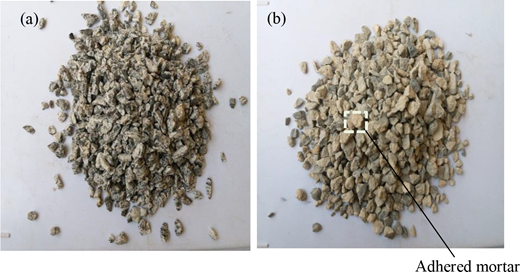
Aggregates (a) granite, (b) RCA.
Sorghum Husk was collected from a local sorghum farm in Ogbomoso, Oyo State, Nigeria. The sample was burnt in an electric furnace at 700°C for 3 hours to obtain SHA. The chemical properties of SHA are shown in Table 1. Ordinary tap water was used for this study with a fixed water/cement ratio 0.4 for all mixes.
Results chemical analysis of SHA
| Chemical constituents | Percentage composition (%) |
|---|---|
| SiO2 | 55.34 |
| Al2O3 | 10.08 |
| Fe2O3 | 11.87 |
| SO3 | 0.50 |
| MgO | 1.18 |
| K2O | 4.48 |
| Na2O | 0.71 |
| CaO | 10.44 |
| SiO2 + Al2O3 + Fe2O3 | 77.29 |
| Loss on ignition | 6.8 |
| Specific gravity | 2.1 |
2.2 Methods
A total of thirty-six mixes were designed for SHA-RCA-PC as shown in Table 2. Pervious concrete samples were cast in plastic cylinder moulds (100 × 200 mm) to conduct density, compressive strength, porosity and permeability. Samples were compacted by filling in three layers using 25 drops of a 16mm diameter steel rod and 10 drops of a 2.5 kg standard proctor hammer. Water to cement ratio was kept constant at 0.4 for all mixes. The mixture proportioning was based on the volume of paste required to bind aggregate together while maintaining a 20% void ratio. All samples were cured at room temperature in the lab for 24 hours after casting before being removed and cured in water for 7 and 28 days. The result of each property tested is the average of at least three specimens.
Mix Proportions
| Mix | % SHA | Cement (kg/m3) | SHA (kg/m3) | Coarse Aggregates (kg/m3) | Water (kg/m3) | |
|---|---|---|---|---|---|---|
| Granite | RCA | |||||
| 0SHA-RCA0 | 1563.40 | 0 | ||||
| 0SHA-RCA20 | 0 | 390.83 | 0 | 1250.72 | 312.68 | 156.33 |
| 0SHA-RCA40 | 938.04 | 625.36 | ||||
| 0SHA-RCA60 | 625.36 | 938.04 | ||||
| 0SHA-RCA80 | 312.68 | 1250.72 | ||||
| 0SHA-RCA100 | 331.01 | 0 | 1324.03 | 132.40 | ||
| 5SHA-RCA0 | 1563.40 | 0 | ||||
| 5SHA-RCA20 | 5 | 371.29 | 19.54 | 1250.72 | 312.68 | 156.33 |
| 5SHA-RCA40 | 938.04 | 625.36 | ||||
| 5SHA-RCA60 | 625.36 | 938.04 | ||||
| 5SHA-RCA80 | 312.68 | 1250.72 | ||||
| 5SHA-RCA100 | 314.46 | 16.55 | 0 | 1324.03 | 132.40 | |
| 10SHA-RCA0 | 1563.40 | 0 | ||||
| 10SHA-RCA20 | 10 | 351.75 | 39.08 | 1250.72 | 312.68 | 156.33 |
| 10SHA-RCA40 | 938.04 | 625.36 | ||||
| 10SHA-RCA60 | 625.36 | 938.04 | ||||
| 10SHA-RCA80 | 312.68 | 1250.72 | ||||
| 10SHA-RCA100 | 297.91 | 33.10 | 0 | 1324.03 | 132.40 | |
| 15SHA-RCA0 | 1563.40 | 0 | ||||
| 15SHA-RCA20 | 15 | 332.21 | 58.63 | 1250.72 | 312.68 | 156.33 |
| 15SHA-RCA40 | 938.04 | 625.36 | ||||
| 15SHA-RCA60 | 625.36 | 938.04 | ||||
| 15SHA-RCA80 | 312.68 | 1250.72 | ||||
| 15SHA-RCA100 | 281.36 | 49.65 | 0 | 1324.03 | 132.40 | |
| 20SHA-RCA0 | 1563.40 | 0 | ||||
| 20SHA-RCA20 | 20 | 312.66 | 78.17 | 1250.72 | 312.68 | 156.33 |
| 20SHA-RCA40 | 938.04 | 625.36 | ||||
| 20SHA-RCA60 | 625.36 | 938.04 | ||||
| 20SHA-RCA80 | 312.68 | 1250.72 | ||||
| 20SHA-RCA100 | 264.81 | 66.20 | 0 | 1324.03 | 132.40 | |
| 25SHA-RCA0 | 1563.40 | 0 | ||||
| 25SHA-RCA20 | 25 | 293.12 | 97.71 | 1250.72 | 312.68 | 156.33 |
| 25SHA-RCA40 | 938.04 | 625.36 | ||||
| 25SHA-RCA60 | 625.36 | 938.04 | ||||
| 25SHA-RCA80 | 312.68 | 1250.72 | ||||
| 25SHA-RCA100 | 248.26 | 82.75 | 0 | 1324.03 | 132.40 | |
The compresive strength test was conducted at 7 and 28 days in accordance with ASTM: C39/C39M, 2015. The samples for compressive strength tests were dried at room temperature for about 2 hours before being crushed at a constant rate loading of 0.06 MPa/s in the machine. The porosity of the PC samples was determined using ASTM C1754 (2012)). The diameter and length of the sample were measured to obtain the total volume of the cylinder. The samples were weighed in both dry (A) and submerged conditions (B) and the void content was calculated using the following equation (1):
where A is the dry weight (g), B is the weight under water (g), Vol is the volume of sample (cm3) and ρw is the density of water at 21°C (kg/cm3).
A falling-head permeameter was used to measure the permeability of each sample. The following Darcy’s law equation (2) was used to determine coefficient of water permeability:
where K is the water permeability coefficient in mm/s, A and Atube are the areas of the cross-sections of the sample and tube in mm2, L is the length of sample in mm and t is the time required for water to fall from an initial water level h1 (mm) to a final water level h2 (mm).
3 Results and discussion
3.1 Density of SHA-RCA-PC
Figure 2 presents the density of SHA-RCA-PC mixtures. The figure clearly showed that density decreases as the proportion of RCA increases from 0 to 100% at every replacement level of cement with SHA. The density of 2129 kg/m3 was recorded for the control mix (0SHA-RCA0). However, it reduced by 3, 7, 12, 15 and 18% for mixtures containing 20, 40, 60, 80 and 100% RCA replacement respectively. Similarly, the 5% SHA replacement (5SHA-RCA0) had a density value of 2124 kg/m3 which is close to the value of the control mix. For 20, 40, 60, 80 and 100% RCA replacement level, the value decreased approximately by 3, 7, 11, 15 and 18% respectively. The mixtures with 10, 15, 20 and 25% SHA replacement followed the same trend with the control and 5% SHA replacement. The lowest density (1714 kg/m3) was obtained at 25SHA-RCA100 mixture. It is obvious that density slightly declined as the amount of SHA increased. This decrease in density with increase in the amount of SHA could be attributed to the lower specific gravity (2.1) of SHA when compared to cement (3.15). The decrease in the values of density as the proportion RCA increases might be attributed to the existence of attached mortar in RCA as shown in Figure 1. However, the values of density obtained were within the range of 1600 - 2000 kg/m3 specified by Tennis et al. (2004). The results are also similar to those obtained by Tijani et al. (2019b and 2019c), Yap et al. (2018), Guneyisi et al. (2016), Sriravindrarajah et al. (2012) and Rizvi et al. (2010).
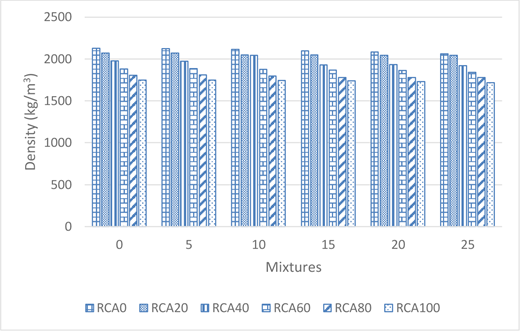
Density of SHA-RCA-PC
3.2 Compressive strength of SHA-RCA-PC
The 7 and 28 days compressive strengths of SHA-RCA-PC are presented in Figures 3 and 4 respectively. While comparing the results of compressive strengths at7 and 28 days, it was observed that the compressive strength of PC mixtures increased with curing. Meanwhile the strengths were generally found to decrease at every RCA replacement levels (0 – 100%) for all SHA substitutions (0 – 25%). At 0% SHA substitution, the 28 day compressive strengths decreased by 10.7, 19.8, 32.1, 41.8 and 47.9 N/mm2 for 20, 40, 60, 80 and 100% RCA incorporation respectively compared to the control. At 5, 10, 15, 20 and 25% SHA substitution, the strength decreased from 8.5 - 43.9, 12.3 – 46.2, 3.2 – 38.9, 7.9 – 44.4 and 14.6 – 53.8% for 20, 40, 60, 80 and 100% RCA incorporation correspondingly compared to the control. The decrease in strength with increasing RCA substitution is attributed to weak bond that formed between the old mortar and the new one as opined by Güneyisi et al. (2016). The compressive strength of all mixtures was within the ACI522R (2010)) specification. Moreover, the compressive strength at 5% SHA substitution were greater than the control at every day of curing irrespective of RCA incorporation. This suggests 5% as the optimum replacement level of cement. The rise in strength at low SHA substitution can be attributed to increased pozzolanic reaction and the filling ability of fine particles of the ash while the decrease in strength at higher replacement of SHA could be due to dilution effect of cement, formation of weaker C-S-H gel as a result of pozzolanic reaction and porous structure of ash particles (Tijani et al., 2020; Tijani et al., 2019c; Olawale and Tijani, 2019; Khankhaje et al., 2018; Tahomah et al., 2017).
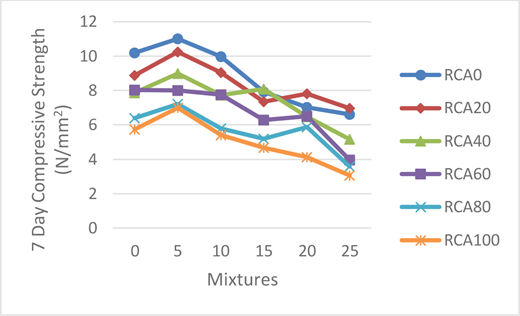
Compressive Strength of SHA-RCA-PC at 7 Day
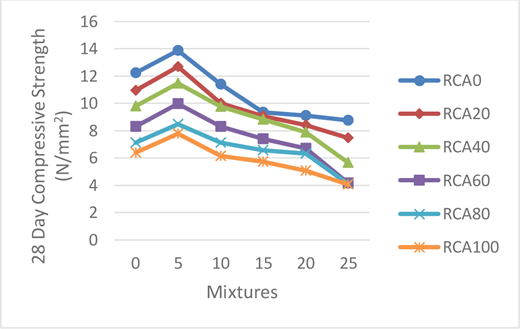
Compressive Strength of SHA-RCA-PC at 28 Day
3.3 Porosity and permeability of SHA-RCA-PC
Figure 5 shows the porosity of SHA-RCA-PC. It was observed that increase in the substitution of SHA with cement lead to increase in porosity at every replacement value of RCA. At 0% SHA replacement level, the porosity was 20.14% and increased by 3.87, 13.61, 15.24, 16.88 and 20.46% for 20, 40, 60, 80 and 100% RCA respectively. The mixture of 5, 10, 15, 20 and 25% SHA replacement followed the same trend with increased porosity from 1.6 to 19.1, 2.8 to 21.3, 0.6 to 13.8, 0.3 to 13.6 and 1.1 to 15.1% for 20 to 100% RCA replacement respectively when compared to the control mixture. The permeability of SHA-RCA-PC is presented in Figure 6. It was revealed that permeability values rise as the SHA additions increases at every replacement level of RCA. At 0, 5, 10, 15, 20 and 25% SHA replacement, the permeability values increased up to 84, 86, 73, 64, 68 and 55% for 0, 20, 40, 60, 80 and 100% RCA replacement respectively. The increase in the values of porosity and permeability as the proportion RCA increases could be attributed to the presence of already used mortar in RCA as shown in Figure 1(b). However, the values of porosity and permeability obtained were within the range specified by ACI 522R (2010)) and Tennis et al. (2004). Similar results were also obtained by Yap et al. (2018), Sriravindrarajah et al. (2012) and Rizvi et al. (2010) where porosity and permeability of PC increased as the percentage of RCA replacement increased. It was obvious that both porosity and permeability slightly increased as the amount of SHA increased. This increase could be attributed to the high porous nature of SHA. Similar results were obtained by Khankhaje et al. (2018) using palm oil fuel ash cement replacement.
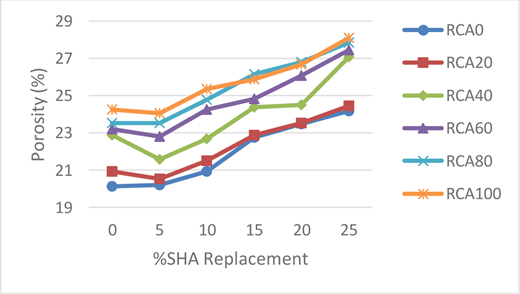
Porosity of SHA-RCA-PC
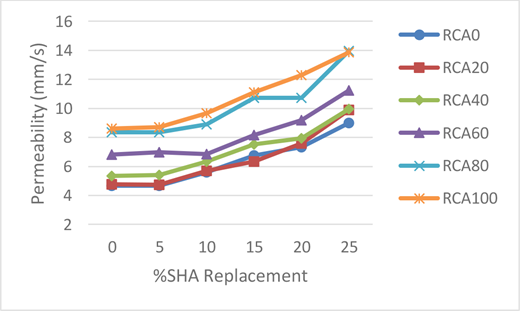
Permeability of SHA-RCA-PC
4 Conclusion
The compressive strength and hydraulic properties of a more sustainable and eco-friendly pervious concrete were investigated using sorghum husk ash to replace cement at varying percentages of 5, 10, 15, 20 and 25 and recycled concrete aggregate to replace granite at 20, 40, 60, 80 and 100%. The density of PC obtained ranged from 2129 to 1714 kg/m3. The compressive strength at 7 and 28 days were 3.6-10.3, 4.1-12.7 N/mm2 respectively. Porosity and permeability of PC mixtures correspondingly ranged from 20.5-27.9% and 4.7-14.0 mm/s. The replacement of granite with RCA on SHA-PC increased the hydraulic properties (porosity and permeability) of PC but decreased the density and compressive strength (7 and 28 days) irrespective of the substitution of cement with SHA. Moreover, the 28 day compressive strength at 5% SHA replacement were greater than the control at every day of curing irrespective of RCA incorporation. This suggests that the 5% is the optimum replacement level of cement. The best PC production variable was at 5% SHA and 20% RCA. It is concluded that SHA and RCA are suitable for the enhancement of PC properties.
