Skip to article sections
Purpose

Integrating artificial intelligence (AI) technologies into knowledge management systems (KMSs) offers transformative potential for organizations by enhancing knowledge-intensive business processes. However, this integration may face barriers and challenges. This study investigates the organizational implications for effective change management and structured implementation processes required for a beneficial integration of AI into KMSs.

Design/methodology/approach

A quantitative research design was employed using an online survey developed for this study and completed by 378 professionals across diverse roles, organizational sizes, and sectors. The instrument assessed perceptions of four barrier categories – human, technological, financial, and ethical-regulatory – through validated multi-item scales. Statistical analyses, including repeated-measures ANOVA, MANOVA, and t-tests, were conducted to identify differences across demographic and organizational variables.

Findings

Technological and ethical-regulatory barriers are perceived as more significant than financial ones. Managers identified human-centered hurdles, such as resistance to change and skills gaps, as more immediate threats than financial constraints. Knowledge managers expressed significant concerns regarding technical integration with existing KMSs. Smaller organizations reported higher levels of human and technological complications compared to medium and large firms. Graduates demonstrated greater sensitivity to ethical-regulatory issues, whereas the high-tech sector perceived fewer obstacles overall. No significant differences emerged across gender, age, or seniority.

Originality/value

By connecting established models of technology adoption with empirical evidence from knowledge-intensive contexts, this study strengthens understanding of AI integration within KMSs as a socio-technical process shaped by organizational contingencies and governance imperatives. It contributes to the literature on business process management by framing AI integration as a process-oriented transformation rather than a purely technological upgrade.

Knowledge management (KM) is founded on key processes such as knowledge capture, storage, distribution, and utilization, all of which are directed toward achieving organizational goals (Hislop et al., 2018; Majumder and Dey, 2022; Taherdoost and Madanchian, 2023). For organizations, the efficiency and effectiveness of knowledge management processes (KMPs) are critical, as they play a pivotal role in enhancing performance and maintaining competitive advantage. By harnessing collective knowledge, organizations can respond more swiftly to market dynamics and customer demands, thereby promoting continuous learning and improvement (Bolisani and Bratianu, 2017; Bratianu et al., 2023; Scarso and Bolisani, 2024). The deployment of appropriate knowledge management systems (KMSs) is equally essential. These socio-technical systems (Maier, 2007) are specifically designed to support KMPs, ensuring that valuable knowledge is both accessible and effectively utilized across the organization (Alavi et al., 2024; Salem et al., 2024). Successful adoption of such systems often requires structured change management processes and well-defined implementation processes to align technological capabilities with organizational workflows (Nakash et al., 2023).

The landscape of KM is undergoing a rapid transformation with the commercialization of advanced artificial intelligence (AI) technologies, such as OpenAI's ChatGPT and similar applications, which gained significant traction in late 2022 and early 2023 (Roberts et al., 2024; Sumbal and Amber, 2025). AI is typically evaluated based on its ability to perform tasks with a level of proficiency comparable to that of skilled humans – yet at far greater speed and scale (Dabija and Vătămănescu, 2023; Debowy et al., 2024). It encompasses a range of subfields, including machine learning, natural language processing, robotics, and computer vision. These technologies are designed to learn from data, identify patterns, and make decisions with minimal human intervention (Benbya et al., 2020; Chatterjee et al., 2024; Davenport and Ronanki, 2018; Dwivedi et al., 2021; Østerlund et al., 2021; Palaniappan et al., 2024; Sharma et al., 2022; Vasiliu and Yavetz, 2026).

As these capabilities permeate organizational practice, their primary impact may be felt in how work is organized and governed. In fact, recent business process management research highlights that AI-enabled process transformation requires rethinking roles, workflows, and decision-rights in knowledge-intensive environments (Abbasi et al., 2025; Zebec and Indihar Štemberger, 2024). This shift signals a broader redesign of technology-mediated work, in which AI becomes embedded within everyday knowledge practices rather than functioning merely as a supportive technological layer (Jarrahi et al., 2023a, b).

According to Alavi et al. (2024), recent advances in AI have ushered in a new, exciting, and complex era for systems that support KM, commonly referred to as KMSs, extending their scope beyond standalone technological tools. More broadly, integrating AI can enable more dynamic, responsive, and efficient knowledge work across the organization, primarily in relation to rational knowledge. However, AI is limited in its ability to process tacit, emotional, or spiritual forms of knowledge (Bratianu, 2025; Bratianu and Bejinaru, 2019; Bratianu and Paiuc, 2025). AI technologies can enhance KMSs by automating routine tasks and providing immediate access to relevant, high-quality explicit knowledge. In addition, they can facilitate the generation of new content and help the analysis of large volumes of data and information in different formats and configurations (Sengar et al., 2024). All this can significantly reduce the time and effort required for KMPs, enhance the effectiveness of KM initiatives, and facilitate decision-making and innovation (Benbya et al., 2020; Jarrahi et al., 2023a; Purba et al., 2024; Salem et al., 2024; Taherdoost and Madanchian, 2023; Wang et al., 2022).

However, while AI introduces unprecedented opportunities, it also presents notable challenges, risks, and ethical dilemmas (Atchley et al., 2024; Kaplan and Haenlein, 2020; Prasad Agrawal, 2024; Stahl, 2021). Although these concerns have often been discussed in general terms (e.g. Marocco et al., 2024), there remains a lack of systematic analysis regarding the perceptions and concerns of potential users (Nakash and Bolisani, 2025). Moreover, previous studies have primarily focused on mapping AI adoption challenges in specific sectors such as education (e.g. Achruh et al., 2024) and healthcare (e.g. Hassan et al., 2024), and are entirely absent from the perspective of KM. This study addresses that gap by exploring the barriers and challenges associated with implementing AI in KMSs, as perceived by employees and managers, through a structured statistical survey.

The paper is structured as follows: Section 2 outlines the research statement, rationale, and questions. Section 3 establishes the theoretical foundation for the research hypotheses. Section 4 details the data collection and analysis procedures. The results are presented in Section 5. Finally, Section 6 concludes with implications, study limitations, and directions for future research.

Perceptions of AI and the factors influencing them have garnered increasing interest (Schepman and Rodway, 2023). Attitudes towards AI acceptance are varied (Gerlich, 2023; Wang et al., 2023), yet there is limited understanding of how employees perceive these advancements in relation to their jobs (Brougham and Haar, 2018). Literature highlights the need to understand the complex challenges of implementing AI and the factors impeding its integration within organizations (Campion et al., 2022; Campos Zabala, 2023b; Kurup and Gupta, 2022; Radhakrishnan and Chattopadhyay, 2020; Sharma, 2024; Storey, 2025). However, existing studies on this issue have often overlooked the KM perspective (Dwivedi et al., 2021; Sharma et al., 2022). Despite AI's transformative potential for enhancing KMPs (Alavi et al., 2024; Böhm and Durst, 2026; Purba et al., 2024; Salem et al., 2024), research on the intersection of AI and KM remains limited (Bencsik, 2021; Zbuchea et al., 2019). The extant literature in this domain has been predominantly theoretical, providing conceptual frameworks and speculative insights without substantial empirical validation (Nakash and Bolisani, 2024; Purba et al., 2024; Taherdoost and Madanchian, 2023).

This lack of knowledge hinders organizations from proactively addressing critical obstacles, potentially slowing or derailing AI adoption, especially regarding its application to KM. The empirical investigation described in this paper aims to bridge this gap by examining the perceived obstacles to AI integration in KMSs across diverse organizational environments. Drawing inspiration from the current literature (see below), we focus on four clusters of barriers and challenges: human, technological, financial, and ethical-regulatory. These clusters were carefully selected to capture the diverse nature of AI integration, ensuring a comprehensive representation of the various impediments organizations may encounter (Campion et al., 2022; Campos Zabala, 2023b; Dwivedi et al., 2021; Kaplan and Haenlein, 2020; Nair et al., 2024).

The human cluster includes issues related to employee resistance, skill gaps, and cultural inertia (Kaplan and Haenlein, 2020; Nair et al., 2024; Sartori and Theodorou, 2022; Vasiliu and Yavetz, 2026). The technological cluster addresses concerns such as system compatibility, data leakage, and the complexity of integrating AI with existing information technologies (IT) infrastructure (Benbya et al., 2020; Campos Zabala, 2023b). The financial cluster encompasses costs associated with AI implementation, including initial investment and ongoing maintenance expenses (Dwivedi et al., 2021; Peeler, 2023; Prasad Agrawal, 2024). Lastly, the ethical-regulatory cluster covers legal and moral considerations, such as data privacy, bias, discrimination, and accountability for outcomes (Campos Zabala, 2023a; Palaniappan et al., 2024; Roberts et al., 2024; Stahl, 2021; Svetlova, 2022). By analyzing these clusters, this study offers practical insights to support smoother AI integration in KMSs, highlighting the critical role of effective change management.

Considering barriers and challenges together is crucial for a comprehensive understanding. Barriers and challenges are inherently interconnected; barriers often give rise to challenges, and addressing challenges can help mitigate certain barriers. For instance, limited technical infrastructure can create challenges in data processing and system integration. Conversely, addressing employee resistance through effective training programs can help alleviate cultural barriers (Campos Zabala, 2023b; Nair et al., 2024). Examining barriers and challenges in tandem acknowledges the inherent complexity of organizational environments and the multifaceted nature of AI implementation, thereby enabling a more coherent understanding of robust and adaptable integration practices.

By shifting the analytical lens from observed implementation outcomes to the perceptions of employees and managers, this study offers deeper, empirically grounded insights into how AI integration within KMSs is interpreted and understood. In light of the above, the key questions addressed in this research work include the following:

RQ1.

What are the primary obstacles to the integration of AI technologies in organizational KMSs?

RQ2.

Are there differences between various types of barriers and challenges in relation to the integration of AI capabilities for enhancing KM?

RQ3.

Are there differences in perceptions based on demographic and occupational factors?

Integrating AI within organizational systems presents multifaceted challenges influenced by various factors (Dwivedi et al., 2021; Roberts et al., 2024; Zebec and Indihar Štemberger, 2024), leading to diverse perceptions and views. The Technology Acceptance Model (TAM) suggests that stakeholders' experiences and expectations shape their views on AI's usefulness and ease of use, indicating that different contexts yield varied evaluations (Gerlich, 2023). The Diffusion of Innovations (DOI) theories, a frequently used approach in AI studies related to innovation management (Mariani et al., 2023), highlight that there are different stages of technology adoption (Rogers, 2003) and, depending on the stage, the perceived difficulties can be different (Radhakrishnan and Chattopadhyay, 2020). This suggests that organizations at various phases of adoption will encounter and perceive barriers differently (Arpaci et al., 2012). Additionally, the Socio-Technical Systems (STS) theories emphasize the interplay between social and technical elements, suggesting that unique configurations in different organizations can lead to diverse perceptions of AI integration challenges (Sartori and Theodorou, 2022). These theoretical insights collectively support the following hypothesis:

H1.

There will be variations in the evaluation of barriers and challenges involved in the integration of AI in organizational KMSs among different respondents.

Building on this foundation, it is crucial to examine business leaders' perspectives on potential obstacles to AI implementation. Managers, especially those in higher positions, are deeply involved in resource allocation and strategic decision-making, which inherently focuses their attention on financial considerations. According to agency theory, managers, as agents of the organization, are often evaluated based on financial performance metrics, heightening their sensitivity to financial constraints (Jensen and Meckling, 2019). This sensitivity is further amplified by their strategic roles, necessitating a keen awareness of financial considerations when implementing new technologies. Financial constraints are a significant barrier to AI adoption, particularly in organizations with tightly controlled budgets (Dwivedi et al., 2021; Radhakrishnan and Chattopadhyay, 2020; Taherdoost and Madanchian, 2023). Consequently, managers, who are directly involved in financial decision-making, are expected to exhibit greater concern for financial obstacles compared to non-managerial employees. Based on this theoretical foundation, we propose the following hypothesis:

H2.

Managers are likely to perceive financial barriers and challenges more acutely than regular employees in the context of AI integration in KMSs.

From a technological perspective, integrating AI models into organizations presents a complex array of challenges. Implementing new capabilities often encounters hurdles related to system integration, data leakage, and compatibility with existing IT infrastructure (Chatterjee et al., 2024). Knowledge managers, responsible for the design, maintenance, and efficiency of KMSs, are uniquely positioned to identify these conflicts due to their deep understanding of KMS intricacies and past integration experiences (Nakash, 2024). Through the lens of absorptive capacity theory (Cohen and Levinthal, 1990), this deep technical involvement enhances their ability to identify, assimilate, and apply new information related to integration challenges. Consequently, knowledge managers' enhanced absorptive capacity and sophisticated technological perspectives lead to a more comprehensive evaluation of the technological hurdles in AI-KMS integration. Therefore, we propose the following hypothesis:

H3.

Knowledge managers, compared to non-knowledge managers, are likely to report more technological barriers and challenges related to the implementation of AI technologies in KMSs.

The size of an organization significantly influences the complications encountered during AI integration, as suggested by theories of technological innovation and adoption, such as the DOI theory (Minishi-Majanja and Kiplang'at, 2005). The Technology-Organization-Environment (TOE) framework also highlights the impact of organizational context, including firm size, on technology perceptions (Arpaci et al., 2012; Radhakrishnan and Chattopadhyay, 2020). Larger organizations typically have more resources and technical expertise, facilitating AI integration (Benbya et al., 2020; Prasad Agrawal, 2024). In contrast, smaller firms often face significant resource limitations and restricted technological capabilities, disadvantaging them in IT adoption and usage (Bolisani et al., 2023; Ghobakhloo et al., 2012; Nakash and Bouhnik, 2023). These observations align with the Resource-Based View (RBV) of the firm, which asserts that organizations with greater resources are better equipped to implement complex technologies (Barney, 1991). Therefore, we propose the following hypothesis:

H4.

The smaller the organization, the greater the reported barriers and challenges to AI integration in KMSs.

Educational background plays a crucial role in shaping perceptions towards AI (Gerlich, 2023). Higher exposure to AI applications and a greater willingness to adopt them are often linked to advanced academic degrees (Debowy et al., 2024; Vasiliu and Yavetz, 2026). In addition, the Theory of Planned Behavior (TPB) (Ajzen, 1991) suggests that attitudes and awareness – shaped by education – significantly influence perceptions of challenges related to technology integration, especially in ethical decision-making contexts. Individuals with academic qualifications are more aware of data privacy and algorithmic bias issues, as their training emphasizes critical evaluation of the ethical dimensions of emerging technologies. Graduates are also more frequently exposed to debates on AI governance and its societal impacts, fostering a cautious approach to AI implementation (Achruh et al., 2024; Baker and Hawn, 2022; Stahl, 2021). Based on these insights, we propose the following hypothesis:

H5.

Graduates will exhibit more ethical-regulatory barriers and challenges in implementing AI in KMSs compared to non-graduates.

Different business sectors have distinct operational needs, strategic goals, and challenges (Hislop et al., 2018), leading to varying degrees of AI exposure (Debowy et al., 2024). Sectors like finance and healthcare, where data security and compliance are critical, may face heightened ethical, confidentiality-related, or regulatory barriers (Davenport and Ronanki, 2018; Palaniappan et al., 2024; Svetlova, 2022). Resource allocation for AI-driven KMSs can also vary, with high-tech industries investing more in advanced technologies, while sectors with limited budgets, such as public administration, face significant financial challenges (Dwivedi et al., 2021; Neumann et al., 2024). Human and technological barriers can differ across sectors due to sector-specific employee skills and technological readiness (Atchley et al., 2024; Benbya et al., 2020; Kirchner et al., 2025). These variations align with contingency theory, which suggests that organizational practices and perceptions are influenced by contextual factors (Chatterjee et al., 2024), indicating that sectoral characteristics shape perceived obstacles to AI integration in KMSs. Therefore, we propose the following hypothesis:

H6.

Significant differences are expected among various business sectors regarding their perceptions of the barriers and challenges associated with AI integration in KMSs.

AI integration in workplaces typically raises universal concerns, such as technological feasibility, ethical implications, and perceived complexity or job displacement risks. These concerns are broadly shared across demographic groups due to their relevance in diverse organizational contexts (Campion et al., 2022; Schepman and Rodway, 2023; Sharma, 2024; Sharma et al., 2022). Ethical and regulatory implications of AI, like data privacy and algorithmic bias, affect all employees regardless of age, gender, or seniority, as they pertain to fundamental issues of fairness and autonomy (Campos Zabala, 2023a). Research indicates that cognitive processes involved in evaluating the risks and benefits of advanced technologies are shaped more by organizational culture, leadership attitudes, and trust levels than by individual demographics (Chatterjee et al., 2024; Radhakrishnan and Chattopadhyay, 2020; Venkatesh et al., 2003). These insights support the following hypotheses:

H7.

There will be no significant differences in the perceived barriers and challenges to implementing AI in KMSs between men and women.

H8.

There will be no significant differences in the perceived barriers and challenges to implementing AI in KMSs across different age groups.

H9.

There will be no significant differences in the perceived barriers and challenges to implementing AI in KMSs across different levels of seniority.

To achieve the research objectives, we employed a quantitative questionnaire method, meticulously designed to assess respondents' viewpoints on the phenomenon under study. We chose an online survey methodology due to its extensive reach, cost-effectiveness, and convenience (Queirós et al., 2017). Additionally, the online survey method was preferred for its ability to swiftly gather a substantial number of responses (Mohajan, 2020; Nayak and Narayan, 2019), enabling us to capture a diverse array of perspectives on the obstacles to integrating AI within the organizational knowledge context.

Data collection was conducted between May and June 2024 among Israeli industries for three key reasons. Firstly, Israel's diverse and multicultural population (Mendelson-Maoz, 2015) provides a rich and varied sample, enhancing the generalizability of the findings. This diversity is crucial for understanding the challenges of AI-KMSs integration and the dynamics of change management and implementation processes across different demographic and organizational contexts. Secondly, Israel's highly developed technological infrastructure and strong culture of innovation (Debowy et al., 2024; Katz, 2018) make it an ideal setting for research on advanced technologies. Thirdly, Israel's dynamic economy, strategic position as a “Start-Up Nation” (Maggor and Frenkel, 2022; Mashiah, 2024), and national program dedicated to advancing AI capabilities (Vasiliu and Yavetz, 2026) further enhance the relevance and applicability of the research findings.

To ensure a diverse respondent pool, the questionnaire was distributed among employees and managers from organizations of various sizes and sectors. We employed a multi-channel distribution strategy, utilizing colleagues, acquaintances, organizational networks, and social media platforms. Specifically, we adopted a convenience sampling method, which relies on the accessibility and willingness of participants to take part in the study (Queirós et al., 2017). This approach aimed to maximize response rates and capture viewpoints from a broad spectrum of organizational contexts. Participation in the survey was voluntary and anonymous, encouraging candid responses and ensuring confidentiality. This methodological choice was essential for obtaining authentic feedback without privacy concerns. The research project was approved by the Human Subjects Institutional Review Board (HSIRB), which examined the ethical aspects of the study (Approval No. 200524103).

The questionnaire was divided into three main sections: the first identified barriers and challenges in implementing AI within KMSs, the second focused on participants' occupational details, and the third gathered demographic information (see  Appendix A). It included various question formats, such as closed statements rated on a 6-point Likert scale (from 1 - Strongly Disagree to 6 - Strongly Agree), multiple-choice questions, and an open-ended query. This mixed-method approach was chosen to comprehensively capture insights into the perceived hurdles to effectively integrating AI within the organizational environment.

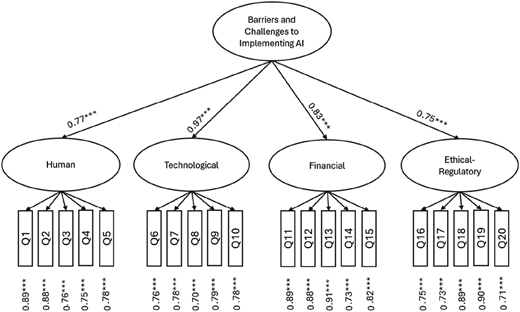
The initial section of the questionnaire included 20 statements rated on a Likert scale, organized into four subscales: human, technological, financial, and ethical-regulatory barriers and challenges to AI implementation in KMSs. Each subscale comprised five items, and a composite score was calculated to evaluate overall perceived barriers and challenges. The subscales demonstrated strong internal consistency: human (α = 0.75), technological (α = 0.71), financial (α = 0.80), and ethical-regulatory (α = 0.76). The overall scale showed excellent internal consistency (α = 0.90). To evaluate construct validity, we used Confirmatory Factor Analysis (CFA) within a Structural Equation Modeling (SEM) framework, performed using R software (version 4.3) and R-Studio (R Core Team, 2023).

The Lavaan package (Rosseel, 2012) was employed to construct a second-order model. In this model, each questionnaire subscale was treated as a latent construct, with the overall perception of AI's barriers and challenges modeled as a second-order construct encompassing all four subscales. The results, presented in Figure 1, indicate an acceptable model fit, as evidenced by the following indices: CFI (0.913), TLI (0.906), RMSEA (0.067), and SRMR (0.068). These findings support the good construct validity of our questionnaire.

The study sample comprised 378 respondents, with a nearly balanced gender distribution (52.6% female, 47.4% male). Most respondents (67.5%) held academic qualifications. Participants were almost evenly distributed across small, medium, and large organizations. The service sector (33.1%) and public sector (27.8%) were the most represented. Notably, 56.1% of respondents held managerial positions, and 34.1% specialized in the KM field. Additionally, 11.9% had over 20 years of seniority. The average age of participants was 41.97 years (SD 10.68). A complete segmentation of the sample is presented in Table 1.

Data analysis was performed using IBM SPSS Statistics (Version 28) and R (Version 4.3). The internal consistency of the study questionnaire was assessed through Cronbach's alpha coefficients. CFA was utilized to evaluate the construct validity of the questionnaire. To address the specific research questions, various statistical tests were conducted, including repeated-measures ANOVA, independent-samples t-tests, multivariate analysis of variance (MANOVA), Pearson's correlations, and Spearman's rank-order correlations. A significance level of α = 0.05 was maintained for all statistical analyses.

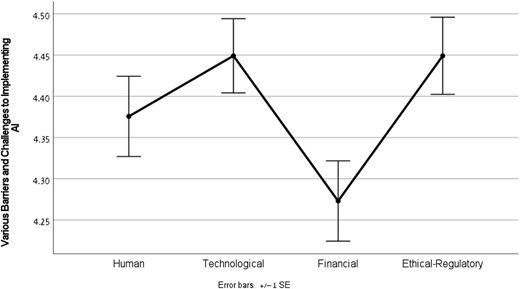
We initially analyzed the perceptions of the different types of barriers and challenges associated with AI-KMSs integration across the four sub-scales. A repeated-measures ANOVA revealed a significant main effect for the sub-scale (F(3, 1131) = 6.72, p < 0.001). Bonferroni pairwise comparison analysis found that integration of AI with KMSs in organizations was significantly estimated to invite more technological (M = 4.45, SD = 0.87) and ethical-regulatory (M = 4.45, SD 0.95) barriers and challenges, compared to financial ones (M = 4.27, SD = 0.95), with all p's < 0.001. Human barriers and challenges (M = 4.38, SD 0.94) did not show significant differences compared to the other three sub-scales. These findings, illustrated in Figure 2, provide robust support for hypothesis H1.

An independent samples t-test was conducted to examine the effect of role (employee vs. manager) on the perceived barriers and challenges to integrating AI into KMSs. All five perception scores (total score and four sub-scales) served as dependent variables. The results indicated a significant main effect of organizational role. Compared to employees, managers tended to report significantly more human barriers and challenges (t(376) = 1.92, p = 0.031), and lower financial ones (t(376) = 1.84, p = 0.039). Differences between managers and employees did not reach a level of significance for technological (t(376) = 0.82, p = 0.205) and ethical-regulatory (t(376) = 0.78, p = 0.219) barriers and challenges. These findings, detailed in Table 2, refute the hypothesis H2.

An independent samples t-test was conducted to examine the effect of expertise in KM (yes vs. no) on the perceived barriers and challenges to integrating AI into KMSs. All five perception scores (total score and four sub-scales) served as dependent variables. The results indicated a significant main effect of KM expertise. Knowledge managers tended to report technological barriers and challenges significantly more than non-knowledge managers (t(376) = 1.75, p = 0.041). The differences concerning the human (t(376) = 0.08, p = 0.470), financial (t(376) = 0.23, p = 0.410), and ethical-regulatory (t(376) = 0.51, p = 0.306) barriers and challenges were not significant. These findings, as detailed in Table 3, provide evidence supporting hypothesis H3.

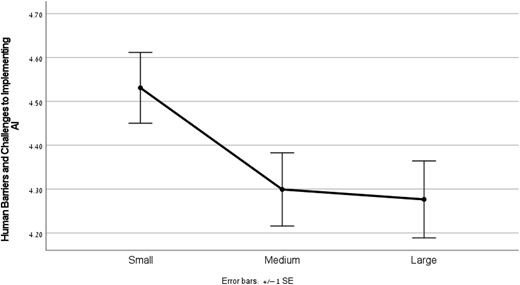
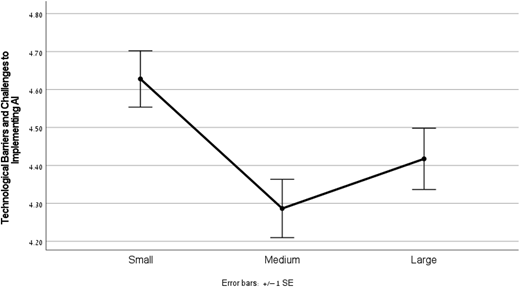
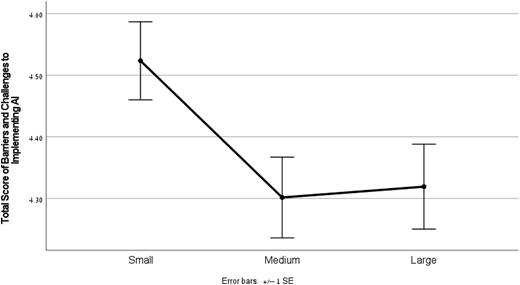
A MANOVA analysis investigated the influence of organization size (small, medium, and large) on the perceived evaluation of barriers and challenges involved in integrating AI technologies in KMSs. The analysis encompassed all five scores (total score and four sub-scales) as dependent variables. Significant main effects emerged for organization size on human barriers and challenges (F(2, 375) = 2.91, p 0.050), technological barriers and challenges (F(2, 375) = 5.21, p = 0.006), and the total score (F(2, 375) = 3.66, p = 0.027). Bonferroni post-hoc tests indicated that small organizations perceived significantly higher levels of human barriers and challenges compared to medium-sized (p = 0.047) and large (p = 0.034) organizations. No significant difference was observed between medium-sized and large organizations (p = 0.852) (see Figure 3). Moreover, our findings indicate that small organizations perceived significantly higher technological barriers and challenges compared to medium-sized organizations (p = 0.002), but not when compared to large organizations (p = 0.167) (see Figure 4). The overall perception score of barriers and challenges to implementing AI in KMSs was higher for small organizations compared to medium-sized (p = 0.015) and large organizations (p = 0.030) (see Figure 5). No significant differences were observed in financial (p = 0.112) and ethical-regulatory (p = 0.456) barriers and challenges between organizations of different sizes. Consequently, the data provided only partial support for hypothesis H4

An independent samples t-test investigated the influence of educational background (graduated vs. non-graduated) on the perceived barriers and challenges to integrating AI into KMSs. The analysis encompassed all five perception scores (total score and four sub-scales) as dependent variables. The results indicated a significant main effect of education on human (t(376) = 1.65, p = 0.050), financial (t(376) = 2.00, p = 0.023), and ethical-regulatory (t(376) = 1.94, p = 0.026) barriers and challenges. Graduates, compared to non-graduates, reported higher perceived ethical-regulatory barriers and challenges, but lower human and financial ones. No significant differences were observed in technological barriers and challenges, nor in the overall perception score of challenges and barriers to implementing AI in KMSs. These findings, as detailed in Table 4, confirm hypothesis H5 in its entirety.

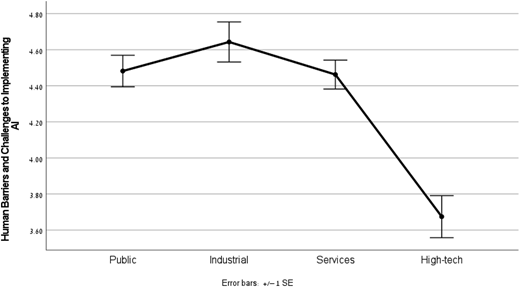
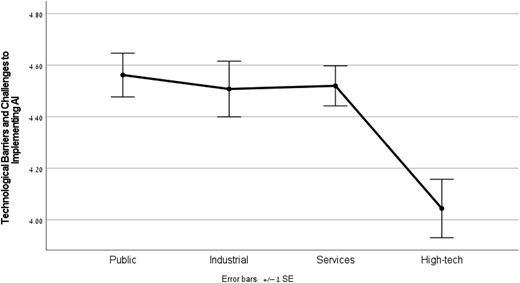
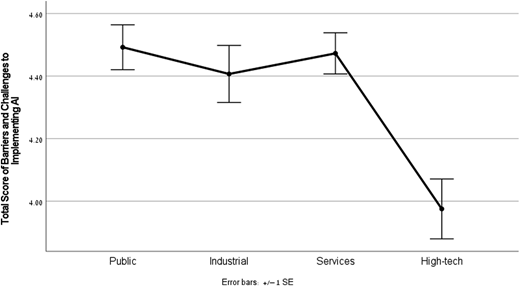
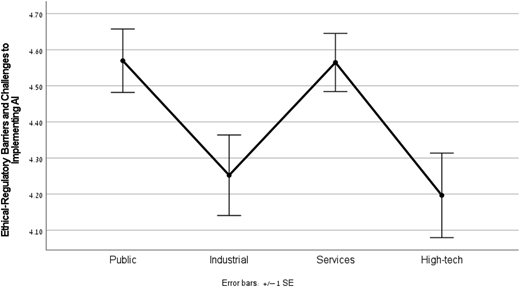
A MANOVA analysis investigated the influence of a business sector (public, industry, services, and high-tech) on the perceived evaluation of barriers and challenges involved in integrating AI technologies in KMSs. The analysis encompassed all five perception scores (total score and four sub-scales) as dependent variables. Significant main effects emerged for the sector on human (F(3, 353) = 14.87, p < 0.001), technological (F(3, 353) = 5.22, p = 0.002), and ethical-regulatory (F(3, 353) = 3.90, p = 0.009) barriers and challenges, as well as on the total score (F(3, 353) = 7.46, p < 0.001). No significant differences were observed between the business sector and financial barriers and challenges (F(3, 353) = 2.32, p = 0.075). Bonferroni post-hoc tests revealed that the high-tech sector perceived significantly lower levels of human barriers and challenges compared to the public (p < 0.001), service (p < 0.001), and industrial (p < 0.001) sectors (see Figure 6). The same pattern was obtained for technological barriers and challenges (see Figure 7) and the total score (see Figure 8), with the high-tech sector reported lower perceptions compared to the public, service, and industrial sectors (all p's < 0.001). Additionally, the public and services sectors reported significantly higher ethical-regulatory barriers and challenges compared to high-tech (p = 0.011, p = 0.010, respectively) and industrial (p = 0.026, p = 0.024, respectively) sectors (see Figure 9). Considering the above, the hypothesis H6 was supported by the data.

Our analysis revealed no significant effects of gender, age, and seniority on the perceived barriers and challenges to integrating AI into KMSs (including all four sub-scales and the total score; all p-values >0.05). Independent samples t-tests were conducted for gender, while Spearman's rank-order correlation coefficients assessed the relationships between the age of the respondent or their seniority in the organization with the barriers and challenges. These results fully confirm hypotheses H7, H8, and H9

Successful integration of AI within KMSs requires aligning business processes with structured implementation strategies and proactive change management. This alignment ensures that technological capabilities become embedded in everyday knowledge workflows and remain sustainable over time. The findings reveal that technological and ethical-regulatory barriers were perceived as more salient than financial ones. Managers emphasized human-related hurdles such as resistance to change and skills gaps, whereas knowledge managers highlighted integration risks and workflow misalignment. Smaller organizations reported greater human and technological difficulties, graduates demonstrated heightened sensitivity to ethical-regulatory issues, and high-tech organizations perceived fewer obstacles overall. Perceptions did not differ meaningfully by gender, age, or seniority. Taken together, these patterns portray AI-KMS integration as a socio-technical endeavor shaped by role, expertise, sector, organizational size, and educational background.

This study contributes to the literature by addressing a persistent empirical gap at the intersection of AI and KM, an area where research remains notably sparse (Bencsik, 2021; Nakash and Bolisani, 2024; Purba et al., 2024; Taherdoost and Madanchian, 2023; Zbuchea et al., 2019). By systematically examining how employees and managers perceive barriers and challenges to integrating AI into KMSs, the study shifts the analytical focus from technical performance or post-implementation outcomes to pre-implementation socio-cognitive dynamics. These perceptions provide theoretically meaningful early indicators of organizational readiness, cultural maturity, alignment, and latent resistance, offering insight into how AI may – or may not – be successfully embedded to enhance KMPs within organizational environments.

The findings further advance theory by conceptualizing AI-KMS integration as a process-oriented transformation rather than a uniform or generic adoption phenomenon. Variations in perceived obstacles across organizational roles, KM expertise, organizational size, educational background, and business sector demonstrate that integration dynamics are shaped by context-sensitive logics rather than uniform determinants. In this way, the study refines established frameworks such as TAM (Gerlich, 2023), DOI (Mariani et al., 2023; Rogers, 2003), and TOE (Arpaci et al., 2012; Radhakrishnan and Chattopadhyay, 2020) by revealing role-dependent and structural factors that challenge assumptions of homogeneous diffusion. This contribution strengthens socio-technical perspectives on advanced IT integration in knowledge-intensive environments (Maier, 2007) by empirically grounding them in the distinctive dynamics of AI-enabled KMSs.

From a practical perspective, the study emphasizes that effective AI integration within KMSs requires context-sensitive implementation strategies that extend beyond purely technical deployment and must be embedded within structured change management processes. The findings indicate systematic variation in perceived barriers across organizational and structural conditions, revealing distinct patterns in how integration challenges are understood – suggesting that a “one-size-fits-all” approach is unlikely to be effective. In particular, for smaller organizations and among managers – who tended to emphasize human-related challenges – initiating workforce development initiatives aimed at skill-building and strengthening AI orientation is critical for reducing resistance and supporting alignment between AI capabilities and existing knowledge workflows.

Consistent with prior research (Benbya et al., 2020; Campion et al., 2022; Ghobakhloo et al., 2012; Kurup and Gupta, 2022; Sharma, 2024), the study suggests that AI-KMS integration entails broader organizational considerations that extend beyond a discrete IT initiative. The variation observed across human, technological, financial, and ethical-regulatory perceptions indicates that integration efforts are likely to intersect with multiple organizational functions and priorities. Importantly, the pronounced sensitivity to ethical-regulatory issues among certain groups highlights the need for particular attention to governance, transparency, and responsible data practices when planning AI-KMS integration. Taken together, these findings suggest that organizations should tailor their implementation approaches to relevant organizational and individual characteristics, ensuring that strategies address the challenges most salient in their context.

Despite the valuable insights offered by this study, several limitations should be acknowledged to guide future research. The reliance on self-reported data introduces potential response bias, as interpretations of survey items may have influenced the participants' responses. Since the study focuses on perceptions rather than actual organizational practices, it is important to note that real integration processes may shift depending on hierarchical decision-making structures and on how decision-makers respond in practice to barriers and challenges that emerge during AI-KMS implementation. Future studies could benefit from mixed methods, combining quantitative surveys with qualitative interviews or observational studies to gain a deeper understanding of the barriers and challenges associated with AI integration in KMSs. Additionally, the cross-sectional design provides a snapshot of perceptions at a single point in time, potentially missing the evolution of these perceptions as AI technologies develop.

Longitudinal studies would also be valuable for examining how attitudes and experiences evolve over time, especially as organizations gain more experience with AI integration with KMSs. The generalizability of this study is also limited by the specific organizational contexts sampled. Future research could expand the scope by including companies in other countries, with unique constraints and challenges in adopting advanced technologies. Examining additional cultural contexts also would provide insight into how cultural attitudes toward technology influence AI adoption for optimal KM. Finally, future research should explore AI applications that directly support decision-making, as these tools may raise distinct practical and organizational considerations not captured through perceptions alone.

Part I – Barriers and Challenges in Implementing AI in KM Systems

Please indicate how much you agree with each of the following statements:

Part II – Occupational Details

  1. What is your seniority in your current organization?

    • Up to Two Years

    • Over 2 years and up to 5 years

    • Over 5 years and up to 10 years

    • Over 10 years and up to 15 years

    • Over 15 years and up to 20 years

    • Over 20 years

  2. What is the approximate number of employees in the organization you belong to?

    • A small organization, with less than 100 employees

    • Medium-sized organization, between 100 and 2,500 employees

    • A large organization, with over 2,500 employees

  3. Which business sector does your organization belong to? [Choose the most suitable definition in your opinion]

    • Public sector (An organization maintained by the state or local authority)

    • Industrial sector (An organization engaged in manufacturing and industry)

    • Services sector (An organization that provides various services, including financial, health, education, and more)

    • High-tech sector (Technology, research, and development organization)

    • Other ___

  4. Which division do you work in within the organization? [Choose the definition that best fits your opinion]

    • Digital and Information

    • Human Resources, Training, and Professional Development

    • Marketing and Sales

    • Operations and Logistics

    • Finance and Accounting

    • Research and Development

    • Customer Service

    • Legal

    • Communications and Public Relations

    • Strategy and Headquarters

  5. What is your role in the organization?

    • Employee, without managerial responsibility

    • Middle management level manager

    • Senior management level manager

  6. Do you specialize in KM in your role?

    • Yes

    • No

  7. [If the respondent indicated that they have KM expertise]:

How many years of accumulated experience do you have in the KM field?

__________

Part III – Demographic Details

  1. Sex:

    • Male

    • Female

  2. Age:

    • __________

  3. Education:

    • High school or lower level

    • Post-secondary or certificate studies

    • Bachelor's degree

    • Master's degree

    • Doctorate degree

Do you have anything to add regarding the risks of integrating AI into KM in the organizational context?

______________________________________________________________________________________________________________________________________________________________________________________________________________________________________________________

Thank you very much for your cooperation!
Abbasi
,
M.
,
Nishat
,
R.I.
,
Bond
,
C.
,
Graham-Knight
,
J.B.
,
Lasserre
,
P.
,
Lucet
,
Y.
and
Najjaran
,
H.
(
2025
), “
A review of AI and machine learning contribution in business process management (process enhancement and process improvement approaches)
”,
Business Process Management Journal
, Vol. 
31
No. 
4
, pp. 
1414
-
1452
, doi: .
Achruh
,
A.
,
Rapi
,
M.
,
Rusdi
,
M.
and
Idris
,
R.
(
2024
), “
Challenges and opportunities of artificial intelligence adoption in Islamic education in Indonesian higher education institutions
”,
International Journal of Learning, Teaching and Educational Research
, Vol. 
23
No. 
11
, pp.
423
-
443
, doi: .
Ajzen
,
I.
(
1991
), “
The theory of planned behavior
”,
Organizational Behavior and Human Decision Processes
, Vol. 
50
No. 
2
, pp.
179
-
211
.
Alavi
,
M.
,
Leidner
,
D.
and
Mousavi
,
R.
(
2024
), “
Knowledge management perspective of generative artificial intelligence (GenAI)
”,
Alavi, Maryam
, pp. 
1
-
12
, doi: .
Arpaci
,
I.
,
Yardimci
,
Y.C.
,
Ozkan
,
S.
and
Turetken
,
O.
(
2012
), “
Organizational adoption of information technologies: a literature review
”,
International Journal of eBusiness and eGovernment Studies
, Vol. 
4
No. 
2
, pp. 
37
-
50
.
Atchley
,
P.
,
Pannell
,
H.
,
Wofford
,
K.
,
Hopkins
,
M.
and
Atchley
,
R.A.
(
2024
), “
Human and AI collaboration in the higher education environment: opportunities and concerns
”,
Cognitive Research: Principles and Implications
, Vol. 
9
No. 
1
, p.
20
, doi: .
Baker
,
R.S.
and
Hawn
,
A.
(
2022
), “
Algorithmic bias in education
”,
International Journal of Artificial Intelligence in Education
, Vol. 
32
No. 
4
, pp. 
1
-
41
, doi: .
Barney
,
J.
(
1991
), “
Firm resources and sustained competitive advantage
”,
Journal of Management
, Vol. 
17
No. 
1
, pp. 
99
-
120
, doi: .
Benbya
,
H.
,
Davenport
,
T.H.
and
Pachidi
,
S.
(
2020
), “
Artificial intelligence in organizations: current state and future opportunities
”,
MIS Quarterly Executive
, Vol. 
19
No. 
4
,
Article 4
.
Bencsik
,
A.
(
2021
), “
The sixth generation of knowledge management–the headway of artificial intelligence
”,
Journal of International Studies
, Vol. 
14
No. 
2
, pp. 
84
-
101
, doi: .
Böhm
,
K.
and
Durst
,
S.
(
2026
), “
Knowledge management in the age of generative artificial intelligence–from SECI to GRAI
”,
VINE Journal of Information and Knowledge Management Systems
, Vol. 
56
No. 
1
, pp.
106
-
121
.
Bolisani
,
E.
and
Bratianu
,
C.
(
2017
), “
Knowledge strategy planning: an integrated approach to manage uncertainty, turbulence, and dynamics
”,
Journal of Knowledge Management
, Vol. 
21
No. 
2
, pp. 
233
-
253
, doi: .
Bolisani
,
E.
,
Scarso
,
E.
,
Ceccato
,
R.
and
Zieba
,
M.
(
2023
), “
Knowledge management implementation in small and micro KIBS: a categorization
”,
Knowledge and Process Management
, Vol. 
30
No. 
3
, pp. 
241
-
253
, doi: .
Bratianu
,
C.
(
2025
), “
The impact of artificial knowledge on designing knowledge strategies
”,
Review of International Comparative Management/Revista de Management Comparat International
, Vol. 
26
No. 
5
, pp.
847
-
857
.
Bratianu
,
C.
and
Bejinaru
,
R.
(
2019
), “
The theory of knowledge fields: a thermodynamics approach
”,
Systems
, Vol. 
7
No. 
2
, p.
20
, doi: .
Bratianu
,
C.
and
Paiuc
,
D.
(
2025
), “
Artificial knowledge: emergence of a new paradigm
”,
Saudi Journal of Business and Management Studies
, Vol. 
10
No. 
3
, pp. 
102
-
111
, doi: .
Bratianu
,
C.
,
Handzic
,
M.
and
Bolisani
,
E.
 
(Eds)
(
2023
),
The Future of Knowledge Management: Reflections from the 10th Anniversary of the International Association of Knowledge Management (IAKM)
,
Springer
.
Brougham
,
D.
and
Haar
,
J.
(
2018
), “
Smart technology, artificial intelligence, robotics, and algorithms (STARA): employees' perceptions of our future workplace
”,
Journal of Management and Organization
, Vol. 
24
No. 
2
, pp. 
239
-
257
, doi: .
Campion
,
A.
,
Gasco-Hernandez
,
M.
,
Jankin Mikhaylov
,
S.
and
Esteve
,
M.
(
2022
), “
Overcoming the challenges of collaboratively adopting artificial intelligence in the public sector
”,
Social Science Computer Review
, Vol. 
40
No. 
2
, pp. 
462
-
477
, doi: .
Campos Zabala
,
F.J.
(
2023a
), “Responsible AI understanding the ethical and regulatory implications of AI”, in
Grow Your Business with AI: a First Principles Approach for Scaling Artificial Intelligence in the Enterprise
,
Apress
,
Berkeley, CA
, pp. 
453
-
477
.
Campos Zabala
,
F.J.
(
2023b
), “The barriers for implementing AI”, in
Grow Your Business with AI: a First Principles Approach for Scaling Artificial Intelligence in the Enterprise
,
Apress
,
Berkeley, CA
, pp. 
85
-
110
.
Chatterjee
,
S.
,
Mikalef
,
P.
,
Khorana
,
S.
and
Kizgin
,
H.
(
2024
), “
Assessing the implementation of AI integrated CRM system for B2C relationship management: integrating contingency theory and dynamic capability view theory
”,
Information Systems Frontiers
, Vol. 
26
No. 
3
, pp. 
967
-
985
, doi: .
Cohen
,
W.M.
and
Levinthal
,
D.A.
(
1990
), “
Absorptive capacity: a new perspective on learning and innovation
”,
Administrative Science Quarterly
, Vol. 
35
No. 
1
, pp. 
128
-
152
, doi: .
Dabija
,
D.C.
and
Vătămănescu
,
E.M.
(
2023
), “
Artificial intelligence: the future is already here
”,
Oeconomia Copernicana
, Vol. 
14
No. 
4
, pp. 
1053
-
1056
, doi: .
Davenport
,
T.H.
and
Ronanki
,
R.
(
2018
), “
Artificial intelligence for the real world
”,
Harvard Business Review
, Vol. 
96
No. 
1
, pp. 
108
-
116
.
Debowy
,
M.
,
Epstein
,
G.S.
,
Bental
,
B.
,
Weiss
,
A.
and
Weinreb
,
A.
(
2024
), “
Artificial intelligence and the Israeli labor market
”,
The Taub Center for Social Policy Studies in Israel
.
Dwivedi
,
Y.K.
,
Hughes
,
L.
,
Ismagilova
,
E.
,
Aarts
,
G.
,
Coombs
,
C.
,
Crick
,
T.
,
Duan
,
Y.
,
Dwivedi
,
R.
,
Edwards
,
J.
,
Eirug
,
A.
,
Galanos
,
V.
,
Ilavarasan
,
P.V.
,
Janssen
,
M.
,
Jones
,
P.
,
Kar
,
A.K.
,
Kizgin
,
H.
,
Kronemann
,
B.
,
Lal
,
B.
,
Lucini
,
B.
,
Medaglia
,
R.
,
Le Meunier-FitzHugh
,
K.
,
Le Meunier-FitzHugh
,
L.C.
,
Misra
,
S.
,
Mogaji
,
E.
,
Sharma
,
S.K.
,
Singh
,
J.B.
,
Raghavan
,
V.
,
Raman
,
R.
,
Rana
,
N.P.
,
Samothrakis
,
S.
,
Spencer
,
J.
,
Tamilmani
,
K.
,
Tubadji
,
A.
,
Walton
,
P.
and
Williams
,
M.D.
(
2021
), “
Artificial intelligence (AI): multidisciplinary perspectives on emerging challenges, opportunities, and agenda for research, practice and policy
”,
International Journal of Information Management
, Vol. 
57
, 101994, doi: .
Gerlich
,
M.
(
2023
), “
Perceptions and acceptance of artificial intelligence: a multi-dimensional study
”,
Social Sciences
, Vol. 
12
No. 
9
, p.
502
, doi: .
Ghobakhloo
,
M.
,
Hong
,
T.S.
,
Sabouri
,
M.S.
and
Zulkifli
,
N.
(
2012
), “
Strategies for successful information technology adoption in small and medium-sized enterprises
”,
Information
, Vol. 
3
No. 
1
, pp. 
36
-
67
, doi: .
Hassan
,
M.
,
Kushniruk
,
A.
and
Borycki
,
E.
(
2024
), “
Barriers to and facilitators of artificial intelligence adoption in health care: scoping review
”,
JMIR Human Factors
, Vol. 
11
, e48633, doi: .
Hislop
,
D.
,
Bosua
,
R.
and
Helms
,
R.
(
2018
),
Knowledge Management in Organizations: a Critical Introduction
,
Oxford University Press
,
Oxford
.
Jarrahi
,
M.H.
,
Askay
,
D.
,
Eshraghi
,
A.
and
Smith
,
P.
(
2023a
), “
Artificial intelligence and knowledge management: a partnership between human and AI
”,
Business Horizons
, Vol. 
66
No. 
1
, pp. 
87
-
99
, doi: .
Jarrahi
,
M.H.
,
Lutz
,
C.
,
Boyd
,
K.
,
Oesterlund
,
C.
and
Willis
,
M.
(
2023b
), “
Artificial intelligence in the work context
”,
Journal of the Association for Information Science and Technology
, Vol. 
74
No. 
3
, pp. 
303
-
310
, doi: .
Jensen
,
M.C.
and
Meckling
,
W.H.
(
2019
), “Theory of the firm: managerial behavior, agency costs and ownership structure”, in
Corporate Governance
,
Gower
, pp. 
77
-
132
.
Kaplan
,
A.
and
Haenlein
,
M.
(
2020
), “
Rulers of the world, unite! the challenges and opportunities of artificial intelligence
”,
Business Horizons
, Vol. 
63
No. 
1
, pp. 
37
-
50
, doi: .
Katz
,
Y.
(
2018
), “
Technology and innovation in Israel: advancing competitive position in a global environment
”,
Open Journal of Political Science
, Vol. 
8
No. 
4
, pp. 
536
-
546
, doi: .
Kirchner
,
K.
,
Bolisani
,
E.
,
Kassaneh
,
T.C.
,
Scarso
,
E.
and
Taraghi
,
N.
(
2025
), “
Generative AI meets knowledge management: insights from software development practices
”,
Knowledge and Process Management
, Vol. 
32
No. 
4
, pp. 
223
-
235
, doi: .
Kurup
,
S.
and
Gupta
,
V.
(
2022
), “
Factors influencing the AI adoption in organizations
”,
Metamorphosis
, Vol. 
21
No. 
2
, pp. 
129
-
139
, doi: .
Maggor
,
E.
and
Frenkel
,
M.
(
2022
), “The start-up nation: myths and reality”, in
Routledge Handbook on Contemporary Israel
,
Routledge
, pp. 
423
-
435
.
Maier
,
R.
(
2007
),
Knowledge Management Systems: Information and Communication Technologies for Knowledge Management
, (3rd ed.) ,
Springer-Verlag
,
Berlin; Heidelberg
,
ISBN: 978-3-540-71407-1
.
Majumder
,
S.
and
Dey
,
N.
(
2022
),
AI-empowered Knowledge Management
,
Springer
,.
Mariani
,
M.M.
,
Machado
,
I.
,
Magrelli
,
V.
and
Dwivedi
,
Y.K.
(
2023
), “
Artificial intelligence in innovation research: a systematic review, conceptual framework, and future research directions
”,
Technovation
, Vol. 
122
, 102623, doi: .
Marocco
,
S.
,
Barbieri
,
B.
and
Talamo
,
A.
(
2024
), “
Exploring facilitators and barriers to managers' adoption of AI-Based systems in decision making: a systematic review
”,
AI
, Vol. 
5
No. 
4
, pp. 
2538
-
2567
, doi: .
Mashiah
,
I.
(
2024
), “
Israeli tech entrepreneurship: glorification of business exits in the media
”,
Israel Affairs
, Vol. 
30
No. 
2
, pp. 
264
-
285
, doi: .
Mendelson-Maoz
,
A.
(
2015
),
Multiculturalism in Israel: Literary Perspectives
,
Purdue University Press
,
available at:
 https://www.press.purdue.edu/9781557536808/
Minishi-Majanja
,
M.K.
and
Kiplang'at
,
J.
(
2005
), “
The diffusion of innovations theory as a theoretical framework in library and information science research
”,
South African Journal of Libraries and Information Science
, Vol. 
71
No. 
3
, pp. 
211
-
224
.
Mohajan
,
H.K.
(
2020
), “
Quantitative research: a successful investigation in natural and social sciences
”,
Journal of Economic Development, Environment and People
, Vol. 
9
No. 
4
, pp. 
50
-
79
, doi: .
Nair
,
M.
,
Svedberg
,
P.
,
Larsson
,
I.
and
Nygren
,
J.M.
(
2024
), “
A comprehensive overview of barriers and strategies for AI implementation in healthcare: mixed-method design
”,
PLoS One
, Vol. 
19
No. 
8
, e0305949, doi: .
Nakash
(
2024
), “‘
A profession that is a story': blurred professional identity of CKO's
”,
Knowledge Management Research and Practice
, pp. 
1
-
11
, doi: .
Nakash
,
M.
and
Bolisani
,
E.
(
2024
), “
Knowledge management meets artificial intelligence: a systematic review and future research agenda
”,
European Conference on Knowledge Management
, Vol. 
25
No. 
1
, pp. 
544
-
552
, doi: .
Nakash
,
M.
and
Bolisani
,
E.
(
2025
), “
The transformative impact of AI on knowledge management processes
”,
Business Process Management Journal
, Vol. 
31
No. 
8
, pp. 
124
-
147
, doi: .
Nakash
,
M.
and
Bouhnik
,
D.
(
2023
), “
The effects of COVID‐19 on information management in remote and hybrid work environments
”,
Journal of the Association for Information Science and Technology
, Vol. 
74
No. 
9
, pp. 
1067
-
1080
, doi: .
Nakash
,
M.
,
Baruchson‐Arbib
,
S.
and
Bouhnik
,
D.
(
2023
), “
Seven‐layer model for creating organizational KM excellence
”,
Proceedings of the Association for Information Science and Technology
, Vol. 
60
No. 
1
, pp. 
1083
-
1085
, doi: .
Nayak
,
M.S.D.P.
and
Narayan
,
K.A.
(
2019
), “
Strengths and weaknesses of online surveys
”,
Journal of Humanities and Social Sciences
, Vol. 
6
No. 
7
, pp. 
31
-
38
.
Neumann
,
O.
,
Guirguis
,
K.
and
Steiner
,
R.
(
2024
), “
Exploring artificial intelligence adoption in public organizations: a comparative case study
”,
Public Management Review
, Vol. 
26
No. 
1
, pp.
114
-
141
.
Østerlund
,
C.
,
Jarrahi
,
M.H.
,
Willis
,
M.
,
Boyd
,
K.
and
Wolf
,
C.T.
(
2021
), “
Artificial intelligence and the world of work, a co‐constitutive relationship
”,
Journal of the Association for Information Science and Technology
, Vol. 
72
No. 
1
, pp. 
128
-
135
, doi: .
Palaniappan
,
K.
,
Lin
,
E.Y.T.
,
Vogel
,
S.
and
Lim
,
J.C.
(
2024
), “
Gaps in the global regulatory frameworks for the use of artificial intelligence (AI) in the healthcare services sector and key recommendations
”,
Healthcare
, Vol. 
12
No. 
17
, p.
1730
, doi: .
Peeler
,
R.
(
2023
), “
The hidden costs of implementing AI in enterprise
”,
Forbes
,
available at:
 https://www.forbes.com/councils/forbestechcouncil/2023/08/31/the-hidden-costs-of-implementing-ai-in-enterprise/
Prasad Agrawal
,
K.
(
2024
), “
Towards adoption of generative AI in organizational settings
”,
Journal of Computer Information Systems
, Vol. 
64
No. 
5
, pp. 
636
-
651
, doi: .
Purba
,
C.A.
,
Kai
,
G.
and
Al-Hosaini
,
F.F.
(
2024
), “
Critically reviewing the integration of knowledge management (KM) and artificial intelligence (AI): future trends and implications
”,
Journal of Organizational Behavior Management
,
Special Issue April
, doi: .
Queirós
,
A.
,
Faria
,
D.
and
Almeida
,
F.
(
2017
), “
Strengths and limitations of qualitative and quantitative research methods
”,
European Journal of Education Studies
, Vol. 
3
No. 
9
, pp.
369
-
387
.
Radhakrishnan
,
J.
and
Chattopadhyay
,
M.
(
2020
), “
Determinants and barriers of artificial intelligence adoption–A literature review
”,
Re-imagining Diffusion and Adoption of Information Technology and Systems: A Continuing Conversation: IFIP WG 8.6 International Conference on Transfer and Diffusion of IT, TDIT 2020, Tiruchirappalli, India, December 18-19, 2020, Proceedings, Part I
,
Springer International Publishing
, pp. 
89
-
99
.
Roberts
,
H.
,
Hine
,
E.
,
Taddeo
,
M.
and
Floridi
,
L.
(
2024
), “
Global AI governance: barriers and pathways forward
”,
International Affairs
, Vol. 
100
No. 
3
, pp. 
1275
-
1286
, doi: .
Rogers
,
E.M.
(
2003
),
Diffusion of Innovations
, ((5th ed.)) ,
Free Press
,
New York, NY
.
Rosseel
,
Y.
(
2012
), “
Lavaan: an R package for structural equation modeling
”,
Journal of Statistical Software
, Vol. 
48
No. 
2
, pp. 
1
-
36
, doi: .
Salem
,
M.
,
Salloum
,
S.A.
and
Shaalan
,
K.
(
2024
), “Exploiting ai's potential in knowledge management”, in
Artificial Intelligence in Education: the Power and Dangers of ChatGPT in the Classroom
, pp. 
283
-
299
.
Sartori
,
L.
and
Theodorou
,
A.
(
2022
), “
A sociotechnical perspective for the future of AI: narratives, inequalities, and human control
”,
Ethics and Information Technology
, Vol. 
24
No. 
1
, p.
4
, doi: .
Scarso
,
E.
and
Bolisani
,
E.
(
2024
), “
Knowledge management processes and innovation phases: insights from metalworking SMEs
”,
Knowledge Management Research and Practice
, Vol. 
22
No. 
4
, pp. 
377
-
387
, doi: .
Schepman
,
A.
and
Rodway
,
P.
(
2023
), “
The general attitudes towards artificial intelligence scale (GAAIS): confirmatory validation and associations with personality, corporate distrust, and general trust
”,
International Journal of Human-Computer Interaction
, Vol. 
39
No. 
13
, pp. 
2724
-
2741
, doi: .
Sengar
,
S.S.
,
Hasan
,
A.B.
,
Kumar
,
S.
and
Carroll
,
F.
(
2024
), “
Generative artificial intelligence: a systematic review and applications
”,
Multimedia Tools and Applications
, Vol. 
84
No. 
21
, pp. 
1
-
40
, doi: .
Sharma
,
R.
(
2024
), “AI change management”, in
AI and the Boardroom: Insights into Governance, Strategy, and the Responsible Adoption of AI
,
Apress
,
Berkeley, CA
, pp. 
135
-
150
.
Sharma
,
M.
,
Luthra
,
S.
,
Joshi
,
S.
and
Kumar
,
A.
(
2022
), “
Implementing challenges of artificial intelligence: evidence from public manufacturing sector of an emerging economy
”,
Government Information Quarterly
, Vol. 
39
No. 
4
, 101624, doi: .
Stahl
,
B.C.
(
2021
), “Artificial intelligence for a better future: an ecosystem perspective on the ethics of AI and emerging digital technologies”, p.
124
,
Springer Nature
.
Storey
,
V.C.
(
2025
), “
Knowledge management in a world of generative AI: impact and implications
”,
ACM Transactions on Management Information Systems
, Vol. 
16
No. 
3
, pp.
1
-
14
.
Sumbal
,
M.S.
and
Amber
,
Q.
(
2025
), “
ChatGPT: a game changer for knowledge management in organizations
”,
Kybernetes
, Vol. 
54
No. 
6
, pp. 
3217
-
3237
, doi: .
Svetlova
,
E.
(
2022
), “
AI ethics and systemic risks in finance
”,
AI and Ethics
, Vol. 
2
No. 
4
, pp. 
713
-
725
, doi: .
Taherdoost
,
H.
and
Madanchian
,
M.
(
2023
), “
Artificial intelligence and knowledge management: impacts, benefits, and implementation
”,
Computers
, Vol. 
12
No. 
4
, p.
72
, doi: .
Vasiliu
,
V.
and
Yavetz
,
G.
(
2026
), “
Who’s afraid of AI? Socio-technological perspectives on artificial intelligence in the workforce: an Israeli case study
”,
Aslib Journal of Information Management
, Vol. 
78
No. 
1
, pp.
49
-
64
.
Venkatesh
,
V.
,
Morris
,
M.G.
,
Davis
,
G.B.
and
Davis
,
F.D.
(
2003
), “
User acceptance of information technology: toward a unified view
”,
MIS Quarterly
, Vol. 
27
No. 
3
, pp. 
425
-
478
, doi: .
Wang
,
X.
,
Zhang
,
X.
,
Cheng
,
Y.
,
Tian
,
F.
,
Chen
,
K.
and
de Pablos
,
P.O.
(
2022
),
Artificial intelligence-enabled Knowledge Management
,
The Routledge Companion to Knowledge Management
, pp. 
153
-
168
.
Wang
,
X.
,
Lin
,
X.
and
Shao
,
B.
(
2023
), “
Artificial intelligence changes the way we work: a close look at innovating with chatbots
”,
Journal of the Association for Information Science and Technology
, Vol. 
74
No. 
3
, pp. 
339
-
353
, doi: .
Zbuchea
,
A.
,
Vidu
,
C.
and
Pinzaru
,
F.
(
2019
), “
Is artificial intelligence changing knowledge management
”,
Strategica
, pp. 
445
-
452
.
Zebec
,
A.
and
Indihar Štemberger
,
M.
(
2024
), “
Creating AI business value through BPM capabilities
”,
Business Process Management Journal
, Vol. 
30
No. 
8
, pp. 
1
-
26
, doi: .
Published by Emerald Publishing Limited. This article is published under the Creative Commons Attribution (CC BY 4.0) licence. Anyone may reproduce, distribute, translate and create derivative works of this article (for both commercial and non-commercial purposes), subject to full attribution to the original publication and authors. The full terms of this licence may be seen at Link to the terms of the CC BY 4.0 licence.

Data & Figures

Figure 1

CFA Model for assessing the quality of the research questionnaire. ***p < 0.001. Source(s): Authors’ own work

Figure 1

CFA Model for assessing the quality of the research questionnaire. ***p < 0.001. Source(s): Authors’ own work

Close Figure 1
Figure 2

Differential perceptions of barriers and challenges for implementing AI in KMSs across sub-scales

Figure 2

Differential perceptions of barriers and challenges for implementing AI in KMSs across sub-scales

Close Figure 2
Figure 3

Human barriers and challenges across organizations of varying sizes

Figure 3

Human barriers and challenges across organizations of varying sizes

Close Figure 3
Figure 4

Technological barriers and challenges across organizations of varying sizes

Figure 4

Technological barriers and challenges across organizations of varying sizes

Close Figure 4
Figure 5

The overall perception score of challenges and barriers across organizations of varying sizes

Figure 5

The overall perception score of challenges and barriers across organizations of varying sizes

Close Figure 5
Figure 6

Differences between business sectors in the perceived human barriers and challenges

Figure 6

Differences between business sectors in the perceived human barriers and challenges

Close Figure 6
Figure 7

Differences between business sectors in the perceived technological barriers and challenges

Figure 7

Differences between business sectors in the perceived technological barriers and challenges

Close Figure 7
Figure 8

Differences between business sectors in the overall perception score of challenges and barriers

Figure 8

Differences between business sectors in the overall perception score of challenges and barriers

Close Figure 8
Figure 9

Differences between business sectors in the perceived ethical-regulatory barriers and challenges

Figure 9

Differences between business sectors in the perceived ethical-regulatory barriers and challenges

Close Figure 9
Table 1

Socio-demographic and organizational profile of the research sample (N = 378)

ItemValueN%
SexFemale19952.6
Male17947.4
EducationNon-graduated12332.5
Graduated25567.5
Organization SizeSmall13636.0
Medium12733.6
Large11530.4
Business SectorPublic10527.8
Industrial6517.2
Services12533.1
High-tech5915.6
Other246.3
RoleEmployee16643.9
Manager21256.1
Specialize in KMNo24965.9
Yes12934.1
Seniority<26116.1
2-<510628.1
5-<107118.8
10-<156116.1
15-<20349.0
20+4511.9
Age<306617.5
30–399625.4
40–4911831.2
50–597419.6
60+246.3
Table 2

Differences in the perception of barriers and challenges of AI implementation by organizational role (N = 378)

Perceived barriers and challenges of AI implementation in KMSs; Organizational roleEmployees n = 166Managers n = 212t-valuep-value
MSDMSD
Human4.300.944.440.951.92*0.031
Technological4.410.854.480.900.820.205
Financial4.340.854.221.021.84*0.039
Ethical-Regulatory4.490.844.420.960.780.219
Total Score4.380.704.390.780.050.487

Note(s): *p < 0.05

Table 3

Differences in the perception of barriers and challenges of AI implementation by expertise in KM (N = 378)

Perceived barriers and challenges of AI implementation in KMSs; KM expertiseNo n = 249Yes n = 129t-valuep-value
MSDMSD
Human4.380.904.371.040.080.470
Technological4.390.864.560.901.75*0.041
Financial4.270.914.291.030.230.410
Ethical-Regulatory4.430.874.480.980.510.306
Total Score4.370.704.420.820.710.238

Note(s): *p < 0.05

Table 4

Differences in the perception of the barriers at AI for KMSs by education (N = 378)

Perceived barriers and challenges of AI implementation in KMSs; educationNon-graduated n = 123Graduated n = 255t-valuep-value
MSDMSD
Human4.490.964.320.941.65*0.050
Technological4.540.854.400.891.480.070
Financial4.410.944.210.942.00*0.023
Ethical-Regulatory4.320.944.510.891.94*0.026
Total Score4.440.754.360.741.000.159

Note(s): *p < 0.05

Table A1

Human barriers and challenges

1 Strongly disagree2 Disagree3 Slightly disagree4 Slightly agree5 Agree6 Agree Strongly
1. Our management is not sufficiently aware of the capabilities and potential inherent in integrating AI into organizational KM      
2. Employees currently lack the necessary skills to fully utilize AI for enhancing KM      
3. A deep cultural change is required to adopt advanced AI applications in the organization      
4. Knowledge managers in my organization fear a loss of personal value with the widespread implementation of AI in KM processes      
5. Employees are skeptical about the potential of AI to significantly improve KM processes      
Table A2

Technological barriers and challenges

1 Strongly disagree2 Disagree3 Slightly disagree4 Slightly agree5 Agree6 Agree Strongly
6. My organization lacks adequate technological infrastructure (for example, computational processing power) to support advanced AI applications      
7. There is difficulty in integrating and interfacing AI applications with existing KM systems in the organization      
8. There may be an increasing dependency on large technology suppliers and manufacturers that dominate the AI market      
9. The leakage of sensitive information from organizational systems may materialize with the expansion of AI usage      
10. AI models are not accurate enough for acquisition, documentation, sharing, and application of the organizational knowledge      
Table A3

Financial barriers and challenges

1 Strongly disagree2 Disagree3 Slightly disagree4 Slightly agree5 Agree6 Agree Strongly
11. The cost of purchasing, implementing, and maintaining AI solutions for KM is too high for my organization      
12. Many resources are required to adapt AI applications to the organization's unique KM processes      
13. There is difficulty in defining clearly and measurably the business value that will be produced from the integration of AI in KM processes      
14. There are no measurement and assessment data for the return on investment (ROI) from AI projects dedicated to KM      
15. High costs are involved in training and converting the workforce to work with AI technologies      
Table A4

Ethical-regulatory barriers and challenges

1 Strongly disagree2 Disagree3 Slightly disagree4 Slightly agree5 Agree6 Agree Strongly
16. There are significant ethical challenges in using AI within the organization      
17. My organization lacks clear procedures for maintaining information security and privacy in AI applications      
18. Biases and hidden discrimination may seep into the decision-making process due to mistaken interpretation of reality by the algorithms      
19. There is a problem of ambiguity in relation to the responsibility for incorrect results when relying on AI recommendations      
20. There is a lack of clarity regarding the ownership of data and the rights to use it after its been processed by advanced AI tools      

Supplements

References

Abbasi
,
M.
,
Nishat
,
R.I.
,
Bond
,
C.
,
Graham-Knight
,
J.B.
,
Lasserre
,
P.
,
Lucet
,
Y.
and
Najjaran
,
H.
(
2025
), “
A review of AI and machine learning contribution in business process management (process enhancement and process improvement approaches)
”,
Business Process Management Journal
, Vol. 
31
No. 
4
, pp. 
1414
-
1452
, doi: .
Achruh
,
A.
,
Rapi
,
M.
,
Rusdi
,
M.
and
Idris
,
R.
(
2024
), “
Challenges and opportunities of artificial intelligence adoption in Islamic education in Indonesian higher education institutions
”,
International Journal of Learning, Teaching and Educational Research
, Vol. 
23
No. 
11
, pp.
423
-
443
, doi: .
Ajzen
,
I.
(
1991
), “
The theory of planned behavior
”,
Organizational Behavior and Human Decision Processes
, Vol. 
50
No. 
2
, pp.
179
-
211
.
Alavi
,
M.
,
Leidner
,
D.
and
Mousavi
,
R.
(
2024
), “
Knowledge management perspective of generative artificial intelligence (GenAI)
”,
Alavi, Maryam
, pp. 
1
-
12
, doi: .
Arpaci
,
I.
,
Yardimci
,
Y.C.
,
Ozkan
,
S.
and
Turetken
,
O.
(
2012
), “
Organizational adoption of information technologies: a literature review
”,
International Journal of eBusiness and eGovernment Studies
, Vol. 
4
No. 
2
, pp. 
37
-
50
.
Atchley
,
P.
,
Pannell
,
H.
,
Wofford
,
K.
,
Hopkins
,
M.
and
Atchley
,
R.A.
(
2024
), “
Human and AI collaboration in the higher education environment: opportunities and concerns
”,
Cognitive Research: Principles and Implications
, Vol. 
9
No. 
1
, p.
20
, doi: .
Baker
,
R.S.
and
Hawn
,
A.
(
2022
), “
Algorithmic bias in education
”,
International Journal of Artificial Intelligence in Education
, Vol. 
32
No. 
4
, pp. 
1
-
41
, doi: .
Barney
,
J.
(
1991
), “
Firm resources and sustained competitive advantage
”,
Journal of Management
, Vol. 
17
No. 
1
, pp. 
99
-
120
, doi: .
Benbya
,
H.
,
Davenport
,
T.H.
and
Pachidi
,
S.
(
2020
), “
Artificial intelligence in organizations: current state and future opportunities
”,
MIS Quarterly Executive
, Vol. 
19
No. 
4
,
Article 4
.
Bencsik
,
A.
(
2021
), “
The sixth generation of knowledge management–the headway of artificial intelligence
”,
Journal of International Studies
, Vol. 
14
No. 
2
, pp. 
84
-
101
, doi: .
Böhm
,
K.
and
Durst
,
S.
(
2026
), “
Knowledge management in the age of generative artificial intelligence–from SECI to GRAI
”,
VINE Journal of Information and Knowledge Management Systems
, Vol. 
56
No. 
1
, pp.
106
-
121
.
Bolisani
,
E.
and
Bratianu
,
C.
(
2017
), “
Knowledge strategy planning: an integrated approach to manage uncertainty, turbulence, and dynamics
”,
Journal of Knowledge Management
, Vol. 
21
No. 
2
, pp. 
233
-
253
, doi: .
Bolisani
,
E.
,
Scarso
,
E.
,
Ceccato
,
R.
and
Zieba
,
M.
(
2023
), “
Knowledge management implementation in small and micro KIBS: a categorization
”,
Knowledge and Process Management
, Vol. 
30
No. 
3
, pp. 
241
-
253
, doi: .
Bratianu
,
C.
(
2025
), “
The impact of artificial knowledge on designing knowledge strategies
”,
Review of International Comparative Management/Revista de Management Comparat International
, Vol. 
26
No. 
5
, pp.
847
-
857
.
Bratianu
,
C.
and
Bejinaru
,
R.
(
2019
), “
The theory of knowledge fields: a thermodynamics approach
”,
Systems
, Vol. 
7
No. 
2
, p.
20
, doi: .
Bratianu
,
C.
and
Paiuc
,
D.
(
2025
), “
Artificial knowledge: emergence of a new paradigm
”,
Saudi Journal of Business and Management Studies
, Vol. 
10
No. 
3
, pp. 
102
-
111
, doi: .
Bratianu
,
C.
,
Handzic
,
M.
and
Bolisani
,
E.
 
(Eds)
(
2023
),
The Future of Knowledge Management: Reflections from the 10th Anniversary of the International Association of Knowledge Management (IAKM)
,
Springer
.
Brougham
,
D.
and
Haar
,
J.
(
2018
), “
Smart technology, artificial intelligence, robotics, and algorithms (STARA): employees' perceptions of our future workplace
”,
Journal of Management and Organization
, Vol. 
24
No. 
2
, pp. 
239
-
257
, doi: .
Campion
,
A.
,
Gasco-Hernandez
,
M.
,
Jankin Mikhaylov
,
S.
and
Esteve
,
M.
(
2022
), “
Overcoming the challenges of collaboratively adopting artificial intelligence in the public sector
”,
Social Science Computer Review
, Vol. 
40
No. 
2
, pp. 
462
-
477
, doi: .
Campos Zabala
,
F.J.
(
2023a
), “Responsible AI understanding the ethical and regulatory implications of AI”, in
Grow Your Business with AI: a First Principles Approach for Scaling Artificial Intelligence in the Enterprise
,
Apress
,
Berkeley, CA
, pp. 
453
-
477
.
Campos Zabala
,
F.J.
(
2023b
), “The barriers for implementing AI”, in
Grow Your Business with AI: a First Principles Approach for Scaling Artificial Intelligence in the Enterprise
,
Apress
,
Berkeley, CA
, pp. 
85
-
110
.
Chatterjee
,
S.
,
Mikalef
,
P.
,
Khorana
,
S.
and
Kizgin
,
H.
(
2024
), “
Assessing the implementation of AI integrated CRM system for B2C relationship management: integrating contingency theory and dynamic capability view theory
”,
Information Systems Frontiers
, Vol. 
26
No. 
3
, pp. 
967
-
985
, doi: .
Cohen
,
W.M.
and
Levinthal
,
D.A.
(
1990
), “
Absorptive capacity: a new perspective on learning and innovation
”,
Administrative Science Quarterly
, Vol. 
35
No. 
1
, pp. 
128
-
152
, doi: .
Dabija
,
D.C.
and
Vătămănescu
,
E.M.
(
2023
), “
Artificial intelligence: the future is already here
”,
Oeconomia Copernicana
, Vol. 
14
No. 
4
, pp. 
1053
-
1056
, doi: .
Davenport
,
T.H.
and
Ronanki
,
R.
(
2018
), “
Artificial intelligence for the real world
”,
Harvard Business Review
, Vol. 
96
No. 
1
, pp. 
108
-
116
.
Debowy
,
M.
,
Epstein
,
G.S.
,
Bental
,
B.
,
Weiss
,
A.
and
Weinreb
,
A.
(
2024
), “
Artificial intelligence and the Israeli labor market
”,
The Taub Center for Social Policy Studies in Israel
.
Dwivedi
,
Y.K.
,
Hughes
,
L.
,
Ismagilova
,
E.
,
Aarts
,
G.
,
Coombs
,
C.
,
Crick
,
T.
,
Duan
,
Y.
,
Dwivedi
,
R.
,
Edwards
,
J.
,
Eirug
,
A.
,
Galanos
,
V.
,
Ilavarasan
,
P.V.
,
Janssen
,
M.
,
Jones
,
P.
,
Kar
,
A.K.
,
Kizgin
,
H.
,
Kronemann
,
B.
,
Lal
,
B.
,
Lucini
,
B.
,
Medaglia
,
R.
,
Le Meunier-FitzHugh
,
K.
,
Le Meunier-FitzHugh
,
L.C.
,
Misra
,
S.
,
Mogaji
,
E.
,
Sharma
,
S.K.
,
Singh
,
J.B.
,
Raghavan
,
V.
,
Raman
,
R.
,
Rana
,
N.P.
,
Samothrakis
,
S.
,
Spencer
,
J.
,
Tamilmani
,
K.
,
Tubadji
,
A.
,
Walton
,
P.
and
Williams
,
M.D.
(
2021
), “
Artificial intelligence (AI): multidisciplinary perspectives on emerging challenges, opportunities, and agenda for research, practice and policy
”,
International Journal of Information Management
, Vol. 
57
, 101994, doi: .
Gerlich
,
M.
(
2023
), “
Perceptions and acceptance of artificial intelligence: a multi-dimensional study
”,
Social Sciences
, Vol. 
12
No. 
9
, p.
502
, doi: .
Ghobakhloo
,
M.
,
Hong
,
T.S.
,
Sabouri
,
M.S.
and
Zulkifli
,
N.
(
2012
), “
Strategies for successful information technology adoption in small and medium-sized enterprises
”,
Information
, Vol. 
3
No. 
1
, pp. 
36
-
67
, doi: .
Hassan
,
M.
,
Kushniruk
,
A.
and
Borycki
,
E.
(
2024
), “
Barriers to and facilitators of artificial intelligence adoption in health care: scoping review
”,
JMIR Human Factors
, Vol. 
11
, e48633, doi: .
Hislop
,
D.
,
Bosua
,
R.
and
Helms
,
R.
(
2018
),
Knowledge Management in Organizations: a Critical Introduction
,
Oxford University Press
,
Oxford
.
Jarrahi
,
M.H.
,
Askay
,
D.
,
Eshraghi
,
A.
and
Smith
,
P.
(
2023a
), “
Artificial intelligence and knowledge management: a partnership between human and AI
”,
Business Horizons
, Vol. 
66
No. 
1
, pp. 
87
-
99
, doi: .
Jarrahi
,
M.H.
,
Lutz
,
C.
,
Boyd
,
K.
,
Oesterlund
,
C.
and
Willis
,
M.
(
2023b
), “
Artificial intelligence in the work context
”,
Journal of the Association for Information Science and Technology
, Vol. 
74
No. 
3
, pp. 
303
-
310
, doi: .
Jensen
,
M.C.
and
Meckling
,
W.H.
(
2019
), “Theory of the firm: managerial behavior, agency costs and ownership structure”, in
Corporate Governance
,
Gower
, pp. 
77
-
132
.
Kaplan
,
A.
and
Haenlein
,
M.
(
2020
), “
Rulers of the world, unite! the challenges and opportunities of artificial intelligence
”,
Business Horizons
, Vol. 
63
No. 
1
, pp. 
37
-
50
, doi: .
Katz
,
Y.
(
2018
), “
Technology and innovation in Israel: advancing competitive position in a global environment
”,
Open Journal of Political Science
, Vol. 
8
No. 
4
, pp. 
536
-
546
, doi: .
Kirchner
,
K.
,
Bolisani
,
E.
,
Kassaneh
,
T.C.
,
Scarso
,
E.
and
Taraghi
,
N.
(
2025
), “
Generative AI meets knowledge management: insights from software development practices
”,
Knowledge and Process Management
, Vol. 
32
No. 
4
, pp. 
223
-
235
, doi: .
Kurup
,
S.
and
Gupta
,
V.
(
2022
), “
Factors influencing the AI adoption in organizations
”,
Metamorphosis
, Vol. 
21
No. 
2
, pp. 
129
-
139
, doi: .
Maggor
,
E.
and
Frenkel
,
M.
(
2022
), “The start-up nation: myths and reality”, in
Routledge Handbook on Contemporary Israel
,
Routledge
, pp. 
423
-
435
.
Maier
,
R.
(
2007
),
Knowledge Management Systems: Information and Communication Technologies for Knowledge Management
, (3rd ed.) ,
Springer-Verlag
,
Berlin; Heidelberg
,
ISBN: 978-3-540-71407-1
.
Majumder
,
S.
and
Dey
,
N.
(
2022
),
AI-empowered Knowledge Management
,
Springer
,.
Mariani
,
M.M.
,
Machado
,
I.
,
Magrelli
,
V.
and
Dwivedi
,
Y.K.
(
2023
), “
Artificial intelligence in innovation research: a systematic review, conceptual framework, and future research directions
”,
Technovation
, Vol. 
122
, 102623, doi: .
Marocco
,
S.
,
Barbieri
,
B.
and
Talamo
,
A.
(
2024
), “
Exploring facilitators and barriers to managers' adoption of AI-Based systems in decision making: a systematic review
”,
AI
, Vol. 
5
No. 
4
, pp. 
2538
-
2567
, doi: .
Mashiah
,
I.
(
2024
), “
Israeli tech entrepreneurship: glorification of business exits in the media
”,
Israel Affairs
, Vol. 
30
No. 
2
, pp. 
264
-
285
, doi: .
Mendelson-Maoz
,
A.
(
2015
),
Multiculturalism in Israel: Literary Perspectives
,
Purdue University Press
,
available at:
 https://www.press.purdue.edu/9781557536808/
Minishi-Majanja
,
M.K.
and
Kiplang'at
,
J.
(
2005
), “
The diffusion of innovations theory as a theoretical framework in library and information science research
”,
South African Journal of Libraries and Information Science
, Vol. 
71
No. 
3
, pp. 
211
-
224
.
Mohajan
,
H.K.
(
2020
), “
Quantitative research: a successful investigation in natural and social sciences
”,
Journal of Economic Development, Environment and People
, Vol. 
9
No. 
4
, pp. 
50
-
79
, doi: .
Nair
,
M.
,
Svedberg
,
P.
,
Larsson
,
I.
and
Nygren
,
J.M.
(
2024
), “
A comprehensive overview of barriers and strategies for AI implementation in healthcare: mixed-method design
”,
PLoS One
, Vol. 
19
No. 
8
, e0305949, doi: .
Nakash
(
2024
), “‘
A profession that is a story': blurred professional identity of CKO's
”,
Knowledge Management Research and Practice
, pp. 
1
-
11
, doi: .
Nakash
,
M.
and
Bolisani
,
E.
(
2024
), “
Knowledge management meets artificial intelligence: a systematic review and future research agenda
”,
European Conference on Knowledge Management
, Vol. 
25
No. 
1
, pp. 
544
-
552
, doi: .
Nakash
,
M.
and
Bolisani
,
E.
(
2025
), “
The transformative impact of AI on knowledge management processes
”,
Business Process Management Journal
, Vol. 
31
No. 
8
, pp. 
124
-
147
, doi: .
Nakash
,
M.
and
Bouhnik
,
D.
(
2023
), “
The effects of COVID‐19 on information management in remote and hybrid work environments
”,
Journal of the Association for Information Science and Technology
, Vol. 
74
No. 
9
, pp. 
1067
-
1080
, doi: .
Nakash
,
M.
,
Baruchson‐Arbib
,
S.
and
Bouhnik
,
D.
(
2023
), “
Seven‐layer model for creating organizational KM excellence
”,
Proceedings of the Association for Information Science and Technology
, Vol. 
60
No. 
1
, pp. 
1083
-
1085
, doi: .
Nayak
,
M.S.D.P.
and
Narayan
,
K.A.
(
2019
), “
Strengths and weaknesses of online surveys
”,
Journal of Humanities and Social Sciences
, Vol. 
6
No. 
7
, pp. 
31
-
38
.
Neumann
,
O.
,
Guirguis
,
K.
and
Steiner
,
R.
(
2024
), “
Exploring artificial intelligence adoption in public organizations: a comparative case study
”,
Public Management Review
, Vol. 
26
No. 
1
, pp.
114
-
141
.
Østerlund
,
C.
,
Jarrahi
,
M.H.
,
Willis
,
M.
,
Boyd
,
K.
and
Wolf
,
C.T.
(
2021
), “
Artificial intelligence and the world of work, a co‐constitutive relationship
”,
Journal of the Association for Information Science and Technology
, Vol. 
72
No. 
1
, pp. 
128
-
135
, doi: .
Palaniappan
,
K.
,
Lin
,
E.Y.T.
,
Vogel
,
S.
and
Lim
,
J.C.
(
2024
), “
Gaps in the global regulatory frameworks for the use of artificial intelligence (AI) in the healthcare services sector and key recommendations
”,
Healthcare
, Vol. 
12
No. 
17
, p.
1730
, doi: .
Peeler
,
R.
(
2023
), “
The hidden costs of implementing AI in enterprise
”,
Forbes
,
available at:
 https://www.forbes.com/councils/forbestechcouncil/2023/08/31/the-hidden-costs-of-implementing-ai-in-enterprise/
Prasad Agrawal
,
K.
(
2024
), “
Towards adoption of generative AI in organizational settings
”,
Journal of Computer Information Systems
, Vol. 
64
No. 
5
, pp. 
636
-
651
, doi: .
Purba
,
C.A.
,
Kai
,
G.
and
Al-Hosaini
,
F.F.
(
2024
), “
Critically reviewing the integration of knowledge management (KM) and artificial intelligence (AI): future trends and implications
”,
Journal of Organizational Behavior Management
,
Special Issue April
, doi: .
Queirós
,
A.
,
Faria
,
D.
and
Almeida
,
F.
(
2017
), “
Strengths and limitations of qualitative and quantitative research methods
”,
European Journal of Education Studies
, Vol. 
3
No. 
9
, pp.
369
-
387
.
Radhakrishnan
,
J.
and
Chattopadhyay
,
M.
(
2020
), “
Determinants and barriers of artificial intelligence adoption–A literature review
”,
Re-imagining Diffusion and Adoption of Information Technology and Systems: A Continuing Conversation: IFIP WG 8.6 International Conference on Transfer and Diffusion of IT, TDIT 2020, Tiruchirappalli, India, December 18-19, 2020, Proceedings, Part I
,
Springer International Publishing
, pp. 
89
-
99
.
Roberts
,
H.
,
Hine
,
E.
,
Taddeo
,
M.
and
Floridi
,
L.
(
2024
), “
Global AI governance: barriers and pathways forward
”,
International Affairs
, Vol. 
100
No. 
3
, pp. 
1275
-
1286
, doi: .
Rogers
,
E.M.
(
2003
),
Diffusion of Innovations
, ((5th ed.)) ,
Free Press
,
New York, NY
.
Rosseel
,
Y.
(
2012
), “
Lavaan: an R package for structural equation modeling
”,
Journal of Statistical Software
, Vol. 
48
No. 
2
, pp. 
1
-
36
, doi: .
Salem
,
M.
,
Salloum
,
S.A.
and
Shaalan
,
K.
(
2024
), “Exploiting ai's potential in knowledge management”, in
Artificial Intelligence in Education: the Power and Dangers of ChatGPT in the Classroom
, pp. 
283
-
299
.
Sartori
,
L.
and
Theodorou
,
A.
(
2022
), “
A sociotechnical perspective for the future of AI: narratives, inequalities, and human control
”,
Ethics and Information Technology
, Vol. 
24
No. 
1
, p.
4
, doi: .
Scarso
,
E.
and
Bolisani
,
E.
(
2024
), “
Knowledge management processes and innovation phases: insights from metalworking SMEs
”,
Knowledge Management Research and Practice
, Vol. 
22
No. 
4
, pp. 
377
-
387
, doi: .
Schepman
,
A.
and
Rodway
,
P.
(
2023
), “
The general attitudes towards artificial intelligence scale (GAAIS): confirmatory validation and associations with personality, corporate distrust, and general trust
”,
International Journal of Human-Computer Interaction
, Vol. 
39
No. 
13
, pp. 
2724
-
2741
, doi: .
Sengar
,
S.S.
,
Hasan
,
A.B.
,
Kumar
,
S.
and
Carroll
,
F.
(
2024
), “
Generative artificial intelligence: a systematic review and applications
”,
Multimedia Tools and Applications
, Vol. 
84
No. 
21
, pp. 
1
-
40
, doi: .
Sharma
,
R.
(
2024
), “AI change management”, in
AI and the Boardroom: Insights into Governance, Strategy, and the Responsible Adoption of AI
,
Apress
,
Berkeley, CA
, pp. 
135
-
150
.
Sharma
,
M.
,
Luthra
,
S.
,
Joshi
,
S.
and
Kumar
,
A.
(
2022
), “
Implementing challenges of artificial intelligence: evidence from public manufacturing sector of an emerging economy
”,
Government Information Quarterly
, Vol. 
39
No. 
4
, 101624, doi: .
Stahl
,
B.C.
(
2021
), “Artificial intelligence for a better future: an ecosystem perspective on the ethics of AI and emerging digital technologies”, p.
124
,
Springer Nature
.
Storey
,
V.C.
(
2025
), “
Knowledge management in a world of generative AI: impact and implications
”,
ACM Transactions on Management Information Systems
, Vol. 
16
No. 
3
, pp.
1
-
14
.
Sumbal
,
M.S.
and
Amber
,
Q.
(
2025
), “
ChatGPT: a game changer for knowledge management in organizations
”,
Kybernetes
, Vol. 
54
No. 
6
, pp. 
3217
-
3237
, doi: .
Svetlova
,
E.
(
2022
), “
AI ethics and systemic risks in finance
”,
AI and Ethics
, Vol. 
2
No. 
4
, pp. 
713
-
725
, doi: .
Taherdoost
,
H.
and
Madanchian
,
M.
(
2023
), “
Artificial intelligence and knowledge management: impacts, benefits, and implementation
”,
Computers
, Vol. 
12
No. 
4
, p.
72
, doi: .
Vasiliu
,
V.
and
Yavetz
,
G.
(
2026
), “
Who’s afraid of AI? Socio-technological perspectives on artificial intelligence in the workforce: an Israeli case study
”,
Aslib Journal of Information Management
, Vol. 
78
No. 
1
, pp.
49
-
64
.
Venkatesh
,
V.
,
Morris
,
M.G.
,
Davis
,
G.B.
and
Davis
,
F.D.
(
2003
), “
User acceptance of information technology: toward a unified view
”,
MIS Quarterly
, Vol. 
27
No. 
3
, pp. 
425
-
478
, doi: .
Wang
,
X.
,
Zhang
,
X.
,
Cheng
,
Y.
,
Tian
,
F.
,
Chen
,
K.
and
de Pablos
,
P.O.
(
2022
),
Artificial intelligence-enabled Knowledge Management
,
The Routledge Companion to Knowledge Management
, pp. 
153
-
168
.
Wang
,
X.
,
Lin
,
X.
and
Shao
,
B.
(
2023
), “
Artificial intelligence changes the way we work: a close look at innovating with chatbots
”,
Journal of the Association for Information Science and Technology
, Vol. 
74
No. 
3
, pp. 
339
-
353
, doi: .
Zbuchea
,
A.
,
Vidu
,
C.
and
Pinzaru
,
F.
(
2019
), “
Is artificial intelligence changing knowledge management
”,
Strategica
, pp. 
445
-
452
.
Zebec
,
A.
and
Indihar Štemberger
,
M.
(
2024
), “
Creating AI business value through BPM capabilities
”,
Business Process Management Journal
, Vol. 
30
No. 
8
, pp. 
1
-
26
, doi: .

Languages

or Create an Account

Close subscription notice
Close access options