


The objective of this paper is to provide insights into the significance of communication factors for sustainability practices and their interconnections within organisations. In order to achieve this, the paper explores the differences between civil society organisations (CSOs), corporations and public sector organisations (PSOs). Furthermore, it analyses the relationship between these factors and the performance of organisations in relation to environmental, social and economic sustainability.
A literature review was conducted to identify eight relevant communication factors. A survey was then carried out to explore sustainability integration, focusing on communication factors and sustainability performance. Data analysis included descriptive statistics, Pearson correlations, and ANOVA to identify patterns and relationships.
The results show that all communication factors are critical for organisational sustainability, with policies ranked first. The results of the correlation analyses indicate that all eight communication factors are interconnected, though the strength of these relationships varies. The reporting shows a low correlation with other communication factors. While there are statistical differences in communication factors across different types of organisations, the “policy” factor is ranked first in all three types. The results also indicate that employee engagement has a significant correlation with all three aspects of sustainability performance. The overall results show that communication factors, including leadership, employee engagement, training, diversity and inclusion, policies, vision and mission and support, have a significant impact on sustainability performance in organisations.
This paper explores key communication factors in sustainability, analysing their interrelations in different type of organisations and links to performance. By mapping factors such as policy, support, reporting and training, the paper highlights how integrated communication structures influence sustainability outcomes. The central roles of support and policy suggest that formal structures are vital for embedding sustainability. PSOs, CSOs and corporations can strengthen their impact through tailored strategies, such as mandatory training, cross-functional teams or incentive-based programs. Improving communication factors enables better alignment with sustainability goals, enhances employee engagement and supports more effective organisation-wide efforts to drive sustainability outcomes and broader societal impact.
This study underscores the societal benefits of effective communication strategies for sustainability. Enhanced communication channels can promote transparency, inclusivity and stakeholder collaboration, shaping public policy and fostering community engagement. By integrating sustainability-focused factors, including leadership and support, into policy frameworks, organisations and policymakers can address sustainability challenges more cohesively. These strategies promote collective action and catalyse progress toward sustainable development goals through increased awareness and collaboration.
This paper provides insights into the interconnections of communication factors for sustainability in different types of organisations and their relationship with performance, emphasising the need for a holistic and integrated approach.
1. Introduction
The importance of sustainability in organisations has increased during the last three decades (Moldavska and Welo, 2018; Tsalis et al., 2022). Organisations [civil society organisations (CSOs), corporate sector and public sector organisations (PSOs)] have begun to engage with their stakeholders on sustainability practices and communicate their sustainability performance by integrating sustainability aspects into their systems to support organisational sustainability and meet societal expectations (Crane and Glozer, 2016; Traxler et al., 2020).
Communication has a key role in sharing an organisation’s sustainability efforts and establishing effective channels with stakeholders (Kang and Kim, 2017; Ortas et al., 2017; Yang and Basile, 2022) and is a relatively new research area, but increasingly receiving more attention in the literature (Golob et al., 2022; Verk et al., 2021). Organisations have utilised various channels such as annual reports, websites, TV and print media to communicate their sustainability efforts and practices to demonstrate their contributions to a sustainable society and address stakeholder concerns (Farneti and Guthrie, 2009; Klettner et al., 2014; Schaefer et al., 2020). Beyond its role in information exchange, communication is essential to foster organisational commitment and sustainable practices, while removing barriers to participatory changes (Petrini and Pozzebon, 2010) and addressing the complex sustainability challenges (Genç, 2017; Newig et al., 2013).
In addition to sustainability practices, communication also plays an important role in sustainability outcomes (Garay et al., 2017; Yang and Basile, 2022). The research has mostly focused on the effects on environmental performance in corporations (Golob et al., 2022; Ohlsson and Riihimäki, 2015), followed by social performance (Lodhia, 2014; Papoutsi and Sodhi, 2020) and economic performance (Oncioiu et al., 2020). Investigations tend to concentrate on a single aspect of sustainability performance and communication (Devin and Lane, 2014; Golob et al., 2022).
While the importance of communication in organisational sustainability is recognised, most research has focused on corporations (Ceulemans et al., 2015). Studies have explored topics such as web-use for sustainability communication (Lodhia, 2014); its impact on employee perceptions and sustainability behaviours (Schaefer et al., 2020), developing frameworks under corporate social responsibility (CSR) (Crane and Glozer, 2016; Du et al., 2010; Fernández et al., 2022; Ji et al., 2022) and the role of sustainability communication in the attitude–behaviour gap (Tölkes, 2020). However, there is limited research on other types of organisations (Alon et al., 2010; Ceulemans et al., 2015; Ho Lee, 2017). Specifically, there is a notable scarcity of research examining the interplay of multiple communication factors and their impact on sustainability initiatives across organisations.
Literature review studies have shown that one or two communication factors have been considered in the literature, which limits a comprehensive understanding of communication’s role in sustainability in organisations (Golob et al., 2022; Nanath and Ajit Kumar, 2021; Nwagbara and Reid, 2013). This shows that there is an important gap in the literature regarding a holistic approach to communication factors for sustainability in various types of organisations beyond the corporate sector.
The purpose of this paper is to provide insights into the importance of communication factors for sustainability practices and their interconnections in organisations. The paper explores differences in communication factors among the different organisation types (CSOs, corporations and PSOs). The paper also analyses how these factors relate to sustainability performance (environmental, social and economic).
Initially, a literature review on communication factors relevant to sustainability was undertaken in this study. Subsequently, eight communication factors were identified and compiled. Each factor was selected based on its recurring importance across relevant studies and its conceptual relevance to sustainability communication (see references provided in the literature review). To address the research purpose, a survey was conducted. The collected data underwent analysis using descriptive statistics, comparison of mean values (rankings) and comparisons between organisation types, alongside correlations and centrality to better understand the relationships between communication factors and sustainability performance.
This paper is structured as follows: Section 2 presents an overview of the literature on communication factors for sustainability and sustainability performance; Section 3 outlines the methods; Section 4 shows the survey results, while Section 5 discusses these results. Finally, Section 6 draws conclusions from the study, highlighting its contributions to the field and suggesting directions for future research.
2. Literature review
2.1 Communication factors for sustainability
Various communication factors can be found in the literature to embed sustainability into the systems of organisations (Carpenter et al., 2016; Franz-Balsen and Heinrichs, 2007; Hahn and Kühnen, 2013; Hörisch et al., 2015; Lodhia, 2014). Through a literature review, eight communication factors for sustainability in organisations have been found (Table 1). These factors are instrumental in shaping how organisations interpret and implement sustainability practices, influencing from decision-making processes to stakeholder engagement. Despite recognition of their individual roles, their importance and relationships among these factors remain under-researched. There is a need for a more integrated approach that covers all aspects of sustainability performance in diverse organisational contexts.
Summary of communication factors for sustainability
| Communication factors for sustainability | Description | References |
|---|---|---|
| 1. Leadership | Improves organisational resilience and performance, fostering effective communication and collaboration, while balancing economic, social and environmental aspects | Javed et al. (2021), Suriyankietkaew and Avery (2014) |
| 2. Reporting | Voluntary initiative, known as sustainability reporting, corporate sustainability reporting, CSR reporting, sustainable development reporting or environment, social and governance reporting involves assessment and communication of an organisational sustainability efforts and progress | Amran and Ooi (2014), Crane and Glozer (2016), Devin and Lane (2014), Farneti and Guthrie (2009), Hidayah et al. (2019), Ibáñez-Forés et al. (2022), Ramos et al. (2021) |
| 3. Employee engagement | Catalyses transformative ideas and operational efficiency, tackling sustainability challenges and addressing positive impacts at multiple organisational levels | Aiswarya and Ramasundaram (2020), Crane and Glozer (2016), Hohnen (2007) |
| 4. Policy | Defines an organisation’s social responsibility and integrates sustainability into its culture and strategy | Hutchins and Sutherland (2008), Moneva et al. (2007), Van Grinsven and Visser (2011) |
| 5. Training | Transforms sustainability resources, enhances sustainability efforts and links these activities to financial performance | Batulan et al. (2021), Székely and Knirsch (2005) |
| 6. Vision/mission | Directs sustainability strategies, promotes communication and ensures the integration of sustainability into business operations and policies | Amey et al. (2020), Becodo (2018), Klein et al. (2020), Millar et al. (2012) |
| 7. Support | Demonstrates organisational sustainability values, establishes partnerships and shapes attitudes and sustainability outcomes | Basil et al. (2011), Saz-Gil et al. (2020) |
| 8. Diversity and Inclusion | Influences sustainability performance and manages dynamics, team collaboration and organisational measurement | Buallay et al. (2022), Gehrels and Suleri (2016), Horak et al. (2018), Khatri (2023) |
Leadership is a crucial driver for sustainability to enhance resilience, organisational and sustainability performance (Domingues et al., 2017; Liao, 2022). Leadership establishes effective communication channels to bring together individuals from diverse backgrounds (Carpenter et al., 2016). This shapes and implements sustainability initiatives (Rieg et al., 2021). Leadership highlights the need for continuous communication for sustainability principles by using both formal and informal channels, and getting constructive feedback in corporations (Quinn and Dalton, 2009). While there is existing research on leadership for sustainability in CSOs (Allen, 2020; Filho et al., 2020), studies in PSOs remain limited (Batulan et al., 2021).
Reporting is a widely used tool to communicate sustainable practices and policies with stakeholders, driven by the demand for transparency (de Oliveira et al., 2023; Verk et al., 2021). This demand has led to the development of reporting tools to measure sustainability and enhance stakeholder involvement (Amey et al., 2020; Kaur and Lodhia, 2019). Regions with advanced digital infrastructure may adopt more sophisticated digital communication tools, while others may rely on traditional methods, impacting the effectiveness of sustainability reporting (Covucci et al., 2024). Digital tools, such as dashboards and online reporting systems, enable organisations to measure, report and communicate their sustainability efforts effectively. By aligning missions, objectives and strategies with control mechanisms facilitated through reporting, organisations can enhance their sustainability performance (Traxler et al., 2020). In PSOs, sustainability reporting is utilised as a mechanism for both stakeholder engagement and change, despite inconsistencies in its implementation (Domingues et al., 2017; Farneti and Guthrie, 2009). While some CSOs report on sustainability practices, the number and the quality of such reports are still limited and fragmented (Ceulemans et al., 2015).
Employee engagement enhances organisational efficiency and positive outcomes at both individual and organisational levels, highlighting the importance of accessible information and communication (Harter et al., 2002; Kate Nnabuife et al., 2015; Verburg et al., 2018). Involved employees proactively identify, communicate and follow opportunities to address sustainability issues in corporations (Fletcher et al., 2016). Fostering active employee participation is also crucial to recognise their commitment to sustainability by enhancing organisational satisfaction and sustainability initiatives in PSOs (Crane and Glozer, 2016; Hohnen, 2007). Employee engagement in universities for sustainability can be enhanced through organisational leadership, support, role models and the provision of time, financial resources and reward systems to facilitate learning, resource sharing and curriculum redesign (Cebrián et al., 2015). In CSOs, specific stakeholders, such as local communities, actively engage as “partners” in implementing sustainability activities (Hayman, 2016).
Policy is reviewed as a foundational framework to guide an organisation’s social interactions and sustainability outcomes (Moneva et al., 2007; Sánchez et al., 2020). An integrated sustainability policy is more effective rather than as a separate policy (Klettner et al., 2014). Clear sustainability policies bridge the information gaps with stakeholders and align employees with organisation’s commitment to knowledge-sharing (Schaefer et al., 2020; Van Grinsven and Visser, 2011). Corporations align their communication strategies with their sustainability policies (Viererbl and Koch, 2022). This includes transparent reporting and collaborative efforts, yet the lack of standardised tools can limit the adoption of sustainability information tools (Ammann et al., 2023; Xie et al., 2022). PSOs have lower adoption of sustainability policies than corporations, since such methodologies have been primarily developed for the private sector (Figueira et al., 2018). Some institutions have used various online strategies such as policy documents, websites, social media, blogs and sustainability plans for sustainability communication (Amey et al., 2020).
Training is a systematic process to improve knowledge, skills, and approaches, which increases organisational competitiveness and performance (Tharenou et al., 2007; Zhang et al., 2019). Training in corporations fosters organisational learning and develops new sustainability guidelines and management systems (Encinas Bartos et al., 2024). For instance, training about sustainability influences suppliers to adopt eco-friendly practices and improve their long-term performance, while motivating to solve complex sustainability problems (Oelze et al., 2016; van Hoof, 2014; Zhao et al., 2022). Prioritising regular training in PSOs strengthens inclusive workplaces and sustainability reporting processes (Domingues et al., 2017; Figueira et al., 2018). Universities and other CSOs give less emphasis to training on sustainability practices and performance due to a lack of personnel training (Briguglio and Brown, 2011; Leal Filho et al., 2021).
Vision and mission is crucial for organisations to guide their sustainability strategies and manage stakeholders’ expectations (Amran et al., 2014). Communication between leaders and members is essential to realise the vision and mission, and to increase sustainability knowledge (Becodo, 2018). Vision for sustainability motivates and guides individuals and organisations towards sustainable practices (Millar et al., 2012). This fosters commitment and transition towards sustainable change. Corporations with a clear vision and mission provide better sustainability knowledge than those focused only on shareholders (Moneva et al., 2007). Establishing a holistic vision with specific guidelines is a fundamental step for guiding PSOs toward sustainability transitions (Klein et al., 2021). Similarly, a well-defined vision and mission can assist CSOs in managing sustainability plans (Amey et al., 2020), while a lack of strategic communication limits stakeholder awareness (Mazo and Macpherson, 2017).
Support is vital to enhance team performance and motivation by providing training and development opportunities (Chiraz and Frioui, 2012; Opoku-Dakwa et al., 2018). Guidance and support build trust, employee engagement and encourage eco-friendly behaviours (Basil et al., 2011; Çop et al., 2021). A supportive work environment improves organisational performance (Hossin et al., 2021; Lyu, 2024; Zhao et al., 2022). In the context of sustainability, support refers to leadership and organisational practices that empower employees through access to training, resources and a workplace culture that fosters sustainable thinking and behaviours (Liao, 2022). Challenges, however, such as insufficient organisational support and leadership, negative environments and the absence of role models or champions, can hinder sustainability integration in curricula and overall progress (Cebrián et al., 2015; Shawe et al., 2019). Support can also include services provided by municipalities to address social, economic and environmental issues in their local communities (Tetrevova and Jelinkova, 2019).
Diversity and inclusion play a significant role in sustainability performance to overcome different cultural barriers (Horak et al., 2018). Diversity refers to the presence of differences within a given setting, particularly in terms of gender, ethnicity, age and background, while inclusion is the practice of ensuring that these diverse individuals are actively engaged, valued and integrated into decision-making processes (Galletta et al., 2022). Sustainability-driven corporations often implement diversity programs for employees at all levels, from recent graduates to senior employees, to promote sustainability (Saz-Gil et al., 2020). Diversity varies by industry, size and region (Kompa and Witkowska, 2018), yet board diversity improves environmental, social performance and reporting transparency (Buallay et al., 2022; Khatri, 2023). Diversity and inclusion are also key for PSOs to assess sustainability performance (Figueira et al., 2018). Regarding CSOs, a comprehensive approach to diversity and inclusion requires funding and internal systems (Hayman, 2016), but a specific link to the existing structures and systems remains unclear (Franz-Balsen and Heinrichs, 2007).
2.2 Impact of communication factors on performance
Sustainability performance covers environmental, social and economic outcomes (Foo et al., 2018). Sustainability performance is a critical metric for various stakeholders and organisations (Papoutsi and Sodhi, 2020; Silva et al., 2019). Environmental performance evaluates an organisation’s impact on the environment, including resource use, pollution prevention, waste minimisation, compliance with regulations and eco-friendly actions (Ameer and Khan, 2020; Huo et al., 2019). Economic performance includes various indicators such as investments in development and profit. Social performance assesses how organisations contribute to society beyond economic interests, demonstrating corporate social responsibility to multiple stakeholders (Foo et al., 2018; Huo et al., 2019).
In the literature, as seen in Figure 1, there are limited studies on communication factors and sustainability performance (Verk et al., 2021), often focusing on individual performance aspects. Sustainable leadership, for example, has been found to influence sustainability performance by encouraging open sharing of ideas and information among employees (Iqbal et al., 2020b; Suriyankietkaew and Avery, 2014) as well as having a significant effect through organisational learning (Iqbal et al., 2020a). Training increases environmental performance by enhancing awareness, and reducing waste and energy consumption (Albrecht et al., 2022; Morrow and Rondinelli, 2002). While some studies have identified an impact of sustainability reporting on corporate performance, particularly in energy, water and safety (Khunkaew et al., 2023), and economic performance (Oncioiu et al., 2020), others have found no relationship due to variations in reporting years and obligations across countries (Khunkaew et al., 2023). The connection between training, policies and sustainability performance in PSOs emphasises the need for investment in training programs and the development of comprehensive policies to enhance overall sustainability performance (Figueira et al., 2018). Other connections in studies are shown in the figure below.
 The left side of the pathway diagram shows eight boxes stacked vertically. From top to bottom, the boxes are labeled as follows: “Policies,” “Leadership,” “Training,” “Employee engagement,” “Vision and mission,” “Reporting,” “Support,” and “Diversity and Inclusion.” On the right side of the figure, three vertical rectangles are present and labeled “Environmental performance,” “Social performance,” and “Economic performance.” Multiple arrows extend from each labeled box on the left toward one or more of the three rectangles on the right, and each arrow is labeled with a specific reference. From “Policies,” three arrows arise: An arrow labeled (Figueira et al, 2018) points toward “Social performance.” An arrow labeled (Liu and Yan, 2018; Wu et al, 2015) points toward “Environmental performance.” An arrow labeled (Figueira et al, 2018) points toward “Economic performance.” From “Leadership,” two arrows arise: An arrow labeled (Arosa et al, 2013; Suriyankietkaew and Avery, 2016) points toward “Environmental performance.” Another arrow labeled (Dyer and Dyer, 2017; Qaisar Iqbal et al, 2022) points toward “Economic performance.” From “Training,” two arrows arise: An arrow labeled (Casey and Sieber, 2016) points toward “Social performance.” Another arrow labeled (Albrecht et al, 2022) points toward “Environmental performance.” From “Employee engagement,” two arrows arise. An arrow labeled (Harter et al, 2002) points toward “Economic performance.” Another arrow labeled (Albrecht et al, 2022; Patil and Sarode, 2020) points toward “Environmental performance.” From “Vision and mission,” one arrow arises. The arrow labeled (Duygulu et al, 2016; Jing et al, 2014; Pearce and David, 1987) points toward “Economic performance.” From “Reporting,” one arrow arises: The arrow labeled (Girón et al, 2021; Oncioiu et al, 2020) points toward “Economic performance.” From “Support,” one arrow arises: The arrow labeled (Hossin et al, 2021; Kusi et al, 2021) points toward “Economic performance.” From “Diversity or Inclusion,” one arrow arises: The arrow labeled (Arioglu, 2020; Rose, 2007) points toward “Economic performance.”
The link between communication factors and sustainability performance. Source: Authors’ own work
The left side of the pathway diagram shows eight boxes stacked vertically. From top to bottom, the boxes are labeled as follows: “Policies,” “Leadership,” “Training,” “Employee engagement,” “Vision and mission,” “Reporting,” “Support,” and “Diversity and Inclusion.” On the right side of the figure, three vertical rectangles are present and labeled “Environmental performance,” “Social performance,” and “Economic performance.” Multiple arrows extend from each labeled box on the left toward one or more of the three rectangles on the right, and each arrow is labeled with a specific reference. From “Policies,” three arrows arise: An arrow labeled (Figueira et al, 2018) points toward “Social performance.” An arrow labeled (Liu and Yan, 2018; Wu et al, 2015) points toward “Environmental performance.” An arrow labeled (Figueira et al, 2018) points toward “Economic performance.” From “Leadership,” two arrows arise: An arrow labeled (Arosa et al, 2013; Suriyankietkaew and Avery, 2016) points toward “Environmental performance.” Another arrow labeled (Dyer and Dyer, 2017; Qaisar Iqbal et al, 2022) points toward “Economic performance.” From “Training,” two arrows arise: An arrow labeled (Casey and Sieber, 2016) points toward “Social performance.” Another arrow labeled (Albrecht et al, 2022) points toward “Environmental performance.” From “Employee engagement,” two arrows arise. An arrow labeled (Harter et al, 2002) points toward “Economic performance.” Another arrow labeled (Albrecht et al, 2022; Patil and Sarode, 2020) points toward “Environmental performance.” From “Vision and mission,” one arrow arises. The arrow labeled (Duygulu et al, 2016; Jing et al, 2014; Pearce and David, 1987) points toward “Economic performance.” From “Reporting,” one arrow arises: The arrow labeled (Girón et al, 2021; Oncioiu et al, 2020) points toward “Economic performance.” From “Support,” one arrow arises: The arrow labeled (Hossin et al, 2021; Kusi et al, 2021) points toward “Economic performance.” From “Diversity or Inclusion,” one arrow arises: The arrow labeled (Arioglu, 2020; Rose, 2007) points toward “Economic performance.”The link between communication factors and sustainability performance. Source: Authors’ own work
3. Research method
In this paper, an online survey was developed with a specific focus on communication. The online survey platform Qualtrics was used for data collection and was conducted between May and December 2023. The survey was structured into four sections to comprehensively explore various aspects of sustainability integration in organisations: (1) General information about organisations, including size and sector; (2) Role of sustainability and respondents in the organisation; (3) Sustainability questions, including communication factors; and (4) Sustainability performance questions. The survey instrument was developed by the research team through a thorough review of existing literature on sustainability communication and sustainability performance. This study uses data from Sections 1, 3 and 4. In total, the survey contained 74 questions, the majority of which were closed-ended using Likert-type scales, with a few open-ended items. The survey was distributed using the Qualtrics XM database and included three reminders. A pre-test was conducted with several sustainability professionals across sectors to evaluate the clarity, relevance and length of the questionnaire. Feedback led to minor revisions, including simplifying terminology and adjusting the layout for better usability.
A stratified random sampling method was used, categorising organisations by type (corporations, PSOs and CSOs) and size (Figure 2). Sweden was chosen as the focus of this study because of its advanced sustainability practices, strong institutional framework and progressive corporate governance culture. The country is often seen as a leader in sustainability reporting and policy, making it an appropriate context for examining the communication dynamics associated with sustainability integration. Approximately 1,200 organisations were randomly chosen from among the several thousand organisations in Sweden, using the Retriever database. About 33% of them were excluded for the following reasons: (1) the organisation was no longer operational (e.g. bankruptcy or permanent closure); (2) it did not align with the sampling criteria (e.g. was outside the defined sectors or based outside Sweden); or (3) it had incorrect or unusable contact details (e.g. invalid email addresses or phone numbers). These exclusions ensured the sample remained consistent with the study’s target population.
 The pie chart is divided into six segments. The data from the chart in the clockwise sense are as follows: From 1 to 49: 23,17 percent. From 50 to 249: 24,18 percent. From 250 to 499: 11,8 percent. From 500 to 999: 16,12 percent. From 1000 to 4999: 50,37 percent. From 5000 and above: 10,8 percent.
The number of employees in organisations. Source: Authors’ own work
The pie chart is divided into six segments. The data from the chart in the clockwise sense are as follows: From 1 to 49: 23,17 percent. From 50 to 249: 24,18 percent. From 250 to 499: 11,8 percent. From 500 to 999: 16,12 percent. From 1000 to 4999: 50,37 percent. From 5000 and above: 10,8 percent.The number of employees in organisations. Source: Authors’ own work
Approximately 800 were contacted via telephone. Among those contacted, 60% organisations agreed to participate, resulting in around 500 invitations sent via email. The email list specifically included people who hold positions actively involved in sustainability efforts. These roles included leadership positions such as sustainability manager and broader titles like corporate sustainability leader or even global sustainability manager. However, some emails never reached their audience, due to erroneous addresses or firewalls, which resulted in 441 organisations in the final sample. 115 organisations provided full responses. To mitigate the risk of non-response bias, we conducted a correlation analysis between the survey completion date and all other variables: no statistically significant correlations were found.
According to the respondents, there were 23 organisations with 1–49 employees, 24 with 50–249 employees, 9 with 240–499 employees, 16 with 500–999 employees, 50 with 1,000–4,999 employees and 9 with more than 5,000 employees (refer to Figure 2).
How long respondents have worked with sustainability is shown in Figure 3. This indicates that a significant majority have more than 10 years, followed by those with 5–10 years and those with 1–5 years of experience. Respondents’ characteristics were assessed using a four-point scale, indicating the duration of involvement in sustainability: less than 1 year, 1–5 years, 5–10 years and more than 10 years.
 The pie chart is divided into five segments. The data from the chart in the clockwise sense are as follows: Less than 1 year: 3 percent. Between 1 and 5 years: 25 percent. Between 5 and 10 years: 21 percent. More than 10 years: 25 percent. Unknown: 26 percent.
The duration of participants’ involvement in sustainability efforts. Source: Authors’ own work
The pie chart is divided into five segments. The data from the chart in the clockwise sense are as follows: Less than 1 year: 3 percent. Between 1 and 5 years: 25 percent. Between 5 and 10 years: 21 percent. More than 10 years: 25 percent. Unknown: 26 percent.The duration of participants’ involvement in sustainability efforts. Source: Authors’ own work
The communication questions were as follows: whether the organisation’s communication factors, which include sustainability reporting, policies, leadership, diversity, employee engagement, training, support, vision and mission, focus on sustainability practices? Respondents used the following five-point scale for their answers: “Definitely not”, “Probably not”, “Possibly yes or no”, “Probably yes” and “Definitely yes”. It should be noted that the sustainability performance was evaluated on a scale over the past five years. Performance was measured by asking the respondent to rate the change experienced in the last 5 years, in 12 areas related to environmental, social and economic sustainability, on a 9-point scale ranging from much worse to much better (Table 4).
The data were analysed using descriptive statistics, Pearson correlations and centrality analysis. Descriptive statistics serve as a statistical approach to summarise large datasets, which present patterns and facilitats comparisons across different groups (Jupp, 2006). In this paper, descriptive statistics were conducted to define individuals and social groups on key variables, which helped rank the communication factors for sustainability based on their significance.
ANOVA (Analysis of Variance) is a statistical method used to compare means across multiple groups to determine whether observed differences are statistically significant (Bryman, 2012; Walliman, 2011). Here, an ANOVA test was used to analyse variance between multiple groups by assessing performance differences across various categories. This test evaluated potential statistical differences in communication factors among different organisation types (CSOs, corporations, and PSOs).
Pearson correlation measures the strength and direction of the relationship between two variables (Bryman, 2012; Walliman, 2011). In this study, Pearson correlation analyses examined the relationship between communication factors and sustainability performance, as the data followed a normal distribution. To visually represent correlations, a Network Map (NM) was created using yEd software (yED, 2019), which employs centrality analysis to identify the relative importance of factors within a network. This technique provides insights into the relationships between different topics and the impact of one idea on another. This process helped identify noticeable issues by measuring linkages and balance among categories (Borgatti, 2005). All statistical analyses were performed using SPSS 24 and yEd. These tools provided comprehensive insights into the data, revealing patterns and relationships critical to understanding the role of communication factors in sustainability efforts.
4. Limitations
While the methodology employed is robust and grounded in a solid theoretical foundation, some limitations should be acknowledged. First, the geographic focus on one country (Sweden) may restrict the generalisability of the findings to other regions with differing cultural, economic or regulatory contexts. Second, the survey may not encompass all communication factors relevant to sustainability in organisations. Lastly, the inclusion of different types of organisations (corporations, PSOs and CSOs) broadens the scope of the study, enhancing external validity. However, this diversity may reduce the depth of insights for specific organisational categories.
5. Results
This section presents the results of analyses, categorised into rankings, correlations and centrality measures for all organisations in the study: corporations (26), CSOs (14) and PSOs (77).
5.1 Ranking communication factors for organisations
Figure 4 presents mean values of the communication factors for sustainability in organisations, ranked from highest to lowest. The results show that the policy holds the highest mean value with a score of 3.95, closely followed by vision and mission at 3.85, and employee participation at 3.64. Leadership and reporting received a rating of 3.58 and 3.46, respectively, while the lowest mean value was training with 3.38.
 The horizontal axis ranges from 0 to 5 in increments of 0.5 units. The markings on the vertical axis from top to bottom are Policies, Vision and mission, Engagement, Leadership, Reporting, Diversity and inclusion, Support, and Training. The bars in the graph follow a decreasing pattern from top to bottom. The data from the bars is as follows: Policies: 3.95. Vision and mission: 3.85. Engagement: 3.64. Leadership: 3.58. Reporting: 3.46. Diversity and inclusion: 3.42. Support: 3.4. Training: 3.38.
The mean values of communication factors for sustainability in organisations as indicators of significance, N = 115, ANOVA p < 0.01. Source: Authors’ own work
The horizontal axis ranges from 0 to 5 in increments of 0.5 units. The markings on the vertical axis from top to bottom are Policies, Vision and mission, Engagement, Leadership, Reporting, Diversity and inclusion, Support, and Training. The bars in the graph follow a decreasing pattern from top to bottom. The data from the bars is as follows: Policies: 3.95. Vision and mission: 3.85. Engagement: 3.64. Leadership: 3.58. Reporting: 3.46. Diversity and inclusion: 3.42. Support: 3.4. Training: 3.38.The mean values of communication factors for sustainability in organisations as indicators of significance, N = 115, ANOVA p < 0.01. Source: Authors’ own work
ANOVA test was also performed to compare the statistical differences between the communication factors across the three types of organisations (CSOs, corporations and PSOs) as detailed in Table 2. The test shows that there are statistically significant differences between the three types of organisations in three out of the eight factors of communication (diversity and inclusion, support and leadership). It should be noted that corporations had the highest mean rank in all the communication factors that showed statistical differences.
Mean values for communication factors, ranked from highest to lowest for different organisation types
| Rank | CSO (N:11) | Corporations (N:26) | PSOs (N:76) |
|---|---|---|---|
| 1 | Polices (3.91) | Policies (4.31) | Policies (3.82) |
| 2 | Leadership (3.82) | Leadership (4.15) | Vision and mission (3.81) |
| 3 | Vision and mission (3.73) | Vision and mission (4.00) | Employee engagement (3.65) |
| 4 | Employee engagement (3.64) | Diversity and inclusion (3.96) | Reporting (3.36) |
| 5 | Training (3.36) | Support (3.77) | Training (3.34) |
| 6 | Reporting (3.27) | Reporting (3.69) | Leadership (3.34) |
| 7 | Support (3.27) | Employee engagement (3.62) | Support (3.27) |
| 8 | Diversity and inclusion (3.25) | Training (3.42) | Diversity and inclusion (3.25) |
Table 2 also presents the ranking of communication factors in order of importance (mean values) for each organisation type. Policies emerged as the top-ranked factor for all three types of organisations: corporations (4.31), CSOs (3.91) and PSOs (3.792). Lowest-ranked communication factors were diversity and inclusion (3.25 for both CSOs and PSOs) and support (3.27 for both of these organisations). Training was the lowest ranked for corporations, with a score of 3.42, followed by employee engagement with 3.62.
In addition to diversity and inclusion, the largest difference among organisation types was seen in employee engagement, which ranked seventh for corporations, fourth for CSOs and third for PSOs. Leadership also showed differences in these organisations, such as the second position for CSOs and corporations, but took the sixth position for PSOs. The remaining factors held similar rankings across the three types, consistent with the results of the ANOVA.
5.2 Correlations among communication factors
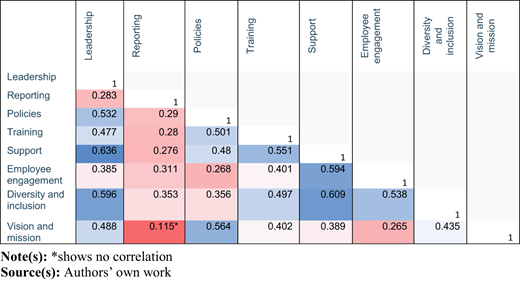
The strength of the connection among communication factors is presented in Table 3 using Pearson’s correlation analysis. The results show that all identified correlations between the studied factors are statistically significant at the p < 0.01 level. High correlations (0.70–0.4 in dark blue) were observed between support and leadership, support and diversity and inclusion, and leadership and diversity and inclusion. Moderate correlations (0.4–0.25 in light blue) were between employee engagement and diversity and inclusion, between policies and leadership and between policies and training. Factors with low or no correlation values (between 0.25 and 0.1) were highlighted in red. Leadership showed a high correlation with support (0.636), while the correlation between vision and mission and reporting was the lowest at 0.115.
Correlations between communication factors in organisations (n = 115; Pearson’s correlation test, p < 0.01), Strongest links in dark blue, moderate in blue, weakest in red
 |
The connections between the communication factors and their centrality are seen in Figure 5, where support has the highest centrality (1.0), indicating a strong interconnection. The policy (0.93) and diversity and inclusion (0.91) also show high centrality, whilst vision (0.76), employee engagement (0.74) and reporting (0.70) demonstrate the lowest centrality in organisations. The centrality score quantifies how well-connected a factor is within the network, with higher scores indicating stronger ties with other factors.
 Eight boxes are arranged within a network of connections. On the left side, two boxes are arranged horizontally: “Training” and “Leadership.” At the center top, there is a box labeled “Policies.” Below the “Policies,” a small box is labeled “Vision.” Below the “Vision,” a small box labeled “Reporting.” At the bottom right of “Leadership,” a box is labeled “Diversity or Inclusion.” On the far right side, there is a large box labeled “Support.” Next to the “Support,” a small box is labeled “Engagement.” All the arrows connecting these boxes are double_headed, solid arrows with labels. A small grey box is present above each of the eight boxes. The grey box above “Leadership” is labeled “0.85.” The grey box above “Training” is labeled “0.84.” The grey box above “Policies” is labeled “0.93.” The grey box above “Reporting” is labeled “0.70.” The grey box above “Engagement” is labeled “0.74.” The grey box above “Diversity or Inclusion” is labeled “0.91.” The grey box above “Vision” is labeled “0.76.” The grey box above “Support” is labeled “1.00.” The arrows are present in this figure, representing the connections. Some of the arrows are as follows: A double-headed arrow labeled “0.29” connects “Leadership” to “Policies.” A double-headed arrow labeled “0.636” is present between “Support” and “Leadership.” A double-headed arrow labeled “0.488” is present between “Vision” and “Leadership.” A double-headed arrow labeled “0.596” is present between “Diversity or Inclusion” and “Leadership.” A double-headed arrow labeled “0.385” is present between “Engagement” and “Leadership.” A double-headed arrow labeled “0.283” is present between “Reporting” and “Leadership.” A double-headed arrow labeled “0.402” is present between “Vision” and “Training.” A double-headed arrow labeled “0.497” is present between “Diversity or Inclusion” and “Training.” A double-headed arrow labeled “0.401” is present between “Engagement” and “Training.” A double-headed arrow labeled “0.29” is present between “Reporting” and “Training.” An arrow labeled “0.477” from “Training” points to “Leadership.” An arrow labeled “0.501” is present between “Policies” and “Training.” A double-headed arrow labeled “0.48” is present between “Support” and “Policies.” A double-headed arrow labeled “0.557” is present between “Support” and “Training.” A double-headed arrow labeled “0.609” is present between “Support” and “Diversity or Inclusion.” A double-headed arrow labeled “0.501” is present between “Support” and “Engagement.” A double-headed arrow labeled “0.276” is present between “Support” and “Reporting.” A double-headed arrow labeled “0.311” is present between “Engagement” and “Reporting.” A double-headed arrow labeled “0.268” is present between “Engagement” and “Training.” A double-headed arrow labeled “0.538” is present between “Engagement” and “Diversity or Inclusion.” A double-headed arrow labeled “0.356” is present between “Policies” and “Diversity or Inclusion.” A double-headed arrow labeled “0.455” is present between “Vision” and “Diversity or Inclusion.” A double-headed arrow labeled “0.564” is present between “Vision” and “Policies.” A double-headed arrow labeled “0.265” is present between “Engagement” and “Vision.”
Centrality network map showing interconnections among communication factors, with dark blue indicating factors with the highest correlations, purple for medium connections, and light purple and grey colours representing factors with the lowest correlation; Larger nodes represent greater centrality and importance in the network, while smaller nodes show lesser centrality. Source: Authors’ own work
Eight boxes are arranged within a network of connections. On the left side, two boxes are arranged horizontally: “Training” and “Leadership.” At the center top, there is a box labeled “Policies.” Below the “Policies,” a small box is labeled “Vision.” Below the “Vision,” a small box labeled “Reporting.” At the bottom right of “Leadership,” a box is labeled “Diversity or Inclusion.” On the far right side, there is a large box labeled “Support.” Next to the “Support,” a small box is labeled “Engagement.” All the arrows connecting these boxes are double_headed, solid arrows with labels. A small grey box is present above each of the eight boxes. The grey box above “Leadership” is labeled “0.85.” The grey box above “Training” is labeled “0.84.” The grey box above “Policies” is labeled “0.93.” The grey box above “Reporting” is labeled “0.70.” The grey box above “Engagement” is labeled “0.74.” The grey box above “Diversity or Inclusion” is labeled “0.91.” The grey box above “Vision” is labeled “0.76.” The grey box above “Support” is labeled “1.00.” The arrows are present in this figure, representing the connections. Some of the arrows are as follows: A double-headed arrow labeled “0.29” connects “Leadership” to “Policies.” A double-headed arrow labeled “0.636” is present between “Support” and “Leadership.” A double-headed arrow labeled “0.488” is present between “Vision” and “Leadership.” A double-headed arrow labeled “0.596” is present between “Diversity or Inclusion” and “Leadership.” A double-headed arrow labeled “0.385” is present between “Engagement” and “Leadership.” A double-headed arrow labeled “0.283” is present between “Reporting” and “Leadership.” A double-headed arrow labeled “0.402” is present between “Vision” and “Training.” A double-headed arrow labeled “0.497” is present between “Diversity or Inclusion” and “Training.” A double-headed arrow labeled “0.401” is present between “Engagement” and “Training.” A double-headed arrow labeled “0.29” is present between “Reporting” and “Training.” An arrow labeled “0.477” from “Training” points to “Leadership.” An arrow labeled “0.501” is present between “Policies” and “Training.” A double-headed arrow labeled “0.48” is present between “Support” and “Policies.” A double-headed arrow labeled “0.557” is present between “Support” and “Training.” A double-headed arrow labeled “0.609” is present between “Support” and “Diversity or Inclusion.” A double-headed arrow labeled “0.501” is present between “Support” and “Engagement.” A double-headed arrow labeled “0.276” is present between “Support” and “Reporting.” A double-headed arrow labeled “0.311” is present between “Engagement” and “Reporting.” A double-headed arrow labeled “0.268” is present between “Engagement” and “Training.” A double-headed arrow labeled “0.538” is present between “Engagement” and “Diversity or Inclusion.” A double-headed arrow labeled “0.356” is present between “Policies” and “Diversity or Inclusion.” A double-headed arrow labeled “0.455” is present between “Vision” and “Diversity or Inclusion.” A double-headed arrow labeled “0.564” is present between “Vision” and “Policies.” A double-headed arrow labeled “0.265” is present between “Engagement” and “Vision.”Centrality network map showing interconnections among communication factors, with dark blue indicating factors with the highest correlations, purple for medium connections, and light purple and grey colours representing factors with the lowest correlation; Larger nodes represent greater centrality and importance in the network, while smaller nodes show lesser centrality. Source: Authors’ own work
Factors with the highest correlations are highlighted by dark blue squares; medium links with purple. Those with the lowest correlations are represented in light purple and grey. The node size in the network map presents each factor’s centrality: larger nodes signify greater centrality and a more significant role in the network, whereas smaller nodes indicate lesser centrality.
5.3 Correlations between communication factors and sustainability performance
Considering the respondents’ answers, the correlation between communication factors and sustainability performance is shown in Table 4. The table highlights significant correlations. This provides insights into the potential influence of communication factors on sustainability outcomes in organisations.
Correlations between communication factors and sustainability performance (Pearson’s correlation analysis)
| Environmental performance (1)- total emissions to air, land, and water | Environmental performance (2)- total greenhouse gas emissions | Environmental performance (3)- water consumption | Environmental performance (4)- energy consumption | Social performance (1)-(gender diversity) | Social performance (2)-Career development and training | Social performance (3)-Participation in decision-making | -Social performance (4)-Number of workplace accidents | Economic performance (1)-Productivity | Economic performance (2)-Operational costs | Economic performance (3)-Investments in research and development | Economic performance (4)- investments in training/developing employees | |
|---|---|---|---|---|---|---|---|---|---|---|---|---|
| Leadership | 0.246* | 0.131 | 0.048 | 0.111 | 0.055 | −0.094 | −0.085 | 0.178 | 0.207* | 0.158 | 0.177 | 0.113 |
| Reporting | 0.059 | 0.052 | −0.043 | −0.091 | 0.083 | 0.124 | −0.086 | 0.021 | 0.056 | −0.005 | −0.178 | −0.059 |
| Policies | 0.091 | −0.039 | 0.078 | −0.045 | 0.047 | −0.145 | −0.165 | 0.112 | 0.297** | 0.217* | 0.028 | 0.288** |
| Training | 0.115 | 0.036 | 0.081 | −0.078 | 0.026 | −0.059 | −0.234* | 0.078 | 0.147 | −0.019 | 0.048 | 0.317** |
| Support | 0.153 | 0.148 | 0.118 | 0.138 | −0.035 | −0.195 | −0.156 | 0.172 | 0.259* | 0.13 | −0.026 | 0.122 |
| Employee Engagement | 0.230* | 0.14 | 0.032 | 0.017 | −0.044 | −0.203* | −0.229* | −0.029 | 0.085 | 0.232* | 0.079 | 0.087 |
| Diversity and Inclusion | 0.212* | 0.086 | 0.078 | 0.057 | −0.086 | −0.107 | −0.200* | 0.194 | 0.021 | 0.127 | 0.132 | 0.104 |
| Vision and mission | 0.138 | 0.095 | −0.014 | 0.058 | 0.145 | −0.143 | −0.058 | 0.115 | 0.202 | 0.145 | 0.136 | 0.248* |
Note(s): *p < 0.05, **p < 0.01. n = 115
Some communication factors are correlated with sustainability performance, but some have a higher correlation than others according to Pearson analysis. The cells indicating a high relative correlation (0.2–0.35) include examples such as between economic performance (1) and policies (0.297), and between economic performance (4) and policies. A relatively moderate correlation (0.10–0.20) is observed between social performance (4) and leadership (0.178). Relatively low or no correlations (0.10−0.15) are seen between environmental performance (2) and diversity and inclusion (0.048). It should be noted that all correlation values below 0.2 are not statistically significant.
6. Discussion
The results of this study highlight the role of multiple communication factors – such as policies, leadership, vision and mission, support and training – in advancing sustainability performance across organisations. While leadership emerged as a particularly central factor, it is important to clarify that leadership is positioned within the broader concept of communication factors in this study. This positioning ensures that leadership remains an integral part of the overall communication framework.
The results indicate that the policy factor was ranked as the most focused on sustainability issues across all organisations, followed by vision and mission, which expands the conceptualisation of communication for sustainability (see Carpenter et al., 2016; Golob et al., 2022; Viererbl and Koch, 2022). Despite extensive discussion in sustainability literature, training ranked lowest. This could be due to its frequent association with other organisational priorities, such as quality and productivity, rather than a direct focus on sustainability. Inadequate financial support and the lack of standardised training data (see Figueira et al., 2018; Leal Filho et al., 2021; Zhang et al., 2019) may also contribute to this outcome.
According to the results, policy was also considered the top position across organisations. This may show that it plays a key role in bridging the sustainability information gap between organisations and employees regardless of organisation type (see Schaefer et al., 2020; Van Grinsven and Visser, 2011). They may also reflect the influence of both external regulatory pressures and internal governance mechanisms. In the Swedish context, where policies support transparency and alignment with stakeholder expectations, they are part of a broader system of sustainability practices, as stated by Arvidsson and Dumay (2022). Sustainability practices are highly institutionalised and organisations frequently adopt formal sustainability policies to meet national expectations.
In addition to policy, the results show some variation across organisation types, particularly in areas such as leadership and diversity. Compared to CSOs and PSOs, corporations scored higher on these factors, which may be partly due to greater access to resources and stronger external pressures, such as investor expectations and public accountability (as stated by Buallay et al., 2022). These factors can encourage more formal approaches to leadership development and diversity initiatives. In contrast, CSOs and PSOs may focus more on mission-specific or administrative goals, which could result in less emphasis on these areas (see Figueira et al., 2018; Hayman, 2016). These differences highlight the importance of considering sector-specific contexts when interpreting sustainability communication practices.
The correlation analyses provide a detailed perspective on how communication factors correlate with each other. The highest correlation was between leadership and support. Yet vision and mission and reporting indicated the lowest correlations, contrary to the findings of Traxler et al. (2020). The positive correlation between leadership and support could potentially be due to the influence of a common underlying factor, organisational climate (see Dey et al., 2022). Leaders could set the direction and inspire action, while supportive environments create the conditions for meaningful dialogue, control mechanisms, collaboration and sustainable outcomes (see Amey et al., 2020; Nasreen et al., 2023; Quinn and Dalton, 2009). This might indicate that combining leadership with supportive practices can effectively implement sustainability communication strategies and improve areas with lower correlations.
The analysis of centrality provides a comprehensive picture of the interconnectedness between the factors, where support (although ranked in penultimate place) has the most central position. This indicates that support plays a critical bridging role, linking various sustainability communication factors and enabling the integration of sustainability into organisational practices. Its centrality may stem from its cross-cutting nature, as support often involves leadership engagement, provision of resources, training, and a workplace culture that encourages sustainable behaviour (Chiraz and Frioui, 2012; Liao, 2022). It should be noted that reporting was the least connected ones although reporting has received considerable attention in sustainability literature. This may be due to a lack of organisational awareness and specific guidelines for PSOs and CSOs (see Domingues et al., 2017; Dumay et al., 2010; Farneti and Guthrie, 2009). This gap may also be influenced by the data composition, primarily from corporations, and the voluntary nature of reporting (see Adams et al., 2014; Guthrie and Farneti, 2008). Corporations often operate under different regulatory and operational contexts compared to PSOs and CSOs, which may account for variations in the integration and emphasis of reporting practices. In these cases, reporting may be more of a compliance activity rather than a strategic tool for sustainability performance, leading to its low correlation with actual sustainability outcomes. The voluntary aspect of sustainability reporting could result in inconsistencies in how organisations approach and interpret sustainability reporting, thus diminishing its impact on performance.
The results of this study clarify the dynamic relationships between various factors and sustainability performance. Some factors associated with sustainability performance as shown in Table 4 and Figure 5. Some factors are positively correlated, others are negative. Employee engagement, for instance, shows mixed results; while beneficial for productivity, it is negatively correlated with career development and decision-making. This may indicate that although employees are engaged in sustainability-related activities, their involvement may be limited to operational roles, with little influence over strategic processes or organisational decision-making. In this context, engagement may be implemented in a symbolic manner, rather than as a mechanism for empowerment. Employees may be motivated to participate in sustainability initiatives but lack access to structures that support career progression or strategic input. This suggests a potential disconnect between engagement and inclusion, highlighting the need to distinguish between surface-level participation and meaningful involvement (see Crane and Glozer, 2016; Hohnen, 2007). This issue may need further exploration, particularly to understand how engagement can be more effectively linked to empowerment and strategic inclusion.
The results strongly align with existing literature that connects diversity, support and leadership with economic performance. For instance, studies (Albrecht et al., 2022; Hossin et al., 2021; Rose, 2007) have highlighted how these factors contribute to enhanced economic outcomes by fostering inclusive environments, effective governance and strategic leadership. The aforementioned factors have been demonstrated to enhance productivity, innovation and employee satisfaction, which, in turn, contribute to economic performance.
While communication efforts focused on sustainability are sometimes associated with economic performance, this is not always the case. However, there is no evidence to suggest that an emphasis on sustainability leads to decreased economic performance. This challenges the prevailing assumption in much of the sustainability literature that prioritising sustainability may incur an economic cost. In other words, there does not appear to be an economic cost associated with prioritising sustainability, nor is there a trade-off between focusing on sustainability and achieving economic performance. This may call for a re-examination of traditional sustainability models, particularly those that portray sustainability efforts as a financial burden. The relationship between these factors and economic outcomes suggests that while diversity, support and leadership are crucial for achieving economic performance, their impact within the context of sustainability performance is less clear. Interestingly, the results reveal a weak correlation between sustainability reporting and overall sustainability performance, which is unexpected considering the emphasis placed on reporting in sustainability literature (Oncioiu et al., 2020). This could be influenced by regional and geographical differences. As Arvidsson and Dumay (2022) highlight, even in countries such as Sweden with strong reporting cultures, performance gains are not guaranteed. These variations could be shaped by different regulatory environments, cultural factors and economic conditions that prioritise different aspects of sustainability reporting.
Furthermore, policies and support tend to have stronger correlations with performance compared to training. Regarding environmental performance, factors such as leadership and diversity and inclusion are significantly correlated with it, especially in reducing emissions, aligning with the literature (see Iqbal et al., 2020a; Kusi et al., 2021; Suriyankietkaew and Avery, 2014). Meanwhile, policy, vision and mission are linked to social performance. Some communication factors significantly impact all three types of performance, such as employee engagement.
The results also show that, although it might be expected that a focus on sustainability would primarily improve social and environmental performance, there is a positive correlation with economic performance. This occurs even when the main focus is on sustainability, rather than on economic factors alone.
These results contribute conceptually to the evolving field of sustainability communication by emphasising that communication factors are not just support tools but integral to how sustainability is implemented and experienced within organisations. Rather than treating communication as a linear or one-dimensional mechanism, this study frames it as a system of interrelated organisational practices – such as leadership, support and policy – that shape and reinforce performance outcomes.
As illustrated in Figure 6, the interconnectedness of communication-related practices with environmental, social and economic performance supports the notion that these factors do not function in isolation but influence each other dynamically.
 The diagram consists of two sections. On the left side, eight stacked boxes are labeled from top to bottom: “Reporting,” “Leadership,” “Employee Engagement,” “Policies,” “Vision and Mission,” “Training,” “Support,” and “Diversity or Inclusion.” On the right side, three vertically aligned rectangles are labeled “Environmental performance,” “Social performance,” and “Economic performance.” Arrows extend from the left boxes to the right rectangles. Solid arrows represent relationships established in existing literature. Dashed arrows represent new relationships proposed as part of the authors’ contribution. Solid arrows and dashed arrows extend from each labeled box on the left toward one or more of the three rectangles on the right. The solid arrows and the dashed arrows in the figure are as follows: From “Leadership,” a solid arrow extends and points to “Economic performance.” From “Leadership,” a solid arrow extends and points to “Environmental performance.” From “Employee Engagement,” a solid arrow extends and points to “Economic performance.” From “Employee Engagement,” a solid arrow extends and points to “Environmental performance.” From “Policies,” a solid arrow extends and points to “Economic performance.” From “Vision and mission,” a solid arrow extends and points to “Economic performance.” From “Training,” a solid arrow extends and points to “Social performance.” From “Support,” a solid arrow extends and points to “Economic performance.” From “Diversity or Inclusion,” a solid arrow extends and points to “Economic performance.” From “Environmental performance,” two dashed arrows arise and point toward “Leadership” and “Employee Engagement.” From “Economic performance,” four dashed arrows arise and point toward “Diversity or Inclusion,” “Support,” “Leadership,” and “Vision and mission.” From “Employee Engagement,” a dashed arrow extends and points to “Economic performance. “From “Policies,” a dashed arrow extends and points to “Economic performance.” A double‑headed dashed arrow is present between “Employee engagement” and “Social performance. From “Employee engagement,” a dashed arrow extends and points to “Economic performance.” A double‑headed dashed arrow is present between “Training” and “Economic performance.” From “Diversity or Inclusion,” a dashed arrow extends and points to “Environmental performance.”
The connection between communication factors and sustainability performance, dashed arrows show study results; solid arrows align with literature. Source: Authors’ own work
The diagram consists of two sections. On the left side, eight stacked boxes are labeled from top to bottom: “Reporting,” “Leadership,” “Employee Engagement,” “Policies,” “Vision and Mission,” “Training,” “Support,” and “Diversity or Inclusion.” On the right side, three vertically aligned rectangles are labeled “Environmental performance,” “Social performance,” and “Economic performance.” Arrows extend from the left boxes to the right rectangles. Solid arrows represent relationships established in existing literature. Dashed arrows represent new relationships proposed as part of the authors’ contribution. Solid arrows and dashed arrows extend from each labeled box on the left toward one or more of the three rectangles on the right. The solid arrows and the dashed arrows in the figure are as follows: From “Leadership,” a solid arrow extends and points to “Economic performance.” From “Leadership,” a solid arrow extends and points to “Environmental performance.” From “Employee Engagement,” a solid arrow extends and points to “Economic performance.” From “Employee Engagement,” a solid arrow extends and points to “Environmental performance.” From “Policies,” a solid arrow extends and points to “Economic performance.” From “Vision and mission,” a solid arrow extends and points to “Economic performance.” From “Training,” a solid arrow extends and points to “Social performance.” From “Support,” a solid arrow extends and points to “Economic performance.” From “Diversity or Inclusion,” a solid arrow extends and points to “Economic performance.” From “Environmental performance,” two dashed arrows arise and point toward “Leadership” and “Employee Engagement.” From “Economic performance,” four dashed arrows arise and point toward “Diversity or Inclusion,” “Support,” “Leadership,” and “Vision and mission.” From “Employee Engagement,” a dashed arrow extends and points to “Economic performance. “From “Policies,” a dashed arrow extends and points to “Economic performance.” A double‑headed dashed arrow is present between “Employee engagement” and “Social performance. From “Employee engagement,” a dashed arrow extends and points to “Economic performance.” A double‑headed dashed arrow is present between “Training” and “Economic performance.” From “Diversity or Inclusion,” a dashed arrow extends and points to “Environmental performance.”The connection between communication factors and sustainability performance, dashed arrows show study results; solid arrows align with literature. Source: Authors’ own work
Overall, a range of communication factors significantly affect sustainability performance in organisations. These factors correlate with various aspects of environmental, social and economic performance, suggesting their importance in effective sustainability implementation. It should be noted that although the current literature largely focuses on how communication factors affect sustainability performance in a one-directional manner, this paper highlights a mutual effect where sustainability performance may also enhance communication factors. This bidirectional relationship underscores the need for a holistic approach, acknowledging the interdependence between organisational sustainability and communication factors.
7. Conclusion
The purpose of the paper is to analyse the importance of communication factors, their interrelationship and the relationship between factors and sustainability performance indicators. The results highlight that all communication factors are important for organisational sustainability, albeit some more than others. The correlation analyses provide a comprehensive picture of the interconnectedness between the factors. All factors are intercorrelated according to the results. Correlation and centrality analyses indicate the importance of leadership and support in driving effective communication for sustainability, with these factors mutually reinforcing each other. The study also indicates that some communication factors are correlated with sustainability performance.
This paper provides insights into communication factors by determining the most focused on sustainability, analysing their intercorrelations, referring to the rankings across different types of organisations, and establishing connections with sustainability performance in different organisational contexts. By mapping the interplay of communication factors – such as policy, support, reporting and training – this research moves beyond isolated analysis to offer a more integrated understanding of how communication structures shape sustainability outcomes. The high centrality of support and the consistent prominence of policy suggest that formal structures and cross-cutting organisational practices play a pivotal role in embedding sustainability. Improved integration of communication factors can provide organisations and their leaders with better structures to understand communication channels. Better communication channels can contribute to a more holistic implementation of sustainability and enhance sustainability performance in organisations. This can raise awareness about the sustainability efforts and catalyse sustainable change and collaboration. PSOs and CSOs could strengthen their sustainability performance by adopting more tailored and context-sensitive strategies. For instance, PSOs might implement mandatory sustainability training for managers/employees and create cross-functional sustainability teams to integrate sustainability into policy development and service delivery. CSOs could embed sustainability into their program planning by offering employee workshops that link sustainability with community engagement activities, or by developing internal systems for tracking sustainability performance. In corporations, initiatives could focus on aligning sustainability with core business operations. This may be achieved through employee-driven innovation programs and performance-based incentives tied to sustainability metrics. Embedding such targeted strategies within communication factors can enable each organisation type to enhance communication, employee engagement, improve alignment with sustainability objectives and achieve more impactful outcomes.
By understanding the centrality of different factors, organisations may optimise their communication strategies by prioritising the most interconnected factors. For example, enhancing leadership support for sustainability could facilitate better alignment between different organisational units, leading to more coherent sustainability goals and more effective implementation. Similarly, increasing the centrality of employee engagement through training and empowerment could reinforce other key factors like decision-making and career development, ultimately leading to better sustainability performance.
In terms of societal implications, this study highlights the potential for effective communication strategies to influence public policy and community engagement. By integrating sustainability-focused communication factors into policy frameworks, organisations and policymakers may create a more interconnected approach to addressing sustainability challenges. For instance, leadership and support strategies identified in this research could be incorporated into policy guidelines to promote transparency, inclusivity and stakeholder collaboration. Enhanced communication channels might also engage communities, improve the quality of life by fostering awareness of sustainability efforts, and inspire collective action toward sustainable development goals.
Despite its contributions, this study has limitations. For instance, the chosen survey method might not have adequately captured all sustainability performance indicators and the relevant communication factors related to sustainability within organisations. For example, while policies were ranked highest across all sectors, this study could not explore whether their prominence is driven by regulatory pressures, internal governance practices, or other contextual factors. Future research using qualitative methods, such as interviews or document analysis, could provide deeper insights into such motivations. Another limitation could be non-response bias, which may arise due to participants choosing not to complete the survey, potentially impacting the representativeness and accuracy of the study’s findings. Although sustainability performance was measured over a five-year period, communication factors were assessed at a single point in time. Future longitudinal studies could better explore potential causal links between sustainability and communication. Also, external factors such as regulatory compliance or stakeholder engagement may mediate or moderate the relationship between sustainability communication and performance, yet, as the data used in this paper do not cover these aspects, we recommend that future research explores their potential influence. Future research should address these limitations by considering more than one country, longitudinal designs, larger and more diverse samples, and exploring additional factors to enhance sustainability performance. Further exploration of underperforming factors, such as training, as well as the economic and societal impacts of sustainability communication, could provide actionable insights.

