Should we prefer parsimony or multidimensionality when operationalizing institutional distance? In this paper, I explore the debate on whether current institutional distance operationalizations are too narrow, or if adding complexity in the operationalization needlessly complicates an otherwise lean construct.
In order to explore the above question, I (1) test the statistical validity of the most common parsimonious operationalizations of institutional distance; (2) test whether a parsimonious or a multidimensional solution is more appropriate; (3) discuss whether the statistically valid operationalizations of institutional distance are psychometrically sufficient.
The findings of this paper indicate that three of the most commonly used operationalizations for institutional distance do not possess statistical validity, nor converge on the effects of each underlying item. The fourth commonly used operationalization does possess statistical validity. Nonetheless, its unidimensional usage for institutional distance should be carefully weighed against the theoretical design of the study, where questions exists about whether it is psychometric sufficient for different theoretical arguments used in institutional distance research.
While institutional distance is considered to be one of the core concepts of IB/M research, results on the topic have been somewhat ambiguous and sometimes contradictory. Simultaneously, several recent calls have highlighted the need for addressing methodological challenges in the field of IB/M. In this paper, I address one of the main methodological challenges for institutional distance research. I illuminate an underexposed debate and argue that multidimensional operationalizations of institutional distance are required, not just to address methodological challenges but to improve theory on institutional distance as well.
Introduction
Despite widespread recognition of both the theoretical and practical importance of the institutional distance construct in IB/M research (Beugelsdijk et al., 2018; Dow, 2017; Ghemawat, 2016), empirical results in the literature have thus far been somewhat ambiguous (Kostova et al., 2020) and even contradictory (see Table 1). As a result, researchers in the field are increasingly critical of the institutional distance literature, arguing that the existing conceptualizations of institutional distance tend to be somewhat narrow (Jackson and Deeg, 2008, 2019; Kostova et al., 2008) and methodologically confusing (Bae and Salomon, 2010; Hutzschenreuter et al., 2016; Zaheer et al., 2012) – often referring to distance as a black box in need of unpacking (Dow, 2017; Lumineau et al., 2021; Maseland et al., 2018). Indeed, institutional theorists and IB/M scholars have repeatedly highlighted the importance of complexity in understanding the influences of institutions (Jackson and Deeg, 2008; Kostova and Zaheer, 1999; Kostova et al., 2020; Williamson, 2000; Zaheer et al., 2012), thus highlighting the need to consider institutional distance as a multidimensional construct.
While many researchers acknowledge the narrowness of institutional distance operationalizations, current practices so far have not incorporated this critique (Aguilera and Grogaard, 2019; Jackson and Deeg, 2019). Instead, distance research often takes a parsimonious approach toward institutional distance; that is, researchers theorize on and/or operationalize institutional distance as a unidimensional construct (e.g. Dikova et al., 2019; Lewis and Bozos, 2019; Morgan et al., 2021). They highlight either the interconnectedness of the different dimensions of institutions, or the similarities between expected effects (e.g. Belderbos et al., 2020; Ilhan-Nas et al., 2018) thus removing the need to measure each dimension separately. Considering this disconnect between the emphasized importance of complexity in the theory on institutional distance and the emerged common practices of parsimony, the question arises whether the current practices regarding institutional distance should indeed be considered too narrow, or if accounting for the complexity in institutional distance would add needless confusion to an otherwise lean construct.
This paper addresses the parsimony vs multidimensionality debate in institutional distance research, doing so, this paper answers recent calls for addressing methodological challenges in the field of IB/M (Aguinis et al., 2020; Cuervo-Cazurra et al., 2016; Nielsen et al., 2020). It does so by (1) testing the statistical validity of the most common parsimonious operationalizations of institutional distance; (2) testing whether a parsimonious or a multidimensional solution is more appropriate for understanding perceived psychic distance; and (3) discuss whether the statistically valid operationalizations of institutional distance are psychometrically sufficient.
In this paper, I argue that we should reconsider the currently dominant practice of parsimony in the measurement of institutional distance, as this practice does not capture the entire breath of the institutional distance construct as laid out in institutional theory and has consequently resulted in oversimplification in the measurement of the institutional distance construct, leading to misunderstandings and mismeasurements. More importantly, a parsimonious approach actively stimulates researchers to oversimplify the construct in their theoretical conceptualization as well, despite theoretical work highlighting the importance of complexity in institutions (Aguilera and Grogaard, 2019; Jackson and Deeg, 2008, 2019; Kostova and Zaheer, 1999; Newenham-Kahindi and Stevens, 2018). By doing so, the parsimonious approach hinders the development of our understanding of the complexities inherent in the institutional distance construct, and how they matter. A recent critique by Maseland et al. (2018) highlights that distance research often lacks clear understanding of the theoretical mechanisms. In this paper, I argue that, at least partially, the blame for this lack of understanding should be laid at the feet of a (too) parsimonious approach toward the measurement of distances in the field of IB/M. Therefore, I conclude that, while both unidimensional and multidimensional measurements of institutional distance have a place in the literature on institutional theory, in order to move the field forward, we need to start accounting for the multidimensional nature of institutional distance – for both our theorizing on – and our operationalizing of the institutional distance construct.
Current state of institutional distance research
Institutional distance refers to the (dis)similarities between the institutions of the MNE's home and host country. Recently, several papers have given extensive overviews of the current state of institutional distance research, be it on the different institutional theories (Hotho and Pedersen, 2012; Kostova et al., 2020), diverging operationalizations (Beugelsdijk et al., 2018; Kostova et al., 2020) or highlighting methodological issues in the literature (Bae and Salomon, 2010; Beugelsdijk et al., 2018; Hutzschenreuter et al., 2016; van Hoorn and Maseland, 2016; Zaheer et al., 2012). To avoid duplication, I will only briefly touch upon the main tenants of the theoretical state of play. Second, I will extensively review the methodological state of play, with a focus on operationalizations of the construct.
Current institutional theories in institutional distance research
Broadly speaking, three institutional streams of thought dominate IB/M literature (Kostova et al., 2020), which will be described briefly in the following paragraphs: New Institutional Economics (NIE), New Organizational Institutionalism (NOI) and Comparative Institutionalism (CI). First, NIE focuses on transaction costs, information asymmetry, uncertainty and the role of institutions in the functioning of markets and overcoming barriers to exchange (Coase, 1937, 1960; Matthews, 1986; North, 1990; Williamson, 2000). This literature defines institutions as “the rules of the game in a society” or as “the humanly devised constraints that shape human interaction” (North, 1990, p. 3). A classic distinction is between formal and informal institutions, where formal institutions concern political and judicial rules as well as economic rules and contracts, while informal institutions concern codes of conduct, social norms and conventions (North, 1990). The NIE literature finds that by constraining potential opportunistic behavior and therefore reducing uncertainty, the efficiency of institutions and effectiveness of enforcement strongly influence both the creation and behavior of organizations and the economic performance of societies. The second perspective (NOI) emerged as a framework for exploring and understanding organizational action when rational action assumptions, such as economic efficiency, appear to be inadequate explanations (DiMaggio and Powell, 1983; Meyer and Rowan, 1977; Oliver, 1991; Scott, 1987). In NOI, institutions are defined as composing “cultural-cognitive, normative, and regulative elements that, together with associated activities and resources, provide stability and meaning to social life” (Scott, 2001, p. 56). These three elements (cultural-cognitive, normative and regulative) are referred to as pillars. Each pillar relates to a distinct mechanism, fostering isomorphism among organizations (i.e. coercive, normative, mimetic) (DiMaggio and Powell, 1983; Scott, 2001) and explaining how actors have to behave, ought to behave and want to behave. NOI finds that legitimacy is critical for organizations' survival and that, in order to attain legitimacy, organizations must comply with the isomorphic pressures exerted upon them by the institutional environment in which they operate (DiMaggio and Powell, 1983; Meyer and Rowan, 1977). The key idea of the third perspective (CI) is that institutions are interdependent, often complementary, and developed in a mutually reinforcing way. In the CI literature, institutions are typically viewed “in terms of resources for strategic coordination across different institutional domains” (Jackson and Deeg, 2008, p. 546). Therefore, institutional configurations influence how firms approach problems and make decisions (Hall and Soskice, 2001; Jackson and Deeg, 2008; Whitley, 1999). These institutional configurations, also referred to as business systems, provide firms with certain opportunities for engaging in specific kinds of activities – although they are less appropriate for others – depending upon how each society solves the coordination issue.
The main argument used in institutional distance research comes forth out of NOI and is outlined by Kostova and Zaheer (1999). They argue that increased institutional distance leads to more difficulties for the MNE, particularly in properly understanding the host country's environment and adhering to local legitimacy pressures. Furthermore, Kostova and Zaheer (1999) argue that the need for an adaptation of organizational practices to local standards in order to gain host country legitimacy increases with increased home–host country institutional dissimilarities. Eden and Miller (2004) followed up on the analysis by Kostova and Zaheer (1999), arguing that institutional distance is the key driver of the Liability of Foreignness (LOF), meaning that greater institutional distance puts MNEs at a greater cost disadvantage relative to local firms. As a result, greater home–host institutional distance increases the LOF faced by the foreign MNE. A larger distance subsequently makes the acquisition of legitimacy in the foreign environment more difficult, which ultimately leads to lower chances of survival.
Current operationalizations used in institutional distance research
To gain a good understanding of the way institutional distance is currently operationalized in the literature, I have manually looked at 1,460 papers published in 28 IB/M journals [1] that mention the phrase “institutional distance”. A total of 236 papers that operationalize the concept of institutional distance in IB/M journals have been recorded.
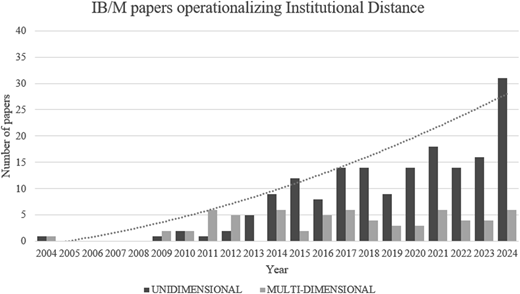
When separating parsimonious and multi-dimensional operationalizations of institutional distance, it seems that researchers have a strong preference for parsimony – where 171 vs 65 (or 72%) of papers use a unidimensional operationalization. What's more, the field seems to converge to this type of operationalization. In the period 2009–2014, the split between parsimonious (20) and multi-dimensional (21) was about even, but ten years later (2019–2024), 80% of papers use unidimensional operationalizations (102) instead of multi-dimensional one (26) – see also Figure 1.
Of the 171 papers that operationalize institutional distance as a unidimensional construct, 148 do so by labeling the concept as (full) institutional distance, 23 do explicitly acknowledge that they are operationalizing a sub-dimension of institutional distance (11*regulatory distance; 10*formal distance; 2*informal distance) but only operationalize that specific subdimension. The World Governance indicators (Kaufmann et al., 2010) is by far the most popular manner to operationalize institutional distance parsimoniously, with 83 papers doing so (e.g. Mingo et al., 2018; Morgan et al., 2021). Second, is the Economic Freedom index (Miller et al., 2021), used 32 times (e.g. Gaur et al., 2022). Other often used sources are the Global Competitive Report (selected items of Xu et al., 2004) with nine papers, which are frequently combined to create a single measure, as well as eight times the institutional distance operationalization of Berry et al. (2010) is used, either via the use of the administrative dimension or via a merging multiple subdimensions. 31 papers use other operationalizations (such as the ICRG, POLCON, surveys or an amalgamation of multiple data sources) and eight papers do not explain which data source they have used. Again, we see a convergence on methods, where in the period 2009–2014, eight out 20 papers (40%) have been classified as “other”, in the same period ten years later, this has dropped to 15% (16 out of 102 papers). It should be noted that unidimensional institutional distance operationalizations, cultural distance is often operationalized as a separate construct next to it – with the vast majority of papers either relying on the Hofstede or GLOBE data to do so.
In total, 65 papers who operationalize institutional distance via multi-dimensional constructs have been identified. Here, most (23) use the NOI framework to do so (e.g. Krammer, 2018; Oki and Kawai, 2022), followed by 18 papers who used the NIE framework (e.g. Dikova et al., 2010; Elango, 2024). Furthermore, seven papers have used the separated dimensions of the Berry et al. (2010) framework and five have used the separated framework of CAGE (Ghemawat, 2001). Twelve papers have been coded as “other”. Most papers in the “other” category have separated out the WGI dimensions, sometimes in combination with a cultural distance calculation using Hofstede data. Papers that operationalized multiple dimensions via the NOI framework typically (but not always) operationalized three sub-dimensions: regulatory distance, normative distance and cognitive distance. The regulatory dimension is seven times operationalized via the regulatory dimension of the GCR (Xu et al., 2004), followed by the WGI (four), EFI (two) and ten “others”. The Normative dimension is eight times operationalized via the normative dimension of the GCR (Xu et al., 2004), two times via Hofstede (1980) and eleven times via other data sources. Finally, the cognitive dimension is most often operationalized via Hofstede (six), where nine papers have used other data sources. Papers that operationalized multiple institutional dimensions via the NIE framework operationalized two sub-dimensions: formal distance and informal distance. For the formal dimension, the WGI is most popular (12), with two papers using the EFI and four using other sources. For the informal dimension Hofstede is most popular (12), with six papers using other sources. Papers who have operationalized multiple subdimensions of institutional distance via Berry et al. (2010) have done so by selecting several items of Berry's institutional distance framework. Finally, five papers operationalize institutional distance via Ghemawat's CAGE framework, typically using Hofstede for cultural distance, WGI for administrative distance; GDP per capita for economic distance, and distance in kilometers for geographic distance (e.g. Campbell et al., 2012).
Considering the trends in international distance operationalizations, four data sources dominate current operationalizations of institutional distance. These are: the World Governance Indicators (used in 106 papers), the Economic Freedom Index (used in 35 papers), Hofstede (used in 25 papers) and Berry et al. (2010) (used in 19 papers). Furthermore, trends indicate that the IB/M field is converging toward unidimensional operationalization over multidimensional ones, as well as homing in on the above-mentioned data sources – with the World Governance Indicators being the dominant source.
The multidimensionality vs parsimony debate
In order to see if a parsimonious approach is able to efficiently capture the institutional distance construct, or if a multidimensional approach is more appropriate, two questions need to be answered: (1) Are there significant theoretical differences between the different institutional dimensions which would be unaccounted for in a parsimonious approach and (2) is the construction of a unidimensional institutional distance metric statistically valid? I will address these questions in reverse order.
Statistical validity of a parsimonious approach
From a statistical point of view, we can use a unidimensional measurement of a construct if either of two conditions are met. (1) If all dimensions highly correlate or (2) if all the effects of the dimensions (are expected to) highly correlate. However, if both conditions are not present, a proposed unidimensional solution will not be able to accurately represent the underlying data, such that a solution which separates out the different dimensions is preferred. Thus, three different scenarios can occur when aiming to sum a multidimensional construct into a parsimonious one. First [scenario one], the dimensions can highly correlate, thus allowing the researcher to sum into a single dimension (this is typically tested via a principal component analysis or via a confirmatory factor analysis (Hair et al., 2010)). Second [scenario two], the dimensions do not highly correlate but the effects do, also allowing the researcher to sum into a single dimension. Or finally [scenario three], both the dimensions do not correlate, and the effects do not correlate either. In such a case, the separation of the underlying items can reveal additional information not captured by the parsimonious approach. As such, a multidimensional approach is preferred over a parsimonious one. We can see these issues reflected in the theoretical debate taking place.
Theoretical validity of a parsimonious approach
Different viewpoints exist on the question of whether or not the current approach toward institutional distance is too narrow. Currently, most of current research toward the effects of institutional distance has adopted a parsimonious approach. Three arguments exist in favor of such an approach. First, much of the argumentation used in institutional distance (either implicitly or explicitly) argues for a singular (typically negative) effect of institutional distance (see, e.g. Bhaumik et al., 2018; Dikova et al., 2019; Hilmersson and Jansson, 2012; Ilhan-Nas et al., 2018; Lewis and Bozos, 2019; Mata and Alves, 2018; Morgan et al., 2021; Moore et al., 2012; Phillips et al., 2009; Vachani et al., 2009), instead of separating out diverging effects per different types of institutional distance. Therefore, they align with a unidimensional approach toward operationalization (e.g. Ando, 2014; Gubbi et al., 2010; Salomon and Wu, 2012; Shi et al., 2012). Put differently, if we theoretically assume the effects to be largely similar between different dimensions, there is no real need for measuring each dimension separately and we can argue on the aggregate level instead (see also the statistical validity part – scenario two). This argument is reflected in other approaches toward distance as well. For instance, Ghemawat's (2007) “law of distance” forwards the idea that, in general, international interactions are dampened by distances. The idea that the effects of dimensions of institutional distance correlate is at least somewhat supported by the findings of a recent meta-analysis by Kostova et al. (2020), who mostly (but not exclusively) found relatively small differences between diverging theoretical operationalizations of institutional distance.
Second, distances in general tend to be highly correlated, making the detection of diverging effects of different distances nearly impossible. Therefore, even when theoretically diverging effects of sub-dimensions of institutional distance exist, the error created by using a parsimonious approach are only marginal when the sub-dimensions themselves highly correlate (see also the statistical validity part – scenario one). To exemplify, Dow and Larimo (2009), showed that the psychic distance stimuli index of Dow and Karunaratna (2006) can be reduced from six to two dimensions due to high correlation between the country differences on each of these dimensions. Similarly, a recent paper by Belderbos et al. (2020) argues for the usage of contextual distance as a composite construct of cultural, administrative and economic distances, jointly reflecting the degree of home–host environmental differences. Finally, Ilhan-Nas et al. (2018) show that the separately created normative distance and regulatory distance measure (as introduced by Xu et al., 2004) highly correlate in their dataset – therefore giving rise to the question whether multiple dimensions need to be operated separately (at the very least for their specific country set) or if the correlation between these distances is too high to adequately distinguish them from each other.
Third, similar to cultural distance, researchers overwhelmingly operationalize institutional distance through either one or two composite dimensions, seemingly preferring parsimony over complexity. Considering the maturity of the field, one would expect that if the error created through such an approach would be problematic, the practice would have already been changed. Instead, unidimensional operationalizations of institutional distance are not just commonplace (e.g. Andrews et al., 2022; Bustamante et al., 2021; Gaur et al., 2022; James et al., 2020; Morgan et al., 2021; Wang, 2020), but an increasing trend, thereby giving precedence for the continuation of the practice.
Against a parsimonious approach, institutional theorists and IB scholars have repeatedly highlighted the importance of complexity in understanding the influences of institutions (Eden and Nielsen, 2020; Jackson and Deeg, 2008, 2019; Kostova and Zaheer, 1999; Kostova et al., 2020; Williamson, 2000; Zaheer et al., 2012), favoring a multidimensional approach over a parsimonious one. Four arguments are forwarded to support this view: First, from a theoretical point-of-view, several authors have highlighted the need for distinguishing between the different dimensions (Busenitz et al., 2000; Eden and Miller, 2004; Gaur et al., 2007; Gaur and Lu, 2007; Krammer, 2018; Kostova and Zaheer, 1999; Perera, 2015; Ramsey, 2005; Xu and Shenkar, 2002; Xu et al., 2004; Zaheer et al., 2012), with Zaheer et al. noting, in regard to the main distance constructs in IB/M: “each of these distance constructs is itself multi-faceted” (2012: 20). While there is no consensus yet to exactly how each dimension influences each phenomena of interest – e.g. Kostova et al. (2008) argue that compliance with regulatory institutions is most important due to the coercive nature of the pillar, while Xu and Shenkar (2002) argue for diverging effects of each pillar depending on the phenomena of interest – some agreement exists in that effects of distances are capable of differing per dimension as well as per studied phenomena, and thus should be considered separately.
Second, different institutional theories exist, each discussing different mechanisms through which institutions and institutional distance might influence foreign MNE behavior and outcomes. While these mechanisms sometimes align (e.g. larger institutional distances lead to negative performance effects both due to increased difficulty to attain legitimacy in the host environment (Kostova and Zaheer, 1999) as well as increased transaction costs (Dikova et al., 2010)), in other cases they do not (e.g. larger institutional distances might lead to positive performance effects due to arbitrage benefits (Gaur and Lu, 2007)). Similarly, there is no reason to assume these effects are equally distributed over the different institutional dimensions, thus creating benefits of separating out potential dimensions.
Third, the critiques on parsimonious operationalizations of institutional distance resonate with the critiques given in the cultural distance literature, which preceded the institutional distance literature (Xu et al., 2004). Specifically, the critique of institutional distance being too narrow (Jackson and Deeg, 2008, 2019) mirrors Shenkar's (2001) critique on the tendency of the cultural distance literature to oversimplify a complex reality, described in both the “illusion of discordance” and the “assumption of equivalence” (Kirkman et al., 2006; Shenkar, 2001, 2012; Tung and Verbeke, 2010; Zaheer et al., 2012). Since institutional distance concerns home–host country dissimilarities in both formal and informal institutions, it is an even broader construct than cultural distance – the latter of which considers dissimilarities in informal institutions exclusively and itself is struggling with the question of whether to use composite cultural distance measures (see, e.g. Cuypers et al., 2018; Maseland et al., 2018; Tung and Verbeke, 2010). Therefore, any potential concerns within the cultural distance construct are expected to be amplified for the institutional distance construct. Consequently, a parsimonious approach would remove vital variation needed to gain a deeper understanding of how, in which context and when institutional distance matters.
Fourth – and resonating with the third point – there are worries regarding whether current parsimonious operationalizations are psychometrically sufficient, that is: whether they are able to capture the entire breath of the construct when operationalized through a single source (Aguinis et al., 2020) or if a mismatch between operationalization and latent construct exists. Even when the metric is statistically valid (i.e. high correlation between either the items included, the effects of these items, or both), they do not automatically capture the entirety of the theorized construct but rather might only capture a subsection or a completely different construct in its entirety. For example (and highlighted above) issues exist with the current operationalizations of cognitive/informal/cultural distance (be it via Hofstede data or via GLOBE data). Kostova et al. (2020, p. 477) labels the use of Hofstede (and by extension GLOBE) as problematic and argues that it should not be used, where “it is not true to the conceptual essence of these constructs”. Similarly – as shown above – multiple operationalizations are used for both the entirety of institutional distance as well as a separate subdimension (e.g. both WGI and EFI for all institutional distance and regulatory distance and formal distance). Questions therefore exist on whether current parsimonious operationalizations of institutional distance actually measure institutional distance, or if they measure only a part of the entire construct or even a completely different construct. Consequently, if current measurements are psychometrically deficient, statistical validity does not matter, since the desired construct is not (in its entirety) operationalized.
In sum, on the one hand some evidence exists that different distances correlate and that separating them has only small effects. Also, unidimensional operationalizations are commonplace in the literature, indicating that both researchers and reviewers alike consider unidimensional operationalization to be valid. On the other hand, theoretical streams of thought on the effects of institutional distance agree on the existence of complexity in the concept which leads to questions on whether this complexity can be captured via a unidimensional operationalization of the institutional distance construct. As well as both methodological and theoretical questions exist with regards to the statistical and face validity of the currently preferred measures of institutional distance. The question emerges, which manner of operationalizing institutional distance is preferred?
Methods
In order to address the theoretical debate discussed above, I will test the statistical validity of each of the four most commonly used institutional distance metrics (WGI; EFI; Hofstede; Berry), doing so allows me to assess whether current parsimonious approaches should be considered statistically valid, or if crucial variation within the construct is lost through its unidimensional operationalization. I will do so by answering three specific questions: (1) Do the items of the operationalization converge into a single factor? (2) If they do not converge, are large effects between the different sub-dimensions present? And (3) for the operationalizations that show statistical validity, do they actually measure the entirety of the institutional distance construct (i.e. are the psychometrically sufficient)?
For the first question, I discuss the reliability of the construct, the convergent validity, and the goodness-of-fit of the offered solution. In order to answer the second question, I test whether the effects of the different items in parsimonious operationalizations of institutional distance converge. For this test I only look at the operationalizations of institutional distance which have not converged in the initial step, where parsimony is only inappropriate when both the dimensions and the effects do not converge.
I have used the perceived psychic distance data as a dependent variable for the second question. The data have been reported by Håkanson and Ambos (2010) and use the base year of 2005, where this year corresponds to the year of the original data collection. Using perceived psychic distance as a dependent to test the validity of distance measures is in line with the study of Beugelsdijk et al. (2017). Finally, I will discuss whether the operationalizations which are statistically valid are also psychometrically sufficient – that is, are there reasons to belief that the statistical valid measures do not measure the entire breath of the institutional distance construct?
Variable construction
I look at four different separated and parsimonious operationalizations of institutional distance. These are via the World Governance Indicators (WGI) (Kaufmann et al., 2010), the Economic Freedom Index (EFI) (Miller et al., 2021), Hofstede (1980) and Berry (Berry et al., 2010). The WGI includes 214 countries over 23 years, resulting in 924,824 home–host distance observations. The EFI includes 186 countries over 28 years, resulting in 765,368 observations. Hofstede includes 78 countries, resulting in 6,006 observations. Berry includes 59 countries, covering 24 years, resulting in 22,196 observations [2]. For each subdimension, I have calculated the distances (square root of the squared differences). For testing the composite operationalizations, I have summed the dimensions via the Euclidean distance method (Drogendijk and Slangen, 2006). I have done so as well via the Kogut and Singh index and the Mahalanobis method for robustness, results for both are given in Appendix.
Analyses
To answer the first question, I have performed four confirmatory factor analyses (CFA) as well as four principal component analyses (PCA). I discuss the reliability of the construct, the convergent validity and the goodness-of-fit (GOF) of the offered solution. Convergent validity denotes the extent to which indicators of a specific construct converge or share a high proportion of variance (Hair et al., 2010). The convergent validity of a latent construct is tested by analyzing the standardized factor loadings, the average variance extracted (AVE), and the eigenvalues. As a rule of thumb, a threshold of 0.50 is used for both factor loadings and AVE, and the number of eigenvalues with a score above one are considered as the correct solution, as well as the number of eigenvalues which explain more than 10% of the underlying variance. Goodness-of-fit (GOF) is a measure that indicates how well a specified model reproduces the observed covariance matrix among the underlying items (Hair et al., 2010). Following the advice of Hair et al. (2010), GOF is assessed by using both an absolute fit index and an incremental fit index. For the absolute fit index, the standardized RMR is preferred over the more common RMSEA (Rigdon, 1996). For the incremental fit index, the CFI is used. Cut-off points are 0.07 and lower for SRMR, and 0.90 and higher for the CFI. The reliability analysis involves calculating Cronbach's alpha (CA) and the construct reliability measure (CR), both of which are measures of the internal consistency of a metric. The textbook rule of thumb for both CA and CR is a threshold of 0.70 (Hair et al., 2010). For the second question, I have relied on ordinary least squares regressions (OLS), since the data (for the second question) are cross-sectional and non-hierarchical.
Results
Table 2 displays the results of the CFAs and PCAs for all four commonly used data sources. For the first data source (WGI), it seems to score above the indicated thresholds for all reliability, convergent validity and GOF. The only indication for non-convergence into a unidimensional solution is that there are two dimensions which explain more than 10% of the variance (69% and 12% respectively). However, considering the entire picture, it is safe to say that the dimensions of the WGI converge for an institutional distance calculation, thereby removing worries of a scenario three situation for institutional distance calculations based on the WGI. For the second data source (EFI), more problems are detected. While the reliability scores stay within the determined bounds, the convergent validity does not. The lowest factor score coming forth out of the CFA is 0.27 (for distance on the Government spending item), but also other scores do not meet the threshold (Monetary freedom = 0.27; Tax burden = 0.33; Investment freedom = 0.49). This lack of convergence is confirmed in the AVE (0.28) as well as in the eigenvalues extracted from the PCA (indicating a three-factor solution instead of a unidimensional one). The convergence issue is reflected in the GOF measures, which do not indicate fit (CFI = 0.76 & SRMR = 0.08). Overall, the EFI does not converge into a single factor. For the third data source (Hofstede), several issues are immediately clear. Namely, the results for a CFA do not converge, even when allowing for more slack (increasing number of iterations, decreasing tolerance, etc.). A forced non-standardized solution, however, confirms non-convergence in all areas. The offered unidimensional solution is not reliable (CR of non-std = 0.39; CA = 0.31) does not possess convergence validity (AVE of non-std = 0.26; Eigenvalues indicate four dimensions with more than 10% [total of 4 items included]) and has some fit issues (CFI of non-std = 0.85; SRMR of non-std = 0.05). Overall, the Hofstede data does not converge into a single factor when used for calculating distances. Finally, the fourth common data source (Berry) shows issues across the board as well. Only one reliability measure score meets the threshold (CA = 0.40 & CR = 0.98) and no convergence validity is detected (lowest factor score = −0.02; AVE = 0.10; Eigenvalues indicate between 3 and 4 subdimensions). Overall, I conclude that – of the four data sources which are commonly used to operationalize institutional distance, three do not converge into a single factor.
Turning our attention to the second question, Table 3 displays the results of the distance calculations of the three data sources which did not converge on perceived psychic distance (since WGI subdimensions converge, the either-or demand of statistical validity is met). Results are separated per data source, with the results of the unidimensional solution on top, and one where each item is considered separately at the bottom. For EFI, the separated solution explains 6.94% points more variance than the unidimensional one (Adj. R2 respectively 22.46 & 29.40). This represents an increase of 31%. Within the separated solution, large differences are detected with regards to the effect sizes (running from 0.33 to −0.20), thus indicating no convergence of the effects. While some moderate indications for variance inflation exist (highest VIF = 4.96 – in line with the idea that some of the items do create subdimensions as indicated via the eigenvalues), it stays well below the commonly accepted threshold of 10. For Berry, the separated solution explains 41.45% points more than the unidimensional one (Adj. R2 respectively 19.14 & 60.59). This represents an increase of 216%. Within the separated solution, large differences are detected with regards to the effect sizes (running from 0.55 to −0.24), thus indicating no convergence of the effects. No indication of multicollinearity exists (highest VIF = 2.04). Finally, for Hofstede, the separated solution explains 8.02% points more than the unidimensional one (Adj. R2 respectively 7.85 & 15.87). This represents an increase of 102%. Within the separated solution, differences are detected with regards to the effect sizes (running from 0.003 to 0.46), indicating no convergence of effects. No multicollinearity is detected (highest VIF = 1.20).
To further explore these results, I have looked at the explanatory power of each item separately. Interestingly, for each of these data sources, the explained variance of the unidimensional solution can be either approached, matched or exceeded via a single item. For EFI, a model with only distance on trade freedom explains 19.74% of the variance. For Berry, geographic distance separated explains 43.73% of the variance. And for Hofstede, distance on Individualism explains 15.67% of the variance. These results highlight the loss of explanatory power via the use of these unidimensional operationalizations.
Psychometric deficiencies
Overall, the results indicate that one of the four commonly used sources can be considered statistically valid when reduced to a unidimensional solution. In the other cases, the consequences are potentially extreme, showing large losses in the explanatory power of the construct. Perhaps the strongest example is the Hofstede data (most commonly used for informal institutional distance, but also for institutional distance as a whole), where a model with only the distance on individualism explains roughly two times the amount of variance than the composite distance construct. Thereby showing that the inclusion of the other three variables in the same solution actively worsens the measurement by introducing unwanted error. For the source which does statistically converge (WGI), a follow-up question emerges in order to understand whether or not the suggested operationalization can capture the entire breath of the construct: is the created construct psychometrically deficient (Aguinis et al., 2020)? As noted by multiple authors, if measures and constructs do not correspond, the interpretation of results can be rendered meaningless (Lambert and Newman, 2023). Thus, the follow-up question needs to be answered: what do we really measure?
In order to discuss this question, we need to understand the underlying data. The WGI is a research project which has developed cross-country indicators of governance. Here governance is defined as “the traditions and institutions by which authority in a country is exercised […]” (Kaufmann et al., 2010, p. 3). It divides this goal into three subdimensions, each having two items attached. These are dealing with the issues of how governments are selected, monitored and replaced; whether governments are able to effectively formulate and implement sound policies; and the respect citizens and the state have for the institutions that govern the economic and social interactions among them. For the application of institutional distance measures based on the WGI data, it is not only used to operationalize the entire parsimonious institutional distance construct (e.g. Lewis and Bozos, 2019; Morgan et al., 2021) but also commonly used to operationalize the narrower regulatory or formal distance constructs (e.g. Abdi and Aulakh, 2012). Considering the underlying data, one could argue that the latter represents a better fit between the data and its usage.
However, when we assume a unidimensional distance calculation based on the WGI to measure regulatory (or formal) distance, still we can ask whether it can capture the entirety of that specific dimension. Using multiple theoretical lenses, one could argue that the regulatory/formal dimension is multidimensional itself, where the WGI data mainly captures an efficiency aspect of the regulatory environment (and the distance between them) – as in line with a NIE approach toward institutions – but a CI approach would highlight the role that the regulatory environment plays in coordinating the business activities in the marketplace (Hall and Soskice, 2001). As such, the tendency of the government to intervene in the market would be an important aspect of the regulatory environment to consider, for firms deciding to operate abroad, but represents a regulatory dimension which does not correlate in either effect or dimensions with the efficiency of its governance. For example, when relying on WGI data, Germany (1.62) and Australia (1,50), as well as the USA (1.03) and France (1.10) are relatively similar countries when it comes to the regulatory distance between them. Similarly, China (−0.25) and Brazil (−0.26) score close, as well as Cuba (−0.51) and Turkey (−0.49) are classified as being regulatory similar. And, perhaps more extreme, both North Korea (−1.61) and the Democratic Republic of Congo (−1.55) would be considered to have similar regulatory environments when operationalizing regulatory distance parsimoniously via the WGI [3]. Each of the aforementioned country pairs do share similarities when it comes to the efficiency of the regulatory environment, hence the similar scores. However, each of the country pairs differ tremendously when it comes to the level of state involvement, with each pair having one country which relies significantly more on government intervention in the economy than the other. To quantify the difference, when relying on data on government spending from EFI (Miller et al., 2021), each country pair has one country scoring above the mean and one scoring below it. Again, the most extreme is the pairing between North Korea and the Democratic Republic of Congo, which are at the complete opposite ends of this scale, while being virtually next to each other at WGI. The composite score of the WGI and the item on governmental spending of the EFI actually have a moderate negative correlation (r = −0.399), thereby indicating that questions can be raised whether a regulatory distance operationalized via the WGI is able to capture any differences on government involvement. This is all to say that, even though the distance calculation based on the WGI data is statistically valid, it does not automatically mean that it is also psychometrically sufficient. Thus, the usage of the construct should be weighed against the theoretical perspective used and the phenomena measured.
Similar arguments can be made on the informal institutional side. For instance, the Morally Debatable Behavior Scale (Harding and Philips, 1986) outlines two diverging types of social norms: personal-sexual issues and dishonest-illegal issues, both describing appropriate ways to pursue goals and objectives, or describing how you ought to behave (Scott, 2001). Finally, the practice of using cultural distance operationalizations for either informal institutional distance, cognitive distance or normative distance is oft critiqued (Kostova et al., 2020) but remains a dominant practice. Here, the results of this paper highlight the existence of multiple subdimensions and the consequences of ignoring them. The results of this paper, therefore, do not only show the importance of preferring multidimensionality in the measurement of the institutional distance construct as a whole but also questions whether a parsimonious approach toward the theoretically defined subdimensions (be it regulatory, informal or cultural-cognitive) is appropriate.
Discussion and conclusion
In their foundational work on institutional distance, Kostova and Zaheer (1999) highlight the importance of complexity for MNEs in order to attain legitimacy. While the importance of complexity has been highlighted in all of the dominant institutional streams in IB/M (see also, e.g. Williamson, 2000; Jackson and Deeg, 2008, 2019) and in the field of IB/M as a whole (Eden and Nielsen, 2020), current practices in institutional distance research so far do not account for the inherent complexity, rather opting for a more parsimonious approach toward operationalizing institutional distance. This paper highlights an ongoing – but underexposed – debate that on the one hand considers current practices regarding institutional distance as too narrow, but at the same time emphasizes that accounting for the complexity in institutional distance would add needless confusion to an otherwise lean construct. The results of this paper – in contrast to current trends in institutional distance operations – point toward a strong preference of multidimensionality over parsimony. While some caveats exits (differences might exist when changing up the dependent variable, or the context or the author might only be interested in a specific part of the institutional distance, not the entire concept), the results of this study indicate that the current trend of parsimonious measures and thought on the effects of institutional distance moves us in the wrong direction. In line with Dow's (2017) thesis on the future of institutional distance research, I believe that we are reaching the limit of what can be discussed via unidimensional operationalizations of institutional distance.
In line with the findings of this paper, I argue that taking a multidimensional approach is vital for keeping institutional theory research moving forward. There are two main arguments for doing so. First, multidimensional operationalizations of institutional distance allow for the consideration of multiple mechanisms simultaneously. Thereby, allow both for accounting the different theoretical streams that underlie the concept of institutional distance, as well as their potential interactions. As noted by Maseland et al. (2018), current application of theory on distances in the field of IB rarely discusses the relative merits of the potential underlying mechanisms, let alone discriminate between them. Part of the reason for this issue could be traced to the proliferation of parsimonious operationalizations of institutional distance, since parsimonious operationalizations – by their nature – do not allow for testing divergence in underlying mechanisms. A second and related reason for advocating for a multidimensional approach is that it allows for explanations on how institutional distance has diverging effects on various outcomes and can therefore shed some light on contradictory findings in IB literature. As argued by (i.a.) Xu and Shenkar (2002), different types of institutional distance can have diverging effects depending on the phenomena of interest at hand: for instance, they argue (via a NOI lens) that the effect of institutional distance on establishment mode choice occurs in the normative and cognitive pillar. Reversely, they argue that the effect of institutional distance on ownership mode happens through the regulatory pillar. Similarly, Azunga (2017) finds that normative distance has an effect on whether or not MNEs localize their HR practices. And Siegel et al. (2019) discuss the benefits of foreignness (Shi and Hoskisson, 2012) with regards to diverging values in the normative dimensions of the home and host country. Allowing to differentiate the dimensions themselves (and their subdimensions) will lead to a better understanding of how exactly the mechanisms described in the different institutional theories influence diverging phenomena of interest. To allow for different types of distances to have diverging effects, a multidimensional approach toward measurement is required. In sum, the first two arguments highlight that using a multidimensional approach allows the researcher to start to understand exactly how institutional distance influences the phenomena of their study.
The findings of this paper are applicable outside of institutional distance research to all fields which potentially struggle with the question of parsimony vs multidimensionality. Perhaps most noticeably, unidimensionality via the Kogut and Singh index (1988) continues to dominate cultural distance research as a distance measure, where the results of this paper would indicate the practice to potentially slow down future progress in the field of cultural distance. For example, recent discussion on the role of culture in the transferability of practices highlights the benefits and acceptance of countercultural practices (Caprar et al., 2022), an exploration of such a phenomenon requires a more fine-grained approach toward cultural distance than the current unidimensional approach can offer.
Finally, ongoing work on institutional distance has provided broader theoretical perspectives on institutions (see, e.g. Aguilera and Grogaard, 2019; Jackson and Deeg, 2019; Kostova et al., 2020) and has seen methodological advancements; such as the emergence of positive and negative distances concepts (Hernandez et al., 2018; Lewis and Bozos, 2019; Trąpczyński and Banalieva, 2016); measuring distance as diversity (Lumineau et al., 2021; Kostova and Beugelsdijk, 2021); or studying distances in combination with home and host country effects (Brouthers et al., 2016; Harzing and Pudelko, 2016; Kostova et al., 2020; van Hoorn and Maseland, 2016). I argue that these recent theoretical and empirical developments in the field of institutional distance are better accommodated by a multidimensional approach toward institutional distance than the current parsimonious operationalizations, which might struggle to offer the flexibility and specificity required to explore emerging topics.
Future research should focus on both how and which aspects of institutional distance influences cross-border firm activities. Currently, institutional distance is too often used as a catch-all measurement (Kostova et al., 2020). A fine-grained understanding exactly which theoretical mechanisms are discussed via which measurement is missing in the literature. Consequently, we see the same measurements attached to different theoretical argumentation, and little justification for the choice of operationalization beyond set precedent. A recent paper by Ambos et al. (2025) highlighted the need for micro-foundational work in international business. Considering the literature on institutional distance so far, it feels like we have skipped a step and moved rapidly to parsimonious measurements of distance instead of exploring the specifics of the concept. Perhaps it would be good to take this step back and start to disentangle exactly how institutional distance relates to the three diverging theoretical mechanisms.
Methodological development has a role to play in the further development of the distance field. Kogut (2009) noted that: “It is one of the best-kept secrets of research that a methodological contribution is the most powerful engine for the replication and diffusion of an idea” (710). The idea being that a methodological contribution can offer researchers guidance into exploring a novel idea. Conversely, when methodological approaches have limitations, these are often reflected backwards into theorization as well. In the context of institutional distance research, this means that when a parsimonious practice emerges as commonly acceptable, theorization will potentially halt at the same level. That is, if we are only able to measure a construct in its aggregate, we are likely also only going to theorize on the aggregate level. Therefore, one could argue that the commonplace theorization of unidimensional institutional distance effects is a consequence of the methodological acceptance of unidimensional operationalizations of institutional distance. Future research needs to develop better measurements which allow for theoretical development of the field as well. As mentioned above, multiple advancements are already made, but all is still based on a parsimonious approach toward institutions – something this paper argues is unable to capture the entire breath of the construct. Allowing for multidimensionality and creating more fine-grained measurements will allow better testing of institutional theories and increase our understanding of the role distance actually plays in cross-border activities.
Finally, validation of newly created constructs should become commonplace in literature. It is surprising how often new operationalizations of concepts are introduced without the appropriate validation of the concept. As noted above, the consequences of doing so can be far-reaching. In this paper, I have shown that in order to move institutional research forward in both theory and methodology, we need to move beyond our current methodological understanding of the institutional distance concept and toward a multidimensional understanding of the concept.
Special thanks to Dr Andre van Hoorn for his feedback and discussions on earlier drafts. As well as thanks to Professor Alfredo Jiménez and the anonymous reviewers for their help and insights throughout the publication process.
Appendix
Results of the diverging constructions of the institutional distance constructs
| Hofstede | EFI | Berry | |||||||||
|---|---|---|---|---|---|---|---|---|---|---|---|
| KSI | EUC | MAH | KSI | EUC | MAH | KSI | EUC | MAH | |||
| ID | 2.80 (0.57) [0.00] | 47.68 (6.07) [0.00] | 2.84 (1.27) [0.03] | ID | 6.37 (0.58) [0.00] | 46.43 (3.51) [0.00] | 1.80 (0.66) [0.01] | ID | 56.75 (8.26) [0.00] | 22.78 (3.00) [0.00] | 2.29 (0.86) [0.01] |
| Constant | 42.56 (1.47) [0.00] | 22.66 (3.67) [0.00] | 41.82 (3.33) [0.00] | Constant | 37.45 (1.28) [0.00] | 10.12 (3.00) [0.00] | 51.22 (2.78) [0.00] | Constant | 32.22 (2.65) [0.00] | 13.12 (4.79) [0.01] | 49.76 (3.68) [0.00] |
| N | 600 | 600 | 600 | N | 600 | 600 | 600 | N | 240 | 240 | 240 |
| Adj. R2 | 3.75 | 7.85 | 1.40 | Adj. R2 | 16.64 | 22.46 | 2.58 | Adj. R-Sq | 16.17 | 19.14 | 15.87 |
Notes
I have considered all journals who score 2 or higher on the ABS list and are classified under the header IB&AREA. The following journals are considered (in brackets the number of papers in which the phrase “institutional distance” appears): Journal of International Business (262); Journal of World Business (183); Global Strategy Journal (56); Management and Organization Review (30); International Business Review (259); Management International Review (132); Journal of International Management (158); Asia Pacific Journal of Management (55); Asia Pacific Business Review (21); Thunderbird International Business Review (59); Critical Perspectives on International Business (34); Multinational Business Review (78); Cross Cultural and Strategic Management (41); African Affairs (1); Journal of Common Market Studies (1); Asian Business and Management (44); China Quarterly (1); Emerging Market Review (12); Eurasian Geography and Economics (4); Europe–Asia Studies (2); European Journal of International Management (47); Journal of Business Economics and Management (2); Journal of Latin American Studies (0); Journal of Modern African Studies (0); Journal of World Trade (0); Review of African Political Economy (0); Third World Quarterly (1); Transnational Corporations (20).
Several choices have been made with regards to data construction. Specifically: for Hofstede, 4 dimensions are used instead of 6, for EFI the 9 dimensions with complete historical data are used, and for Berry, year by year distances have been used, only observations where all variables have an observation are taken into account. A more elaborate explanation of these choices is available on request.
To compare, the regulatory distance between the US (1.03) and Canada (1.48) is at least four times as large as all of the mentioned country pairs in the main text.