This study explores the sustainability of nurses’ careers. Therefore, this study considers the Careership Theory’s periods of stability and turning points in light of the career sustainability dimensions, person, context, and time, throughout nurses’ careers.
Semi-structured interviews with 17 home-care nurses were analysed through a phenomenological approach with contextualised thematic analyses of the in-depth narratives and visualisations of life diagrams.
The diagrams consisted of three types of turning points presented by Careership Theory: structural, forced, and self-initiated, and the following routines in the careers of home-care nurses: confirmatory, contradictory, socialising, dislocating, and evolutionary routines. Turning points did not always trigger change during careers, and contradictory and dislocating routines were found to be sustained for extended periods while these nurses remained happy, felt healthy and productive, provoking a discussion regarding sustainable careers.
This study combines the psychological person-centred lens of sustainable careers with the context-centred sociological lens of the careership theory against the shared systemic and dynamic background by deepening our understanding of the relationship between individual agency and contextual structures. It finds that individuals can maintain seemingly “unhealthy” career routines while feeling satisfied, adding complexity to our understanding of sustainable career indicators. Additionally, the consistency individuals exhibit in their careers highlights the importance of intra-personal dynamics, enriching the careership theory.
Introduction
Despite the crucial role of providing professional home-care for older persons (Marć et al., 2019), the nursing profession in the home-care sector has faced many challenges. Due to an ageing population and rising healthcare costs, many care homes have been merged or closed (Kroneman et al., 2016), while older persons living at home longer need support from home-care nurses for physical and cognitive problems, extending the home care nurses’ workload (Sjöberg et al., 2020). This puts the shelf-life and sustainability of a career in nursing under pressure, which necessitates a renewed interpretation (Nowell, 2022).
Sustainable careers (SC) are defined as “sequences of career experiences reflected through a variety of patterns of continuity over time, thereby crossing several social spaces, characterized by individual agency, herewith providing meaning to the individual” (Van der Heijden and De Vos, 2015, p. 7) and enable individuals to remain healthy, happy, productive, and employable throughout their career, and fits with the rest of one’s life at all stages (Van der Heijden and De Vos, 2015). For the sequence and variety of these patterns, the Careership theory (CS, Hodkinson and Sparkes, 1997) identifies periods of stability interspersed by turning points. Coming from two different disciplines, psychology and sociology, both theoretical frameworks, SC and CS can inform, supplement, and complement each other. We argue that refining the role of turning points in the surrounding context and time, combined with a more nuanced view on agency and career trajectories, also considering periods of stability, provides a more integrative, complete, and realistic description and study of the development of SC for home-care nurses.
Consequently, our research question, RQ, is: How do turning points and phases of stability during one’s career evolve and influence career sustainability? In particular, perceived turning points may have prompted home-care nurses to make career decisions that may have affected the sustainability of their careers. A phenomenological approach focusing on a sustainable career will provide a deeper understanding of the processes and mechanisms underlying career trajectories and sustainability. Our study contributes to the literature and adds insight into SC by applying an integrative (person-centred, systemic, and dynamic) view recommended by recent calls (e.g. De Vos et al., 2020).
Theoretical background
In establishing happiness, health, and productivity throughout one’s therefore sustainable career, three dimensions of SC are considered to be vital, namely: (1) the person dimension reflecting personal agency and experiences of personal meaning (De Vos et al., 2020); (2) the context dimension, referring to how an individual career is interconnected with the surrounding context; which encompasses the different contexts in which the career develops, including the work context and private life (Greenhaus and Kossek, 2014); and (3) the time dimension, referring to sequences and continuity of the career over time (De Vos et al., 2020) addressing current career requirements without jeopardising future needs (Van der Heijden and De Vos, 2015). Hence, SCs require a person-centred approach, considering both a systemic and dynamic process, as many factors within the context and the person influence SCs over time (De Vos et al., 2020). This ongoing navigation of the different dimensions of SCs relates to different elements of the sociological CS Theory (Hodkinson, 2009; Hodkinson and Sparkes, 1997).
Similarly to SC, CS also considers time and processes, the person, and interactions with the context while considering turning points and periods of stability (Hodkinson and Sparkes, 1997). The CS theory is based on Bourdieu’s theory of practice (Bourdieu, 1977), which connects individual agency to social structures. According to CS, at turning points, the person makes a decision and changes pathways, resulting in changes in their identity, often triggered by an event (Hodkinson and Sparkes, 1997). For example, individuals can choose a different field of study (e.g. nursing) if a previously made school choice is disappointing. The impact of turning points can vary from person to person; for example, a lay-off can lead to significant distress, while for others, it can be a relief (Hodkinson and Sparkes, 1997). In interaction with the context, CS identifies three types of turning points during careers, i.e. structural, forced, or self-initiated turning points (for an overview, see Table 1, Hodkinson and Sparkes, 1997). These turning points can hamper SCs because of their disruptive nature and the interconnectivity of the person with the context (De Vos et al., 2020). Significant events like setbacks or “career shocks” can trigger a deliberate process and “push” individuals out of a career track (Akkermans et al., 2018; Rummel et al., 2021; Seibert et al., 2013). Between turning points, routines occur when people stabilise, modify, or change their career identities according to their experiences (Hodkinson and Sparkes, 1997). There are five types of routines based on their relationship between the decision taken at the preceding turning point and the person’s identity, i.e. confirmatory, contradictory, socialising, dislocating, or evolutionary routines (for an overview and description, see Table 1, Hodkinson and Sparkes, 1997).
Overview of the turning points and routines according to the Careership theory (Hodkinson and Sparkes, 1997, pp. 40-41)
| Career turning points | Description |
|---|---|
| Structural turning points | Structural turning points are determined by external structures, e.g. the end of schooling or retirement |
| Self-initiated turning points | Self-initiated turning points are the result of an individuals’ initiating a transformation on their own accord, in response to a range of factors in their personal life in that field, but not as required by any particular structural system |
| Forced turning points | Turning points are forced by (sudden) external events or the actions of others. A common example is redundancy or an accident or injury |
| Career Routines | |
| Confirmatory Career Routine | Confirmatory routines “reinforce a career decision already made, so that the new identity develops broadly in the way in which the subject hoped and intended.” |
| Socialising Career Routine | Socialising routines “confirm an identity that was not originally desired”. Here, these routines socialise a person into accepting a career that was reluctantly entered, perhaps because nothing better was available at the time as appropriate |
| Evolutionary Career Routine | Evolutionary routines “occur when a person gradually changes, outgrowing their original career identity, in ways that are not especially contradictory or painful. Such evolutionary routines may result in an eventual transformation, with or without a contributing turning point.” |
| Contradictory Career Routine | During contradictory routines, “the person’s experiences undermine the original decision, as he/she becomes dissatisfied and either begins to regret an original change or, alternatively, decides that the current experience is no longer adequate or appropriate.” “The result of such contradictory routines is to undermine the identity assumed at the previous turning-point.” |
| Dislocating Career Routine | In dislocating routines, “the person lives with an identity they do not like, neither becoming socialised to accept it, nor feeling able to initiate a transformation, perhaps because they hanker after a previous identity which is no longer accessible to them. This can happen, for example, as a result of traumatic illness or accident, when the person continues to see the previous activity as desirable, even though it is now impossible to attain.” |
Source(s): Based on Hodkinson and Sparkes (1997, pp. 40-41)
Contradictory and dislocating career routines may bring negative career experiences as people can regret their original career decision or need to find a justification for the new situation to keep going (Hodkinson and Sparkes, 1997). Such negative ways of looking at or experiencing one’s career or repressing one’s original desires and needs may take up much energy and deplete one’s resources. From the SC perspective, such a resource-depleting career situation cannot be endured (Van der Heijden and De Vos, 2015) as it would hamper happiness, health, and productivity (De Vos et al., 2020). We expect that home-care nurses will not be able to sustain these routines for an extended period because these negative associations make this career unsustainable (Van der Heijden and De Vos, 2015). Individuals (e.g. home-care nurses) in such a situation may need to take action, seek and find adjustments to protect their careers, and move past negative experiences. Therefore, we assume that conflicting and disruptive routines will be relatively short-lived in the careers of home-care nurses, as people will find them uncomfortable and feel the urge to turn the tide. In contrast, because of the positive experiences they bring along, we expect that confirmatory and socialising career routines can and will be sustained over a more extended time.
Contradictory and dislocating routines have a shorter duration, and confirmatory and socialising career routines are of longer duration in the careers of home care nurses.
It would be artificial to strictly separate routines and turning points (Hodkinson, 2009), as making a career decision is rarely a demarcated event because there is usually a build-up, and further evolution follows. As noted, at forced turning points, decisions are made that are enforced by events or actions of others, while at self-initiated turning points, people make decisions on their own accord (Hodkinson and Sparkes, 1997). In addition, routines reflect the (in)congruence between the decision made at the previous turning point and the person’s current or new identity (Hodkinson and Sparkes, 1997). Following this reasoning and taking a SC lens, we propose that self-initiating turning points are more likely to be followed by confirmatory and socialising routines and relate to great happiness, health, and productivity. At the same time, forced turning points are more likely to be followed by contradictory or dislocating routines and therefore low happiness, health, and productivity. When one makes a free choice, one has control over the decision, and the decision will be more in line with one’s own wishes or needs (Gooding et al., 2018). Conversely, if the decision is forced, there is no free choice, and we expect that the change will more often or easily contradict one’s needs, desires, and identity. For example, if a home care nurse chooses to take a sabbatical, the experience is different than if she is forced to do so because she is fired.
Forced turning points are more likely to be followed by contradictory or dislocating routines, and self-initiated turning points are more likely to be followed by confirmatory and socialising routines in the careers of home care nurses.
Methods
To study SCs of home-care nurses throughout career routines and turning points, a phenomenological approach was used, which concerns a descriptive study of personal experiences and prioritises openness and exploration (Wertz, 2005). A phenomenological approach is particularly valuable for investigating emerging phenomena that cannot be studied in isolation but require a thorough understanding of what the individual’s perceptions are and what this means to them, giving it a philosophical connotation within qualitative research (Cunningham et al., 2022). In this study, SCs are the phenomenon under study. Since this study focuses on understanding careers, with sequences and overall patterns, this qualitative lens aims to gather in-depth information, descriptions, and understanding of experiences and their interconnections during careers (Richardson et al., 2022).
Procedure
As part of the phenomenological approach, we held a descriptive, narrative inquiry and asked interviewees to describe their current and past careers and create narratives (cf. Hartung, 2013; Paley, 2017). The interviews were guided by a semi-structured interview protocol (see Appendix 1) that included a retrospective inventory of their careers (education, jobs, organisations, choices, decisions, transitions, experiences), held a narrative inquiry, and drew life diagrams. For the life diagrams, we took three systematic iterations, in which we carefully and increasingly abstracted the most relevant information and checked the final drawings with the interviewees. Reflexivity, a continuous process of self-awareness and critical evaluation, enables researchers to scrutinise their subjectivity and interpretations (Olmos-Vega et al., 2023). To bolster reflexivity, researchers engaged in active listening, posing extra questions or summarisation to check whether everything was understood in the way it was intended (Gioia et al., 2013). This was aimed at mitigating potential bias of the researchers (confirming their own beliefs) and fostering reflexivity (awareness of their own beliefs), allowing interviewers and researchers to assess their perspectives, positions continuously, and potential biases throughout the data analysis process (Olmos-Vega et al., 2023). We took the eight considerations and principles for qualitative research into account (Levitt et al., 2017). In order to amplify methodological integrity and rigor (Levitt et al., 2018), all decisions with regard to coding were recorded in the sense that each step was systematically tracked through process files (Rheinhardt et al., 2018). Saturation, “the point at which no new data or themes are emerging from the data set, which indicates that the data have been fully explored” (Naeem et al., 2024, p. 1), was monitored between the interviews, determining the sample size (Wertz, 2005). Here, the saturation depends on deconstructing the narratives and the identified phenomena. . When we were able to understand the narratives, we ceased inviting additional respondents.
Setting and participants
Researchers emailed employees from a Dutch home-care organisation to participate in our interview study. Purposive sampling resulted in 17 subjects, 14 females and three males (congruent with the 1 out of 7 male ratio in healthcare according to the national statistics CBS, 2023). See Table 2 for the interviewee characteristics, such as the type of nursing, which corresponds to different educational levels in nursing (Kroneman et al., 2016). This study adheres to the ethical guidelines of the university where the researchers worked at the time of conducting this study. The employees of the home-care organisation were informed about the purpose of the research, confidentiality, and details on the duration and method of the interview by the researcher via telephone and the following invitation letter. Before the interview, each interviewee signed an informed consent agreeing to the terms and conditions. Personal information was kept confidential, anonymised after the interviews were transcribed, and not shared with anyone outside the research team, of which nobody worked or was affiliated with the home-care organisation.
Descriptives of the interviewees
| No | Name1 | Sex | Age2 | Family | Employment status | Seniority |
|---|---|---|---|---|---|---|
| 1 | Amy | Female | 62yo | Married, adopted four children, one past away, two grandchildren, family caregiver | DN, 24 h contract | 23 y |
| 2 | Bianca | Female | 56yo | Widow, one daughter, family caregiver | CN, 20 h contract | 16 y |
| 3 | Chris | Male | 47yo | Married, no children, antique dealer | CN, 30 h contract | 4 y |
| 4 | Daisy | Female | 60yo | Married, two children, four grandchildren, family caregiver | CN, 22 h contract | 32 y |
| 5 | Emma | Female | 50yo | Married, three children, family caregiver | RN, 22 h contract | 1.5 y |
| 6 | Frida | Female | 52yo | In a relationship, cohabitating, active volunteer | DN, 28 h contract | 14 y |
| 7 | Gina | Female | 52yo | In a relationship, cohabitating, family caregiver | CN, 30 h contract | 30 y |
| 8 | Harriet | Female | 58yo | Married, four children, active volunteer | CN, 18 h contract | 23 y |
| 9 | Irene | Female | 63yo | Married, three children | CN, 30 h contract | 27 y |
| 10 | Jade | Female | 35yo | Single, three children | DN, 32 h contract | 7 y |
| 11 | Kristen | Female | 64yo | Married, three children, six grandchildren | CN, 20 h contract | 22 y |
| 12 | Linda | Female | 46yo | Single | CN, 30 h contract | 28 y |
| 13 | Mia | Female | 32yo | Married, two children | CN, 15 h contract | 13 y |
| 14 | Nick | Male | 61yo | Married, three children, four grandchildren | CN, 30 h contract | 23 y |
| 15 | Olivia | Female | 55yo | Married, two children | CN, 22 h contract | 19 y |
| 16 | Polly | Female | 65yo | Married, two children | RN, 32 h contract | 22 y |
| 17 | Quentin | Male | 63yo | Single, active volunteer and entrepreneur | RN, 36 h contract | 25 y |
Note(s): 1The names are fictitious for anonymity reasons. 2Age at the time of the interview
CN = Certified Nurse; RN = Registered Nurse; DN = District Nurse
Source(s): Authors’ own work
The majority (sixteen) of the semi-structured interviews took place face-to-face and had a duration of between 45 and 90 min. During the first five interviews, two researchers (the first and second author) were present, one of whom posed the questions and the other made observations. The first two interviews piloted the questions no adjustments to the questions appeared necessary. There was no pre-existing relationship between any interviewer and any participant, nor the organisation they worked for.
Analyses
The researcher recorded and transcribed the interviews with the support and check of a research assistant and a transcription tool (AmberScript). This resulted in 427 pages of single-spaced transcripts. The language of the interviews was the native language of both the interviewers and the interviewees; the excerpts of the interviews in the results section were translated and back-translated by two researchers after all analyses were done. This took two iterations as the interpretations initially differed.
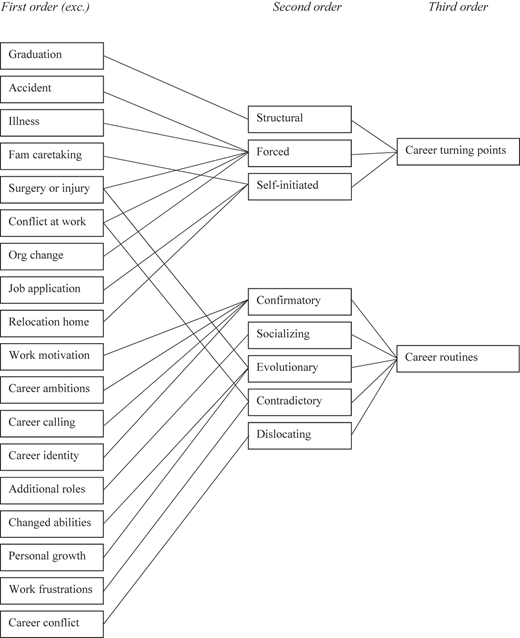
The transcripts of the interviews were thematically analysed by all four researchers through thematic coding (Gioia et al., 2013) using qualitative software (ATLAS.ti, version 9). First-order concepts indicated emerging themes (inductive and open coding) along the career narratives. The emerging second-order themes were compared with contemporary motivational and (sustainable) career theories. The researchers took several iterative rounds of independent analyses. When we applied the careership theory (Hodkinson and Sparkes, 1997), the first round of coding resulted in > 0.80 interrater reliability. The Careership theory (Hodkinson and Sparkes, 1997) appeared to have the best fit in understanding how home-care nurses’ careers evolved. The aggregated dimensions aligned with the different types of routines and turning points, resulting in the second-order concepts and the overall distinction of turning points and routines in the third-order concepts. A coding list based on the careership themes, including types of turning points and routines, was entered into the software and used for recoding (for an excerpt of the code tree, see Appendix 2). The four researchers compared the identified routines and turning points results, and the differences were discussed and agreed upon. The identified routines and turning points were reviewed to construct chronological career paths.
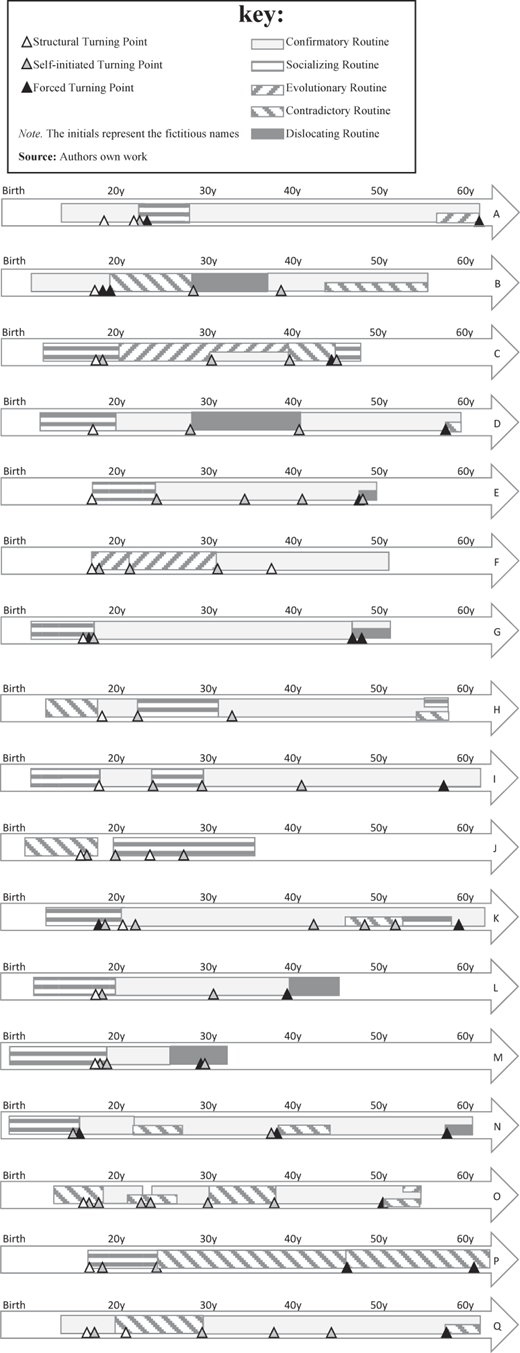
The narratives were deconstructed by all researchers. For each subject, a chronological visualisation of the individual career path was created by organising the routines and turning points along a timeline (see Figure 1). This is in line with the life diagram approach (Söderström, 2020). To this end, three iterative rounds were made, and the final drawings were checked with the interviewees. Finally, the individual career visualisations were then explored for similarities, differences, and trends of the occurrence and frequency of turning points and routine types over time in light of sustainability by trying to cluster them. Again, the researchers initially tried to cluster them independently, and afterwards, the reflections were shared. In the first round, the focus was on the descriptive findings (for example, the occurrence and frequency of turning points and routines, and the interviewees’ interpretations). The researchers concluded that, in order to find groups, we had to consider the overall careers and recurring themes or types of routines. During the second round, we identified the same remarkable findings, which are discussed in the results section.
Results
Routines’ conditionality upon turning points
When evaluating the sequencing within careers and the visualisations of the individual career graphs (see Figure 1), most self-initiated turning points served as the starting point of a confirmatory routine (for samples of the turning points and routines, see Table 3). However, we also observed one self-initiated turning point triggered a socialising routine (Amy, during her 20s), one self-initiated turning point triggered a contradictory routine (Chris, around his 40s), and two self-initiated turning points triggered dislocating routines (Bianca, in her late 20s and Daisy also in her late 20s). Amy shared:
From an early age, I thought, well, that really seems like the best thing to work in district nursing or home-care. But you have to get in there, and when I came back to live here, this crossed my path. So I’m happy I was able to get and do that job. Working in a hospital, I also really enjoyed working there, but that’s a different kind of nursing.
Overview of sample quotes of the turning points and routines
| Career turning points | Number of respondents (N) | Exemplary quote |
|---|---|---|
| Structural turning points | 17 | “I had graduated. And then you’re going to apply for a job.” (Emma) |
| Self-initiated turning points | 17 | “And when the youngest went to school, there was a lot of demand in home-care. Then I applied … I was hired right away.” (Harriet) |
| Forced turning points | 14 | “I had just been admitted to intensive care training. I was already working there at the time and then the situation came that my husband had to go to Amsterdam for work. That would be for a long period of time. So we decided to move there. That also meant that I couldn’t take that training […] , and you didn’t have the chance more than once [i.e. to be admitted to the training].” (Amy) |
| Career Routines | ||
| Confirmatory Career Routine | 15 | “And I was 39 when I came here [referring to the organisation], I never regretted my transition for a day (..) healthcare is just my thing.” (Bianca) |
| Socialising Career Routine | 12 | “So, then I ended up in home-care via a detour [referring to an “incidental” employment agency assignment]. In older persons’ care, it turned out that I really liked that. While that seemed really awful to me at first. Those old smelly people, I thought, I’m not going to work with them.” (Emma) |
| Evolutionary Career Routine | 3 | “I did that for 4 years. I worked there for a number of years until 1999 so I was 33 at the time. And then I thought, it’s not practical enough for me. So, then I started doing nursing school.” (Frida) |
| Contradictory Career Routine | 11 | “Primary school doesn’t appeal to me at all. Good thing I didn’t realise that at the time, so I stopped with the whole teacher training.” (Jade) |
| Dislocating Career Routine | 7 | “But that has already cost me my balance. So, in combination with that, I’m slowly already crumbling.” (Mia) |
Source(s): Authors’ own work
Chris started working at a campsite after working at the bank, which he experienced was not in line with his identity (self-initiated turning point resulting in a contradictory routine): “I ran a campsite with my husband. That was his dream.”
Forced turning points triggered dislocating routines in four situations, but also triggered contradictory routines in two situations or did not redirect the routine at all. For example, after the organisation decided to discontinue a particular service and his job was terminated (forced turning point), Quentin’s career experience, and in particular his view on retiring, changed 180° (contradictory routine):
A big turning point for me was that the [name care service] ceased to exist. Before that, people sometimes asked me how long you have to go [i.e. until retirement], and then I always said, how long do I still have to? I am having a great time. As long as I’m having fun, I’ll just keep doing it. But when that team was disbanded and we all had to go and search, what else can you do? Then I suddenly started counting how many years I still have to work. And then really looked at when I can retire and how long I still have to. (Quentin, in his fifties)
However, we also found that many turning points led to interruptions or changes in routines, but at some turning points, the routines continued. Irene experienced a forced turning point (a different way of working), which she disliked, but did not alter her career routine (remained confirmatory). Another example, after the birth of her children, Emma continued her home-care career at a slower pace, in order to combine her work with taking care of her family. When she was in her 40s and the family did not need as much of her attention anymore, she decided she wanted to work at the level of nursing she was originally trained for but had never worked at. This meant she had to go back to school and re-register as a qualified nurse: “I really wanted to work as a nurse. And then I did the training for the nursing registration, because that’s how I started working for the organization as a nurse.” Emma continued her work as a nurse to full satisfaction (the confirmatory routine was not interrupted) until a conflict made her decide to leave the organisation. She found a job as a nurse at another home-care organisation, but still would have liked to work for her old organisation. This was a disruptive career experience and led to a dislocating routine: “I would have loved to work at [old organization], yes. But that sounds very negative for [new organization]. Yes, I am attached to an organization, and there you have such a bond with it. You grew up together.” (Emma).
Sustainability of routines upon turning points
In line with sustainable careers, we examined the extent to which career routines supported the core indicators of a sustainable career: happiness (subjective well-being and satisfaction), health (physical and mental resilience), and productivity (the ability to contribute and perform effectively). Most home-care nurses have confirmatory or socialising routines that last for 15–30 years. Some even have careers of over 40 years consisting entirely of confirmatory and socialising routines. These routines often reflected sustainable careers, as individuals consistently reported feeling satisfied in their roles (happiness), able to manage work demands over time (health), and engaged in productive work. For example, Amy expressed long-term clarity, contentment, and productivity in her nursing role from a young age (“I was always very pleased with it. I really enjoyed doing it”; “One day I give more time to one client, which I then make up with them and spend on someone else the next day. That actually works well.”). This career illustrates alignment between personal values and work, contributing to the dimensions of sustainable careers.
However, we also found careers with contradictory or dislocating routines with long durations. These routines typically lacked one or more dimensions of sustainability. For instance, Bianca and Daisy spent years in roles that significantly compromised their happiness, health, and productivity. Figure 1 shows contradictory and dislocating routines that together last about 20 years in the career of Bianca. Although she did a job and lived an identity that was not hers, this routine persisted because she had the feeling that she had no alternatives and that the “flight” that she could make through nationwide traveling helped her to escape mentally:
I didn't like it at all on the island. I was obliged to live there. You either like it or you don't, and I felt very cooped up there, and I was like, I just want to leave, I want to go back. The only option at that time was courier service. (…) I don't really have a diploma. So you have to do something, and at that time, I was just a breadwinner. So, yes, then you do that. Oh well, for the rest it wasn't unkind, but you do notice that you were just really numbed. (Bianca)
Another example can be found in Daisy’s career. In order to care for her young children, Daisy decided to quit her care job with irregular shifts and take a job where she could work during school hours. Although she did not like the job at all, she did it for 12 years because she persisted to manage her work-life balance this way.
Even in the meantime that I was not here [the home-care organisation], I spent 12 years behind the cash register at [name supermarket]. Well, that was mind-numbing. At one point, of course, that “beep, beep” …. Terrible. Well, when my daughter turned 12, she went to high school. Then I immediately said, now I go back into care. … I was able to do all shifts again. (Daisy)
Hence, contradictory and dislocating career routines appeared to have a long duration too and lasted for many years. This was the case when respondents wanted to manage priorities in work and life, which may be accompanied by unhappiness within the job. Or it happened when the person has a constant drive for a better career fit. For example, Quentin described how he felt more satisfied in situations of conflict, tension, or discussion, where he was able to express his unhappiness with the situation at work. He raised and addressed several issues at work, but felt that he was not able to initiate a transformation during the years he worked as a nurse, living an identity (as a nurse) he did not really like, but being content with his efforts and ability to address the issues at work. Eventually, he ended up as a chosen representative in the works council, finding the ideal career for a short period, until he noticed another “conflict” between attaining individual needs and collective needs; which he was not able to address through the works council, so he took on a role as a consultant for the labour union. Overall, he felt happiest when he expressed his dissatisfaction with the situation at work.
Contradictory routines were sometimes sustained over long periods and provided intermittent moments of sustainability. For example, Quentin’s career was marked by persistent efforts to contribute to healthcare innovation, despite frequent tension and disappointment. While he sometimes experienced dissatisfaction (reduced happiness) and conflict (stress), he also reported periods of meaning, agency, and impact (boosts productivity and happiness). His career was not uniformly sustainable, but it demonstrates how meaningful engagement, even in the presence of strain, can maintain aspects of career sustainability.
Overall career patterns
We noticed some home-care nurses having similar overall career patterns based on the predominant routine types in their careers. Firstly, we see a long confirmatory routine from the early career onward, sometimes after a short initial socialisation routine. Also, only a few parallel routines reflect negative experiences, and not all turning points lead to new routines. Therefore, these career patterns appear to reflect a recurring pattern within careers, stability along individuals’ careers, and similarity across interviewees. For example: “I was very young when I said I wanted to be a nurse. A friend from kindergarten and I used to say we’ll be nurses later. Yeah, I’ve never really thought of anything else, no.” (Amy). Secondly, we notice that the first part of some careers is dominated by socialising routines, alternating with confirmatory and contradictory routines. It seems that people are looking for a suitable career, for example:
I first started teacher training when I finished high school. Then, after a year, I stopped because I thought, this is really just not my thing. Then I had my oldest son, and then I thought, yes, I must do something again. What are we going to do then? I also liked social work. But there was not one rotten cent to be made at that time. Then I thought such a nursing training is handy because then you get an international diploma, and if I want to go abroad, then that is possible. And there is always work in it, and it wasn't so much “I want to help people”. No. But that was more for those reasons. But now I do it for that reason. (Jade)
Or that people change their careers because a lot is happening in their lives that requires adjustment, for instance:
I actually wanted to be a maternity nurse, take care of babies. Well, at that time, there was a huge waiting list. (..) Then I did a nursing training (..), I worked in the children’s rehabilitation centre, which was very nice. But then I had twins, and my husband, who also worked in shifts. It just did not work. And that also had to do with a a housing subsidy. That became so complicated because the subsidy was cut from my income, and then I actually had to go to work for nothing, so I stopped. And when the youngest went to school, then yes, there was a lot of demand in home-care. Then I applied. Well, then I was hired right away. (Harriet)
Thirdly, the evolutionary routine is predominant in the careers of Chris and Frida. For instance:
When I was in my early twenties, I had that administrative job and I started part-time training in social pedagogical assistance. (..) I did that for 4 years. I worked there for several years until 1999, so I was 33 at the time. And then I thought, it’s not practical enough for me. So then I went on to study nursing. (Frida)
In Chris’ career, the evolutionary routines predominated. Frida’s career eventually stabilises in an ongoing confirmatory, but the need for evolution remains:
What I noticed in myself every time I became restless, then something has to happen again. There had to be another job or another education or something else, yes. No, I switched teams again at this organisation. I also need that challenge. Now I have it again in that training. And knowing myself, I already know in 5 years it will start to itch. (Frida)
Fourthly, several contradictory routines are found in the careers of Polly and Quentin. Striking in the interviews of these home-care nurses is the sailing against the tide, and persevering in it. For instance, in Quentin’s interview, there are many references to the urge to contribute to innovation, the disappointment when things do not work out, and then trying to do something different. After a short career in fishery, he decided to start a nursing education on the other side of the country, as he wanted to move out: “I can’t do that close to home, so my parents can’t force me to stay close.” (Quentin).
About the time after graduation and where he eventually ended up, Quentin says:
At that time, healthcare was innovating. (…) And I wanted to help with that. Well, it turned out that you could bring about much less change. Then I became a practical trainer. Also, with the idea that I might be able to help a little more with the change in healthcare. That actually turned out to be a bit disappointing, then I thought, well, then I'll just go back to working directly in healthcare. (…) The locations where I have worked there, the urge for innovation was not really big enough for me. At the time, I was a member of the works council, and I was able to support people, but not individually. I stopped doing that after 13 years or so, because I noticed that people individually cannot get support from the organisation. And then I became a labor union consultant. (…) and that works well for me. (…) I would surely give [my job] a 7.5/8 on a scale of 0–10. And certainly my work as a union consultant as well. (…) I often hear from people about what’s going on with scheduling. And they don’t know where to get that knowledge from, and then I write in my newsletter, this is how it works, or you can find it there. (Quentin)
Fifthly, dislocating routines are also predominant in some careers. Early in her career, Bianca was fired twice as a healthcare apprentice due to insufficient study results and then went on to work behind the counter in a post office. After several years, Bianca wanted to return to the island, which was only possible by becoming a courier driver, a job she held for 11 years despite the negative experience.
The pressure mounted, and at some point, I gave birth to my daughter and wanted to work part-time. Yes, that was possible on paper, but in my car, there were just as many packages that had to be delivered if I worked full-time. And it was just that car that just had to be empty. (..) you became completely numb because for the rest, you had to do what was told. You become just as hard and business-like as all those other people. I couldn’t keep this up until I’m 65, I just run away screaming. (Bianca)
Daisy did a job she had hated for over 12 years. After her children were born, she decided to take a job as a cashier so that she could work during school hours and take care of her children. For example: “I was so sick of it behind the cash register. Then I thought, well, if my daughter goes to high school, then I can go back into care”. (Daisy) Mia loves her care job very much. But after she has children, the combination of family and work becomes too much. Because her husband also works in shifts, little family life remains. For several years, despite the increasing stress, she puts up with the situation until she eventually burns out. For example: “Well, what I have a lot of trouble with is actually that it is a predominantly a woman’s profession and obviously there are a lot of ambitious women among them, but there are also a lot of mothers. I’ve struggled for a long time to participate in that, but that costs me all my balance. (…) I’m slowly crumbling.” (Mia).
These three nurses have been living with a career experience they did not like, that gave them a lot of stress (even health impairment), and for many years they did not take the initiative to change the situation, maybe because they were not able to, or perhaps because they did not feel they were able to. These examples show that long duration does not equate to career sustainability when personal needs are persistently unmet.
Drawing on sustainable careers theory, we identify three distinct patterns in how happiness, health, and productivity were maintained or compromised across the sample. First, careers with long confirmatory, socialising, or evolutionary routines, such as those of Amy and Frida, reflect sustainable careers with strong alignment across happiness, health, and productivity. Second, some careers, like Quentin’s, reflect partial sustainability: meaningful and productive work is achieved despite ongoing tension. Third, some careers, particularly those dominated by dislocating routines (e.g. Bianca, Daisy, Mia), lack key elements of sustainability, resulting in emotional strain, health risks, and disengagement. These patterns illustrate the complex interplay of life events, personal values, and career routines in shaping sustainable careers.
Discussion
This study contributes to career research by the integration of SC (De Vos et al., 2020) and CS (Hodkinson and Sparks, 1997), taking into account the SC dimensions person, time, and context on the one hand, and the CS facets of turning points and routines on the other hand. This corresponds to the call for a more integrative view on SC with a person-centered, systemic, and dynamic approach (De Vos et al., 2020) with a whole-life perspective (Donald et al., 2024) while making sure that contextual structures are balanced with the intrapersonal dynamics (Delva et al., 2021). In the following, we highlight two remarkable findings regarding (a) the type of turning points, reflecting agency, and the conditionality of routines upon turning points, and (b) the duration of routines in relation to indications of sustainable careers (happy, healthy, and productive).
Firstly, not all turning points affected the career stories, raising questions about the role of the person and their agency, against the backdrop of the context and time. The second dimension of SCs, i.e. contextual connections and interactions, may help explain these observations, suggesting that external influences and workplace interactions have a larger impact on the career experiences of these nurses than their personal choice and self-initiated changes. This may also explain why lifespan diagrams and derived phenomena indicated that not only confirmatory or socialising routines were held for a long period of time —which foster long-term continuity and are essential for SCs— but also evolutionary, contradictory, and even dislocating routines appeared prominently in several careers. The third SC element, i.e. contextual connections and interactions considering the fit of one’s career with the rest of life (i.e. referring to the importance of meaning) may help explain these patterns. The turning points did not always collide with a decision or change. This extends insights from perspectives on transition and adaptation (Schlossberg, 1981); considers different types of movement and change during one’s career through a qualitative approach (Baruch and Sullivan, 2022); extends a focus on standalone critical incidents (Hurst and Brantlinger, 2022), and acknowledges potential “non-events” (Gati and Kulcsár, 2021) captured in routines when no turning point occurred. This emphasises the importance of the integrative perspective when considering careers.
Secondly, in examining the career routines of home care nurses through this phenomenological lens, it seems relevant to consider that some seemingly unsustainable aspects of these routines—particularly those perceived as “less healthy” from an external viewpoint (for example, persistently addressing unhappiness with work-related issues)—may, paradoxically, contribute to a greater sense of happiness and satisfaction. This phenomenon particularly appeared in the “contradictory routines” observed within these careers. These routines, which can appear unsustainable from an outsider’s perspective, are not only retained over time but are often deliberately sought out and maintained by individuals because they bring enjoyment or a sense of fulfilment. Contradictory routines emerged as a relevant feature of several nurses’ careers, underscoring that career sustainability is not solely dependent on maintaining routines that appear healthy or stable. Instead, a sustainable career may also involve perpetuated routines because they are a necessity or even inherently satisfying, even if they entail challenges or push against normative career expectations. This nuanced perspective may help to explain why not only confirmatory and socialising routines—those typically associated with sustainable career progression—were maintained, but also evolutionary, contradictory, and even dislocating routines. These contrasting patterns suggest that sustainability in careers extends beyond stability alone and may also encompass the intrinsic rewards derived from the experiences within these routines, especially when they align with individual motivations and personal satisfaction. They further indicate that home care nurses with careers dominated by contradictory routines may actively seek challenges or change, thereby fuelling a sense of novelty and engagement in their roles. While these routines may appear inconsistent with traditional markers of a sustainable career, the personal happiness derived from such challenges contributes to their ongoing retention and maintenance. This insight into contradictory routines may broaden our understanding of SCs, showing that sustainability can be driven by personal meaning and enjoyment, in combination with given possibilities or opportunities, even if it involves routines that reflect addressing unhappiness at work; it can still imply happiness during one’s career.
The findings suggest the presence of different career profiles based on the predominant routines and, subsequently, probably the person-career fit, the perceived compatibility between the individual and their career (Parasuraman et al., 2000) in home-care careers. These dominating career routines seem to align with the meaning individuals give to their career and how this interacts and aligns with the context. The recurring theme in Careership theory is identity. Career identity has been considered to be constructed throughout a sequence of experiences and is crucial in contemporary careers (LaPointe, 2010). We found that careers dominated by confirmatory routines are characterised by stability in the nurses’ career identity. Home-care nurses with these careers found at an early stage a suitable career that developed as hoped. They were able to tailor career paths to their needs. Careers predominated by socialising routines are very dynamic for the first 15–20 years and thereafter mostly stabilise in careers with confirmatory routines. Two different mechanisms may be applicable here. Firstly, these home-care nurses take longer to find meaning in their work and to develop a stable career identity. Secondly, although these nurses experience similar events and dynamics as nurses with confirmatory routines in their early careers, they respond differently; for example, after having children, they may choose to pause their careers to care for the children. Careers dominated by evolutionary routines appear to reflect ongoing renewal and personal development. Even when the career stabilises into one dominated by confirmatory routine, the evolution continues as the nurses express the need to develop and learn within the home-care context. Home-care nurses with careers predominated by contradictory routines seem to be people who stay in an undesirable situation. Home-care nurses with a career dominated by dislocating routines seem to stay while being unable to accept the situation and being unable to initiate a transformation. Interestingly, some participants with contradictory or dislocating routines appeared to remain in unsatisfying or unhealthy jobs for extended periods without taking steps to return to care or pursue other options. While this might initially seem like passivity or constraint, several accounts suggest that these decisions were, in fact, deliberate and rational. They were made to accommodate caregiving responsibilities or avoid financial instability. These cases offer a valuable opportunity to connect our findings to the theory of career inaction (Verbruggen and De Vos, 2019), which explores why individuals do not always act on their career desires. The theory identifies reasons such as perceived costs, doubts, or a lack of urgency. However, our findings suggest a potential addition: purposeful inaction as a considered strategy in navigating complex life-career intersections.
Theoretical implications and future research avenues
Although the Careership theory is considered to “have kept pace with changing times” (Lauder and Neary, 2020), we advance it by uncovering the relevance attached to a person-centred and within-person approach; together with the external influences in light of sustainable careers (De Vos et al., 2020). In our findings, the parallel routines seemed to contradict each other and related to different domains, e.g. confirmatory for a job and contradictory for the organisation; it mainly depended on the perspective and thought or internal processes of the individual. We noticed long-lasting contradictory or dislocating routines, suggesting that individuals may “sustain” non-confirmatory career routines for extended periods. On the one hand, this adds nuance to Careership theory: it suggest that contradictory routines—whether perceived as sustainable or not—are often intentionally sustained because they contribute to individual happiness or satisfaction. This can also deepen our insight into how the sustainability of careers can evolve. In the case of our nurses, the dimensions of SCs interact over time in such a way that potentially less sustainable career situations or periods can exist and also last. Future research could explore how turning points interact with the concept of career inaction. While career literature emphasises moments of change or redirection, our findings highlight periods of deliberate stasis that are underexplored in career scholarship. Future research could investigate the nuances between “paralysis” and “pragmatic pausing” in career development, especially in contexts like home-care, where structural and personal constraints are deeply intertwined. Moreover, this could expand the scope of turning point studies by integrating moments of non-turning—when individuals consciously decide not to change their path, at least temporarily. Integrating Verbruggen and De Vos’s (2019) theory of career inaction into the study of routines and turning points could illuminate why individuals remain in unsatisfying routines and how this affects long-term sustainability. Comparative studies might explore whether certain professions or demographic groups are more likely to engage in intentional inaction, and whether such inaction contributes to, or undermines, sustainable careers over time. Future research may take a whole-life perspective and consider the outcomes of sustainable careers (happiness, health, and productivity) as a dynamic mechanism in which not all indicators are equally important at all times in order to safeguard a sustainable career.
Limitations
This study is qualitative and exploratory by taking a phenomenological approach. The subjectivity of this approach lies in the two perspectives during and after the interviews. Firstly, the interviews were held with a limited number of interviewees, and they were asked about their past careers. With the use of retrospective data comes a subjective and limited recall. However, individuals’ career narrative determines their actions and is, therefore, especially valuable. Although variation with regard to tenure was sought through purposive sampling, all interviewees were employed in the same country, at the same, somewhat geographically isolated organisation, and in a similar profession. This limits the generalisability of the interpretations and conclusions. Secondly, the coding is done by researchers with their own background and career experience. This coding may limit the richness of qualitative data, and the researchers apply their interpretation to qualitative data. However, the data collection and coding considered the level of saturation that emerged when no additional concepts arose from the final interviews.
Practical implications
The study highlights the importance of considering individuals’ turning points and routines in light of sustainable careers. Career counsellors can utilise this theoretical (cf. Lauder and Neary, 2020) and narrative approach (cf. LaPointe, 2010) to help individuals manage their career sustainability. For instance, a nurse contemplating leaving the profession might explore alternative roles within healthcare that align more closely with their identity, thereby addressing job satisfaction. Within healthcare, different specific professions (or care tasks or roles) and contexts (like home care nursing versus nursing at a hospital) may still align with one’s identity and can overcome “unhappiness” or dissatisfaction with the job. Also, by identifying and labelling routines and addressing potential risks, counsellors can prompt self-awareness and help manage ambiguities, (temporary) disharmony or imbalances, and provide support in vital dynamics affecting career sustainability. Especially since increasing self-awareness and conscientiousness about career development is a valuable tool for individuals to grow (Verbruggen and De Vos, 2019). Understanding career trade-offs enables informed decision-making, contributing to navigating sustainable careers.
References
Appendix 1 Interview questions
Retrospective inventory of career experiences, starting from current frame of reference guided by questions such as:
What (personal) goals do you have with regard to your current work?
What (personal) wishes do you have with regard to your current work?
What (personal) needs do you have with regard to your current work? What do you aspire? What do you long for, what do you need?
Why?
What or who within the work would help with this?
Who or what outside of work would help with this?
What hinders this? What works against?
What goals, wishes, needs do you have for future work? Why?
How are you going to achieve it?
What or who could help?
What hinders? What works against?
Shifting to the past: Why did you choose a job in healthcare?
What education did you have?
What experiences did you have?
What jobs did you have? How was the experience?
What events/turning points did you experience during your career? What decisions or choices did you make? How did these influence your career?
How have your goals, wishes, needs with regard to your work changed since you started working? (What goals, wishes and needs did you start with at the start of your career and how has this evolved?)
Who or what hindered you?
What tipping points do you see when something gained momentum?