


Drawing on the Social Exchange Theory, we developed and examined a sequential model about the effects of prosocial motivation on turnover intentions and career commitment via the sequential mediators of social support and career networking.
We collected three waves of time-lagged data from a sample of 261 full-time employees.
Our results confirm the fact that through the sequential mediating roles of social support and career networking, prosocial motivation negatively influenced turnover intentions while it positively affected career commitment.
This study contributes to the social exchange and careers literature, shedding light on the mechanisms through which employees' prosocial motivation impacts their job and career-related outcomes. We conclude by outlining the theoretical contributions and practical implications of these findings.
1. Introduction
Why would a prosocially motivated employee remain committed to the job and career? Despite increasing interpersonal competition in the labor market (To et al., 2020), helping others or contributing to society is considered a major reason shaping individuals' attitudes toward the choice of and commitment to a job and career (Duffy and Sedlacek, 2007; Grant, 2007). Research on prosocial motivation, defined as a desire to benefit others (Grant, 2008; Hirschi and Pang, 2023), suggests that prosocially motivated people are more persistent and productive in their current jobs (Grant, 2008), and better able to adapt to occupational changes and more optimistic about their careers (Duffy and Raque-Bogdan, 2010). These findings indicate that prosocial motivation can shape both job- and career-related outcomes and be beneficial for organizational performance. Building on this premise, our study examines how prosocial motivation influences key job and career outcomes and through what mechanisms these effects unfold.
Although research has highlighted the importance of employees' motivation to improve others' welfare in prosocial occupations and careers, little is known about whether and how prosocial motivation benefits employees themselves across diverse work settings over time (Liao et al., 2022). This gap may constrain theoretical and practical advances in careers research. Specifically, prosocially motivated employees may behave differently from the common assumption within social, motivation and organizational theories that individuals primarily pursue self-interest, such as rewards, competence and autonomy (Miller, 2001). Those who are more concerned about others often sacrifice their own interests for others' benefit (Grant, 2007), thereby aligning less closely with the central notion of self-interest pursuit in motivation theories (Liao et al., 2022). Yet, we still know little about how prosocial motivation shapes long-term career outcomes. Given that self-interest assumptions remain prevalent in contemporary management studies, more research on prosocial motivation is needed to disclose and account for related attitudes and behaviors across occupations, therefore enhancing our understanding of how to improve employees' performance and organizational effectiveness (cf. Effelsberg et al., 2014).
This study aims to address the above gap by examining how prosocial motivation influences employees' turnover intentions and career commitment. These outcomes are particularly important because they reflect domains in which self-interest has traditionally been assumed to dominate (Grant, 2007), yet prosocially motivated employees may rely on different mechanisms to sustain their careers. In this study, turnover intentions refer to employees' willingness to leave the job or pursue alternative employment (Irving et al., 1997), whereas career commitment reflects an individual's dedication and attachment to their career (Morrow, 1993). Moreover, insight into the mechanisms underlying the effects of prosocial motivation on these employee outcomes remains limited. This warrants greater attention because employees working in or pursuing careers in fields outside the domain of prosocial vocations can still be motivated by a desire to help others, for instance by supporting colleagues or contributing to broader organizational and societal goals (Hu and Liden, 2015), rather than being driven by self-interest. Accordingly, our study seeks to explain how prosocial motivation shapes turnover intentions and career commitment across diverse work contexts, thereby providing relevant insights for scholars and practitioners.
Drawing on the social exchange theory (Blau, 1964), we develop and test a sequential mediation model in which social support and career networking serve as key underlying mechanisms. Social support refers to the socio-emotional and informational resources provided by others (i.e. friends, coworkers) (Carlson and Perrewé, 1999), while career networking captures individuals' efforts to build and use relationships to address career-related challenges (Wolff and Moser, 2009). We argue that prosocial motivation fosters positive social exchanges that elicit reciprocation (i.e. social support), which in turn facilitates broader career networking. As a result, such exchange relationships are reciprocated by recipients with additional resources, making employees less likely to consider leaving the organization and more committed to their career (Cropanzano et al., 2017).
This study makes four important contributions to the career literature. First, it extends the social exchange theory by explaining how prosocial motivation can initiate and sustain exchange relationships at work over time. Second, it sheds light on the mechanisms through which prosocial motivation influences turnover intentions and career commitment by examining perceived social support and career networking as sequential mediators. Third, it advances an understanding of the spillover effect of social support on career-oriented exchange relationships by showing how perceived social support may foster employees' engagement in career networking over time. Finally, by drawing on a multi-industry sample of full-time employees, the study extends prior research on prosocial motivation beyond traditionally prosocial occupations (e.g. lawyers, firefighters, nurses; Grant, 2007) and strengthens the generalizability of the findings across diverse work contexts.
2. Theory and hypotheses
2.1 Prosocial motivation as a driver of social exchange relationships
Prosocial motivation can play a key role in initiating favorable social exchanges and reinforcing positive exchange relationships. Prosocial means “benefiting others,” and motivation refers to an internal condition that initiates, orients and maintains a particular behavior (Grant, 2007). Accordingly, prosocial motivation can be defined as a psychological condition to initiate and sustain helping behaviors for others (Grant, 2008). Research shows that prosocial motivation encourages people to take others' perspectives at work (Grant and Berry, 2011) and enhances their commitment and engagement into prosocial actions (Hirschi and Pang, 2023). Earlier studies also indicate that prosocially motivated employees are willing to sacrifice self-interests to improve others' welfare (Bolino and Turnley, 2005) and team effectiveness (Hu and Liden, 2015). Therefore, when prosocially motivated, employees are more likely to initiate and continue engaging in helping behaviors even when doing so requires them to forego personal gains.
According to the social exchange theory (Blau, 1964), social exchange comprises a series of bi-directional transactions through which mutual trust, commitment and high-quality relationships are formed and developed over time. Because social exchange is typically initiated by one party's positive move toward another (Cropanzano and Mitchell, 2005), the exchange process can begin when a prosocially motivated employee provides help or benefits to a target person. For instance, such employees may support others by advising and assisting coworkers in need or connecting them with those who can provide help. Social exchange theory further suggests that subsequent rounds of exchange are likely to occur when recipients reciprocate by recognizing a giver's prosocial behaviors, expressing appreciation, or providing assistance.
Employees motivated by self-interest may also develop interpersonal relationships in workplaces by investing personal resources (e.g. time, effort) in colleagues. Yet research suggests that people vary in their relational processes, attitudes and behaviors toward others depending on their underlying motives. Grant (2008) argues that prosocial motivation reflects an intrinsic desire to enhance others' well-being and the organization's welfare, whereas self-interested motivation is more often linked to extrinsic rewards. Importantly, recipients of help tend to respond with greater gratitude, trust and prosocial exchange when perceiving support as driven by genuine and autonomous motivation, which in turn strengthens commitment and cooperation within exchange relationships (Eisenberger et al., 2001). Thus, while employees who help others with self-interest may still form interpersonal links at work, prosocially motivated employees are more likely to develop stronger mutual ties and commitment, which further reinforce cooperative behaviors in workplaces (Grant and Berry, 2011).
Given this difference in the effect of an individual's motivation, by self-interest or prosocially, we argue that favorable actions and behaviors from a particular source (i.e. a prosocially motivated employee) can positively reinforce social exchanges and the corresponding relationships by leading the recipients to orient their favorable attitudes and behaviors toward that source (Lavelle et al., 2007). As such, prosocially motivated employees are likely to initiate and sustain positively reinforced social exchange relationships, which in turn, benefit them as reflected in enhanced job- and career-related attitudes.
We further argue that social support from positive social exchange relationships encourages employees to engage more actively in career networking. Social support facilitates the exchange of resources and strengthens positive relationships, thereby expanding employees' social networks (Cropanzano et al., 2017). Thus, employees with prosocial motivation are more likely to gain relational and instrumental resources (e.g. workplace assistance, emotional support), in turn fostering positive work attitudes and behaviors while reducing negative outcomes. For example, employees who are well interconnected with colleagues are less likely to leave the organization, as doing so would mean losing valuable social resources. They also likely demonstrate stronger career commitment, supported by advice and guidance from mentors through career networking. Indeed, Lent and Brown (2019) highlight the key role of social support in enhancing employees' career attitudes and behaviors.
2.2 A social exchange lens of prosocial motivation and work outcomes
Prosocially motivated employees frequently interact with colleagues and make efforts to improve others' well-being (De Dreu et al., 2000) through their work (Grant and Shandell, 2022). According to previous research, people with prosocial motivation are more concerned with others' benefits than their self-interests, more engaged in helping behaviors and more willing to maintain their membership in a group (Grant and Mayer, 2009) with a long-term perspective (Grant, 2008). Further, prosocial motivation is positively associated with an individual's perception of social support at work (Kim et al., 2013), commitment to their organization (Shao et al., 2017), efficacious belief in career decisions and adaptability to changes in job and career environments (Duffy and Raque-Bogdan, 2010).
According to the social exchange theory (Blau, 1964), when a social exchange relationship develops because of a recipient receiving help or benefits from a prosocially motivated employee, the exchanged socio-emotional resources (i.e. concerns, aids) signal to the recipient that their well-being is cared for. Then, this perception generates a sense of reciprocal obligation to the recipient. Moreover, bi-directional transactions between a prosocially motivated employee and the recipient constitute social exchange processes which produce mutual trust and commitment (Cropanzano and Mitchell, 2005). These processes reinforce interpersonal relationships by improving the quality and quantity of subsequent transactions between exchange partners (Cropanzano and Mitchell, 2005). Building on social exchange theory, we contend that such positive exchange relationships lead employees to form favorable job and career attitudes such as reducing withdrawal behaviors and increasing commitment to their careers (Arnold, 1990; Lavelle et al., 2023).
To reveal the underlying mechanisms of the linkage between prosocial motivation and the outcomes, we argue that prosocially motivated employees will likely perceive more social support from co-workers because their prosocial behaviors would be more frequently and positively reciprocated by their colleagues (i.e. recipients) during social exchange processes. When reacting to care and aid received from others, recipients seek to maximize the possibility that a co-worker may notice their efforts to reciprocate (Cropanzano et al., 2017). Additionally, socio-emotional and instrumental resources (e.g. concerns, help, benefits) provided by a co-worker are appreciated as more valuable when offered voluntarily based on the co-worker's discretionary choice (Rhoades and Eisenberger, 2002), which features prosocial motivation.
An employee high in prosocial motivation tends to show more affiliative citizenship behaviors which promote work processes and relationships (Grant and Mayer, 2009; Liao et al., 2022). In turn, these affiliative actions will likely elicit reciprocal social support from the beneficiaries who feel obligated to respond positively to the contributing employees (Cropanzano et al., 2017). To support this theorization, Lin et al. (2024) found that employees who attribute a prosocial motive to increasing social resources (e.g. asking colleagues for advice) experienced more social support and less social undermining in workplaces. Hence, we expect that prosocially motivated employees will perceive more support from the people surrounding them.
According to Social Cognitive Career Theory (Lent et al., 2002), environmental factors (e.g. social support) lead individuals to engage in career-related behaviors via their enhanced self-efficacy and outcome expectations. When perceiving social support available at work, an employee may engage more in career networking behaviors as co-workers’ support can improve his/her self-efficacy and outcome expectations. For example, those who perceive more support from co-workers may feel more confident in finding career mentors or obtaining career-related information. They may also form more favorable expectations that their networking efforts will create opportunities aligned with their career goals.
We further argue that perceived social support will lead employees to be more actively involved in career networking. Career networking refers to an individual's activities of forming, retaining and using interpersonal ties to achieve a career goal (Wolff and Moser, 2009). From a social exchange perspective, social support represents a valuable socio-emotional and instrumental return that signals the availability of exchange resources and the reliability of relational partners (Cropanzano et al., 2017). These supportive returns make employees more willing and able to broaden and activate career-relevant ties because they possess greater relational resources, including encouragement, information and access to introductions. Thus, we contend that social support does not merely co-occur with networking. Rather, it provides exchange-based resources that enable employees to develop broader career-oriented networks which are particularly consequential in work domains (Porter et al., 2016). Based on the reasoning above, we posit that prosocially motivated employees will more likely receive social support in return for their helping behaviors (Hypothesis 1). Furthermore, these beneficial exchange relationships will stimulate greater engagement in career networking (Hypothesis 2). Indeed, Grant (2008) suggests that prosocial motivation orients individuals toward the needs of others, therefore increasing the likelihood that supportive relationships are formed and subsequently leveraged into broader career connections.
Drawing on the social exchange theory (Blau, 1964), we theorize that an employee's desire to portray prosocial behaviors, driven by prosocial motivation, and the resulting beneficial exchange relationships (i.e. give and take social support, network for the good of others and oneself) will lead them to form positive jobs and career attitudes such as decreased turnover intentions and increased career commitment. Specifically, employees can obtain valuable socio-emotional and instrumental resources (e.g. friendship, information) through career networking which help them effectively manage work stressors (Ren and Chadee, 2017). As a result, we expect that employees who engage more in career networking may experience lower intentions to quit and higher career commitment. Studies show that social support positively influences intention to stay (Basford and Offermann, 2012) and career commitment (Azim and Islam, 2018), while reducing turnover intentions (Ito and Brotheridge, 2005). We propose that career networking is a key mechanism through which supportive exchange resources are translated into these career outcomes.
To summarize, we expect that prosocial motivation will predict social support, which will then enhance career networking. Furthermore, we assume that career networking will be negatively associated with turnover intentions and positively with career commitment. Accordingly, we hypothesize.
Prosocial motivation is positively associated with perceived social support.
Perceived social support is positively associated with engagement in career networking.
Engagement in career networking is negatively associated with turnover intentions.
Engagement in career networking is positively associated with career commitment.
The negative relationship between prosocial motivation and turnover intentions will be sequentially mediated by social support first and then career networking.
The positive relationship between prosocial motivation and career commitment will be sequentially mediated by social support first and then career networking.
Our sequential mediation model is displayed in Figure 1.
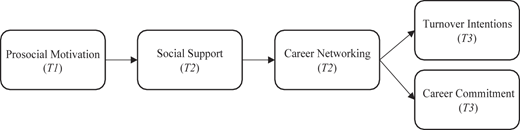
Hypothesized sequential model. Note: T1 = Time, T2 = Time, T3 = Time. Source(s): Authors’ own work
Hypothesized sequential model. Note: T1 = Time, T2 = Time, T3 = Time. Source(s): Authors’ own work
3. Methods
3.1 Data and sample
After receiving ethics approval from the Australian university, we collected data from full-time employees through Amazon's Mechanical Turk (MTurk) in the United States. Research has shown that MTurk offers as reliable samples and data as conventional samples do in management research (Walter et al., 2019). MTurk participants tend to be more heterogeneous in age, education and occupational backgrounds than students or single-organization samples, which enhances the representativeness and generalizability of our findings (Landers and Behrend, 2015). It is unlikely that self-employed or gig-economy workers were included in the dataset because participants were to report the organizational tenure. As an organizational tenure assumes a formal employment relationship to an employer, independent workers do not earn it due to their self-employment. As a result, the final sample is likely to represent individuals in standard full-time organizational roles.
To ensure data quality, we implemented multiple safeguards. First, we adopted a three-wave research design to temporally separate the measurements of focal constructs and mitigate potential common method variance (CMV; Podsakoff et al., 2012). At Time 1, participation was voluntary, and the invitation emphasized confidentiality and data use for research purposes only. We included instruction-based attention checks (e.g. “please select Strongly Agree”) and excluded those who failed them. Approximately three weeks later, we received 310 responses at Time 2. Five respondents failed the attention checks and were removed. The remaining respondents were invited to complete the Time 3 survey about three weeks later. Ultimately, 261 respondents, who completed all three questionnaires and passed all attention checks, were retained for analyses. Such screening and temporal separation procedures are widely recognized to reduce careless responding and enhance the reliability of survey data (Hauser and Schwarz, 2016). We used validated measures for all constructs (see Measures) which supported the suitability of the data for testing our theoretical model. Taken together, these steps increased confidence that our data accurately captured the focal constructs and provided a robust foundation for testing the proposed model.
The participants' average age was 40.75 years (SD = 10.42) with 42.91% of these employees aged between 31 and 40 and 22.61% of them between 41 and 50. Out of 261 employees, 106 employees (40.6%) were female. Participants had worked for 3.76 years in their current organization (SD = 1.14) on average. A total of 58.24% of the respondents obtained a high school diploma and 20.69% of them earned a bachelor's degree or higher.
3.2 Measures
A five-point Likert-type scale (1 = strongly disagree to 5 = strongly agree) was used for all measurement items in this study. All scales were well-validated with good psychometric qualities were good in the literature.
Prosocial motivation (α = 0.96) was measured at Time 1, using the four-item scale developed by Grant (2008). An example item is: “It is important for me to do good for others through my work.”
Social support (α = 0.96) was measured with six items at Time 2, using Sarason et al.’s (1987) measure of social support. This scale stated “People sometimes look to others for companionship, assistance, or other types of support at work. How often is each of the following kinds of support available to YOU if you need it?” An example item is: “Someone who distracts you from your worries when you feel under stress.”
Career networking (α = 0.89) was measured at Time 2, using the three-item scale adapted from Sturges et al. (2002). An example item is: “I have built contacts with people in areas where I would like to work.”
Career commitment (α = 0.93) was measured at Time 3, with the six-item scale from Meyer et al. (1993). A sample item is: “My career is important for my self-image.”
Turnover intentions (α = 0.89) were measured at Time 3, with the three-item scale from Irving et al. (1997). An example item is: “I intend to stay in this job for the foreseeable future.”
Control variables. We controlled for an employee's age, gender, educational level and organizational tenure in the analyses as research suggests that these variables may affect networking behaviors, career commitment and turnover intentions (Katz et al., 2019). Gender was dummy-coded (Male = 1; Female = 0).
3.3 Data analysis
First, a confirmatory factor analysis (CFA) in AMOS 23 (Arbuckle, 2014) examined the distinctiveness of our study variables in the measurement model and addressed potential CMV issues. We assessed alternative models using the comparative fit index (CFI), Tucker–Lewis index (TLI), root mean square error of approximation (RMSEA) and standardized root mean square residual (SRMR), with thresholds of > 0.90 for CFI and TLI, and <0.10 for RMSEA and SRMR indicating a good fit (Hu and Bentler, 1999). Next, hierarchical regression analyses with SPSS 25 investigated the hypothesized direct effects in our model. Lastly, we used Hayes' (2018) PROCESS Macro to examine the indirect effect of prosocial motivation on turnover intentions and career commitment through social support and career networking. We computed 95% confidence intervals from 5,000 bootstrapped samples (Preacher and Hayes, 2008).
4. Results
4.1 The measurement model
We conducted a CFA to assess the fit of our proposed five-factor model including all items of our measures: prosocial motivation, social support, career networking, career commitment and turnover intentions. As shown in Table 1, we compared the five-factor model to the alternative models: (1) Three four-factor models with, first, career commitment (T3) and turnover intentions (T3), second, social support (T2) and career networking (T2) and, third, career networking (T2) and career commitment (T3) loaded on one factor, respectively; (2) a three-factor model with one factor at each time point; (3) a two-factor model with the variables at Time 2 and 3 loaded on one factor and (4) a one-factor model.
Results of CFAs and chi square difference tests
| Models | χ2 (df) | Δχ2 (df) | CFI | TLI | RMSEA | SRMR | |
|---|---|---|---|---|---|---|---|
| Estimates | 90% CI | ||||||
| 5-factor model | 687.41*** (199) | 0.92 | 0.91 | 0.10 | [ 0.09, 0.11 ] | 0.05 | |
| 4-factor modela | 896.99*** (203) | 209.58*** (4) | 0.89 | 0.87 | 0.12 | [ 0.11, 0.12 ] | 0.06 |
| 4-factor modelb | 1174.55*** (203) | 487.14*** (4) | 0.84 | 0.82 | 0.14 | [ 0.13, 0.14 ] | 0.13 |
| 4-factor modelc | 1067.59*** (203) | 380.18*** (4) | 0.86 | 0.84 | 0.13 | [ 0.12, 0.14 ] | 0.08 |
| 3-factor model | 1383.23*** (206) | 695.82*** (7) | 0.81 | 0.78 | 0.15 | [ 0.14, 0.16 ] | 0.13 |
| 2-factor model | 2785.38*** (208) | 2097.97*** (9) | 0.57 | 0.53 | 0.22 | [ 0.21, 0.23 ] | 0.16 |
| 1-factor model | 3790.33*** (209) | 3102.92*** (10) | 0.41 | 0.34 | 0.26 | [ 0.25, 0.26 ] | 0.19 |
Note(s): N = 261. ***p < 0.001. CI = confidence interval
Items for turnover intentions at Time 3 and career commitment at Time 3 were loaded on one factor
Items for social support at Time 2 and career networking at Time 2 were loaded on one factor
Items for career networking at Time 2 and career commitment at Time 3 were loaded on one factor
The CFA outcomes in Table 1 showed that the five-factor model offered a better fit to the data (χ2 = 687.41, df = 199, p < 0.001, CFI = 0.92, TLI = 0.91, RMSEA = 0.10, SRMR = 0.05) in comparison with all the alternative models. These results suggest that our five measures (prosocial motivation, social support, career networking, turnover intentions, career commitment) are distinctive from one another. Therefore, CMV is unlikely to pose a substantial issue to the validity of our empirical work. However, as with all self-report surveys, CMV cannot be entirely ruled out.
Following Williams et al.’s (2010) and Shuck et al.’s (2017) approach, we also conducted a marker variable analysis to address the CMV issue (Podsakoff et al., 2003) rigorously in relation to the methods in this study. An individual's prevention focus measured at Time 1 was used as a marker variable. It is because, among the other variables measured additionally in this research, this construct is considered as theoretically less (or un-) related to the other key variables (i.e. prosocial motivation, social support, career networking, turnover intentions, career commitment) in this study, not showing a significant correlation coefficient to those key variables other than career commitment at Time 3 (r = 0.127, p = 0.040) (Williams et al., 2010, p. 478).
In the first phase of the marker variable analysis, we ran the CFA model with a prevention focus of five items. A prevention focus as a marker variable was added to the five-factor measurement model including prosocial motivation (Time 1), social support and career networking (Time 2) and turnover intentions and career commitment (Time 3). Examining the CFA model, we obtained the estimates of the factor loadings and error variances for the five items of a marker variable. Next, we evaluated the baseline model in which these five variables were correlated with each other, while the correlations between these five variables and the marker variable (i.e. a prevention focus) were forced to be a zero (0). In this model, the indicators (i.e. the five items) of the marker variable were set up with fixed factor loadings and fixed error variances. The unstandardized factor loadings and unstandardized error variances of a prevention focus obtained from the CFA model were used for those fixed values of the marker variable in the baseline model.
Then, we examined the constrained model, or the Method-C model, in which all the factor loadings from the marker variable to each indicator of each variable were forced to have equal values. In other words, we had a total of 22 method factor loadings from the marker variable to all the other indicators in addition to the five factor loadings of the marker variable. Each of these 22 method factor loadings from the marker variable to the five variables (i.e. prosocial motivation, social support, career networking, turnover intentions, career commitment) were set up to be equivalent in value “to appropriately reflect the assumption of the CMV Model of equal method effects” (Williams et al., 2010, p. 21). By comparing the Method-C Model with the baseline model, we investigated the presence of common-method bias related to the marker variable in our research model. If the Method-C model with the method factor loadings constrained to have equal values does not show a significantly better fit than the baseline model, it suggests that there is no evidence of common-method bias in relation to the marker variable (Williams et al., 2010). Our maker variable test did not find that the Method-C model had a significantly improved fit over the baseline model. Thus, we concluded that common-method bias is not likely to be a critical issue in our empirical model.
4.2 Descriptive statistics
Table 2 shows the means, standard deviations and correlations of all study variables. The results indicated that all main study variables were significantly correlated with each other in the expected directions.
Means, standard deviations, correlations and reliabilities
| Variable | M | SD | 1 | 2 | 3 | 4 | 5 | 6 | 7 | 8 | 9 |
|---|---|---|---|---|---|---|---|---|---|---|---|
| 1. Age (T1) | 40.76 | 10.42 | |||||||||
| 2. Gender (T1) | 0.59 | 0.49 | −0.10 | ||||||||
| 3. Educational level (T1) | 3.03 | 0.71 | −0.12* | −0.00 | |||||||
| 4. Tenure (T1) | 3.76 | 1.14 | 0.34*** | 0.04 | −0.01 | ||||||
| 5. Prosocial motivation (T1) | 3.89 | 0.90 | 0.09 | 0.02 | 0.14* | 0.08 | (0.96) | ||||
| 6. Social support (T2) | 3.45 | 1.14 | −0.00 | −0.05 | 0.05 | 0.10 | 0.22*** | (0.96) | |||
| 7. Career networking (T2) | 3.20 | 1.07 | −0.02 | 0.06 | 0.12 | 0.09 | 0.40*** | 0.34*** | (0.89) | ||
| 8. Career commitment (T3) | 3.81 | 1.09 | 0.13* | −0.03 | 0.09 | 0.06 | 0.45*** | 0.36*** | 0.49*** | (0.93) | |
| 9. Turnover intentions (T3) | 2.25 | 1.20 | −0.23*** | 0.08 | 0.02 | −0.14* | −0.28*** | −0.39*** | −0.36*** | −0.68*** | (0.89) |
Note(s): N = 261. Gender was coded as 1 = male and 0 = female. Tenure = Organizational tenure. Numbers in parentheses are reliabilities. T1 = Time 1, T2 = Time, T3 = Time 3
*p < 0.05
***p < 0.001
4.3 Hypotheses' testing
We used hierarchical regression analyses to test the direct effects in Hypotheses 1, 2, 3 and 4. Table 3 shows that prosocial motivation at Time 1 was positively related to social support at Time 2 (b = 0.28, p < 0.001), and that social support at Time 2 was positively related to career networking at Time 2 (b = 0.24, p < 0.001) after controlling for the effect of prosocial motivation (T1) on career networking (T2). Thus, Hypotheses 1 and 2 were supported. Hypotheses 3 and 4 were both supported as career networking at Time 2 was negatively related with turnover intentions at Time 3 (b = − 0.25, p < 0.001), while positively associated with career commitment at Time 3 (b = 0.33, p < 0.001) after controlling for the effects of prosocial motivation (T1) and social support (T2) on turnover intentions and career commitment at Time 3 (see Table 3).
Regression analyses
| Social support (T2) | Career networking (T2) | Career commitment (T3) | Turnover intentions (T3) | ||||||||||
|---|---|---|---|---|---|---|---|---|---|---|---|---|---|
| Step 1 | Step 2 | Step 1 | Step 2 | Step 3 | Step 1 | Step 2 | Step 3 | Step 4 | Step 1 | Step 2 | Step 3 | Step 4 | |
| Age (T1) | −0.00 | −0.01 | −0.00 | −0.01 | −0.01 | 0.01 | 0.01 | 0.01 | 0.01* | −0.02** | −0.02** | −0.02** | −0.02*** |
| Gender (T1) | −0.13 | −0.14 | 0.12 | 0.10 | 0.13 | −0.04 | −0.06 | −0.03 | −0.07 | 0.15 | 0.17 | 0.12 | 0.15 |
| Educational level (T1) | 0.07 | 0.02 | 0.18 | 0.09 | 0.09 | 0.16 | 0.06 | 0.05 | 0.03 | −0.01 | 0.06 | 0.06 | 0.08 |
| Tenure (T1) | 0.11 | 0.10 | 0.09 | 0.08 | 0.05 | 0.01 | −0.01 | −0.03 | −0.05 | −0.08 | −0.07 | −0.03 | −0.02 |
| Prosocial motivation (T1) | 0.28*** | 0.46*** | 0.39*** | 0.54*** | 0.46*** | 0.33*** | −0.35*** | −0.25** | −0.15 | ||||
| Social support (T2) | 0.24*** | 0.27*** | 0.19*** | −0.36*** | −0.30*** | ||||||||
| Career networking (T2) | 0.33*** | −0.25*** | |||||||||||
| R2 | 0.02 | 0.06*** | 0.03 | 0.17*** | 0.23*** | 0.03 | 0.22*** | 0.29*** | 0.37*** | 0.06** | 0.13*** | 0.24*** | 0.28*** |
| ΔR2 | 0.05*** | 0.14*** | 0.06*** | 0.19*** | 0.07*** | 0.08*** | 0.07*** | 0.11*** | 0.04*** | ||||
Note(s): N = 261. Unstandardized beta coefficients are reported. T1 = Time 1, T2 = Time 2, T3 = Time 3
All tests are two-tailed
*p < 0.05
**p < 0.01
***p < 0.001
Finally, we used Hayes' PROCESS model 6 (Hayes, 2018) to test the sequentially mediated relationships in Hypotheses 5 and 6 with 95% confidence intervals and 5,000 bootstrapped resamples. Hypothesis 5 predicted a negative indirect effect of prosocial motivation on turnover intentions via social support and career networking. Hypothesis 6 predicted a positive indirect effect of prosocial motivation on career commitment through the same sequential mediators. Table 4 shows that prosocial motivation at Time 1 was negatively related to turnover intentions at Time 3, through social support and career networking at Time 2 (estimate = −0.02, 95% CI = [−0.04, −0.00]). On the contrary, prosocial motivation at Time 1 was significantly positively related to career commitment at Time 3, through the same sequential mediators at Time 2 (estimate = 0.02, 95% CI = [0.01, 0.05]). Therefore, Hypotheses 5 and 6 were both supported.
Bootstrap results of the effects of prosocial motivation
| Coefficient | 95% CI | |
|---|---|---|
| 1. Direct and indirect effects of prosocial motivation on turnover intentions | ||
| Prosocial motivation (PM) → Turnover intentions | −0.15 | [−0.31, 0.00 ] |
| PM → Social support (SS) → Turnover intentions | −0.08* | [−0.16, −0.03 ] |
| PM → Career networking (CN) → Turnover intentions | −0.10* | [−0.17, −0.04 ] |
| PM → SS → CN → Turnover intentions (Hypothesis 5) | −0.02* | [−0.04, −0.00 ] |
| 2. Direct and indirect effects of prosocial motivation on career commitment | ||
| PM → Career commitment (CC) | 0.33* | [ 0.20, 0.46 ] |
| PM → Social support (SS) → CC | 0.05* | [ 0.01, 0.11 ] |
| PM → Career networking (CN) → CC | 0.13* | [ 0.07, 0.20 ] |
| PM → SS → CN → CC (Hypothesis 6) | 0.02* | [ 0.01, 0.05 ] |
Note(s): N = 261. Coefficients are unstandardized. CI = confidence interval
All tests are two-tailed
*p < 0.05
5. Discussion
5.1 Theoretical contributions
Consistent with social exchange theory, our findings support a sequential process in which prosocial motivation is associated with perceived social support, then facilitating career networking and subsequently lowering turnover intentions and enhancing career commitment. This highlights that social support functions as an enabling resource for career networking rather than a factor that merely co-occurs with it.
Our study has four important theoretical implications. First, we extend social exchange theory (Blau, 1964) by explaining how prosocial motivation commences and drives social exchange relationships at work over time. Prior research has largely assumed that exchange relationships occur in pre-established social contexts (e.g. leader–member, customer–employee) and focused on reciprocal obligations arising from material or task-related exchanges (e.g. Le et al., 2023). By contrast, our study shows that motivation to benefit others can lead employees to engage in exchange relations and behaviors more actively, leading to the development of social support and broader exchange networks beneficial for their career.
Second, our study clarifies the mechanisms underlying positively reinforced exchange relationships (Cropanzano and Mitchell, 2005). Chernyak-Hai and Rabenu (2018) argued that the social exchange theory requires further development to reflect changing workplace contexts, such as flexible work arrangements, which may shape the quality of exchange relationships and trust among workplace actors. In this regard, our study extends social exchange theory by revealing a sequential pathway from prosocial motivation to turnover intentions and career commitment via social support and career networking. This serial mechanism enriches social exchange theory by showing how employees mobilize internal and external resources to navigate career decisions, thereby extending research on workplace relationships and employees' job and career attitudes.
Third, our study reveals the spillover effect of perceived social support on career-oriented exchange relationships over time. While researchers have examined social support at work and career networking in isolation (e.g. Eisenberger et al., 2020), we found that social support spills over to facilitate career networking over time as prosocial motivation evolves beyond organizational boundaries. From a social exchange perspective (Cropanzano and Mitchell, 2005), we advance the understanding of how employees leverage social resources to shape career trajectories and longer-term job and career attitudes. As such, our time-lagged design provides evidence for the mechanisms linking prosocial motivation, social support and career networking with the job and career outcomes.
Finally, our multi-industry sample improves the generalizability of findings beyond the public, prosocial, health and service-oriented occupations mainly studied in prosocial motivation research (e.g. Lebel and Patil, 2018). With employees across diverse industries, this study enhances the external validity of the results and demonstrates that prosocial motivation has relevance and impact in work settings not traditionally associated with prosocial behavior.
5.2 Practical contributions
Our findings have several practical implications. First, our findings suggest that prosocial motivation can shape an individual's career outcomes through their relational choices at work. Employees with prosocial motivation are more likely to interact with genuine intents to benefit others, which can increase the likelihood that colleagues respond with social support over time. It implies that employees can benefit when their prosocial motives are consistently expressed through authentic relationship building with sustained contributions to others' success. As these employees receive support from their network ties, they may also manage career stress more effectively and have better performance, possibly supporting their career progression. Managers can therefore guide employees to reflect on their affiliative motives, translate prosocial intentions into relationship-building routines and establish prosocial goals to reinforce support networks and career development.
Second, these findings may be especially relevant in contexts where careers are less bounded and work relationships are more fluid such as the gig economy (Petriglieri et al., 2017). In such settings, prosocial motivation may serve as personal resources for individuals to maintain a cooperative, other-oriented reputation, which can sustain supportive ties and career-relevant networks. Consistent with “feeling good, doing good” perspectives, prosocially motivated behaviors can support meaning at work and resilience in challenging interpersonal contexts (Liao et al., 2022). Thus, employees may benefit from allocating time to relationship building that reflects their prosocial orientation such as checking in with colleagues and offering assistance as these exchanges can help accumulate social capital and career opportunities. Furthermore, organizations may benefit more from these members with prosocial motivation, particularly when relying on knowledge sharing and collaboration (Hu and Liden, 2015). Leaders and managers can reinforce prosocial behaviors through coaching, mentoring and recognition practices to signal that the organization values supportive relationship-building in the workplace.
In addition, organizations should make efforts to provide structured opportunities for employees to build connections internally and externally (e.g. volunteering activities) through their prosocial motivation and behaviors. For example, Qualcomm offers volunteering opportunities and team activities for employees' relationship building (Qualcomm Technologies, 2025). Such practices enable employees to increase relational resources through developing internal and external networks that benefit both employees and the organization (Ballinger et al., 2011). Corporate volunteering has also been described as a growing trend that supports network development and career commitment (Haski-Leventhal et al., 2019).
Finally, prosocial motivation and behaviors may not be uniformly beneficial across contexts. Collective prosociality may produce unintended consequences. For example, when employees perceive psychological contract violations, group norms and exchange expectations may intensify their reactions to unfairness. Also, employees highly connected may be more visible to competitors, which can increase poaching risk or collective turnover (Ballinger et al., 2011). Thus, organizations should attend to how prosocial dynamics operate and monitor the conditions under which supportive exchanges translate into sustainable retention and commitment.
6. Limitations and future directions
This study has several limitations. First, although CMV does not seem a major threat in our study, CMV could still have inflated the estimated effect sizes due to all self-reported responses (Podsakoff et al., 2012). To reduce CMV, we measured the independent, mediating and dependent variables at three different time points by a time-lagged research design. We also conducted a marker variable analysis to address the CMV issue. Its outcome suggests that, as CMV is not a critical issue in the current model, it is unlikely to change the significance of the hypothesized relations. Future studies could minimize this concern through multi-source or longitudinal approaches.
Second, our sampling approach relied entirely on one of the major online platforms (i.e. MTurk). In spite of recent research findings that online samples are similarly reliable in comparison with conventional samples (Walter et al., 2019), we suggest that future studies use samples and responses from different sources (i.e. supervisors and coworkers) and occupational settings to assess our hypotheses. Then, these approaches will add more insights about the generalizability of our findings.
Third, we did not measure the respondents' self-interest. So, we could not examine empirically how self-interest would function in the hypothesized model. Although we theoretically support the hypothesized mechanism with the findings of prior research (Grant, 2007; Liao et al., 2022), the current outcomes remain open to alternative explanations, particularly by self-interest. Further, we cannot determine whether prosocial motivation offers a stronger explanation of the observed relationships than the self-interest perspective. Future research could address this limitation by simultaneously modeling prosocial and self-interested motives and comparing their relative explanatory power. Such work may benefit from incorporating cognitive variables (i.e. an attribution of motives or intent to help) to better capture the psychological processes in our model.
Last, we did not test boundary conditions in our model. The effects of prosocial motivation may become weakened or reversed depending on contextual attributes. Particularly, a competitive work culture may suppress prosocial behaviors by discouraging cooperation and supportive returns for other-oriented efforts. Prosocially motivated employees may perceive poor fit and increased turnover intentions in these environments. More broadly, prosocially motivated employees could behave against others' well-being under adverse conditions. Recent research found that, when mistreated by customers, service employees are more likely to retaliate against them (Lavelle et al., 2021). Hence, future studies should investigate our sequential mechanisms while considering boundary conditions such as occupational and organizational contexts.
Ethical statement
The paper strictly follows the university's ethical requirements in Australia.

