


Networking behaviour is essential for building instrumental social relationships in the work domain that facilitate organisational and career outcomes. While most research on networking determinants examined stable dispositions, interest in malleable determinants that lend themselves to interventions has recently increased. We use the theory of planned behaviour (TPB) to extend the range of malleable predictors and integrate them into an overarching model.
We investigate whether networking attitudes, subjective norms and perceived behavioural control are positively related to networking intentions and, in turn, to networking behaviour. We use a three-wave survey design (N = 155) and employ regression analyses and relative weights analysis.
Perceived behavioural control and subjective norms are the most important drivers of networking intentions, whereas attitudes appear less influential when considered alongside other TPB predictors. Networking intentions mediated the relationship between these drivers and networking behaviours.
The TPB lens integrates research on attitudes and perceived behavioural control into a single model and extends it to account for social norms. Our findings indicate that although changing attitudes may benefit networking, we recommend perceived behavioural control and subjective norms as more promising levers to change networking behaviours.
Finding ways to foster employees' networking behaviour is essential to advance both individual and organisational outcomes. For individuals, networking is an important career self-management behaviour (Hirschi and Koen, 2021). They use networking to proactively gather resources that help them navigate their careers (Forret and Dougherty, 2004) and enhance their career satisfaction (Ng and Feldman, 2014a), salary (Ng and Feldman, 2014b) and job-search success (Van Hoye et al., 2009). Likewise, for organisations, networking contributes to an innovative culture (Chenhall et al., 2011) and organisational performance (Collins and Clark, 2003). Given these benefits, studies sought to identify determinants of networking (e.g. Forret and Dougherty, 2001). While many of these focused on stable dispositions, such as personality traits (Bendella and Wolff, 2020) or motives (Porter et al., 2023), only a few examined more malleable determinants. These studies showed that attitudes (Forret and Dougherty, 2001; Wanberg et al., 2000) are associated with networking, and self-efficacy plays an important role in networking training (Wanberg et al., 2020; Weihrauch et al., 2021). Moreover, Kuwabara et al. (2020) recently demonstrated that interventions targeting attitudes can enhance participants' networking behaviours. However, with the literature's primary focus on stable determinants, we still lack a complete picture of more malleable determinants.
This study advances our knowledge of malleable determinants by adopting a theory of planned behaviour (TPB; Ajzen, 1991, 2020) perspective. The TPB is widely used in psychology, and several meta-analyses support its applicability for predicting and changing behaviour (Armitage and Conner, 2001; Hagger et al., 2022; McEachan et al., 2011). The TPB's focus on deliberative, intentional behaviour fits well with networking, which scholars likewise define as goal-directed behaviour (Gibson et al., 2014). The TPB conceptualises attitudes, subjective norms and perceived behavioural control (which is equivalent to self-efficacy, cf. Ajzen, 1991) as predictors of intentions, which, in turn, affect behaviour. Comparing the TPB with networking research, we find that knowledge is incomplete in two ways. First, we lack knowledge about the impact of subjective norms on networking behaviours. The networking literature largely overlooks that, alongside attitudes and perceived behavioural control, social expectations or pressures from others affect people's behaviour (a notable exception is Michael and Yukl, 1993). These social expectations may be an important lever for fostering networking behaviour. Second, the unifying framework of the TPB suggests that prior studies on malleable determinants have been conducted in a seemingly siloed manner, focusing on either attitudes or perceived behavioural control. As research in other areas has shown that the relative impact of the three TPB determinants depends on context (e.g. job search, playing video games, see Ajzen, 1991), we do not know how the determinants compare against each other. In the networking context, practitioners have no evidence yet on whether attitudes towards networking, normative signals or perceived behavioural control are the most important levers for fostering networking.
To address these questions, we employ the TPB model to examine how its three predictors affect networking intentions and behaviour in a three-wave study. We posit that, next to attitudes and perceived behavioural control, subjective norms also affect networking behaviours. In addition, we position intentions as a central mechanism linking TPB predictors and networking behaviours. Finally, we explore the relative importance of attitudes, subjective norms and perceived behavioural control to further gauge their suitability for interventions (Tonidandel and LeBreton, 2015).
Our article contributes to the literature on determinants of networking behaviours in several ways. First, we contribute to research on networking and career self-management by extending and integrating malleable determinants of networking behaviours using the TPB. While scholarship on stable dispositions emphasises the habitual aspects of networking behaviours, the TPB adds a rational, deliberative perspective on individuals' intentions to network. We also add subjective norms as a malleable predictor of networking behaviours. The effects of subjective norms are a precondition for contextual interventions, such as those initiated by supervisors or HR managers. Second, we contribute to research on the TPB, providing further evidence of its applicability to career self-management. Finally, understanding the relative importance of determinants provides fundamental insights for designing career or Human Resource Management (HRM) interventions. It allows scholars and practitioners to focus their efforts on the most effective determinants. In sum, this study seeks to identify and weigh a broader set of potential levers to foster networking, drawing on an overarching and integrative theory of behaviour and behaviour change.
Theoretical background
Networking refers to informal behaviours aimed at creating, cultivating and utilising relationships within and outside one's organisation (Gibson et al., 2014). Definitions emphasise that networking is goal-oriented and instrumental to exchanging and acquiring resources from one's contacts (Forret and Dougherty, 2001; Porter and Woo, 2015). Through their network of informal contacts, people gain access to job-related resources (e.g. task advice, strategic information) that they can utilise for their work or career (Van Hoye et al., 2009; Wolff and Moser, 2009). The positive effects of networking on work and career success (e.g. Ng and Feldman, 2014a, 2014b) have fuelled research on the determinants of networking, albeit it largely focused on stable dispositional differences. For example, Bendella and Wolff (2020) identified 41 studies on personality constructs in their meta-analysis. They found that proactivity and self-monitoring, as well as extraversion and openness to experience of the five-factor model of personality, showed moderate positive relationships with networking. Yet, networking itself is not a stable disposition. Despite some temporal stability (Sturges et al., 2002), scholars characterise networking as an ability (Ferris et al., 2002) or a behavioural syndrome (Wolff et al., 2008), and have found that interventions can increase networking intensity (Wanberg et al., 2020; Weihrauch et al., 2021).
Moving beyond stable dispositions, considering malleable determinants is essential because these lend themselves to interventions to foster networking. So far, this research has focused on attitudes and self-efficacy. For example, attitudes towards workplace politics correlated positively with networking (Forret and Dougherty, 2001), and networking comfort – defined as feelings of unease and embarrassment when networking – predicted networking intensity of unemployed persons (Wanberg et al., 2000). More recently, Kuwabara et al. (2018) argued that lay theories (i.e. implicit theories) about the malleability of networking abilities affect people's attitudes towards networking. They found that attitudes towards the morality and utility of networking enhance networking behaviours and that attitudes mediate the effect of lay theories on the number of networking events attended (Kuwabara et al., 2020). Studies also noted the importance of promoting self-efficacy (Bandura, 1997) in networking training (Wanberg et al., 2020; Weihrauch et al., 2021). In these studies, networking behaviours increased along with self-efficacy beliefs (Weihrauch et al., 2021) or mediated the effects of a training intervention on reemployment outcomes (Wanberg et al., 2020). Note, however, that these studies consider self-efficacy as an outcome, and evidence on self-efficacy as a predictor of networking is still lacking.
Networking and the theory of planned behaviour
The TPB is a conceptual framework for understanding and predicting a broad range of goal-oriented behaviours. Scholars have used it to study behaviour across a variety of domains, including health behaviours (e.g. Zhang et al., 2015), career decisions (Moore and Burrus, 2019) and other social behaviours at work (e.g. Chan, 2013). As outlined in Figure 1, the TPB posits that behaviour is motivated by intentions, which represent the effort a person is willing to invest in performing a behaviour (Ajzen, 1991, 2020). In turn, intentions are determined by the three TPB predictors: attitudes, subjective norms and Perceived Behavioral Control (PBC). Intentions thus mediate the effects of the TPB predictors on behaviour.
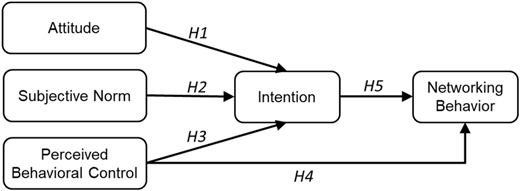
Conceptual model (designation of Hypothesis 6 on mediation omitted). Source: Authors' own work
Conceptual model (designation of Hypothesis 6 on mediation omitted). Source: Authors' own work
In delineating hypotheses on how these predictors may affect networking, we begin with the concept of attitudes. The TPB defines attitudes as positive or negative evaluations towards performing a specific behaviour. People base their evaluations on the expected outcomes of an action (i.e. behavioural beliefs) and the value they attribute to these outcomes (Ajzen, 1991, p. 188). A positive attitude towards networking reflects the belief that it has positive, valued consequences. Because people form stronger intentions to show behaviours they evaluate more positively (Ajzen, 1991), we predict that positive attitudes towards networking will lead to stronger networking intentions and more frequent networking behaviours. In line with this reasoning (albeit ignoring intentions), research has found that attitudes affect networking behaviours, as noted in the previous section (Forret and Dougherty, 2001; Kuwabara et al., 2020; Wanberg et al., 2000). In addition, Kuwabara et al. (2020) report that an intervention targeting attitude change led to students attending more professional events at their university. Hence, we pose:
Attitudes towards networking positively relate to networking intentions.
Second, subjective norms refer to the perceived social expectations of significant others to act in a certain way, resulting from normative beliefs and the motivation to comply (Ajzen, 1991, 2012). This concept broadly captures a range of contextual pressures to network and, for example, may encompass pressures to act in line with a company's culture and HR policies (Collins and Clark, 2003), as well as supervisor expectations and role requirements. Because people usually heed others' expectations and generally intend to perform in the roles they assume, we predict that perceptions of others' beliefs about networking will positively predict a person's intentions to network.
Subjective norms towards networking behaviour positively relate to networking intentions.
Third, PBC refers to beliefs about possessing adequate resources and opportunities to perform a specific behaviour (Ajzen, 1991, 2020). PBC affects intentions because people take into account their capability to perform a behaviour and to overcome barriers. Thus, those who believe they cannot network are unlikely to engage in it. Additionally, PBC can also directly affect behaviour (cf. Figure 1) when perceived control beliefs accurately align with actual control. If accurate, perceptions reflect actual control and will directly affect behaviours beyond intentions (Ajzen, 1991). This is likely when the respective behaviours are easy to perform, and actual control is high. In relating prior networking research to PBC, we draw upon the notion of self-efficacy (Bandura, 1997). Ajzen states that “conceptually, there is no difference between PBC and self-efficacy” (2020, p. 136), and we thus use the two concepts interchangeably. Concerning self-efficacy, Wanberg et al. (2020) showed that training increased networking self-efficacy, which in turn predicted job search outcomes. Although these authors assessed networking self-efficacy and networking intensity, they did not examine the relationship between these variables. Here, we predict this effect, presuming that people's belief in possessing the resources and opportunities to network will affect their networking intentions. We also assume that people generally know how to and can perform networking behaviours, because these behaviours, such as introducing themselves or catching up on professional news, are easy to perform. Therefore, PBC reflects actual control and exerts a direct effect on networking behaviour, as well.
PBC over networking behaviour positively relates to networking intentions.
PBC over networking behaviour positively relates to networking behaviours.
Consistent with the TPB, we predict that intentions predict networking behaviours and mediate the relationship between the TPB predictors and networking. According to Ajzen, a prerequisite for this account is that “the behaviour in question is under volitional control” (1991, pp. 181–182). As scholars conceptualise networking as goal-directed behaviour (Gibson et al., 2014), it meets this condition of volitional control. When people pursue their goals, they develop plans on how to reach them and intentions that often involve contacts to acquire important resources. As people form intentions to engage in a behaviour when they believe it is a good thing to do (attitude), they ought to do it (subjective norms) and can do it (PBC), we also predict that intentions act as a mediator. We presume partial mediation, as networking may also occur serendipitously, without specific intentions. For example, others can initiate relationships, or people may meet someone with valued resources by chance (Kim, 2013; Mitchell et al., 1999). While we acknowledge that purely serendipitous networking may occur, we emphasise that networking goals are often vague in many of these situations. For example, even if people have no clear goals whom to contact or what resource to acquire at a networking event (i.e. “just to be there”), attendance still requires forming the intention to do so. Therefore, in line with meta-analytic evidence (Armitage and Conner, 2001; Hagger et al., 2022; McEachan et al., 2011), we expect that networking behaviours result from individuals' networking intentions, which mediate the effects of the other TPB predictors.
Networking intentions are positively related to networking behaviour.
Networking intentions mediate the positive relationship between (a) networking attitudes, (b) networking-related subjective norms, (c) networking PBC, and networking behaviour.
The relative importance of TPB determinants
Going beyond the assumption that TPB predictors positively affect behaviour, we also explore the relative importance of the three determinants in the networking domain. Our research remains exploratory, however, because we were unable to find any theorising on the relative importance of the TPB predictors across domains. While reviews and meta-analyses support the effects of TPB predictors in a variety of domains (Ajzen, 1991, 2012, 2020; Armitage and Conner, 2001; Hagger et al., 2022), these studies have also shown that the predictors' effect sizes vary across situations and behaviours. To illustrate, Ajzen (1991, Table 2) reported 19 effect sizes for the TPB predictors, and each predictor had a large effect on intentions in at least one context and a small or even negligible effect in others. For example, PBC had a large effect on intentions to participate in elections and a small effect on job search intentions (Ajzen, 1991, Table 2). We believe that disentangling the relative importance of predictors provides further information on which determinants offer the most promising leverage for networking interventions. In addition, from a methodological perspective, TPB predictors are often correlated (Ajzen, 2020; Armitage and Conner, 2001), and multicollinearity can obscure a predictor's effects due to shared variance with other predictors. Relative importance is thus a valuable supplement for gauging each predictor's individual and combined contributions (Tonidandel and LeBreton, 2015).
Are there differences in the relative importance of (a) networking attitudes, (b) networking-related subjective norms and (c) networking PBC in explaining networking intentions?
Method
Procedure and sample
We collected data through a German professional online panel provider. [1] Following prior research (e.g. Forret and Dougherty, 2001; Wolff and Moser, 2009) and to limit concerns about range restriction and generalisability, we did not restrict the sample to a specific occupation; instead, we included employed persons who worked at least 20 h a week. A priori power analyses for regression and mediation analyses indicated that a final sample size of 150 participants would be sufficient to achieve at least 0.90 power. More specifically, the power to detect a significant regression effect of medium size (i.e. β > 0.30 or f2 = 0.0989, five predictors, two-tailed) in an Ordinary Least Squares (OLS) regression is Power = 0.97 (Buchner et al., 2019) and the power to detect mediation with effect sizes based upon McEachan et al.'s (2011) meta-analysis of TPB studies was Power >0.99 (Kenny, 2017). We also estimated from Tonidandel et al.'s (2009) Figure 3 that the relative weights analysis would be well powered. Note, however, that power may be insufficient for a Confirmatory Factor Analysis (CFA), which we also conducted to examine our entire measurement model (see the section on data analyses).
We used three survey waves to temporally separate the assessment of TPB predictors (T1), intentions (T2) and networking behaviour (T3) by 10 days. This aligns our study with the presumed causal order of effects. At T1, 495 eligible persons (i.e. employed with >20 h/week) consented to participate. We excluded 44 persons (11%) who failed one or more of three attention check items. Of the remaining 451 participants, 369 (75%) completed the survey at T1 and were reinvited for T2 and T3, resulting in completion rates of 68% (252 participants) and 53% (195 participants), respectively. Drop-out analysis using logistic regression of our study variables on response vs. nonresponse indicated significant drop-out at T2, Chi2 (7) = 23.97, p < 0.01 and T3, Chi2 (7) = 18.33, p < 0.01. An inspection of parameters showed that older respondents were significantly more likely to remain in the sample. Although drop-out was independent of our substantive variables, we included age in all our analyses to account for this potential cause. These analyses are consistent with missingness at random, provided that no additional unobserved mechanisms caused drop-out (Schafer and Graham, 2002). Note, however, that this remains an untestable assumption.
Of the 195 participants who completed all three waves, we excluded 31 participants because they took too long (i.e. >30 Min) or too short (i.e. <2 s per item) to complete a survey. Finally, we excluded 9 participants who indicated problems completing the survey (e.g. the applicability of the topic to one's work context), resulting in a final sample size of 155 participants (85 or 55% male, 70 or 45% female) with a mean age of 44.66 years (SD = 11.29). On average, participants worked 37.45 h per week (SD = 5.34), and 69 (44.5%) held a supervisor position. They came from a variety of fields; the most common were business/administration (19%), services (17%), social work/education (17%), information technology (8%) and production (5%).
Measures
If necessary, we adapted measures to the German and the networking context. We sought to predict the broad construct of networking behaviours and thus assessed predictors in a similar broad way to adhere to the principle of compatibility (Ajzen, 2020). Note that the study was part of a larger project containing some additional measures not used here. [2] While the data include additional measures of attitudes, subjective norms and intentions, we focus on those from Zhang et al. (2015) because they align more closely with our broad measure of networking behaviours. Note that using these other measures did not lead to substantially different conclusions. The online supplement shows details on these alternative measures and respective findings.
Networking attitudes
Following Ajzen's (2019) general recommendations for building a TPB questionnaire, we asked respondents to evaluate professional networking using a four-item, 5-point semantic differential scale (i.e. good – bad, beneficial – harmful, valuable – not valuable, negative – positive, α = 0.94). Other research has used similar measures to assess attitudes in the context of social networking sites (e.g. Zhang et al., 2015).
Subjective norms
We measured subjective norms using a three-item semantic differential scale, similar to that used by Zhang et al. (2015). Participants indicated how significant others would react when they engaged in networking behaviours (disapproving – approving, unsupportive – supportive, discouraging – encouraging, α = 0.94).
Perceived behavioural control
We measured PBC with an eight-item networking self-efficacy measure by Weihrauch et al. (2021 e.g. “When I face difficult tasks while networking, I am confident that I can handle them well.”, α = 0.96). Ajzen (1991, 2020) argued that self-efficacy (Bandura, 1997) and PBC are equivalent constructs and “most compatible” (Ajzen, 1991, p. 184). Meta-analyses also suggest that the two constructs account for equivalent proportions of variance (Armitage and Conner, 2001) and self-efficacy “should be the preferred measure of ‘perceptions of control’ within the TPB” (Armitage and Conner, 2001, p. 487). Moreover, in Weihrauch et al.'s (2021) study, this measure showed higher reliability (α > 0.89 across four measurement waves) than Zhang et al.'s (2015) 2-item measure (α = 0.70).
Networking intentions
We adapted three items from Zhang et al. (2015), which referred to motivation, intention and commitment to engage in physical activity, to the networking context (e.g. “How motivated are you to network over the next ten days?”, α = 0.97). We recorded responses on a 5-point Likert scale (1 = not at all to 5 = very strong).
Networking behaviour
We measured self-rated networking behaviour with the Short Networking Behaviour Scale (Wolff and Spurk, 2019). The scale measures the two dimensions: external networking behaviour (e.g. “I develop informal contacts with professionals outside the organisation, in order to have personal links beyond the company.“) and internal networking behaviour (e.g. “In my company, I approach employees I know by sight and start a conversation.“) with nine items each (1 = never/very seldom to 5 = very often/always). As our theoretical focus is on networking in general and Wolff and Spurk (2019) argue that the measure can focus on different levels of specificity, we combined the two highly correlated dimensions (r = 0.81, p < 0.001) into a single networking index (α = 0.97).
Control variables
We considered gender and supervisor position as potential control variables. Scholars have discussed gender differences in networking (Forret and Dougherty, 2004; Woehler et al., 2021; Wolff et al., 2008), and gender stereotypes may influence subjective norms and attitudes (Woehler et al., 2021). Also, individuals in supervisor positions exhibit more networking behaviours (Forret and Dougherty, 2001), and subjective norms (i.e. role expectations) may influence their networking. In addition, we controlled for age because the dropout analysis indicated that it significantly predicted dropout. Note that, in line with Ajzen's (2020) assumption of sufficiency of the three TPB predictors, including these controls did not affect our findings substantively. Findings without control variables are available in the online supplement.
Data analyses
We performed OLS regressions, entering controls and, subsequently, all TPB predictors simultaneously to test Hypotheses 1-5, and assessed mediation using the PROCESS macro by Hayes (2017, version v3). We also employed relative weights analysis (RWA) using R syntax, as described by Tonidandel and LeBreton (2015). In the latter two analyses, we report bootstrapped confidence intervals based on 10.000 bootstrap samples to assess the significance of mediation effects and relative weights (Tonidandel et al., 2009).
We tested our measurement model using confirmatory factor analysis with robust maximum likelihood estimation. Our five-factor measurement model (attitudes, subjective norms, PBC, networking intentions and networking behaviour) fits the data well according to prominent fit indices, χ2(584) = 101.68, p < 0.001, root mean square error of approximation = 0.076, confirmatory fit index = 0.98 and standardised root mean residual = 0.061. Following Cheung et al. (2024), Table 1 shows additional indicators, including construct reliability, average variance extracted (AVE), the minimum standardised factor loading per factor and latent correlations between factors. None of them indicated any reason for concern about the measurement model.
Confirmatory factor analysis results
| Observed | Latent | Min | Latent correlations | ||||||
|---|---|---|---|---|---|---|---|---|---|
| Construct | Mean | SD | λi | AVE | 1 | 2 | 3 | 4 | 5 |
| 1) Attitude | 3.94 | 0.84 | 0.88 | 0.89 | (0.94) | ||||
| 2) Subjective Norms | 3.62 | 0.82 | 0.90 | 0.91 | 0.61 | (0.94) | |||
| 3) Perceived behavioural Control | 3.39 | 0.81 | 0.80 | 0.85 | 0.42 | 0.35 | (0.96) | ||
| 4) Intention | 3.17 | 1.15 | 0.94 | 0.95 | 0.44 | 0.46 | 0.57 | (0.97) | |
| 5) Networking | 3.04 | 0.69 | 0.70 | 0.78 | 0.39 | 0.37 | 0.60 | 0.63 | (0.97) |
Note(s): N = 155. Parameters and indices from correlated five-factor solution. AVE = Average variance extracted. Construct reliability in brackets on the diagonal of the latent correlations
While this provides some evidence for the validity of our measures, we employed several additional means to reduce common method bias (for a recent review, see Podsakoff et al., 2024). First, with the assessment of internal states, such as attitudes, self-efficacy or intentions, the temporal separation into three measurement waves “may prove particularly useful” (Podsakoff et al., 2024 p. 24). Second, taking measures against insufficient effort in responding should also ensure that CMB due to low motivation is detected and reduced. We also sought to minimise suspicions about the measurement context, for example, by informing participants that we'd anonymise data after the third survey wave and that the data would be used for research purposes only.
Results
Table 2 presents descriptive statistics and bivariate correlations for the study variables. As in most other studies (e.g. Armitage and Conner, 2001; McEachan et al., 2011), there were positive and significant correlations among TPB predictors.
Descriptives, correlations and reliabilities
| M | SD | 1 | 2 | 3 | 4 | 5 | 6 | 7 | 8 | |
|---|---|---|---|---|---|---|---|---|---|---|
| T1 | ||||||||||
| 1. Gender | 0.55 | 0.50 | – | |||||||
| 2. Age | 44.66 | 11.29 | 0.15 | – | ||||||
| 3. Supervisor position | 0.45 | 0.50 | 0.08 | −0.02 | – | |||||
| 4. Attitudes | 3.94 | 0.87 | 0.09 | −0.17* | 0.12 | (0.94) | ||||
| 5. Subjective norms | 3.63 | 0.84 | 0.07 | −0.07 | 0.05 | 0.58** | (0.94) | |||
| 6. PBC | 3.39 | 0.80 | 0.08 | 0.15 | 0.29** | 0.40** | 0.34** | (0.96) | ||
| T2 | ||||||||||
| 7. Intentions | 3.17 | 1.20 | 0.08 | 0.02 | 0.14 | 0.43** | 0.44** | 0.56** | (0.97) | |
| T3 | ||||||||||
| 8. Networking behaviour | 3.04 | 0.81 | 0.00 | −0.10 | 0.25* | 0.38** | 0.37** | 0.57** | 0.60** | (0.97) |
Note(s): N = 155; Gender (0 = male, 1 = female), Supervisor position (0 = no, 1 = yes); T1 to T3 denote survey waves separated by ten days
*p < 0.05; **p < 0.01 (two-tailed)
Table 3 shows the results from regression analyses we used to test our hypotheses. We entered the TPB predictors in Model 2, adding them to control variables (see Model 1). Hypotheses 1 to 3 proposed that TPB predictors positively relate to networking intentions. Findings did not support Hypothesis 1 because attitudes towards networking were unrelated to networking intentions, b = 0.18, SE = 0.12, p = 0.129. Note, however, that attitudes and intentions were significantly positively correlated, r = 0.43, p < 0.001 (see Table 1), suggesting that multicollinearity affects the relationship between attitudes and intentions.
Regression of networking intentions on TPB predictors and results from relative weights analysis (RWA)
| Variable | OLS regression | Relative weights analysis | |||
|---|---|---|---|---|---|
| Model 1 B (SE) | Model 2 B (SE) | Raw weight | 95% CI testa | Rescaled weight | |
| Intercept | 2.88 (0.40) | −0.87 (0.54) | |||
| Gender | 0.15 (0.20) | 0.04 (0.16) | 0.002 | [-0.02:0.03] | 1% |
| Age | 0.01 (0.01) | −0.01 (0.01) | 0.003 | [-0.02:0.02] | 2% |
| Supervisor position | 0.31 (0.19) | −0.06 (0.16) | 0.007 | [-0.01:0.04] | 1% |
| TPB predictors | |||||
| Attitudes | 0.18 (0.12) | 0.079 | [0.02:0.15] | 20% | |
| Subjective norms | 0.32** (0.11) | 0.098 | [0.04:0.18] | 24% | |
| PBC | 0.66** (0.11) | 0.213 | [0.12:0.33] | 53% | |
| R2 | 0.02 | 0.40** | |||
Note(s): N = 155. TPB predictors and networking intentions assessed at Waves 1 and 2, respectively. Raw weights refer to variance attributable to a predictor as a decomposition of R2 (i.e. except for rounding errors, raw weights sum up to R2 of model 2). Rescaled weights refer to the percentage of variance attributable to a variable (deviations due to rounding error)
Confidence interval refers to Bootstrap (BCa) confidence interval test of significance. If zero is not included, the weight is not significant
**p < 0.01
In support of Hypothesis 2, subjective norms significantly predicted networking intentions, b = 0.32, SE = 0.11, p = 0.006. Likewise, we found support for Hypothesis 3, stating that PBC significantly predicts networking intentions, b = 0.66, SE = 0.11, p < 0.001. In sum, subjective norms and PBC predicted networking intentions, but attitudes did not.
Table 4 depicts results of regressing networking behaviours on control variables (Model 1), TPB predictors (Model 2) and networking intentions (Model 3). Hypothesis 4 predicted that PBC exhibits a direct effect on networking behaviours, even when controlling for intentions. According to Model 3, this hypothesis received support, b = 0.33, SE = 0.08, p < 0.001. Note that, in line with the TPB, neither attitudes nor subjective norms had direct effects on networking behaviours when we entered intentions into Model 3. Next, we tested Hypothesis 5, which states that intentions predict networking behaviours. Supporting Hypothesis 5, networking intentions predicted networking behaviour, b = 0.25, SE = 0.05, p < 0.001. Additionally, we regressed networking behaviours on only networking intentions (and control variables) and found that networking intentions explained 34% of the variance in networking behaviours, R2 = 0.34, F(1, 150) = 84.89, p < 0.001. Together, intentions and PBC explained 41% of the variance over and above control variables in networking behaviours, R2 = 0.41, F(2, 149) = 58.63, p < 0.001.
Direct and indirect effects via networking intentions of TPB predictors on networking behaviours
| Direct effects from OLS regression | Indirect effects (X → M → Y) | ||||
|---|---|---|---|---|---|
| Model 1 | Model 2 | Model 3 | |||
| Variable | B (SE) | B (SE) | B (SE) | Estimate | 95% CI |
| Intercept | 3.17 (0.27) | 1.02 (0.36) | 1.24 (0.34) | ||
| Control variables | |||||
| Gender | −0.01 (0.13) | −0.07 (0.11) | −0.08 (0.10) | ||
| Age | −0.01 (0.01) | −0.01 (0.01) | −0.01 (0.01) | ||
| Supervisor position | 0.41 (0.13) ** | 0.15 (0.11) | 0.16 (0.10) | ||
| TPB predictors | |||||
| Attitudes | 0.06 (0.08) | 0.01 (0.07) | 0.04 | [-0.02, 0.12] | |
| Subjective norms | 0.15 (0.08) | 0.07 (0.07) | 0.08* | [0.03, 0.14] | |
| PBC | 0.50** (0.08) | 0.33** (0.08) | 0.17* | [0.08, 0.28] | |
| Networking intentions | 0.25** (0.05) | ||||
| R2 | 0.07* | 0.40** | 0.46** | ||
Note(s): N = 155. TPB predictors, networking intentions and networking assessed at Wave 1, Wave 2 and Wave 3, respectively. Indirect or mediating effects estimates are the product of the effect of a TPB predictor on intentions (X→M) and the effect of intentions on networking behaviours (M → Y). Estimates control for other TPB predictors and control variables
*p < 0.05; **p < 0.01
To assess whether networking intentions mediated the effects of TPB predictors on networking, as predicted in Hypotheses 6a to 6c, we examined the indirect effects of TPB predictors on networking behaviours based on Model 2 in Table 4. The bootstrapped confidence intervals for these effects are displayed in Table 3. We found no support for Hypothesis 6a, which predicted an indirect effect of attitudes on networking behaviours via intentions, estimate = 0.04, 95% CI [−0.02, 0.12]. In support of Hypothesis 6b, intentions fully mediated the relationship between subjective norms and networking behaviours, estimate = 0.08, 95% CI [0.03, 0.14]. In support of Hypothesis 6c, intentions partially mediated the effect of PBC, estimate = 0.17, 95% CI [0.08, 0.28]. The direct effect of PBC remained significant, estimate = 0.33, 95% CI [0.18, 0.49]. In sum, these findings support Hypothesis 6b and Hypothesis 6c, which concern the mediation of the effects of subjective norm and PBC on networking behaviours by intentions. In contrast, we find no support for Hypothesis 6a, which posits a mediating effect of attitudes.
We examined the relative importance of the TPB predictors for networking intentions using relative weights analysis. Table 3 shows raw weights with their confidence intervals, along with rescaled weights that allow direct comparisons among predictors. The confidence interval tests of significance included zero, indicating that control variable weights were not significant, whereas all TPB predictors exhibited significant weights. Rescaled weights show that PBC was the most important contributor to networking intentions, with a rescaled weight of 53%. Subjective norms (rescaled weight = 24%) and attitudes (rescaled weight = 20%) contributed somewhat less but significantly to the variance in networking intentions. Bootstrapping the difference in relative weights, we found that the relative weight of PBC was significantly greater than that of attitudes, 95% CIdifference [0.001–0.279]. The relative weight for subjective norms neither differed significantly from attitudes, 95% CIdifference [−0.059, 0.010], nor PBC, 95% CIdifference [−0.017, 0.269].
Discussion
Adopting a volitional perspective on networking behaviours, this study uses the TPB to advance our knowledge on potential levers to foster networking. We extend levers to include subjective norms and integrate proximal, malleable predictors of networking behaviours, gauging their relative importance. While we find evidence for the importance of all TPB predictors, our analyses provide converging evidence of an order of importance. PBC is the most important predictor, followed by subjective norms and then attitudes. This order is consistent with a depiction of networking as a skill that not everyone believes they possess; those who do not believe they have it will not engage in networking despite believing in its benefits or the existence of normative pressures. It also suggests that PBC and subjective norms are the more critical levers for interventions.
First, regarding the TPB predictors, this study adds subjective norms as a consistent predictor of networking behaviours. In support of some older studies (Collins and Clark, 2003; Michael and Yukl, 1993), we thus reintroduce contextual effects into theorising about networking. Networking does not occur in a vacuum, and people do take opinions of significant others – or social pressures in the TPB terminology – into account. We believe that subjective norms are a particularly suitable means of assessing overall contextual influences because of their broad coverage of individuals' perceptions about what they should do. Yet, future research should further disentangle the importance of more specific pressures, such as supervisors' informal expectations, formal role descriptions, organisational support (e.g. HR practices) or generalised norms (i.e. culture).
We also find effects of PBC. In fact, PBC turned out to be the most important predictor of networking intentions and behaviours. More specifically, we find an indirect effect via networking intentions and a direct effect on networking behaviours. This indicates that perceived and actual control correspond well in the networking context (Ajzen, 2020), and people likely have appropriate knowledge of their networking capabilities and opportunities. Given the equivalence of PBC and self-efficacy, this finding goes beyond prior studies on networking trainings (e.g. Wanberg et al., 2020), which show that trainings strengthen PBC (or networking self-efficacy). Here we also provide evidence for the missing link that PBC affects intentions and behaviour, suggesting that PBC may be an important mediator in networking trainings.
We also found that attitudes predict networking behaviours, though effects depended upon the method of analysis. In isolation, the medium-sized correlation between attitudes and networking behaviour (Table 1) conceptually replicates prior studies that examined attitudes by themselves (e.g. Forret and Dougherty, 2004; Kuwabara et al., 2020). Our analyses using alternative measures show that the findings do not depend on the generality vs. specificity (i.e. the networking comfort measure by Wanberg et al., 2000) of the attitude measure used (see online Supplement). Considering all three TPB predictors, relative weights analyses showed that attitudes remained an important predictor. However, regular OLS regression indicated that the explanatory power of attitudes was redundant when PBC and subjective norms were considered. Attitudes do not account for any uniquely separable variance of the TPB predictors. Several rationales may explain this finding. First, effects of information or experiences might flow via multiple pathways to influence TPB predictors (Ajzen, 2020). For example, when a supervisor convinces their subordinates of the importance of networking, this likely affects both attitudes and subjective norms simultaneously. Also, upon supervisors' request, individuals may network even if they do not like it. Another explanation is that most people exhibited positive attitudes towards networking (cf. Table 2), possibly because popular media portray networking as beneficial. If most people believe that networking is beneficial, beliefs about whether they should and can engage in networking behaviours may become more significant in explaining networking. This reflects our experience from informal discussions about networking with professionals, where we often hear that people are well aware of the benefits of networking but think they are not good at it. Their low PBC may keep them from networking despite their positive attitude. In sum, attitudes appear to be of some but modest importance for networking when studied together with subjective norms and PBC.
Concerning the effects of intentions, this study corroborates that networking represents behaviour under volitional control. This aligns well with depictions of networking as deliberate goal selection and strategic action. The mediation account further shows that people base their networking intentions upon attitudes, social norms and PBC. We acknowledge that the variance in networking behaviour attributable to intentions is far from perfect. Both intentional and serendipitous networking coexist, as outlined in Mitchell et al.'s (1999) notion of planned happenstance. Yet intentions do play an important role, and their subjectivity to deliberate action justifies the development and conduct of interventions.
Finally, concerning the TPB, our study supports its explanatory power in another domain and provides a comprehensive picture of the determinants of networking behaviour. It shows that the importance of the determinants varies across domains and that attitudes are not always the most important determinant. It supports the inclusion of subjective norms in the TPB, which has been questioned due to their often low explanatory power (cf. Armitage and Conner, 2001). Organisational contexts may be subject to higher normative pressures than those typically examined in TPB research. Our findings also support including PBC as an additional determinant, as Ajzen (1991) further expanded the theory of reasoned action into the TPB.
Practical implications
Our findings suggest that interventions benefit most when they target behavioural control or subjective norms to foster networking behaviours. Such interventions foster networking and proactive career self-management, which scholars deem necessary for navigating today's careers. Employment agencies and educational institutions may encourage their clients to network, particularly those who network less (e.g. people with lower educational levels, cf. Wolff et al., 2008). Given the resource acquisition potential of networking, this contributes to positive career outcomes and thus more sustainable careers. More specifically, career development professionals need to be aware that fostering PBC or self-efficacy beliefs is key to fostering networking behaviours. We consider training methods that focus on self-efficacy, such as behaviour modelling (Taylor et al., 2005) or cognitive training (e.g. Frayne and Geringer, 2000), particularly useful due to their potential to change PBC and behaviour. For students or early-career professionals with little experience in networking, a focus on PBC, which builds through mastery experiences, may be especially suitable. In addition, while targeting attitudes by educating trainees about the benefits of networking may be a suitable addendum, it is unlikely to be sufficient on its own.
Though career development professionals may also consider targeting subjective norms, we believe they are a more powerful lever for supervisors, HR professionals or organisations in general. Supervisors and HR professionals should be aware that they can facilitate employees' networking through their promotion and support. Networking is not only a matter of personality, and thus, employee selection. Supervisors can effectively foster networking by encouraging employees to network and by serving as role models. Likewise, HR professionals may implement practices that promote a networking-supportive organisational culture, thereby influencing employees' subjective norms and encouraging networking (Collins and Clark, 2003). We think training and mentoring programs, in particular for newcomers, monetary support and encouragement to attend networking events, or an integration into formal feedback procedures appear viable to signal the importance and desirability of networking.
Limitations and future research
Regarding the methods of this research, we acknowledge that we cannot draw firm causal conclusions, even though we have separated concepts temporally in line with their causal sequence. While this, along with measures to address problems caused by insufficient effort and self-presentation, should reduce common method bias, we cannot completely rule it out. Although all measures suffer from deficiencies, future research may employ more objective behavioural measures (e.g. LinkedIn activity) or other sources (e.g. supervisor ratings) for some constructs to ensure independence from the method used. Additionally, attitudes, beliefs and intentions may have changed even within our short observation period (Volmer and Wolff, 2018), and we may be underestimating their effects. In addition, while our core hypotheses had adequate power, some more peripheral analyses (e.g. the CFA) may lack power. Another limitation concerns our data collection in Germany, which may limit generalisability, most likely to other Western, industrialised countries. For example, social norms might play a more important role in collectivist cultures than in the individualistic German culture. Future research is necessary to replicate our findings, possibly in another culture or using a longer period between waves to strengthen the validity of our findings.
Also, we operationalised networking behaviour as a unitary construct. In adherence to the correspondence principle, our measures of TPB predictors and intentions generally referred to networking. Thus, we cannot specify how the antecedents (subjective norms, PBC and attitudes) affect finer-grained behavioural facets, such as internal and external networking. Future research might build on this study using more specific measures, for example, by using different attitude facets or more specific measures of subjective norms relating to internal and external significant others to disentangle how attitudes and subjective norms affect internal and external networking. In addition, although the TPB is a well-established theory of determinants of intentions and behaviours, its focus on malleable predictors limits the range of determinants it captures. We cannot gauge whether personality (Bendella and Wolff, 2020) or current resource endowments (Porter and Woo, 2015) are more important drivers of networking behaviours than those examined here, or whether objective organisational determinants affect networking beyond subjective norms and PBC.
Conclusion
Using the goal-directed perspective of the TPB, we find that subjective norms and PBC are the primary drivers of forming intentions to network and, in turn, engaging in networking behaviour. It appears less fruitful to convince people of the utility of networking. Thus, interventions, for example, training or advice from mentors, might fare better when they foster PBC and create a networking-supportive work environment to motivate employees to engage in networking behaviour.
Notes
In Germany, approval by an ethics committee is only necessary when medical or physiological information about the participants is collected or when participants are treated in a way that may harm them. As this does not apply to our survey study, we did not need to get approval from the ethics committee. Nevertheless, we closely followed the guidelines for the treatment of human subjects of relevant Institutional bodies (DGPs, 2016; EFPA, 2015). Specifically, we informed participants about the purpose, duration, procedures, option to withdraw at any time, and confidentiality/anonymisation of the collected data and requested informed consent.
For example, we also collected data on promotion and prevention focus or implementation intentions that do not pertain to our hypothesis. This is the first article from this data.
The supplementary material for this article can be found online.

