The article presents the phenomenon of hazards related to severe acute respiratory syndrome coronavirus 2 (SARS-CoV-2) in the food supply chain (FSC) by identifying possible stakeholders of a seafood company who might be influenced by the hazards.
A case study analysis was conducted with a review of the organization's documentation alongside a semi-structured interview and an impact effort matrix.
Seven out of 18 stakeholders had to strongly engage in minimizing the effects of hazards related to SARS-CoV-2. The most important areas of cooperation regarded safety were identified. Both external and internal documents and reports regarding the minimizing of negative effects of hazards related to SARS-CoV-2 were required by institutional clients, official authorities and the studied organization itself. The proper identification of stakeholders and up-to-date knowledge about them allowed the organization to react faster and protect the FSC.
The authors’ research was based on qualitative methods, so it lacked a diagnostic survey, along with similar studies for comparison of results and approaches.
The surveyed company may be a good benchmark for others to follow when choosing the appropriate approach in the field of stakeholder analysis for addressing new emerging risks.
The findings are important, timely and original, and they focus on a subject rarely studied in the literature. The information from the paper applies to numerous groups of food companies.
Introduction
severe acute respiratory syndrome coronavirus 2 (SARS-CoV-2) – the one causing Covid-19 – was first reported in December 2019 in China. On March 11, 2020, the World Health Organization (WHO) recognized it as a pandemic (Sarria-Guzmán et al., 2021), which eventually caused irreparable losses to people and to the global economy (Jackson, Weiss, Sutter, Schwarzenberg, & Sutherland, 2021), including different supply chains (SCs; Parast & Subramanian, 2021). The food supply chain (FSC) and the logistics processes “farm-to-fork” were no exception (Barman, Das, & De, 2021; Coluccia, Agnusdei, Miglietta, & De Leo, 2021; Nakat & Bou-Mitri, 2021; Palouj, Adaryani, Alambeigi, Movarej, & Sis, 2021; Yekta, Vahid-Dastjerdi, Norouzbeigi, & Mortazavian, 2021). Different impacts of the pandemic on the FSC include the following: reduced incomes, reduced access to buyers and essential services (e.g. veterinarians, seeds and fertilizers), modifications in food distribution and increased delivery needs due to closed restaurants, children losing free school meals, absenteeism due to illness across the food chain industries, increased food waste farm-to-fork and potential spikes in food prices due to the increased demand and slower FSC (Boyacι-Gündüz, Ibrahim, Wei, & Galanakis, 2021). FSCs are different from other product SCs because food – especially fresh produce and perishable goods – are vulnerable to continuous and significant change in quality and remain in danger of contamination throughout entire SCs (Link & Wahab, 2020). Studies showed the possible impact of coronavirus on food safety (e.g. Ceniti, Tilocca, Britti, Santoro, & Costanzo, 2021; Chen, Liu, & Guo, 2020; Guo et al., 2020; Sim & Wiwanitkit, 2021; Yekta et al., 2021), food safety management systems (FSMS) and relations with stakeholders, which must be updated to reflect the new risks introduced by SARS-CoV-2.
This article presents the phenomenon of hazards related to SARS-CoV-2 in the FSC and identifies possible stakeholders of the seafood company, who might be influenced by the hazards.
The choice of the organization was based on three factors. The first was the organization's openness to cooperation, including willingness to share data on the sensitive sphere of product quality and safety management, especially delicate as the research was conducted during the difficult period of the pandemic's escalation. The second factor was the fact that the specificity of the organization's operation was the seafood industry, a characteristic of the authors’ region of origin. The most important premise was the fact that seafood products are healthy for humans and that this sector is crucial for the conservation of biodiversity and food security (FAO, 2022).
We were inspired by the fact that, so far, there has been little research analyzing the impact of the coronavirus on seafood organizations’ stakeholders, especially regarding food industry companies. Such works exist (e.g. Campbell, 2021; Han et al., 2021), but they focus not on the perspective of a specific food company and remain general. Moreover, they do not consider a broad catalog of stakeholders. Therefore, our work fills this gap in research.
The article is organized as follows. The first part will begin with a critical literature review to present issues related to the functioning of food companies and the FSC during the pandemic. Next, we will detail the methodology and research design by describing the process of data collection. Subsequently, we will describe the main results and discuss them in relation to the literature. The last section will synthesize the main themes, present conclusions and propose future research possibilities.
Literature review and research questions development
Recent market trends like outsourcing and globalization have made SCs – including the FSC – more exposed to external disruptive incidents such as catastrophic man-made events and natural disasters (Ponis & Ntalla, 2016). The outbreak of the Covid-19 pandemic was no exception. The pandemic created a global health emergency with a newfound domestic and international trade disruption such as restrictions on imports and exports of major food commodities, loss of lives and closure of various essential institutions. The food and agricultural sector experienced a negative downturn with immense labor loss and the inadequate distribution of food inputs around the world (Nasereldin et al., 2021). This negative phenomenon affected all links in the FSC, which to this day directly impacts food security. Food companies differ from other organizations because they produce products essential for daily life. If an industry closes, an explicit number of individuals who work in these commercial spaces can crave new jobs, but if distributors and processors are disturbed, the whole country is at risk (Staniforth, 2020). According to the Food and Agriculture Organization (FAO), “food security exists when all people, at all times, have physical and economic access to sufficient, safe and nutritious food that meets their dietary needs and food preferences for an active and healthy life” (Food Security, 2006). Therefore, due to numerous relationships and dependencies in the FSC, the occurrence of a coronavirus infection at a food company impacts its stakeholders (Nakat & Bou-Mitri, 2021), who are generally defined as “any group or individual who can affect or is affected by the achievement of the firm's objectives” (Barnett, 2019). The ISO 26000 (2010) defines a stakeholder as an “individual or group that has an interest in any decision or activity of an organization.” Thus, the food industry's stakeholders include consumers (individual and institutional), employees, primary producers, packaging and raw materials suppliers, co-operators, food laboratories, official food agencies, like vet authorities (e.g. health and sanitary inspections), service providers, customs authorities, local and national governments, employees and their families, mass media, consultants, consumer organizations, research institutions, certification bodies and auditors. Each of these stakeholders directly and indirectly impacts the food company, along with the values of product quality and safety, and each of them may be affected if these values are at risk.
Due to the above considerations, we asked the following research questions.
Which of the company's stakeholders besides clients and employees might be influenced by SARS-CoV-2 hazards?
What is the area of interest regarding the relationship with a given stakeholder?
The organization itself and its stakeholders are found to be significantly impacted by the different environmental turbulence factors, including regulatory, market, competitive, weather, economic and political factors (Despoudi, Papaioannou, & Dani, 2020; Zaridis, Vlachos, & Bourlakis, 2020). Currently, the possibility of contracting the coronavirus is undisputed, which creates additional threats at the workplace. Both physical and psychological safety at work plays a central role in human resources management and the organization during a Covid-19 outbreak (Falco, Girardi, De Carlo, Arcucci, & Dal Corso, 2022). We may define safety as a set of conditions that must be maintained at the workplace so that employees can perform their tasks safely and without harm to their health (Studenski, 2000). Therefore, to prevent Covid-19 from spreading to employees and stakeholders, every company is morally obliged to follow necessary measures, such as providing masks, hand washing facilities, hand sanitizers, gloves and face shields (Ambarwati, Yuliastri, & Sulistiyowati, 2022). These Covid-19 protocols must be implemented in various work programs and in stakeholder protection plans, the prerequisite being a proper identification of stakeholders. The need to identify stakeholders – both internal and external – agrees with the requirements of ISO 9001 (Quality management systems) and 14001 (Environmental management systems). Knowing relationships with stakeholders is necessary, especially when food safety or the environment is threatened, and recalls or emergency measures are required. Then there remains the urgent need to recognize the cause of such an event and carefully trace the history of the product, event, or infection origin.
According to the position of international agencies, like the FAO, the WHO or the European Food Safety Authority (EFSA), “so far there is no evidence that food is a source of Covid-19” (FAO and WHO, 2020; cf. EFSA, 2020). However, there is more and more evidence that viral contamination in food and food-related surfaces is possible (e.g. Ceniti et al., 2021; Ceylan, Meral, & Cetinkaya, 2020; Guo et al., 2020; Han, Zhang, He, & Jia, 2020; Sim & Wiwanitkit, 2021). The risk of contamination increases with the complexity of the farm-to-fork processes. Bearing in mind the above hazards, basic hygiene control measures and food risk assessment to prevent staff infection are critical. Therefore, food handlers in the entire FSC should be encouraged to adopt and follow standard hygiene practices, wash hands and cover the nose and mouth when sneezing or coughing (Safefood, 2020). The WHO and scholars make it clear that to eliminate or reduce these risks and to protect food workers and other stakeholders from contracting Covid-19, food handlers must prevent exposure to or transmission of the virus, strengthen food hygiene, reinforce sanitation practices, fortify personal hygiene measures, provide refresher training on food hygiene principles, introduce physical distancing and promote responsible behavior at each stage of food processing.
Furthermore, the food industry should have FSMSs in place based on hazard analysis and critical control point (HACCP) principles, including good manufacturing practice (GMP) and good hygienic practice (GHP; FAO and WHO, 2020; Galanakis, 2020, Groot-Kormelinck, Trienekens, & Bijman, 2021; Rahman, Sharun, Jose, & Dhama, 2020). In most countries (e.g. the European Union countries and the USA), the implementation of HACCP and GMP/GHP is obligatory. We should remember that food handlers and preparers with poor personal grooming habits put their own and public health at risk. Many foodborne illnesses can be avoided with simple practices, including extensive hand washing and proper washing facilities (Modi et al., 2021). We should emphasize that the emergence of SARS-CoV-2 is recognized to be caused by a lack of FSMS implementation (UNIDO, 2020).
Moreover, the absence or ineffective implementation of FSMS – as well as non-compliance with individual hygiene rules and safety procedures – may lead to disrupting business continuity inside and outside of organizations. It is of particular importance in the FSC because any disruption in such a chain directly threatens the consumer and can also affect other stakeholders (Parast & Subramanian, 2021) and shareholders (Alora & Barua, 2021). Therefore, in times of crisis, the resilience of the FSC appears as a critical factor (Béné, 2020; Hobbs, 2021). A condition conducive to resilience undoubtedly is the traceability of products in the FSC (Collart & Canales, 2021; Link & Wahab, 2020; Thilmany, Canales, Low, & Boys, 2021). SC resilience is “the adaptive capability of the SC to prepare for unexpected events, respond to disruptions, and recover from them by maintaining continuity of operations at the desired level of connectedness and control over structure and function” (Hobbs, 2021). The SC disruption can be defined “as the unintended, unplanned and rare situation that disrupts the usual flow of goods and materials within a supply chain” (Alora & Barua, 2021). As already mentioned, the longer the FSC, the greater the possible negative impacts. When an emergency occurs, tight coordination and cooperation among all stakeholders are necessary (Elshaer, 2021; Moreno-Miranda & Dries, 2022). In the context of the above, we propose the following research questions:
What information must be considered when an emergency occurs, including incoming and outgoing information?
What is the impact of a stakeholder on the functioning of the organization and how important is it to the organization?
To what extent should stakeholders be involved to minimize an identified SARS-COV-2 risk, if it does occur?
Methodology
Our research was based on case study analysis, including a review of an organization's documentation. The study was supported by the results of a semi-structured interview, based on open-ended questions with the company representative for quality and food safety assurance (RQFSA). To analyze the relationship and impact of hazards related to SARS-CoV-2 on stakeholders, we employed the method of conceptual work and the impact effort matrix. The case study generally covered the “how” and “why” questions, focusing on real-life context (Halkias & Neubert, 2020). Semi-structured interviews are commonly used in qualitative research and are the most frequent qualitative data source in different areas of interest. This method typically consists of a dialog between the researcher and the participant, guided by a flexible interview protocol and supplemented by follow-up questions, probes and comments. The method allows the researcher to collect open-ended data, explore the participant's thoughts, feelings and beliefs about a particular topic and delve deeply into personal and sometimes sensitive issues (DeJonckheere & Vaughh, 2019).
In our case, when interviewing the RQFSA, we followed the generally accepted rules (Bearman, 2019; DeJonckheere & Vaughh, 2019): (a) presenting the purpose and scope of the study; (b) introducing participants (representative of the organization and authors of the study); (c) considering ethical issues (compliance with the conditions of anonymity of the organization, ensuring the truthfulness of the data provided); (d) developing questions and presenting them to the RQFSA; (e) developing the schedule of the interview (greetings, presenting the work plan, indicating the importance of the research for science and practice, confirming logistic, substantive and ethical issues, asking questions, organizing and confirming answers, reflecting on what has been discussed and giving thanks); (f) planning and confirmation of logistics (confirmation of the days and places of subsequent meetings with RQFSA); (g) conducting the interview (following the schedule of the interview, asking questions and keeping notes on the basis of obtained answers); (h) organizing the obtained responses and consulting them again with the RQFSA; (i) analyzing the data and (j) presenting findings. Data for the research were gathered in 2021. The steps of the research and methods used are presented in Table 1.
Our study applied a triangulation approach to the research was applied, which allowed us to go beyond the limitations of qualitative methods and participants’ declarations (Noble & Heale, 2019).
Results and discussion
General company characteristics
The analyzed organization was an important link in the global SC of frozen seafood products. Their core activity was providing high-quality logistics services, handling and storage of packed frozen food products, cross-docking, documentation flow and value-added logistics services. The company operated in the north of Poland, located in the middle of the FSC between main producers of raw materials and food processors producing food products. The company had implemented complex FSMS, including ISO 9001, ISO 14001 and ISO 45001, complying with the requirements of the Global Food Safety Initiative (GFSI) recognized standards – namely IFS Logistics and BRC Storage and Distribution – and with the MSC Chain of Custody Standards and the four-pillar norm by Sedex Members Ethical Trade Audit (SMETA). Although these standards are optional, they are a key element in the management of a company operating in the FSC. As researchers confirmed, these standards influence underlying transaction characteristics and therefore contract arrangements (Groot-Kormelinck et al., 2021). Moreover, the standards play an important protective role in times of a pandemic (Djekic et al., 2021). The company employed 21 staff members, with seven divisions responsible for operational, tactical and strategic aspects. At the operational level, there were three divisions. The first was directly responsible for food handling, the second for customer service and the third for technical activities. At the tactical level, there were three divisions responsible for administrative and human resources management, quality assurance and finance and accounting. At the top of this structure was the management in the person of the CEO. Among additional bodies responsible for ensuring compliance with food safety requirements and achieving quality assurance goals there were the management RQFSA, a crisis management team consisting of three people responsible for analyzing preventive and corrective measures related to unexpected and incidental events, an interdisciplinary HACCP team consisting of three people representing quality assurance and technical and food handling divisions. The processes in the company were supported by information technology (IT) software – Warehouse Management System (WMS) – that ensured the full traceability of handled products and storage space management.
Company stakeholders' susceptibility to SARS-CoV-2 hazards
The analysis of internal documents and the explanations by the RQFSA allowed us to obtain answers about the possible impact of hazards related to SARS-COV-2 on stakeholders. All company stakeholders were listed in the official document with only their names. To make this list more useful and complete, we additionally asked the RQFSA the research questions RQ1, RQ2, RQ3 and RQ4. The interview with the RQFSA lasted three hours. The responses were recorded in the form of handwritten notes, summarized, and organized. The answers are included in Table 2. The original official document was extended by us with new elements, such as “Area of interest,” “hazards related to SARS-CoV-2,” “organization's information flow” and “SARS-CoV-2 related impact and effort.” Because the content presented in Table 2 resulted from opinions confirmed by the RQFSA, we do not use quotation marks.
The study showed the analyzed company cooperated with many different stakeholders, and we identified 18 stakeholders apart from customers and employees. The type of these stakeholders resulted primarily from the specificity of company activity and industry, along with the company location and its neighborhood. Besides such stakeholders as “competitors and co-operators,” “research and development entities,” “industry organizations (port, logistics, etc.)” or “shareholders,” a very important role was played by various official institutions. This largely stemmed from the fact that to function in the FSC, the company must comply with the requirements of food and customs law. Hence, further important groups of stakeholders were “vet authority,” “customs authority,” “port authority,” “local authorities” and “government authorities.” All these groups should also be notified if the organization poses any threat to itself and to the broadly understood environment. Cooperation between them is not only necessary but also regulated by law (Imami, Valentinov, & Skreli, 2021; Wiśniewska, 2021). Therefore, it is unsurprising that the most important are those areas in which various types of safety are essential, including own, food and public safety. As the state of being safe from harm or danger, safety is the most valuable asset of every human being, including employees, customers and communities (Górecka, 2006). In the main sense, safety is understood as “a state of no danger, of peace and certainty” (Jakubczak, Skrabacz, & Gąsiorek, 2008); it is also the opposite of chaos (Rosicki, 2010). When safety is compromised, chaos and uncertainty arise, which can happen in the face of any crisis, including a pandemic (Barman et al., 2021; Coluccia et al., 2021; Dudek & Śpiewak, 2022; Nakat & Bou-Mitri, 2021; Palouj et al., 2021; Sharma, Alkatheeri, Jabeen, & Sehrawat, 2022; Yekta et al., 2021). In this way, we obtained answers to research questions RQ1 and RQ2.
To minimize the risk of the hazard spreading along the supply chain, one must provide relevant information. Such information should be documented and legible for all parties. The term “documented information” in ISO 9001 standard refers to all the important information in a business that must be kept organized and controlled (ISO, 2015). It is basically a combination of different documents like food safety policy, food safety procedures and protocols and records. Lack of relevant information in an emergency hinders decision-making and, then, appropriate actions by individual stakeholders (Ceniti et al., 2021; Djekic et al., 2021; Elshaer, 2021). In the case of the organization under study, these are both external and internal documents and reports, while the external ones are usually requirements imposed by various supervisory authorities, like “food safety requirements and guidelines,” “customs requirements and guidelines,” or “additional local guidelines.” Of course, various requirements set by institutional clients that constitute the basis for cooperation are very important, including “good market practices,” “other requirements” and “statements regarding SARS-COV-2 risks.” When it comes to internal documents, in the event of a threat, the main points noted are the need to keep various records (e.g. “SARS-CoV-2 cases reporting”) and the need to immediately notify relevant stakeholders. Keeping such records and notifying stakeholders is regulated both by law and the adopted best practices. This means that information is not only collected when an emergency occurs but also on a regular basis. The types and nature of information are presented in Table 2 (columns 4 and 5). In this way, we obtained an answer to the next research question (RQ2).
To answer research questions RQ3 and RQ4, we performed an impact effort analysis (see Table 2, columns 6 and 7). In our case,
“impact” means stakeholders’ impact on organizations, which identifies the importance of the stakeholder for the organization and the impact on its effective and efficient functioning and
“effort” means the intensity with which hazards related to SARS-COV-2 influence stakeholder engagement to minimize those risks.
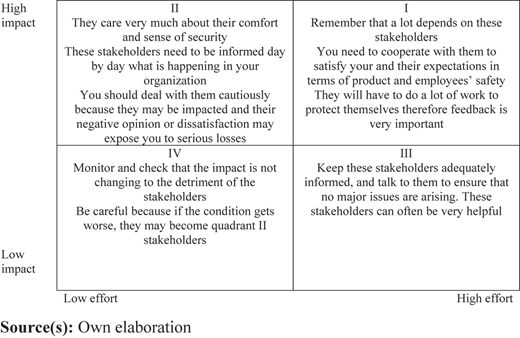
To score the parameters, we used a scale of 1 to 5. For “impact,” the value “1” meant a very small impact of the stakeholder on activities conducted by the company, and “5” meant a very high impact. For “effort,” “1” meant a very small engagement, and “5” meant a very high engagement of the stakeholder to minimize hazards related to SARS-COV-2. In general, the impact effort matrix is a helpful tool that enables the determination of a strategy for managing relationships with stakeholders (Oliver, Oliver, & Chen, 2019). This strategy undertaken by the organization is determined by the quadrant in which a particular stakeholder is located (see Figure 1):
High impact – high effort;
High impact – low effort;
Low impact – high effort and
Low impact – low effort.
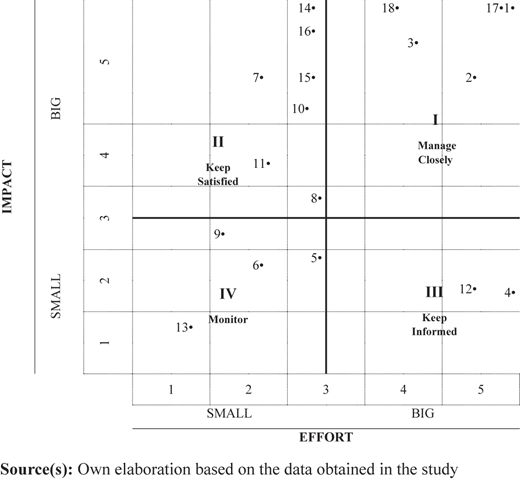
The study positioned most stakeholders (12 out of 18) in the upper part of the matrix, which meant that they were stakeholders with a large or very large impact on the functioning of the company. As an example, we can indicate the veterinary authority (VA). It is one of the crucial stakeholders with the biggest impact on the company, as all possible legal and actual activities undertaken by the VA are related to core business activities. These are rooted in the European food law, so any deviation from this law – including new emerging risks – can lead to serious consequences, including the suspension or withdrawal of food handling permissions. The VA's efforts focus on legal obligations and empowerments of supervisory of all activities related to food handling, and they cover regular and ad-hoc compliance checks with relevant legal provisions. The stakeholders from Quadrant II were an interesting case, as these included emergency services. When cooperation is based on trust and respect for mutual needs, these types of stakeholders are by nature characterized by relatively low effort but very high impact. They are not significantly involved in the company's daily operations, but their decisions resulting from the occurrence of, for example, an SARS-CoV-2 hazard may have a very large impact on the company, should the emergency services issue an order for the immediate disinfection and temporary closure of the company. Respectively, in the case of a positive scenario and good cooperation, stakeholders from Quadrant II can act as the organization's ambassadors in the local environment. As we found, seven out of 18 stakeholders will have to be strongly engaged in minimizing the effects of hazards related to SARS-CoV-2. After all, nongovernmental organizations and industry associations make extensive efforts to keep the market and economy status quo e.g. by preparing branch guidelines and recommendations or by involvement in SARS-CoV-2 special law-making procedures. However, it is not that others are free from this obligation. Stakeholders in Quadrant IV also must make some effort for their own and their stakeholders’ benefit and safety. For example, we may mention here suppliers and service providers where constant, reliable cooperation, open communication and mutual trust as key success factors for both parties in building resilience and business continuity during temporary economic and social shocks like the Covid-19 pandemic. In the event of an emergency, suppliers may also be involved in finding the possible cause, e.g. at their company level (Figure 2).
To summarize, apart from the obvious stakeholders like customers, consumers and employees, the surveyed organization should cover for all stakeholders with appropriate care for their welfare and safety. The nature of this concern and care depends on the type of mutual relationship and must be continuously reviewed. This means that the impact effort analysis should be systematically verified (Oliver et al., 2019). The target list of stakeholders should be updated in the same way because the context of each organization varies (Despoudi et al., 2020; Zaridis et al., 2020), especially in times of crisis.
Conclusions
The pandemic made it clear that now – as never before – stakeholders demand transparency and evidence on food safety and quality, along with the safety of employees across the SC. Relationships with stakeholders and their timely notification in the event of an emergency are key factors in cooperation. Supported by semi-structured interview, our case study obtained comparative material regarding SARS-CoV-2 occurrences impacting stakeholders, which revealed that constant cooperation with stakeholders – mainly those from quadrants I and III, who will be strongly engaged in minimizing the consequences of the negative event – is a very important element in managing the hazards related to SARS-CoV-2.
Proper identification of stakeholders and updating knowledge about them allows organizations to react faster and to be better prepared to protect the FSC. Moreover, we also found that the impact effort analysis is certainly a very good tool to study the matter, as the matrix perfectly illustrates the relationships and links between the organization and its stakeholders.
In our opinion, the seafood company surveyed in this study may be a good benchmark for others to follow and when choosing the appropriate approach in the field of stakeholder analysis for addressing new emerging risks.
The results we obtained offer new knowledge and confirm how strong and distant an organization's ties with various stakeholders can be. The research results also showed that proper stakeholder analysis serves not only the organization itself but also strengthens relations with stakeholders and makes the organization more prepared to cooperate in an emergency. Different researchers can use our results to deepen their understanding of the mechanisms and factors that regulate stakeholder relationship management in order to protect against the spread of hazards.
We are aware of the limitations of our study. One of them is conducting our research based on qualitative methods. In the future, the study should be expanded to include a diagnostic survey – e.g. among the stakeholders of the analyzed organization – whose role could be to assess the quality and security of cooperation. Another limitation is certainly the lack of similar scientific studies with which to compare our results.
So far, no publication of a similar nature has appeared, which would allow us to comprehensively describe the problem of hazards related to SARS-CoV-2 in the context of stakeholder analysis. Such an approach is of key importance when it comes to human life and health protection.
Research Funding: This research did not receive any specific grant from funding agencies in the public, commercial, or not-for-profit sectors; The first author is employed at the University of Gdańsk, Poland; The second author is a PhD student at the University of Gdańsk.
Authors' Contributions: Małgorzata Z. Wiśniewska: Conceptualization, Methodology, Investigation, Writing – Original Draft, Supervision, Project administration. Tomasz Grybek: Investigation, Visualization.
Data Availability: The data used and/or analyzed in the study are available in the analyzed organization and were used with its consent. The consent to the research is available upon request from the corresponding author.