This article aims at exploring the importance of perceived benefits in scholars' decision to use generative artificial intelligence (GAI), as well as at developing and testing a theoretical multifaceted model of scholars' intention to use GAI.
The article uses a mixed deductive-inductive approach. The theoretical multifaceted model of scholars' intention to employ GAI was tested based on structural equation modelling using partial least squares (PLS-SEM) and a survey conducted among 471 scientists.
The results show that the benefits perceived by scholars in the fields of teaching and research have the strongest influence on their decision to employ GAI. On the other hand, perceived benefits in the administrative field are not of importance in scholars' intention to use GAI.
The research conducted was limited in context (universities in Poland) and did not take into account a longitudinal perspective, which could have led to the omission of changes in researchers' intentions regarding the use of GAI as a result of more intensive use of those tools in scientific work (those intentions are subject to change over time).
The presented research constitutes a significant contribution to the literature on the use of GAI in the academic environment. Relative to previous research, our findings offer a new conceptual framework that illustrates the perceived benefits of GAI in shaping researchers' intentions to use it, taking into account the following three key areas of academic activity: research, teaching and administrative tasks. The findings respond to the need for an in-depth analysis. They also include an analysis of the impact of socio-demographic factors and personality traits on the intention to use GAI, which constitutes an innovative contribution to the existing scientific achievements in this field.
1. Introduction
Generative artificial intelligence (GAI), defined as “a machine learning model that uses unsupervised and supervised learning techniques to understand and generate human-like language” (Lund & Wang, 2023, p. 1), has emerged as a revolutionary technology that is changing the academic landscape (Bearman, Ryan, & Ajjawi, 2023; Crompton & Burke, 2023; Escotet, 2024; Teng, Zhang, & Sun, 2023; Zhou, Zhang, & Chan, 2024), acting as “the new panacea of the academic world” (Quintans-Júnior, Gurgel, Araújo, Correia, & Martins-Filho, 2023, p. 1) and revolutionising different aspects of education (Chen, Chen, & Lin, 2020; Dwivedi et al., 2023), with the “education sector being one that is likely to be majorly impacted by AI” (Chen et al., 2020, p. 75269).
It is emphasised that GAI is of key importance in reshaping and transforming HEIs in all their fields of activity, which ultimately may contribute to institutions adapting to changing social, economic and technological needs (Bates, Cobo, Mariño, & Wheeler, 2020). In the context of academic work (Andersen et al., 2025), GAI is also considered to be a catalyst for changes to academic work (McDonald, Johri, Ali, & Collier, 2025), as well as a stimulator and a paradigm shift (Castillo-Martínez, Flores-Bueno, Gómez-Puente, & Vite-León, 2024) that accelerates and transforms the existing approach to scientific work (Benbya, Strich, & Tamm, 2024).
Despite the potential benefits of GAI that have been identified (Yusuf, Pervin, Román‐González, & Noor, 2024), its use continues to arouse mixed emotions among scholars, from enthusiasm and caution to concern and reluctance (Petricini, Zipf, & Wu, 2025), ending with scepticism and complete unwillingness to make use of GAI (Jiang, He, Zhang, Zhou, & Han, 2024). Supporters of scholars' use of GAI emphasise the possibilities for increasing scientific efficiency and improving every area of academic work (Van Noorden & Perkel, 2023; Andersen et al., 2025). Meanwhile, sceptics and opponents underline that GAI is a two-edged sword in academic work (Bin-Nashwan, Sadallah, & Bouteraa, 2023) and accuse it of a lack of transparency, disinformation, bias and violation of intellectual property rights (Bandi, Adapa, & Kuchi, 2023). Researchers refer to technological stress among scholars (Zhang, Zhao, Zhou, & Kim, 2024). Those extreme emotions and attitudes can therefore be perceived as an encouragement to undertake research into scholars' intention to make use of GAI and confirm that the very issue is a key research problem in both practice and theory.
Although existing research provides solid evidence explaining scholars' intention to use GAI, these are limited only to a selected area of scholars' work and are narrowed down to specific scientific disciplines and geographical areas (Ivanov, Soliman, Tuomi, Alkathiri, & Al-Alawi, 2024; Andersen et al., 2025; Baig & Yadegaridehkordi, 2025; Kim et al., 2025). In addition, existing research was conducted predominantly employing selected theories related to the intentions and behaviours of a given recipient, including the theory of planned behaviour (Ivanov et al., 2024), social cognitive theory (Bin-Nashwan et al., 2023), the unified theory of acceptance and use of technology and the expectation confirmation model (Baig & Yadegaridehkordi, 2025). However, theoretical models do not enable a broader view and do not take into account academics' areas of work in the context of the perceived benefits and their importance in scholars' intention to use GAI. Meanwhile, it is recommended in the literature that research into scholars' intention to use GAI should take into account the specifics of academic work, divided according to the fields of research, teaching and administrative duties (Indergård & Hansen, 2025).
As a result, we know very little about the perceived benefits of GAI, taking into account the areas of academic work that are important in scholars' intention to use GAI. At the same time, the extant literature points out that “limited empirical work has systematically explored its diverse use and perceptions across academic contexts and research fields. This includes variations between disciplines or ways of conducting research, as well as potential disparities across career stages, gender and other demographics. Furthermore, the question remains about not only whether, but how academics might use GAI in research and how they assess its research integrity implications across various use cases” (Andersen et al., 2025). In addition, although some declared the importance of personality in the intention to use GAI, the researchers only took this factor into account from the perspective of students (Weng, Qi, Gu, Rajaram, & Chiu, 2024).
Existing research has not fully explored scholars' intention to use GAI, taking into account all areas of academic work: research, teaching and administrative. What is more, researchers continue to be encouraged to conduct further investigations into the importance of perceived benefits in scholars' intention to use GAI (Ivanov et al., 2024), not only in the area of research (Andersen et al., 2025), including increasing scientific production but also in the teaching field, including didactic excellence (Bozkurt et al., 2023) and the administrative field (Watermeyer, Phipps, Lanclos, & Knight, 2024). It is also emphasised that there is some need for broader research taking into account various cultural and socio-economic contexts (Ivanov et al., 2024). This is important because using any form of technology depends on the cultural norms that exist in different countries.
Despite growing research interest in the use of GAI in academia, there is still a lack of comprehensive research into scholars' intentions to use GAI across all areas of their professional activity. Much of this research focuses on the student perspective (Weng et al., 2024). However, it is impossible to directly transfer existing findings on the benefits of using GAI from a student perspective to scholars, as both groups operate in different institutional contexts, motivations and academic responsibilities. Those differences encompass not only the methods of using GAI tools but also the expected outcomes, the level of decision-making autonomy and the ethical and professional implications of their use (Ivanov et al., 2024).
To date, research on academics' intention to use GAI is fragmented and focused on selected disciplines, behavioural theories and limited geographical contexts (Ivanov et al., 2024; Baig & Yadegaridehkordi, 2025). The literature emphasises the need to provide further comprehensive findings covering all areas of academic work, taking into account individual and contextual differences. To address the above-mentioned calls and the identified gaps in the literature, the aim of this article is to identify the importance of perceived benefits in scholars' decisions to use GAI, as well as to develop and test a theoretical multifaceted model of how the perceived benefits of GAI influence scholars' intention to use GAI, taking into account all areas of academic work: research, teaching and administrative. To achieve our aim, we address the following research questions (RQs):
What benefits are of importance in scholars' intention to use GAI?
Which of these benefits have a positive impact on scholars' intention to use GAI in the research, teaching and administrative areas of their activity?
To answer our research questions, we adopt a multifaceted approach to the perceived benefits of scholars making use of GAI. This approach is recommended in the case of understanding concepts that can be analysed from various perspectives or many points of view. What is more, a multifaceted approach ensures a better understanding of intentions (Wu & Chen, 2025). In our article, received benefits refer to a given individual's belief in the positive consequences of carrying out a specific action or behaviour (Leung & Waters, 2013). Meanwhile, intentions “refer to the ‘degree’ to which a given individual has formulated conscious plans for performing or not performing out a specific future behaviour” (Warshaw & Davis, 1985, p. 214).
Although most of the previous research on the benefits of scholars using GAI (e.g. Ivanov et al., 2024) is conducted using theories of intention and behaviour, this study did not utilise them. Their application allows for a limited explanation of the complexity of the benefits. These theories focus primarily on attitudes towards technology, assuming rational decisions and behavioural stability. However, the use of GAI by scholars is multifaceted and depends on the specific areas of academic activity: research, teaching and administration (Ivanov et al., 2024; Kim et al., 2025). For this reason, we adopted a mixed deductive-inductive approach. We first identified the potential benefits of using GAI for scholars' research, teaching and administrative work based on a systematic literature review (SLR). Then, using a quantitative approach, we conducted empirical verification of the findings included in the literature.
Our research provides several contributions to the literature on GAI in the context of academic work. Firstly, we answer the call to conduct further research into the importance of perceived benefits for scholars' intention to use GAI (Ivanov et al., 2024). Previous findings in this regard did not take into account the specifics of academic work relating to the various areas of scholars' work.
Our research extends the current state of knowledge using a multifaceted approach to the perceived benefits obtained by scholars through the use of GAI, and we take into account all areas of academic work, that is research, teaching and administrative tasks (Indergård & Hansen, 2025). We enrich existing findings by taking into account the specifics of academic work and its three areas: research, teaching and administrative.
Secondly, we respond to calls to conduct research into scholars' intention to use GAI, taking into account various geographical contexts and scientific disciplines. The scant research conducted to date has been limited to the perspective of scholars from higher educational institutions in developed countries such as the USA (Kim et al., 2025) and Denmark (Andersen et al., 2025), as well as in developing countries such as Pakistan (Baig & Yadegaridehkordi, 2025). As far as the authors are aware, research into the importance of potential benefits for the intention to use GAI has not so far been conducted in the context of scholars from Poland.
Finally, to the best of our knowledge, this is the first research that takes into account socio-demographic and personality factors in scholars' intention to use GAI. This is in line with indications in the literature, according to which position, age, gender and personality traits may be of importance in scholars' intention to use GAI (Andersen et al., 2025; Ivanov et al., 2024), although this has not been verified in research. Next, based on the recommended multifaceted approach, we developed and tested a multifaceted model that involves all areas of academic work, as well as individual and contextual factors. This model goes beyond previous findings by other researchers. (Andersen et al., 2025; Ivanov et al., 2024).
2. Literature review and hypothesis development
2.1 Generative artificial intelligence
GAI is considered to be a breakthrough technology (Rice, Crouse, Winter, & Rice, 2024) and is one of the subsets or models of artificial intelligence (AI). It is defined as “a machine learning model that uses unsupervised and supervised learning techniques to understand and generate human-like language” (Lund & Wang, 2023, p. 1), while AI refers to “the use of computational machinery to emulate capabilities inherent in humans, such as doing physical or mechanical tasks, thinking, and feeling” (Huang & Rust, 2021, p. 31). The potential of GAI combines capabilities for processing, analysing and generating various formats such as text, images and multimedia. This is possible thanks to the identification of large datasets and patterns, and the use of machine learning models and neural networks. The most popular tools based on GAI include ChatGPT, Bard and Copilot.
Previous research into GAI focused on the potential benefits (Dwivedi et al., 2023), barriers and ethical, technical and legal challenges (Floridi & Chiriatti, 2020), antecedents (Shrestha, Ben-Menahem, & von Krogh, 2019), drivers (Zhang et al., 2023), the use of GAI by representatives of various industries and sectors, in particular artists, designers and multimedia creators, healthcare, medical and pharmaceutical professionals, programmers, IT specialists, translators, marketing specialists and bankers (Dwivedi et al., 2023), HR department employees (Tambe, Cappelli, & Yakubovich, 2019) and retail, workplace, manufacturing and management personnel in all types of organisations. It is emphasised that GAI is a rapidly developing field with a broad scope of application, in particular in higher education institutions (HEI) (Gupta & Yadav, 2023). Recently, GAI has gained in importance in the HEI context. For example, recent research has underlined the benefits of using GAI for students (Baidoo-Anu & Owusu Ansah, 2023), teaching staff (Cotton, Cotton, & Shipway, 2023), researchers (Andersen et al., 2025) and HEI management personnel (Mollick & Mollick, 2023).
2.2 Generative artificial intelligence and academic settings
The latest GAI research has examined the HEI context from various perspectives. Emphasis has been placed on the possibilities for using GAI in teaching and learning processes (Baidoo-Anu & Owusu Ansah, 2023), its impact on teaching practice and course design (Cotton et al., 2023), support for research activity (van Dis, Bollen, Zuidema, van Rooij, & Bockting, 2023), as well as the challenges and opportunities related to the implementation of GAI by educational institution administration and management personnel (Mollick & Mollick, 2023).
In addition to potential benefits, researchers have also drawn attention to barriers, challenges and limitations linked to the implementation of GAI in the academic environment (Dwivedi et al., 2023). Several studies have already verified whether GAI matches educational goals. These studies include publications focused on strategies and recommendations related to effective academic work with the use of GAI. A few studies have also taken into account the issues of the acceptance and perception of GAI by HEI stakeholders, including students, teaching staff, scholars and HEI managers. Additionally, there are also publications on institutional policies and regulatory frameworks related to the use of GAI by various stakeholder groups, such as students and researchers. In the management context, GAI is also perceived as a tool for supporting decision-making and automating administrative processes (Mollick & Mollick, 2023).
2.3 Benefits of generative artificial intelligence among scholars
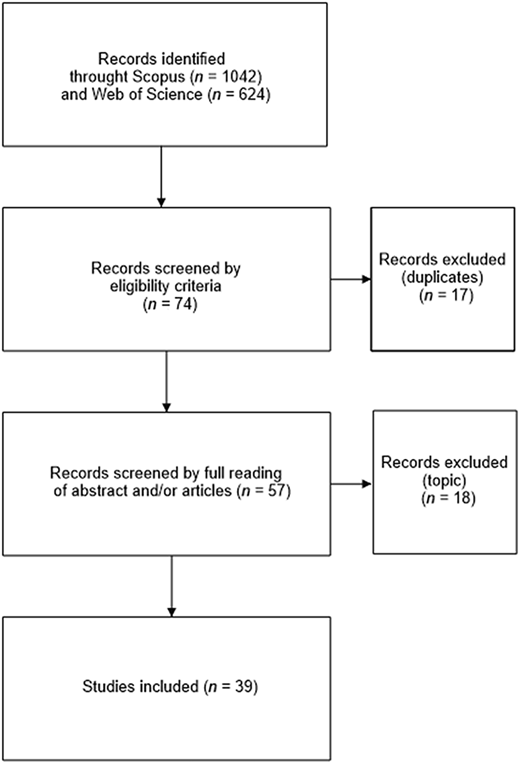
To identify the benefits of generative artificial intelligence among scholars, we conducted an SLR (Figure 1), which is considered by researchers to be the gold standard in any research process (Kraus et al., 2022). The literature search was conducted using Web of Science and Scopus – international, interdisciplinary databases offering the widest access to literature. The SLR included steps such as planning, implementation and reporting (Kraus et al., 2022).
During the planning phase, the following criteria were adopted for the literature search: keywords (“generative artificial intelligence” and “higher education”), search period (2022–2025; the start date is the launch of ChatGPT, the first GAI-based model. The initial search was conducted in June 2024, and a follow-up search was conducted in November 2025), search field (article title, abstract, keywords), document type (peer-reviewed article), source type (journal), category (Business, Management and Accounting) and language: English.
The second phase, implementation, involved the actual review. Based on the adopted assumptions, the initial keyword search in the “title, abstract, keywords” category in the databases yielded 1,666 records (Web of Science: 624; Scopus: 1,042). The resulting records were then subjected to the established inclusion and exclusion criteria to narrow the selection of relevant articles, resulting in 74 publications, including 28 from Web of Science and 46 from Scopus. We then removed 17 articles that were duplicated in the databases, yielding 57 publications. We then conducted a record screening process, which involved reviewing titles, abstracts and keywords, with particular attention paid to articles that explicitly addressed the benefits of GAI for scholars (Tranfield, Denyer, & Smart, 2003). This resulted in the inclusion of 18 records that were removed due to the student perspective. Ultimately, 39 articles were selected for further analysis.
The final stage of the SLR involved an in-depth analysis of these articles to determine their relevance to the research questions regarding the benefits of GAI for scholars using content analysis (Khirfan, Mohtat, & Peck, 2020). This analysis identified the presence of specific words, themes or concepts in the collected publications (Miles & Huberman, 1994). With the research questions in mind, the collected publications were searched for the benefits of GAI for scholars. They were then grouped into categories related to three areas of scholars' work: research, organisational and administrative (Table 1).
The research area focuses on achieving three individual stages of the scientific process: (1) conceptual, (2) empirical and (3) formulating and reporting conclusions (Macfarlane, 2011; Indergård, Hansen, & Collins, 2022). The conceptual stage includes conceptualisation, explication and operationalisation. Its aim is to identify, justify and formulate the research problem, as well as its operationalisation, enabling the developed theoretical concept to be translated into a specific research plan. Meanwhile, the empirical research stage is related to the performance of scientific research, including pilot studies and full research. The last stage involves the analysis of the data collected in the empirical part and the proposal of a contribution to theory. Here, conclusions are also formulated on the basis of the results and are published.
The teaching area refers to scholars preparing and conducting didactic classes, as well as their supervision and the grading of coursework and exams (Indergård et al., 2022).
The administrative area in scholars' work refers to their work in various committees, writing reports and statements and replying to emails from students and fellow employees (Indergård et al., 2022).
2.3.1 Perceived benefits for research area
The literature highlights a number of benefits associated with the use of generative AI for research. For example, Andersen et al. (2025) indicate that GAI contributes to increased efficiency and time savings, supports improved linguistic quality of publications and research proposals, enables data analysis, increases research productivity and streamlines conceptual work and scholarly communication. The authors refer to GAI as a research accelerator, emphasising the acceleration of individual stages of the research process.
Dwivedi et al. (2023), based on the opinions of 43 experts, confirm that GAI streamlines the process of writing first drafts of scientific texts, reports, reviews and abstracts, as well as facilitates information retrieval, literature synthesis, and the generation of new research ideas. Livberber and Ayvaz (2023) indicate that GAI can be helpful in planning article structure, improving language and style, overcoming writer's block and searching and analysing literature. This tool shortens the time it takes to develop a research concept and supports content translation and paraphrasing, making the publication process more efficient. Furthermore, Owens (2023) highlights the potential of GAI for literature reviews, and Leung et al. (2023) highlight its potential in the context of peer review writing. Given the above findings, we propose the following hypothesis for this research:
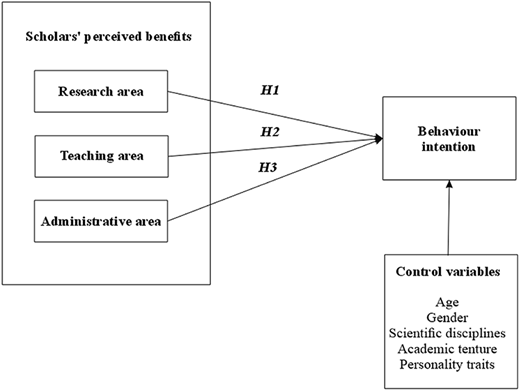
The perceived benefits for research area positively impact scholars' intention to use GAI.
2.3.2 Perceived benefits for the teaching area
For example, Ivanov et al. (2024) conducted a study on the benefits of GAI among scholars using the theory of planned behaviour. Based on a study of 130 lecturers from 19 countries, they demonstrated a relationship between perceived benefits and the intention to use GAI in teaching. The researchers note that those tools save time, increase scholars' productivity and streamline the preparation process for classes. The results also showed that attitude, subjective norms and perceived behavioural control had a positive and significant relationship with scholars' intention to use GAI.
Kim et al. (2025) indicate that GAI enables the automation and personalisation of teaching materials, generating content, exam questions and practice examples. This allows lecturers to adapt content to students' diverse learning styles and create more engaging and modern academic courses. Livberber and Ayvaz (2023) also emphasise the potential of GAI in expanding course content, developing examples and presentations and introducing new teaching perspectives. Finally, Esplugas (2023) notes that GAI supports the improvement of academic communication and teaching skills, including scientific writing, which indirectly affects the quality of teaching and learning.
In this context, GAI constitutes an educational tool that enables scholars to prepare didactic materials and lesson plans and adapt them to the needs of the students, as well as develop and assess coursework tests (Crompton & Burke, 2023). GAI also enables for feedback to be provided to students on their study progress, as well as monitoring and predicting their results. Finally, GAI can support academic honesty by verifying papers submitted by students in terms of copyright (Leung et al., 2023). We therefore propose the following hypothesis for this research:
The perceived benefits for the teaching area positively impact scholars' intention to use GAI.
2.3.3 Perceived benefits for the administrative area
With respect to the administrative sphere, Baig and Yadegaridehkordi (2025) draw on the theoretical foundations of the unified theory of acceptance and use of technology and the expectation confirmation model. They found that GAI could automate repetitive bureaucratic tasks, thus reducing the workload of academics and allowing them to focus more on research and teaching.
In the case of additional duties related to organisational work, managing a department or institute, scholars face additional tasks connected to employee appraisals, writing job advertisements, employing new co-workers and preparing timetabling plans and teaching programmes. The literature postulates that GAI helps scholars to optimise and accelerate the completion of routine tasks (Beerkens, 2022), as well as initiate new study programmes and carry out changes in existing programmes, predict students' withdrawal from continuing their studies, measure academic productivity, improve workflow, especially in contacts with students, and provide answers to questions related strictly to issues connected to studying. GAI also enters the field of human resource management (e.g., help with preparing recruitment documentation, assessment of application documents) and marketing (e.g., developing audio and video promotional materials and posts on social media). Therefore, we expect scholars’ intention to use GAI to stem from perceived benefits for the administration area.
The perceived benefits for the administrative area positively impact scholars’ intention to use GAI.
Additionally, some authors have already found that socio-demographic factors are important in scholars’ intention to use GAI. In terms of gender, no differences were observed in the use of GAI between men and women (Andersen et al., 2025). Other researchers consider that men are more open to using GAI (Kim et al., 2025). In addition, previous research showed that scholars at the beginning of their academic careers demonstrated a greater intention to use GAI than more experienced scholars (Andersen et al., 2025). There are findings that show that scholars’ intention to use GAI depends on the field of science. The findings of Andersen et al. (2025) show that this intention is greater in the case of representatives of the technical sciences, but lower among those representing the humanities. Other results show that STEM researchers (the acronym for Science, Technology, Engineering and Mathematics; e.g., biology, physics, engineering, mathematics, statistics and computer science) demonstrate a greater intention to use GAI.
The literature also suggests a link between character traits (those included in the Big Five) and a given individual's intention to use GAI (Kaya et al., 2022). However, prior findings do not take into account the perspective of academic employees. For example, research conducted on Turkish residents showed that people with a high level of openness to experience and extroversion more often used GAI (Kaya et al., 2022). Other researchers conducted research among students, and they showed that, in addition to openness to experience and extroversion, high levels of agreeableness and conscientiousness are equally as important in the context of using GAI (Wang & Xue, 2024). Azeem and Abbas (2025) also conducted research among students and found that extroversion and agreeableness were important for the intention to use GAI, while conscientiousness, neuroticism and openness to experience were not significantly linked to the use of GAI.
To sum up, the extant literature focuses mainly on samples from among students and the general population, omitting the specifics of the academic environment, which, in terms of motivation, pressure and professional responsibility, differs significantly from other groups of users. Despite those recent papers, the state of knowledge on why a given person uses GAI remains fragmentary. As far as the authors are aware, such research has not been conducted. For all these reasons, it is necessary to focus greater attention on scholars' intention to use GAI, taking into account their personality traits. This approach will make it easier to understand why some researchers adopt new technologies such as GAI with enthusiasm, while others keep their distance.
Figure 2 provides a hypothetical multifaceted model of the perceived benefits of scholars' intention to use GAI, taking into account all three areas of their work: research, teaching and administrative.
3. Methods
3.1 Sample and data collection
The research sample consists of scholars employed in state and private higher educational institutions in Poland. We respond to the invitation of Ivanov et al. (2024, p. 11), where “(…) future research may delve into the nuances of GenAI use in different countries, allowing for a more comprehensive understanding of potential linkages and distinct patterns across diverse cultural and socioeconomic contexts.” Although globally there is growing interest in the academic environment in using GAI, prior research leaves a cognitive gap as regards Central and Eastern Europe, including Poland. The system of higher education in Poland features differing institutional conditions, digital infrastructure and approaches to technological innovation, which may have an impact on the perception and implementation of GAI among Polish scholars. As a member of the European Union and a beneficiary of funds for the development of innovation, Poland has an obligation to react to international recommendations (e.g., UNESCO, European Commission) related to the responsible and inclusive implementation of GAI in higher education.
According to official data of the National Information System on Higher Education and RADON Science (https://radon.nauka.gov.pl), there are 72,061 scientific employees in Poland (as of 01.06.2023). The minimum sample size was determined taking into account the permissible measurement error (5%) and an assumed confidence level of (γ = 0.95; α = 1.96; d = 0.05). On this basis, it was determined that the minimum sample size should amount to 385 people.
Data were collected between May and June 2023 using an anonymous online questionnaire prepared using Google Forms (https://forms.office.com). SYMPA software was used (https://www.sympa.com) to send an invitation to all scholars in the RADON database to take part in the research. In total, we sent three reminders with a request to potential participants to join the study. Altogether, 471 respondents completed the questionnaire, and thus, the minimum sample size was obtained. The response rate was at the level of 11.08%, which is an acceptable response rate for scientific research (Wu, Zhao, & Fils-Aime, 2022). The demographic characteristics are presented in Table 2. In total, 471 scholars took part in the research, including 255 women (54.10%) and 204 men (43.30%), wherein 12 people (2.50%) refused to answer the question about gender. The majority of the research participants were born in the years 1965–1979 (55.60%), were representatives of the social sciences (88.30%) and had the academic title of doctor (55.80%).
3.2 Developing a measurement scale
Our literature review showed that despite the growing interest in GAI in the work of scholars, and the perceived benefits from its use, there is no measurement scale that takes into account the areas of scholars' work (Bin-Nashwan et al., 2023; Ivanov et al., 2024; Baig & Yadegaridehkordi, 2025). Researchers used existing measurement tools dedicated to theories of behaviour, e.g., the unified theory of acceptance and use of technology and the expectation confirmation model. For this reason, we developed and rigorously verified our measurement scale for perceived benefits (Table 1), generating an initial list of elements based on GAI literature, and then conducting a pilot study to perfect the scale according to the respondents' opinions.
More specifically, we grouped the benefits identified using the SLR into areas of scholars' work. We assumed that the scale tool should not be overly extensive but rather focused on key benefits that representatively reflect the specificity of academic work and allow for further empirical validation (Podsakoff, MacKenzie, Lee, & Podsakoff, 2003). That is why, the collected benefits were consolidated into general formulations that formed the basis for the scale's construction. To measure perceived benefits in the area of our research, we developed a scale comprising three questions. A sample question is: “GAI will significantly improve research methods at universities”. Perceived benefits in the area of teaching were measured using three questions. A sample question is: “GAI will significantly improve education at universities”. In turn, to measure perceived benefits in the area of administration, the scale ultimately comprises three questions. A sample question is: “GAI will increase the efficiency of administrative task execution at universities”. The intention to use GAI was assessed using four items adapted from Ajzen (1991). A sample question is: “I find it very likely that I will use GAI within the next 12 months”.
We also took into account control variables widely used in previous research, i.e., gender, age, scientific field, academic title and personality traits. Taking into consideration various positions (Nielsen & Raswant, 2018), we included gender (binary: male or female) as a control variable. Previous research has shown that gender is a deciding factor in scholars' use of GAI (Andersen et al., 2025). Age is measured in our research using periods of time in accordance with generations: born in 1946–1964 (Baby Boomers), born in 1965–1979 (Generation X), born in 1980–1994 (Generation Y), born in 1995–2009 (Generation Z), born after 2010 (Generation Alpha). Prior research has shown that age is a deciding factor in scholars' use of GAI (Andersen et al., 2025). To measure the representation of fields of science, we adopted the following OECD classification of fields of science and technology: Natural Sciences, Engineering and Technology, Medical and Health Sciences, Agricultural and Veterinary Sciences, Social Sciences, Humanities and the Arts. This is in line with other research into scholars' use of GAI (Andersen et al., 2025). Other control variables adopted were academic title, in order to determine whether a scholar has a Master's, is a Doctor, a Habilitated Doctor or a Professor. Finally, we took into account personality traits (from the so-called “Big Five” model) measured using the 10-item measure of the Big Five by Gosling, Rentfrow, and Swann (2003). A sample question is:
“I see myself as extraverted, enthusiastic”. This variable was used earlier in other research as a control variable (Kaya et al., 2022). All elements included in the scales are included in Appendix 1.
The process as a whole resulted in the development of a draft version of the questionnaire. All the questions on the measurement scale were translated from Polish by the authors and measured using a 7-point Likert scale with the options ranging from “1” – I decidedly disagree to 7 “I decidedly agree”. The selection of the scale was determined by the fact that a seven-point scale provides more precise measurements than other scales (Finstad, 2010). All the elements included in the scale are presented in Table 3. To test the basic features of the scale, a pilot study was conducted with the participation of 30 scholars. The aim was to check the understandability of the questions and the appropriateness of the scale items, and to make an initial assessment of its reliability and accuracy. Based on the results, the necessary language and format corrections were made. This ultimately led to a final version of the questionnaire that contained 12 questions measured on a 7-point Likert scale.
3.3 Data analysis
The collected data were first subjected to statistical analysis, in which the measurements used were: position (arithmetic mean), dispersion (minimum and maximum) and variability (standard deviation). Subsequently, to measure the relationship between perceived benefits according to the three areas (research, teaching and administrative) and scholars' intention to use GAI, the Pearson's correlation procedure was applied. To assess and verify the reliability and accuracy of the research tool, we conducted confirmatory factor analysis (CFA). The model fit was considered to be acceptable, namely the Chi-square (χ2), Comparative Fit Index (CFI), Tucker-Lewis Index (TLI), Standardised Root Mean Square Residual (SRMR) and Root Mean Square Error of Approximation (RMSEA). The convergent validity of the research tool was assessed using Cronbach's alpha and Harman's single-factor reliability tests. The convergent validity of the research tool was verified using composite reliability (CR) and average variance extracted (AVE). Based on the t-Student test for independent samples, comparison of the means was conducted between the groups of scholars. Finally, to test our hypotheses and validate our measurements, we used PLS-SEM. Data analysis was conducted using the following software: SmartPLS 4, PS IMAGO Pro 10 and Statistica 64.
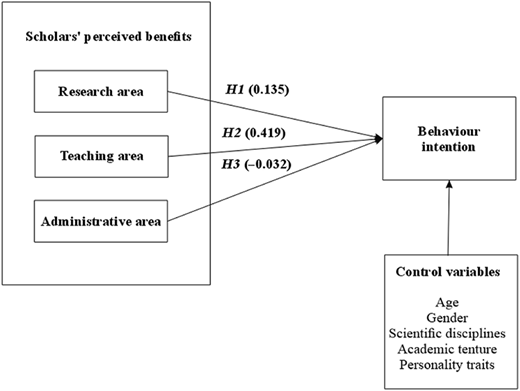
For all input data, a validated multifaceted model of the perceived benefits of scholars' intention to use GAI is presented in Figure 3.
4. Findings
4.1 Descriptive statistics reliability and validity test
Table 3 presents descriptive statistics including the minimum values, maximums, means, standard deviations, skewness and kurtosis. The mean values show that perceived benefits in the area of teaching are the most important factor influencing a scholar's intention to use GAI. As far as the remaining factors are concerned, there are only small differences between the means. Then, to describe the statistical relationship between the factors and scholars' intention to use GAI, we used the Pearson linear correlation procedure. As can be seen from the results, teaching is the most important area in terms of perceived benefits influencing scholars' intention to use GAI. To check for collinearity, we calculated the variance inflation factor (VIF) for each variable. As these were below 1.87, it can be assumed that there is no excessive multilinearity.
In order to assess and verify the reliability and accuracy of the research tool, the Cronbach's alpha reliability test was used. Considering that Cronbach's alpha adopts values from 0 to 1, the research tool as a whole is characterised by very high reliability (0.924; 16 items). For all the factors, there is also very high internal consistency. The detailed results are as follows: perceived teaching benefits – 0.801 (3 items), perceived research benefits – 0.879 (3 items), perceived administration benefits – 0.923 (3 items), intention – 0.856 (3 items).
Additionally, conducting measurement of all variables at the same time using measurement tools with a similar style of test items and an answer scale with an identical scale of answers may lead to measurement error. Therefore, to identify potential common method bias, we applied Harman's single-factor test. We obtained a result of 44.973%, therefore not exceeding 50%, which allows us for concluding that there was no common method bias.
Non-response bias and potential sampling limitations are major problems that can occur in any empirical study that employs survey methods (Pearl & Fairley, 1985). Non-response bias can occur when individuals refuse to participate in the study or withdraw before its completion. As indicated in the literature, the following techniques were used to increase the number of responses received: relevance and interest in the topic for the study population, personalisation, including direct contact information for the researcher and assurances of anonymity (Anseel, Lievens, Schollaert, & Choragwicka, 2010).
In our study, of the 72,061 individuals invited to participate, 471 responded, representing a response rate of approximately 0.65%. This rate should be considered low, especially when compared to typical values obtained in online surveys, which typically range from 20% to 50% (Baruch & Holtom, 2008; Dillman, Smyth, & Christian, 2014). However, such a rate may result from information overload among scholars in their work environment (Eppler & Mengis, 2004). Nevertheless, the number of responses obtained (n = 471) exceeds the minimum threshold of representativeness calculated for the population of 72,061 individuals at a 95% confidence level and a 5% error estimate (n = 382), which allows us for considering the sample statistically sufficient to conduct the planned analyses. To verify the potential impact of nonresponse bias, a comparison of early and late respondents was conducted using Student's t-test and chi-square tests. The analyses revealed no significant differences (p > 0.05), confirming the absence of nonresponse bias (Armstrong & Overton, 1977).
For construct validation of the research tool, we used confirmatory factor analysis (CFA), which focuses on the relationships between factors and their measurement, without taking into account the causal relationships between latent constructs and enables the precision of the proposed measurement model to be determined. Tests showed that the proposed theoretical model is consistent with the measurement model. The results showed the Squared Root-Mean Square Residual (SRMR) value to be 0.064, which is in line with the acceptable threshold of 0.08 (Hooper et al., 2008). Meanwhile, the Normed Fit Index (NFI) value should be between 0 and 1 (Bentler & Bonett, 1980). The results show that the model has an ideal fit (NFI = 0.818). Match index values were as follows: NFI = 0.90, TLI = 0.99, CFI = 0.99, RMSEA = 0.12. In addition, χ2(48) = 347.00. The model has an ideal fit, as the Normed Fit Index (NFI) is between the values 0 and 1 (Bentler & Bonett, 1980). The closer the NFI is to 1, the better the fit. The excessively high RMSEA value and the statistically significant chi-square are the result of assumptions about dependencies between all three benefit indicators and intention. Meanwhile, two of these three are not statistically significant. Table 4 presents the factor loading results. The values of all 16 items are within the range of good fit (0.719–0.959) and thus qualify for further analysis, as the factor loading must be at least 0.50 (Hair, Black, Babin, & Anderson, 2009).
The factor loadings and composite likelihood values were verified using CR and AVE (Hair, Hult, Ringle, Sarstedt, & Thiele, 2017). All values are within the required range: for AVE, a value greater than 0.50 is acceptable, and for CR, greater than 0.70 (Fornel, Larcker, 1981). The required threshold of ≥0.50 for CR results and of ≥0.70 for AVE results was exceeded for all factors. Meanwhile, all heterotrait-monotrait ratio (HTMT) values are lower than the threshold value of 0.85 (Hair et al., 2021). Together, these results show that all the indexes are well-defined with these factor loadings for the related constructs, while the proposed measurement model has a good fit. Thanks to this, it is possible to continue with further assessment of the structural model.
4.2 Structural model
Table 5 presents the path coefficients for the five tested hypotheses. We used the bootstrapping method based on the recommended 5,000 draws (Hair et al., 2017). The R2 coefficient of determination is 0.57, which means that all the independent variables are responsible for at least 57% of the variability of the dependent variable. The results show that perceived benefits in the administrative area do not influence scholars' intention to use GAI (H3) (path = −0.032, T = 0.678, p > 0.005). In addition, our results show that perceived benefits in the teaching area have the strongest positive impact on scholars' intention to use GAI (H2) (path = 0.419, T = 6.677, p < 0.005). Finally, our results show that perceived benefits in the area of research positive impact scholars' intention to use GAI (H1) (path = 0.135, T = 2.114, p < 0.05).
4.3 Robustness check
Subsequently, the robustness of the results was checked, and the measurement model of scholars' intention to use GAI was tested, taking into account the control variables of age, gender, scientific discipline, academic tenure and personality traits. On the basis of the single-factor variance analysis result, no statistically significant differences were found in the intention to use GAI among the compared age groups, F(1.368) = 3.91, p > 0.05. In the case of gender, based on the t-Student test for independent samples, no statistically significant differences were found between women and men [t(0.758) = 0.94, p > 0.05]. Our results show that in the case of the field of science, no statistically significant differences were found [t(0.522) = 0.94, p > 0.05]. With regard to academic title also, no statistically significant differences were found [t(-1.174) = 0.22, p > 0.05]. In the context of personality traits, the Pearson r correlation coefficient value between the intensity of individual traits according to the Big Five model and scholars' intention to use GAI was determined using the bootstrapping method on the basis of 5,000 draws. Our results indicate that no statistically significant correlation was found between extraversion and the intention to use GAI [−0.12; 0.05]. The intensity of the next trait from the Big Five model, conscientiousness, is not statistically significantly correlated with the intention to use GAI [−0.15; 0.06]. Meanwhile, neuroticism is not linked to the intention to use GAI [−0.04; 0.11]. Our results show that no statistically significant correlation was found between extraversion and the intention to use GAI [−0.12; 0.05]. Finally, our research shows that openness is positively correlated with the intention to use GAI [−0.16; −0.01].
5. Discussion
This article examines the importance of perceived benefits for scholars' decisions regarding the use of GAI and develops and tests a theoretical multifaceted model of how the perceived benefits of GAI influence scholars' intention to use GAI. We thus contribute an in-depth discussion to the current state of knowledge in this area. Of course, theories of behaviour used by other researchers, including the theory of planned behaviour (Ivanov et al., 2024), social cognitive theory (Bin-Nashwan et al., 2023), the unified theory of acceptance and use of technology and the expectation confirmation model (Baig & Yadegaridehkordi, 2025), help explain what influences scholars' intentions to use GAI. However, they do not take into account the specific nature of scholars' work, including their areas of research, teaching and administration.
In particular, based on a multifaceted approach, we examined the influence of perceived benefits on scholars' intention to use GAI, taking into account all areas of academic work (research, teaching and administrative tasks). In addition, we tested the impact of socio-demographic factors (age, gender, scientific discipline, academic tenure) and personality factors (personality traits according to the Big Five) on scholars' intention to use GAI.
Firstly, our research shows that perceived benefits in the research area have a positive impact on scholars' intention to use GAI. These results are in line with previous research (Andersen et al., 2025; Dwivedi et al., 2023; Leung et al., 2023; Livberber & Ayvaz, 2023; Owens, 2023). Our results show that the benefits of improving research methods, accelerating scientific discovery and revolutionising traditional research practices are important for scholars to adopt GAI. This can be assessed from a perspective of the excessive amount of research and academic duties, which is why scholars' decision to use GAI in performing research tasks is based on the perceived benefits or the belief that the needs of the researcher will be satisfied.
Secondly, our research shows that perceived benefits in the teaching area positively influence scholars' decision to use GAI, which is in line with earlier findings (Crompton & Burke, 2023; Esplugas, 2023; Ivanov et al., 2024; Kim et al., 2025; Leung et al., 2023; Livberber & Ayvaz, 2023). This may suggest that if scholars perceive that GAI has the potential to improve the quality of education at universities, personalising education and revolutionising teaching methods.
This confirms the view that, in effect, scholars make use of GAI because they recognise that it can support the teaching process, which ultimately enables them to focus on direct contact with students.
Thirdly, our results show that perceived benefits in the administrative area do not have an impact on scholars' intention to use GAI. These results are not in line with earlier research (Beerkens, 2022; Baig & Yadegaridehkordi, 2025). One of the possible reasons for this discrepancy with the existing literature may be attributed to the fact that this area is often considered to be of secondary importance in academic work (Indergård & Hansen, 2025). Scholars may not perceive the direct benefits of implementing GAI in this area.
Finally, our findings show that socio-demographic features are not important in scholars' intention to use GAI, which is not in line with prior findings (Kaya et al., 2022; Azeem and Abbas, 2025; Andersen et al., 2025; Kim et al., 2025). Our discoveries bring an entirely new contribution to the current state of knowledge. In terms of gender, previous findings pointed to discrepancies in the importance of gender for scholars' intention to use GAI. Some claimed that gender was of no importance (Andersen et al., 2025), while others found that men are more open to using GAI (Kim et al., 2025). These discrepancies can be explained by the fact that prior findings may be dependent on the cultural and institutional context and the specifics of the research sample. The differences may also result from various methods of measuring intention and the varying degree of access to GAI in academic environments. Our research, conducted in a specific institutional and geographical context, indicates no impact of gender on scholars' intention to use GAI, which may suggest that these differences should take into account local conditions.
Our research shows that age is not important for scholars' intention to use GAI, which is not in line with previous findings (Andersen et al., 2025). Prior research shows that scholars at the beginning of their academic careers have a greater intention to use GAI than more experienced scholars (Andersen et al., 2025). Our findings show that both beginner and experienced scholars demonstrate a similar level of familiarity with GAI. This can be explained by the fact that generational differences are less important in academic environments, where the use of modern tools becomes the norm, irrespective of professional tenure. In addition, the growing pressure for productivity in science may encourage all scholars, regardless of age, to seek the support of technology.
Our research shows that the scientific discipline represented is not important for scholars' intention to use GAI, which is not in line with previous findings (Andersen et al., 2025). Previous findings show that scholars' intention to use GAI depends on the field of science. Some claim that this intention is greater among representatives of the technical sciences, with it being the lowest among representatives of the humanities (Andersen et al., 2025), although others claim that it is highest for STEM sciences (Science, Technology, Engineering and Mathematics; e.g., biological sciences, physics, engineering, mathematics and statistics and computer science).
Finally, the results show that in the group of five personality traits (based on the Big Five), only openness to experience was connected to scholars' intention to use GAI, which is in line with previous findings (Kaya et al., 2022; Weng et al., 2024). Our findings confirm that scholars with a high level of openness are more likely to use tools to support their academic work.
Our findings show that the level of extroversion is not connected to the intention to use GAI, which is not in line with previous findings (Kaya et al., 2022). However, our findings are not surprising, as people with a low level of extroversion are more open to novelty than those with the highest level (Koole, Jager, van den Berg, Vlek, & Hofstee, 2001). Our research shows that a high level of conscientiousness is not linked to scholars' intention to use GAI, which is not in line with previous findings (Weng et al., 2024). This can be explained by the fact that people with a high level of conscientiousness are not willing to perform tasks outside their standard professional obligations (Alford & Hibbing, 2007).
Our research shows that a high level of agreeableness is not linked to scholars' intention to use GAI, which is not in line with previous findings (Azeem and Abbas, 2025; Weng et al., 2024). This can be explained by the fact that agreeableness is linked to the desire for cooperation, trust and avoiding conflicts, which are not important from the point of view of GAI. This is because using GAI is an individual activity that is often of an instrumental nature and not directly linked to interpersonal relations (Kovbasiuk et al., 2025).
Finally, our research shows that a high level of neuroticism is not linked to scholars' intention to use GAI, which is in line with previous findings (Azeem and Abbas, 2025). This can be explained by the fact that people with high neuroticism often experience fear and uncertainty with regard to new technology (Stănescu & Romaşcanu, 2024).
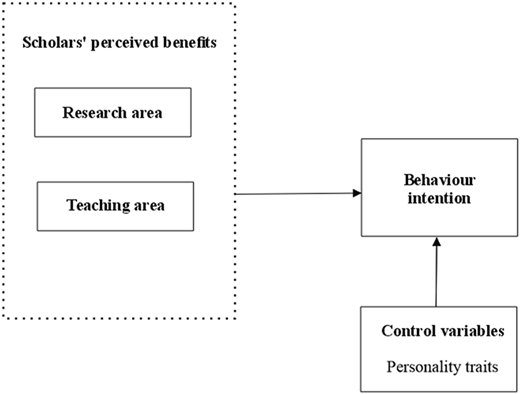
Ultimately, based on our findings, we developed a conceptual framework that takes into account factors important for scholars' intention to use GAI (Figure 4). The proposed framework was created in order to synthesise our research results, as these take into account the perceived benefits for scholars according to the area of academic work. The framework provides an understanding of the fact that scholars' decision to use GAI is not one-dimensional but depends on the professional context and the functional needs of academics. Additionally, the model integrates both personal factors, such as personality traits and socio-demographic features, as well as perceived benefits, thus creating a comprehensive approach to the intention to use GAI in academic work.
6. Implications and concluding remarks
6.1 Implications for theory
Our research expands existing knowledge on scholars' intention to use GAI. Firstly, prior literature indicated that scholars' perceived benefits are key in their intention to use GAI (Andersen et al., 2025; Ivanov et al., 2024; Kim et al., 2025; Baig & Yadegaridehkordi, 2025); however, earlier knowledge omitted the area of academic work. To the best of our knowledge, this is the first study that investigates the importance of perceived benefits for scholars' intention to use GAI, taking into account all the areas of academic work, i.e., research, teaching and administrative tasks. Thus, we extend and perfect existing findings by applying not only a quantitative, but above all multifaceted approach. This enabled us to gain a more detailed and nuanced understanding of the factors influencing scholars' intention to use GAI.
Firstly, we discovered that perceived benefits in both the areas of research and teaching are important for scholars' intention to make use of GAI. However, the results showed that perceived benefits in the administrative area are not important for scholars' intention to use GAI. Our findings allow us to conclude that scholars' intention to use GAI is the result of the potential usefulness of GAI in their main areas of activity, that is, research and teaching, but not administrative tasks.
Secondly, although there are many studies on the importance of control variables for the intention to use GAI, such as age, gender, field of science, academic tenure and personality traits, little is known about their importance in the context of perceived benefits in the fields of research, teaching and administration for scholars' intention to use GAI. For this reason, we took these variables into account in our research, enabling us to provide a holistic view of scholars' intention to use GAI.
Finally, our research contributes to expanding existing knowledge on GAI in the context of academic work by developing and testing a multifaceted model of scholars' intention use GAI. Our research allows us for concluding that perceived benefits in the areas of research and teaching are important in scholars' intention to use GAI. The respondents considered that the benefits of increasing the efficiency of administrative tasks, streamlining decision-making processes or revolutionising traditional academic management methods were not important for reaching for GAI. This discovery emphasises that scholars are more likely to use GAI if they see its potential usefulness in their compulsory professional duties, such as conducting research or preparing and delivering classes. At the same time, our findings confirm the need to understand perceived benefits in a differentiated way, depending on the area of academic activity and not as a generalised category. Thus, the multifaceted model offers a more precise tool for researching the intention to use GAI than one-dimensional approaches.
6.2 Implications for practice
Recognising the importance of perceived benefits for scholars' intention to use GAI has enabled us to provide some understanding and explanation of the reasons for which scholars intend to use GAI. In this context, HEI management should be aware that the decision to use GAI in academic work should belong to scholars, while the HEI should ensure support for those researchers who consider using GAI in their academic work. What is more, the research enables developing and testing of a theoretical multifaceted model of scholars' intention use GAI.
Our research has shown that perceived benefits in the area of research are important for scholars' intention to use GAI. We therefore propose implications for higher education institutions that wish to promote GAI among scholars by indicating specific, scientifically useful benefits of its use as support, for example, for literature reviews, redacting scientific texts, generating research ideas and automating information processing. It is recommended that HEI should consider organising workshops and training for scholars, during which real examples of the use of GAI in scientific activity are presented. Showing practical applications may increase the perceived usefulness and break down barriers among sceptical users. It is also important not to forget about the dark side of GAI in research, such as the risk of violating intellectual property rights, the fabrication of data, excessive reliance on algorithmic recommendations and threats to scientific integrity. For this reason, it is highly important for HEIs to create principles of ethical use of GAI, as well as implement university and research institute policies that specify potential threats and delineate the boundaries of using GAI in research. However, in developing such policies, we encourage HEIs to include and engage the entire research community, both researchers as well as the editorial offices of university scientific journals, scientific associations and the university administrative department. Such an approach based on cooperation will help to develop a joint position that responds to the needs of the academic environment.
Our research shows that perceived benefits in the area of teaching are important for scholars' intention to use GAI. In this respect, HEIs demonstrate greater activity in showing scholars the potential benefits of using GAI in their teaching. It is important to support and encourage scholars to use GAI by showing them what it is and what benefits it can bring to those who decide to make use of it. This can be done through workshops and training in which practical examples are shown of using GAI in teaching. It is also important to implement policies and guidelines on the ethical use of GAI in teaching, covering such areas as transparency with students regarding the use of GAI, and principles for its use in the responsible designing of content. Of equal importance is developing guidelines that provide clear principles for the use of GAI by students in writing their diploma theses. The latter in particular should open up a broad discussion on the form of diploma theses in the context of GAI.
Our research has underlined that perceived benefits in the area of administrative tasks are not important for scholars' intention to use GAI. This means that the possibilities of using GAI to support scholars in performing administrative tasks (e.g., generating reports, organising timetables, handling correspondence) do not have a direct influence on their intention to use GAI. This may be due to the fact that many scholars focus above all on using GAI in areas closely related to their main professional activity, that is, scientific research and teaching, while they consider administrative tasks to be marginal or requiring less technological support. This may lead to the conclusion that HEI management personnel can demonstrate greater activity through workshops and other forms of support in showing scholars the potential benefits of using GAI in performing administrative tasks. It may be useful to show scholars how specific GAI tools can really relieve them of their daily duties.
6.3 Societal implications
The research findings have some social implications. Firstly, over the past few years, we have seen a growing role for GAI in the functioning of HEIs, as well as in the research, teaching and administrative tasks of academics. This means that understanding the factors that influence the intention to use GAI, particularly the perceived benefits in teaching and research, can help universities, policymakers and technology developers develop strategies to support the responsible use of GAI-based solutions in the academic environment.
Secondly, the research highlights potential inequalities in digital readiness and GAI adoption among the academic community. Varying access to technology and digital literacy levels can exacerbate existing gaps between disciplines, generations and institutional types. Therefore, it is essential to develop inclusive policies and training programs that ensure equal opportunities for all researchers and educators to utilise the potential of GAI.
Thirdly, it is undeniable that GAI is becoming an integral element of research and teaching, which necessitates a systemic approach to ethical issues such as transparency, intellectual property and academic integrity. The results of this study can serve as a basis for formulating ethical principles and regulatory frameworks that support the sustainable and responsible use of GAI in academia.
Fourthly, the increasingly frequent and widespread use of GAI by scientists could lead to significant social changes, both within and outside the academic community. Automating some research and teaching tasks could lead to a redefinition of competencies considered crucial in academic work and thus to changes in the employment structure and expectations of academic staff. However, it must be remembered that scholars' use of GAI carries the risk of disseminating unverified information, blurring the line between human and artificial creativity and weakening public trust in scientific research results. Therefore, it is essential to promote responsible use of GAI among scholars, based on the principles of ethics, transparency and social responsibility of science.
6.4 Limitations and future research
Our research has certain limitations that, at the same time, constitute a catalyst for further research into the use of GAI for academic work. Firstly, our research was limited contextually by focusing on HEIs in Poland. It is therefore recommended that further research be conducted to verify our proposed model in other countries. Secondly, another limitation may be related to conducting the measurement of all variables at the same time via a questionnaire with an identical answer scale, which can lead to common method bias. For this reason, we applied Harman's single-factor test to identify potential common method bias. We obtained the result 44.973%, thus not exceeding 50%, which allows us for concluding that common method bias did not occur. Thirdly, we conducted the research using an authored questionnaire, which encourages further research and validation. Nevertheless, researchers are encouraged to use qualitative research to look for other areas of perceived benefits from the perspective of scholars. Fourthly, our research did not take into account a longitudinal perspective, which could have caused us to miss changes in scholars' intentions to use GAI as a result of its intensified use for academic work. However, it should not be forgotten that intention is subject to change (Mohd Amir, Mohd, Saad, Abu Seman, & Tuan Besar, 2020), and it is also susceptible to change, and it may differ depending on various events. It would therefore be interesting to consider longitudinal research projects in future studies. This would enable data to be captured and collected over a longer period of time. Fifthly, similarly to research by Mitręga (2016) and Lenart-Gansiniec, Czakon, and Meyer (2025), in our case, a difficulty that appeared was the lack of a database of scientists with their email addresses.
As a result, it was necessary to create our own database by manually searching university websites. This process was time-consuming and burdensome for the authors and also entailed significant limitations. Although the contact details were obtained from HEI websites, on many occasions, they turned out to be inactive. In such cases, attempts were made to find the correct contact details using an internet search engine; however, this also did not bring the expected results. Due to time limitations, further attempts were not undertaken to contact the universities. As a result, it was not possible to find the contact details for 185 people, as they were neither available on the institution's webpages nor in any publicly available source. Sixthly and finally, we did not take into account mediating and moderating variables in our research. In future research, an additional variable that could be taken into account is how attitude, as the result of a given individual's beliefs, relates to the positive and negative feelings of such an individual towards performing a specific activity. Such findings may enrich the discussion on barriers to adoption.
The supplementary material for this article can be found online