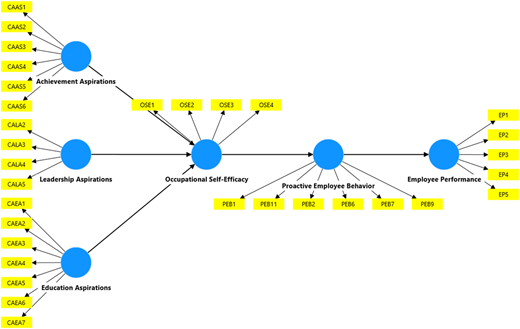
The study's main purpose is to explore Saudi women's career aspirations with various dimensions (achievement, education and leadership) that impact occupational self-efficacy and proactive behavior, which leads to employee/task performance.
The study targets first-line and middle-management Saudi women, who are also studying in Master’s and PhD programs within Saudi universities. Between September and December 2024, self-reported questionnaires were used for data collection in two phases. The questionnaires were distributed in four major Saudi cities (i.e., Jeddah, Medina, Dammam and Riyadh) to obtain a nationally diverse sample. Participants were chosen by snowball sampling. Snowball sampling enabled the researchers to leverage professional and academic networks to recruit participants during a two-phase data collection period, ensuring both geographic and institutional diversity.
The results demonstrated how an employee's career aspirations (i.e., CAA, CLA and CEA) could affect their performance. The outcomes also confirm that ECA (i.e., achievement, leadership and education) affects OSE and PEB. Additionally, the findings show a large and strong direct relationship between OSE and EP, OSE and PEB and PEB and EP.
This research study sought to provide an exponential study. We made this the first attempt to explore career aspirations and their subscales (achievement, education and leadership), showing the variables' reflective and composite impact. Hence, this study provides new insights into theoretical knowledge that has added value to the review literature by exploring various career aspirations subscales in depth. Additionally, this research provides methodological contributions, which showcase a well-defined assessment model using each dimension of career aspirations separately. Thus, this has bridged the gap between theoretical and practical approaches.
Introduction
Saudi Arabia has been actively working to expand its economy over the next decade, with a significant focus on increasing the visibility and participation of women. Historically, the professional opportunities available to Saudi women were largely confined to sectors such as education and healthcare, and workforce participation was relatively limited (Al-Rasheed, 2021). However, since the implementation of Vision (2030), there has been a marked shift in both societal attitudes and labor market dynamics. Increasing numbers of women are enrolling in higher education institutions, participating in the labor force and assuming leadership roles across various industries, reflecting broader changes in societal perceptions regarding women’s capabilities and professional contributions (Asfahani, Eskandarany, & Dahlan, 2025).
Female labor force participation has more than doubled, rising from 17% in 2017 to 36.3% in 2025, thereby exceeding the initial Vision 2030 target of 30%. Concurrently, the unemployment rate among Saudi women has declined to a historic low of 10.5% (General Authority for Statistics, 2025). Women now occupy over 78,000 senior management positions, own or manage nearly half of the nation’s small and medium-sized enterprises and constitute approximately 44% of upper and middle management roles. These figures not only signify increased representation but also highlight women's growing aspirations and achievements in leadership (Ministry of Human Resources and Social Development, 2025). Furthermore, over one-third of Saudi women aged 25 and above possess at least a bachelor's degree, indicating a substantial investment in higher education that equips them for advanced career opportunities (GASTAT, 2024).
Currently, Saudi women are becoming increasingly accomplished and qualified professionals capable of working in previously male-dominated fields and diverse industries (Alharbi, 2024). Recent data from McKinsey & Company indicate that 87% of women in the workplace describe themselves as ambitious, with approximately 48% claiming to be “very” ambitious and actively seeking career advancement opportunities within their respective fields (Blue Rock, 2025). Additionally, 41% of women across organizations are willing to switch employers for enhanced flexible working arrangements and career development opportunities, reflecting the significant emphasis placed on career progression and professional growth (HiBob, 2025). Understanding Saudi women's career aspirations becomes paramount, particularly regarding their pursuit of higher-level leadership positions and subsequent effects on job performance in increasingly competitive organizational environments (Asfahani et al., 2025). Women's employment aspirations have expanded substantially, encompassing comprehensive career trajectories and professional advancement rather than traditional work arrangement considerations (Szczygiel et al., 2024). Career aspirations encompass a sophisticated understanding of women's complicated and dynamic career decision-making processes, including desires for leadership advancement, professional development and organizational influence (Sun, 2023; Hamzah, Musa, & Mohamad, 2022).
Career aspirations is defined “as the desire to achieve specific career milestones including leadership positions, educational advancement, and meaningful professional growth, career aspirations serve as critical motivational forces driving employee behavior and organizational contribution” (Picker-Roesch & Lang, 2024). Occupational self-efficacy (OSE) refers to workers' beliefs in their own capabilities to successfully perform tasks related to their occupational domain, encompassing individuals' confidence in their ability to execute behaviors necessary to produce specific performance attainments in work settings (Hassan Mujtaba & Iram Naz, 2025). Proactive behavior denotes forward-thinking and self-initiating work behaviors through which employees spontaneously adopt actions to change themselves or their organizational environments, demonstrating future-oriented and change-oriented behavioral patterns that benefit both individual and organizational outcomes (Ji, He, Zhu, & He, 2025). Employee performance represents a comprehensive assessment of an individual's capabilities, skills, achievements and behavioral outcomes within the workplace, encompassing the achievement of responsibilities and tasks given to employees as measured by quantity and quality within a specific time range (Menhat, 2025).
Prior studies on Saudi women's career development have concentrated on institutional and personal influences on career choice (Albugamy, 2014), career advancement challenges (Allui & Kamaludin, 2017), career selection factors (Almoaibed, 2020), factors influencing employment decisions (Al-Hendawi, Thurlow, Hammad, & Khair, 2022), career opportunity enhancement (Albahoth, 2018) and advancement barriers (Al-Asfour, Tlaiss, Khan, & Rajasekar, 2017). However, substantial gaps exist regarding facilitative mechanisms linking career aspirations through OSE and PEB to EP. Thus, this study examines how Saudi women's career aspirations – encompassing achievement, education and leadership dimensions – influence employee performance through the sequential mediation of OSE and PEB, providing foundational insight into understanding how career motivation and professional confidence translate into superior workplace performance outcomes.
Theoretical framework and hypothesis
This research is grounded in Social Cognitive Theory (Bandura, 2012) and Social Cognitive Career Theory (Lent, 2025), both of which examine the interplay between self-efficacy beliefs, environmental factors and perceived opportunities (Nickerson, 2025). Social Cognitive Career Theory posits that individuals with higher self-efficacy are more likely to establish ambitious goals and persist in the face of challenges (Lent, 2025). Furthermore, Proactive Motivation Theory and Work Design Theory (Melisa & Rino, 2025) suggest that individuals who are inherently proactive and possess a conducive mindset often exceed their prescribed roles by initiating change and taking independent action. The Triarchy Model of Employee Performance (Pradhan & Jena, 2016) further categorizes performance into task performance, adaptive performance and contextual performance, all of which are influenced by motivation, self-confidence and organizational culture (Al Montaser Mohammad et al., 2025). Synthesizing these perspectives, this study proposes that robust career aspirations – whether oriented toward advancement, leadership or continued education – enhance Saudi women’s self-efficacy, which in turn fosters proactive behavior and leads to improved overall job performance.
Literature review
Career aspirations
Career aspirations are not merely abstract ambitions; rather, they constitute tangible objectives that drive individuals' professional trajectories. These aspirations significantly influence decision-making processes, levels of work engagement and overall job performance (Reddy, Rudraraju, & Chandramouli, 2024). Wang (2025) categorizes career aspirations into distinct types: the pursuit of significant achievements or recognition, the desire for leadership and influence and the commitment to continuous learning and professional development within a specific field. Importantly, the impact of career aspirations extends beyond the individual. Clearly defined career goals foster greater initiative and facilitate the development of stronger workplace relationships, both of which are increasingly vital for organizational success in rapidly evolving environments.
Career aspirations and employee performance (EP)
Career Achievement Aspirations (CAA) refer to the motivation for recognition, financial stability and career advancement within the workplace. This form of ambition is not merely supplementary; rather, it serves as a significant driver that compels employees to increase their efforts and enhance their performance (Sutoni & Sugiyarti, 2025; Wibisono & Mauludin, 2025). Goal setting and OSE are complementary to each other. Goal-setting theory elucidates the mechanisms by which goals influence behavior and how the latter can be moderated by goal characteristics, the importance of the goal, levels of self-efficacy, commitment, task complexity and feedback (Hitka, Lorincova, Rowland, & Lipoldova, 2023). The subscale for achievement aspirations assesses how much women aspire to be recognized in their careers. Furthermore, the career achievement aspiration motive refers to the desire to do well relative to the standard of excellence. Hence, career achievement aspirations strongly impact work/task performance.
The desire to accomplish more sustains intrinsic motivation, prompts individuals to establish more challenging objectives and fosters perseverance even in the face of difficulties (Reddy et al., 2024). This is reflected in the vigour and focus employees’ exhibit in their roles. Empirical research supports these observations, indicating that employees with pronounced achievement aspirations typically set higher personal standards and are often rated as higher performers by supervisors compared to less ambitious peers (Picker-Roesch & Lang, 2024; Wati, Wibawa, Riana, & Surya, 2024).
Career Leadership Aspirations (CLA) manifest differently. Individuals aspiring to leadership roles or managerial positions are more likely to demonstrate initiative and assume additional responsibilities (Gueta & Urbina, 2025). These leadership-oriented goals enhance both engagement and motivation, contributing to overall employee performance (Mohamud, Mohamud, & Mukhtar, 2024). Such individuals are more inclined to mentor colleagues, support team development and drive organizational progress. They also facilitate stronger interpersonal relationships and organizational adaptability during periods of change (Li, Yang, & Akhtar, 2022).
On the other hand, Career Education Aspirations (CEA) centers on continuous learning, whether through skill acquisition, advanced qualifications or participation in formal training. This commitment to professional development enhances performance by fostering adaptability, cognitive agility and the technical expertise required to address both routine responsibilities and significant workplace transformations (Hiri et al., 2023; Erfan & Bakri, 2025). Educational and career aspirations are pertinent factors influencing one's career progression. Educational aspirations are a person's perceptions about his or her prospects of obtaining a particular level of education. Educational aspiration and its prognosticators are always interesting topics among economists, sociologists and psychologists (Abu-Hilal, 2000). Khoo and Ainley (2005) stated that the theory of status attainment continued to be the leading sociological revelation in which career aspiration has been considered a cognitive state that drives young women to pursue upcoming achievements.
Individuals who are driven to pursue continuous learning often report higher levels of job satisfaction and organizational commitment (Hiri et al., 2023; Darmawangsa & Nursyamsi, 2024). Employees with pronounced educational aspirations display greater career flexibility, longer tenure and contribute innovative ideas and solutions derived from training or formal education (Nyathi & Oosthuizen, 2023; Adanzounon, Meddeb, & Ika, 2024). Each category of career aspiration – achievement, leadership and education – plays a distinct yet essential role in enhancing employee performance. Thus, we formulate the below hypotheses which is as follows.
Career achievement aspirations significantly impact employee performance.
Career leadership aspirations significantly impact employee performance
Career education aspirations significantly impact employee performance
Career aspirations and occupational self-efficacy (OSE)
Occupational self-efficacy represents an individual's confidence and conviction in their professional capacity to execute work-related responsibilities within their occupational domain (Atalla, El-Ashry, & Mohamed, 2025). Distinguished from general self-efficacy, it is a domain-specific psychological belief reflecting an employee's competence to organize and implement actions necessary to accomplish occupational task requirements and achieve performance standards (Dautovic, Fredriksson-Larsson, Yang Hansen, & Brink, 2025). It incorporates people's views about their abilities to organize and execute the behaviors needed to achieve specified goals. Mastery experiences, social persuasion, vicarious experiences and physical/emotional arousal help people assess their self-efficacy (Bandura, 1986).
Individuals with pronounced Career Achievement Aspirations (CAA), characterized by a strong desire for professional advancement and recognition, often demonstrate higher levels of OSE. Ambitious career goals serve as a motivating factor, enhancing individuals’ perceptions of their own capabilities and their willingness to engage with complex tasks (Homeo, 2025; Tan, Li, & Yi, 2025). This persistent pursuit of achievement encourages perseverance in the face of challenges and contributes to the development of self-efficacy as individuals accumulate successful experiences (Stavropoulou, Daniilidou, & Nerantzaki, 2025). Empirical evidence supports this relationship, indicating that those driven by achievement in the workplace tend to exhibit greater self-efficacy, which continues to strengthen as they deepen their professional engagement (Peng & Zhang, 2024).
Furthermore, individuals aspiring to leadership roles – referred to as Career Leadership Aspirations (CLA) – experience an even greater enhancement in OSE. The motivation to lead teams, assume managerial responsibilities and influence organizational outcomes reinforces their confidence in managing significant duties and collaborating effectively with others (Notarnicola et al., 2024). These aspiring leaders actively seek professional development opportunities, embrace challenging assignments and pursue experiences that facilitate personal and professional growth, thereby incrementally strengthening their self-efficacy (Mohamad, Hassan, & Rashid, 2025). Notably, when supervisors possess high OSE, it not only supports their own adaptability and leadership effectiveness but also positively influences the collective confidence of their teams (Singh, Varma, Budhwar, & Soral, 2023).
Therefore, leaders with high OSE pay attention and manage difficult situations, allowing them to influence workplace change and achieve organizational goals. Self-assured women in leadership OSEs are more inclined to pursue top leadership positions. Supervisors possessing high OSE create supportive organizational climates, facilitating mastery experiences and constructive feedback delivery (Xu, Chen, Lan, & Zhao, 2025). Leadership aspirations measure women's career leadership aspirations (e.g., “I hope to become a leader in my career field.”). Higher career aspiration leads to greater proactivity in attaining career objectives (Khan & Sherwani, 2019). Consequently, career aspirations measure women's desire for leadership and continuing their education (O'Brien, 1996).
In contrast, some employees focus their objectives on continual learning and educational improvement, which is known as Career Education Aspirations (CEA). These individuals continually obtain higher educational degrees, certifications and fresh expertise, consistently diversifying their knowledge base as well as competencies and boosting their job confidence (Ali, Sethi, Soltani, & Nazar, 2025; Hagedoorn, Reijbroek, Huizinga, Luyten, & Wolfensberger, 2025). As these individuals engage more deeply in learning, their capacity for solving problems and adaptation at work increases, and their confidence in their professional competence strengthens (Liu et al., 2025a). There is a strong correlation between educational achievement and career maturity, with self-efficacy performing a substantial part in this phase of development (Ntarmah, Adu, & Abrokwah, 2025). Employees who continually engage in learning and professional development generally report higher levels of resilience and confidence in the workplace (Martincov, Stakov, Snopek, & Zemnkov, 2025). Based on these findings, the following hypotheses are proposed.
Career achievement aspirations significantly impact occupational self–efficacy.
Career leadership aspirations significantly impact occupational self–efficacy
Career education aspirations significantly impact occupational self–efficacy
Career aspirations and proactive employee behavior
The study refers to career-related drives as career aspirations because they motivate individuals to act in their self-interested behavior. The employees with career aspirations engage networks, develop skills and seek career guidance to prepare for future career-related jobs (Strauss, Griffin, & Parker, 2012). These career-focused behaviors, like skill development and networking, can significantly impact organizational results (Shin & Konrad, 2017). Thus, only self-interested career aspirants benefit from diverse organizations or businesses. Career aspirations increase with (1) organizational knowledge, processes and capabilities and (2) organizational networking and linkages through cognitive, psychosocial and instrumental affiliation. According to the social exchange theory, employees with career aspirations will feel obligated to improve organizational linkages and capabilities. Thereby, workers with initiative are more likely to learn and improve (Baroudi, Khapova, Fleisher, & Jansen, 2018). Consequently, these workers will be better equipped to plan more productive and successful work processes (Shin & Konrad, 2017).
Employees with strong Career Achievement Aspirations (CAA) are those who strive for significant accomplishments at work – are inclined to engage in proactive behaviors independently. Rather than waiting for directions, they actively seek chances to enhance procedures and make changes that benefit the entire organization (Addis, 2025). Such personnel demonstrate high levels of intrinsic desire and initiative, continually seeking opportunities to exceed expectations (Liu, Guo, Zhou, Ma, & Zeng, 2025b). They are willing to take on new duties, directly confront organizational difficulties and put in extra work that not only benefits their individual development but also adds to organizational progress (Astuti & Suryani, 2025).
In terms of Career Leadership Aspirations (CLA), these ambitions motivate employees to take charge of organizational change initiatives and enhance team performance (Kong, Liu, Ding, Liu, & Yu, 2024). Individuals with leadership aspirations often demonstrate pronounced initiative, leading development discussions and mentoring colleagues (Yang, 2025). Organizations that foster career development opportunities observe even greater proactive behavior, as employees thrive, take on challenges and make substantial contributions that strengthen organizational competitiveness (Ji et al., 2025).
Career Educational Aspirations (CEA) have a major impact on proactive behaviors at work. Employees who pursue advanced certificates or degrees are always learning, actively seeking new information, sharpening abilities and sharing expertise with teammates (Fu, Zhang, Zhou, & Wang, 2024; Lan, Hu, & Nie, 2025). These educational aims encourage strategic planning, collaboration and self-directed growth in employment. Finally, this commitment to learning ultimately results in ongoing proactive actions that shape both individual development paths and the organization's ability for innovation (Ugoani, 2025). In light of the aforesaid, the following hypotheses are articulated.
Career achievement aspirations have a significant impact on their proactive employee behavior
Career leadership aspirations have a significant impact on their proactive employee behavior
Career education aspirations have a significant impact on their proactive employee behavior
Occupational self-efficacy (OSE) and proactive employee behavior (PEB)
PEB and OSE are attitudes, orientations and personality traits that guide career aspirations. OSE is a person's belief that they can handle their job's challenges, achieve their career aspirations and succeed in life. Employees who believe in the OSE will believe in their ability to meet challenging goals and overcome difficult tasks. Even if the employee has past expertise in the field or could be better in some areas, a strong OSE would encourage them to persevere despite obstacles and meet expectations until results are achieved. It is also suggested by (Breso, Schaufeli, & Salanova, 2010) that high OSE employees are driven by their belief in career success. High-OSE employees work hard to produce high-quality outputs that are recognized as a result of their efforts. They view job and organizational demands as opportunities to grow and improve their skills and abilities. Thus, we framed the following hypothesis.
Occupational self-efficacy has a strong and positive impact on proactive employee behavior.
Occupational self-efficacy (OSE) and employee performance (EP)
Occupational self-efficacy positively influences employee performance by enhancing task execution, skill development, work engagement and organizational attitudes (Cetin & Askun, 2019; Buric & Moe, 2020). OSE is strongly correlated with both task and contextual performance, indicating that higher self-efficacy leads to improved overall employee performance outcomes (Sampath Kappagoda, 2018).
Based on the literature, we developed the following hypothesis.
Occupational self-efficacy has a direct and significant impact on employee performance.
Career aspirations, occupational self-efficacy (OSE) and proactive employee behavior (PEB)
Individuals with strong Career Achievement Aspirations (CAA) are distinguished by their proactive behavior in the workplace rather than a passive attitude. Their innate determination to succeed leads to increased confidence in their ability to handle complex tasks, which encourages them to take on autonomous roles such as finding solutions to problems or collaborating without being pestered (McCormick, Tanguma, & Lpez-Forment, 2019; Lisá, 2020). This relationship is mediated by OSE, which converts aspirational purpose into actionable steps. Individuals who are confident in their professional competencies are more likely to set ambitious goals and actively pursue and achieve these goals in the workplace (Akmal, Hood, Duffy, & Creed, 2024).
Similarly, Career Leadership Aspirations (CLA) promote a sense of self-efficacy among personnel aspiring to leadership positions. Employees aiming for leadership roles build up a sense of self-efficacy – they believe they can tackle complicated workplace issues, and this assurance is manifested in their strategic problem-solving and their willingness to take initiative (Qiang, Xiaohong, & Qianru, 2023). When organizations encourage paradoxical leadership, balancing control with freedom, employees feel seen and capable. This kind of environment boosts their self-efficacy even more, pushing them to go beyond the usual and contribute to the team and the whole organization (Deci, Koestner, & Ryan, 2017).
Career Education Aspirations (CEA) make a substantial contribution to proactive workplace behavior. Employees who are motivated to increase their education or training constantly improve their skill sets, which boosts their job confidence (Liu et al., 2025b). As their competencies grow, they actively seek out new knowledge, build professional networks and share acquired experience, all of which help organizations adapt and gain an edge over their competitors (Ma et al., 2025). Once again, OSE serves as a critical mechanism; when employees are confident in their expertise, they are more likely to champion change, support innovation and advance organizational growth (Mehner, Kauffeld, Knzel, & Eisenhauer, 2025). Thus, the following hypotheses are proposed.
The relationship between career achievement aspirations and proactive employee behavior is mediated by occupational self-efficacy.
The relationship between career leadership aspirations and proactive employee behavior is mediated by occupational self-efficacy.
The relationship between career education aspirations and proactive employee behavior is mediated by occupational self-efficacy.
Proactive employee behavior and employee performance
Proactive employee behavior is radical and forward-thinking, seeking to lead and innovate. It includes career planning, networking, guidance and skill acquisition (Smale et al., 2019). Proactive behavior guides employees’ problem-solving, persistence and ability to achieve desired results (Zhou, Zhong, & Zhang, 2024). In this context, Zhang, Fang, Luan, Chen, and Peng (2022) found that proactive behavior improves task performance. According to research, proactive professional behavior is essential for career success and development (Peng, Song, & Yu, 2021). Proactive behavior improves task performance and creativity (Zhang et al., 2022). Task performance and career success have been linked to proactivity's positive effects. Therefore, we hypothesized the following:
Proactive employee behavior has a significant impact on employee performance.
Occupational Self–Efficacy (OSE), proactive employee behavior (PEB) and employee performance (EP)
Occupational self-efficacy is a person's confidence in their job, not a personality trait or work capacity. Felfe and Schyns (2006) defined OSE as the belief that one can perform work-related tasks. Bandura and Locke (2003) found that OSE affects work performance, and it significantly impacts workplace motivation and performance, which impacts an individual's performance. Research shows two aspects of OSE. First, it is about occupational contents or a person's confidence in their ability to do their job (e.g., the education needed by an occupation, the concrete occupational task). Second, it is linked to the occupational behavior process or a person's confidence in career decision-making, job-seeking and behavioral goals (Myszka-Strychalska (2020) stated that professional development has extensively studied proactive personality, PEB and OSE. This field's research shows that they can predict an individual's success in various areas, including career success. Faith in one's ability to achieve goals boosts teamwork, academic performance and professional adaptability (Shang, Zhang, & Wang, 2022). Thus, the following hypothesis is formulated as.
The relationship between occupational self–efficacy and employee performance is mediated by proactive employee behavior.
Career aspirations, occupational self-efficacy (OSE), proactive employee behavior (PEB) and employee performance (EP)
Career aspirations and employee performance connect through OSE and PEB. When employees are motivated by career achievement aspirations (CAA) they tend to deliver high performance. Their intrinsic motivation boosts self-confidence, encouraging individuals to take action and become better at their jobs (Khan, Quan, Abbas, Jian-ya, & Gul, 2025). This process occurs in a step-by-step manner: aspiration boosts confidence, which leads to proactive action, and these behaviors, when combined, improve performance (Nusraningrum, Rahmawati, Wider, Jiang, & Udang, 2024).
A parallel trajectory is observed among individuals with CLA, wherein aspiration for leadership is first translated into self-efficacy, subsequently encouraging risk-taking, innovation and the assumption of new responsibilities (Samo, Bughio, Ahmed, Shah, & Ahmed, 2024). This serial pathway reveals that OSE transformation enables leadership-aspirant employees to translate supervisory ambitions into discretionary proactive contributions, substantially enhancing employee performance and organizational capability (Liu et al., 2025a).
Career Education Aspirations (CEA) works similarly to improve performance. Employees that are committed to continual learning boost their self-efficacy, encouraging them to seek out new information and test improved work techniques. As a result, companies can better adapt and innovate (Shao & Kang, 2022; Hoedemakers, Vanderstukken, Stoffers, & Van der Heijden, 2025).
Career aspirations, whether oriented toward achievement, leadership or education, improve employee performance in a systematic progression: ambition fosters self-efficacy, self-efficacy motivates proactive behaviors, and these behaviors turn aspirations into achievable, productive results for employees as well as organizations. (see Figure 1 for the theoretical model). Hypotheses based on the literature review are as follows.
The relationship between career achievement aspirations and employee performance is serially mediated by occupational self-efficacy and proactive employee behavior.
The relationship between career leadership aspirations and employee performance is serially mediated by occupational self-efficacy and proactive employee behavior.
The relationship between career education aspirations and employee performance is serially mediated by occupational self-efficacy and proactive employee behavior.
Methodology
Measurement
Translated and updated Korean career aspiration scale (K-CASR) was used to gauge employee career aspirations. It is divided into three subscales: leadership, educational and achievement aspirations (Kim, O'Brien, & Kim, 2016). On a scale from 1 (not at all true of me) to 5 (very true of me), participants expressed their level of agreement with each of the 18 statements.
The achievement aspiration subscale, which consists of six items, gauges how much women aspire to notable accomplishments and acclaim in their careers (e.g., “I want to be among the very best in my field”). The 4-item (of 5) leadership aspiration subscale gauges how much women want to have a leadership role in their work (e.g., “I plan to rise to the top leadership position of my organization or business”). The seven-item educational aspirations subscale (e.g., “I will attend conferences annually to advance my knowledge”) gauges how much women aspire to further their education and train for careers.
To assess the construct of OSE, we used the 4-item scale (out of 6) adopted from the study of (Rigotti, Schyns, & Mohr, 2008). This scale measured the degree to which women believe they can fulfill their work-related tasks and activities (e.g., “I feel prepared for most of the demands in my job”). These items have good reliability (a = above 0.7) and validity (AVE = above 0.50).
PEB was measured using the 6-item scale (of 12) taken from the study of Seibert, Kraimer, and Crant (2001). These six items have good reliability (a = above 0.7) and validity (AVE = above 0.5). The scale's items assessed how likely it was for women to identify prospective issues or opportunities at work and act to improve those conditions in the future (e.g., “If I see something I do not like, I fix it”).
Employee performance was measured using a 5-item scale from the study of Koopmans et al. (2013). This scale evaluated how well women could carry out their job-related tasks (e.g., “I managed to plan my work so that it was done on time”). The participants indicated their degree of agreement with the items of OSE, PEB and EP on a scale from 1 (strongly disagree) to 5 (strongly agree).
Sample and procedure
The study targets first-line and middle-management Saudi women, who are also studying in Masters and PhD programs within Saudi universities. Between September and December 2024, self-reported questionnaires were used for data collection in two phases. The questionnaires were distributed in four major Saudi cities (i.e., Jeddah, Medina, Dammam and Riyadh) to obtain a nationally diverse sample. Participants were chosen by snowball sampling. This sampling technique was employed due to the specificity and accessibility challenges of the target population. Because no comprehensive sampling frame exists for this group, probability-based methods were impractical. Snowball sampling enabled the researchers to leverage professional and academic networks to recruit participants during a two-phase data collection period, ensuring both geographic and institutional diversity.
After interviewing five experts and pilot testing with 30 female employees, some questionnaire items were rephrased. The sample's characteristics necessitated administering the questionnaire in Arabic (i.e., citizens of four major Saudi cities). Thereby, Arabic-fluent academics translated each statement from English. Back translation ensured that each questionnaire item was understood. Researchers asked colleagues and friends to distribute the survey. Participants were informed of the questionnaire's purpose after consenting. In both phases, participants had two days to complete the questionnaires thoughtfully.
In the first phase of data collection, 400 questionnaires were distributed. This phase included 308 demographic, career aspiration and OSE survey responses. Three months later, 264 Phase 1 participants completed the second phase of data collection and reporting on proactive employee behavior and performance. In the second data collection phase, some respondents quit or still need to finish the questionnaire. This methodological choice is consistent with best practice guidelines in the organizational psychology field (Podsakoff, MacKenzie, Lee, & Podsakoff, 2003). It supports the validity of mediation analysis by ensuring that predictors and criteria were not measured simultaneously.
To ensure data quality, a systematic cleaning procedure was conducted prior to analysis. First, incomplete and unmatched responses from the two waves of data collection were removed. Second, responses with signs of patterned or careless responding (e.g., straight-lining across items) were eliminated. Third, statistical outliers were identified using Cook's Distance and Leverage values, as recommended for regression-based and SEM analyses. Following Hair, Howard, and Nitzl (2020), influence values greater than the threshold of p < 0.001 were deemed extreme and thus removed to prevent distorting parameter estimates and model fit. After these steps, 233 valid responses were retained, offering a strong dataset for empirical testing. Each participant who completed both phases of questionnaires received 50 SAR shopping vouchers, equivalent to about 13.33 US dollars. They had an average age of 29.37 years (SD 6.71) and 6.21 years of experience (SD 5.87). Nearly 70% of participants are studying in a postgraduate or higher programs and working in the healthcare, education and hospitality sectors.
Data analysis
In this study, to test the theory and path analysis, the appropriate tool, partial least squares-structural equation modeling (PLS-SEM), was utilized. PLS-SEM with numerous latent variables can address some of the measurement flaws common in social sciences research (Rasoolimanesh, Wang, Roldan, & Kunasekaran, 2021).
Results
Outliers and common method variance
The data came from a single source; to minimize common method variance, procedural and statistical corrections were used (Podsakoff & Organ, 1986). First, participants were assured that their identities would be kept confidential to reduce social desirability bias. Second, the measurements of the variables were distributed at random. Third, Harman's single-factor test was used, and the results showed that only 28.173% of the total variance of 68.854% could attribute to a single factor. This result is less than 50%, demonstrating no common method variance in the data (Podsakoff & Organ, 1986). As Lynch (2013) suggested, outliers with a significance level greater than 0.001 were found and eliminated. Table 1 shows the variables’ mean, standard deviation and bivariate Pearson correlation.
Measurement model assessment
The validity and reliability of the reflective constructs were first ensured (OSE, PEB and EP). This was expanded to incorporate the three reflective employee career aspirations (ECA) dimensions of achievement (CAA), educational (CEA) and leadership (CLA). Employee career aspirations (ECA) were constructed as a second-order composite construct based on the score of its connected dimensions, with the relevant criteria utilized to assess ECA as a composite second-order construct for the data (Kim et al., 2016). Researchers used the formula proposed by Dijkstra and Henseler (2015) to measure the reliability and validity of the reflective constructs. According to Dijkstra and Henseler (2015), all items should have a factor loading of no less than 0.60, composite reliability greater than 0.70 and average variance extracted greater than 0.50. One item for CLA, two for OSE and six for PEB were excluded due to low factor loadings (less than 0.60), as suggested by Hair et al. (2020).
All reflective constructs had acceptable loadings between 0.626 and 0.814 (Dijkstra & Henseler, 2015; Hair et al., 2020). The CR values for all reflective constructs met the satisfactory criteria as for CAA, it was 0.840; for CLA, it was 0.879; for CEA, it was 0.862; for OSE, it was 0.823; for PEB, it was 0.860, and for EP, it was 0.833. The values for AVE range from 0.525 to 0.617, representing acceptable values for convergent validity. The values of VIF (Variance inflation factor) for all the items are less than 1.8, showing no multicollinearity (see Table 2). Three criteria were used to evaluate the measurement model for the composite construct (Career aspiration). First, multicollinearity through VIFs (Variance Inflation Factors), the values are less than 2, so they are acceptable (Hair et al., 2020). Second, the outer weights of the associated items with the composite construct should be significant (Rasoolimanesh & Ali, 2018). The bias-corrected confidence interval (BCCI) approach (0.95) was used to establish the significance of all outer weights. Third, the nomological validity of the composite construct was assessed (Rasoolimanesh & Ali, 2018) (see Table 2). Fornell-Larcker criterion and heterotrait-monotrait (HTMT) techniques were used to assess discriminant validity. Results for discriminant validity were acceptable for both approaches. The value of the square root of the AVE of each construct should be greater than its correlation with other constructs (Fornell & Larcker, 1981). The accepted HTMT values for the Heterotrait-Monotrait (HTMT) approach can be lower than 0.85. (Henseler, Ringle, & Sarstedt, 2015).
Following Hair et al. (2020) recommendations, various criteria were used to explain and predict the variation in the endogenous variables caused by the exogenous factors. It comprises Q2 (Greater than 0.00), NFI (Greater than 0.90) and the SRMR score (less than 0.08). The endogenous variables have good Q2 values for OSE (Q2 = 0.439, Q2 effect = Large), PEB (Q2 = 0.151, Q2 effect = moderate) and EP (Q2 = 0.506, Q2 effect = large), demonstrating that the study model accurately captures the empirical data and has a good predictive capacity (Henseler et al., 2015). The SRMR value (0.071) and NFI value (0.997) further validated the good model fit.
Hypothesis testing
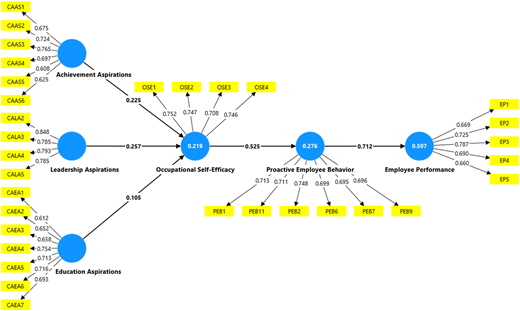
The findings of the hypothesis assessment are shown in Figure 2 and Table 3. The results demonstrated how an employee's career aspirations (i.e., CAA, CLA and CEA) could affect their performance (H1a, H1b and H1c). The outcomes also confirm that ECA (i.e., achievement, leadership and education) affects OSE and PEB (H2a, H2b, H2c, H3a, H3b and H3c). Additionally, the findings show a large and strong direct relationship between OSE and EP (H5), OSE and PEB (H4) and PEB and EP (H7).
By assessing the significance of indirect effects using BCCI, the product coefficient approach (Indirect effect) was utilized to estimate the potential mediation impact (Hayes & Scharkow, 2013; Rasoolimanesh et al., 2021). Results of Table 3 supported the indirect but significant effects of CAA, CLA and CEA on PEB via OSE (H6a, H6b and H6c), along with the indirect and significant effects of OSE on EP via PEB (H8). Finally, the findings in Table 3 confirm that career aspirations have a significant and indirect effect on EP conveyed through both mediators (i.e., OSE and PEB) in a series (H9a, H9b and H9c).
Discussion
The findings of the study investigate how among Saudi women's career aspirations dimensions (i.e., achievement, leadership and education) form OSE, PEB and consequently employee performance. Moreover, the findings demonstrate a pattern of structured behavioral and psychological relationships (i.e., OSE and PEB) that is directly and indirectly influenced by career aspirations and can predict employee performance. The nature and magnitude of the influence are significantly different across different forms of career aspirations.
The results for the first hypotheses (H1a, b, c), demonstrates that all three forms of career aspirations have a significant and positive impact on EP. These results align with the studies of Reddy et al. (2024) and Wang (2025), illustrating that career aspirations drive higher employee engagement, persistence and goal-oriented behavior. Among career aspirations, ELA had the strongest (β = 0.097), and CEA demonstrated the weakest influence on performance (β = 0.044). These ranking highlights that employees having leadership aspirations endorse behaviors that involve taking initiatives, ownership of decisions and team outcome’s responsibility, consequently, it translates into higher EP. Studies conducted by Gueta and Urbina (2025) and Mohamud et al. (2024) also indicated these patterns in their studies, signifying that employees aspiring for leadership orientation illustrate higher engagement and assume regularly extra-role responsibilities. Consistent with goal-setting theory, employee performance is also positively influenced by achievement aspirations. It explains that employees who have higher self-imposed performance standards, exert more effort and determination, resulting in higher performance (Hitka et al., 2023). Whereas, in comparison with CLA and CAA, education aspirations have a relatively weaker influence on EP. This strength illustrates that the aspirations based on long-term learning and development capabilities influence employee performance gradually (Erfan & Bakri, 2025).
The results of the second hypotheses (H2a, b, c) reveal the influence of career aspirations (i.e., CLA, CAA and CEA) on OSE. The findings demonstrate the significance of self-efficacy in transforming career aspirations into employee work behaviors. In predicting OSE, leadership aspiration (β = 0.257) was again the strongest predictor as compared to achievement aspirations (β = 0.225) and educational aspirations (β = 0.105). The results showed theoretical alignment with the Social Cognitive Career Theory. The theory hypothesizes that aspiring and ambitious career goals (i.e., Leadership aspirations) are attached to a strong sense of confidence and capability (Lent, 2025). The findings also align with the study of Jach (2023) by illustrating that women with leadership career aspirations should trust their capabilities to direct organizational dynamics, conduct difficult and complex task and coordinate various teams, consequently resulting in uplifting their OSE. The study findings also reveal a significant influence of achievement aspirations on OSE. The findings are supported by Stavropoulou et al. (2025) and Peng and Zhang (2024), that suggested that through proficient experiences and recognition-driven goals raises employee's confidence level regarding their task competence. Educational aspirations, as compared to CLA and CAA have a weaker influence on OSE. This aligns with the perception that ECA supports the OSE overtime by acquiring various learning experiences, then enhancing the confidence readily (Ali et al., 2025; Liu et al., 2025b).
The findings of the study significantly confirm hypotheses (H3a, b, c), that illustrates that career aspirations (i.e., CAA, CLA and CEA) can influence PEB in Saudi women. The findings demonstrate that leadership aspirations (β = 0.135) among other CAs (i.e., CAA and CEA) have the strongest impact on PEB, recommending that Saudi women who have leadership ambitions are relatively inclined toward not only initiating change and predicting workplace challenges, but moreover, they also engage in activities that support organizational performance (Yang, 2025). The findings of the study also align with Kong et al. (2024), revealing that employees having leadership orientation will demonstrate more future-oriented behavior (i.e., PEB). The results of the study also reveal that achievement aspirations (β = 0.122) also promote the proactive capabilities of employees that reflect the motivational role of aspirations and goal-oriented behavior (Liu et al., 2025a). These employees show a higher level of internal aspirations and creativity that would support them in seeking better opportunities (Addis, 2025). Moreover, educational aspiration (β = 0.061) revealed the weakest impact but they significantly contribute in enhancing proactive employee engagement through learning focused activities. The employee learning commitment can enhance their proactive behaviors, resulting in transforming not only their individual development activities but also enhancing the organizational innovative ability (Ugoani, 2025). The findings of the third hypothesis confirm that these dimensions of career aspirations can be a meaningful tool in enhancing employee proactivity.
The findings for Hypothesis 4 reveal that OSE significantly influences PEB (β = 0.525). Akmal et al. (2024) and McCormick et al. (2019) explained OSE as an individual psychological resource that can positively influence their workplace actions (i.e., initiatives, determination and creativity). Employees with higher OSE, can anticipate challenges, independently resolve complex issues and take the responsibility and ownership of work-related decisions (i.e., core proactive behaviors) (Bandura, 1986). The theoretical and empirical evidence confirms that among Saudi women, OSE is a significant antecedent of PEB.
The results of Hypothesis 5 illustrate that OSE has a significant and positive influence on EP (β = 0.377). The results are consistent with the study of Zwane (2025), which showed that higher-levels of OSE can lead to improved employee performance. McCormick et al. (2019) also emphasized that employees with higher levels of OSE demonstrate higher task engagement, determination and capabilities to resolve challenging problems, consequently resulting in enhancing EP. Based on the theoretical evidence provided by Bandura (1986), Zwane (2025) and McCormick et al. (2019), and the empirical results of this study, it confirms that OSE strengthen an employee's self-belief to meet not only the job requirements but also the desired results. This results in improving the job quantity, quality and consistency.
The findings of Hypotheses 6 (H6a, b, c) represent the mediating role of OSE on the relationship between career aspirations and PEB. The results demonstrate that the mediating role of OSE has a strongest for leadership aspirations (β = 0.135) among career aspirations dimensions. The reveals that women with leadership ambitions have higher confidence in their occupational abilities, resulting in enhancing their proactive behaviors. Gueta and Urbina (2025) and Iqbal, Nazir, and Ahmad (2022) in their studies illustrate that leadership-driven employees rely mostly on their self-efficacy beliefs to bring change, anticipate challenges and their solutions, and also exercise influence within their position. Similarly, OSE mediates the relationship between achievement aspirations and PEB (β = 0.122). The findings are consistent with the studies of Reddy et al. (2024) and Notarnicola et al. (2024), which state that aspirations and performance-based goals reinforce employee self-belief and improve their initiatives and problem-solving abilities. These employees utilize OSE to transform their goals into proactive behaviors. Moreover, OSE also had a weak but significant influence on the relationship between educational aspirations (β = 0.061) and PEB. Zhou et al. (2024) illustrated in their study that employee's learning-oriented aspirations can gradually increase their self-efficacy that can lead to a gradual increase in proactive behavior. These educational aspirations trigger capability development in employees and encourage them to portray improvement-driven behaviors (i.e., PEB).
The findings of the study provide substantial validation that PEB (β = 0.712) significantly improves EP (H7). Zhou et al. (2024) emphasized that proactive employees are involved in anticipatory activities, resolve problems and drive for continuous improvement, resulting in enhancing their performance levels. Moreover, proactive employees show behaviors (e.g., flexibility, initiative-taking, adaptability and role expansion) that are strongly related with exceptional performance (Iqbal et al., 2022; Gueta & Urbina, 2025). Thus, the findings of the study confirm that PEB is an effective behavioral mechanism that improves employee capabilities to exceed employee's performance expectations.
The findings of the study also provide evidence that PEB (β = 0.377) mediates between the relationship of OSE and EP (H8). The results affirm the previous studies that highlight the employee's behavioral mechanism that transforms self-efficacy beliefs into employee outcomes (i.e., EP) (Zhang et al., 2022; Dautovic et al., 2025). Individuals having higher levels of OSE are confident in dealing with workplace requirements, resulting in initiating proactive activities, pursue for better extra-role opportunities and resolving issues independently. These empirical evidences are consistent with the theoretical evidences provided by Shang et al. (2022) that OSE enhances goal-directed and adaptive behaviors, whereas PEB directly influence employee's task and contextual performance (Zhang et al., 2022). Thus, the findings confirm that PEB works as a significant pathway through which employees having higher levels of self-efficacy can deliver exceptional performance outcomes.
The findings of serial mediation illustrate that all three dimensions of career aspirations (i.e., CLA, CAA and CEA) impact EP through the serial mediation of OSE and PEB (H9a, b, c). For CAA, the sequential indirect influence (β = 0.088) shows that employees driven by achievement, their self-belief is strengthened, and they engage in proactive work activities that improve their performance levels. This is aligned with the prior studies that aspirations can develop self-efficacy and proactive behaviors (Nusraningrum et al., 2024; Khan et al., 2025). For serial mediation hypotheses, the CLA has the strongest effect (β = 0.097). This affirms the studies of Liu et al. (2025b) and Samo et al. (2024), illustrating that employees having leadership orientation can transform their leadership position aspirations to exceptional self-beliefs, resulting in taking higher risks and challenges, consequently improving performance. Lastly, CEA shows a positive sequential influence on EP through OSE and PEB (β = 0.044). This demonstrates that individual aspirations for continuous learning can enhance OSE, resulting in endorsing employees to seek knowledge and initiative-taking behaviors that support performance (Shao & Kang, 2022; Hoedemakers et al., 2025). Empirically, these findings confirm that aspirations can strengthen self-efficacy, resulting in stimulating PEB that transforms into enhancing performance outcomes.
The comparative power of impact systematically differentiates across the structural model when analyzed through standardized path coefficients. For EP, PEB demonstrates the strongest direct influence (β = 0.712), followed by OSE (β = 0.377). Moreover, the direct impact of dimensions of career aspiration is relatively weak (CLA: β = 0.097; CAA: β = 0.088; CEA: β = 0.044). Whereas, PEB directly explained OSE as the dominant predictor (β = 0.525), which significantly enhances the influence of dimensions of career aspirations. Also, for OSE, CLA employs the strongest influence (β = 0.257), followed by CAA (β = 0.225) and CEA (β = 0.105). Importantly, although career aspirations have modest direct effects on EP, their influence strengthens through indirect and serial pathways via OSE and PEB, with CLA showing the largest total indirect effect. This pattern indicates that influence intensifies as variables become more proximal to the performance outcome.
Theoretical implications
The present discussion offers substantive contributions to our understanding of gender, employment and career development, particularly within contexts that diverge from Western paradigms. Central to these contributions are the constructs of OSE and PEB. The findings indicate that educational attainment, career ambition and leadership aspirations are significant determinants of OSE. Enhanced self-efficacy, in turn, fosters greater proactive engagement in the workplace, facilitating career advancement. This aligns with the principles of Bandura's social cognitive theory (Bandura, 2012), while extending its applicability to non-Western contexts, such as Saudi Arabia.
Furthermore, the integration of Islamic Feminism as a theoretical framework represents a pivotal advancement. This perspective challenges the assumption that gender equality must mirror Western experiences, emphasizing instead the importance of contextualizing empowerment within local religious and cultural paradigms. Scholars are thus encouraged to examine the intersections of gender, faith and power through contextually relevant lenses, rather than relying on generalized theories that may not adequately capture the lived realities of women outside the West. This approach paves the way for the development of more nuanced and locally resonant theoretical models.
The study also highlights a significant gap in current scholarship – the limited attention given to the implications of labor market exclusion on career aspirations, particularly among educated women facing barriers to employment. There is a pressing need for theoretical frameworks that conceptualize career aspiration as dynamic and responsive to both macro-level factors, such as labor market policies and individual variables, including self-efficacy and agency. Future research should explore the ways in which societal structures either constrain or facilitate career progression, especially in rapidly transforming environments.
Additionally, the findings underscore the critical role of agency. Proactive behaviors are identified as essential drivers of upward mobility, especially in settings where women are newly entering the workforce. Key questions arise regarding the cultivation, maintenance and expression of agency across diverse cultural and sectoral contexts, as well as the ways in which these processes interact with broader systems of power and authority.
Collectively, these theoretical implications extend beyond existing discourse by advocating for greater cultural sensitivity and recognition of the complexities inherent to women's career trajectories globally.
Practical implications
Organizations in Saudi Arabia, especially in banking, higher education, healthcare and hospitality, can benefit from actively cultivating OSE and PEB among female employees. Leadership development programs, mentorship and skill-building initiatives should be prioritized to empower women and enhance their proactive behaviors. Policymakers should consider emulating successful institutional mechanisms from Europe and North America, such as flexible work policies, formal mentorship programs and career development services, to support sustained labor market engagement and career advancement for women. The findings suggest that addressing workplace precarity requires both institutional reforms (e.g., anti-discrimination laws, childcare and transport access) and cultural shifts. Organizations must foster inclusive environments that challenge patriarchal norms and support women's agency. Targeted interventions are needed to address the preference for public sector employment and limited career readiness among Saudi women. Career counseling, exposure to private sector opportunities and practical training can bridge this gap.
Societal implications
This emphasizes that sustainable progress in women's workforce participation requires a transformation not only in laws and policies but also in societal attitudes and cultural norms. This involves a collective effort to challenge patriarchal structures and promote gender equity at all levels of society. The adoption of culturally sensitive frameworks like Islamic Feminism can empower women to actively reshape societal structures, fostering greater equity and inclusivity. This approach can help bridge the gap between institutional reforms and social change. The rise in female labor force participation and leadership aspirations contributes to broader societal development goals, including economic diversification and social modernization, as envisioned in the Saudi Vision (2030). Enhanced female agency and career advancement can lead to more dynamic, innovative and resilient communities. Addressing persistent disparities in political empowerment and senior leadership representation remains critical for achieving comprehensive gender parity. Societal support for women's participation in all spheres – including politics and senior management – will be essential for long-term progress.
Limitation and future directions
Despite its merits, the present study is not without limitations. To begin with, the use of snowball sampling, although suitable for accessing Saudi women managers who are pursuing postgraduate studies simultaneously, risks introducing selection bias and reducing the representativeness of the results. As such, the findings should be treated as context-specific conclusions rather than universally applicable generalizations. Future research may use probability-based sampling methods to increase representativeness.
Second, dependence on self-report questionnaires risks social desirability and common method biases. While procedural (e.g., anonymity guarantees, temporal separation of measures) and statistical solutions (e.g., Harman's test) were employed, future studies may consider incorporating objective performance data, supervisor ratings or qualitative approaches to triangulate the results.
Third, the study employed Kim's Career Aspiration Scale, originally developed in a different cultural background. Although translation, back-translation and pilot testing were used to increase validity, the nuances of culture may still influence responses. Extending validation activities to include diverse Saudi populations would enhance their strength.
Lastly, the sample primarily consisted of young, well-educated women from four major cities, which may not be representative of the experiences of women in rural areas, other industries or at different career stages. Future studies are encouraged to have broader demographic and geographic scope, as well as multi-wave longitudinal designs, to shed more light on the temporal dynamics of career aspirations, self-efficacy and proactive behavior.
Conclusion
This study contributes to the understanding of Saudi women's career aspirations by examining the interrelatedness of achievement, education and leadership aspirations, as well as their impact on EP through OSE and PEB, which serve as mediating variables. The findings show that career aspirations are not only critical predictors of individual performance but also crucial enablers of psychological and behavioral mechanisms underlying career advancement. Theoretically, the study broadens Social Cognitive Career Theory in a non-Western context, while practically, it highlights the significance of organizational and policy interventions in promoting women's aspirations, thereby supporting both institutional effectiveness and national development goals. Policymakers and organizations should therefore introduce targeted programs that promote women's involvement and advancement, thereby accelerating progress toward Vision 2030's goals of economic diversification and sustainable development.