The article examines the process of value creation in projects to address the following questions: How can we better understand value creation in projects? How is value created in projects? The main topic of sustainable value management is currently the subject of extensive scientific research, covering a wide range of aspects, from terminological issues to the impact of sustainability factors on company development. To date, researchers have explored value creation in projects to a limited extent. This article explores research on value creation in projects.
We used a Delphi method in the form of expert interviews with specialists in relevant fields. The interviews drew on the professional knowledge of experts and their experience related to a specific domain.
The findings focus on how organizations create value and identify key assets and activities involved in value creation. To maximize the benefits, this study developed a conceptual framework that outlines the assets, activities, and approaches to managing projects.
The article is conceptual in nature. A review of the relevant literature examines trends in the interpretation of value creation within the context of project management.
Introduction
Due to technological developments in the new digital economy, the internet continues to open new spaces for creating value (Lumpkin & Dess, 2004, pp. 161–173). Value creations that use digital technology can easily and quickly enhance the digital capabilities of organizations (Lumpkin & Dess, 2004, p. 33). A research approach enabling scholars to understand the modern world is sustainability. It is based on the following assumptions: First, the value proposition must provide both ecological or social, and economic value through its products and services (Boons & Lüdeke-Freund, 2013, pp. 9–19). Second, the methods for creating, delivering, and capturing this value must also maintain or regenerate natural, social, and economic capital beyond the organization's boundaries (Schaltegger, Hansen, & Lüdeke-Freund, 2015). Projects focus on the assumption that they should meet conditions adequate to social (norms, values), economic (profit, finance, and labor rules), and ecological (nature, environment) behavior. Certain organizations have adopted the TBL rules to evaluate their social, economic, and ecological performance (Elkington, 1997) with a view to creating value. Aspects under evaluation may include ecologically friendly products, activities with a positive impact on society, or innovative solutions that contribute to environmental protection. These are guided by the TBL (triple bottom line) principles, also known as the 3Ps: people, planet, and profits. These three elements together form a triple goal for achieving sustainability.
Different authors highlight the importance of business for progress in sustainable consumption and production (SCP) (Ludeke-Freude, 2010). The 2030 Agenda for Sustainable Development acknowledges the importance of SCP in its introductory section, includes the objective as one of the seventeen sustainable development goals (SDGs), and outlines SCP-related targets as part of several other SDGs. The SCP goal (SDG 12), which aims to “ensure sustainable consumption and production patterns” by 2030, consists of eleven targets (three of which serve as means of implementation) comprising thirteen indicators (Bengtsson, Alfredsson, Cohen, Lorek, & Schroeder, 2018). Innovative projects can support the adoption of products, processes, the sustainable value chain, and contributions toward SCP. Project management aims to respond to sustainability challenges via innovative projects. Sustainability should build a competitive advantage by supporting projects that create value and have a positive impact on society, the environment, the planet, and profit.
Sustainable project management helps organizations implement the principles of sustainability in the form of a sustainable development strategy and contribute to creating value for themselves and society as a whole (Toljaga-Nikolić, Obradović, & Todorović, 2022, p. 53). The concept of value management plays a crucial role in sustainable project management. Economic, ecological, and social values determine the design of contemporary sustainable projects in the new digital economy. Project management and project results support innovative solutions that create social value, economic value, and ecological value, which have a positive impact on society. Key challenges relate to creating sustainable value and include the aspects of project resource allocation, profit creation, social and environmental benefits, and technological integration.
Research findings of Toljaga-Nikolić et al. (2022) highlight that a project's success lies in creating value for both the organization and society. The organization can obtain values through sustainable project management, with research outlining these values as increased profit, increased competitive advantage, increased effectiveness, efficiency, and productivity (Toljaga-Nikolić et al., 2022, pp. 52–62). Value creation benefits society by preserving ecosystems, promoting renewable energy, supporting local communities, creating jobs, and improving societal well-being (Toljaga-Nikolić et al., 2022, pp. 52–62). The concept of value plays a vital role in the new digital economy. The traditional approach's assumptions follow the stages of the value chain, such as design, production, distribution, and consumption.
By presenting key results of research on value-creating projects, this article seeks to answer the following research questions:
How is value created in a project?
How can we better understand value creation in projects?
The findings focus on methods of value creation in projects, identifying key value creation assets, activities, and types of value. The primary goal of this article is to develop a conceptual framework that highlights the assets, activities, and mechanisms used to create value in projects.
The research analysis provides insights into project value creation, focusing on its progression toward sustainable value management. The conceptual framework highlights how value is generated in projects through both activities (process) and assets (content), as well as through product production. Projects encourage a “learning by doing” approach at the individual, team, and organizational levels, which promotes the creation of new knowledge. This process involves adopting new collaborative methods and generating various types of value - including added, captured, and sustainable value – along with other broader benefits.
Literature review
What is value? The resource-based view (RBV) theory depicts the organization as a set of resources. The resources are valuable, rare, and inimitable (VRI) (Barney, 1991, pp. 99–120), while a resource must also be non-substitutable (VRIN) (Peteraf & Barney, 2003, pp. 309–323) to create sustainable competitive advantage. The theory of value helps identify valuable activities and assets in projects. What is the value in projects? How is value created in projects? The resources generate value through their ability to produce profits and prevent losses, which makes them a valuable asset (Miller & Shamsie, 1996, pp. 519–543). A valuable resource transforms into an output that provides value. According to Bowman and Ambrosini, resources include activities and capabilities (Bowman & Ambrosini, 2007, pp. 320–329). Companies must have access to adequate capabilities to take advantage of their resources (Amit & Schoemaker, 1993, pp. 33–46). Project management researchers use the term “value” interchangeably with words such as benefits, outcome, worth (Zwikael & Smyrk, 2012; Schryen, 2013, pp. 139–169), result, effect, value added, success, and value creation. Resources, including skills, knowledge, collaboration, and assets, are essential to value creation in projects. When coordinated and integrated effectively, these heterogeneous aspects generate value. Unique, hard-to-imitate skills are particularly important. Understanding the sources of value and avoiding disruptive changes are vital activities. Idiosyncratic processes and inertia impact value retention. Aligning resources with project goals and managing these factors ensures sustainable value generation.
Value refers to diverse phenomena. Value aligns with the divergent perception of project success. According to Laursen and Svejvig, value is the relation between benefits and costs (Dvir & Lechler, 2004, pp. 1–15; Bradley, 2010, xiii; Laursen & Svejvig, 2016, pp. 736–747). Benefit is an outcome that a stakeholder perceives as a positive change. In the literature (Table 1), authors more often focus on project deliverables than on the intended benefits (Ashurst, Doherty, & Peppard, 2008, pp. 353-354).
A project is a distinct type of process that follows the input–process–output model (Lewis, Welsh, Dehler, & Green, 2002, pp. 546–564; Samset, 2009, pp. 18–35). A project consumes resources within a system – work processes transform input data into output results, such as new products, services, deliverables, and tasks. Projects are key drivers of organizational performance from individual businesses to the broader economy (Zwikael and Smyrk, 2012). Traditional success measures like the “iron triangle” (1969), “triangle of objectives” (1988) (Barnes, 1988, pp. 69–79), or “triple constraints” (Dobson, 2004) appear insufficient (qtd. in Shenhar & Dvir, 2007), raising the challenge of performance measurement. The process of generating organizational benefits often prioritizes project efficiency, such as timely completion, over effectiveness (Zwikael & Smyrk, 2011). The wide gap between project business drivers (benefits-based) and existing methodologies, practices, and performance measurement frameworks (outputs-based) remains unresolved (Zwikael and Smyrk, 2012). Current theories fail to bridge this gap (Lepak et al., 2007, p. 181). To address this issue, Zwikael and Smyrk propose a new methodology for project assessment based on the concept of “worth” (Collis & Montgomery, 1995, pp. 118–128).
What is value creation? What are the main topics in the literature on project value creation? There are two main types of value at the organizational level of analysis: use value and exchange value (Bowman & Ambrosini, 2000, p. 13). The question of what constitutes value creation refers both to its content and process. The management literature depicts value creation as a complex concept (Peteraf & Barney, 2003; Lepak et al., 2007; Morris, 2013) due to the multidisciplinary nature of management and organization studies. Value creation is a crucial notion in management, with many conceptual challenges involved in its evaluation.
Two key economic conditions are essential for the persistence of value creation activities. First, the exchanged value must exceed the producer's costs (money, time, effort) at the time of exchange. Second, the user's willingness to pay depends on the extent to which they perceive the new value (of the product, service, or task) as superior to its closest alternative. These definitions suggest that:
Value creation depends on the relative amount of value that is subjectively realized by a target user (or buyer) who is the focus of value creation – whether individual, organization or society – and that this subjective value realization must at least translate into the user’s willingness to exchange a monetary amount for the value received (Lepak et al., 2007, p. 182).
The creation of value for stakeholders is one of the main purposes of projects (Winter & Szczepanek, 2008, pp. 95–103). Business perceives projects as value-creating approach systems (Porter, 1985; Hellgren & Stjernberg, 1995, pp. 377–394; PMI, 2021, p. 7). How is value created? Various researchers describe value creation in projects as: the logic of value chain (Normann & Ramirez, 1993, pp. 65–77), inter-organizational collaboration (Stabell & Fjeldstand, 1998, pp. 413–437), value constellation (Allee, 2000, pp. 36–39), value configuration analysis approach, (Bowman & Ambrosini, 2000, pp. 12–13), value network – virtual organization (Ramirez & Wallin, 2000, p. 62), valuable resource (Winter et al., 2006a, b, pp. 699–709), customer's own value creating activities (Prahalad & Ramaswamy, 2004, pp. 5–14), generator of value and learning (Grönroos & Voima, 2013, pp. 133–150), co-creation process (Vargo & Lusch, 2014), value-in-use (DeFillippi & Sydow, 2016), “service-dominant (S–D) logic” (Artto, Ahola, & Vartiainen, 2015, pp. 258–270), front-end stage of projects (Matinheikki et al., 2016, pp. 1226–1241), a link from the front-end of the system lifecycle, the project phase, to the back end, the operations phase; multi-organizational system (Lepak et al., 2007, p. 181), inter-organizational network, or collaborative project-based value creation (Laursen & Svejvig, 2016, pp. 736–747).
Some perspectives argue for combining value creation into a unified approach, as value created by one source or at one level of analysis may be captured at another. This process, which we call “value slippage,” also applies to value created by organizations, possibly through society as a whole (Normann, 2001, p. 121).
What is project value creation? While research on this topic is still in its early stages and less developed than in other fields (Normann & Ramirez, 1993, pp. 65–77), it is a crucial area of study. The perception of value creation can vary, and consequently, different actions may be considered “effective” in different contexts. In project management, value creation is closely aligned with program and portfolio management, which serves to centralize the prioritization and oversight of projects (Kreiner, 1992, pp. 37–52; Packendorff, 1995, pp. 319–333; Winter et al., 2006a, b, pp. 638–649; Winter & Szczepanek, 2008, pp. 95–103; Bradley, 2010, pp. 18, xiii; Breese, 2012, pp. 341–351), value management integrates with project management to create a learning-performance program model (OGC P3O, 2011, p. 21; Morris, 2013, pp. 83, 186; Laursen & Svejvig, 2016, pp. 737–747; PMI, 2017a, b, c), project value creation has close ties to strategic management, which involves redefining organizational practices (Thiry, 2002, pp. 221–227; Meskendahl, 2010, pp. 807–818), benefit management aligns with value and the balance between strategic needs and resource usage (Winter et al., 2006a, b, p. 644; Lepak et al., 2007, pp. 180–194), marketing management creates value for customers (March and Simon, 1958), and human resource management creates value for individual employees and society (von Kuehnelt-Leddihn, 1999; Babbie, 2004, p. 327).
The article presents concepts of project value creation that explores the process's relationship with strategy, value management, program and portfolio management, benefits, marketing, and HRM. The question of value generation methods relates to value creation processes and identifies potential sources or creators of value. The process of value creation varies depending on different sources, target analyses, and other factors.
Methods and materials
Qualitative research has evolved from a complementary approach to a fully independent and robust methodology, providing a unique evaluation perspective within management sciences. The study employed the Delphi method, conducting expert interviews with specialists in relevant fields. The interviews leveraged the professional expertise and experience of these experts. The selection criteria included significant professional achievements, in-depth knowledge of the topic, and the ability to offer insightful analytical perspectives or realistic forecasts. According to Churchill:
The gap between “scita” and “scienda”, between the actual knowledge of the individual and the scope of knowledge necessary to understand the problem to some extent, is constantly widening. Nowadays, even a very educated person is not able to discern in all areas of knowledge and science (Churchill, 2002, pp. 309–311).
For this study, we selected three experts based on pre-defined criteria regarding specialized experience: at least twenty years of experience in project management, including participation in more than three large projects, each with a substantial budget exceeding one million Polish zlotys (PLN). As part of the research program on project value creation, we conducted three interviews (Table 2). We used a convenience sampling method to identify project managers for this study. The participants represented diverse project management environments, which ensured a wide range of perspectives within our sample.
The term “expert” in the expert interview method refers to competencies that include specific knowledge, skills, and professional experience. To collect primary data, the study conducted individual interviews (Table 2) with experts, each acting as a project manager. The interviews were focused and unstructured, with each session lasting between 2.5 and 3 hours. The primary purpose of these interviews was to explore the specialized knowledge of the experts. This interviewing method proved particularly effective for gathering diverse perspectives on topics that have not been extensively explored. During the interviews, the moderator used semi-structured, open-ended questions to explore how interviewees interact with the topic of value creation in projects.
Each interview with each expert focused on a consistent topic; however, the interviews did not follow an identical set of open-ended questions in a rigid form or order (Eisenhardt & Graebner, 2007; Charmaz, 2014). All interviewees were provided with a core set of questions to guide their reflections on projects in which they had personally been involved. Each of the three individual interviews was recorded for subsequent thematic analysis and transcribed verbatim (Table 4). The interviews were conducted in person, in Polish, at locations chosen by the interviewees to ensure their comfort.
The triangulation approach focused on accessing the three experts' knowledge and extensive experience in managing large projects. These experts served as project managers for multiple projects, ranging from several to several dozen, each with a budget exceeding PLN 1 million. In this context, we did not use triangulation as a validation strategy or to replicate the collected data. Instead, we used triangulation to incorporate different perspectives on the research problem to gain a more nuanced understanding of the phenomenon under investigation and to expand the existing knowledge base. This approach aimed to enhance the quality of qualitative research in the social sciences.
The study sought to analytically generalize a theory derived from an inductive approach, rather than to generalize a specific conclusion (Sadun, Bloom, & Van Reenen, 2017, pp. 120–127).
We conducted the data analysis in several stages: we took notes during the data collection phase, performed initial coding after we had gathered the data, which we followed with categorization, topic determination, and thread identification for writing the results. We made field notes immediately after each expert interview, rather than in the form of coding during the data collection process.
The coding process followed an inductive approach, focusing on identifying activities, assets, and processes. We coded the data using a line-by-line analysis of the transcribed interviews, capturing both the explicit statements of the interviewees and, in some cases, implicit or unspoken meanings. Open coding involved a detailed reading of the data to grasp the meaning and context of the interviewees' perspectives. We coded experts' reflections, as well as the rationale behind the creation and justification of assets and activities expressed during the interviews, under relevant topics to reflect project activities. Categorization began with the most common codes and progressed to the least frequent, including those referenced only once.
To illustrate the relationship between the data we obtained in the course of expert interviews and the identified themes, several excerpts from the transcribed interviews demonstrate links to the codes and categories we assigned to project value creation activities and assets. We translated interview excerpts, as well as the corresponding codes and categories, from Polish into English.
The categories in the list of value-added contributions focus on activities, assets, and project management approaches, serving as inputs for identifying the created value. Collectively summarizing the categories and areas of action as value creation measures, we present them in the section outlining the results of the study.
A project evolves through various stages, from resources to value creation, results, and effects. The article focuses on activities and assets that generate value, though some projects may also cause value loss. Below are the main research assumptions of the study:
The complexity of understanding value creation in projects.
Projects are complex social processes (human interactions, relationships, and collaboration).
The shift from product creation to value creation in projects.
A broader conceptualization of projects and multidisciplinary approaches.
Project value creation depends on the quality of management.
The value creation process varies based on multiple factors:
Sources (content, process) within heterogeneous resources.
- –
Assets (content) in the project.
- –
Activities (actions, processes) within the project.
- –
Targets of analysis (business owners, project team, and team members).
Levels of analysis (team, individual, and organization).
Value slippage arises when those who create value do not retain all of the new value generated. This occurs when the use value is high and the exchange value is low (Lepak et al., 2007, p. 181). Value slippage does not encourage value creation from resources. Therefore, it is crucial to understand the nature of the project value creation process.
Results of research and discussion
This section presents and describes the research results. We can divide value into two categories: the value of a project and the value in a project. The value of a project refers to what we can obtain after the project's completion (the result). A completed project introduces new value in the area for which it was designed. The value in a project relates to the activities, as well as tangible and intangible assets during the project, such as the project's organization, management style, the acquisition of new experience and cooperation skills, and the gaining of new knowledge while working on the project.
We grouped the results of the expert interviews into categories and codes during the analysis process. We created four categories:
We assigned seven codes to the “Creating value through collaboration in projects” category (Table 3).
After conducting a qualitative analysis of the interviews in the “Creating value of cooperation in projects” category, we identified seven codes within a project team.
Effective collaboration depends on team members' willingness to contribute to value creation. Team composition should be strategic, ensuring that skills align with project goals. Cooperation, rooted in social theories, emphasizes collective effort. Selecting team members with complementary skills is crucial for success. Collaboration competencies evolve through continuous learning and interaction. A positive attitude toward change is essential, as adaptability helps teams thrive in shifting environments. Involvement, driven by intrinsic motivation, is key to value creation. Leaders should model desired behaviors, inspire others, and create environments where team members feel valued and empowered. Trust is a foundational value in project teams, contributing to team spirit and collaboration (Giddens, 1991). Trust fosters mutual learning, support, and openness even when team members' opinions differ. Building trust requires a sense of reliability, honesty, and psychological safety among team members (Edmondson, 2004, pp. 239–272; Edmondson, 2018, p. xvi). Effective conflict resolution is essential for maintaining team cohesion. Pragmatism underscores the value of problem-solving through inquiry and experimentation (Dewey, 1938). Teams must approach conflicts analytically, dividing them into manageable components to identify root causes. Active listening (Rogers & Farson, 1957-2015) is a key skill in conflict resolution. Creativity in finding solutions reflects divergent thinking, a concept central to the structure of intellect theory (Guilford, 1988). Leaders should encourage open dialogue, validate differing perspectives, and guide teams toward consensus. Effective conflict management drives innovation and growth. Clear roles and responsibilities are crucial for project success, as they reduce ambiguity. Diversity adds value but requires managing environments that respect diverse perspectives and foster innovation. A sense of responsibility is a driving force of commitment in project teams. Feedback is a powerful tool for growth and improvement. Assertive communication delivers feedback respectfully and effectively (Mehrabian, 1981). Effective communication is a key component of successful projects, fostering cooperation, information exchange, and problem-solving. High-quality communication occurs when team members have similar intellectual levels and professional experience. We assigned seven codes in the “Creating knowledge value in projects” category (Table 4).
After conducting a qualitative analysis of the interviews in the “Creating value of knowledge in projects” category, we identified seven codes within a project team.
Knowledge sharing within project teams serves as the bedrock for fostering a learning culture and achieving collective success. Knowledge creation and sharing are cyclic processes (Nonaka & Takeuchi, 1995). A supportive organizational culture (Schein, 1985) that prioritizes openness and collaboration over internal competition is pivotal to ensuring that knowledge serves as a shared resource rather than an individual asset. The concept of collective consciousness (Durkheim, 1984) is evident in this instance: the exchange of knowledge enhances the shared goals and mutual understanding within a project team. To enhance knowledge sharing, organizations must cultivate a culture that rewards transparency and mutual support. Mechanisms such as mentoring, coaching programs, and structured feedback loops encourage open exchange. The data highlights that involving supervisors in development programs supports Vroom's expectancy theory: when employees perceive evident links between skill enhancement and performance outcomes, they are more motivated to excel (Vroom, 1964). Similarly, self-determination theory (Ryan & Deci, 2017) posits that fulfilling autonomy, competence, and relatedness enhances intrinsic motivation. We can analyze fostering professional development through social exchange theory (Blau, 1964), where reciprocal benefits strengthen team cohesion. Experiential learning theory (Kolb, 1984) provides a robust framework for understanding the importance of learning by doing. The iterative process of concrete experience, reflective observation, abstract conceptualization, and active experimentation is evident in the delegation of tasks that challenge employees. The 70/20/10 model reinforces the empirical validity of experiential learning in professional contexts. Stepping out of comfort zones aligns with the concept of self-efficacy, as confidence develops through the successful mastery of challenging tasks (Bandura, 1986). Learning from others embodies the zone of proximal development (Vygotsky, 1978), where mentorship and peer interactions facilitate learning beyond an individual's immediate capabilities. Regular feedback mechanisms and coaching sessions align with organizational learning theory (Argyris & Schön, 1996; Senge, 1990), particularly double-loop learning, where individuals question assumptions and adapt strategies. Engaging employees in self-directed development tasks and projects contributes to individuals continually expanding their capacities. Structured peer-to-peer learning opportunities amplify collective expertise and build resilience. The change management model (unfreeze, change and refreeze) (Lewin, 1936) explores how cultivating cognitive flexibility and openness to change encourages a mindset shift. This model emphasizes the importance of preparation, transition, and consolidation. Stimulating creativity and unconventional problem-solving skills foster innovation and resourcefulness, aligning with the componential theory of creativity (Amabile, 2012), which highlights the importance of domain-relevant skills, intrinsic motivation, and creative thinking. Holistic thinking aligns with systems theory, which emphasizes the understanding of interconnections and feedback loops within complex systems. Strategic management theories (Mintzberg, 1978, pp. 934–948; Mintzberg & McHugh, 1985, pp. 160–197), such as emergent strategy and adhocracy, advocate for flexibility and intuition in planning. Promoting holistic thinking in teams necessitates adaptability. Organizations must encourage integrative approaches that consider micro- and macro-level outcomes.
We assigned five codes to the “Creating value in projects” category (Table 5).
After conducting a qualitative analysis of the interviews in the “Creating value in projects” category, we identified five codes.
Individual and team skills are vital to achieving project goals. Effective communication, cooperation, goal-setting, and task delegation create value. Change management, as well as optimizing cooperation and team dynamics, are crucial for success. Managing time pressure, avoiding past mistakes, and leveraging project events can enhance outcomes. Activities such as balancing solution quality with timely completion, along with managing project debts, also influence value generation. From a project management perspective, the importance of individual and team skills aligns with the principles of Tuckman's stages of team development (Tuckman, 1965, pp. 384–399; Tuckman, 2001, pp. 71–72), which emphasize the role of team cohesion in delivering effective project results. These factors align with the resource-based view of strategic management, where the organization's ability to create value relates to its internal capabilities (Barney, 1991). Furthermore, balancing quality and project completion time aligns with the iron triangle of project management, which emphasizes the trade-offs between these constraints (Atkinson, 1999, pp. 337–342). Financial theories on cost reduction, including cost-benefit analysis (Kaplan & Cooper, 1998) and activity-based costing (Cooper & Kaplan, 1991, pp. 130–135), suggest that minimizing project costs while maximizing value is key to achieving financial efficiency.
Asset renewal, both tangible and intangible, is key to generating project value. Aspects such as improving knowledge creation, facilitating flow, and sharing knowledge among teams create long-term value. Tangible assets and intellectual capital shape outcomes. The expansion of knowledge, in turn, boosts innovation and adaptability, ensuring competitive advantage. This outcome aligns with the knowledge-based view of the firm, which suggests that intangible assets, such as knowledge and intellectual capital, are key drivers of competitive advantage (Grant, 1996, pp. 109–122). Additionally, the SECI model (Nonaka, 1994, pp. 14–37) emphasizes the importance of knowledge sharing and innovation in organizational growth. The dynamic capabilities theory (Teece, Pisano, & Shuen, 1997, pp. 509–533) highlights how organizations can leverage their knowledge assets to adapt to changes and create new value over time. The renewal of assets aligns with capital expenditure (CapEx) and its role in generating future economic returns (Modigliani & Miller, 1958, pp. 261–297). The generation of intangible value through knowledge management can undergo evaluation using frameworks such as the balanced scorecard (Kaplan & Norton, 1992, 1996), which includes intangible assets as part of a broader strategy for value creation.
The successful alignment of project goals with organizational strategy can lead to a competitive advantage. KPIs are vital indicators of how projects align with strategic objectives, such as market position and competitive advantage. High-quality project management directly correlates with the achievement of strategic success measures, while the implementation of operational excellence can make the replication of a project difficult for competitors, thereby securing lasting value. The concept of strategic alignment in project management originates from the work of project portfolio management (PMI, 2017a, b, c), where the alignment of projects with organizational strategy is essential to creating business value (PMI, 2017a, b, c). Additionally, Porter's generic strategies (Porter, 1985) emphasize how aligning project outcomes with competitive strategies can lead to sustainable competitive advantage. The balanced scorecard framework also links project outcomes with strategic objectives, ensuring that KPIs and performance indicators contribute to both operational and strategic goals (Kaplan & Norton, 1992, 1996). The financial theories of shareholder value (Rappaport, 1997) and added economic value (Stewart, 1991) suggest that projects should create value that contributes to the long-term financial condition of the organization.
Developing a methodology suitable for application across a range of projects builds the capacity for repeatable success. The concept of repeatable success aligns with total quality management principles (Deming, 1986), which emphasize continuous improvement and the standardization of successful processes in projects (PMI, 2021; OGC, 2011). This aspect ties into the concept of organizational capabilities (Collis & Montgomery, 2008, pp. 118–128), where developing in line with appropriate methodologies and processes enables organizations to sustain competitive advantage over time.
Economic, social, and ecological value are key components of sustainable project value management. These values are crucial for aligning projects with broader sustainability goals and generating value that extends beyond financial profits. The incorporation of environmental, social, and governance (ESG) factors in project management creates value that supports long-term organizational success and societal well-being. Economic rent theories (Pigou, 1920) suggest that organizations can acquire value from resources that are scarce and unique, and ones that can incorporate the management of social and ecological resources. The triple bottom line (Elkington, 1994, pp. 90–100) emphasizes that organizations should create value not only through economic means but also through social and environmental considerations, making sustainability a key driver of long-term value. Furthermore, corporate social responsibility (Carroll, 1999, pp. 268–295) links the creation of social value to organizational success, positioning sustainability as a key component of strategic value creation.
After conducting a qualitative analysis of the interviews in the “Extracted or lost value in projects” category, we identified two codes (Table 6).
Capture value refers to a project team's ability to use its unique competences and cooperation skills to benefit stakeholders. Capture value results from leveraging core capabilities and teamwork, as well as aligning with the resource-based view, which sees unique resources as vital components of competitive advantage and value creation (Barney, 1991). Project teams that avoid mistakes and make informed decisions enhance long-term organizational success by optimizing asset use. In project-based organizations, value creation relies on transferring knowledge, skills, and innovation between projects. According to project-based organizations theory (PBO), aspects such as integrating knowledge and adapting to change are key to sustaining value (Lundin and Soderholm, 1995, pp. 437–455). Project managers are, therefore, important “change agents” in organizations that have a considerable influence on the sustainability of organizations (Silvius & Schipper, 2014, pp. 40–58). Effective decision-making minimizes errors and aligns projects with strategic management theories (Porter, 1985). Firms capture market value not by merely imitating or copying, but by innovating and differentiating, as Schumpeter (2014) suggests. Competitive advantage arises from unique products and intellectual property. Value chain analysis (Porter, 1985) highlights the role of innovation and customer relationships in strengthening the organization's market position.
Slippage value arises from inefficiencies like inertia and rigid structures, which hinder information flow and adaptability. Organizational silos and hierarchy reduce agility, leading to lost value (Hannan & Freeman, 1984, pp. 149–164). Management theories, including Deming's improvement cycle (Deming, 1986), emphasize the need for continuous improvement to prevent such losses (Deming, 1993, pp. 18–20). Without continuous refinement, projects risk stagnation and value loss. Lean management (Womack & Jones, 1996) highlights waste elimination (7 types of muda) as key to preserving value. Rigid hierarchies and organizational silos hinder communication, reducing efficiency, creativity, and adaptability, ultimately weakening project performance. Slippage value relates to resource management theories, emphasizing asset renewal and reinvestment. Failure to update project assets, both physical and human, weakens competitiveness and efficiency, limiting value creation (Barney, 1991). Financial theory links stagnant assets and poor resource allocation to lower returns on investment and financial performance.
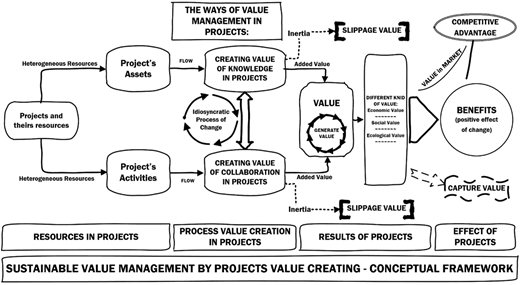
Section five will present research results as a concise summary, using a figure titled “Sustainable value management in project value creation: A conceptual framework.”
Conclusions
The analysis of expert interviews provides insights into project value creation in the context of sustainable value management. The research addressed two main questions: How can we better understand value creation in projects? How is value created in projects?
The findings of the study focus on the creation of value through knowledge and collaboration in projects, identifying key assets and activities in these areas. The study also categorizes the flow of added value into two main streams.
The study developed a conceptual framework to summarize the findings, highlighting resource assets and activities. The results demonstrate the methods of value creation in projects through knowledge and collaboration, emphasizing the flow of value toward sustainable outcomes and market benefits. The framework consists of key components: resources, the value creation process, project results, and project effects. Figure 1 summarizes these conclusions and illustrates how organizations can conceptualize project value creation.
The first component, project resources, includes all resources that organizations use in a project. We can categorize them into two main paths:/1/Assets: these involve knowledge sharing, individual and team knowledge, organization knowledge, information, as well as tangible and intangible assets./2/Activities: these refer to collaboration methods, project management approaches, cooperation, adaptability, trust, and team involvement. In projects, individuals and teams apply unique knowledge and collaboration approaches that are difficult to replicate but are essential for creating added value. Project value creation originates from two primary sources: content (assets) and process (activities).
The second component, the value creation process in projects, focuses on the unique (idiosyncratic) processes of change involved in co-creating value through knowledge and collaboration. Organizations achieve added value by effectively allocating and reconfiguring resources. Without understanding methods of value generation, project managers may unintentionally generate problems. Inertia, such as resistance to change or poor collaboration, can hinder value creation, leading to diminished or lost value. Organizations should create value through a dynamic (idiosyncratic) process of reallocating and combining heterogeneous resources (assets, activities, knowledge, and collaboration) within the project. The research emphasizes the importance of resource allocation and process reconfiguration in generating sustainable value. Projects evolve as a unique value network, with collaboration and knowledge assets creating added value.
The third component involves project results, which are the outcomes of the positive, idiosyncratic change process that captures added value. The component also highlights inertia, or value slippage, which hinders value creation and causes value loss. The type of project influences the value it generates. Different projects can produce various forms of added value, including value activities, assets, or business value, while some may even result in subtracted value due to inertia. These diverse forms contribute to sustainable value creation, including economic, social, and ecological value.
The fourth component focuses on project effects, examining how added, realized, and sustainable value contributes to project benefits within the organization. Capability building enhances value creation, supports innovation, and improves the change process, leading to market benefits and competitive advantage.
This framework highlights that projects build critical capabilities (e.g. new knowledge and collaboration methods), whose full value is often realized in subsequent projects. It provides a guide for understanding the diverse types of value generated in projects, which include economic, social, ecological, and business organizational value. The conceptual framework, titled “Sustainable value management in project value creation – a conceptual framework” focuses on how value is created through project activities (process) and assets (content), resulting in tangible outputs and fostering learning at individual, team, and organizational levels. It defines key concepts such as value added, value capture, value slippage, and sustainable value. The model (framework) further emphasizes the critical roles of collaboration and knowledge development, and the necessity of actively managing and measuring value. Finally, it explores the unique idiosyncratic process of change and the impact of inertia on value creation.
This study contributes to project management by presenting a framework for sustainable value management, which incorporates new types of value and explores the impact of value slippage. It shifts the focus of project success evaluation from traditional metrics to a broader understanding of value, including economic, social, and ecological dimensions. Furthermore, the framework highlights the importance of collaborative processes and collective learning for achieving project benefits. This study suggests further research on value creation in project networks and other organizational contexts, acknowledging that the findings may not apply universally and there are limited possibilities for generalizing the results to a wider population. The study used qualitative research to develop a conceptual model. Future research could refine definitions of project success and explore new sources of value.