The purpose of the article is to construct a competency model for R&D employees in advanced-technology enterprises.
The empirical research was quantitative. The unit of analysis comprised 82 R&D employees operating within advanced-technology enterprises headquartered in the Silesian Voivodeship. Data collected via CATI/CAWI were analyzed using exploratory factor analysis and structural equation modelling (SEM) to estimate the impact of individual KSA components on the overall competency model of R&D employees in advanced-technology enterprises.
SEM analysis confirmed that the competency profile is significantly constituted by all three KSA components. Knowledge emerged as the strongest determinant, followed by skills, while Attitudes showed the weakest, though still significant, influence. Specific domain knowledge and analytical skills were identified as the core pillars of professionalism in the R&D sector.
SEM analysis showed that the competency model is significantly composed of knowledge, skills and attitudes, but their relative importance depends on the organisational role.
Although many studies address employee competencies, relatively few focus on R&D personnel in advanced-technology enterprises. This article helps fill that gap. The findings on competency models can serve employers in the surveyed sector as a valuable information source for effective competency management of their R&D workforce.
1. Introduction
In the era of intense technological change and the growing role of innovation, the competencies of research and development (R&D) employees are becoming a key strategic resource for high-tech enterprises. The aim of this article is to develop a competency model for R&D employees in high-tech enterprises and to describe the dynamics of interactions between its individual components.
Despite numerous studies on competencies, the literature still lacks cohesive models specifically dedicated to R&D employees in the high-tech sector, where rapid technological change necessitates the continuous redefinition of professional profiles. Although the literature extensively describes universal competency models (e.g. Boyatzis, 1982), diagnostic tools that account for the specific nature of work in R&D departments remain insufficiently tailored to this context.
The research gap addressed by this study concerns the lack of a precise determination of the impact strength of individual KSA model components within the specific context of the high-tech sector. The originality of this work lies in linking the classical KSA framework with the unique requirements of the high-technology industry. The empirical research conducted shifts the focus toward individual employee competencies, treating them as the microfoundations of a firm's innovative capabilities. It encompasses a multidimensional approach to modelling R&D employee competencies that extends beyond the standard KSA framework. While the structure of knowledge, skills, and attitudes is well-established in the literature, the original contribution of this study consists in the empirical verification of the influence of individual components on the overall competency model within the specific, dynamic environment of high-tech enterprises. In contrast to existing general competency models, this study identifies a unique hierarchy of success factors in the R&D sector. Structural Equation Modelling (SEM) revealed that specialised knowledge, along with learning and communication skills, constitutes the core of professionalism, while attitudes play a complementary role in supporting innovation processes. Furthermore, the added value of this study is the attempt to demonstrate the varying importance of particular competency groups depending on the level of the organisational structure – ranging from the primacy of skills at operational levels to the dominance of general management knowledge at middle-management levels. Such an approach enables the precise design of Human Resource Management (HRM) development strategies tailored to specific career paths within R&D departments.
The remainder of this article is structured as follows. The first part presents a critical literature review on the competencies of research and development (R&D) employees in high-tech enterprises and highlights the importance of competency modelling. The second part of the article presents the methodology, including the characteristics of the studied enterprises, data collection techniques, and the research instruments used. The third part delivers the empirical results, focussing on hypothesis testing and the estimation of the Structural Equation Modelling (SEM) parameters across knowledge, skills, and attitudes. The application of SEM as a tool for a deeper analysis of the relationships between latent variables represents an advancement over the descriptive statistics-based analyses frequently encountered in the literature. Finally, the article concludes with a discussion of the findings, their theoretical and practical implications for Human Resource Management (HRM), and directions for future research.
2. Literature review and hypotheses development
2.1 Competencies of research and development employees of high-tech enterprises
Today's high-technology enterprises are based on innovation with R&D teams as their foundation. R&D employees play a key role in the creation of new products, services, and technological solutions. The development of research and development (R&D) activities in organisations, is an important element in building competitive advantage in a knowledge-based economy. A key role in this process is played by the competencies of employees involved in innovation activities. The literature shows a growing interest in analysing these competencies in the context of the changing technological and organisational environment (Vargová, Paľov, & Noga, 2014; Chursin, Strenalyuk, & Agaptsov, 2019; Garavan, Carbery, Rock, & O’Brien, 2019; Liu & Yang, 2021).
Differences between sectors – such as the level of technological sophistication, regulations, competitive dynamics, or customer needs – shape the catalogue of competencies of high-tech employees (Garavan et al., 2019). Competencies related to innovation, adaptability, expertise, and problem-solving, digital or analytical competencies are crucial in high-tech companies. There is also a strong emphasis on competencies related to teamwork in a multicultural environment, communication, and mental resilience (Rosen et al., 2018). In the case of organisations operating in an international environment, which very often include high-tech companies, the catalogue of competencies is often expanded to include adaptability to diverse work environments or cultural tolerance (Sun and Mei, 2024).
An important factor influencing the selection of industry-driven competencies is also the dynamics of competition. The catalogue of competencies should be dynamic and adapt to technological, regulatory, and market changes. Organisations must identify not only current but also future competence needs in order to be competitive (Jabloński, 2024). High product variability forces high-tech employees to have competencies related to flexibility, rapid learning, and innovation (Sun and Mei, 2024).
In high-tech companies, due to intensified competition, rapidly changing market needs, and frequent technological breakthroughs, the characteristic directions of key success factors (Braguinsky, Klepper, & Ohyama, 2012) forming the basis for building business strategies of these organisations are shaped. Achieving competitive advantage appears to be one of the key points of these strategies. Aiming to achieve a competitive advantage in the market, high-tech companies undertake a series of activities to ensure their success, measured by a high rate of return on capital employed, including human capital (Magretta, 2014). It is, therefore, significant to integrate the human resource management process with the rest of the management processes in the organisation in such a way as to ensure the achievement of strategic objectives and the implementation of the companies' development strategies. People are the strategic resource through which an organisation creates competitive advantage, key competencies, and characteristics that distinguish organisations from their rivals, so the implementation of specific strategies requires the organisation's human resource management processes to adapt to them.
Recognising the high performance resulting from the alignment of talent with specific roles, high-tech companies consider the development of a competency model essential to the process of building a competitive advantage (Liu, Xu, Yuan, & Zhao, 2013).
Nowadays, the issue of competence is the subject of both extensive theoretical considerations and empirical research (Dolot, 2017; Dzieńdziora, 2018; Oczkowska, Lula, & Wiśniewska, 2018; Springer, 2018; Tyrańska, 2018, 2021; Aprianti & Sahid, 2020; Chen, Yang, Huang, & Yao, 2020; Kipper et al., 2021; Blanka, Krumay, & Rueckel, 2022; Fazal, Mamun, Ahmad, & Masud, 2022). As defined by Boyatzis (1982), competencies are “the characteristics underlying an individual's effective performance at work or in other work situations”. According to the framework proposed by Spencer and Spencer (1993), employee competencies are treated as a combination of knowledge, skills, and traits that are essential for the proficient performance of duties and the attainment of organisational goals. Hayton and Kelley (2006) describe competencies as a synthesis of the abilities, attitudes, and behaviours that an individual possesses, or that an organisation expects from a specific employee. In etymological terms, the word denotes authority, skills, and abilities, referring to superior behaviours or areas of specialised expertise demonstrated by personnel possessing high-quality skills and knowledge. Dzieńdziora (2018) sees competencies as a set of knowledge, skills, and characteristics that allow an individual to perform tasks effectively and to achieve the goals of the job effectively in the context of the adopted goals of the organisation. Definitions presented in the literature define competencies in the form of a behavioural description covering behaviours in terms of tasks performed on the job according to standards set by organisations. In summary, competencies are, in practice, the abilities and traitssuch as knowledge and behavioural attitudes—required for a given position; in other words, they represent the integration of all these aspects in predicting potential job effectiveness (McClelland, 1973), which relates to the description of requirements for performing work at the mandated level of proficiency (Ali, Qureshi, Memon, Mari, & Ramzan, 2021; Ashkezari & Aeen, 2012).
The definitions presented above treat competence as an individual's internal potential, though they do not unequivocally evaluate its constituent parts. Among the most frequently mentioned elements of competencies characterising their variability are: knowledge, skills, attitudes, abilities, motivation, both personality and psychophysical traits, as well as personal culture and value systems (Pacher, Woschank, & Zunk, 2024). Knowledge is most commonly defined as a conglomerate of formal education and acquired experience (Springer, 2011). Skills are defined as “practical knowledge of something, proficiency in something”. Abilities, meanwhile, are “a set of relatively stable psychological and psychophysical properties of a person that condition the ease of learning and the effectiveness of performing activities in a specific field”, whereas predispositions are an “innate inclination toward something” (Dzieńdziora, 2018). From a psychological perspective, an attitude is a relatively enduring disposition of an individual toward someone or something (an object, person, or idea) (Le Deist & Winterton, 2005). This disposition encompasses three primary components: the cognitive (a set of beliefs and knowledge on a given topic), the affective (a set of feelings toward the object of the attitude), and the behavioural (the tendency to act in a certain way) (Lindzey & Aronson, 1985).
The issue of R&D employee competencies in the high-tech sector currently constitutes a pivotal research area within management and quality sciences, determined by the knowledge-based economy paradigm and the challenges of Industry 4.0 and 5.0. Within the specific conditions of the high-tech sector—characterised by high R&D intensity, short product life cycles, and environmental turbulence—the competencies of R&D staff are no longer perceived merely as a static set of traits, but rather as a dynamic strategic resource that determines competitive advantage (Sanchez, 2004). In this context, R&D employee competencies are defined as an integrated set of knowledge, skills, and attitudes essential for the effective execution of creative work undertaken to increase the stock of knowledge and to find new, innovative applications for it. The specific nature of this professional group requires a holistic approach, combining advanced technical expertise with so-called meta-competencies, which enable adaptation to rapid technological changes and effective knowledge transfer.
Königova, Urbancova, and Jajfar (2012) emphasise a particularly significant approach to competencies within the context of R&D activities, which entails linking them with job performance—specifically knowledge, abilities, skills, traits, motives, attitudes, and values—measured through the analysis of outcomes. This definition served as the foundation for developing the research model and the research hypotheses.
The management of competencies defined in this manner within high-tech enterprises must be a process strictly integrated with the organisational strategy, encompassing a cycle of identification, assessment, development, and knowledge transfer. The foundation of this process lies in the development of a competency profile, which enables a precise alignment of the unique potential of R&D employees with the long-term innovation goals of the enterprise (Hayton, 2005; Ljungquist, 2007; Teece, 2007; Szczepańska-Woszczyna, 2016; Kianto, Sáenz, & Aramburu, 2017).
2.2 Modelling the competencies of research and development (R&D) employees
Contemporary organisations that invest in research and development (R&D) activities increasingly recognise the need for a systemic approach to managing employee competencies in this area. Modelling the competencies of R&D employees not only allows for a better alignment of employee competency profiles with the strategic goals of the organisation but also supports the development of innovation in high-tech companies (Campion et al., 2011; Male, Bush, & Chapman, 2011; Dreyfus, 2004).
In contemporary management and quality sciences, the modelling of competencies for R&D sector employees in high-tech enterprises is perceived as a systematic and multidimensional process of describing unique abilities that condition innovative effectiveness. A key research challenge lies in the operationalisation of human capital components in such a way that they form a cohesive structure supporting the organisation's dynamic capabilities (Teece, 2007).
For the purposes of this study, it is assumed that a competency model is a document containing a set (a list and description) of all competencies that an organisation deems essential for the implementation of its strategy, the attainment of business goals, and for achieving success in its operations. When characterising the construction of a competency model, it is necessary to define the modelling process itself. In the subject literature, modelling takes on various meanings. Trocki defines modelling as a problem-solving method that consists of creating a model, conducting research on it, and interpreting the research results (Trocki, 1988).
The process of modelling the competencies of R&D employees first requires the development of a catalogue of competencies, which consists of identifying the abilities of individuals in the context of organisational requirements. At this stage, it is essential to incorporate emotional, cognitive, and social competencies (Boyatzis, 2018). Garavan et al. emphasise that this process requires strategic analysis, a competency gap assessment, and the involvement of all stakeholders to match human resources with the future needs of the organisation (Garavan et al., 2019). Campion et al. (2011) point to the use of modern tools such as data analytics and artificial intelligence to support the process of accurately identifying the required competencies in an organisation.
The first stage of competency modelling for R&D employees in high-tech enterprises was competency identification. Although the subject literature presents various approaches to identifying competencies, there is a consensus regarding the primary tasks of this stage. It typically encompasses strategic and organisational analysis, the creation of a competency catalogue, the identification of key competencies for the organisation, and competency profiling. The result of the competency catalogue analysis should be the selection of key competencies from the perspective of the given organisation. Such selection allows for a focus on those skills that are of decisive importance for the organisation's development and its market competitiveness. Furthermore, this selection forms the basis for constructing the organisation's competency profile as well as competency profiles for individual roles and positions. The foundation of the competency identification stage was a review of national and international literature concerning employee competencies in the high-tech sector. This stage also serves as the basis for developing a competency profile for employees of a high-tech enterprise – that is, a set of key skills, knowledge, and attitudes of employees that are essential for achieving expected results and implementing organisational goals.
A competency model should reflect the needs of a given organisation and the specific nature of its R&D activities. In order to systematise the competencies of high-tech enterprise employees, the Knowledge, Skills, and Attitudes (KSA) model structure was utilised (Jeris & Johnson, 2004). This model, developed by D. McClelland, categorises competencies into knowledge, skills, and attitudes, as presented in Table 1.
Knowledge, as the first component of the KSA model, is generated through the association, comparison, and analysis of information. It refers specifically to the familiarity with definitions, issues, and theoretical concepts. It determines information regarding methods of operation, procedural knowledge, as well as an understanding of processes and methods. A competent individual must know “what” and “how” to perform a task correctly. Skills were adopted as the second component of the competency profile for high-tech sector employees, understood as the ability to execute complex behavioural patterns necessary for performing assigned tasks. Skills are recognised as practical behaviours related to the performance of job tasks, and their acquisition occurs through learning, development, and support in the form of coaching or mentoring. The transformation of knowledge and skills into relatively enduring dispositions is conditioned by attitudes, which influence the willingness to utilise knowledge and skills to achieve goals in a manner consistent with expectations. Attitudes activate the mechanisms responsible for initiating, directing, and sustaining actions. McClelland's (KSA) model aligns cohesively with Bloom's taxonomy, creating a comprehensive approach to the analysis and assessment of competencies in organisations. The KSA model (Knowledge, Skills, Attitudes) focuses on three key aspects of competence essential for effective job performance.
The analysis of competency weights and significance is typically conducted by assessing which of them exert the greatest impact on organisational effectiveness and the implementation of its strategy, as well as by selecting the most critical competencies for individual positions and roles within the organization. In a competency profile, it is essential to determine the relative importance of each constituent element. While all identified competencies are significant, they are not all of equal importance. Subsequently, a pilot study was conducted among 15 R&D employees of a high-tech enterprise, aimed at defining the competency profile. This subject-specific competency profile served as the foundation for the main research.
The identification of the main premises of the research problem resulted in the search for answers to the following questions:
What is the relationship between knowledge and the competency model of R&D employees in high-tech enterprises?
What is the relationship between skills and the competency model of R&D employees in high-tech enterprises?
What is the relationship between attitudes and the competency model of R&D employees in high-tech enterprises?
In accordance with a holistic perspective, a competency model is not merely a sum of disparate traits, but a purposeful composition of intertwined components: cognitive knowledge, functional skills, and social attitudes (Le Deist & Winterton, 2005). The proposed approach assumes that an effective model must reflect the specific nature of creative work, where embodied expert knowledge constitutes the foundation for the development of applied skills and pro-innovation attitudes (Szczepańska-Woszczyna, 2016). These dependencies require empirical verification, which allows for the formulation of the following primary hypothesis: H0: There is a significant relationship between the competency profile – comprising knowledge, skills, and attitudes – and the competency model of R&D employees in high-tech enterprises.
Adopting the assumption of the complementarity of these dimensions (Cohen & Levinthal, 1990; Hayton, 2005; Ljungquist, 2007) leads to the formulation of specific hypotheses. Consequently, the primary hypothesis was developed into a set of specific hypotheses adopted for empirical verification:
There is a significant relationship between employees' knowledge and the competency model of R&D staff in high-tech enterprises.
There is a significant relationship between employees' skills and the competency model of R&D staff in high-tech enterprises.
There is a significant relationship between employees' attitudes and the competency model of R&D staff in high-tech enterprises.
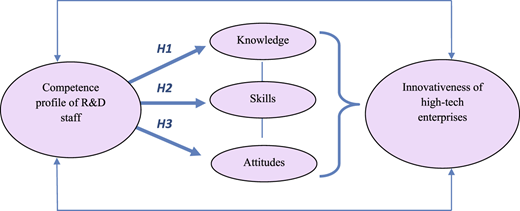
For the purpose of the specific hypotheses, a research model was established to test the relationships between the constructs (components) that constitute the components of employee competencies. The formulated hypotheses and the relationships between them became the basis for constructing the research model presented in Figure 1.
In the model presented above, role within the organisation and experience in R&D were used as control variables [1]. The study presents a multidimensional model of employee competencies based on the triad of knowledge, skills, and attitudes, in which knowledge constitutes the foundational source for skills.
3. Research design
The results presented in this paper were obtained as part of a larger study on the issue of competence management in high-tech companies. The empirical research was quantitative in nature, utilising original survey data collected via the CATI/CAWI technique between March and May 2024. A multi-stage purposive sampling procedure was adopted. In the first stage, high-tech enterprises headquartered in the Silesian Voivodeship were identified based on their economic activity using the NACE/PKD classification (specifically, divisions 21, 26, 60, 61, 62, 63, and subclasses 30.3, 72.11, 72.19). In the second stage, exactly one eligible R&D employee was selected from each identified enterprise to serve as a respondent. Consequently, the unit of analysis and the final research sample comprised n = 82 individual respondents, each representing a unique high-tech company (1:1 ratio between respondents and firms). This sampling design ensures that the data reflects a broad industry perspective rather than the internal organisational characteristics of a limited number of enterprises.
The research tool was a survey questionnaire consisting of two parts: a metric and qualification questions and statements on competence needs among high-tech employees. The statements related to general knowledge, specialist knowledge, skills, attitudes. All statements were measured on an ordinal scale according to the following code: not useful (1), not very useful (2), moderately useful (3), very useful (4) and necessary (5). This made it possible to analyse and evaluate the competence management process in high-tech enterprises and to develop a competence profile for high-tech enterprise employees.
The aim of the research was to develop a competency model for R&D employees in high-tech enterprises. In the first stage of the research, on the basis of the literature review, the competency profile of R&D employees in high-tech enterprises was determined, divided into components: knowledge, skills and attitudes. As part of the analysis of the survey results, basic descriptive statistics (i.e. mean, median, standard deviation, skewness, kurtosis), reliability analysis and factor analysis were used, the aim of which was to select items appropriately loading individual factors. The next step was to estimate the parameters of the SEM model by knowledge, skills, attitudes. This procedure was applied to how the competency profile of high-tech workers was measured. The other elements of the competency management model of the R&D employees of these companies were also assessed. The final stage of the research procedure was the construction of the SEM model in relation to R&D employees. The following assumptions were made in the estimation of the model parameters:
Estimation of the discrepancy between the theoretical construct and the empirical model using the maximum likelihood method.
Estimation of the covariance matrix by the maximum likelihood method.
A modification index indicating the degree of correlation of the random component at level 20 (this means that correlations of random components for which the modification index exceeds level 20 are included in the model).
4. Results
The study was conducted among 82 R&D employees (including 68.3% operational staff and 25.6% lower-level management), which allows for capturing the perspective of individuals directly executing innovation processes. The selection of respondents enabled an assessment of the utility (usefulness) of specific competencies in daily research practice, providing a foundation for effective competency management – understood here as the process of aligning human resources with the technological requirements of the position. The majority of the respondents had more than five years of experience in R&D (58.5%). Those with experience of less than two years accounted for 22.0% of the total respondents, while those with experience of 2 to 3 years accounted for 13.4%. The least numerous group were those with 4 to 5 years' experience in R&D, represented by 6.1% of the total number of respondents. The main characteristics of the respondents are summarised in Table 2.
In the survey, respondents were asked to what extent the elements of general and specialised knowledge and skills listed in Table 3 are useful in their work. The basic descriptive statistics for all competence indicators are included in Table 3. With regard to knowledge, specialised knowledge comes to the fore, rated highest (M2 = 4.70, Me3 = 5). Knowledge of organisational and project management is also important (with an average of about 3.5 and Me = 4). The other aspects are moderately useful according to the respondents (averages 2.7–2.9, Me = 3). The skills catalogue was much more extensive. The participants in the survey indicated the following as the most important: the ability to communicate effectively (U2) and to learn (U19) - M = 4.0, as well as the ability to identify and solve problems and irregularities (U16), analytical thinking (U15), planning and organising (U4) and the ability to work in a team (U22) and time management (U5, M = 4.24). Also important (M > 4) are adaptation skills (U18), presentation skills (U3) and awareness of the assigned role (U12). Other skills were rated less than 4, including the lowest, the ability to develop desirable attitudes in others (M = 3.22). Leadership, change management and business awareness were also rated relatively low. In terms of attitudes, on the other hand, responsibility (P3, M = 4.37), sharing knowledge and experience (P5), self-reliance (P17), conscientiousness (P16) and commitment (P9) come to the fore.
Reliability analysis. In the area of general knowledge, there are 6 scale items for which the value of Cronbach's alpha coefficient is 0.876. The result is above the minimum acceptable threshold of 0.7 which means that the knowledge statements meet the assumption of high reliability. Table 4 shows the results for the scale item statistics. The results indicate that all scale items are strongly correlated with the sum scale and removing any item does not increase the reliability of the questionnaire in this area.
In the area of expertise, there is only one statement, so no reliability analysis was conducted.
In the area of skills, there are 22 scale items for which the value of Cronbach's alpha coefficient is 0.893. The result is above the minimum acceptable threshold of 0.7 which means that the knowledge statements meet the assumption of high reliability. Table 5 shows the results for the scale item statistics. The results indicate that most of the scale items are strongly correlated with the sum scale. It was observed that removing item U18 - adaptive skills (correlation with the summative scale at 0.232 - weak) would increase the value of the Cronbach's alpha coefficient to 0.895. However, it should be considered whether this is justified, as the coefficient value would increase by only 0.002.
In the area of attitudes, there are 20 scale items for which the value of Cronbach's alpha coefficient is 0.894. The result is above the minimum acceptable threshold of 0.7 which means that the knowledge statements meet the assumption of high reliability. Table 6 shows the results for the scale item statistics.
The results indicate that most scale items are strongly correlated with the sum scale. It was observed that removing item P19 – Identification with company (correlation with the summative scale at 0.325 – weak) would increase the value of the Cronbach's alpha coefficient to 0.896. However, it should be considered whether this is justified, as the value of the coefficient would increase by only 0.002.
In conclusion, the reliability analysis showed that the individual components of the questionnaire are highly reliable. In light of the results of the survey, competences were assessed in the survey proper on the basis of a catalogue of 42 variables, of which 7 related to knowledge (including 6 general knowledge and 1 specialised knowledge), 17 to skills, and 18 to attitudes. Indicators U2, U12, U17, U19, U21, P4 and P20 were omitted. The catalogue of 42 variables had high reliability at the survey level, with a Cronbach's alpha coefficient of 0.935.
Prior to the SEM analysis, a factor analysis was used to select items that appropriately load on each factor. The following assumptions were made:
factor extraction method: principal components,
number of factors: 1,
minimum factor loading value: 0,5.
Thus, the following observable variables used for factor construction were obtained:
The factor loadings for all items on each factor meet the assumptions made, so these selected items were used to build the SEM models. Table 10 shows the structural parameters of the model without disaggregating by employee group.
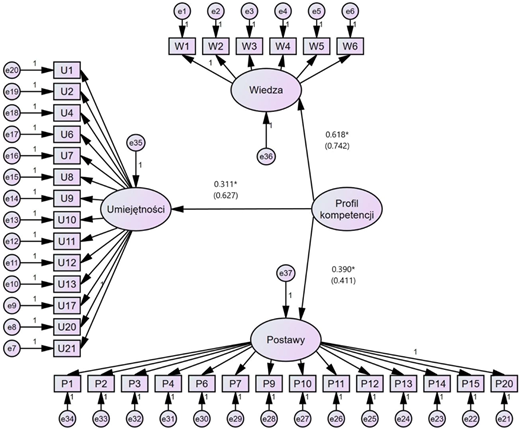
The results of the analysis show that all parameters of the SEM model are positive and statistically significant. The standardised coefficients indicate that the individual components are related to the competence profile to varying degrees. Knowledge and skills are the strongest contributors to the competency profile, while attitudes are the least. Table 11 shows the fit measures for the estimated model. All fit measures indicate a good fit between the theoretical model and the empirical data. The model properly implies the actual structure of the variance-covariance matrix between the analysed components of the construct.
The model, together with the estimated parameters, is presented in Figure 2 (the values of the standardised coefficients are given in brackets).
5. Conclusion and discussion
In the practice of high-tech enterprises, the competencies of R&D employees are of great importance, depending on the search for innovative solutions, leading to a rapid increase in the competitiveness of the enterprise (Zakrzewska-Bielawska, 2010; Chursin & Tyulin, 2018). By modelling the competence profile of R&D employees in these enterprises, it is possible to create a competence model that allows, among other things, to shape the innovation climate in the organisation, or to perform the efficient transfer of new technologies (Vargová et al., 2014; Chursin et al., 2019; Głomb, 2020).
The application of SEM analysis allowed us to confirm that the competency profile model based on the three components - knowledge, skills, and attitudes - is a good fit to the empirical data. The SEM model confirmed that knowledge was the most important component of the competency profile (β = 0.742), a slightly weaker effect was also shown for skills (0.627), while attitudes had the relatively weakest effect (0.411), despite being rated highly. This may suggest that attitudes have a supportive but not directly determinant function for operational success in R&D activities. The result indicating a relatively weaker impact of attitudes (0.411) compared to knowledge (0.742) may stem from the high degree of formalisation and technical complexity of R&D work in the surveyed companies, where measurable outcomes (patents, prototypes) depend primarily on hard expertise. Although respondents rated attitudes such as responsibility (M = 4.37) or conscientiousness very high on a declarative scale, the SEM analysis reveals that they perform a complementary function. Attitudes, therefore, constitute a necessary background (innovation climate) but are not the direct “engine” of innovative capabilities to the same extent as cognitive resources. This model configuration finds strong justification in studies on digital transformation within capital-intensive sectors (e.g. among German capital goods manufacturers). Similar to research on German industry, where social competencies showed a surprisingly low impact on the success of digital transformation, the present study confirms that in the high-tech sector, the “core” of professionalism consists of hard competencies (Arnold & Voigt, 2019; Butschan, Heidenreich, Weber, & Kraemer, 2019). This suggests that in the face of technological pressure, social aspects (e.g. empathy, tolerance) become secondary to the requirement for the efficient operation of advanced systems and processes. This result fits in with the concept of competence 4.0, where technical and cognitive competences are supported by flexible attitudes and commitment (Bettiol, Capestro, Di Maria, & Micelli, 2022; Pedota, Grilli, & Piscitello, 2023; Poszytek et al., 2023; Molla, Gekara, Karanasios, & Snell, 2025).
These findings have significant implications for human resource management practice, suggesting that recruitment and development systems within R&D departments should primarily prioritise the verification of advanced knowledge and analytical skills, treating attitudes as an important but insufficient element of the success profile.
The results indicate that in the high-tech sector, expertise is a key component of the competence profile of R&D employees (Nonaka & Takeuchi, 1995). Analysis of the results of surveys carried out in high-tech companies indicates that among the competencies that R&D employees should possess, the expertise of R&D employees comes to the fore. Similar conclusions were reached by Kozłowski and Matejun (2010), who identified an appropriate level of expertise as the primary universal competency required for the efficient, effective, and trouble-free operation of advanced technologies in contemporary enterprises. Similarly, Tylżanowski (2016) considers the priority in these enterprises to be 'the transfer of knowledge and skills and their application within the business, including in production processes. This is also in line with the observations of Chłoń-Domińczak and Strzeboński (2021), who emphasise that the development of domain knowledge in innovative sectors is crucial to the creation of a firm's competitive advantage. In the study, the average rating for the usefulness of domain knowledge was 4.70 (Me = 5), which clearly indicates its high importance in innovation activities. This is also supported by the study of Chen, Tong, and Xue (2024), who showed that the strong relationship between expertise and the effectiveness of R&D teams intensifies in the context of digital transformation.
At the same time, although project and organisational management expertise were rated not very high (around 3.4–3.5), it remains important, especially in project environments with variable structures. This may be due to the increasing complexity and interdisciplinarity of R&D projects, as highlighted by Turner and Keegan (2001), among others, who pointed out the need to develop both hard and soft skills in parallel in project environments. This is also confirmed by a review of research on competencies 4.0 (Poszytek et al., 2023), where the need to develop meta-managerial competencies as a prerequisite for adapting to the transformations of Industry 4.0 was highlighted.
Among the skills rated highest were effective communication, planning, time management, and analytical thinking (score of 4.0). This confirms the findings of authors such as Tett, Jackson, and Rothstein (1991), who demonstrated that interpersonal and cognitive skills are strongly correlated with occupational performance, especially in high-uncertainty environments such as R&D. Converging results were also presented by Cardon et al. (2023), indicating that communication, interpersonal skills, and reflexivity are becoming the most important professional competencies in the AI era – often surpassing hard technical skills. Today's R&D teams require high levels of collaboration and the ability to learn quickly, which coincides with high scores for learning skills (M = 4.40) and teamwork (M = 4.28). As X. Yun (2009) argues high-tech companies must not only be limited to employees with outstanding expertise in their field, but also capable of reacting quickly to the changing technological and business environment, displaying their own initiative, operativeness, and creativity, so they should also be entrepreneurial. Employees should possess competencies such as creativity, communication competence, teamwork, analytical skills, and a success orientation. These results partly correlate with experts in the private sector, who primarily pay attention to competencies that enhance employee performance, i.e. primarily soft competencies and the ability to adapt to change (Jerman, Bertoncelj, Dominici, Pejić Bach, & Trnavčević, 2020).
Competences related to shaping attitudes in others, leadership, and change management were rated relatively low in the research. Interestingly, the ability to form desirable attitudes in others was rated relatively low (M = 3.22), as were leadership and change management competencies. The surprisingly low rating of leadership and change management competencies stands in apparent contradiction to the body of literature emphasising the role of innovation leaders. However, in the context of the surveyed enterprises (diverse NACE sectors ranging from pharmaceuticals to software), this may indicate an adhocratic work culture or work in distributed structures, where traditional hierarchical leadership gives way to specialist autonomy and the self-management of project teams. The lack of significant sectoral differences in the overall model suggests that within high-tech industries, there exists a competency “common denominator” based on the fast-learning paradigm. This may indicate that in R&D teams leadership functions are diffuse and less formalised, as also noted by Mintzberg (2009) in the context of organisations' innovation. This may also be due to the flat structures of R&D teams and a culture of autonomy. Miller (2024) notes that domain knowledge requirements often limit the diversification of leadership roles and reduce the rotation of leadership functions, which may reduce the need for extensive leadership competencies.
In the area of attitudes, responsibility (M = 4.37), conscientiousness, self-efficacy, and knowledge sharing received the highest scores. These are important qualities from the perspective of project work, especially under uncertainty and time pressure. A study by Goth et al. (2023) on the competencies of software engineers in research and development environments indicates that responsibility, mental toughness, and social competencies (e.g. empathy, and collaboration) are essential for work requiring a high degree of self-discipline and continuous interdisciplinary collaboration. Responsibility comes to the fore here (M = 4.37), which is consistent with research by Luthans and Youssef-Morgan (2007), who indicate that attitudes that foster self-discipline, mental toughness, and collaboration play a key role in innovation environments. Other highly rated attitudes, such as conscientiousness, commitment, and knowledge sharing, indicate that respondents have a high orientation towards collaboration and quality of work, which coincides with the soft competence model proposed by Spencer and Spencer (1993). At the same time, it should be assumed that, in a volatile environment, the list of competencies of an R&D employee of high-tech enterprises is not and should not be a closed list (Liu & Yang, 2021).
All measures of fit (e.g. RMSEA = 0.039, CFI = 0.904) show good agreement between the theoretical model and the empirical data. Thus, the model can be used as a basis for the construction of competence development strategies for R&D employees of high-tech enterprises operating under conditions of high technological variability.
6. Summary
The competencies needed in high-tech enterprises are perceived in terms of competencies of the future (Kocór & Springer, 2019). The analysis of the survey results provides valuable information on the competence profile of employees in the high-tech sector, especially in research and development (R&D) positions. The model properly implies the actual structure of the variance-covariance matrix between the analysed components of the construct.
The SEM analysis showed that the competence profile is significantly composed of the individual components' knowledge, skills, and attitudes. The results showed that for R&D employees, knowledge is the most important, followed by skills and finally attitudes.
In terms of knowledge, the expertise of R&D employees had the greatest impact on the innovativeness of high-tech enterprises. Organisational and project management knowledge also proved to be important. The importance of the other knowledge components was relatively less important. The catalogue of skills was much more extensive. The most relevant skills included: the ability to communicate and learn effectively, the ability to identify and solve problems and irregularities, analytical thinking, planning and organising, the ability to work in a team, and time management. Adaptability, presentation skills, and awareness of the role were also found to be important. Other skills were rated less than 4, including the lowest rating for the ability to develop desirable attitudes in others. Leadership, change management, and business awareness were also rated relatively low. In terms of attitudes, responsibility, sharing knowledge and experience, self-reliance, conscientiousness, and commitment were found to be the most important.
Building competency profiles of R&D employees in the high-tech sector may have important implications for HR policies in knowledge-based organisations. The research undertaken leads to the unequivocal conclusion that it is possible to develop a competency profile of R&D employees for high-tech companies, which can influence the growth of their innovation.
The developed competency model for R&D employees provides concrete tools for optimising human resource management processes in high-tech enterprises, enabling a transition from general assumptions to precise implementations within soft HR – particularly in the areas of recruitment, periodic appraisals, and employee development and training plans. Regarding recruitment and selection, hiring processes should prioritise the verification of advanced specialised knowledge, which constitutes a fundamental prerequisite for entering the organization. At the same time, selection methods such as Assessment Centres should be calibrated to evaluate analytical skills and learning ability, as these demonstrate strong explanatory power for the competency profile within the SEM model.
The implementation of the model into periodic appraisal systems suggests a departure from universal evaluation forms in favour of profiling based on organisational roles. For operational staff, the emphasis should be placed on evaluating technical skills, whereas for lower-level management, the focus should remain on monitoring general management knowledge. Training and development plans should account for the high importance of knowledge and experience sharing by implementing mentoring programs that formalise the transfer of tacit knowledge. The relatively lower rating of leadership competencies suggests a need to reorient training toward distributed leadership, which may also point to the fact that leadership functions in R&D teams are less formalised, consistent with Mintzberg's conceptual framework.
The research results also open new perspectives for the discipline of management and quality sciences by outlining future research directions. A key area remains the empirical verification of the link between the identified competency profile and objective measures of corporate innovativeness, such as the number of patents or revenue from new inventions. The analysis of moderating variables will also be of significant importance, allowing for an investigation of the extent to which organisational culture or digital maturity influences the reconfiguration of the weights of individual KSA components. These efforts should be complemented by longitudinal studies to capture the dynamics of evolving competency needs in the face of Industry 4.0 and 5.0 transformations and high technological volatility.
The scientific contribution of this article is realised on three levels. First, the components of the KSA model within the high-tech sector were identified. It was demonstrated that, contrary to general HRM trends promoting the primacy of soft competencies, within the specific R&D environment, it is specialised knowledge and hard analytical skills that constitute the core of the competency profile. This finding represents a significant refinement of the “Competencies 4.0” concept and the knowledge creation theory by Nonaka and Takeuchi (1995) within the context of the Polish high-tech sector. Furthermore, the article has bridged the gap between theoretical considerations of corporate innovative capabilities and the operational level by treating individual competencies (knowledge, skills, and attitudes) as the microfoundations of these capabilities. Thus, the theses regarding the strategic importance of human capital in creating the competitive advantage of high-tech firms have been confirmed.
An additional original contribution of this work is demonstrating that the weight of individual competency components evolves along with the levels of the organisational structure – shifting from the primacy of operational skills to the dominance of general management knowledge at middle management levels. This allows for a departure from “universal” competency models in favour of a situational approach in HRM.
The indicated contribution corresponds with research postulates regarding the necessity of dynamically adapting competency catalogues to market changes (Jabłoński, 2024), as well as the need for a deeper analysis of the relationships between latent variables in competency modelling, which was achieved through the application of the SEM method. Furthermore, the work represents an attempt to fill the gap identified by Liu and Yang (2021) concerning the insufficient investigation of the impact of core technological capabilities on sustainable competitive advantage under conditions of high volatility.
Despite its contributions, this study has limitations. The geographical focus on the Silesian Voivodeship and the moderate sample size (n = 82) suggest caution in generalising the results. Additionally, the reliance on self-reported data may introduce subjectivity. Future research should consider longitudinal designs and a broader geographical scope to validate the model's robustness.
Competence modelling is a complex and multifaceted process, therefore this issue requires defining further research directions (constituting a point of reference for them), which in the aspect of emerging new conditions and perspectives of development of many phenomena may constitute significant scientific challenges. The authors of the study hope that the presented empirical research will contribute to the understanding of the importance of the process of modelling the competencies of research and development employees in high-technology enterprises and will initiate a broader discussion devoted to this issue and will encourage researchers to undertake further research and scientific reflection.
During the preparation of this work, the authors used Gemini (AI) in order to refine the linguistic accuracy and translate specific sections of the manuscript. After using this tool/service, the authors reviewed and edited the content as needed and take full responsibility for the content of the publication.
Notes
Due to the volume of the article, only a fragment of the research carried out within the scope of the project Shaping the competences of R&D workers in the high-tech sector is presented.
AVE – Average Variance Extracted.