The construction industry, contributing approximately 39% of global carbon emissions, faces challenges to reach net-zero emissions by 2050. Traditional methods for estimating and managing carbon emissions suffer from inaccuracies, low transparency and data integrity issues, highlighting the need for trustworthy and efficient solutions. This paper aims to demonstrate how blockchains can enhance the accuracy of tracking carbon emissions and streamlining carbon trading, providing a robust system to manage and reduce carbon emissions effectively.
A case study-based approach is adopted to develop a blockchain-based system (EcoConstruct) to track carbon emissions and circularity of construction materials and facilitate carbon trading in the industry. The implementation uses smart contract technology and the Beneficial Assets Ownership protocol in the Tezos blockchain to validate carbon emission tracking, carbon trading and circularity criteria. The system was evaluated and validated through expert feedback, ensuring its practical applicability and effectiveness.
EcoConstruct demonstrates advancements in transparency, data integrity and efficiency in carbon estimation and trading. The system’s immutable ledger securely stores carbon emissions and their compensations using non-fungible tokens called carbon rewards. This system facilitates transparent and accountable carbon trading among stakeholders (clients, contractors and material suppliers). The findings highlight the potential of blockchains to overcome current challenges in carbon emissions management and trading in the construction industry.
EcoConstruct provides a novel blockchain-based solution for managing carbon emissions and promoting sustainability in construction, moving beyond conceptualisation by leveraging blockchain’s decentralisation, immutability, transparency and security to enhance carbon estimation accuracy and streamline carbon trading.
Introduction
As the world confronts the pressing issue of climate change, the construction industry is recognised as one of the most significant contributors to global carbon emissions, comprising 39% of global energy-related carbon emissions (Figueiredo et al., 2022; Sadeghi et al., 2023; UN Environmental program, Global alliance for building and construction, 2023). The Global Status Report for Buildings and Construction (Buildings-GSR, 2022) highlights the need for sustainable practices as it warns that if current trends continue, emissions from the sector could increase by 50% by the year 2030. While efforts to mitigate carbon emissions focus on optimising the life cycle stages of construction projects, such as adopting energy-efficient designs and sustainable materials, these measures alone cannot eliminate a portion of emissions (Rodrigo et al., 2020; Rodrigo et al., 2021). This persistent gap highlights the urgent need for innovative and scalable solutions to effectively manage and mitigate the industry’s carbon footprint.
Therefore, carbon offsets and trading have emerged as essential strategies in the global effort to address emissions that cannot be eliminated through conventional measures, offering economic incentives to promote decarbonisation (Perdan and Azapagic, 2011; Rodrigo et al., 2020; Rodrigo et al., 2022; Woo et al., 2021). However, the construction industry faces significant barriers to adopting such innovative systems due to its decentralised nature, fragmented workflows and limited knowledge sharing (WEF (Forum WE), 2016; Edirisinghe, 2019). Because of this, several challenges arise when trying to implement carbon trading mechanisms for construction projects, including trust and transparency issues persist in material sourcing and emission reporting (Figueiredo et al., 2022; Perera et al., 2020; Wu et al., 2022; Parchami Jalal et al., 2021), the lack of standard methods to enforce and monitor carbon trading systems (Safapour et al., 2021; Perera et al., 2020; Rodrigo et al., 2020), possible communication breakdowns due to the involvement of professionals from different disciplines (Parchami Jalal et al., 2021; Safapour et al., 2021) and vulnerability to fraud because of the lack of transparency (Kshetri, 2018; Basheer et al., 2024).
Moreover, traditional carbon trading mechanisms are often criticised for their complexity, lack of real-time data and difficulties in verifying the authenticity of carbon credits (Rodrigo et al., 2020; Liu et al., 2019; Mulligan et al., 2024). These inefficiencies have been widely documented with Bebbington and Larrinaga-González (2008) and Rodrigo et al. (2024) highlighting how inaccuracies in carbon accounting can lead to overestimation or underestimation of carbon credits, affecting market stability. Moreover, manual verification processes add significant delays and costs, reducing the system’s efficiency and appeal (Bebbington and Larrinaga-González, 2008; Perdan and Azapagic, 2011; Rodrigo et al., 2024). These challenges are compounded by the lack of standardisation in carbon accounting methodologies, which results in inconsistent and unreliable carbon credit assessments (Robinson et al., 2018; Oke et al., 2024). These issues undermine the effectiveness of carbon trading in achieving substantial emission reductions and erode confidence in the system.
With its decentralised and immutable ledger, blockchain technology presents a promising solution to these challenges (Perera et al., 2020; Figueiredo et al., 2022; Rodrigo et al., 2020). Blockchain can ensure the integrity of carbon credits by providing a tamper-proof record of transactions, which enhances trust and accountability among stakeholders (Wang et al., 2023; Rodrigo et al., 2020). Furthermore, the automation of verification processes and real-time data provision addresses key inefficiencies, improving the reliability and effectiveness of carbon trading systems (Mahmudnia et al., 2022; Zhang et al., 2020; Perera et al., 2020). Recent studies, such as Shu et al. (2022),Jiang et al. (2022) and Rodrigo et al. (2024) have explored the blockchain’s ability to create automated, tamper-proof verification systems to reduce carbon emissions.
Research gap and research aim
Despite blockchain technology’s potential to address challenges in traditional carbon trading systems, its practical application in the construction industry remains largely underexplored. Recent research has explored blockchain applications for carbon emission estimating and trading, (Rodrigo et al., 2024; Boumaiza and Maher, 2024; Shu et al., 2022) emphasising platform transparency and security. However, existing research primarily focuses on conceptual frameworks without providing real-world implementations or detailed case studies within the construction sector. This gap in practical application highlights the need for a tailored blockchain solution that directly addresses the unique challenges faced by the construction industry, such as trust, transparency and the efficiency of carbon trading mechanisms. In particular, issues like material sourcing, emission tracking and the verification of carbon credits are yet to be fully addressed through blockchain technology in this sector.
Therefore, this study aims to bridge this gap by developing and demonstrating EcoConstruct, a blockchain-based smart contract solution for tracking carbon emissions and facilitating carbon trading in construction projects. The specific objectives of this research are (1) to enhance transparency and trust in carbon trading by leveraging blockchain’s decentralised and immutable ledger, (2) to integrate carbon emission tracking with material circularity aspects and (3) to validate the system’s applicability through expert feedback. The solution is tested via a hypothetical 1 km highway project and evaluated by four domain experts during an international hackathon. By addressing inefficiencies in current carbon trading practices, EcoConstruct provides a scalable, tamper-proof and transparent solution, setting a precedent for adopting digital innovations in sustainable construction.
The paper is structured as follows: Firstly, it discusses the background of blockchain technology and smart contracts, along with their applications in various industries, focusing on the construction industry. Then, the methodology for developing, implementing and evaluating the blockchain-based smart contract is presented. Thirdly, the results and validation are discussed. Finally, the paper concludes with a discussion and a conclusion.
Literature review
Blockchain technology and smart contracts
Blockchain is a decentralised and distributed ledger technology that records transactions across a network of computers securely and transparently (Lee, 2019; Liu et al., 2019). Initially conceptualised for cryptocurrency frameworks, blockchain has evolved into a disruptive technology with profound implications for diverse industries (Saberi et al., 2019). Transparency, traceability and accountability are the key features of blockchain technology that help it successfully be applied in various industries (Perera et al., 2020; Nanayakkara et al., 2021). These features ensure that all participants within a network have visibility into the same ledger, making a transparent and tamper-proof environment (Teh et al., 2020). The immutability of recorded transactions, achieved through cryptographic hashing, enhances the system’s trustworthiness by preventing unauthorised alterations (Wu et al., 2022; Awan et al., 2022). Recent studies have emphasised these characteristics to strengthen transparency and accuracy in supply chains and track carbon emissions (Rodrigo et al., 2024; Rodrigo et al., 2020; Shu et al., 2022).
Theoretical underpinnings
Blockchain is grounded in distributed ledger theory, which allows transactions to be validated and recorded without a central authority (Sunyaev and Sunyaev, 2020; Li and Kassem, 2021). This decentralisation creates a trustless environment, where trust is built into the technology itself, making it ideal for sectors like construction, which require transparent, verifiable transaction systems (Rodrigo et al., 2020; Rodrigo et al., 2024; Li and Kassem, 2021).
Smart contracts are self-executing agreements with automated enforcement (Wang et al., 2023; Cardeira, 2016). Blockchain-based smart contracts, invented by Nick Szabo in 1990 (Szabo, 1997), execute contractual terms transparently and without the need for trust. By automating contractual processes, these programs eliminate the need for intermediaries, enhancing efficiency and reducing costs (Szabo, 1997). The trustless nature of smart contracts removes the need for trust between the parties involved, as the code’s execution is relied upon instead (Cardeira, 2016; Chaveesuk et al., 2020). Immutability ensures that once deployed, a smart contract’s code and execution history cannot be altered (Cardeira, 2016; Chaveesuk et al., 2020). The decentralised nature of this technology eliminates the need for a trusted third party to control the resources in an application. Instead, authority is delegated among network contributors to validate transactions, reducing the risk of failures and improving the service’s trustworthiness (Nanayakkara et al., 2021; Perera et al., 2020).
Blockchain-based smart contracts have already found applications in various industries, notably in supply chains, where they help manage material provenance, verify product authenticity and reduce fraud (Basheer et al., 2024; Koppelaar et al., 2023). By extending these features to carbon trading systems, blockchain can ensure the transparency, efficiency and security needed for more effective carbon emissions management in the construction sector.
Blockchain in construction.
Despite the construction industry has traditionally been perceived as slow in adopting new technologies, (Edirisinghe, 2019) in the recent past, it has undergone a significant transformation, with the introduction of innovative concepts such as “digital skin” and “future smart construction sites” (Edirisinghe, 2019) with the integration of cutting-edge technologies such as artificial intelligence, the internet of things (IoT) and building information modelling (BIM) (Forcael et al., 2020; Edirisinghe and Woo, 2021). Moreover, research into blockchain technology within the construction sector has gained traction during this transformative period in document management (Gad et al., 2022; San et al., 2019; Mahmudnia et al., 2022), project management (Cardeira, 2016; Perera et al., 2020), supply chain management (Basheer et al., 2024; Shu et al., 2022; Rodrigo et al., 2024) and project collaboration (Chaveesuk et al., 2020) due to its versatile advantages.
Despite significant advancements in blockchain applications for construction, challenges such as the lack of standardised frameworks, limited interoperability between blockchain networks and the need for broader industry-wide adoption continue to hinder its full transformative potential (Basheer et al., 2024; Zhang et al., 2020). For example, Zhang et al. (2020) proposed a blockchain-based Life Cycle Assessment (LCA) framework to evaluate environmental impacts across a material’s lifecycle. However, their work remains conceptual and requires further research to develop a practical, proof-of-concept blockchain-based LCA system. Similarly, Basheer et al. (2024) demonstrated a blockchain system for material provenance tracking in the construction industry, enabling improved transparency and traceability of shared supply chain information. While this system provides a comprehensive approach to material management, it does not incorporate carbon emissions tracking or assess the circularity of construction materials – critical aspects for advancing sustainability goals.
Blockchain technology for tracking carbon emissions and carbon trading in the construction industry.
Blockchain technology presents a promising solution for tracking carbon emissions and trading in the construction industry, as evidenced by recent studies focusing on supply chain-based embodied carbon (EC) estimation methods (Rodrigo et al., 2020; Rodrigo et al., 2021; Rodrigo et al., 2022; Perera et al., 2020). These studies highlight the inconsistencies and inaccuracies inherent in traditional EC estimation methods due to varying assumptions and lack of standardisation. They propose that blockchain’s decentralised, immutable and transparent nature can significantly enhance the accuracy and reliability of EC estimates by providing a secure and auditable record of transactions throughout the construction supply chain. Moreover, these studies compare traditional EC estimating tools with blockchain-integrated tools and discuss how blockchain-enabled systems can provide more accurate EC estimates, which are crucial for effective carbon management in construction projects (Rodrigo et al., 2024; Shu et al., 2022; Jiang et al., 2022).
Recent studies have begun exploring innovative frameworks such as blockchain-integrated EC estimation systems. For instance, (Rodrigo et al., 2022; Rodrigo et al., 2024) proposed a Blockchain-Enabled Carbon Estimator, which integrates supply chain-based embodied carbon estimation methods (SCEEM). Similarly, Shu et al. (2022) proposed a blockchain-enhanced trading system tailored for the construction industry, aiming to control carbon emissions effectively (Shu et al., 2022). Their research highlights the integration of blockchain with emission trading systems to manage emissions during the materialisation phase of construction projects.
Despite these advancements, significant gaps remain in the practical implementation of blockchain-based carbon estimation and trading systems. Previous research has primarily focused on conceptual frameworks and technical models, with limited empirical validation in real-world construction settings. For instance, while Rodrigo et al. (2022) developed detailed data models and flow diagrams for blockchain-based EC estimation systems, these remain untested in large-scale pilot projects or operational scenarios. The lack of standardised methodologies for integrating blockchain into carbon trading further limits its broader adoption across the industry (Perera et al., 2020).
Additionally, research on blockchain applications in carbon trading is notably scarce compared to its use in EC estimation. Expanding the scope of blockchain solutions to include dynamic carbon trading platforms could significantly enhance the efficiency and transparency of trading mechanisms. Such platforms could automate carbon credit issuance, validation and trading, thereby reducing administrative costs and improving accountability (Zhang et al., 2020; Wang et al., 2023). Addressing these gaps through pilot projects, larger-scale studies and standardised frameworks is essential to unlock blockchain’s full potential in revolutionising carbon management and trading in the construction industry.
In conclusion, notable studies have discussed the potential of blockchain technology to address critical challenges in construction material management, project collaboration and embodied carbon estimation. Most discussions about using blockchain technology in carbon management are still in the conceptual stage despite its advancements. An empirical solution to track carbon emissions of construction materials and facilitate carbon trading using blockchain technology has yet to be developed. According to the authors’ best knowledge, none of the previous studies have considered tracking carbon emissions and circularity of construction materials with a blockchain-based solution. Therefore, this study demonstrates a blockchain-based solution to track carbon emissions of construction materials and a system to trade the generated carbon credits.
Research methodology
As the first step of the study, a comprehensive literature review was carried out, and the prevailing research gaps in the literature were identified. As the second step, the study’s main objective was defined based on the research gaps found.
The primary objective is to develop a demonstratable platform capable of tracking carbon emissions, creating and trading carbon credits and sourcing sustainable materials for construction projects.
This study aims to develop a system to facilitate carbon trading in the construction industry using blockchain technology, addressing the shortcomings of traditional carbon trading systems. The proposed system is designed to comprehensively track carbon emissions of construction materials from the design stage, ensuring sustainable sourcing of materials throughout the construction lifecycle. Furthermore, it will enable a transparent, reliable and secure carbon trading mechanism that empowers project stakeholders, aligning with emerging green innovation trends (Han et al., 2023; Li et al., 2024).
To achieve the defined objectives, a comparative evaluation of various blockchain platforms was conducted to identify the most viable platform for developing the prototype. This analysis drew insights from recent advancements in blockchain technologies, such as exploring decentralised protocols and smart contracts (Far et al., 2022; Taherdoost, 2023). Based on this analysis, a comprehensive framework was designed, incorporating metrics for tracking carbon emissions and ensuring circularity in construction projects. Then, the focus shifted to prototyping the system, using insights from state-of-the-art literature on blockchain network development and innovations in tokenisation (Awan et al., 2022; Far et al., 2022). This phase culminated in creating a proof-of-concept blockchain system called EcoConstruct, which used the Beneficial Asset Ownership (BAO) protocol on the Tezos blockchain (Tezos, 2018).
The developed system was showcased at an international hackathon, where valuable feedback was obtained from a panel of four domain experts. Their insights emphasised the potential of blockchain to revolutionise carbon trading mechanisms while addressing institutional and technical barriers identified in previous studies (Awan et al., 2022; Han et al., 2023).
In summary, the methodology encompassed five core steps: firstly, identifying requirements and stakeholders; secondly, selecting the appropriate blockchain platform; thirdly, developing a conceptual framework for the system; fourthly, prototyping and developing the system; and, finally, evaluating and validating the system to ensure it met the objectives. This systematic approach ensured a rigorous and thorough development and evaluation process, paving the way for practical implementation and broader adoption of blockchain in carbon trading (Li et al., 2024).
Requirement analysis and stakeholder identification
The methodology begins with a comprehensive requirement analysis to address the specific needs and challenges of implementing a blockchain-based system in the construction industry. A 1 km hypothetical road construction project was selected as the case study due to its high material consumption, significant carbon emissions and complex supply chain dynamics. Road construction projects are among the most impactful in terms of carbon emissions within the construction sector, primarily driven by the extensive use of materials such as asphalt, concrete and steel, which have substantial embodied carbon values. Additionally, road projects involve diverse stakeholders and intricate workflows, making them an ideal context for testing the feasibility and effectiveness of blockchain technology in improving carbon management.
Sample material databases were developed using Excel to support the blockchain platform, containing detailed information on material types, embodied carbon values and sourcing attributes. These databases were populated with data from the Inventory of Carbon and Energy (ICE), which provided embodied carbon data for commonly used construction materials and supplier reports and specifications, offering information on material sourcing, composition and sustainability certifications. Construction regulatory standards and guidelines were also incorporated to ensure compliance with local, state and federal requirements. The detailed and reliable data set provided a solid foundation for validating the blockchain system and enabled accurate tracking of carbon emissions throughout the construction process.
Based on the BAO protocol, the stakeholder analysis identified three primary stakeholder groups: material suppliers, contractors and clients. Each stakeholder plays a critical role in implementing and operating the blockchain system. Material suppliers provide accurate data on material composition, sourcing and embodied carbon values, ensuring traceability and compliance with sustainability standards. Their data forms the backbone of the blockchain ledger, establishing transparency and accountability across the supply chain. Contractors oversee the usage of materials during construction, recording real-time data such as material quantities and on-site emissions and ensuring compliance with sustainability requirements outlined in project contracts. As project initiators, clients are responsible for aligning the blockchain platform with sustainability goals, validating carbon credits generated by the system and enforcing compliance with sustainability objectives. They also play a governance role, ensuring all stakeholders adhere to the agreed protocols and practices.
Through this requirement analysis, the research methodology ensured that the developed blockchain platform addresses the practical needs of road construction projects while promoting sustainability objectives. By integrating stakeholder contributions and leveraging detailed material databases, the platform facilitates transparent, accountable and efficient carbon management.
Selection of a suitable blockchain platform
In exploring blockchain technologies, various alternative platforms were thoroughly evaluated before selecting Tezos as the most appropriate platform for the development of EcoConstruct. The evaluated blockchain platforms, compared in Table 1, were analysed based on critical features such as scalability, energy efficiency, ease of integration and support for smart contract development (Far et al., 2022; Taherdoost, 2023). This evaluation aimed to ensure that the chosen platform aligns with the utility of carbon trading systems.
The BAO protocol, specifically designed to link non-fungible tokens (NFTs) to crowd-financed profitable projects, was selected as the backbone for the system. The BAO protocol introduces real-world utility to the blockchain by creating tokenised representations of profitable assets and distributing their value to token holders (Far et al., 2022; Taherdoost, 2023). This feature aligns closely with the project’s objective of ensuring transparency and shared benefits among stakeholders. Additionally, BAO’s open-source nature, supported by the collaborative contributions of Hyperglade, enhances its credibility and adaptability for innovative applications.
Tezos was selected as the platform for implementing the BAO protocol due to its energy-efficient consensus mechanism and robust framework for managing NFTs and decentralised applications (Li et al., 2024). These attributes made it particularly suitable for a project focused on reducing carbon emissions and supporting sustainable construction practices. Moreover, Tezos’ active developer community and institutional support provide a foundation for long-term scalability and innovation, which are crucial for achieving the project’s broader goals of integrating blockchain into carbon trading systems (Han et al., 2023).
Tezos emphasises security by using formal verification to minimise vulnerabilities in smart contracts and increase trust in decentralised applications. However, Tezos has encountered challenges in gaining widespread recognition and adoption. Compared with industry giants like Ethereum, Tezos’s ecosystem is more limited, which reduces the variety of decentralised applications and projects available. Furthermore, Tezos uses its own programming language, Michelson, for smart contract development, which may present a learning curve for developers more accustomed to using widely used languages such as Solidity. To overcome this, they have developed the “Smartpy” programming framework, which allows developers to build their solutions using the more user-friendly Python language. Despite these challenges, Tezos still shows promise as a critical player in the blockchain space, leveraging its unique governance model and technical innovations to carve out its niche in the decentralised ecosystem. Combining these innovative features makes Tezos a suitable foundation for the project, as it aligns with the project’s goals and requirements.
EcoConstruct software development process
The development followed the waterfall methodology, which takes a structured and sequential approach to project progression. In the first phase, all project requirements were documented to establish a comprehensive understanding of goals, functionalities and constraints. A detailed software architecture blueprint was created in the following system design phase, defining modules, data flow and component interactions to lay a solid foundation for the upcoming development stages. After that, the implementation phase followed, where developers translated the design into functional code. Each iteration was rigorously tested to ensure the reliability and functionality of the evolving system. This structured approach aligned with the principles of the waterfall model, providing a systematic and comprehensive framework for project development.
System design and architecture
The developed system ensured transparency by providing access to material requests and supply information for all project stakeholders. This accessibility enabled stakeholders to closely track various aspects, including material requests, supply status, recycled percentages and the embodied carbon values of materials. The system consisted of four fundamental and consistent members: the protocol admin, the client, the material supplier and the building constructor. The diagram of the Solution Architecture is provided in Supplementary_material_appendix_1.
Functionalities of EcoCnstruct
The study emphasised the specific functional requirements governing various aspects of system development. The initial configurations aimed to set the carbon rewards to zero for the building contractor and material supplier at the project’s outset, with further functionalities specifying the inclusion of admin, facilitator, protocol owner, constructor and supplier addresses. Regarding user interface design, the primary goal was to provide stakeholders with an interactive dashboard that allows them to oversee and manage their carbon rewards. The aim was to go beyond mere observation and enable meaningful interaction with the carbon reward system. Therefore, the study investigated the development of an interactive interface for carbon trading. This interface facilitates transparent and seamless carbon reward trading among stakeholders.
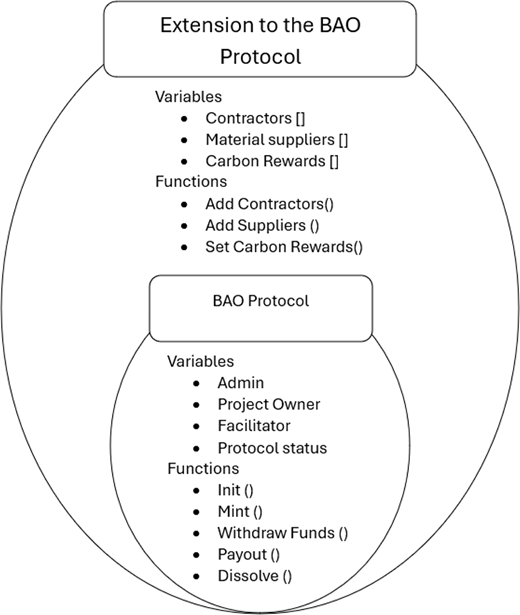
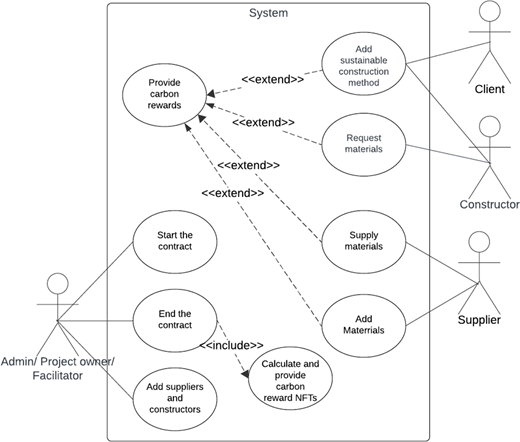
User management functionalities were integrated into the platform, ensuring secure and streamlined processes for stakeholders. The focus extended to onboarding new stakeholders onto the platform by allowing them to register securely. Concurrently, robust user authentication procedures guarantee the integrity of user accounts. The system used role-based permissions to enhance the user experience, ensuring that each user type is granted distinct roles and permissions tailored to their specific needs and responsibilities. Figure 1 shows the functionality of EcoConstruct extended from the BAO protocol, while Figure 2 shows the use case diagram of the proposed system.
The study’s most important aspect involved systematically recording participants’ actions in the construction projects. Specifically, the activities of the building contractor and material supplier were documented, with a better focus on tracking changes in carbon rewards resulting from their respective contributions. This thorough recording process aimed to create a transparent and accountable system, ensuring that the environmental impact of these stakeholders is accurately captured throughout the various phases of the construction project.
Moreover, this system used a sophisticated process for minting NFTs using positive carbon rewards. This process is initiated after the construction project has been completed. By converting positive carbon rewards into NFTs, stakeholders are provided with a tangible representation of their sustainable practices and contribute to the emerging landscape of eco-friendly digital assets.
These comprehensive functional specifications clearly understand the expected system behaviours, including initiating carbon rewards, user management, contractor and supplier actions and implementing NFTs with positive carbon rewards.
Carbon rewards integration
The BAO protocol has been updated to include a new feature focusing on carbon rewards. This update aimed to incentivise and reward environmentally responsible practices during construction, aligning with the BAO ecosystem’s broader sustainability objectives. The update involved introducing a dynamic environmental component to the protocol.
As a preliminary measure, the baseline for carbon rewards was established at zero for the client, building contractor and material supplier. This starting point emphasised the positive impact of reducing carbon footprint during construction. A dedicated variable has been added to the extended BAO protocol to monitor and quantify carbon reward changes systematically. This variable was designed to record and reflect alterations in carbon rewards during state changes in the smart contract. The recording process ensured accurate documentation of the environmental impact made by stakeholders throughout the various phases of the construction project.
This innovative approach aligned with the broader sustainability objectives of the BAO protocol and established a transparent and accountable system for stakeholders. Integrating carbon rewards introduced a real-time mechanism to promote environmentally conscious actions, fostering a collective commitment to sustainable practices within the BAO ecosystem.
Reward mechanism used in the developed platform.
A comprehensive mechanism has been developed to operationalise the integration of carbon rewards within the BAO protocol. This mechanism was designed to dynamically associate positive and negative carbon rewards with the actions of the building contractor and material supplier throughout the construction project.
The mechanism systematically linked carbon rewards to stakeholders’ actions during the project. Positive carbon rewards are earned when the building contractor and material supplier actively engage in practices that reduce their carbon footprint. For instance, if the contractor asks the material supplier for asphalt concrete, specifying that it should contain 8%–10% recycled glass and 25%–35% reclaimed asphalt pavement. This is necessary for the contractor to receive positive carbon rewards based on the specified criteria. Likewise, all the other road construction materials are defined with recycling percentages and reduction of carbon emissions due to the usage of recycling low-carbon materials. Conversely, negative rewards are incurred when actions taken by these stakeholders result in an adverse environmental impact.
This mechanism is critical because positive carbon rewards earned through environmentally responsible actions can be used for a specific purpose. Once the construction project is completed, these rewards will be used to mint NFTs. By linking carbon rewards to the minting of NFTs, the BAO protocol fosters a direct and tangible connection between sustainability efforts and tangible, tradable assets. This mechanism is an innovative incentive for stakeholders and reinforces the BAO ecosystem’s commitment to promoting environmental responsibility and transparency throughout the construction project lifecycle.
Selection of tools and techniques
In selecting tools and techniques for crafting the software architecture, careful consideration was given to integrating frontend and backend technologies seamlessly, ensuring the development of an interactive and scalable system. The JavaScript ecosystem, encompassing React, Express and Node.js, was chosen intentionally due to its widespread adoption and robust community support. React’s component-based structure facilitated efficient frontend development, complemented by Express and Node.js, which created a scalable and performant backend.
The adoption of the Firebase real-time database was motivated by its capabilities as a real-time NoSQL database. The cloud-based architecture of Firebase ensured high availability and reliability, aligning with the project’s essential requirements for real-time data updates and accessibility. The BAO protocol stood out as a versatile and extendable choice for blockchain integration. Its incorporation into the project provided a decentralised, secure and transparent mechanism for recording and managing carbon reward changes, aligning seamlessly with the overarching sustainability goals of the project.
In summary, the software architecture, integrating both frontend and backend technologies, adhered to principles of interactivity and scalability. The development process followed a systematic waterfall model, progressing seamlessly from requirements to implementation. The selection of tools and techniques, including Firebase and the BAO protocol, aligned strategically with project goals and industry best practices.
Graphical user interface design process
The graphical user interface (GUI) design process for “EcoConstruct” emphasised the creation of intuitive dashboards tailored to four user roles: Protocol Owner, Client, Supplier and Constructor. This strategic orientation prioritised user-friendly interactions to ensure seamless navigation and efficient execution of critical actions.
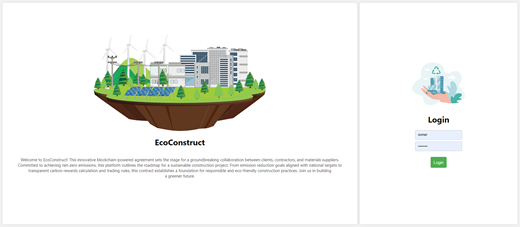
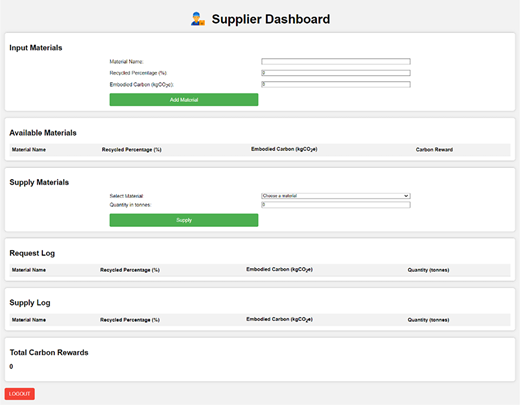
Within the realm of user authentication, the focus was on establishing a secure and straightforward login mechanism. This involved the design of a login screen prompting users to input credentials (username and password), with concurrent authentication mechanisms rigorously verifying user identity. Figure 3 shows the login screen of the dashboard. The dashboard’s design was tailored to specific user roles, each with a distinct layout. The stakeholders were chosen based on the requirements discussed above. Figure 4 shows the functional modules for material suppliers, such as tools for managing material quotas and supply records. Screenshots of other stakeholders’ dashboards (Protocol Owner, Client and Contractor) are provided in Supplementary_material_appendix 1.
Navigation and usability considerations in GUI design ensured logical navigation and ease of use. This involved using intuitive icons, labels for actions and tooltips for unfamiliar functionalities. The responsiveness aspect necessitated adapting the GUI layout to different screen sizes and comprehensive testing across multiple devices.
The aspect of user feedback, although yet to be implemented, seeks to gather insights for continuous improvement. Mechanisms such as surveys or in-app prompts are planned, with iterative improvements based on user interaction patterns. In terms of security measures, paramount consideration was the implementation of features to protect user data and system integrity, involving the use of secure authentication protocols and the encryption of sensitive user data during both transmission and storage. To summarise, the GUI design process followed a detailed and user-focused approach, catering to the unique requirements of various stakeholders such as protocol owners, clients, suppliers and constructors.
Evaluation and validation
After the solution was developed, it was presented in an international hackathon called BAOlympics. This hackathon marked a significant milestone for this study as it showcased the real-world utility of blockchain technology and brought together developers, industry leaders and blockchain enthusiasts around the globe. Based on the BAO protocol, the hackathon facilitated the creation of unique and diverse tokenised asset applications, emphasising innovation-driven utility.
The evaluation process at the BAOlympics Hackathon was rigorous and comprehensive. The judging panel comprised four experts with diverse backgrounds, including digital innovation, blockchain technology, fintech and construction management. Their experience in research, industry leadership and technological development added significant credibility to the validation process.
Expert panel details
The first expert was a senior academic researcher specialising in digital innovation and smart technologies in the built environment. With extensive experience in projects involving IoT, BIM, digital twins, AI and sustainable construction, this expert brought a wealth of knowledge in advancing innovative solutions for the construction industry.
The second panellist represented the blockchain industry, focusing on the Tezos blockchain. His expertise in blockchain applications, particularly energy-efficient solutions and low-cost transaction systems, provided valuable insights into the technical feasibility of the proposed platform.
The third panellist was a leader in Web3 and blockchain technology, recognised for developing educational programs and mentoring talent in blockchain applications. His deep understanding of blockchain ecosystems and technological implementation added significant value to the evaluation process.
The final panellist was a seasoned fintech and Web3 expert with extensive experience in decentralised finance, tokenisation and blockchain infrastructures. His background in derivatives trading and advisory roles for early-stage projects enriched the assessment of EcoConstruct’s scalability and practical application in financial and trading ecosystems.
Hackathon procedure and questions
The panel evaluated the platform against predefined criteria, including functionality, usability, alignment with sustainability goals, scalability and real-world applicability.
The experts asked targeted questions to probe the system’s capabilities, such as: How does EcoConstruct ensure data integrity and transparency in carbon credit transactions? Can the platform manage scalability for large-scale construction projects? How does the interface accommodate stakeholders with varying levels of technical expertise? What mechanisms are in place to prevent fraudulent activities or double counting in carbon credit trading? How well does the platform integrate with existing construction workflows and regulatory frameworks?
Feedback and recommendations
The expert panel acknowledged the innovative aspects of EcoConstruct, particularly its ability to enhance transparency and efficiency in carbon trading. They emphasised the system’s potential to transform the construction industry by integrating blockchain-based solutions into sustainability practices. However, they also highlighted key areas for improvement:
Adaptability to Diverse Jurisdictions: The panel emphasised the importance of tailoring the platform to comply with diverse local, national and international regulatory frameworks to facilitate broader adoption.
Broader Industry Implications: Recommendations were made to enhance the platform's scalability and adaptability to ensure its applicability across various construction projects globally.
User Interface and Usability: Suggestions were made to refine the interface for greater usability and to develop a comprehensive user guide to accommodate stakeholders with varying technical expertise.
The research team systematically reviewed the expert panel’s scoring against each criterion and feedback, and used it as a guiding reference for platform improvements. Each comment and suggestion was discussed in post-hackathon debrief sessions and actionable recommendations were prioritised for integration based on feasibility, alignment with the project’s scope and potential industry impact. This iterative refinement process ensured that the platform met technical standards and aligned with practical needs in real-world construction workflows, contributing to the system’s credibility and usability.
Discussion
This study aimed to explore the potential of blockchain technology in enhancing transparency, carbon tracking and validation within construction projects, using the EcoConstruct platform as a case study. The findings indicate that while blockchain offers significant advantages in creating a reliable and verifiable system for carbon trading, several challenges must be addressed to ensure scalability, regulatory adaptability and industry-wide adoption. This section discusses how the study fulfilled the three core research objectives, the opportunities blockchain presents in carbon management and the challenges that must be addressed. The discussion comprehensively analyses blockchain’s role in transforming carbon trading and emission tracking in construction projects by integrating insights from expert feedback and aligning with recent academic literature.
Advancing transparency in carbon trading
Blockchain technology has been widely recognised for enhancing transparency in various industries, including supply chain management and finance (Saberi et al., 2019; Zhang et al., 2023). EcoConstruct applies this advantage to carbon trading by providing an immutable and verifiable ledger for recording transactions related to construction materials’ carbon emissions. By leveraging blockchain’s decentralised nature, EcoConstruct eliminates the reliance on intermediaries, reducing the risk of fraudulent reporting and enhancing accountability. The system ensures that stakeholders, including contractors, suppliers and regulators, can track material sourcing, embodied carbon emissions and carbon credit transactions in real time, thereby addressing long-standing concerns regarding opacity in carbon management (Figueiredo et al., 2022).
Improving carbon tracking in construction projects
Inconsistent data collection methods, fragmented databases and unreliable reporting practices have historically hindered accurate carbon tracking in construction (Tezel et al., 2020). EcoConstruct addresses this challenge by integrating a supply chain-based embodied carbon trading model that records carbon emissions at each stage of a construction project. Unlike traditional carbon tracking tools, which often rely on self-reported data with limited verification mechanisms (Rodrigo et al., 2021), EcoConstruct provides a decentralised, transparent and auditable record, reducing the risk of double-counting and greenwashing. However, scalability remains an issue, particularly as large-scale infrastructure projects generate vast amounts of data that require efficient storage and processing. Cloud-based blockchain solutions and edge computing strategies have been proposed as potential solutions for this problem (Wu et al., 2022). However, further studies are required to validate their effectiveness in real-world construction settings.
Validation and expert feedback: challenges and opportunities
The validation of EcoConstruct through the 1 km highway case study and expert feedback from industry professionals confirmed the feasibility of using blockchain for carbon trading in construction. The expert panel, consisting of specialists in blockchain, fintech and sustainable construction, acknowledged the system’s potential to enhance the efficiency of carbon credit exchanges and incentivise sustainable practices in construction projects. However, they also identified critical areas requiring further improvement. One primary concern was the system’s adaptability to diverse regulatory frameworks. Since different regions have distinct carbon reporting standards, future iterations of EcoConstruct should incorporate dynamic compliance modules that adjust to regional laws and sustainability criteria.
Another key challenge highlighted was the risk of inaccurate data input in carbon credit transactions. While blockchain ensures data integrity after input, it does not verify the authenticity of data at the point of entry (Wahab et al., 2022). This limitation can lead to discrepancies in embodied carbon calculations. To address this, machine learning-based automated validation (Zhang et al., 2023) and integration with environmental product declarations (EPDs) can improve data verification, reducing the risk of misinformation. Smart contracts could further automate compliance checks by cross-referencing submitted data with predefined regulatory criteria (Perera et al., 2020).
Sustainability, usability and Industry-Wide adoption
Scaling blockchain-based carbon trading systems in construction remains complex due to significant technical, institutional and usability-related barriers. A major concern involves the high computational costs and energy demands of some blockchain networks, which paradoxically challenge the sustainability goals they aim to support (Rodrigo et al., 2021). These criticisms, including the carbon footprint of blockchain infrastructure itself, have prompted increasing scrutiny in the literature (Kukah et al., 2024; Yu et al., 2024). To address this, EcoConstruct is deployed on Tezos, a Proof-of-Stake blockchain that offers energy-efficient operation without compromising decentralisation and security (Saberi et al., 2019). This choice supports a low-energy design that aligns with the project’s environmental objectives. Nevertheless, further empirical work is necessary to optimise blockchain performance and sustainability for large-scale construction settings.
Beyond sustainability, usability remains another concern in the construction industry, where legacy systems, technical unfamiliarity and fragmented workflows hinder the adoption of blockchain platforms(Yu et al., 2024; Sati and Al-Tabtabai, 2024; Pinto Varela Alberte and de Oliveira Novelli, 2024). EcoConstruct addresses these barriers by implementing modular stakeholder roles, a tokenised carbon rewards system and simplified smart contract workflows designed to mirror existing construction practices. These elements help bridge the usability gap identified in literature and reduce the cognitive and technical load for end-users (Kukah et al., 2024). The system’s evaluation in a domain-specific hackathon further supports its real-world applicability, offering practical insights into how it could be adopted within typical construction project environments.
Nonetheless, scaling EcoConstruct for large infrastructure projects requires overcoming persistent challenges such as interoperability with legacy systems, integration with regulatory frameworks and digital literacy among industry actors. Wider adoption may also depend on incentives such as tax credits, government subsidies and policy support (Wang et al., 2023). Cross-sector collaborations involving standardisation bodies and industry consortia will be critical to mainstream adoption (Wahab et al., 2022).
In summary, while EcoConstruct addresses prevailing technical and sustainability criticisms by using an energy-efficient blockchain architecture, its value also lies in usability and regulatory adaptability. It provides a viable, low-barrier entry point for construction stakeholders, but future scalability and broader adoption will depend on ongoing industry engagement and refinement of compliance frameworks.
Conclusion
The construction industry, responsible for a substantial portion of global carbon emissions, faces significant challenges in achieving effective carbon trading. Traditional carbon trading systems are often plagued by inefficiencies such as lack of transparency, mismanagement of resources and data integrity issues, which undermine the credibility and efficacy of carbon credits. These identified challenges and problems highlight the need for a more robust and trustworthy solution to manage and trade carbon emissions. While existing studies on blockchain-based carbon trading have primarily focused on conceptual frameworks and theoretical discussions, this study advances the field by developing EcoConstruct, a blockchain-based smart contract system that tracks embodied carbon emissions of construction materials and facilitates carbon trading within construction projects.
By using the inherent advantages of blockchain technology – decentralisation, immutability and transparency – EcoConstruct enhances the accuracy and reliability of carbon trading systems. The prototype developed in this study demonstrated significant improvements in managing and trading carbon credits, which industry experts validated. The system’s capabilities include sustainable material sourcing, tracking embodied carbon emissions and facilitating carbon trading in construction projects, collectively supporting a holistic approach to sustainability. This aligns with the global agenda to reach net-zero emissions.
Despite these advancements, several limitations remain. Scalability, interoperability with existing construction management systems, comprehensive data validation mechanisms and adaptability to diverse regulatory frameworks require further enhancement. Future research should develop scalable blockchain frameworks, improve interoperability standards and establish clear regulatory guidelines. Additionally, integrating blockchain with emerging technologies like IoT and AI could enhance data accuracy and system efficiency. Implementing standardised protocols and frameworks will be crucial for broader adoption in the construction industry.
While the 1 km highway project provided a valuable hypothetical test case to demonstrate EcoConstruct’s core functionalities, future research should prioritise real-world implementation in live construction environments. Deploying the system in actual projects would uncover operational challenges, stakeholder adoption barriers and system integration issues that cannot be fully captured in a simulated scenario. Such empirical application will be essential to further validate the system’s scalability, usability and regulatory compliance in practice.
In conclusion, this research contributes a novel approach to integrating blockchain in construction. EcoConstruct sets a solid foundation for future exploration, offering a promising solution for the complex challenges of tracking carbon emissions and trading in the construction industry. Collaborative efforts among industry stakeholders, including regulatory bodies and technology providers, are essential to overcome resistance and incentivise the adoption of blockchain-based carbon trading systems.
Supplementary material
The supplementary material for this article can be found online.