Industry 4.0 (I4.0) presents a significant potential for digital transformation in the construction industry (CI), yet a substantial implementation gap remains. Despite digital advancements in Australian CI, many firms struggle to translate digital potential into operational outcomes. Existing studies largely catalogue adoption barriers but provide limited, actionable guidance on how to move forward. This study aims to address this gap by identifying practical, firm-led strategies to overcome these challenges within the Australian context.
Using purposive and snowball sampling, 19 semi-structured interviews were conducted with directors, managers, innovation officers and other personnel experienced in implementing I4.0-related technologies (I4.0-tech) in their firms. These interviews were analysed using content analysis techniques.
Drawing on the technology-organisation-environment framework, the study identifies technical limitations, organisational resistance and relational deficiencies as key inhibitors of I4.0 adoption. A dual-layered response is needed, comprising formalised governance to drive change management and empirical validation to demonstrate job-specific value. Successful integration also relies on top-down leadership to build a digital culture, unified standards and strategic partnerships that support collaborative risk mitigation and resource sharing.
To build upon established I4.0 implementation strategies, this study anchors its contribution in the practical realities of the Australian construction industry. The research advances current understanding by isolating specific, practitioner-based mechanisms for digital adoption. Grounded in these findings, this study offers an empirical lessons-learned repository with practical insights for managing and navigating the industry’s digital transformation.
1. Introduction
Although the construction industry (CI) is a major contributor to gross domestic product (GDP) and economic development in any nation, it is often regarded as slow to improve its productivity (Alaloul et al., 2021). Reliance on traditional methods and practices has led it to lag behind other industries in adopting new technologies and innovations (Newman et al., 2021; Cuellar et al., 2023). Industry 4.0 (I4.0) presents a compelling opportunity for the CI to transform its operations and improve its efficiency, productivity, safety and sustainability (Xu et al., 2022; Perera et al., 2023), yet a key implementation gap persists: integrating I4.0 systems into a fragmented, project-based industry.
The push for I4.0 adoption in construction is driven by mounting pressure to deliver projects faster, at lower cost and with higher quality, prompting a shift from manual processes to automated precision (Alshihri et al., 2022; Wang et al., 2022). At the same time, net-zero compliance requirements and labour shortages have turned I4.0 from a competitive advantage into a basic condition for survival (Schwab, 2017; Chen et al., 2020; Cañas et al., 2021; Akinlolu et al., 2022; Perera et al., 2022; Balasubramanian et al., 2024).
Australia has made notable efforts to accelerate the I4.0 adoption in the CI. Initiatives such as the Building 4.0 cooperative research centre (CRC), launched in 2020–2021 and co-funded by the Australian Government, seek to support this transition. However, a disconnect remains between institutional research and on-site operational reality. Although these co-funded programmes aim to catalyse a digitally integrated sector, the Australian CI is still moving through a slow digital transformation (Soltani et al., 2023; Perera et al., 2025b). While many studies have documented challenges to I4.0 in the CI (Demirkesen and Tezel, 2021; Regona et al., 2022; Wang et al., 2022), such as high upfront costs, data security concerns, resistance to change, lack of a skilled workforce, unclear benefits and gains and a lack of standardisation, this barrier-focused view has created an academic gap.
This study adopts a different perspective: the core problem is not the existence of barriers but the lack of actionable mitigation frameworks that turn digital transition into scalable business cases. It therefore shifts from asking “why firms fail” to exploring the strategic “how” of successful transitions (Siriwardhana et al., 2025). By examining how mature Australian construction firms navigate the digital transformation across a range of I4.0-related technologies (I4.0-tech) such as artificial intelligence (AI), augmented reality (AR), virtual reality (VR), Building Information Modelling (BIM), cloud computing, digital twins, drones, laser scanning, 3D printing, mobile computing, radio-frequency identification (RFID), robotics and sensors, this research addresses a key gap in both academia and industry: the move from digital experimentation to systemic innovation.
2. Literature review
2.1 Industry 4.0 technology adoption in the construction industry
The adoption of I4.0-tech within the CI marks a shift from fragmented project delivery to an integrated, cyber-physical ecosystem. Unlike the stationary and controlled environments of manufacturing, construction is characterised by site-specific conditions and temporary organisational structures. Adoption typically occurs through a BIM-centric integration pathway, with BIM serving as the central digital thread that connects technologies such as internet of things (IoT) sensors, autonomous robotics and cloud-based analytics (Oesterreich and Teuteberg, 2016). This shift is driven by the need to address persistent deficits: low labour productivity, high material waste and increasing infrastructure complexity. Net-zero compliance requirements further accelerate adoption, as I4.0-tech provides the granular data needed for carbon accounting that manual processes cannot deliver (Sacks et al., 2020). At the same time, pressure for rapid housing delivery is pushing the industry towards digitised, off-site manufacturing as a key means of meeting national supply targets.
2.2 Challenges for Industry 4.0 technology adoption in the construction industry
The CI’s reliance on one-off projects and uncertain on-site environments fundamentally clashes with the standardised, data-driven logic of I4.0 (Bataglin et al., 2024). Unlike sectors with stable factory settings, the CI’s fragmentation creates a major implementation gap. A key unresolved question is whether I4.0 can realistically scale in a sector dominated by small and medium-sized enterprises (SMEs) with limited financial buffers (Alkilani and Loosemore, 2022). Although marketed as a productivity booster, I4.0 presents significant challenges for the CI, as outlined in Table 1.
In the Australian CI, systemic challenges are well documented and merely listing these barriers now yields diminishing returns. The real gap lies not in identifying obstacles but in the lack of actionable transition pathways. There is a clear shortage of evidence-based frameworks that show how construction firms operating within Australia’s specific regulatory and economic constraints can move beyond pilots to full-scale operational adoption.
2.3 Strategies to promote the adoption of Industry 4.0 technologies in the construction industry
A subset of the literature has sought to move beyond barrier identification towards strategic frameworks, as summarised in Table 2. Yet, these models are largely conceptual and give limited consideration to the CI’s operational realities (Smith, 2014b; Pan and Pan, 2020). By contrast, Siriwardhana et al. (2025) highlight the need for coordinated national strategies, improved training and collaborative ecosystems to drive sector-wide transformation in the Australian CI.
There is an ongoing debate about where the responsibility for transformation lies. Some contend that, without national strategies, firm-level adoption will remain fragmented and ineffective. However, the literature still lacks evidence-based strategies that would allow individual construction firms to develop digital resilience without relying on industry-wide reform.
2.4 Theories and models for technology acceptance and adoption
Technology acceptance has been examined through a range of models, ranging from individual psychological lenses to broader socio-economic perspectives (Davis, 1989; Gallivan, 2001; Rogers, 2003; Venkatesh et al., 2003). At the firm level, the technology-organisation-environment (TOE) framework and Innovation Diffusion Theory (IDT) are particularly prominent (Oliveira and Martins, 2011; Li, 2020). While IDT sheds light on how innovations diffuse across an industry, it pays less attention to external constraints than TOE. TOE extends beyond technical and internal factors by explicitly incorporating environmental influences. As empirical work suggests that TOE is one of the most robust models for organisational studies (Perera et al., 2025a), it provides a strong foundation for examining how construction firms manage the I4.0 transition.
2.4.1 Technology-organisation-environment framework.
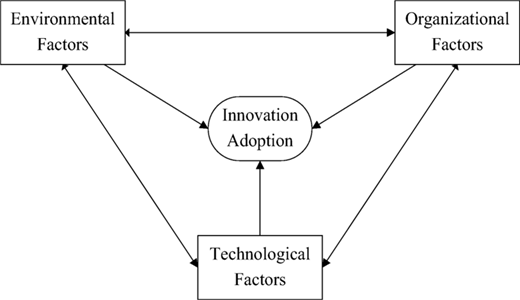
The TOE framework, introduced by Tornatzky et al. (1990), argues that the adoption and implementation of institutional innovations is shaped by three contextual dimensions: technological, organisational and environmental (Figure 1). These dimensions interact to form an ecosystem that influences an entity’s readiness for digital change.
Technological factors concern the technology’s relative advantage, its technical compatibility with existing systems and its potential to streamline complex operational workflows (Baker, 2012; Aduwo et al., 2017). The organisational dimension focuses on internal characteristics and available resources, highlighting the firm’s readiness, strengths and weaknesses before a technological shift (Baker, 2012). The environmental dimension covers the broader context in which a firm operates, including the business ecosystem, industry maturity, competitive pressures and regulation. Together, these dimensions make the TOE framework a robust lens for analysing the drivers of technological integration.
3. Research methodology
This research adopted an iterative, inductive approach to capture insights into the lived reality of I4.0 adoption. Quantitative methods prioritise breadth but often overlook the subjective interpretations and behavioural nuances that shape digital change (Creswell, 2014). Qualitative methods, by contrast, are often more revealing and produce rich data. This is because they capture people’s interpretations of their opinions, attitudes, experiences, processes or behaviours. Through this qualitative lens, this research explores how Australian firms manage the tension between technical potential and operational inertia. It identifies adoption strategies and interrogates the reasoning behind them, offering deeper insight into digital transformation and extending research on advanced technology adoption in the CI.
Semi-structured interviews were used as the primary data collection method, enabling access to nuanced perceptions, unscripted experiences and strategic trade-offs. The flexibility of this method enabled the researcher to pursue unanticipated lines of inquiry through follow-up questions, thereby supporting a comprehensive understanding of I4.0 adoption (Saunders et al., 2009; Walliman, 2011).
Following ethics approval from the Human Research Ethics Committee of the University of Melbourne (Application 1955933.1), this study used purposive and snowball sampling to identify nineteen Australian construction firms actively engaging with I4.0-tech. The focus on mature adopters limits generalisability to the broader, less digitally active industry, but it was a deliberate choice to ensure that findings reflected operational reality rather than speculation. Although adoption intentions may vary by firm size, the study seeks strategic commonalities that cut across organisational scale. It therefore prioritises adaptable mitigation strategies relevant to construction companies with varying resource capacities. Participants were strategic decision-makers, including directors, managers and innovation officers, with a holistic view of the adoption lifecycle (see Table 3). Data saturation was reached when the last three interviews yielded no new codes or strategic themes, indicating sufficient information saturation.
To support preparation and enhance data quality, interview guidelines were distributed in advance. Using a conversational style (Saunders et al., 2009), the interviews combined predetermined questions with dynamic probes to elicit deeper insights. Each semi-structured interview lasted 60–90 min, adhered to ethical protocols and used probing to validate participants’ claims and ensure the depth of data. With participants’ consent, interviews were audio-recorded to ensure accuracy and enable thorough scrutiny during analysis (Fellows and Liu, 2015). Data were content analysed in NVivo 12, using a hybrid inductive-deductive coding strategy (Given, 2008), allowing themes to be refined iteratively across interviews.
Guided by the validity framework of Whittemore et al. (2001) in this study, credibility, authenticity and criticality were prioritised. To ensure authenticity and factual accuracy, all interviews were audio-recorded and transcribed verbatim, enabling direct verification (Maxwell, 1992). Audio files and transcripts were systematically compared to reduce interpretive bias and keep findings grounded in participants’ perspectives.
Credibility was further strengthened through an iterative analysis process that actively pursued data saturation. To support the criticality and integrity of the findings, the findings underwent recursive checking and validation through follow-up interviews (Finlay, 2006). This repeated scrutiny ensured that the identified I4.0 adoption strategies reflected a robust synthesis of industry practice rather than isolated cases, thereby enhancing the transferability of the insights.
4. Research findings
4.1 Analysis of adoption barriers: a taxonomy of digital resistance
The research identified 11 distinct challenges forming a multidimensional barrier to I4.0 adoption. Rather than a uniform set of obstacles, these challenges appear as technological friction that varies with both the technological complexity and dependence on existing site workflows.
Systematic hurdles, such as structural fragmentation and contractual risk-shifting, affect the entire I4.0 landscape, while other barriers are highly technology-specific. For instance, high-fidelity I4.0-tech like digital twins face a computational-literacy gap, whereas mobile computing is mainly constrained by intermittent infrastructure. I4.0 adoption in the CI is therefore a stratified transition, not a binary success or failure, where the severity of each challenge increases with the required level of digital-physical integration. The following sections distinguish between systemic industry constraints and technology-specific operational hurdles.
4.1.1 The return on investment (ROI) paradox: High cost of investment.
The primary barrier to I4.0 is not merely the high capital cost but a fundamental uncertainty about value. As Mgt_13 noted, a system may “cost thousands of dollars and take ten years to pay for itself”, exposing the tension between immediate expenditure and long-term, often intangible, returns. This creates a justification vacuum where, as Mgt_16 stated, “we’re not sure what the benefits are.”
The data suggest that adoption is stalled by a gap in quantifiability. Ten interviewees emphasised that investment feasibility depends on the industry’s ability to measure non-linear gains. The transition also exposes a hidden infrastructure burden. While software-led I4.0-tech, such as BIM or cloud computing, are marketed as accessible, they often trigger a ripple effect of mandatory, expensive hardware upgrades (Mgt_14). Because these technologies are frequently deployed company-wide, the cost is not a localised project expense but a systemic financial strain, pushing firms to prioritise short-term tangible gains over transformative digital evolution.
4.1.2 The integration paradox: Inability of the technologies to adapt.
I4.0 depends on standardisation, but the CI is characterised by project-based uniqueness. Ten interviewees identified limited adaptability as a core challenge, noting that the non-repetitive nature of construction workflows often undermines a technology’s value. As Mgt_16 mentioned, “with most platforms, you have to adapt your way of doing things to the platform”, indicating that current I4.0-tech demands a level of process rigidity that the CI cannot operationally sustain. This forces a trade-off between preserving workflows and fitting the technology, highlighting a significant gap in customisation.
Internal fragmentation also leads to “technological silos”. Nine interviewees argued that the inability to integrate platforms creates isolated pockets of data, with Mgt_7 stating, “We don’t want siloed technology, so we are conscious.” This issue is compounded in multi-regional firms, where decentralised problem-solving results in redundant, incompatible solutions. Since the core promise of I4.0 is systemic integration, siloed technology represents a strategic failure. The transition must therefore move from isolated I4.0-tech adoption towards interoperable ecosystems that enable diverse platforms to communicate without undermining localised processes.
4.1.3 The empirical valuation gap: Lack of case studies and quantifiable results.
The findings point to a quantifiability crisis that goes beyond cost. Fifteen interviewees identified the lack of quantifiable results as a barrier, indicating that the CI lacks the benchmarking data to validate emerging I4.0 investments. This is compounded by a circular dependency; the industry’s limited use of technology (seven interviewees) prevents the very data collection needed to justify its broader adoption. As Mgt_16 noted, this data vacuum makes it “more difficult to do a risk assessment and analysis”, effectively paralysing strategic decision-making.
The data also uncover a temporal misalignment in construction innovation. Mgt_1 highlighted that because “nothing happens in a single day”, meaningful testing requires at least six months, with associated financial burden and substantial sunk costs. While mature technologies like BIM or cloud computing have crossed the certainty threshold, emerging I4.0-tech remains trapped in an innovation paradox. They require long-term, longitudinal testing to prove value, yet the industry’s project-based, risk-averse nature demands immediate, short-term ROI. The key issue is not only the lack of results but the structural inability to fund extended validation for high-risk, low-maturity technologies.
4.1.4 The socio-technical barrier: Identity, trust and resistance.
The data uncover a psychological safety gap. Six interviewees highlighted a lack of user confidence, with Mgt_6 explaining that employees were afraid of “feeling stupid” if they sought clarification. “Fat finger syndrome”, especially with mobile devices, reveals low digital self-efficacy, compounded by age-related computer literacy gaps. This “lack of trust” (Mgt_13) and the persistence of parallel processes, where users secretly maintain traditional methods, undermine systemic adoption. Concerns over surveillance, union involvement and perceived tracking also link I4.0-tech to job loss and privacy risks.
Resistance is also tied to perceived threats to professional autonomy. Construction professionals can see algorithmic problem-solving as devaluing their core competencies. As Mgt_2 noted, they may see a computer solving a problem as an “insult to their professional competence”. This creates significant identity-technology friction, in which technology is seen as a replacement rather than a support for professional judgement.
Across the fragmented supply chain, five interviewees noted that subcontractors prioritise immediate survival over innovation, as “subbies don’t want to look at your alternatives. They just want the lowest price” (Mgt_14). This creates a procurement-innovation deadlock; even when firms wish to innovate, client resistance and a focus on the “lowest price” (Mgt_14) push them back to familiar technologies. Digital evolution is therefore constrained by value perceptions from engineers through to subcontractors and clients.
4.1.5 The collaboration paradox: Fragmented nature.
Six interviewees argued that the main barrier to I4.0 is structural rather than technical, rooted in the antagonism inherent in traditional procurement. Eleven interviewees identified collaboration as the essential catalyst for BIM, digital twins and cloud-based technologies, yet fragmentation creates a compliance gap. As Mgt_2 observed, “the real difficulty with BIM isn’t the technology itself, but how you get everyone in the group to work together to leverage it”, indicating that I4.0-tech are being forced into a system designed for isolation.
A risk-averse deadlock further sabotages data integrity. Four interviewees noted that when construction firms are excluded from early model development, they inherit “undercooked assets” (Mgt_3) while carrying a disproportionate share of the risk of errors. This creates a “non-symbiotic and antagonistic relationship” (Mgt_1), in which the “tendency to pass risk down the chain” discourages use of shared platforms. As Mgt_4 suggested, a collaborative threshold is needed where all consultants contribute equally. Without a shift away from risk-shifting towards symbiotic data-shared responsibility, the systemic benefits of I4.0 will remain unrealised.
4.1.6 The competency stratification: Lack of skills.
Eleven interviewees described a competency stratification where a technology’s “cool factor” masks a steep learning curve (Mgt_11). Technologies such as AR/VR and 3D printing appear “fun” or “gimmicky”, but they share the same intensive modelling requirements as BIM and digital twins. As Mgt_7 noted, value depends on “making sure you’ve got people who know how to use it”, indicating the gap between user perception and operational reality.
In contrast, some lower-complexity I4.0-tech shows a smoother hobbyist-to-professional path. Drones are relatively easy to adopt because existing personal interests and informal learning, such as “training sessions and watching YouTube videos” (Mgt_1), reduce barriers. This creates an uneven skill landscape: while drones benefit from consumer familiarity, digital twins demand advanced computational literacy. Underneath an accessible interface lies a reliance on complex data-modelling skills, the same competencies currently limiting BIM adoption.
4.1.7 The temporal paradox: Modelling intensity vs project dynamics.
There is a temporal misalignment between intensive modelling and the rapid, fast-turnaround projects. In some cases, digital development can take longer than the project itself. As Mgt_3 commented, for a six-week project, “by the time you’ve developed the model to a useful level, the project would already be built.”
Design volatility intensifies this problem. Five interviewees highlighted that “constant changes” from clients (Mgt_4) transform digital models into a source of inefficiency rather than optimisation. When clients “change their mind” and teams spend time “modelling stuff that’s never going through”, the I4.0 asset becomes a sunk-cost liability. To make I4.0 viable, the sector must adopt agile digital workflows that can accommodate change without compromising the project’s critical path.
4.1.8 Long-term utility gap: Poor operational use of the digital models.
Four interviewees described a long-term utility gap that undermines the adoption of high-fidelity digital assets such as BIM and digital twins. This is not merely a technical handover issue but a lifecycle misalignment. As Mgt_4 noted, while “a lot of money and time is invested” in these models, they often stagnate because “there’s no one to maintain them.” Without a post-construction operational strategy, the “live model” becomes a static, depreciating archive.
The data also uncover an over-specification risk, in which the drive for “these incredible assets” (Mgt_4) outpaces the client’s functional capacity. This implies that the value of I4.0 visualisation is context-dependent rather than absolute. Successful adoption, therefore, requires moving beyond maximum detail towards strategic fit, ensuring digital complexity aligns with the client’s long-term maintenance resources to prevent capital loss during the operational stage.
4.1.9 Data integrity gap: Poor information availability and lack of accuracy.
Four interviewees described a data-integrity gap that threatens the reliability of collaborative I4.0-tech such as BIM, digital twins and AR/VR. This reflects not only a technical shortage but also weak collaboration. As Mgt_4 observed, “the program’s only as good as the models you’re getting from all the different parties”, indicating that the lowest-quality input across the supply chain constrains the value of I4.0.
This creates a risk of interdependence: high-fidelity technologies are only as strong as their weakest data contributor. The transition to I4.0, therefore, requires a systemic audit culture rather than isolated tool adoption. As two interviewees suggested, audited data from each consultant is essential to avoid a “garbage-in, garbage-out” outcome that undermines predictive capability.
4.1.10 The governance gap: Lack of standards and guidelines.
Five interviewees reported that outdated contracts hamper the governance of high-integration technologies such as BIM and digital twins. These technologies require radical multi-party transparency, yet adversarial legal frameworks still push liability down the chain rather than fostering collective responsibility. As Mgt_4 observed, “it is the contractual framework that dictates how people work together”, implying that without legal reform, technical integration will remain constrained.
“Restrictions and challenges in getting approvals” for drones (Mgt_13) further highlight a regulatory lag where oversight fails to keep pace with rapid technological advancement. The governance gap is therefore a structural barrier that encourages defensive behaviour. Progress towards I4.0 requires not only technical standards but also collaborative legal protocols that treat project data as a shared asset rather than a liability to be offloaded.
4.1.11 The infrastructure-cloud disconnect: the geospatial digital divide.
The findings show a dependency paradox, with three interviewees identifying network interruptions and unstable internet connections as significant issues. Although I4.0 is promoted as a decentralised, cloud-based solution, it still relies on fragile physical infrastructure. This creates a geospatial digital divide, in which “regional projects with poor connectivity” (Mgt_17) are effectively excluded from real-time innovation due to slow 5G rollouts.
Dependence on on-site network connectivity also introduces intermittency risks largely absent in traditional methods. For “cloud-based” products (Mgt_17), poor infrastructure represents a single point of failure. This reflects a misalignment between advanced software requirements and the reality of regional telecommunications capacity. Sector-wide maturity will depend on overcoming last-mile connectivity constraints that currently limit rural participation in the digital ecosystem.
4.2 Strategic frameworks for digital transformation
The findings identify 11 interrelated strategies that management uses to overcome systemic barriers to I4.0. Rather than standalone interventions, these strategies constitute a socio-technical alignment model that addresses the industry’s core challenges of fragmentation, risk aversion and hierarchical culture.
These approaches can be grouped into four primary pillars: organisational governance (dedicated digital teams and standards), knowledge engineering (targeted training and peer-led champions), strategic de-risking (partnerships and pilot projects) and value validation (quantifying benefits and resource optimisation). Adopted together, they provide a structured pathway for integrating complex digital workflows into traditional site-based environments. The following sections outline the operational mechanics and theoretical significance of each strategy.
4.2.1 Distributed governance: Digital teams and peer advocacy.
Successful I4.0 adoption depends on a structured implementation unit rather than a general mandate. Thirteen interviewees identified dedicated digital teams as the “one-stop” (Mgt_10) hub for transformation, acting as a strategic filter for technology selection. As Mgt_15 noted, this team’s role in evaluating and shortlisting vendors ensures that I4.0 assets are “piloted on-site” before full commitment. In a context where technology often fails due to a “lack of a real plan” (Mgt_1), a dedicated team provides the procedural rigour necessary for “well-coordinated” (Mgt_10) rollouts and long-term compliance.
Peer-led validation is a primary strategy for reducing resistance to top-down directives. Employees are “a lot more accommodating if one of their peers” (Mgt_13) leads the transition, highlighting the importance of “champions” as cultural translators who help colleagues “wrap their heads around” (Mgt_6) complex I4.0-tech. In high-pressure site environments, technical legitimacy is conferred by peers rather than management. Engaging champions, therefore, reframes adoption from a head-office imposition into a grassroots shift, leveraging peer trust to normalise digital workflows within the existing project team culture.
4.2.2 The pedagogical gap: from technical literacy to value perception.
Training is a necessary but insufficient catalyst for I4.0 adoption. Eight interviewees identified training as the primary tool for building a skilled workforce, yet Mgt_2 argued that “training is insufficient to justify or support the usefulness”, exposing a gap between knowing how to use a technology and understanding why it is valuable. For high-complexity I4.0-tech such as BIM, training must therefore extend beyond functional instruction towards value alignment, where a “ton of training” and “constant refresher courses” (Mgt_13) normalise the technology as a core competency.
The data also highlights the importance of a persona-based support framework as central to effective transition. Rather than a “one-size-fits-all” model, Mgt_11 emphasised the need to “support different personas, generations and skill sets”, shifting the focus from the technical features to the user’s adaptive capacity. This produces a stratified learning environment. Low-barrier I4.0-tech, such as drones, benefit from “hobbyist familiarity” (Mgt_1), while complex systems require a tiered training for “beginners, advanced users and experts” (Mgt_13).
A reflexive feedback loop is another critical factor. Regular “internal catchups” (Mgt_18) to “get more out of the programme”, firms transform training from a one-off event into a continuous optimisation process. The “foundation for understanding” is solidified only when training is iteratively tailored to evolving needs, ensuring that the I4.0 investments translate into sustained operational benefits.
4.2.3 The operationalisation mandate: Resource acquisition to continuity.
Five interviewees highlighted a lifecycle funding gap rather than a mere upfront cost issue. I4.0 demands ongoing funding for the entire ecosystem (hardware, software and skill retention), reframing technology from a one-off capital expense to a continuing operational requirement. As Mgt_4 observed, “once you invest in them, then you have to operationalise it”, indicating that procurement is merely the entry fee for a long-term commitment.
Resource planning emerges as essential for continuity. Without sustained liquidity, firms risk abandoning technologies due to upgrade costs or staff turnover. Effective adoption, therefore, requires shifting from procurement-focused budgeting to an operationalisation framework that treats digital infrastructure as a permanent, evolving need rather than a static, project-specific asset.
4.2.4 The contextual value-realisation: Exposure and understanding of the technology.
I4.0 adoption is driven more by job-specific needs than by general technological awareness. Thirteen interviewees identified user exploration as key to reducing resistance rooted in a limited understanding of personal benefits. As Mgt_2 explained, the challenge is helping people to “understand how technologies improve their work”, making adoption a matter of judgement. Resistance is often a rational response to perceived irrelevance, which only direct experience can overcome.
The data also identifies divergent stakeholder value propositions. Clients emphasise “cheaper, lower-risk construction”, while firms focus on how it helps them “win more contracts” (Mgt_1). This reveals a stratified incentive structure in which generic awareness is insufficient for industry-wide transition. As Mgt_14 noted, once users “saw the value in speeding up processes, they’ve all got on board”, indicating that perceived usefulness drives onboarding. Implementation must therefore move beyond generic demonstrations towards tailored value propositions that align with the economic and operational incentives of each stakeholder group.
4.2.5 Pilot projects: as an experiential de-risking strategy.
I4.0 adoption is shaped by a confidence-need loop that only real-world application can trigger. Six interviewees identified pilot projects as a primary means of reassurance, offering the empirical evidence required to move both management and users from scepticism to commitment. As Mgt_7 noted, these trials create a platform for understanding a technology’s benefits and value, making observational learning a prerequisite for institutional trust in the CI.
Pilots also serve as diagnostic tools for identifying “what was working, what wasn’t” (Mgt_11), providing a contextualised learning experience that far exceeds generic demonstrations. By showing how technology affects day-to-day work, pilots prevent the engagement decay described by Mgt_16, where a lack of visible benefits leads people to “lose interest”. Mgt_6’s experience suggests that pilots can trigger a paradigm shift, fundamentally changing professional “views and thoughts” through direct exposure. The benefits of I4.0 are thus often retrospective and cumulative. While difficult to quantify at the outset, continued use in a pilot framework supports retrospective value assessment, turning a high-risk innovation into a validated operational standard.
4.2.6 The value-validation mechanism: Access to quantifiable benefits.
Appreciation of I4.0 is not an organic by-product of adoption but is built through empirical persuasion. Seven interviewees pointed to formal processes for quantifying benefits as the primary strategy to move beyond anecdotal success. As Mgt_11 explained, this requires a shift from subjective use to objective measurement: “We started measuring time savings. We engaged with the users to show them the value they were getting.” In a low-margin, risk-averse industry, I4.0-tech face a proof-of-need burden that only solid data can meet.
Quantification functions as a psychological bridge. By translating abstract technical features into tangible time savings, firms lower the perceived complexity and cost of digital transition. This creates a feedback-loop dependency. When users see the digital dividend in measurable terms, resistance declines and institutionalised adoption becomes more likely. The ability to measure value is therefore as critical as the technology itself, providing an essential evidence tool to justify I4.0 investment to both the workforce and the firm.
4.2.7 Institutional stabilisation: Standards, audit and procedures.
To progress beyond ad hoc experimentation, I4.0 adoption requires procedural formalisation. Fourteen interviewees stressed the importance of internal and inter-stakeholder protocols as core strategies for managing compliance and risk. As Mgt_17 noted, this includes developing specific protocols for “setting up projects, around the technology, use of it and the processes for applying it and how to scope it within a contract.” In the CI, technology is therefore not plug-and-play but must be contractually and operationally anchored to function as a deliverable.
The data also identifies a parallel-process risk, whereby users revert to traditional methods if a technology’s role-specific value is unproven. To counter this, firms need a utility-audit cycle. As Mgt_14 stated, “You need to audit and make sure you are using it that way.” Standards thus operate as behavioural guardrails, embedding digital workflows in specific roles rather than leaving them as optional add-ons.
Furthermore, the data points to a maturity-mandate threshold. Mandates tend to be effective only for stabilised I4.0-tech, such as cloud computing or large-scale BIM, whereas “infant technologies” (Mgt_18) may require continued flexibility and iterative validation before formal enforcement.
4.2.8 Integration as a mitigant: Strategic change management.
The main point of failure in I4.0 adoption is not technical but an integration-support gap. Four interviewees noted that without a formal change management process, users become overwhelmed and either abandon or underuse the technology. As Mgt_2 stated, “technology rollouts often fail because there’s no real plan. They just hand you a new tool and tell you to use it”, indicating that delivery is often mistaken for adoption.
Contextual integration is the catalyst for sustained use. Instead of isolated training, users must be supported to “integrate it into their day-to-day” (Mgt_2). Rollouts must connect new digital interfaces to existing site-based workflows. A formal change management framework provides psychological and operational support, aligning technical capabilities with daily work.
4.2.9 Cultural catalyst: Top management leadership.
Ten interviewees indicated that I4.0 adoption in construction is driven by top-down cultural leadership rather than by a democratic consensus. In an “instructional, not democratic” (Mgt_1) industry, a centralised mandate is needed to overcome institutional inertia. As Mgt_1 observed, the sector remains an “alpha male type environment, where things tend to happen when the boss orders them”, indicating that without explicit executive backing, digital initiatives are likely to be ignored or resisted at the project level.
Leadership also acts as a de-risking signal. When top management leads implementation, it aligns fragmented project teams. In the CI, technology adoption depends less on bottom-up user acceptance and more on strategic authority. Strong leadership disrupts traditional work patterns and positions I4.0-tech as non-negotiable professional standards rather than optional tools.
4.2.10 Socio-technical normalisation: Organisational cultural change.
I4.0 adoption is fundamentally a cultural recoding process. Fifteen interviewees identified a positive environment as essential for moving beyond the traditional construction “modus operandi” (Mgt_1). Adoption is not merely a technical upgrade but a strategic mindset shift, in which leadership must foster a culture where users are “open to new ideas.” As Mgt_17 noted, a change in the “attitude of some of our managers” acts as a “game-changer”, indicating that cultural permission precedes technical execution.
Procedural enforcement is the mechanism for stabilising this shift. To avoid a “regression to tradition”, firms must implement a “gradual approach” with a strong commitment. For instance, by “not accepting paper anymore” (Mgt_13), firms compel digitalisation of daily routines. Standards and guidelines act as behavioural anchors, making digital practices “officially recognised” and non-negotiable.
The study also highlights the value of the synergy between cognitive diversity and innovation. Combining “young brains” (innovative thinking) with “old brains” (technical feasibility), firms create a feasibility-innovation loop (Mgt_1). This collaborative mix ensures that new ideas are grounded in reality while allowing employees to “be part of the solution” (Mgt_18). Cultural change is thus participatory and intergenerational, shifting employees from passive recipients of technology to active architects of digital transformation.
4.2.11 The partnership model: De-risking and knowledge transfer.
The findings show that construction firms use partnerships to de-risk I4.0 adoption in a high-capital, high-uncertainty context. Instead of incurring permanent overheads, 17 interviewees reported relying on external partners to address skill shortages and high investment barriers. This supports an as-a-service model in which partners “provide their expertise, particularly on their hardware” (Mgt_7), allowing firms to avoid the sunk costs of unproven technology.
These collaborations act as a temporary capability bridge. By using “resources from industry expert partners to build the capability” (Mgt_4), firms enable a controlled knowledge transfer and reduce the internal learning curve. Implementation becomes a validation pilot rather than a high-risk gamble, allowing evaluation before full commitment. Partnering thus functions not just as outsourcing but as a core transformation strategy that helps firms remain agile while embedding complex, emerging technologies into core workflows.
5. Discussion
While the Australian CI is undergoing a digital transition, adoption remains fragmented and is characterised by a “wait-and-see” paradox. A small group of firms act as innovators, while the majority behave as late adopters who prefer to observe early entrants before committing resources. This hesitation points to a diffusion gap driven by deep-seated systemic barriers that outweigh the perceived relative advantages of I4.0-tech.
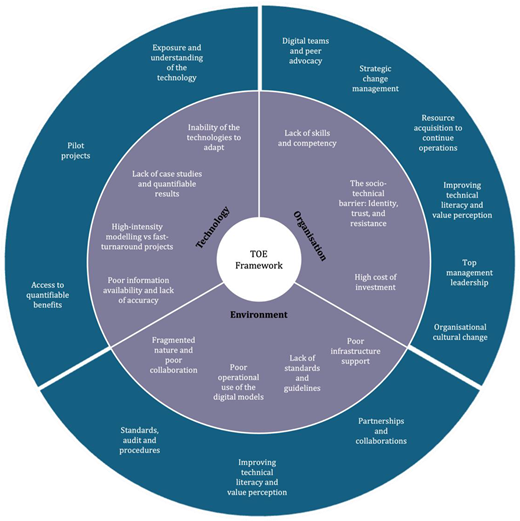
Accordingly, this research adopts a socio-technical lens to investigate the implementation of I4.0-tech, including AI, AR, VR, BIM, cloud computing, digital twins, drones, laser scanning, 3D printing, mobile computing, RFID, robotics and sensors. Rather than treating adoption as a purely technical exercise, this study examines the causal relationship between industry challenges and the strategies needed to address them. By identifying 11 core challenges and 11 corresponding strategies (summarised in Figure 2), the research explains why particular patterns of resistance emerge and how targeted strategic interventions can realign the industry’s structural and cultural systems to support a more rapid and effective digital evolution.
5.1 Discussion on the identified challenges
5.1.1 Technology-related challenges: the integration-customisation gap.
I4.0 adoption is limited not by the availability of technology, but by a misalignment between digital logic and on-site reality. Consistent with previous research, the inability to adapt to existing processes suggests a rigidity barrier, whereby off-the-shelf technologies rarely match the bespoke nature of construction projects (Bargstädt, 2015; Ayinla and Adamu, 2018; Nnaji and Karakhan, 2020). This research extends prior studies by identifying personalisation as a functional necessity. Without customisation, the technology remains an external imposition rather than an integrated asset.
Furthermore, the findings reveal a dependency on data collaboration. For high-fidelity technologies such as BIM, digital twins, AR/VR and 3D printing, the availability of accurate data (Criminale and Langar, 2017; Al-Hammadi and Tian, 2020) is not merely a technical variable but a governance outcome. Poor collaboration creates a data vacuum, indicating that technical accuracy depends on shared standards and guidelines. The research also confirms a utility-proof burden (Criminale and Langar, 2017; Ayinla and Adamu, 2018; Nnaji and Karakhan, 2020; Arabshahi et al., 2021), in which the absence of quantifiable results leads to a perceived lack of usefulness. This is compounded by a temporal mismatch. The long time required for model development (Azhar et al., 2008; Bryde et al., 2013; Criminale and Langar, 2017) often exceeds the relatively short construction timelines of many projects. Consequently, the value of BIM and digital twins is frequently deferred and if the models are not maintained during the operation, the initial investment becomes futile. Overall, this reveals that the primary challenge lies not in the technological speed but in the industry’s short-term procurement cycles, which fail to support long-term digital lifecycle management.
5.1.2 Organisation-related challenges: Risk-aversion and the familiarity gap.
I4.0 adoption is shaped by a valuation crisis, in which high investment costs are not merely financial figures but symptoms of a perceived-value deficit (Gardezi et al., 2014; Ayinla and Adamu, 2018; Delgado et al., 2019; Al-Hammadi and Tian, 2020; Nnaji and Karakhan, 2020; Arabshahi et al., 2021). Consistent with Arayici and Coates (2012), limited evidence of benefits and asymmetric risks means immediate capital costs outweigh uncertain long-term gains. In the CI, firms therefore appear less price-sensitive than certainty-sensitive, a claim that still requires empirical evidence to overcome institutional hesitation.
The research also identifies a competency-complexity threshold. While skills shortages are a well-known systemic issue (Ayinla and Adamu, 2018), this study extends existing theory by uncovering a familiarity-utility paradox. Technologies, such as drones and AR/VR, often face less resistance because they are seen as enjoyable and simple, reflecting their use in hobbies. Technology transfer is thus more effective when I4.0-tech aligns with the workforce’s existing cognitive schemas, reducing fear of the new.
Stakeholder resistance is also rooted in socio-psychological friction (Sardroud, 2012; Smith, 2014a; Al-Hammadi and Tian, 2020). The research finds that resistance is not only professional but also driven by personal anxieties. I4.0-tech can be perceived as threats to individual competence or to existing power structures (e.g. union arrangements), creating a human-centric barrier. Organisational challenges should therefore be seen as a socio-technical mismatch in which technological complexity exceeds the industry’s current cultural and cognitive readiness.
5.1.3 Environmental and legal challenges: the infrastructure-governance nexus.
I4.0 adoption is tightly linked to a geospatial digital divide. While prior literature generally identifies unstable internet as a challenge (Schwab, 2017; Arabshahi et al., 2021), this research identifies a specific infrastructure-interruption risk in Australia. The barrier is not a national shortfall but a localised failure in regional 5G rollouts, indicating that the digital transition is physically constrained by regional telecommunications policy.
The data also reveal a dependency on governance and collaboration. Consistent with Musa et al. (2016) and Delgado et al. (2019), a lack of collaboration remains a key barrier, but this study traces its root cause to contractual antagonism. Current main contracts impose a zero-sum risk management strategy that fosters non-symbiotic, antagonistic relationships, directly contradicting the data-sharing demands of BIM and cloud computing. This exposes a legal-technological mismatch. I4.0 requires radical transparency, yet poorly defined contractual frameworks still incentivise risk-shifting (Ayinla and Adamu, 2018; Al-Hammadi and Tian, 2020; Arabshahi et al., 2021). Thus, technology adoption cannot rely on software alone; it also requires institutional re-anchoring and a move towards collaborative legal protocols and standards that shift stakeholder relationships from adversarial to symbiotic, creating the trust-based infrastructure needed for high-fidelity digital integration.
5.2 Discussion of the identified strategies and the approaches
5.2.1 Technological strategies: Value validation.
This research framed technological strategies in terms of perceived relative advantage and identified a relevance gap that generic demonstrations fail to bridge. To address this, the study extends Ayinla and Adamu (2018) and Shojaei and Burgess (2022), arguing that quantifying benefits through pilot projects can empirically de-risk adoption when pilots use real-life examples tied to users’ daily work and are grounded in contextual value-realisation (Mansour et al., 2023; Soltani et al., 2023). Thus, while pilot projects provide useful exposure, I4.0 adoption is driven mainly by job-specific needs rather than general technological awareness.
5.2.2 Organisational strategies: Governance and cultural re-coding.
While champions can initiate change (Fernandes et al., 2006; Gambatese and Hallowell, 2011), this study extends IDT by identifying the digital team as a key strategic filter (Shojaei and Burgess, 2022). By centralising the selection-to-compliance lifecycle, the team acts as a structural anchor, explaining why coordinated governance produces more stable outcomes than fragmented, ad hoc adoption. This shifts I4.0 integration from an informal, individual effort to a systemic organisational capability, aligned with firm-wide standards. Formalisation keeps adoption coordinated through five key contributions: change management, technology selection, user support, standards and informed decision-making, reducing the risk of a regression to traditional workflows.
To be effective, a technology-positive culture must move beyond informal encouragement (Shojaei and Burgess, 2022) and be explicitly embedded in the firm’s mission and strategy. Within the organisational pillar of the TOE framework, this creates a highly decisive top-down mandate (Taher, 2021; Gledson et al., 2023) that helps overcome the CI’s inherently rigid and hierarchical nature. By aligning digital transformation with the core corporate identity, leadership provides the institutional legitimacy needed to counter resistance and positions I4.0 adoption as a core strategic priority rather than an optional add-on. This research also identifies change management as essential for preventing parallel processes. Without clear structural enforcement, users may exploit loopholes and revert to familiar, non-digital methods, leaving the technological transition incomplete.
The study further reframes training as a pedagogical, not merely technical, intervention within the organisational pillar (Manley and McFallan, 2006; Gambatese and Hallowell, 2011; Ayinla and Adamu, 2018; Shojaei and Burgess, 2022). Effective I4.0 adoption requires training that forms the cognitive basis for perceived value. Tailored, feedback-informed instruction helps align complex technological demands with existing cognitive schemas. This explains why one-size-fits-all programmes often fail; without role-specific alignment, the technology remains a conceptual burden rather than a functional part of professional identity.
As a unique contribution, this study identifies resource operationalisation as a critical success factor in this TOE pillar. I4.0 adoption often fails due to an acquisition trap, where technologies are purchased without adequate funding for ongoing operational costs. Reframing expenditure from one-off capital expenditure to sustained investment in enabling conditions supports deep long-term integration. High investment cost (Gardezi et al., 2014) should thus be understood as a lifecycle funding requirement. Without a budget for continuous support, initial digital investments risk becoming stranded assets rather than embedded organisational capabilities.
5.2.3 Environmental strategies: External resource synergy.
Within the environmental pillar of the TOE framework, the findings indicate that standards and procedures serve as procedural anchors, ensuring that all stakeholders share a common understanding (Manley and McFallan, 2006; Ayinla and Adamu, 2018).
The study also identifies collaborative de-risking as a crucial strategy for managing the complexity of I4.0. Building on Zahrizan et al. (2013), findings indicate that strategic partnerships operate as an external capability bridge, allowing firms to test technologies before committing capital. This approach shifts the risk of unproven innovations to specialised collaborators who provide the resources and user support missing internally. By leveraging these external networks, firms can avoid steep learning curves and high failure rates associated with isolated adoption, transforming environmental uncertainty into a manageable, shared transition.
Moreover, within the environmental and organisational pillars of the TOE framework, the research identifies hybrid support models as the key means of overcoming persistent skill shortages. By combining exposure and training delivered by internal teams and external technology providers, firms can draw on specialised expertise to bridge capability gaps.
6. Conclusion
This study examined systemic adoption strategies to overcome the I4.0 challenges in the CI, identifying that barriers are not only technical but stem from organisational inertia and weak relational structures. Using insights from mature adopters, this research provides a strategic roadmap for digital transformation that prioritises long-term value realisation over simple technology acquisition.
6.1 Theoretical implications: Extending the technology-organisation-environment framework
This research advances innovation diffusion and TOE theory by clarifying how successful implementation occurs. It identifies the digital team as a strategic filter connecting top-down mandates to bottom-up user concerns. It also introduces procedural anchoring, arguing that standardisation is a psychological necessity to stop users running parallel, non-digital processes, not just a technical requirement. Finally, it reframes training from functional instruction to persona-based alignment, ensuring technologies fit workers’ cognitive schemas and professional identities.
6.2 Managerial and practical implications
For practitioners, the study offers practical guidance to stabilise I4.0 adoption. Managers should move beyond upfront cost models and explicitly budget for ongoing operational expenses and hardware refresh cycles to avoid the acquisition trap. To reduce stakeholder hesitation, it recommends pilot projects grounded in real-world use cases that demonstrate clear, job-specific value. Organisations can also close internal skills gaps through hybrid support models that combine internal teams with external technology providers, maintaining user support as in-house digital capability grows.
6.3 Policy, contractual and regulatory implications
The findings point to an urgent need for institutional change led by regulators and professional bodies. Contracts should shift from adversarial risk allocation to collaborative models (e.g. integrated project delivery) that reward information sharing and shared digital risk. Industry bodies should establish unified digital standards to enable inter-organisational compatibility. At the policy level, the study argues that while I4.0 strategies may be broadly applicable, implementation capacity differs; regulators should therefore consider targeted support to build SME digital literacy and ensure industry-wide progress towards I4.0 parity.
6.4 Limitations and future research directions
Although the findings are highly relevant to firms in high-cost, highly regulated environments, the qualitative focus on Australian firms limits statistical generalisability. Future research should test these strategies across sectors and regions, including different sub-sectors such as civil infrastructure and residential construction. While this study notes that adoption intentions vary across small, medium and large firms, it focuses on cross-cutting strategic commonalities. Follow-up work should examine how these strategies are tailored for different firm sizes and sectors. Longitudinal studies are also needed to quantify I4.0 benefits over time and to develop robust, evidence-based investment models for the wider industry.