Sustainable building designs and practices (SBDPs) are increasingly recognised worldwide for their potential to enhance environmental sustainability, reduce resource consumption and improve occupant well-being. In New Zealand, however, the integration of energy efficiency (EE), water efficiency (WE) and indoor environmental quality (IEQ) remains a critical but underexplored area. This study aims to investigate the combined benefits, challenges and recommendations associated with integrating EE, WE and IEQ in advancing SBDPs within the New Zealand context.
Semi-structured interviews were undertaken with 43 experts engaged in sustainable building initiatives. Thematic analysis was used to explore stakeholder perspectives on the benefits, challenges and recommendations associated with EE, WE and IEQ integration.
The findings reveal that EE is widely regarded as a fundamental driver of sustainable buildings, but cost concerns, weak regulations, and market-driven priorities constrain its implementation. WE is frequently overlooked, despite its potential to support water conservation, owing to perceptions of resource abundance, limited policy support and financial barriers. IEQ is increasingly valued for its role in promoting occupant health, comfort and productivity, but regulatory and awareness gaps remain significant.
This study provides one of the first holistic assessments of EE, WE and IEQ integration in SBDPs in New Zealand. By framing New Zealand as a testbed for countries with high renewable potential, abundant water resources and weak regulatory enforcement, the research advances academic discourse while delivering actionable insights for policymakers, practitioners and investors to promote meaningful sustainability transitions in the built environment.
Abbreviation
- BREEAM
= building research establishment environmental assessment method;
- EE
= energy efficiency;
- GHG
= greenhouse gas;
- HVAC
= heating, ventilation and air conditioning;
- IAQ
= indoor air quality;
- IEQ
= indoor environmental quality;
- IoT
= internet of things;
- LEED
= leadership in energy and environmental design;
- MBIE
= Ministry of Business, Innovation and Employment (New Zealand)
- NABERS
= National Australian Built Environment Rating System;
- NZ
= New Zealand;
- NZEBs
= net-zero energy buildings;
- NZ Herald
= New Zealand Herald;
- O&M
= operation and maintenance;
- SBDPs
= sustainable building designs and practices;
- SBRS
= sustainable building rating systems;
- SDGs
= sustainable development goals;
- UK
= United Kingdom;
- VOC
= volatile organic compound;
- WE
= water efficiency; and
- WGBC
= World Green Building Council.
1. Introduction
The prominence of sustainable building designs and practices (SBDPs) has increased substantially in recent years, particularly in developed economies, as they offer effective pathways to reduce environmental impacts, improve resource efficiency and enhance occupants’ quality of life (Poorisat et al., 2024). Globally, international organisations such as the World Green Building Council advocate net-zero energy buildings (NZEBs) as a critical mechanism for achieving decarbonisation targets, primarily through the integration of renewable energy systems, energy-efficient design and advanced building technologies (Poorisat et al., 2024). Within this discourse, energy efficiency (EE), water efficiency (WE) and indoor environmental quality (IEQ) are widely recognised as core pillars of sustainable building performance. They are closely aligned with multiple United Nations Sustainable Development Goals (SDGs), particularly SDGs 3, 6, 7, 11, 12 and 13 (United Nations, 2022). These dimensions also underpin major sustainable building rating systems (sbrs), including LEED, BREEAM, Green Star and NABERS, which increasingly shape building design practices and investment decisions worldwide (Doan et al., 2021). A growing body of international literature has examined EE, WE and IEQ within the context of sustainable buildings (Alawneh et al., 2018; Greer et al., 2019). Studies on EE have predominantly focused on reducing energy demand through building envelope optimisation, HVAC system performance, and post-occupancy energy outcomes (Hafez et al., 2023; Magrini et al., 2020). Moreover, studies on WE have explored water-saving technologies, rainwater harvesting, greywater reuse and the water–energy nexus, particularly in regions experiencing water scarcity (Rodrigues et al., 2020). Meanwhile, IEQ research has largely centred on indoor air quality (IAQ), thermal comfort, lighting, acoustics and their impacts on occupant health, productivity and well-being, with heightened attention following the COVID-19 pandemic (Bennett et al., 2022). While these studies provide valuable insights, they have tended to examine EE, WE and IEQ either independently or in pairwise combinations, often adopting a predominantly technical or performance-based perspective.
Despite increasing recognition of the interdependence among EE, WE and IEQ, there remains a notable lack of empirical studies that simultaneously integrate all three dimensions within a unified analytical framework, particularly from a stakeholder-driven perspective. Existing research frequently overlooks how governance structures, market dynamics, regulatory environments and socio-cultural factors collectively shape the adoption and implementation of integrated SBDPs across different contexts. Moreover, much of the current literature is concentrated in regions with strong regulatory frameworks or acute resource constraints, such as Europe (Giorgi et al., 2022), North America (Perera et al., 2025) and parts of Asia (Yang et al., 2023), leaving other contexts underexplored in comparative sustainability research.
For example, in Europe, Giorgi et al. (2022) conducted interviews across five European countries to examine circular economy strategies at the building level. Their analysis focused on policy application and practices related to resource and waste management, design for reversible buildings, and business networking within the construction value chain; however, it did not explicitly address EE, WE or IEQ integration. In North America, Perera et al. (2025) identified 19 interrelationships between EE and IEQ through a systematic literature review, yet their study did not incorporate stakeholder perspectives. Similarly, Opoku, Agyekum and Ayarkwa (2022) examined the drivers of environmental sustainability in construction projects in Ghana using semi-structured interviews with built environment professionals. While their findings highlighted green design, policies, regulations and competitive advantage, these studies did not explicitly examine the integrated roles of EE, WE and IEQ.
Within this broader global gap, New Zealand presents a compelling case for research and intervention in SBDPs, accounting for 22% of total final energy consumption (IEA, 2022) and 20% of total emissions (Bell, 2022). New Zealand benefits from a high share of renewable energy (80%), led by hydropower (50%), geothermal (19%) and wind (5–6%) and around 60% of the grid is supported by advanced metering systems, creating opportunities to enhance EE (EECA, 2025). Government initiatives, such as the Net Zero Carbon Roadmap for Aotearoa’s Building set clear targets, zero carbon for new buildings by 2030 and all buildings by 2050, providing measurable goals for decarbonisation (Skellern, 2021). Interestingly, these natural advantages coexist with comparatively weak regulatory enforcement, slow updates to building codes and limited mandatory sustainability requirements. As a result, EE, WE and IEQ are often treated as optional or fragmented considerations rather than as integrated priorities within SBDPs.
To date, no study has comprehensively examined the combined integration of EE, WE and IEQ as interdependent components of SBDPs, particularly through the perspectives of multiple stakeholder groups. This gap constrains both theoretical advancement and practical implementation, as fragmented approaches fail to capture critical trade-offs, synergies and governance challenges inherent in sustainable building delivery. Accordingly, this study investigates the integration of EE, WE, and IEQ as interconnected dimensions shaping SBDPs, drawing on insights from key stakeholders across the built environment sector in New Zealand. Specifically, it addresses two research questions:
How do the contributions of integrating EE, WE and IEQ shape and influence SBDPs in New Zealand?
How do stakeholders perceive and articulate strategies and recommendations for enhancing EE, WE and IEQ within SBDPs in New Zealand?
By adopting a stakeholder-informed qualitative approach, this study moves beyond purely technical evaluations to reveal how regulatory frameworks, market priorities and sociocultural dynamics influence sustainability outcomes in practice. The perspectives from producers, policymakers, academics, investors and building users provide context-rich evidence that supports evidence-based decision-making, enabling policymakers to refine regulation, investors to align sustainability with long-term value, producers to innovate and users and academics to advocate for healthier and more efficient buildings. While grounded in the New Zealand context, the findings offer broader relevance by positioning New Zealand as a testbed for countries characterised by high renewable energy potential, relative resource abundance and weak regulatory enforcement. In doing so, this study contributes systems-level insights that extend international scholarship on SBDPs and offers transferable lessons for the countries seeking to reconcile ambitious climate goals with practical implementation.
2. Literature review
2.1 Sustainable building designs and practices as socio-technical systems
SBDPs are increasingly conceptualised as socio-technical systems, where sustainability outcomes emerge from interactions among technologies, regulation, professional routines, organisational arrangements and occupant behaviour, rather than from design decisions alone (Poorisat et al., 2024; Seo Yoo et al., 2024). This perspective helps explain persistent intent–performance gaps and the limits of purely technical accounts of building sustainability (Broday and Gameiro da Silva, 2023; Seo Yoo et al., 2024). To frame these system interactions, this study adopts the multi-level perspective (MLP), which explains transitions through the interplay between landscape pressures, dominant regimes, and niche innovations (Geels, 2019; Phan et al., 2026). Landscape pressures, including climate change, water stress, demographic and public-health risks) create urgency for change regimes, stabilise existing practice through codes, standards, certification systems and established workflows (USGBC, 2022, 2023). Niche innovations provide protected spaces for experimentation and learning that may disrupt regime lock-in (Geels, 2019; Phan et al., 2026). Table 1 summarises how MLP has been applied in the building sustainability literature and highlights a core implication for SBDPs: fragmentation is largely structural and institutional, not simply technical. Regimes tend to reinforce EE-centric and siloed implementation, while niche practices, such as integrated EE–WE–IEQ approaches and post-occupancy evaluation, offer pathways to more holistic, performance-oriented outcomes (Niza et al., 2023; Oyalowo et al., 2020). This framing underpins the following sections, which examine how EE, WE and IEQ have been institutionalised unevenly and why integration remains challenging.
2.2 Energy efficiency: the dominant sustainability regime
EE is the most institutionalised sustainability dimension in building practice, embedded in regulations, minimum performance standards, national strategies and certification schemes, for example, LEED, Green Star and BEEC (Poorisat et al., 2024; Ullah et al., 2019). These instruments frequently position energy performance as the primary operational proxy for sustainability (Greer et al., 2019; Hafez et al., 2023). Table 2 synthesises empirical EE evidence across international and New Zealand contexts. Overall, studies report measurable energy improvements in some settings (Clay et al., 2023; Hafez et al., 2023), but also persistent performance gaps between predicted and operational outcomes and inconsistent benefits across certification levels (Poorisat et al., 2024; Saha et al., 2021). Regime dominance can also encourage narrow optimisation, where EE targets are pursued in isolation and may generate trade-offs that marginalise WE and IEQ (Pedersen et al., 2021; Poorisat et al., 2024). Accordingly, EE appears necessary but insufficient for sustainable building performance, motivating the need to examine WE and IEQ and the conditions required for integration.
2.3 Water efficiency: an unevenly embedded sustainability dimension
Compared with EE, WE has developed through a more fragmented institutional trajectory, despite growing landscape pressures, including climate change, drought risk, population growth and urbanisation, that elevate its strategic importance (Bint et al., 2019; Challies et al., 2022). WE remains inconsistently embedded in dominant building regimes and assessment frameworks (Bint et al., 2019). Table 3 indicates that WE outcomes are most consistent where governance mechanisms provide clear signals, such as mandatory requirements, structured audits and benchmarking, supporting verifiable savings (Mohd Zaini et al., 2021; Rodrigues et al., 2020). In contrast, voluntary and point-based approaches show mixed outcomes, including weak differentiation between certified and non-certified buildings and high variability in environmental impacts per WE credit (Greer et al., 2019; Luo et al., 2021).
In New Zealand, the evidence base remains limited and comparatively dated. Building-scale studies show technical feasibility of rainwater harvesting and greywater reuse, but modest network-level savings and tariff sensitivity that weaken system incentives for uptake (Bint, 2012). Urban-scale studies indicate progress in metering and awareness, yet adoption remains uneven and weakly connected to building action (Bint et al., 2019). At the policy level, water-abundance narratives and allocation-focused governance have historically marginalised demand-side efficiency, constraining WE institutionalisation (Challies et al., 2022). Collectively, the literature suggests WE performance is shaped less by technical feasibility than by regulatory strength, data visibility and pricing structures, explaining its secondary status within SBDPs.
2.4 Indoor environmental quality: high-impact but marginalised
IEQ has increased in prominence due to its impacts on health, comfort, cognitive performance and productivity, with COVID-19 further intensifying attention to indoor air risks (Anand et al., 2022; Bennett et al., 2022). IEQ spans thermal comfort, ventilation, lighting, acoustics and material emissions, and is highly sensitive to operation and user behaviour (Poorisat et al., 2024). Table 4 synthesises evidence showing that IEQ improvements are associated with well-being and satisfaction outcomes and that ventilation has measurable public-health relevance in contexts where indoor pollutants often exceed outdoor levels (Bennett et al., 2022). However, institutionalisation remains weak: measured IEQ gains can involve energy trade-offs and operational variability (Elnaklah, Walker, and Natarajan, 2021). While harmonised VOC testing frameworks exist in parts of Europe, implementation and enforcement remain incomplete (Scutaru and Witterseh, 2020). In New Zealand, IEQ governance is largely prescriptive and compliance-based, with limited post-occupancy verification and weak enforcement (Ade and Rehm, 2020), alongside procedural gaps in assessment and monitoring (Kabir and Morgan, 2021). While user-preference evidence highlights demand for ventilation, fresh air, comfort, noise reduction and partial control, empirical measurement remains limited (Rasheed and Rotimi, 2022). Overall, IEQ is a high-impact but marginalised dimension that is weakly embedded relative to EE, reinforcing sustainability fragmentation and the need for integrative approaches (Elnaklah et al., 2021).
Against this international background, New Zealand exhibits both similarities and notable deviations in its socio-technical configuration. At the landscape level, the country benefits from a low-carbon electricity grid, relative water abundance and advanced metering technologies, creating favourable conditions for energy efficiency improvements comparable to other nations with high renewable energy penetration (Cielo and Subiantoro, 2021). However, at the regime level, New Zealand lacks a comprehensive and mandatory sustainable building certification framework, and progress towards NZEBs has been comparatively slow (Doan et al., 2021; Hall and Pertrass, 2022). This regulatory gap contrasts sharply with the European Union, where increasingly stringent building performance standards are enforced through legally binding mechanisms under the Energy Performance of Buildings Directive (EPBD), most recently strengthened in May 2024 to mandate performance improvements across both new and existing buildings (European Commission, 2026). The contrast is particularly pronounced in the domain of WE. In water-scarce contexts, WE has evolved from a niche concern into a regime-level priority, supported by mandatory rainwater harvesting, greywater reuse and robust benchmarking systems (Yalin et al., 2023)
In New Zealand, however, long-standing perceptions of water abundance have contributed to regime lock-in, reducing the perceived urgency of demand-side efficiency (Challies et al., 2022). While cities such as Auckland have made progress in water metering and demand management, implementation remains uneven and weakly supported by policy or public engagement (Bint et al., 2019). The Three Waters Reform Programme represents a significant landscape-level intervention (MBIE, 2021), yet building-level performance data, benchmarking frameworks and recent empirical studies remain limited. Notably, the most comprehensive investigation of commercial building water performance in New Zealand dates back more than a decade (Bint, 2012), highlighting a substantial evidence gap relative to international best practice. By contrast, Australia’s BASIX scheme mandates substantial residential water reductions (Fane et al., 2024), while Israel integrates national and building-level systems to treat and reuse nearly 90% of its wastewater (Yalin et al., 2023)
IEQ represents a further area of divergence. In several countries, IEQ has been institutionalised through explicit regulations governing IAQ and material emissions. Germany’s Committee for Health-related Evaluation of Building Products (AgBB), for example, embeds mandatory VOC emission testing directly into building codes rather than treating IEQ as an optional sustainability credit (Scutaru and Witterseh, 2020). In contrast, IEQ in New Zealand remains weakly regulated. Inadequate insulation and heating affect a large proportion of the housing stock, contributing to adverse health outcomes (Ade and Rehm, 2020). While outdoor air quality is regulated under the Resource Management Act (1991), IAQ remains largely unregulated, limiting accountability and consistency in IEQ performance (Kabir and Morgan, 2021). Empirical IEQ research in the New Zealand context also remains limited, reinforcing the need for context-specific evidence and stronger policy frameworks (Rasheed and Rotimi, 2022).
Overall, despite extensive international research on EE, WE and IEQ, relatively few studies examine their combined effectiveness through an integrated, systems-oriented, and stakeholder-informed lens. This fragmentation constrains both theoretical development and practical implementation, as stakeholders lack holistic evidence to navigate trade-offs, synergies, and governance challenges across multiple system levels. Given the interconnected nature of EE, WE and IEQ, a deeper understanding of their combined impacts is essential for advancing sustainable building transitions (Abdelaal and Guo, 2021). In the New Zealand context, the absence of comprehensive legislation and the slow uptake of integrated sustainability approaches further amplify the need for focused and contextually grounded research (Doan et al., 2021). By addressing these gaps, this study contributes a holistic, socio-technical examination of EE–WE–IEQ integration in SBDPs, advancing both academic understanding and practical guidance for stakeholders seeking to reduce resource consumption, minimise emissions and improve indoor environmental outcomes.
3. Research methods
This study adopted a qualitative research design using key informant interviews to examine the contributions of EE, WE and IEQ to SBDPs, and to identify strategies for their enhancement in the New Zealand context. A qualitative approach was selected because the integration of EE, WE and IEQ involves complex technical, regulatory and organisational processes that require in-depth, experience-based insights rather than statistically generalisable data, and this method is well established in building and energy research (Mushi et al., 2025; Poorisat et al., 2024). Participants were recruited using a combination of purposive and snowball sampling, consistent with qualitative research focused on expert knowledge and multi-stakeholder systems (Ahmad and Wilkins, 2025). Purposive sampling was used to deliberately select participants with direct professional involvement in SBDPs across design, policy, investment, research and building operation, ensuring access to information-rich cases relevant to the research questions (Campbell et al., 2020). Snowball sampling was subsequently applied to identify additional senior and specialised professionals through professional networks, which is particularly appropriate in the New Zealand context, where expertise in integrated SBDPs is concentrated within relatively small and interconnected networks (Hauashdh et al., 2022). This combined strategy strengthened conceptual coverage and enhanced the depth and credibility of the data set beyond what eligibility criteria alone could achieve.
Eligibility criteria required a minimum of three years’ professional experience in SBDPs to ensure informed and credible contributions. Invitations were distributed through organisational databases and LinkedIn (Robinson, 2021). From 160 invitations, 43 participants consented, exceeding commonly cited qualitative saturation thresholds and enabling robust cross-stakeholder comparison (Braun and Clarke, 2021). Interviews were conducted between September and November 2024 (42 online and one face-to-face), representing 27 organisations across large (84%), medium (5%) and small (11%) enterprises, consistent with MBIE (2017) classifications. The sample included producers (n = 15), users (n = 9), investors (n = 6), policymakers (n = 6), and academics (n = 7), thereby capturing all major stakeholder groups directly influencing SBDPs in New Zealand and providing a sufficiently representative foundation for addressing the study’s research questions (see Table 5).
3.1 Interview design
Before the interviews, each participant received a consent form to acknowledge their rights and an information sheet outlining the study’s purpose and confidentiality. An interview protocol was used, with the interview questions focusing on four key questions:
Expert opinion on how EE contributions shape and influence SBDPs in New Zealand;
Role of WE initiatives and measures in advancing SBDPs in New Zealand;
Impact of enhancements in IEQ on the development and implementation of SBDPs in New Zealand; and
Key recommendations and strategies for advancing EE, WE, and IEQ in the context of SBDPs in New Zealand (See Appendix for interview protocol).
3.2 Data collection and analysis
All interviews were digitally recorded and transcribed to ensure consistency and accuracy. To protect confidentiality, participants were anonymised using identifiers (P1–P43). The list of interviewee identifiers is provided in Table 1, which summarises interviewee demographics, showing that all had at least five years of experience in SBDPs, with 12 holding PhDs (28%), 13 Master’s degrees (30%), and 18 bachelor’s degrees (42%). Most participants (65%) had over 15 years of professional experience.
Thematic analysis was undertaken following the six-phase approach outlined by Braun and Clarke (2021), with NVivo software used to enhance analytical efficiency, transparency and methodological rigour (Elliott-Mainwaring, 2021). The semi-structured interviews lasted between 20 and 50 min, allowing for sufficient depth and richness of data to support qualitative interpretation (LaDonna et al., 2021). Data saturation was reached after 17 interviews, consistent with the saturation thresholds identified by Hennink and Kaiser (2022). Consequently, the total of 43 completed interviews substantially exceeds the point of saturation and aligns with recent evidence suggesting that 20–30 or more interviews are typically sufficient to achieve theoretical saturation in many qualitative research designs (Wutich et al., 2024). This extended sample size, therefore, strengthens the robustness and credibility of the thematic findings rather than merely meeting minimum qualitative requirements.
Moreover, theme development was iterative and reflexive, beginning with initial open coding, followed by successive rounds of code refinement, clustering and abstraction (Braun and Clarke, 2021). Emerging themes were continuously compared across interviews and stakeholder groups through cross-case analysis, allowing for the consolidation, merging or redefinition of themes as analysis progressed (Tang, 2023). This iterative process ensured that final themes were not predetermined but grounded in the data and responsive to variations across professional experience, stakeholder roles, and organisational contexts. Reliability was strengthened through cross-checking of transcripts and coding consistency. Member checking was used by sharing preliminary interpretations with selected participants to verify accuracy and resonance with their experiences, thereby enhancing credibility and trustworthiness (Reyes et al., 2024).
To further enhance methodological transparency, the researchers engaged in ongoing reflexivity throughout the research process. The primary researcher’s academic background in building and environmental engineering and professional engagement with SBDPs provided contextual understanding that supported nuanced interpretation. At the same time, this positionality carried the potential risk of confirmation bias towards integration-oriented sustainability narratives (Hakkarainen et al., 2023). To mitigate this, reflexive memoing was used during coding and analysis, and interpretations were continuously tested against divergent views expressed by participants. The use of semi-structured interviews, cross-stakeholder sampling, and member checking further helped ensure that findings reflected participants’ perspectives rather than researcher preconceptions.
4. Results and discussion
4.1 Contributions of energy efficiency, water efficiency and indoor environmental quality to sustainable building designs and practices
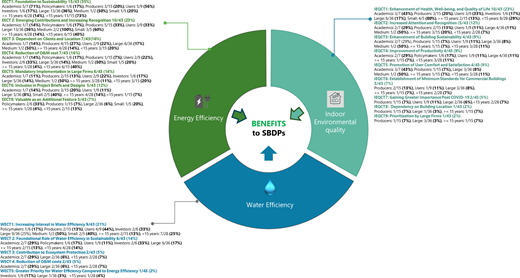
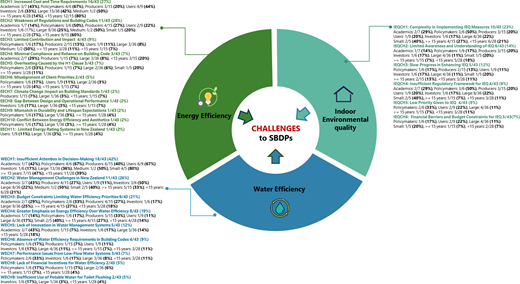
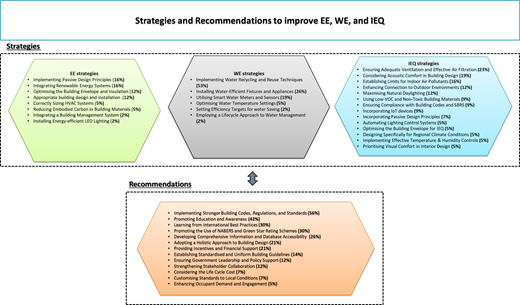
Participants were asked to reflect on how EE, WE and IEQ shape and influence SBDPs in New Zealand. Their responses were categorised into perceived benefits, challenges and recommendations. A cross-case analysis was conducted to identify patterns across stakeholder groups, organisational sizes, and levels of professional experience, providing insights into how EE, WE and IEQ contribute to SBDPs in practice. Table 1 summarises participant demographics, while Figures 1–3 present distinct analytical outputs from the cross-case analysis: Figure 1 synthesises perceived benefits, Figure 2 reports key challenges, and Figure 3 outlines recommended strategies. The percentage values shown in Figures 1–3 reflect the relative prevalence of themes identified through NVivo-assisted coding across stakeholder and organisational contexts, rather than duplicated results.
4.1.1 Benefits of energy efficiency, water efficiency and indoor environmental quality to sustainable building designs and practices.
4.1.1.1 Benefits of energy efficiency.
All participants agreed that EE is significantly beneficial for SBDPs. Participants (35%) highlighted that EE is foundational to sustainability in building projects. P1 noted that “EE is the main aspect of SBDPs […]” P26 contextualised New Zealand’s energy landscape: “Over 80% of electricity comes from renewable energy […]”, which reflects the nation’s strong renewable supply. Participants (23%) suggested that EE’s contribution is emerging from “increasing electricity price” (P33). In addition, participants (16%) agreed that EE is pivotal in reducing O&M costs.“Energy-efficient savings are tangible, which makes building more attractive […]” (P19), suggesting that EE initiatives gain more traction when they align with clear economic benefits, regardless of sustainability branding. These perspectives illustrate how energy savings can enhance a building’s market appeal. Accordingly, many stakeholders acknowledge that EE measures are often more enthusiastically adopted when they promise economic paybacks alongside environmental benefits (Hafez et al., 2023).
In addition, participants (16%) agreed that EE depends on the client and location; “EE depends significantly on the client and the project’s location […]” (P17). The findings resonated with Palm and Bryngelson (2023), who noted that the effectiveness of EE measures is shaped by site-specific conditions and the degree of stakeholder engagement. In practice, while some clients pursue ambitious sustainability objectives, others are satisfied with meeting only baseline compliance, and factors such as climate and infrastructure often constrain feasibility. Moreover, participants (14%) highlighted that incorporating EE into SBDPs is now regarded as mandatory by larger businesses. As P41 observed, “Many large companies now require buildings’ environmental certifications […]”, while P27 added, “Some companies demand the wellness factor […]” as part of their building criteria. These perspectives suggest that major corporations, often motivated by corporate sustainability agendas and brand positioning, increasingly insist on high EE standards and associated SBRS. Poorisat et al. (2024) reinforce this view, arguing that the implementation of robust EE features functions as a visible demonstration of corporate social responsibility. In addition, participants (12%) emphasised that EE is fundamental to the design brief and highly dependent on client requirements. For instance, P23 noted, “EE shapes design by setting target efficiencies […]”, and P30 explained, “Compliance with the building code and meeting client sustainability requirements are key […].” These findings resonate with Saroglou et al. (2024), who stressed that embedding energy targets early in the design process ensures that EE is integrated from the beginning of the project. A further 9% of participants pointed out that “EE features can function as value-added components”, enhancing building performance, future-proofing projects, and appealing to environmentally conscious buyers or tenants (P18)(P19).
The cross-case analysis (Figure 1) shows broad consensus that EE underpins SBDPs, though its significance is framed differently across stakeholder groups. Academics and users most strongly positioned EE as foundational, emphasising its long-term societal value and contribution to sustainability outcomes, while investors highlighted its role in enhancing asset performance. Producers and users more frequently described EE as an emerging priority, driven by market conditions, client expectations and operational cost considerations. Organisational context further shaped perspectives as large firms tended to treat EE as a non-negotiable requirement embedded in corporate sustainability agendas, whereas smaller firms more often viewed advanced EE measures as aspirational. Professional experience also influenced framing, with less-experienced participants emphasising EE’s foundational and future-oriented role, while more senior experts acknowledged its importance but highlighted contextual and implementation constraints. Overall, EE is universally recognised as critical, yet prioritised through differing logics, ranging from societal value and regulatory compliance to cost efficiency and occupant comfort, reflecting underlying tensions in how sustainability objectives are operationalised in practice.
4.1.1.2 Benefits of water efficiency.
A large share of participants (40%) emphasised that WE is critical for SBDPs, highlighting its growing prominence in New Zealand. Participants (21%) mentioned that WE is gaining more attention: “WE awareness increasing, especially in Auckland […]” (P20)(P15). Such findings are consistent with Jayawardena (2024), who noted that WE is gaining policy attention in New Zealand’s cities due to rising demand and periodic droughts. P11 and P38 pointed out that “Water abundance leads to less public awareness of WE […]”, meaning the public often assumes water is unlimited. This observation is supported by Challies et al. (2022), who noted that New Zealand’s abundant per capita freshwater meant WE was long overlooked; however, growing population pressures and climate change are now elevating its importance (Suazo, 2022).
In addition, 14% of participants highlighted that WE is foundational to sustainability, “WE is closely tied to SDGs and contributes to SBDPs’ advancement”, (P37)(P15), implying that practical water management is essential for moving building projects towards sustainability benchmarks. These views align with Weerasooriya et al. (2021), who asserted that a continuous, reliable water supply is essential for achieving several SDGs. In practice, incorporating WE in buildings through water-saving technologies and designs helps ensure long-term resource availability and resilience (Poorisat et al., 2024). Furthermore, 12% of participants noted regional disparities in water metering: “Only in Auckland, water is charged per unit […]” (P33). By contrast, Christchurch and Wellington lack universal metering, limiting awareness and engagement. P39 observed, “Wellington homes lack water meters; this hinders management and requires reform […]”. Traditionally, Wellington applied flat-rate charges, offering little feedback. Currently, over 60% of New Zealand, including Auckland, Tauranga, and Christchurch, already use volumetric pricing, with Wellington only now transitioning (Wellington Water, 2025). These findings align with Suazo (2022), who emphasises that while water authorities manage consumption, the lack of universal metering hinders WE as a national priority.
Another 14% of participants drew attention to the interconnection between WE and EE, as saving water can also save energy. P36 explained, “More energy is consumed for heating and cooling than for water use […]”, underscoring that while direct water use in buildings may not consume much energy, the indirect energy associated with water heating is significant. P16 supported this point: “Lowering water heating temperatures improves EE […]”, highlighting a practical example where a water-related measure, for example, using warm versus very hot water, reduces energy consumption. These observations are supported by Pinto et al. (2017), who demonstrated that increased water consumption in buildings directly raises energy demand, a strong linkage known as the water-energy nexus. Around 5% noted that water-efficient design helps protect ecosystems by easing pressure on municipal supply and wastewater systems, while another 5% cited reduced O&M costs. Only 2% suggested WE should outweigh EE, suggesting it often remains secondary. Strengthening its case may require public education and clearer demonstration of long-term benefits, given New Zealand’s history of perceived water abundance.
The cross-case analysis (Figure 1) reveals pronounced demographic differences in how WE is perceived within SBDPs. While WE is increasingly acknowledged, particularly by users and investors, it is far less consistently framed as foundational when compared with EE. Academics and policymakers were more likely to position WE strategically, linking it to long-term sustainability objectives and SDG alignment. In contrast, producers and clients tended to engage with WE in response to external pressures such as pricing structures, metering availability and infrastructure constraints. Broader WE benefits, including ecosystem protection and long-term operational cost savings, were referenced only marginally, and very few stakeholders prioritised WE over EE or IEQ. These patterns indicate that, despite growing awareness, WE continues to occupy a secondary and reactive position within SBDPs in New Zealand. Accordingly, addressing WE more effectively will therefore require stronger policy intervention, targeted stakeholder education, and demonstrative case studies that clearly articulate its long-term environmental and economic value.
4.1.1.3 Benefits of indoor environmental quality.
Nearly half of the participants (47%) indicated that enhancing IEQ, which encompasses factors like air quality, thermal comfort, lighting and acoustics, is highly beneficial to SBDPs. Among these, about 23% specifically emphasised IEQ’s role in improving occupant health and overall quality of life. P29 observed that better IEQ “reduces airborne illnesses and improves well-being […]” P11 similarly noted that “a well-designed office environment enhances productivity […]”, tying IEQ improvements to tangible benefits for building users. P6 added that “IEQ increasing sustainable buildings appeal and value […]”. This highlights a dual benefit because good IEQ conditions support human health and comfort, and they can also elevate property value and marketability (Poorisat et al., 2024). This resonates with Llanos-Jiménez et al. (2024), who highlighted the critical importance of IEQ, noting that people spend about 87% of their time indoors, rising to nearly 100% during COVID-19 lockdowns (Bennett et al., 2022), underscoring participants’ view of IEQ as central to sustainability and daily well-being.
Participants (12%) observed that IEQ has gained significant prominence in recent years. P1 noted that “IEQ gained more interest due to New Zealand’s climatic characteristics […]”, with the temperate climate enabling design strategies such as natural ventilation and passive comfort, positioning IEQ as a priority. Similarly, P22 highlighted that “the pandemic underscored the importance of IEQ […]”, reflecting how global health crises reshaped perceptions of indoor environments. These perspectives show how local climate and global events shape awareness, with Bennett et al. (2022) linking lockdown confinement to greater focus on healthy IEQ, which has shifted from a technical concern to a central pillar of sustainable, resilient building design.
Furthermore, participants (9%) emphasised IEQ’s synergies with EE and overall sustainability, especially given New Zealand’s climate, which allows greater use of passive design strategies. P19 pointed out that “New Zealand’s climate varies, Wellington is cooler, while Auckland is warmer and more humid […]”, implying that design approaches must be tailored to regional conditions to maintain good IEQ. Importantly, these moderate climatic conditions also enable natural solutions: as P37 explained, “a moderate climate supports SBDPs by reducing energy needs for heating and cooling […]”, P20 noted that “air quality is very clean [here]; drawing fresh air from the rooftop is sufficient to improve IAQ […]”, highlighting how New Zealand’s favourable outdoor air quality supports ventilation with minimal mechanical intervention, enhancing IEQ while reducing energy demand.
In addition to those, about 9% suggested that better IEQ can directly boost occupant productivity, as P11 mentioned that “healthy environments enable people to perform tasks more effectively”. Another 7% of participants pointed out that the industry is establishing minimum IEQ standards for commercial buildings, meaning that IEQ features are increasingly becoming non-negotiable in building codes and SBRS(P13)(P14). A few participants (5%) noted that IEQ has gained greater significance post-COVID-19, with building owners more often considering air circulation and hygiene in design. Only 2% observed that emphasis varies by building type or location, for example, urban noise or rural air quality. Accordingly, these insights highlight the need for context-specific IEQ strategies.
The cross-case analysis (Figure 1) indicates that perceptions of IEQ in SBDPs are strongly shaped by stakeholder role and organisational context. Academics and users predominantly frame IEQ through a human-centred lens, emphasising health and well-being, while investors and policymakers link IEQ to productivity and workforce performance. In contrast, producers tend to adopt a compliance-oriented perspective focused on minimum standards. Organisational size and professional experience further shape these framings, with larger organisations associating IEQ with employee health and absenteeism reduction, and more experienced practitioners recognising IEQ’s transition from a marginal concern to a mainstream sustainability requirement. Overall, although IEQ is widely acknowledged as important, it is legitimised through divergent rationales, underscoring the need for tailored strategies that align health, productivity and regulatory priorities to support its effective integration within SBDPs.
4.1.2 Challenges of energy efficiency, water efficiency and indoor environmental quality to sustainable building designs and practices.
4.1.2.1 Challenges of energy efficiency.
Participants discussed the challenges of improving the EE. Participants (27%) cited additional cost and time required. “EE is rarely the focus unless explicitly required by the client […]” (P2). In addition, P10 observed a prevailing focus on “value for money”, which creates a conflict with sustainability goals, resonating with recent research by Poorisat et al. (2024), who found that high initial costs are the most prominent barrier to enhancing building EE. Moreover, participants (26%) identified weak building codes and regulations as a significant barrier; P20 cited that “Few buildings adhere to best practices […]” unless pushed by stricter codes. A concern echoed by Hall and Pertrass (2022), who cited the lack of comprehensive certification and slow SBRS uptake in New Zealand.
In addition, participants (9%) cited limited contributions and impacts of EE. P13 explained, “EE impact is often limited because consultants fail to engage with the project’s requirements fully […]” Also, “We lag behind much of the world in SBDPs […]” (P39), a point reinforced by Doan et al. (2021), who highlighted the delayed progress of SBDPs in New Zealand and the limited understanding of EE principles, which have further constrained efforts to achieve advanced levels of EE. In addition, 7% of participants observed that “most people still build to meet the minimum requirements rather than going beyond […]” (P3). This illustrates a persistent gap between the sector’s sustainability ambitions and actual industry practices, emphasising the need for stronger incentives and more robust regulatory frameworks. Another 7% of participants pointed to unintended consequences of the H1 clause, with P38 noting, “H1 houses are overheating, which also led to increased cost […].”, which is supported by Birchmore et al. (2017) who found that Auckland homes built to H1 standards still overheated with solar gains the main driver and only modest relief from ventilation or thermal mass. Several additional challenges were identified, though less frequently. These included misalignment of client priorities (5%), the influence of climate change on building standards (2%), discrepancies between design intent and operational performance (2%), mismatches between durability and lifespan expectations (2%), conflicts between EE measures and aesthetic considerations, and the limited scope of energy rating systems in New Zealand (2%). Collectively, these findings highlight the diverse and multi-layered barriers that hinder the consistent advancement of EE in practice.
The cross-case analysis (Figure 2) indicates that perceptions of challenges to enhancing EE are strongly influenced by stakeholder role and professional experience. Increased upfront costs and extended project timelines emerged as the primary concern, particularly among policymakers, users and large organisations. Weak regulatory frameworks and limited enforcement were identified as a second major barrier, most strongly emphasised by policymakers and producers.
Less-experienced professionals were notably more critical of regulatory shortcomings than senior practitioners, suggesting higher expectations for systemic reform. Participants also identified technical challenges, including overheating associated with the H1 clause, as well as misalignment between client priorities and sustainability objectives. Overall, the findings show that while cost and regulatory barriers dominate, perceptions of EE challenges vary by professional role and experience, highlighting the socio-institutional nature of constraints on advancing EE in SBDPs.
4.1.2.2 Challenges of water efficiency.
Participants highlighted the widespread neglect of WE, with 42% noting it receives little attention in decision-making and is often treated as secondary. This neglect stems from New Zealand’s perceived water abundance, which has lowered public awareness and prioritisation of WE initiatives. “Water is the poor cousin to energy […]” (P21). Similarly, P23 added, “EE far exceeds WE in New Zealand […]” Beyond its lower prioritisation, they highlighted the limited implementation of WE measures. P13 noted, “Rainwater harvesting is completely off track”, underscoring its absence from mainstream practices. These observations align with Bint et al. (2019), who reported that New Zealand lacks specific guidelines to support and ensure the effective implementation of alternative water supply solutions. In fact, nearly 100% of New Zealand’s commercial buildings rely on reticulated municipal water, meaning treated potable water is used for all purposes rather than tapping sustainable alternatives (Bint, Garnett, and Siggins, 2017), indicating both a regulatory gap and a missed opportunity for WE.
Participants (26%) cited water challenges such as drought and extreme weather, with P20 highlighting this: “Auckland’s 2020 drought was one of the longest, triggering public concern […]” Alongside conservation, issues of stormwater and resilience emerged, with P18 urging “WE measures should be integrated into building design”. Overall, climate pressures are driving calls for rainwater harvesting, on-site storage and efficient fixtures as part of broader resiliency strategies.” However, even when water-saving technologies are available, performance and perception issues can impede their uptake. About 7% of participants brought up concerns with low-flow fixtures and systems, noting a belief that these will “perform poorly” (P8). The findings align with Ali et al. (2020), showing that low-flow fixtures can underperform when system pressure or user acceptance is lacking, as longer shower times often offset savings, fostering scepticism towards WE measures.
Moreover, participants (21%) mentioned budget constraints limiting WE priorities. “Enhancing WE is seen as added costs […]” (P18). Also, P42 echoed, “The complex water systems cost can outweigh the cost-saving benefits […]” The findings align with Antão-Geraldes et al. (2023), who stressed that despite higher upfront costs, WE should be evaluated through life-cycle economic, environmental, and social benefits. However, in New Zealand, many investors remain reluctant to fund such measures without incentives or mandates (Bint et al., 2017).
Participants (19%) highlighted the stronger emphasis on EE over WE, largely due to energy’s higher costs and related incentives. As P12 noted, “EE has a stronger influence due to energy’s higher cost […]”, while P21 added, “Financial incentives are rarely focused on water […]”, underscoring a policy gap. Consequently, design teams often prioritise energy optimisation while limiting WE to code-minimum requirements. A further 12% cited limited innovation in water management, pointing to outdated systems and the common use of potable water for toilets and irrigation. P41 stressed “water reuse must be prioritised”. These insights align with Bint et al. (2019), who observed that nearly all New Zealand commercial buildings rely on treated potable water for both high- and low-grade uses. In addition to those, the challenges include the absence of code requirements (9%), perceived fixture performance issues (7%), lack of incentives (5%), and inefficiencies such as potable water use for non-potable needs (5%). Collectively, these factors explain why WE lags other aspects because it is neither mandated nor economically incentivised, and remains constrained by inertia and practicality concerns.
The cross-case demographic analysis (Figure 2) indicates a broad consensus that WE remains under-prioritised within SBDPs. Policymakers and end-users were particularly vocal in highlighting the need to elevate WE as a strategic priority, noting that it receives limited attention in early design, procurement, and investment decision-making. The cost of implementing WE measures emerged as a key constraint, most strongly emphasised by policymakers and producers, and also noted by investors and academics, suggesting persistent concerns about short-term capital costs relative to perceived returns. Technical performance issues associated with low-flow systems were also raised, particularly by policymakers and investors, reflecting hesitation about functionality, user acceptance, and maintenance. In contrast, academics stressed a lack of innovation inWE practices, frequently referencing international benchmarks to illustrate New Zealand’s relative lag. Collectively, these findings point to weak policy signals, limited incentives and fragmented responsibility, which together reinforce the continued marginalisation of WE within SBDPs despite growing awareness of its long-term importance.
4.1.2.3 Challenges of indoor environmental quality.
The participants noted that IEQ remains underdeveloped compared to other aspects, with 23% citing implementation complexity, including ventilation, moisture control, and leaky buildings. For example, P41 cited that “Leaky building had widespread impacts […]” P24 added, “It can result from hidden structural failures […]”, highlighting the need for high construction quality in unseen areas. Health concerns were also stressed: “Mould and indoor moisture issues lead to several diseases […]” (P8), reinforcing IEQ as a public health issue.
Several participants underlined interconnections with EE and WE. “Discuss IEQ in isolation from EE, and WE are challenging as they are interconnected […]” (P11). For instance, P42 observed, “Unlimited hot water encourages longer showers, increasing mould and humidity”, while P19 noted, “Fresh air should be provided when needed to reduce energy use and balance with comfort […]” These views support Niza et al. (2022), who linked thermal comfort and EE, though Pedersen et al. (2021) argued that energy use was not a primary concern from tenants’ perspective, as good IEQ often took precedence.
Moreover, participants (14%) identified limited awareness and understanding of IEQ. As P32 mentioned: “Mould issues come from limited understanding of IEQ […]” Such knowledge gaps prevent designers, builders, and occupants from addressing causes or applying solutions. Raising awareness is therefore critical for healthier environments. Barthelmes et al. (2019) support this, noting that education is foundational to IEQ improvement. In addition, participants (12%) highlighted slow progress in enhancing IEQ. As P36 and P16 noted, “IEQ is not far along compared to other aspects […]” which highlights ongoing gaps and a lack of standardisation in IEQ, underscoring the need for further research and innovation (Bennett et al., 2022). Participants (9%) also underscored the insufficient regulatory framework. “IEQ is the weakest aspect of the New Zealand Building Code […]” (P34). Similarly, P13 reinforced this: “Regulations on VOCs in building materials remain limited […]” Unlike many developed countries, which regulate VOCs in paints and furnishings. Bennett et al. (2022) confirmed this gap, observing that regulation focuses only on outdoor air, leaving little accountability or incentive for healthy IAQ. Additional challenges include the low priority given to IEQ (9%) and financial barriers (7%), as high-performance systems increase costs without clear short-term returns. Collectively, these challenges highlight the urgent need to better quantify and communicate the long-term benefits of IEQ to justify greater investment and drive regulatory reform.
The cross-case analysis (Figure 2) demonstrates that IEQ challenges are strongly shaped by stakeholder role, organisational context and experience. Policymakers primarily emphasised regulatory gaps and system complexity, while producers and users focused on operational barriers, particularly cost and limited awareness. Organisational size further influenced perceptions, with large firms highlighting coordination and technical complexity, and small firms facing combined financial, awareness and capacity constraints. Experience also mattered, as senior participants reported greater difficulty navigating IEQ implementation, whereas less experienced stakeholders more often identified knowledge gaps. These contrasts reveal a tension between strategic-level governance challenges and practice-level resource constraints, underscoring the need for integrated IEQ–EE–WE approaches supported by stronger regulation, passive design education, and behavioural change to enable healthier SBDPs in New Zealand.
4.2 Strategies and recommendations to improve energy efficiency, water efficiency and indoor environmental quality
4.2.1 Strategies.
Participants were asked to identify key strategies and recommendations for advancing EE, WE and IEQ within SBDPs in New Zealand. Their responses were categorised into strategies and recommendations. The strategies included adopting technologies focused on EE, WE and IEQ enhancement. Recommendations highlighted the necessity for stronger regulations and incentives, improved economic viability, holistic design approaches, early stakeholder collaboration, performance-based metrics, enhanced data availability and increased education and awareness (see Figure 3).
4.2.1.1 Strategies for energy efficiency.
Participants (37%) discussed EE improvement strategies, including passive design and the integration of renewable energy technologies. Participants (16%) emphasised that optimising building orientation and layout is fundamental for EE. P38 noted that “passive design orients buildings northward, placing unheated spaces to the south”, while P30 added that “Insulation maximises EE” These insights suggested that good orientation combined with thermal mass and insulation thus cuts energy use. Moreover, participants (16%) noted the benefits of integrating renewable energy systems. P6 cited, “Incorporating high-performance insulation and renewable energy systems reduces GHG emissions”. Collectively, these strategies highlight the role of design and technology integration in driving EE and sustainability.
In addition, participants (12%) highlighted the building envelope’s role. P24 explained that a “building envelope with high-performance insulation minimises energy leakage”. This thereby reduces the energy needed to maintain comfortable indoor temperatures. This finding aligns with Elaouzy and El Fadar (2022), who noted that upgrading envelope insulation is the most effective way to enhance EE. Participants also mentioned specific active-system improvements. For instance, 5% suggested correctly sizing HVAC systems to avoid inefficiencies from oversizing or under sizing equipment. Others advocated for integrating modern Building Management Systems (2%) and installing energy-efficient LED lighting (2%). These strategies target ensuring mechanical systems run optimally, and lighting uses minimal power. Also, efficient HVAC design and controls can significantly cut energy use without sacrificing comfort, and LED lighting uses a fraction of the energy of traditional lighting. Together with passive design, such measures further drive down a building’s energy demand (Ahmadizadeh et al., 2024).
4.2.1.2 Strategies for water efficiency.
Over half of the participants (53%) highlighted the significance of non-potable water applications. “Non-potable water reduces treatment demands […]” (P12). In addition, P11 added, “Water harvesting and storage systems should be prioritised […]” These perspectives align with Bint et al. (2019), who identified rainwater harvesting and greywater recycling as two key measures for reducing water consumption. Moreover, participants (26%) highlighted the significance of using high-efficiency fixtures. P20 noted, “Australian WELLS scheme rates, influencing Green Star Rating, enhance WE […]” P6 supported this: “Water-efficient fixtures play a crucial role […]” The findings are consistent with those of Pollard (2022), who found that the installation of water-efficient fixtures is a recurring feature among several six-star Green Star-rated buildings in New Zealand.
Participants (19%) also advocated using smart water metering and sensors. P16 highlighted, “Smart meters identify leaks and system issues […]” P37 added, “Sensors and feedback systems help tenants understand the significance of water conservation […]” These findings align with Koech, Cardell-Oliver and Syme (2021), which found that the adoption of smart water metering has increased in Australia and New Zealand due to its economic benefits. In addition to those, participants cited optimising water temperature settings (5%), setting efficiency targets for water saving (2%), and using a lifecycle approach to water management (2%). Overall, water-efficient design is crucial as it reduces reliance on municipal water supplies and improves overall resource efficiency. The findings suggest that combining innovative technologies, regulatory support and increased awareness among stakeholders is essential to advancing WE in New Zealand.
4.2.1.3 Strategies for indoor environmental quality.
Participants (23%) stressed the significance of adequate ventilation and filtration. P29 cited that “Increasing fresh air quality significantly improves IEQ […]” P16 reinforced, “Integrating air filtration systems is critical […]” These insights align with Azzazy et al. (2025), who highlighted the role of ventilation in enhancing occupant well-being. At the same time, ensuring correct HVAC sizing is essential to balance EE and IEQ, preventing unnecessary energy consumption while maintaining indoor comfort (Yao and Shekhar, 2021). Acoustic comfort was also emphasised (19%). P11 mentioned “Managing unwanted noises is critical for well-being […]” P40 added, “Auckland’s unitary plan designates noise-exposed areas, requiring buildings to meet acoustic standards”, consistent with Zhang et al. (2024), who linked acoustic comfort to occupant performance, health and well-being. Limiting indoor pollutants (16%) was another strategy. “CO2 sensors regulate airflow efficiently, minimising energy use […]” (P23). Similarly, P32 stated, “CO2 sensors are now mandatory for new buildings”. However, the CO2 sensors must be used in conjunction with other measurements, as the sensors alone provide an incomplete picture of IEQ (Ballerini et al., 2025)
Participants also underscored IoT integration (9%), “Many commercial buildings in New Zealand now use dashboards and IoT to manage IEQ […]” (P26). However, the reliability of IEQ data depends on accurate sensor calibration. Calibration errors can accumulate from environmental drift and sensor drift, which may distort readings of air quality, thermal comfort, or noise levels. Without scheduled recalibration and correction, such errors compromise the effectiveness of IoT systems in maintaining healthy and comfortable indoor environments (Nalakurthi et al., 2024). Finally, daylighting (12%) and outdoor connections (12%) were identified as key factors. P11 mentioned “Strong connection with the outdoor environment improves IEQ […]” P37 added, “Daylighting reduces the need for artificial lighting,” reinforcing findings by Asojo and Hazazi (2025), who argued that integrating these principles benefits both IEQ and EE. Moreover, participants (9%) highlighted using low-VOC products as a key measure for improving the IEQ. P23 noted, “Adoption of low-VOC-emitting materials is increasing […]” These findings align with Tazmeen and Mir (2024), who emphasised the necessity of integrating low-VOC-emitting building materials to foster better IEQ. However, Chepaitis et al. (2024) cautioned that many products marketed as low-VOC can still release harmful compounds such as formaldehyde when exposed to moderate heat, posing potential risks that may be exacerbated under climate change scenarios.
In addition, participants identified several complementary strategies for improving IEQ, including ensuring compliance with building codes and sustainability rating systems (9%), integrating IoT-enabled monitoring and control systems (9%), adopting passive design principles (7%), automating lighting controls (5%), optimising building envelopes (5%), tailoring design to regional climate conditions (5%), implementing advanced temperature and humidity management (5%) and prioritising visual comfort in interior design (5%). Collectively, these findings underscore the need for an integrated and systemic approach to IEQ within New Zealand’s SBDPs. Achieving high IEQ, therefore, requires not only technical solutions but also holistic, occupant-centred design processes and management practices that align sustainability, regulatory compliance and innovation to enhance both performance and well-being.
4.2.2 Recommendations and policy implications.
More than half of the participants (56%) emphasised the critical role of policy, regulation, and building codes in shaping SBDPs. As P1 observed, “Establishing stringent standards will significantly impact practice”, a view reinforced by P11: “Highest international standards should be mandated”. Within the New Zealand context, P20 noted that “The building code is outdated and lacks best-practice standards,” underscoring the urgency of regulatory reform. Collectively, these participants strongly advocated for a more robust framework that enforces best-practice standards, ensuring that SBDPs become the norm rather than the exception. These findings align with Poorisat et al. (2024), who emphasised that mandating building codes and regulations is a vital driver of SBDP progress. However, Payyanapotta and Thomas (2021) argued that the number of sustainable buildings compliant with energy standards remains minimal, partly due to the complexity and rigid nature of assessment systems. Their findings indicate that regulations, if not designed to be user-friendly and context-sensitive, risk inhibiting rather than facilitating adoption.
Following closely, participants (42%) highlighted the need for education and awareness. “Training the market and industry is essential, and the right area must be influenced […]” (P1). Also, P15 echoed this, “We must influence the right areas to advance SBDPs […]” Together, these perspectives highlight the crucial role of education and awareness in promoting the adoption of SBDPs. The findings align with Ebekozien et al. (2022), who claimed that providing education and awareness is one of the most significant drivers. However, Maqbool et al. (2023) cautioned that even when awareness is high, adoption may remain limited due to resistance to change, insufficient incentives, and organisational inertia, suggesting that awareness alone is not enough without complementary structural and policy support.
In addition, participants (30%) expressed concerns about the slow progress of SBDPs, emphasising the need to learn from international best practices. P11 highlighted this gap: “New Zealand’s SBDPs are behind other countries […]” P10 and P22 mentioned “Australia has taken a more structured approach regarding EE and WE […]” Similarly, P35 highlighted the UK’s approach to energy transparency, noting that “In the UK, every building has an annual energy rating […]” Although many participants emphasised the benefits of adopting international best practices, some cautioned that these might not seamlessly translate to New Zealand. “The international solutions should be tailored to our context […]” (P35). This aligns with Griffiths et al. (2021), who argue that sustainability guidelines must adapt to local challenges and conditions to improve urban energy and water management systems effectively.
Participants (30%) supported the adoption of SBRS. As P20 explained, “Using SBRS for energy benchmarking is beneficial”, while P21 added, “Both Green Star and NABERS use the prescriptive approach to set measurable targets.” These perspectives align with AlAwam and Alshamrani (2021), who observed that the LEED system encourages integrated design, enabling developers to optimise sustainability outcomes. However, Ismaeel (2019) cautioned that many SBRS and tools lack sufficient practical guidance, limiting their effectiveness in decision-making and implementation. In particular, rating systems and associated databases often fall short in operational clarity, which undermines their potential to provide actionable direction for real-world projects. Moreover, participants (26%) emphasised the critical role of database availability. “Providing evidence-based insights ensures wide understanding and implementation […]” (P15). Also, P12 reinforced this:” The access to the database enables more informed decision-making […]” The findings resonated with Chen et al. (2022), who identified the availability of the database as an essential driver for advancing SBDPs.
In addition, participants (21%) recommended adopting a holistic approach to building design. As P16 noted, “EE, WE and IEQ should be considered holistically,” a view reinforced by P19: “A holistic approach helps balance efficiency, affordability and create desirable spaces.” These findings align with Franco et al. (2024), who argued that EE, WE and IEQ should be addressed in an integrated manner. However, Ayoobi et al. (2024) cautioned that the proliferation of sustainability indicators across disciplines can overwhelm decision-makers, making holistic strategies challenging to operationalise. They suggest that for holistic models to be effective, indicators must be streamlined to avoid complexity becoming counterproductive. Taken together, these insights highlight the need for holistic frameworks that are not only integrative but also simplified and practical, ensuring that decision-makers can embed them effectively into design and policy processes.
Moreover, participants (21%) mentioned providing incentives and financial support. As P5 emphasised, “Beyond regulatory enforcement, there should be balanced incentives […]” The findings are supported by Ebekozien et al. (2022), who claimed that government incentives are essential to drive SBDPs forward. In addition to those, participants cited establishing standardised building guidelines (14%), ensuring government leadership and policy support (12%), strengthening stakeholder collaboration (12%), considering life-cycle costs (7%), customising standards to local conditions (7%) and enhancing occupant engagement (5%) as measures to advance SBDPs in New Zealand.
In essence, the participants’ insights provide a comprehensive understanding of the multifaceted recommendations necessary to advance SBDPs in New Zealand. The findings underscore the importance of a coordinated and strategic approach, encompassing the critical roles of policy reform and education, as well as the adoption of international best practices and rating systems. The recurring emphasis on regulatory strength, awareness-building and context-specific adaptations highlights a shared recognition that systemic change is needed. Moreover, enhanced data accessibility, financial incentives, holistic design and collaborative governance point to a collective vision for sustainable transformation that is paramount. These findings align with existing literature and provide practical guidance for stakeholders seeking to integrate sustainability into the core of New Zealand’s building sector.
4.3 Implications of research findings: towards a stakeholder-specific roadmap
The findings of this study demonstrate that the advancement of SBDPs in New Zealand depends on coordinated yet differentiated actions across stakeholder groups. While broad agreement exists on the importance of integrating EE, WE and IEQ, the study reveals that these dimensions are valued and prioritised through distinct institutional, economic and professional logics. Accordingly, this section translates the empirical findings into a stakeholder-specific roadmap that clarifies priority actions and practical implementation pathways to enhance real-world uptake.
Regarding EE, policymakers emerge as the primary enablers of systemic change. The findings indicate that the current reliance on voluntary sustainability measures has limited their impact, reinforcing the need for a transition towards mandatory sustainable building and energy performance requirements. Such a shift would provide regulatory certainty, reduce fragmentation and incentivise long-term investment in SBDPs. Priority actions of policymakers include strengthening and regularly updating building codes to align with evolving international best practices. In particular, compliance with high-performing thermal insulation standards should be prioritised to enhance EE outcomes and reduce long-term energy demand (Rasoulinezhad and Taghizadeh-Hesary, 2022).
For WE, policymakers should mandate the integration of water-efficient technologies across all building typologies, including the use of alternative water sources for toilet flushing, rainwater harvesting and green roofs (Almeida et al., 2023). These measures would address the persistent under-prioritisation of WE identified in the findings. In relation to IEQ, mandatory post-occupancy evaluations should be introduced to ensure that IEQ is maintained throughout the building lifecycle, rather than assessed solely at the design stage. Greater alignment with internationally recognised IEQ frameworks, such as WELL, BREEAM and Green Star, would further strengthen accountability and performance consistency (Altomonte et al., 2019). To accelerate adoption, government policies should incorporate targeted financial incentives, including subsidies or tax relief for EE retrofits, WE systems, and IEQ upgrades (Poorisat et al., 2024). In addition, mandating data transparency and public reporting is essential to support benchmarking, performance tracking and evidence-based policymaking, enabling continuous regulatory refinement and informed decision-making (Ebekozien et al., 2022). Collectively, these measures would foster sustained industry engagement while enhancing the resilience and environmental performance of the built environment (Nainwal and Sharma, 2023).
Producers, including architects, engineers and contractors, are critical to translating regulatory intent into built outcomes. The findings highlight the need for producers to adopt holistic design approaches that integrate EE, WE and IEQ from the earliest project stages. Practical implementation pathways include the systematic use of SBRS and benchmarking tools to assess trade-offs and synergies between sustainability dimensions. In particular, adopting points-based evaluation systems can support more balanced decision-making across EE, WE and IEQ while minimising energy and carbon impacts (Doan et al., 2021). Moreover, producers should also prioritise professional development through targeted training, interdisciplinary collaboration and knowledge-sharing initiatives to strengthen technical capacity and reduce reliance on minimum compliance approaches (Poorisat et al., 2024). Embedding integrated sustainability principles within routine design and construction practices would help normalise SBDPs across projects of varying scales and capital costs.
Users and occupants play an increasingly influential role in shaping sustainability outcomes through demand, behaviour and feedback. The findings suggest that enhancing user awareness and literacy around EE, WE and IEQ can increase demand for higher-performing buildings and indirectly influence regulatory and market expectations. Priority actions include structured education initiatives, clearer sustainability labelling, and improved access to building performance information. Feedback mechanisms such as smart metering and occupant-facing dashboards can further support behavioural change by making energy, water and IEQ impacts visible and actionable (Poorisat et al., 2024). In addition, investors and developers are well-positioned to drive market transformation by shifting decision-making frameworks from capital cost minimisation towards whole-life cost and value-based assessment. The findings indicate that prioritising intelligent building management systems, performance-based frameworks such as NABERS, Green Star and BREEAM, and sustainable finance mechanisms can significantly improve long-term EE, WE and IEQ outcomes (Akomea-Frimpong et al., 2022). By embedding sustainability metrics into investment appraisal processes, investors can align financial performance with long-term operational efficiency, risk reduction and asset value.
Academics and researchers play a key enabling role by bridging the gap between theory, policy and practice. The findings underscore the importance of academics facilitating industry collaboration, translating research outputs into accessible guidance, and supporting evidence-based policymaking (Elnaklah et al., 2021). Comparative international research is particularly valuable, as New Zealand continues to lag behind countries such as Australia and the UK, where sustainability processes are more structured and embedded within regulatory frameworks (Asquith, McNeill, and Stockley, 2021). Beyond EE, international experience in water governance highlights the benefits of stricter WE regulations, as demonstrated in Australia (Balasooriya et al., 2023). Learning from such contexts can inform more robust and integrated policy development in New Zealand.
Across all stakeholder groups, the findings emphasise the importance of simplifying sustainability processes, mandating comprehensive data collection and sharing, and expanding building-level metering to generate granular performance data. These measures are essential for benchmarking, accountability, and continuous improvement, enabling EE, WE and IEQ benefits to be embedded within evidence-based policy and practice (Poorisat et al., 2024; Wang et al., 2021). In summary, this study advances a stakeholder-specific and integrated pathway for accelerating SBDPs in New Zealand. By strategically aligning mandatory regulatory reform with data transparency, international best practices, whole-life cost thinking, innovative financing mechanisms, and targeted stakeholder education, the study moves beyond conceptual advocacy to offer a practical and implementable roadmap. This approach enables stakeholders to overcome existing institutional and market barriers, translate sustainability ambitions into measurable performance outcomes, and embed EE, WE, and IEQ as core decision-making criteria across the building lifecycle. Collectively, these actions position SBDPs not as an optional aspiration, but as a mainstream, value-driven pathway towards a more sustainable, resilient and high-performing built environment in New Zealand and beyond.
5. Conclusion
This study examined key stakeholder perspectives on the contributions, recommendations and strategies for enhancing EE, WE and IEQ within SBDPs in New Zealand, drawing on interviews with 43 relevant stakeholders across the built environment sector. The findings provide a comprehensive overview of current practices and future sustainability pathways. Stakeholders consistently identified EE, WE and IEQ as fundamental components underpinning SBDPs, highlighting their potential to reduce O&M costs while improving overall building performance. However, while EE continues to dominate sustainability decision-making, it is largely influenced by client priorities and geographic considerations, WE remains persistently undervalued due to perceptions of water abundance, infrastructure limitations and cost constraints. In contrast, IEQ was strongly emphasised for its critical role in enhancing occupant health, well-being, productivity and quality of life. Despite widespread recognition of their importance, significant barriers continue to impede the effective implementation of EE, WE and IEQ. These include high upfront costs, extended project timelines, insufficient regulatory frameworks, weak enforcement of building codes and limited industry engagement. WE initiatives are particularly constrained by low prioritisation in decision-making, complexities in water management and budgetary pressures, while efforts to enhance IEQ face challenges associated with technical complexity, limited industry awareness and the slow adoption of innovative solutions. Collectively, these findings suggest that SBDPs in New Zealand remain at an early stage of development, underscoring the need for stronger policy interventions, improved coordination and enhanced collaboration across the sector.
To accelerate the advancement of SBDPs, this study recommends targeted strategic actions, including strengthening building regulations and standards, improving education and awareness, drawing on international best practices, and encouraging wider adoption of SBRS such as NABERS and Green Star. Importantly, the findings reinforce the importance of adopting an integrated and holistic approach to SBDPs, given the intrinsic interdependence among EE, WE, and IEQ. For example, increased water use directly contributes to higher energy demand, while EE measures can influence indoor comfort, moisture levels and occupant health. Similarly, interactions between WE and IEQ, particularly in moisture control, highlight how poorly integrated systems can elevate indoor humidity and increase the risk of mould growth. These interdependencies underscore the need for building designs that optimise performance and comfort while minimising resource consumption.
Beyond its empirical findings, this study advances sustainability knowledge by explicitly challenging the prevailing siloed paradigm that treats EE, WE and IEQ as discrete or sequential objectives. Instead, it proposes an integrated, systems-oriented perspective in which these dimensions are understood as interdependent levers shaped by technical, regulatory and behavioural interactions. This reframing moves the sustainability discourse beyond narrow performance optimisation towards a governance- and decision-centric paradigm that better reflects real-world complexity. Moreover, the findings move beyond descriptive stakeholder insights by revealing recurring structural patterns, such as energy-centric decision-making, the systemic undervaluation of WE, and the conditional treatment of IEQ, that rise above the New Zealand context. By synthesising these patterns into strategic implications, the study offers a transferable conceptual lens applicable to other regulatory and market environments characterised by resource abundance, fragmented governance or market-led sustainability adoption.
This study contributes to the growing body of literature on SBDPs by providing a comprehensive, context-specific understanding of the complex dynamics governing EE, WE and IEQ integration within New Zealand’s built environment. Unlike prior studies that examine sustainability dimensions in isolation, this research adopts a stakeholder-informed perspective that reflects real-world challenges and priorities. In doing so, it addresses critical knowledge gaps, particularly the persistent undervaluation of WE and the systemic barriers limiting IEQ enhancement, while offering a practical roadmap for integrative policy and design approaches. Despite these contributions, several limitations should be acknowledged. The qualitative research design prioritises depth and contextual understanding over statistical generalisability, and the findings are based on stakeholder perceptions rather than measured building performance outcomes. Although the sample captures conceptual representativeness across all major stakeholder groups influencing SBDPs in New Zealand, perspectives from non-professional building users and small-scale residential developers may be underrepresented. In addition, the focus on the New Zealand context, characterised by high renewable energy penetration, relative water abundance and comparatively weak regulatory enforcement, may limit direct transferability to regions with different climatic, resource, or governance conditions. Accordingly, future research should adopt interdisciplinary and mixed-methods approaches that integrate qualitative insights with quantitative performance data, such as post-occupancy evaluations, energy and water monitoring, questionnaire surveys, focus group workshops and IEQ measurements. Also, comparative cross-country studies would further enhance understanding of how different regulatory and market contexts influence the integration of EE, WE, and IEQ. Such studies would strengthen the evidence base needed to advance resilient, high-performing and genuinely integrated SBDPs in New Zealand and comparable international settings.
The authors sincerely thank all participants for their time and valuable insights, which were essential to this study.
References
Appendix. Interview questions
Could you please introduce yourself, including your qualifications, professional experience, current position, and the company you represent?
In your expert opinion, how do contributions to energy efficiency shape and influence sustainable building designs and practices in New Zealand?
How do water efficiency initiatives and measures contribute to the advancement of sustainable building designs and practices within New Zealand?
From your perspective, how do enhancements in indoor environmental quality impact the development and implementation of sustainable building designs and practices in New Zealand?
What are your key recommendations and strategies for advancing energy efficiency, water efficiency, and indoor environmental quality in the context of sustainable building designs and practices in New Zealand?