

The purpose of this paper is to investigate possible improvements in the pursuit of the sustainable development goals (SDGs) by multinational enterprises (MNEs) through an analysis of the literature.
A critical framework based on Gleicher’s formula for change is provided after conducting a systematic literature review.
The best way to pursue the SDGs is through an integrated approach that recognises the importance of MNEs in terms of possibilities and power of action. Working towards the SDGs appears to be largely limited by three aspects of the problem: its complexity and wickedness, the genuine interest in reaching some SDGs, at the expense of profit and low foresight.
A fundamental limitation of the study concerns, as in most of the literature on the matter, the impossibility of providing an optimal solution to the problem of meeting the SDGs, given their nature. However, formulating the best definition of the problem and its characteristics can contribute to making its management better.
This study has social implications due to the extreme importance that many SDGs have with regard to democracy and social equity, beyond their environmental and economic aspects.
The claimed contribution is the value brought by the synthesis of several points of view, through the interdisciplinary analysis of the research question. The novelty consists in organising the literature according to the formula for change.
1. Introduction
Several researchers agree that the sustainable development goals (SDGs) cannot be achieved by 2030 if we continue on this path (Grainger-Brown and Malekpour, 2019). The scientific community concurs that climate change and its consequences are real while demonstrating the inconsistencies of denialists and fatalists (Benestad et al., 2016). From a social point of view, presumed temporary victories for the well-being of people have been celebrated, such as the lengthening of the average life or the decrease in absolute poverty. Yet, such achievements are not free from critical positions. For example, Galimberti (2009) associates the lengthening of the average life with extending the years for useful work and old age often plagued by illness. Indeed, the road to the SDGs is still long: even if progress has improved the conditions of the weakest part of the planet, making the poor of today, on average, richer than the poor of 500 years ago, their condition has worsened if compared to that of the richest people on the planet. Moreover, different indicators – from the ecological footprint to the Gini coefficient recently proposed for the evaluation of the SDGs (Alan and Wai-Poi, 2020) – have shown a worsening condition over the years.
In this not-too-happy scenario, the 2030 Agenda for Sustainable Development has officially assigned private enterprises one of the key roles and a significant responsibility in the process of achieving the SDGs (Zavyalova et al., 2018). According to Ajwani-Ramchandani et al. (2021), it is appropriate to focus on large multinational enterprises (MNEs) for four main reasons: the impact that those corporations have on waste, their resources and capabilities available worldwide, their internal strategies around corporate social responsibility (CSR) and ethics and the risk to their brand value if their stakeholders’ interests are jeopardised. Billions of dollars in investment will be essential to achieve the SDGs (James, 2019) and economic power is the most important factor to consider in terms of the actual impact MNEs can have in meeting the SDGs (Kolk et al., 2017). In this respect, an enormous architecture exists, in which control and power are concentrated in a small, tightly-knit group of MNEs (Vitali et al., 2011) and this economic superentity raises important new questions. However, this economic dominance gives MNEs a crucial responsibility in helping to pursue the SDGs. García-Alaminos et al. (2020) point out the incoherence of hypocritical sustainability reports, reflected, for instance, by the situation of developed countries struggling to meet SDGs within their borders and hosting MNEs that perpetrate a large footprint of forced labour behind their production chains. This focusses on the issue that the problem of SDGs and MNEs has to be addressed not only in terms of the sustainability of the MNEs themselves but of the whole network directly or indirectly linked to them. Indeed, one of the most challenging issues is the management of entire supply chains in a sustainable way (Varriale et al., 2020; Varriale et al., 2021).
From a first exploration of the topic of SDGs in the specific context of MNEs, different contributions emerge. Some works focus only on a specific issue related to sustainability, such as innovation (Cordova and Celone, 2019; Michelino et al., 2019; Nylund et al., 2021; Shan and Khan, 2016; van der Waal et al., 2021), energy (Ajwani-Ramchandani et al., 2021; Kaartemo and Gonzalez-Perez, 2020; Patchell and Hayter, 2021), social aspects (Bowie, 2019; Breinbauer et al., 2019; De Feis, 2018; García-Alaminos et al., 2020), migrant entrepreneurship (Sinkovics and Reuber, 2021), taxation (James, 2019) or health (Javadi et al., 2019). Some contributions discuss the relationship between small businesses and MNEs in the achievement of the SDGs (De Perea et al., 2019; Prashantham and Birkinshaw, 2020), while others focus on specific case studies in specific countries or sectors (Dery Tuokuu et al., 2019; Shan and Khan, 2016).
What is lacking is a holistic approach that looks at the multifold issues related to sustainability in an overall vision and takes into account the numerous trade-offs among such issues. Moreover, the prevalence of case studies over large field research prevents the establishment of common guidelines that are applicable in diversified contexts. To overcome such a gap, this paper provides a systematisation of the literature from the perspective of defining: the importance of MNEs in pursuing the SDGs, the system in which they operate to pursue them, the difficulties they encounter in pursuing them, the motivations for pursuing them, the definition of what sustainability means for MNEs, the practical steps they must take to pursue the SDGs and the relative costs involved in doing so. In this sense, this study is a first attempt to define a path leading to change in the process of meeting the SDGs that is driven by MNEs.
The paper proceeds as follows. After delineating the conceptual framework, the methodology for the systematic review of the literature is explained. Thereafter, the results are illustrated and a comprehensive framework on the changes required of MNEs in working towards the SDGs is derived from the review. The article concludes with a discussion of the results, providing some practical insights, limitations and suggestions for further research.
2. Conceptual framework
The 2030 Agenda for Sustainable Development has officially assigned private businesses a key role in the process of achieving the SDGs (Zavyalova et al., 2018). Kolk et al. (2017) highlighted the importance of MNEs regarding their impact on three macro-areas of interest that indirectly refer to some goals: energy and climate change (SDGs 7 and 13), peace (SDG 16) and poverty and inequality (SDGs 1 and 10). Yet, MNEs cannot operate on their own, as they are surrounded by other institutions whose actions strongly affect the attainment of the SDGs. For example, MNEs cannot directly address some indicators, but their initiatives can indirectly combat the causes of poverty, such as lack of education (SDG 4) or weak economies (SDG 9). Moreover, to enhance the achievement of the SDGs, MNEs should abandon the mere logic of profit (García, 2019; Grainger-Brown and Malekpour, 2019; Isaksson, 2019; Ramboarisata and Gendron, 2019). Indeed, external pressures and legal actions appear insufficient in terms of increasing their motivation (Kronfeld-Goharani, 2018) and spontaneous motivation towards the desired change would be more efficient.
According to Gleicher’s formula for change (Beckhard, 1975), the voluntary motion to change can occur when:
status quo dissatisfaction;
clarity as to the desired state; and
practical steps to such a state.
are more relevant than the:
cost of change.
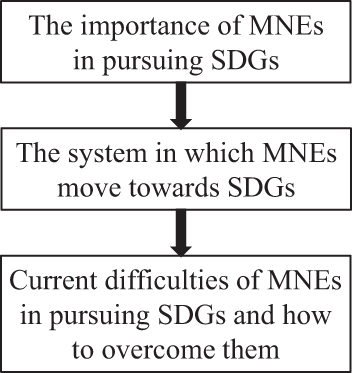
For these reasons, the conceptual framework developed here starts from the recognition of the central role of MNEs in pursuing the SDGs, goes on to acknowledge the other parties involved in such an achievement and how they interact with each other and ends with the identification of the current difficulties in pursuing the SDGs and the ways in which such difficulties can be overcome (Figure 1).
3. Methodology
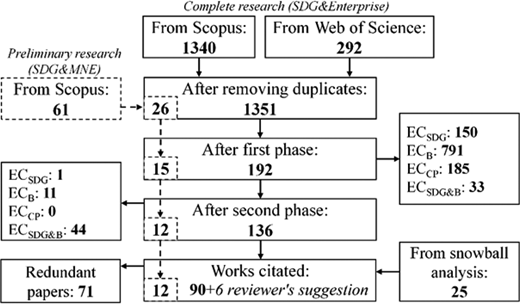
A first exploratory search was performed on Scopus on titles, abstracts and keywords, using terms and synonyms related to the SDGs (“sustainable development goals” or “SDG”) and MNEs (“multinational enterprise” or “multinational corporation” or “transnational enterprise” or “transnational corporation” or “multinational company” or “multinational companies” or “transnational company” or “transnational companies” or “MNE” or “MNC” or “TNC” or “TNE”). From this search, 61 papers were identified: the SDGs are a recent topic (since 2015) and the international business literature is wider on sustainability, in general, but quite limited in relation to the specific theme of how to pursue the SDGs. On the other hand, by broadening the research to include all types of businesses, several contributions can be found, which, although not specifically referring to MNEs, include concepts – such as the Principles for Responsible Management Education and CSR – which are far more widespread among MNEs that in small and local businesses. For this reason, complete searches were conducted using both Scopus and the Web of Science, with a set of keywords structured in two different groups. The former includes the keyword “sustainable development goals” and the relative acronym “SDG”, while the second group includes the keyword “enterprise” and its synonyms (company, companies, corporation, corporate, business and firm). The synonyms were connected with the Boolean operator “OR”, while the groups were connected to each other with the Boolean operator “AND” (TS = sustainable development goal OR SDG AND TS = company OR companies OR corporation OR corporate OR business OR firm). The search took place in March 2020. Articles reporting such keywords in the title, abstract or keywords were selected. The research was not limited to a specific year range and only English articles were taken into consideration. After performing the search, all documents were loaded into the Mendeley database manager and all duplicates were removed. The selection process was divided into two phases. The first phase involved reading the titles, abstracts and keywords. In this screening phase, the works were classified as included or excluded according to the specific exclusion criteria (EC) described below:
ECSDG: papers in which SDGs are absent or they are a secondary aspect compared to the main purpose of the paper.
ECB: papers in which businesses are only mentioned or they are a secondary aspect compared to the main purpose of the paper.
ECCP: entire conference proceedings.
ECSDG&B: papers that do not establish for businesses whether it is possible to work towards the SDGs or where this is a secondary aspect to the main purpose of the paper.
The second phase involved reading the complete text of the included works that could be classified with a tag or excluded according to the above criteria. Finally, the snowball technique was used by analysing the useful references found in the bibliography of the documents included in the second phase. Some articles selected in an area of interest referred to the same source and for this reason, the total number of articles cited is lower.
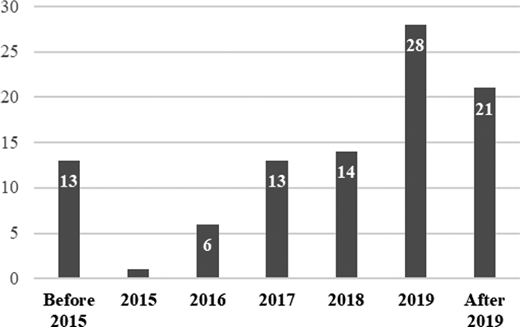
Figure 2 shows a summary of the process followed, whereas Figure 3 and Tables 1 and 2 show the results obtained in terms of distribution of selected papers per year, journal and type. Since the definition of the SDGs in 2015, the contributions increased in number until 2019, while a decrease was registered in 2020. The two top-cited journals focus on sustainability, but all the others are in the management area, including journals from the international business literature. In the relevant papers, theoretical contributions prevail and case studies are included, but there is a lack of quantitative works.
Distribution of selected papers per journal
| Journal title | Frequency |
|---|---|
| Journal of Cleaner Production | 13 |
| Sustainability (Switzerland) | 11 |
| International Journal of Management Education | 10 |
| Critical Perspectives on International Business | 6 |
| Business and Politics | 2 |
| Transnational Corporations | 2 |
| Journal of World Business | 2 |
| International Business and Management | 1 |
| Journal of International Business Studies | 1 |
| Multinational Business Review | 1 |
| Others | 48 |
| Total | 96 |
Distribution of selected paper per type
| Article type | Frequency |
|---|---|
| Theoretical | 62 |
| Case study | 18 |
| Review | 11 |
| Interview | 5 |
| Total | 96 |
The selected papers were read throughout and seven broad areas emerged from the analysis of their contributions. The first concerns the motivations around which MNEs can be considered a primary engine towards the attainment of the SDGs: indeed, these contributions justify the relevance of analysing the theme. A second area is related to the environment in which MNEs move towards the SDGs, recognising that even though this is their preeminent role, they cannot operate as the sole player but are required to interact with other institutions. The third area refers to the current difficulties MNEs encounter in pursuing the SDGs. From the recognition of such difficulties and by adopting Gleicher’s formula for change (Beckhard, 1975), the subsequent four areas are defined, with contributions investigating: the motivations to shift towards the SDGs (why), a definition of sustainability itself (what), the practical steps to follow in attaining the SDGs (how) and the related costs (how much). In the Appendix, the classification of the MNEs’ different contributions in one or more of these areas is reported and the analysis of the results is structured accordingly.
4. The importance of multinational enterprises in pursuing the sustainable development goals
Although the role of private businesses in achieving the SDGs is still evolving (Nylund et al., 2021), their great responsibility has been recognised (Bowie, 2019), but the trajectory in terms of actual achievement does not seem to instil optimism (De Perea et al., 2019). Although the specific literature linking MNEs and SDGs is not extensive (van der Waal et al., 2021), some authors (Kolk et al., 2017) have highlighted the importance of MNEs, especially in developing countries (Shan and Khan, 2016). In these emerging markets, about three-quarters of the total plastic waste is produced by only five MNE companies; indeed, the production of plastic waste on the part of the top 15 MNEs accounts for 95% of the total (Ajwani-Ramchandani et al., 2021). Often, the developing countries are strong attractors of MNEs due to their less oppressive sustainability legislation (Patchell and Hayter, 2021) or to the downward trend concerning unskilled workers’ wages (De Feis, 2018). These countries also have larger populations and the presence and impact of MNEs among these populations provide a measure of the importance of MNEs’ actions globally. Regarding the effects of MNEs in developing countries, García-Alaminos et al. (2020) provide an interesting observation: the MNE sustainability reports show analysts only the very small last part of the entire value chain. In fact, in addition to the direct impact on the SDGs by the finished product of an MNE, all processes and choices in the supply chain should be considered (Prashantham and Birkinshaw, 2020). Such choices indirectly impact the SDGs, through small and medium-sized enterprises sacrificing sustainability in exchange for an economic competitive advantage. As for the environmental issues, Kaartemo and Gonzalez-Perez (2020) speak about a “dark side” of international renewable energy. With reference to taxation, James (2019) estimates tax evasion by MNEs of $600bn every year in the developing countries, due to legislative bugs and differences in laws between nations, which contributes to the further impoverishment of these already poor countries. Moreover, the influence of MNEs and, sometimes, their political interference with government institutions can lead to a lack of democracy (Yeganeh, 2019).
The immense impact that MNEs can have on the SDGs is also related to the economic power and the community of intentions in the orientation of state policies. Vitali et al. (2011) analysed the network of all the MNEs in the world and discovered that it consists of many small, connected components, but the largest one (three-quarters of all nodes) contains all the top MNEs by economic value, which account for 94.2% of the total MNEs’ operating revenue. Indeed, to reach the SDGs, an overall investment of between $5tn and $7tn in the years up to 2030 has been estimated (Grainger-Brown and Malekpour, 2019). On the other hand, the annual turnover of the top 10 MNEs alone has been consistently higher than $3tn a year in recent years, while, if we consider the top 25, it is over $6tn. From 2015 to 2019, out of 100 global economies, 69 were companies, while only 31 were nations (Yeganeh, 2019).
5. The system in which multinational enterprises move towards the sustainable development goals
Different frameworks underline the holistic approach through which the SDGs have to be addressed. Ghosh and Rajan (2019) suggest a 5P logic including people (SDGs 1, 2, 5 and 10), planet (SDGs 7 and 12 to 15), prosperity (SDGs 3, 4 and 8), peace (SDGs 6 and 16) and partnership (SDG 17). Jia et al. (2019) define three dimensions: biosphere (SDGs 6 and 13 to 15), society (SDGs 1 to 7, 11 and 16) and economy (SDGs 8 to 10 and 12), which are mutually related through partnership (SDG 17). A similar categorisation, using a pyramid model, was proposed by Goralski and Tan (2020). Actually, the goals are not independent, but rather a hierarchy of the SDGs can be hypothesised, with the quality of education (SDG 4) being the driver for all the others, up to the partnership (SDG 17) implemented to achieve them all (Kumar et al., 2018).
According to Horne et al. (2020), MNEs mainly contribute indirectly to SDG 1 through other SDGs, such as 4 or 9. Xu et al. (2019) offer an improvement of the definition for some SDG 9 targets. Filser et al. (2019) identify in education (SDG 4) the driving wheel to trigger economic development (SDG 8) and decrease poverty (SDG 1), recognising a trade-off between these two goals and those related to the environment (SDGs 1, 14 and 15). Pradhan et al. (2017) identify trade-offs between the achievement of SDGs 1 to 4, 6 and 10 at the expense of SDGs 12 and 15. One way to overcome such trade-offs could be prioritising the production of the goods needed to meet the basic needs of humans (Ghezzi et al., 2018). For example, Isaksson (2019) notes that competition exacerbates the scarcity of resources to the extent that some business ideas might no longer be viable. Therefore, the implication for companies that produce services or goods that are not basic needs, but are higher in Maslow’s hierarchy of needs, is that a paradigm shift is needed from profit to people and planet. Also, Ferro et al. (2019) acknowledge that the use of the triple bottom line logic proves to be empirically effective in treating the SDGs in a universal way, in various contexts and over time. However, other authors show that a sustainable business model is not necessarily an attempt to deny the usual business perspective, but rather a way of integrating this vision, emphasising a more axiological and systemic approach (Morioka et al., 2017).
From the classifications highlighted so far, a framework is suggested for acknowledging how MNEs can move towards the SDGs while recognising all the other players with which they interact (Figure 4). Nature contains corporeal people and the intangible institutions they have created. By “institutions”, we mean the rules objectified in different structures, which are divided into three macro-types: punishment/reward institutions, institutions of practices and profit institutions (Korten, 1995; Mintzberg, 2015). The institutions of punishment/reward relate to systems capable of legislating and enforcing laws: they use coercion in the case of the non-fulfilment of goals and are represented by governments. The institutions of practices are the set of norms, languages, traditions and customs of communities. The institutions of profit refer to companies that compete in markets and exploit the power of technology. A similar categorisation was proposed by Lashitew and van Tulder (2019), who divided the institutional field into governance institutions, market institutions and socio-cultural institutions.
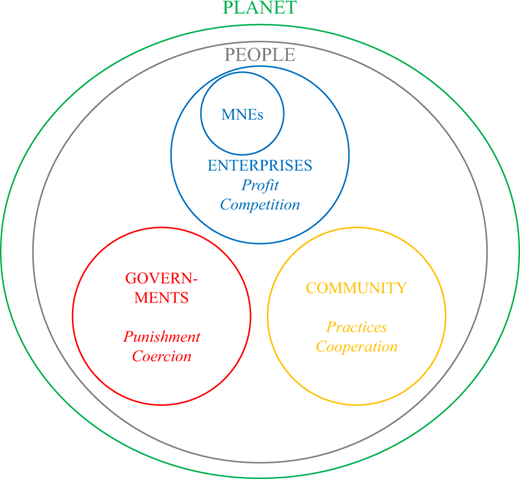
This framework, valid for multinationals, could obviously also be generalised for smaller companies operating only locally, where communities are small groups of citizens and governments are municipal administrations. The substantial difference between this framework at the regional/municipal level and the international one is the imbalance of power between the stakeholders. Indeed, within companies, a particular role is played by MNEs, as they have both high economic power (Kolk et al., 2017) and a global impact worldwide (Ajwani-Ramchandani et al., 2021). In fact, the huge amount of investments needed for pursuing the SDGs can be more easily afforded by MNEs than by smaller and more local companies (James, 2019). Moreover, by working in tune with different governments and communities, MNEs can act as accelerators, transferring best practices worldwide. This means that, even if every company, no matter its dimension or regional boundaries, interacts with communities and governments, for MNEs, such an interaction should be recognised as the primary trigger towards the attainment of the SDGs.
6. Current difficulties of multinational enterprises in pursuing sustainable development goals and how to overcome them
Often invoked in the literature are the need for MNEs’ change of perspective and substantial transformation of the mere logic of profit (García, 2019; Grainger-Brown and Malekpour, 2019; Isaksson, 2019; Ramboarisata and Gendron, 2019). This change is imperative (Peterson and Lunde, 2016), but legal actions and pressure from employees, civil society and international standards often allow for only a timid approach to sustainability (Kronfeld-Goharani, 2018). Stronger regulatory measures cannot attract MNEs in poor and isolated regions with high work costs or difficult infrastructures and, if uncontrolled access is granted to MNEs, they will reach only the regions where infrastructures and markets are conducive to staying competitive (Akter et al., 2017). Therefore, bringing MNEs into remote regions is not a simple matter without adequate incentives and ensuring access to reliable, sustainable and modern energy for all is not an easy task. This problem pertains to the lack of shared legislation everywhere, at least regarding important factors such as taxation and labour costs. For example, Banik and Lin (2019) argue that, in China, there is considerable interest in the tight application of legislation for all enterprises towards sustainable development. However, the hypothesis that there is a positive influence from perceived external (but also internal) pressures on the implementation of the SDGs has not been proven (Cantele and Zardini, 2020).
On the other side, it is understood that this influence is negatively mediated by any perceived barriers and positively mediated by perceived benefits. Therefore, hoping that the power of the institutions of punishment and practices alone can force MNEs to pursue SDGs is insufficient. The incentive system aimed at the SDGs should be revolutionised, as the mere economic “carrot and stick” approach is not effective (Rahdari et al., 2016). All systems and institutions, at every level, should autonomously move towards the SDGs, in a process called the “principle of subsidiarity”, absorbing complexity at each level through a recursive architecture (Schwaninger, 2015). Sachs et al. (2019) identify six preliminary transformations that are necessary to pursue the SDGs: a change in the education system, a guarantee of well-being and health, a focus on renewable energy, the sustainable management of natural and artificial resources and the use of technology to create a sustainable digital revolution, all through a circularity and decoupling process. Yet, the actions of MNEs do not seem effective in bringing about all these transformations. Govindan et al. (2020) identified numerous limitations that can block the MNEs’ movement towards meeting the SDGs: network issues; a low level of awareness; high capital cost; a high probability of risks and a lack of trust, technology, expertise, rules and regulations, sharing business models from an industrial perspective, multi-stakeholder collaboration, interactive platforms which can assist industries to share their resources, forecasting on potential resources flow, pressures from stakeholders (lack of necessity), access and transparency to data and sharing partner evaluation (certification) platforms.
Yiu and Saner (2017) analysed David Gleicher’s formula for change from the point of view of the implementation of the SDGs: we realise that many of the aforementioned limits to the actual achievement of the SDGs are attributable to the factors used in such inequation (Figure 5).
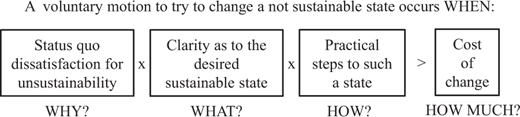
Formula for change towards sustainability (our adaptation from Gleicher’s formula)
Formula for change towards sustainability (our adaptation from Gleicher’s formula)
In the following sections, each of the factors of the inequation is analysed.
6.1 Why pursue sustainable development goals? Principles for responsible management education
One of the biggest challenges in pursuing the SDGs is answering the question: “Why should a company do it”? According to Ramboarisata and Gendron (2019), a large part of the literature is strongly critical of the inclusion of the ethical problem in business schools, assuming that business students are already able to critically assess these issues. Therefore, the answer to the question should necessarily be utilitarian and profit-oriented. Other authors believe that education about sustainability in entrepreneurial training, although difficult to implement, is still possible and desirable (Hermann and Bossle, 2020).
As we have highlighted, the trigger for the implementation of the SDGs is education on sustainability at all levels. SDG 4 mentions the quality of education and the need for everyone to be able to access it, but the actual problem is what to teach.
Several authors recognise the principles of responsible management education (PRME) as a good starting point to provide a valid motivation for enterprises that rely on only the rules of profit in moving towards the SDGs (Gentile, 2017; Hays et al., 2020; Herrmann and Rundshagen, 2020; Kolb et al., 2017; Molthan-Hill et al., 2020; Ndubuka and Rey-Marmonier, 2019; Neal, 2017; Ramboarisata and Gendron, 2019; Rosenbloom et al., 2017; Storey et al., 2017; Wood and Pansarella, 2019). As reported by the United Nations, “PRME is a United Nations-supported initiative founded in 2007 as a platform to raise the profile of sustainability in schools around the world and to equip today’s business students with the understanding and ability to deliver change tomorrow. […] PRME has become the largest organised relationship between the United Nations and management-related higher education institutions […] (and) engages business and management schools to ensure they provide future leaders with the skills needed to balance economic and sustainability goals while drawing attention to the Sustainable Development Goals […]”. However, the PRME audience is more oriented towards tomorrow’s entrepreneurs, while for today’s MNEs, embracing these principles still remains rather haphazard. This seems like a recursive problem. The motivation to pursue the SDGs must be sought within institutions and not outside them, according to the principle of autonomy (Schwaninger, 2015).
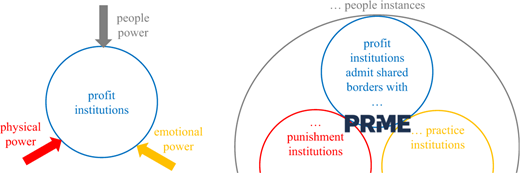
In Figure 6, two possible paths are suggested for improving and making clearer the motivations on the basis of which companies should pursue the SDGs. Firstly, with respect to companies focussed solely on profit issues, their awareness should mature such that, due to sustainability problems, the other institutions, with which they interact, will face greater and greater dissatisfaction which, if neglected, will lead to conflicts and physical, emotional and people power will ultimately be exercised over the companies. This is particularly true for MNEs, whose notoriety makes them more exposed to mass movements and loss of reputation. On the other side, by adopting PRME, profit institutions acknowledge the existence of shared borders with other institutions and the need to respect them. However, even if PRME theoretically applies to any type of company, in practice, the adoption of such principles should be far more widespread among MNEs, which can act as the trigger for change. In fact, as noted by Molthan-Hill et al. (2020), the process of strengthening the reasons to move towards the SDGs (the “why”), although it is recursively circular (Schwaninger, 2015) on a micro-, meso- and macro-scale, requires a top-down trigger, not a spontaneous bottom-up movement. This consideration is perfectly consistent with the observation of Vitali et al. (2011), which is that if economic and political power is shown to be in the hands of a small circle of private entities, such entities have the burden of responsibility to start taking sustainable actions.
6.2 What is a sustainable state? A problem not fully defined yet
As the birth of the SDGs, a substantial part of the literature has attempted to immediately suggest actions for implementing them or tools to measure their progress. Some authors view the implementation of the SDGs from a hierarchical approach, which prioritises some actions because they are necessary for subsequent ones. For example, Muff et al. (2017) translate the first three steps proposed by the Global Reporting Initiative, the UN Global Compact and the World Business Council of Sustainable Development into a business tool that uses a gap frame to understand the SDGs, business sustainability 3.0 to define priorities (Ike et al., 2019) and the “collaboratory” method to set goals. According to Gusmao Caiado et al. (2018), the SDGs implementation process consists of a virtuous cycle, where, in the first phase, research, information and education must be addressed in the various areas of knowledge, focussing on the integration of skills around the world and on the proposal of methodologies or technologies. The second step is to transform research and development into new sustainable products, processes or services. In the third phase, innovation is implemented by continuously monitoring goals and good practices. Shahbazi et al. (2019) compare four tools for monitoring the impact of production: life cycle assessment, waste flow mapping, green performance map and environmental value stream mapping. Despite a large number of tools and indicators aimed at measuring the SDGs, Janoušková et al. (2018), in comparing over 300 indicators, conclude that assessing sustainability is a tremendously difficult task; they believe that the different and inconsistent results published can cause serious doubts and misunderstandings about the ability to evaluate the implementation of the SDGs. Indeed, the tools and indicators for evaluating the performance of the SDGs are heterogeneous and often subjective and a debate on the topic is still ongoing. Moreover, although a complex set of indicators to monitor the results of the general efforts to reach the SDGs have been developed, there are few actual monitoring mechanisms with punitive capabilities (Bull and Miklian, 2019). According to Mishenin et al. (2018), it is even impossible to define clear and uniform operational guidelines for the implementation of the SDGs globally. Breinbauer et al. (2019), analysing empirical data on contributions towards the SDGs by Global 100 companies, show that compliance with the standards is still weak, the quality of reporting is poor, the current certification system does not provide sufficient quality assurance and the indicators needed to measure the progress of the SDGs is still incomplete, both at the micro and macro level. These considerations are supported by the recognition that most problems related to meeting the SDGs are wicked or complex (Van Tulder, 2018). Analysing the literature on complexity, De Toni and Pessot (2020) identify four dimensions of complexity: diversity, interdependence, dynamicity and uncertainty (DIDU). A mathematical approach to solving high DIDU problems is expensive. If problem-solving systems evolve towards excessive complexity – and therefore towards higher costs – they tend to be deprived of further financing and collapse or end up requiring more and more energy subsidies in an unsustainable spiral (Costanza et al., 1996). For this reason, one of the characteristics of a sustainable business is a sustainable problem-solving system that accepts temporary declines in profits. According to De Toni and De Zan (2016), if the external complexity increases, companies are faced with the “complexity dilemma”: accept the complexity and try to adapt (Ashby’s law of requested variety) or avoid and reduce it (Luhmann’s theory of complexity reduction). Both theories are valid and their synthesis is found in an inverted U-shaped relationship between complexity and performance. Once the amount of external complexity has been set, the performance increases as the internal complexity increases, until reaching a point of no return, after which an overload of complexity sinks the performance.
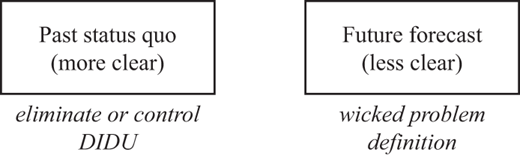
This reasoning is valid if the performance towards the SDGs is not confused with the business performance considered only as profit. The strategies, still often prevalent in managerial thinking, oriented to best practices, try to eliminate or control external DIDU. However, this type of managerial strategy is impotent towards wicked problems (Fahey, 2016). Rittel and Webber (1973), recognise that a rational-technical answer to wicked (social) questions can generate, at best, a temporary solution that tames the effects of the problem without solving its root causes and, therefore, results in antithetical long-term consequences. For these reasons, the alternative to looking at the imbalance caused by the problem of the SDGs as an opportunity to make a profit or try to restore a previous status quo is to understand that not all the SDGs are tameable and to treat them as wicked problems using adequate tools to deal with them (Figure 7). MNEs, which are characterised by high institutional complexity due to the interaction with multivariate environments (Marano and Kostova, 2015), can more easily face the complexity involved in attaining the SDGs. Therefore, unlike smaller and more local businesses, MNEs can exploit more sophisticated tools for defining such a wicked problem as sustainability.
6.3 How to move towards sustainable development goals? Clumsy solutions on the edge of the chaos
In literature, CSR is considered an important tool for enterprises in moving towards the SDGs (Gunawan et al., 2020). One of the broadest definitions of CSR is shown in the Carroll (1991) pyramid: at the base, there is the need to be profitable; immediately above this is the need to obey the laws; above this is the need to respect the culture and its unwritten rules by acting ethically and the highest level is to improve the quality of people’s physical and psychological life by philanthropic action. Xia et al. (2018), carrying out an analysis of the recent literature on CSR, note that only a small percentage of papers place the emphasis on the economic dimension of responsibility, taking it for granted, while the remaining portion focus more on the social dimension and less on the environmental one. Yet, the assumption that the commitment to CSR alone can provide a corporate contribution to sustainable development is under discussion (Schönherr et al., 2017). CSR hardly ever faces sustainability challenges at the system level, such as the degradation of ecosystems, poverty (Pimpa, 2020) and social injustice; instead, companies limit their ideas to problems related to themselves, following the approach of corporate self-responsibility (Van Tulder, 2018). We need also to recognise that MNEs alone will not be successful in achieving certain SDGs, nor can they act by taking for granted the power of local institutions and people (Pimpa, 2020). Many contributions in the literature corroborate the need to include environmental aspects in the definition of CSR; otherwise, the relationship between responsibility towards society and towards the environment is not immediate (Schönherr et al., 2017). A self-centred vision represents, in fact, only the first step identified in the literature to move towards a solution co-created with other actors, which is characterised by reactive rather than proactive behaviour (D’Antonio and Sim, 2017; Keijzers, 2012; Porter and Kramer, 2011; Sukhonos et al., 2019). Similarly, Caldera et al. (2018) propose concrete actions depending on the stage the firm is at, which, according to Hart (2013) involves moving from the passive phase of prevention of environmental damage to assuming product stewardship and pursuing proactive sustainable development. Sinkovics et al. (2020) have also developed a framework on the possible evolution of responsibility in width (associative, peripheral, operational and embedded) but also in-depth (delinquent, neutral, nascent, enhanced, advanced). Unfortunately, not all businesses have both the level of maturity and the economic strength to translate their attitudes towards the SDGs into proactivity. In a most inclusive definition, given by the Commission of the European Communities (2001), CSR is a concept whereby companies integrate social and environmental concerns into their business operations and interactions with their stakeholders on a voluntary basis. Indeed, according to Yeganeh (2019), as CSR falls on the voluntary side of the regulatory scale, it cannot be effective in curbing the pernicious social impacts of large companies and “a functional economy and a prosperous society are contingent upon a state monopoly of coercive powers”. For example, the Indian government requires by law that companies allocate a percentage of their profits to CSR (Bergman et al., 2019). Yet, according to Rahdari et al. (2016), “one of the major scholarly challenges of social entrepreneurship is the lack of an established epistemology that partly contributes to and/or stems from a conflict of discourses”. The conceptualisation of the acronym “CSR”, therefore, has undergone an evolution over time, from a dimension linked only to society, up to one that concerns the whole environment (Kolk, 2016). At the highest level of integration, it is appropriate to speak of “corporate sustainable responsibility” (Van Tulder, 2018). Some authors even go beyond the social and sustainable dimension, reaching a spiritual conception and taking as a mission the healing and repairing of the world (Grzeda, 2019). According to this view, the only way to effectively pursue sustainability is to consider nature not as something extraneous to society, but as sacred to humanity. In this vein, we can speak of a “corporate spiritual responsibility” (Table 3).
Levels of maturity in CSR; our elaboration inspired by literature (Kolk, 2016; Van Tulder, 2018; Grzeda, 2019)
| Kind of corporate responsibility | Self | Social | Sustainable | Spiritual |
|---|---|---|---|---|
| Dimension | Rational | Legal/moral | Etic | Transcendent |
| Rule | Maximum profit with minimum effort | Maximum profit with minimum effort in compliance with the law | Greater well-being of society, exploiting nature in a regenerative way | Give care to nature and people |
| Nature conception | Freely accessible good | Freely accessible good under legal constraints | Shared good, even with future generation | God’s demonstration |
| People conception | Goods | Consumers of goods | Responsible citizens | God’s demonstration |
| Means | Nature, people and technology | Nature and technology | Nature and technology | Technology |
| Aim | Profit | Profit and people wellness | Profit, people wellness and planet wellness | People and planet wellness |
Moreover, CSR actions cannot be implemented once and forever, and therefore a specific organisational form, one that is dynamic and capable of learning the effects of one’s actions, is required (Moggi et al., 2018). Organisations’ difficulty in achieving and maintaining sustainable goals is often because the concept of CSR has not been integrated into their internal control objectives (Liu, 2018). Examples of tools that can be used to achieve the SDGs include the new version of the Global Reporting Initiative, the SDG Compass and the SDG Industry Matrix (Grainger-Brown and Malekpour, 2019). However, to what extent is it possible to increase internal complexity and integrate ever-greater responsibilities in working towards the SDGs? One of the most interesting perspectives is based on the concept of the edge of chaos (De Toni and De Zan, 2016): An area of maximum energy (the crest of the wave) that divides order from disorder. Too much order causes death by fossilisation, whereas too much disorder causes death by disintegration. There can be three types of responses from MNEs to the waves of complexity:
Strategic, by focussing only on the SDGs on which it is possible to act;
Management, through modularisation, minimising the interdependence between the different SDGs (Campagnolo and Camuffo, 2010); and
Organisational, through self-organisation (Schwaninger, 2015), autonomy and cooperation.
By way of analogy, in this situation of precarious equilibrium, despite the learnable and applicable techniques and the kinds of responses seen above, a surfer (i.e. an MNE) dynamically assumes “clumsy” positions to maintain balance in the midst of the wave’s complexity (Grint, 2010).
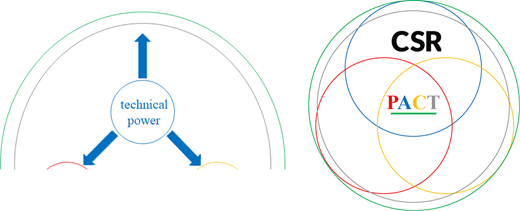
Partnership is the only space for solutions that, on the one hand, does not remain anchored to imbalances and, on the other hand, does not try to tame the externally complex dimensions of society by reducing their interdependences and controlling uncertainty and dynamicity. The alternative to infringing on the boundaries of other institutions (leading to conflicts), is to make this space a mutual arena through strenuous dialogue, after assuming higher levels of responsibility towards the issue and, thus reaching a pact (Figure 8). However, this pact between institutions should reflect a commitment that is proportional to their individual power and responsibilities. We often hear that it is necessary to surrender personal, family, community and national sovereignty for a shared good. The most illustrative example of this mantra is the European Union project, in which communities and governments are expected to surrender their sovereignty to the greater whole. A pact between institutions must provide, instead, that the companies participate in a proportional way. Even if the principles of CSR are applicable to all businesses, there is no doubt that MNEs, more than other types of companies, must try to embrace them, thus acting as a trigger and a landmark for other companies, governments and communities.
In this partnership space are multilateral institutions (Bull and Miklian, 2019) and a partnership between the public (community and governments) and private (enterprises) is considered more effective in keeping MNEs accountable for upholding human rights (Sinkovics and Archie-Acheampong, 2019). A type of company that has evolved in this space is the social hybrid (Littlewood and Holt, 2018), in which the spirit of SDG 17 was previously present. There is no formula in the literature to explain how to live in this space of partnership, just as there is no book on how to teach surfing. The ability to move here requires skills that rarely belong to the toolbox of managers (Yiu and Saner, 2017), as well as that of governors. As Mutale et al. (2019) point out, for a simple businessman, it is impossible to determine the real needs of a community (and, in fact, often these needs are created by the market). Grint (2010) identifies a leader as capable of adopting clumsy solutions for solving wicked problems and living in this space. Indeed, he associates a figure (commander, manager and leader) and a cultural approach (hierarchists, individualists and egalitarians) to each type of problem (critical, tameable and wicked). But while for non-wicked problems, it is possible to find elegant solutions and to learn the art of command and management, for wicked problems, it is necessary to explore a clumsy solutions space, exploiting autonomy and cooperation, through the capability of phronesis that only a true leader can possess. Nevertheless, once a clumsy solution has been found, both individualists and hierarchists are needed to achieve it.
6.4 How much does it cost to change? A shared worldview
Several MNEs have interpreted meeting the SDGs not as a burden to which all humanity is called to contribute, but an opportunity to exploit emotional marketing to generate profit (García, 2019), thus hiding social and environmental devastation behind philanthropic actions. The practice of greenwashing that was detected in 95% of the product samples analysed by Peterson and Lunde (2016) is one proof of this type of misleading action. Moreover, only about a dozen patents out of every hundred are related to at least one SDG (van der Waal et al., 2021) and there is no guarantee that improvement towards one SDG will not worsen another (for example, pesticides that favour food safety or health objectives, but damage ecosystems) nor that a patent will reach the developing countries (for example, pharmaceutical patents do not guarantee the accessibility of drugs by poor countries, increasing disparities). However, CSR does not mean paying every time a human right is trampled to rebalance the economy; it means collaborating to help preserve and guarantee the well-being of communities, institutions and the environment. It is important to understand that meeting the SDGs is the final goal and that CSR is the tool to achieve these goals. Indeed, the idea of “shared values”, although it relates closely to sustainable action, still remains anchored to the perspective of profit institutions and it is certainly not able to solve all the problems of society.
As García (2019) reports: “CSR and human rights respect would become a simple management issue of goodwill-nomics violations would be read as a risk and, sometimes, this approach can treat violations as unavoidable costs of production, while the word stakeholders could end up hiding victims, i.e. rights-holders. This cost-effective way of thinking has an additional problem as far as it would allow corporations to prioritise some human rights. All these quantitative manias may reflect certain dissemination of the corporate form of thinking. It is not so difficult to avoid confusing stakeholders with right-holders and the above-mentioned risk of permitting a private-led prioritisation or marketisation of human rights […] companies should accept that CSR is only partially quantifiable and, more importantly, that CSR is not automatically profitable: sometimes it is, but not always and necessarily”.
The cost to be paid for the change, in the space of the partnership, should be equally distributed among the actors involved, at all levels, if all have the same importance. However, in the case of conflicts, those with more power can more easily impose the burden of responsibility on others, while continuing to engage in unsustainable behaviour (Figure 9). The risk that would follow in the long term, however, would be a loss of reputation and intolerance on the part of communities and governments. To avoid social unrest or legal action and, at the same time, have a balanced responsibility between institutions, it is appropriate for MNEs to consider sharing more power and responsibility with other institutions.

7. Discussion and conclusion
In this work, we have endeavoured to systematise the literature on whether and how MNEs can contribute to the pursuit of the SDGs. A systematic search of the literature on the subject has clarified that, among all the actors involved in this change, the MNEs are highly important, due to their significant economic and technological power, as well as their organisational capacity and unity of intent, unlike civil society and its governors, which often have different needs and less organisation. Subsequently, after presenting a framework in which MNEs operate, we identified three major macro-categories of limitations that can hamper real change towards the SDGs: lack of motivation, lack of clarity on the state to be achieved and lack of practical steps to reach that state, including the delegation of responsibility to the actors involved. For each of these shortcomings, we identified a different alternative than the reactive approach. Regarding the real motivation to pursue the SDGs, we recognised the concept of autonomy at multiple levels as the most valid for MNEs, separate from the higher impact of sustainability education on the managers of tomorrow’s businesses. A forward-looking vision, instead of one with a limited time horizon, can also help, as well as the figure of the leader who is more transversal than a simple manager or commander. The theory on complexity and wicked problems is fundamental for increasing awareness of the state to be achieved because the challenge of meeting the SDGs is not tameable. Finally, we proposed a way to increase CSR regarding the SDGs, as a more effective tool to try to combat the problem, rejecting theories that start exclusively from the point of view of profit, even if projected towards a space of sharing. Unfortunately, the cost of change for MNEs cannot be minimised; otherwise, the risk is unpleasant effects on other institutions and on people and the planet. The alternative to dealing with excessive costs is to distribute responsibilities and actions equally to the SDGs. Figure 10 shows the complete framework.
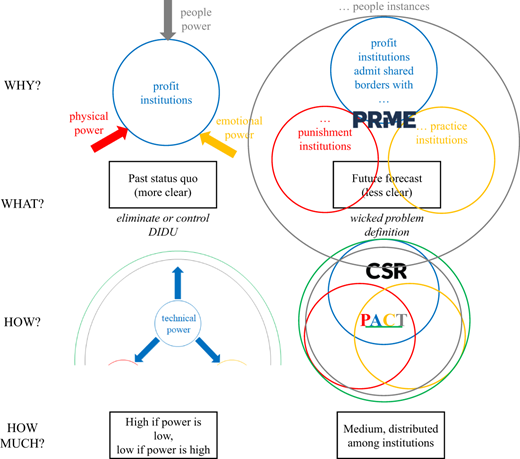
Framework on the change towards SDGs. Comparison between the previous and next condition
Framework on the change towards SDGs. Comparison between the previous and next condition
From the theoretical point of view, the paper identified seven broad areas of current research on the theme of MNEs and SDGs. We recommend that future research focus on how the current difficulties for MNEs in pursuing the SDGs should be overcome. Additional research is, therefore, called for that aims towards a clearer definition of a sustainable state, the practical steps to reach such a state and the costs in reaching it. Indeed, the many interactions and trade-offs between the different SDGs should be analysed and solved, also suggesting new sustainability indicators that could be included in decision-making processes. Moreover, the lack of quantitative studies on the theme and the relative scarcity of case studies should be tackled: starting from the many theoretical contributions already published, more practical research is needed. Finally, given that the ultimate goal of companies is profit, the cost issues related to the achievement of the SDGs should be addressed.
From the analysis of the literature on the environment in which MNEs interact with other entities in moving towards the SDGs, including the criticalities they face in such a process and the possible pathways to overcome them, some practical implications can be defined for managers and decision makers. Crucially, an MNE should not look for reasons to pursue the SDGs outside the company (laws or community pressures), nor make profit the sole purpose of this endeavour, but rather integrate the SDGs into their vision, making them the end and not the means. Additionally, given the complexity of the problem, MNEs should focus only on the SDGs in which they can intervene without worsening the others, always consulting with other institutions in an effort to understand any potential negative impacts to avoid. Furthermore, it is essential to satisfy only the real needs of people – for example, using a crowdsourcing process (Ghezzi et al., 2018) – rather than creating more needs or using power to try to reduce, manage or tame the complexity of society through control.
This work is an attempt to systematise the literature in the field of MNEs and SDGs. Its main limitation is its theoretical nature, as well as the lack of quantitative analysis. For this reason, future research should address putting the suggested framework into practice by analysing case studies through an action research approach. Quantitative validation of the proposed framework could also be pursued using a survey.
References
Appendix. Our classification of the contributions
| Authors | Keywords | Our classification |
|---|---|---|
| Ajwani-Ramchandani et al., 2021 | Artificial intelligence; blockchain; circular economy; digitalisation; emerging economies; multinationals; packaging waste and U.N. sustainable development goals | 1) The importance of MNEs in pursuing SDGs |
| Alan and Wai-Poi, 2020 | Goal 10; target 10.4; the redistributive impact of fiscal policy and Gini coefficient | 1) The importance of MNEs in pursuing SDGs |
| Benestad et al., 2016 | Climate change; intergovernmental panel on climate change (IPCC) and goal 13 | 1) The importance of MNEs in pursuing SDGs |
| Bowie, 2019 | Civilizing capitalism; destructive capitalism; human rights; multinational corporations (MNCs); sustainable development goals (SDGs) and UN global compact | 1) The importance of MNEs in pursuing SDGs |
| De Feis, 2018 | No profit and social enterprise | 1) The importance of MNEs in pursuing SDGs |
| De Perea et al., 2019 | International SMEs; international business models; internationalisation archetypes; management control systems and innovation | 1) The importance of MNEs in pursuing SDGs |
| Dery Tuokuu et al., 2019 | Ghana; gold mining; human capital; stakeholders and sustainable development | 1) The importance of MNEs in pursuing SDGs |
| Galimberti, 2009 | Cult of youth; idolatry of intelligence; obsession with economic growth and the tyranny of fashion | 1) The importance of MNEs in pursuing SDGs |
| García-Alaminos et al., 2020 | Multinational enterprises; MRIO model; social footprint; international trade and indecent labour | 1) The importance of MNEs in pursuing SDGs |
| Janoušková et al., 2018 | Tax; trade; e-commerce; digital trade; digital economy and development | 1) The importance of MNEs in pursuing SDGs |
| Jia et al., 2019 | Health systems; operational research; sort it; sustainable development goals and universal health coverage | 1) The importance of MNEs in pursuing SDGs |
| Keijzers, 2012 | Renewable energy; climate change; fossil fuel phase-out; corporate sustainability; sustainable development goal 7 and SDG 7 | 1) The importance of MNEs in pursuing SDGs |
| Korten, 1995 | Corporate social responsibility; human rights; multinationals; poverty; stakeholders and sustainability | 1) The importance of MNEs in pursuing SDGs |
| Nylund et al., 2021 | Innovation ecosystems; multinational enterprise; responsible research and innovation; sustainability management and sustainable development goals | 1) The importance of MNEs in pursuing SDGs |
| Patchell and Hayter, 2021 | Cloud computing; renewable energy; firm-specific advantages; country-specific advantages; home countries and host countries | 1) The importance of MNEs in pursuing SDGs |
| Prashantham and Birkinshaw, 2020 | MNE-SME cooperation; SME internationalisation; sustainable development goals; global innovation; global value chain and interorganisational relationships | 1) The importance of MNEs in pursuing SDGs |
| Shan and Khan, 2016 | China; emerging markets; frugal innovation; Philips Inc; reverse innovation; SDG and socio-economic sustainability | 1) The importance of MNEs in pursuing SDGs |
| Vitali et al., 2011 | Control network and transnational corporations (TNCs) | 1) The importance of MNEs in pursuing SDGs |
| Zavyalova et al., 2018 | Sustainable development; transnational corporations (TNC); millennium development goals (MDG); sustainable development goals (SDG); SDG classification; socially-oriented SDG and corporate social responsibility | 1) The importance of MNEs in pursuing SDGs |
| Ferro et al., 2019 | Sustainability; Spain; business; sustainable development goals; triple bottom line approach and UN 2030 agenda | 2) The system in which MNEs move towards SDGs |
| Filser et al., 2019 | Entrepreneurship; sustainable development and literature review | 2) The system in which MNEs move towards SDGs |
| Ghezzi et al., 2018 | Crowdsourcing | 2) The system in which MNEs move towards SDGs |
| Ghosh and Rajan, 2019 | Sustainable development goals (SDGs); inclusive business; the base of the pyramid (BoP); private sector; emerging economies and social impact | 2) The system in which MNEs move towards SDGs |
| Goralski and Tan, 2020 | Artificial intelligence (AI); 2030 agenda for sustainable development and SDGs categorisation | 2) The system in which MNEs move towards SDGs |
| Ike et al., 2019 | Entrepreneurship; sustainable development goals and startups content analysis | 2) The system in which MNEs move towards SDGs |
| Kaartemo and Gonzalez-Perez, 2020 | Sustainability; big data; bibliometric analysis; information management; science visualisation and Cite Space | 2) The system in which MNEs move towards SDGs |
| Kronfeld-Goharani, 2018 | Anti-globalisation; multinational corporation; consumerism; deregulation; privatisation; corporate power and speculation | 2) The system in which MNEs move towards SDGs |
| Hart, 2013 | Developing countries; interpretive structural modelling; MDG; SDG and sustainable development | 2) The system in which MNEs move towards SDGs |
| Lashitew and van Tulder, 2019 | Base of the pyramid; embeddedness; multinationals; political CSR; proto-institutions and social value | 2) The system in which MNEs move towards SDGs |
| Mintzberg, 2015 | Public; private; plural sector; inequalities and multinationals | 2) The system in which MNEs move towards SDGs |
| Morioka et al., 2017 | Sustainable business model; sustainable value; competitive advantage; sustainable development goals; corporate sustainability and value proposition | 2) The system in which MNEs move towards SDGs |
| Pradhan et al., 2017 | MNE-SME cooperation; SME internationalisation; Sustainable Development Goals; global innovation; global value chain and interorganisational relationships | 2) The system in which MNEs move towards SDGs |
| Xu et al., 2019 | SDGs; county level; improved indicator system and transportation infrastructure construction | 2) The system in which MNEs move towards SDGs |
| Akter et al., 2017 | MNE contribution; renewable energy; sustainable development and LfA programme | 3) Current difficulties in pursuing SDGs |
| Banik and Lin, 2019 | CSR; SDGs; China; corporate behaviour and social development | 3) Current difficulties in pursuing SDGs |
| Beckhard, 1975 | Organisation change; large system and complex organisation | 3) Current difficulties in pursuing SDGs |
| Cantele and Zardini, 2020 | Sustainability; drivers; pressures; barriers; benefits and small businesses | 3) Current difficulties in pursuing SDGs |
| Govindan et al., 2020 | Industrial sharing economy; best worst method; DEMATEL; barriers and SDG’s | 3) Current difficulties in pursuing SDGs |
| Kumar et al., 2018 | Discourse theory; maritime economy; ocean industry and sustainability reporting | 3) Current difficulties in pursuing SDGs |
| Sachs et al., 2019 | SDG and transformation | 3) Current difficulties in pursuing SDGs |
| Gentile, 2017 | Business ethics; giving voice to values; leadership development; management education; pedagogy and UNGC PRME | 4) Why pursuing SDGs |
| Hermann and Bossle, 2020 | Sustainable process paradigm; sustainable development goals; principles for responsible management education; leadership; case study and sustainable learning | 4) Why pursuing SDGs |
| Herrmann and Rundshagen, 2020 | Bibliometric; sustainability education; entrepreneurship education; sustainable development goals; teaching framework and higher education | 4) Why pursuing SDGs |
| Horne et al., 2020 | SDG 2 and humanistic management | 4) Why pursuing SDGs |
| Kolk et al., 2017 | Responsible management education; SDG; best practise; CSR; sustainability; sustainable management; business schools and higher education institutions | 4) Why pursuing SDGs |
| Molthan-Hill et al., 2020 | Business; carbon; climate mitigation; education for sustainable development; principles of responsible management education; responsible management education and sustainable development goals | 4) Why pursuing SDGs |
| Ndubuka and Rey-Marmonier, 2019 | Academics; business schools; capability approach; RME; responsible management education; SDGs and sustainable development goals | 4) Why pursuing SDGs |
| Neal, 2017 | Business schools; CSR; PRME | 4) Why pursuing SDGs |
| Ramboarisata and Gendron, 2019 | Responsible management education; ethics; CSR; sustainability and business schools | 4) Why pursuing SDGs |
| Rosenbloom et al., 2017 | Poverty; poverty reductions; PRME; anti-poverty working group; management education; business programmes and sustainable development goals | 4) Why pursuing SDGs |
| Storey et al., 2017 | Sustainable development goals; Bourdieu; responsible management education; PRME; UN; ethics; responsibility and education | 4) Why pursuing SDGs |
| Wood and Pansarella, 2019 | PRME; SDG; transdisciplinary learning; reflexive practice and immersive programme | 4) Why pursuing SDGs |
| Costanza et al., 1996 | Ecological economics | 5) What is a sustainable state |
| Bergman et al., 2019 | Companies Act 2013; content configuration analysis; corporate responsibility expectations; India and media analysis | 5) What is a sustainable state |
| De Toni and Pessot, 2020 | Complexity theory; knowledge management; project management and uncertainty | 5) What is a sustainable state |
| Fahey, 2016 | Wicked strategies; complexity and wicked problems | 5) What is a sustainable state |
| Gusmao Caiado et al., 2018 | Sustainable development goals; sustainability science; knowledge management interdisciplinary; 2030 agenda and stakeholder engagement | 5) What is a sustainable state |
| Isaksson, 2019 | Corporate sustainability; sustainable development goals; goal prioritisation; manufacturing multinational enterprises and association of Southeast Asian Nations | 5) What is a sustainable state |
| Javadi et al., 2019 | Agenda 2030; global indicator framework; SDGs; sustainability indicators and sustainable development goals | 5) What is a sustainable state |
| Mishenin et al., 2018 | Management of flows; flow thinking; industrial ecology; logistics; region’s sustainable development; circular economy and regional policy | 5) What is a sustainable state |
| Muff et al., 2017 | Collaboratory; gap frame; SDG compass; sustainable development goals and true business sustainability | 5) What is a sustainable state |
| Rittel and Webber, 1973 | General theory of planning; wicked problem and complexity | 5) What is a sustainable state |
| Sinkovics and Archie-Acheampong, 2019 | CSR; MNE; multinational enterprise; scoping review and social value | 5) What is a sustainable state |
| Grint, 2010 | Tame; wicked; critical; leadership; management; command; elegant and clumsy | 6) How to move towards SDGs |
| Hays et al., 2020 | Natural-resources-based view of the firm and sustainable development | 6) How to move towards SDGs |
| Kolb et al., 2017 | Business; government and sustainable development | 6) How to move towards SDGs |
| Kolk, 2016 | Corporate social responsibility; human rights; multinationals; poverty; stakeholders and sustainability | 6) How to move towards SDGs |
| Littlewood and Holt, 2018 | Think global trade social; UN’s new sustainable development goals (SDGs) and social enterprise | 6) How to move towards SDGs |
| Liu, 2018 | Sustainability performance; corporate social responsibility (CSR); internal control; multi-attribute decision model (MADM); decision-making trial and evaluation laboratory (DEMATEL); DANP (DEMATEL based ANP) and VIKOR | 6) How to move towards SDGs |
| Moggi et al., 2018 | Food donation; waste reduction; accountability; inter-organisational processes; network organisations; sustainability; corporate social responsibility (CSR); legitimacy and SDGs | 6) How to move towards SDGs |
| Mutale et al., 2019 | Community; corporate sustainability performance; mining industry; SDGs; sustainable development and Zambia | 6) How to move towards SDGs |
| Pimpa, 2020 | Multinational corporations (MNCs); poverty alleviation and CSR | 6) How to move towards SDGs |
| Porter and Kramer, 2011 | Capitalism and shared value | 6) How to move towards SDGs |
| Schönherr et al., 2017 | Transnational corporations; sustainable development; corporate social responsibility; sustainable development goals and impact measurement | 6) How to move towards SDGs |
| Sinkovics et al., 2020 | Corporate social responsibility (CSR); MNEs; multinational enterprise (MNE); responsibility matrix; responsible business; SMEs; small and medium-sized enterprise (SME); suppliers and sustainable development goals (SDGs) | 6) How to move towards SDGs |
| Sukhonos et al., 2019 | Corporate social responsibility; sustainability; CSR strategy; SDGs and responsible behaviour | 6) How to move towards SDGs |
| Xia et al., 2018 | Corporate social responsibility (CSR); construction organisations; construction industry; framework and sustainable development goals | 6) How to move towards SDGs |
| Caldera et al., 2018 | Characteristics; lean and green; natural-resource-based view theory; regenerative development; small and medium-sized enterprises and sustainable business practice | 6) How to move towards SDGs |
| Carroll, 1991 | Corporate social responsibility; moral management and organisational stakeholders | 6) How to move towards SDGs |
| Commission of the European Communities, 2001 | Corporate Social Responsibility; Human rights; holistic approach and U.N. sustainable development goals | 6) How to move towards SDGs |
| D’Antonio and Sim, 2017 | Business case for sustainability; business case drivers; business model for sustainability; sustainability innovation; radical innovation; corporate sustainability; corporate social responsibility; CSR; sustainability strategies; proactive environmental strategies; strategic management; framework and conceptual model | 6) How to move towards SDGs |
| Grzeda, 2019 | Spirituality; Tikkun Olam; corporate social responsibility; healing and sustainability | 6) How to move towards SDGs |
| Gunawan et al., 2020 | Corporate social responsibility; Indonesia Responsible consumption and production and Sustainable development goals | 6) How to move towards SDGs |
| García, 2019 | Corporate social responsibility; fragile and failed states; sustainable development goals; Colombia and Democratic Republic of Congo | 7) How much does it cost to change 1) The importance of MNEs in pursuing SDGs 3) Current difficulties in pursuing SDGs |
| van der Waal et al., 2021 | Sustainability-oriented innovation; patents; multinational enterprises; SDGs; global challenges and sustainability reporting | 7) How much does it cost to change 1) The importance of MNEs in pursuing SDGs |
| Peterson and Lunde, 2016 | Overconsumption; degradation of resources; sustainable business practices and greenwashing | 7) How much does it cost to change 3) Current difficulties in pursuing SDGs |
| Grainger-Brown and Malekpour, 2019 | Sustainable development goals; strategic management; strategic planning; organisational strategy; corporate social responsibility; organisational action and transformations | 1) The importance of MNEs in pursuing SDGs 3) Current difficulties in pursuing SDGs |
| Breinbauer et al., 2019 | Emerging market multinationals | 1) The importance of MNEs in pursuing SDGs 5) What is a sustainable state |
| Yeganeh, 2019 | Business and society; corporate cronyism; environmental degradation; international business; large corporations; multinational corporations and state sovereignty | 1) The importance of MNEs in pursuing SDGs 6) How to move towards SDGs |
| James, 2019 | Sustainability; excellence; stakeholder; paradigm; licence to operate; SDG and planetary boundaries | 2) The system in which MNEs move towards SDGs 3) Current difficulties in pursuing SDGs |
| Yiu and Saner, 2017 | Business diplomacy; sustainable development goals; business sustainability; organisational and multi-stakeholder learning | 3) Current difficulties in pursuing SDGs 5) What is a sustainable state |
| Rahdari et al., 2016 | Sustainability; corporate social responsibility; social entrepreneurship; social enterprise and sustainable development | 3) Current difficulties in pursuing SDGs 6) How to move towards SGDS |
| Schwaninger, 2015 | Sustainability; systems approach; viable system model; organisation design; organisational cybernetics and recursive structure | 4) Why pursuing SDGs 6) How to move towards SGDS |
| Bull and Miklian, 2019 | Development; multilateral institutions; sustainable development goals; corporate social responsibility and public/private partnerships | 5) What is a sustainable state 6) How to move towards SGDS |
| Van Tulder, 2018 | Business; sustainable development goals and sustainable finance | 5) What is a sustainable state 6) How to move towards SGDS |

