

This study aims to examine how the adoption of digital technologies affects the business competitiveness of countries in Latin American and European countries.
This study used a structural model based on factors representing the pillars of the Global Competitiveness Index: financial system, adoption of information and communication technologies (ICT), skills, labor market, product market, macroeconomic stability, business dynamism and gross domestic product (GDP) purchasing power parity (PPP) as a percentage of the total world value. The authors considered 17 Latin American and 28 European countries. The model was analyzed by partial least squares-structural equation modeling.
ICT adoption in Latin American countries is a strong predictor of business dynamism (66% of the variance), skills (81% of the variance), product market (75% of the variance), labor market (42% of the variance) and financial system (49% of the variance). Similarly, ICT adoption in European countries is a strong predictor of business dynamism (35.6% of the variance), skills (72.2% of the variance), product market (51.6% of the variance), labor market (81.7% of the variance, but with a negative path coefficient) and financial system (38% of the variance).
Latin American countries should create policies to build skills to increase ICT adoption, and improve business and labor market dynamism. A theoretical implication is that the authors propose two structural models based on the GCI that best explains competitiveness in Europe and Latin America.
Using GCI data, the authors present empirical evidence on the predictors of competitiveness across 17 Latin American and 28 European countries with a special focus on the adoption of digital technologies.
1. Introduction
In recent decades, organizations have been forced to develop their businesses in more versatile ways to respond to different market needs, become more efficient and productive and, ultimately, be more competitive than their competitors. The implementation and application of new digital technologies is crucial in this context. They can positively affect the ability of companies to respond to market needs (Blichfeldt and Faullant, 2021). Ferrari (2012) notes that technological development has been a priority in government agendas in many countries, and considered as the engine of economic and competitive development. While companies incorporating these technological developments, such as digital transformation, may be doing so to evolve themselves, it can also cause internal resistance from employees owing to the complexity and uncertainty that it may bring. For instance, despite the changes over the past 15 years, very few economies have managed to completely advance toward the fourth industrial revolution, since a mix of both the digital and physical worlds is needed (Teigens et al., 2020). Furthermore, Karim et al. (2022) argue that the business performance of regarding information and communication technologies (ICT) depends on the national context in which they are developed. For instance, firms in developing countries may lack access to ICTs which may be readily available to their counterparts in developed countries. Then, the former will need to learn these ICTs from the latter and introduce them into their own firms to gain a competitive advantage.
This study explores how the adoption of digital technologies influences the competitiveness of countries. For instance, ICT adoption has been slow in Latin American countries and a generalized implementation policy is missing. Furthermore, only a small fraction of the society has high broadband connectivity (Gallego and Gutierrez, 2015). Ramírez-Alujas (2011) also notes that Latin America has social problems which affect its growth and market development: an education system that does not focus on skills and innovation, economic inequality and low levels of ICT adoption and implementation, which generally remain in the hands of a few private companies.
Arredondo-Trapero et al. (2020) point out that cooperation is necessary to create new technologies, products and processes, especially in emerging economies where resources and capacity for innovation are relatively limited. Sukno and Pascual del Riquelme (2019) found that in some countries such as Chile, the e-commerce has been growing but it is still far from its real potential. Meanwhile, developed countries have allocated resources for ICT implementation and are seeking to move from an industrial economy to a global economy based on knowledge transfer. According to the World Economic Forum (WEF, 2016a), digitization as well as access to, and the use and development of ICT allow countries to have greater opportunities to generate citizen well-being.
Goumagias et al. (2022, p. 78) state that “firms reconfigure their resources when they respond to changes in their external or internal environment, often by incorporating new knowledge and resources in collaboration with external stakeholders. However, the reconfiguration process is difficult, costly[,] and often fails.” Ideally, these decisions around firm and resource reconfiguration and transformation should be made with the participation of all members of the company together with the leadership. The latter manages the relationships and integration of all the necessary components for the achievement of the desired objectives.
Moreover, digitization is becoming a way to improve the efficiency of processes and promote the development of countries, allowing greater competitiveness and facilitating important transformations in all spheres of human life (Aghimien et al., 2021). This has been the case with the development of ICT. Almost all manifestations of social life are now available in digital format (Cijan et al., 2019), which allows us to conceive a broader concept of the performance and impact generated. In turn, this can help us analyze strategies for the development of digital transformation and organizational innovation. Essentially, digital technologies can contribute to the organization via better production, services, performance and productivity. An interconnected world also allows firms to visualize the opportunities for offering a product or service that satisfies client needs, exploiting new strategies and opening the possibilities for implementing activities for promoting innovation. This is because the way of creating products, services and processes has transformed (Vallejo, 2018). In this context, it is important to ask how ICT adoption impacts configuration, reconfiguration and international competitiveness in Latin American and European countries. To our knowledge, this is the first study to provide information on factors that could explain competitiveness from the perspective of digital technology adoption.
The rest of this article is organized as follows. Section 2 reviews the literature on digital technologies. Section 3 develops our hypotheses and structural model of this study. Section 4 outlines the methodology and the results are presented in Section 5. This is followed by a discussion of the results in Section 6. Section 7 describes the theoretical and practical implications. Finally, Section 8 presents the conclusions of this study.
2. Evolution of digital technologies
In this section, we discuss the literature on the importance of digital technologies for companies, and the advantages and opportunities created by ICT adoption in entrepreneurial contexts. Essentially, this theoretical review identifies the extent to which digital technologies may be key to competitiveness.
Companies must have the ability to promote and lead the different changes in production models in an immediate and flexible way. This can help them survive and remain competitive. In addition, companies must be innovative to become more competitive and should not be afraid of risks when adding networks that improve the productivity of their business processes.
A particularly important aspect is investigating how digital transformation helps the empowerment of their business. Furthermore, we should examine whether it is necessary to change the organizational culture for the successful implementation of digital transformation, and the collective reorientation of business objectives and processes toward a digital future. The exchange of information is an additional element that the digital medium offers us because it collects different data that users provide. In this way, firms can evaluate what is needed to satisfy the client, what the client expects from their product or service, making the corresponding changes and, thus, be relevant, visible and competitive.
Moreover, digital transformation and innovation are positively integrated, allowing the development of new organizational and administrative processes that generate value, and improve financial and market performance (Gerasimenko and Razumova, 2020). Furthermore, digitization and innovation have been changing exponentially. Therefore, entrepreneurs have had to evaluate the new demands of the market and the product/service offerings that their firms must have to remain competitive. There are new types of opportunities, ranging from products, digital services, platforms and, above all, customer experience, radically changing the market offering (Kagermann, 2015).
There are different ways to integrate digital transformation into organizations to improve competitiveness. Essentially, there are five fundamental principles: integrating digital platforms to make the exchange of information transparent and streamlined; standardize technological and business processes while maintaining an efficient production management and control system; adapting the organizational structure by hiring people trained in digital skills; supporting digital transformation so that both employees and partners understand the concept and how to implement it; and evaluating the efficiency before and after the digital transformation, taking frequently used digital tools and systems as evidence. By carefully evaluating these factors, firms can choose the right way to strategically proceed to improve or maintain their processes, while maintaining quality, low cost, timelines, efficiency, effectiveness and safety (Yurii et al., 2021).
Companies must constantly transform because new elements may emerge that can help enhance internal processes. However, in a globalizing world, being competitive both locally and globally is challenging, while simultaneously fulfilling consumer needs, and growing and expanding into new emerging markets (Sheth, 2011). Given the variety of changes in organizations, technologies, societies, cultures and markets, firms must search for competitive advantages that lead to the development of the abilities to both produce and distribute as well as communicate. Firms must not only offer quality products and services, but they must also advertise themselves. The easiest way to do this can be participating in networks that allow the circulation of information and the added value that the company offers.
An organization’s leadership is key to being able to design and define its strategies, character and resource allocation. Nylén and Holmström (2015) note that digital technologies generate potential scenarios for service and product innovation. Therefore, organizations need to develop dynamic tools that facilitate resource usage, user experience, business skill development and greater value propositions (Henfridsson et al., 2014; Yoo, 2012). Under the leadership’s guidance, these tools can help connect organizational research activities and applications for new business trends.
Today, ICTs are indispensable parts of the daily life in a modern society. Importantly, the adoption of technologies has not only created opportunities but also risks. For instance, if ICT inclusion is not timely and inclusive in emerging economies, they will lag advanced digital economies (Hanna, 2020). The pervasive presence of ICT, the convergence of social media, the development of competing networks, broadband convergence and industry create a digital ecosystem where users are active players and governments not only face regulatory challenges but also play a key role in strengthening the ecosystem (Gallego and Gutierrez, 2015). Arredondo-Trapero et al. (2020) point out that a crucial challenge for countries is ensuring that their economies develop factors which make them more competitive, among which ICT adoption stands out. Countries are striving to meet domestic needs and improving the profitability of their own firms in the international market relative to other countries. This competitiveness allows them to increase productivity, which in turn translates into better income, a stronger economy and a better quality of life for citizens (Yamashita, 2018).
Furthermore, unlike many types of technology, ICT can be adopted in all areas of the economy, including both industry and social markets. Computer networks are essential for business and commercial activities. Furthermore, the internet is essential for the production and consumption of goods and services, and forms a fundamental part of the daily lives of many people. The adoption and development of ICTs can contribute to national competitiveness by revolutionizing the financial environment as well as the goods and labor markets (Escuder, 2019).
Elia et al. (2020) observe that digital technologies have a very strong impact on the creation of new organizations. This is because these technologies combine the potential of collaboration and collective intelligence with design, and help implement stronger and more sustainable business initiatives. Notably, the authors highlight that there is limited discussion in the literature about the real impact of digital technologies and collaboration on the business process. Research should explore the nature and characteristics of the entrepreneurial ecosystem enabled by this new sociotechnical paradigm. Moreover, Skare and Soriano (2021) indicate that ICTs act by generating a competitive advantage, as they allow the integration of processes, products and services in an integral and efficient manner in an organization; this makes ICTs an essential element for firm survival and growth. Ahmadi et al. (2020) argue that ICT adoption in organizations is rapidly increasing, especially in small and medium-sized enterprise (SME). In particular, ICTs are being applied in different organizational domains, where new ways of identifying, storing, processing, analyzing, distributing and exchanging information within companies and with customers are being developed.
Besides reducing costs and improving efficiency, ICTs also help in providing better customer service (Travaglioni et al., 2020). Jarmooka et al. (2020) state that ICTs and knowledge management have a positive impact on innovation. Hannigan (2018) and Ahmadi et al. (2020) found that the implementation of ICT has dramatically increased productivity gains owing to the new generation of business models that implement ICTs. Similarly, Cuevas-Vargas et al. (2020) also observe that ICT usage significantly affects firm performance and is critical for any type of business. Their research shows that ICTs allow Mexican SMEs to achieve an optimal relationship between supply chain management, innovation and performance.
Essentially, every time an industrial revolution occurs, elements that mark the evolution of the economic society emerge, and facilitate or even force the reinvention of traditional companies. Given the dramatic changes due to this evolution, a great variety of opportunities also emerge. Ultimately, companies must decide whether to adapt and change, or simply end their economic activity. For example, in the first industrial revolution, technological advances related to the application of the steam engine facilitated productivity advances and facilitated urbanization. In the second industrial revolution, electricity and chain manufacturing dramatically transformed firm productivity. In the third industrial revolution, robots were introduced in industry and the production system continuously improved. Indeed, a substantial portion of the global population lives in cities (Bal and Erkan, 2019).
Finally, the fourth industrial revolution introduced the internet and has given rise to technologies that have provided new opportunities in an interconnected world for both data, and the transport of goods and people. Today, companies have to compete both locally and internationally, thus, facilitating the birth of Industry 4.0 and Logistics 4.0 (Bernal et al., 2019) in different fields, such as cities, the internet, e-commerce, cybersecurity, databases and smart grids (Garrell and Guilera, 2019). Notably, the implementation and development of these fields directly impact the way we live and interact, setting a higher standard than previous industrial revolutions for customer satisfaction and developing products that meet the needs of the times (Ghobakhloo, 2020).
Digital technologies have incorporated themselves into business models. Moreover, they have positioned themselves in the value chain such that they are collecting data as a relevant resource. Technological progress has made the collection, storage and processing of data an important strategy for improving the customer experience as firms can personalize their products and services. Once the data are available, it can be analyzed and inform decisions. The stored data can give any type of information to the firm, including understanding their sector, measuring customer loyalty, examining current or past sales and when they increase or decrease, knowing the spending quotas of both the person and sector, locating their buyers, analyzing consumers’ expectations of the product and assessing what other needs must be met (Fitzgerald et al., 2013).
In summary, if companies do not evolve with the changing technologies and consumer needs, they may disappear. Therefore, firms need to safely and appropriately exploit all available information and resources via digital transformation. This can help them remain competitive in the market by increasing their business value, and the ease of relating to and understanding the customer. The latter can allow faster and more efficient response times, and increase consumers’ satisfaction with the company.
3. Hypotheses development
ICT significantly improves the productivity of companies because the processes are carried out intelligently. Although human capital is still necessary, the constant training of human capital is key for positive outcomes and achieving impact (Schroeder et al., 2019). Furthermore, digital technology can help in meeting commercial objectives by effectively controlling supply and demand through different tools, such as month-to-month management.
The essential objective of all these firm activities is to offer a user experience where the product/service is easy to use, aesthetically pleasing, has an impactful design, generates loyalty, offers a value proposition in markets where customers are segmented and that the different products/services are correctly positioned. Meanwhile, the company should exhibit sustainable and innovative behavior, whereby the organization offers the benefits of digital transformation and digital innovation promoting continuous learning in the field, and has a new structure and flexibility where processes are balanced, low costs and excellent customer experience.
Indeed, ICTs have transformed finance today. Marszk and Lechman (2021) note that exchange-traded funds (ETF) are highly innovative and fast-growing financial products which have benefited from the digital revolution. ETFs are changing the global economic landscape, laying solid foundations for unlimited and unrestricted flows of information and knowledge, eliminating information asymmetries and fostering the rapid diffusion of financial innovations. At the global level, the authors note that ICTs have positively influenced the spread of ETFs.
Ozili (2020) indicates that digital finance encompasses products, services and infrastructure that allow companies and individuals to access payment, savings and credit facilities through the internet (online) without the need to go to a bank branch or a financial service provider. Based on this discussion, we propose our first hypothesis as follows:
ICT adoption positively affects the financial system.
Furthermore, the unprecedented global spread of ICTs has coincided with dynamic changes in financial systems, with the introduction and spread of innovative financial services, institutions and instruments (Lechman and Marszk, 2015) contributing to global financial diversity. These have influenced financial and economic development in several countries. Based on this, we propose our second hypothesis:
The financial system positively affects competitiveness (GDP).
In the era of the fourth industrial revolution, ICT has replaced information technology (IT) as an essential resource for sound business performance (Koh et al., 2019).
The use of ICT tools has become widespread throughout both developed or developing countries that it is now considered a necessity for all companies (Agarwal and Audretsch, 2001). Based on this discussion, we propose our third hypothesis as follows:
ICT adoption positively affects business dynamism.
In recent decades, the digital revolution has dramatically changed societies and economies by offering new possibilities and paths that have significantly altered human life. For instance, studies suggest that digital transformation can be an important factor in achieving sustainability. It has spawned entirely new mechanisms to maintain and promote natural resources, national wealth and well-being (Akande et al., 2019). Based on this discussion, we propose our fourth hypothesis as follows:
Business dynamism positively affects competitiveness (GDP).
ICTs contribute to business innovation, and simultaneously, to the wealth of organizations. According to prevailing views in economics, unlike the accumulation of physical and human capital, technology is what counts most in explaining the differences in income and growth between countries. Moreover, ICT adoption has been linked to an increase in ICT skills and competencies (Lim et al., 2021). When some firms adopt new ICTs, they increase the skills of the workers who are trained to use the new technologies (Behaghel et al., 2012). Furthermore, these technologies are also used to improve the skills of their employees, such as online trainings. Based on this discussion, we propose our fifth hypothesis as follows:
ICT adoption positively affects the labor market.
Vilaseca et al. (2006) indicate that ICTs are characterized by the application of awareness to generate new knowledge. Consequently, besides building a vital source of competitiveness for companies, ICTs have assumed a leading role in the process of transforming the economy. Ho et al. (2011) and Jorgenson and Vu (2016) also observe a relationship between GDP and ICT. Thus, ICT can affect the economic growth of countries. One important channel of this influence can be the labor market. Based on this, we propose our sixth hypothesis as follows:
The labor market positively affects competitiveness (GDP).
ICTs also influence the flexibility of companies to adapt to market contingencies, allowing them to adapt their product/service offerings to market needs (Vilaseca et al., 2006). Based on this, we propose our seventh hypothesis as follows:
ICT adoption positively affects the product market.
ICTs positively affect productivity both directly and indirectly depending on the sector (Gretton et al., 2004). ICT investments contribute to productivity growth at the firm level through direct capital deepening effects as well as through the overall effect on the factor contributing to productivity. Based on this, we propose our eighth hypothesis as follows:
The product market positively affects competitiveness (GDP).
As noted, ICTs can influence the economy via the labor market by affecting workers skills. Based on this, we propose our ninth hypothesis as follows:
ICT adoption positively affects skills.
Furthermore, skills are crucial labor productivity, and, thus, a country’s economic performance and competitiveness. Based on this, we propose our tenth hypothesis as follows:
Skills positively affect competitiveness (GDP).
Rasiah (2006) found a strong and significant positive effect of ICT indicators on GDP per capita for the period 1995–2000; consequently, the author calls for more investment in ICT to increase the development of countries. Furthermore, Welfens and Perret (2014) find that ICT investment has been underestimated in some official statistics; that is, the influence of ICT investment on GDP may be higher than reported. Indeed, a large and growing body of literature connects ICT adoption and some ICT proxies with GDP and economic development in some countries and regions (Njoh, 2018; Hossein and Yazdan, 2012; Dehghan and Shahnazi, 2019), including small island states (Qureshi and Najjar, 2016). Based on this, we propose our eleventh hypothesis as follows:
Institutions positively affect competitiveness (GDP).
ICTs have profoundly transformed the global landscape, radically altered the structure of economies and created new types of organizational and social networks (Marszk and Lechman, 2019). Thus, we propose our twelfth hypothesis as follows:
ICT adoption positively affects institutions.
4. Methodology
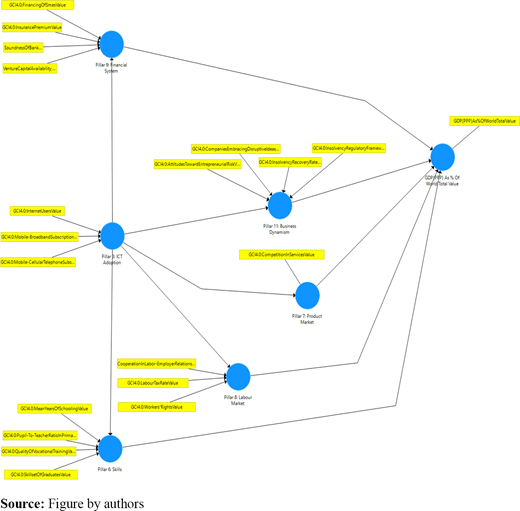
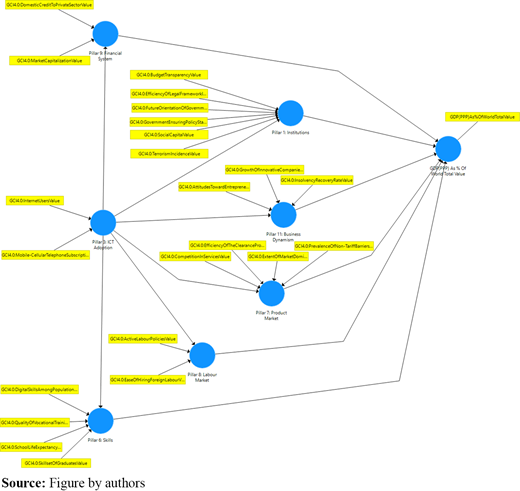
The objective of this study is to identify how the adoption of digital technologies influences the competitiveness of Latin American countries and compare these results with those of European countries. To our knowledge, this is the first study to provide information on factors that could explain competitiveness from the perspective of digital technology adoption. To validate the hypothetical structural model (presented in Figures 1 and 2), we used data from the World Economic Forum’s Global Competitiveness Index (GCI) on the following GCI pillars: financial system, ICT adoption, skills, labor market, product market, macroeconomic stability, business dynamism and GDP (PPP) as a percentage of total world value.
The following Latin American countries were considered: Bolivia, Brazil, Chile, Colombia, Costa Rica, the Dominican Republic, Ecuador, Honduras, Haiti, Mexico, Nicaragua, Panama, Peru, Paraguay, El Salvador, Uruguay and Venezuela. Next, the following European countries were considered: Austria, Belgium, Bulgaria, Croatia, Cyprus, the Czech Republic, Denmark, Estonia, Finland, France, Germany, Greece, Hungary, Ireland, Italy, Latvia, Lithuania, Luxembourg, Malta, The Netherlands, Poland, Portugal, Romania, the Slovak Republic, Slovenia, Spain, Sweden and the United Kingdom. To evaluate the structural models, partial least squares-structural equation modeling (PLS-SEM) was applied using SmartPLS software package (Ringle et al., 2015). PLS-SEM is useful when a complex research model includes multiple variables, which can be difficult to manage with first-generation techniques such as linear regression or ANOVA (Deng et al., 2018; Gefen et al., 2000). Studies in the field of competitiveness have also applied this technique to evaluate complex models (Mohammad and Pourghanbary, 2023; Padilla-Lozano and Collazzo, 2021).
Note that we developed two theoretical models: one for Latin America and the other for Europe. Each region differs from the other, and consequently, some predictors may be more important than others in explaining the variables of interest. Furthermore, most European countries are first-order economies, while most Latin American countries are emerging economies. Consequently, the degree of influence of each factor may differ. A unique model for both regions may also be misleading because some GCI pillars predict the competitiveness of each region in different ways. Thus, the conclusions obtained from the model may not be generalized.
5. Results
According to Hair et al. (2017), to evaluate a structural model under the PLS-SEM method, the following steps must be followed first: evaluation of the formative measurement model (see Section 5.1), evaluation of the structural model (see Section 5.2) and evaluation of the predictive relevance of the model (see Section 5.3).
5.1 Evaluation of the formative measurement model
The following exogenous variables and their corresponding indicators defined the formative measurement model: financial system, ICT adoption, skills, labor market, product market, macroeconomic stability and business dynamism. Redundancy analysis was applied to evaluate the convergent validity of the measurement model. In addition, collinearity analysis [variance inflation factor (VIF)] and external load analysis (Hair et al., 2017) were considered to evaluate the formative measurement model. The results for the 17 Latin American and 28 European countries are shown in Tables 1 and 2, respectively. Regarding convergent validity, the results show that the formative constructs are clearly above the recommended threshold of 0.7.
Outer loadings, convergent validity, composite reliability and average variance extracted (AVE) for the formative measurement model for Latin America
| Formative constructs | Construct indicators | External loads (> 0.5) | Convergent validity - redundancy analysis (> 0.7) | Collinearity (VIF < 5) | Composite reliability (> 0.7) | AVE (> 0.5) |
|---|---|---|---|---|---|---|
| Financial system | 0.964 | 0.935 | 0.879 | |||
| GCI4.0: domestic credit to private sector value | 0.827 | 2.35 | ||||
| GCI4.0: value of market capitalization | 0.993 | 2.35 | ||||
| ICT adoption | 0.713 | 0.928 | 0.865 | |||
| GCI4.0: value of internet users | 0.999 | 2.17 | ||||
| GCI4.0: mobile-cellular telephony subscription value | 0.701 | 2.17 | ||||
| Institutions | 1.000 | 0.848 | 0.496** | |||
| GCI4.0: value of budget transparency | 0.512 | 1.32 | ||||
| GCI4.0: effectiveness of the legal master in value adjustment regulation | 0.400* | 9.65*** | ||||
| GCI4.0: future government value orientation | 0.608 | |||||
| GCI4.0: stability government policy value | 0.655 | 15.44*** | ||||
| GCI4.0: value of social capital | 0.971 | |||||
| GCI4.0: impact value of terrorism | 0.788 | 7.23*** | ||||
| Business dynamism | 0.749 | 0.903 | 0.755 | |||
| GCI4.0: attitudes toward the value of business risk | 0.746 | 3.17 | ||||
| GCI4.0: Growth of innovative companies value | 0.687 | 3.41 | ||||
| GCI4.0: value of the insolvency recovery rate | 0.955 | 1.50 | ||||
| Product market | 0.852 | 0.537 | ||||
| GCI4.0: competence in services value | 0.657 | 1.82 | ||||
| GCI4.0: complexity of tariffs value | 0.755 | 1.59 | ||||
| GCI4.0: efficiency of value dispatch process | 0.756 | 2.66 | ||||
| GCI4.0: degree of market value dominance | 0.745 | 2.72 | ||||
| GCI4.0: prevalence of nontariff barriers value | 0.500* | 1.44 | ||||
| Labor market | 1.000 | 0.988 | 0.977 | |||
| GCI4.0: value of active labor market policies | 0.674 | 10.98*** | ||||
| GCI4.0: ease of foreign labor recruitment value | 0.865 | 10.98*** | ||||
| Skills | 0.982 | 0.864 | 0.613 | |||
| GCI4.0: digital skills at people’s value | 0.500* | 2.70 | ||||
| GCI4.0: quality of professional training value | 0.552 | 6.27 | ||||
| GCI4.0: value of school life expectancy | 0.952 | 1.11 | ||||
| GCI4.0: graduate skill set value | 0.514 | 6.67 |
Notes:
*Subthreshold external loads that were withheld to maintain model relevance; **the AVE of institutions was slightly below the threshold, but the construct was retained due to its relevance to the model;
***indicators with VIF above the thresholds that were maintained due to their importance in the model
Outer loadings, convergent validity, composite reliability and average variance extracted (AVE) for the formative measurement model for Europe
| Formative constructs | Construct indicators | External loads (> 0.5) | Convergent validity – redundancy analysis (>0.7) | Collinearity (VIF < 5) | Composite reliability (> 0.7) | AVE (> 0.5) |
|---|---|---|---|---|---|---|
| Financial system | 0.999 | 0.939 | 0.795 | |||
| GCI4.0: finance from tables value | 0.947 | 7.043* | ||||
| GCI4.0: insurance premium value | 0.949 | 4.776 | ||||
| Bank soundness.1–7 (best) value | 0.625 | 2.795 | ||||
| Availability of risk capital.1–7 (better) Index 1–7 (better) | 0.581 | 3.809 | ||||
| ICT adoption | 0.986 | 0.886 | 0.724 | |||
| GCI4.0: value of internet users | 0.807 | 2.952 | ||||
| GCI4.0: value of mobile broadband subscriptions | 0.953 | 6.044* | ||||
| GCI4.0: value of mobile subscriptions | 0.775 | 3.180 | ||||
| Business dynamism | 0.999 | 0.821 | 0.551 | |||
| GCI4.0: attitudes toward the value of business risk | 0.983 | 6.043* | ||||
| GCI4.0: companies employ disruptive ideas value | 0.500 | 1.369 | ||||
| GCI4.0: value of the insolvency recovery rate | 0.500 | 2.225 | ||||
| GCI4.0: insolvency regulatory framework value | 0.692 | 5.010 | ||||
| Product market | 0.999 | 0.999 | 0.999 | |||
| GCI4.0: competence in services value | 0.999 | 1.000 | ||||
| Labor market | 0.923 | 0.741 | 0.510 | |||
| Cooperation in labor relations with employers.1–7 (best) score | 0.916 | 1.129 | ||||
| GCI4.0: value of labor taxation | 0.728 | 1.211 | ||||
| GCI4.0: value of workers’ rights | 0.579 | 1.107 | ||||
| Skills | 0.999 | 0.861 | 0.611 | |||
| GCI4.0: mean value of years of schooling | 0.995 | 1.739 | ||||
| GCI4.0: pupil-teacher relationships in primary education | 0.504 | 1.324 | ||||
| GCI4.0: quality of professional training value | 0.500 | 3.368 | ||||
| GCI4.0: graduate skill set value | 0.500 | 3.703 |
Note:
*Three indicators with high VIF levels were retained because of their importance in model prediction
5.2 Evaluation of the structural model
A bootstrapping method was applied in SmartPLS to evaluate the structural model following Hair et al. (2017). Table 3 (Table 4) shows the results of R2 and R2 (adjusted) for each endogenous latent construct (i.e. dependent variable) as well as the total and indirect effects for each of the corresponding exogenous constructs (i.e. independent variables) for Latin America (Europe).
Results of R2, adjusted R2, total effects and indirect effects of the structural model for Latin America
| Dependent variable | Independent variable | R2 (R2 adjusted) | Total effects | Indirect effect |
|---|---|---|---|---|
| GDP (PPP) as a percentage of total world value | 0.664 (0.511) | |||
| Business dynamism | 1.319 | |||
| ICT adoption | 0.541 | 0.541 | ||
| Skills | −0.125 | |||
| Product market | −0.020 | |||
| Labor market | 0.140 | |||
| Financial system | −0.498 | |||
| Business dynamism | 0.669 (0.647) | |||
| ICT adoption | 0.818 | |||
| Skills | 0.813 (0.801) | |||
| ICT adoption | 0.902 | |||
| Product market | 0.754 (0.738) | |||
| ICT adoption | −0.869 | |||
| Labor market | 0.422 (0.384) | |||
| ICT adoption | −0.650 | |||
| Financial system | 0.498 (0.464) | |||
| ICT adoption | 0.705 |
Results of R2, adjusted R2, total effects and indirect effects of the structural model for Europe
| Dependent variable | Independent variable | R2 (R2 adjusted) | Total effects | Indirect effect |
|---|---|---|---|---|
| GDP (PPP) as a percentage of total world value | 0.497 (0.353) | |||
| Business dynamism | 0.112 | |||
| Institutions | 1.082 | |||
| ICT adoption | 0.114 | 0.114 | ||
| Skills | −0.302 | |||
| Product market | 0.747 | |||
| Labor market | 1.161 | |||
| Financial system | −0.270 | |||
| Business dynamism | 0.356 (0.331) | |||
| ICT adoption | 0.580 | |||
| Skills | 0.722 (0.712) | |||
| ICT adoption | 0.853 | |||
| Product market | 0.516 (0.497) | |||
| ICT adoption | 0.916 | |||
| Labor market | 0.817 (0.810) | |||
| ICT adoption | −0.921 | |||
| Financial system | 0.380 (0.356) | |||
| ICT adoption | 0.589 |
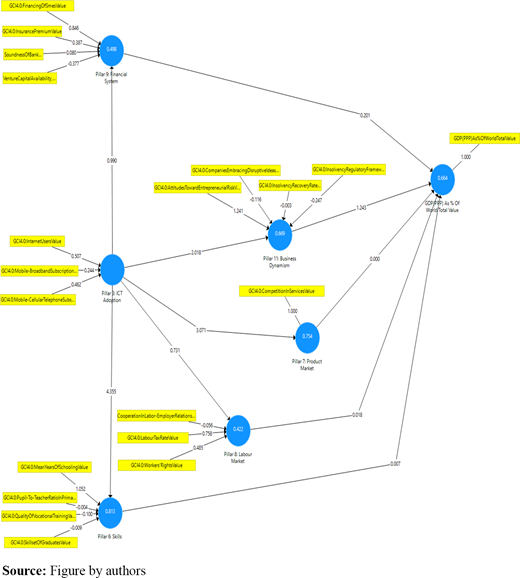
For Latin America, the model explains 66% of the variance in the GDP (competitiveness). The constructs that positively affect GDP (competitiveness) are ICT adoption (0.541), business dynamism (1.319) and labor market (0.140). Meanwhile, GDP (competitiveness) is negatively influenced by skills (−0.125), product market (−0.020) and financial system (−0.498). Next, ICT adoption in Latin America is a strong predictor of other pillars of competitiveness, such as business dynamism (predicts 66% of the variance), skills (predicts 81% of the variance), product market (predicts 75% of the variance), labor market (predicts 42% of the variance) and financial system (predicts 49% of the variance).
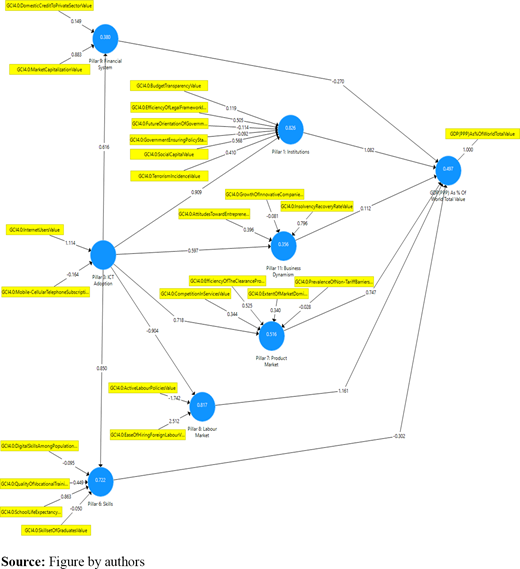
For Europe, the model explains 49.7% of the variance in GDP (competitiveness). The constructs that positively affect GDP (competitiveness) are business dynamism (0.112), institutions (1.082), ICT adoption (0.114), product market (0.747) and labor market (1.161). Meanwhile, GDP (competitiveness) is negatively influenced by skills (−0.302) and financial system (−0.270). Next, ICT adoption is a strong predictor of other pillars of competitiveness, such as business dynamism (predicts 35.6% of the variance), skills (predicts 72.2% of the variance), product market (predicts 51.6% of the variance), labor market (predicts 81.7% of the variance, but with a negative path indicating a negative influence) and financial system (predicts 38% of the variance).
Hypothesis testing results for Latin America
| Hypothesis | Route | Path coefficient | Effect size (f2) | t-Value | p-Value | Supported |
|---|---|---|---|---|---|---|
| H1 | ICT adoption→ financial system | 0.705 | 0.990 | 4.908 | <0.001 | Yes |
| H2 | Financial system→ GDP (competitiveness) | −0.498 | 0.201 | 0.820 | 0.413 | No |
| H3 | ICT uptake→ business dynamism | 0.818 | 2.018 | 12.490 | <0.001 | Yes |
| H4 | Business dynamism→ GDP (competitiveness) | 1.319 | 1.243 | 2.204 | 0.028 | Yes |
| H5 | ICT adoption → labor market | −0.650 | 0.731 | 5.198 | <0.001 | Yes |
| H6 | Labor market→ GDP (competitiveness) | 0.140 | 0.018 | 0.355 | 0.722 | No |
| H7 | ICT adoption→ product market | −0.869 | 3.071 | 20.222 | <0.001 | Yes |
| H8 | Product market→ GDP (competitiveness) | −0.020 | 0.000 | 0.030 | 0.976 | No |
| H9 | ICT adoption→ skills | 0.902 | 4.355 | 14.729 | <0.001 | Yes |
| H10 | Skills→ GDP (competitiveness) | −0.125 | 0.007 | 0.220 | 0.826 | No |
Hypothesis testing results for Europe
| Hypothesis | Route | Path coefficient | Effect size (f2) | t-Value | p-Value | Supported |
|---|---|---|---|---|---|---|
| H1 | ICT adoption→ financial system | 0.616 | 0.61 | 5.64 | <0.001 | Yes |
| H2 | Financial system→ GDP (competitiveness) | −0.270 | 0.05 | 0.757 | 0.44 | No |
| H3 | ICT adoption → business dynamism | 0.597 | 0.55 | 3.67 | <0.001 | Yes |
| H4 | Business dynamism→ GDP (competitiveness) | 0.112 | 0.00 | 0.26 | 0.79 | No |
| H5 | ICT uptake→ labor market | −0.904 | 4.47 | 1.10 | 0.27 | No |
| H6 | Labor market→ GDP (competitiveness) | 1.161 | 0.25 | 1.27 | 0.20 | No |
| H7 | ICT adoption→ product market | 0.718 | 1.06 | 6.75 | <0.001 | Yes |
| H8 | Product market→ GDP (competitiveness) | 0.747 | 0.25 | 1.58 | 0.11 | No |
| H9 | ICT adoption→ skills | 0.850 | 2.60 | 8.94 | <0.001 | Yes |
| H10 | Skills→ GDP (competitiveness) | −0.302 | 0.01 | 0.46 | 0.64 | No |
| H11 | Institutions→ GDP (competitiveness) | 1.082 | 0.12 | 1.43 | 0.15 | No |
| H12 | ICT adoption→ institutions | 0.909 | 4.74 | 5.45 | <0.001 | Yes |
5.3 Predictive importance of the structural model
As recommended by Hair et al. (2017), the Stone–Geisser Q2 was used to assess the predictive relevance of the structural model. This measure provides information about the degree to which the model can predict new values (from another data set). To obtain the Stone–Geisser Q2 in SmartPLS, the Blindfolding method was applied with an omission distance of 7 and using the cross-validated redundancy approach. Tables 7 and 8 show the results for Latin America and Europe, respectively. For Latin America, the results show that all endogenous variables exhibit high predictive power, except for GDP (competitiveness) which has low predictive power. Meanwhile, for Europe, two endogenous constructs show low predictive power: institutions and GDP (competitiveness). This may because the predictive power of these constructs may depend on other factors.
Stone–Geisser Q2 for the predictive relevance of the structural model for Latin America
| Endogenous variables | Stone–Geisser’s Q2 |
|---|---|
| GDP (competitiveness) | 0.037 |
| Business dynamism | 0.196 |
| Skills | 0.326 |
| Product market | 0.722 |
| Labor market | 0.156 |
| Financial system | 0.341 |
Stone–Geisser’s Q2 for the predictive relevance of the structural model for Europe
| Endogenous variables | Stone–Geisser’s Q2 |
|---|---|
| GDP (competitiveness) | 0.067 |
| Business dynamism | 0.225 |
| Skills | 0.240 |
| Product market | 0.268 |
| Labor market | −0.617 |
| Financial system | 0.303 |
| Institutions | 0.066 |
6. Discussion
Table 9 summarizes the hypotheses or paths that were supported by the two models. Notably, some hypotheses were supported for both the Latin American and European models, while two were only supported for the Latin American model. Here, we discuss these paths with respect to the literature.
Summary of supported hypotheses
| Hypothesis | Path | Model |
|---|---|---|
| H1 | ICT adoption→ financial system | Europe and Latin America |
| H3 | ICT adoption → business dynamism | Europe and Latin America |
| H4 | Business dynamism→ GDP (competitiveness) | Latin America |
| H5 | ICT adoption→ labor market | Latin America |
| H7 | ICT adoption→ product market | Europe and Latin America |
| H9 | ICT adoption→ skills | Europe and Latin America |
First, ICT adoption affects the financial system, in line with the literature on the importance of ICT in the financial sector. For instance, Hernández-Nieves et al. (2020) indicate that ICT advancements have allowed financial institutions to improve the provision of services, such as digital finance.
Second, ICT adoption positively and significantly affects business dynamism. This result is consistent with Karim et al. (2022), who find that both enabling and general-purpose technologies significantly influence business performance. Yunis et al. (2018) also find improvements in productivity and business performance in companies that have adopted ICT.
Third, business dynamism positively affects competitiveness in Latin America. This may be because the region has many informal micro-companies in a highly competitive market (Lopes et al., 2021). To address this, Latin American countries should develop policies to improve business dynamism, and thereby, improve their competitiveness.
Fourth, ICT adoption positively affects the labor market in Latin America. This may be because ICT can be useful for improving the skills of workers in this region. Some researchers note that ICT adoption and the labor market may be related (Díaz-Chao et al., 2009). Our result is also in line with research which indicates that companies that adopt ICTs can increase the skills of workers (Behaghel et al., 2012). In general, ICT adoption has been linked to an increase in skills and competencies (Lim et al., 2021). Thus, to improve the labor market, Latin America countries should pursue policies to improve ICT adoption in companies.
Fifth, ICT adoption positively influences the product market. This may be via e-commerce platforms, which can expand the product market. The COVID-19 pandemic showed that to survive, companies required a digital presence or mechanisms that take advantage of technology. Some small businesses were unable to adapt or move to a digital presence during the pandemic, and simply disappeared.
Sixth, ICT adoption positively affects skills. Research also shows that ICT adoption positively affects the marketing capabilities in small- and medium-sized enterprises (Setiowati et al., 2015). Others show that innovation environments have a positive relationship with management and workforce development (Kipper et al., 2021). Our result demonstrates that ICT adoption can help increase the skills which job market candidates must possess for both current and future jobs.
The debate on the effect of ICT, as one of the main dimensions in the processes of competitiveness and innovation of organizations, has increased notably in recent decades, particularly owing to the effect of the internet. According to Castro and Rajadel (2015), technology and innovation support direct and stimulate local development, favoring business productivity and competitiveness, and the social, economic and intellectual development of countries. Similarly, Arrieta (2019) observes that ICTs have become a necessary factor for economic development. Indeed, the European Union indicates that the development of ICT is vital for Europe’s competitiveness in today’s increasingly digitalized world economy. This process of digitalization has been accelerated by COVID-19, such as remote work. Our results support these assertions and provide empirical evidence demonstrating the importance of ICT adoption for the competitiveness of Latin American and European countries.
7. Theoretical and practical implications
Theoretically, our findings show that skills, product market and financial system negatively influence GDP. Future research should examine the causal factors and underlying mechanisms in these relationships. Next, we propose a structural model that explains competitiveness in Europe and Latin America using the GCI pillars. This model can be used to explore new avenues for research on competitiveness in other regions. Future research should also examine why certain factors do not influence competitiveness at all.
Practically, the model highlights the factors that Europe and Latin America can focus on to strengthen the competitive advantages of their firms via ICT adoption. In particular, Latin American countries should develop policies to build skills, and improve business and labor market dynamism. Finally, the models suggested here can be used by business administration instructors to train students on the different strategies that can improve firm competitiveness. Moreover, students can be challenged to analyze how each factor positively influences a firm's competitiveness.
8. Conclusions
In this paper, we examine how ICT adoption affects the competitiveness of Latin American and European countries using a model based on GCI pillars. Digital technologies have significantly affected the creation or transformation of companies. They can help create more solid and sustainable companies which are competitive globally, and offer world-class products. Importantly, ICTs can help firms achieve these objectives efficiently and productively. Furthermore, organizations should have a hybrid approach and can achieve better results by leveraging the different perspectives within the company. These perspectives can highlight the diverse opportunities and which capabilities should be built to take advantage of these opportunities. However, these decisions are made through leaders, who must be trained for everything the world brings that enables the improvement of their business. Crucially, leaders must have the ability to transform and manage uncertainty, while motivating and empowering their work teams. Simultaneously, companies must stay competitive by updating and transforming technologies, as digitalization revolutionizes product and service systems, as well as tools and processes. Coupling these with good decision-making, digitalization can drive productivity, innovation and competitive advantage for the company. However, the education system must also train human capital with values, principles and skills in ICT. Our findings are summarized below.
First, for 17 Latin American countries, ICT adoption is a strong predictor of business dynamism (predicts 66% of the variance), skills (predicts 81% of the variance), product market (predicts 75% of the variance), labor market (predicts 42% of the variance) and financial system (predicts 49% of the variance). Thus, ICT adoption positively affects a Latin American country’s competitiveness. Furthermore, our model explains 66% of the variance in GDP (competitiveness), with ICT adoption, business dynamism and labor market positively affecting GDP. This suggests that Latin American countries should create policies to build skills to increase ICT adoption, and improve business and labor market dynamism. Meanwhile, skills, product market and financial system negatively influence GDP. Future research should examine why and how these pillars negatively influence GDP.
Second, for 28 European countries as well, ICT adoption is a strong predictor of business dynamism (predicts 35.6% of the variance), skills (predicts 72.2% of the variance), product market (predicts 51.6% of the variance), labor market (predicts 81.7% of the variance but with a negative path, indicating a negative influence) and financial system (predicts 38% of the variance). This demonstrates the importance of digital technologies for fostering the competitiveness of European countries, in line with Zoroja (2015) and Zoroja and Pejić (2016). Furthermore, our model explains 49.7% of the variance in GDP (competitiveness), with business dynamism, institutions, ICT adoption, product market and labor market positively affecting GDP, and skills and financial system negatively affecting GDP. Future research can explore why skills and the financial system negatively influence the GDP of European countries.
The authors would like to thank to Fundación Universitaria Konrad Lorenz and Fundación Universitaria Los Libertadores for the support provided for this study.

