Overview
Broward Virtual School (BVS) delivers education to K-12 students around the world through technology and media. The school gives students the opportunity to work at their own pace and develop strong relationships with their teachers and peers while growing into productive members of society. The curriculum design and community service opportunities stimulate positive learning experiences for students in a unique way.
Mission
The goal of BVS is to provide students with equal and excellent education. Through successful student graduation rates, the program is able to continue; students obtain quality education that prepares them for post secondary education (community colleges, universities, and Ivy League schools around the nation). BVS (2012) “offers full-time enrollment to students in Grades K-12” and “home educated students in Grades 6-12 may enroll parttime” (para. 1). BVS is an obvious choice in that “Virtual learning provides flexibility of time and location, and promotes development of the skills, attitudes, and self-discipline necessary to achieve success in the 21st century” (para. 1).
Accreditation
According to the Broward Virtual School (2012) website, “the BVS administrative office is located in Davie, Florida inside the BECON TV building” (para. 5). This is the main working center for BVS where administrators, support staff, and educators report. There are also meetings and student events held within the BECON TV building. BVS is fully accredited by the Southern Association of Colleges and Schools (SACS) and the Commission on International and Trans-Regional Accreditation (CITA). All of the BVS educators meet state standard requirements to teach for BVS, even if the educator is located outside of the state of Florida.
Educators
BVS offers a wide array of courses with experienced and well-trained instructional staff. The diverse educators’ expertise range from individual or a combination of knowledge in: Spanish; science; language arts; reading; physical education; health; critical thinking; business; social studies; mathematics; career education; world cultures; English; and Advanced Placement (AP); Grades K-5 specialty; and Exceptional Student Education (ESE) specialty. This team of educators assists in broadening the collaborative learning experience for BVS students while providing individualized attention when needed. The courses offered at BVS encompass all the subjects any traditional public school would have (math, science, history, english, reading, the arts, and elective work).
All of the educators are very knowledgeable and patient when working with their students. However, one particular educator was recognized on the Broward Virtual School (2012) website as being an outstanding educator. Math teacher Melanie McCutcheon is the “2013 Teacher of the Year.” Her devotion and active involvement in her students’ learning experiences is outstanding. She spends considerable time with students over the phone and via live Elluminate chats. Even though McCutcheon resides in Texas, she has the ability to meet her students’ diverse needs and can personalize instruction of any mathematical concept.
Administration
Administrators help to engage students and provide opportunities for success. Students have the ability to communicate openly and regularly with administrative staff. The importance of the administrators is not only to communicate with students; rather they are also greatly involved in development of programs for BVS. BVS administration is constantly working to continuously improve curriculum development, delivery techniques, and manage effective budget spending for the school.
Students
The school has a unique and diverse population of students from all over the state of Florida and beyond. Public school, private school, and home school students all have the ability to attend BVS; the students may either register as a full-time or part-time student (Broward Virtual School, 2012). The students take BVS courses as a way to accelerate, catch up if they are behind, or have a more flexible school schedule so they can participate in activities that normally wouldn't be possible in a traditional classroom setting (e.g., sports training and competitions, acting careers, running a community service organization, or just having more time to enjoy life in other ways).
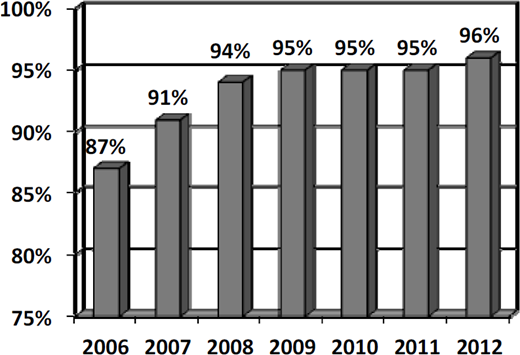
The most important indication of whether or not a school is successful is apparent from completion rates. Quillen (2011) discusses that “Articles in the ‘New York Times’ questioned not only the academic results for students in virtual schools, but also the propriety of business practices surrounding the use of public dollars for such programs” (p. 1). BVS is a successful program and has student statistical data to prove why. The following graph, Figure 1, shows student course completion success rates over the years. The percentage of completion rates is the highest it has been within the given time frame. BVS targeted an appropriate learning strategy that enables the majority of students to complete coursework.
Cost
BVS is a public school and is, therefore, free to Broward County residents. As a public school, BVS does not charge tuition fees. The school is fully online and also partners with other schools to give traditional classroom students the opportunity to experience distance education methods. The more exposure that students have to varying modes of communication and technology tools, the better prepared they will be for future studies and/or job related responsibilities.
Attendance
There is a strict student contact policy that encompasses continuous contact between students, parents/guardians, and educators. “Only through continuous communication can students be successful in an online course. Within each course the instructor outlines the weekly minimum work requirements. There is an essential component to a successful course completion that the student and instructor maintain regular contact” (2012, para. 1). If policy is not followed, there are follow-up procedures in place to deal with inconsistent contact. Communication is essential to student success in a distance education program such as BVS.
Communication Delivery
BVS communicates with its students in the classroom in a variety of ways. Lishon-Savarino (2012) discusses the concept of Coldeway's Quadrants in accordance with the varying modes of communication technology that BVS utilizes. BVS incorporates three of the four delivery methods. As opposed to a traditional classroom that delivers at the same time and in the same place, BVS delivers via: a learning center, same time and different place; synchronous distance education, different time and same place; or asynchronous distance education, different time and different place (Lishon-Savarino, 2012).
The successful understanding of the material being covered is dependent upon what modes of communication are utilized in the virtual classroom. Belair (2012) concluded that “a variety of communication methods must be employed in order to facilitate effective virtual schooling” (p. 26). Prerecorded lessons are good for students to be able to review, while live chats give students the opportunity to collaborate with one another and ask their instructors questions to define their understanding of the concepts. Discussion boards are also used so that students can openly respond and discuss topics amongst themselves. In another perspective, a learning center might give a student a better ability to focus and easily ask for help from facilitators. Every student's learning style is different, so the approach to teaching educational material should be just as customized and personalized based on the students’ needs.
Student Activities
A common misconception among the general public is that distance education programs lack collaborative efforts and extracurricular opportunities. BVS offers many opportunities for students to collaborate with one another and experience life as traditional classroom students do. The following “face-to-face” extracurricular activities are offered to BVS student (Broward Virtual School, 2012): Broward Teen News Internships; National Honor Society membership (for qualifying students); National Junior Honor Society membership (for qualifying students); Key Club; Florida Future Educators of America; monthly enrichment activities; student talent show; field trips; academic competitions; college planning seminars; junior and senior prom; and formal graduation ceremony for seniors. These events allow students to collectively work with one another, engage in constructive programs, raise awareness for good causes, enrich their personal learning experience, and actively participate in community services activities.
Partnerships With Organizations
According to the Broward Virtual School (2012) website, “Broward Virtual School is a franchise partner of Florida Virtual School for middle and high school curriculum” (para. 4). Florida Virtual School developed a thriving distance learning program; serving students all over the state of Florida. Broward Virtual School caters specifically to Broward County students. As a result of the customized education Broward County residents receive, “BVS is proud to be the top performing Florida Virtual School franchise in Florida” (Broward Virtual School, 2012, para. 4). In addition to the strong middle and high school grades program, BVS has a K-5 program as well; the school is partnered with K12 Inc. (Broward Virtual School, 2012).
BVS also has aligned itself with schools that participate in videoconferencing sessions. These videoconferencing sessions have students from various schools in the district in one online classroom; students can see each other and their instructor via a television screen. Microphones are set up in the rooms to pick up audio spoken by students and teachers as to keep a steady pace and allow active participation amongst the schools. The students enjoy engaging with one another and obtaining quality education from some of the best teachers in the state.
Technology Requirements
Students who take online courses must have access to the technology needed to view and complete coursework. High speed Internet is required so the students can log onto the website and access their courses in a secure account. Additional computer hardware requirements are an efficient high powered processor, Windows XP (or higher), and 256 MB RAM (Broward Virtual School, 2012).
Flash Player is another technical need for students so they can view multimedia presentations and the lessons for each section. The students must also have a safe and secure way of saving their coursework such as a jump-drive or removable disk. Audio equipment is needed for assignments, presentations, live chats, and so on; the computer must have a sound card, reliable speakers (to hear lessons, instructors, and peers), and a microphone or headset (to speak into for recording assignments or live active participating chats). If a student has a Macintosh computer then a comparable setup is required (Broward Virtual School, 2012).
Technology Utilized
The courses are comprised of interactive multicomponent lessons organized into easily navigated modules. Depending on the type of course a student is taking will depend on what type of technology is utilized. For example, in a Spanish course, the use of video and audio is required to illustrate and equip students with what is being said and how to say it. The students must record themselves orally saying things as per assignments and writing simple sentences to long papers in that language.
Technological skills of how to access special symbols specific to that language are also taught to students. The verbal, reading, and writing skills are equally important; therefore, all skills are taught via multimedia presentation delivery. A reading course, on the other hand, may have more assignments related to writing and utilizing synchronous and asynchronous chats for in depth discussions on required reading literature. A geometry class may require students to utilize graphic drawing tools to show shapes and related properties (e.g., labeling a triangle's angles and sides as per congruency theorems).
Technology Supplements and Support
BVS has a user-friendly support system for parents and students. The E-Resource Library on the BVS (2012) website provides links to orientation presentations, downloadable software (e.g., Cute PDF Writer and OpenOffice Software Suite). Students and parents have access to the FLVS Technical Support Center to address any technical issues hindering the ability of a student to complete coursework. Another form of support is supplemental resources available for instructional purposes, such as BrainPop (activity page with interactive videos), Florida Virtual School Math Help Pages (tutorial sessions), Khan Academy (tutorial sessions), and Lit2Go Audiobooks.
Videoconferencing
Videoconferencing is a very valuable tool in distance learning. BVS utilizes videoconferencing so students, educators, and administrators can collaborate with one another. The students and educators have the ability to see, hear, and communicate with each other easily. In addition, software may be downloaded for utilizing an e-board; the educator can write on the blank board so the student can follow along with verbal commands or steps of a problem. The setup is required in every room that has videoconferencing classes. The network system expands so that schools from across the district can communicate with one another. Latency is very small, only 1-3 seconds.
At Coconut Creek Elementary School, fifth grade students learning mathematical concepts via videoconferencing are given dry erase boards and markers. The television screen is set up in the front of the classroom, microphones pick up speech, and a camera is set up to show the entire classroom.
Multiple schools may be videoconferencing at one time. The educator is set up in one of the classrooms, in this case Coconut Creek Elementary. The reason the educator is actually in a classroom is to assist the educator in knowing if the pacing of the lesson is appropriate. Students enjoy seeing each other on the television screen and actively participating in completing mathematical problems. The students compare answers to every problem and then the educator reviews how to obtain the answer to the question. Students also participate in other activities such as art projects (making geometrical shapes) and utilizing creative ways to learn more difficult concepts. The classes are divided based on the level of the students (grade level and cognitive abilities).
Statistics
Videoconferencing is an effective way to distribute effective educational material on a massive scale. Educators who participated in videoconferencing courses were asked a series of questions related to lessons plans and the overall effectiveness of the instructor from BVS providing the lesson. McGuire (2012) provided numerical data that indicated the number of educators that agreed or disagreed with specific statements. The relevancy of the lessons with integrated videoconferencing is indirectly analyzed from the results of the surveys.
The lesson plans were evaluated by educators present in classrooms during videoconferencing sessions. The majority of educators strongly agreed that the course objectives were met with quality planning and implementation. Very few respondents of the entire polled population sample disagreed that the videoconferencing course lesson plans were effective. The colleagues appear to be in strong agreement that videoconferencing lesson plans are very good for students and meet the needs of the standards set by the schools, state, and testing requirements (see Table 1).
The instructor implementing the videoconferencing lesson was evaluated by educators present in classrooms during videoconferencing sessions. The majority of educators strongly agreed that the instructor was knowledgeable and enhanced the students’ learning experience. A relatively small amount of the polled population sample disagreed that the instructor was effective in implementing lessons via videoconferencing. The data show a clear indication that many educators feel the videoconferencing instructor is well equipped to handle diverse classroom environments and keep the students actively engaged (see Table 2).
Awards and Recognition
The standards for BVS are high, as it “was the first and only district virtual school to be rated as an ‘A’ school by the Florida Department of Education in 2010. BVS offers courses and a diploma approved by the NCAA” (Broward Virtual School, 2012, para. 1). BVS has achieved many special recognitions and partnerships with programs. Last year BVS was very active in expanding their program academically and via extracurricular activities. McGuire (2012) discussed the following BVS achievements:
EOC (End of Course) exam results (100% passed Algebra, 100% passed Biology, 97% passed Geometry); trained 56 students and staff in CPR; partnered with Atlantic Technical Center to provide every ninth grader an opportunity to earn online learning credit (Reading for College Success); partnered with 10 elementary schools and 3 middle schools to offer acceleration opportunities. (p. 4).
In 2010, BVS was the recipient of the International Association for Online Learning (iNACOL) Outstanding Online Learning Practice award (Broward Virtual School, 2012). This award encompasses the ideals of a distance education program. The focus is on the students and the best deliveries for the students. Since this particular award was international, this shows the versatility and capabilities that BVS has in distributing good, quality education. The curriculum is the same to that of a traditional school setting; however, the delivery system is different.
Goals
Broward Virtual School has ideas for projects and programs to be implemented for the future. McGuire (2012) discussed that BVS would like to see the percentage of their students rise in ability to pass with higher scores of 3 or above on the Florida Comprehensive Assessment Test (FCAT), maintain a 95% student course completion rate, and that 95% of students and parents will have verbal communication with their instructors at least once a month.
Conclusion
In terms of accountability, McGuire (2012) outlined important aspects BVS considers: “student learning; successful course completions; school improvement plan goals; graduation rate; customer surveys; and student success act (Marzano Evaluation System)” (p. 10). With these goals and measurable objectives at the foundation of BVS, the room for growth is limitless. BVS is a good option for students seeking a flexible learning environment that considers their individualized needs.
Broward Virtual School (2012) states that “Our courses engage students in real-life projects, requiring the use of critical thinking, problem-solving skills, and the ability to apply the knowledge they have acquired” (para. 9). BVS keeps a few main stakeholders in mind: administrators, educators, students, and parents. Funding is necessary to keep BVS operational; new programs and partnerships are constantly being formed to expand and enhance the distance education program for students. Broward Virtual School is revolutionizing distance education by providing students with opportunity to complete school studies with a fully online program utilizing the latest and greatest technology available.
About the author