INTRODUCTION
Nigeria's guiding principle on education is the equipping of every citizen with knowledge, skills, attitudes, and values that will enable the individual to derive maximum benefit from being a member of the society and to lead a fulfilling life as well as contribute to both the development and welfare of the society. Educational objectives in Nigeria include the inculcation of national consciousness and national unity, inculcation of true values and attitudes needed for the survival of an individual and the society, and training for understanding the world as a whole. These objectives are viable; however, educational development has faced many constraints. Globally, education is seen as the enabler for all, and the continent of Africa particularly needs education for its continued development—the type that can cushion the effect of war, famine, and other man-made/natural catastrophes.
A closer look at the educational scene in Nigeria reveals many disparities, including disparities observed between rural and urban schools and federal-owned and privately owned schools. Gaps are also observed in the enrolment of the genders; admission figures and the available teaching resources.
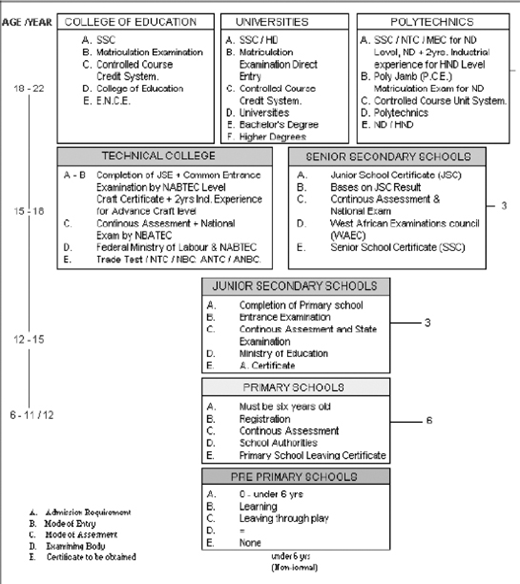
Figure 1 shows the Nigeria education system and the expected age range toward attaining the educational objectives. It shows the primary school and its expected age bracket, as well as secondary and the tertiary institutions. The higher education is shown as including the colleges of education, polytechnics, colleges of technology and the universities. This paper has as its purview, the Nigerian youths of university age bracket. It will therefore, look into higher education alone.
OVERVIEW OF HIGHER EDUCATION IN NIGERIA
Higher education holds a strategic place in national development; it is the platform for the production of quality graduates to drive the various sectors of the economy. Higher education is also seen as the bedrock of the human capital development in economic, agriculture, infrastructure, energy, oil and gas, and other sectors. The importance of higher education in Nigeria and Africa as a whole in catalyzing national development cannot be overemphasized (Adei, 2001).
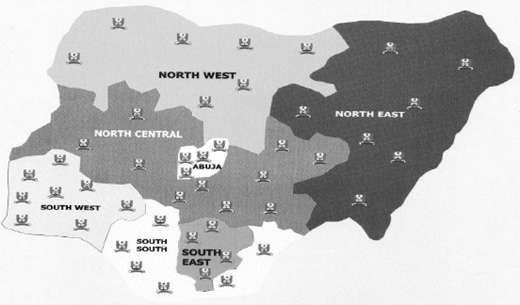
The polytechnics, colleges of education, and universities are the subsectors that produce higher education in Nigeria. Within its 774 local governments in 6 geopolitical zones there are 104 universities. The breakdown includes 40 federal, 39 state, and 50 private universities (“Nigerian Universities,” 2013). All these universities are to produce highly skilled manpower for the nation and as a segment of the public service; their management is being guided by various policies. A survey of higher education faces an increasingly hostile and complex issues pertaining to enrolment in conventional education in Africa. This remains a great challenge all over Africa, including Nigeria where closer survey of university education shows serious constraints in the issues of enrollment. In Africa alone, it is said that 10.1 million people are out of school. In Nigeria, 16% of the population accounts for school children, of which 26% are not able to complete the cycle of education. There are an astounding 40 million illiterates (EFA: Profile, 2007). All these have put a peg in the current efforts of developing the educational sector to meet the goals of both the Millennium Development Goals and the Education for All (EFA) targets by 2015. Dodds (2002) observed that globally, 125 million are out-of-school; Africa has more than 50 million out of this total. What, then, are the challenges inhibiting the educational development in Africa, especially in Nigeria?
CHALLENGES OF HIGHER EDUCATION
The demand for university education is growing in leaps and bounds. This is as a result of high birthrate in some parts of Africa. Nigeria alone is witnessing exponential population growth. According to the EFA profile on Nigeria on Global status (2007), the high rate of population growth has put immense pressure on the country's resources and overstretched public services and the available infrastructure. An after-effect of population growth is the increased enrollment rate, which has created a challenge in ensuring quality education and satisfactory learning outcomes as available educational resources are more thinly spread.
The EFA profile still exposes the fact that despite the heavy investment on infrastructure over the recent years, the number of educational facilities available remains inadequate for the eligible number of education seekers; the teaching curricular are also tilted toward academics and less on skills; and there remains a huge apathy for technical and vocational education. The table below illustrates enrollment rate and its percentages in Nigeria tertiary institutions.
According to Okojie (Table 1), Nigerian universities had a total enrollment of 1,096,312 during the 2006-2007 school year. This is a low rate compared to the number of Nigerian youths who are denied access to university enrollment each year as shown on the table below:
Table 2 shows a huge gap in the enroll-ment rate of tertiary institutions in Nigeria. Only 20% of applicants out of the percentage are admitted to universities, polytechnics, and colleges of education; others are not given access. For years, in Africa as a whole the educational systems have been saddled with the problem of accessibility, equity, and relevance. Nigeria faces more challenge due to its ever-increasing population rate. The table also shows that the formal education system in the country cannot cope with the admission request of young school-leavers. Kanwar (2008) observed that the conventional universities have problems with the enrollment of new entrants because they lack the capacity—space, facilities, and resources—to admit and cater for the huge number of the populace seeking admission. She also observed that their capacities can never be raised to meet the ever-increasing demand for educational pursuit by the masses. More than a decade after so many forums and conferences—Jomtien, March 1990; Delhi declaration, December 1993; Dakar framework for Action, 2000; Millennium Development Goals—the objectives for all of these are still far from being achieved; most, according to Rumajogee (1999), have been churned into another distant dream for the next 10 or more years. The enrollment in universities in Nigeria compares unfavorably with that of many developing countries. Low female participation and achievement remains a salient feature; lack of access to rural and dispersed youths, lack of appropriately trained teachers, noninclusive practices in conventional universities, long-term disrupted educational provision, lack of access to habitation prone to destruction and insurgency, and poverty are all factors limiting access to conventional education.
Rumajogee (1999) further observes that the traditional face-to-face teaching is a historical heritage that is a disappointment to the masses and has failed to ensure the human capital formation required for Africa's economic edge. Increasingly, alter-native or complementary approaches to education delivery are needed to create access, equity and socioeconomic develop-ment. What, then, do we need to create access?
OPEN LEARNING: THE WAY FORWARD
The demand for higher education is on the increase all over the world. Consequently, there must be a proactive orchestration of efforts to satisfy the yearnings of the admission seekers and create access for people thirsty for education at all levels. Open learning is a philosophy of learning that promotes the concepts of flexibility in order to promote access and equity. Open learning has as its major advantage the “seven league boots” which made it, unlike the conventional system of education, able to operate over a distance; cater for widely scattered bodies; with its evolving technol-ogy, can be used as an effective tool for addressing the needs of geographically iso-lated populations; broaden access to multi-level and multi-sector education; academic and professional training; and lifelong learning for personal and social development of an individual. Other accompanying advantages of open learning include flexibility and cost effectiveness. Stretching the intake of conventional universities will not only imply considerable up-front investment but also training and retraining of teachers. However, in the context of competing priorities, such investment is not possible due to tight budgetary constraints placed on education in Nigeria. Furthermore, the conventional system forbids learning while earning, mostly where the enrollment ratio has been almost stagnant for some years. Open learning does not have the constraint of time and space; its flexible teaching approach promotes lifelong learning. Open learning is a subset of open and distance learning (ODL). ODL is an emerging paradigm in teaching and learning method that is facilitated by infor-mation communication technologies. In most countries of the world, ODL has become a dominant force in educational management, especially in higher education. Its main advantage is that it helps to reduce the stress on physical infrastructure and reduces pressure on the limited financial resources in universities while giving access to the unreached and those denied access by conventional universities.
According to Association for the Devel-opment of Education in Africa (2002), not one of the African countries in Sub-Saharan Africa has fulfilled the promise of providing education to the entire population through the educational system, Nigeria inclusive. It is in view of all the aforementioned challenges in the Nigerian education system that the government set up the National Open University of Nigeria (NOUN), an ODL institution set up to cater for and give access to all in need of education irrespective of age, status and gender.
NOUN: VISION, QUALITY, AND THE NIGERIAN YOUTHS OF UNIVERSITY-AGE BRACKET
The problem of inaccessibility in conventional universities in Nigeria with the resultant effect of low human capital index prompted the federal government to join her other counterparts to set up NOUN. This is not only to give access, but to change attitude toward the knowledge economy and see higher education as a critical partner in development. The concept of ODL in Nigeria has come to stay. It was introduced to Nigeria in 1983 (established and dismantled in 1984) but was resuscitated and became functional in the year 2002 with the establishment of NOUN. The vision is to provide highly accessible and enhanced quality education anchored by social justice, equity, and national cohesion through a comprehensive reach that transcends all barriers (Alaezi, 2006).
NOUN, at 11 years since resuscitation, has 49 study centres located across the 36 states of the federation. It is the only single mode open and distance learning institution in West Africa.
Instructional delivery is predominantly through print, multimedia, and face-to-face tutorials, seminars, workshops and practicum. The print materials often referred to as course materials are either developed in-house by NOUN or adapted from materials obtained from outside sources—other open universities. They are put together in a manner that activates the dormant critical and analytical abilities of the learner; hence, the course materials are written in an interactive manner In many cases distance learning is the only way to achieve the scale, the scope, and the impact required to tackle the challenges of education and training faced in Africa (Daniel, 2005). It is not enough to licence a higher education institution to operate; there must be a constant evaluation to ensure that set standards and operational guides are not violated. A system that grows is such that sets standards and disciplines itself to attain them. Accreditation is a way of examining the state of an institution in relation to where it ought to be (Okojie, 2008). This is a quality assurance process. NOUN has gone through the accreditation process and has been given a merit mark by the National Universities Commission. Thirty-three programs presented by the institution, including MBA and MPA, were accredited by National Universities Commission. The courses have been publicly measured with the rate of enrollment that the university has witnessed—with over 50,000 students. The institution, as single-mode distance learn-ing, follows an established process and standards as expected of open and distance learning institutions all over the world.
NOUN caters to professionals, skilled and nonskilled workers, the qualified, and the underqualified at work level. The mode is to work and learn, with an entry requirement that has no age barrier, and maturity, which is also a key prerequisite in admission. Also the use of feeder approaches creates a niche for admission to NOUN, in that there is room for an individual to partake in foundational pro-grammes in a bid to transit from a deficiency in any entry requirement to the course such individual will like to pursue.
Nigerian youths of conventional age bracket have a lot to gain in NOUN, bearing in mind all the roles the institution plays. NOUN has successfully blurred the normally rather rigid distinctions between formal and nonformal approaches to learning. For youths in geographically isolated, disaster-ridden areas, and habitations prone to destruction, NOUN has overcome all these by filling the isolated areas and bringing education to all at their door steps with the study centres at all nooks and crannies of Nigeria. For youths who have dropped out of the school system due to financial constraints or other factors, NOUN provides reintegration or a second chance. With the use of readymade, self-study educational resources, and courses tailored to learner's needs, youths can benefit more in the institution. The institution is adaptable and flexible, learners can accumulate credits that are transferable, and the examination system gives room for youths to retake examinations because it is learning at one's own pace and space. The educational resources are also structured toward learners' needs; that is, it is learner-centered. There is provision of e-library at the centres as well as visual materials for the hearing and visually impaired learners. Access is given to all, irrespective of age, geographical location, and to the handicapped.
There is a quick deployment of education to where there are no infrastructures in place through the NOUN mode of delivery; with the institution's heterogeneous nature, there is an equitable access to publicly—funded educational services.
CONCLUSION
With the advent of NOUN in Nigeria, the nation has been able to close the seemingly irreparable and widening gap between the reached and the unreached. The institution has to a large extent mitigated the effect of inaccessibility of those seeking admission in conventional universities by not only giving access but by increasing enrolment for those deprived of such while maintaining sufficient quality to meet the demands of global competition.
The Nigerian youths of conventional university age bracket have a place of pride in the delivery mode of NOUN and according to its vision it has heralded a major breakthrough in opening access to higher education for such and other unreached populations. Therefore, the NOUN vision has removed the constraint of time and space with its mode of delivery.
About the author