Skip to article sections

The benefits of online learning at the college and university level have been widely acknowledged, including improved writing and computer skills, anonymity that benefits students who are reluctant to participate in the physical classroom, increased course selection, and the ability to complete assignments when it is most convenient for individual students (Appana, 2008; Aslanian & Clinefelter, 2013; Daymont et al., 2011; Heap, 2017). Online degree programs designed to attract and meet the educational needs of adult learners rely heavily on computer technology; currently, there is no alternative approach that can reach so many students (Bart, 2016; Rodriquez & Nash, 2004). There is an investment on the part of the student, the instructor, and the institution; students must learn how to use the learning management system (LMS) and understand the design of the online course (Cole et al., 2017). While the benefits of online learning are substantial, there are also challenges: the tools that make online learning possible—the laptops, tablets, and smartphones—also constitute a digital barrier that limits instructor and learner communications to characters on a screen or grades in an online grade book. Online learning can feel very isolating and lonely because of the lack of contact with classmates and instructors (Bart, 2016). Although the newest LMSs incorporate more media and interactive elements than previous systems, online learning environments continue to rely heavily on textbased resources and communications that limit incorporating emotional context (Sarsar, 2017). However, it is the human element that still counts and may be the most challenging element of learning online: “We learned that instructional technology may be a way of enhancing and increasing learning opportunities, but in the end, the human factor matters most of all” (Rodriquez & Nash, 2004, p. 74). The human element in online learning, for this study, consists of the instructor incorporating ideograms, in the form of emojis, into online course discussions to add emotional context.

The reality of effective teaching in the online classroom involves being emotionally and cognitively present without the benefit of a physical presence. Students’ perceived lack of an instructor presence in online courses has been associated with their expressed preference for face-to-face classes; some students associate online classes with learning entirely on their own, without the support of classmates and, more importantly, without an instructor (Delaney et al., 2010; Diebel & Grow, 2009; Tichavsky et al., 2015). “Students believe they would have to teach themselves or prefer a course taught by a ‘human’ or a ‘real’ teacher” (Tichavsky et al., 2015, p. 6).

More specifically, students’ perception that their online course is managed automatically via an LMS leads to a belief that there is no one to whom they can turn for help, answer questions, or care about their performance in the course. Also, students have expressed the view that online courses are more challenging than face-to-face courses because of these missing elements that only an instructor can provide: their enthusiasm for the discipline, their ability to convey what is most important about the course topic, and their distinct personality (Tichavsky et al., 2015).

To be present in an online learning environment involves putting aside the false notion that an instructor can effectively hide behind a computer interface or that, at the very least, one is invisible. For most faculty teaching today, many of their experiences as students and new faculty have been rooted in the physical classroom, with bright lines that separate shared student-instructor spaces (classrooms, office hours, dining hall) from instructor-only spaces (office, home). The instructor’s physical presence meant standing in front of neat rows of desks or at the head of a lecture hall; no extra effort was necessary to convey presence on the part of the instructor beyond simply showing up (McQuiggan, 2012). Because these physical student-instructor spaces do not exist in online classes, “some faculty simply put their lectures online and call it teaching” (McQuiggan, 2012, p. 32).

However, effective online teaching involves responding to students individually via email, online discussions, and online course chats; these communications are the core of online course management and serve to maintain course continuity (Conceição, 2006). While necessary, these interactions are not sufficient to convey the presence of an instructor in an online course; presence is a function not of transactions but space, even if that space is digital. Consistent with this line of thinking, an online instructor demonstrates presence “in the shape of an avatar [expressed as] a text, icon, image, or a three-dimensional shape; a teacher’s digital body is a way of teaching and showing presence in an online setting” (Bolldén, 2016, p. 2).

The notion of social presence was introduced by Short et al. (1976), researchers in the field of social communications; they defined social presence as “the degree of salience of the other person in a mediated communication and the consequent salience of their interpersonal interactions” (p. 65). The contextualization of instructional communication using nonverbal cues was identified by Anderson (1979) as teacher nonverbal immediacy. These cues consist of eye contact, body language, facial expressions, gestures, appropriate touching, classroom space, and vocal expression: inflection, pitch, tone, pace (Kerssen-Griep & Witt, 2012).

In response to the rise of the digital world, Walther (1992) discovered that participants in online environments created visual interpretations of fellow participants based on their digital contributions to create a sense of closeness and identification. Gunawardena and Zittle (1997) helped shape the notion of online social presence by extending it to include the participants’ feeling that they are interacting with a real person (Cunningham, 2015; Sung & Mayer, 2012).

The online teaching environment creates a new environment that is distinct from the onsite teaching environment; the presence of the instructor and the other students creates a learning space that neutralizes feelings of isolation and promotes a conducive learning environment (Bolldén, 2016; Lehman & Conceição, 2010). Still, the importance of social presence is not always clear to even experienced online instructors (Casey & Kroth, 2013). Social presence has been directly and indirectly linked to student satisfaction (Leong, 2011; Mathieson & Leafman, 2014). Social presence is a quality that students value in their online instructors (Akyol & Garrison, 2008; Caspi & Blau, 2008; Gunawardena & Zittle, 1997; Mathieson & Leafman, 2014).

Conversely, a lack of instructor social presence in an online course has been associated with student dissatisfaction, “an unreasonably critical attitude toward the instructor’s effectiveness, and a lower level of affective learning” (Wei et al., 2012, p. 529). Bayne’s (2005) study of identity construction in online learning environments found that teachers did not create an online social presence as much as constructing an identity rooted in control and authority. Not surprisingly, online educators have been strongly encouraged to consider social presence when designing and developing their online courses (Kear et al., 2014; Lee & Huang, 2018; Muilenburg & Berge, 2005).

Social presence is one of the three core elements of Garrison et al. (2000, 2003) community of inquiry framework, along with teaching presence and cognitive presence, and represents the “human third of the [community of inquiry] equation” (Mathieson & Leafman, 2014, p. 3). The founding concept of the community of inquiry framework is the vital role that community plays in effective online learning: “Within our model, we define social presence as the ability of learners to project themselves as ‘real’ people in a community of inquiry” (Garrison et al., 2003, p. 115). Social presence is rooted in social communication, or communication that is not directly related to the academic content; social communication conveys the following: humor, emotion, self-disclosure, appreciation, encouragement, and the acknowledgment of students as individuals (e.g., the use of names and nicknames; Garrison et al., 2010). Although the concepts of “teaching presence” and “social presence” may appear to describe the same phenomenon, teaching presence focuses specifically on students’ perception of course content-related communications as well as course direction (Cole et al., 2017).

The term LMS was developed initially in association with the PLATO K–12 learning system and described the course management component and not the content element (R. Foshay, personal communication, October 24, 2006, cited in Watson & Watson, 2007). According to Watson and Watson (2007), an LMS is defined as follows:

[An] LMS is the framework that handles all the aspects of the learning process. An LMS is the infrastructure that delivers and manages instructional content, identifies and assesses individual and organizational learning or training goals, tracks the progress towards meeting those goals and collects and presents data for supervising the learning process of an organization as a whole. (p. 29)

Despite students’ insistence that social presence is important to their learning, the design of LMSs has not focused on supporting the social presence of instructors in online courses (Kumar et al., 2011; Mathieson & Leafman, 2014). In an online course environment, social presence must be purposefully created and is not generated automatically as a function of the system itself. When teaching online, the traditional onsite classroom environment is not re-created; instead, an entirely new environment is created. The presence of other learners and the instructor is vital to facilitate a successful learning environment and avoid feelings of isolation (Lehman & Conceição, 2010).

Emojis are small images that provide an emotional context for textual communication, often but not always on a mobile Internet-enabled device; they qualify as ideograms to represent an object, idea, or emotion without expressing its pronunciation. First introduced by Shigetaka Kurita in Japan in the late 1990s, these small pictures add emotional context and contextual cues to text-based communications on a mobile Internet-enabled device. The term “emoji” is derived from the Japanese characters for “picture” and “character,” although it does evoke the English word for emotion (Skiba, 2016).

The term “emoji” is often used interchangeably with the term “emoticon,” but they are not the same; emoticons are created by combining keyboard symbols to make pictures (e.g., <3 to represent a heart; Alshenqeeti, 2016). The smiley, formed by stringing together a colon, a dash, and a right parenthesis, is not a new invention. Harvey Ross Ball, an American graphic artist, invented the smiley in 1964 as part of an insurance company’s efforts to raise employee morale by having the staff wear buttons with the smiley (Danesi, 2016). Not all emojis convey human emotion or experience: nonface emojis are more accurately called pictograms (e.g., a pizza emoji or a dog emoji; Riordan, 2017). Emojis were adopted with enthusiasm by Japanese users of mobile devices to convey emotional context and other information. The immense popularity of emojis and their ease of use and low cost transformed text-based messaging with its humor, sarcasm, affection, playfulness, and human feeling (Alshengeeti, 2016; McIntyre, 2016; Moschini, 2016).

Used individually or strung together to create a more complex message, emojis add creativity that is an expression of the user (Tauch & Kanio, 2016). The power of emojis also lies in its universal nature, allowing users to bridge language and generational divides. In 2010, Google and Apple standardized over 722 emoji codes using the Unicode Consortium, and in 2011 Apple added an emoji keyboard to its operating system (iOS; Alshenqeeti, 2016; Doiron, 2018).

For current undergraduates of traditional or near-traditional college age (18–30), emojis are routinely included in their online communications and constitute 38% of users who send several messages with emojis on any given day (Emoji Research Team, 2016). These students have always been able to convey feelings and emotions with a few clicks on a keyboard; users of all ages in the digital world have made it clear that the emotional context of messages is important. Moreover, the context is more than just black and white, happy or sad: anger, sadness, confusion, relief, joy, and surprise are just some of the emojis that represent emotional context (Alshenqeeti, 2016). For instructors who wish to incorporate emojis into the course-related digital communications, Doiron (2018) suggests that the meaning or concept associated with a specific emoji be made clear to students: “an emoji lexicon for higher education needs to be created,” and instructors should “include a lexicon in the course syllabus and provide examples of their use” (p. 8).

The universal nature of emojis is often noted and their potential to facilitate communication between individuals who do not share a common verbal language (Alshenqeeti, 2016; Gulsen, 2016). Although they are a relatively recent invention, early research indicates that emoticons/emojis can provide emotional context that clarifies the intended message behind digital communications (Kaye et al., 2016), take the place of non-verbal communications (Yuasa et al., 2011), and reveal the personality of the user (Wall et al., 2016). However, there is a potential for confusion because of differing platforms (e.g., Apple, Google, Twitter, Facebook) and cultural interpretations (Doiron, 2018; Miller et al., 2016).

Emojis’ expression of emotion allows the instructor to create a digital persona (or e-persona) that extends their personality into the otherwise impersonal digital sphere (Clark, 1994; de Kerckhove & de Almeida, 2013). This capacity to convey personality may be associated with the emojis’ because emojis come in various subjects, including universal facial expressions (Azuma, 2012). “In effect, they act as nonverbal surrogates, telling the reader what the writer’s expression would be, and delivering additional social cues to support understanding of the message” (Alshenqeeti, 2016, p. 60).

Our objective is to present the concept of h-learning, a variation on the term e-learning, as it applies to digital communications and the humanizing effect of ideograms and other online course communication tools utilized at the University of Central Florida. This study aims to determine the impact of using emojis in online discussions on students’ perception of the instructor’s human presence.

Hypothesis 1: Using emojis in online discussions will increase students’ perception of the online instructor’s human presence.

This exploratory, quasi-experimental study took place at the University of Central Florida in Orlando, Florida, in the Department of Modern Languages and Literatures. The type of quasi-experimental design used in this study qualifies as a non-equivalent comparison group design; this design is widely used in educational research that involves an experimental and comparison group and a pretest and posttest (Campbell & Stanley, 1963). Students in two sections of an introductory Spanish language course (taught by the same instructor) served as the population, and participation in this study was voluntary. The Spanish language course was SPN1120C-Elementary Spanish Language, and Civilization I. Offered in both fall and spring semesters, SPN1120C “introduces the student to Spanish culture through the major language skills: listening, speaking, reading, and writing. Open only to students with no experience in this language” (University of Central Florida, 2018).

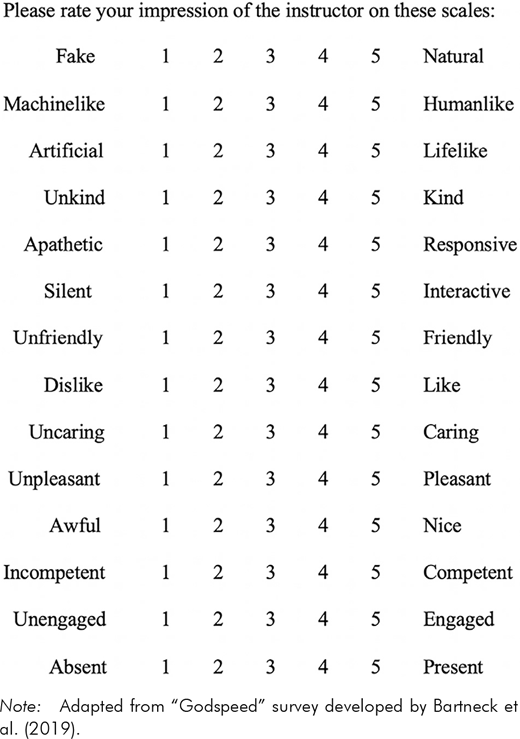
The instrument used to collect data from study participants (Figure 1) was adapted from a series of short surveys titled “Godspeed” (Appendix B); according to the authors of these surveys, the name “Godspeed” was selected because the intended audience was developers of robots. According to the authors Bartneck et al. (2009), the instrument was developed “for the technical developers of interactive robots who want to evaluate their creations without having to take a degree in experimental psychology” (p. 71).

The original purpose of this instrument was to standardize the measurement of human-robot interaction (HRI) by focusing on five HRI concepts: anthropomorphism, animacy, likeability, perceived intelligence, and perceived safety (Bartneck et al., 2009; Table 1). Although developed for evaluating interactive robots, the Godspeed series has been previously adapted for use in a study that focused on students’ perceptions of the instructor through her digital feedback (Clark-Gordon et al., 2018).

The Cronbach’s Alpha’s for the questions in each concept (Table 1) were reported by Bartneck et al. (2009) to be above 0.7, thus determining that the questionnaire has sufficient internal consistency reliability.

An exploratory study was conducted to identify which emojis to use as part of the experimental treatment to determine perceived emoji valence (Clark-Gordon et al., 2018). Unicode emojis (version 11.0) were used in this pilot study; they appear, with their potential meanings, in Table 2 (Full Emoji List, v11.0 2018).

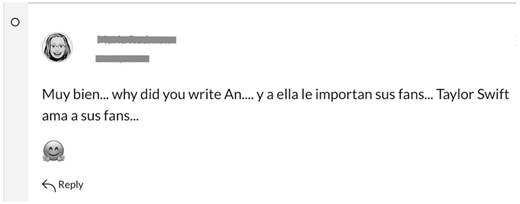
To determine if the use of emojis by the instructor had an impact on students’ perception of her human qualities, the instructor added emojis to her responses to students’ online discussion posts (added as an image in the Canvas LMS; Figure 2). The number of online discussions was three and involved discussion of writing assignments. The pretest and posttest for each group (treatment and comparison) were administered through the Canvas LMS using the Quiz (graded anonymous survey) function that allows respondents to remain anonymous while still earning extra credit points as an incentive for completing the pretest (5 points) and posttest (5 points). Researchers could not identify answers submitted by individual students, but students’ pretest and posttest responses could be matched for analysis.

A paired t -test was conducted to examine students’ perceptions of their instructor’s presence following exposure to instructor emojis in online discussion compared to no exposure to emojis. A scale was created by summing student responses to the 14 survey items; Cronbach’s alpha showed strong reliability (α = .93). There was no significant difference in students’ perceptions of their online instructor when exposed to emojis (M = 55.15, SD = 10.52) compared to students who were not exposed to emojis (M = 62.58. SD, 10.33); t(23) = -.250, p = .810. These results indicate that emojis in online discussions are not sufficient to impact students’ perceptions of their online instructor. Therefore, the null hypothesis is rejected: the use of emojis in online discussions did not increase students’ perception of the online instructor’s human presence.

There are several possible explanations for why the use of emojis failed to impact students’ perception of instructor presence significantly: limited experience of instructor use of emojis in the context of course feedback, students’ limited exposure to the emojis because they did not read the instructor’s discussion feedback, and limiting the use of emojis to three online discussions. The small sample size (N = 8) may have impacted the results. The use of emojis may also be extended beyond online discussions to increase exposure. Replication of this study is warranted, with increased sample size and increased exposure to emojis. Too, replication is recommended because conveying instructor care, presence, and emotional investment in students in an online environment remains a challenge for many instructors. Using emojis as part of a robust approach to incorporating feedback with a human touch can improve student satisfaction and success.

A portrait of Shelly Wyatt.
Shelly Wyatt, PhD, Associate Instructional Designer, University of Central Florida, 12351 Research Parkway, P.O. Box 162811, Room 230A-X, Orlando, FL 32826-2811.

A portrait of María T. Redmon.
María T. Redmon, MA, Senior Instructor, Modern Languages and Literatures, Trevor Coburn Hall, 4000 Central Florida Blvd., Orlando, FL 32816.

Akyol
,
Z.
, &
Garrison
,
D. R.
(
2008
).
The development of a community of inquiry over time in an online course: Understanding the progression and integration of social, cognitive, and teaching presence
.
Journal of Asynchronous Learning Networks
,
12
(
3-4
),
3
22
.
Alshenqeeti
,
H.
(
2016
).
Are emojis creating a new or old visual language for new generations? A socio-semiotic study
.
Advances in Language and Literary Studies
,
7
(
6
),
56
69
.
Anderson
,
J. F.
(
1979
). Teacher immediacy as a predictor of teaching effectiveness. In
D.
Nimmo
(Ed.),
Communication yearbook 3
(pp.
543
559
).
Transaction Books
.
Appana
,
S.
(
2008
).
A review of benefits and limitations of online learning in the content of the student, the instructor, and the tenured faculty
.
International Journal on E-Learning
,
7
(
1
),
5
22
. https://www.learntechlib.org/primary/p/22909/
Aslanian
,
C. B.
, &
Clinefelter
,
D. L.
(
2013
).
Online college students 2013: Comprehensive data on demands and preferences
.
The Learning House
.
Azuma
,
J.
(
2012
).
Graphic emoticons as a future universal symbolic language
.
Approaches to Translation Studies
,
36
,
61
84
.
Bart
,
M.
(
2016
,
February
6
).
How to add the human element to online learning
.
Faculty Focus
. https://www.facultyfocus.com/articles/online-education/how-to-add-the-human-element-to-online-learning/
Bartneck
,
C.
,
Kulić
,
D.
,
Croft
,
E.
,
Zoghbi
,
S.
(
2009
).
Measurement instruments for the anthropomorphism, animacy, likeability, perceived intelligence, and perceived safety of robots
.
International Journal of Social Robotics
,
1
(
1
),
71
81
.
Bayne
,
S.
(
2005
). Deceit, desire and control: The identities of learners and teachers in cyberspace. In
R.
Land
&
S.
Bayne
(Eds.),
Education in cyberspace
(pp.
26
41
).
Routledge
.
Bolldén
,
K.
(
2016
).
Teachers’ embodied presence in online teaching practices
.
Studies in Continuing Education
,
38
(
1
),
1
15
.
Campbell
,
D. T.
, &
Stanley
,
J. C.
(
1963
).
Experimental and quasi-experimental designs for research
.
Houghton Mifflin
.
Casey
,
R. L.
, &
Kroth
,
M.
(
2013
).
Learning to develop a presence online: Experienced faculty perspectives
.
Journal of Adult Education
,
42
(
2
),
104
110
.
Caspi
,
A.
, &
Blau
,
I.
(
2008
).
Social presence in online discussion groups: Testing three conceptions and their relations to perceived learning
.
Social Psychology of Education
,
11
,
232
346
.
Clark-Gordon
,
C. V.
,
Bowman
,
N. D.
,
Watts
,
E. R.
,
Banks
,
J.
, &
Knight
,
J. M.
(
2018
).
As good as your word: Face-threat mitigation and the use of instructor nonverbal cues on students’ perceptions of digital feedback
.
Communication Education
,
67
(
2
),
206
225
.
Clark
,
R.
(
1994
).
The digital persona and its application to data surveillance
.
The Information Society
,
10
(
2
),
77
92
.
Cole
,
A. W.
,
Anderson
,
C.
,
Bunton
,
T.
,
Cherney
,
M. R.
,
Disher
,
V. C.
,
Draeger
,
R.
,
Featherston
,
M.
,
Motel
,
L.
,
Nicolini
,
K. M.
,
Peck
,
B.
, &
Allen
,
M.
(
2017
).
Student predisposition to instructor feedback and perceptions of teaching presence predicts motivation toward online courses
.
Online Learning
,
21
(
4
),
245
262
.
Conceição
,
S. C. O.
(
2006
).
Faculty lived experiences in the online environment
.
Adult Education Quarterly
,
57
(
1
),
26
45
.
Cunningham
,
J. M.
(
2015
).
Mechanizing people and pedagogy: Establishing social presence in the online classroom
.
Online Learning
,
19
(
3
),
34
47
. Retrieved from ERIC database (EJ1067482).
Danesi
,
M.
(
2016
).
The semiotics of emoji: The rise of visual language in the age of the internet
.
Bloomsbury
.
Daymont
,
T.
,
Blau
,
G.
, &
Campbell
,
D.
(
2011
).
Deciding between traditional and online formats: Exploring the role of learning advantages, flexibility, and compensatory adaptation
.
Journal of Behavioral and Applied Management
,
12
(
2
),
156
175
.
de Kerckhove
,
D.
, &
de Almeida
,
C. M.
(
2013
).
What is a digital persona?
Technoetic Arts: A Journal of Speculative Research
,
11
(
3
),
277
297
.
Delaney
,
J.
,
Johnson
,
A. N.
,
Johnson
,
T. D.
, &
Treslan
,
D. L.
(
2010
).
Students’ perceptions of effecting teaching in higher education
.
Distance Education and Learning Technologies
.
Diebel
,
P. L.
, &
Grow
,
L. R.
(
2009
).
A comparative study of traditional instruction and distance education formats: Student characteristics and preferences
.
NACTA Journal
,
53
(
2
),
8
14
.
Doiron
,
J. A. G.
(
2018
).
Emojis: Visual communication in higher education
.
PUPIL: International Journal of Teaching, Education and Learning
,
2
(
2
),
1
11
.
Emoji Research Team
. (
2016
).
2016 emoji report
. https://www.emogi.com/insights/view/report/1145/2016-emoji-report
Garrison
,
D. T.
,
Anderson
,
T.
, &
Archer
,
W.
(
2000
).
Critical inquiry in text-based environment: Computer conferencing in higher education
.
Internet and Higher Education
,
2
(
23
),
87
105
.
Garrison
,
D. T.
,
Anderson
,
T.
, &
Archer
,
W.
(
2003
). A theory of critical inquiry in online distance education. In
M. G.
Moore
&
W. G.
Anderson
(Eds.),
Handbook of distance education
(pp.
113
128
).
Erlbaum
.
Garrison
,
D. T.
,
Cleveland-Innes
,
M.
, &
Fung
,
T. S.
(
2010
).
Exploring casual relationships among teaching, cognitive and social presence: Student perceptions of the community of inquiry framework
.
Internet and Higher Education
,
13
(
1
),
31
36
.
Gulson
,
T. T.
(
2016
). You tell me in emojis. In
T.
Ogata
&
T.
Akimoto
(Eds.),
Computational and cognitive approaches to narratology
.
IGI Global
.
Gunawardena
,
C. N.
, &
Zittle
,
F. J.
(
1997
).
Social presence as a predictor of satisfaction within a computer-mediated conferencing environment
.
The American Journal of Distance Education
,
11
(
3
),
8
12
.
Heap
,
T.
(
2017
,
June
5
).
5 benefits of studying online (vs. face-to-face classroom)
.
Illinois Online
. http://online.illinois.edu/articles/online-learning/item/2017/06/05/5-benetits-of-studying-online-(vs.-face-to-face-classroom)
Kaye
,
L. K.
,
Wall
,
H. J.
, &
Malone
,
S. A.
(
2016
).
Turn that frown upside-down: A contextual account of emoticon usage on different virtual platforms
.
Computers in Human Behavior
,
60
(
C
),
463
467
.
Kear
,
K.
,
Chetwynd
,
F.
, &
Jefferis
,
H.
(
2014
).
Social presence in online communities: The role of personal profiles
.
Research in Learning Technology
,
22
, Article 1970.
Kerssen-Griep
,
J.
, &
Witt
,
P. L.
(
2012
).
Instructional feedback II: How do instructor immediacy cues and facework tactics interact to predict student motivation and fairness perceptions
.
Communication Studies
,
63
(
4
),
498
517
.
Kumar
,
S.
,
Daweson
,
K.
,
Black
,
E. W.
,
Cavanaugh
,
C.
, &
Sessums
,
C. D.
(
2011
).
Applying the community of inquiry framework to an online professional practice doctoral program
.
International Review of Research in Open and Distance Learning
,
12
(
6
), http://www.irrodl.org/index.php/irrodl/article/view/978/1961
Lee
,
S. J.
, &
Huang
,
K.
(
2018
).
Online interactions and social presence in online learning. (2018)
.
Journal of Interactive Learning Research
,
29
(
1
),
113
128
.
Lehman
,
R. M.
, &
Conceição
,
S. C. O.
(
2010
).
Creating a sense of presence in online teaching: How to “be there” for distance learners
.
Jossey-Bass
.
Leong
,
P.
(
2011
).
Role of social presence and cognitive absorption in online learning environments
.
Distance Education
,
32
(
1
),
5
28
.
Mathieson
,
K.
, &
Leafman
,
J. S.
(
2014
).
Comparison of student and instructor perceptions of social presence
.
Journal of Educators Online
,
11
(
2
).
ERIC database. (EJ1033262)
McIntyre
,
E. S.
(
2016
).
From cave paintings to Shakespeare and back again: What are emoji and should I be afraid?
[Unpublished thesis]
.
Texas State University
.
McQuiggan
,
C. A.
(
2012
).
Faculty development for online teaching as a catalyst for change
.
Journal of Asynchronous Learning Networks
,
16
(
2
),
27
61
.
ERIC database. (EJ971044)
Miller
,
H.
,
Thebault-Spieker
,
J.
,
Chang
,
S.
,
Johnson
,
I.
,
Terveen
,
L.
, &
Hecht
,
B.
(
2016
). “Blissfully happy” or “ready to fight”: Varying interpretations of emoji. In
Proceedings of the 10th International Conference on Web and Social Media
(pp.
259
268
).
AAAI Press
.
Moschini
,
I.
(
2016
).
The “face with tears of joy” emoji: A socio-semiotic and multimodal insight into a Japan-America mash-up
.
HERMES-Journal of Language and Communication Business
,
55
,
11
25
.
Muilenburg
,
L. Y.
, &
Berge
,
Z. L.
(
2005
).
Student barriers to online learning: A factor analytic study
.
Distance Education
,
26
(
1
),
29
48
.
Riordan
,
M. A.
(
2017
).
Emojis as tools for emotion work: Communicating affect in text messages
.
Journal of Language and Social Psychology
,
36
(
5
),
549
567
.
Rodriquez
,
F. G.
, &
Nash
,
S. S.
(
2004
).
Technology and the adult degree program: The human element
.
New Directions for Adult and Continuing Education
,
103
,
73
79
.
Sarsar
,
F.
(
2017
).
Student and instructor responses to emotional motivational feedback messages in an online instructional environment
.
The Turkish Online Journal of Educational Technology
,
16
(
1
),
115
127
.
Short
,
J. E.
,
Williams
,
E.
, &
Christie
,
B.
(
1976
).
The social psychology of telecommunications
.
Wiley
.
Skiba
,
D. J.
(
2016
).
Face with tears of joy is a word of the year: Are emoji a sign of things to come in health care?
Nursing Education Perspectives
,
37
(
1
),
56
57
.
Sung
,
E.
, &
Mayer
,
R. E.
(
2012
).
Five facets of social presence in online distance education
.
Computers in Human Behavior
,
28
,
1738
1747
.
Tauch
,
C.
, &
Kanjo
,
E.
(
2016
).
The roles of emojis in mobile phone applications
. In
Proceedings of the 2016 ACM International Joint Conference on Pervasive and Ubiquitous Computing: Adjunct
(pp.
1560
1565
).
Tichavsky
,
L. P.
,
Hunt
,
A. N.
,
Driscoll
,
A.
, &
Jocha
,
K.
(
2015
).
“It’s just nice having a real teacher”: Student perceptions of online versus face-to-face instruction
.
International Journal for the Scholarship of Teaching and Learning
,
9
(
2
),
1
8
.
University of Central Florida
. (
2018
).
University of Central Florida 2018–2018 undergraduate catalog
. http://catalog.ucf.edu/index.php?catoid =3
Wall
,
H. J.
,
Kaye
,
L. K.
, &
Malone
,
S. A.
(
2016
).
An exploration of psychological factors on emoticon usage and implications for judgment accuracy
.
Computers in Human Behavior
,
62
,
70
78
.
Walther
,
J.
(
1994
).
Interpersonal effects in computer-mediated interaction
.
Communication Research
,
12
(
4
),
460
487
.
Watson
,
W. R.
, &
Watson
,
S. L.
(
2007
).
An argument for clarity: What are learning management systems, what are they not, and what should they become?
TechTrends
,
51
(
2
),
28
34
.
Wei
,
C.
,
Chen
,
N.
, &
Kinshuk
. (
2012
).
A model for social presence in online classrooms
.
Educational Technology Research and Development
,
60
(
3
),
529
545
. ERIC database. (EJ965847)
Yuasa
,
M.
,
Saito
,
K.
, &
Mukawa
,
N.
(
2011
).
Brain activity when reading sentences and emoticons: An fMRI study of verbal and non-verbal communication
.
Electronics and Communications in Japan
,
94
(
5
),
17
24
.
Licensed re-use rights only

Data & Figures

Figure 1
A questionnaire contains a series of scales for rating an instructor's impression. The survey lists thirteen opposing terms, such as Fake versus Natural and Unkind versus Kind, with a numbered scale from one to five.The questionnaire is titled Please rate your impression of the instructor on these scales. It includes thirteen pairs of opposing terms. The left column lists the terms Fake, Machinelike, Artificial, Unkind, Apathetic, Silent, Unfriendly, Dislike, Uncaring, Unpleasant, Awful, Incompetent, Unengaged, and Absent. The right column lists the opposing terms Natural, Humanlike, Lifelike, Kind, Responsive, Interactive, Friendly, Like, Caring, Pleasant, Nice, Competent, Engaged, and Present. A horizontal line of numbers from one to five is present between each pair of terms. A note at the bottom says Adapted from Godspeed survey developed by Bartneck et al open parenthesis 2019 close parenthesis.

Survey measuring students’ perception of instructor “humanness.”

Figure 1
A questionnaire contains a series of scales for rating an instructor's impression. The survey lists thirteen opposing terms, such as Fake versus Natural and Unkind versus Kind, with a numbered scale from one to five.The questionnaire is titled Please rate your impression of the instructor on these scales. It includes thirteen pairs of opposing terms. The left column lists the terms Fake, Machinelike, Artificial, Unkind, Apathetic, Silent, Unfriendly, Dislike, Uncaring, Unpleasant, Awful, Incompetent, Unengaged, and Absent. The right column lists the opposing terms Natural, Humanlike, Lifelike, Kind, Responsive, Interactive, Friendly, Like, Caring, Pleasant, Nice, Competent, Engaged, and Present. A horizontal line of numbers from one to five is present between each pair of terms. A note at the bottom says Adapted from Godspeed survey developed by Bartneck et al open parenthesis 2019 close parenthesis.

Survey measuring students’ perception of instructor “humanness.”

Close Figure 1
Figure 2

Sample discussion post using emojis.

Figure 2

Sample discussion post using emojis.

Close Figure 2
Table 1

Five HRI Concepts to Measure Human-Robot Interaction and Their Associated Questions

HRI FactorsDescription of FactorQuestions in Godspeed SurveysQuestions in Adapted Godspeed Survey
Anthrop omorphism
  • The attribution of human characteristics, form, or behavior to a nonhuman object, such as animals, computers, or robots

  • Fake/natural

  • Machinelike/humanlike

  • Unconscious/conscious

  • Artificial/lifelike

  • Moving rigidly/moving elegantly

  • Fake/natural

  • Machinelike/humanlike

  • Artificial/lifelike

Animacy
  • The characteristic of being lifelike; the perception of life

  • Dead/alive

  • Stagnant/lively

  • Mechanical/organic

  • Artificial/lifelike

  • Inert/interactive

  • Apathetic/responsive

  • Apathetic/

  • Responsive

  • Silent/interactive

  • Engaged/unengaged

  • Absent/present

Likability
  • The association of an individual with positive impressions, especially first impressions

  • Nice/awful

  • Friendly/unfriendly

  • Kind/unkind

  • Pleasant/unpleasant

  • Kind/unkind

  • Friendly/unfriendly

  • Dislike/like

  • Caring/uncaring

  • Unpleasant/pleasant

  • Awfuil/nice

Perceived intelligence
  • The association of intelligence with a living creature

  • Incompetent/competent

  • Ignorant/knowledgeable

  • Irresponsible/responsible

  • Unintelligent/intelligent

  • Foolish/sensible

  • Incompetent/competent

Perceived safety
  • The perception of danger associated with any interaction or situation

  • Anxious/relaxed

  • Agitated/calm

  • Quiescent/surprised


Source: Adapted from Bartneck et al. (2009).

Table 2

Unicode Emojis Included in Pilot Test

EmojisPotential Meanings
A smiling face emoji with an open mouth.Big smile
A smiling face emoji with closed eyes and an open mouth.Laughing
A smiling face emoji that is winking.Winking
A thinking face emoji with a furrowed brow and a finger resting on the chin.Thinking
A smiling face emoji.Smile
A face emoji with a slight smile and two hands on either side of its cheeks, as if hugging itself.Clapping
A smiling face emoji with closed eyes.Smile

Supplements

References

Akyol
,
Z.
, &
Garrison
,
D. R.
(
2008
).
The development of a community of inquiry over time in an online course: Understanding the progression and integration of social, cognitive, and teaching presence
.
Journal of Asynchronous Learning Networks
,
12
(
3-4
),
3
22
.
Alshenqeeti
,
H.
(
2016
).
Are emojis creating a new or old visual language for new generations? A socio-semiotic study
.
Advances in Language and Literary Studies
,
7
(
6
),
56
69
.
Anderson
,
J. F.
(
1979
). Teacher immediacy as a predictor of teaching effectiveness. In
D.
Nimmo
(Ed.),
Communication yearbook 3
(pp.
543
559
).
Transaction Books
.
Appana
,
S.
(
2008
).
A review of benefits and limitations of online learning in the content of the student, the instructor, and the tenured faculty
.
International Journal on E-Learning
,
7
(
1
),
5
22
. https://www.learntechlib.org/primary/p/22909/
Aslanian
,
C. B.
, &
Clinefelter
,
D. L.
(
2013
).
Online college students 2013: Comprehensive data on demands and preferences
.
The Learning House
.
Azuma
,
J.
(
2012
).
Graphic emoticons as a future universal symbolic language
.
Approaches to Translation Studies
,
36
,
61
84
.
Bart
,
M.
(
2016
,
February
6
).
How to add the human element to online learning
.
Faculty Focus
. https://www.facultyfocus.com/articles/online-education/how-to-add-the-human-element-to-online-learning/
Bartneck
,
C.
,
Kulić
,
D.
,
Croft
,
E.
,
Zoghbi
,
S.
(
2009
).
Measurement instruments for the anthropomorphism, animacy, likeability, perceived intelligence, and perceived safety of robots
.
International Journal of Social Robotics
,
1
(
1
),
71
81
.
Bayne
,
S.
(
2005
). Deceit, desire and control: The identities of learners and teachers in cyberspace. In
R.
Land
&
S.
Bayne
(Eds.),
Education in cyberspace
(pp.
26
41
).
Routledge
.
Bolldén
,
K.
(
2016
).
Teachers’ embodied presence in online teaching practices
.
Studies in Continuing Education
,
38
(
1
),
1
15
.
Campbell
,
D. T.
, &
Stanley
,
J. C.
(
1963
).
Experimental and quasi-experimental designs for research
.
Houghton Mifflin
.
Casey
,
R. L.
, &
Kroth
,
M.
(
2013
).
Learning to develop a presence online: Experienced faculty perspectives
.
Journal of Adult Education
,
42
(
2
),
104
110
.
Caspi
,
A.
, &
Blau
,
I.
(
2008
).
Social presence in online discussion groups: Testing three conceptions and their relations to perceived learning
.
Social Psychology of Education
,
11
,
232
346
.
Clark-Gordon
,
C. V.
,
Bowman
,
N. D.
,
Watts
,
E. R.
,
Banks
,
J.
, &
Knight
,
J. M.
(
2018
).
As good as your word: Face-threat mitigation and the use of instructor nonverbal cues on students’ perceptions of digital feedback
.
Communication Education
,
67
(
2
),
206
225
.
Clark
,
R.
(
1994
).
The digital persona and its application to data surveillance
.
The Information Society
,
10
(
2
),
77
92
.
Cole
,
A. W.
,
Anderson
,
C.
,
Bunton
,
T.
,
Cherney
,
M. R.
,
Disher
,
V. C.
,
Draeger
,
R.
,
Featherston
,
M.
,
Motel
,
L.
,
Nicolini
,
K. M.
,
Peck
,
B.
, &
Allen
,
M.
(
2017
).
Student predisposition to instructor feedback and perceptions of teaching presence predicts motivation toward online courses
.
Online Learning
,
21
(
4
),
245
262
.
Conceição
,
S. C. O.
(
2006
).
Faculty lived experiences in the online environment
.
Adult Education Quarterly
,
57
(
1
),
26
45
.
Cunningham
,
J. M.
(
2015
).
Mechanizing people and pedagogy: Establishing social presence in the online classroom
.
Online Learning
,
19
(
3
),
34
47
. Retrieved from ERIC database (EJ1067482).
Danesi
,
M.
(
2016
).
The semiotics of emoji: The rise of visual language in the age of the internet
.
Bloomsbury
.
Daymont
,
T.
,
Blau
,
G.
, &
Campbell
,
D.
(
2011
).
Deciding between traditional and online formats: Exploring the role of learning advantages, flexibility, and compensatory adaptation
.
Journal of Behavioral and Applied Management
,
12
(
2
),
156
175
.
de Kerckhove
,
D.
, &
de Almeida
,
C. M.
(
2013
).
What is a digital persona?
Technoetic Arts: A Journal of Speculative Research
,
11
(
3
),
277
297
.
Delaney
,
J.
,
Johnson
,
A. N.
,
Johnson
,
T. D.
, &
Treslan
,
D. L.
(
2010
).
Students’ perceptions of effecting teaching in higher education
.
Distance Education and Learning Technologies
.
Diebel
,
P. L.
, &
Grow
,
L. R.
(
2009
).
A comparative study of traditional instruction and distance education formats: Student characteristics and preferences
.
NACTA Journal
,
53
(
2
),
8
14
.
Doiron
,
J. A. G.
(
2018
).
Emojis: Visual communication in higher education
.
PUPIL: International Journal of Teaching, Education and Learning
,
2
(
2
),
1
11
.
Emoji Research Team
. (
2016
).
2016 emoji report
. https://www.emogi.com/insights/view/report/1145/2016-emoji-report
Garrison
,
D. T.
,
Anderson
,
T.
, &
Archer
,
W.
(
2000
).
Critical inquiry in text-based environment: Computer conferencing in higher education
.
Internet and Higher Education
,
2
(
23
),
87
105
.
Garrison
,
D. T.
,
Anderson
,
T.
, &
Archer
,
W.
(
2003
). A theory of critical inquiry in online distance education. In
M. G.
Moore
&
W. G.
Anderson
(Eds.),
Handbook of distance education
(pp.
113
128
).
Erlbaum
.
Garrison
,
D. T.
,
Cleveland-Innes
,
M.
, &
Fung
,
T. S.
(
2010
).
Exploring casual relationships among teaching, cognitive and social presence: Student perceptions of the community of inquiry framework
.
Internet and Higher Education
,
13
(
1
),
31
36
.
Gulson
,
T. T.
(
2016
). You tell me in emojis. In
T.
Ogata
&
T.
Akimoto
(Eds.),
Computational and cognitive approaches to narratology
.
IGI Global
.
Gunawardena
,
C. N.
, &
Zittle
,
F. J.
(
1997
).
Social presence as a predictor of satisfaction within a computer-mediated conferencing environment
.
The American Journal of Distance Education
,
11
(
3
),
8
12
.
Heap
,
T.
(
2017
,
June
5
).
5 benefits of studying online (vs. face-to-face classroom)
.
Illinois Online
. http://online.illinois.edu/articles/online-learning/item/2017/06/05/5-benetits-of-studying-online-(vs.-face-to-face-classroom)
Kaye
,
L. K.
,
Wall
,
H. J.
, &
Malone
,
S. A.
(
2016
).
Turn that frown upside-down: A contextual account of emoticon usage on different virtual platforms
.
Computers in Human Behavior
,
60
(
C
),
463
467
.
Kear
,
K.
,
Chetwynd
,
F.
, &
Jefferis
,
H.
(
2014
).
Social presence in online communities: The role of personal profiles
.
Research in Learning Technology
,
22
, Article 1970.
Kerssen-Griep
,
J.
, &
Witt
,
P. L.
(
2012
).
Instructional feedback II: How do instructor immediacy cues and facework tactics interact to predict student motivation and fairness perceptions
.
Communication Studies
,
63
(
4
),
498
517
.
Kumar
,
S.
,
Daweson
,
K.
,
Black
,
E. W.
,
Cavanaugh
,
C.
, &
Sessums
,
C. D.
(
2011
).
Applying the community of inquiry framework to an online professional practice doctoral program
.
International Review of Research in Open and Distance Learning
,
12
(
6
), http://www.irrodl.org/index.php/irrodl/article/view/978/1961
Lee
,
S. J.
, &
Huang
,
K.
(
2018
).
Online interactions and social presence in online learning. (2018)
.
Journal of Interactive Learning Research
,
29
(
1
),
113
128
.
Lehman
,
R. M.
, &
Conceição
,
S. C. O.
(
2010
).
Creating a sense of presence in online teaching: How to “be there” for distance learners
.
Jossey-Bass
.
Leong
,
P.
(
2011
).
Role of social presence and cognitive absorption in online learning environments
.
Distance Education
,
32
(
1
),
5
28
.
Mathieson
,
K.
, &
Leafman
,
J. S.
(
2014
).
Comparison of student and instructor perceptions of social presence
.
Journal of Educators Online
,
11
(
2
).
ERIC database. (EJ1033262)
McIntyre
,
E. S.
(
2016
).
From cave paintings to Shakespeare and back again: What are emoji and should I be afraid?
[Unpublished thesis]
.
Texas State University
.
McQuiggan
,
C. A.
(
2012
).
Faculty development for online teaching as a catalyst for change
.
Journal of Asynchronous Learning Networks
,
16
(
2
),
27
61
.
ERIC database. (EJ971044)
Miller
,
H.
,
Thebault-Spieker
,
J.
,
Chang
,
S.
,
Johnson
,
I.
,
Terveen
,
L.
, &
Hecht
,
B.
(
2016
). “Blissfully happy” or “ready to fight”: Varying interpretations of emoji. In
Proceedings of the 10th International Conference on Web and Social Media
(pp.
259
268
).
AAAI Press
.
Moschini
,
I.
(
2016
).
The “face with tears of joy” emoji: A socio-semiotic and multimodal insight into a Japan-America mash-up
.
HERMES-Journal of Language and Communication Business
,
55
,
11
25
.
Muilenburg
,
L. Y.
, &
Berge
,
Z. L.
(
2005
).
Student barriers to online learning: A factor analytic study
.
Distance Education
,
26
(
1
),
29
48
.
Riordan
,
M. A.
(
2017
).
Emojis as tools for emotion work: Communicating affect in text messages
.
Journal of Language and Social Psychology
,
36
(
5
),
549
567
.
Rodriquez
,
F. G.
, &
Nash
,
S. S.
(
2004
).
Technology and the adult degree program: The human element
.
New Directions for Adult and Continuing Education
,
103
,
73
79
.
Sarsar
,
F.
(
2017
).
Student and instructor responses to emotional motivational feedback messages in an online instructional environment
.
The Turkish Online Journal of Educational Technology
,
16
(
1
),
115
127
.
Short
,
J. E.
,
Williams
,
E.
, &
Christie
,
B.
(
1976
).
The social psychology of telecommunications
.
Wiley
.
Skiba
,
D. J.
(
2016
).
Face with tears of joy is a word of the year: Are emoji a sign of things to come in health care?
Nursing Education Perspectives
,
37
(
1
),
56
57
.
Sung
,
E.
, &
Mayer
,
R. E.
(
2012
).
Five facets of social presence in online distance education
.
Computers in Human Behavior
,
28
,
1738
1747
.
Tauch
,
C.
, &
Kanjo
,
E.
(
2016
).
The roles of emojis in mobile phone applications
. In
Proceedings of the 2016 ACM International Joint Conference on Pervasive and Ubiquitous Computing: Adjunct
(pp.
1560
1565
).
Tichavsky
,
L. P.
,
Hunt
,
A. N.
,
Driscoll
,
A.
, &
Jocha
,
K.
(
2015
).
“It’s just nice having a real teacher”: Student perceptions of online versus face-to-face instruction
.
International Journal for the Scholarship of Teaching and Learning
,
9
(
2
),
1
8
.
University of Central Florida
. (
2018
).
University of Central Florida 2018–2018 undergraduate catalog
. http://catalog.ucf.edu/index.php?catoid =3
Wall
,
H. J.
,
Kaye
,
L. K.
, &
Malone
,
S. A.
(
2016
).
An exploration of psychological factors on emoticon usage and implications for judgment accuracy
.
Computers in Human Behavior
,
62
,
70
78
.
Walther
,
J.
(
1994
).
Interpersonal effects in computer-mediated interaction
.
Communication Research
,
12
(
4
),
460
487
.
Watson
,
W. R.
, &
Watson
,
S. L.
(
2007
).
An argument for clarity: What are learning management systems, what are they not, and what should they become?
TechTrends
,
51
(
2
),
28
34
.
Wei
,
C.
,
Chen
,
N.
, &
Kinshuk
. (
2012
).
A model for social presence in online classrooms
.
Educational Technology Research and Development
,
60
(
3
),
529
545
. ERIC database. (EJ965847)
Yuasa
,
M.
,
Saito
,
K.
, &
Mukawa
,
N.
(
2011
).
Brain activity when reading sentences and emoticons: An fMRI study of verbal and non-verbal communication
.
Electronics and Communications in Japan
,
94
(
5
),
17
24
.

Languages

or Create an Account

Close subscription notice
Close access options