Faculty members accustomed to conducting face-to-face classes are often overwhelmed at the prospect of migrating those classes to a Web environment. Employing a systematic approach helps novice and experienced instructors create effective online courses efficiently. R2D5 is a systematic development approach that was proven effective in a prototype environment and is being used successfully in the real world by instructors to design and develop online courses.
The Online Course Challenge
Face-to-face classroom instruction is a performance. There is usually a script or game plan, but the action relies on the give-and-take interaction between participants. Since the Web limits the timeliness and richness of discourse between participants, instruction on the Web changes from a performance to a product. In essence, instructors become developers of a product delivered via the computer, and learners become users of that product. This performance-to-product shift requires a significant change in approach to planning and developing courses, one that is foreign to those inexperienced in the process.
The Birth of R2D5
The R2D5 model was fashioned as a planning and development guide for a variety of online courses created in a prototype project to study issues related to online course development. Recognition of the performance-to-product shift suggested the need for a systematic approach based on other systematic processes such as the product development cycle, computer programming, rapid prototyping, and various instructional design models.
An Overview of R2D5
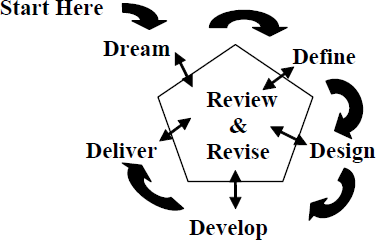
The R2D5 online course development process consists of five phases. Each phase requires explicit inputs, incorporates specific processes, and produces well-defined deliverables as outputs. At the conclusion of each phase, the deliverables from that phase are reviewed and revised before the next phase is begun. The review process for each phase and the participants who perform it are clearly defined by the model to produce optimum results. Using a systematic process increases efficiency and enhances quality while ensuring a focus on learner use of the end product.
The goal of the first phase (Dream) is to conceptualize the completed online course (see Figure 1). The Dream phase begins with a desire (or dictate) to develop a particular course or course components for the Web. The process consists of researching and reviewing potential approaches that might be incorporated into the finished course by looking at existing courses, talking to experienced practitioners, and reviewing the literature. The deliverable for the Dream phase is a course description containing a contemplated—but not crystallized— conceptualization of what the course site for the course might look like and what it might include. A team that includes subject matter experts, instructional designers, and Web developers with experience developing online courses conducts the review process for the Dream phase. The reviewers focus on both the requirements needed to produce the course as conceptualized and the feasibility of the various proposed approaches and components.
The Define phase focuses on specifics for the course. The process includes a content analysis, an audience analysis, a technology analysis, creating objectives, and an assessment plan. In addition to those items, the deliverables include a list of components that will be in the course and an organizational structure for the course. Once again, a team of experienced subject matter experts, instructional designers, and Web developers conduct the review. The subject matter expert(s) focus on the content while the instructional designers and Web developers continue to assess feasibility and requirement issues. From the product development perspective, attention is also given to the inclusion of elements that support learner use in an isolated environment.
The course begins to take shape in the Design phase. Using the specifics from the Define phase, various design architectures are created. Design architectures are sketches, storyboards, outlines, lists, diagrams, etc., used to plan and develop items for the course. The design process and deliverables differ according to the type of component to be developed. The review team is expanded to include target participants and the process focuses on the instructional effectiveness of the planned components.
Components are created and posted to the online course in the Develop phase. Using the architectures from the Design phase, existing materials are revised and new materials are created. The Develop phase deliverable is a completed online course that is reviewed by the team. Feedback from target participants is especially important at this phase.
The final phase is Delivery of the course. During this phase, the instructor manages the online course, monitors student participation, and collects course effectiveness data that are reviewed to determine revisions for future implementations of the course.
In addition to guiding novices through the course development process, R2D5 provides a structure for project management. The sequential list of tasks to be completed can be incorporated into a timeline. Responsibilities are clearly established, and the deliverables provide milestones for measuring progress.
More information about the R2D5 course development model can be found at http://edtech.erau.edu/activities/mentoring/r2d5.htm
Applying R2D5
In the prototype project, R2D5 was used to produce courses with significant amounts of multimedia and other highly engaging content and activities, as well as courses with minimal Web components. One prototype course was a highly interactive self-directed basic weather tutorial developed by a virtual team. Another course used the Web to facilitate learning activities designed around an existing textbook, collaboration, and supplemental Websites. More information about the Online Course Development Prototype Project can be found at http://edtech.erau.edu/activities/prototypes/
The R2D5 process has also been used in a mentoring program for instructors with no experience developing online course components. The model provided guidance for them as they worked through the development process for their first online course. More information about the eMentoring Project can be found at http://edtech.erau.edu/activities/ mentoring/
The R2D5 course development process has proven to be an effective tool for creating online courses efficiently. While it is particularly helpful to novices developing a totally online course, it is also useful for producing Web and non-Web components for a face-to-face course. Those facing the daunting task of creating online courses, or supporting those who do, will find the R2D5 course development model helpful.